South of Stygia are the vast black kingdoms of the Amazons, the Kushites, the Atlaians and the hybrid empire of Zembabwe.
—Robert E. Howard, “The Hyborian Age”
The Hyborian Age of Conan the Cimmerian was no mythical white space, occupied only by pale Caucasians. In formulating the adventures of the Cimmerian, Robert E. Howard drew on everything he knew: Conan’s travels encompass not just a fantasy geography, but chronologies and genres. The barbarian might find himself leading a battle of European-style medieval knights; on the deck of a ship whose pirates could have stepped out of Robert Louis Stevenson’s Treasure Island; in a frontier wilderness fort reminiscent of pioneer Texas; in a stone temple that might have stood in some fantastic vision of ancient Egypt—and in a fantasy equivalent of Africa, populated by Black people, who were to Conan’s friends, allies, enemies, and lovers.
The Conan stories, while fantasy and aimed at Weird Tales, grew out of Howard’s love for history and adventure fiction, and writing historical adventure stories for magazines like Oriental Stories. The conceit of the Hyborian Age is that by setting it before any known period, Howard had a free hand to invent details that would otherwise trip him up if trying to write a realistic historical yarn.
For pulps like Adventure, accuracy was paramount; the magazine prided itself on publishing stories from people who knew their subject, who had gone out and lived in exotic lands, and returned to tell the tale. To that end, Adventure invited readers to write in with their questions, for Adventure’s stable of writers to answer. In September 2024, scholar Patrice Louinet came across a letter printed in a copy of Adventure (30 December 1923):
White Man and Native of West Africa
HAUSAS—trading-factory terms—marriage ceremonies and customs:
Question:—”I am writing to get some information in regard to the customs, habits, etc., of the natives of that part of Africa which is included in your section in ‘Ask Adventure.’
- Are the natives of a war-like stock? That is, did they come from a fighting race?
- How much authority does the superintendent of a trading-post possess?
- Do the whites interfere with the natives in dealing with native criminals?
- What are some of the punishments of native wrong-doers by the whites? By the natives themselves?
- What are some marriage customs among the natives? Am I right in supposing a native has full power to punish his wife in any way he pleases?
- Have the morals of the African natives been raised by the rule of the white men or have they decreased in standard?
- Is the ceremony of Mumbo-Jumbo—or something of some name like that—for the correcting of disobedient women used in that part of Africa? If so, how is it carried out?
- What is the customary costume of the natives?
I apologize for asking so many questions, but I am very much interested in Africa. If by any chance this letter should be published in Adventure, please do not print my name.”
—R.E.H., Cross Plains, Texas.
Text from REH.world.
This would be Robert E. Howard of Cross Plains, Texas—and if the questions of a 17-year-old boy seem somewhat ignorant, it must be remembered that knowledge of Africa was by no means widespread in the rural United States during the 1920s and 30s. For many years and even decades to come, Africa would be the metaphorical “dark continent,” whose peoples, geography, and history were intermixed with fantasy, racism, and plain ignorance. Howard’s questions were honest ones, and it is to his credit that he sought out answers instead of immediately falling back to stereotypes and fantasy when he wrote his first few African stories.
The Conan boom in the 1960s and 70s brought with it not just an increased admiration for Robert E. Howard as a writer and Conan the Cimmerian as a character, but new criticism and new sensibilities. As Marvel Comics adapted Howard’s character and stories to a new medium, they had to face the reality that this was a new world: the Civil Rights movement had won victories with the decision in Brown vs. the Board of Education (1954) and the passage of the Civil Rights Act of 1964. Black Pride and other movements raised awareness of the roots of the African diaspora in the United States and surrounding countries.
Adaption to this new reality was, at first, slow. “The Vale of Lost Women”(1967) by Robert E. Howard is one example of how 1930s stereotypes and prejudice found an unwelcome audience in the 1960s and 70s, and how later writers and artists worked to make this work acceptable to a contemporary audience of all races. Not every creator was so conscientious; in 1975, Black fan Charles R. Saunders wrote “Die Black Dog! A Look At Racism in Fantasy Literature.” While it was one thing for something Robert E. Howard, who died in 1936 and never lived to see the changes in US society, to rely on racial stereotypes the essay specifically called out latter-day creators of Conan pastiche for continuing to use such lazy and biased storytelling nearly four decades later.
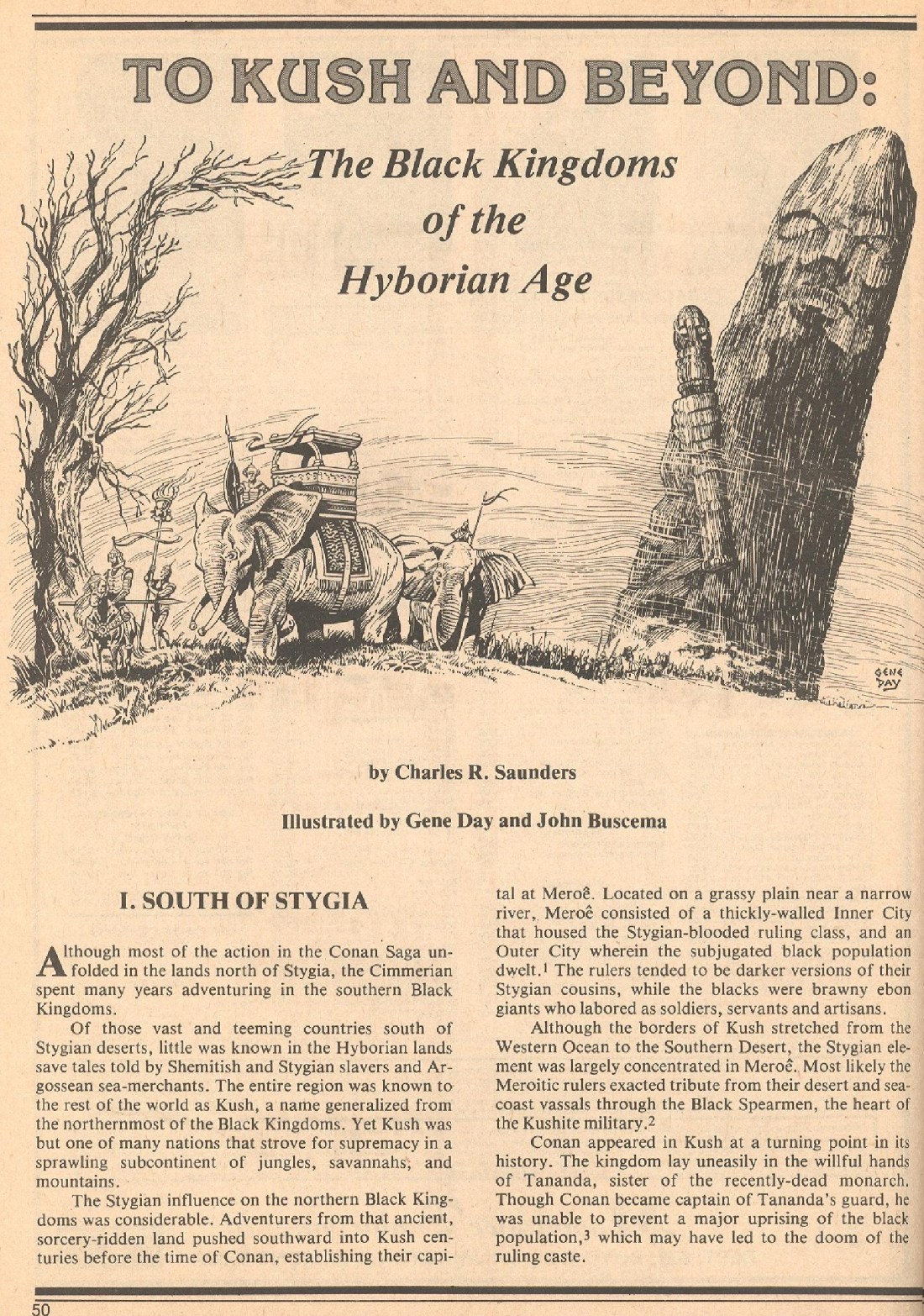
Just because Charles R. Saunders called out writers of heroic fantasy doesn’t mean he stepped away from the genre; quite the opposite. In 1980, Saunders published two related essays: “Hyborian Africa” was published in the fanzine Paragon #1 (May 1980), and “To Kush and Beyond: The Black Kingdoms of the Hyborian Age” was published in Savage Sword of Conan #56 (Sep 1980). Both essays deal with similar subject matter: an exploration of the “Black Kingdoms” mentioned in Howard’s essay “The Hyborian Age,” references to which are sprinkled throughout Conan’s adventures. However, the purpose and approach of each essay is different.
The historical derivation of the lands south of Stygia, the Black Kingdoms, are less obvious. Nonetheless, a look at any reference work on African history quickly exposes Howard’s inspirations for the names of some of his Black Kingdoms, if not their cultural backgrounds [.] Kush, Punt, Darfar, Zembabwei and Amazon are names as familiar to African scholars as those of Poland, France, Spain and Italy are to students of the European past.
—Charles R. Saunders, “Hyborian Africa,” Paragon #1 (1980), 27
“Hyborian Africa” looks at the historical sources and inspiration behind Howard’s stories. Given that this was a fanzine and that Howard studies was in its infancy, the usual apparatus of scholarly writing is neither present nor expected: no footnotes, no bibliography. However, Saunders’ care in the article is evident. He addresses only the stories written by Robert E. Howard, not later pastiches or derivative material from the Marvel comic books. It is brief, at only a little over two pages, but the history offered is largely accurate…and if Saunders criticizes some of Howard’s depictions of these fantasy versions of African kingdoms, he also offers a parting observation:
Although Howard’s depictions of Hyborian Age blacks consisted primarily of stock racist stereotypes, he did do more research into African history than such contemporaries as Edgar Rice Burroughs. Even today, the mention of the wor[d] “Kush’ would draw only blank stares from most people. With the exception of Darfar, Howard’s historical foundations for his Black Kingdoms were as solid as those of the rest of Conan’s world. And this is to his credit.
—Charles R. Saunders, “Hyborian Africa,” Paragon #1 (1980), 29
“To Kush and Beyond: The Black Kingdoms of the Hyborian Age” was published as a literary exploration of the Black Kingdoms as they appear in the broader Conan mythology, which includes not just Howard’s stories but also stories that were completed or re-written by L. Sprague de Camp and Lin Carter like “Hawks over Shem,” “The Snout in the Dark,” and “The City of Skulls.” In adapting Conan stories to comics, Marvel had included some of de Camp and Carter’s creations, including Conan’s ally Juma the Kushite, and so Saunders incorporates that lore into his survey of the Black Kingdoms of the Hyborian Age. Saunders’ work provided an explanation and codification of lore on the world of Conan that both readers and writers could reference.
Being published in a comics magazine, Saunders’ essay was illustrated by Conan artists John Buscema and Gene Day, and being of a scholarly character includes a page of endnote citations, for a total of 7 pages. Saunders’ interest in African history is still present, though less explicit. In the closing paragraph, for example, he writes:
The cataclysm that formed the outlinees of the modern world separated the land south of the River Styx from the rest of the world, and raised up from the sea the entire west coast of what is now Africa. Much of the history and lore of the Black Kingdoms perished in the disaster—yet the Black Kingdoms did not truly die. Kush, Darfar and Punt rose again in historical times, and the West African Kingdom of Dahomey boasted a formidable corps of Amazon warriors. Like so many other nations and races, the African can trace their history “back into the mists of the forgotten Hyborian Age….”
—Charles R. Saunders, Savage Sword of Conan #56 (1980), 54
While the two essays have very different purposes, considered together gives the sense that Charles R. Saunders wasn’t just chronicling the lore of the Hyborian world and glossing it to make it fit. Saunders was studying the work of Howard and other writers to see how they used Black characters and African history in their stories, for good or for ill—and he used those lessons when he wrote his own fiction, the kind of heroic fantasy series that he wanted to read.
Saunders combined his interests in African history and heroic fantasy in his own fiction, including the Dossouye stories about fantasy warrior-women that were first published in the anthology Amazons! (1979), and the Nyumbani setting stories that feature his hero Imaro—who would star in Saunder’s first novel, Imaro (1981). These are the critical early stories of Sword & Soul (see Milton J. Davis’ A Sword and Soul Primer), and they represent a desire to look beyond what other people have written to what stories have not been written, that need to be written, and to write them.
“Hyborian Africa” has not been reprinted. “To Kush and Beyond” has been reprinted in the Savage Sword of Conan Omnibus vol. 4.
Bobby Derie is the author of Weird Talers: Essays on Robert E. Howard and Others and Sex and the Cthulhu Mythos.
Deep Cuts in a Lovecraftian Vein uses Amazon Associate links. As an Amazon Associate I earn from qualifying purchases.

 Deep Cuts in a Lovecraftian Vein