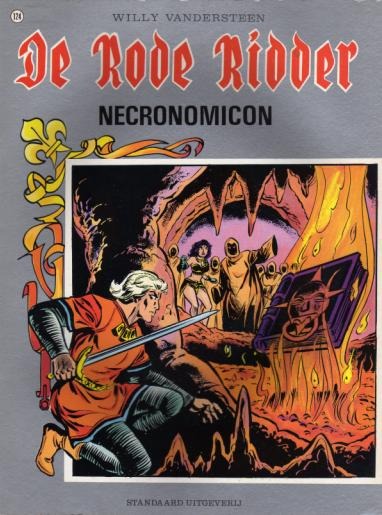
De Rode Ridder 124: Necronomicon (1987) by Karel Biddeloo

De Rode Ridder (“The Red Knight”) is a long-running Flemish-language medieval fantasy comic created by Willy Vandersteen in 1959, based on a series of children’s novels by Leopold Vermeiren in the 1940s. Roughly comparable to Prince Valiant, although not quite as consistent in storyline, as de Rode Ridder involves many standalone episodes and more fantasy and even science fiction elements. Vandersteen, who is credited with writing and drawing the strip for the first 43 albums (although gruntwork was done by others in his studio), passed it on to Karel Biddeloo, who wrote and drew the next 150 or so albums of De Rode Ridder’s adventures. About in the middle of Biddeloo’s run was album 124: Necronomicon, with Biddeloo joined by Urssla Lundmark (colorist) and Anita Schauwvlieghe (lettering).

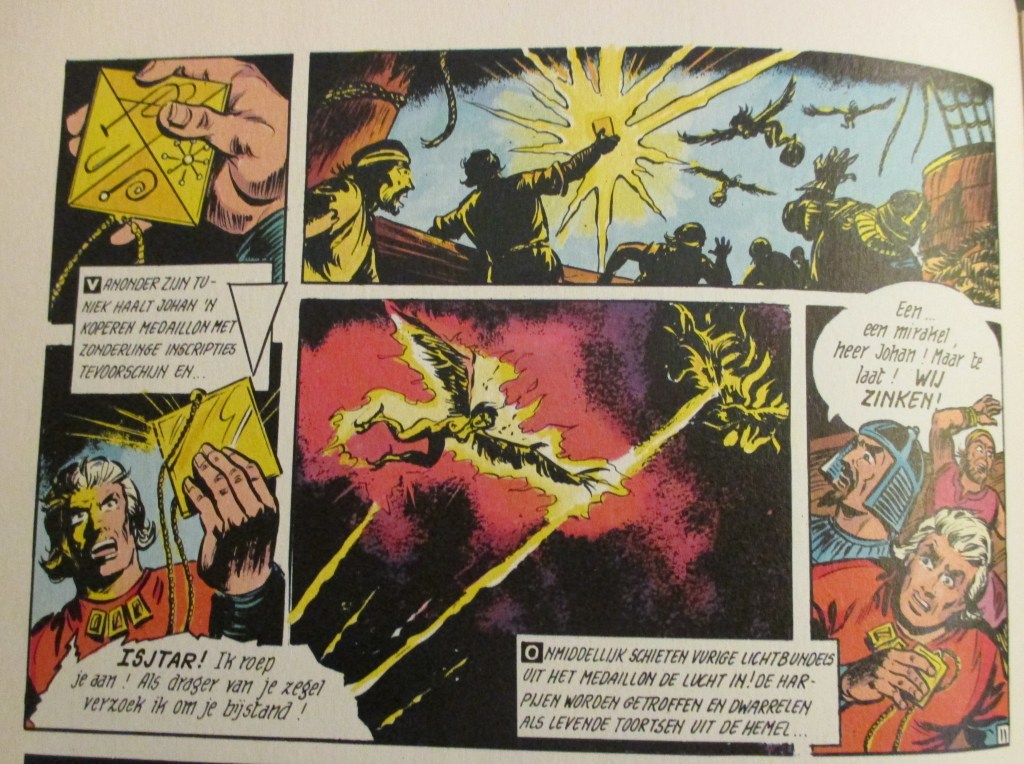
While at sea returning from Byzantium, Johan, the Red Knight, is besieged by harpies…who are defeated with the aid of the Seal of Ishtar, which Johan acquired in the last album, Oniria. Except the amulet that de Rode Ritter pulls out from underneath his tunic may look a bit familiar:

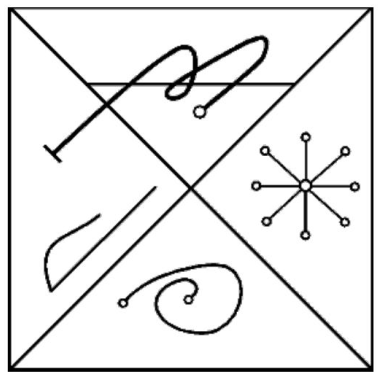
The Goddess of Venus is the most excellent Queen INANNA, called of the Babylonians ISHTAR. She is the goddess of Passion, both of Love and of War, depending on her sign and the time of her appearance in the heavens. […]

This is her Seal, which you must engrave on Copper, Venus being exalted in the heavens, with no one about watching its construction. Being finished, it is to be wrapped in the purest silk and lain safely away, only to be removed when need arises, at any time.

Simon Necronomicon 14-15
The Seal of Innana/Ishtar from the Simon Necronomicon

The Simon Necronomicon was first published in 1977, and by 1980 was released as a mass-market affordable paperback, to grace the New Age shelves of bookstores forevermore. While the impact of the Simon Necronomicon on Lovecraftian occult literature is sizable—see Dan Harms & John Wisdom Gonce III’s The Necronomicon Files for details—the artistic impact of it is often more apparent. The Gate Sigil on the cover of the book, created by artist Khem Caigan, has gone on to be appropriated by dozens or hundreds of artists for illustrations, comics, album covers, tattoos, and various and sundry merch.

The other illustrations in the book provided the first real visual occult symbols of the Mythos. While Lovecraft and Derleth had described their Elder Signs, and Robert W. Chambers had mentioned the Yellow Sign, Lord Dunsany the Sign of Mung, etc., there was no consistent popular depiction of these symbols or gestures—it was up to the readers to imagine what they would look like. Now, thanks to the Simon Necronomicon, there was a visual reference for various occult signs and talismans. Not surprising, then, that writer/artists like Karel Biddeloo opted to work them in.

Not the Simon Necronomicon gate sigil on the back cover of the upper-right panel.

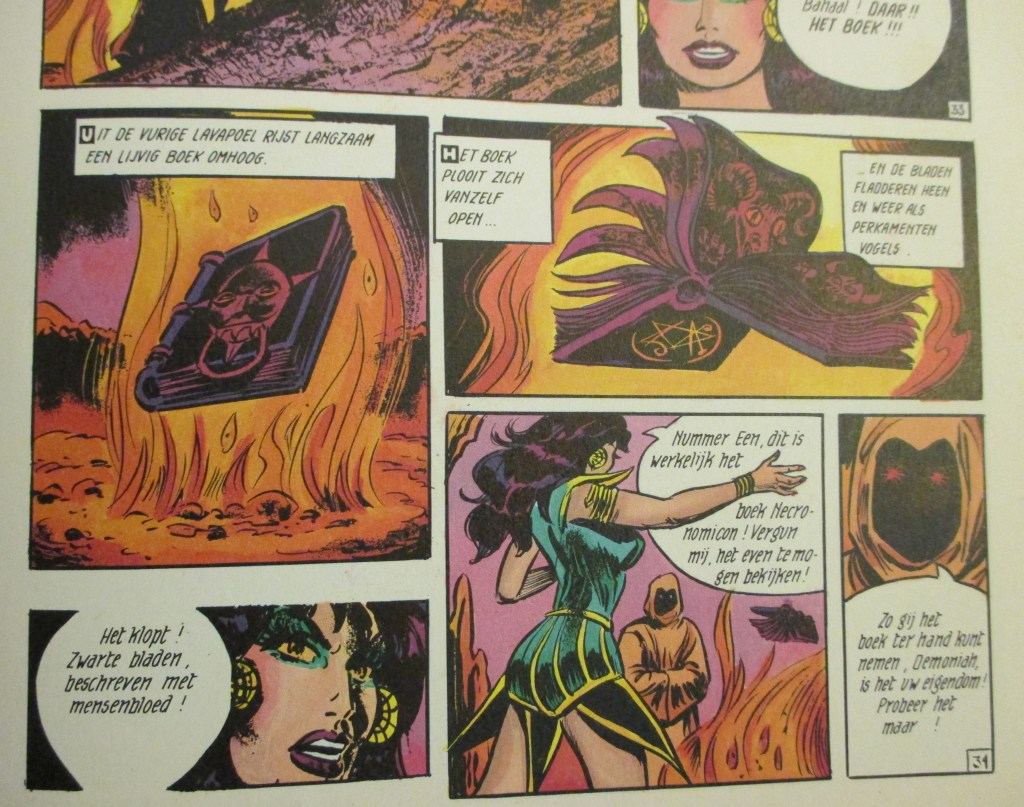
The Necronomicon of this Rode Ridder album isn’t a cheap paperback however, but a full-blown grimoire stored in a pillar of flame in a cavern beneath the earth, with a will of its own. A group of cultists working with Johan’s old foe, the sorceress Demoniah, manipulate him into retrieving the book for them. What follows is a rather typical adventure, full of action and a bit more swords & sorcery than horror—and I rather suspect that since the cultists are “der Meesters van de Swarte Kring” (“the Masters of the Black Circle”) that Biddeloo was also inspired in part by Robert E. Howard’s Conan stories, which includes “The People of the Black Circle.” The Necronomicon survived the destruction of the Swarte Kring, and would reappear in album 128: De Boeienkoning (“The Escape Artist, lit. “The King of Fetters,” much as how Houdini was sometimes billed “the Handcuff King”).

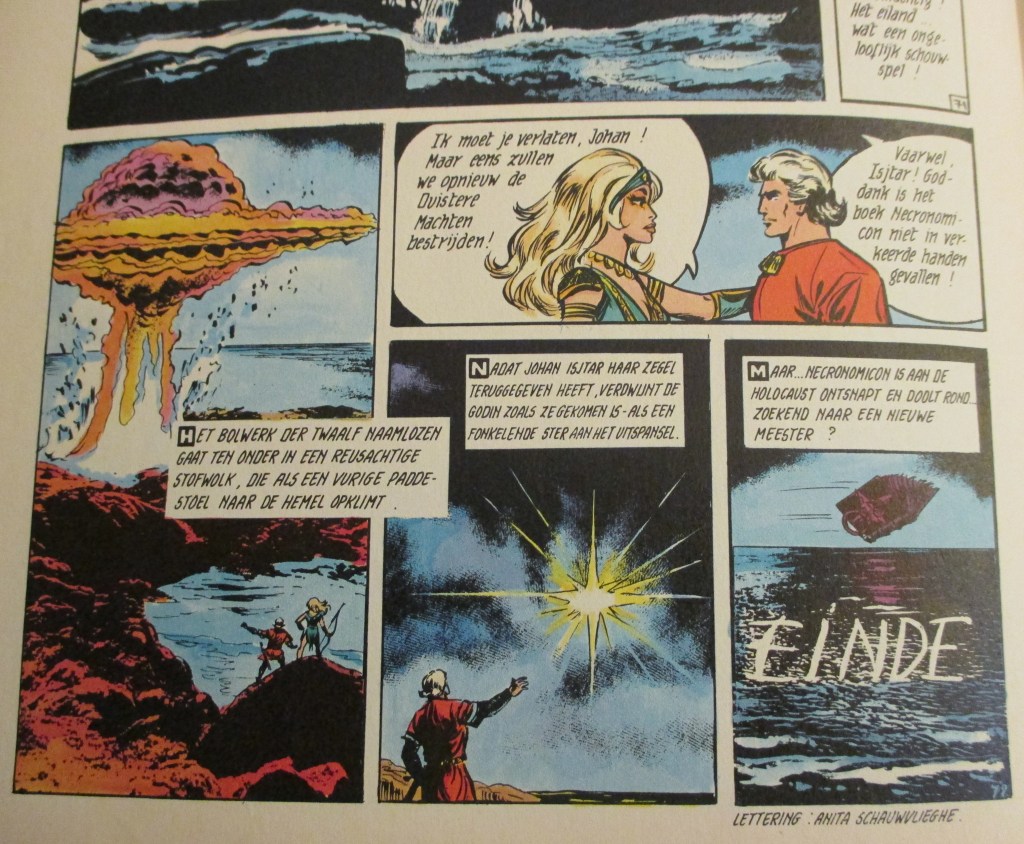
The Necronomicon literally flies off to its next adventure.

De Rode Ridder: Necronomicon is a fairly typical dip-of-the-toes into the Mythos; while Cthulhu, Yog-Sothoth, et al. don’t merit a mention, that’s probably as much as because Biddeloo was drawing from the Simon Necronomicon rather than directly from Lovecraft for inspiration; if this had been published after The Evil Dead came out in Belgium, the Necronomicon might be bound in human skin with a face on it! The book itself becomes a typical MacGuffin, since for all its portentous power it does not do much of anything by itself. For readers already familiar with the Necronomicon, it might be a fun or cute reference that gives de Rode Ridder another adventure; for those whose first experience with the Necronomicon was reading about it in this comic…perhaps this was their first step toward reading Lovecraft.

In terms of art, Karel Biddeloo is no Hal Foster, and the coloring sometimes muddies what might be better linework, yet it is still a very competent product with occasional dynamic illustrations that break out of the panel borders and breathe a little life into the work.

Regrettably, the adventures of de Rode Ridder have never been translated into English, although the Belgian albums and reprints are fairly available from European booksellers.


Bobby Derie is the author of Weird Talers: Essays on Robert E. Howard and Others and Sex and the Cthulhu Mythos.

Deep Cuts in a Lovecraftian Vein uses Amazon Associate links. As an Amazon Associate I earn from qualifying purchases.
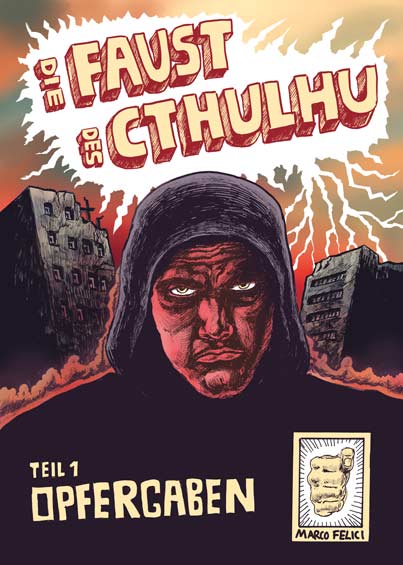
Die Faust des Cthulhu Teil 1: Opfergaben (2014) by Marco Felici

In naher zukunft existiert die menschliche zivilisation, wie wir sie kennen, nicht mehr.

Alte wesen sind aus ihrem schlaf erwacht und haben die herrschaft über die erde übernommen. Die wenigen überlebenden ergaben such der beuen religion und ihrer propheten.

Dies ist die geschichte eines mannes, der sich nicht unterwirft, sondern den kampf gegen die neuen mächte aufnimmt.
In the near future, human civilization as we know it will no longer exist.

Ancient beings have awakened from their sleep and have taken control of the earth. The few survivors surrendered to the new religion and its prophets.


This is the story of a man who does not submit, but takes up the fight against the new powers.
Back cover of Die Faust des Cthulhu 1.English translation

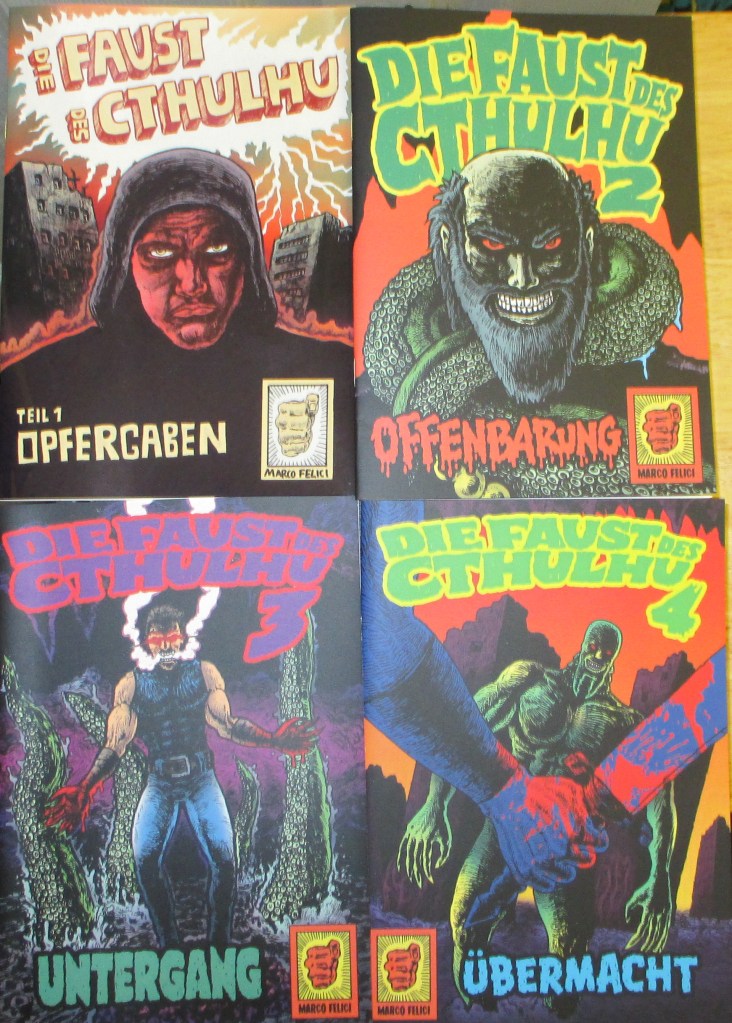
Die Faust des Cthulhu (The Fist of Cthulhu) is an independently published, black-and-white, German-language post-apocalyptic action-horror comic from writer/artist Marco Felici (lettering by Till Felix, cover colors & title design for issues 2-4 by Olaf Hänsel). Published irregularly, the series appears to consist of four separate issues and a collected edition:

  • Teil 1: Opfergaben (Part 1: Offerings) (2014)
  • Teil 2: Offenbarung (Part 2: Epiphany) (2015)
  • Teil 3: Untergang (Part 3: Downfall) (2018)
  • Teil 4: Übermacht (Part 4: Superiority) (2020)
  • Sammelband (Collected) (2022)

(Note: the listing I’ve seen for the collected edition says it collects the first five issues, so I may well be missing one.)

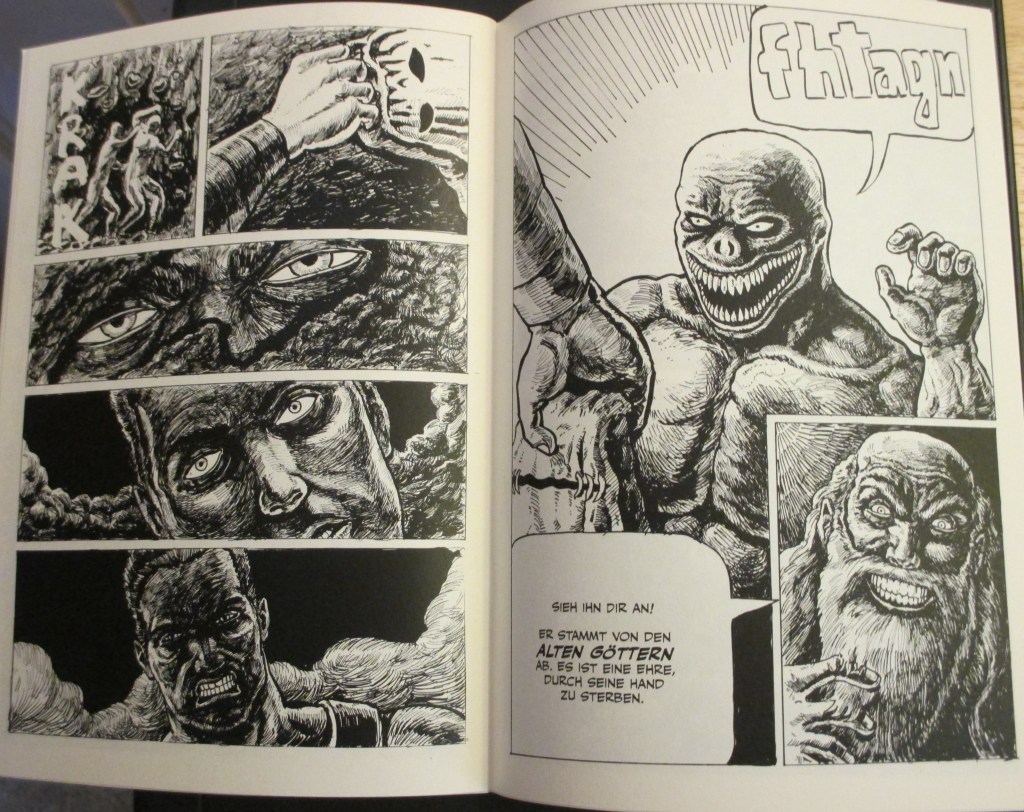
The art and story are strongly reminiscent of American underground comix of the 1970s-1980s, with the occasional shade of Richard Corben (especially in the color covers on issues 2-4), or Eastman and Laird’s early, relatively grungy-looking black-and-white issues of Teenage Mutant Ninja Turtles, long before the children’s cartoon softened their image and sensibilities. Story-wise, there may also be more than a touch of a manga influence, with shades of Fist of the North Star or other post-apocalyptic action-adventure series. Surprisingly, there’s also a touch of luchador influence, with the humanoid monsters sometimes going masked, at least initially.

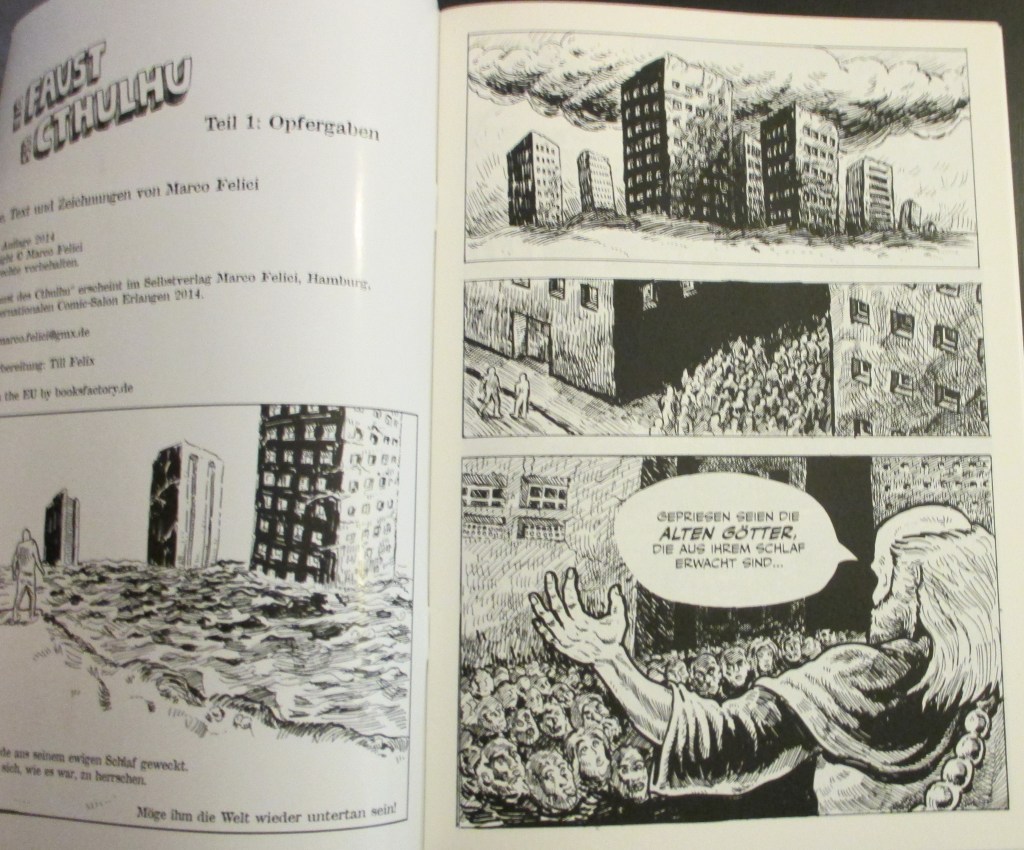
We open on the scene of a sacrifice to the Old Gods.

Fundamentally, the story is straightforward: a mysterious stranger takes exception to one of the regular innocent sacrifices to the Old Ones, and deals with a cultist and his minion—a half-human spawn of elder beings. Of course, our hero soon shows that he isn’t entirely human either…imagine if Wilbur Whateley decided he related more with his mother than Yog-Sothoth and chose to try and rid the world of eldritch horrors, and you’ve about got the scope of the series. Along the way, a kid sees him fight and becomes witness-cum-sidekick as they travel through the hellscape of the future.

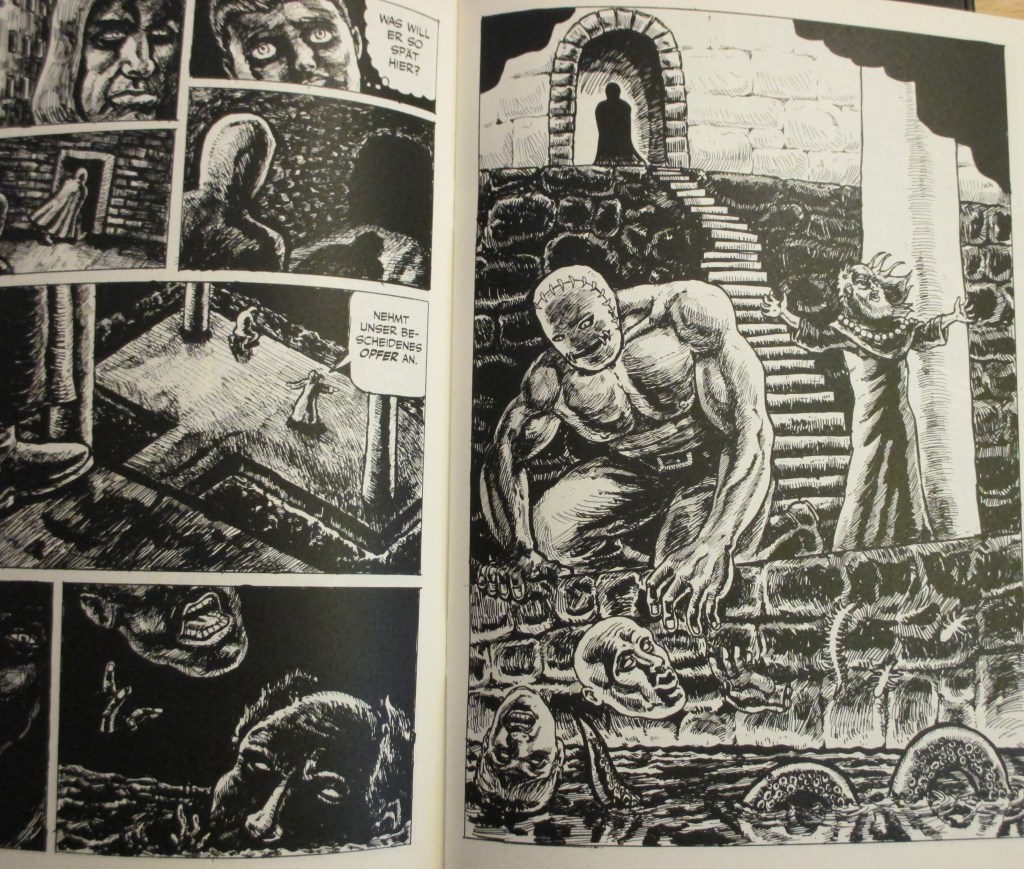
Down below, the dismembered bodies of the sacrifices are fed to… something.

The art is a mix of that underground comix serviceable-enough grunginess and moments of interesting character and creature design. Backgrounds tend to give way to action lines or solid blocks of black or white, which makes sense in black-and-white comics where the focus is on the figures more than the surroundings.

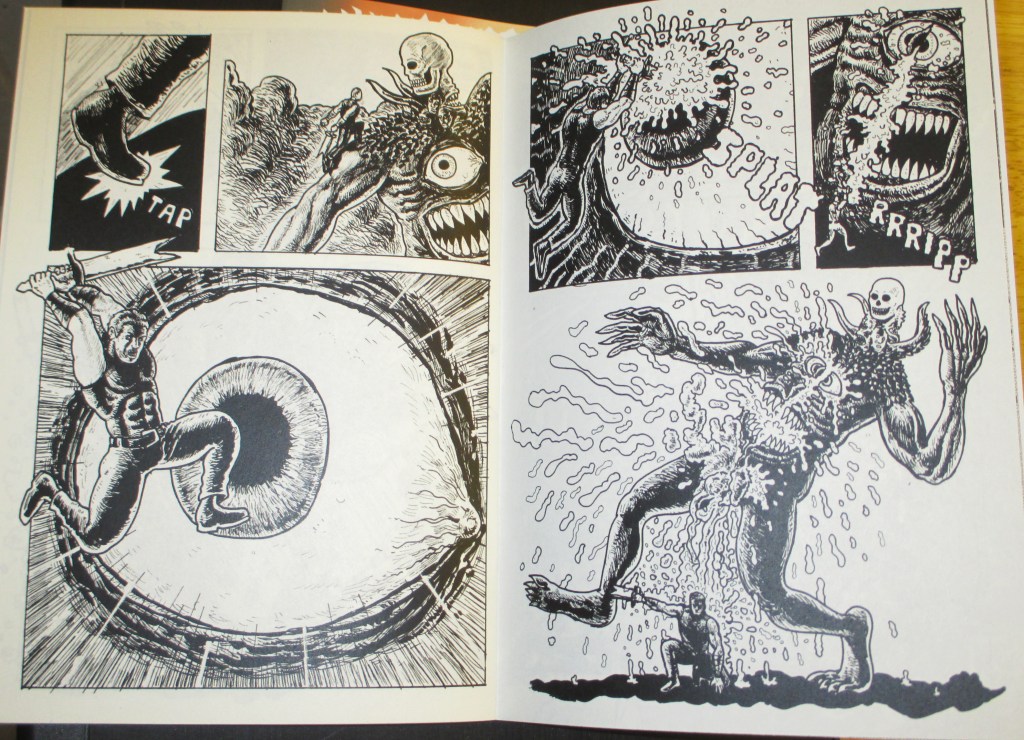
Mythos references are a bit scanty; Die Faust des Cthulhu isn’t a pastiche in the sense that it wants to expand on the lore in vast detail, and while there is a bit of exposition the actions tend to speak louder than words, and the explicit connections to the Mythos are usually relegated to a few exclamations in the heat of battle. There is more of an element of Robert E. Howard to the story than Lovecraft; the nameless hero is of the same mind as Conan that if something bleeds then it can die, even if the thought is not expressed in so many words. Readers hoping for deep pathos or character development may be disappointed, but primarily this is fun. A guy with a pair of knives wrestles tentacled monsters and cuts them apart. It’s closer to sword and sorcery than cosmic horror.

Sometimes that’s silly. Sometimes that’s awesome.

Climactic scene from Teil 4: Übermacht.

It is not clear how many copies of a given issue are printed, but given the scarcity probably not many; readers interested in tracking down a few should check out German comic shops or eBay.


Bobby Derie is the author of Weird Talers: Essays on Robert E. Howard and Others and Sex and the Cthulhu Mythos.

Lovecraft (1994) by Reinhard Kleist & Roland Hueve

Lovecraft. H. P. Lovecraft. Saft Dir das was?

Nur flüchtig.

Also, paß auf. Schriftsteller. Amerika. 1890-1937. Hat in Edgar Allen Poe—Nachfolge phantastiche Geschichten geschrieben. Origien des Grauens. Versponnen Wissenschaftler und romantische Helder gegen unheimliche und unbekannte Mächte aus den Tiefen des Universums. Ganz eigene, in sich geschlossene Mythologie. Kosmische Götter und Monstren mit merkwürdigen Namen. Azathoth, Nyarlathotep, Cthulhu…

Okay, okay. Ende des Klappentextes. Was hast Du vor?

Ich will was über die Lebensgeschichte von Lovecraft machen.

Und was?

Einen Comic.

Einen Comic? In wieviel Bänden?

Lies erst mal!
Lovecraft. H.P. Lovecraft. Mean anything to you?

Just in passing.

Okay, pay attention. Writer. America. 1890-1937. Like Edgar Allen Poe’s succesor—wrote fantastic stories. Origins of horror. Weaves scientists and romantic heroes against sinister and unknown forces from the depths of the universe. Completely separate, self-contained mythology. Cosmic gods and monsters with strange names. Azathoth, Nyarlathotep, Cthulhu…

Okay, okay. End of blurb. What are you up to?

I want to do something about Lovecraft’s life story.

And that is?

A comic.

A comic? In how many volumes?

Read it first!
Roland Hüve & Reinhard Kleist, introduction to LovecraftEnglish translation

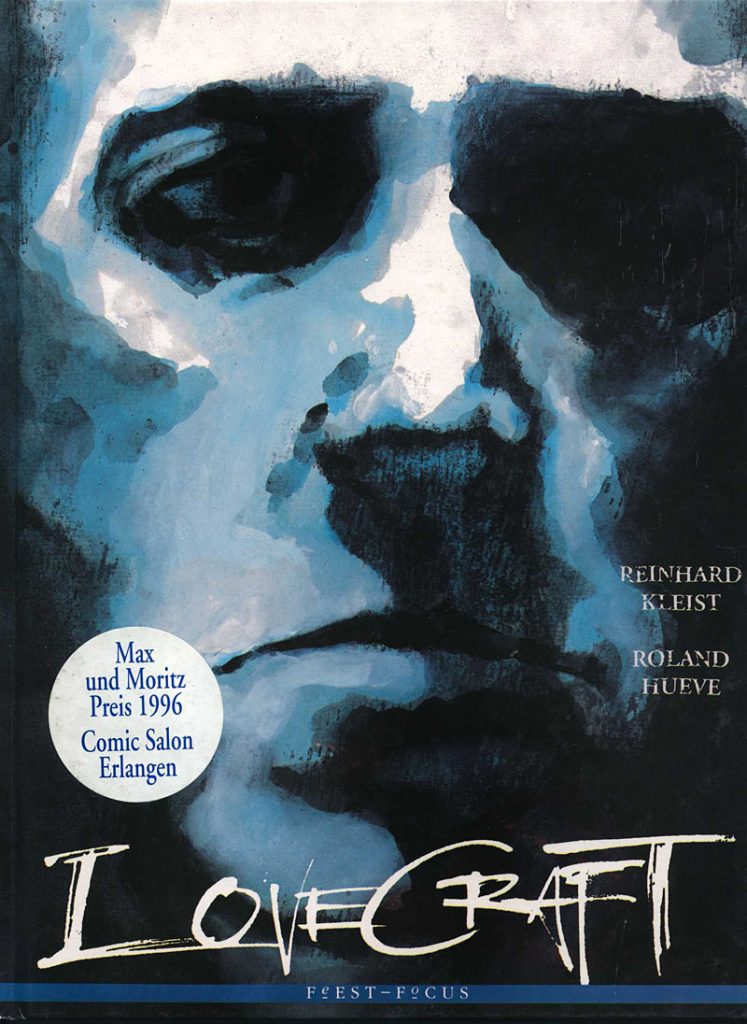
Lovecraft (1994) is a standalone German-language graphic novel in the European format normally associated with bandes dessinée—a slim, full-color hardback. The creation of Roland Hüve (script) and Reinhard Kleist (script & art), the 80-page story is focused on the idea of the character of Randolph Carter as a literary expy and alter ego for H. P. Lovecraft himself. As part of that, it adapts or partially adapts the story of “The Statement of Randolph Carter” as sort of an arching narrative of Lovecraft’s life, drawing on L. Sprague de Camp’s 1975 biography for details.

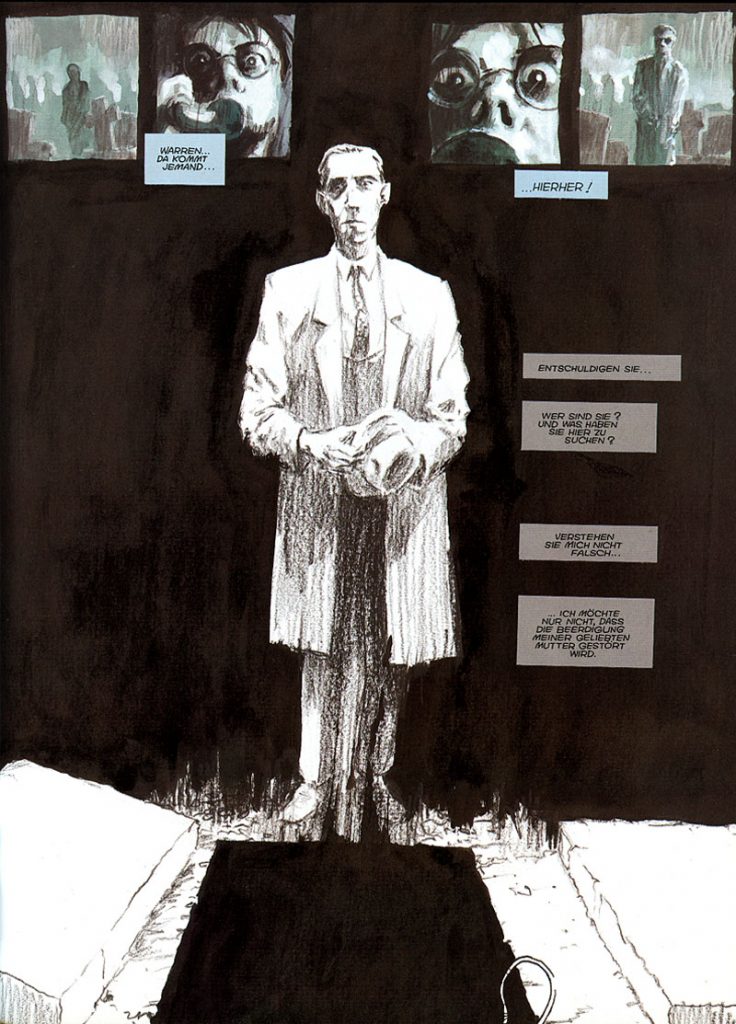
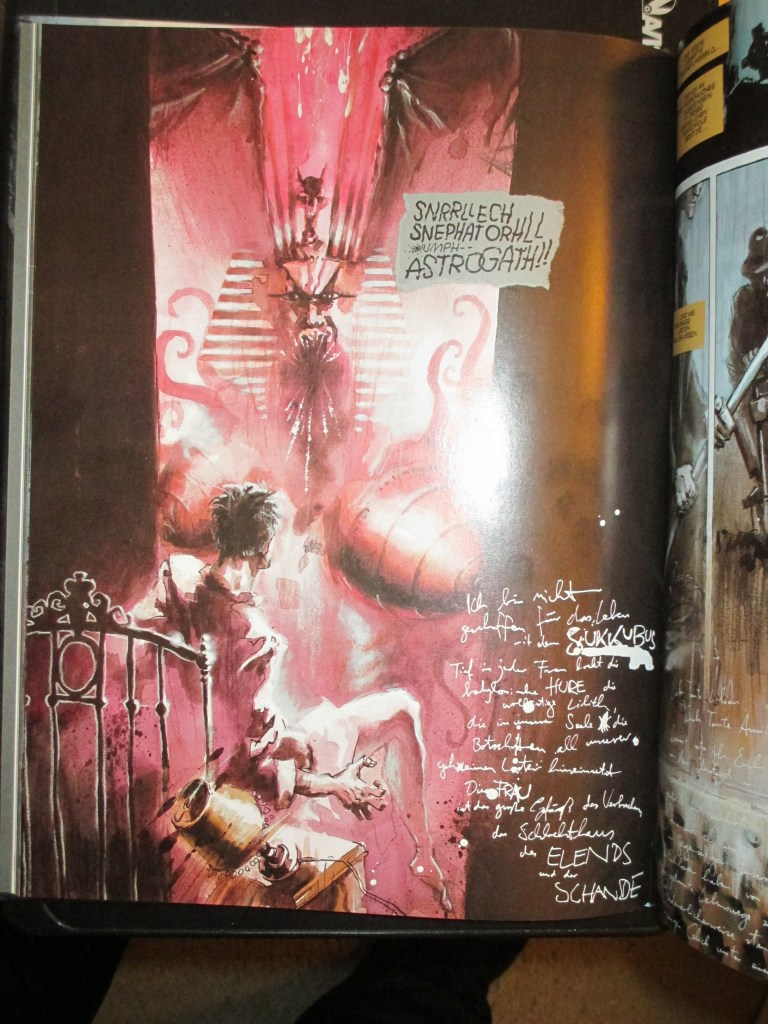
That bare description doesn’t really do the book justice. While the story is familiar—making Lovecraft himself a central character, part and parcel of the Mythos has been a favored treatment of many comic book creators—the real pleasure of the book is in Kleist’s artwork. The style is impressionistic, shifting, often mixing watercolors and frantic pencils, charcoals, and mixed media to great effect. It is a style very far away from the clean figures and lines of most comics at the time, either in Europe or North America. Much as if Dave McKean‘s lauded covers for The Sandman (1989-1996) were stretched out to fill a book.

Reinhard Kleist

Although that still might not be giving Kleist quite enough credit; as an artist, he has his own style, adaptable and varied. It is a visual feast, and readers familiar with Lovecraft’s biography will find many interesting visual references…and some amusing errors. Sonia H. Greene goes from a Juno-esque brunette who was seven years older than Lovecraft in real life to a young, ginger-haired flapper with a bob-cut…until she turns into a succubus.

Following the trend of blending real-life and fiction, more than a few liberties are taken. Don’t try to take it as a straight biography, but as what it is: a flight of fantasy spinning out from Lovecraft’s reputation as a horror writer and the rather neurotic and sexually-inhibited depiction of the man in de Camp’s flawed but ground-breaking biography.

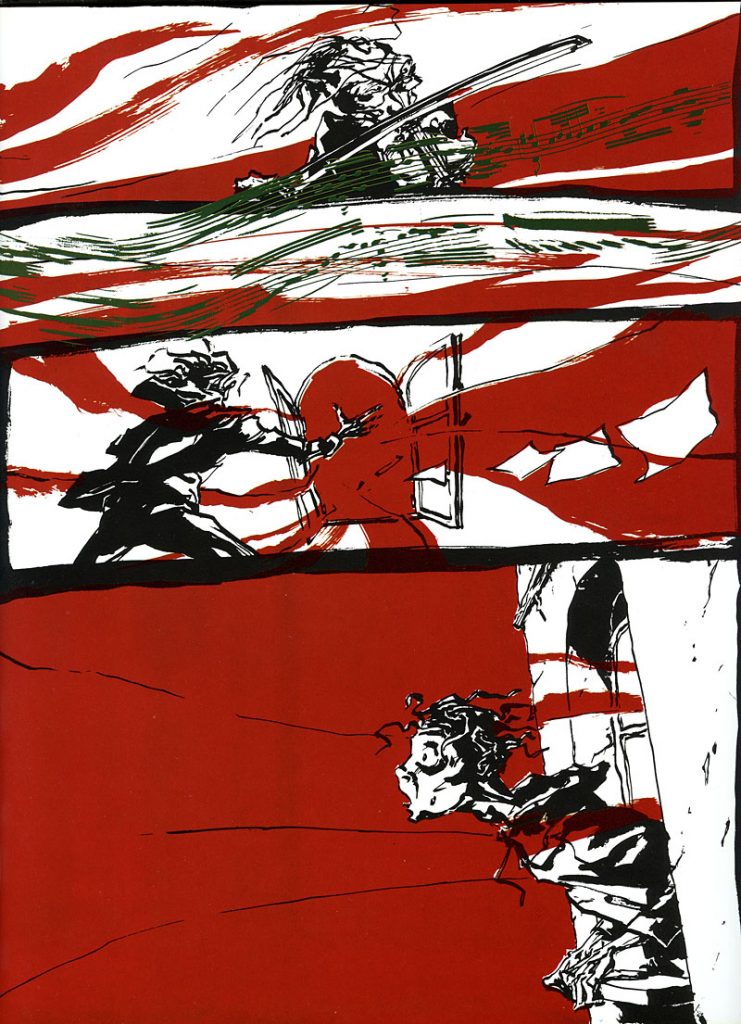
The second story in the book is a separate adaptation by Kleist alone, a much more restrained and deliberately grungier adaptation of “The Music of Erich Zann,” done in black and white and red, a much more sparse style that contrasts neatly with the rather more busy and cluttered compositions of the lead story.

Reinhard Kleist

As an adaptation, this one is rather faithful and does more to capture the mood and atmosphere of the story with its bold use of red; it’s an aesthetic choice that serves to suggest and convey the invasion from beyond in a way that a tentacle or a starry blackness doesn’t.

Like many European graphic novels, Lovecraft was never translated into English, so remains fairly obscure among English-reading audiences today. Of course, today it would have to compete with any number of competitors like Lovecraft (2004) by Hans Rodionoff, Enrique Breccia, and Keith Giffen; The Strange Adventures of H. P. Lovecraft (2010) by Mac Carter, Tony Salmons, Adam Byrne, and Keaton Kohl, and Some Notes on a Nonentity (2017) by Sam Gafford and Jason C. Eckhardt among many others.

That is a pity, because while the writing may lose something in the translation from the German, the art is compelling and might have universal appeal.


Bobby Derie is the author of Weird Talers: Essays on Robert E. Howard and Others and Sex and the Cthulhu Mythos.

Deep Cuts in a Lovecraftian Vein uses Amazon Associate links. As an Amazon Associate I earn from qualifying purchases.
1000 Ögon: Lovecraft (2014) by Jonas Anderson & Daniel Thollin

Tänk om H.P. Lovecraft hade levt idag och bott i Uppsala! Hur hade hans berättelser sett ut då? Vår bok heter helt enkelt 1000 Ögon: Lovecraft och är vår hyllning till denna skräckens mästare. Vi tolkar några av hans berättelser och placerar dem i vårt 1000 Ögon-universum. What if H.P. Lovecraft was alive today and lived in Uppsala! What would his stories look like then? Our book is simply called 1000 Eyes: Lovecraft and is our tribute to this master of horror. We interpret some of his stories and place them in our 1000 Eyes universe.
Swedish pitch on IndiegogoEnglish translation

1000 Ögon (1000 Eyes) is the label for a contemporary Swedish-language series of horror graphic novels (really, thin bandes dessinée-style hardbacks) by the creative team of Jonas Anderson, Anders Björkelid, and Daniel Thollin, the last three published by Albumförlaget. Several of these have Lovecraftian influences, notably Filgia (2013), Lovecraft (2014), and Cthulhu (2015), but like a lot of non-English language publications that don’t make it into translation, they tend to get overlooked by English-reading audiences. The name “1000 ögon” is presumably a reference to the Swedish horror film Skräcken har 1000 ögon (“Fear has 1000 Eyes,” 1970).

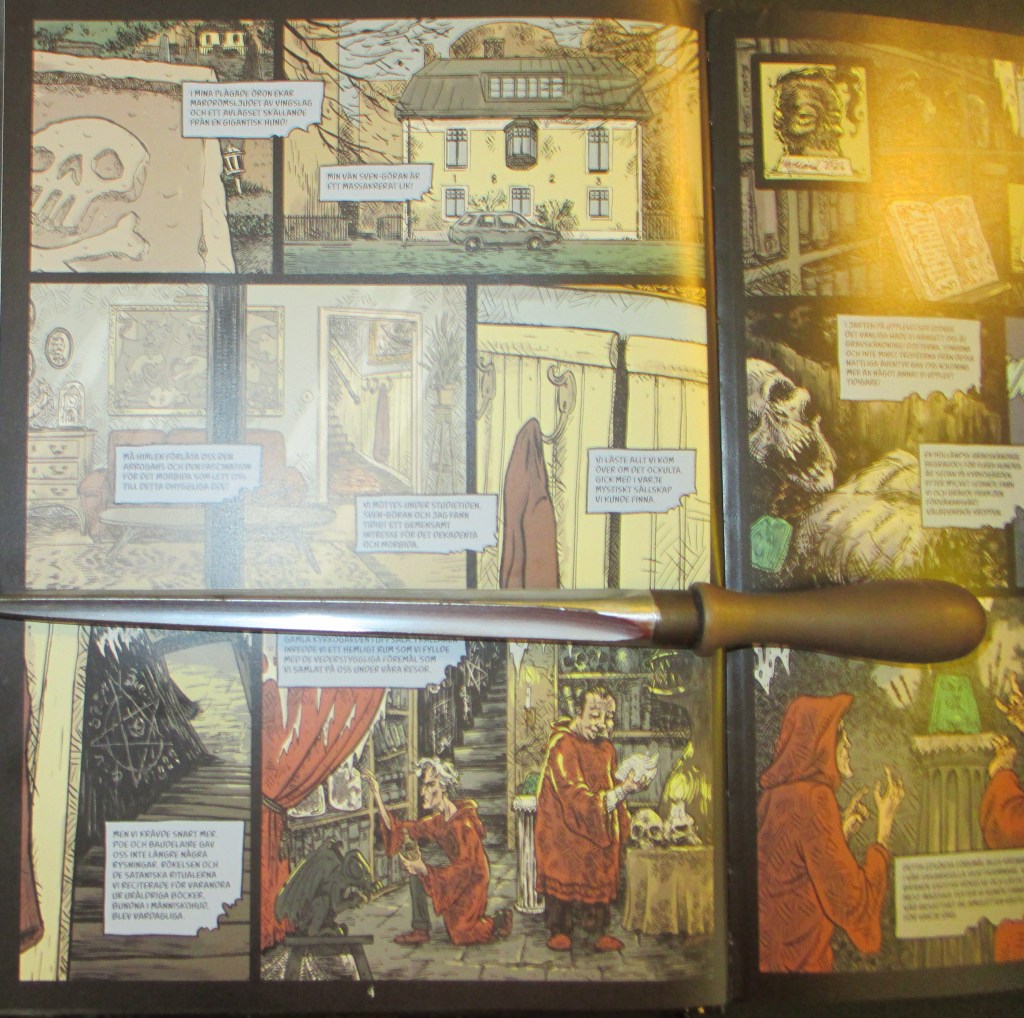
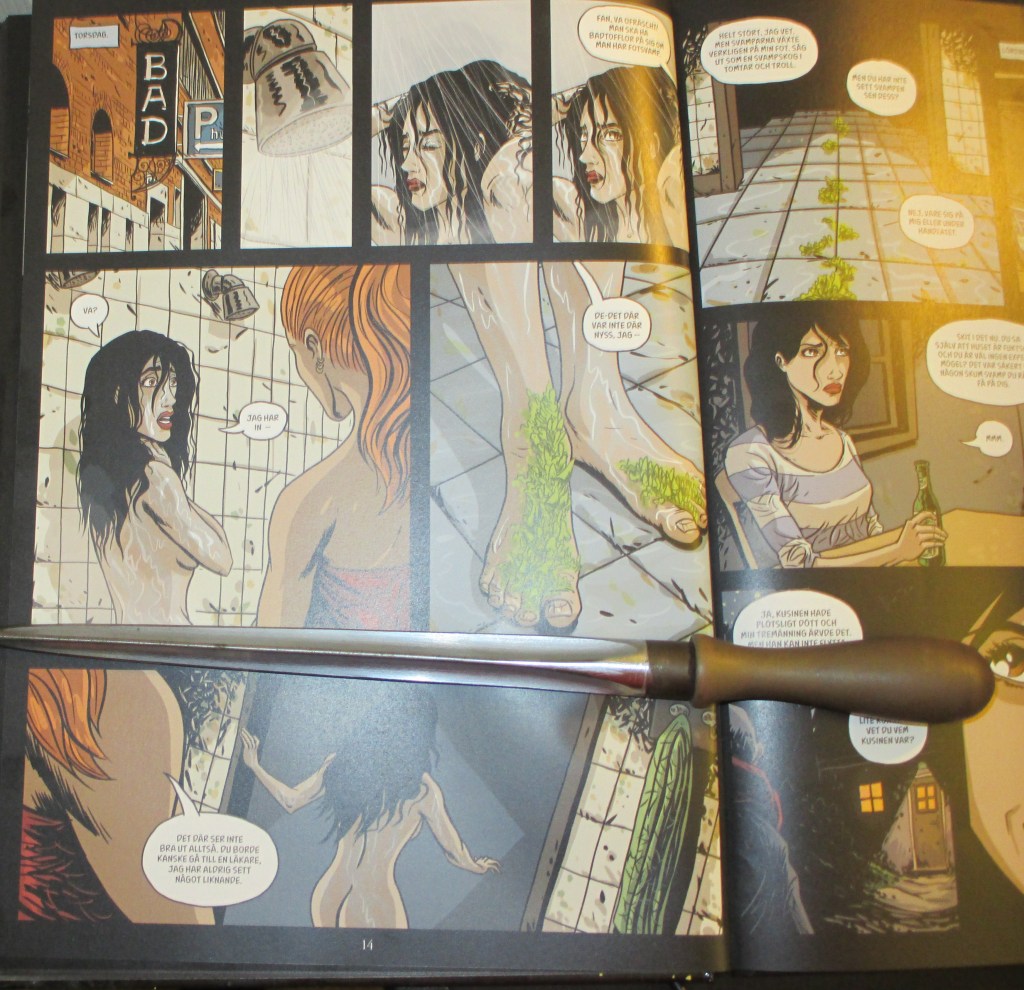
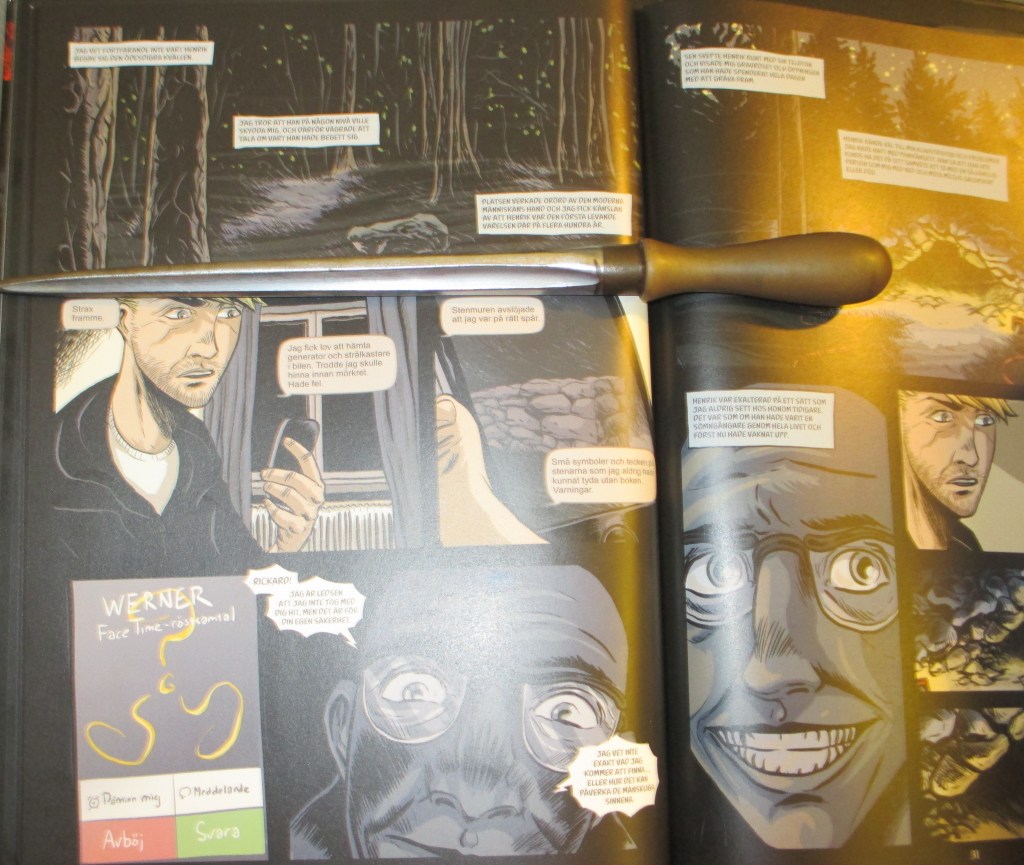
This is a bit of a shame because Lovecraft has an interesting basic premise: taking the core of four of Lovecraft’s stories (“The Hound,” “The Shunned House,” “The Statement of Randolph Carter,” and “The Shadow over Innsmouth”), and reworking them in a shared, contemporary setting, keeping what they feel is the essence of Lovecraft’s stories while freely altering the trappings and settings. In this way, the two graverobbing aesthetes of “The Hound” become more notably occult in their predilections (and apparently drive a Citroën GS); the protagonist of “The Shunned House” is a young woman named Cecilia dealing with something more than the standard mildew and black mold in the house, “The Statement of Randolph Carter” involves facetime over a smartphone rather than a field telephone, and “The Shadow over Innsmouth” takes some specific visual cues from the buildings of Uppsala and the Swedish fishing industry.

“The Hound”

Like many contemporary takes on the Mythos, Thollin and Anderson each work in references to the Cthulhu Mythos in these stories, even if there were none before. As each one writes and draws their respective episodes independently (“The Shunned House” and “The Statement of Randolph Carter” for Daniel Thollin and “The Hound” and “The Shadow over Innsmouth” for Jonas Anderson), this provides a degree of narrative continuity that might otherwise be lacking. Readers get the sense that these stories are connected, expressions of some common threat or body of myth, in a way that might not be obvious otherwise.

“The Shunned House”

For those at least passingly familiar with Swedish architecture or Uppsala in particular, the connectivity of the stories is also geographic and cultural. Which is rather the entire point of this exercise. While Lovecraft never weighed in on localization per se, he did famously note:

Searchers after horror haunt strange, far places. For them are the catacombs of Ptolemais, and the carven mausolea of the nightmare countries. They climb to the moonlit towers of ruined Rhine castles, and falter down black cobwebbed steps beneath the scattered stones of forgotten cities in Asia. The haunted wood and the desolate mountain are their shrines, and they linger around the sinister monoliths on uninhabited islands. But the true epicure in the terrible, to whom a new thrill of unutterable ghastliness is the chief end and justification of existence, esteems most of all the ancient, lonely farmhouses of backwoods New England; for there the dark elements of strength, solitude, grotesqueness, and ignorance combine to form the perfection of the hideous.

H. P. Lovecraft, “The Picture in the House”

Which is to say: horror can be found closer to home than you think. Forget for a moment all those Hollywood horrors set in the United States, don’t think yourself safe just because Lovecraft restricted himself primarily to New England. Horror can be anywhere, closer than you would like…you may be in some corner of Lovecraft Country already and not even know it.

“The Statement of Randolph Carter”

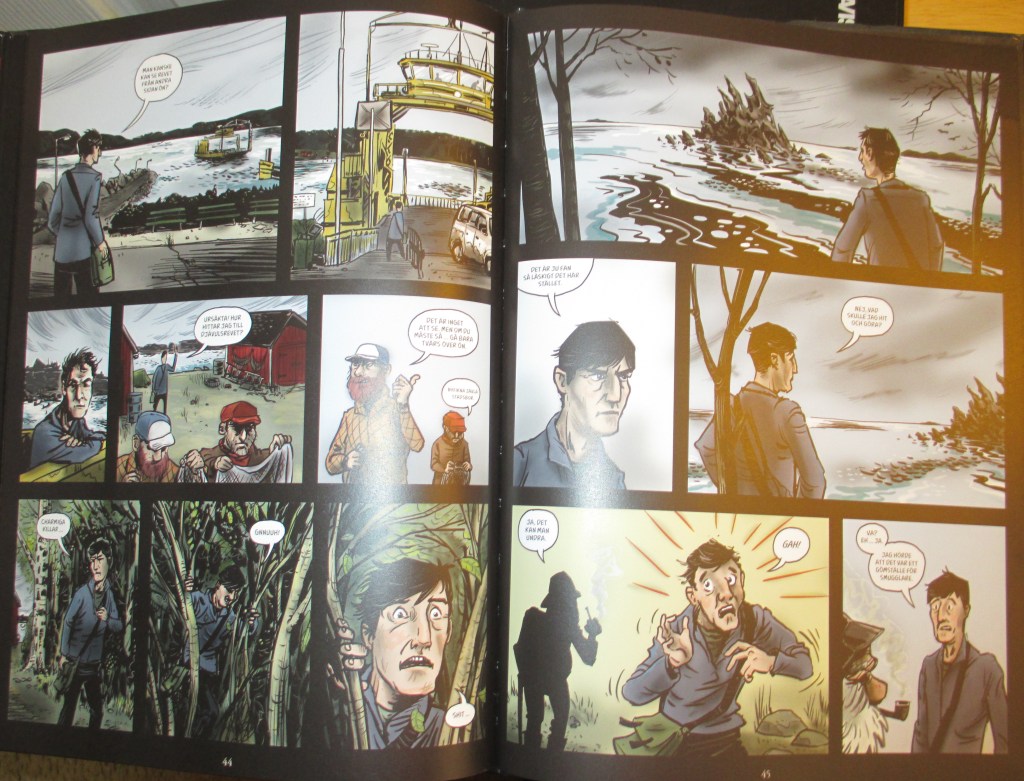
Visually, Thollin’s style is “cleaner” and closer to American-style comic figuring, while Anderson’s is a little scratchier and closer to the Franco-Belgian school, and the digital coloring on Anderson’s work in particular can look a little muddy at times. While it wouldn’t be correct to say that none of the stories being adapted lend themselves to grand visuals, it seems both Thollin and Anderson lean into a more subdued approach, focusing on the human characters and generally keeping things at their scale. So there are few grand visuals, but several clever and well-designed elements, like the stark outcropping of Devil’s Reef, which really stands out when compared to how it is normally portrayed, as barely a bump above the waterline.

“The Shadow over Innsmouth”

Lovecraft was followed up by a sequel titled Cthulhu. Whereas Lovecraft consists of four adaptations, Cthulhu is made up of two original works, both set in Uppsala, before and after the stars are right. The stories maintain much of the same artistic style and themes of the Lovecraft adaptations, but the creators have a little more free play to indulge their imaginations. Readers who dig the style and want to see what happens what Thollin and Anderson move beyond adaptation to pastiche won’t be disappointed.

While you might find Filgia, Lovecraft, and Cthulhu available online in some second-hand bookstores, the best way to order them is probably direct from Albumförlaget.


Bobby Derie is the author of Weird Talers: Essays on Robert E. Howard and Others and Sex and the Cthulhu Mythos.

Deep Cuts in a Lovecraftian Vein uses Amazon Associate links. As an Amazon Associate I earn from qualifying purchases.
Wolff (1971) by Luis Gasca & Esteban Maroto

Luis Vigil, que ne época fazia a revista Nueva Dimensión, tinha me mostrado algumas capas norte-americanas de um gênero resgatado sa antigas pulps estadunidenses: Espada & Feitiçaria. Essas capas eram maravilhosas. Em uma, um guerreiro selvagem protegia uma donzela seminua, rodeados por um conjunto de figuras misteriosas, caveiras, bruxos, fortalezas, dragões… Tudo apenas insinuado. Em outra, o guerreiro montado nas costas de uma gigantesca serpente, com diversas caveiras e outras formas monstruousas, preso em um calabouço. Elas raziam todos os elementos que eu sempre amei. Perguntei a Luis se havia alguma tradução daquelas histórias para o espanhol e ele respondeu que não (anos mais tarde, a editora Bruguera a publicaria). O protagonista das imagens se chamava Conan e o ilustrador era Frank Frazetta.

Quando em, 1969, Luis Gasca me pediu idias para uma história que seria publicada em uma nova revista, props um personagem daquele estilo. Ele aprovou, e assim nasceu Wolff, para a revista Drácula. Eu desenhava o que queria, fazia uma pequena sinopse e ele escrevia os textos finais com a pseudônimo Sadko. Mese depois, começaram a publicar nos Estados Unidos a adaptação do personagem de Robert E. Howard, Conan, no clássico formato dos comics, na revista Savage Tales, da Marvel, com desenhos de Barry WIndosr-Smith e roteiros de Roy Thomas.
Luis Vigil, who at the time was at Nueva Dimensión magazine, had shown me some North American covers of a genre rescued from the old American pulps: Sword & Sorcery. Those covers were marvelous. In one, a wild warrior protected a half-naked maiden, surrounded by an array of mysterious figures, skulls, witches, fortresses, dragons… All just hinted at. In another, the warrior riding on the back of a gigantic serpent, with several skulls and other monstrous shapes, trapped in a dungeon. They brought out all the elements that I’ve always loved. I asked Luis if there was any translation of those stories into Spanish and he answered no (years later, Bruguera publishing house would publish it). The protagonist of the images was called Conan and the illustrator was Frank Frazetta.

When, in 1969, Luis Gasca asked me for ideas for a story to be published in a new magazine, I proposed a character in that style. He approved, and thus Wolff was born, for Drácula magazine. I would draw what I wanted, make a short synopsis, and he would write the final texts under the pseudonym Sadko. Months later, they began publishing in the United States the adaptation of Robert E. Howard’s character Conan in the classic comic book format in Marvel’s Savage Tales magazine, with drawings by Barry Windsor-Smith and scripts by Roy Thomas.
Esteban Maroto, Espadas e Bruxas (2017) 10English translation

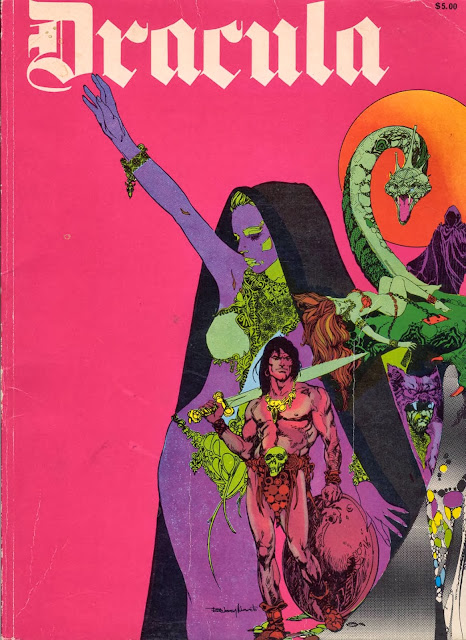
In 1971, Spanish publisher Buru Lan published began publishing Drácula, which despite the name had little to do with Bram Stoker’s character, but was a general fantasy and horror comic comparable in some ways to Warren Comics’ Eerie and Creepy in the United States—especially since Warren would, at about the same time as Drácula came out, begin relying heavily on Spanish artists such as Esteban Maroto. At the same time, the paperback fantasy boom in the United States was blossoming with the Lancer editions of Robert E. Howard’s Conan, with covers by Frank Frazetta (who also lent his talents to Warren magazines).

Conan the Usurper (Lancer 1967), art by Frank Frazetta

Marvel’s Conan the Barbarian comic by Roy Thomas and Barry Windsor-Smith first hit the stands in 1970, and its success helped to spread the fantasy boom to comic books. It was a good time to build your own barbarian…and so, Gusca and Maroto created Wolff, inspired by and in the mold of Conan (or at least, Frazetta’s covers for the Conan paperbacks). The series caught the eye of English-language publishers, and the British publisher New English Library translated and published twelve issues under the title Dracula; Warren combined several issues as a standalone graphic novel, also titled simply Dracula…implicitly competing with Dracula Lives! and Savage Tales, both produced by Curtis, Marvel’s magazine imprint. Full-size comic magazines could circumvent the restrictions on nudity and content imposed by the Comics Code Authority on comic books.

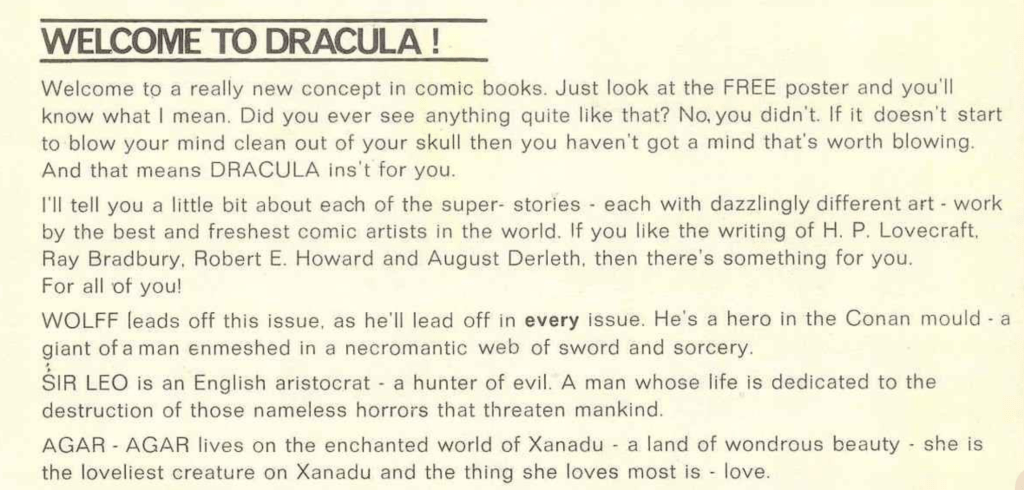
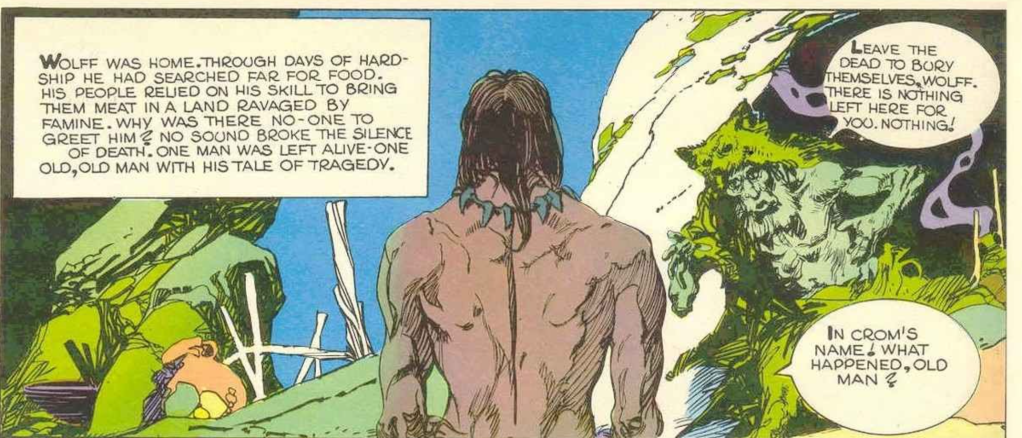
One gets the impression the English publishers of Dracula understood exactly what they were doing; in the intro to the first issue of Dracula, the editors wrote:

The Wolff comics themselves would seem to reinforce these arguments, since Wolff is happy to swear by Crom, Mitra, and Set and throw in other references to Howard’s Conan stories and Lovecraftian allusions. All of which are, in hindsight, a bit odd if Maroto claimed they hadn’t been translated yet.

Dracula #1 (1972)

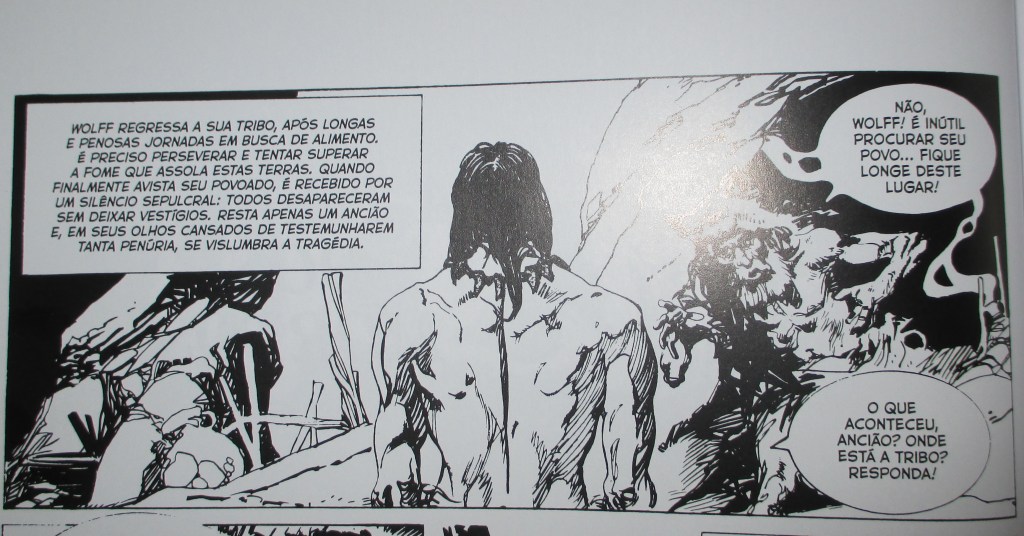
What happened is that Gusca’s script was changed in the translation. Compare this same scene to that in the 2017 Brazilian Portuguese translation, which is closer to the original Spanish:

Espadas e Bruxas (2017)

The uncredited translator obviously took a few liberties in order to emphasize the connections between Wolff and Conan, inserting the occasional “By Crom!” or whatnot wherever convenient. Whatever injustice was done to Luis Gusca’s script, however, was balanced by accurate reproduction of Maroto’s artwork, especially in the 1973 trade paperback edition, which is larger than the average magazine page size and on glossy paper rather than newsprint.

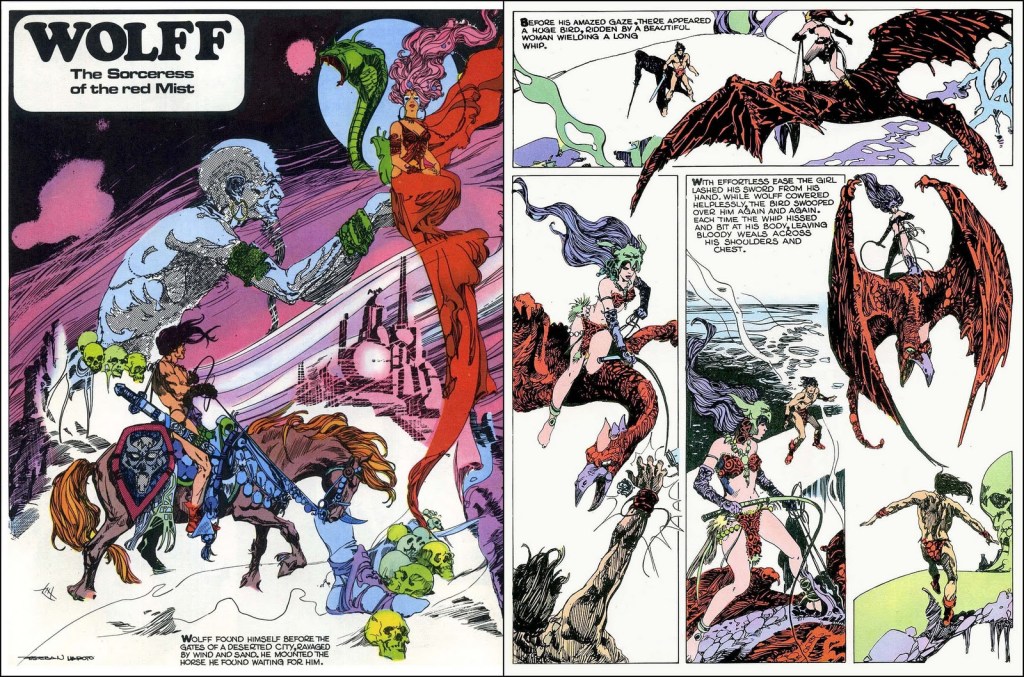
From the description Maroto gives, he and Gusca appear to have used something similar to the Marvel Method—and the evidence of Maroto’s freed is clear in nearly every page and panel; while more restrained than the other blatantly psychedelic stories in Dracula, Maroto’s backgrounds are often sparse, but with well-proportioned, realistic figures and phantasmagoric tableaux.

Dracula #3 (1972)

Wolff’s adventures follow a series of interlinked quests. Unlike Howard’s Conan stories, the plots tend to be rather straightforward, with few betrayals or moral complexities to vex the hero; but there is much of wonder and horror. This was before Conan had become widely-parodied as a simple musclebound brute, and Wolff often overcomes the challenges set regularly in his path by luck and cunning as much as brute strength or swordplay. Wolff is obviously inspired by Conan, right down to the visual details, but he is not Conan; there is none of the brooding and cynicism that mark Howard’s hardboiled fantasy.

In terms of fantasy comics of the 1970s, “Wolff” is sadly little more than a footnote, much like Dagar the Invincible (Gold Key, 1972-1976) by Don E. Glut and Jesse Santos, or Maroto’s other barbarian Dax the Warrior for Warren’s Eerie (based on his Spanish comic “Manly”), and remembered today largely for Maroto’s artwork than for the stories themselves. These were the barbarians inspired by Conan, both as Robert E. Howard wrote him, and increasingly as Conan was depicted in the artwork and adaptations created by folks like Frank Frazetta, Roy Thomas, and Barry Windsor-Smith.

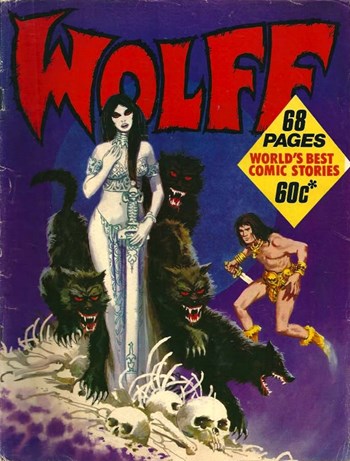
Aside from translation issues, the full series was only ever collected in English in a scarce Australian edition printed on newsprint in black and white:

So, most collectors would have to hunt down the original issues if they want to see what Wolff’s later adventures were. In other markets, a resurgence of interest in Esteban Maroto’s art have led to reprints like Espadas e Bruxas, but most English-speaking readers who want to admire Maroto’s work will have to content themselves with volumes like Lovecraft: The Myth of Cthulhu (2018).


Bobby Derie is the author of Weird Talers: Essays on Robert E. Howard & Others (2019) and Sex and the Cthulhu Mythos (2014).

Deep Cuts in a Lovecraftian Vein uses Amazon Associate links. As an Amazon Associate I earn from qualifying purchases.
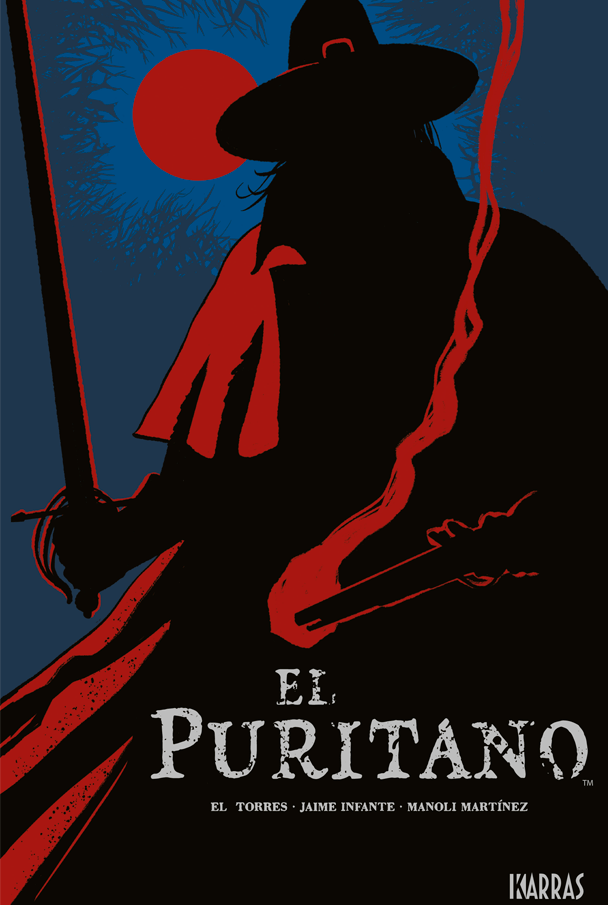
El Puritano (2021) by El Torres, Jaime Infante, & Manoli Martínez

¿Dónde está Bess?
El Puritano (2021)

“Where is Bess?” said Solomon Kane.
“Woe that I caused her tears.”
“In the quiet churchyard by the sea
she has slept these seven years.”
The sea-wind moaned at the window-pane,
and Solomon bowed his head.
“Ashes to ashes and dust to dust,
and the fairest fade,” he said.
—Robert E. Howard, “Solomon Kane’s Homecoming” (1936)

For any other pulp writer, Solomon Kane would be a breakout character. Robert E. Howard’s original pulp stories, even the unpublished drafts, fragments, and synopses, have been collected, published, translated into other languages, and recorded as audiobooks. Kane has been adapted to comics by at least Marvel, Blackthorne, Dark Horse, Diabolo Ediciones, and now Karras Comics. In 2009 a feature film titled Solomon Kane was released; no less an author than Ramsey Campbell handled the novelization, and Campbell had also previously completed some of Howard’s Solomon Kane fragments. There is a Solomon Kane roleplaying game, a Solomon Kane board game, toys and action figures, and bootleg t-shirts. Solomon Kane has even been borrowed into the work of other authors, like Paul Di Filippo’s “Observable Things.”

Few pulp characters can claim as much success in publication, commercialization, and longevity. Yet Robert E. Howard’s Solomon Kane has since the 1930s dwelled in the shadow of Conan the Cimmerian. While Solomon Kane was Howard’s first successful series character, Conan was easily his most popular, and the tales and poems of the Puritan swordsman are often discovered by readers after they have already been hooked by Conan.

El Puritano (“The Puritan,” 2021, Karras Comics) is an original graphic novel based on Robert E. Howard’s Solomon Kane, who has fallen into the public domain in Europe. The creators of this graphic novel are El Torres (script), Jaime Infante (pen & inks), & Manoli Martínez (colorist); the logo was designed by Ferran Delgado. While it is a standalone graphic novel in that the story is self-contained, the framing narrative makes this a kind of “second chapter” to Sangre Bárbara (2021) by El Torres, Joe Bocardo, & Manoli MartínezEl Puritano begins where Sangre Bárbara ends, with the former slave Mary Bohannon telling tales to a young Robert E. Howard, so while each stands on its own, taken together there is an episodic narrative…or perhaps it would be more accurate to say that Robert E. Howard’s own story, the narrative and mythology of his life, have been closely entwined with his characters so that he becomes the common bridging element between them.

Solomon Kane did not attract as much fan interest as Conan in the 1930s, ’40s, and ’50s, so there were fewer efforts to define a canonical chronology of his adventures—and indeed, Howard made no particular effort to set down a timeline; certain adventures clearly take place after others, because they refer to earlier events or Kane had acquired his strange cat-headed staff, but trying to fix real-world dates gets problematic. We never see Solomon Kane’s parents or home, we never get a fix for when he was born or how old he is; Kane steps onto the page, fully formed, and leaves the same way after completing his mission.

In El Puritano, El Torres and Jaime Infante have placed a much older but still spry Solomon Kane in the English colonies of North America. Various influences are at play here, some more obvious than others: Arthur Miller’s The Crucible (1956); Twins of Evil (1971), starring Peter Cushing as a witch-hunter; and The VVitch (2015) by director Robert Eggers all play their part in the mix, with little nods and homages to the various creators, actors, and storylines at play. Solomon Kane, the self-declared Puritan, is present in a colony of fellow believers, and yet he is apart from them. As it may be, since Howard noted:

All his life he had roamed about the world aiding the weak and fighting oppression, he neither knew nor questioned why. That was his obsession, his driving force of life. Cruelty and tyranny to the weak sent a red blaze of fury, fierce and lasting, through his soul. When the full flame of his hatred was wakened and loosed, there was no rest for him until his vengeance had been fulfilled to the uttermost. If he thought of it at all, he considered himself a fulfiller of God’s judgment, a vessel of wrath to be emptied upon the souls of the unrighteous. Yet in the full sense of the word Solomon Kane was not wholly a Puritan, though he thought of himself as such.
—Robert E. Howard, “Red Shadows”

The story that unfolds is a love letter to the character, with many references to past adventures without dwelling on them. Kane is faced once again with supernatural evil, and the need to defend an innocent young woman whose only crime may have been to love a witch. But Kane is also faced with his own conscience and past deeds—and how his own people, with all their superstition and ignorant faith, judge him and others. N’longa makes a surprising but very appropriate appearance, this time inhabiting the flesh of a Wampanoag woman, a kind of transgender experience that is at once novel and yet very fitting for the character.

Jaime Infante’s subdued, realistic artwork greatly compliments the script, and Manoli Martínez does some really notable work as a colorist, shifting the palette of the scenes to depict flashbacks, astral visitations, somber daylight, and vicious battle.

The story ends, not with Mary Bohannon talking to a young Robert E. Howard, but with Bob himself in his room, standing before the typewriter. The house still stands in Cross Plains, TX, now a museum with Bob’s room restored. You can see a Tour of the Robert E. Howard Home by Ben Friberg online, if you can’t get out there in person, and see it just as Infante tried to capture it on the page. Bob needs to write a story, and begins to type the opening words of “Red Shadows”…so it is both an ending and a beginning; what might be the last tale of Solomon Kane loops around as Howard records his legend. It begins and ends with Robert E. Howard.

El Puritano can be purchased from Karras Comics; they are working on other new works based on Robert E. Howard’s stories and characters as well.


Bobby Derie is the author of Weird Talers: Essays on Robert E. Howard and Others and Sex and the Cthulhu Mythos.

Deep Cuts in a Lovecraftian Vein uses Amazon Associate links. As an Amazon Associate I earn from qualifying purchases.
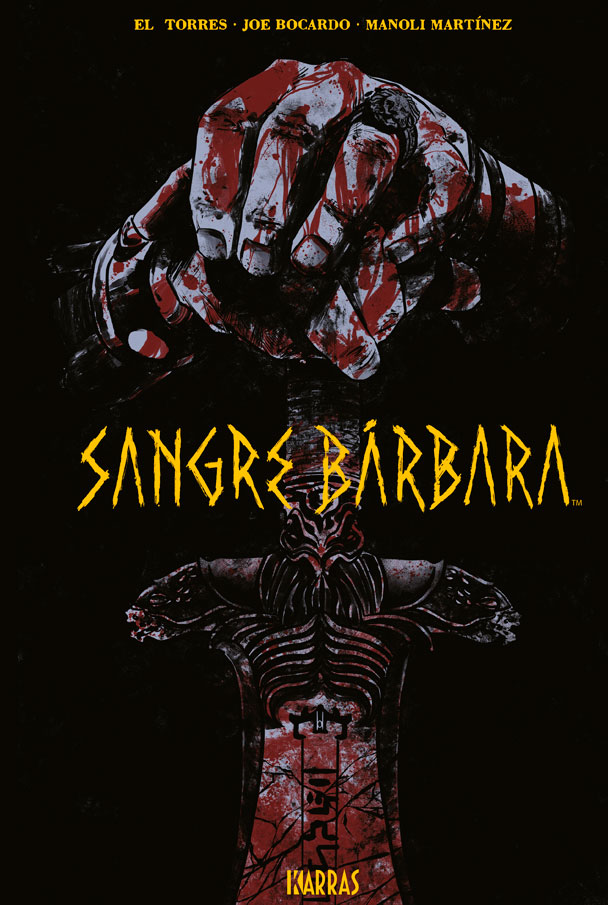
Sangre Bárbara (2021) by El Torres, Joe Bocardo, & Manoli Martínez

“Sabed, oh Principe…

“…que entre los años en que los océanos enguilleron Atlantis y sus resplandecientes ciudades, y el surgir de los hijoes de Aryas…

“…hubo una edad no soñada.”

Brillantes reinos se esparacían por el mundo como mantos azules bao las estrellas.

“Nemedia, Ofir, Brithunia, Hiperbórea…”

“Zamora, con sus mujeres de oscuros cabellos y sus torres plagadas de arácnidos misterios…”

“Zingara y su gallardía, Koth, que lindaba con las tierras de pastoreo de Shem.

“Estigia, con sus tumbas custodiadas por sombras.

“E Hirkania, cuyos jinetes vestían de acero, seda y oro.

“Pero el reino más orgulloso del mundo era Aquilonia, que reinaba suprema en el oeste.

“Ya hacía años que allí regia el poderoso Rey Conan, el cimmerio, aquel que fue guerrero, ladrón, pirata y saqueador antes que gran monarca.

“Y llegó el tiempo en que una sombra se agitó en las junglas Pictas que dormitaban al oesta de Aquilonia.”
“Know, oh Prince…

“…that between the years when the oceans engulfed Atlantis and her resplendent cities, and the rise of the sons of Aryas…

“There was an age undreamed of.”

Brilliant kingdoms spread across the world like blue mantles beneath the stars.

“Nemedia, Ophir, Brythunia, Hyperborea…”

“Zamora, with its dark-haired women and its towers plagued by arachnid mysteries…”

“Zingara and her chivalry, Koth, which bordered on the pastoral lands of Shem.

“Stygia, with its shadow-guarded tombs.

“And Hyrkania, whose horsemen wore steel, silk, and gold.

“But the proudest kingdom in the world was Aquilonia, which reigned supreme in the west.

“It had been years since the mighty King Conan, the Cimmerian, ruled there, the one who was a warrior, thief, pirate, and plunderer before being a great monarch.


“And the time came when a shadow stirred in the Pictish jungles that slept west of Aquilonia.”
Sangre Bárbara (2021, Karras Comics)

So begins Sangre Bárbara (“Barbarian Blood,” 2021, Karras Comics). It is a fitting opening, with a variation of the incipit that Robert E. Howard wrote for “The Phoenix on the Sword,” which was the very first Conan the Cimmerian story, and which ran as a masthead across the Marvel Conan the Barbarian comics for decades, and even ran in a slightly different form at the beginning of the Conan the Barbarian (1982) film that starred Arnold Schwarzeneggar. The opening sets the mood; it immediately places the reader in the time and place for the action, and then the story opens…

As with The Barbarian King 1: Le Spade Spezzate (2019) by Massimo Rosi & Alessio Landi and The Song of Bêlit (2020) by Rodolfo Martínez, this is an original work which takes advantage of the fact that Robert E. Howard’s characters and fiction have fallen into the public domain in Europe. The creators of this graphic novel are El Torres (script), Joe Bocardo (pen & inks), & Manoli Martínez (colorist); the logo was designed by Ferran Delgado.

Like The Barbarian King, Sangre Bárbara is set after the series of stories written by Robert E. Howard, giving the creators a freer hand in writing the adventure. Unlike that work, the principal character in the story is not Conan of Cimmeria…although he is still very much in the story…it is his son, the Prince Conan. A lean young man with the lean build and close-cropped hair of a boxer or legionnaire, scouting in the Pictish wilderness over the Aquilonian border, much as his father did in “Beyond the Black River.”

The story that follows wears several of its literary and artistic influences openly: the iconography of the 1982 film runs through the book like a river, from the cover to almost the last page. There is strong dedication to the original Howard texts, as shown in the opening. And there are hints of suggestions from the Marvel comics as well; I wouldn’t liken it to any kind of borrowing, but more of an inspiration: there was a storyline in Marvel’s Conan the King series titled “The Prince is Dead” which might have been the seed of this story…but Karras Comics takes the storyline much further than Marvel would ever have dared.

There is nudity, and there is gore; the writers and artist get away with it because they finally can—the same way the writers and artists of the French Glénat adaptations, and the Italian Leviathan Labs The Barbarian King books. Conan comics have almost always been a little more mature than the standard superhero fare, a little more bloody and sexy and visceral, but they have never been primarily ago either sex or blood. There are plenty of pornographic and horror comics that go in for plenty of each, if those are what readers want; so the trick for Conan comics nowadays is finding the right balance—in 2006, Dark Horse released a nude cover for Conan the Barbarian #24, and that was too much for some. In Sangre Bárbara, for the story being told and the atmosphere being set, it is certainly not much more explicit than in the 1982 film.

When reading this neo-Howardiana, it is interesting to see the choices that the writers and artists make in the depiction of the Hyborian Age. In this particular case, it is notable how racially diverse the cast is. Robert E. Howard held many of the racial prejudices one would expect of a young white man who grew up primarily in small towns in Texas; it was mentioned in the memoir One Who Walked Alone (1986) by Novalyne Price Ellis how Cross Plains was a sundown town. Some of this 1930s Texas racial stratification made it into Howard’s tales of the Hyborian Age—and some of that was continued in the Conan pastiches by other authors, which is why Charles R. Saunders wrote “Die Black Dog! A Look At Racism In Fantasy Literature” (1975, rev. 2011)—but they aren’t essential to it. Of course you can have Black characters in the Hyborian Age. Why not?

It is difficult not to compare Sangre Bárbara and The Barbarian King, since both works are branching off from similar premises, but they go about their work very differently. The Barbarian King is more acid sword & sorcery, heavier on the magic and the melancholy, the dream-like sequences and monstrous clash of color. Sangre Bárbara is much more gritty, subdued, and realistic; there is sorcery, but it isn’t bolts of flame erupting from fingertips, and the conflicts in the story are more complex than just a math problem of how many bodies can be piled up with a sword. There is a constant thread on the nature of civilization that runs through the story…right down to the last, and my favorite page.

As regards African-legend sources, I well remember the tales I listened to and shivered at, when a child in the “piney woods” of East Texas, where Red River marks the Arkansaw and Texas boundaries. There were quite a number of old slave darkies still living then. The one to whom I listened most was the cook, old Aunt Mary Bohannon who was nearly white—about one sixteenth negro, I should say.

Robert E. Howard to H. P. Lovecraft, c. Sep 1930, A Means to Freedom 1.44

This is, as far as I am aware, the first appearance of Mary Bohannon in comic book or graphic novel—and I like the sentiment, that to honor the past does not mean to be bound to every part of it irrevocably, and that the future remains to be written. The adventures of Conan are far from over, there are tales of the Hyborian Age left to tell—and maybe they will be a little more mature in more ways than just enough blood and nudity to ensure an NC-17 rating, but in what stories they tell and how, and how race fits into the age undreamed of. Certainly, this is a good start.

Sangre Bárbara can be purchased from Karras Comics; they are working on other new works based on Robert E. Howard’s stories and characters as well.


Bobby Derie is the author of Weird Talers: Essays on Robert E. Howard and Others and Sex and the Cthulhu Mythos.

Deep Cuts in a Lovecraftian Vein uses Amazon Associate links. As an Amazon Associate I earn from qualifying purchases.
The Barbarian King: Salomé (2020) by Barbara Giorgi & Nicolò Tofanelli


Salomé muore e arriva nell’Aldilà.

La vista dell’Inferno è così terrificante de spaventare a morte anche la strega.

Con le ultime energie rimaste stringe un patto con un demonio, un traghettatore di anime, prigioniero anch’egli degli Inferi.

Salomé gli dona parti del suo corpo e quel che rimane della sua anima per fuggire dall’Inferno. In cambio dovrà donare al demone un erede, ma fare patti con il Male ha sempre delle consequenze terribili.
Salomé dies and arrives in the afterlife.

The sight of Hell is so terrifying that it scares even the witch to death.

With her last remaining energy she makes a pact with a demon, a ferryman of souls, also a prisoner of the Underworld.

Salomé gives him parts of her body and what remains of his soul to escape from Hell. In exchange she will have to give the demon an heir, but making deals with Evil always has terrible consequences.
Back cover copy to The Last Barbarian: Salomé (2020)

One of the surprises in The Barbarian King 1: Le Spade Spezzate (2019) by Massimo Rosi & Alessio Landi was the appearance of Salomé, the witch-queen from Robert E. Howard’s Conan story “A Witch Shall Be Born” (Weird Tales Dec 1934). This was a surprise not only because of a tie-in with another classic Conan tale, but because Salomé was quite firmly deceased at the end of that episode, long before Conan won his kingdom of Aquilonia. So how did she show up in The Barbarian King?

To answer that, Leviathan Labs published a spin-off: The Barbarian King: Salomé (2020). The creative team for this effort was Barbara Giorgi (script), Nicolò Tofanelli (pencils/inks), Angelo Razzano (colorist), Massimo Rosi (editor), Mattia Gentili (letter), and Lucrezia Benvenuti (logo & map design). This graphic novel covers what happened to Salomé between the end of “A Witch Shall be Born” and her appearance to aid the stricken Conan in The Barbarian King 1.

Robert E. Howard did populate his Conan tales with various non-Conan characters, but he never wrote any separate adventures of Bêlit or Valeria, or of Conan’s grandfather or sons or daughters, so there was no exact precedent for spin-offs. Thus it should not be surprising that in the seventy-odd years of Conan pastiche stories and novels, and fifty-odd years of Conan comics, spin-offs for side characters are comparatively rare. Pasticheurs, faced with the choice of writing new Conan tales or new non-Conan tales set in the Hyborian Age, generally went with the former; although The Leopard of Poitain (1985) by Raul Garcia-Capella is a notable early exception, and The Song of Bêlit (2020) by Rodolfo Martínez focuses in large part on Bêlit, though it is still a Conan story at heart.

In comic books, Marvel was largely skittish about spin-offs, early in Conan the Barbarian‘s run Roy Thomas and Gil Kane had produced a “Tale of the Hyborian Age” backup feature, echoing the successful “Tales of Asgard,” but the idea was never repeated. As Thomas tells it:

So I enlisted Gil to do a “Tale of the Hyborian Age”—a series I’d hoped to use occasionally in the 52-page Conan to give Barry [Windsor Smith] a rest. “The Blood of the Dragon” introduced the concept (which may have been Gi’s idea, since we co-plotted the story) that, when the hydragon was killed, its human assassin was magically changed to take its place. I was always proud of the name “hydragon,” combining the mythical “hydra” and the word “dragon,” and intended one day soon to use the hydragon of the Bossonian Marches in an actual Conan story.

Roy Thomas, Barbarian Life. vol. 1, 76

Conan never faced the hydragon, and there would be no more “Tales of the Hyborian Age.” Instead, Thomas created Red Sonja—an original Hyborian Age character loosely inspired by Robert E. Howard’s Red Sonya of Rogatino from “The Shadow of the Vulture” (The Magic Carpet Magazine Jan 1934). Red Sonja would go on to become a character who could be the protagonist of her own series—or series of series—which are still ongoing as of this writing.

Leaving Red Sonja aside, there were very few non-Conan series to spin-off from the main line: Conan: The Book of Thoth (2006, Dark Horse), Age of Conan: Bêlit (2019, Marvel), Age of Conan: Valeria (2020, Marvel), and Bêlit & Valeria: Swords vs. Sorcery (2022, Ablaze) are the only other spin-off series centered on characters from the Conan line; one might add Robert E. Howard Presents Thulsa Doom (2010, Dynamite) which spun out of Dynamite’s Red Sonja comics, though the character shares little more than a name with Howard’s original creation. Even so, that is a rather sparse showing from the dozens of series and hundreds of Conan and Red Sonja comics produced.

Red Sonja probably gives a good explanation why: for all of the worldbuilding that was put into the Hyborian Age by Robert E. Howard and subsequent writers, many of the comic adventures made little use of this. Red Sonja and Conan often tackled monster-of-the-month in their individual comics, or adventured through cities and countries never named by Robert E. Howard, in what were effectively generic sword-and-sorcery stories starring familiar protagonists. Even when Marvel published both Conan and Red Sonja comics at the same time, the two series were not written with reference to one another; they were effectively standalone S&S series that only nominally shared the same setting.

The same issue is evident in the spin-off series based around Thoth-Amon, Bêlit, Valeria, and Thulsa Doom. Many of these stories were well-written and illustrated—Sana Takeda’s covers for Age of Conan: Bêlit are absolutely gorgeous—but for the most part, these stories veer fairly far from Howard’s original conception of the characters and often have limited continuity with the Hyborian Age in the series they’re nominally spinning off from. Readers interested in greater lore for the Hyborian Age, like readers of the Cthulhu Mythos that desire more fragments of the artificial mythology to fit into their puzzle, were disappointed.

The Barbarian King: Salomé certainly takes it liberties with the character and the setting—but it begins very faithfully to “A Witch Shall Be Born.” Salomé begins just as Howard and Conan had left her, dead and her schemes unraveled. What we get next is her afterlife, which Howard never depicted or wrote about, so the writer and artist had a very free hand. I rather suspect that a possible inspiration for the series was Claudia Chevalier Vampire (2004- , Pat Mills & Franck Tacito), which is a spin-off of the popular Requiem Chevalier Vampire (2000-2012, Pat Mills & Olivier Ladroit)—both series have an emphasis on Hell, violence, sexuality, and mature storytelling, with the spin-offs taking a prominent female supporting character and turning them into a protagonist to expand on their characterization and tell their story.

Salomé’s harrowing, and the physical and mental transformations of her character—something less than redemption—lead her very far from the character that Robert E. Howard created. Yet it does change her into exactly the strange, wan, damaged character who aids Conan in the pages of The Barbarian King. Nor do they ever lose sight of where Salomé came from; her own abandonment as an infanticide and rescue being important themes in her interactions with other characters.

In that sense, Salomé follows the same philosophy of The Barbarian King: Robert E. Howard’s work is the launching point from which the creators start, but they are pushing into new, unwritten territory…but not without losing sight of where they came from, or where they’re going. If you like The Barbarian King, Salomé is an interesting accessory that goes deeper into the background and character of an important supporting character.

The Barbarian King: Salomé (2020) is available from Leviathan Labs. Like The Barbarian King it is in Italian, with no English translation yet.


Bobby Derie is the author of Weird Talers: Essays on Robert E. Howard and Others and Sex and the Cthulhu Mythos.

Deep Cuts in a Lovecraftian Vein uses Amazon Associate links. As an Amazon Associate I earn from qualifying purchases.
The Barbarian King 1: Le Spade Spezzate (2019) by Massimo Rosi & Alessio Landi

Oggi Aquilonia has ottenuto la pace a caro prezzo e il Barbaro ormai è un vecchio stanco Re pieno di rimorsi, sognando il clamore della battaglia e l’adrenalina dell’avventura… questi sono tempi in cui il fuoco e l’acciaio potrebbero dettare le nuove leggi dell’uomo.

Today Aquilonia has obtained peace at a great price and the Barbarian is now a tired old King full of remorse, dreaming of the clamor of battle and the adrenaline of adventure … these are times when fire and steel could dictate the new laws of man.
— The Barbarian King 1: Le Spade Spezzate

Dead pulp authors can eternal lie, and in strange aeons many of their works may still be under copyright or have certain characters trademarks depending on the intellectual property laws of any given country. In Europe, the works of Robert E. Howard may be in the public domain, and because of that they are fair game for reprinting and reimagination. This applies both for prose works like the novel The Song of Bêlit (2020) by Rodolfo Martínez, and for comic books and graphic novels like French publisher Glénat’s gorgeous series of new adaptations of Robert E. Howard’s original stories of Conan the Cimmerian.

Comic books and graphic adaptations of the Cimmerian are intriguing because from 1970 to 1993 Conan (and other Robert E. Howard characters) were licensed to Marvel Comics, which provided a distinctive and iconic interpretation of the character—all the more so because the Conan comics were translated and published everywhere from Japan to Turkey. Marvel’s Conan the Barbarian was the most successful sword & sorcery comic of all time, with tie-ins to the 1980s Arnold Schwarzeneggar films, merchandise, and the lore of Robert E. Howard became intimately entangled with the Marvel Universe—including the Serpent-god Set, the Serpent Men, the eldritch entity Shuma-Gorath, the sinking of Atlantis, and by extension the Hyborian backstory of Varnae the Vampire and Kulan Gath, the villain of a popular X-Men event.

Marvel wouldn’t be the first to publish a Conan comic—La Reina de le Costa Negra in Mexico has that honor with its blond barbarian—nor the last, as Dark Horse held the license for many years. Yet Marvel’s Conan remains distinctive in fixing the barbarian’s appearance and some of his mannerisms and the development of his world. Even Dark Horse’s Conan under various artists and writers looked a bit more like the Marvel Conan than it did the original illustrations in Weird Tales, although the Frank Frazetta covers for the Lancer paperbacks in the 60s had their influence on both. Both Marvel and Dark Horse worked to both adapt Robert E. Howard stories and to publish new adventures of the barbarian, woven in and around his published career.

Which makes it really exciting to see how different creative teams handle the character.

The Barbarian King is an Italian-language series of fumetti (comics, equivalent to perfect bound graphic novels in the United States) from publisher Red Dragon and Leviathan Labs. The creative team for the first volume, Le Spade Spezzate (“The Broken Swords”) is Massimo Rosi & Alessio Landi (script); Luca Panciroli, Federico de Luca, & Alessandro Bragalini (pencils, ink, & layout); Marco Antonio Imbrauglio (colorist); Enrico Santodirocco (editing); Mattia Gentili (letterer); and Lucrezia Benvenuti (logo & map design).

In adapting Conan to comics there are traditionally two routes to take: adaptation of the original stories or the creation of new works that are based on past works and/or the same characters—Marvel also had a habit of adapting some non-Conan Robert E. Howard stories, non-Robert E. Howard Conan stories, and even some non-Conan sword & sorcery stories as Conan comics. One reason Marvel could “get away” with this is because they took a very different approach to continuity than Robert E. Howard did.

By the time Marvel got Conan, essentially all of his adventures had been published. These were initially written and published out of chronological order; Robert E. Howard was not setting out to create a single sprawling epic novel like The Lord of the Rings or The Odyssey, the adventures of Conan were written and published out of order, telling different stories from different periods of Conan’s life. This freed Howard from any strict timeline of events, much as the Hyborian Age—as a prehistoric hodgepodge of different places and eras—allowed him the freedom to shift setting and tone. Conan could be in a young thief in police procedural one story (“The God in the Bowl”), then an experience adventurer in a pirate story (“The Treasure of Tranicos”), then a king of a mighty nation overthrowing usurpers in a medieval war (The Hour of the Dragon), and it was up to the fans to piece together a probably outline of Conan’s career…which a couple of early fans did in the 1930s, and which other fans have added to or revisited ever since.

Marvel and to a degree Dark Horse would use these outlines as the skeleton on which to build their own storylines. By starting more or less linearly from the beginning of Conan’s career, they could intersperse Robert E. Howard adaptations with original storylines, follow the trace of Conan’s journeys and develop additional characters and plots—sometimes expanding on what Howard and others had written, sometimes adding new elements, even borrowing from the Cthulhu Mythos or staging crossovers. As a method, this has the advantage in that the Conan comics often had a kind of narrative flow that is usually missing from monthly comics in the United States: you can often literally trace Conan’s travels on the map of the Hyborian Age.

It also allows the development of series characters—sidekicks, reoccurring antagonists, etc.—which are almost entirely absent from Howard’s stories. Robert E. Howard’s Conan is not like Michael Moorcock’s Elric to have a Companion to Champions along for the ride for several subsequent adventures, neither does he have the same lover or enemy. Stygian sorcerer Thoth-Amon as Conan’s arch foe is entirely a creation of later writers; they never even meet in “The Phoenix on the Sword,” or in any other Howard story (although Conan runs afoul of the wizard’s deeds in “The God in the Bowl”). Conan’s habit of killing every wizard he meets and always ending the story with a different girlfriend was one of the major critiques laid against the pulp hero—but in the comics, many more encounters could be planned and carried out, more tension built up, relationships would have more lasting impact because they lasted longer from issue to issue and story to story.

The Howard’s Conan chronology ends, effectively, with The Hour of the Dragon. There he is king, he has survived multiple attempts on his life and rule, and he is going to take as queen the young woman Zenobia. No Howard stories are set after this point, though other authors and comics picked up at this point because it is a natural gray area: anything can happen, because nothing more is written after this point! Conan could even die—an impossibility in earlier tales, because of course he has to survive for the next adventure that is already planned out.

So after the events of The Hour of the Dragon is where The Barbarian King picks up.

King Conan is conspicuously different in this incarnation than the Marvel or Dark Horse versions: heavier, hairier, with grey streaks in his beard and scars on his face. While Conan comics have often been a bit more mature than others on the stands, able to get away with more gore and nudity than most comics, The Barbarian King leans into both more than most, but less for exploitation than because this is a very different, darker, more mature story than more readers will be familiar with and occasionally gritty, multi-media artwork fits the tone.

If acid sword & sorcery is a thing, this might be it.

When Roy Thomas and other writers began to adapt Conan to comics in the 1970s, they did so in part with the guidance of L. Sprague de Camp; de Camp had inserted himself into the editing of Robert E. Howard’s Conan stories, and had written several Conan pastiches, finished various fragments and synopses, and expanded the outline of Conan’s career. He didn’t do this for free or even directly, and Roy Thomas is frank about their relationship in his great memoir Barbarian Life: A Literary Biography of Conan the Barbarian, but de Camp’s influence was still strong on the series. Dark Horse’s comics, on the other hand, were published after a revolution in Howard studies & publishing had strongly emphasized the publishing of the original, unedited Robert E. Howard texts and the decline of pastiche—so show fairly less influence from de Camp—but they still follow Campian certain trends, like the emphasis on Thoth-Amon as an archvillain.

The Barbarian King ignores de Camp more or less entirely. Rather than setting Thoth-Amon up as the villain, they turn to one of the most iconic Conan stories of all time: Yara from “The Tower of the Elephant,” who has escaped from his prison and is now in command of new and inhuman powers from the Cthulhu Mythos to revenge himself on the barbarian king. This crossover isn’t the first time the Mythos have entered a Conan story (Robert E. Howard himself included explicit refrences to Lovecraft’s Mythos in the first draft of “The Phoenix on the Sword”), but it set the tone for the series as it develops: this is sword & sorcery with a strong blend of horror into the mix.

If The Barbarian King avoids de Camp and Marvel’s legacy for the most part, the influence of the 1982 film Conan the Barbarian is still very obvious, in theme, language, and occasional artistic flourishes that call back to the iconic Atlantean sword. Perhaps some of the costuming and nudity may also be reminiscent of 1980s Italian Sword & Sorcery films that were inspired by Conan, such as the Ator series or Sangraal…or perhaps not; the artists and writers on this project are obviously keen on the genre, but this is a Robert E. Howard project through-and-through.

Il desiderio era fondere il Fantasy Eroico Howardiano con un qualcosa di quasi Lovecraftiano e Barkeriano, cosa che immaginai quando lessi i VERMI DELLA TERRA con Bran Mak Morn la prima volta, nonché flavour che ho ritrovato da poco in Britannia di Milligan e Ryp, ad esempio.

The desire was to blend Howardian Heroic Fantasy with something almost Lovecraftian and Barkerian, which I imagined when I first read WORMS OF THE EARTH with Bran Mak Morn, as well as the flavor I recently found in Milligan and Ryp’s Britannia, for example.
—Massimo Rosi, “Intervista a Massimo Rosi a cura di Italian Sword & Sorcery” in The Barbarian King 1: Le Spade Spezzate

The story is brutal enough in some places to edge toward grimdark, although I don’t think the story is amoral or dystopian in that sense. It is definitely less reminiscent of Howard’s more high-hearted hero and more Conan in his darker and broodier moods, pushed in directions that Howard would never have dared take him in the pulps—and in that respect, I think, the series is highly reminiscent to the new Elric graphic novel adaptions being published by Titan books beginning with The Ruby Throne. Comic storytelling can be grittier and more explicit now than ever before, and in revisiting these characters these writers and artists are pushing the limit a little, going beyond just the words in old paperbacks and pulp magazines…and there’s nothing wrong with that.

Questo è il Re Barbaro! E sono sicuro che lo riconoscerete nell’albo che stringete ta le mani, perché gli autori che lo hanno realizato sono figli di Cimmeria e hanno compreso da temp il segreto dell’acciaio; ad animarli è la passione per le battaglie e per le donne; a contraddistinguerli uno lo spirito libero, sprezzante della censura e del politically correct. Chi sono io per dirlo? Son il cronista delle loro imprese e brindo alla loro gloria. Ma ora, bando alle ciance, è tempo di tornare nel mondo hyboriano.

Buona lettura cimmeri!

This is the Barbarian King! And I’m sure you will recognize it in the book that you hold your hands, because the authors who made it are sons of Cimmeria and have long understood the secret of steel; to animate them and the passion for battles and women; to distinguished by a free spirit, contemptuous of censorship and political correctness. Who am I to say? I am the chronicler of their exploits and I toast to their glory. But now, no more chatter, it’s time to go back to the Hyborian world.

Happy reading Cimmerians!
—Enrico Santodirocco, “Introduzione” in The Barbarian King 1: Le Spade Spezzate

A preview of the first few pages of The Barbarian King can be read for free on Issuu, and there is a video trailer on Facebook. While The Barbarian King is not yet available in English, the series and its art volumes can be purchased from Leviathan Labs, and some translations into other languages are available; O Rei Bárbaro (2019) for example is in Brazilian Portuguese and printed in black and white.


Bobby Derie is the author of Weird Talers: Essays on Robert E. Howard and Others and Sex and the Cthulhu Mythos.

Deep Cuts in a Lovecraftian Vein uses Amazon Associate links. As an Amazon Associate I earn from qualifying purchases.
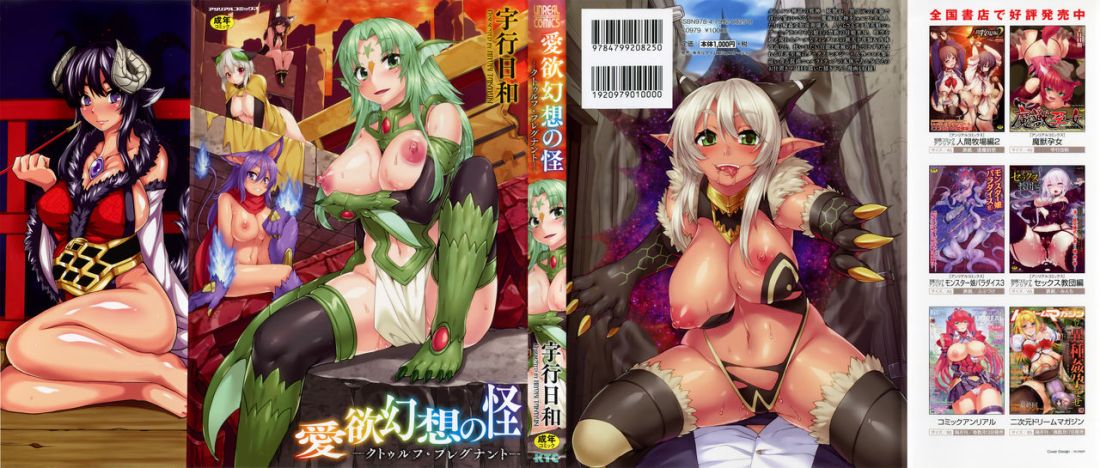
The Mystery of Lustful Illusion -Cthulhu Pregnant- (2015) by Takayuki Hiyori (宇行 日和)

Eldritch Fappenings

This review deals with a work of pornography, and the history of erotic art and writing. As part of this review, selected images with cartoon depictions of genitalia and/or sexually explicit contact will be displayed.
As such, please be advised before reading further.


愛欲幻想の怪~クトゥルフ・プレグナント~ (The Mystery of Lustful Illusion -Cthulhu Pregnant-) by Takayuki Hiyori (宇行 日和) is a 2015 Japanese tankōbon hentai manga published by Unreal Comics (アンリアル). This book is divided into ten chapters, each of which contains a fully-illustrated and sexually explicit Cthulhu Mythos story.

In art style, the book is geared more toward erotic comedy than erotic horror; and many of the Cthulhu Mythos entities within are presented as monster girls. Takayuki Hiyori had been previously known for their dōjinshi based on popular monster girl harem manga Monster Musume, and their manga are essentially a pornographic parallel to the mostly non-explicit books like Monster Girl Encyclopedia II (2016) by Kenkou Cross (健康クロス).

Cthulhu_TOC

In terms of writing and storytelling, The Mystery of Lustful Illusion -Cthulhu Pregnant- is a disconnected collection of short works, much like most Lovecraft story collections or Lafcadio Hearn’s classic collection Kwaidan. There is no larger overarching story of narrative, the major appeal of the work being simply that it uses the Cthulhu Mythos for these erotic stories and sexualized versions of eldritch entities like Cthulhu, Hastur, Shub-Niggurath, the Deep Ones, the Hounds of Tindalos, and the Cats of Ulthar.

The contents are aimed toward some well-established tropes and kinks: as the title might imply, impregnation is a fairly significant theme in many of the stories, but there are also instances of multiple penetration, sex work, incest, nonconsensual sex, body transformation or modification, breast expansion, group sex, large genitals, etc. Readers familiar with tentacle erotica might wonder if such appendages play their part, as they do in Le Pornomicon (2005) by Logan Kowalsky, but in truth they don’t play a significant role in the proceedings.

Cthulhu_CalloftheAbyssIn point of fact, The Mystery of Lustful Illusion -Cthulhu Pregnant- is difficult to distinguish from Monster Musume or Monster Girl Encyclopedia products. While Takayuki Hiyori uses references to the Cthulhu Mythos in the crafting and telling of the stories, the manga itself is pretty straight forward monster girl erotica, and aimed more directly at that audience than Lovecraft fans. The depictions of the various Mythos entities is mostly original, but skewed toward “mostly human with a few non-human traits”—the Cats of Ulthar, for example, are indistinguishable from the generic manga or anime “catgirl,” with their primary feline traits being cat ears and tail on a nubile young woman’s body. Eldritch horrors are hinted at but seldom realized.

The contents of this book might be generally compared to the more sexually explicit chapters of The Elder Sister-like One by Pochi Iida (飯田ぽち。), but where Pochi is telling an extended narrative with a few characters with extended character development and exploring emotions, Takayuki Hiyori is necessarily more episodic, with varied content and swift-moving stories that tend to get to the sexual action fast, dwell on them for the majority of the length of the chapter, and come to a relatively swift conclusion.

Cthulhu - Ulthar

Arguably the most fun chapter in the book is a variation on “The Cats of Ulthar.” While the forms the cats take are stereotypical for hentai manga, and the results are pretty much what you might expect, it both pays homage to Lovecraft’s original work while playfully subverting aspects of it. One might compare it in some ways to the “erotic” versions of classic horror novels which achieved a bit of notoriety in the 1970s, like The Adult Version of Frankenstein and The Adult Version of Dracula by “Hal Kantor” (Ed Wood, Jr.). Erotic retellings of Lovecraft aren’t exactly new—for example, “Herburt East: Refuckinator” (2012) by Lula Lisbon—but illustrated or graphic adaptations are relatively scarce.

愛欲幻想の怪~クトゥルフ・プレグナント~ (The Mystery of Lustful Illusion -Cthulhu Pregnant-) by Takayuki Hiyori (宇行 日和) has not been officially translated into English or published in the United States; perhaps some company like FAKKU might do so in the future and make it more widely available. Until then, those interested in the Japanese original can still find copies available from retailers online.


Bobby Derie is the author of Weird Talers: Essays on Robert E. Howard and Others and Sex and the Cthulhu Mythos.

Deep Cuts in a Lovecraftian Vein uses Amazon Associate links. As an Amazon Associate I earn from qualifying purchases.