Derivative works all share a connection with the parent work. Every story with Cthulhu derives, directly or indirectly, from Lovecraft’s “The Call of Cthulhu.” Every story with Conan the Cimmerian derives from the original stories written by Robert E. Howard. From the humble pages of Weird Tales have spun out thousands of creative works in a dizzying array of media—short stories, novels, comics (strips, books, magazines, and graphic novels), cartoons, live-action and animated films, music, paintings, sculptures, toys, video games—and one of the key thing to remember about these works is that they aren’t being created in a vacuum, but in communication with one another.
The Atlantean sword in the film Conan the Barbarian (1982) owes nothing to anything in the stories of Robert E. Howard; the closest the Texas pulpster managed to a special weapon was in the first Conan tale, “The Phoenix on the Sword,” and that sword was broken in the course of the story. Some of the pastiche tales and comic book stories that followed included magic weapons, but none of them served as the immediate inspiration for the Atlantean sword in the film either. Nevertheless, the sword featured extensively in the poster and marketing materials for both Conan the Barbarian and its sequel Conan the Destroyer (1984)—and, unsurprisingly, was represented fairly faithfully in the Marvel Comic adaptations of the films.
Art by Bob Camp
For many years, outside the movie continuities, the Atlantean sword was not a key feature of most Conan media. While it continued to have lingering appeal because of the tie to the film—including multiple weapon makers providing official or bootleg versions of the sword for fans and collectors—publishers like Marvel and Dark Horse did not lean into that aspect of the film iconography.
More recently, however, the iconic Atlantean sword has seen increased placement in both official and unofficial Conan media. The latest Conan comics published by Titan have deliberately leaned into a melding of the iconic looks of previous incarnations of the Cimmerian, drawing both from the John Buscema/Ernie Chan era of Marvel Comics as well as the 1982 film. It’s little surprise that when Conan does actually go to Atlantis in Conan the Barbarian #11, the Atlantean sword—or at least a good facsimile—makes an appearance.
Art by Roberto de la Torre, Color by Diego Rodriguez
Outside of the official comics, works produced in areas where the Conan the Cimmerian stories by Robert E. Howard have fallen into the official domain have had fewer qualms about borrowing the iconic imagery of the Atlantean sword. Such is the case for Sangre Bárbara (2021) by El Torres, Joe Bocardo, & Manoli Martínez, and such is also the case for Conan de Cimmeria (2021) by the creative team of Ángel Gª Nieto (writer), Julio Rod (artist), & Esteban Navarro (colorist).
Hace mucho tiempo, en una era no soñada, caminó Conan, el Cimmerio, que a lo largo de su turbulent existential vivió multiud de fastuosas adventuras.
Dejadme que os cuente cual cronista de un tiempo olvidado sus grandes y magníficas hazañas, que lo convertieron en Leyenda.
Long ago, in an age undreamed of, walked Conan the Cimmerian, who throughout his turbulent life lived a multitude of magnificent adventures.
Let me tell you like a chronicler of a forgotten time his great and magnificent exploits, which made him a Legend.
Conan de Cimmeriais a standalone Spanish-language graphic novel that tells three original stories based on the Conan character created by Robert E. Howard, each one telling a brief adventure of the Cimmerian at a different point in his career. It is essentially identical in general form and intent to the majority of comics produced officially by the owners of the Conan trademarks, just produced independently. The prominent usage of the Atlantean sword in the first story, “La Forja del Destino” (“The Forge of Destiny”), is perhaps the most notable artistic callback to other Conan-related works, but the book also appears to draw inspiration from the classic Marvel comics, while still taking the opportunity to present an original—if recognizable—version of the barbarian.
The stories are a bit more violent and bloody than the classic Marvel Comics, but not so gore-filled as to detract from what are essentially pulpy adventure tales; there is one scene with the topless corpse of a woman, but other than that, there is no nudity or sex. It is the kind of Conan comics that could please everyone from 13 to 93 in terms of being exactly what it sets out to be: the kind of broad-appeal Conan comic that is reminiscent and evocative of what has come before, but which is distinctly original, an addition to the Conan cycle that is respectful of the source material.
In an era when properties falling into the public domain often leads to a splurge of derivative trash that pays little to no respect for the original, it’s nice to find examples of works where the creators basically want to use the stories to create new tales of character they like, int he style in which they’d like to read them.
The first fandom of Robert E. Howard’s Conan of Cimmeria arose in the 1930s, when the adventures of the barbarian were published in the pages of Weird Tales. Some fans, including R. H. Barlow, Emil Petaja, Charles B. Hornig, Alvin Earl Perry, and P. Schuyller Miller wrote to Howard—and the Texas pulpster wrote back, answering questions, sometimes gifting manuscripts of his stories, subscribing to fan publications like The Fantasy Fan, and providing unpublished stories and poetry for fanzines like The Phantagraph to publish as well.
This early interaction with fandom endeared Howard to his fans, and helped provide the basis for the first fan-publications, like Miller & Clark’s “A Probable Outline of Conan’s Career” in The Hyborian Age (1938), a one-shot zine published after Howard’s death by eager fans and containing Howard’s worldbuilding-essay of the same name. However, early desires to publish a collection of Howard’s Conan stories came to naught in the 30s; while the Texan had fans, he lacked anyone with the entrepreneurial spirit to start their own publishing business like August Derleth and Donald Wandrei did when they established Arkham House in 1939 to print the work of H. P. Lovecraft, who died the year after Howard passed away.
Following Howard’s death in 1936, his works passed to his father, Dr. I. M. Howard, who survived his son; Dr. Howard largely entrusted his son’s literary legacy to his agents, the Otis Adelbert Kline Agency, and several previously unpublished works appeared in the pages of Weird Tales, which continued to pay Dr. Howard the monies they owed his son. Still, within a few years publications dwindled, and no new Conan material was forthcoming in the 1930s. One by one, the first caretakers of Howard’s legacy passed: Farnsworth Wright, editor of Weird Tales, died in 1940; Dr. Howard joined his wife and son in 1944; Otis Adelbert Kline passed away in 1946. Dr. Howard willed the rights to his son’s material to his friends the Kuykendalls, and Kline’s agency was taken up by his associated Oscar Friend. Slowly, new published opportunities emerged.
In 1946, Arkham House published the collection Skull-Face and Others, and in 1950 Gnome Press published Conan the Conqueror, the first in a series of Conan titles. These collections in hardcovers weren’t just found new fans—and a more organized fandom. The first fanzine devoted to Howard’s creation was Amra, which began publication in 1956, and fan Glenn Lord got the ball rolling on Howard scholarship with The Howard Collector, founded in 1961. In the late 1960s and 70s, paperback reprints of these books exploded in popularity, part of the rise in paperback fantasy that included the Hobbit and The Lord of the Rings by J. R. R. Tolkien, and the Ballantine Adult Fantasy series that began in 1969.
In 1970, Marvel Comics published the first Conan the Barbarian comic, adapting and expanding his adventures into a new medium. The series and its sister magazine title Savage Sword of Conan would run for decades, drawing comic fans to read the stories as much as they drew fans of Howard’s fiction to buy the comics. In 1982 when the film Conan the Barbarian starring Arnold Schwarzenegger in the title role appeared on screens, it was swiftly followed by a tie-in comic from Marvel’s Conan creative team.
All of this increased fan activity, such as the Hyborian Legion and the Robert E. Howard United Press Association (founded in 1972). Conan was no longer an obscure hero from the pages of Weird Tales; the Cimmerian had become a staple of science fiction and fantasy, an archetype of barbarians, fighters, and rogues, a multi-media figure well-known and established in fandom—and the serious critical study of Robert E. Howard’s life and fiction were picking up, echoing the scholarly interest that Lovecraft had attracted a decade earlier.
Which is where things stood when fan Anne Braude wrote the jocular (but largely accurate) “Ballad of Conan” for the Conan-heavy issue of the fanzine Niekas in 1983. Drawing on the canonical Conan tales then widely available in paperback, rather than the comics adventures or the recent film. Unlike “I Remember Conan” (1960) by Grace A. Warren, this is tongue very much in cheek, showing someone familiar with the material but decidedly irreverent. All in good fun.
South of Stygia are the vast black kingdoms of the Amazons, the Kushites, the Atlaians and the hybrid empire of Zembabwe. —Robert E. Howard, “The Hyborian Age”
The Hyborian Age of Conan the Cimmerian was no mythical white space, occupied only by pale Caucasians. In formulating the adventures of the Cimmerian, Robert E. Howard drew on everything he knew: Conan’s travels encompass not just a fantasy geography, but chronologies and genres. The barbarian might find himself leading a battle of European-style medieval knights; on the deck of a ship whose pirates could have stepped out of Robert Louis Stevenson’s Treasure Island; in a frontier wilderness fort reminiscent of pioneer Texas; in a stone temple that might have stood in some fantastic vision of ancient Egypt—and in a fantasy equivalent of Africa, populated by Black people, who were to Conan’s friends, allies, enemies, and lovers.
The Conan stories, while fantasy and aimed at Weird Tales, grew out of Howard’s love for history and adventure fiction, and writing historical adventure stories for magazines like Oriental Stories. The conceit of the Hyborian Age is that by setting it before any known period, Howard had a free hand to invent details that would otherwise trip him up if trying to write a realistic historical yarn.
For pulps like Adventure, accuracy was paramount; the magazine prided itself on publishing stories from people who knew their subject, who had gone out and lived in exotic lands, and returned to tell the tale. To that end, Adventure invited readers to write in with their questions, for Adventure’s stable of writers to answer. In September 2024, scholar Patrice Louinet came across a letter printed in a copy of Adventure (30 December 1923):
White Man and Native of West Africa
HAUSAS—trading-factory terms—marriage ceremonies and customs:
Question:—”I am writing to get some information in regard to the customs, habits, etc., of the natives of that part of Africa which is included in your section in ‘Ask Adventure.’
Are the natives of a war-like stock? That is, did they come from a fighting race?
How much authority does the superintendent of a trading-post possess?
Do the whites interfere with the natives in dealing with native criminals?
What are some of the punishments of native wrong-doers by the whites? By the natives themselves?
What are some marriage customs among the natives? Am I right in supposing a native has full power to punish his wife in any way he pleases?
Have the morals of the African natives been raised by the rule of the white men or have they decreased in standard?
Is the ceremony of Mumbo-Jumbo—or something of some name like that—for the correcting of disobedient women used in that part of Africa? If so, how is it carried out?
What is the customary costume of the natives?
I apologize for asking so many questions, but I am very much interested in Africa. If by any chance this letter should be published in Adventure, please do not print my name.” —R.E.H., Cross Plains, Texas. Text from REH.world.
This would be Robert E. Howard of Cross Plains, Texas—and if the questions of a 17-year-old boy seem somewhat ignorant, it must be remembered that knowledge of Africa was by no means widespread in the rural United States during the 1920s and 30s. For many years and even decades to come, Africa would be the metaphorical “dark continent,” whose peoples, geography, and history were intermixed with fantasy, racism, and plain ignorance. Howard’s questions were honest ones, and it is to his credit that he sought out answers instead of immediately falling back to stereotypes and fantasy when he wrote his first few African stories.
The Conan boom in the 1960s and 70s brought with it not just an increased admiration for Robert E. Howard as a writer and Conan the Cimmerian as a character, but new criticism and new sensibilities. As Marvel Comics adapted Howard’s character and stories to a new medium, they had to face the reality that this was a new world: the Civil Rights movement had won victories with the decision in Brown vs. the Board of Education (1954) and the passage of the Civil Rights Act of 1964. Black Pride and other movements raised awareness of the roots of the African diaspora in the United States and surrounding countries.
Adaption to this new reality was, at first, slow. “The Vale of Lost Women”(1967) by Robert E. Howard is one example of how 1930s stereotypes and prejudice found an unwelcome audience in the 1960s and 70s, and how later writers and artists worked to make this work acceptable to a contemporary audience of all races. Not every creator was so conscientious; in 1975, Black fan Charles R. Saunders wrote “Die Black Dog! A Look At Racism in Fantasy Literature.” While it was one thing for something Robert E. Howard, who died in 1936 and never lived to see the changes in US society, to rely on racial stereotypes the essay specifically called out latter-day creators of Conan pastiche for continuing to use such lazy and biased storytelling nearly four decades later.
Just because Charles R. Saunders called out writers of heroic fantasy doesn’t mean he stepped away from the genre; quite the opposite. In 1980, Saunders published two related essays: “Hyborian Africa” was published in the fanzine Paragon #1 (May 1980), and “To Kush and Beyond: The Black Kingdoms of the Hyborian Age” was published in Savage Sword of Conan #56 (Sep 1980). Both essays deal with similar subject matter: an exploration of the “Black Kingdoms” mentioned in Howard’s essay “The Hyborian Age,” references to which are sprinkled throughout Conan’s adventures. However, the purpose and approach of each essay is different.
The historical derivation of the lands south of Stygia, the Black Kingdoms, are less obvious. Nonetheless, a look at any reference work on African history quickly exposes Howard’s inspirations for the names of some of his Black Kingdoms, if not their cultural backgrounds [.] Kush, Punt, Darfar, Zembabwei and Amazon are names as familiar to African scholars as those of Poland, France, Spain and Italy are to students of the European past. —Charles R. Saunders, “Hyborian Africa,” Paragon #1 (1980), 27
“Hyborian Africa” looks at the historical sources and inspiration behind Howard’s stories. Given that this was a fanzine and that Howard studies was in its infancy, the usual apparatus of scholarly writing is neither present nor expected: no footnotes, no bibliography. However, Saunders’ care in the article is evident. He addresses only the stories written by Robert E. Howard, not later pastiches or derivative material from the Marvel comic books. It is brief, at only a little over two pages, but the history offered is largely accurate…and if Saunders criticizes some of Howard’s depictions of these fantasy versions of African kingdoms, he also offers a parting observation:
Although Howard’s depictions of Hyborian Age blacks consisted primarily of stock racist stereotypes, he did do more research into African history than such contemporaries as Edgar Rice Burroughs. Even today, the mention of the wor[d] “Kush’ would draw only blank stares from most people. With the exception of Darfar, Howard’s historical foundations for his Black Kingdoms were as solid as those of the rest of Conan’s world. And this is to his credit. —Charles R. Saunders, “Hyborian Africa,” Paragon #1 (1980), 29
“To Kush and Beyond: The Black Kingdoms of the Hyborian Age” was published as a literary exploration of the Black Kingdoms as they appear in the broader Conan mythology, which includes not just Howard’s stories but also stories that were completed or re-written by L. Sprague de Camp and Lin Carter like “Hawks over Shem,” “The Snout in the Dark,” and “The City of Skulls.” In adapting Conan stories to comics, Marvel had included some of de Camp and Carter’s creations, including Conan’s ally Juma the Kushite, and so Saunders incorporates that lore into his survey of the Black Kingdoms of the Hyborian Age. Saunders’ work provided an explanation and codification of lore on the world of Conan that both readers and writers could reference.
Being published in a comics magazine, Saunders’ essay was illustrated by Conan artists John Buscema and Gene Day, and being of a scholarly character includes a page of endnote citations, for a total of 7 pages. Saunders’ interest in African history is still present, though less explicit. In the closing paragraph, for example, he writes:
The cataclysm that formed the outlinees of the modern world separated the land south of the River Styx from the rest of the world, and raised up from the sea the entire west coast of what is now Africa. Much of the history and lore of the Black Kingdoms perished in the disaster—yet the Black Kingdoms did not truly die. Kush, Darfar and Punt rose again in historical times, and the West African Kingdom of Dahomey boasted a formidable corps of Amazon warriors. Like so many other nations and races, the African can trace their history “back into the mists of the forgotten Hyborian Age….” —Charles R. Saunders, Savage Sword of Conan #56 (1980), 54
While the two essays have very different purposes, considered together gives the sense that Charles R. Saunders wasn’t just chronicling the lore of the Hyborian world and glossing it to make it fit. Saunders was studying the work of Howard and other writers to see how they used Black characters and African history in their stories, for good or for ill—and he used those lessons when he wrote his own fiction, the kind of heroic fantasy series that he wanted to read.
Saunders combined his interests in African history and heroic fantasy in his own fiction, including the Dossouye stories about fantasy warrior-women that were first published in the anthology Amazons! (1979), and the Nyumbani setting stories that feature his hero Imaro—who would star in Saunder’s first novel, Imaro (1981). These are the critical early stories of Sword & Soul (see Milton J. Davis’ A Sword and Soul Primer), and they represent a desire to look beyond what other people have written to what stories have not been written, that need to be written, and to write them.
Conan the Cimmerian first appeared in “The Phoenix on the Sword” by Robert E. Howard in Weird Tales (Dec 1932); his immediate literary antecedents were Conan the Irish Reaver in “The People of the Dark” (Strange Tales of Mystery and Terror Jun 1932), and the Atlantean barbarian Kull, who last appeared in “Kings of the Night” (Weird Tales Nov 1930). Like most of Howard’s heroes, Conan was male, and the gender politics of the Hyborian Age tended to be a combination of 1930s Texas and various historical periods and cultures as Howard understood them. There were warrior-women in Howard’s stories: Bêlit, the Queen of the Black Coast; the Valeria of the Red Brotherhood; Red Sonya of Rogatino; and Dark Agnes de Chastillon—but savage as they might be with sword or pistol, these were not barbarians per se, and they were always exceptions in male-dominated settings.
Howard wasn’t alone in producing warrior-women for his fantasy and weird adventure stories, with C. L. Moore’s Jirel of Joiry (who first appeared in “Black God’s Kiss” (1934)) being a notable peer to Conan in the pages of Weird Tales. Yet the Cimmerian’s popularity won out, and influenced generations of later media, from pastiche stories and novels to comics, beginning with Marvel’s Conan the Barbarian in 1970, and film, with Conan the Barbarian starring Arnold Schwarzenegger in 1982.
Many of these adaptations included warrior-women as well. Red Sonja was created by Roy Thomas and Barry Windsor-Smith as a foil for the Cimmerian in the pages of Conan the Barbarian, and went on to an extensive career of her own. Valeria (played by Sandahl Bergman) in the 1982 film served as Conan’s ally and later lover. Later sword & sorcery works sometimes focused on female barbarians, such as Hundra (1983), Red Sonja (1985), Barbarian Queen (1985), Amazons (1986), Stormquest (1988), and Barbarian Queen II: The Empress Strikes Back (1990), but these were mostly poor pastiches that often captured the fur-bikini aesthetic but little to nothing of the character or power of Howard’s warriors, men or women.
So when French director Bertrand Mandico set out to make a film that took the popular conception of the ultramasculine figure of Conan and turned it on its head by making the barbarian female, that was an interesting premise. The resulting film is Conann, released to English audiences as She Is Conann, is a 2023 French-language film written and directed by Mandico.
However, the key aspect of this film is less Howard’s hero, and more Mandico’s definition of barbarism:
I wanted to make a film about barbarism, and tell what is for me the height of barbarism, it’s old age killing youth. So, in the figurative sense, physically, but at the same time, symbolically, by betraying convictions, etc. So I started with this idea and I invoked Conan, the character from Howard’s novels. I even went back to the source that inspired Howard. It’s a character from Celtic mythology named Conan with two n’s who was surrounded by dog-headed demons. I started from this mythology to traverse time, eras and to make a sort of survey of barbarism. All of this carried by a choir of actresses. —Bertrand Mandico, interview with Sara Bradbury
In a purely factual sense, Mandico has erred here. The mythological Conann and the Cynocephali (Dog-Headed People) he refers to appears to be a reference to The Voyage to the Other World Island in Early Irish Literature by Christa Maria Loffler or equivalent source. In that work, Conann (or Conainn) is one of the Tuatha de Danann, and the Cynocephali are another name for the Fomorians whom the Tuatha de Danann overthrew in the conquest of Ireland, as recorded in works like the Book of Invasions. Howard was certainly familiar with some of the content of the latter, because he discusses it in letters to Lovecraft, but it isn’t clear that Howard ever read the Book of Invasions himself, and makes no reference to dog-headed people (or even Fomorians) in his stories of Conan.
Still, the point of this film is not pastiche of Howard, or even of the 1982 Conan the Barbarian film; it is a film concerned entirely with Mandico’s concept of the barbarian, which is radically different from Howard’s, and starring a largely female cast. The film stars Elina Löwensohn as Rainer; Julia Riedler as Sanja; and six actors that play the eponymous Conann at various ages: Claire Duburcq (15), Christa Théret (25), Sandra Parfait (35), Agata Buzek (45), Nathalie Richard (55), and Françoise Brion (Queen Conann and dead Conann).
The film “Conan the Barbarian” was the symbol of virilism, of virility. And I found it really interesting to take the complete opposite of this character. With “The Wild Boys” [“Les garçons sauvages”], I had already wondered about the masculine-feminine shift with fairly aggressive characters. And there, I wanted to work on this barbarity and make it feminine. Then also bring a great breath of romanticism. Because barbarism, in itself, does not interest me. What interests me is the contrast between barbarism and romanticism. —Bertrand Mandico, Sur le tournage de Conan de Déviante, de Bertrand Mandico cf. Le réalisateur Bertrand Mandico féminise « Conan le Barbare »
The Nanterre National Drama Center, well known for its hybrid and avant-garde exhibitions, will welcome the filmmaker from January to February 2021, for a theatrical performance on the border of living theater and cinema which “will also give birth to a film shot in film” , and “will invite the public to settle in the middle of its various paintings and stories, in a circus-hell of rocks studded with bursts of tears and blood” —Bertrand Mandico adapte « Conan le Barbare » pour le théâtre des Amandiers
While production details are a bit hazy, French media reports from 2020-2021 or so indicate that what would become Conann started out as much more focused on the 1982 film for inspiration, which can perhaps be seen in the first act with the 15-year-old Conann, which partially seems a response to the opening of the 1982 Conan the barbarian where Conan’s mother is killed and he is enslaved. The earlier version of what would be Conann seems to have been much more of a multimedia/performance space, which may have suffered delays or transformations due to COVID-19. Yet the final film(s) that resulted seem fairly true to Mandico’s original vision as expressed in interviews and press releases.
I feel like a barbarian-adventurer myself in the way I built this project. As for Howard’s original novels, I have kept the esoteric impulse, the memory of an adaptation by Corben “Bloodstar,” but I especially see Conan as a pop figure, a war cry. In my project, Conan is girl(s) and woman(s), and they will evolve in a feminine world. I decided to offer actresses of all ages and all origins unusual characters and situations . There will be six Conans, as many as there are periods in his life. Each new Conan will come and kill the previous one because, for me, the height of barbarity is to kill one’s youth. —Bertrand Mandico, « Conan la barbare » : Bertrand Mandico nous présente sa prochaine œuvre monstre
Mandico references Richard Corben’s novel Bloodstar, which is an adaptation of Robert E. Howard’s “The Valley of the Worm.” Understanding that Conannis not in any strict or even broadly metaphorical sense related to Howard’s Conan as put on paper is important, because viewers who go in hoping for something like an adaptation of Red Nails where a female Conan and Valeria might kiss are going to be disappointed.
Mandico’s approach to filmmaking is very much surrealist, gritty, and avant garde compared to Conan the Barbarian and its sequel and pastiches. Director Jim Jarmusch’s Dead Man (1995) has been described as an Acid Western, and Mandico’s Conann might be described as Acid Sword & Sorcery. It has that punk aesthetic, not just in the sets, the wardrobe, the props where swords look forged out of scavenged bits of rebar, but in the attitude of the characters, which is often nihilistic, focused on the moment, and ultimately self-destructive—just as the darkest part of punk has always been a disenfranchised generation preying on itself.
But is it any good?
I realized, almost while making this film, that it concludes a trilogy. A trilogy that began with “Les garçons sauvages” [The Wild Boys], and continued with “After Blue” [Paradise Sale/Dirty Paradise]. So “Les garçons sauvages” would be paradise, “After Blue” the purgatory, and “Conann” hell. So there’s hell in my paradise, but there’s also a romantic dimension in my hell. —Bertrand Mandico, interview with Sara Bradbury
If you like Mandico’s other films, you’ll probably like Conann. If you haven’t seen his other films, it’s important to go into Conann with an open mind. There is a deliberate sense of theatricality: according to an interview, the sets were built inside a big warehouse in Luxembourg, and there’s a conscious sense that these are sets, not location shots. The camera moves, but it stays close, there’s no peeking around corners, and the narrative structure plays to that sense of place.
From the standpoint of pure cinematography, there are some beautifully shots, even when the subject is ugly; Mandico shot on film instead of digital camera, and that reality comes through in almost every frame. The contrast between the black-and-white and color segments works well. The practical effects come across very well, much like an 80’s horror film, and the visceral presence of the gore effects often blends with the rather surreal nature of the narrative. Costume and makeup deserve all due praise; the dog-like face mask of Ranier in particular is an effect that seems fundamentally simple but effective, as in the Twilight Zone episode The Masks. By contrast, the action sequences are not the best-choreographed; while there is plenty of bloodletting and bladework, the tone of the film and the shape of the narrative doesn’t build up much tension.
If there’s a major turn-off for audiences expecting something more akin to the nearly-dialogue-free first twenty minutes of Conan the Barbarian (1982), it is the script. There’s a lot of dialogue, a lot of philosophy, and a lot of narration, to the point where sometimes the best parts of the film are those rare moments when the characters stop talking and do something. Yet the philosophy is in a large sense why Mandico is here; the story is being told because this is how he puts barbarism—or at least his conception of it, the self-destructive Ouroboros that eats its own tail—on display. You either appreciate the film for what it is, or you don’t.
I want to adapt Conan the barbarian on stage. With only women. Several generations of women, who kill each other, fuck, betray each other, embrace, and love one another in a world doomed to disappear. —”Rainer, A Vicious Dog in Skull Valley”
Filmed alongside Conann and featured on the BluRay as bonus features are “L’Emission a déjà commencé” (“The Show Has Already Started”), an introductory segment to three short experimental/surrealist/metafictional films: “Rainer, A Vicious Dog in Skull Valley”; “Nous le Barbares” (“We Barbarians”), and “The Last Cartoon -Nonsense, Optimistic, Pessimistic.” These are much more in the deliberately arthaus vibe, but can be seen as meta-commentary and interactive with Conann as a film. By their nature, they tend to showcase different aspects of the film and its lead actors’ performances. If you like Conann, it’s worth watching these short films too.
“Rainer, A Vicious Dog in Skull Valley,” for example, is a meta-commentary on the difficulties of filming during the COVID-19 pandemic. A director reading Lips and Conan (a fictional paperback) wants to produce a play and makes a deal with the dog-faced demon Ranier to produce Conann. “The show must go on. At all costs.” The short film can say outright things that the film itself cannot say without breaking character.
Conann is very consciously a queer narrative. The eponymous Conann, in all of her incarnations, is primarily sexually interested in women, but their sexuality is fluid, especially in the short films, with relationships marked by violence, death, and betrayal. While the majority of the cast are women, some of the cast is deliberately more ambiguous: Christophe Bier is presented in drag throughout; Elina Löwensohn’s Ranier is consistently described as male, and all of them have a sexuality, implicit or explicit.
The nudity in the film isn’t particularly egregious as far as Sword & Sorcery cinema goes, but unlike those films the titillation doesn’t seem to be solely targeted for the male gaze. Women aren’t stripped to show vulnerability, but to tease titillation with violence: a recurring image is a breast with a vicious spike growing from the nipple. Sex and violence are often combined, but not in the sense of rape, but more in a BDSM-inflected sense of pain as an enhancement or counterpart of pleasure. Mandico plays with certain fetishistic images, but steers clear of anything to explicit; whatever else Conann may be, it is not sexploitation.
Of all the weird cinema with some strand of Robert E. Howard in their literary DNA, Conann and its bevy of short films are probably the strangest to yet see widespread release—and it can be very difficult, if you haven’t gone back through the interviews and press-releases, to see how Bertrand Mandico got from Conan to Conann. Yet if you are willing to watch it with an open mind, and appreciate the spectacle and the craft, the performances and the ideas on display, then Conann is at least an interesting film, far more than just another Sword & Sorcery pastiche.
This review deals with a work of pornography, and the history of erotic art and writing. As part of this review, selected images with cartoon depictions of genitalia and/or sexually explicit contact will be displayed. As such, please be advised before reading further.
It was a woman, dressed as von Kalmbach had not seen even the dandies of France dressed. She was tall, splendidly shaped, but lithe. From under a steel cap escaped rebellious tresses that rippled red gold in the sun over her compact shoulders. High boots of Cordovan leather came to her mid-thighs, which were cased in baggy breeches. She wore a shirt of fine Turkish mesh-mail tucked into her breeches. Her supple waist was confined by a flowing sash of green silk, into which were thrust a brace of pistols and a dagger, and from which depended a long Hungarian saber. Over all was carelessly thrown a scarlet cloak. —Robert E. Howard, “The Shadow of the Vulture” (The Magic Carpet Magazine Jan 1934)
In his stories, Robert E. Howard had written a number of warrior-women. Bêlit, the eponymous Queen of the Black Coast; Valeria, the pirate; Dark Agnes de Chastillon, who rejected the role of woman in medieval France to take up the blade; and Red Sonya of Rogatino, a fiery-tempered mercenary in the wars against the Ottoman Empire.
In February 1973, Marvel Comics’ Conan the Barbarian was coming close to the end of its second year. Writer Roy Thomas had freely adapted some of Howard’s Conan stories, and written some original stories of his own, generally following the outline of Conan’s career. Now, with issue #23, Thomas and artist Barry Windsor Smith (inked by Sal Buscema, John Adkins, and Chic Stone, adapted one of Howard’s non-Conan tales—”The Shadow of the Vulture” as a Conan tale, following the example provided by L. Sprague de Camp. Where “The Shadow of the Vulture” was set during the Siege of Vienna in 1529, Thomas borrowed from Howard’s references to Turan in stories like “The People of the Black Circle” and set it during a series of Turanian wars.
So Red Sonya of Rogatino was re-envisaged as Red Sonja of Hyrkania.
Conan the Barbarian #23 (1972)
Only a couple of pages later, Red Sonja turned up—dressed in a mailshirt and something which can only be described as red “hot pants,” a type of skimpy garment worn briefly (in every sense of the word) by young women in the early 1970s. This wasn’t the way I had seen Red Sonja in my mind, but Barry was the artist, and I didn’t feel like second-guessing him. Besides, he was a good enough artist to pull it off. —Roy Thomas, Barbarian Life: A Literary Biography of Conan the Barbarian, Vol. 1 (2018) 134
The new character elicited interest, with issue #24 titled “The Song of Red Sonja.” Then, she and Conan parted. She would not reappear until 1974, in the first issue of The Savage Sword of Conan, a full-sized comic magazine—where she played a prominent role. The cover features Conan and Red Sonja by Boris Vallejo; the first story “The Curse of the Undead-Man” was adapted by Roy Thomas from Robert E. Howard’s “The Mistress of Death” (a Dark Agnes fragment), with art by John Buscema, inked by Pablo Marcos, featured Sonja as a supporting character, and later on Red Sonja appeared in her first solo adventure “Red Sonja” written by Roy Thomas, and illustrated by Esteban Maroto, with inks by Neil Adams and Ernie Chau (often credited as Ernie Chan). Only this time, Red Sonja’s outfit had changed:
John BuscemaEsteban Maroto
Maroto had never done any work for Marvel (he would later contribute to Vampire Tales #s 3 and 4), but he clearly admired its books and had seen the two issues of Conan the Barbarian in which Sonja had made her debut. maroto was fond of drawing fantasy women in revealing outfits and decided to send an illustration of Sonja, rendered in this fashion, to the Marvel offices. The response was huge, and Thomas saw no reason why Sonja couldn’t wear a chainmail bikini if Conan paraded around in a lioncloth. In terms of the practicality of it, Thomas “came up with a mildly twisted rationale for her wearing clothing that deliberately tempted men when of course she’d cut off their fingers if they tried to go touchy-feely on her” (“A Fond Look Back at Big Red”). […]
So Red Sonja traded her mail-shirt and hot-pants for what would become an iconic chainmail bikini. She also gained a vow:
Savage Sword of Conan #1
Sonja would continue to reappear periodically in the pages of Conan the Barbarian, Savage Sword of Conan, and the short-lived Kull and the Barbarians both as a recurring character with Conan and in solo stories like “Episode” in Conan the Barbarian #48 (script by Roy Thomas, art by John Buscema, inked by Dick Giordino) but while she had received a great deal of character definition—an iconic outfit, and non-romantic foil to Conan who could fight as well as he could but didn’t let him or anyone else manhandle her—she hadn’t developed much backstory or lore. Like Jirel of Joiry, Red Sonja’s adventures were fantastic and at the same time disjointed. Any fan could pick up any comic with a Red Sonja story and need not have read any of the others. Yet between the cheesecake outfit and serious attitude, Red Sonja developed a fanbase.
So it was that in Marvel Feature #1 (1975), “Red Sonja” by Thomas and Maroto was reprinted in color, with a new story “The Temple of Abomination” written by Roy Thomas with art by Dick Giordino (backgrounds inked by Terry Austin, colors by Michele Wolfman) to fill out the issue. These were still random episodes from an adventurous life, and most of the rest of the stories in Marvel Feature, which despite the title was essentially a soft-launch of a Red Sonja solo comic, are the same: random sword & sorcery adventures with little connective tissue to each other or the wider Hyborian world—except when Conan makes a guest-appearance in her comic for a change!
Yet in Kull in the Barbarians #3, Red Sonja got an origin story in “The Day of the Sword,” with a plot by Roy Thomas, script by Doug Moench, and art by Howard Chaykin. It’s not a pretty story: Sonja’s family is murdered, she’s raped, and then a goddess grants her the power for revenge…at a price. She cannot know the love of man unless defeated in battle. The origin of the vow mentioned back in Savage Sword of Conan #1.
Much ink has been spilled over this decision over the years. The rape-revenge origin was probably only possible because Kull and the Barbarians was a magazine and not a comic book, and so didn’t need to go through the Comics Code Authority; the divine vision is reminiscent of Joan d’Arc, the heroine of France, and there’s a touch of Dark Agnes in Sonja’s early desire to not be treated just like any other woman. The vow of chastity probably seemed like a good idea at the time, but it is needless to say the men writing and drawing Red Sonja probably didn’t ask any women what they thought of the idea.
In the years and decades to follow, Red Sonja’s origin—like her outfit—would be both iconic and problematic, and subject to redesign and reinterpretation from generations of creators, including Gail Simone, Nancy Collins, and Christopher Hastings. Through different series, Sonja has been both sexually active and celibate, worn the iconic chainmail bikini and exchanged it for different outfits, been saved by a goddess and saved herself without any divine help. Fans have alternately applauded Red Sonja’s strength and independence and lamented the focus on her sexuality, and the explicit idea that the only way to have sex with her was through violence.
The second issue of Marvel Feature (1976) was much of the same as the first, with a new Red Sonja story titled “Blood of the Hunter,” scripted by Bruce Jones with all art by Frank Thorne. As the series went on, Thorne would write as well as illustrate most of the Red Sonja stories for the remainder of Marvel Feature‘s 7-issue run. When the character got her own ongoing series Red Sonja in January 1977, it was Thorne who drew her—and would continue to do so through issue #11, when he left the series.
Thorne’s run on Red Sonja is notable for not using much of what was established in “The Day of the Sword,” and for his strong involvement with the Red Sonja fanbase, dressing up as a wizard at conventions and judging cosplay contests. Thorne’s Sonja doesn’t dwell over much on her origin or her oath, and continues on fighting monsters and more human villains, kicking ass and looking good while doing it. Thorne’s artistic take on Sonja was marked by eyes that seemed rimmed with kohl, and a warrior who was both vicious and voluptuous, but with a flirtatious sense of humor.
His last feature was “The Wizard and Red Sonja” in Savage Sword of Conan #29 (1978), a rather bizarre out-of-continuity story where a wizard (modeled on Thorne himself) accidentally summons several different versions of Red Sonja.
Savage Sword of Conan #29
This is, in part, meta-commentary, noting the many different ways that Red Sonja had been written and drawn at this point. She had been conceived without a real character arc, without even a comic of her own, and while she was popular, Red Sonja’s stories outside of her interactions with Conan had little continuity. Random fantasy adventures, often wildly different in tone and style.
Red Sonja #11 was Frank Thorne’s final issue; he left the series, and worked on others for which he had more creative control and artistic license…including Ghita of Alizarr, a fantasy swordswoman who was in many ways Red Sonja without the oath of celibacy and with graphic sexuality.
1984 issue 7
If Ghita of Alizarr was an X-rated Thorne’s Red Sonja with the copyrighted and trademarked serial numbers filed off, well…he wasn’t the only one thinking along those lines.
THORNE: One of the prouder moments is when some guy advertised an eight-page Tijuana bible of Red Sonja in The Buyer’s Guide. [Groth laughs]. I ordered a dozen! [Laughs.]
The title: Red Sonja and Conan, Hot and Dry.
GROTH: [Laughs.] That’s great.
THORNE: I keep, in the first of my really big scrapbooks. I’m just finishing filling up the fourth. These scrapbooks are like two by three feet and two inches thick. Sonja got a ton of media attention.
Red Sonja and Conan: Hot and Dry was an 8-pager (also called a Tijuana bible or bluesie) put together by Randy Crawford, who released a number of other parody sex comics in 1977 including Star Trek: Spock in Heat and a Plastic Man 8-pager. Tijuana bibles had first emerged in the 1930s, often crudely written, drawn, printed, and bound together with a staple or two—but these sexually explicit comics were incredibly popular. They often featured the unlicensed use of existing comic strip characters, popular athletes, Hollywood stars, and politicians, and even early comic book superheroes like Superman, Batman, and the Captain Marvel family.
Interest and production waned during the 1940s and 50s, but still carried on sporadically; the later Tijuana bibles published after the institution of the Comics Code Authority often seem to have crossover with underground comix, and might feature established characters such as Captain Ameria, Jacqueline Kennedy Onassis, and the Archie gang, but publication and distribution were shifting. Within a year or so of Marvel publishing Conan the Barbarian in 1970, the first pornographic parody “Gonad the Barbarian” appeared in the San Francisco Ball, an adult-oriented underground newspaper in mocking parody of the San Francisco Call.
Red Sonja took a little longer. It’s clear from the cover image that Randy Crawford was looking at the Marvel Feature/Red Sonja (vol 1.) Frank Thorne-era Red Sonja for inspiration, with the straps, armlets, gloves, and pauldrons which would gradually be dropped from her wardrobe. There’s no mention of her origin, oath, goddess, or need to battle before the action begins.
Red Sonja #1 (1977)
Conan is an even rougher figure, although clearly John Buscema’s take on the character. Something of the notched nose and posture recalls Conan’s second meeting with Red Sonja.
Savage Sword of Conan #1
Readers can judge for themselves. Sorry for the roughness of these photos, these are the only ones I could get.
The inside rear cover includes a reprint of the cover for Crawford’s Plastic Man 8-pager
Erotica tends to be ephemeral: only 1,250 copies of Red Sonja and Conan: Hot and Dry were published, and they very rarely come onto the second-hand marketplace. Many have no doubt been lost or discarded, or damaged because of their fragile construction. Yet the crude content and art are the point. While today with the internet readers can find dozens of pornographic comics featuring Red Sonja, some lovingly rendered by digital artists, in the 1970s this kind of erotic fan-product was not just illegal (copyright violation, and possibly deemed obscene depending on the jurisdiction), it was representative of a seriously fringe commercial activity.
How the hell do you advertise a Red Sonja/Conan Tijuana bible? Without getting caught?
Randy Crawford apparently published an ad in the Comic Buyer’s Guide, but this was the sort of thing that would probably have been sold under the table at conventions, or by mail-order in severely plain envelopes. It was illicit fare for the true post-pubescent comic nerds to geek out over. It represents almost the opposite of Frank Thorne’s approach with Ghita of Alizarr—none of the characterization, the beautiful artwork, the erotic atmosphere—just a gonzo narrative, straight to sex and ending with a climax.
Frank Thorne, no doubt, got a good laugh out of it. Yet he was an artist; he may have wanted to see his favorite flame-haired swordswoman in flagrante delicto…but he also wanted to do right by her as a character. Nothing quite illustrates the difference between an avid fan’s pornographic fantasy and a dedicated artist’s erotic epic than to look at something like this, and see how crude the work could be, tossed out quick and printed on the cheap to make a few bucks.
I am not entirely sure how to frame an introduction to a comic book that I hope, very strongly, will speak for itself. So I’m just going to extend the thank yous from the previous page to everyone else who gets these jokes. To everyone who finds my comic accessible, regardless of gender or race or age or level of Conan loremastery, thank you for proving an old artistic tenet true: the personal, made public, can transcend its source. I am completely convinced that a little magic is needed for such an act, and that magic, for me, comes in the form of a fictional character whose worldview has been a wonderful new frame through which to view my own life.
That anyone else is interested in these jokes means two wonderful things are true: I am not the only one who loves Conan this way; and I am not the only one who evaluates her fancy clothing by how fast it would allow her to run away from crap. —Rachel Kahn, Conan the Barbarian Is My Spirit Guide, By Crom! (2013), 1
In 1936, Robert E. Howard took his own life. A friend, Thurston Torbett of Marlin, Texas, wrote of the sad event to a mutual friend, the pulp writer C. L. Moore in Indianapolis, Indiana. Moore immediately dashed off a postcard to H. P. Lovecraft in Providence, Rhode Island—and Lovecraft, it seems, wrote to nearly everyone. Dozens of letters to people across the country, written in haste, his eulogy building with each one so that we can almost trace when a letter was written by how much he has added in his grief for his Texas friend, who he had never met but had exchanged letters with for six eventful years.
In trying to sum up what made “Two-Gun Bob” Howard special, Lovecraft settled on:
It is hard to say just what made Two-Gun’s yarns stand out so, but the real secret is that he was in every one of them. Even when he made outward concessions to the Mammon-guided editors & commercial critics he had an inner force & sincerity which broke through the surface & put the imprint of his personality on everything he wrote. —H. P. Lovecraft to August Derleth, 20 June 1936, Essential Solitude 2.737
Yet there is another side to this. It is not just the words that Howard wrote on the page, in his small room in Cross Plains, Texas. It is the people who read them whose imaginations complete the characters. When Conan the Cimmerian, or Kull of Atlantis, or Solomon Kane, Bran Mak Morn, Sailor Steve Costigan, Breckinridge Elkins, El Borak, etc. —when these characters speak to a reader, it is because some of Robert E. Howard speaks to a reader, and the reader responds to that.
One reader might see Conan the Cimmerian as a masculine ideal; another might see him as an archetype of toxic masculinity. One reader might see him as an escapist fantasy on Howard’s part, another might see one of the many clones of Edgar Rice Burroughs’ Tarzan, cynically manufactured for pulp magazine consumption. Readers often look at Conan through the lens of their own lives and desires, influenced by the stories they have read, what they know of the life of Robert E. Howard, the history of pulp magazines, etc.
While everyone reads the same words, the understanding they come away with of the character and the story can vary as widely as the readers themselves do.
Howard, we can be fairly sure from his letters, did not set out to write Conan the Cimmerian or any of his characters as ideals to be followed; he wrote pulp fiction, not theology or philosophy—although having said that, Howard invested a great deal of bloody philosophy and world-weary wisdom into his characters, whose triumphs are often matched by tragedies, and whose tales are often set against the grinding movement of time which will eventually crush and subsume all things. There are veins of cynicism that sometimes give way to wonder, black rage and pity, catlike jests, and dour moods no drink can drown.
In 2012, Rachel Kahn (Shel Kahn) began a series of autobiographical webcomics, originally on Tumblr, and later collected as a ‘zine and a short series of books: Conan the Barbarian Is My Spirit Guide, By Crom! (2013), Full Colour Cromulence: Book 2 of By Crom! (2014), and a crowdfunded full collection titled simply By Crom! (2016).
What lessons can a fictional Cimmerian hold for a Canadian artist in the 2010s? At first glance, the reactions of a wandering barbarian thief, warrior, pirate, and later king might not have much relevance. This is, in part, the initial charm of the comic: the juxtaposition of this forthright, sometimes violent adventurer when faced with a young woman who often faces the trials and tribulations of everyday life, such as anxiety and medical issues.
The Conan that plays foil to Rachel Kahn’s alter ego in these strips is derivative of Howard’s Conan the Cimmerian, not the musclebound superhero of the comics or the films starring Arnold Schwarzenegger. Yet it is very obviously a Conan that partakes of Kahn herself as much as Howard. In asking herself, essentially, “What Would Conan Do?” the Cimmerian dispenses advice that often affirms the kind of positive, active attitude she struggles with. Conan, whatever and whoever else he is, makes no pretense and suffers no moment of self-doubt or crisis of identity; in By Crom! he embodies the kind of easy self-confidence, self-awareness, and self-acceptance that many struggle with.
In a personal essay at the rear of By Crom! (2016), Kahn elaborated on her inspiration to start the comic, how she fell into Robert E. Howard and other pulp writers, the death of her father, and her ongoing struggles to live and work as an artist with all the stress that entails. And she wrote:
And through this all, this whole time when I felt I was waging war against the whole world alone, carrying all this pain that left me isolated in my own mind, I had Conan. I had comics Conan, novel Conan, even Arnie’s cinematic Conan, who speaks less and succeeds less than any other Conan but still will not give up his quest. Conan managed, so I managed. Conan took risks, so I took risks. Conan pursued his goals despite incredible opposition, so I pushed harder at what I wanted every day. Conan followed his own moral code, so I tried to remember mine more often as well.
Lovecraft wrote that Howard’s secret was that he put himself in every story. It is appropriate that Rachel Kahn followed in his footsteps and put so much of herself into By Crom!, and her depiction of Conan shows the mingled influence. Her Conan does not strip quotes from Howard’s stories in pursuit of some dogmatic canon; she expresses the heart of who Conan was and is to her. In an interview with Jenna Lindford, Kahn wrote:
I think one of the fantasies I can obsess over as someone living with mental illness is the dream of being emotionally invincible, or perhaps, invincible to my own emotions. The futility of that, the reality that I was not a hugely resilient and self sufficient person, was either going to crush me or become something I could laugh about and thus accept, and drawing the comic really helped me choose laughter. In the end no real person can achieve the kind of simple purity of intention that Conan has, and by juxtaposing it with my own experiences I think it shows some of the absurdity of both approaches.
In terms of the fine line, well, while I made myself the butt of most of the jokes, I hope that the honest expression of my frustrations and struggles and concerns communicated a sort of self-acceptance. If I can write and draw a comic about a rage-tinted panic attack in a bra shop, I have to be able to accept myself as someone who lived that. I hope that while the comic has a sense of humour about these anxieties, anyone else who is familiar with living with them senses the acceptance and fellow-feeling, and does not feel like the butt of the joke. However, when you make something like this you have to accept that your intentions don’t dictate the results, so I don’t pretend to think the comic is invincible to other perceptions.
The reader always completes a story; a writer can control the words, but not how someone responds to those words. Robert E. Howard, typing away at his writing table in Cross Plains, Texas in 1936 could never have guessed that in 2012 what he wrote would find new manifestation with a freelance artist in Canada in 2012…yet, that happened, and Rachel Kahn’s Conan is recognizably Conan, as recognizable in his own was as any Frank Frazetta cover.
Physical copies of the By Crom! collections appear to be sold out, but for those who are interested in the additional commentary, essays, and pin-ups, PDFs are still available via the Gumroad store.
Depuis la nuit des temps, alors que tout n’était que téneberes et silence, les hommes osaient à peine pronouncer son nom, tant il leur inspirait de crainte. Maisie ils ignorant que Crom était né mortel, empli de rage et de haine, avide de connaître son destin dans un monde à l’agonie. Ses yeux aussi noirs que le corbeau portaient en eux le présage d’une pluie de sang éternelle et de rafales de vent tranchantes comme l’acier, semper la vengeance et la mort, anéantir Des civilisations entiéres sur son passage, peu lui important. Il aspiration à devenir le dieu Des dieux et à régner sur toute créature et toute chose. Voici son histoire.
Since the dawn of time, when all was darkness and silence, men have scarcely dared to speak his name, so great was their fear of him. But little did they know that Crom was born mortal, filled with rage and hatred, eager to know his fate in a dying world. His raven-black eyes carried the omen of an eternal rain of blood and of steel-sharp winds, sowing vengeance and death, annihilating entire civilizations in his path, mattered little to him. He aspires to become the god of gods and rule over all creatures and all things. This is his story.
Crom(2022) is a French-language bande dessinée in homage of Robert E. Howard and his creation Conan of Cimmeria, who swore by Crom. The script was written by Raule, drawn by Jaunfra MB, and colored by Alejandro TM. It is implicitly set long before the age of Conan, and tells what might be a pretty stereotypical blood-soaked, high-octane fantasy story, with some images that could have been ripped straight from a heavy metal album cover.
Chekov’s volcano: if a volcano appears at the start of a fantasy graphic novel, it must erupt by the end.
Men and monsters are killed, there’s very little dialogue and most of the story is told in pithy snippets that try not to get in the way of the artwork.
But who is Crom, really?
“They have no hope here or hereafter,” answered Conan. “Their gods are Crom and his dark race, who rule over a sunless place of everlasting mist, which is the world of the dead. Mitra! The ways of the Aesir were more to my liking.” —Robert E. Howard, “The Phoenix on the Sword”
“What of your own gods? I have never heard you call on them.”
“Their chief is Crom. He dwells on a great mountain. What use to call on him? Little he cares if men live or die. Better to be silent than to call his attention to you; he will send you dooms, not fortune! He is grim and loveless, but at birth he breathes power to strive and slay into a man’s soul. What else shall men ask of the gods?” —Robert E. Howard, “The Queen of the Black Coast”
His gods were simple and understandable; Crom was their chief, and he lived on a great mountain, whence he sent forth dooms and death. It was useless to call on Crom, because he was a gloomy, savage god, and he hated weaklings. But he gave a man courage at birth, and the will and might to kill his enemies, which, in the Cimmerian’s mind, was all any god should be expected to do. —Robert E. Howard, “The Tower of the Elephant”
“Such is not the custom of my people,” Conan growled, “nor of Natala’s either. The Hyborians do not sacrifice humans to their god, Mitra, and as for my people—by Crom, I’d like to see a priest try to drag a Cimmerian to the altar! There’d be blood spilt, but not as the priest intended.” —Robert E. Howard, “Xuthal of the Dust”
Crom, the name of the god of the Cimmerians in Robert E. Howard’s Hyborian Age adventures of Conan the Cimmerian, is invoked or named in nearly every episode, but very little is said about him. We get an idea of Crom as a sort of patron deity of Cimmerians; powerful, dark, dour, and concerned with fate, but generally uncaring. Howard does not expand on this explicitly in any of his letters, but it’s worth noting that before Conan the Cimmerian called on Crom, Conan the Reaver did:
I had clambered the cliffs—no, by the thunder of Crom, I was still in the cavern! I reached for my sword— —Robert E. Howard, “The People of the Dark”
“The People of the Dark” (Strange Tales of Mystery and Terror June 1932), features a familiar plot device of Howard’s: a contemporary individual receives a blow to the head and is thrown back into re-living an episode of a past life, in this case the Irish reaver Conan—Conan being a relatively common Gaelic name (e.g. Arthur Conan Doyle, Conan O’Brien, etc.) Howard identified as Irish-American and many of his heroes were Irish or Irish-American too—he later noted in the Hyborian Age essay that in his fanciful history of the world, the Cimmerians were the ancestors of the Celts, and thus the Irish too.
One of Howard’s major conceptual leaps in writing the adventures of Conan the Cimmerian was not just to set the stories before recorded history, but to remove the whole element of past life regression. There is no James Allison to recall his past life as Conan the Cimmerian, Conan’s adventures appear directly on the page, without any framing narrative set in the present day. However, Howard still drew on elements of real world mythology and history in crafting his Hyborian Age.
The Crom that Conan the Reaver swears by is probably intended to be Crom Cruach, a pagan deity of pre-Christian Ireland that Howard may have run across in his studies of Irish history and folklore. This Crom is only known through post-Christian legends, which paint it as an ancient figure of worship that accepted human sacrifice, until the cult-image was destroyed by St. Patrick. The fantasy Crom of Cimmeria is not quite as malevolent (no human sacrifice), and both figuratively and physically more distant, residing atop an unnamed mountain. Howard was free to fudge the details; after all, who was going to correct him?
This image of Crom as essentially distant and dour has persisted through various adaptations; the 1982 Conan the Barbarian movie added a war with giants, a riddle of steel, and a Nordic Valhalla. Various comic adaptations from Marvel and Dark Horse have made Crom a more-or-less humanoid figure who appears only in rare circumstances. For example, in What if? #39, when Thor is sent back to the Hyborian Age, he climbs Crom’s mountain and actually meets with the (literally) dark and vaguely Nordic chief of the Cimmerian pantheon:
What if? #39 (June 1983). Alan Zelenetz (script), Ron Wilson (pencils), Danny Bulanadi (inks), Janice Chiang (letters), George Roussos (color)
A notable exception is Crom the Barbarian, a Conan pastiche character created by Gardner F. Fox in the 1950s for a few comic strips; this character borrows the name, but nothing else. Like Marvel’s Thor, he even appears blond.
None of these works have really tackled Crom’s origin or expanded much on his mythology; while Conan the Cimmerian might frequently swear by or at his god (or any of the others he’s adopted along the way), there’s been very little written about Crom’s worship or past—and that mostly in roleplaying games.
This is a long way to say that Raule had a free hand when it came to the script, and Jaunfra MB and Alejandro TM could exercise their imagination however they pleased when envisaging Crom and his apotheosis. What they ended up going with was a somewhat stereotypical quest narrative: Crom goes hunting for four artifacts of power, from the ruin of the first city, long sunken to the lairs of various monsters.
With a superhuman physique and strength, Crom slaughters…everyone. Entire armies. Depicted in loving detail, sometimes. Which is really sort of what sets this book off from Conan the CImmerian as Howard first conceived him, and as he is often written.
While many people comment on the artistic portrayals of Conan as this hulking musclebound figure, more brawn than brain, capable of superhuman feats of strength, speed, stamina, and swordplay…the original Conan as Howard first conceived him is very human, very mortal. Strong, but not inhumanly so; tough, but in the way a boxer is tough, able to roll with the punches and soak up punishment, and he does. Conan in “The Phoenix in the Sword” suffers terrible wounds, and only his leonine strength, speed, and skill save him from the assassins out for his hide.
From a meta-perspective, is isn’t likely that the lead character in a successful series is going to die in every fight, and readers might well expect Conan to overcome the odds—he is the hero after all—but generally Conan is in mortal danger for at least part of the story, and tends to overcome the odds with skill and bravery more than any exercise of superhuman power (a notable exception being “A Witch Shall Be Born,” where Conan is crucified…and after he gets his hands free, pulls out the remaining nails himself!)
By contrast, Crom in Cromis nearly superhuman from the get-go, facing major foes but few major injuries, obstacles, or setbacks. This isn’t a grounded, hardboiled tale of sword & sorcery—this is a legend. So when Crom runs out of mortal foes, he faces off against the four ancestral gods.
As an adult, having read many fantasy books and comics, the idea of collecting the four themed artifacts and defeating the four elemental-themed gods may seem a bit basic. If I was a twelve-year-old pouring over the pages of Heavy Metal/Metal Hurlant, however, I’d probably be breathless in awe at how metal this all is. I think everyone involved in the creation of this book understood what they needed to do, and they weren’t going to try and squeeze a lot of metaphysical complications or complex narrative twists into this story. There’s no comedic foil, no love interest, no moral dilemmas.
Sometimes the gods have to die.
In overall style and aesthetic, there are similarities between Crom and Orcs et Gobelins T11: Kronan (2021) by Jean-Luc Istin, Sébastien Grenier, and J. Nanjan. These are artists working within a fantasy milieu where the iconic bodybuilder physique and penchant for big swords has been exaggerated almost to the point of parody; the colors are vivid, but also tend to highlight and oversaturate the atmosphere of the artwork, sometimes adding a lot of emphasis that might have been missing from the original, sparse backgrounds; sometimes muddying the line work a bit.
The real Crom may be only a broken stone figure in Ireland; the Crom of Robert E. Howard’s stories was a distant pagan figure, undefined and possibly better left that way. This is not Robert E. Howard’s Crom.
For what it is trying to be, however—an homage to the concept of Crom, and the superheroic barbarian of comics, film, games, and pastiche—Crom achieves exactly what it set out to be. This incarnation of Crom seems to be almost an over-the-top parody of the comic-book Conan the Barbarian specifically because the Conan of the comics is so often already an exaggerated superheroic figure. Crom needs to be a character that takes all the essence of the Cimmerian and makes the legendary hero into something greater.
The sixth issue of the Spanish horror comic magazine Cthulhu was dedicated to Robert E. Howard, and while not every work inside the covers is derived from or in reference to the Texas pulpster, several are.
Manuel Barrero kicks things off with “Robert E. Howard, Del terror al cómic” an essay on comic adaptations of Howard’s horror stories. Luis Miguez wrote and illustrated “La Mano derecha de la fatalidad,” a very competent black-and-white adaptation of the Solomon Kane story “The Right Hand of Doom.” The regular feature El joven Lovecraft by José Oliver, Isaac Casanova, and Bartolo Torres presents an abbreviated two-page variation on “In the Forest of Villefère,” played for laughs.
Then there are two works back-to-back. “El guardian” is a colored six-page story written by Enrique Balmes and illustrated by Roc Espinet; a silent sword & sorcery piece where a nameless but familiar barbarian seeks some mystic elixir from a demonic guardian…that transitions, at the last, back to a more morbidly horrific reality.
Left literally unsaid is the idea that the failure of the fantasy barbarian is an echo of Howard’s own attitude, a prelude to what came next. There was no mystic elixir that would restore his mother to health. No matter how hard her fought, he could not save her. Only readers familiar with Howard’s life and legend would recognize the import of that transition, what was about to happen next.
Then, the reader turns the page…
…to the opening of “Life After Death” by David Güell, a 4-page black-and-white comic which picks up immediately thereafter.
Where “El guardian” is silent, “Life After Death” speaks directly to the deceased writer. “Cinezas a las cenizas, polvo al polvo” (ashes to ashes, dust to dust) the priest prays him into Hell, and his characters reproach him as they are dragged down into the grave with him. Until at last they end with “Ni los dioses ni la eternidad podrán separarnos” (Neither the gods nor eternity will separate us.)—and what echoes does that have? Does it recall the words of Valeria, in Conan the Barbarian (1982), when she claimed “All the gods, they cannot sever us”? Or perhaps the inscription on the headstone for the Howard family, which proclaims “And in death they were not divided” (2 Samuel 1:23)?
Or, perhaps, just a bit of sentiment.
Taken independently, neither of these stories is much. They are evocative little tone poems of graphic art. Each seeks to capture a certain mood, a certain aspect of Howard’s life and legend—and yet what the editors Lorenzo Pascual and Pilar Lumbreras have done, by putting these two pieces together, in this order, to get that transition, is to highlight an absolutely essential element of the personal mythology of Robert E. Howard.
Death and doom is a constant in the works of Robert E. Howard. While heroic fantasy is sometimes characterized as mindless manslaughter, all blood and thunder and no characterization, toxic masculine escapism…the fact is that while they may not die on the page in most of the stories penned by Howard, they are all doomed to die, and ultimately to fail. Kull’s Valusia and Atlantis are legend and dust by the time of Conan the Cimmerian; the Hyborian Age is a myth and its last peoples degenerated in the Bran Mak Morn tales. The Pictish empire that Bran forges collapses after his death, so that by the time of Turlough Dubh O’Brien it is a fading race among the British Isles, and by the time of the present Conrad and Kirowan know it survives only as a dim and almost-forgotten cult.
For all that Robert E. Howard’s heroes achieve, no peace is ever permanent, no legacy is everlasting, no kingdom eternal, no castle or monument uneroded by time, no legend remembered forever. Bloodlines fail, nations fall, peoples intermingle and old races are lost and replaced by new ones, constantly, forever. For all that some have considered Howard’s essay The Hyborian Age to be driven by white supremacy, it doesn’t take very close reading to realize that the “white” peoples get their asses kicked a lot. That’s part of the cyclical nature of the world in Howard’s fiction; and every conquering Aryan is boasting of their prowess, at the last, defeated or killed.
What’s more, Howard’s heroes know it. The best of them, the deepest of them, know it in their bones. It hangs on them like a shroud, it haunts their thoughts and leads to dour moods. Kull of Atlantis and Conan of Cimmeria come as outsiders to their thrones, and have to earn acceptance and legitimacy; their position is constantly threatened as neither has established an heir. Bran Mak Morn, who fought his way to kingship, sees himself the last of a degenerating race, an underdog against the mightiest empire in the world—Rome. In “Wings in the Night,” Solomon Kane, whose stories often reflect the popular Colonialist attitudes toward race in the 1920s, finds himself thrust into the role of defender one too many times, and fails—left with nothing else, he takes on the role of the avenger, and hunts the last of an ancient race to extinction.
Almost any victory won in Howard’s tales is a brief and fleeting thing, a temporary reprieve at best against the foregone conclusion that in the end, every man must die, and the price is often bloody. His characters are not, generally speaking, supermen; though many have superior strength, speed, skill, or simply a nearly inhuman ability to soak up punishment. They hurt, they bleed, they laugh, they sorrow.
Like Howard himself.
I do not hold that there is one single incident that drove Robert E. Howard to suicide. The long illness of his mother, the unexpectantly blunt words of a nurse, the break-up with his girlfriend, the financial stress of his mother’s care combined with the large amounts of money that Weird Tales owed him…these are all no doubt parts of it. Stressors that built and built until finally he put into action his plan.
Yet that it was a planned suicide seems clear. The thought appears in several of Howard’s letters over the years, it makes an appearance in a few of his stories, such as the opening to “Xuthal of the Dusk,” where Conan knows he has reached the end of his trail. After his death, his father Dr. I. M. Howard spoke somewhat more candidly about his son’s inclination, and perhaps with the benefit of hindsight, saw clearly that they were preparations for his demise. Robert E. Howard had bought the funeral plot. Borrowed a friend’s gun. Given instructions to his agent in case of his deceased.
Of all the letters that tackle this theme or philosophy, one has always stood out to me. On 19 June 1935, Robert E. Howard and his friend Truett Vinson set out for a road trip to New Mexico. They returned a scant five days later, having taken in the immense natural beauty of the Carlsbad Caverns and various sites of interest. In Santa Fe, the pair paused at the New Mexico Museum of Art.
We went through the art museum which is supposed to be very good, but I shall not pretend to try to pass on it. I know nothing about paintings, and, unless the painting portrays some sort of strenuous action, I care less. Most of the paintings were of New Mexican landscape, and I find the Witt Museum in San Antonio less monotonous, because Texas presents a greater variety of scenery than does New Mexico, and therefore a collection of Texas landscape paintings offers more different scenes. Only one painting stands out in my mind, and I studied that for a long time. It was a large painting of a half-naked Indian trudging over a desert country, leaning on a staff, and dragging behind him several horses’ heads, with portions of the vertebrae still attached; he was dragging them by means of raw-hide ropes fastened in deep gashes in the muscles of his back. At first glance I supposed it to portray a Penitente, but a description was affixed to the painting. It portrayed a scene the artist had witnessed in Montana, many years before. An old Crow chief had word that his favorite son had died in Carlisle University; he killed the boy’s horses, cut off their heads, gashed his back and fastened rawhide thongs into the raw flesh, and dragged those skulls all over the mountains all day long, to show that neither grief nor physical agony could shake his fortitude. Doubtless it did more to lessen his sorrow than anything he could have done. I was reminded of Chesterton’s lines, about the old Viking:
“And a man hopes, being foolish, Till in white woods apart He finds at last the lost bird dead, But a man can still hold up his head, Though nevermore his heart.” [The Ballad of the White Horse (1911)]
When the world cracks under a man’s feet and the sky breaks and falls on his head, if he can clench his jaws and keep on his feet, and keep his head up, if for no other reason than the stubborn pride of fighting, then that’s something, at least; and if he can’t do that, he’d better blow his brains out, like a gentleman. The title of the picture was “The Stoic.”
—Robert E. Howard to H. P. Lovecraft, c. July 1935, A Means to Freedom2.872-873
It is not clear how many biographical details of Howard’s life, how many of his letters in English or in translation, that the creators of “El guardian” and “Life After Death” had when they put their work together. Yet they had the gist of it, the essence of the ending that helped catapult Howard from a popular pulp writer to a legend. In the flip of a page, the reader gets the shock of that transition, that supreme moment…and then Howard was gone.
It was up to his friends and loved ones to carry on without him.
“Ustedes no conocen lo queue significa la palabra “miedo”. No, yo sé lo queue me digo. Ustedos son soldados, aventureros. Han conocido las Cargas de Los regimenientos de dragons, El frenesí de Los mares azotados por Los vientos. Pero El miedo, else miedo queue pone los pelos de punta, see queue os estremece de horror, ése no lo han conocido. Yo sí he conocido semejante miedo… Pero no será hasta queue las legions de Las tinieblas salgan en torbellino por las puertas del inferno y el Mundo se consuma entre llamas queue ése miedo vuelva a ser conocido por Los hombres.”
“FEAR? Your pardon, Messieurs, but the meaning of fear you do not know. No, I hold to my statement. You are soldiers, adventurers. You have known the charges of regiments of dragoons, the frenzy of wind-lashed seas. But fear, real hair-raising, horror-crawling fear, you have not known. I myself have known such fear; but until the legions of darkness swirl from hell’s gate and the world flames to ruin, will never such fear again be known to men.”
Antarya traverse une crise des plus graves depuis que la reine Nawell a perdu la raison. Lors d’une trahison de haut vol, elle fait exécuter ses soldats. L’orc Kronan, capitaine de sa garde en réchappe. Pour lui, celle qui dit se nommer Nawell est une usurpatrice et il compte bien le prouver mais aussi se venger. Et quand Kronan se venge, il trace toujours un sillon de sang sur son chemin.
Antarya is going through a serious crisis since Queen Nawell lost her mind. In a high-level betrayal, she has her soldiers executed. The orc Kronan, captain of his guard, escapes. For him, the woman who says her name is Nawell is a usurper and he intends to prove it but also take revenge. And when Kronan takes revenge, he always leaves a trail of blood in his path.
The publication of J. R. R. Tolkien’s works The Hobbit (1937), The Lord of the Rings (1954-1955), and The Silmarillion (1977, with Christopher Tolkien and Guy Gavriel Kay) fundamentally changed the landscape of contemporary fantasy. Not just because of what J. R. R. Tolkien created and its enduring popularity, but because his approach to fantasy races and world-building set a high standard which many writers then took as a template for their own works. While Tolkien was not alone in creating fantasy worlds—Lord Dunsany’s The Gods of Pegāna (1905), E. R. Eddison’s The Worm Ouroboros (1922), and Poul Anderson’s The Broken Sword (1954) all preceded The Lord of the Rings—Tolkien’s conception of elves, dwarves, hobbits, ents, orcs, goblins, et al. strongly influenced the public imagination. This can especially be seen in tabletop games like Dungeons & Dragons and Warhammer Fantasy, computer games inspired by those works such as World of Warcraft, and novels such as Dennis L. McKiernan’s Mithgar series.
Robert E. Howard’s fantasy in the pages Weird Tales in the 1920s and 30s represents a very different kind of fantasy. There are fewer distinct fantasy races in Howard’s work; there are no elves and goblins per se. The Children of the Night from “Worms of the Earth” (Weird Tales Nov 1932) and other tales are inspired by the Little People stories of Arthur Machen, but shaped by Howard’s correspondence with Lovecraft, have taken a very different form. They are not servants of a Satanic Morgoth or Sauron, nor are they corrupted elves or even inherently evil in a purely good-and-evil sense. The morality of Howard’s tales is always murkier, the racial politics more complicated, and that tarnished air, that hardboiled sensibility where there is no true good and evil, no ultimate victory for the forces of light or darkness, just men and women and things beyond human ken interacting according to their own needs and desires is part of what sets Howard’s fantasy distinctly apart from Tolkien.
Whether you call it sword & sorcery, heroic fantasy, or something else, Howard’s bloodier, grimier, but very approachable brand of fantasy had an equal influence with Tolkien on later writers. Tolkien may have helped define orcs, elves, and dwarves for a few generations, but Howard helped define the thief, barbarian, and mercenary man-at-arms as iconic roles. They both had their own contributions in terms of magic rings and magic swords, and they had a penchant for taverns and themes of kingship. While their ethos and style sometimes clash, their joint influence on fantasy is undeniable…and sometimes more strongly felt together.
In 2013, French comics publisher Soleil began producing a series of bandes dessinées: Elfes Tome 1: Le Crystal des Elfes Bleus was published in 2013, and became popular enough to become an ongoing series. These were set in a very generic Dungeons & Dragons-derived fantasy world called Arran. The series was popular enough to merit several spin-off series of various levels of popularity: Nains (Dwarves, 2015), Orcs & Gobelins (Orcs and Goblins, 2017), Mages (2019), Terres d’Ogon (Lands of Ogon, 2022), and Guerres d’Arran (Wars of Arran, 2023). As with D&D itself, this is very specifically riffing off of the popular conception of fantasy races derived from Tolkien, but the world is grimier, more visceral, a bit more hardboiled—Tolkien as filtered through Howard, in a sense.
Jean-Luc Istin is a veteran of the series, having written several of the preceding volumes of Elfes and Orcs & Gobelins, and for the 11th tome in the O&G series, he partnered up with Sébastien Grenier (artist) and J. Nanjan (colorist) to produce something kind of special: a re-telling of Robert E. Howard’s “A Witch Shall be Born” (Weird Tales December 1934) set in the world of Arran, and starring not Conan the Cimmerian, but Kronan the Orc.
Copyright law in France works a little differently than in the United States. During Robert E. Howard’s lifetime, the Berne Convention would guarantee his works would remain under copyright for at least 50 years after his death (since Howard died in 1936, that would mean 1986); in France, the general term is 70 years after the author’s death (i.e. 2006). Either way, Howard’s works are generally considered in the public domain in France (although international trademarks may still apply). Even if copyright was an issue, Kronan might still pass as an homage…but not a parody.
While the concept of Conan as an orc might sound silly, the creative team between Kronan plays it very straight. Kronan is a hulking, musclebound figure that takes very strong artistic influence from the fantasy bodybuilder culture that Frank Frazetta’s paperback covers, John Buscema’s comic book Conan for Marvel, and Arnold Schwarzenegger’s turn as Conan in Conan the Barbarian (1982) all helped to inspire, and readers can clearly see in the absolutely ripped muscles, the deep-set eyes, and long hair various influences from all three mashed together. Yet this is not just Conan with tusks and green face paint.
While Kronan follows the general outline of Howard’s story, and includes adaptations of many of the famous scenes—including Kronan on the cross, which was borrowed into the 1982 film—in adapting the story from Hyboria to Arran, the creators have shifted many of the details to fit the new setting. Instead of Crom, Kronan swears by the Orc deity Gor, for one example. In adapting the prose text to comic format, they’ve also veered away from some of the hallmarks of Howard’s narrative style in this story.
It is a weird penchant in Howard’s works that in several of the Conan stories, Conan himself takes a while to appear. The first chapter of “A Witch Shall Be Born” doesn’t mention Conan at all; it features Queen Taramis in her bed chamber, confronted by her twin sister. When Conan is first mentioned in chapter two, it is just that—a mention. The soldier Valerius is telling his sweetheart what happened. So we don’t actually see Conan in the story proper until he is crucified and on the cross.
In Kronan, by contrast, the narrative device is shifted: it is an older orc on a throne that is telling the story. We skip the bedroom scene with the queen (Nawell in place of Taramis) and see her attack her loyal army and citizens, and has Kronan crucified (as seen in a flashback-within-a-flashback). Where Howard had chapter 3 as a letter written to Nemedia about what all has happened, in the comic Kronan meets someone who tells him some these things, and we get a glimpse of Kronan doing some investigations of his own, breaking into a library to learn a bit of eldritch lore at knife-point.
Some aspects of the story are removed or simplified; we don’t actually see Kronan pull the nails out of his own flesh, as we did when Roy Thomas and John Buscema first adapted “A Witch Shall Be Born” to comics in Savage Sword of Conan #5 (1975); the crystal ball and acolyte by which the witch surveys the battle doesn’t feature either. Much of the architecture and landscaping is, for lack of a better term, more generically fantasy in aspect, with huge towers and walls, vast arched libraries carved into the solid earth, huge domed chambers like pagan cathedrals, etc. Arms and armor are likewise much more generic fantasy in design, less realistic than Howard’s descriptions, but more in keeping with the setting of Arran.
Eldritch entities are decidedly less toad-like.
However, we do get some rather inspired artistic decisions. Kronan is the only Orc in the entire book, much as Conan was the only Cimmerian in Howard’s series; the one greenskin among a group of otherwise human characters makes him stand out all the more. Also, the occasional epic page-spread that really gives a sense of scale worthy of the series.
Taken together, the changes streamline the story and focus it more on Kronan himself. A lot of the exposition where a character talks about Conan become tales told to Kronan, or scenes that the reader sees directly; Kronan takes a more active and central role in unraveling the central mystery of the witch in the narrative, and there are fewer secondary characters to keep track of. The bones of Howard’s story are there, but Kronan is much more the focus, and the world is much more one familiar to gamers and Tolkienian fantasy fans than the Hyborian Age.
Yet for all that, it’s fun. There’s never been an adaptation quite like this, and never one that didn’t veer into winking at the reader or lapsing into parody, as when Mark Rogers adapted Howard’s Conan tale “Beyond the Black River” (Weird Tales May-Jun 1935) as “Beyond the Black Walnut” in The Adventures of Samurai Cat(1984). It is faithful to the mood and tone of Howard’s story, and Howard’s conception of Conan, while also making allowances for the different medium, the different setting, and the artistic allowance where a fantasy orc barbarian can ride a massive horned ox into battle while wielding a fifty-pound sword one-handed.
To the memory of Robert E. Howard.
Perhaps needless to say, this is also fun. Sébastien Grenier’s art hits that sweet spot between the almost self-parody of Warhammer Fantasy and the more realistic tone or the Dungeons & Dragons 3rd edition Player’s handbook. J. Nanjan’s coloring work is solid; while I might like to see what a black & white version looks like some day, the vividness of the colors used on the cover really makes the banners pop, and the use of light and darkness on the interiors in muted tones really works. I think a different colorist would have been tempted to make things brighter or darker, which would have ruined the effect and made the whole work much too cartoonish.
When Robert E. Howard sat down at his typewriter to pound out another adventure of Conan the Cimmerian, there is no indication that he had any explicit age range in mind for the audience. Weird Tales was not an all-ages magazine by any stretch of the imagination, but anecdotes show its readers ran from young teens to college students, to grown men and women well into their professional lives. The artistic and literary content leaned toward a more mature audience, what with the occasional nudity, graphic violence, scary monsters, and dabbling in blasphemy and the occult, sometimes even torture and guarded references to more salacious fare such as incest and castration.
Conan the Cimmerian was right at home in Weird Tales, his adventures seldom as spicy as the Spicy pulps, or as gruesome as the Shudder pulps, but definitely at the upper limit of what was deemed acceptable by editor Farnsworth Wright—who sometimes censored stories that went too far over the line in some particular. It can be fairly said that whomever Conan was for in the 1930s, he was not explicitly aimed at kids.
The general audience for Conan remained somewhat ambiguous in the decades after Robert E. Howard’s death. The Gnome Press hardback collections of Conan’s adventures in the 1950s were priced above what the average kid could afford; the paperback reprints and collections put out in the 1960s and 70s were more affordable and accessible, but while the Frank Franzetta covers no doubt caught a few eyes and won a few converts among the younger audience, the paperbacks weren’t explicitly marketed to children.
Then in 1970, Marvel Comics published Conan the Barbarian #1. The formation of the Comics Code Authority in 1954 substantially altered the comics landscape in the United States over the subsequent decades; where before comics had been written, illustrated, and marketed for many audiences, some for children and others for adults, the blanket censorship of the CCA meant that nearly all of the comics sold on newsstands and to the direct market were now aimed almost exclusively at children and teenagers. While Conan the Cimmerian didn’t run around in body-hugging spandex fighting Communists, he still had to conform to a code that resigned in the gore, the sex, and sometimes the morality.
It was the beginning of the kidification of Conan.
Not that the Cimmerian went down without a fight. Marvel launched The Savage Sword of Conan in 1974 through its Curtis Magazines imprint, which allowed it to bypass the CCA and tell stories with more nudity and gore. The 1982 film Conan the Barbarian was given an R rating for nudity and violence—despite the fact that Mattel, who was trying to develop a Conan toy line, asked them to ease up:
Kalinske also worried that the Conan film might be too violent or sexually suggestive to merit an R rating from the Motion Picture Association of America, and he proposed that they “discuss how we might deal with that.” —Conan Properties, Inc. v. Mattel, Inc., 712 F. Supp. 353 (S.D.N.Y. 1989)
Conan the Destroyer (1984), cut down on both sex and violence, and was able to secure a PG rating. The success of the films led to a Universal Studios attraction, The Adventures of Conan: A Sword & Sorcery Spectacular (1983-1993, video), and an animated show Conan the Adventurer (1992-1993), a highly bowdlerized version of the character far removed from Howard’s original conception. The follow-up animated series, Conan and the Young Warriors(1994) was aimed even more directly at younger viewers.
No gore, no sex, and not much in the way of moral ambiguity or complex plotting.
All during this same period, plenty of Conan material was being published for older audiences, from New pastiche novels to reprints of Howard’s original. Conan’s career in the comics waxed and waned with the decades, but has fairly consistently remained aimed primarily for more mature readers, without slipping into either outright pornography (except through bootleg productions like the Red Sonja & Conan: Hot and Dry Tijuana bible) or the more gory excesses of some small press comics like Crossedfrom Avatar Press.
The question might be asked: so why was Conan kidified at all?
We might as well ask why Norse mythology was bastardized into the blonde, blue-eyed Thor of Marvel Comics, or why Count Chocula wears an opera cape in the style of Bela Lugosi. The writers and artists that shape these works are drawing freely from the original source material, but without excessive concern for accuracy—they’re recycling and repurposing the material for their own ends. As with any adaptation, the end result may barely be recognizable. The Cthulhu plushies sold, cute and cuddly and green as they are, share little more than a name with H. P. Lovecraft’s hulking mountain of an extraterrestrial High Priest of the Old Ones in sunken R’lyeh.
¡¡¡Descubre la leyenda de CONAN y su pandilla de amigos, los BARBARIAN KIDS!!!
En unas tierras repletas de acción, magia oscura ya hechicería, un joven guerrero llamado CONAN se alía con ATALI, la hija del gigante de hielo, y TAURUS, el príncipe de los ladrones, para correr la aventura más extradorindaria de todas: entrar en la legendaria Torre del Elefante y hacerse con su tesoro.
¿LO CONSEGUIRÁN?
Discover the CONAN legend and his gang of friends, the BARBARIAN KIDS!!!
In a world full of action, dark magic and sorcery, a young warrior called CONAN teams up with ATALI, the frost giant’s daughter, and TAURUS, the prince of thieves, to run the most extraordinary adventure of all: enter the legendary Tower of the Elephant and get their hands on its treasure.
WILL THEY SUCCEED?
Back cover copy
English translation
Barbarian Kids is an illustrated novel in Brazilian Portuguese by Nacho Golfe (writing) & Dani Peña (illustrations) which tells a highly bowdlerized version of Howard’s epic tale of a young Conan in Shadizar. In this story, Conan is adolescent, and his partners-in-crime are Taurus (from the original story) and Atali (very loosely adapted from “The Frost Giant’s Daughter,” but with powers reminiscent of Elsa in Frozen, and prefers to generate ice daggers). The trio successfully brave the tower’s difficulties, encounter the elephant-headed Yag-Kosha…and then overcome Yara, the evil wizard who imprisoned Yag-Kosha. In a duel of magic, the evil wizard is vanquished into a gem, the Heart of the Elephant…and everyone lives happily ever after.
The 144-page book switches between mostly text with illustrations, to full-on comic pages. The script is fairly dialogue-heavy.
For a fantasy adventure aimed at the younger market, it’s easy to see why “The Tower of the Elephant” was chosen: this is the story with one of the chronologically youngest Conan (“The Frost-Giant’s Daughter” is presumably younger), and is as close to a traditional dungeon crawl adventure as Conan ever went on. Many of the changes made are sensible. Making Conan younger makes him more identifiable to younger readers; adding Atali to the mix makes it more attractive to girls; there is very little blood, and nobody dies. This is supposed to be a fun adventure for impressionable little minds, not a horror story to scare them.
Golfe and Peña do their jobs; the story moves along at a quick pace, the text is designed to be engaging, the more action-packed sequences are rendered as comic panels in a half-graphic novel layout, there’s a puzzle involving gems, a lesson about teamwork is learned, and the heroes are rewarded for saving Yag-Kosha and overcoming the wizard.
Rather than human guards, Conan & Co. face mechano-magical guardians, a lion, a snake, a giant venomous spider, and a puzzle involving various gems.
What they have achieved is fine. Kids will no doubt love it. Yet they have also robbed the story of any depth. There’s no reason for this to be a Conan story anymore. When Roy Thomas and Barry Windsor-Smith adapted “The Tower of the Elephant” in Conan the Barbarian #4 (1971), comic book readers used to seeing heroes defeat and slay evil monsters were confronted with a tragic figure, broken on the rack. A creature that had flown through space, now confined to its tower in a crippled body. There was only one escape possible, and the stroke that Conan gave was one of mercy—and vengeance.
Like many artists, Yag-Kosha is depicted as having a literal elephant’s head.
Roy Thomas notes in Barbarian Life: A Literary Biography of Conan the Barbarian Vol. 1, that in the latter half of the story, Conan is little more than a spectator, first as Yag-Kosha recounts how he came to this place, and then as a witness as the Cimmerian brings the Heart of the Elephant to Yara. This was not an uncommon device of Howard’s; many of his stories begin with a stirring opening, but feature a long and evocative historical narrative, vision, or dream that fills the expository needs of the story, explaining or hinting at some of the vast and shadowy background, so that the conclusion of the story is often the conclusion of a historical epic.
Yag-Kosha’s backstory is dealt with briefly.
In Barbarian Kids 1, the epic of Yag-Kosha’s backstory is about four pages. The confrontation with Yara is not the foregone conclusion it is in Howard’s story; the three principals fight Yara in a duel of swords and sorcery. There is no mercy-stroke, no sacrifice. The idea of Conan as a witness to the end of some great history has vanished. The grandeur and cosmic sweep of Howard’s story are gone…and there is something inexpressibly sad about that, because that was what made “The Tower of the Elephant” so special.
It is a different story. Not a bad story, it is entertaining enough, the art is lively, the mix of fonts and lettering is eye-catching and probably perfect for younger readers. Perhaps, when the kids who read it get a bit older, they’ll read Howard’s original story and find out what they’ve been missing. I hope so.
Coming soon: volume 2: Red Nails and volume 3: The Phoenix on the Sword.
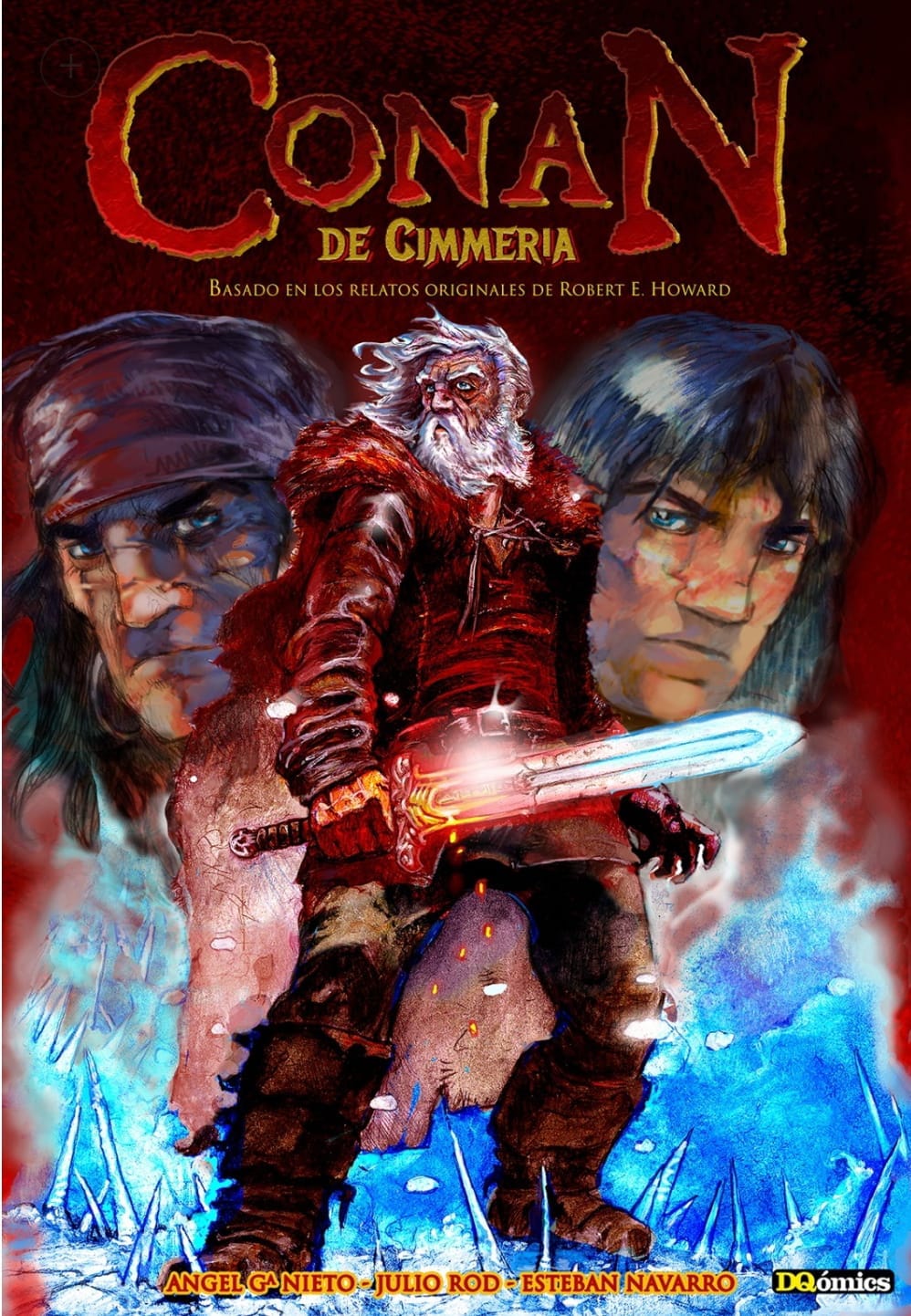
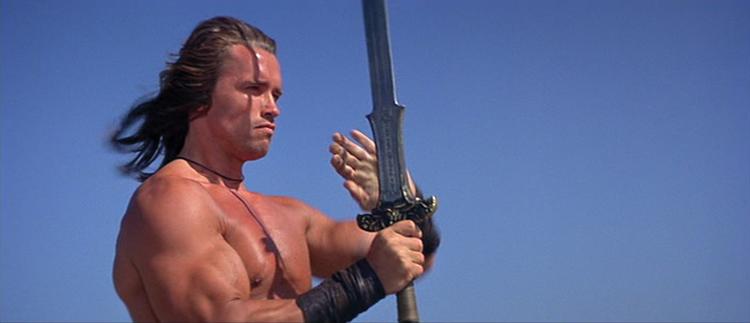
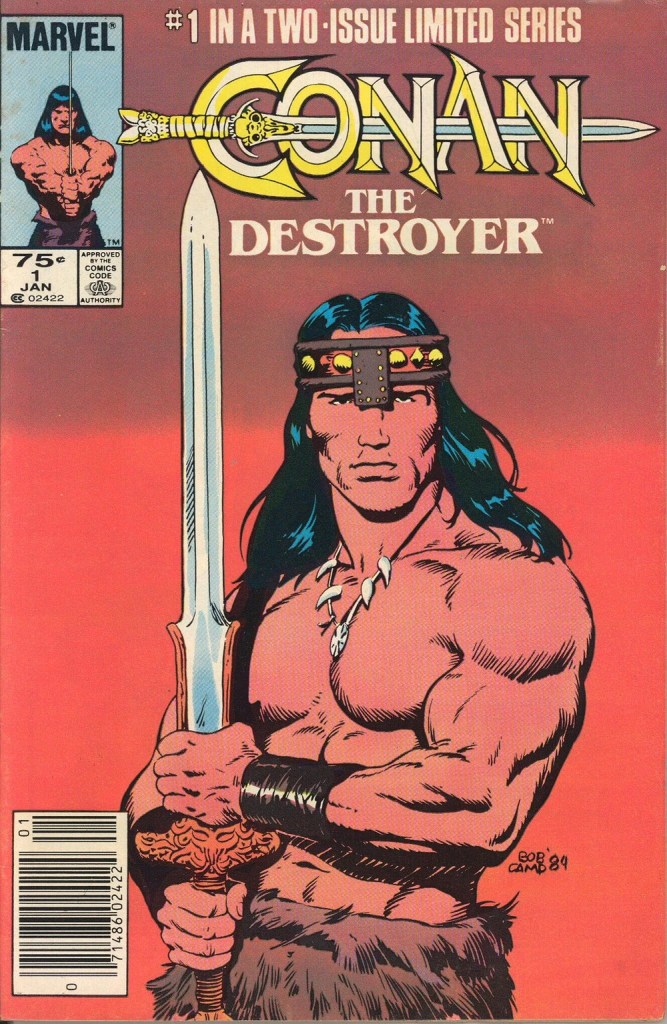
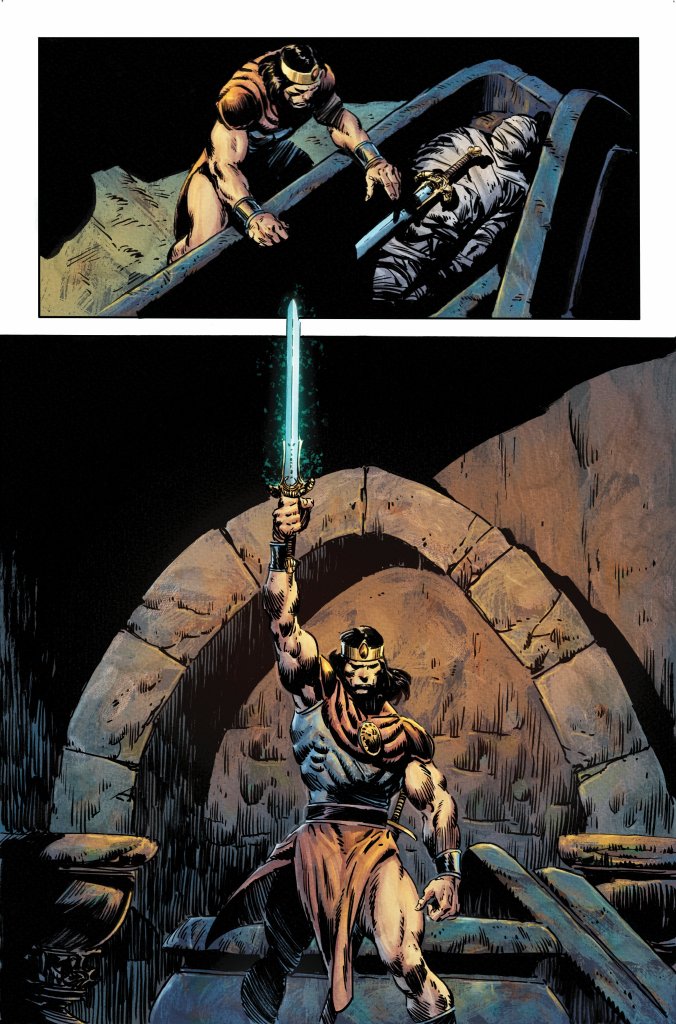
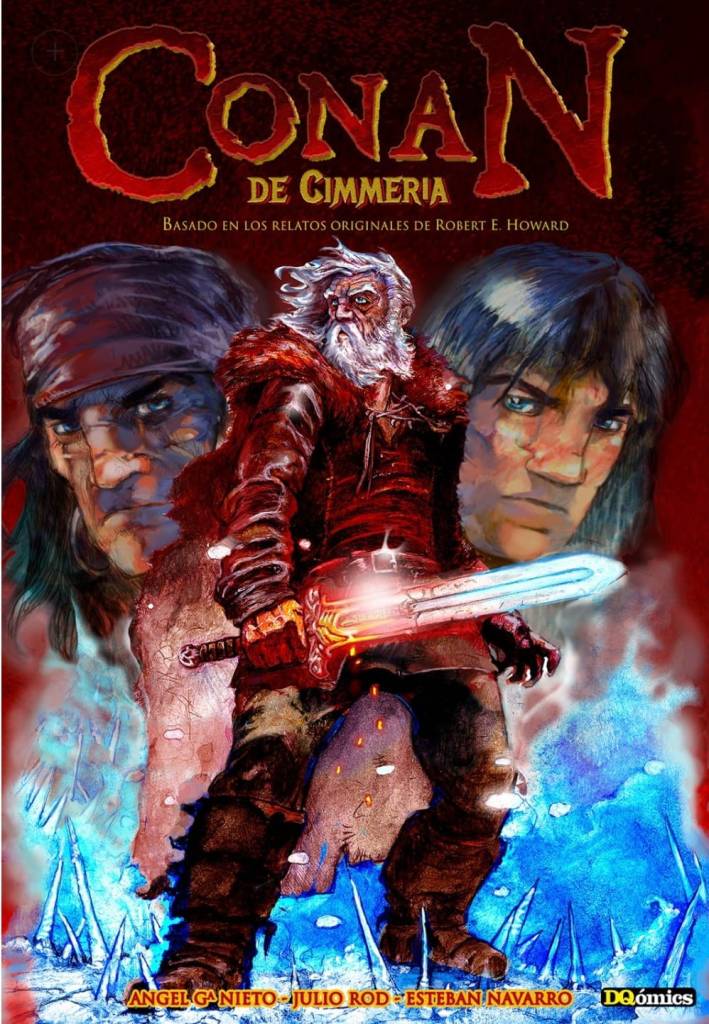
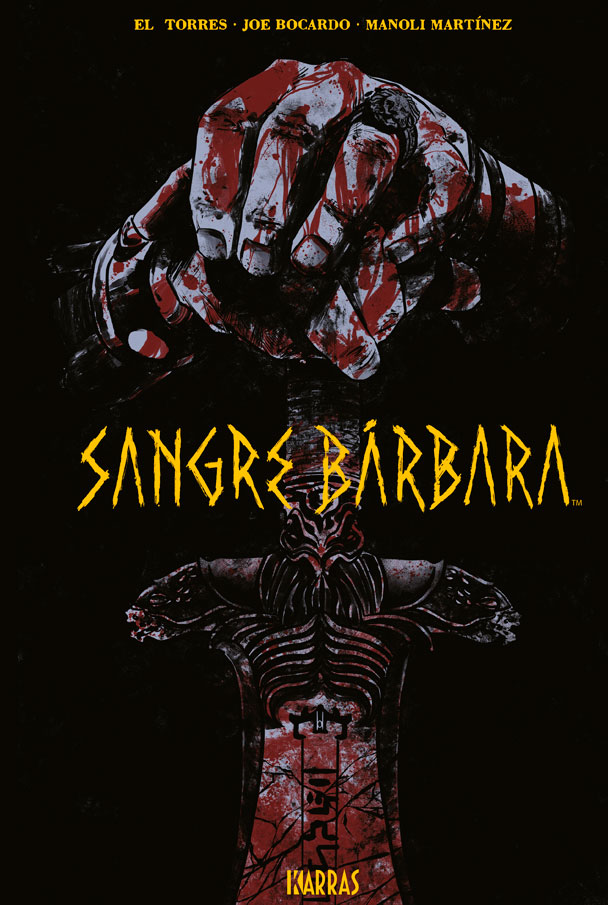
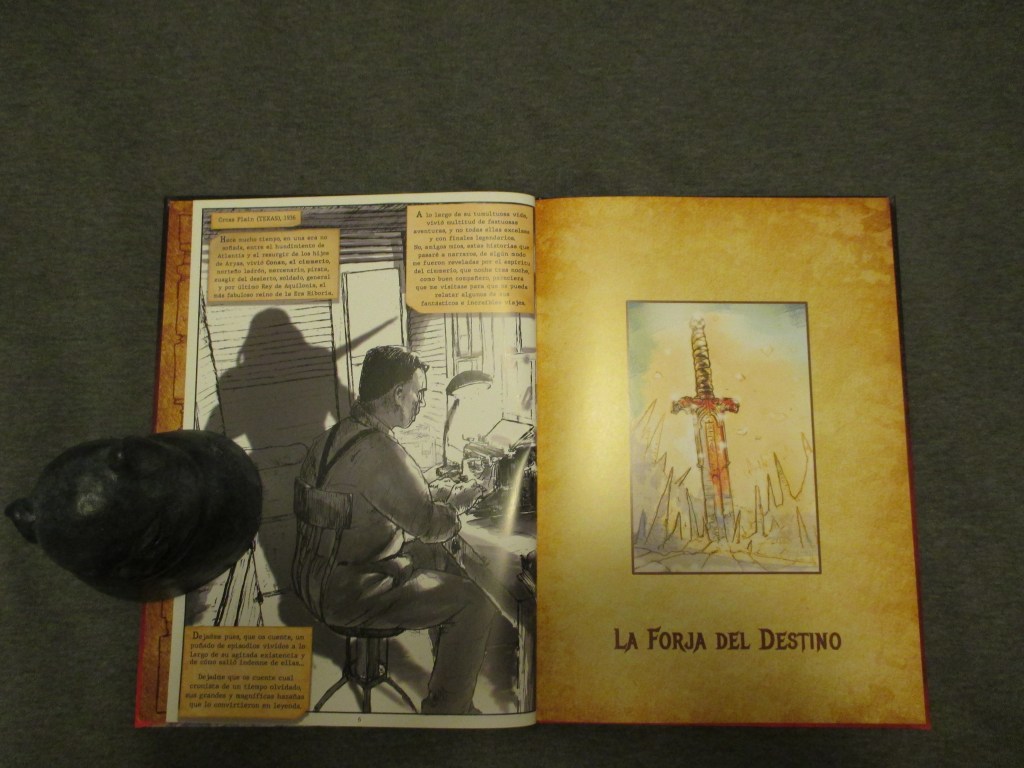

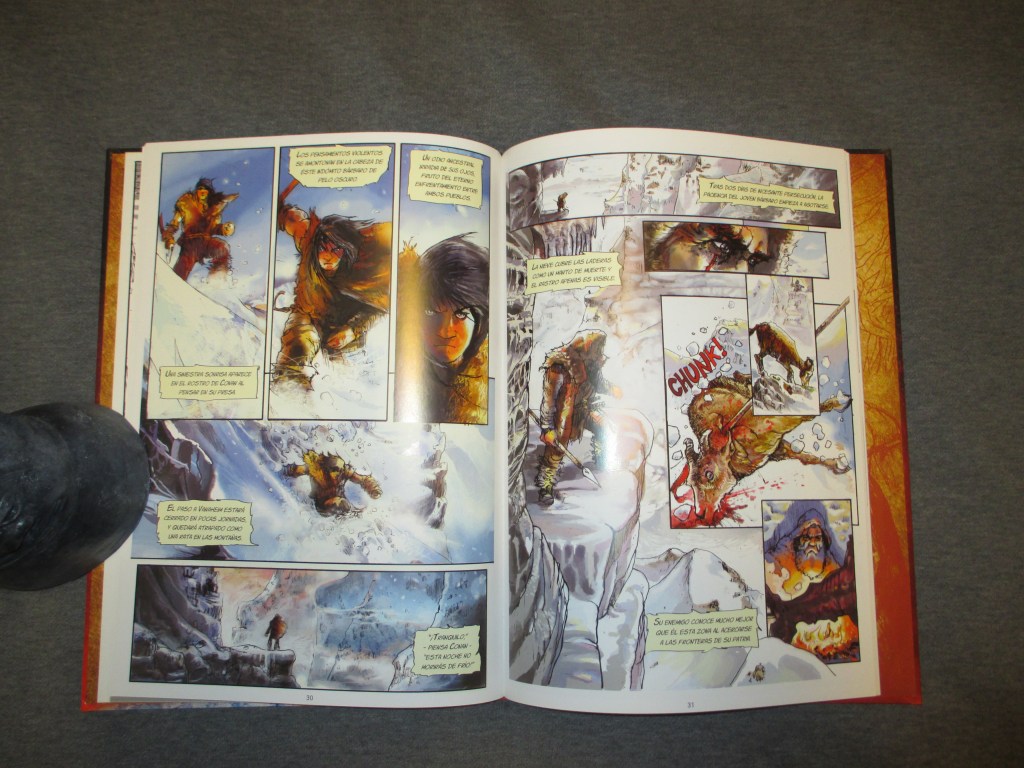
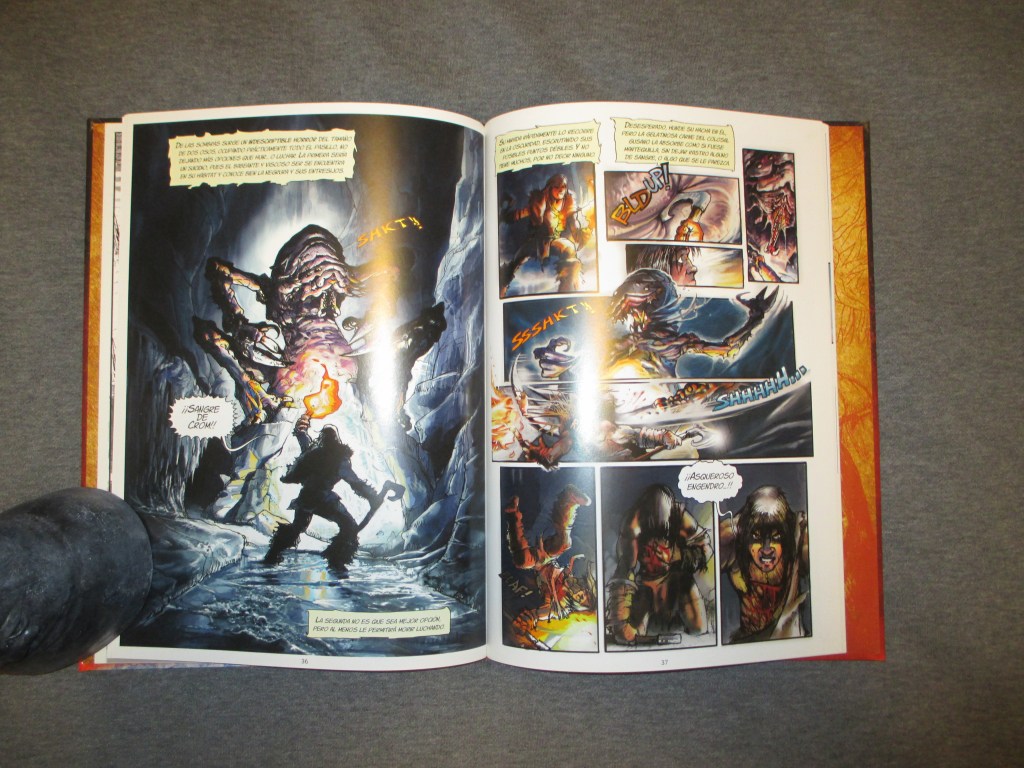
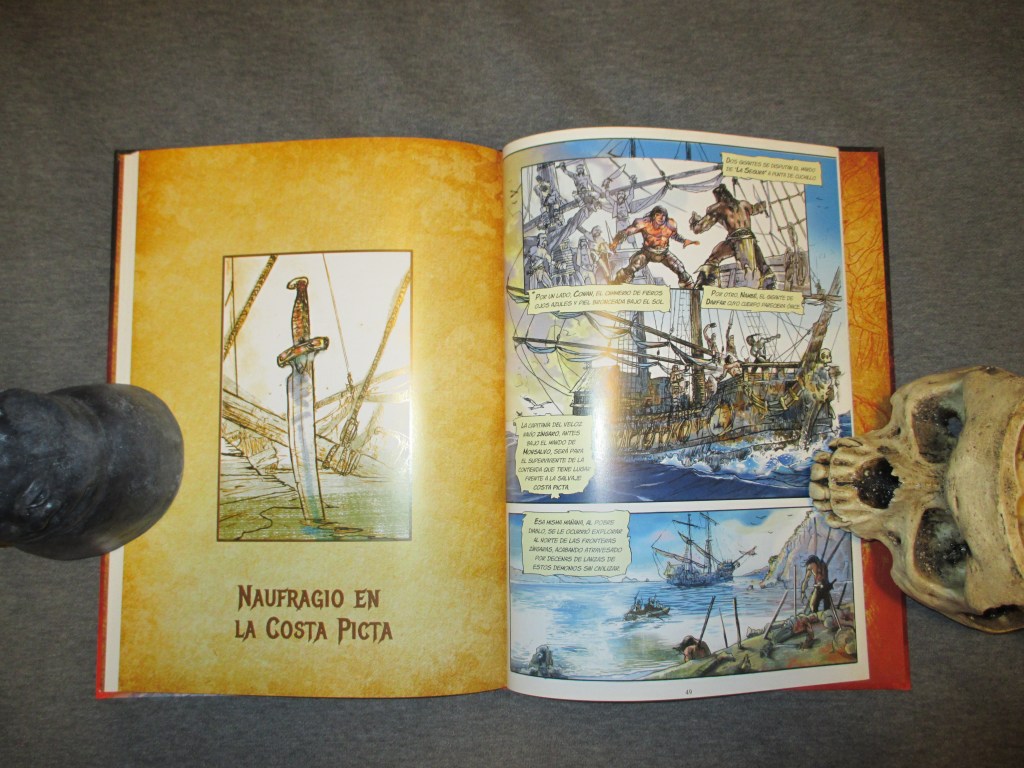
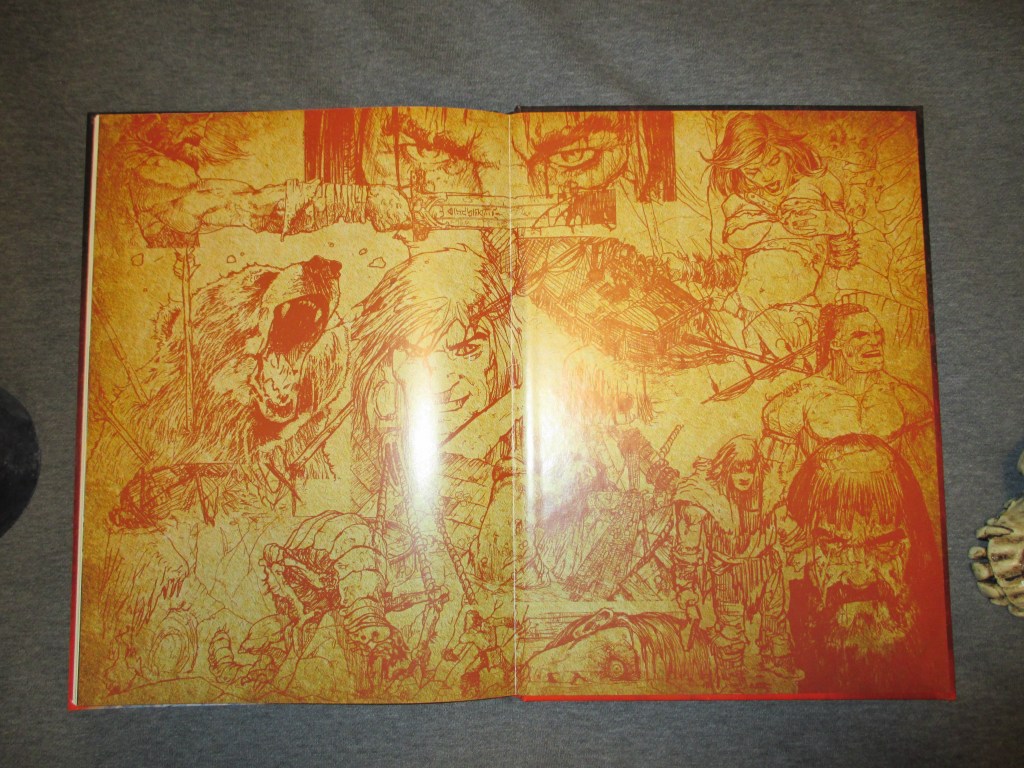
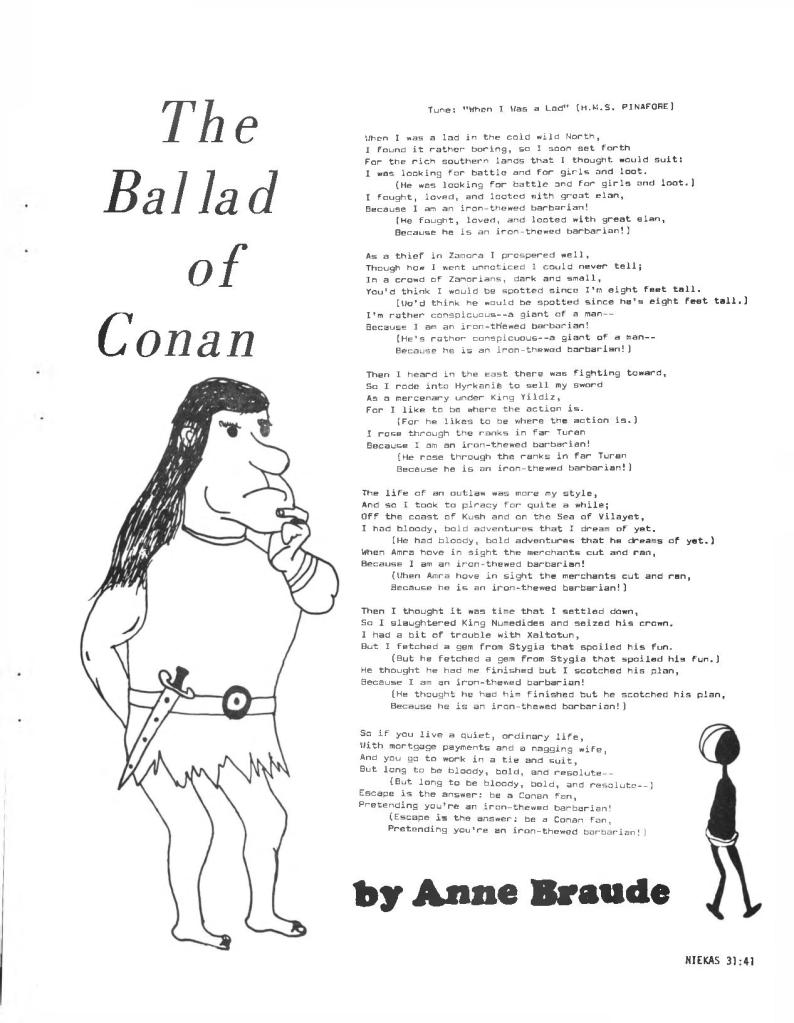
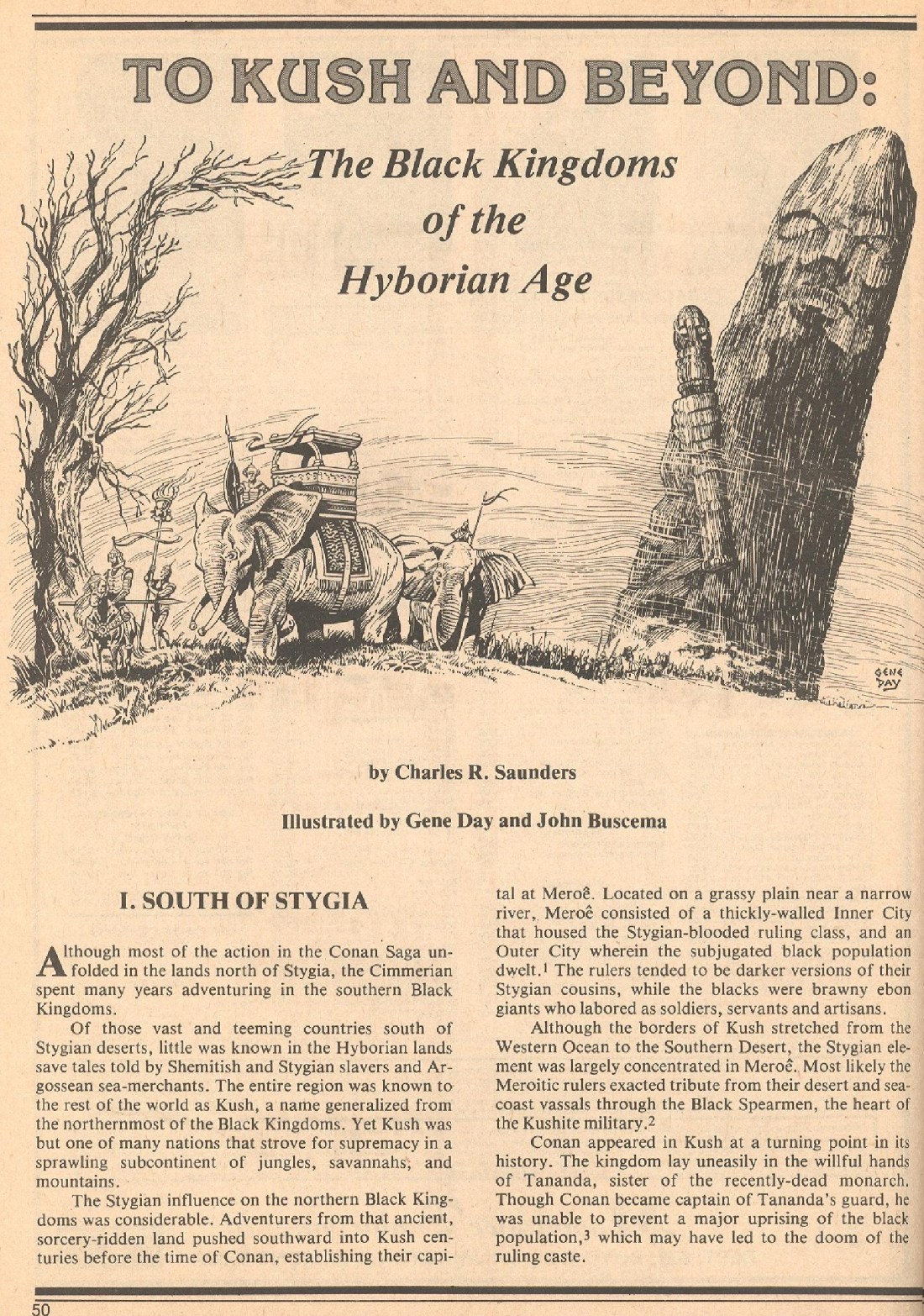


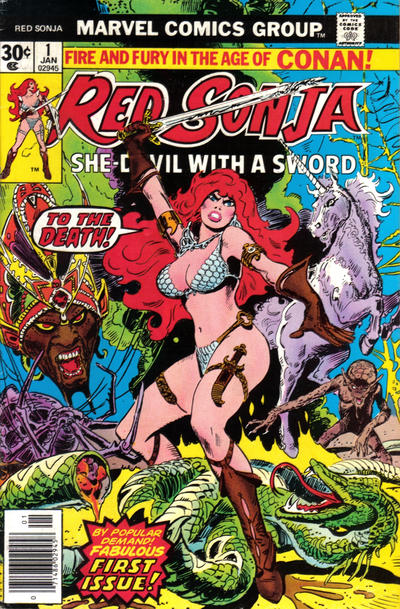


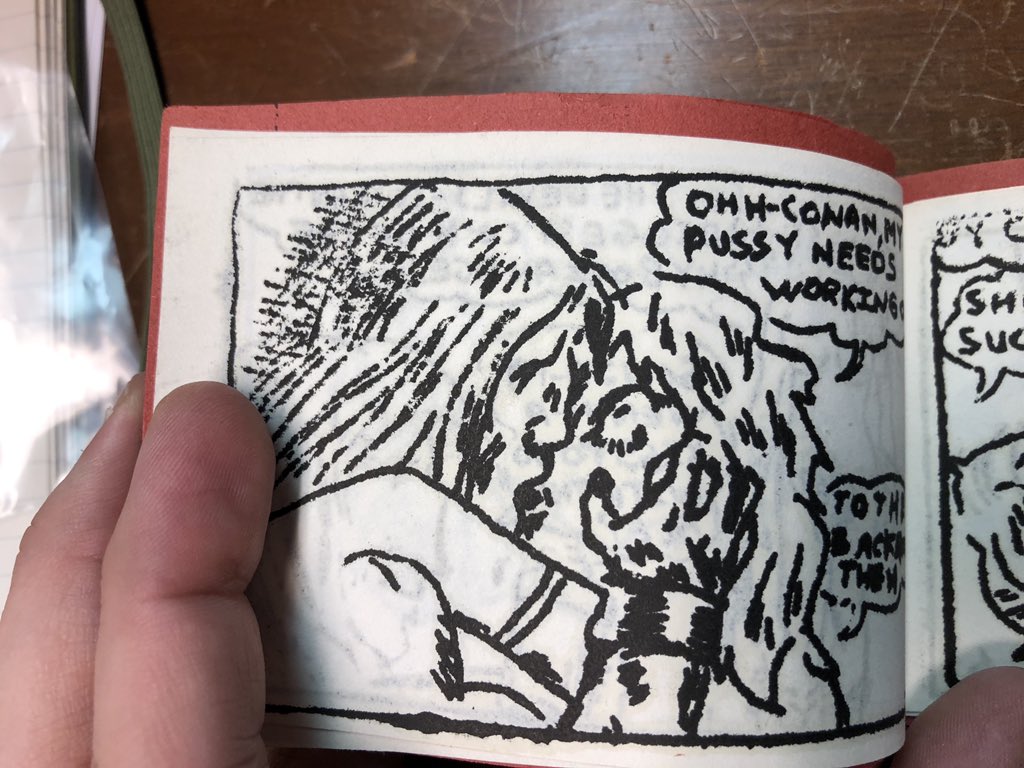


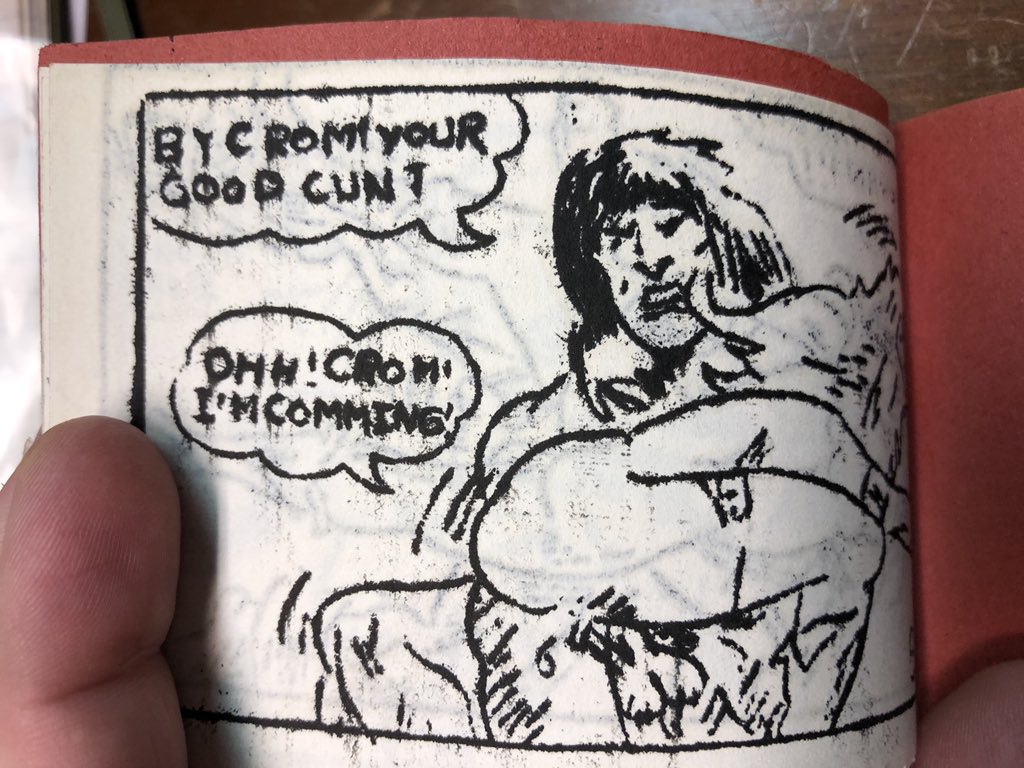

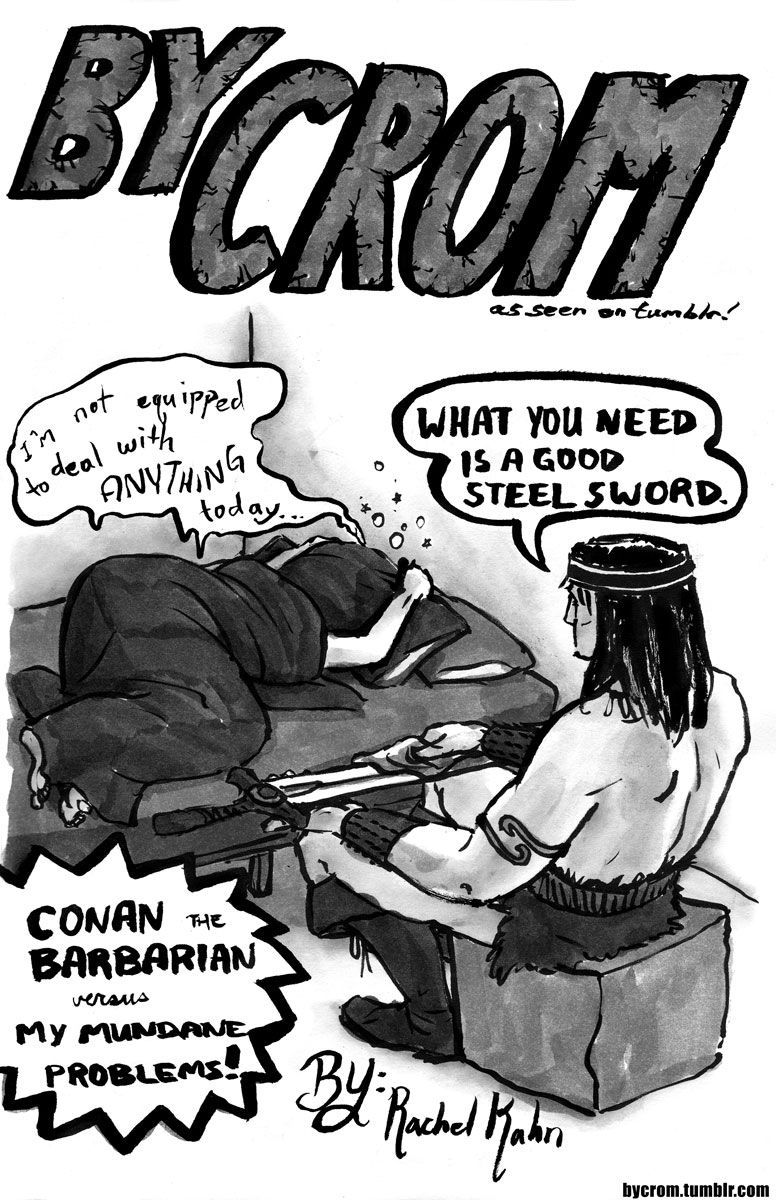


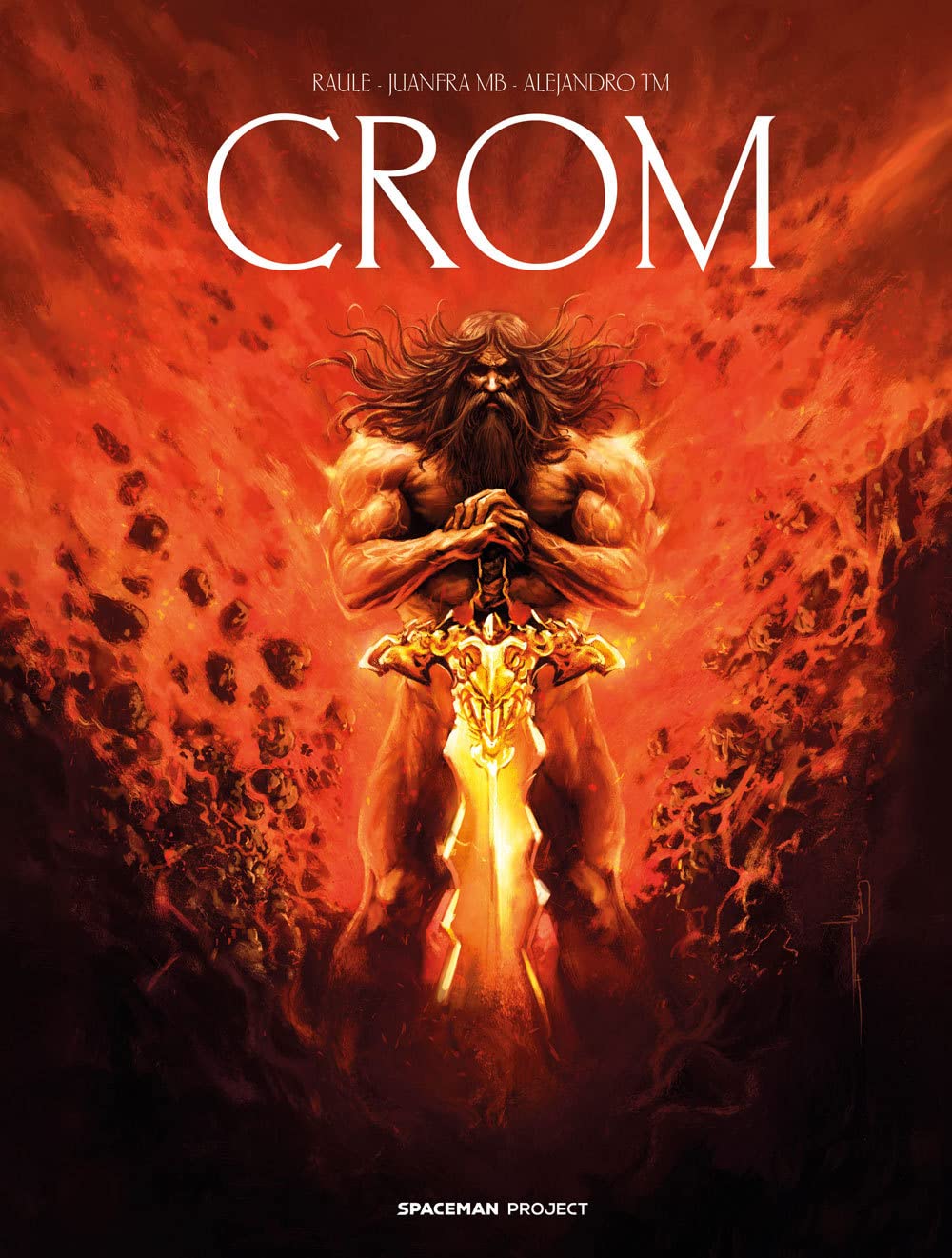

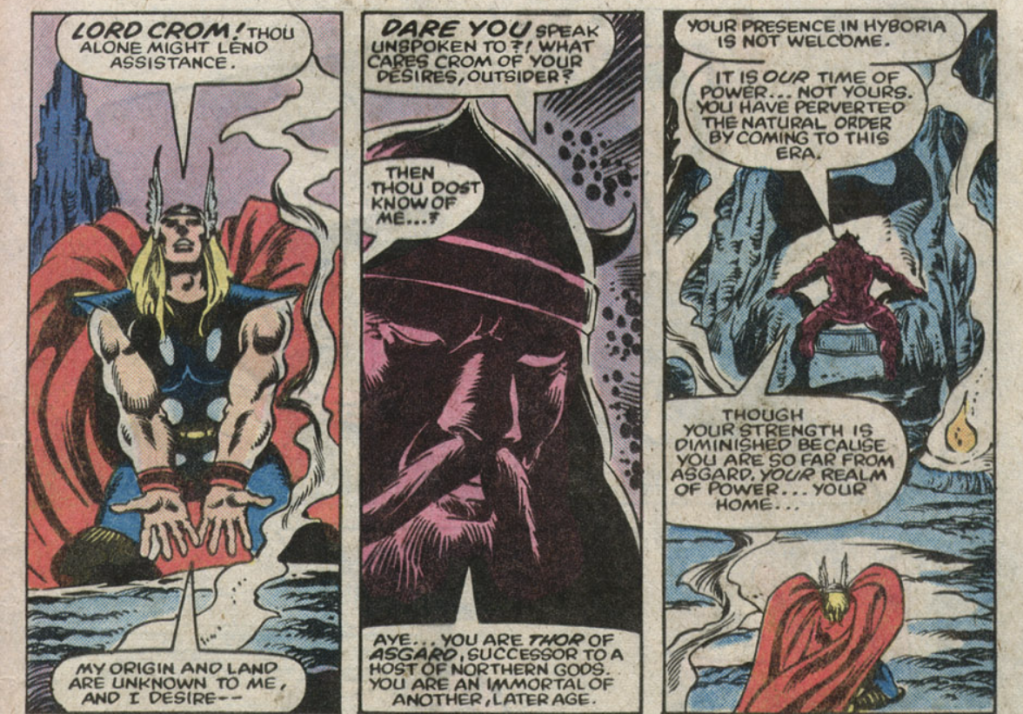


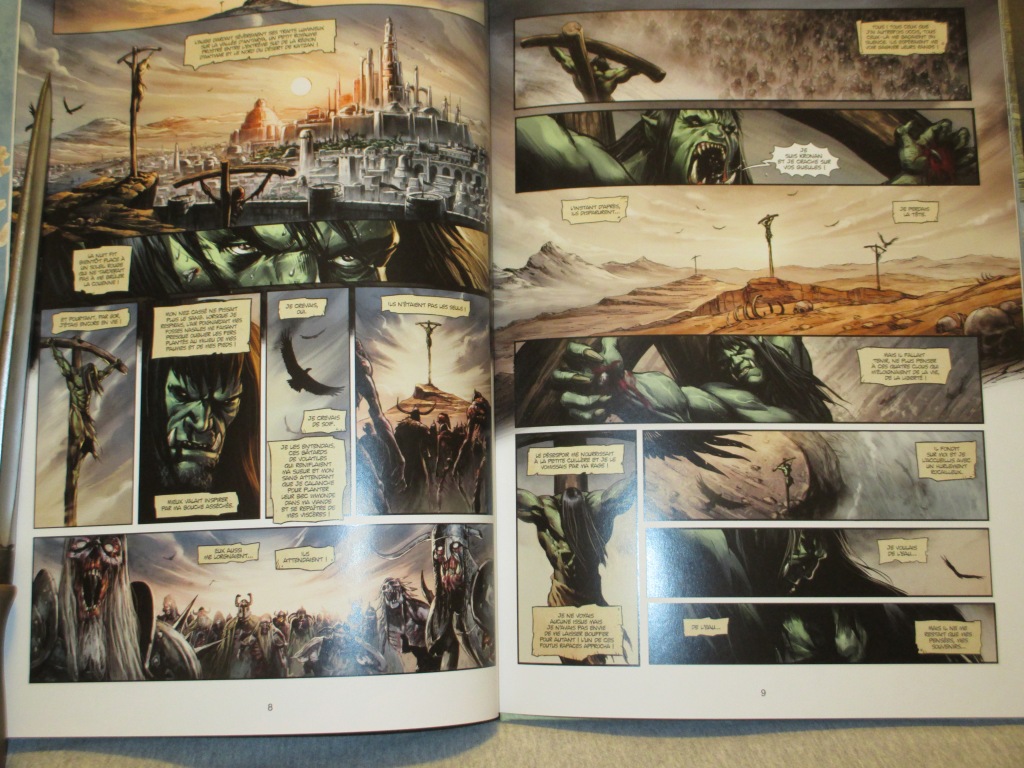
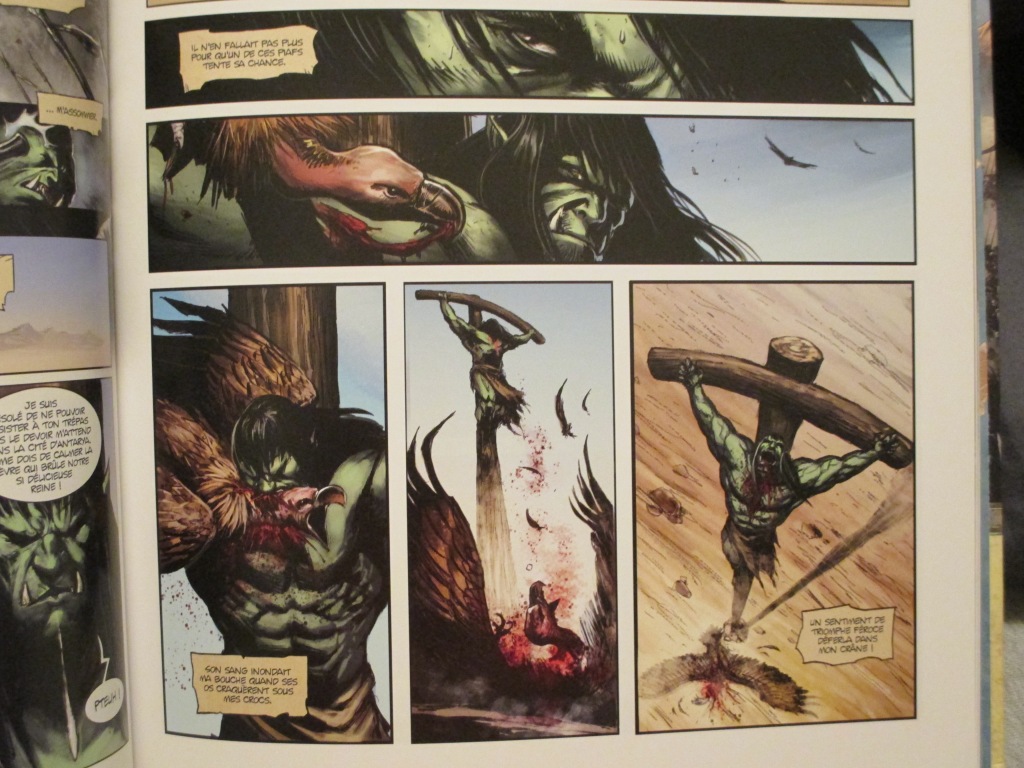


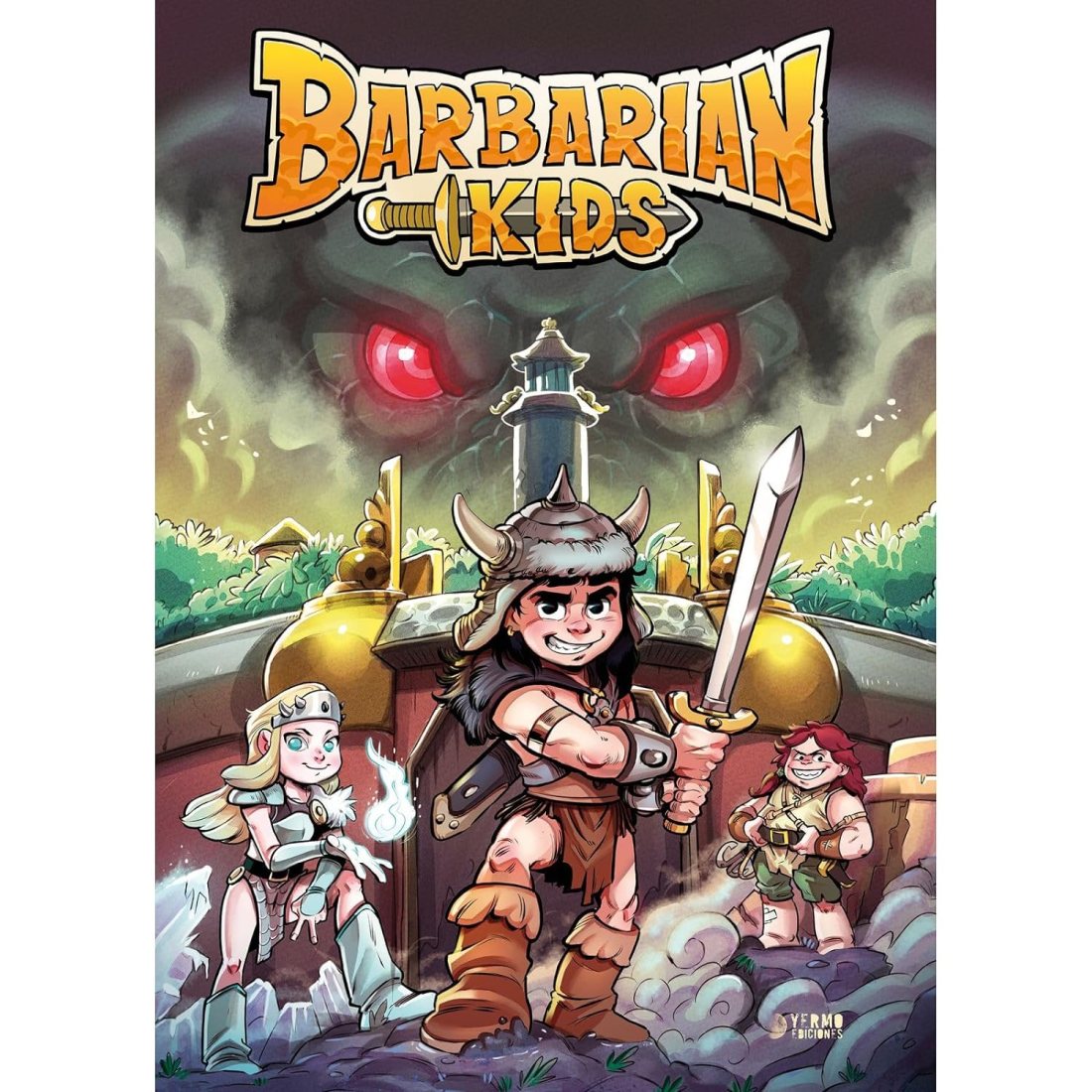
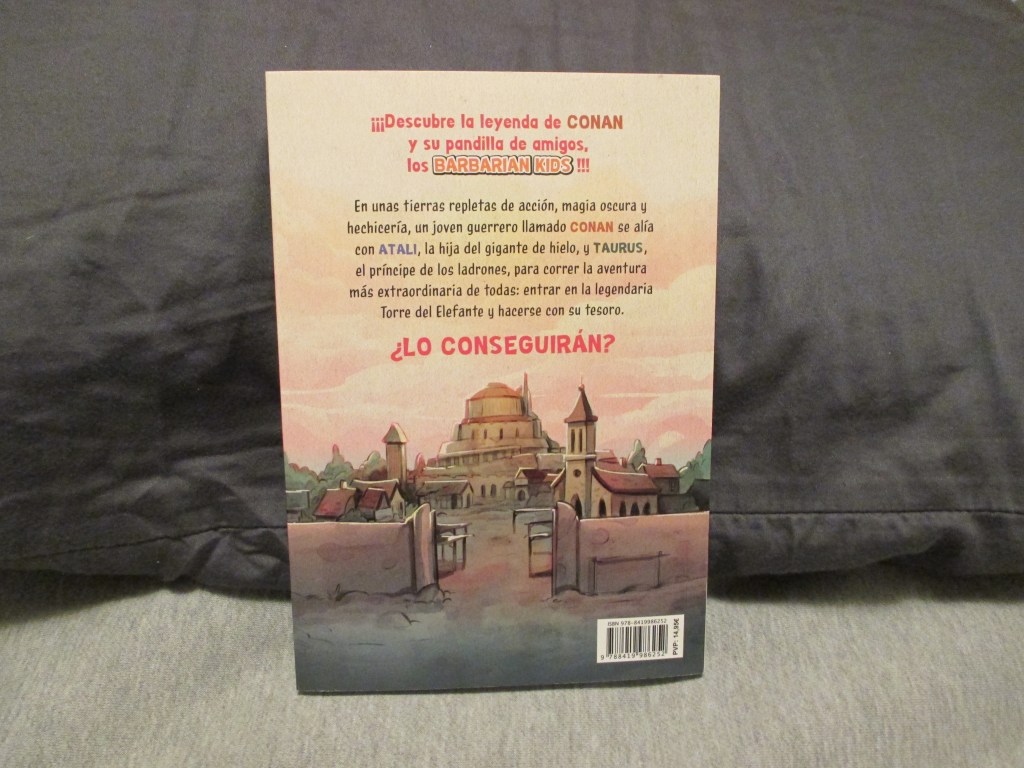
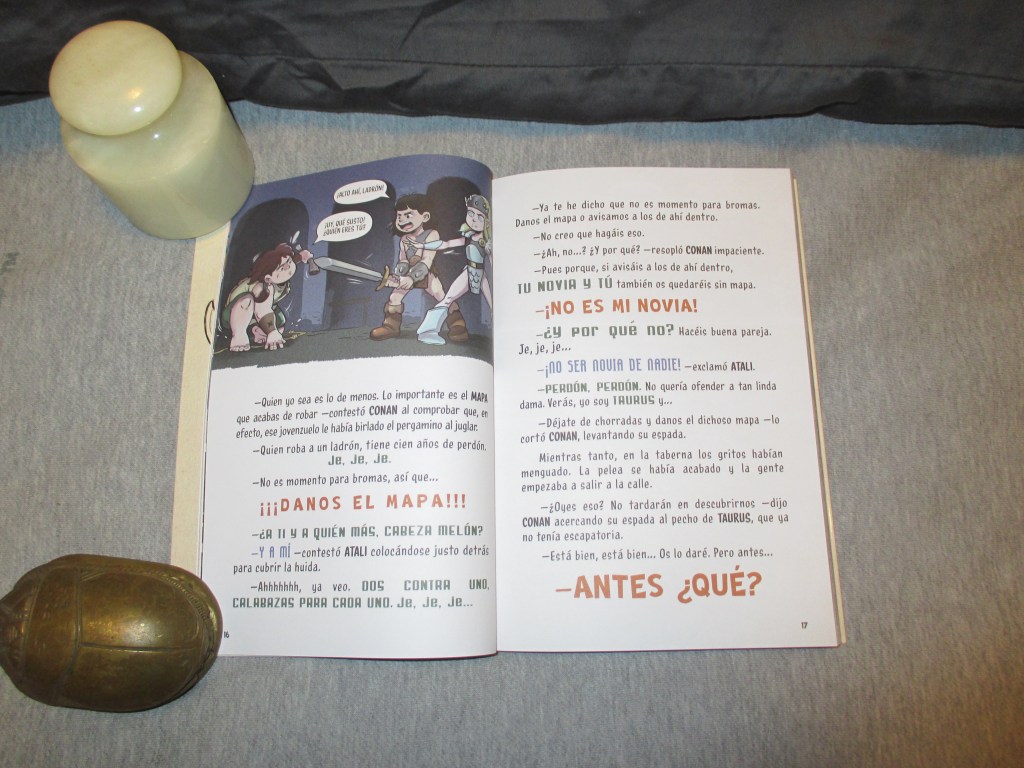
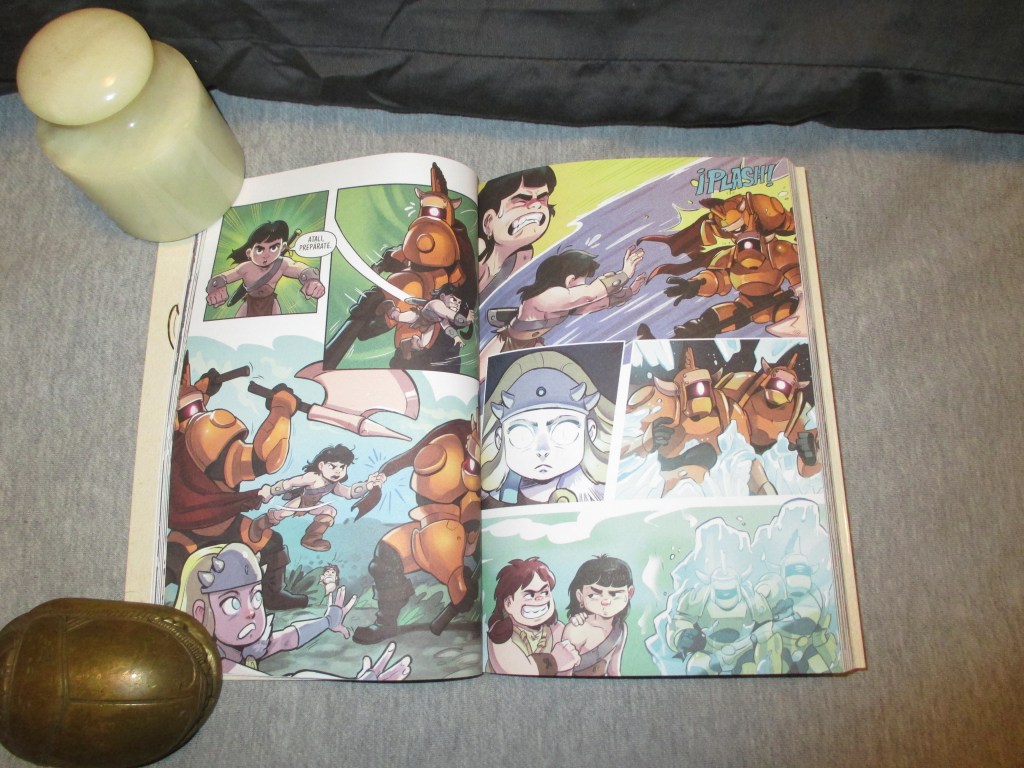


 Deep Cuts in a Lovecraftian Vein