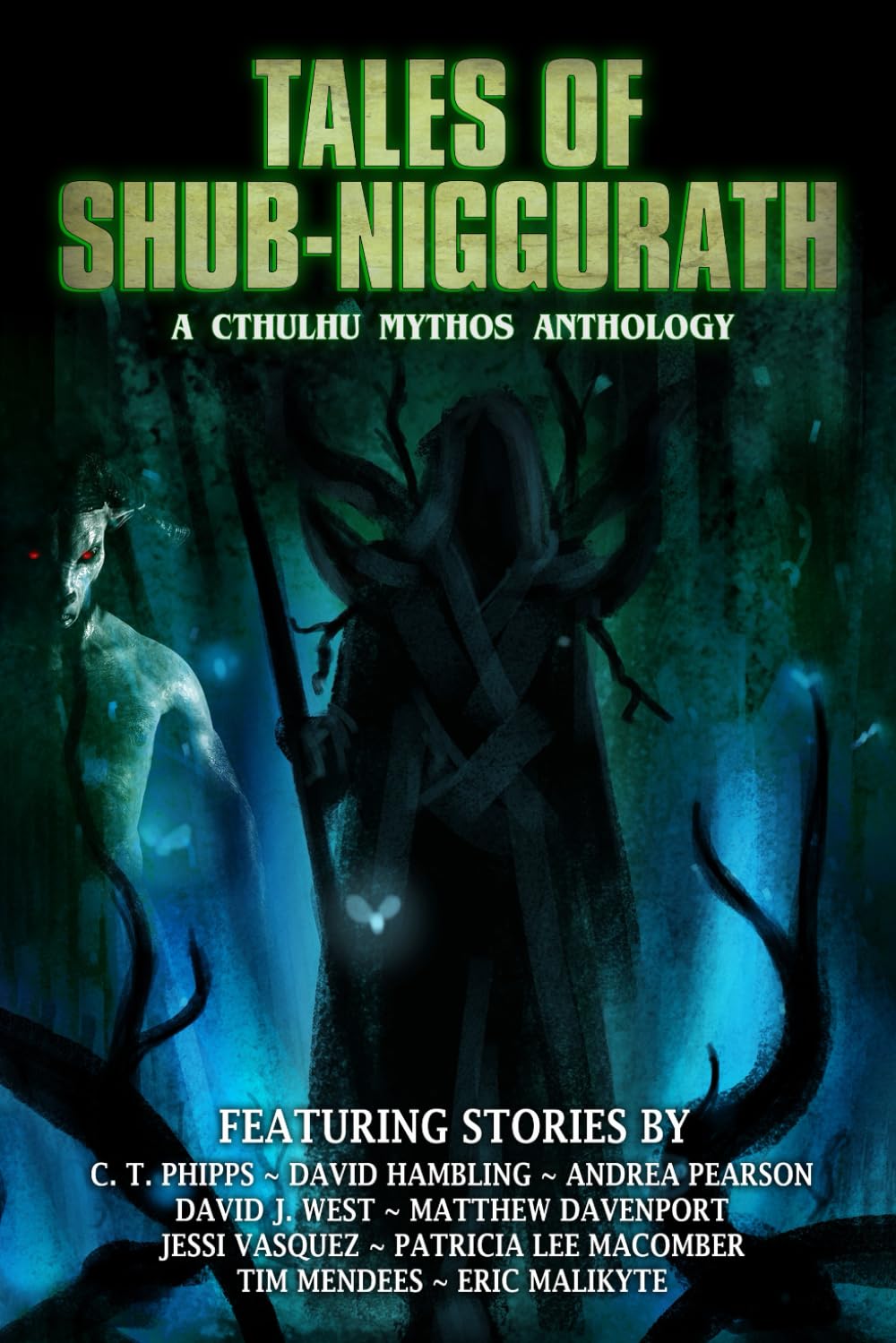
After years of infertility, failed IVF cycles, and slowly decaying hope, she knew she was not one of the lucky or even one of the blessed, whatever that meant. She wasn’t meant to have children.
So when she first heard the name Dr. Keziah Mason offhandedly mentioned in an online infertility support group, it felt less like salvation and more like an invitation to finally belong. —Andrea Pearson, “A Thousand Young” in Tales of Shub-Niggurath(2025), 213
Pregnancy has been a common element in weird fiction. The act of conception, the trauma of birth, the aftermath of a sexual act that leads to a natural set-up or sequel for a story, have been familiar elements since Arthur Machen’s “The Great God Pan” (1894) or Aleister Crowley’s Moonchild(1917)—and writers like H. P. Lovecraft (“The Dunwich Horror”, “The Curse of Yig”), Clark Ashton Smith (“The Nameless Offspring”) are direct literary descendants of that tradition.
Pregnancy is still scary; women still go through a physical transformation and ordeal, even if they are more likely to survive it than a century ago. Unwanted pregnancies, as from rape, remain a real concern. With improvements in medicine involving fertility and infertility, the possibilities of pregnancy horror have shifted, however. Now we have adult fears of persistent infertility, of unsupportable pregnancies of multiples, dangerous pregnancies due to the mother’s health or age that are as yet possible due to science, and a shifting cultural emphasis on pregnancy and against abortion that threatens women’s bodily autonomy.
Yet these are themes, elements, narrative devices. Weird writers have addressed these issues in works like “In His Daughter’s Darkling Womb” (1997) by Tina L. Jens and Flowers for the Sea (2021) by Zin E. Rocklyn, both of which use more contemporary frameworks to set up the narrative framework for the monstrous pregnancy. The main difference between writers like Jens, Rocklyn, and Pearson from Machen, Crowley, and Lovecraft, however, is the change in protagonist focus. None of the older writers focus on the experience of pregnancy, none of them tell of the horror from the woman’s point of view. They are always outsiders looking in.
Andrea Pearson’s “A Thousand Young” is not a fetishistic gaze at pregnancy; we don’t get lascivious descriptions of baby bumps, labor, breastfeeding, etc. Strip away the Mythos elements and it is almost a classic monkey’s paw story, where the dearest wish is granted in a way that is unexpected or undesired. Yet it is told from the woman’s perspective; it is her body, her hopes, her dreams, that are at play, and as the story progresses, the reader gets a sense of the enormity of what is happening, and what will continue to happen, long after the last word is read on the final page. That is why it works—and what makes it a fitting paean to Shub-Niggurath, alongside stories like “Goat-Mother” (2004) by Pierre Comtois and “In Xochitl in Cuicatl in Shub-Niggurath” (2014) by Nelly Geraldine García-Rosas.
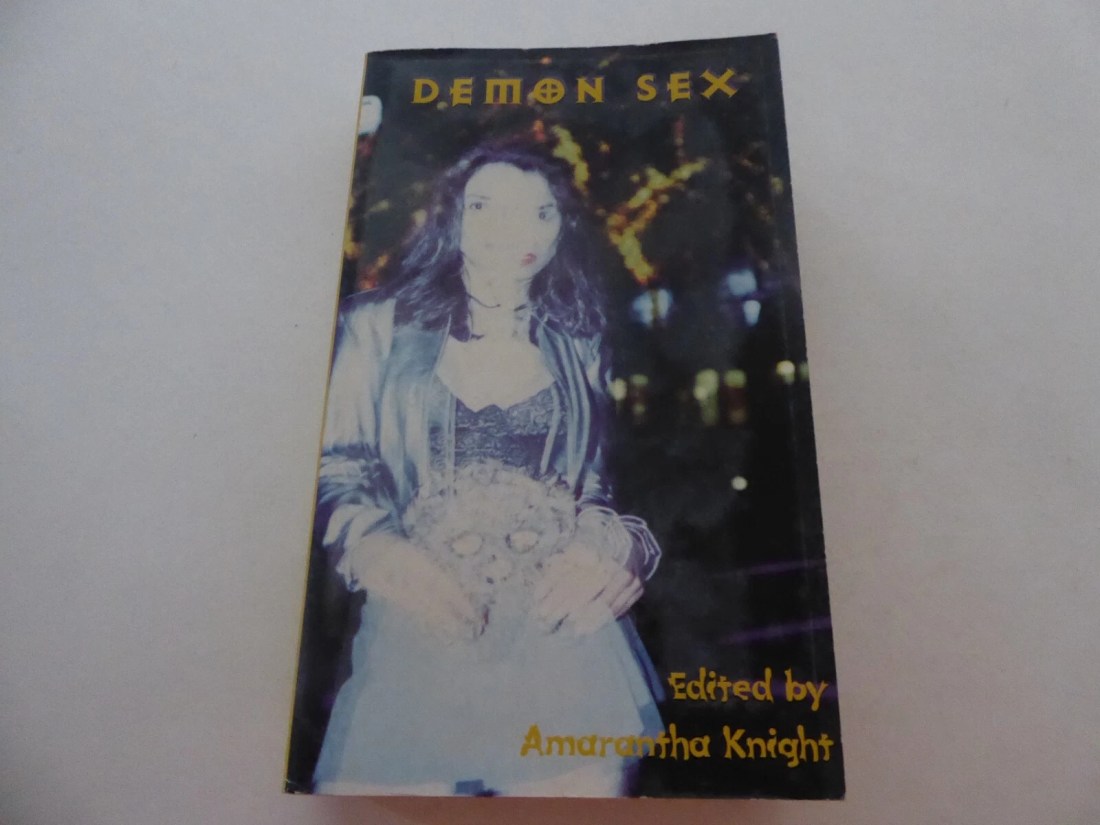
Lois Gresh writers her erotic fiction under the nom de plume Maxi Dell. […] She says about her story: “Perception marks the boundaries of reality. What seems strange to us, what we fight the most, may be the only thing that matters. In a world of cold darkness the heat of love ignites sex even if the lover is a so-called demon.” —Demon Sex (1998), 45-46
Some writers of Cthulhu Mythos fiction approach the project with the care of a pasticheur working another episode into a series of canonical tales—like writing an unofficial sequel to a classic Sherlock Holmes story, they might write “what happened next” for Lovecraft’s “The Dunwich Horror” or “The Shadow over Innsmouth”; such is the case with “The Shuttered Room” by August Derleth. Other writers prefer to reinterpret the story, providing an alternate take on what really happened, this is what you see with “The Black Brat of Dunwich” (1997) by Stanley C. Sargent.
In her Mythos fiction career, Lois H. Gresh’s approach is closer to that of a DJ, remixing familiar songs and beats but putting her own spin on it. She doesn’t re-tell old stories, she doesn’t try to abide by anyone’s canon, and the result is something that at once has a lot of familiar elements, but is nothing like what you’ve heard before—and perhaps not what you would expect, either. None of which is a bad thing, unless you go into her stories expecting something else.
You’ll be twenty tomorrow, Emilie. It’s time for us to share The Gift.” Rolfe’s voice was hoarse, gravel grating against the fishdead air.
She said, “The Gift is something I definitely don’t want for my birthday. How about if we just say here in Innsmouth and never have sex?” —Maxi Dell, “A Loobelier Licking” in Demon Sex 48
The story is set in Innsmouth, though not quite the same Innsmouth readers will find familiar. It deals with Yog-Sothoth and Eihort, the latter an eldritch entity that was created by Ramsey Campbell for his Mythos stories. Emilie and Rolfe are best friends, 19 years old, irrepressibly horny, outsiders among outsiders—and is stuck in a tricky situation. Emilie is the cosmic equivalent of an ugly duckling, physically unlovely and ostracized because she carries the genes of a Great Old One. The Innsmouthers want to kill her. The brood of Eihort, the Loobeliers, Yog-Sothoth, and most especially her friend Rolfe want to impregnate her.
Except if she gets pregnant, she dies and Cthulhu gets loose and ends the world.
If that sounds a little complicated—well, yes. It’s also sexually explicit, more than slightly surreal, and probably doesn’t make too much sense if you think about it too long. Emilie’s negative body image, search for love, and the apparent fact of her imminent demise or translation to another reality if she gives in to her teenage lust plays as very nearly a parody, a kind of cosmic teenage sex comedy. While it plays a little more serious than that (at least from Emilie’s point of view), in an era when “monsterfucker” is a tag for a vast swathe of fiction, I think audiences today might have more sympathy for Emilie.
It’s not just that she wants to get laid. She wants love, too.
Rolfe, on the other hand, is utterly inept. By his logic, he and Emilie are two of a kind, and he’s the only option for her to survive—his every effort to get laid, however, reinforces the problem. In the end, he’s been friendzoned so hard the reader would almost feel sorry for him, if he wasn’t so utterly without romance.
[“]Our only chance is to mate with each other before they get to you.”
He was being ridiculous. As if her only choices were sex with Rolfe or sex with a fish. What an absurd thought. Of course, if it came down to it, she’d choose Rolfe. He wasn’t a fish, after all, and he did have a certain raw masculinity that she found appealing. Plus, she’d known him since they were children, and he was her only friend. But still…
Maybe it was the way he put it: mating. —Maxi Dell, “A Loobelier Licking” in Demon Sex 49
(Readers may, at this point, wonder what the heck a loobelier is. As near as I can tell, they appear only in this story and nowhere else, so it would be a terrible spoiler to reveal that. Trust me, knowing what they are does not significantly make much more sense in context.)
As an erotic horror story, if you don’t invest too much time in thinking about it, this is fun. Gresh has a knack for entertaining prose and slightly surreal situations (see “Showdown at Red Hook” (2011) by Lois H. Gresh), and this is no exception. While probably never going to appear in any list of canonical Innsmouth tales, I think the subversion of expectations, as much as the anticipation of Emilie’s final decision, is what makes this story work.
“A Loobelier Licking” as by Maxi Dell was published in Demon Sex (1998). It has not been reprinted.
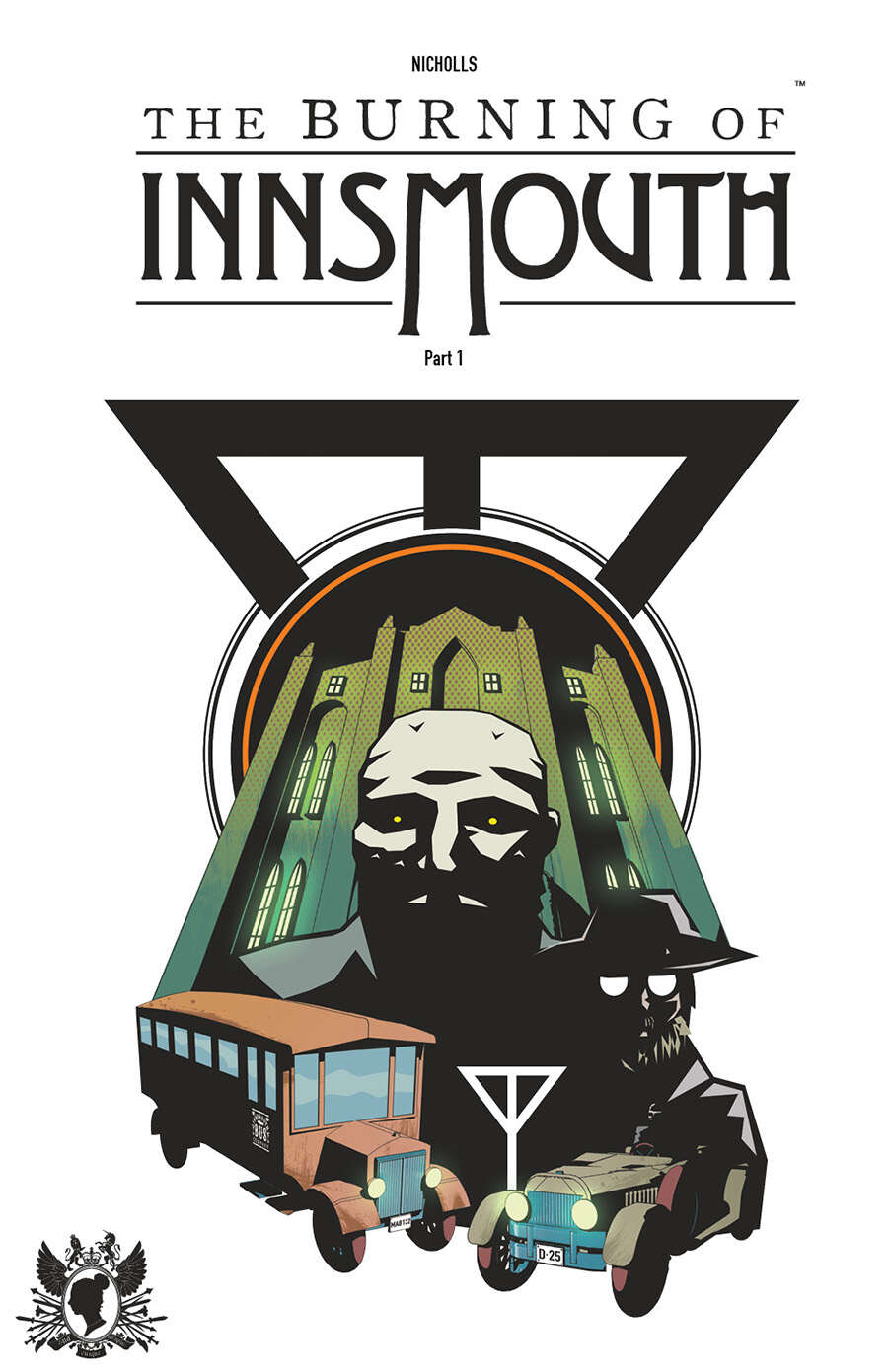
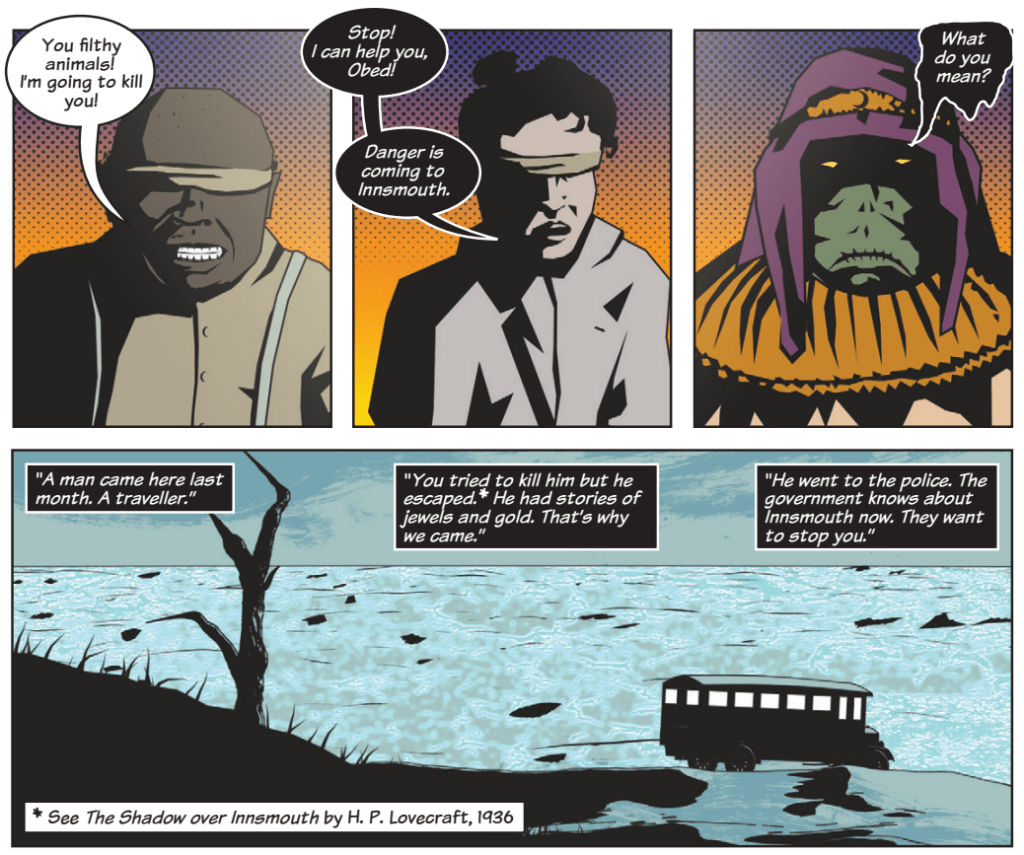
‘The Burning of Innsmouth’ is a Lovecraftian-themed tale of eldritch horror and hidden corruption. In the all-too-quiet Massachusetts port-town of Innsmouth, nothing is quite what it seems and no one is who they say they are. The story takes place in 1927, just after the fictional events described by HP Lovecraft in his classic tale ‘The Shadow Over Innsmouth’. Beautifully illustrated, it’s a cat-and-mouse story explores how the town and its cultish denizens came to be destroyed by a shadowy branch of the American government. —descriptor for The Burning of Innsmouth, Part 1 on DriveThruComics
Tammy Nichols is a UK-based graphic designer and illustrator (Tears of Envy). In 2019 she released The Burning of Innsmouth, Part 1, the first of what was proposed to be a three-issue series. The other issues have not yet been seen; such things happen. As a result, what we have is an inherently incomplete story. Characters are introduced, mysteries set up, but we have no idea how things would end. The first issue doesn’t end so much on a cliffhanger as on a promise: Innsmouth isn’t burning yet, but it is a pile of dry tinder waiting for the spark.
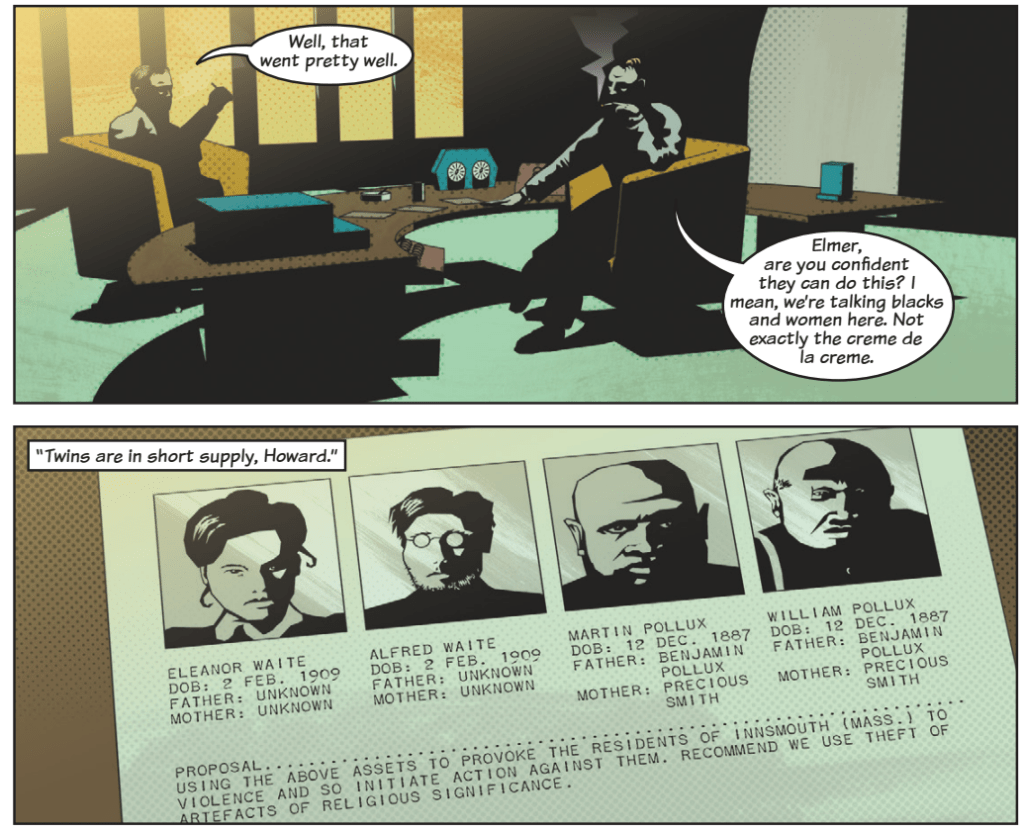
The art shows a careful aesthetic: deep shadows and heavy blacks, digital shading that’s made to look like halftone. Nichols explains some of her graphic language on her blog, including the customized font for the Gilman House hotel, as well as the film noir influence and the colour journey she intends to take the reader on. These are elements of visual rhetoric that inform a story and how it is told in ways that prose text cannot capture. The Facebook group dedicated to the comic also includes some behind-the-scenes of pages and panels in black and white vs. colored.
From a storytelling standpoint, the decision for the federal government to employ outside agents—two pairs of twins, one of whom is African-American, and another a sister-brother pair with ties to the infamous Waite family of “The Thing on the Doorstep” fame—is interesting. It gives us characters who are outsiders, agents of a bigoted government but not a part of it, sympathetic in their motivations, at least insofar as they are being coerced into this dangerous task. It also adds a welcome bit of diversity into a Mythos that tends heavily to the white and male.
If there’s a criticism of the story, it plays a little fast and loose with the Innsmouth lore. Obed Marsh is portrayed as still alive in 1927, when Lovecraft has him die in 1878. There are hints of further divergences, but these aren’t developed fully in this 32-page first issue. Such shifts from Lovecraftian “canon” aren’t necessarily bad—it being remembered that mythologies are by their nature often cycles of stories with similar settings, themes, and characters, not a single continuity or cohesive narrative universe. I would have liked to see where this one went.
For now, The Burning of Innsmouth is incomplete. Someday, perhaps, Nicholls will finish it. Or perhaps she won’t. Such fragments and the what-might-have-beens they inspire are still a part of the broader constellation of Mythos materials, a part of the shared narrative for readers to muse over and enjoy. And if you don’t like how Nicholls did it, or where the story was headed at the end of part 1…write your own.
The Burning of Innsmouth, Part 1 by Tammy Nicholls is available at DriveThruComics. There is also merch (including a nice map of Innsmouth) on the associated Redbubble store.
Eldritch Fappenings The following review of LGBTQ+ comic history includes images from selected works that depict cartoon nudity, sex, and violence. Reader discretion is advised.
Marriage and Sex
(1) Divorce shall not be treated humorously nor represented as desirable. (2) Illicit sex relations are neither to be hinted at nor portrayed. Violent love scenes as well as sexual abnormalities are unacceptable. (3) Respect for parents, the moral code, and for honorable behavior shall be fostered. A sympathetic understanding of the problems of love is not a license for morbid distortion. (4) The treatment of live-romance stories shall emphasize the value of the home and the sanctity of marriage. (5) Passion or romantic interest shall never be treated in such a way as to stimulate the lower and baser emotions. (6) Seduction and rape shall never be shown or suggested. (7) Sex perversion or any inference to same is strictly forbidden. —Comic Book Code of 1954
LGBTQ+ characters and themes received little coverage in the comic strips and comic books in the United States before 1954. When looking at the Pre-Code Lovecraftian Horror Comics, there are no characters or themes that jump out as explicitly gay or lesbian, transgender or genderqueer. After the Code was created in 1954, LGBTQ+ representation in commercial comics was implicitly forbidden.
Without access to mainstream publications, LGBTQ+ comics shifted to venues that were not controlled by the Comics Code Authority. Pornographic comics and underground comix formed a creative outlet for LGBTQ+ characters, stories, and creators—at the risk of being charged with obscenity. The late 60s and 70s in particular saw the birth of the underground comic scene, an outlet for readers and artists who wanted comics that were forbidden, transgressive, or mature—featuring themes of realism, sex, violence, drugs, politics, mysticism, and horror, often in some combination.
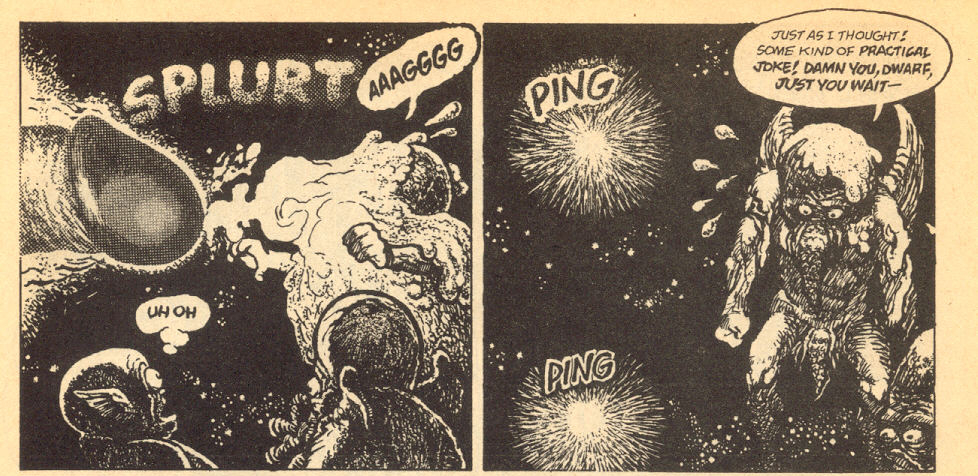
Tales from the Leather Nun (1973), for example, was an underground nunsploitation anthology comic. One of the episodes, “Tales of the Leather Nun’s Grandmother” by Spain Rodriguez, mixes Lovecraft’s Mythos with hardcore pornography, as Abdul Alhazred’s spells have accidentally turned the Leather Nun’s Grandmother’s vagina into a gateway to the realm of Cthulhu. Thus, one of the earliest appearances of Cthulhu in comics has the eldritch horror getting a face full of spunk.
Tales from the Leather Nun (1973); art by Spain Rodriguez
Cthulhu’s facial is a gag, not a homoerotic act. Tales from the Leather Nun isn’t the first LGBTQ+ Lovecraftian comic, just one of the first to begin to transgress in ways that combined sexual themes with Lovecraftian horror. It is difficult to say for sure what was the first LGBTQ+ Lovecraftian comic, if only because we have to look outside of the well-indexed mainstream.
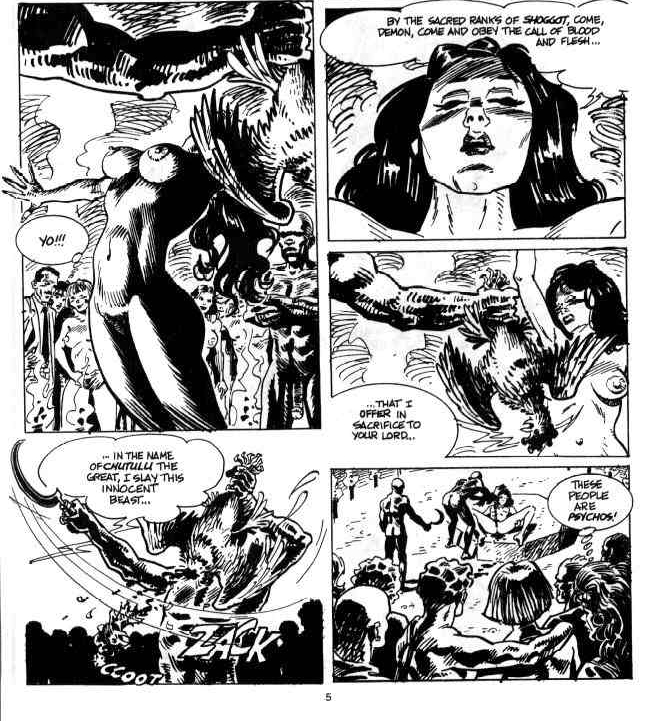
“R. H. B.” (1978) by Andreas and Rivière is a likely candidate, because it focuses on R. H. Barlow, who was gay. However, Barlow’s homosexuality isn’t really the focus of comic, barely mentioned at the end. A later example is the Italian erotic comic Ramba #4 (1989), which features the bisexual Ramba facing down a demon named Azatoth summoned during a voodoo-esque ceremony:
Ramba #6 (Eros Comix), Marco Bianchini (script) and Fabio Valdambrini (art)
Of course, most of Europe never had an equivalent to the Comics Code Authority, so they had a freer hand to explore such themes. In the United States, works like Ramba appeared in translation in the early 90s, after the CCA had been weakened or ignored by independent publishers. If we can’t quite answer the question of who came first (whether into Cthulhu’s visage or elsewhere), we can at least say there was another notable work that emerged in that period that combined Lovecraftian horror and explicit LGBTQ+ characters and themes.
In the 1970s, comic writer and artist John Blackburn created the character Coley Cochran, a 19-year-old uninhibited bisexual character with a penchant for sex, violence, and the occult and antipathy to prudes and authority figures. In the late 80s/early 90s Blackburn self-published four books of Coley’s sex-drenched adventures, a combination of erotica, character-driven drama, and graphic violence. In the first book, Coley on Voodoo Island (1989), Coley is kidnapped and transformed into a sex god in a voodoo ceremony; this supernatural element would re-emerge periodically throughout Coley’s adventures, such as Breathless (1991), which includes an adventure at a ruined temple titled “Flowers of Evil.”
In the 1990s Fantagraphics picked up the Coley adventures under their Eros Comix imprint, publishing a series of 2-3 issue miniseries, beginning with Return to Voodoo Island (1991). The problem with the Eros Comix series is that they never reprinted Coley’s earlier adventures (except when Blackburn summarized them for reprints), so that new readers come into a series that has already been going on for hundreds of pages.
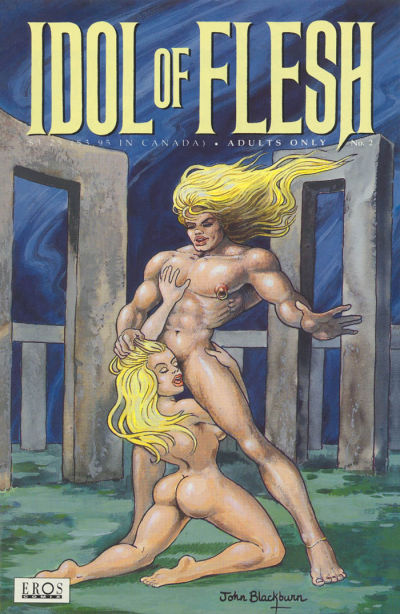
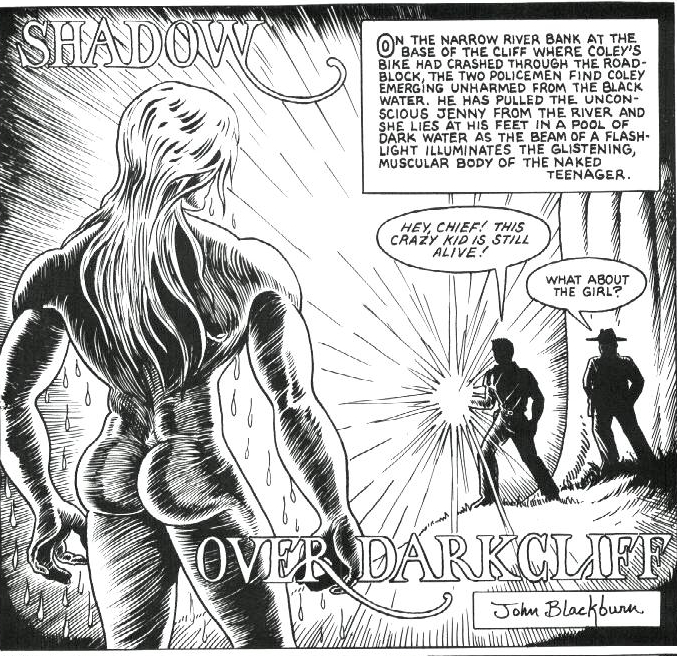
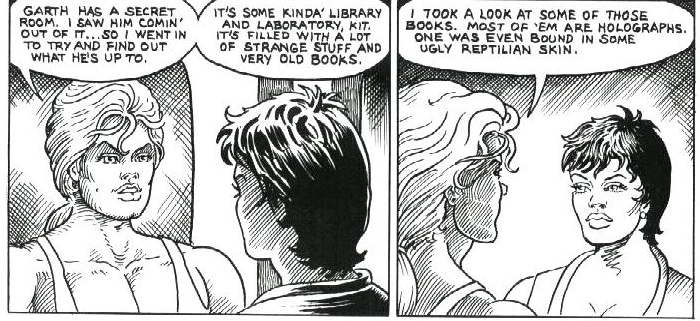
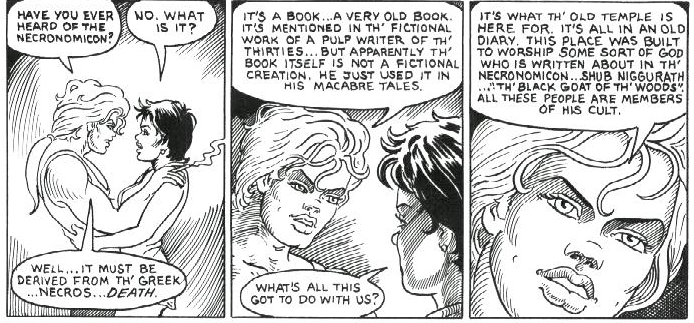
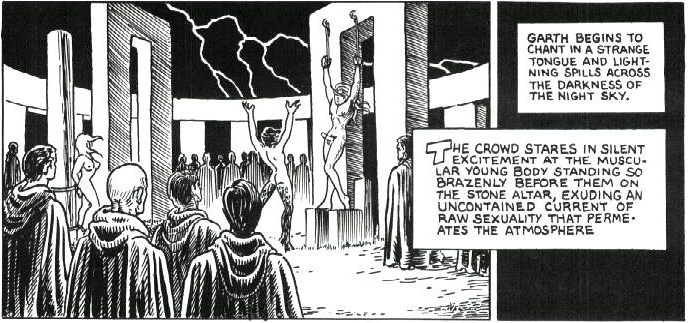
John Blackburn’s “Shadow over Darkcliff” is the second part of the two-issue series Idol of Flesh (1993), and sees Coley and friends return to the temple ruins of “Flowers of Evil”—but this time featuring a strange cult, led by a man named Garth. While the 32-page episode involves a bit of drama and a good bit of sex, the core story is explicitly Lovecraftian:
Idol of Flesh (1992) #2, by John Blackburn
Garth, it turns out, isn’t exactly human and wants Coley for sex and sacrifice. This isn’t the first or the last time Coley would be in this sort of position, the magnetic sexual attraction to both men and women is one of his supernatural traits throughout all of Blackburn’s series, as are scenes of flagellation, bondage, and sexual violence—especially the threat of castration, which appears in Return to Voodoo Island and reappears here. As in “Flowers of Evil,” Coley’s escape from this particular peril is somewhat miraculous—not a great storytelling trick, and one which Blackburn overuses a bit. Not that readers would know that unless they hunted out some of the stories that Fantagraphics did not reprint.
Blackburn would return to Coley and the Cthulhu Mythos in a longer, more involved, and even weirder storyline titled Dagger of Blood (1997), which makes brief reference to Garth and the events of “Shadow over Darkcliff.” Yet it reading the stories in order gives a better sense of the ideas that Blackburn was developing. Coley is presented as this perfect bisexual heartthrob, while characters like Garth and the antagonist of Dagger of Blood are both attracted to and hate Coley because of their own deformed bodies. There is a strong element of body dysmorphia to those characters, really only implicit here and more fully developed (and exploited) in Dagger of Blood, which fixates on genital mutilation.
It feels like Blackburn was working through some things, if only in art and writing, and perhaps only for his own entertainment. Certainly Blackburn was aware of the main focus of his comics—Coley has no shortage of sexual partners on the page, in explicit detail, both men and women—and the mundane drama of trying to keep his lovers happy is a counterweight to the more fantastic elements of Lovecraftian horror, even as the action and horror plots provide some relief from the soap opera.
When you look back at the history of LGBTQ+ characters and themes in comics, Blackburn’s work arriving when and where it did—first in self-published underground comix, and then after the CCA waned in series from an independent press which stressed the erotic angle—makes sense. It took decades after the Stonewall Riots for LGBTQ+ folks to gain greater recognition, acceptance, and basic rights in the United States, and such works were slow to find a place in mainstream comic books and strips. The underground was more willing to accept these nonconforming works with LGBTQ+ characters and to have discussions about subjects like homosexuality, polyamory, bisexuality, kink—and, yes, how the occasional bit of Lovecraftian horror fit into the mix. At the time, homosexuality in the Mythos was limited to stories like Ramsey Campbell’s “Cold Print” (1969), and those were few and far between.
Reading all of John Blackburn’s Coley saga is damn near impossible these days. Fantagraphic’s individual issues and reprint collections are long out of print and command collectors’ prices; the Idol of Flesh comics are reprinted in Coley Running Wild Book One: The Blade and the Whip. Several other adventures by Coley were published or re-printed in the gay comics anthology Meatmen, though there is no complete index for that series as yet.
The friend whose daughter had gone to school with Asenath Waite repeated many curious things when the news of Edward’s acquaintance with her began to spread about. Asenath, it seemed, had posed as a kind of magician at school; and had really seemed able to accomplish some highly baffling marvels. She professed to be able to raise thunderstorms, though her seeming success was generally laid to some uncanny knack at prediction. All animals markedly disliked her, and she could make any dog howl by certain motions of her right hand. There were times when she displayed snatches of knowledge and language very singular—and very shocking—for a young girl; when she would frighten her schoolmates with leers and winks of an inexplicable kind, and would seem to extract an obscene and zestful irony from her present situation. —H. P. Lovecraft, “The Thing on the Doorstep”
The most subtly pervy moment in all of Lovecraft’s fiction is near the end of this paragraph, when the reader realizes that the mind of an old man is trapped in a young woman’s body as she goes to high school. It’s the kind of body-swapping setup that could serve as the premise for bad porn…or, in the hands of a competent writer, for a particular kind of tongue-in-cheek horror story. But who would write such a tale?
Molly Tanzer.
There has been considerable discussion about whether or not “The Thing on the Doorstep” is a transgender story (see: Must I Wear This Corpse For You?: H. P. Lovecraft’s “The Thing on the Doorstep” (1937) by Joe Koch ), but there is general agreement that Lovecraft deliberately avoided or elided any question of sexual attraction or the sex act itself in the tale. The pornographic possibilities went unrealized, but so did any potential interrogation of the character’s sexual identities with regard to gender. That has left a blank space on the Lovecraftian map for other writers more comfortable with such ideas to explore.
There’s a definite element of the quintessential queer film But I’m a Cheerleader! (1999) in the mix of influences Tanzer is drawing on, and the first half of the story plays it relatively straight when prudish, sheltered Victoria comes to terms with the complicated feelings aroused when her cousin Asenath reappears at Miskatonic High dressing like a boy and going out with girls. But Tanzer only plays out the high school melodrama and teenage angst so long, and even then, it’s with tongue-very-much-in-cheek.
Veronica rolled her eyes. “So what—you’re Laura Palmer now?”
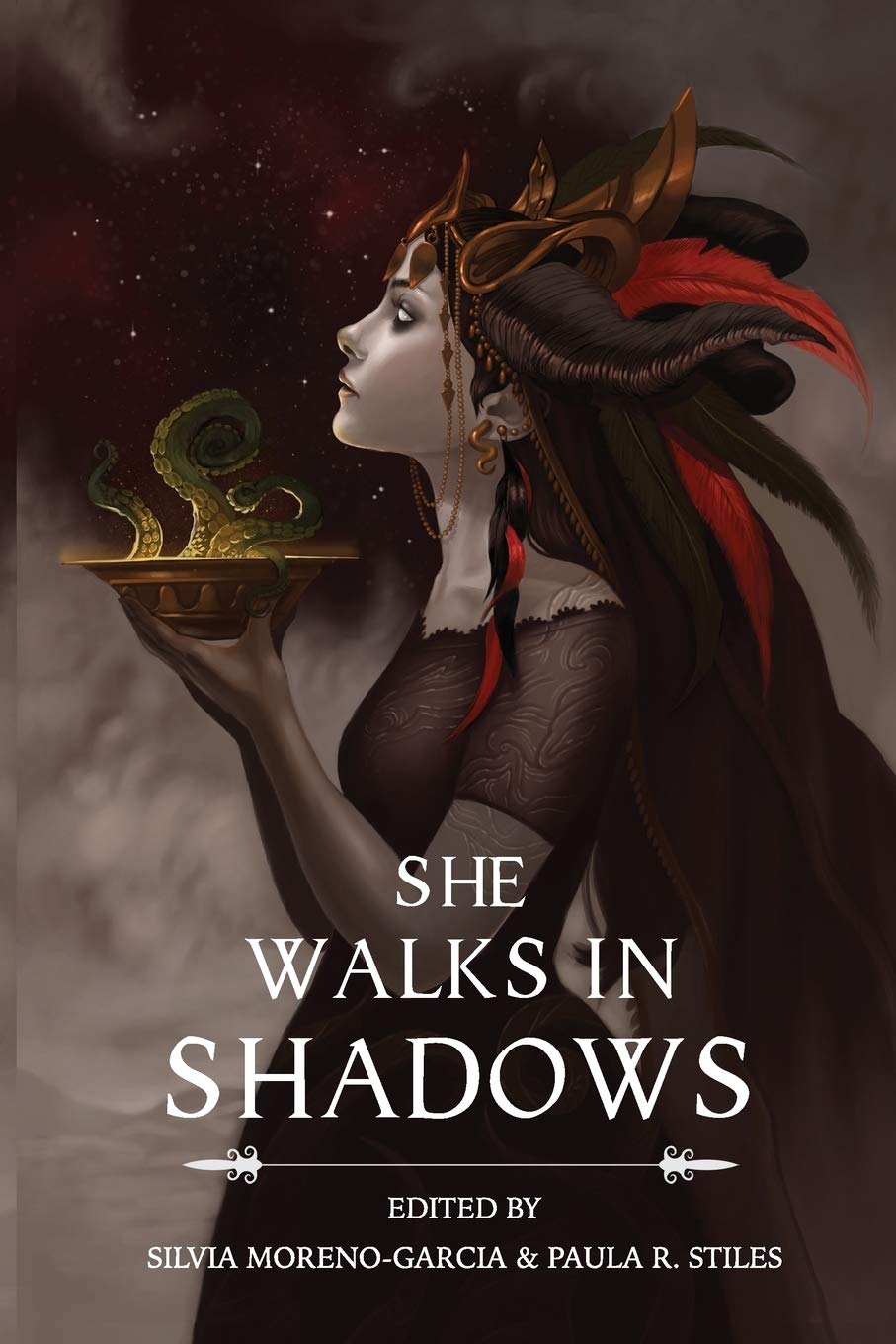
“Maybe Bobby Briggs,” Asenath lowered her voice. —Molly Tanzer, “The Thing on the Cheerleader Squad” in She Walks in Shadows122
The plot in this story is very slight, Veronica’s treacle-sweet faith in Jesus and her utter frustration at how Asenath’s bad reputation is affecting her own showcase the kind of general ignorance, vapid insecurities, and rampant cruelty that are the hallmarks of high school. The story is told well; Tanzer keeps the pace ticking, doesn’t get too bogged down in secondary characters, or feel the need to jam a shoggoth out of left field into act three. The surprises, when they come, feel like they’ve always been there, waiting to be discovered.
What makes it work is the ending. Readers of “The Thing on the Doorstep” have their preconceptions of what is going on and how events will play out; those familiar with narratives of homosexual awakening might imagine that Tanzer is going to take the But I’m a Cheerleader! route with a Lovecraftian twist. The truth is, this was always a horror story, and the finale brings together all the elements in a way that readers probably won’t expect.
Is this a transgender story? When considering it in the context of Lovecraft’s original story, there’s a definite argument to make that it is more of a trans story than “The Thing on the Doorstep.” Asenath never comes out and makes the claim to be transmasculine directly, but that ambiguity is part of what makes the story work. The reader sees, through Veronica’s eyes, how Asenath acts and dresses and presents, and must make their own determination of which gender Asenath identifies with. That still leaves plenty of room for other authors to play with the unrealized possibilities of sex and gender in “The Thing on the Doorstep.”
If something more had been made of the kind of harm done by the release of atomic energy, there might be great possibilities for original & unusual development. How about it? What could you imagine as a sufficiently hellish consequence of the conquest of energy? The opening up of another dimension & the submergence of our familiar physical universe by some influence from ‘outside’? The explosion of all the matter in the immediate space-time continuum? The total or partial suspension of physico-chemical laws, or the disastrous ability of users to effect such a suspension locally or universally? Any of these lines—& many others—would be promising. But at any cost get away from the beaten track! —H. P. Lovecraft to Richard F. Searight, 31 Aug 1933, LRS 10
It is difficult for many people today to understand what it was like to live during the Cold War. A period when the world was divided between great superpowers whose direct conflict would lead to mutually assured destruction, and whose proxy wars consumed generations. A war that was won, not ideologically, but by the unsustainability of the conflict itself, the inability of the human government systems to maintain the constantly escalating costs of preparing for a conflict that would destroy them both.
There were people who, for decades, were told that at any moment the world might end and all they could do was hide under a desk and pray to survive the blast wave. People who grew up being told that equitable government distribution of resources was a blacker evil than conscription of troops to fight in a foreign military intervention, or that breadlines and internal passports were the cost of security for the nation as a whole.
It was not a conflict that Lovecraft lived to see.
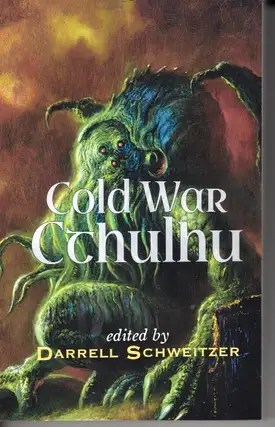
Such were the ways of the elder gods, of which these engineers had been told nothing, nothing at all. —Susan Shwartz, “Red Star at R’lyeh” in Cold War Cthulhu(2025) 41
The gold standard stories of Cold War Cthulhu Mythos fiction are “The Unthinkable” (1991) by Bruce Sterling and “A Colder War” (2000) by Charles Stross. Both stories capture more than just the chronological era of the Cold War, the trappings of cars, clothing, hairstyles, language, music. They focus on the psychology of the period, the mix of ideology and rapid technological progress, the paranoia and, especially, the sacrifices made in pursuit of victory. Sometimes, the technology and the sacrifices went hand in hand.
“Red Star at R’lyeh” by Susan Shwartz is a Mythos-inflected take on a real Cold War event, the Nedelin Catastrophe. It plays out in the form of a secret history: the Cold War has turned colder as the superpowers, so consumed with their conflict, dabble with eldritch forces beyond their understanding. The unthinkable becomes pragmatic, almost prosaic; a toxic cosmic byproduct repurposed as rocket fuel, the better to lift the U.S.S.R. to the stars. Ultimately, due to human hubris, this leads to disaster.
Shwartz captures the mood. The culture of bad decisions that led to lost lives. Like the victims of nuclear radiation, the victims of the Nedelin Catastrophe were an acceptable human cost in pursuit of technological, economic, and ultimately ideological supremacy over their foe. The question to ask is: does it make a difference if Cthulhu was involved, however peripherally?
Knowing how it turned out in the real world, effectively no. The Cold War was a tragedy on a global scale, and the Nedelin Catastrophe happened without the help of Cthulhu or shoggoths. In terms of the story, however, it hints at darker bargains being struck. Lies and omissions that went beyond Cold War norms. It is one thing to have an industrial accident using dangerous technology, enabled by inadequate safeguards and dangerous pressure for an accelerated schedule. It’s something else to have that and know that the dangerous technology is something that humans know they shouldn’t be playing with, bought at some unknown but likely obscene cost, and placed in the hands of those who were unaware of what dangers they truly faced.
Perhaps that’s what makes it a colder war. The realization that someone, somewhere, knew how dangerous this all was, and decided that the human cost was an acceptable risk. That kind of obscenity isn’t unique to the Cold War, but….it is emblematic of the darker side of the conflict, where both sides were willing to sacrifice their own for whatever advantage they thought it would give them, only to be pawns in a much older, vaster game.
There are not a vast number of women mentioned in H. P. Lovecraft’s “The Rats in the Walls.” However, two stand out:
The worst characters, apparently, were the barons and their direct heirs; at least, most was whispered about these. If of healthier inclinations, it was said, an heir would early and mysteriously die to make way for another more typical scion. There seemed to be an inner cult in the family, presided over by the head of the house, and sometimes closed except to a few members. Temperament rather than ancestry was evidently the basis of this cult, for it was entered by several who married into the family. Lady Margaret Trevor from Cornwall, wife of Godfrey, the second son of the fifth baron, became a favourite bane of children all over the countryside, and the daemon heroine of a particularly horrible old ballad not yet extinct near the Welsh border. Preserved in balladry, too, though not illustrating the same point, is the hideous tale of Lady Mary de la Poer, who shortly after her marriage to the Earl of Shrewsfield was killed by him and his mother, both of the slayers being absolved and blessed by the priest to whom they confessed what they dared not repeat to the world. —H. P. Lovecraft, “The Rats in the Walls”
While it wouldn’t be quite accurate to say that Lovecraft scholarship has ignored these women, it would be accurate to say that the picklocks of literary critics and historians haven’t turned up any particular connections or likely historical or literary inspirations for Margaret Trevor and Mary de la Poer. While we know Lovecraft drew inspiration for this tale from Sabine Bearing-Gould’s “S. Patrick’s Purgatory” in Curious Myths of the Middle Ages, and while there is no lack of mysterious ladies therein, one stands out as a possible inspiration:
It is worthy of remark that the myth of S. Patrick’s Purgatory originated among the Kelts, and the reason is not far to seek. In ancient Keltic Mythology the nether world was divided into three circles corresponding with Purgatory, Hell, and Heaven ; and over Hell was cast a bridge, very narrow, which souls were obliged to traverse if they hoped to reach the mansions of light. This was—
“The Brig o’ Dread, na brader than a thread.”
And the Purgatory under consideration is a reflex of old Druidic teaching. Thus in an ancient Breton ballad Tina passes through the lake of pain, on which float the dead, white robed, in little boats. She then wades through valleys of blood. (248-249)
This is speculative; Lovecraft borrows some of the imagery for “The Rats in the Walls,” and it includes a woman recalled in a ballad associated with pain and blood, which may have been the seed from which Margaret Trevor and Mary de la Poer (and their respective ballads) grew. One might also wonder if the legend of Elizabeth Bathory worked on Lovecraft’s imagination, or any of the prospective cultists included in Margaret Murray’s The Witch-Cult in Western Europe, and these are certainly possible. The image is, in both cases, of women of the line who do not shrink away from the family cult, but become active participants.
Trish Thawer in The Witches of BlackBrook (2015) famously wrote: “We are the daughters of the witches you weren’t able to burn.” While that may not be historically true (convicted witches during the Salem Witch hysteria were hung, not burned at the stake), there is a sentiment that applies to readers and writers in Lovecraft’s Mythos: who are the daughters and granddaughters of Lovecraft’s women cultists, who had such a bad reputation that they haunted the ballads of the country for centuries thereafter?
Which is the theme that E. Catherine Tobler assays in “Lockbox,” one of the stories in She Walks in Shadows. The brief story is a return to Exham Priory by a female descendant of the de la Poer (or Shrewsfield) line and her not-quite-trustworthy lover…and the thing that makes the story work is that it is her story, her reconnection with this ancestor and all the mystery and horror that Margaret Trevor of Cornwall represents, not as a member of the cult she was marrying into, but as a black saint in her own right:
The worst thing was, despite the horrors around her, Margaret Trevor was something to be worshipped, a glory even in the blood and ruin that streaked her. The stories said that she loved the old cults well, but had taken a passive role beside her husband. But here, in the horrible cellar with the collapsing girders, she was a gold-and-silver goddess while her husband cowered. —E. Catherine Tobler, “Lockbox” in She Walks in Shadows 94-95
The story is told with many footnotes, many caveats, things that cannot be said and perhaps dare not be remembered. It gives the suggestion of a maddening experience that has snapped a thread of sanity and memory, but the title is the crux of the story, because it is a mystery and a memory that the narrator can choose to recall whenever she wishes—whenever she is ready to leave her placid isle of ignorance and remember what really happened down there, in the buried ruins of Exham Priory.
Have any of these yokels even seen a Black woman before? —Sarah Hans, “U.S. Fish and Wildlife Services Inspection Report No. IF-32651” in Arkham Institutions(2024) 137
“The Shadow over Innsmouth” is one of Lovecraft’s most quintessential tales, not just in the sense that it has become one of the core stories for his artificial mythology, but because when you strip down the story to its fundamentals it is one of the quintessential stories of its type: a civilized intruder tale. Someone from wider civilization travels to a liminal community, someplace that is, whether or not it is physically far away, somehow isolated culturally from the wider network of the world we know, and there’s something wrong there.
What is wrong and who does the intruding vary. In The Wicker Man (1973), a police officer finds a neo-pagan religion up to no good. In Midsommar (2019), tourists go to a remote Swedish village and find a pagan survival group up to no good. The essential framework is supremely adaptable, and most importantly, it leaves a great deal of room for novelty and reinvention. When Lovecraft used the idea in “The Shadow over Innsmouth,” the idea wasn’t new; he was riffing off stories like Herbert Gorman’s “The Place Called Dagon” (1927) and Algernon Blackwood’s “Ancient Sorceries” (1908). What Lovecraft added was the twist: that the intruder was not really an intruder at all, but was akin to the horrors.
Innumerable versions of this basic idea have played out through the Cthulhu Mythos, sometimes revisiting and recapitulating “The Shadow over Innsmouth,” sometimes with other locations. Stories like “Satan’s Servants” (1949) by Robert Bloch and “The Moon Lens” (1964) and “The Horror Under Warrendown” (1997) by Ramsey Campbell all riff on the basic concept, while La Planète aux Cauchemars (2019) by Mathieu Sapin & Patrick Pion, “The Chabad of Innsmouth” (2014) by Marsha Morman, and now with “U.S. Fish and Wildlife Services Inspection Report No. IF-32651” (2024) by Sarah Hans are examples of revisiting and updating the Innsmouth story itself.
With a few changes.
Before I exit the truck, I get my gun out of the glovebox. I do have a permit for it, but I’m not supposed to carry one while I’m on official duties. I can’t risk being caught in the middle of nowhere unarmed, though. I work alone most of the time and sundown towns don’t exactly advertise themselves —Sarah Hans, “U.S. Fish and Wildlife Services Inspection Report No. IF-32651” in Arkham Institutions(2024) 138
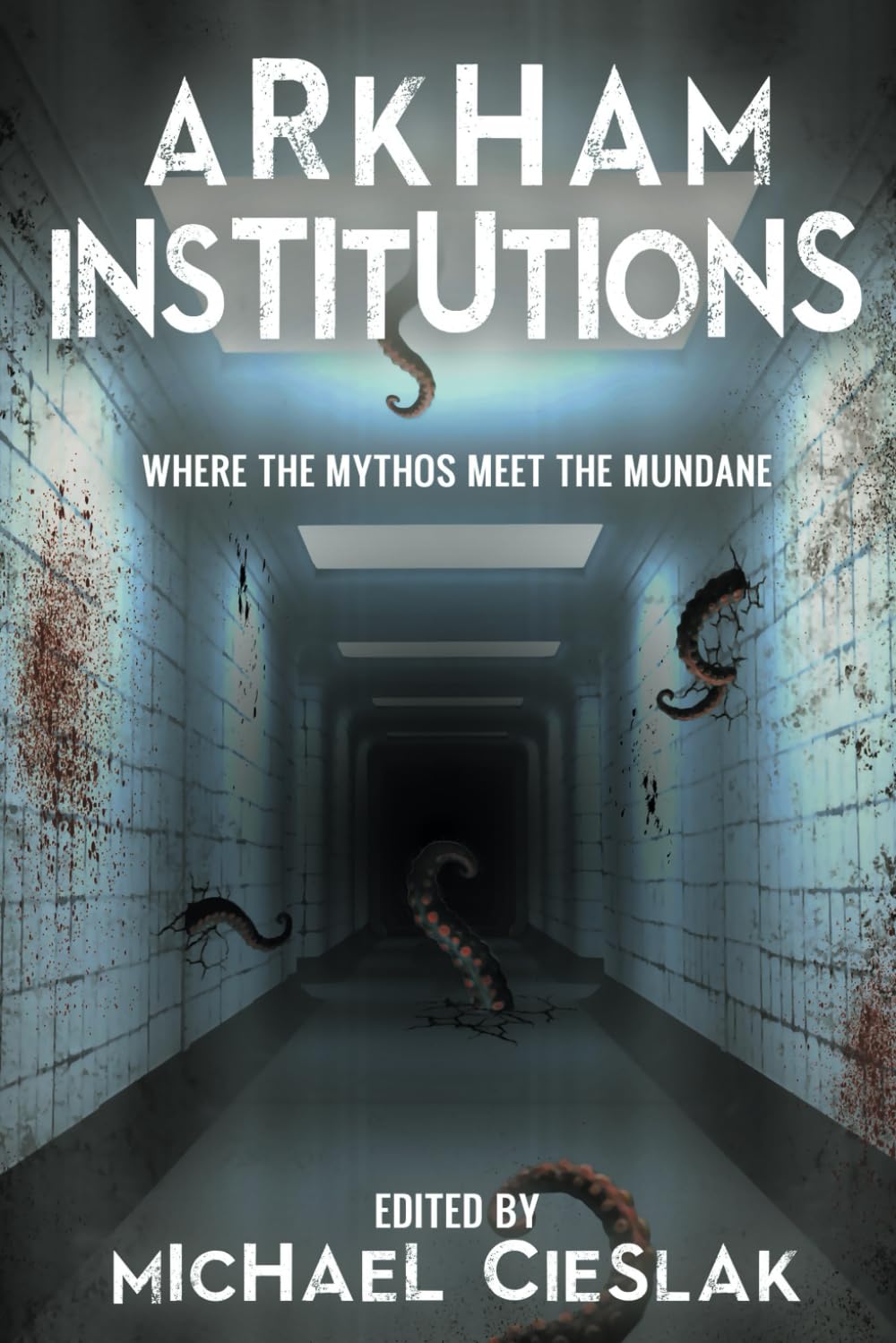
The pitch for Arkham Institutions is “to explore how the people who run these towns and their institutions deal with the eldritch abominations of Lovecraftian terror” (back cover text). Which is as good a reason why a Fish & Wildlife Service agent will pop into Innsmouth for an inspection of the Innsmouth Fisheries as any other reason why someone might intrude on this liminal community.
Hans’ Innsmouth isn’t exactly Lovecraft’s, and the story doesn’t try to recapitulate the whole narrative. It is a contemporary setting, there’s no mention of the government raid of 1927, no reference to the Marsh Refinery. The business of the town is fishing, and Agent Cherise Brown has no ancestral links to the inbred locals. What plays out is a very different story that takes inspiration from Lovecraft—and probably wouldn’t be very comprehensible unless you’re familiar with that story—but tries to do something original with the idea.
The central idea is one I can dig: no liminal community can remain unvisited forever. Innsmouth was always going to receive some outside visitor who would cause problems. The question was not a matter of if it would happen, but who would intrude and when, and how the community would respond to that intrusion. It is an idea that suggests different possibilities—when would Innsmouth be no longer able to hide? As timeless as the locale seems in Lovecraft’s tale, in the context of how the world has developed after his death, it is easy to see how fragile Innsmouth’s isolation really was.
This review deals with a work of erotic content. As part of this review, selected art displaying cartoon nudity will be included. As such, please be advised before reading further.
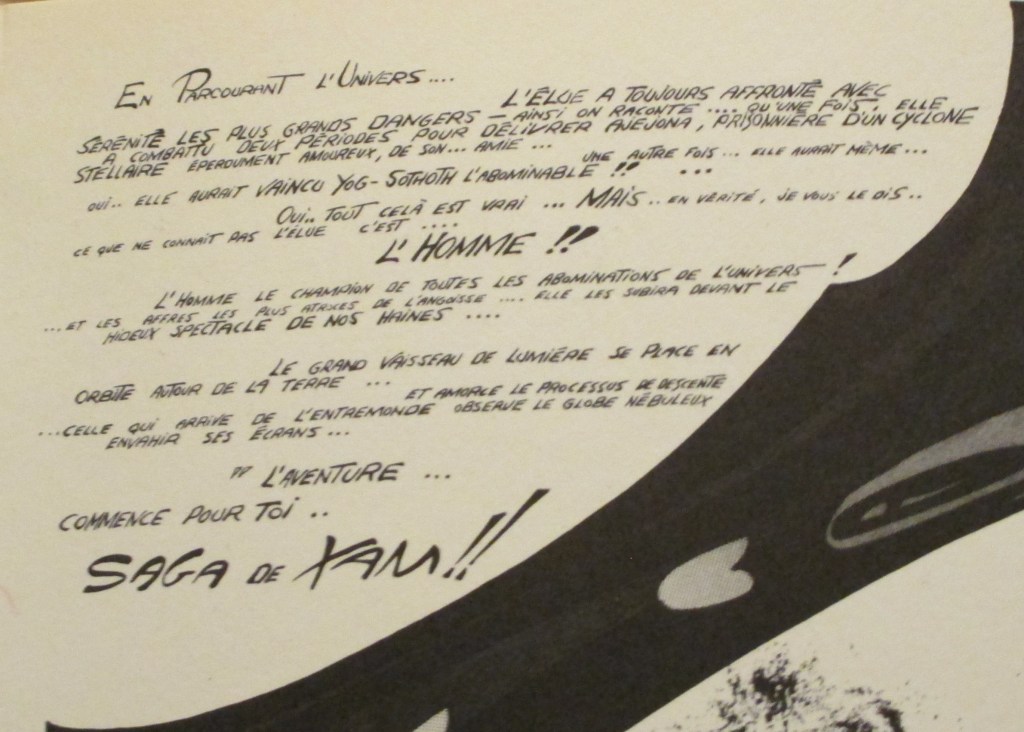
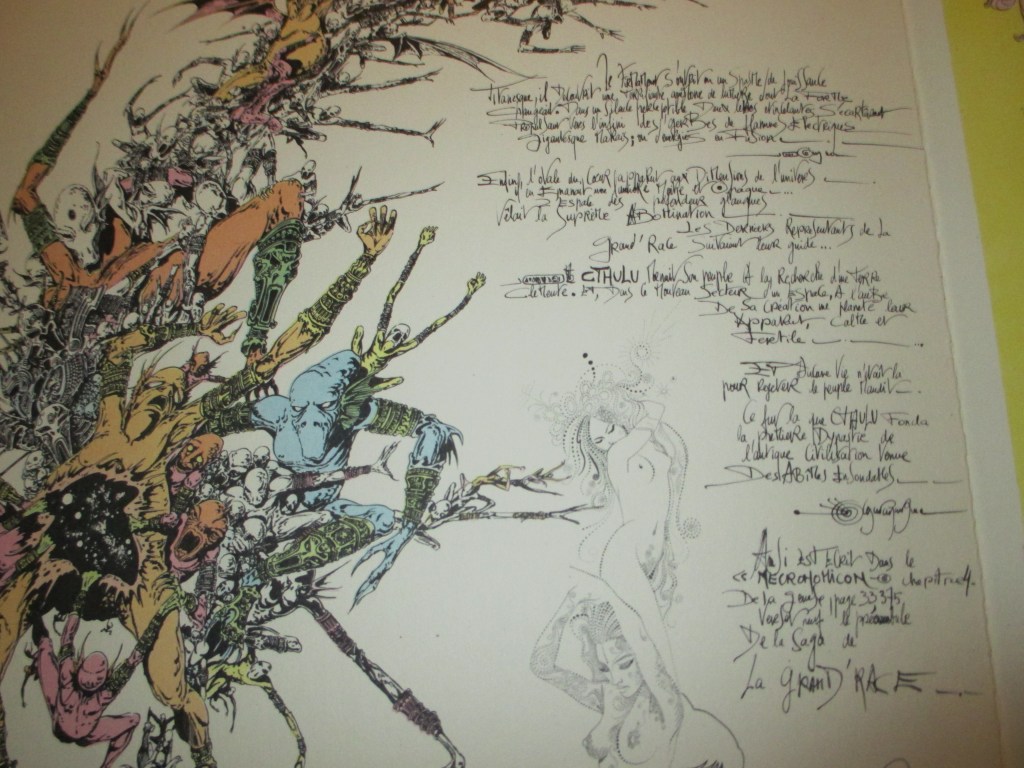
En Parcourant l’Univers . . .
L’Élue a toujours affronté avec sérénité les plus grands dangers—ainsi on raconte . . . . qu ‘une fois, elle a combattu deux périodese fois . . . Elle aurait m pour délivrer ajejona, prisonniére d’un cyclone stellaire éperoument amoureux, de son . . . amie . . .
Une autre fois . . . Elle aurait mème . . . oui … Elle aurait vaincu Yog-Sothoth l;abominable!! . . .
Oui . . tout celà est vrai . . . MAIS … en verité, je vous Le ois . . ce que ne connaître pas l’élue c’est . . . . L’HOMME !!
L’Homme le champion de toutes Les abominations de l’univers—! . . . et Les affres Les plus atroces de l’angoisse . . . . Elle Les subira devant Le hideux spectacle de nos haines . . . .
Le grand vaisseau de lumiére SE place en orbite author de la terre . . .
Et amorle Le processus de descente . . . celle qui arrive de l’entremonde observe Le globe nébuleux envahir ses écrans . . .
L’aventure … commence pour toi . . Saga de Xam!
Traveling the Universe . . .
The Chosen One has always faced the greatest dangers with serenity—thus it is said . . . . that once, she fought twice . . . She would have to free Ajejona, prisoner of a stellar cyclone, desperately in love, from her . . . friend . . .
Another time… She would have even… yes… She would have defeated the abominable Yog-Sothoth!!…
Yes… all this is true… BUT… truly, I tell you… what not knowing the chosen one is… MAN!!
Man, the champion of all the abominations of the universe—! . . . and the most atrocious pangs of anguish . . . . She will endure them before the hideous spectacle of our hatreds . . . .
The great ship of light places itself in orbit above the earth . . .
And begins the process of descent . . . she who arrives from the in-between world observes the nebulous globe invade her screens . . .
The adventure… begins for you . . Saga of Xam!
Saga de Xam (1967), chapter 1
English translation
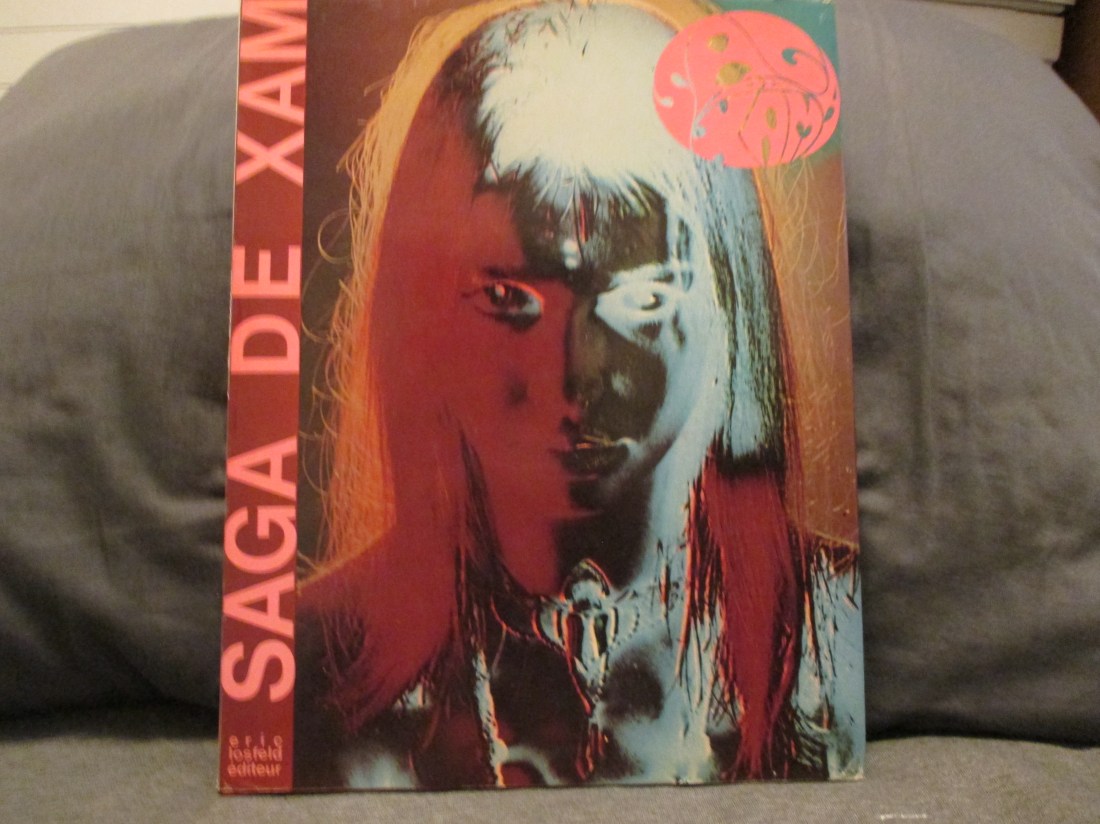
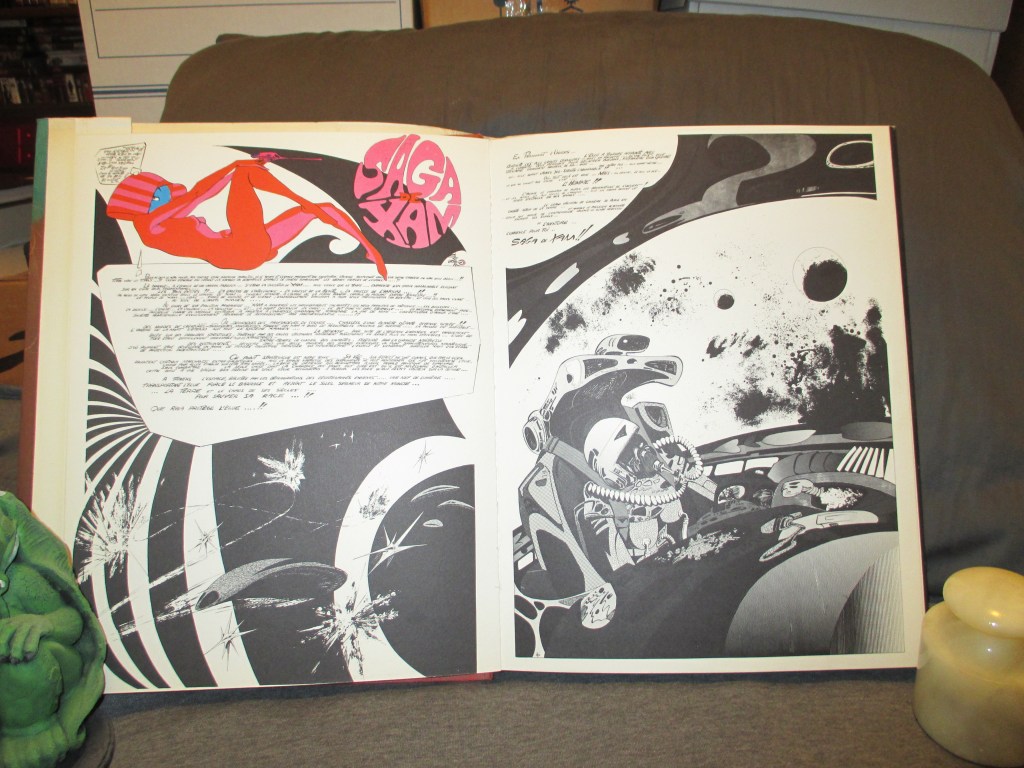
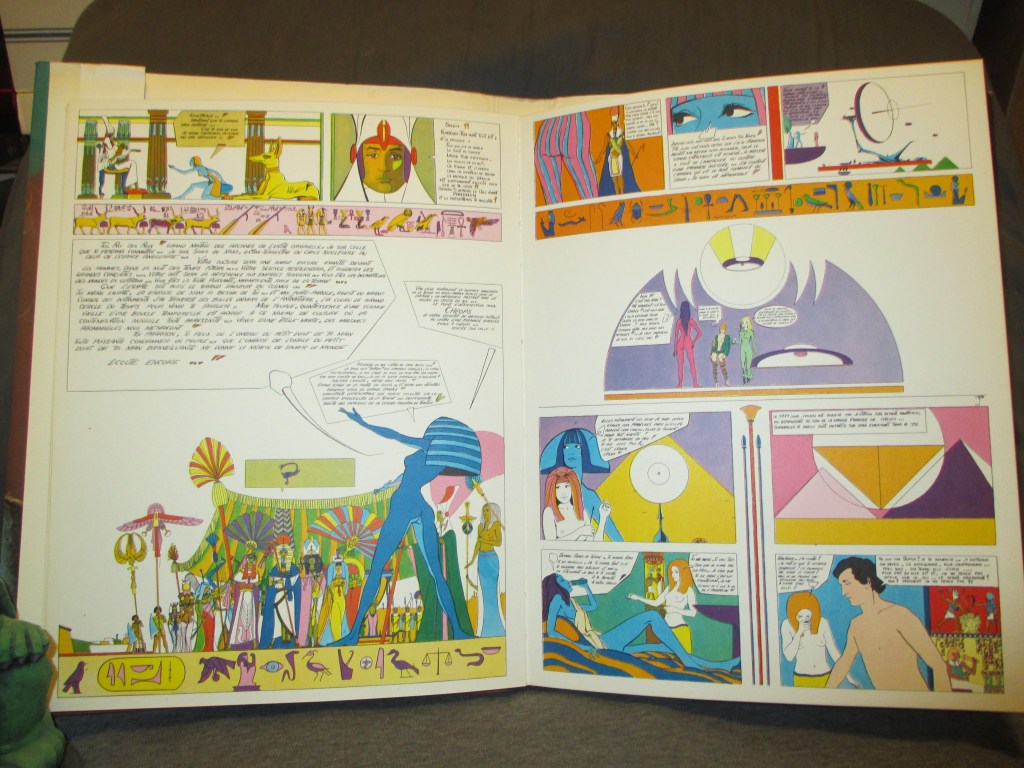
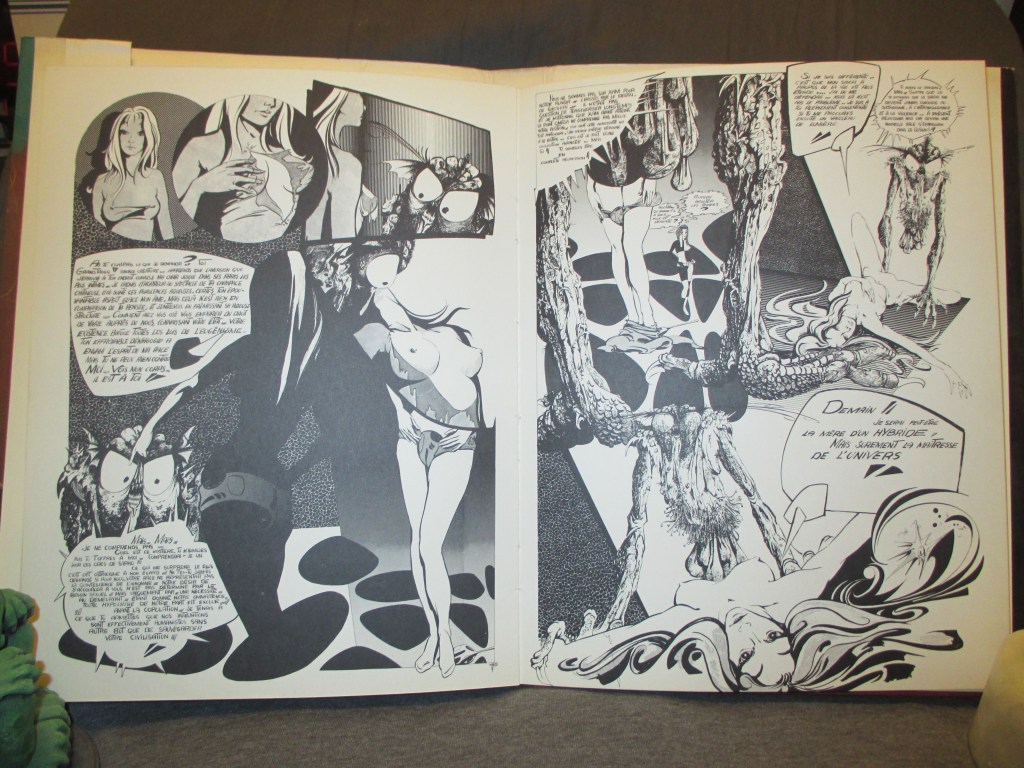
In 1967, French director Jean Rollin had not yet made his mark on cinema. While he had directed a few films, his moody, unconventional erotic horror/fantasies like Le viol du vampire (1968, “The Rape of the Vampire”), La vampire nue (1970, “The Nude Vampire”), and Le Frisson des Vampires (1971, “The Shiver of the Vampires”) all lay in the future. However, he was in contact with Éric Losfeld, a French publisher of literary and artistic works that challenged the sensibilities of the day, including fantasy, science fiction, and erotic comics like Barbarella by Jean-Claude Forest, Lone Sloane: Mystère des Abîmes by Phillipe Druillet, and Phoebe Zeit-Geist by Guy Peellaert, as well as Nicolas Devil (Nicolas Deville), who served as art director for Rollin’s short Les pays loin (1965, “The Far Countries”).
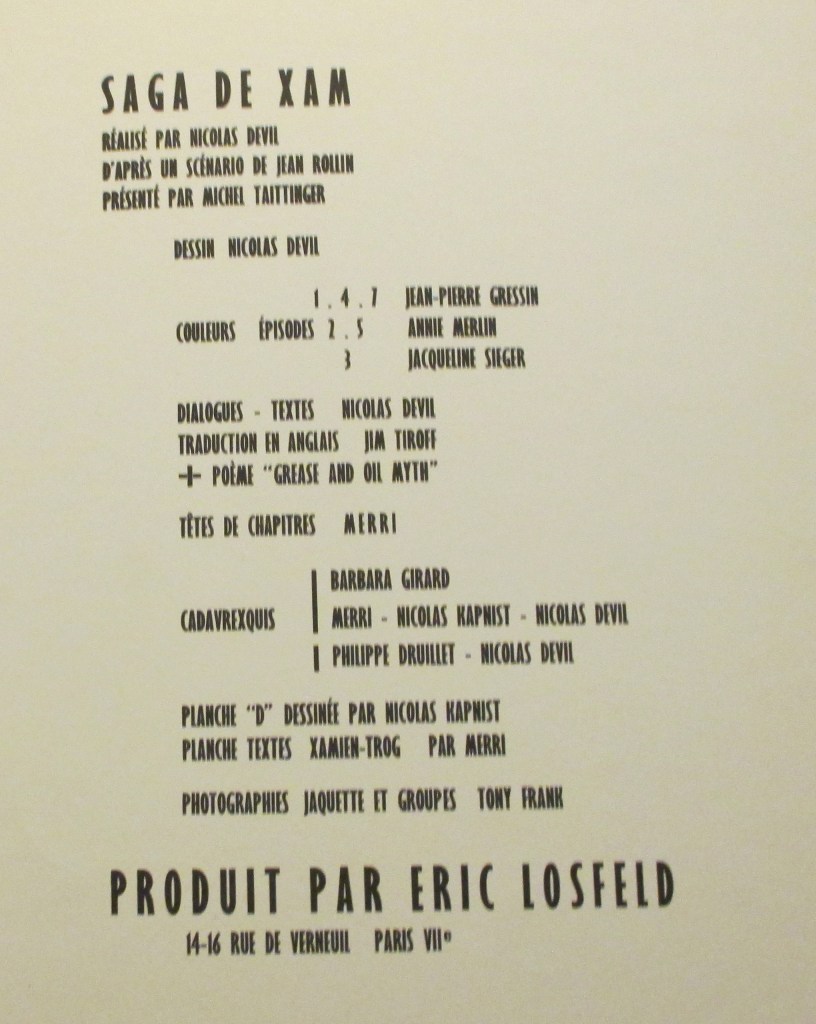
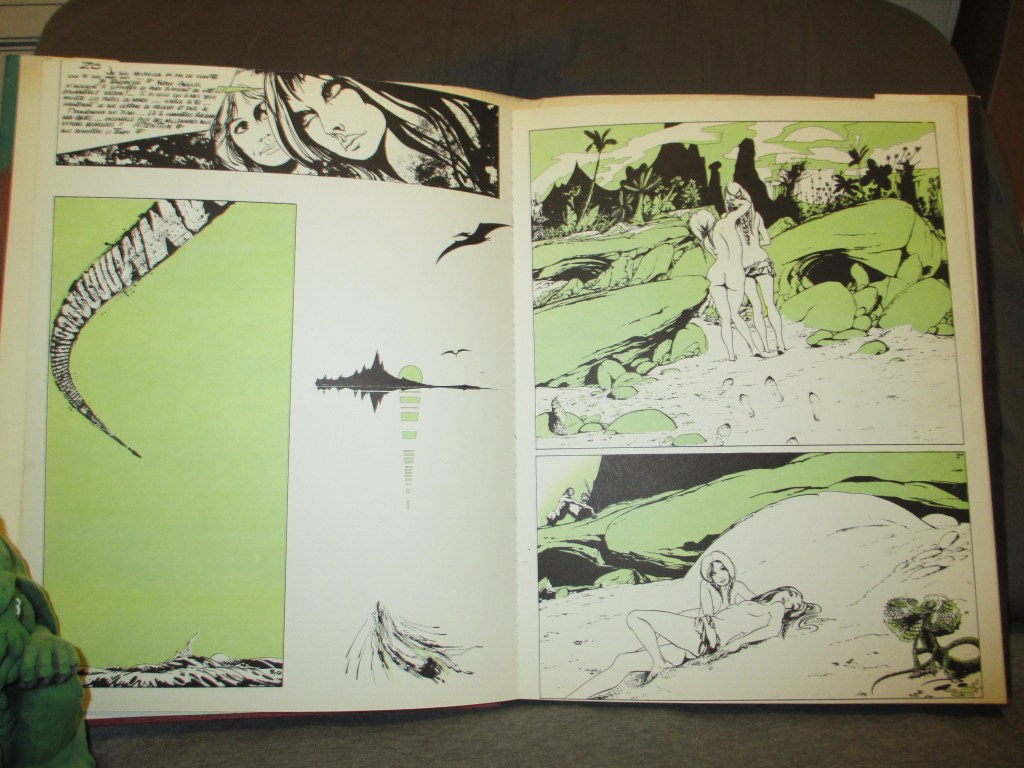
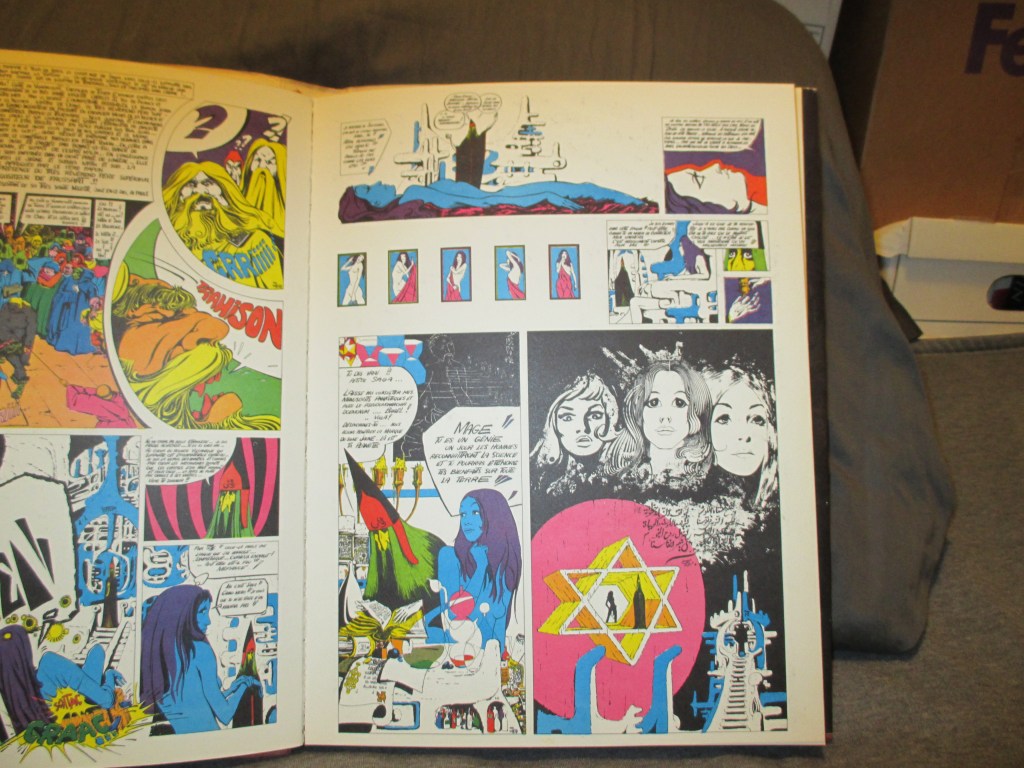
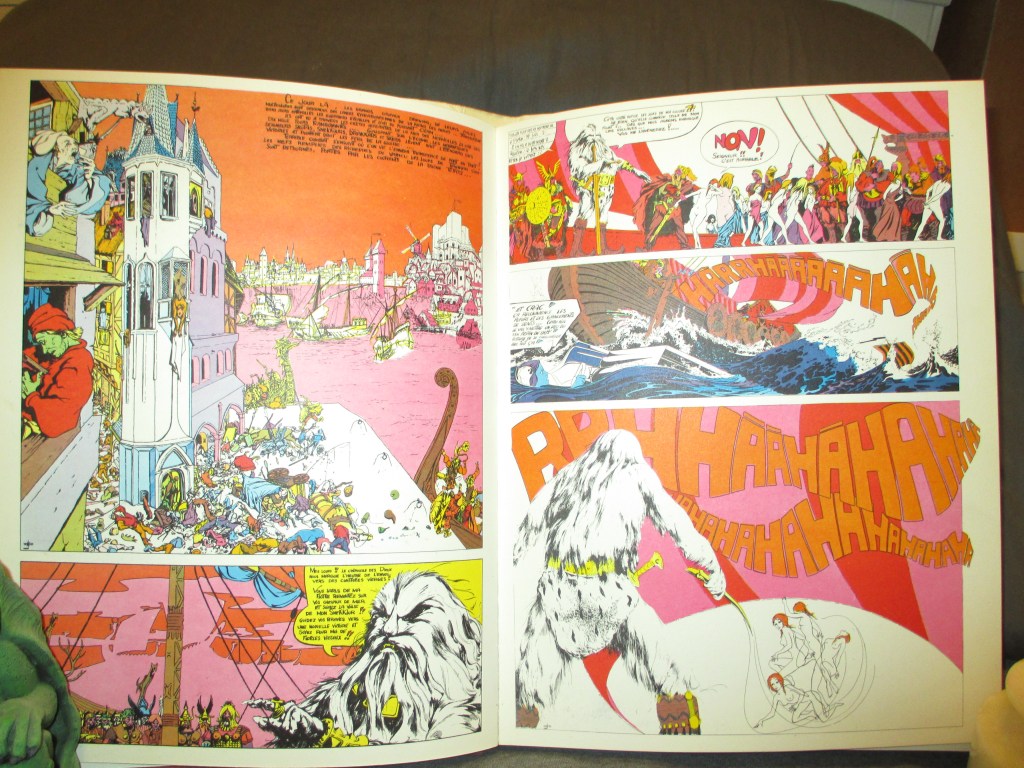
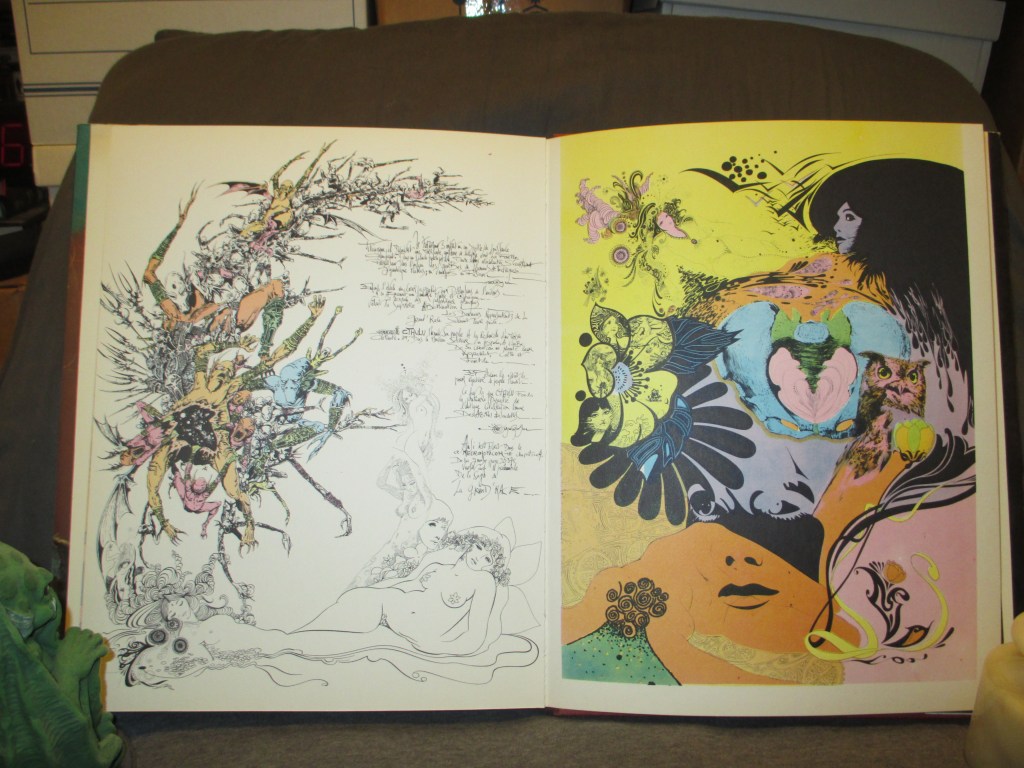
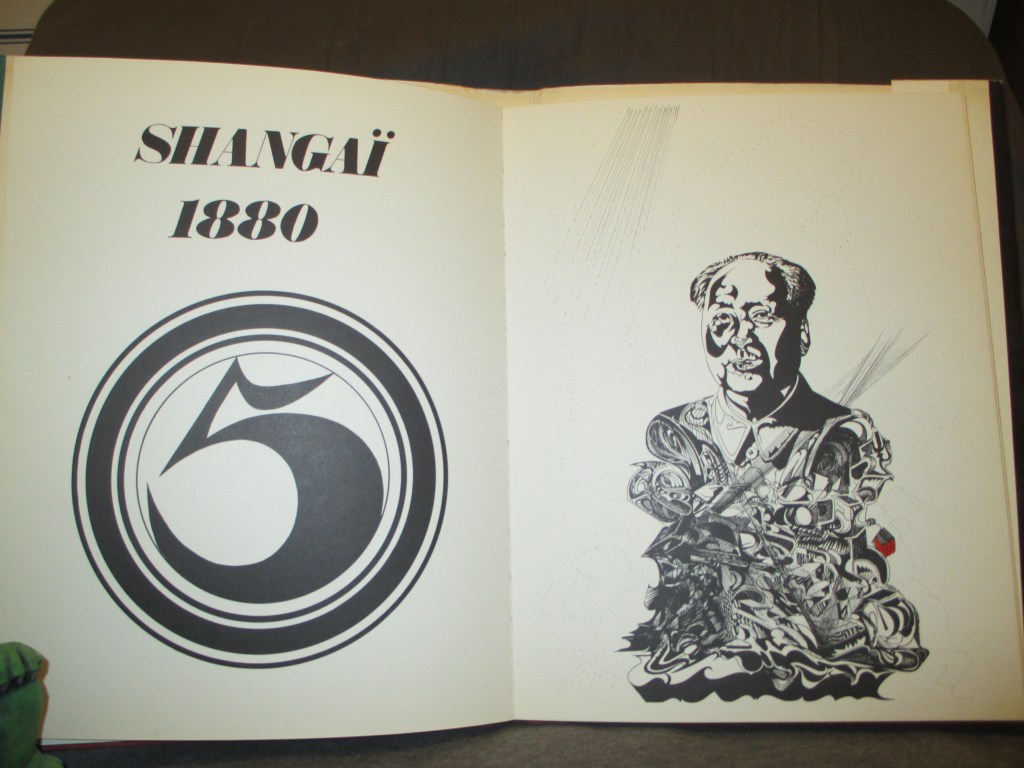
Together, they produced Saga de Xam. Rollin’s scenario had been intended for a science-fiction film that never materialized. Nicolas Devil took that script and realized it artistically. The blue-skinned woman Saga from the planet Xam is on a mission to Earth, and moves through a series of surreal adventures that expose her to the best and worst of humanity in a blend fantasy, science fiction, and eroticism for six chapters, plus a seventh chapter that is largely splash pages. Barbara Girard, Merri, Nicolas Kapnist, and Phillipe Druillet all lend their talents, and actor Jim Tiroff provides a poem in English, “Grease and Oil Myth.” While Devil is the primary creator, the final chapter uses the ExquisiteCorpse approach, with creators building on each other’s work.
Credits page
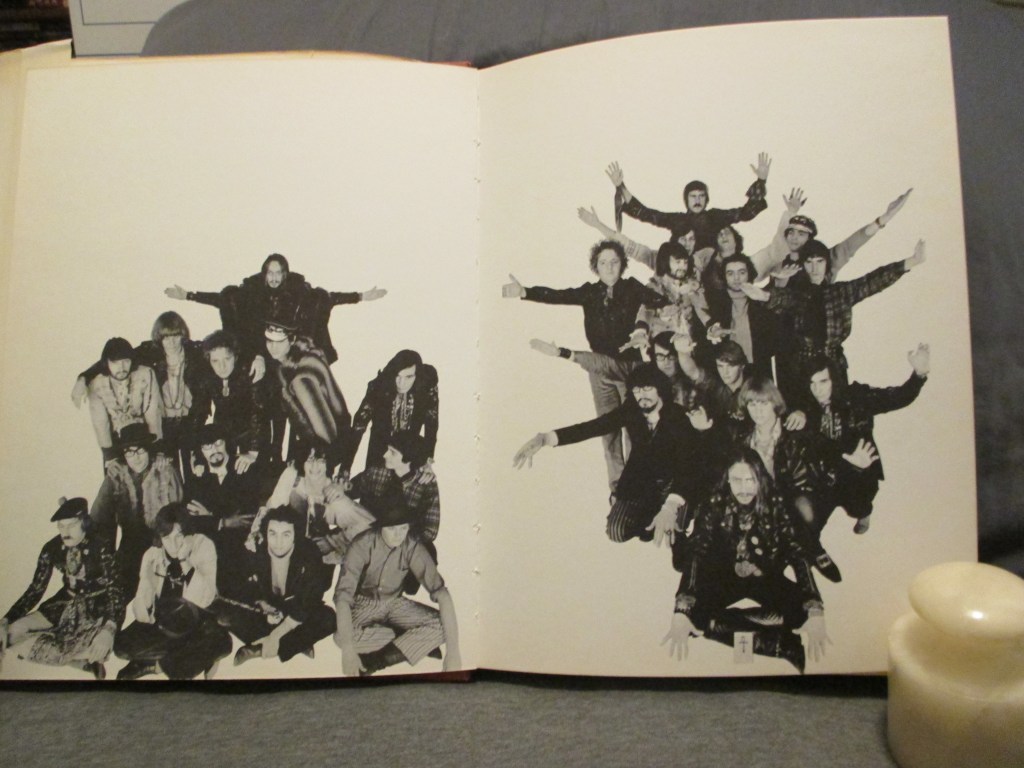
The creative team.
Saga de Xam was released as a single large hardbound album by Éric Losfeld in 1967. Because it was drawn on large boards and reduced to fit the page size, some of Devil’s hand-lettered text is very difficult to read without a magnifying glass, but the overall production quality was high, with excellent print quality and vibrant colors. It was in every sense of the word an avant-garde production, a psychedelic graphic novel that played with all manner of artistic styles, techniques, layout, coloring, and storytelling. Published in an edition of 5000 copies that quickly sold out, the book was somewhat legendary until relatively recently: there were reprints in 1980 and 2022, and an English translation is due for release in 2025.
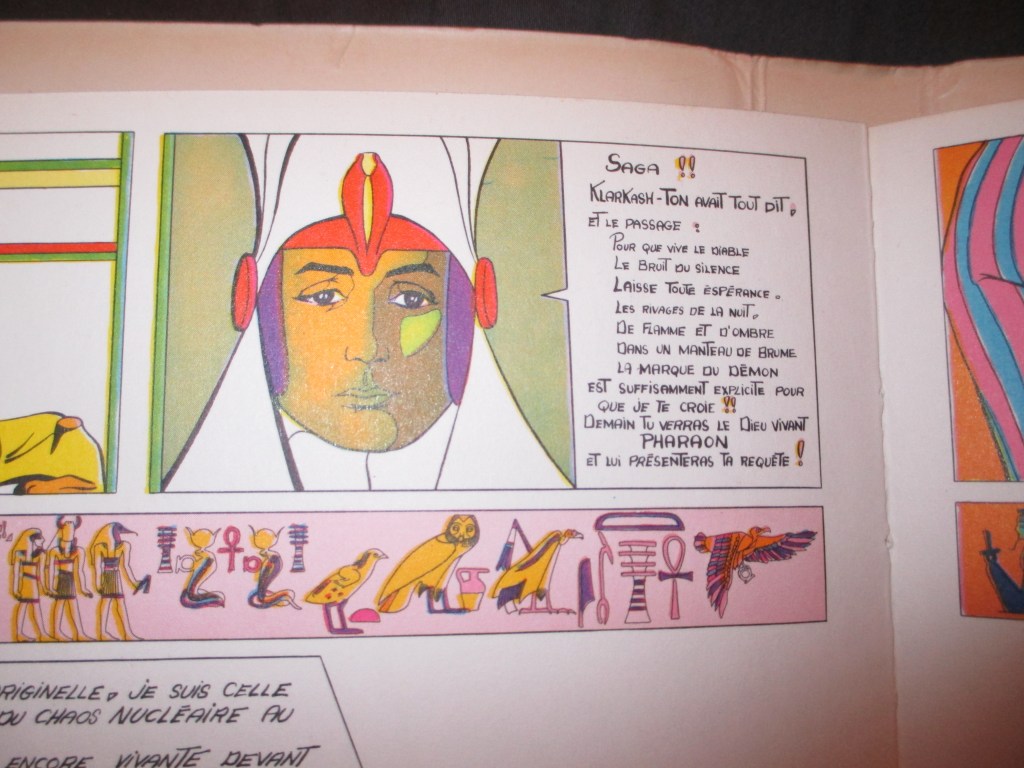
Lovecraft’s Mythos are subtly but consciously present in the text, woven into the storyline at different points. At one point, for instance, Saga encounters Abdul Alhazred; in another, a poem by “Klarkash-Ton” is quoted:
Klarkash-Ton avait tout dit, etc Le passage:
Pour que vive le diable Le bruit du silence Laisse toute éspérance. Les rivages de la nuit, De flamme et d’ombre Dans un manteau de brume Le marque du démon
Klarkash-Ton has said it all, and the passage:
Long live the devil The sound of silence Leaves all hope. The shores of the night, Of flame and shadow In a cloak of mist The demonic mark
Saga de Xam (1967), chapter 4
English translation
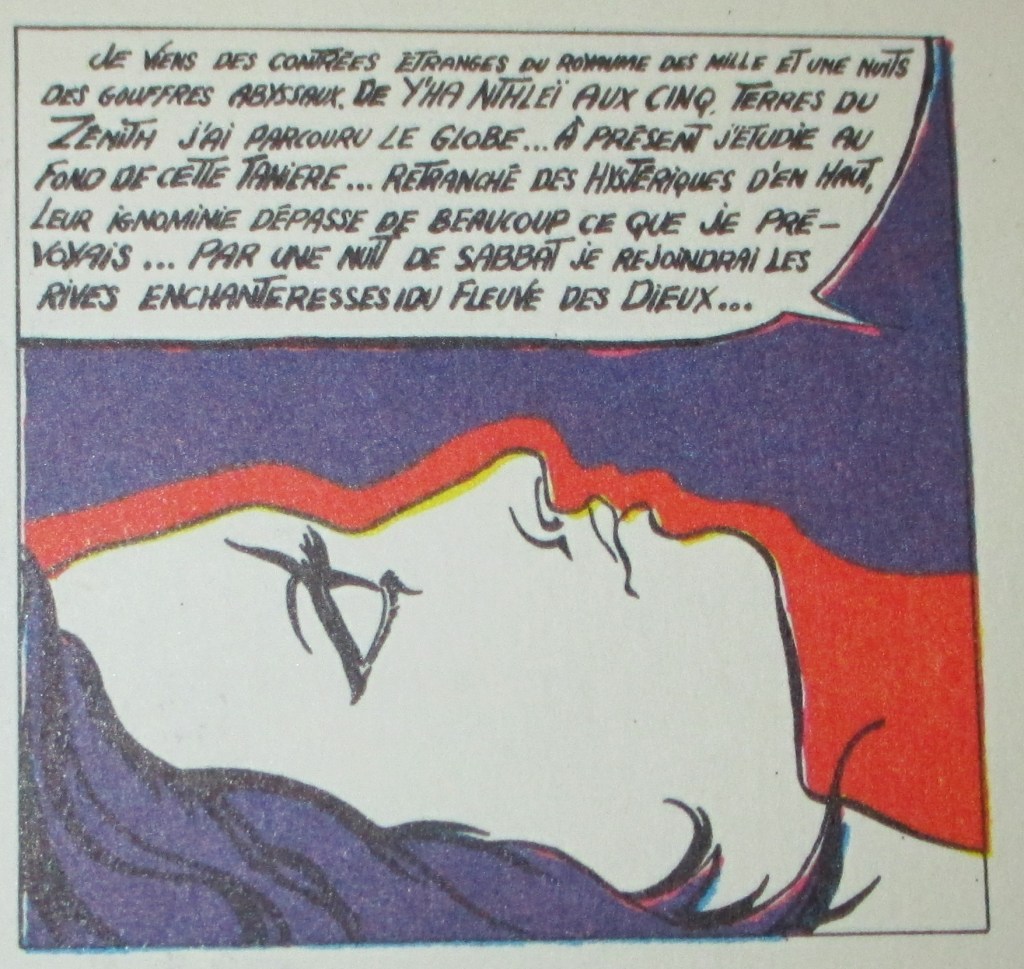
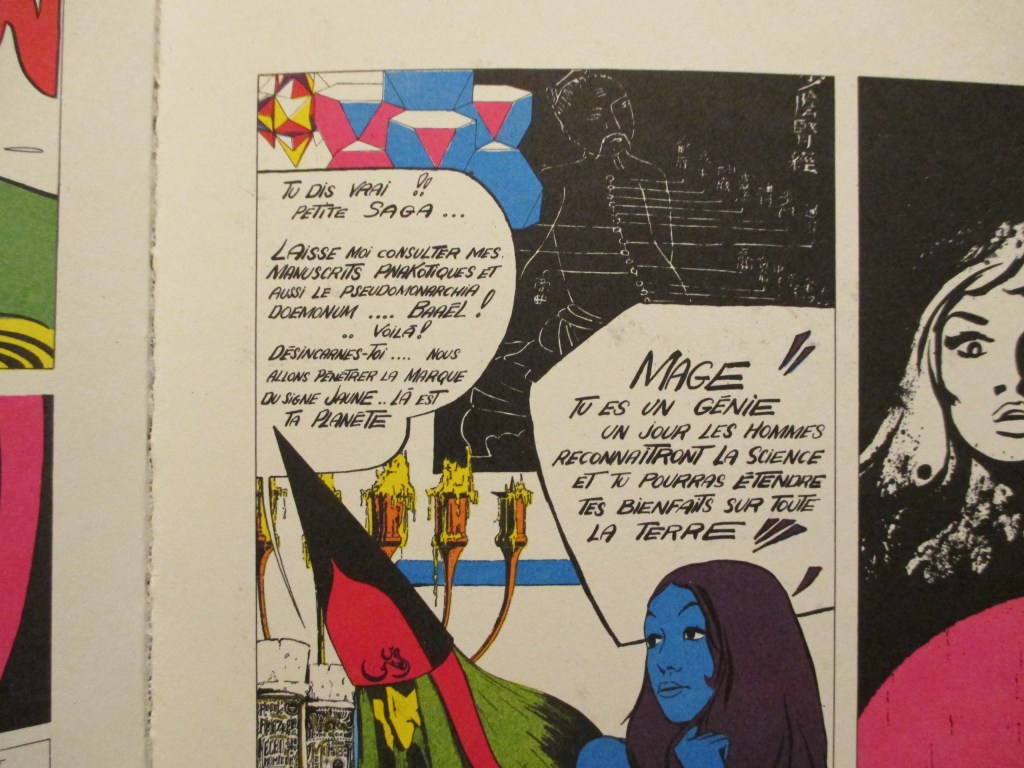
While such blank verse isn’t a translation of any poem of Clark Ashton Smith’s that I could find, it is a nice homage to the master of Averoigne. There are several other references scattered throughout the book, not necessarily playing a large part in the proceedings but adding to the charm for fans of the Mythos. Among Fruillet’s pages in chapter 7 is one ripped straight from the Necronomicon, or at least definitely in keeping with the pages that would be published in the Métal Hurlant/Heavy Metal/Metal Extra Lovecraft Special a few years later. It’s tempting to speculate that all the Mythos elements in the book might come from Druillet’s contributions, but it is impossible to tell on such a collaborative work.
Abdul Alhazred name-drops Y’ha-nthlei from “The Shadow over Innsmouth”Abdul Alhazred consults the Pnakotic ManuscriptsDruillet’s Necronomicon page
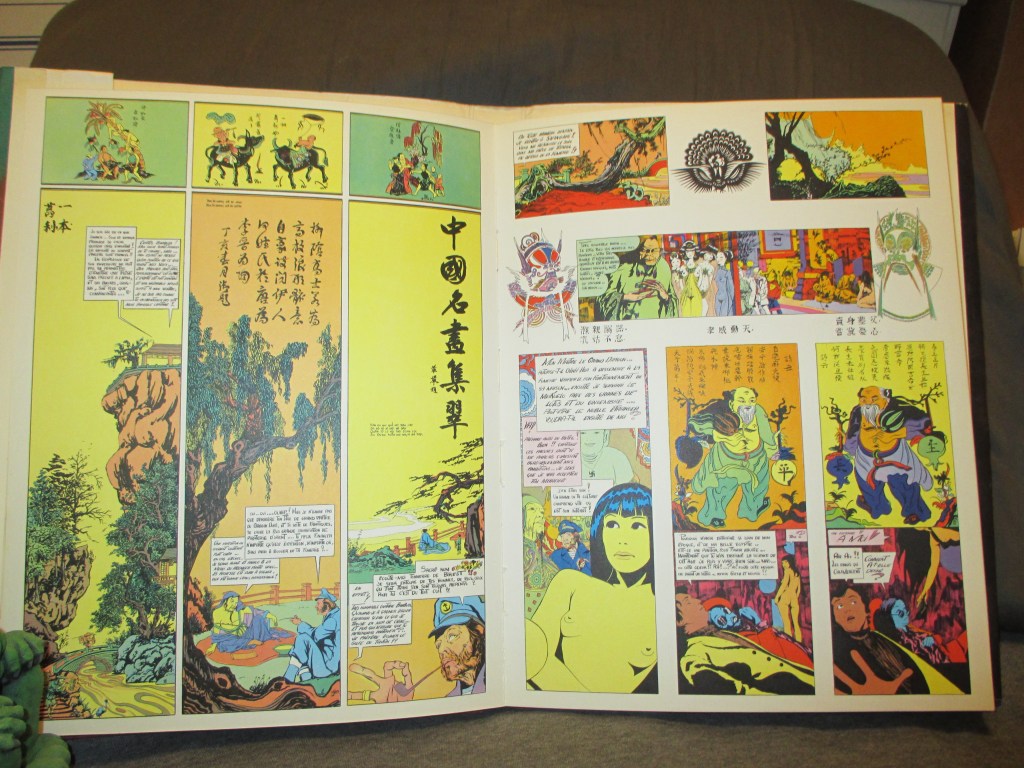
The visual style and politics are both very ensconced in the 60s counterculture; Saga is often nude but rarely powerless, violently rejecting rapists, leading women to free themselves, and developing love affairs with other women. There is a certain quirky mid-century aspect to the depictions, for example. Chapter 5 is specifically set in China, and the color tone literally renders the Asian women yellow, just as Saga is depicted as blue.
The ending is also a bit stark; when the hideous and violent Troggs invade, rather than destroying them Saga chooses to make love, not war—literally, by conceiving a hybrid child with the Grand Trogg. In an era dominated by the Vietnam War, the idea of finding a peaceful means of coexistence had its appeal.
That, then, is the story of Saga of Xam: to learn that love and sex should be given freely, not taken by force.
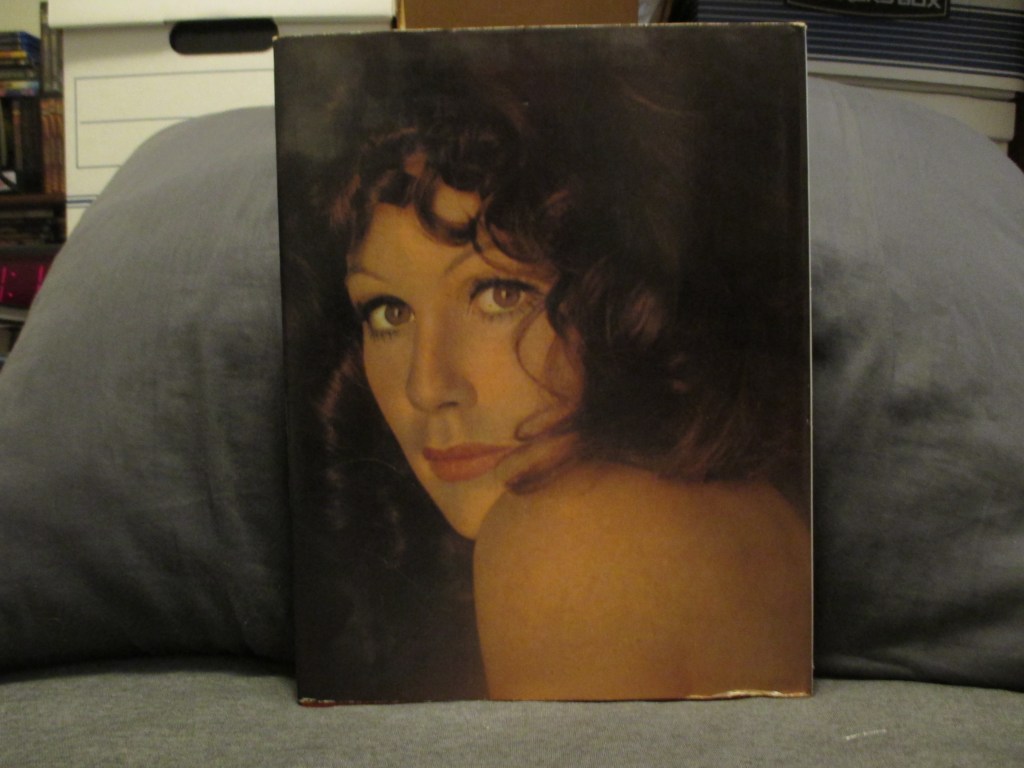
Back cover of the first edition.
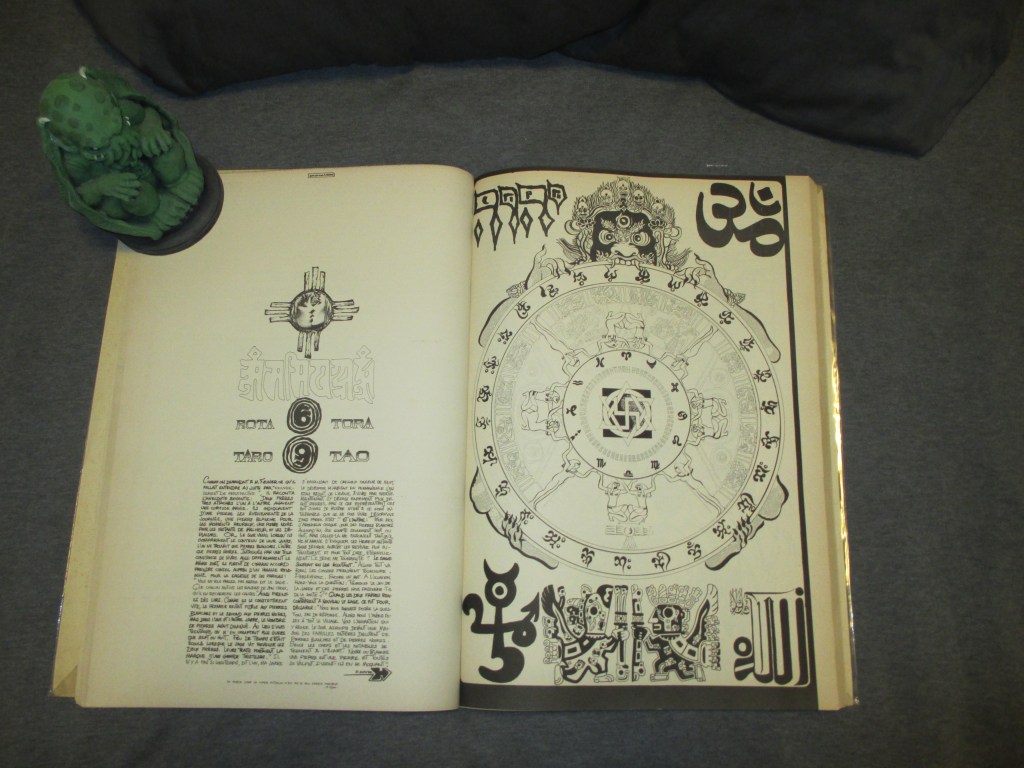
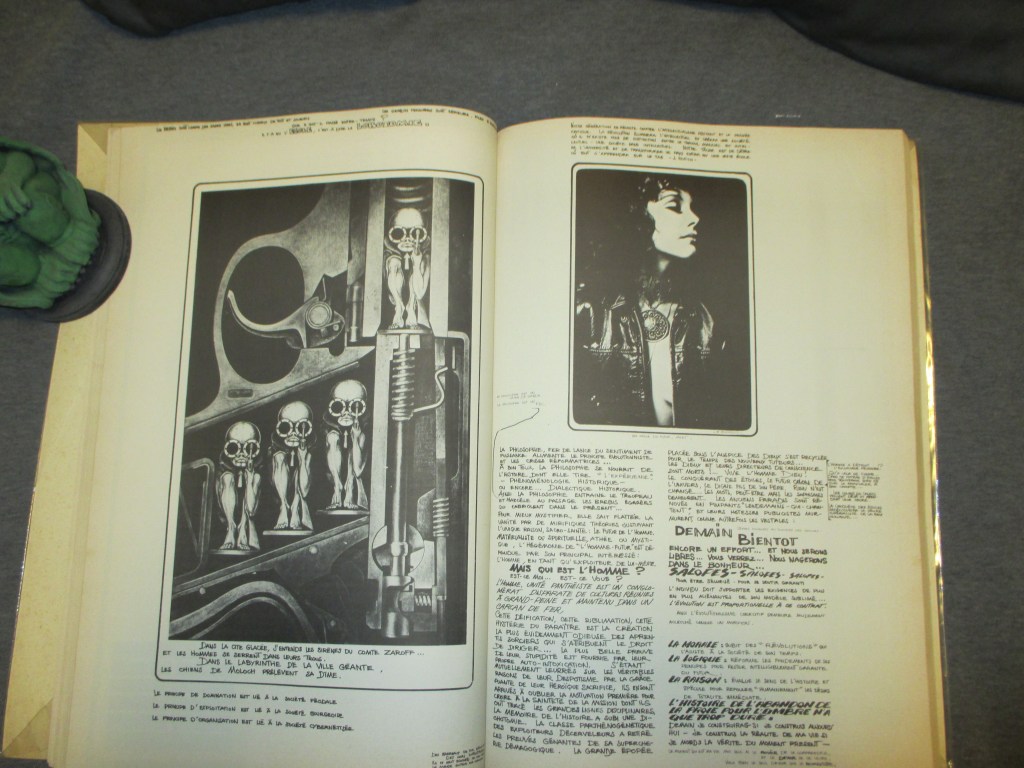
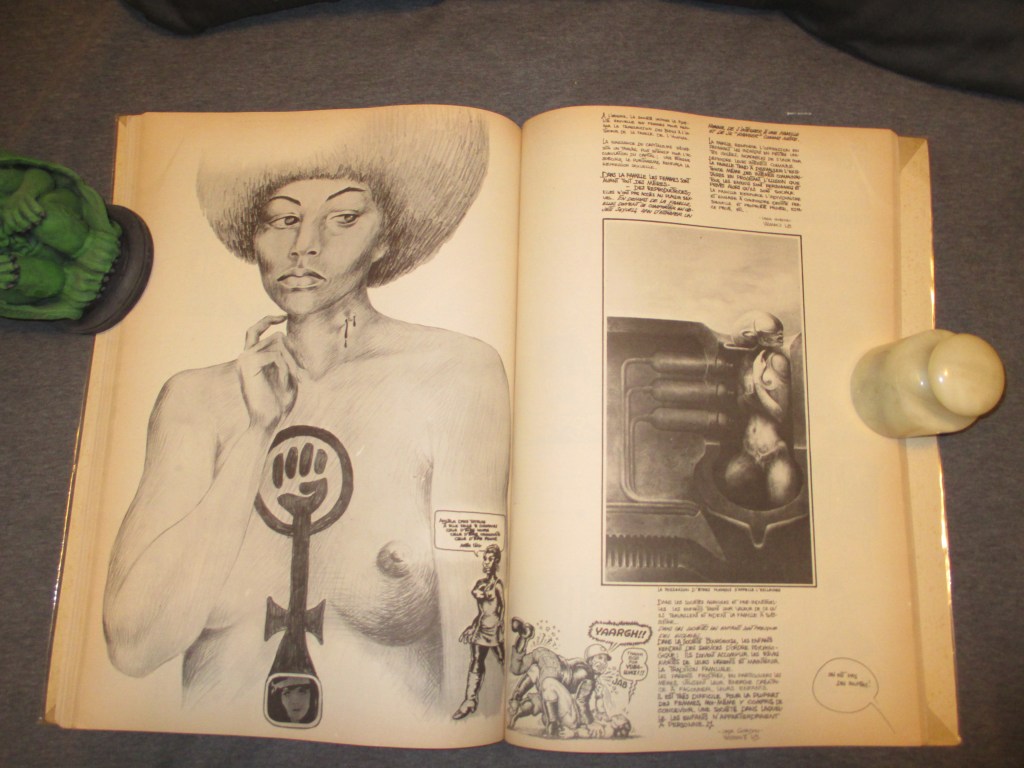
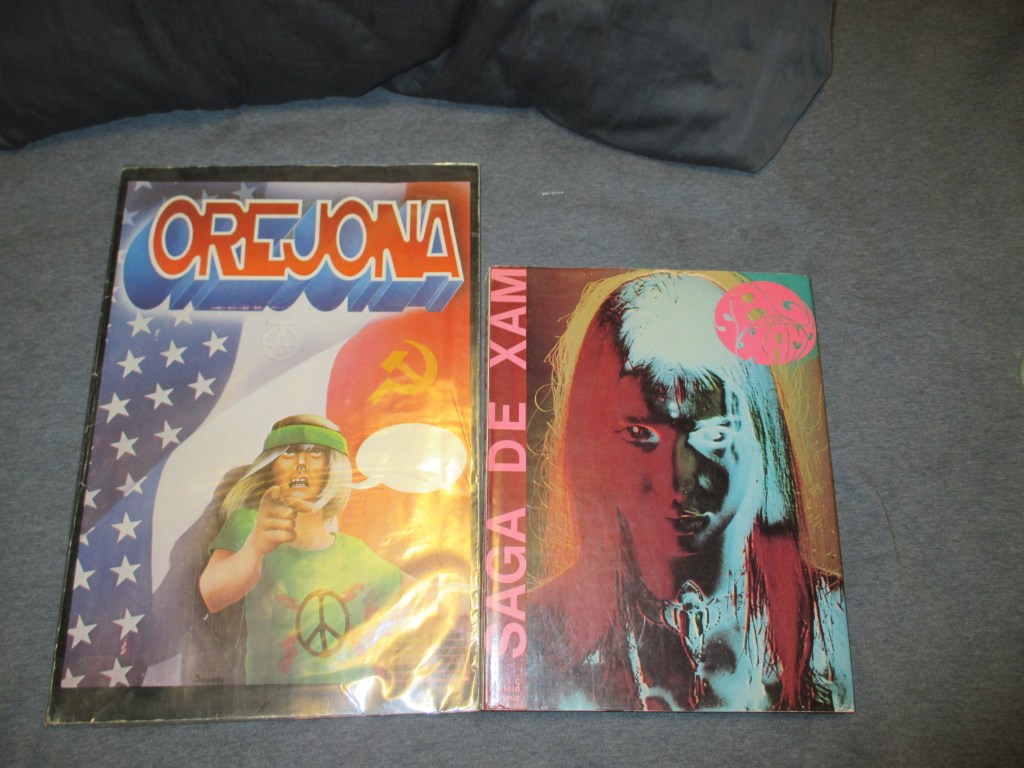
Nicolas Devil had another major graphic novel, Orejona ou Saga Generation (1974), in the form of an enormous softcover with soft paper. Despite the name, there is no direct connection to Saga de Xam except philosophically, continuing the countercultural vibe. Stylistically, it is another masterpiece of the moment, a collage of American underground comix, newsprint, original art, photographs, occult designs, and even some H. R. Giger thrown in for good measure, but there is no explicit Mythos material that I can see.
While the original Saga de Xam and its 1980 reprint remain scarce, the 2022 French reprint and the 2025 English translation remain available, and hopefully this book will continue to find an appreciative audience as something more than a scarce collector’s item.
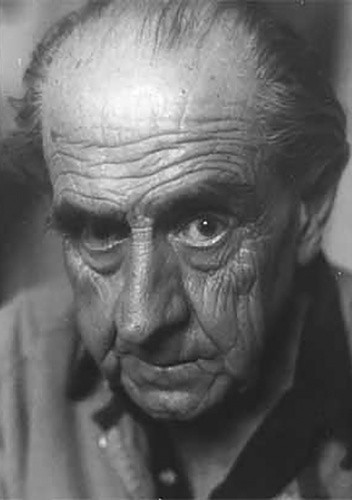
Alberto Breccia (1919-1993) was an Argentine comic artist, acknowledged as a master of the form. He began working professionally in 1939, working on comic magazines like Tit-Bits, and providing illustrations for Narraciones terrorificas, a Spanish-language horror fiction magazine which reprinted (in unofficial translation) stories from the U.S. Weird Tales.
Saturain: Ce qui t’a pousse a creer Captura, outre le fait de gagner des sous, c’etait ton interet pour le genre, evidemment. Et la litterature d’epouvante, tu l’as toujours aimee ou ca t’est venu apres?
Breccia: Avant. J’ai commence ave la collection Narraciones terrorificas des editions Molino. J’ai dessine des couvertures [pour cette collection], Albistur aussi Ce’etait dans les annees 1930, en gros, j’etais encoure celibatair. Ca a dure quelques annees. C’est la que j’ai commence a acheter et lire des recits d’epouvante. Jusqu’alors, je connaissais seulement Poe, qui est plus ou moins un auteur d’epouvante. Ou Conan Doyle et Sax Rhomer avec Fu Manchu, mais ce ne sont pas des auteurs de genre a proprement parler.
Saturnin: Ils combinent l’aventure, les feuilleton et l’epouvante.
Breccia: Oui, et le policier. Mais avec Narraciones terrorificas, je me suis plonge dans le genre, en y decouvrant Bloch, Lovecraft tous ceux dont j’ignorais alors jusqu’au nom.
Sasturain: Et tu commences a les lire pour de bon.
Breccia: Tout a fait, et je ne savais pas que la revue etait une replique de cette celebre revue americaine (Weird Tales), tu vois? Je m’en suis rendu compte longtemps apres. C’est la-dedans que j’ai lu Lovecraft, entre autres. Je possedais surement tous les Mythes de Cthulhu, et j’ai du tout vendre. Parce que j’avais cette idee fixe d’etre un lecteur cultive. Alors j’ai commence a vendre ce qui me paraissait inutile pour m’acheter a la place des livres ennuyeux a mourir Les pensees d’un tel, les maximes de La Rochefoucauld et toutes ces conneries qui ne m’ont absolument servi a rien. Maintenant, j’ai un mal de chien a reuperer ces tresors, que je tretouve mais abimes, manges aux mites. Tu sais, Lovecraft, je pense l’avoir lu bien avant. J’imaginais l’avoir decouvert lors de mon voyage en Europe, mais je l’avais probablement lu tout gamin, sans le savoir.
Sasturain: Quend tu lis de l’histoire, des romans, etc., quelle epoque preferes-tu?
Breccia: J’aime le dix-neuvieme siecele des romans de Dickens, tu vois? Cette epoque me plait: les auberges, les diligences. Mais davantage la litterature europeenne qu’americaine. J’aime les recits dont l’action se situe vers la moitie du siecle dernier, voire avants. Jusqu’en 1915, 1920.
Saturain: What pushed you to create Captura, besides earning money, was your interest in the genre, obviously. And horror literature, have you always liked it or did it come to you later?
Breccia: Before. I started with the collection Narraciones terrorificas from Molino publishing. I designed covers [for this collection], Albistur too. It was in the 1930s, basically, I was still single. It lasted a few years. That’s when I started buying and reading horror stories. Until then, I only knew Poe, who is more or less a horror author. Or Conan Doyle and Sax Rhomer with Fu Manchu, but they are not genre authors strictly speaking.
Saturnin: They combine adventure, soap opera and horror.
Breccia: Yes, and the detective story. But with Narraciones terrorificas, I immersed myself in the genre, discovering Bloch, Lovecraft, all those whose names I didn’t even know at the time.
Sasturain: And you start reading them for real.
Breccia: Exactly, and I didn’t know that the magazine was a replica of this famous American magazine (Weird Tales), you see? I realized it a long time later. It’s in there that I read Lovecraft, among others. I probably had all the Cthulhu Mythos, and I had to sell everything. Because I had this fixed idea of being a cultured reader. So I started selling what seemed useless to me in order to buy instead the boring books The Thoughts of So-and-So, the Maxims of La Rochefoucauld and all that crap that was absolutely useless to me. Now, I have a hell of a time finding these treasures, which I find but damaged, moth-eaten. You know, Lovecraft, I think I read him long before. I imagined I had discovered it during my trip to Europe, but I probably read it as a kid, without knowing it.
Sasturain: When you read history, novels, etc., what era do you prefer?
Breccia: I like the nineteenth century of Dickens’ novels, you see? I like that era: the inns, the stagecoaches. But more European literature than American. I like stories whose action takes place around the middle of the last century, or even before. Up to 1915, 1920.
Breccia: Conversations avec Juan Sasturain 349-350 (This interview was conducted in Spanish by Breccia’s collaborator Juan Sasturain and first published in that language, but I only had access to a French translation.)
English translation
Breccia continued working for local publishers for twenty years before he made his first trip to Europe in 1959, and began working with European publishers. It was then that Breccia became more thoroughly acquainted with the works of H. P. Lovecraft. In the 1970s, Breccia would create adaptations of several of Lovecraft’s stories, not for any specific publisher, but on his own, and using that as an opportunity to experiment artistically with the form:
Sasturain: C’etait un systeme de pensee tres profondement ancre en toi, non?
Breccia: C’es la que ‘ai pris conscience que je devais creer pour moi. C’est la que j’ai commence a dessiner Les Mythes de Cthulhu sans avoir un editeur precis en vue. Je me rendais compte que ce marche s’ouvrait a moi, alors je me suis mis a travailler pour ce marche.
Sasturain: Tu dis toujours que Les Mythes, cette idee de dessiner due Lovecraft, est nee bien avant. Qu’un jour, bien des annees plus tot, tu t’etais achete un petit livre de lui et que tu l’avais lu…
Breccia: Je l’avais achete en 1959, au cours de mon premier voyage.
Sasturain: Et quel a ete le detonateur pour te lancer la-dedans dix ans apres?
Breccia: A l’epoque, j’avais rassemble tous les Mythes, je les avais tudies a fond, et je me sentais capable de m’y attaquer. D’ailleurs, j’avais plaisieurs versions du premier, Le Ceremonial, toutes ratees – j’ai tout jete.
Sasturain: Le Ceremonial est le premier.
Breccia: Le premier que j’adapte. Je ne me souviens plus dans quel order, mais j’ai fait La Ceremonial, Le Cauchemar d’Innsmouth, Le Monstre sur le seuil, et an 1973 j’ai decide d’aller montrer tout ca.
Sasturain: Tu pars avec plusieurs episodes termines. Les autres, tu les as faits a ton retour. Je crois que le dernier date de 1975.
Breccia: Je crois que c’est Celui qui chuchotait dans les tenebres.
Sasturain: Tu es parti en Europe avec ces nouvelles planches.
Breccia: Oui, just celles-la. [179] Sasturain: C’etait la premier fois que tu produisais quelque chose sans savoir qui allait le publier.
Breccia: Exactement, avec amour, en prenant mon temps. C’est tout un horizon qui s’ouvre a moi, je ne suis plus un salarie un professionniel qui y consacre le temps necessair. Je commence a jouir du dessin d’une autre manier. Enfin bref, h’ai du mal a expliquer ce que j’ai ressenti.
Sasturain: It was a very deeply rooted system of thought in you, wasn’t it?
Breccia: That’s when I realized that I had to create for myself. That’s when I started drawing The Myths of Cthulhu without having a specific publisher in mind. I realized that this market was opening up to me, so I started working for this market.
Sasturain: You always say that The Myths, this idea of drawing by Lovecraft, was born well before. That one day, many years earlier, you had bought a little book by him and that you had read it…
Breccia: I bought it in 1959, during my first trip.
Sasturain: And what was the trigger that got you into this ten years later?
Breccia: At the time, I had collected all the Myths, I had studied them thoroughly, and I felt able to tackle them. Besides, I had several versions of the first one, The Festival, all failed – I threw them all away.
Sasturain: The Festival is the first.
Breccia: The first one I adapted. I don’t remember in what order, but I did The Festival, The Innsmouth Nightmare, The Monster on the Doorstep, and in 1973 I decided to go and show all that.
Sasturain: You leave with several episodes finished. The others, you did them when you returned. I think the last one dates from 1975.
Breccia: I think it’s The Whisperer in Darkness.
Sasturain: You left for Europe with these new boards.
Breccia: Yes, just those. [179] Sasturain: It was the first time you produced something without knowing who was going to publish it.
Breccia: Exactly, with love, taking my time. It’s a whole horizon that opens up to me, I’m no longer an employee, a professional who devotes the necessary time to it. I’m starting to enjoy drawing in a different way. Anyway, I have a hard time explaining what I felt.
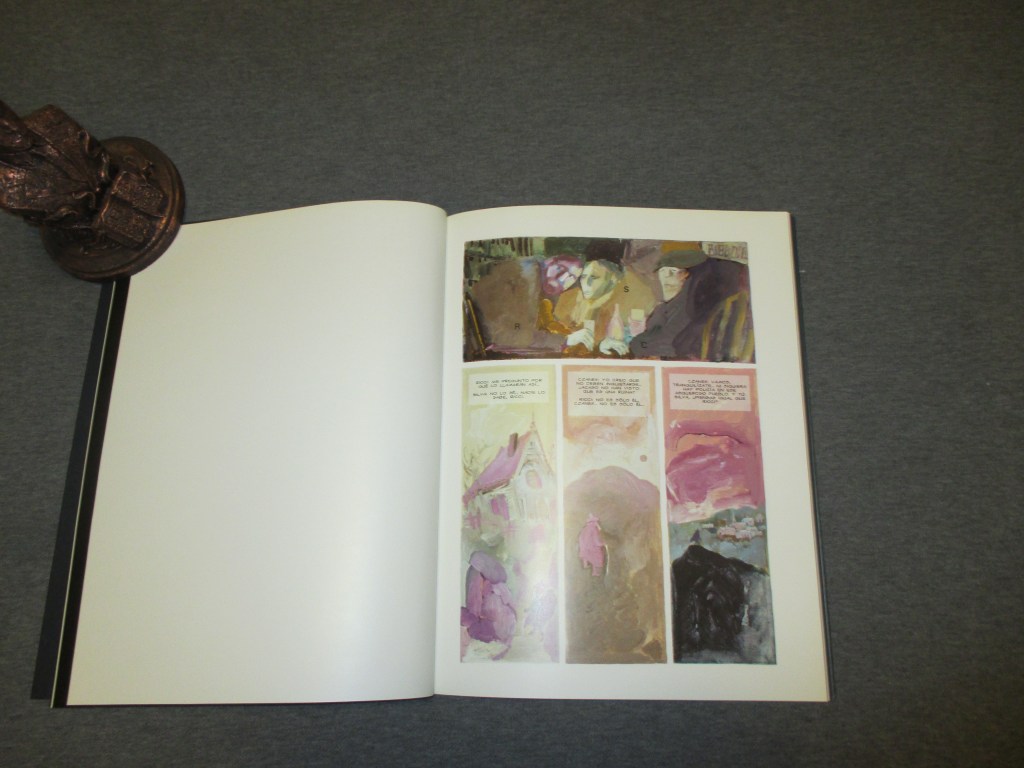
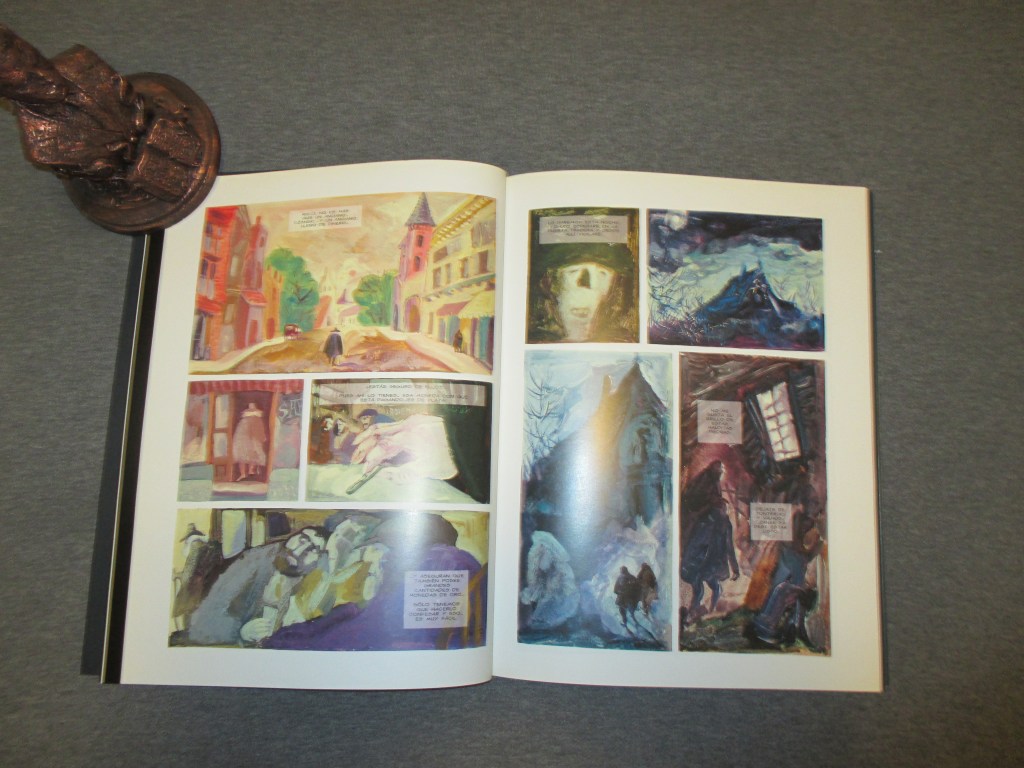
Breccia would complete ten adaptations of Lovecraft’s stories, the majority of them between 1972-1974, six of them from scripts developed by his collaborator Norberto Buscaglia. The first six stories were published in the Italian comic magazine Il Mago, but were translated and reprinted in other languages, such as the Métal Hurlant/Heavy Metal/Metal Extra Lovecraft Special. Multiple collections of these comic stories have been published over the decades, although ironically, few of Breccia’s influential Lovecraft adaptations have been published in English. While the first nine are relatively well-known and widely republished, after Breccia’s death a new collection of adaptations was published, Sueños Pesados (2003, “Heavy Dreams”). These are painted, in color, and contain one additional Lovecraft adaptation.
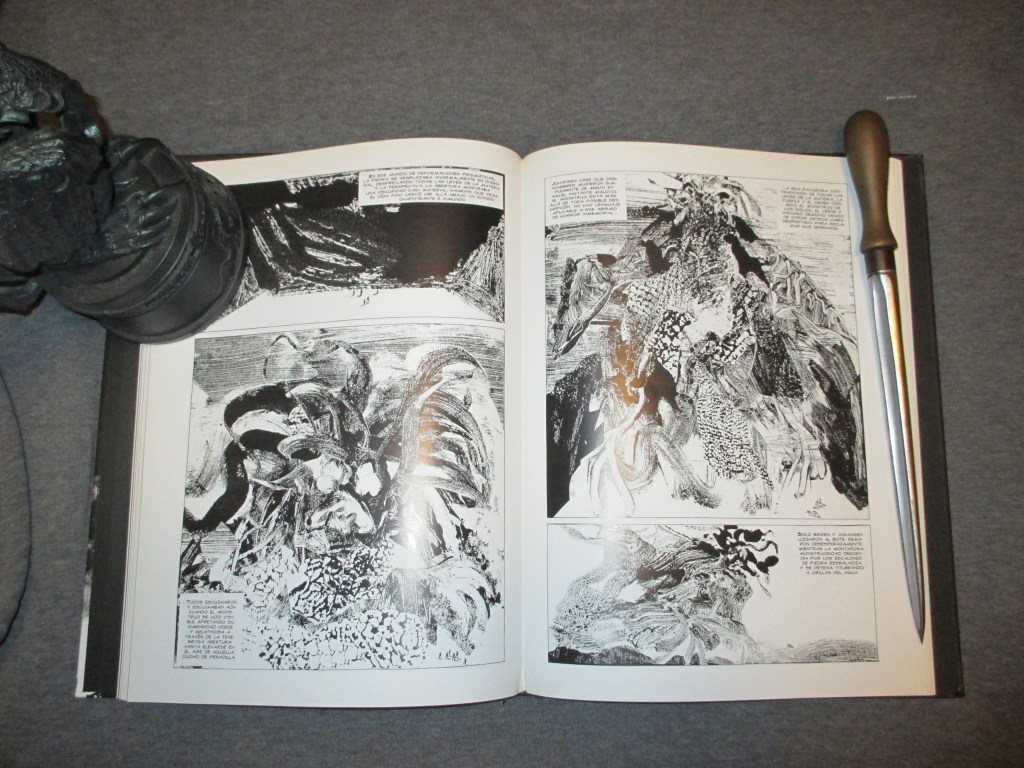
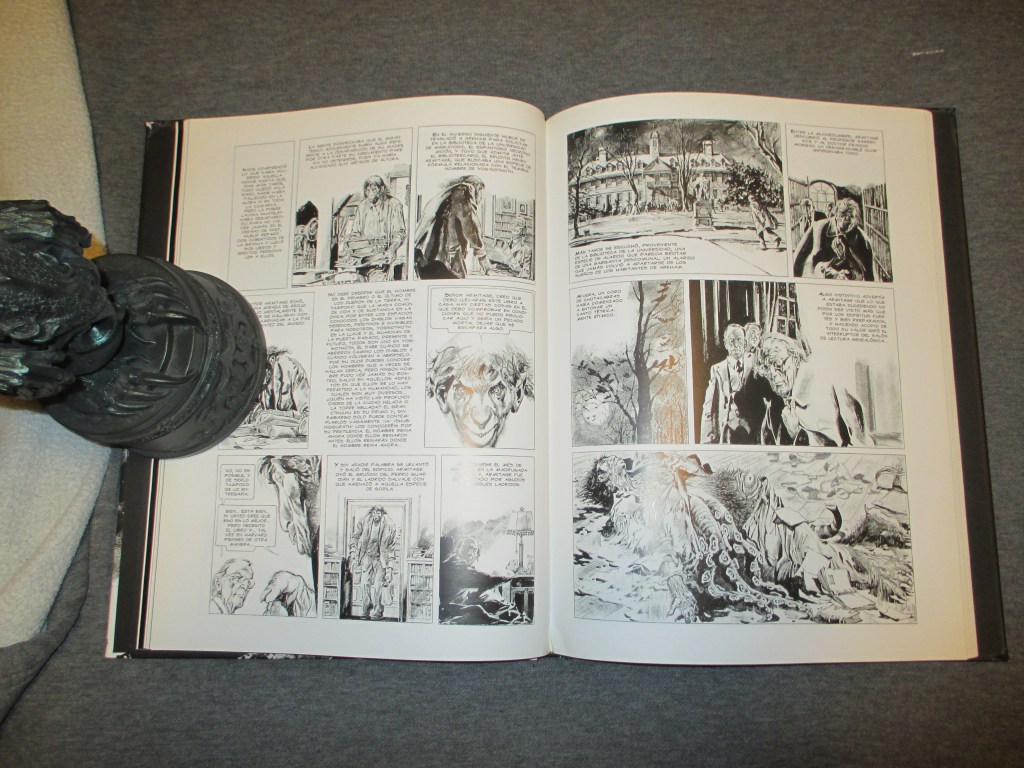
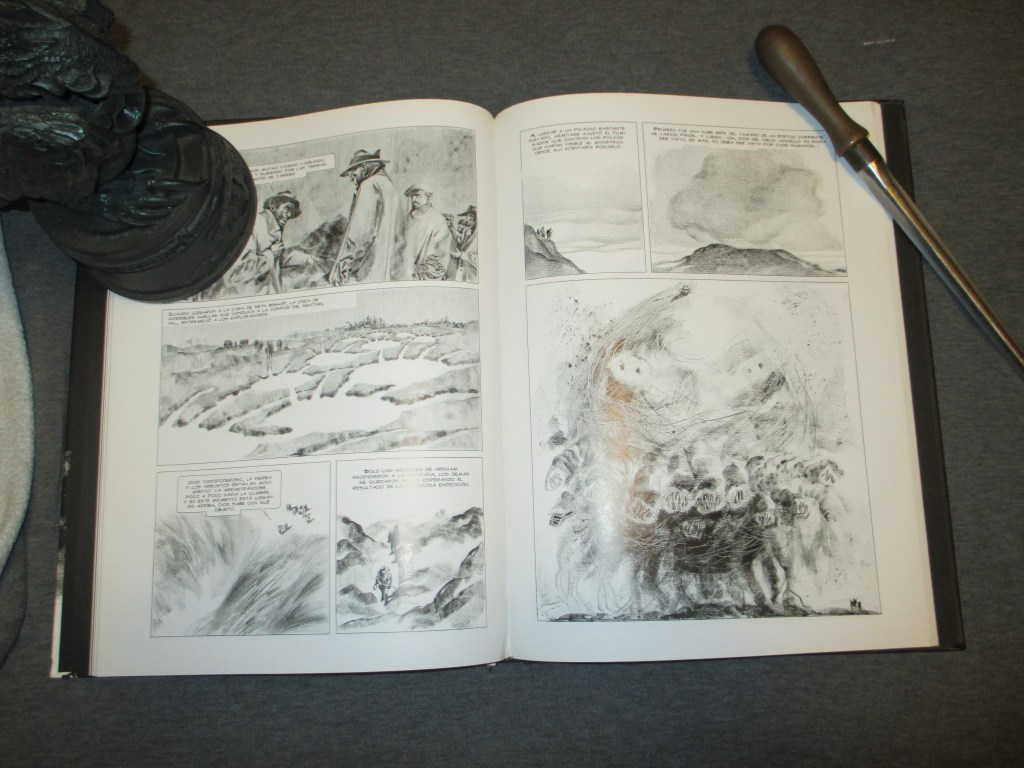
It is difficult to overstate how influential Breccia’s Lovecraft adaptations were, from their first publication in the 1970s right up until today, when they are still being reproduced. These are experimental comics, playing with the form, the medium, often combining elements of collage, photography, paint, and watercolors in addition to traditional pen and ink. Breccia’s assistant Horacia Lalia would go on to produce his own highly-regarded series of adaptations of Lovecraft stories, and his son Enrique Breccia provided the artwork for the graphic novel Lovecraft(2004), with Hans Rodinoff and Keith Griffen.
While it wouldn’t be accurate to say that Breccia was the first to adapt Lovecraft to comics, he single-handedly raised the bar for the quality of Lovecraft adaptations. So it is only fitting to take a look at each in turn.
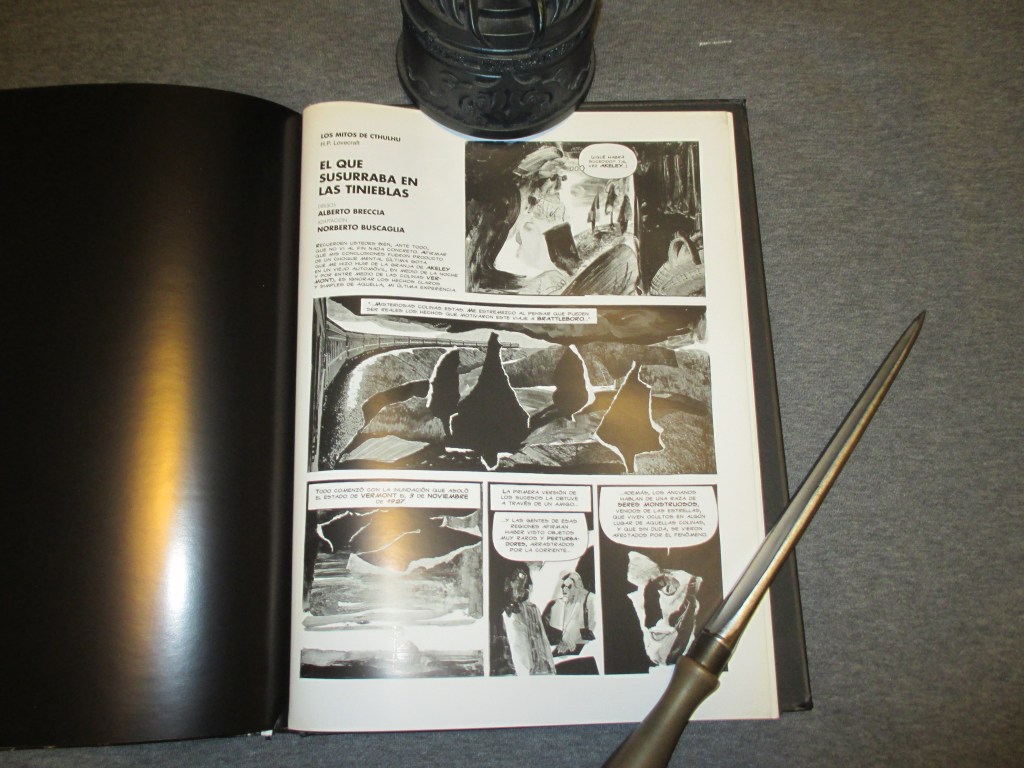
These works were not published strictly in order of completion, although there is considerable stylistic variation between the earliest stories and the last (“El Que Susurraba en Las TInieblas”), and the exact publishing history is a little hazy (since they were all first published in non-English periodicals and collections), so this is a roughly chronological order of publication.
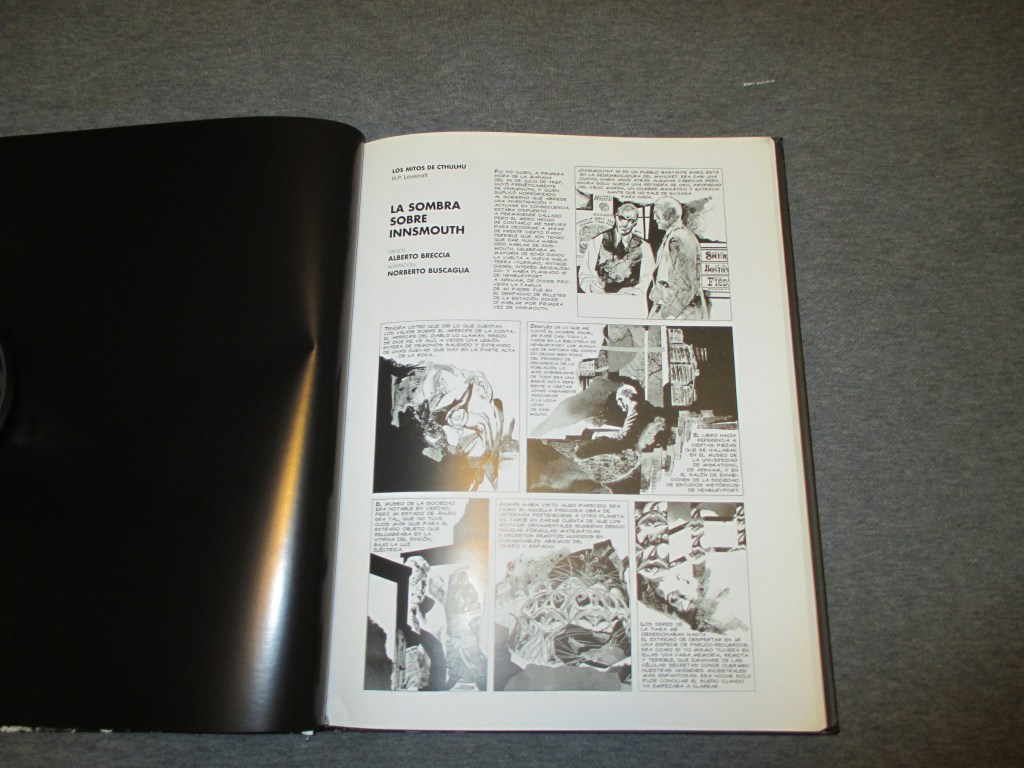
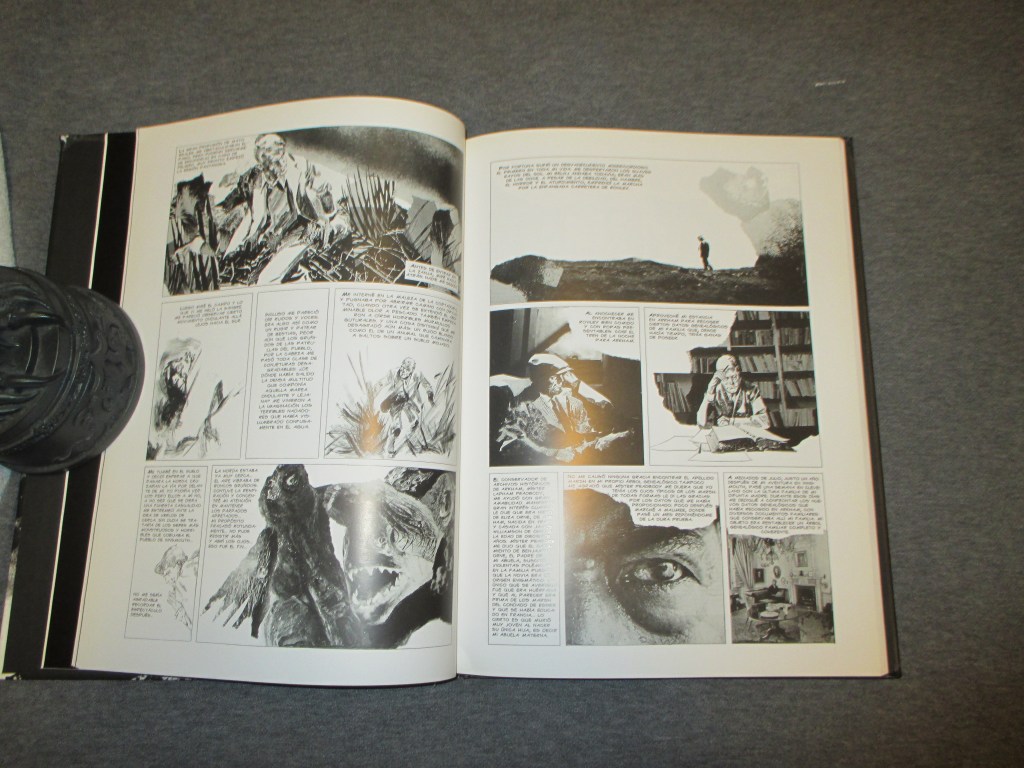
“La Sombra Sobre Innsmouth” (1973)
17 pages. Script by Norberto Buscaglia, art by Alberto Breccia. First published in Il Mago (Nov 1973). This adaptation of “The Shadow over Innsmouth” is verbose, selective in its imagery, evocative and often ambiguous in terms of landscape but with detailed faces and figures that give evidence of “the Innsmouth Look.”
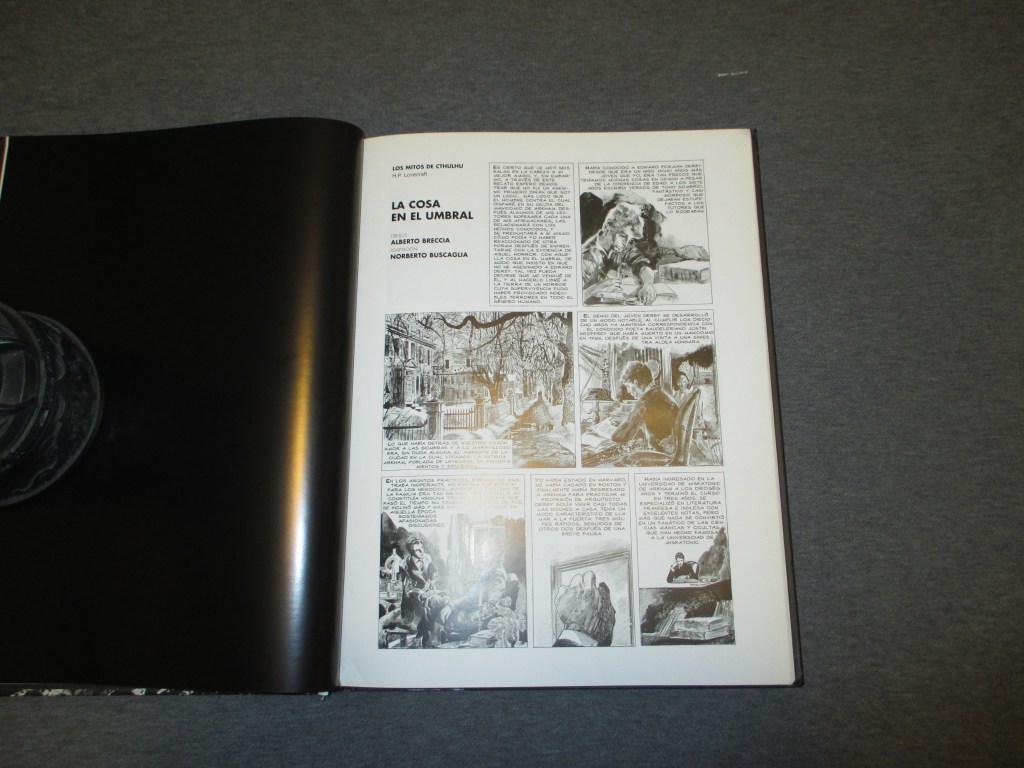
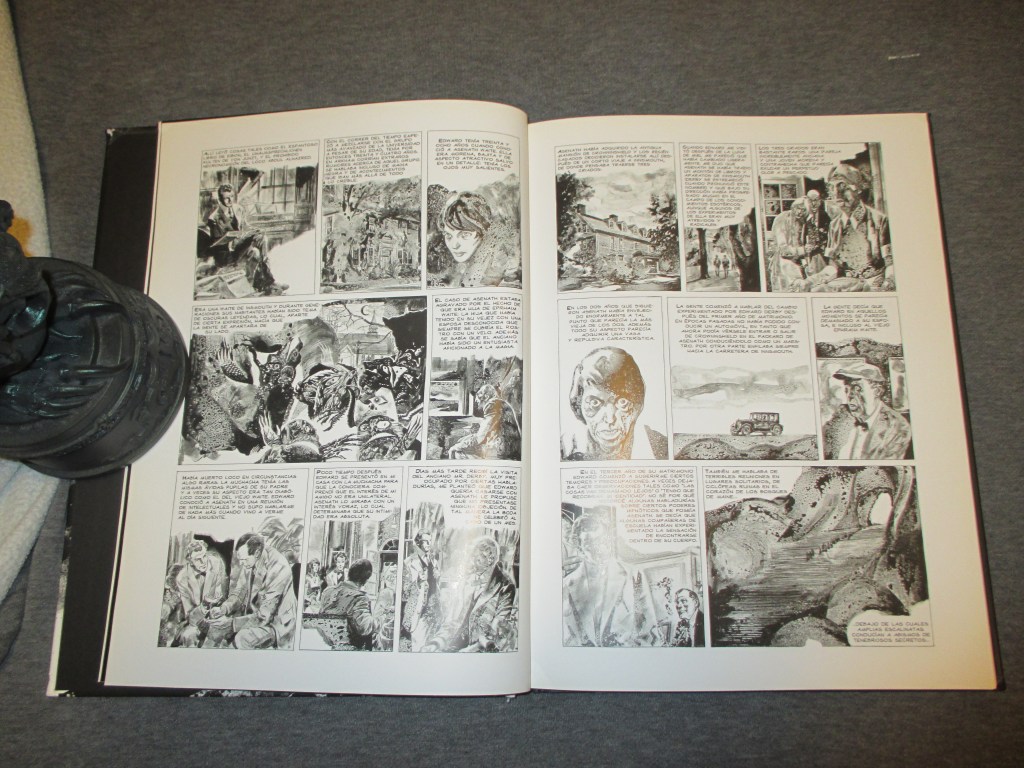
“La Cosa en el Umbral” (1973)
11 pages. Script by Norberto Buscaglia, art by Alberto Breccia. First published in the album Il piacere della paura (Oct 1973), and then in Il Mago (Jan 1974). This adaptation of “The Thing on the Doorstep” begins very sedately, with a heavier emphasis on traditional line work, Breccia’s other techniques mainly adding texture. However, that texture soon comes to grow and dominate as it reflects Edward Pickman Derby’s relationship with Asenath Waite; the depiction of “the Innsmouth Look” is very consistent with Breccia’s adaptation of “The Shadow over Innsmouth.”
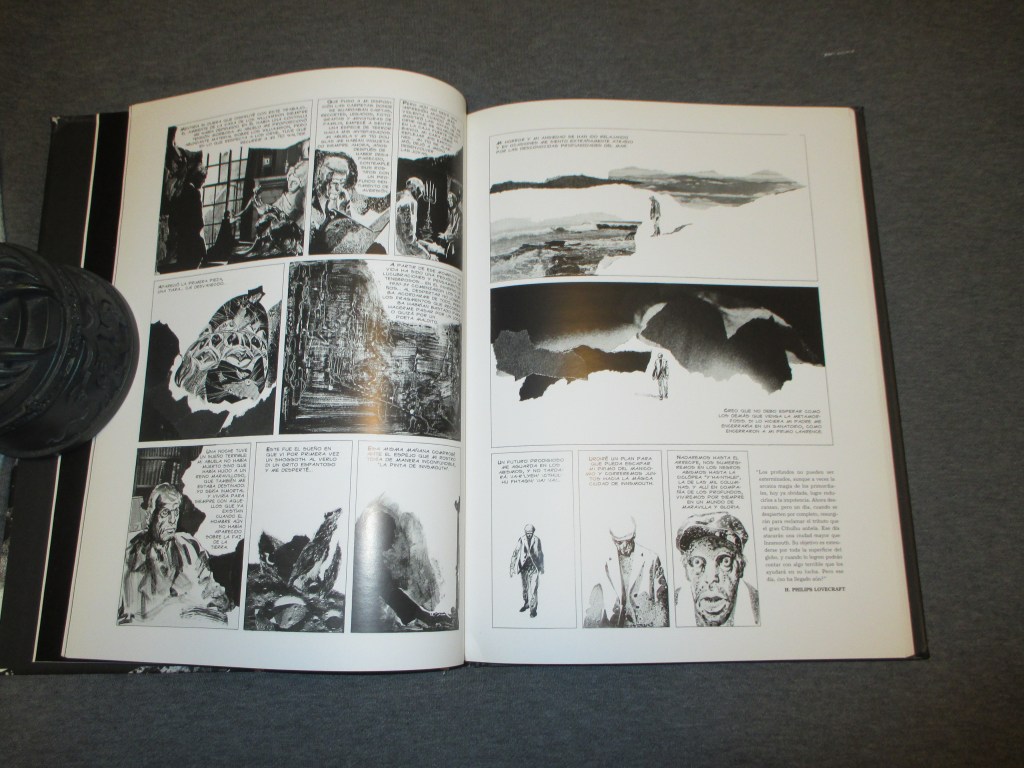
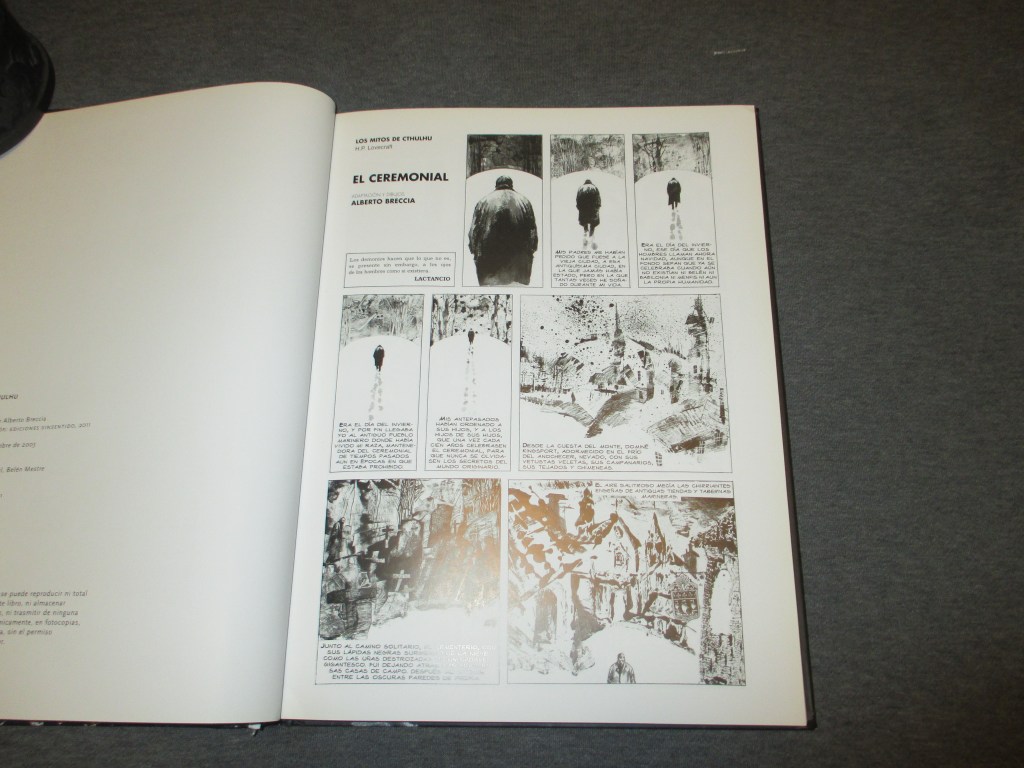
“El Ceremonial” (1974)
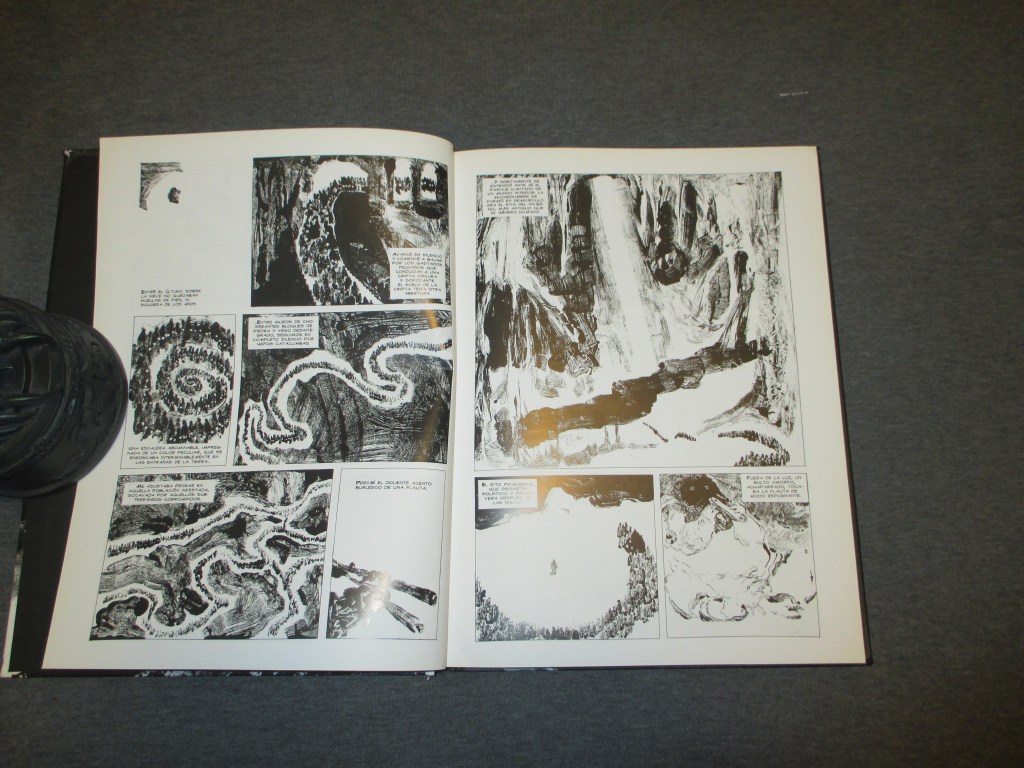
9 pages. Written and illustrated by Alberto Breccia. Signed “Breccia ’72,” this is the first adaptation of Lovecraft that Breccia completed, but wasn’t published until Il Mago (Mar 1974). Breccia makes the most of the chiaroscuro possibilities, with the white space sometimes doubling for snow, sometimes for light, or simply negative space. The combination of the surreal painting and collage with the ultra-realistic photographs and sketches that bookend the story add to the dreamlike nature of the narrative.
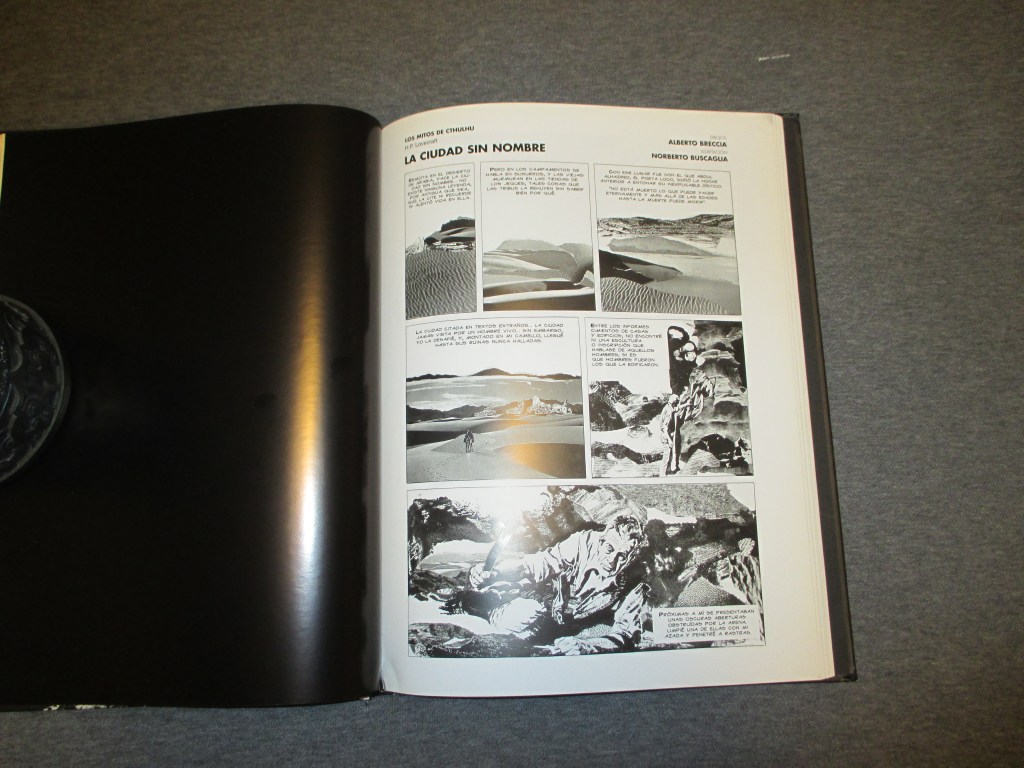
“La Ciudad sin Nombre” (1974)
6 pages. Script by Norberto Buscaglia, art by Alberto Breccia. First published in Il Mago (Sep 1974). The shortest of the adaptations, and dominated by photographs of sandy deserts and rock outcroppings, which are collaged with sketched figures in a way suggestive of alien vistas that pure pen and ink could not capture alone.
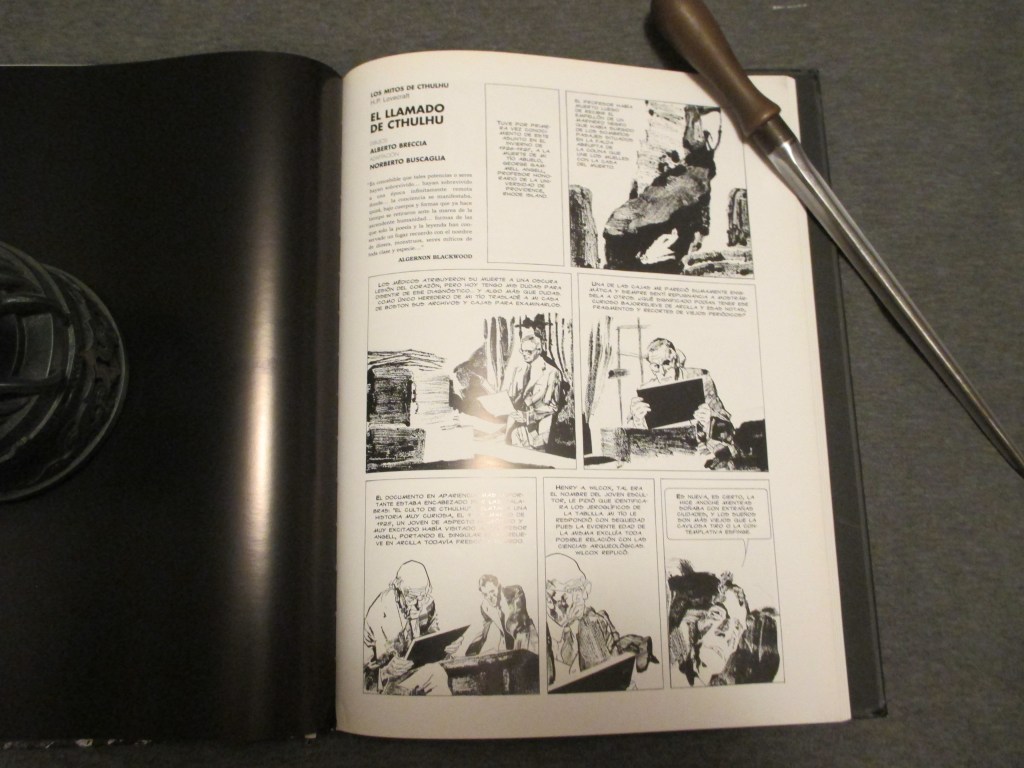
“El Llamado de Cthulhu” (1974)
11 pages. Script by Norberto Buscaglia, art by Alberto Breccia. First published in Il Mago (Dec 1974). At 11 pages, this is a very truncated version of Lovecraft’s story “The Call of Cthulhu,” though it captures all the essential plot points, it also abbreviates the complicated narrative story-within-story structure. What is really striking about this brief adaptation is how well Breccia restrains himself from revealing Cthulhu, even in the image in clay, until the moment that title entity appears on the page, at which point he presents something so truly outlandish that readers almost don’t notice the miniscule human figures that give it scale.
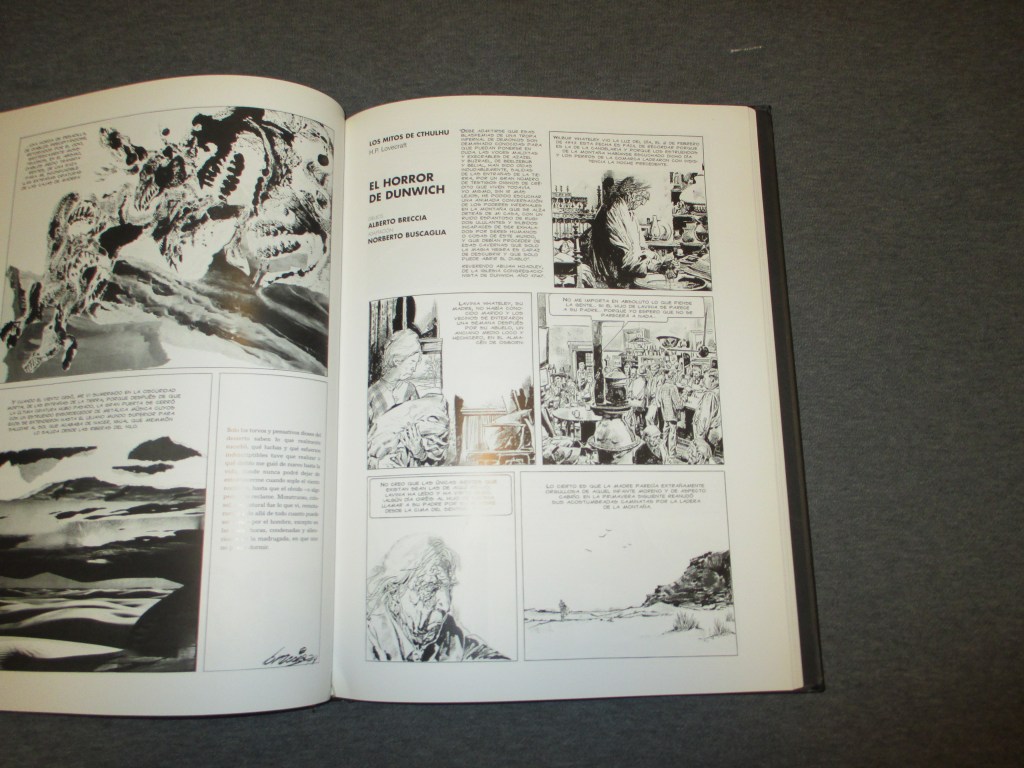
“El Horror de Dunwich” (1975)
15 pages. Script by Norberto Buscaglia, art by Alberto Breccia. First published in Il Mago (Nov 1975). Arguably, this adaptation of “The Dunwich Horror” is the most famous and widely-republished of Breccia’s adaptations, because of its including in theMétal Hurlant Lovecraft Special, and the works that followed from that. Possibly some of Breccia’s finest figure and face work went into the goatish countenance of Wilbur Whateley. Like most of Breccia’s adaptations, the backgrounds and setting details are relatively spare but evocative.
Sasturain: Ce qui explique peut-etre que, pour la creature extraterrestre de <<Tres ojos>>, dans Sherlock TIme, tu n’as pas dessine un monstre. Dans L’Eternaute, tu les as desintegres. Les monstres sont intangibles: tu as dessine la sensation que genere l’epouvante chex les gens, pas l’object qui la prodout. Et tu as fait pareil pour Lovecraft.
Breccia: Je n’aime ni voir ni dessiner des monsters. Ca ne m’interesse pas.
Sasturain: Which may explain why, for the extraterrestrial creature of <<Three Eyes>>, in Sherlock Time, you didn’t draw a monster. In L’Eternaute, you disintegrated them. Monsters are intangible: you drew the sensation that generates terror in people, not the object that produces it. And you did the same for Lovecraft.
Breccia: I don’t like to see or draw monsters. I’m not interested.
Despite Breccia’s comment, when the time came at the end of the story to reveal Wilbur’s unnamed twin, he pulled out all the stops.
“El Color que Cayó del Cielo” (1975)
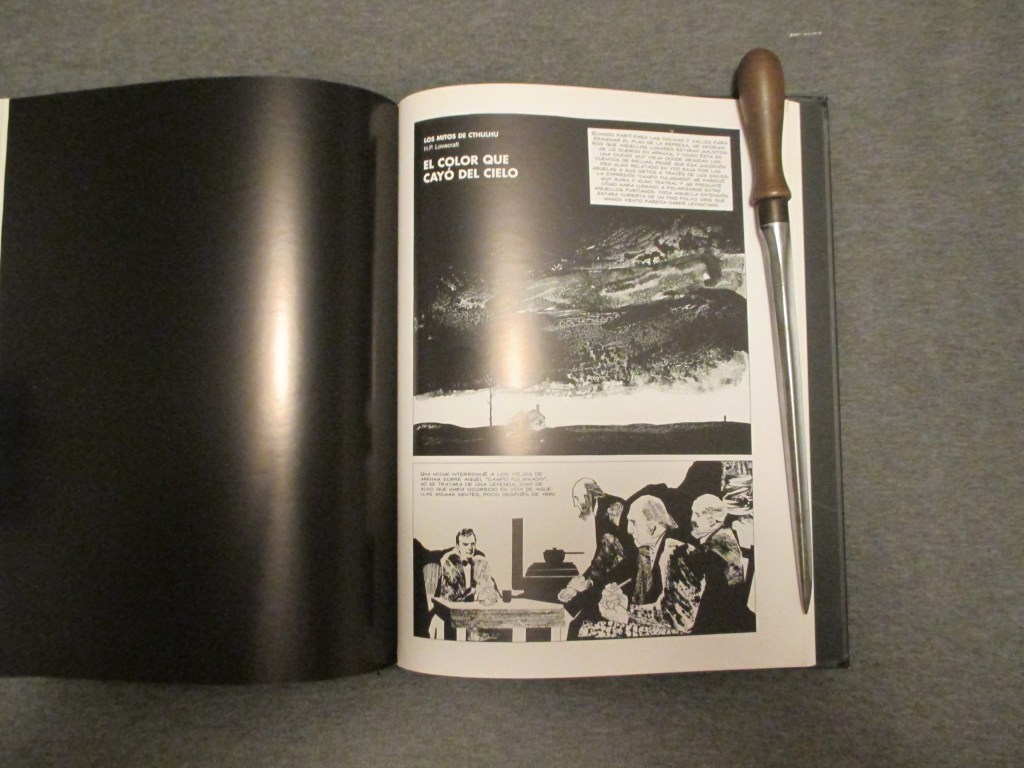
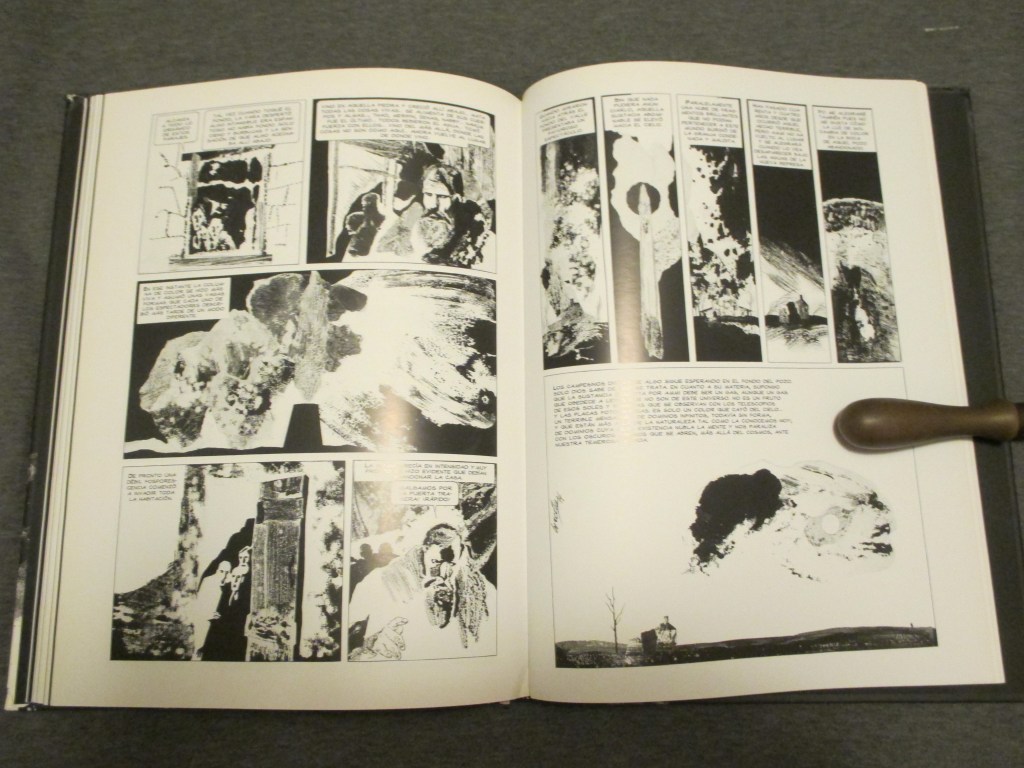
13 pages. Written and illustrated by Alberto Breccia. This adaptation of “The Colour Out of Space” first appeared in his album Los mitos de Cthulhu (1975), which contained all but one of his Lovecraft adaptations (the last not being published until years later). Compared to the previous stories, this one is much more experimental in style, bolder in its use of collage, stark blacks and blinding whites.
“El Morador de las Tinieblas” (1975)
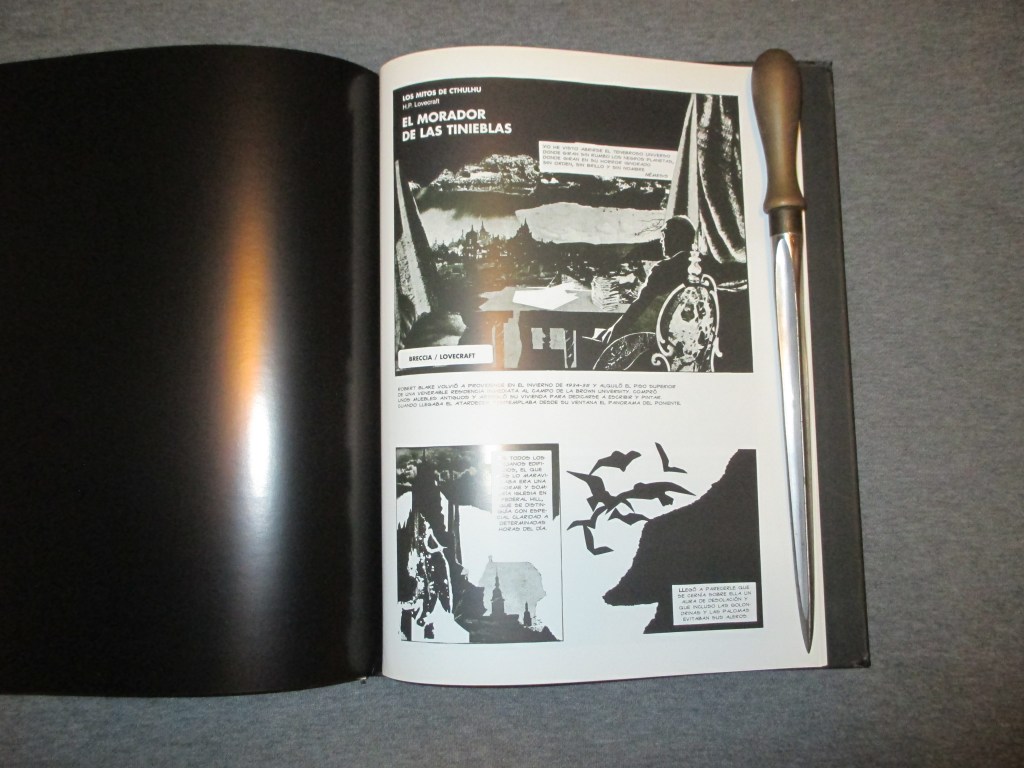
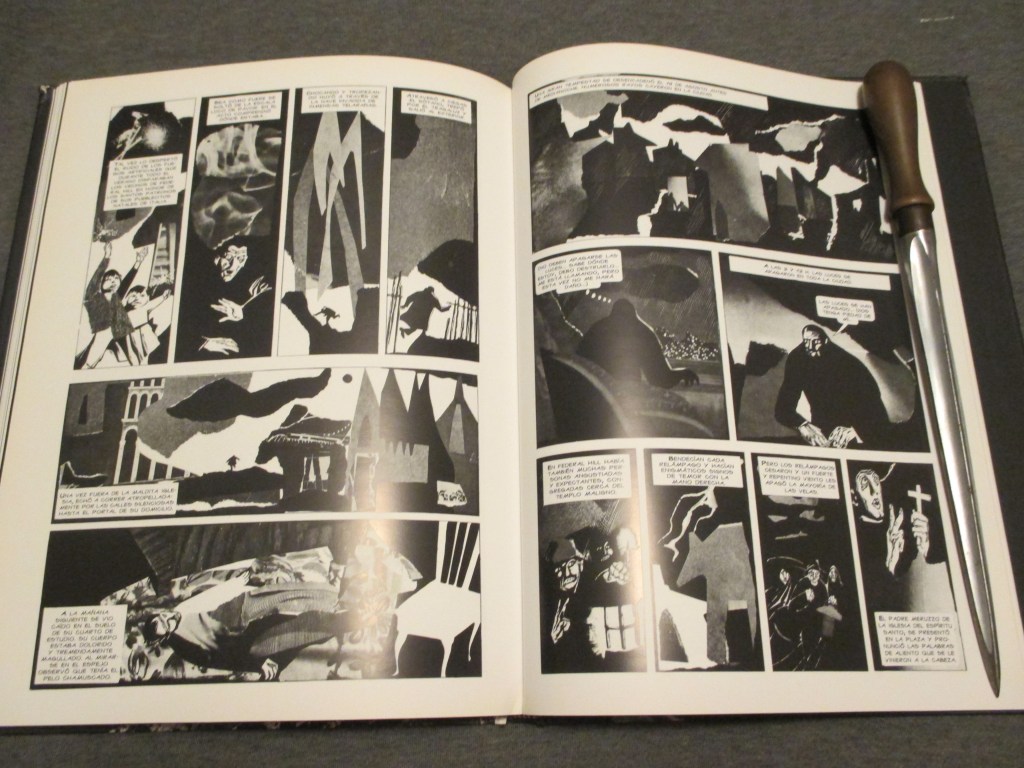
15 pages. Written and illustrated by Alberto Breccia. This adaptation of “The Haunter of the Dark” first appeared in his album Los mitos de Cthulhu (1975). Again, Breccia pushes the envelope of his experimental style, his pen-and-ink illustrations taking on the more exaggerated style characteristic of his work in the 80s like Drácula, but still playing with texture, shape, and strong contrasts.
According to a note by Latino Imperato in later collections, many of the original pages for this story have been lost, and subsequent reproductions were made from the first Italian printing.
“El Que Susurraba En las Tinieblas” (1979)
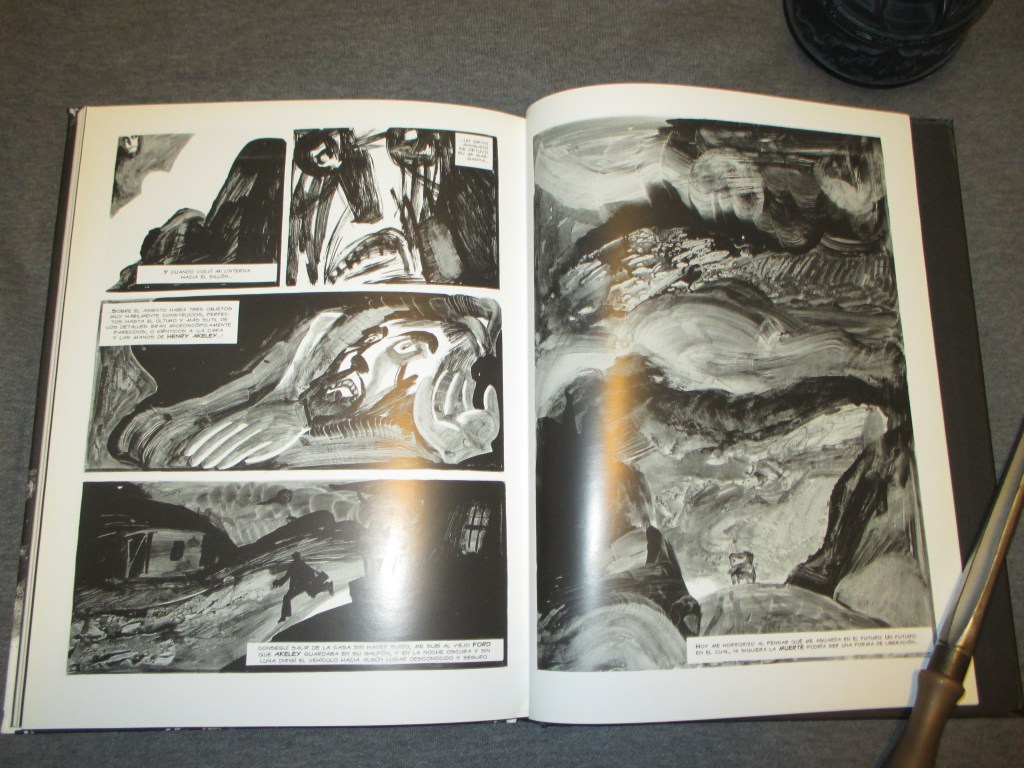
15 pages. Script by Norberto Buscaglia, art by Alberto Breccia. First published in the Argentine magazine El Pendulo (Sep 1979). This adaptation of “The Whisperer in Darkness” was the last of Breccia’s Lovecraft adaptations to be published, and the last to be collected. It is in many ways the apex of the artistic experiments and strongly points to some of Breccia’s stylistic choices in subsequent works during the 1980s like Perramus. For the most part, however, it is the most deliberately choppy and nightmarish of Breccia’s adaptations.
“El anciano terrible” (2003)
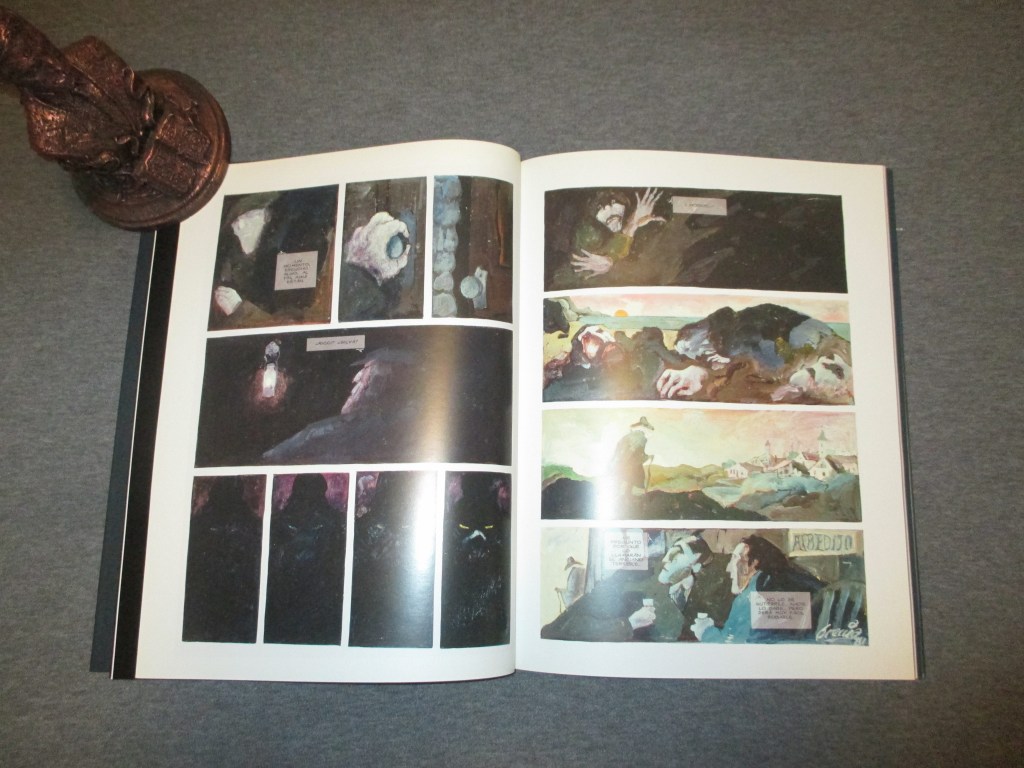
7 pages. Painted, in color, as are the other works in Sueños Pesados. The last page is dated “Breccia ’81.” Here, Breccia takes more liberties with the text than usual, eschewing much of Lovecraft’s exposition and description to give the characters a bit of dialogue, letting the art do most of the talking. The art is characteristic of this period, with vibrant colors, rich textures, but muddier faces, deliberately stylized and evocative.
 Deep Cuts in a Lovecraftian Vein