Eldritch Fappenings
The following review is of a work that contains cartoon nudity, and some images are reproduced.
Reader discretion is advised.
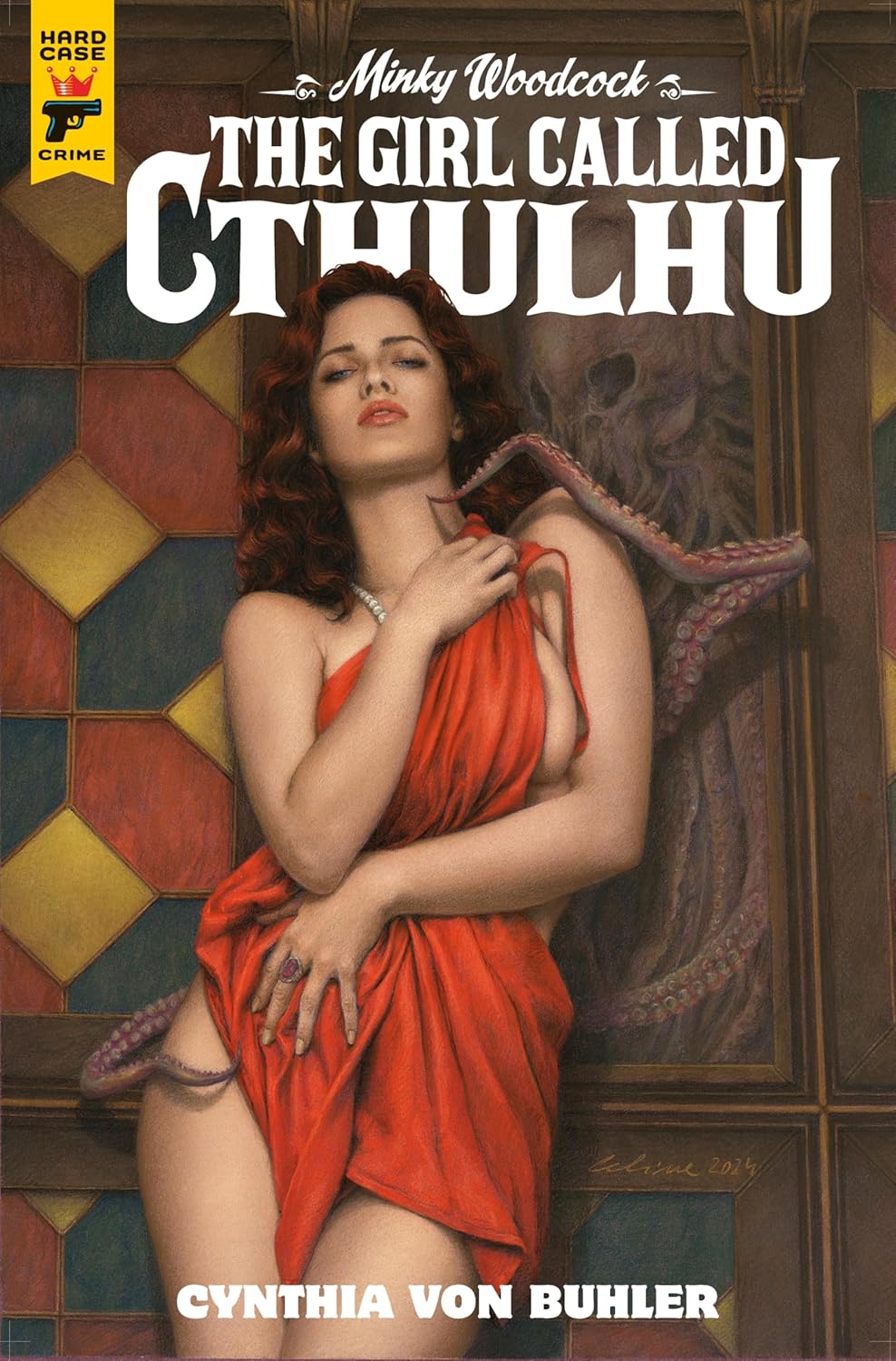
In 2017, writer-artist Cynthia von Buhler introduced the world to Minky Woodcock, private detective, in a 4-issue series The Girl Who Handcuffed Houdini, published under the Hard Case Crime imprint of Titan Comics. The series was a clever mix of hardboiled detective themes with historical characters, with the bisexual and extraordinarily intelligent and adaptable Minky Woodcock often ending up in dangerous situations and/or sans her clothes—but also finding or fighting her way out again. The series was followed up with a sequel, The Girl Who Electrified Tesla (2021), and then The Girl Called Cthulhu (2024), which was lettered by Jim Campbell.
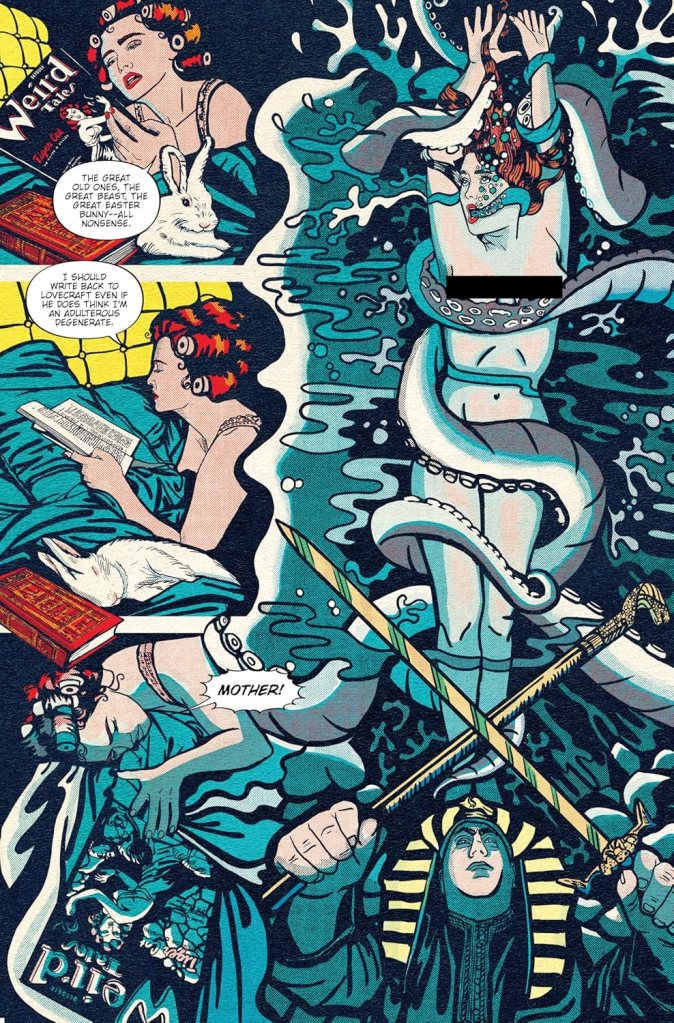
The plot is drawn from history, dealing with Lovecraft’s relationships with Harry Houdini and Aleister Crowley, slightly fictionalized for purposes of the plot, but in general faithful to the timeline—with careful reproductions of Weird Tales covers and effort made to reproduce real people, places, and events. There are a number of fun little Easter eggs for Weird Tales fans in the pages, captured in von Buhler’s own style, who favors a heavy line and stylized coloring that echoes noir and giallo films.
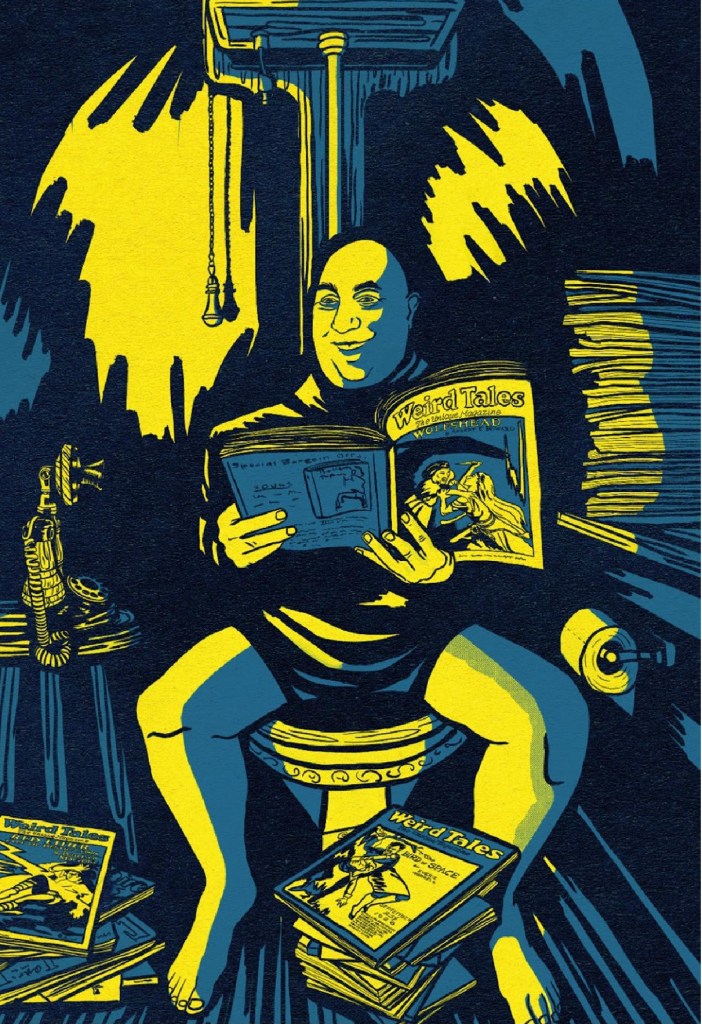
At its heart, Minky Woodcock: The Girl Called Cthulhu is a rather traditional detective/mystery story, tied up in a historical setting and with some added titillation thrown in. The depiction of H. P. Lovecraft and his wife Sonia are synthesized from various sources, notably The Private Life of H. P. Lovecraft (1985) by Sonia H. Davis, but aren’t particularly cruel or inaccurate given the needs of the story. Buhler flaunts her artistic homages, such as Hokusai’s “Diver and Two Octopi,” and is one of the few artists not afraid to depict Howard’s penis. Whether that’s a warning or an enticement to read the book is something I leave up to the readers.
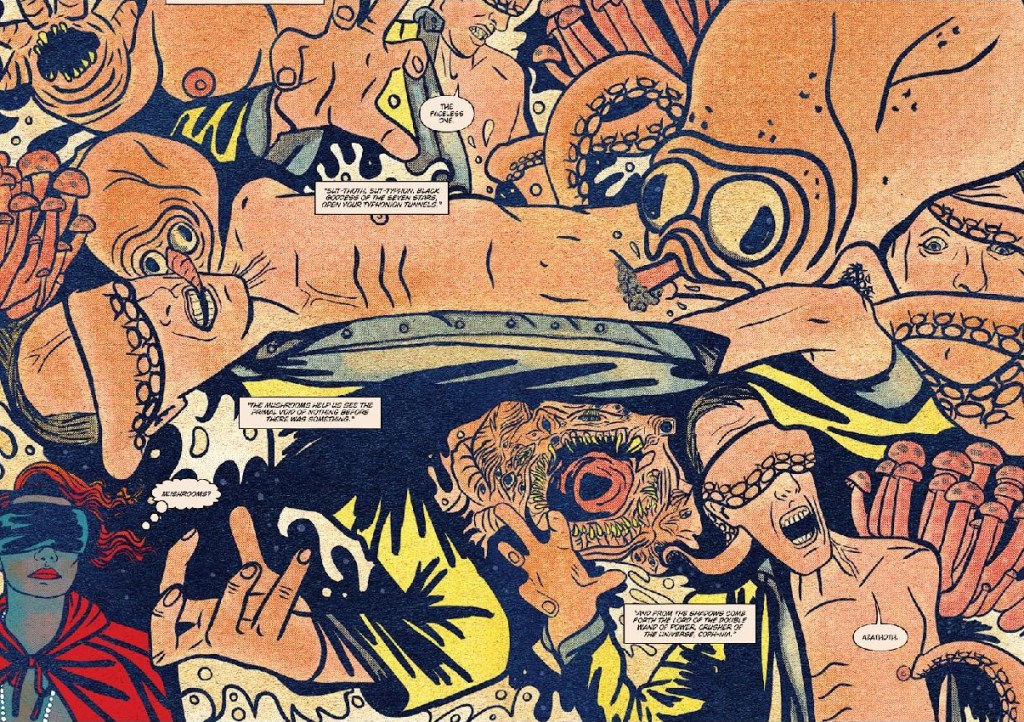
It is a fun book, and plays to both Lovecraft and Crowley’s particular legends. Cynthia von Buhler has obviously done a good bit of research, and she wears it on her sleeve, including a section at the rear of the collected edition (and in the individual issues) explaining some of the details:
The investigations portrayed in the Minky Woodcock series are grounded in fact, the result of my extensive research. I acknowledge that some of the details may seem peculiar leading to numerous questions. Here are my responses to them. – CvB
Is all the research correct? Well, there’s no evidence Sonia H. Greene heard Crowley at the Sunrise Club (though she did attend the club), and no evidence Crowley read Lovecraft. The comparison between Lovecraft’s fiction and Crowley’s magical writing is the stuff of wishful occultists, as shown in the opening of the Simon Necronomicon. But for fictional purposes, these are pedantic niggles, and certainly other authors that have posited Lovecraft/Crowley interactions have gone further and been more ahistorical. A more interesting tidbit is the question of Lovecraft’s prejudices:
Lovecraft was a racist and anti-Semite. Why would you honor him with the title of your book? I highly doubt he would have married a Jewish woman.
Lovecraft was married to Sonia H. (Haft), a successful Jewish milliner and amateur pulp fiction writer, from 1924 to 1937. She tried to educate him as best as she could, and by the end of his life, his views had changed somewhat, but he said some pretty awful things in his day. I make his outrageous beliefs absolutely clear in my book.
—Cynthia van Buhler, Minky Woodcock: The Girl Called Cthulhu
While von Buhler doesn’t answer the first question directly, I think the book itself makes the point clear: Lovecraft was weird, and is the connective tissue between Houdini and Crowley, the three together providing a bridge from rationality to occultism and weird fiction. Lovecraft comes across as a bit stiff and surreal, but that’s not unusual for fictional depictions of HPL, and if the effort is made not to hide Lovecraft’s prejudices, neither does she make the effort to depict him as a cartoon caricature of a bigot. Sonia gets less attention, unfortunately, but her part in the proceedings is a minor one.
Ultimately, this isn’t Lovecraft’s story, or Crowley’s, but Minky Woodcock’s. A dame detective who finds herself in strange company and dangerous situations, surviving largely by her ample wits. While not quite as bloody and fierce as Max Collins’ Ms. Tree, there is that same sense of a woman in a primarily male occupation dealing with society’s preconceptions and some quite ruthless characters—and, sometimes by the skin of her teeth, coming out alive if not always on top.
Bobby Derie is the author of Weird Talers: Essays on Robert E. Howard and Others and Sex and the Cthulhu Mythos.
Deep Cuts in a Lovecraftian Vein uses Amazon Associate links. As an Amazon Associate I earn from qualifying purchases.
 Deep Cuts in a Lovecraftian Vein