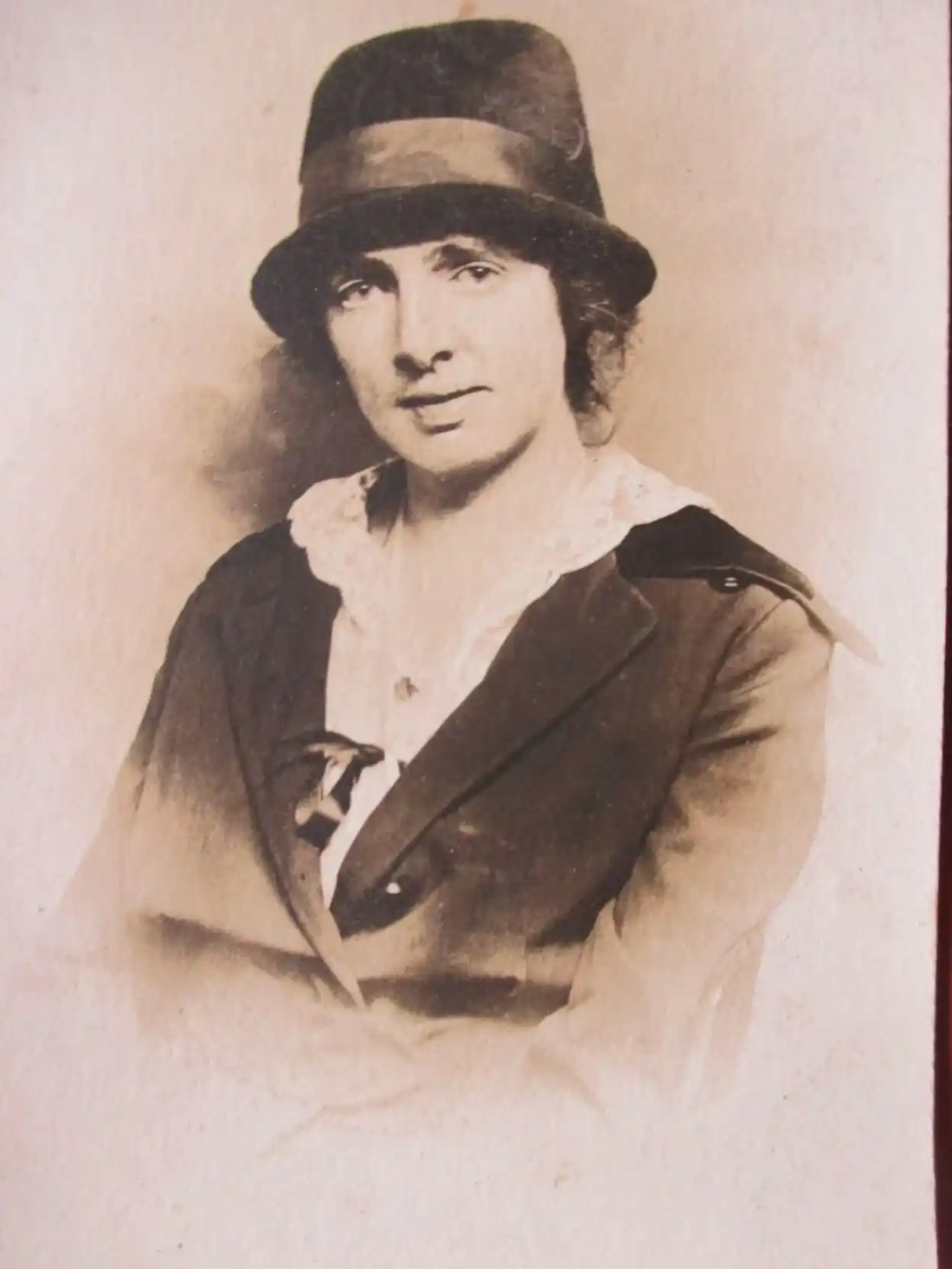
“Three Hours with H. P. Lovecraft” (1959) by Dorothy C. Walter

The time of this meeting was early in 1934. Mr. Lovecraft was living in Providence, Rhode Island, his native city. I was spending the winter with relatives there. A man who knew us both wanted us to become acquainted, and so it came about that one day Mr. Lovecraft climbed our doorsteps, rang out bell, and settled down on my aunt’s parlor sofa for a leisurely conversation.
—Dorothy C. Walter, “Three Hours with H. P. Lovecraft” in The Shuttered Room & Other Pieces 178

Lovecraft scholars are spoiled in the sense that so many of Lovecraft’s letters have survived. There are direct, primary source accounts of Lovecraft’s life and thought that are just absent from the majority of pulp writers or average individuals of the time when Lovecraft lived. This also means we have a large body of material to compare and contrast memoirs and anecdotes of Lovecraft’s life with; a way to evaluate the accuracy of recollections and see what a particular memoir actually adds to our understanding of Lovecraft’s life that his letters do not.

However, not everything made it into Lovecraft’s letters, or not all letters survive. There is, for example, no direct mention of Dorothy C. Walter or any meeting with her in Lovecraft’s extant correspondence. That doesn’t necessarily mean that the meeting didn’t happen or that Walter made it up, as is suspected with “The Ten-Cent Ivory Tower” (1946) by John Wilstach or “The Day He Met Lovecraft” (1972) by Lew Shaw. It does mean that we need to examine the content of Walter’s memoir carefully to evaluate the plausibility of the scenario and confirm and corroborating details.

In the opening to her memoir, Walter claims her meeting with Lovecraft occurred in “early 1934.” Lovecraft spent two weeks in New York City with friends after Christmas, returning to Providence on January 9th. Walter adds a further detail:

[…] I took my turn tending an exhibit of distinguished paintings of bird-life being shown that week by my aunt’s pet project, the Audubon Society, at the John Hay Library […]
—Dorothy C. Walter, “Three Hours with H. P. Lovecraft” in The Shuttered Room & Other Pieces 182

The Calendar of Events January 1934 for Brown University shows that from 9 – 23 January, the John Hay Library at Brown University hosted “Paintings of North American Birds by Rex Brasher under the auspices of the Audu­bon Society.” So that’s a good corroborating detail; it shows that Walter was at least in the right place at the right time, and narrows down the scope of when the visit could have occurred. Her memoir also emphasizes the extreme cold of that January, which called Lovecraft to beg off his first appointment to visit. Lovecraft was particularly sensitive to cold due to some undiagnosed circulatory issue, and this jives with behavior and observations in Lovecraft’s letters for January 1934, which contain passages like this:

I envy you your climate—we’re having a cold spell, so that I haven’t been out of the house for three days.
—H. P. Lovecraft to R. H. Barlow, [31 Jan 1934], O Fortunate Floridian 103

So while we don’t have explicit reference to Lovecraft visiting with Dorothy C. Walter some Sunday afternoon in mid-to-late January in his letters, such a visit is certainly very plausible.

To play devil’s advocate for a moment; the main reason to suspect the authenticity of Walter’s memoir, besides the lack of mention in HPL’s letters, is that the memoir is embellished with some additional research which may have skewed or informed her depiction of Lovecraft. Walter had written about Lovecraft previously in “Lovecraft and Benefit Street” (1943), and letters and papers at the John Hay Library show she was somewhat active in the early Lovecraft studies from shortly after Lovecraft’s death through the early 1960s, in part through her connection with Lovecraft’s friend W. Paul Cook (whom she claims encouraged her to meet with Lovecraft). It is clear reading her “Three Hours with H. P. Lovecraft” that some of her information was derived from Cook and/or his memoir  “In Memoriam” (1941), including the anecdote with the kitten:

“Lovecraft, you know, prefers to write at night. He is also passionately devoted to cats. I suppose he knows every Tabby and Tom in Providence and loves them all.

“Years ago when I was living in Massachusetts and he was visiting me, I asked him to write an article on the Supernatural in Literature for the magazine I was getting out. He did it too—to the Queen’s tatste—but that’s not the story. Knowing his nocturnal habits, I settled him at my desk to make a start on it, when the lateness of the hour forced me off to bed to be ready to pull out and go to work next day. Just before I left him, I dropped a half-grown kitten into his lap. he was delighted. In no time at all the little cat was curled up comfortably, safe in the presence of a friend.

“Next morning I found Howard sitting exactly as I had left him—not one scratch on his paper, the kitten still asleep in his arms. And when I remonstrated because he hadn’t got on with my article, he replied, ‘But I didn’t want to disturb kitty!’
—Dorothy C. Walter, “Three Hours with H. P. Lovecraft” in The Shuttered Room & Other Pieces 189

The two versions of the anecdote aren’t identical, but it’s clear that Walter wasn’t above repeating second-hand material to pad out her brief hours with Lovecraft. In truth, aside from the fact of the encounter itself, there really isn’t much new information about Lovecraft that is contained in Walter’s memoir, no major surprises in thought or action, just a confirmation of Lovecraft’s habits as he himself maintained and as seen by someone outside his normal circle and a couple brief anecdotes. Better to have it than not, but easy to overlook among more substantial or provocative memoirs like The Private Life of H. P. Lovecraft (1985) by Sonia H. Davis.

Which is perhaps, as it should be. Not a great deal can be expected from a three-hour visit, nor did it develop into the kind of friendship and correspondence that Lovecraft had with other women. It was one of many social calls that were part of the life of old New England, even into the 1930s.

Soon after his call I went back to my home in Vermont, remaining away from Providence for several years. By the time I returned, Mr. Lovecraft was dead.
—Dorothy C. Walter, “Three Hours with H. P. Lovecraft” in The Shuttered Room & Other Pieces 178

Based on a letter from August Derleth dated 2 Nov 1959, Walter was concerned about misprints in “Three Hours with H. P. Lovecraft.” These concerns were apparently well-founded, as in a letter to Derleth dated 9 Jul 1960, Walter points out several misprints and a dropped line. Derleth’s reply dated 13 Jul 1960 was apologetic, but the damage was done. After initial publication in The Shuttered Room & Other Pieces (1959), “Three Hours with H. P. Lovecraft” was reprinted in Lovecraft Remembered (1998) and Ave Atque Vale (2018), retaining the same errors, and was translated into German for Das schleichende Chaos (2006).

Perhaps, when it is reprinted again, some kindly editor might fix the errors that Walter felt plagued the piece.


Bobby Derie is the author of Weird Talers: Essays on Robert E. Howard and Others and Sex and the Cthulhu Mythos.

Deep Cuts in a Lovecraftian Vein uses Amazon Associate links. As an Amazon Associate I earn from qualifying purchases.
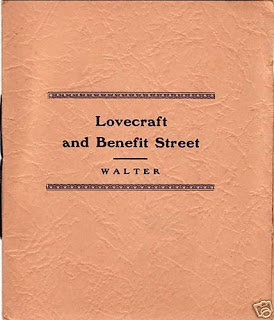
“Lovecraft and Benefit Street” (1943) by Dorothy C. Walter

The house was—and for that matter still is—of a kind to attract the attention of the curious. Originally a farm or semi-farm building, it followed the average New England colonial lines of the middle eighteenth century—the prosperous peaked-roof sort, with two stories and dormerless attic, and with the Georgian doorway and interior panelling dictated by the progress of taste at that time. It faced south, with one gable end buried to the lower windows in the eastward rising hill, and the other exposed to the foundations toward the street. Its construction, over a century and a half ago, had followed the grading and straightening of the road in that especial vicinity; for Benefit Street—at first called Back Street—was laid out as a lane winding amongst the graveyards of the first settlers, and straightened only when the removal of the bodies to the North Burial Ground made it decently possible to cut through the old family plots.
—H. P. Lovecraft, “The Shunned House”

Dorothy Charlotte Walters was secretary of the League of Vermont Writers, a worker on the Vermont Commission on Country Life, and local historian and writer who had attended Brown University in Providence.  She met H. P. Lovecraft only once, in early 1934 while visiting Providence; her memoir of that meeting was later published as “Three Hours with H. P. Lovecraft” (1959). But her first memoir of Lovecraft, published in 1943, as “Lovecraft and Benefit Street.” It is one of the first such memoirs of Lovecraft by any of his female acquaintances.

Returning from such rambles in space and time to his desk in his sightly study from which he overlooked the treetops of Benefit Street, dark against the sky-glow of downtown Providence, he spent night after night, which was his working time, using the familiar localities, the characteristic family and Christian names of Rhode Island, and factual details of the present and past of the life and business of Providence to furnish a setting for tales and doings that were strange indeed.
—Dorothy C. Walter, “Lovecraft and Benefit Street”

At the time they met, Lovecraft was ensconced at 66 College Street, his final home; the window in Lovecraft’s study offered a good view of the treetops and roofs lower down the hill. Walter’s piece combines elements of biography and literary criticism; it is obvious she either read or re-read a good chunk of Lovecraft’s fiction before writing this piece, probably from the first Arkham House collection The Outsider and Others (1939) which she mentions later on in the piece. Some of her observations are more cogent than others:

In the making of imaginative tales of the sort that Mr. Lovecraft wrote there cannot help being a good deal of claptrap and mumbo-jumbo. His stories suffer, if too many are read in quick succession, from similarity in the method of producing a weird atmosphere. It is easy to tire of gothic effects in landscape and in weather when one knows that by such artifices one is being “softened up” to be bowled over at the appropriate moment by the horror of the narrative. One longs for a mystery to develop in a neat, ordinary house, or for a homicide committed in brilliant daylight. Many of the stories are too long. Cutting would have improved them. And Mr. Lovecraft leaned too heavily on a few trick words that had come to have a heightened significance for him—nameless and forbidden, for example, to mention two. He also relied much too often on references to things distasteful to himself that he assumed would produce similar feelings of aversion or fear or disgust in others—fishy odors, for instance, which he couldn’t endure and used again and again as a symbol of the evil and the malevolent; the strangeness of the foreigner; the unpleasantness of things squirmy and slimy; and chief of all, the sensation of cold. […] He would have agreed with Dante in making hell cold. (ibid.)

Subjective assessments aside, there are criticisms and observations in Walter’s piece which would be repeated by many others—indeed, some of the myths about Lovecraft may have been partially popularized by her little memoir. The main thrust of her article is not just about Lovecraft, but about Benefit Street itself, and here it should be remembered that Walter and Lovecraft were of an age—she was born in 1889, he in 1890—and shared a few of the same influences and, probably, prejudices. So in describing the street, she wrote:

One can savor early Providence under its elms, or the Yankee Providence of today, and one can also travel to foreign lands without leaving the street, if one has an open sesame to the pleasant hospitality of the Syrian, Portuguese, and Jewish homes that cluster around its opposite ends. (ibid.)

Benefit Street also provides the setting of “The Shunned House,” and so  involves one of the more dramatic and complicated publishing histories in the Lovecraftian corpus. Robert Weinberg wrote an excellent article on the publishing history of “The Shunned House,” but the short version is that in 1928, Lovecraft’s friend W. Paul Cook—a small-time printer—offered to publish the story in an edition of 250 copies. It would have been Lovecraft’s first standalone hardcover publication. Nothing went right. The edition was printed, but not bound; some of the unbound sheets were bound by R. H. Barlow, and later still some were bound by Arkham House, becoming an odd collector’s item long after Lovecraft’s death, with asking prices in the thousands of dollars (and at least one set of forgeries). The general failure of the book to be properly published during his lifetime was one of Lovecraft’s many discouragements and regrets in the writing game. Cook mentions the printing briefly in his own memoir “In Memoriam: Howard Phillips Lovecraft: Recollections, Appreciations, Estimates” (1941), which is probably all that Walter knew of the matter.

Her own approach to this confluence of Lovecraft and local history comes by way of an anecdote:

But one below-zero night in northern Vermont, in search of a bedtime story, she opened the huge Lovecraft volume that a friend had loaned her. Her eye chanced on a familiar name in a story entitled “The Shunned House,” and she read on just where she had opened the book, astonished to find herself in Providence, wandering along Benefit Street. It was pleasant to be so transported so unexpectedly to a neighborhood well known since college days, interesting and amusing to find it figuring as a setting for the outrageous events of a weird tale when she had always considered it seemly and sedate. She read on, absorbed in the pleasures of recollection. And before she knew it, she was getting shivers and a crinkly spine out of the hair-raising particulars of an uncanny and not very believable yarn. Well, of course it was late, and a very cold night! But what more could a writer of weird fiction have asked for his efforts! (ibid)

Walter’s memoir doesn’t offer any uniquely critical insight into Lovecraft: their association was too brief. Yet it as an example, if any be needed, at how we all touch the lives of others, and might be remembered afterwards by those we knew but briefly. Walter has her few anecdotes of Lovecraft, expands on his fiction and character through her own lens, and even though there is little hard data here that you won’t find anywhere else, she still adds what little she has to the store of Lovecraftian lore. We are richer for her brief memoirs of Lovecraft than we would be without them.

“Lovecraft on Benefit Street” was first published by W. Paul Cook in The Ghost #1 (1943), reprinted by his Driftwind Press as a small chapbook, reprinted again in the fanzine Xenon (July 1944), reached something like wider publication in Rhode Island on Lovecraft (1945, Donald M. Grant), and finally in Lovecraft Remembered (1998, Arkham House).

“Three Hours with Lovecraft” was first published in The Shuttered Room and Other Pieces (1959, Arkham House), republished in Lovecraft Remembered (1998, Arkham House), and again in Ave atque Vale: Reminiscences of H. P. Lovecraft (2018, Necronomicon Press).


Rhode Island on Lovecraft can be read for free at the Internet Archive.


Bobby Derie is the author of Weird Talers: Essays on Robert E. Howard & Others (2019) and Sex and the Cthulhu Mythos (2014).