Deeper Cut: A Survey of Dracula Newspaper Serials in English (1899-1928)

It is almost inconceivable that Bram Stoker wrote Dracula. Still, he must have done it. There is his name on the title page, and before the tale was bound up and offered us between covers it ran in length in various newspapers, and under the same name of authorship.
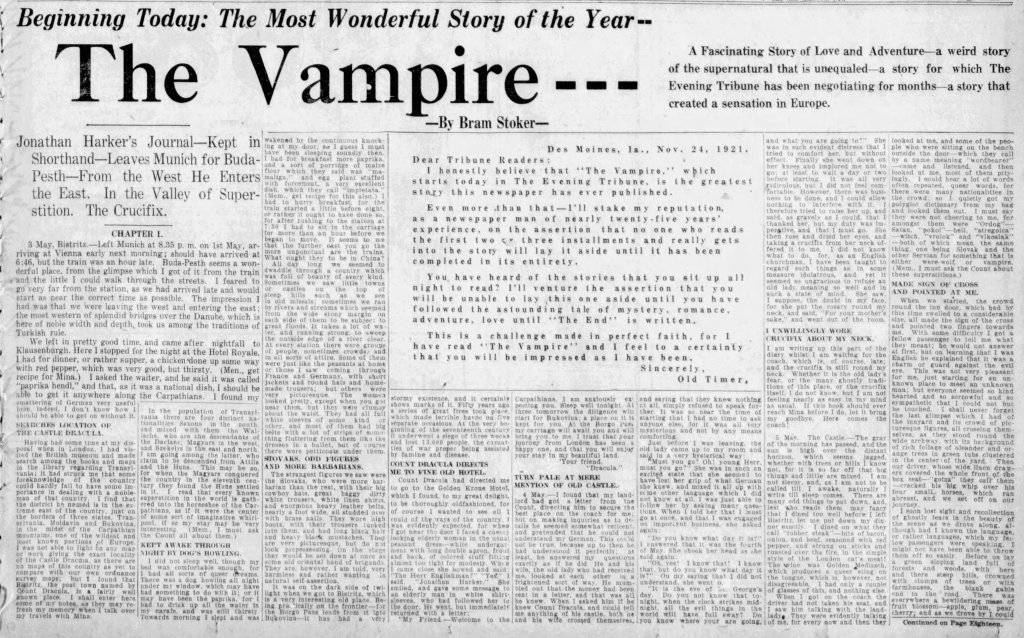
“Bram Stoker’s Story” in the Detroit Free Press, 18 Nov 1899, p11

The research for Deeper Cut: Lovecraft, Miniter, Stoker: the Dracula Revision required an examination of the history of the Dracula manuscript and an evaluation of the textual variations in order to evaluate whether there was any place in the timeline for Edith Miniter, as Lovecraft alleged, and to judge Bram Stoker’s involvement with changes to the text before and after publication.

One of the most notable developments in Dracula studies in recent years has been the discovery of and translation into English of the 1899 Swedish translation Mörkrets Makter (translated into English as Powers of Darkness), which was serialized in the newspaper Dagen, and 1901 Icelandic edition Makt Myrkanna (also translated into English as Powers of Darkness) serialized in the newspaper Fjallkonan. However, there were also numerous Dracula serializations in English-language newspapers in the period 1899-1928.

Some of these have been discussed by previous scholars: John Edgar Browning in The Forgotten Writings of Bram Stoker listed serialization in the Washington Times (1917-1918) and the Charlotte Daily Observer (1899), drawing on information from the Bram Stoker Estate and researcher David J. Skal. Browning also mentions advertisements in the Fitchburg Daily Sentinel, Lowell Sun for a serial in the Boston Advertiser (1921); I have not been able to find an online archive for the Advertiser yet, but can confirm the ads.

That advertisement also ran in Worcester Telegram, Berkshire Eagle, Biddeford-Saco Journal, Boston Jewish Advocate and Herald; Springfield Daily News, Republican, and Morning Union; Quincy Patriot Ledger; Fall River Evening Herald and Globe; Holyoke Transcript-Telegram; The Day (New London, CT), Daily Herald (Rutland, VT), Sun-Journal (Lewiston, ME), and Bangor Daily News around the same time.

Hans Corneel de Roos, searching for the origin of the Swedish and Icelandic newspaper serials, came across the 1899 Inter Ocean serialization—the first known Dracula serial—and also added the Buffalo Courier (“Next Stop: Chicago! Earliest U.S. Serialisation of Dracula Known so Far Discovered. Was it the Source of Mörkrets makter?”)

.Thanks to the digitization of old newspaper archives and online subscription services, these newspaper serials, which have received rather scanty attention, are more accessible today than they were previously. Enough that a survey of the extant texts is warranted.

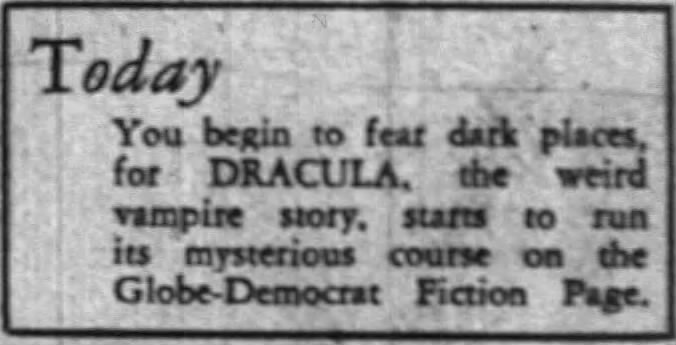
Serialization of novels was nothing strange in the late 19th/early 20th century; many newspapers contained fiction, and ran short stories, poetry, and serials for the entertainment of their readers. Licensing serials was another source of income for authors (or their widows), and served as ready-made advertising, as newspapers often made much of the stories, at least in the first few installments, to drum up excitement for their investment. The problem with serializing Dracula, however, might be apparent to anyone that has read the book. The unabridged 1897 novel is rather long (~160,500 words), divided up into 27 chapters of unequal length, and is in epistolary format, further sub-divided into an assortment of letters, diaries, articles, phonograph recordings, and memoranda, which are also of varied length.

Trying to break that up into newspaper format would be an ordeal for any editor, and many ended up breaking up chapters, letters, and diary sections as they attempted to squeeze the text into space. Worse, from the newspaper person’s perspective, many of the individual sections mean little in themselves and contain little narrative action. Realistic as Dracula is, individual letters only gain meaning and import in the sum of their parts, and the plot progresses very gradually and not in any obvious direction. Imagine their frustration at trying to write synopses for chapters to aid readers trying to follow the story day-by-day or week-by-week! The serials ultimately ran from as few as 22 installments to as many as 131 installments, over the course of a single month or strung out over 5-6 months, but all of them start strong and enthusiastic but dwindle in excitement as the story nears the final chapter.

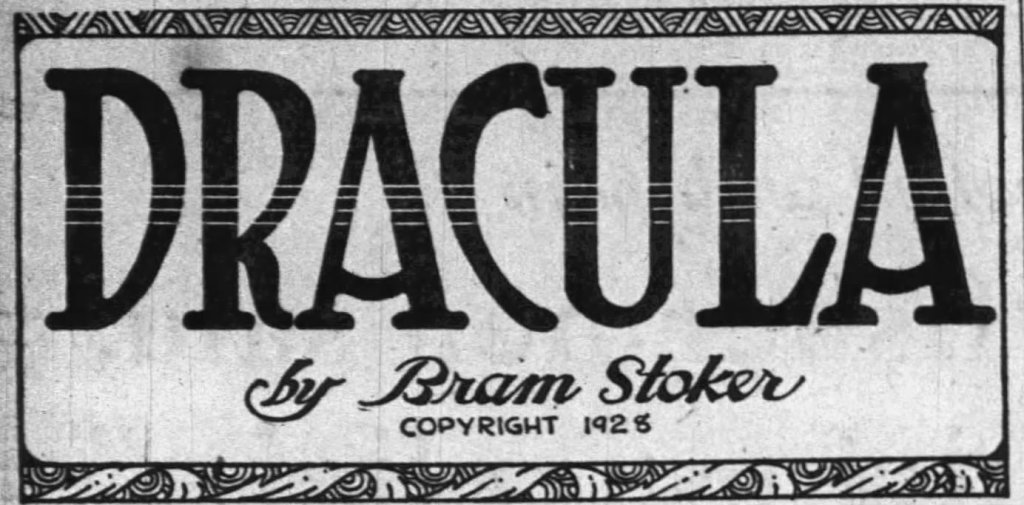
The first four serials all use more or less the identical text, an abridged version of the 1897 Dracula text that removes several sections (probably for space) but does not re-write any sections or correct any errors, as the 1901 abridged edition does. Aside from omissions, the main textual variations are typesetting or transcription errors, some of which are howlers—in the 30 June 1928 entry of the St. Louis Globe-Democrat, for example, the installment ends with the words “hands of oGd!” However, the editors did embellish the text in other ways, often adding synopses or interjecting subsection titles, presumably to punch up the text. Some of these are fun in and of themselves, being occasionally barely literate and often showcasing how tricky it is to improve Stoker’s prose.

The serializations covered in this survey are as follows:

It is notable that there is no overlap between the runs of these serializations. While we don’t have the contracts between the newspapers and Stoker (or his widow, or their agent), that would seem to be deliberate, so that each paper had exclusive rights to the story for a set period, which may have affected the sectioning as well. There is also no known newspaper serialization during the period when the Argosy pulp magazine serialized Dracula (9 parts, Jun 1926 – Feb 1927). Whether this was intentional or coincidental is unknown.

There may well be additional newspaper serializations of Dracula besides these; these are just the serials available via newspapers.com as of the time of this writing. Links will be to the full pages, as clips tend to come out illegible.

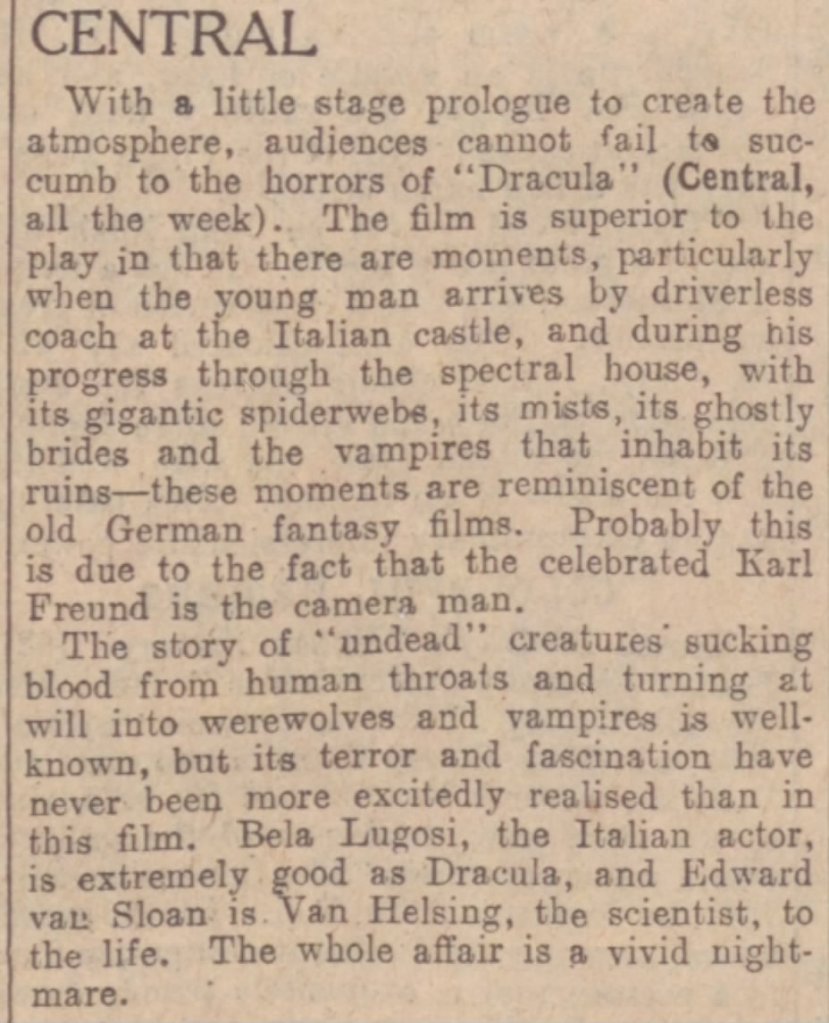
The wisdom of putting this story into the newspapers may be questioned, from a humanitarian point of view, for the oerdinary reader will have to take a nerve tonic after its perusal, especially if inclined to timidity, and the newspaper public numbers thousands of nervous and superstitious people, some of whom are imbued with the particular legendary lore from which the conception of “Dracula” originally sprang.
“A Grewsome Tale.”, Washington D.C. Times 21 Jan 1900, p20


Inter Ocean (7 May 1899-4 Jun 1899)

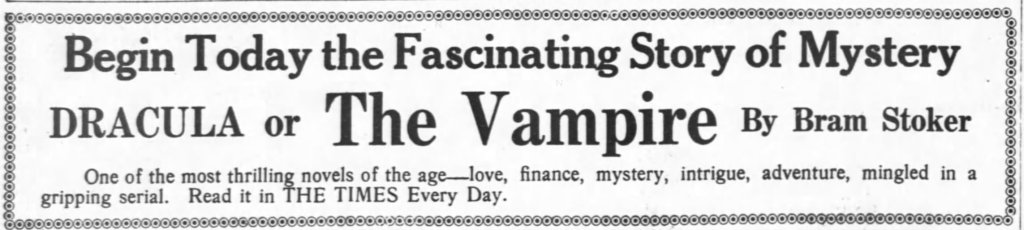
The first serialization of Dracula was announced in the Inter Ocean on 3 May 1899, on page 5:

The title for the series was The Strange Story of Dracula, and ran for 28 installments from 7 May 1899 to 4 June 1899, or nearly a chapter a day. Although the text is taken from the 1897 edition, there has been some abridgement: Jonathan Harker’s prologue (“How these papers have been placed in sequence […]”) has been omitted, as well as parts of chapter V (“Dr. Seward’s Diary (kept in phonograph),” “Letter, Quincey P. Morris to Hon. Arthur Holmwood,” and “Telegram from Arthur Holmwood to Quincey P. Morris.”), chapter VII (Mina Murray’s journal for 10 August), the tail end of Dr. Seward’s Diary in chapters VIII and IX, Lucy Westenra’s Diary of 12 September at the beginning of chapter XI, a few sentences from Hennessy’s letter in chapter XII, both sections of Dr. Seward’s Diary and the Westminster Gazette excerpts in chapter XIII, parts of Mina Harker’s Journal in chapter XIV, etc. Chapters XV and XVI of the book have been excised completely, and as a consequence the chapter numbering was subsequently changes so that the story has 25 chapters instead of 27.

There are a number of small changes that represent either typographical or typesetting errors, too many to list, and a few that may represent editorial fiat. For example, in the Inter Ocean chapter XIV (chapter XVII in the book), “Mina Harker’s Journal” is rendered as “Nina Harker’s Journal” and in the Inter Ocean XXII (chapter XXIV in the book), “Dr. Seward’s Diary” is rendered as “Dr. Seward’s Story,” etc. The 15th installment (Sunday, 21 May 1899) provided readers with a summary of the preceding chapters; another summary appeared with the 22nd installment (Sunday, 28 May 1899).

Note: Until chapter XIV, chapter numbering is identical with the 1897 text, starting with Inter Ocean chapter XV the numbering changes. Equivalent chapters from the 1897 text are presented in parantheses.

Part 1: 7 May 1899, page 17. Chapter I. “3 May” to “sharply to the right.” Link
Part 2: 8 May 1899, page 7. Chapters I-II. “Soon we were hemmed in” to “Peter Hawkins. So!” Link
Part 3: 9 May 1899, page 7. Chapters II-III. “We went thoroughly” to “up and said:” Link
Part 4: 10 May 1899, page 7. Chapter III. “Have you written” to “sank down unconscious.” Link
Part 5: 11 May 1899, page 7. Chapter IV. “I awoke in my” to “whom I am dear!” Link
Part 6: 12 May 1899, page 7. Chapters IV-VI. “30 June, Morning” to “this time tomorrow.” Link
Part 7: 13 May 1899, page 7. Chapters VII-VIII. “CUTTING FROM ‘THE DAILYGRAPH’” to “far over the sea.” Link
Part 8: 14 May 1899, page 17. Chapters VIII-IX. “Same Day, Noon.” to “an excuse and try.” Link
Part 9: 15 May 1899, page 7. Chapters IX-X. “25 August” to “knees begin to tremble.” Link
Part 10: 16 May 1899, page 7. Chapters X-XI. “There on the bed” to “God help me!” Link
Part 11: 17 May 1899, page 7. Chapter XII. “18 September” to “similar incoherent ravings.” Link
Part 12: 18 May 1899, page 7. Chapters XII-XIV. “The two carriers” to “WILHELMINA HARKER.” Link
Part 13: 19 May 1899, page 7. Chapters XIV-XV [XIV, XVII]. “25 September” to “that terrible story!” Link
Part 14: 20 May 1899, page 7. Chapters XV-XVI [XVII-XVIII]. “Then it was terrible” to “that giveth rest.” Link
Part 15: 21 May 1899, page 7. Chapter XVI-XVII [XVIII-XIX]. “Thus when we find” to “become itself corrupt.” Link

Summary of Preceding Chapters: Jonathan Harker, an English solicitor, goes to Transylvania to close negotiations with Count Dracula for an estate which the latter wishes to buy in England. As he approaches the Count’s castle the peasantry indicate that he is going into great danger. He reaches the castle at night and is received by the Count, who warns him not to stray beyond certain rooms. The necessary papers for the transfer of the estate, called Carfax, are signed and the Count also makes arrangements for his own removal to England. Harker discovers that he and the Count are apparently the only inhabitants of the castle. He is also struck by the fact that the Count casts no shadow in a mirror and seems to have strange power over the wolves which range the forests about the castle. The Count forces Harker to write advance letters giving the dates of his own departure from the castle and arrival at a neighboring town. In exploring the castle Harker finds the Count lying in a coffin in the ruined chapel, apparently dead, yet alive. Harker falls asleep in one of the deserted rooms and apparently dreams that three beautiful women are about to kill him. Finally Harker escapes from the castle after the departure of the Count by climbing down the walls, and is next heard of with brain fever in a hospital. Meanwhile Harker’s fiancée, Mina Murray, has gone to visit Lucy Westenra, at Whitby. A Russian vessel driven ashore there with her dead captain lashed to the wheel. A dog, which jumps ashore and disappears, is the only living thing on board. The logbook shows that all but the captain have been driven to jump overboard by some terrifying specter. Lucy Westenra walks in her sleep and is found sitting on a bench with a dark shape hovering over her. Mina Murray brings her home and finds two tiny punctures in her throat, but thinks them made accidentally with a pin. Lucy’s health steadily declines. Dr. Seward, head of an insane asylum near the Carfax estate, notes peculiar conduct of a homicidal patient named Renfield. Dr. Van Helsing comes from Amsterdam to examine Lucy Westenra. He finds her condition critical and employes [sic] transfusion of blood. She is better for a day or two and then relapses. Van Helsing finds the wounds in her throat, again transfuses blood, and orders her to sleep only in a closed room hung with garlic. By a series of accidents these precautions prove unavailing, and Lucy dies. Meanwhile, Harker has returned to England, having married Mina Murray, who had gone to Hungary to nurse him. He sees Dracula on the streets in London. Van Helsing announces that Lucy has been killed by a vampire, and holds counsel with the Harkers, Lucy’s fiancée and Dr. Seward as to means to rid the world of the monster.
Part 16: 22 May 1899, page 7. Chapters XVII-XVIII [XIX-XX]. “Under ordinary circumstances” to “up to the door.” Link
Part 17: 23 May 1899, page 7. Chapters XVIII-XIX [XX-XXI]. “I thought that” to “few minutes join you.” Link
Part 18: 24 May 1899, page 7. Chapter XIX [XXI]. “The patient was breathing” to “clung to him fiercely.” Link
Part 19: 25 May 1899, page 7. Chapters XIX-XX [XXI-XXII]. “Van Helsing and” to “Is it not?” Link
Part 20: 26 May 1899, page 7. Chapter XX [XXII]. “Then let us come” to “the coming of the Count.” Link
Part 21: 27 May 1899, page 7. Chapter XXI [XXIII]. “3 October” to “sorrows have come!” Link
Part 22: 28 May 1899, page 7. Chaptera XXI-XXII [XXIII-XXIV]. “The men were” to “forms, he departed.” Link

Summary of Preceding Chapters: Jonathan Harker, an English solicitor, goes to Transylvania to close negotiations with Count Dracula for an estate which the latter wishes to buy in England. As he approaches the Count’s castle the peasantry indicate that he is going into great danger. He reaches the castle at night and is received by the Count, who warns him not to stray beyond certain rooms. The necessary papers for the transfer of the estate, called Carfax, are signed and the Count also makes arrangements for his own removal to England. Harker discovers that he and the Count are apparently the only inhabitants of the castle. He is also struck by the fact that the Count casts no shadow in a mirror and seems to have strange power over the wolves which range the forests about the castle. The Count forces Harker to write advance letters giving the dates of his own departure from the castle and arrival at a neighboring town. In exploring the castle Harker finds the Count lying in a coffin in the ruined chapel, apparently dead, yet alive. Harker falls asleep in one of the deserted rooms and apparently dreams that three beautiful women are about to kill him. Finally Harker escapes from the castle after the departure of the Count by climbing down the walls, and is next heard of with brain fever in a hospital. Meanwhile Harker’s fiancée, Mina Murray, has gone to visit Lucy Westenra, at Whitby. A Russian vessel driven ashore there with her dead captain lashed to the wheel. A dog, which jumps ashore and disappears, is the only living thing on board. The logbook shows that all but the captain have been driven to jump overboard by some terrifying specter. Lucy Westenra walks in her sleep and is found sitting on a bench with a dark shape hovering over her. Mina Murray brings her home and finds two tiny punctures in her throat, but thinks them made accidentally with a pin. Lucy’s health steadily declines. Dr. Seward, head of an insane asylum near the Carfax estate, notes peculiar conduct of a homicidal patient named Renfield. Dr. Van Helsing comes from Amsterdam to examine Lucy Westenra. He finds her condition critical and employes [sic] transfusion of blood. She is better for a day or two and then relapses. Van Helsing finds the wounds in her throat, again transfuses blood, and orders her to sleep only in a closed room hung with garlic. By a series of accidents these precautions prove unavailing, and Lucy dies. Meanwhile, Harker has returned to England, having married Mina Murray, who had gone to Hungary to nurse him. He sees Dracula on the streets in London. Van Helsing announces that Lucy has been killed by a vampire, and holds counsel with the Harkers, Lucy’s fiancée and Dr. Seward as to means to rid the world of the monster. Dr. Van Helsing describes the character of the vampire, the conditions under which these damned souls are able to walk the earth and prey upon the living, and the means of destroying them. The boxes which the Count sent from Transylvania contain earth from the graveyard in which the vampire was originally buried, and these are necessary to afford a retreat from the monster. Armed with carnal and spiritual weapons, Van Helsing and the others search the Carfax house and are attacked by legions of rats. Some of the boxes of earth are gone. They are traced to their different houses in London which the Count has bought. Renfield protests his sanity and begs for release, to be allowed to go away to save his soul. He is found fatally injured in his room, and confesses that he has yielded to the temptations of the vampire, but rebelled when the monster attacked Mrs. Harker. The vampire is found at work on Mrs. Harker, and attempting to make her one of his own kind. Van Helsing drives him from the house with a consecrated wafer and he disappears in a mist. Mrs. Harker is in an agony of despair, but Van Helsing warns her that she must live until the monster is laid, unless she wishes to become like him. The vampire’s lair at Carfax is sterilized by placing in each box of earth a portion of the consecrated wafer. This operation is repeated at the Count’s other house in London, but one box of earth from Transylvania is not found. The Count appears at the house where the avengers are waiting for him, but escapes them. Mrs. Harker fears that she may become a vampire.
Part 23: 29 May 1899, page 7. Chapter XXII [XXIV]. “No one knew” to “She is calling to me.” Link
Part 24: 30 May 1899, page 7. Chapter XXIII [XXV]. “11 October, Evening” to “1 o’clock today.” Link
Part 25: 31 May 1899, page 7. Chapters XXIII-XXIV [XXV-XXVI]. “28 October” to “anything in his power.” Link
Part 26: 1 Jun 1899, page 7. Chapter XXIV [XXVI]. “30 October” to “hands of God!” Link
Part 27: 2 Jun 1899, page 7. Chapters XXIV-XXV [XXVI-XXVII]. “Later.—Oh” to “Come to us. Come! Come!” Link
Part 28: 4 Jun 1899, page 17. Chapter XXV [XXVII]. “In fear I turned” to “JONATHAN HARKER. (THE END.)” Link

Memphis Commercial Appeal (14 Jun 1899-13 Jul 1899)

The serialization of Dracula in the Commercial Appeal for Memphis, Tennessee was announced in the 13 June 1899 issue, on page 1:

Memphis Commercial Appeal, 13 Jun 1899, p1

The title for the series was simply Dracula, and ran for 26 installments from 14 June 1899 to 13 July 1899. The text largely follows the Inter Ocean abridgement, including the chapter numbering, but without the two synopses and with some unique typesetting/typographical errors (for example, Chapter I opens with “Jonathan Barker’s Journal”) and slight changes to some titles (e.g. the Inter Ocean for Chapter XXII starts simply “This to Jonathan Harker” and in the Commercial Appeal Chapter XXII this is preceded by: “Dr, Seward’s Phonograph Diary, Spoken by Van Helsing. BY VAN HELSING.”)

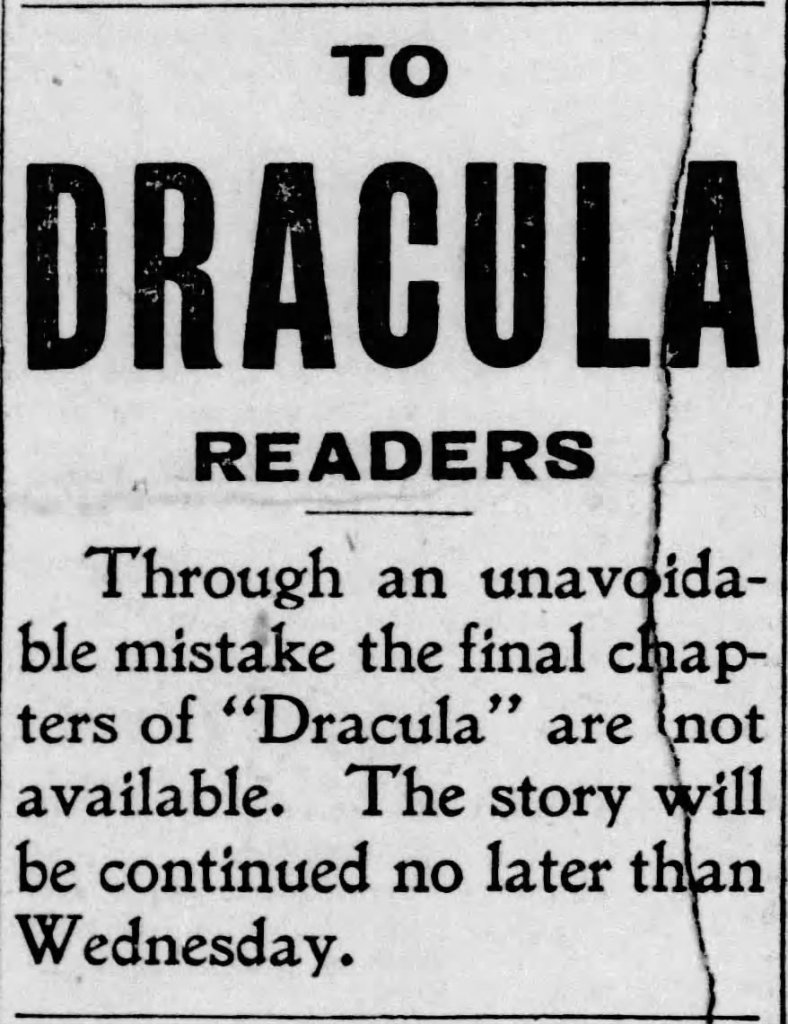
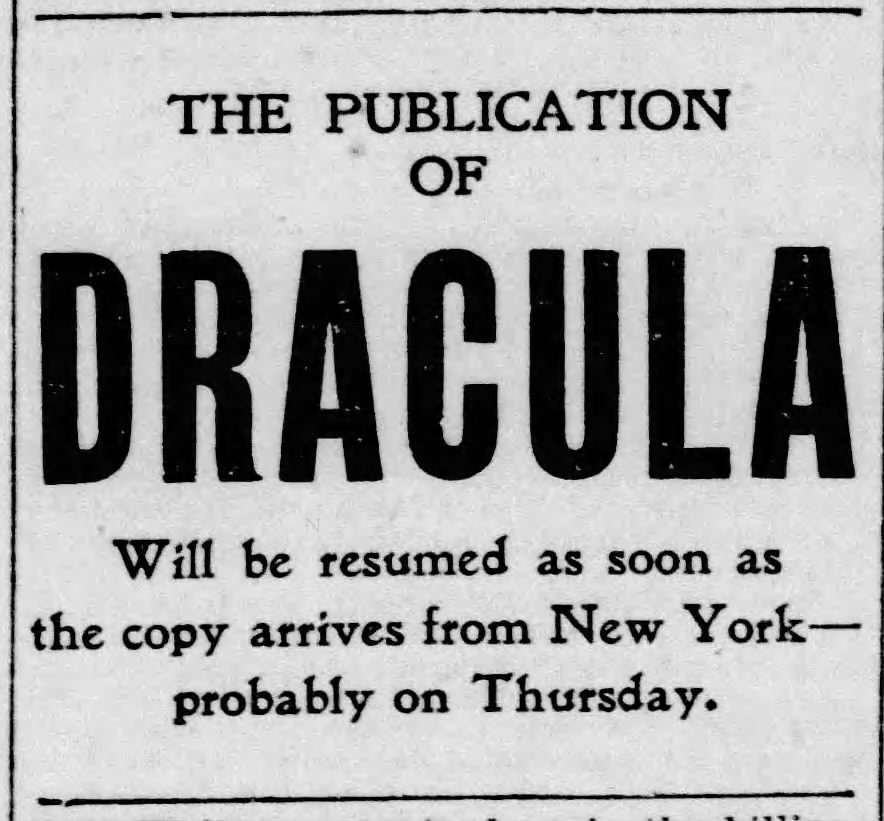
One amusing incident was an announcement to readers that ran in place of Dracula on 4 and 5 July:

Publication resumed on 8 July. Given the text is nearly identical to that in the Inter Ocean, this raises the question: where did the Commercial Appeal get the text? Were they literally copying it from issues of the Inter Ocean, or did they receive it from the Inter Ocean editorial, or was there an approved newspaper abridgement that would have come from Stoker or whatever agency that brokered the sale?

Note: Until chapter XIV, chapter numbering is identical with the 1897 text, starting with Commercial Appeal chapter XV the numbering changes. Equivalent chapters from the 1897 text are presented in parantheses.

Part 1: 14 Jun 1899, page 3. Chapter I. “3 May” to “the moonlit sky.” Link
Part 2: 15 Jun 1899, page 3. Chapter II. “5 May” to “I am a prisoner!” Link
Part 3: 16 Jun 1899, page 3. Chapter III. “When I found” to “sank down unconscious.” Link
Part 4: 17 Jun 1899, page 3. Chapter IV. “I awoke in” to “he stopped. ‘Hark!’” Link
Part 5: 18 Jun 1899, page 16. Chapters IV-V. “Close at haul” to “Good-bye.” Link
Part 6: 19 Jun 1899, page 3. Chapter VI. “24 July” to “this time tomorrow.” Link
Part 7: 20 Jun 1899, page 3. Chapter VII. “Cutting From ‘The Dailygraph,’” to “routine of her life.” Link
Part 8: 21 Jun 1899, page 3. Chapter VIII. “Same day, 11 o’clock p.m.” to “of good things?” Link
Part 9: 22 Jun 1899, page 3. Chapter IX. “My Dearest Lucy” to “till have seen you.” Link
Part 10: 23 Jun 1899, page 3. Chapter X. “7 September” to “Ho! ho!” Link
Part 11: 24 Jun 1899, page 3. Chapter XI [Mislabeled as Chapter XII]. “13 September” to “God help me!” Link
Part 12: 25 Jun 1899, page 11. Chapter XII. “18 September” to “Wait and see.” Link
Part 13: 26 Jun 1899, page 3. Chapters XIII-XIV. “22 September” to “you will,’ I said.” Link
Part 14: 27 Jun 1899, page 3. Chapter XV [XVII]. “When we arrived” to “to comfort him.” Link
Part 15: 28 Jun 1899, page 3. Chapter XVI [XVIII]. “30 September” to “convince you tonight.” Link
Part 16: 29 Jun 1899, page 3. Chapter XVII [XIX]. “1 October, 5 a.m.” to “sleep. Good-night.” Link
Part 17: 30 Jun 1899, page 3. Chapter XVIII [XX]“1 October, Evening” to “I must go at once.” Link
Part 18: 1 Jul 1899, page 3. Chapter XIX [XXI]. “3 October” to “its daily course.” Link
Note: upper-left corner of page destroyed in this scan, data filled in from Inter Ocean text based on context.
Part 19: 2 Jul 1899, page 11. Chapter XX [XXII]. “3 October” to “coming of the count.” Link
Part 20: 3 Jul 1899, page 3. Chapter XXI [XXIII]. “3 October” to “in a faint.” Link
Part 21: 8 Jul 1899, page 3. Chapter XXII [XXIV]. “Dr. Seward’s Phonograph” to “She is calling to me.” Link
Part 22: 9 Jul 1899, page 11. Chapter XXIII [XXV]. “11 October, evening” to “the MS. to us.” Link
Part 23: 10 Jul 1899, page 3. Chapter XXIV [XXVI]. “29 October” to “every minute is precious.” Link
Part 24: 11 Jul 1899, page 3. Chapter XXIV [XXVI]. “Ground of Inquiry” to “always for him.” Link
Part 25: 12 Jul 1899, page 3. Chapter XXV [XXVII]. “1 November” to “but one word:” Link
Part 26: 13 Jul 1899, page 3. Chapter XXV [XXVII]. “DRACULA” to “JONATHAN HARKER. THE END.” Link

Charlotte Daily Observer (16 Jul 1899-10 Dec 1899)

The serialization of Dracula in the Daily Observer for Charlotte, North Carolina follows the Inter Ocean abridged text, including the chapter numbering but minus the synopses, and was published in 22 parts from 16 July 1899 to 10 December 1899. Inevitably there were numerous misspellings, either from transcription or typesetting, such as “Yours always, JOHN SEAWRD.” in Chapter IX, “DR. SEWARD’S DAIRY” in Chapter XI, “JONATHAN HARKER’S JOURNNAL” in Chapter XXVII, etc. The subtitle for the serial was “A Strong Story of the Vampire,” and as “By Bram Stoker, the Dramatic Critic, Theatrical Manager and Author of ‘Miss Betty,’ ‘Under the Sunset,’ and Other Books.” although Miss Betty (1898) is sometimes mistranscribed as “Miss Betsy,” “Miss Belay,” etc.

Note: Until chapter XIV, chapter numbering is identical with the 1897 text, starting with Daily Observer chapter XV the numbering changes. Some chapters are unnumbered. Equivalent chapters from the 1897 text are presented in parantheses.

Part 1: 16 Jul 1899, page 10. Chapter I. “3 May” to “the moonlit sky” Link
Part 2: 23 Jul 1899, page 10. Chapter II. “5 May” to “I am a prisoner!” Link
Part 3: 30 Jul 1899, page 10. [Chapter III.] “When I found” to “sank down unconscious.” Link
Part 4: 6 Aug 1899, page 10. Chapter IV. “I awoke in” to “Goodby, all! Mina!” Link
Part 5: 13 Aug 1899, page 10. Chapters V-VII. “My Dearest Lucy” to “routine of her life.” Link
Part 6: 20 Aug 1899, page 10. Chapter VIII. “Same day 11 o’clock p. m.” to “distribution of good things?” Link
Part 7: 27 Aug 1899, page 10. Chapter IX. “Budapest, 24 August” to “till have seen you.” Link
Part 8: 3 Sep 1899, page 10. Chapter X. “7 September” to “Ho! ho!” Link
Part 9: 10 Sep 1899, page 10. Chapter XI. “13 September” to “God help me!” Link
Part 10: 17 Sep 1899, page 10. Chapter XII. “18 September” to “Wait and see.” Link
Part 11: 24 Sep 1899, page 10. Chapter XIII-XIV. “22 September” to “will,’ I said.” Link
Part 12: 1 Oct 1899, page 10. [Chapter XVII]. “When we arrived” to “to comfort him.” Link
Part 13: 8 Oct 1899, page 10. [Chapter XVIII]. “20 September” to “convince you to-night.” Link
Part 14: 15 Oct 1899, page 10. Chapter XVII [XIX]. “1 October, 5 a. m.” to “sleep. Good night.” Link
Part 15: 22 Oct 1899, page 10. Chapter XVIII [XX]. “1 October, Evening” to “I must go at once.” Link to page 1
Note: Page 10 missing from online scan, data filled in from Inter Ocean.
Part 16: 29 Oct 1899, page 10. Chapter XIX [XXI]. “2 October” to “its daily course.” Link
Part 17: 5 Nov 1899, page 10. Chapter XX [XXII]. “3 October” to “coming of the Count.” Link
Part 18: 12 Nov 1899, page 10. Chapter XXI [XXIII]. “3 October” to “forward in a faint.” Link
Part 19: 19 Nov 1899, page 10. Chapter XXII [XXIV]. “DR. SEWARD’S PHONOGRAPH DIARY” to “She is calling to me.” Link
Part 20: 26 Nov 1899, page 10. Chapter XXIII [XXV]. “11 October, evening” to “brought the MS to us.” Link
Part 21: 3 Dec 1899, page 14. Chapter XXIV [XXVI]. “23 October” to “be always for him.” Link
Part 22: 10 Dec 1899, page 10. [Chapter XXVII]. “1 November” to “JONATHAN HARKER. [THE END].” Link

Buffalo New York Courier (19 Feb 1900-1 Apr 1900)

The serialization of Dracula in the Courier for Buffalo. New York follows the Inter Ocean abridged text, including the chapter numbering (more or less) but with its own synopses, and was published in 37 parts from 19 February 1900 to 1 April 1900. The synopses begin with part 3 and are a regular feature of the daily Dracula until the finale in parts 36 and 37. Given the relatively slow pace of Dracula, many of the synopses are identical from segment to segment.

Of interesting note is the copyright notices; the first nine installments read simply “Copyright Bram Stoker,” but starting with the 1 March 1900 entry, the copyright notice changes to:

This would reflect the first U.S. publication of Dracula by Doubleday & McClure in 1899.

Note: Until chapter XIV, chapter numbering is identical with the 1897 text, starting with Commercial Appeal chapter XV the numbering changes. Some chapters are unnumbered. Equivalent chapters from the 1897 text are presented in parantheses.

Part 1: 19 Feb 1900, page 5. Chapter I. “3 May” to “into strange relief” Link.
Part 2: 20 Feb 1900, page 5. [Chapter I]. “The ghost-like clouds” to “against the moonlit sky.” Link.
Part 3: 21 Feb 1900, page 5. Chapter II. “5 May” to “what strange things here may be.” Link.
Synopsis: Count Dracula is a vampire. He lives in a deserted castle in the Carpathian Mountains. Finding existence somewhat monotonous, he writes to London with a view to procuring new victims. In this installment Jonathan Harker is on his way to the castle to pay a visit to the Count.
Part 4: 22 Feb 1900, page 5. [Chapter II]. “This led to ” to “I am a prisoner!” Link.
Synopsis: Identical to part 3.
Part 5: 23 Feb 1900, page 5. Chapter III. “When I found” to “‘modernity’ cannot kill.” Link.
Synopsis: Count Dracula lives in a deserted castle in the Carpathian Mountains. He desires to take up a residence in the vicinity of London. At his request Jonathan Harker of Exeter pays a visit to the castle, bringing with him papers describing a place which he believed would suit Count Dracula. Mr. Harker describes in a diary his remarkable experiences on his way to the castle and after arriving there. Yesterday’s instalment of the story closed with Harker a prisoner in Dracula’s home.
Part 6: 24 Feb 1900, page 5. [Chapter III-IV]. “Later: the morning of 16 May” to “new scheme of villany.” Link.
Synopsis:  Count Dracula lives in a deserted castle in the Carpathian Mountains. He desires to take up a residence in the vicinity of London. At his request Jonathan Harker of Exeter pays a visit to the castle, bringing with him papers describing a place which he believed would suit Count Dracula. Mr. Harker describes in a diary his remarkable experiences on his way to the castle and after arriving there. Yesterday’s instalment of the story closed with Harker practically a prisoner in Dracula’s home, the Count informing him that he desired him (Harker) to remain as his guest for thirty days.
Part 7: 26 Feb 1900, page 5. [Chapter IV]. “17 June” to “Goodby, all! Mina!” Link.
Synopsis: Count Dracula lives in a deserted castle in the Carpathian Mountains. He concludes to take up his abode near London and writes to Peter Hawkins to find for him a suitable place. Mr. Hawkins sends Jonathan Harker to the castle with plans of the house he has selected. Mr. Harker keeps a diary of his extraordinary experiences. Dracula at the conclusion of the last instalment had made Harker a prisoner in his castle.
Part 8: 27 Feb 1900, page 5. Chapter V. “9 May” to “auditors put it.” Link.
Synopsis: Identical to part 7.
Part 9: 28 Feb 1900, page 5. Chapter V-VI. “8 July” to “ship is steadier.” Link.
Synopsis: Count Dracula lives in a deserted castle in the Carpathian Mountains. He concludes to take up his abode near London and writes to Peter Hawkins to find for him a suitable place. Mr. Hawkins sends Jonathan Harker to the castle with plans of the house he has selected. Mr. Harker keeps a diary of his extraordinary experiences. After witnessing many wierd [sic] and uncanny incidents Harker decides that he will return home, being now in mortal fear of his life. He finds, however, that he is a prisoner in the castle. His continued absence is causing uneasiness at home.
Part 10: 1 Mar 1900, page 5. Chapters VII-VIII. “29 July” to “if to herself:” Link.
Synopsis: Identical to part 9.
Part 11: 2 Mar 1900, page 5. Chapters VIII-IX.“His red eyes” to “loving MINA HARKER” Link.
Synopsis: Identical to part 9.
Part 12: 3 Mar 1900, page 5. [Chapter IX]. “20th of August” to “till I have seen you.” Link.
Synopsis: Dracula lives in a deserted castle in the Carpathian Mountains. He concludes to take up his abode near London and writes to Peter Hawkins to find for him a suitable place. Mr. Hawkins sends Jonathan Harker to the castle with plans of the house he has selected. Mr. Harker keeps a diary of his extraordinary experiences. After witnessing many wierd [sic] and uncanny incidents Harker decides that he will return home, being now in mortal fear of his life. He finds, however, that he is a prisoner in the castle. His continued absence is causing uneasiness at home. Dracula has left his castle in the mountains and gone to his house near London. Harker has also left the castle and is recovering from a long illness.
Part 13: 5 Mar 1900, page 5. Chapters X-XI. “No sitting up tonight” to “Lucy’s phonograph.” Link.
Synopsis: Count Dracula lives in an isolated castle in the Carpathian Mountains. An air of mystery surrounds him. Tiring of his secluded life he writes to Peter Hawkins to find him a place near London. Jonathan Harker is sent to the Count with plans of a place which Dracula accepts and goes to London, leaving Harker a raving maniac at the castle due to his weird and uncanny experiences. Harker partially recovers, however, and is married to Mina Murray. Mina’s friend Lucy Westenra is about to be married but becomes ill from loss of blood. Her case is extraordinary and is now under investigation by Dr. Seward who is the superintendent of a lunatic asylum and by a famous specialist, Dr. Van Helsing. Mr. Renfield, who is confined in Dr. Seward’s asylum is also a subject of much concern to the Doctor and his case is under investigation.
Part 14: 6 Mar 1900, page 5. Chapter XI. “17 September” to “That’s so.” Link.
Synopsis: Identical to part 13.
Part 15: 7 Mar 1900, page 5. [Chapters XI-XII]. “And I guess” to “loving MINA HARKER” Link.
Synopsis: Identical to part 13.
Part 16: 8 May 1900, page 5. Chapters XII-XIII. “20 September” to “he was speaking:” Link.
Synopsis: Identical to part 13.
Part 17: 9 May 1900, page 5. Chapters XIII-XIV. “It is the” to “so I said:” Link.
Synopsis: Identical to part 13.
Part 18: 10 Mar 1900, page 5. Chapters XIV-XV [XIV, XVII]. “Dr. Van Helsing” to “that terrible story!” Link.
Synopsis: Count Dracula lives in an isolated castle in the Carpathian Mountains. An air of mystery surrounds him. Tiring of his secluded life he writes to Peter Hawkins to find him a place near London. Jonathan Harker is sent to the Count with plans of a place which Dracula accepts and goes to London, leaving Harker a raving maniac at the castle due to his weird and uncanny experiences. Harker partially recovers, however, and is married to Mina Murray. Mina’s friend Lucy Westenra is about to be married but becomes ill from loss of blood. Her case is extraordinary and is now under investigation by Dr. Seward who is the superintendent of a lunatic asylum and by a famous specialist, Dr. Van Helsing. Mr. Renfield, who is confined in Dr. Seward’s asylum is also a subject of much concern to the Doctor and his case is under investigation. Lucy Westenra dies mysteriously.
Part 19: 12 Mar 1900, page 5. [Chapter XVIII]. “All we have” to “addressing an equal:” Link.
Synopsis: Identical to part 18.
Part 20: 13 Mar 1900, page 5. Chapter XVII-XVII [XVIII-XIX]. “Can you not” to “us go home.” Link.
Synopsis: Count Dracula lives in an isolated castle in the Carpathian Mountains. An air of mystery surrounds him. Tiring of his secluded life he writes to Peter Hawkins to find him a place near London. Jonathan Harker is sent to the Count with plans of a place which Dracula accepts and goes to London, leaving Harker a raving maniac at the castle due to his weird and uncanny experiences. Harker partially recovers, however, and is married to Mina Murray. Mina’s friend Lucy Westenra is about to be married but becomes ill from loss of blood. Her case is extraordinary and is now under investigation by Dr. Seward who is the superintendent of a lunatic asylum and by a famous specialist, Dr. Van Helsing. Mr. Renfield, who is confined in Dr. Seward’s asylum is also a subject of much concern to the Doctor and his case is under investigation. Lucy Westenra dies mysteriously. It is discovered beyond doubt that Dracula is a vampire, and efforts are being put forth to destroy him.
Part 21: 14 Mar 1900, page 5. Chapters XVII-XVIII [XIX-XX]. “The house was” to “for the despite.” Link.
Synopsis: Identical to part 20.
Part 22: 15 Mar 1900, page 5. [Chapter XX]. “An interview with” to “another of us:” Link.
Synopsis: Identical to part 20.
Part 23: 16 Mar 1900, page 5. Chapters XVIII-XIX [XX-XXI]. “Quincey’s head is level” to “as he spoke:” Link.
Synopsis: Identical to part 20.
Part 24: 17 Mar 1900, page 5. [Chapter XXI]. “There is no” to “to him fiercely.” Link.
Synopsis: Identical to part 20.
Part 25: 19 Mar 1900, page 5. [Chapter XXII]. “3 October” to “may be strong.” Link.
Synopsis: Count Dracula lives in an isolated castle in the Carpathian Mountains. He writes to Peter Hawkins, a barrister, to secure a place for him near London. Jonathan Harker is sent to him with plans for a place, which the County [sic] accepts. While at the castle Harker has the most weird and uncanny experiences. He leaves the castle a raving maniac. He recovers and marries Mina Murray. The Count moves to his new place near London and soon afterward Mrs. Harker’s friend Lucy Westenra dies mysteriously. Dr. Van Helsing a famous specialist and Dr. Seward, superintendent of a lunatic asylum investigate and learn beyond doubt that Miss Westenra was killed by a vampire. Further investigation shows that Dracula is the vampire. Renfield, a patient in Dr. Seward’s asylum is killed by Dracula and he has just been frustrated in attempting the death of Mrs. Harker.
Part 26: 20 Mar 1900, page 5. Chapters XX-XXI [XXII-XXIII ]. “Breakfast was a” to “Death, met Life.” Link.
Synopsis: Identical to part 25.
Part 27: 21 Mar 1900, page 5. [Chapter XXIII]. “Harker groaned and” to “his sublime misery.” Link.
Synopsis: Identical to part 25.
Part 28: 22 Mar 1900, page 5. [Chapter XXIII]. “We had a” to “into the rachet.” Link.
Synopsis: Identical to part 25.
Part 29: 23 Mar 1900, page 5. Chapters XXI-XXII [XXIII-XXIV]. “What are you” to “want to know.” Link.
Synopsis: Identical to part 25.
Part 30: 24 Mar 1900, page 5. [Chapter XXIV]. “They make known” to “glory of God.” Link.
Synopsis: Identical to part 25.
Part 31: 26 Mar 1900, page 5. Chapters XXII-XXIII[XXIV-XXV]. “The Czarina Catherine” to “no need to speak.” Link.
Synopsis: Identical to part 25.
Part 32: 27 Mar 1900, page 5. [Chapter XXV]. “I want you” to “doom, I trust!” Link.
Synopsis: Identical to part 25.
Part 33: 28 Mar 1900, page 5. [Chapter XXV]. “26 October” to “that we think.” Link
Synopsis: Identical to part 25.
Part 34: 29 Mar 1900, page 5. Chapters XXIII-XXIV [XXV-XXVI]. “Then, as he” to “anxiety and eagerness.” Link.
Synopsis: Identical to part 25.
Part 35: 30 Mar 1900, page 5. [Chapter XXVI]. “30 October, evening” to “on, Russian fashion.” Link.
Synopsis: Identical to part 25.
Part 36: 31 Mar 1900, page 5. Chapter XXIV-XXV [XXVI-XXVII]. “4 November” to “with my work.” Link.
Part 37: 1 Apr 1900, pages 17, 23. [Chapter XXVII]. “I knew that” to “Jonathan Harker. The End.” Link p17. Link p23.

Washington D.C. Times Herald (13 Sep 1917-21 Jan 1918)

Bram Stoker died in 1912; subsequent serializations would have been authorized by his widow Florence. In the Washington, D.C. Times, the story was run as “Dracula, or The Vampire.” Unlike previous serials, this was for the most part the complete 1897 text, with only one notable cut: Jonathan Harker’s prologue. The spelling was also changed from British to American English (e.g. “labor” instead of “labour”), as well as some punctuation (many commas see to have been left out), and there are the typical typographical or typesetting errors. The text is augmented by a number of key phrases which were interjected as sub-headings, presumably to give a sense of action. Starting with the 8th installment on 20 September 1917, the editors also began to run a synopsis, which ran until the 47th installment on 29 October 1917, at which point apparently the editors gave up; most of the synopses are identical in wording.

These additions, the largely unabridged text, and the smaller size of each installment account for its length: this is the longest-running of the newspaper Dracula serials, published in 131 installments from 13 September 1917 to 21 January 1918.

Note: Many parts do not contain chapter headings. Equivalent chapters from the 1897 text are presented in parantheses.

Part 1: 13 Sep 1917, page 14. [Chapter I]. Link.
“3 May” to “on without it.”
ATTEMPTS TO LOCATE THE CASTLE DRACULA.
To “Mem., I must ask the count [sic] all about them).”
BEGINS A LONG JOURNEY ON A SLOW TRAIN.
To “natural self-assertion.”
FINDS LETTER FROM COUNT AT HOTEL.
To “Your Friend, DRACULA.”
REFUSED INFORMATION OF COUNT OR CASTLE.
To “Here comes the Coach!”
PEASANT SUPERSTITIONS CAUSE WORRY.
To “about these superstitions.)”
CROWD GIVES CHARM AGAINST ALL EVIL.
To “right before us:”
MEN AND WOMEN KNEEL BEFORE SHRINE.
To “light his lamps.”
PASSENGERS’ EXCITEMENT CAUSE FOR SPEED.
To “in a white cloud.”
Part 2: 14 Sep 1917, page 8. [Chapter I]. Link.
“We could” to “For the dead travel fast.”
THE STRANGE JOURNEY INTO BUKOWINA BEGINS.
To “sick feeling of suspense.”
HOWLING WOLVES ADD TO THE TRAVELER’S PERIL.
To “anything through the darkness.”
THE DRIVE FIGURES IN A WEIRD [sic] DREAM.
To “in a moving circle.”
RING OF WOLVES SURROUND THE CARRIAGE.
To “understand their true import.”
Part 3: 15 Sep 1917, page 5. [Chapters I-II]. Link.
“All at once” to “the moonlit sky.”
THE DRIVER SHOWS HIS MARVEL STRENGTH.
To “was swung back.”
BID WELCOME BY STRANGE OLD MAN.
To “your supper prepared.”
FEARS DISSIPATED BY COURTEOUS TREATMENT.
To “into the other room.”
Part 4: 16 Sep 1917, page 21. [Chapter II]. Link.
“I found supper” to “very marked physiognomy.”
STRUCK BY THE COUNT’S PECULIAR APPEARANCE.
To “and he said:”
COUNT HEARS MUSIC IN HOWLING OF WOLVES.
To “the Law List.”
TELLS OF HIS LONGING TO VISIT ENGLAND.
To “you speak excellently.”
Part 5: 17 Sep 1917, page 9. [Chapter II]. Link.
“Not so,” to “what strange things there may be.”
THE COUNT ANSWERS QUESTIONS FRANKLY.
To “in the friendly soil.”
DECLARES PEASANTS ARE COWARDS AND FOOLS.
To “Peter Hawkins. So!”
DETAILS FOR PURCHASING THE ESTATE ARRANGED.
To “visible from the grounds.”
Part 6: 18 Sep 1917, page 11). [Chapter II]. Link.
“When I had finished” to”jumping to his feet, said:”
KEPT TALKING UNTIL DAWN WAS UPON HIM.
To “except myself.”
A MIRROR THAT MAKES NO REFLECTION.
To “The castle is a veritable prison, and I am a prisoner!”
Part 7: 19 Sep 1917, page 11. Chapter III. Link.
“When I found” to “coach that brought me here.”
PAST EVENTS ARE NOW BEING PUT TOGETHER.
To “whose blood is in these veins?”
TELLS OF WARLIKE HISTORY OF HIS FAMILY.
To “as a tale that is told.”
Part 8: 20 Sep 1917, page 11. [Chapter III]. Link.
“It was by this time” to “be useful to me.”
LEGAL SITUATION IN ENGLAND INTERESTS DRACULA.
To “known by any one persons.”
INQUIRIES REGARDING MAKING CONSIGNMENTS.
To “find all things as you wish.”

Synopsis: Jonathan Harker, a London solicitor’s clerk, takes a long journey to Bukowina to see Count Dracula and arrange for the transfer of an English estate to the count. In his diary, kept in shorthand, he gives the details of his strange trip the latter part filled with mysterious and thrilling happenings. Upon his arrival at Castle Dracula he is met by the count and finds himself virtually a prisoner. The castle itself is a piece of mystery with doors all barred, and no servants to be seen. The count greets him warmly, but his strange personality and odd behavior cause Harker much alarm. In order not to arouse suspicion Harker leads the count to tell of his estate and of the history of his family.
Part 9: 21 Sep 1917, page 9. [Chapter III]. Link.
“At the door he turned” to “looked carefully out.”
THE COUNT DESCENDS THE PRECIPITIOUS BASTION.
“What I saw” to “the key was gone!”
AN EXPLORING TRIP IN QUEST OF A KEY.
“That key must” to “was a great precipice”

Synopsis: Jonathan Harker, a London solicitor’s clerk, takes a long journey to Bukowina to see Count Dracula and arrange for the transfer of an English estate to the count. In his diary, kept in shorthand, he gives the details of his strange trip the latter part filled with mysterious and thrilling happenings. Upon his arrival at Castle Dracula he is met by the count and finds himself virtually a prisoner. The castle itself is a piece of mystery with doors all barred, and no servants to be seen. The count greets him warmly, but his strange personality and odd behavior cause Harker much alarm. In order not to arouse suspicion Harker leads the count to tell of his estate and of the history of his family. Later the Count orders him to write his employer he is to stay at the castle for a month.
Part 10: 22 Sep 1917, page 9. [Chapter III]. Link.
“The castle was built on” to “a soft quietude come over me.”
A MARKED CONTRAST WROUGHT BY TIME.
To “what he may say.”
IGNORES COUNT’S WARNING ABOUT PLACES TO SLEEP.
To “that it was all sleep.”
THE “DREAM” BEHINS TO UNWIND ITSELF.
To “some deadly fear.”

Synopsis: Jonathan Harker, a London solicitor’s clerk, takes a long journey to Bukowina to see Count Dracula and arrange for the transfer of an English estate to the count. In his diary, kept in shorthand, he gives the details of his strange trip the latter part filled with mysterious and thrilling happenings. Upon his arrival at Castle Dracula he is met by the count and finds himself virtually a prisoner. The castle itself is a piece of mystery with doors all barred, and no servants to be seen. The count greets him warmly, but his strange personality and odd behavior cause Harker much alarm. In order not to arouse suspicion Harker leads the count to tell of his estate and of the history of his family. Later the Count orders him to write his employer he is to stay at the castle for a month. castle for a month [sic] That night he sees the Count crawl down the castle wall like a lizard.
Part 11: 23 Sep 1917, page 19. Chapters III-IV. Link.
“I felt in” to “with beating heart.”
A RUDE INTERRUPTION AND AWAKENING.
“But at that” to “work to be done.”
A WELCOME ENDING TO A TERRIBLE SCENE.
“Are we to have” to “suck my blood.”
DOOR TO THE MYSTERY ROOM IS LOCKED.
To “on this surmise.”

Synopsis: Jonathan Harker, a London solicitor’s clerk, takes a long journey to Bukowina to see Count Dracula and arrange for the transfer of an English estate to the count. In his diary, kept in shorthand, he gives the details of his strange trip the latter part filled with mysterious and thrilling happenings. Upon his arrival at Castle Dracula he is met by the count and finds himself virtually a prisoner. The castle itself is a piece of mystery with doors all barred, and no servants to be seen. The count greets him warmly, but his strange personality and odd behavior cause Harker much alarm. In order not to arouse suspicion Harker leads the count to tell of his estate and of the history of his family. Later the Count orders him to write his employer he is to stay at the castle for a month. That night he sees the Count crawl down the castle wall like a lizard.
Part 12: 24 Sep 1917, page 7. [Chapter IV]. Link.
“19 May” to “God help me.”
OPPORTUNITY TO ESCAPE PRESENTS ITSELF.
“28 May” to “again a shock!”
NOT A ROAD TO ESCAPE IS LEFT OPEN.
To “new scheme of villainy.”
Synopsis: Identical to part 11.
Part 13: 25 Sep 1917, page 9. [Chapter IV]. Link.
“17 June” to “ruthless villainy.”
THE COUNT APPEARS IN MY STOLEN CLOTHING.
To “and simply cried.”
WOMAN’S AGONIZED CRY IN THE COURT YARD.
To “Monster, give me my child!”
Synopsis: Identical to part 11.
Part 14: 26 Sep 1917, page 13. [Chapter IV]. Link.
“She threw herself” to “from the earth.”
THE FIRST FATAL LETTER STARTS ON ITS COURSE.
To “was covered with dust.”
A GOLDEN HOARD IN THE COUNT’S ROOM.
To “I made a discovery.”

Synopsis: Jonathan Harker, a London solicitor’s clerk, takes a long journey to Bukowina to see Count Dracula and arrange for the transfer of an English estate to the count. In his diary, kept in shorthand, he gives the details of his strange trip the latter part filled with mysterious and thrilling happenings. Upon his arrival at Castle Dracula he is met by the count and finds himself virtually a prisoner. The castle itself is a piece of mystery with doors all barred, and no servants to be seen. The count greets him warmly, but his strange personality and odd behavior cause Harker much alarm. In order not to arouse suspicion Harker leads the count to tell of his estate and of the history of his family. Later the Count orders him to write his employer he is to stay at the castle for a month. That night he sees the Count crawl down the castle wall like a lizard. A series of mysterious incidents follow, and Harker gains an idea of the strange character of his host. One night three women appear in his room but are driven away by the Count in fury. Recognizing his danger he seeks to escape, but finds all avenues of escape closed.
Part 15: 27 Sep 1917, page 11. [Chapter IV]. Link.
“There, in one of the great boxes” to “can look as he said:”
THE MORROW BRINGS A WELCOME EVENT.
To “Hark!”
AGAIN THE AWFUL HOWLING OF THE WOLVES.
To “I cried out.”
Synopsis: Identical to part 14.
Part 16: 28 Sep 1917, page 13. [Chapter IV]. Link.
“Shut the door” to “I left the Count.”
A RESOLVE BORN OF DESPERATION.
To “batten on the helpless.”
PARALYZED BY THE FLASH OF UNEARTHLY EYES.
To “the nethermost hell.”
Synopsis: Identical to part 14.
Part 17: 29 Sep 1917, page 11. Chapters IV-V. Link.
“I thought and” to “we shall see.”
ONLY SCANT NEWS FROM JONATHAN.
To “curly-haired man???”
Synopsis: Identical to part 14.
Part 18: 30 Sep 1917, page 19. [Chapter V]. Link.
Letter, Lucy Westenra to Mina Murray
“17, Chatham Street, Wednesday” to “your sympathy.”
THE OLD PROVERB AND THE MATRIMONIAL QUESTION
To “to my present trouble.”
REGULAR BOOK METHOD OF RECEIVING REPLY.
To “though I am so happy.”
Synopsis: Identical to part 14.
Part 19: 1 Oct 1917, page 11. [Chapter V]. Link.
“Evening. Arthur has just gone” to “say it now.”
NO. 2 IS FOUND INTERESTING TALKER
To “very faithful friend.”
AN EASY WAY OUT OF A DISTRESSING SITUATION.
To “I was blushing very much—he said:—”
AND SO PASSES OUT MR. MORRIS
“Good-bye.”
Synopsis: Identical to part 14.
Part 20: 2 Oct 1917, page 11. Chapters V-VI. Link.
“May 25” to “he is coming this way. . . .”
Synopsis: Identical to part 14.
Part 21: 3 Oct 1917, page 11. [Chapter VI]. Link.
“He is a funny old man.” To “cuttin’ them on the tombsteans [sic].”
Synopsis: Identical to part 14.
Part 22: 4 Oct 1917, page 13. [Chapter VI]. Link.
“Look here all” to “took as evidence!”

Synopsis: Jonathan Harker, a London solicitor’s clerk, takes a long journey to Bukowina to see Count Dracula and arrange for the transfer of an English estate to the count. In his diary, kept in shorthand, he gives the details of his strange trip the latter part filled with mysterious and thrilling happenings. Upon his arrival at Castle Dracula he is met by the count and finds himself virtually a prisoner. The castle itself is a piece of mystery with doors all barred, and no servants to be seen. The count greets him warmly, but his strange personality and odd behavior cause Harker much alarm. In order not to arouse suspicion Harker leads the count to tell of his estate and of the history of his family. Later the Count orders him to write his employer he is to stay at the castle for a month. That night he sees the Count crawl down the castle wall like a lizard. A series of mysterious incidents follow, and Harker gains an idea of the strange character of his host. One night three women appear in his room but are driven away by the Count in fury. Recognizing his danger he seeks to escape, but finds all avenues of escape closed. Harker discovers the Count wounded and believes him dead. Then the strange developments are told in a series of letters which throw new light on the Count’s wierd [sic] personality.
Part 23: 5 Oct 1917, page 11. [Chapter VI]. Link.
“I do not know” to “to his room.”
RENFIELD’S PECULIAR TASTE FOR UNUSUAL FOOD.
To “with his food.”
Synopsis: Identical to part 22.
Part 24: 6 Oct 1917, page 9. [Chapter VI]. Link.
“19 July” to “and bearing:”
A STUDY OF THE MAN SHOWS STRANGE MANIA.
To “during the day.”
ATTENDANT DISCLOSES RENFIELD’S CARNIVOROUS HABIT.
To “habit of walking in her sleep.”
Synopsis:Identical to part 22.
Part 25: 7 Oct 1917, page 20. [Chapter VI]. Link.
“Her mother has” to “a very gentle way:”
THE OLD MAN ATTEMPTS TO PLACATE MINA.
To “at a strange ship.”
A STRANGE VESSEL APPEARS IN THE OFFING.
To “before this time tomorrow.”
Synopsis: Identical to part 22.
Part 26: 8 Oct 1917, page 9. Chapter VII. Link.
“Cutting from ‘The Dailgraph [sic],’” to “of a sensitive nature.”
A SOLITARY VESSEL ACTS STRANGELY IN FACE OF STORM.
To “storm-tossed sea bird.”
Synopsis: Identical to part 22.
Part 27: 9 Oct 1917, page 11. [Chapter VII]. Link.
“On the summit” to “away in its rush.”
MYSTERIOUS SCHOONER DEFIES THE STORM.
To “Tate Hill Pier.”
IMMENSE DOG FLEES FROM STRANDED VESSEL.
To “the binding cords.”
Synopsis: Identical to part 22.
Part 28: 10 Oct 1917, page 11. [Chapter VII]. Link.
“The poor fellow may” to “harbor in the storm.”
SHIP’S IDENTITY AND CARGO FINALLY SOLVED.
To “into archipelago.”
Synopsis: Identical to part 22.
Part 29: 11 Oct 1917, page 11. [Chapter VII]. Link.
“On 13 July” to “some trouble ahead.”
CREW PANICKY OVER STRANGE HAPPENINGS.
“On 17 July” to “ship is steadier.”
ONE BY ONE, CREW DISAPPEARS FROM SHIP.
To “have deserted us.”
Synopsis: Identical to part 22.
Part 30: 12 Oct 1917, page 11. [Chapter VII]. Link.
“3 August” to “air might hear:”
MATE TELLS STORY OF STRANGE ENCOUNTER.
“signal for help” to “leave my ship.”
THE CAPTAIN DECIDES TO STICK BY HIS VESSEL.
To “routine of her life.”
Synopsis: Identical to part 22.
Part 31: 13 Oct 1917, page 11. Chapter VII-VIII. Link.
“Early in the morning” to “by his dog.”
MORE MATERIAL FOR LUCY’S WIERD [sic] DREAMS
To “God bless and keep him.”
ROUSED FROM SLUMBER BY DEEP FEELING OF FEAR.
To “fear chilling my heart.”
Synopsis: Identical to part 22.
Part 32: 14 Oct 1917, page 12. [Chapter VIII]. Link.
“Finally I came to” to “our favorite seat.”
IN THE CLOUD-HIDDEN RUINS.
To “endless steps to the abbey.”
A GHOSTLY ADVENTURE IN THE ABBEY.
To “moaning and sighing occasionally.”
LUCY AWAKENED IN THE CHURCHYARD.
To “I thought I should faint.”
LUCY SWEARS MINA TO SECRECY ABOUT EVENT.
To: as it is so tiny.”
Synopsis: Identical to part 22.
Part 33: 15 Oct 1917, page 11. [Chapter VIII]. Link.
“Same day, night” to “any trouble tonight.”
TWICE AWAKENED BY LUCY TRYING TO GET OUT.
To “followed her eyes.”
A STRANGE FIGURE WITH BLAZING EYES.
To “some one to protect her.”
Synopsis: Identical to part 22.
Part 34: 16 Oct 1917, page 11. [Chapter VIII]. Link.
“Poor dear” to “Lucy’s sleep-walking.”
A DREADFUL PALL DROPS OVER HAPPINESS.
“17 August” to “recall it to herself:”
Synopsis: Identical to part 22.
Part 35: 17 Oct 1917, page 11. [Chapter VIII]. Link.
“I didn’t quite dream” to “SISTER AGATHA.”
JONATHAN SEES WOLVES AND BLOOD IN DELIRIUM.
To “if men only knew!”
Synopsis: Identical to part 22.
Part 36: 18 Oct 1917, page 19. [Chapter VIII]. Link.
“For half an hour” to “to know so well.”
REFFIELD’S [sic] DISPOSITION UNDERGOES A CHANGE.
To “door of the chapel.”
THE “LUNATIC” TALKS TO AN UNSEEN MASTER.
To “danger in good time.”
Synopsis: Identical to part 22.
Part 37: 19 Oct 1917, page 13. Chapters VIII-IX. Link.
“With strength” to “that is to be mad.
JONATHAN PLACES SECRET IN MINA’S HAND
To “my wedding present.”
Synopsis: Identical to part 22.
Part 38: 20 Oct 1917, page 11. [Chapter IX]. Link.
“When the chaplain” to “Tonight he will not speak.”
RENFIELD HAS RECURRENCE OF VIOLENT MOOD.
To “once more escaped.”
Synopsis: N/A
Part 39: 21 Oct 1917, page 28. [Chapter IX]. Link.
“Later—Another night adventure.” To “could see nothing.”
HUGE BLACK BAT DISAPPEARS TOWARD WEST.
To “have analyzed them.”
LUCY UNBURDENS HER MIND TO THE PHYSICIAN.
To “habit has not returned.”
Synopsis: Identical to part 22.
Part 40: 22 Oct 1917, page 9. [Chapter IX]. Link.
“I am in doubt” to “all you think.”
DR. VAN HELSING WARNS OF SERIOUSNESS.
To “anything of young ladies?”
Synopsis: Identical to part 22.
Part 41: 23 Oct 1917, page 13. [Chapter IX]. Link.
“He has his madams” to “but is not.”
DOCTOR ORDERS VIGILANCE TOWARD HIS PATIENT.
To “I cannot quite understand it.”
QUEER PATIENT AGAIN RESORTS TO FLY-EATING.
To “himself than to me:”
Synopsis: Identical to part 22.
Part 42: 24 Oct 1917, page 15. Chapters IX-X. Link.
“All over!” to “looked around him.”
THE SUN AND MOON ARE STRUCK UPON AS CLUES.
To “when the time comes.”
Synopsis: Identical to part 22.
Part 43: 25 Oct 1917, page 15. [Chapter X]. Link.
“I did not see” to “gently out of the room.”
BLOOD TRANSFUSION IS IMMEDIATE DEMAND.
To “in a kindly way:”
Synopsis: N/A
Part 44: 26 Oct 1917, page 17. [Chapter X]. Link.
“Young miss is bad” to “effort with success.”
PREPARING FOR OPERATION THAT MEANS LIFE OR—
To “you have have done. Good-by.”
MARKS COME ON NECK IN FOR INVESTIGATION.
To “sight pass from her.”
Synopsis: Identical to part 22.
Part 45: 27 Oct 1917, page 11. [Chapter X]. Link.
“Shall I have” to “wander where he wills.”
Synopsis: N/A
Part 46: 28 Oct 1917, page 22. [Chapter X]. Link.
“I know where my thoughts” to “being to tremble.”
SAPPED OF HER BLOOD LUCY AGAIN NEAR DEATH.
To “and half-whispered:”
WARNED TO KEEP AFFAIR SECRET FROM FIANCE.
To “amid her pillows.”
TOLD TO EAT AND DRINK ENOUGH.
To “It is coming.”
Synopsis: Identical to part 22.
Part 47: 29 Oct 1917, page 11. Chapters X-XI. Link.
“11 September” to “Good-night, everybody.”
Synopsis: Identical to part 22.
Page 48: 30 Oct 1917, page 11. [Chapter XI]. Link.
“13 September” to ‘his pipe, he said:”
Page 49: 31 Oct 1917, page 13. [Chapter XI]. Link.
“Now, sir, you” to “fight in ‘im.”
Page 50: 1 Nov 1917, page 11. [Chapter XI]. Link.
“This one ain’t” to “natural length with surprise.”
“BERSICKER” MAKES APPAREANCE AT WINDOW OF HOUSE.
“God bless me!” to “soon fell asleep.”
AWAKENED AGAIN BY FLAPPING AT WINDOW.
To “not to go to sleep.”
Page 51: 2 Nov 1917, page 15. [Chapter XI-XII]. Link.
“Presently the door” to “hurled on the floor.”
GAUNT GRAY WOLF CRASHES THROUGH THE WINDOW.
To “room to look for them.
THE FOUR MAIDS ARE FOUND DRUGGED.
To “all to us now.”
Page 52: 3 Nov 1917, page 9. [Chapter XII]. Link.
“We went round” to “and entered the room.”
SCENE OF HORROR GREETS THE TWO PHYSICIANS.
To “What’s the matter with me, anyhow?”
AN OLD FRIEND APPEARS AT AN OPPORTUNE TIME.
To “outstretched hands.”
Part 53: 4 Nov 1917, page 16. [Chapter XII]. Link.
“What brought you here?” to “all myself again.”
DR. SEWARD EXPLAINS OBJECT OF CALL.
To “About ten days.”
A PROBLEM THAT BAFFLES EVERYONE CONCERNED.
To “and I’ll do it.”
Part 54: 5 Nov 1917, page 9. [Chapter XII]. Link.
“When she woke late” to “round the house.”
DAYLIGHT REVEALS SAD CONDITION OF PATIENT.
To “Mr. Hawkins said:—”
A HAPPY TURN OF EVENTS FOR THE LOVERS.
To: “to swing for it.”
Part 55: 6 Nov 1917, page 11. [Chapter XII]. Link.
“I opened the window” to “on another account.”
Part 56: 7 Nov 1917, page 13. [Chapter XII]. Link.
“He says the amount” to “and said calmly:”
DR. VAN HELSING WARNS THAT LUCY IS DYING.
To “a tired child’s.”
Part 57: 8 Nov 1917, page 15. Chapters XII-XIII. Link.
“And then insensibly” to “form her lips:”
ARTHUR IS FORBIDDEN A FAREWELL KISS.
To “at once it ceased.”
FINALLY SUCCUMBED MYSTERIOUS MALADY.
To “such as this.”
Part 58: 9 Nov 1917, page 13. [Chapter XIII]. Link.
“As he spoke” to “looking at a corpse.”
THE DEATH CHAMBER IS DECKED WITH GARLIC.
To “new puzzle to grapple with.”
Part 59: 10 Nov 1917, page 9. [Chapter XIII]. Link.
“The forenoon” to “sympathetic understanding.”
LEAVES FOR VISIT TO LORD GODALMING.
To “constraint with him.”
ARTHUR SUFFERS BREAKDOWN UNDER DEEP STRAIN.
To “is she really dead?”
Part 60: 11 Nov 1917, page 14. [Chapter XIII]. Link.
“I assured him” to “he turned aside.”
BID FAREWELL TO DEAD SWEETHEART.
To “as Arthur.”
ARTHUR APOLOGIZES AND ASKS FORGIVENESS.
To “never thought of it.”
VAN HELSING ASKS TO HOLD LUCY’S LETTERS.
To “till the time comes.”
ARTHUR WARNED TO BE UNSELFISH.
To “an exercise anyhow.”
FUNERAL SERVICES MARKED BY SIMPLICITY.
To “that disturbed him.”
IS MUCH DISTURBED BY A STRANGE LOOKING MAN.
To “who it is?”
Part 61: 12 Nov 1917, page 9. [Chapter XIII]. Link.
“No, dear,” to “as if to himself:—”
COUNT DRACULA MAKES APPAEARANCE IN LONDON.
To “your own dear sake.”
SAD HOME-COMING FOR PARTY OF FRIENDS.
To “He said:”
VAN HELSING EXPLAINS CAUSE OF BREAKDOWN.
To: “what it may be.”
Part 62: 13 Nov 1917, page 9. [Chapter XIII]. Link.
“I did not like” to “am bigamist.”
FAILS TO SEE JOKE IN THE SITUATION.
To “imagine themselves—to be.”
MISSING CHILDREN HAVE WOUNDS IN THROAT.
To “which may be about.”
Part 63: 14 Nov 1917, page 15. Chapter XIII-XIV. Link.
“The Westminster Gazette 25 Sept.” to “subject to him.”
HESITATES TO TALK ABOUT RECENT EVENTS.
To “how you love her.”
VAN HELSING PLEADS FOR MINA’S AID.
To “real truth now!”
HORRIBLE PAST EVENTS RECALLED TO MIND.
To “just at present.”
FINDS GOOD CRY MAKES HER FEEL BETTER.
To “upset him again.”
GLAD JONATHAN NOW KNOWS FOR CERTAIN.
To “record it verbatim.”
Part 64: 15 Nov 1917, page 17. [Chapter XIV]. Link.
“It was half-past” to “at once began:”
LUCY’S DIARY MENTIONS SOMNAMBULISM.
To “handed it to him.”
ASKS FORGIVENESS FOR SILICITIOUSNESS.
To “by both hands.”
VAN HELSING DELIGHTED BY CONTENTS OF DIARY.
To “do not know me.”
Part 65: 16 Nov 1917, page 12. [Chapter XIV]. Link.
“Not know you” to “I went on:”
CONTENTS OF LETTERS DISTURBS PATIENT.
To “study and experience.”
PROMISES TO AID IN EVERY POSSIBLE WAY.
To “mad or sane.”
MINA GIVES VAN HELSING THE STRANGE JOURNAL.
To “if I may.”
Part 66: 17 Nov 1917, page 11. [Chapter XIV]. Link.
“Jonathan will be here” to “Yours the most faithful, Abraham Van Helsing.”
THANKS DR. VAN HELSING FOR RELIEVING HER MIND.
To “wrote down was true.”
LETTER REVEALS COUNT IS IN LONDON.
To “laughed as he said:”
JONATHAN LISTENS TO DOCTOR PRAISE MIND.
To “quite choky.”
DOCTOR INQUIRES ABOUT TRIP TO TRANSYLVANIA.
To “as ever I can.”
Part 67: 18 Nov 1917, page 15. [Chapter XIV]. Link.
“26 September” to “into my hand.”
READS OF CHILDREN BEING DECOYED AWAY.
To “and went on:”
TOO PREJUDICED, DOCTOR TELLS HIS FRIEND.
To”the thought reading.”
SOME ADVANCED MEDICAL THOUGHT INTRODUCED.
To “the church lamps?”
DOCTOR ASKS QUESTION THAT PUZZLES HARKER.
To “who cannot die?”
THEORY OF SUSPENDED ANIMATION EXPOUNDED.
To “where I am going.”
Part 68: 19 Nov 1917, page 12. Chapters XIV-XV. Link.
“That is good image” to “I cried.”
COVERS FACE WITH HANDS AND SPEAKS.
To “Dare you come with me?”
STAGGERED BY THE WEIGHT OF THE AWFUL TRUTH.
To “afternoon was passing.”
CHILDREN HAD HAD SLEEP AND TAKEN FOOD.
To “the ‘bloofer lady.’”
WANTED PARTENS OF CHILD CAUTIONED.
To “which could pass away.”
WENT ABOUT HIS WORK SYSTEMATICALLY.
To “week-old corpse.”
Part 69: 20 Nov 1917, page 13. [Chapter XV]. Link.
“We doctors,” to “dreary, miserable time.”
A STARTLING DISCOVERY IN THE CEMETERY.
To “dismay shot through me.”
LUCY’S BODY AGAIN IN ITS RESTING PLACE.
To “showed the white teeth.”
Part 70: 21 Nov 1917, page 11. [Chapter XV]. Link.
“See,’ he went on” to “take more blood.”
TRANCE HOLDS VICTIM IN “UN-DEAD” STATE.
To “snap, and said:”
VAN HELSING SUDDENLY CHANGES HIS PLANS.
To “my own way.”
MEETING ARRANGED TO CONTINUE THEIR PLANS.
To: “I shall learn it.”
SUPERHUMAN POWERS OF THE UN-DEAD.
To “I know not what.”
Part 71: 22 Nov 1917, page 13. [Chapter XV]. Link.
“So that it be” to “intense gravity:”
VAN HELSING AKS PERMISSION TO ACT.
To “we are to do?”
ANOTHER VISIT TO LUCY’S TOMB ARRANGED.
To “what is it?”
A REQUEST THAT CAUSES DEEP REVULSION.
To “the head of dead Miss Lucy?”
Part 72: 23 Nov 1917, page 13. Chapter XV-XVI. Link.
“Heavens and earth” to “may seem to me.”
TO LET RESULT OF PLAN RECOMMEND ITSELF.
To “looked in and recoiled.”
AGAIN THE COFFIN IS FOUND UNOCCUPIED.
To “which they shun.”
VAN HELSING WARNS OF STRANGE HAPPENINGS.
To “door behind him.”
Part 73: 24 Nov 1917, page 9. [Chapter XVI]. Link.
“Oh! But it” to “as he answered:”
A STRANGE SUBSTANCE TO KEEP OUT THE UN-DEAD.
To “features of Lucy Westerna [sic].”
THE APPARITION IS THAT OF LUCY WESTENRA.
To “a voluptuous smile.”
SPIRIT DROPS CHILD AFTER DRINKINK [sic] ITS BLOOD.
To “enter the tomb.”
HELD AT BAY BY THE POWER OF THE CRUCIFIX.
To “by asking Arthur:”
Part 74: 25 Nov 1917, page 17. [Chapter XVI]. Link.
“A newer me” to “like this of tonight.”
LEAVE YOUNG VICTIM SAFE WITH POLICE.
To “sufficient to work by.”
FEELING OF LOATHING AGAINST FORMER SWEETHEART.
To “and remained silent and quiet.”
VAN HELSING PREPARES FOR GHOULISH OPERATION.
To “so wicked mouth.”
Part 75: 26 Nov 1917, page 9. [Chapter XVI]. Link.
“But if she die” to “has a better right?”
GRUESOME WORK FOR A HOLY CAUSE.
To “the Un-dead pass away.”
ARTHUR DRIVES STAKE THROUGH LUCY’S HEART.
To “terrible task was over.”
TERRIBLE TASK AT LAST IS ACCOMPLISHED.
To “Van Helsing said to him:—”
Part 76: 27 Nov 1917, page 12. Chapter XVI-XVII. Link.
“And now, my child” to “you can help me.”
WORK ACCOMPLISHED, VAN HELSING GOES HOME.
To “as that of today.”
DOCTOR LEAVES DIARIES FOR CLOSE STUDY.
To “Here she is!”
MINA PAYS VISIT TO DR. VAN HELSING.
To “hear it say something?”
Part 77: 28 Nov 1917, page 8. [Chapter XVII]. Link.
“Certainly,’ he replied” to “out of his embarrassment:”
MINA SEEKS DETAILS OF FRIEND’S DEMISE.
To “pallor as he said:”
REFUSES TO TELL DETAILS OF DEATH OF LUCY.
To “we can get.”
RECORDS DISCLOSE LIGHT ON DARK MYSTERY.
To “ears and listened.”
SHOCKED BY RECITAL OF UNEARTHLY STORY.
To “somewhat restored me.”
Part 78: 29 Nov 1917, page 11. [Chapter XVII]. Link.
“My brain” to “when they come.”
BEGIN TASK OF COLLATING DETAILS.
“He accordingly” to “that way madness lies!”
HARKER ADVISES TALK WITH ZOOPHAGUS PATIENT.
“Harker has” to “vampire’s ultimate triumph?”
RENFIELD RAVES MUCH OF STRANGE MASTER.
“Stay; he is himself” to “consignment of boxes.”
SIGHT OF COUNT’S LETTER STARTLES HARKER.
To “and the harbormaster.”
Part 79: 30 Nov 1917, page 14. [Chapter XVII]. Link.
“They had all” to “ex post facto manner.”
DELIVERY OF BOXES TRACED TO CARFAX.
“From there I” to “raised his terms.”
SATISFIED THAT BOXES HAVE BEEN LOCATED.
“Of one thing” to “order for tonight.”
THRILLED AT PROSPECT OF HUNT FOR COUNT.
“I feel myself” to “all this, Mrs. Harker?”
LORD DOFALMING PROFESSES TO CONFUSION.
To “heart was breaking:”
Part 80: 1 Dec 1917, page 9. Chapters XVII-XVIII. Link.
“I loved dear” to “for Lucy’s sake!”
OVERWHELMING GRIEF CAUSES BREAKDOWN.
“In an instant” to “to comfort him.”
MANUSCRIPT TO EXPLAIN ALL DETAILS.
“He bore his” to “simply answered: ‘Why’?”
THE ZOOPHAGANS [sic] MANIAC “CLEANS UP” HIS ROOM.
To “held out her hand.”
Part 81: 2 Dec 1917, page 19. [Chapter XVIII]. Link.
“Good evening, Mr. Renfield” to “shown contempt to me:”
PHILOSOPHY OF THE INSANE PATIENT.
“You will, of course” to “mentioned certain things.”
RENFIELD DISCUSSES HIS PECULIAR APPETITE.
“Why, I myself” to “astonishment, he replied:”
A STRANGE METHOD OF SAYING FAREWELL.
“Good-by, my dear” to “we go alone.”
OBTAINS HOUSE THAT ADJOINS DRACULA’S.
To “to this morning.”
Part 82: 3 Dec 1917, page 13. [Chapter XVIII]. Link.
“But why not” to “a bright smile.”
FINAL MEETING ARRANGED FOR WAR ON VAMPIRE.
“And so now,” to “who did love her.”
MUST WORK HARD TO SAVE OTHER SOULS.
“But that is gone” to “come unknown.”
PLANNING TO DESTROY THE INHUMAN MONSTER.
“How then are” to “no other reason.”
FRINEDS SOLEMNLY PLEDGE THEMSELVES TO COMPACT.
To “tradition and superstition are everything.”
Part 83: 4 Dec 1917, page 16. [Chapter XVIII]. Link.
“Does not the” to “men have been.”
FIGHTING AN ENEMY OF THE WHOLE WORLD.
“In old Greece” to “madman in his cell.”
THE COUNT’S POWER CEASES WITH COMING OF DAY.
“He cannot go” to “with our eyes.”
VAMPIRE PERPETUATES SPIRIT OF POWERFUL MAN.
To “we must trace—”
Part 84: 5 Dec 1917, page 17. [Chapter XVIII]. Link.
“Here we were” to “resume his statement:—”
MUST STERILIZE EARTH THAT GIVES COUNT LIFE.
“We must trace” to “down the passage together.”
INSANE PATIENT DEMANDS TO BE RELEASED.
“We found him” to “saying in turn:—”
RECALLS A DUEL HIS FATHER FAUGHT. [sic]
To “of their liberties.”
Part 85: 6 Dec 1917, page 17. [Chapter XVIII]. Link.
“And I am” to “its own charm.”
MANIAC’S SPEECH CAUSES CONSIDERABLE SURPRISE.
“I think we” to “he said slowly:”
RENFIELD MAKES FOR FRIENDSHIP.
“Then I suppose” to “The Professor went on:”
DR. VAN HELSING FAILS TO GET RENFIELD’S AID.
“Come, sir, bethink” to “efforts were unavailing.”
RENFIELD CHANGES TACTICS TO OBTAIN WISH.
To “keeping me here.”
Part 86: 7 Dec 1917, page 16. Chapters XVIII-XIX. Link.
“I am speaking” to “the rest to us.”
MEMORY OF RENFIELD STILL REMAINS.
“We were, I think” to “Then he spoke:”
VAN HELSING WARNS OF DANGER THAT LIES AHEAD.
“My friends, we are” to “at Miss Lucy’s.”
BOLT FINALLY YIELDS TO DOCTOR’S KEY.
To “proceeded on our search.”
Part 87: 8 Dec 1917, page 9. [Chapter XIX]. Link.
“The light from” to “I felt myself doing.”
HOB-NAIL MARKS ON DUST-COVERED FLOOR.
“The whole place” to “stagnant and foul.”
ATMSPHERE LADEN WITH MYRIAD VIL EODERS.[sic]
“There was an” to “no mistaking them.”
STARTLED BY APPARITION OF COUNT DRACULA.
“There were only” to “alive with rats.”
LORD GODALMING FIRST TO ACT IN EMERGENCY.
To “and we moved out.”
Part 88: 9 Dec 1917, page 19. [Chapter XIX]. Link.
“Lord Godalming lifted” to “in our resolution.”
SEARCH OF HOUSE REVEALS NOTHING NEW.
“We close the” to “has gone elsewhere.”
VAN HELSING SATISFIED WITH PROGRESS MADE.
“Good! It has” to “not to disturb her.”
ARISE FROM WELL-EARNED NIGHT’S REPOSE.
To “Who knows?”
Part 89: 10 Dec 1917, page 13. [Chapter XIX]. Link.
“I went on” to “Well?”
RENFIELD TELLS PROFESSOR UNCOMPLIMENTARY THINGS.
“I fear that” to “the terrible excitement.”
EVENTS OF PAST SEEM HORRIBLE TRAGEDY.
“Last night I” to “mystery of their own.”
THIN VEIL OF MIST MOVES SLOWLY TOWARD HOUSE.
“Not a thing” to “continued in dreams.”
Part 90: 11 Dec 1917, page 18. Chapters XIX-XX. Link.
STRANGE POWER SEEMS SLOWLY TO MOVE ALL.
“I thought that” to “we can imagine.”
THICK VEIL OF MIST POURS INTO ROOM AT NIGHT.
“The mist grew” to “out of the night.”
MINA DETERMINES TO STRIVE AGAINST DREAMS.
“I must be” to “important to communicate.”
FEARFUL OF APPROACH OF MUCH-NEEDED SLEEP.
“I was not so” to “headpiece of his own.”
CLEW OBTAINED TO TWELVE BOXES OF EARTH.
To “He replied:”
Part 91: 12 Dec 1917, page 17. [Chapter XX]. Link.
“Well, guvnor” to “of our decision.”
THE EARLY MAIL BRINGS INFORMATION.
“2 October, evening” to “I asked.”
OFF AGAIN WITH ONLY A SLENDER CLUE.
“I’m the depity [sic]” to “which he replied:”
JONATHAN LEARNS MUCH ABOUT MOVEMENTS OF COUNT.
“Well, guv’nor,” to “earn a copper.”
DRACULA LOSES TEMPER AND EXHIBITS STRENGTH.
To “complete the task unobserved.”
Part 92: 13 Dec 1917, page 15. [Chapter XX]. Link.
“At Piccadilly Circus” to “access to the house.”
CARE INSPERTION [sic] FAILS TO REVEAL ANYTHING.
“There was at” to “It is sold, sir.”
RUN UP AGAINST STONE WALL IN AGENT.
“Pardon me” to “He said:”
LORD GOLDAMING CARD HAS MYSTIC RESULT.
“I would like” to “our grim task.”
MIND BECOMING RECONCILED TO APPARENT SLIGHTS.
To “in the morning.”
Part 93: 14 Dec 1917, page 21. [Chapter XX]. Link.
“Lord Godalming’s brows” to “he answered me:”
DR. SEWARD BRINGS PHILOSOPHY FROM MANIAC.
“The fly,” to “occupied spiritually!”
LEARNED DOCTOR STUMPED BY LUNATICS WISDOM.
“This was a poser” to “means of life!”
PATIENT SUDDENLY LAPSES INTO SILENCE.
To “with their souls!”
Part 94: 15 Dec 1917, page 9. [Chapter XX]. Link.
“Something seemed” to “jaws was white.”
THE PATIENT TURNS AGAINST HIS USUAL DIET.
“It was evident” to “elephant’s soul is like?” [sic]
RENFIELD LOSES TEMPER UNDER CONSTANT GRUELLING.
“The effect I desired” to “Here they are:”
SUMMARY OF OBSERVATION OF ASYLUM INMATE.
“Will not mention” to “MITCHEELL [sic], SONS & CANDY.”
SENTRY POSTED TO KEEP TAB ON PATIENT.
To “was to call me.”
Part 95: 16 Dec 1917, page 19. Chapters XX-XXI. Link.
“After dinner” to “in strait-waistcoats.”
RENFIELD’S MOODS FOLLOW TOSE OF THE COUNT.
“Later.—” to “I must proceed.”
HEAPED ON THE FLOOR IN POOL OF BLOOD.
“When I came” to “he whispered to me:”
VAN HELSING DISMISSES ALL THE ATTENDANTS.
To “just above the ear.”
Part 96: 17 Dec 1917, page ??. [Chapter XXI]. Link to page 1.
“Without another word” to “he went on:—”
Note: Would presumably have appeared on page 19, but that page is not available on scan. Data filled in from 1897 text.
Part 97: 18 Dec 1917, page 19. [Chapter XXI]. Link.
“I didn’t know” to “instant to spare.”
THE MANIAC IS HELPLESS IN HIS MASTER’S GRIP.
“There was no need” to “in a stupor.”
THE COUNT SUCCEEDS IN MAKING MINA A VICTIM.
“Kneeling on the” to “and cowered back.”
COUNT COMES BEFORE UPLIFTED CRUCIFIXES.
To “beneath her shook.”
Part 98: 19 Dec 1917, page 19. [Chapter XXI]. Link.
“But in God’s name” to “take counsel together.”
TELLTALE TEETHMARKS EVIDENCE OF COUNT’S LUST.
“She shuddered and” to “to the utmost:”
DR. SEWARD RELATES STORY OF COUNT’S DEED.
“And now, Dr. Seward” to “So Art went on:”
HAD DESTROYED ALL THEIR PRECIOUS RECORDS.
To “she began:”
Part 99: 20 Dec 1917, page 17. [Chapter XXI]. Link.
“I took the” to “of some presence.”
READ CREATURE APPEARS SIF [sic] FROM MIST.
“I turned to” to “appease my thirst!”
STRANGE POWER WITHELD ALL RESISTANCE.
“I was bewildered” to “I was countermining them.”
“LATER ON TO BE MY COMPANION AND HELPER.”
To “them from pollution.”
Part 100: 21 Dec 1917, page 17. [Chapters XXI-XXII]. Link.
“As she was” to “To work!”
MAKE INQUIRY OF ATTENDANT.
“When Dr. Van Helsing” to “the same result.”
DECIDE TO TAKE MINA INTO CONFIDENCE.
“When the question” to “stating a fact:”
MINA PREFERS DEATH TO YIELDING TO DRACULA.
To: “grim an interest.”
Part 101: 22 Dec 1917, page 7. [Chapter XXII]. Link.
“As usual Van Helsing” to “his hand warningly.”
VAN HELSING WARNS AGAINST PRECIPITATE ACTION.
“Nay, friend Jonathan” to “I nodded.”
THE SIMPLEST WAY WAY [sic] IS THE BEST.
“Now, suppose that” to “of the house.”
PRACTICABILITY OF PLAN BECOMES APPARENT.
To “so it may.”
Part 102: 23 Dec 1917, page 11. [Chapter XXII]. Link.
“Mina took a” to “time for fear.”
DISCUSSIONS OF PROCEDURE REVEALS SOME WEAKNESSES.
“When we came” to “him in force.”
DEITY [sic] LIES IN PROTECTING MINA FROM HARM.
“To this plan” to “to comfort her.”
HORRIBLE RECOLLECTIONS INADVERTANTLY RECALLED.
“Oh, Madam Mina” to “Father, the Son, and—”
SACRED WAFER BURNS ITS MARK ON MINA.
To “things outside himself:”
Part 103: 24 Dec 1917, page 9. [Chapter XXII]. Link.
“It may be” to “heart we know.”
MUST BEAR THEIR CROSS TILL DIVINE AID ARRIVES.
“For so surely” to “their ghastly ranks.”
FIND ALL THINGS JUST AS ON FIRST VISIT.
“We entered Carfax” to “as he worked.”
VAN HELSING STERILI⅝ES [sic] BLACK BOX OF EARTH.
“One by one” to “may come along.”
ARRANGE PLANS FOR GAINING ACCESS TO HOUSE.
To “entered the hall.”
Part 104: 25 Dec 1917, page 9. Chapters XXII-XXIII. Link.
“We sat still” to “in the house.”
ONE MYSTERIOUS BOX STILL UNDISCOVERED.
“In the dining-room” to “the other houses.”
SET OUT TO DESTROY COUNT’S SOURCE OF STRENGTH.
“When we had” to “here it is:”
PROFESSORS DISCLOSES DATE ON DRACULA’S HISTORY.
“I have studied” to “as he spoke:”
HOW THE COUNT WORKS HIS INSIDIOUS WILL.
To “they are hidden.”
Part 105: 26 Dec 1917, page 10. [Chapter XXIII]. Link.
“He may have” to “absent once return.”
STARTLED BY KNOCK ON DOOR TO HALL.
“While he was” to “may not change.”
A RACE BETWEEN FRIEND AND FOE.
“It will take him” to “Be ready!”
GRATING OF KEY WARNS OF PRESENCE OF COUNT.
“He held up” to “he feared it.”
THE COUNT SUDDENLY BURSTS INTO THE ROOM.
To “through his heart.”
Part 106: 27 Dec 1917, page 10. [Chapter XXIII]. Link.
“As it was” to “my left hand.”
HELD AT BAY BY POWER OF CRUCIFIX.
“I felt a” to “spoke to us:”
THE COUNT SINGS HIS “HYMN OF HATE.”
“You think to baffle” to “seen him depart.”
MUST AWAIT RISING SUN TO RESUME THE HUNT.
“It was now late” to “altogether without hope.”
BRAVELY RECEIVES NEWS OF TERRIBLE DANGERS.
To “outcast from God.”
Part 107: 28 Dec 1917, page 12. [Chapter XXIII]. Link.
“’Jonathan,’ she said” to “as he spoke:”
HARKER, PRAYS FOR OPPORTUNITY FOR REVENGE.
“May God give” to “with their God.”
VAN HELSING PREPARES MINA’S ROOM AGAINST VAMPIRE.
“Before they retired” to “where it was.”
MAY HIDE FOR YEARS IF NECESSITY DEMANDS.
To “must try again.”
Part 108: 29 Dec 1917, page 7. [Chapter XXIII]. Link.
“4 October, morning” to “me for nothings.”
MINA MAKES STRANGE REQUEST OF PROFESSOR.
“I want you to” to “Professor spoke again:”
STRANGE FAR-OFF RESPONSE TO DOCTOR’S QUESTIONING.
“Whare are you” to “called them back:”
VAN HELSING REASONING GOOD, AS ALWAYS.
To “We follow him.”
Part 109: 30 Dec 1917, page 17. [Chapters XXIII-XXIV]. Link.
“Tally ho!” to “as he replied:”
PROFESSOR BIDS FRIENDS BE CALM AND PATIENT.
“Ask me nothings” to “sun go down.”
FINAL PLACE OF SAFETY WHEN ALL ELSE FAILS.
“It was his last” to “again and again.”
STRENGTH OF PURPOSE SPURS HARKER’S ACTION.
“Somehow, although the” to “see last night.”
CLUE TO TYPE OF VESSEL AS REVEALED BY MINA.
To “the Czarina Catherine.”
Part 110: 31 Dec 1917, page 17. [Chapter XXIV]. Link.
“He swear much” to “want to know.”
VAN HELSING OBTAINS NEWS OF DRACULA’S MOVES.
“They make known” to “master amongst men!”
PROFESSOR IMPRESSES UPON THEM NECESSITY OF PURSUIT.
To “geologic and chemical world.”
Part 111: 1 Jan 1918, page 10. [Chapter XXIV]. Link.
“There are deep” to “make you like him.”
VAN HELSING REVEALS THE HORRIBLE TRUTH.
“This must not” to “a great city.”
THE DRACULA’S CUNNING EQUALED BY HIS LEARNING.
“What does he” to “cause of action.”
CONTENTMENT VANISHES AT GLIMPSE OF LOATHSOME MARK.
“I feel a wonderful” to “beginning to work.”
ALL PART OF WELL-LAID PLANS OF THE VAMPIRE.
To “a noble woman!”
Part 112: 2 Jan 1918, page 14. [Chapter XXIV]. Link.
“Van Helsing is” to “he went on:”
AN ALARMING CHANGE NOTED IN MINA.
“Madam Mina, our” to “as I expected.”
VAN HALSING [sic] MAKES PLANS FOR CONFERENCE.
“It is now” to “Quincey Morris added:”
MORRIS OFFERS SUGGESTION BASED ON EXPERIENCE.
To “me tenderly, said:—”
Part 113: 3 Jan 1918, page 8. [Chapter XXIV]. Link.
“Jonathan, I want” to “right to make it.”
MINA EXACTS SOLEMN PROMISE FROM HUSBAND.
“But, dear one” to “a dreamless sleep.”
MINA AWAKENS EARLY AND ASKS FOR VAN HELSING.
“6 October, morning” to “said very gravely:”
THE FOUR AVENGERS CONSENT TO TAKE MINA.
“Madam Mina you” to “I hope he did.”
NO SLACKERS WHEN TIME FOR ACTION COMES.
To “shall have remainder.”
Part 114: 4 Jan 1918, page 14. Chapters XXIV-XXV. Link.
“It is now drawing” to “inciting her to action.”
MENTAL FREEDOM SUBJECT TO CONDITIONS OF SUN.
“This mood or” to “may not take?”
MINA COURTS DEATH TO ESCAPE HORRIBLE FATE.
“That I may” to “low and strained.”
AS THE ONLY ESCAPE FROM ETERNAL TORMENT.
“When you shall” to “oh, my wife.”
MINA EXACTS PROMISE THAT MEANS HER DEATH.
To “slay them.”
Part 115: 5 Jan 1918, page 7. [Chapter XXV]. Link.
“It is men’s duty” to “enemy against you.”
ACQUIESCE N FINAL SOLEMN REQUEST.
“One more request” to “f-fail m-me!”
FIND SOLACE IN PATIENT’S MENTAL FORTITUDE.
“She was right” to “in the box.”
SUNRISE PRESENTS OPPORTUNE TIME FOR ACTION.
To “have some report.”
Part 116: 6 Jan 1918, page 17. [Chapter XXV]. Link.
“17 October” to “will be done.”
PLANS COMPLETED FOR DISPOSING OF DRACULA.
“We have already” to “in her presence.”
LETHARGY GROWS DESPITE APPARENT STRENGTH.
“In old days” to “ice-cold hand!”
MINA LAPSES INTO STUPOR AFTER RESTLESS HOURS.
“Van Helsing and I” to “signaled any moment.”
NON-APPEARANCE OF SHIP CAUSES MUCH UNEASINESS.
To “He added significantly:”
Part 117: 7 Jan 1918, page 17. [Chapter XXV]. Link.
“I did not” to “will-o’-the-wisp to man.”
MUST MAKE THE BEST OF BAD TURN OF FORTUNE
“It was an odd” to “asked Lord Godalming.”
VAN HELSING DELEGATES TO EACH MAN A TASKS. [sic]
“Van Helsing shook” to “seeing me alone.”
DRACULA TRANSPORTS SPIRIT TO READ MINA’S MIND.
“You are in part” to “thinks not so.”
VAN HELSING REALIZES HOPE RESTS ON HIGH.
To “of her misery.”
Part 118: 8 Jan 1918, page 14. [Chapter XXV]. Link.
“As she came in” to “to be empiric.”
SAYS CRIMINALS HAVE CHILD-BRAINS.
“The criminal always” to “as she spoke:—”
MINA GAVE HYPNOTIC HISTORY OF EVENTS.
“The count is a” to “that we think.”
SEEKS SAFETY, ALL ELSE BEING FORGOTTEN.
To “where he fail!”
Part 119: 9 Jan 1918, page 14. Chapters XXV-XXVI. Link.
“That terrible baptism” to “gone Van Hel- [sic] said:”
DREAMS PRESAGE NEARNESS OF HUNTED MONSTER.
“You see, my friends” to “what is happening.”
MRS. HARKER YIELDS TO HYPNOTIC INFLUENCE.
To “with equal quickness.”
Part 120: 10 Jan 1918, page 14. [Chapter XXVI]. Link.
“All is dark” to “an agonized voice.”
THE RISING SUN DISPELS VAN HELSING’S POWER.
To “meet his match!”
Part 121: 11 Jan 1918, page 17. [Chapter XXVI]. Link.
“The skipper was” to “rid o’t althegither.”
BROUGHT AN ORDER TO RECEIVE BOX.
“We didn’t do” to “all he knew.”
NO ONE KNEW WHERE SKINSKY HAD GONE.
To “hotel to Mina.”
Part 122: 12 Jan 1918, page 9. [Chapter XXVI]. Link.
“When we met” to “blindfold at Galatz.”
EVERY DETAIL WORKED TO AID DRACULA.
To “all shall do.”
Part 123: 13 Jan 1918, page 17. [Chapter XXVI]. Link.
“I shall get a steam” to “the enemy’s country.”
VAN HELSING PLANS A BOLD MOVE.
To “a moment’s notice.”
Part 124: 14 Jan 1918, page 13. [Chapter XXVI]. Link.
“Dr. Seward and” to “is firing up.”
EXPERIENCED HAND ON STEAM LAUNCH.
“He is an experienced” to “not to excite curiosity.”
MAY BE NECESSARY TO JOIN FORCES.
“When they dismiss” to “to ask or do.”
NATIVES TELL OF SPEEDY ESSEL PASSING UP RIVER.
To “coming back to me.”
Part 125: 15 Jan 1918, page 13. Chapter XXVI-XXVII. Link.
“I wonder where” to “go on, Russian fashion.”
LAUNCH DETAINED BY AN ACCIDENT.
“4 November” to “the evil eye.”
HAS MANAGED TO ESCAPE SUSPICIONS.
To “or for myself.”
Part 126: 16 Jan 1918, page 14. [Chapter XXVII]. Link.
“I write this” to “keep us comfortable.”
HYPNOTIC TRANCE REVEALS NOTHING NEW.
“At dawn Van Helsing” to “is not well.”
VAN HELSING’S POWER SLOWLY DIMINISHING.
To “all to her.”
Part 127: 17 Jan 1918, page 14. [Chapter XXVII]. Link.
“I think I” to “may not sleep.”
SPELL OF INTENSE SLEEP DESCENDS UPON MINA.
“The sun rise up” to “that Vampire baptism.”
Sleeps As He Travels over the Rough Road
“’Well,’ said I” to “knowing her unavailingness.”
Take Precautions to Guard Madame Mina
“But I myself” to “her soul was safe!”
HORSES BECOME PANICKY FROM UNKNOWN CAUSES
“Presently the horses” to “with trailing garmnts [sic]”
Horses Show Fear of Unknown Terrors.
“All was in dead” to “Then, alas! I knew.”
Misty Figures Keep Outside Holy Circle.
To “Come! Come!”
Part 128: 18 Jan 1918, page 14. [Chapter XXVII]. Link.
“In fear I” to “to me again.”
HORRID FIGURES VANISH WITH COMING OF DAWN.
“At the first” to “one of them.”
VAN HELSING DISCOVERS ONE OF THE VAMPIRE WOMEN.
To “ranks of the Un-dead!”
Part 129: 19 Jan 1918, page 11. [Chapter XXVII]. Link.
“There is some” to “that I heard.”
BRACES HIMSELF FOR HORRID TASK.
“Then I braced” to “Un-Dead, for ever.”
BEGINS TERRIBLE TASK OF DESTROYING VAMPIRES.
“Then began my” to “sat down to rest.”
LOOKS BACK UPON DRACULA’S CASTLE.
To “not reproach me.”
Part 130: 20 Jan 1918, page 10. [Chapter XXVII]. Link.
“Taking his field-glasses” to “God’s will be done!”
THROUGH THE SNOW FLURRY THEY SAW FRIENDS APPROACH.
“Down came another” to “desire to do something.”
BATTLE BEGINS FOR POSSESSION OF GREAT CHEST.
To “out the order.”
Part 131: 21 Jan 1918, page 14. [Chapter XXVII]. Link.
“In the midst” to “cut at him.”
SCARLET STREAM TELLS BLOW HAS REACHED HOME.
“He had parried” to “turned to triumph.”
JONATHAN DELIVERS DEATH STROKE TO DRACULA.
“But, on the instant” to “Look! Look!”
CURSE OF THE VAMPIRE FADES WITH THE SUN.
To “for her sake. JONATHAN HARKER. THE END.”

Des Moines Tribune (25 Nov 1921-10 Feb 1922)

When the Tribune of Des Moines, Iowa ran Bram Stoker’s story, they did it under the title The Vampire. The text is the unabridged 1897 text, minus Jonathan Harker’s prologue. As with the Washington, D.C. Times Herald edition, the editors added both frequent interjections to break up the text (which cease after part 12), and starting from the second installment, original synopses (which cease after part 55). The story ran in 64 or 65 parts (one installment appears missing from the scans, but the numbering continues as if it did not run) from 25 November 1921 to 10 February 1922, parts often split between two pages in the same issue.

The production was initially lavish by newspaper serial standards; the first section ran on the front page, and included a message from the editor (“Old Timer”) to the readers:

Des Moines, Ia., Nov. 24, 1921.

Dear Tribune Readers:

                I honestly believe that “The Vampire,” which starts today in the Evening Tribune, is the greatest story this newspaper has ever published.

                Even more than that—I’ll stake my reputation, as a newspaper man of nearly twenty-five years’ experience, on the assertion that no one who reads the first two or three installments and really gets into the story will lay it aside until it has been completed in its entirety.

                You have heard of the stories that you sit up all night to read? I’ll venture the assertion that you will be unable to lay this one aside until you have followed the astounding tale of mystery, romance, adventure, love until “The End” is written.

                This is a challenge made in perfect faith, for I have read “The Vampire” and I feel to a certainty that you will be impressed as I have been.

                Sincerely,

                                Old Timer.

Des Moines Tribune 25 Nov 1921 p1

The story is also notable in that original illustrations were commissioned and published for the first two installments. The first appeared on 25 Nov 1921, page 14:

Des Moines Tribune 25 Nov 1921 p14

The second appeared on 26 Nov 1921, page 4, with a rare depiction of Dracula himself:

Note: Many parts do not contain chapter headings. Equivalent chapters from the 1897 text are presented in parantheses.

Part 1: 25 Nov 1921, pages 1, 14. Chapter I. Link to page 1. Link to page 14.
Jonathan Harker’s Journal—Kept in Shorthand—Leaves Munich for Buda-Pesth—From the West He Enters the East. In the Valley of Superstition. The Crucifix.

“3 May, Bistritz” to “on without it.”
SEARCHES LOCATION OF THE CASTLE DRACULA.
“Having had some” to “all about them.)”
KEPT AWAKE THROUGH NIGHT BY DOG’S HOWLING.
“I did not sleep” to “petticoats under them.”
STOVAKS, ODD FIGURES AND MORE BARBARIANS.
“The strangest figures” to “famine and disease.”
COUNT DRACULA DIRECTS ME TO FINE OLD HOTEL.
“Count Dracula had” to “Your friend, ‘Dracula.’”
TURN PALE AT MERE MENTION OF OLD CASTLE.
“4 May” to “out of the room”
 I UNWILLINGLY WORE CRUCIFIX ABOUT MY NECK.
“I am writing” to “about these superstitions.)”
MADE SIGN OF CROSS AND POINTED AT ME.
“When we started” to “by I could”
Note: Says “Continued on Page Eighteen,” actually continued on page 14.
“see the green” to “at loading point.”
Mighty Forests Arose.
“Beyond the green” to “crossed himself reverently.”
Many Goiter Afflicted.
“As we wound” to “late-lying snow.”
Weird and Solemn Effect.
“Sometimes, as the” to “expected, but though”
None Could Explain.
“I asked each” to “than my own:”
Horses Began Plunging.
“There is no” to “dead travel fast.’)”
Gripped With Steel Hand.
“The strange driver” to “feeling of suspense.”
Weird Sounds of Night.
“Then a dog” to “to the right.”
Driver Disappears.
“Soon we were” to “their true import.”
Then the Wolves.
“All at once” to “the moonlit sky.”
Tomorrow—In the Old Castle of Dracula.
Part 2: 26 Nov 1921, page 4. Chapter II. Link.
In the Castle of Dracula—Meets the Count—Night in the Place of Mystery—The Blue Flame—The Wolves in the Distance—Dracula’s London House.

“5 May” to ”the dark openings.”
Stood in Silence.
“I stood in” to “of the morning.”
Hear Heavy Step.
“Just as I” to “Again he said: —”
The Count’s Welcome.
“Welcome to my” to “flamed and flared.”
Ushered Into Great Room.
“The Count halted” to “do not sup.”
The Sealed Envelope.
“I handed to” to “I had experienced.”
Describes the Host.
“By this time” to “dear to me!”
One Night in Castle.
“7 May” to “found it locked.”
Finds Good Library.
“In the library” to “certainly,’ and added:”
The Locked Doors.
“You may go” to “the friendly soil.”
Canine Teeth Showed.
“‘But how,’ said” to “I inscribe here:”
The London House.
“At Purfleet, on” to “from the grounds.’”
Count’s Traditions.
“When I had” to “the Yorkshire Coast.

Synopsis (“What Has Gone Before”): Shorthand notes from Jonathan Harker’s Journal who has started out on a journey to Dracula castle. Through many adventures and mysterious incidents he reaches his destination. The first chapter leaves him alone at the entrance of the enchanted place.
Part 3: 28 Nov 1921, pages 9, 10. Chapters II-III. Link to page 9. Link to page 10.
Mystery of the Mirror—The Count’s Attack—Stopped by the Crucifix—Prisoner in the Castle—Transylvania History.

“It was the better” to “his feet, said:”
Sat Up All Night.
“‘Why, there’s the” to “or seem to.”
Seized by Throat.
“I only slept” to “was ever there.”
Threw Mirror Away.
“‘Take care,’ he” to “to get through.”
I Am a Prisoner.
“I had hardly” to “awake his suspicion.”
Talks With Count.
“Midnight—I” to “the Romanoffs can”
Note: Continued on Page Ten.
“never reach.” to “so he said:”
The Count Explains.
“I shall illustrate.” to “up and said:”
Had Not Written.
“Have you written” to “moment’s pause said:”

Synopsis (“What Has Gone Before”): Shorthand notes from Jonathan Harker’s Journal who has started out on a journey to Dracula castle. Through many adventures and mysterious incidents he reaches his destination. The first chapter leaves him alone at the entrance of the enchanted place. Count Dracula, a peculiar man, keeps him prisoner in castle.
Part 4: 29 Nov 1921, pages 11, 16. Chapters III. Link to page 11. Link to page 16.
The Count’s Warning—Lizard-Like Form of a Man Crawling Down Castle Wall—The Three Vampires—”I Feel Human Teeth at My Throat”—Unconsciousness.

“Let me advise” to “it shall remain.”
“Feeling on My Nerves.”
“When he left” to “looked carefully out.”
Crawling Like Lizard.
“What I saw” to “not think of . . . .”
Vanished Into Hole.
“15 May” to “‘modernity’ cannot kill.”
Now Fighting Insanity.
“Later: the Morning” to “he may say!”
Then I Fell Asleep.
“When I had” to “was all sleep.”
I Was Not Alone.
“I was not” to “smells in blood.”
Kisses for All.
“I was afraid” to “with beating heart.”
And Then the Count.
“But at that” to “to answer him:”
The Vampires Go.
“You yourself never” to “sank down unconscious.”

Synopsis (“What Has Gone Before”): Shorthand notes from Jonathan Harker’s Journal who has started out on a journey to Dracula castle. Through many adventures and mysterious incidents he reaches his destination. The first chapter leaves him alone at the entrance of the enchanted place. Count Dracula, a peculiar man, keeps him prisoner in castle.
               Count Dracula, wolf-like with canine teeth has supernatural powers over the wolves which infest the forest. Harker attempts to escape but has two letters thrown to some gypsies intercepted and returned to him by the count. In wanlering [sic] over the castle he comes upon the body of the count in a queer like box. he flees to his room and later the count appears.
Part 5: 1 Dec 1921, pages 7, 12. Chapter IV. Link to page 7. Link to page 12.
Specks Floating in the Air—A Night of Terror—The Count in a Box—Mina’s Journal—The Wolves Again.

“I thought I” to “the aerial gambolling”
The Vampires Appear.
“Something made me” to “and simply cried.”
Agonized Cry of Woman.
“As I sat” to “of all Mina.”
Safely Returned.
“Same day, later” to “old and stained.”
Heavy Door Barred.
“At one corner” to “made a discovery.”
There Lay the Count.
“There, in one” to “I fell asleep.”
Still Prisoner.
“I was awakened” to “Hark!”
Hear Howling of Wolves.
“Close at hand” to “the opening door.”
Note: Continued on Page Twelve
“I knew then” to “I cried out:”
Wait Till Morning.
“Shut the door” to “find me ready.”
Ready for Flight.
“At last I” to “monster I sought.”
Like Filthy Leech.
“The great box” to “above the forehead.”

Synopsis (“What Has Gone Before”): Shorthand notes from Jonathan Harker’s Journal who has started out on a journey to Dracula castle. Through many adventures and mysterious incidents he reaches his destination. The first chapter leaves him alone at the entrance of the enchanted place. Count Dracula, a peculiar man, keeps him prisoner in castle.
                Count Dracula, wolf-like with canine teeth, has supernatural powers over the wolves which infest the forest. Harker attempts to escape but has two letters thrown to some gypsies intercepted and returned to him by the count. In wandering over the castle he comes upon the body of the count in a queer like box. He flees to his room and later the count appears. Harker goes to a room forbidden him. He sleeps and three vampires appear and are about to piece his throat and suck his blood when consciousness leaves him.
Part 6 [mislabeled as 5th installment]: 2 Dec 1921, pages 11, 12. Chapters IV-V. Link to page 11. Link to page 12.
The Bloated, Bloodstained Face in the Box—I Strike as the Lid Closes Over—The Gypsies—My Second Resolve to Escape—Letters Between Mina and Lucy.

“The shovel fell” to “much—he said.”

Synopsis (“What Has Gone Before”): Identical to part 5.
Part 7: 3 Dec 1921, page 5. Chapters V-VI. Link.
“Little girl.” To “leant over and read:”

Synopsis (“What Has Gone Before”): Shorthand notes from Jonathan Harker’s Journal who has started out on a journey to Dracula castle. Through many adventures and mysterious incidents he reaches his destination. The first chapter leaves him alone at the entrance of the enchanted place. Count Dracula, a peculiar man, keeps him prisoner in castle.
                Count Dracula, wolf-like with canine teeth, has supernatural powers over the wolves which infest the forest. Harker attempts to escape but has two letters thrown to some gypsies intercepted and returned to him by the count. In wandering over the castle he comes upon the body of the count in a queer like box. He flees to his room and later the count appears. Harker goes to a room forbidden him. He sleeps and three vampires appear and are about to piece his throat and suck his blood when consciousness leaves him.
                Here begins a correspondence between Mina and Lucy touching upon the love affairs of the latter.
Part 8: 5 Dec 1921, page 9. [Chapter VI]. Link.
The Insane patient—The Flies, the Spiders, and the Sparrows—The Revolting Discovery—Birds Consumed by the Maniac, Feathers and All—Reasoning of a Lunatic.

“Sacred to the” to “of a suicide”
[“]It Won’t Hurt Ye.”
“That won’t harm ye” to “to his room.”
Catching Spiders.
“1 July” to “with his food.”
Colony of Sparrows.
“19 July” to “shall know more.”
With the Maniac.
“10 p. m.” to “ate them raw!”
Gives Him Opiate.
“11 a. m.” to “when he arrives.”
No News from Jonathan.
“27 July” to “for the key.”

Synopsis (“What Has Gone Before”): Shorthand notes from Jonathan Harker’s Journal who has started out on a journey to Dracula castle. Through many adventures and mysterious incidents he reaches his destination. The first chapter leaves him alone at the entrance of the enchanted place. Count Dracula, a peculiar man, keeps him prisoner in castle.
                Count Dracula, wolf-like with canine teeth, has supernatural powers over the wolves which infest the forest. Harker attempts to escape but has two letters thrown to some gypsies intercepted and returned to him by the count. In wandering over the castle he comes upon the body of the count in a queer like box. He flees to his room and later the count appears. Harker goes to a room forbidden him. He sleeps and three vampires appear and are about to piece his throat and suck his blood when consciousness leaves him.
                Here begins a correspondence between Mina and Lucy touching upon the love affairs of the latter.
                Lucy hears the strange story from a Scotchman of the man who took his own life because of his unnatural hatred for his mother.
Part 9: 6 Dec 1921, page 4. Chapters VI-VII. Link.
Mina Gets No Word from Jonathan—The Story of Old Mr. Swales—The Strange Ship—His Cobble or His Mule—The Shipwreck.

“6 August” to “lashed to the wheel.”

Synopsis: Jonathan Harkness goes to the wilderness of Transylvania with legal papers for Count Dracula who lives in an old castle. The count proves to be a mystery man, changing from man to part wolf and holding a peculiar spell over the wolves. He keeps Harkness prisoner in the castle. Harkness is terrorized by vampires trying to pierce his throat and suck his blood. The story veers to correspondence between Mina, Harkness’ wife, a friend, Lucy, in which an insane man enters the story. He also is believed to be unnatural in that he eats raw birds and sucks their blood.
Part 10: 7 Dec 1921, page 5. [Chapter VII]. Link.
“It was no wonder” to “Will that ever be?”
Synopsis: Identical to part 9.
Part 11: 8 Dec 1921, pages 16, 19. Chapters VII-VIII. Link to page 16. Link to page 19.
“4 August” to “over the sea . . .”
Synopsis: Identical to part 9.
Part 12: 9 Dec 1921, pages 8, 26. [Chapter VIII]. Link to page 8. Link to page 26.
“Same day, noon.” to “again all night.”
On the East Cliff.
“14 August” to “it from cold.”
Held Her Throat.
“I did not” to “seeing about them.”
Another Letter.
“Letter, Samuel F. Billington” to “having teams ready”
Note: Continued on page 24 [actually 26]
“at King’s Cross” to “happy ending together.”

Synopsis: Jonathan Harkness goes to the wilderness of Transylvania with legal papers for Count Dracula who lives in an old castle. The count proves to be a mystery man, changing from man to part wolf and holding a peculiar spell over the wolves. He keeps Harkness prisoner in the castle. Harkness is terrorized by vampires trying to pierce his throat and suck his blood. The story veers to correspondence between Mina, Harkness’ wife, a friend, Lucy, in which an insane man enters the story. He also is believed to be unnatural in that he eats raw birds and sucks their blood.
                From diary kept by Mina there is a story of a strange shipwreck in which the man at the wheel is dead and lashed to his post. Also details of her friend, Lucy, walking in her sleep and found in the ruins of an old abbey.
Part 13: 10 Dec 1921, page 4. [Chapter VIII]. Link.
“19 August” to “turn and movement.”

Synopsis: Jonathan Harkness goes to the wilderness of Transylvania with legal papers for Count Dracula who lives in an old castle. The count proves to be a mystery man, changing from man to part wolf and holding a peculiar spell over the wolves. He keeps Harkness prisoner in the castle. Harkness is terrorized by vampires trying to pierce his throat and suck his blood. The story veers to correspondence between Mina, Harkness’ wife, a friend, Lucy, in which an insane man enters the story. He also is believed to be unnatural in that he eats raw birds and sucks their blood.
                From diary kept by Mina there is a story of a strange shipwreck in which the man at the wheel is dead and lashed to his post. Also details of her friend, Lucy, walking in her sleep and found in the ruins of an old abbey.
                Lucy tells of mysterious happenings while walking in her sleep and gradually grows anemic as from a loss of blood. There are two little mystifying scars in her throat which Mina believes are pin pricks. At last Mina hears from Jonathan Harker.
Part 14: 12 Dec 1921, pages 8, 10. Chapters VIII-IX. Link to page 8. Link to page 10.
“Just now he spoke” to “to see me so.”
Synopsis: Identical to part 13.
Part 15: 13 Dec 1921, pages 4, 6. [Chapter IX]. Link to page 4. Link to page 6.
“Albemarie hotel, 31 Aug” to “up to now.”
Synopsis: Identical to part 13.
Part 16: 14 Dec 1921, pages 4, 16. Chapters IX-X. Link to page 4. Link to page 16.
“The attendant tells” to “have knowledge of.”
Synopsis: Identical to part 13.
Part 17: 15 Dec 1921, pages 16, 17. [Chapter X]. Link to page 16. Link to page 17.
“I used my knowledge” to “into the room.”
Synopsis: Identical to part 13.
Part 18: 16 Dec 1921, pages 8, 14. [Chapter X]. Link to page 8. Link to page 14.
“The blind was down” to “grim purpose in all”
Note: The section of paper on page 14 is missing in the scan. Based on context, the missing section was “I do” to “an evil spirit.”
Synopsis: Identical to part 13.
Part 19: 17 Dec 1921, pages 4, 7. Chapters X-XI. Link to page 4. Link to page 7.
“Perhaps I am” to “know for certing. [sic]”
Synopsis: Identical to part 13.
Part 20: 19 Dec 1921, pages 15, 22. [Chapter XI]. Link to page 15. Link to page 22.
“Did anyone else” to “look for them.”
Synopsis: Identical to part 13.
Part 21: 20 Dec 1921, pages 8, 10. Chapters XI-XII. Link to page 8. Link to page 10.
“My heart sank” to “Now go.”
Synopsis: Identical to part 13.
Part 22: 21 Dec 1921, pages 6, 8. [Chapter XII]. Link to page 6. Link to page 8.
“In the hall” to “Yours faithfully, Patrick Hennessey”
Synopsis: Identical to part 13.
Part 23: 22 Dec 1921, pages 6, 8. Chapters XII-XIII. Link to page 6. Link to page 8.
“18 September” to “at a corpse.”

Synopsis: Jonathan Harkness goes to the wilderness of Transylvania with legal papers for Count Dracula who lives in an old castle. The count proves to be a mystery man, changing from man to part wolf and holding a peculiar spell over the wolves. He keeps Harkness prisoner in the castle. Harkness is terrorized by vampires trying to pierce his throat and suck his blood. The story veers to correspondence between Mina, Harkness’ wife, a friend, Lucy, in which an insane man enters the story. He also is believed to be unnatural in that he eats raw birds and sucks their blood.
                From diary kept by Mina there is a story of a strange shipwreck in which the man at the wheel is dead and lashed to his post. Also details of her friend, Lucy, walking in her sleep and found in the ruins of an old abbey.
                Lucy tells of mysterious happenings while walking in her sleep and gradually grows anemic as from a loss of blood. There are two little mystifying scars in her throat which Mina believes are pin pricks. At last Mina hears from Jonathan Harker.
                Later friends of Lucy found her in a faint from a mysterious loss of blood. It became necessary to resort to blood transfusion. She was restored, but could remember nothing during her lapse into unconsciousness. Her friends are greatly mystified although an old physician indicates that he understands the cause for Lucy’s illness.
Part 24: 23 Dec 1921, page 4. [Chapter XIII]. Link.
“The Professor looked” to “she really dead?”
Synopsis: Identical to part 23.
Part 25: 24 Dec 1921, page 6. [Chapter XIII]. Link.
“I assured him sadly” to “me quite cheerfully:”
Synopsis: Identical to part 23.
Part 26: 26 Dec 1921, pages 10, 14. [Chapter XIII-XIV]. Link to page 10. Link to page 14.
“Why, Mina, have” to “save much questioning.”
Synopsis: Identical to part 23.
Part 27: 27 Dec 1921, page 10. [Chapter XIV]. Link.
“Later.—He has” to “dark, and distrustful.”
Synopsis: Identical to part 23.
Part 28: 28 Dec 1921, pages 4, 6. Chapters XIV-XV. Link to page 4. Link to page 6.
“But now that” to “in this direction.”
Synopsis: Identical to part 23.
Part 29 [mislabeled as 28th installment]: 29 Dec 1921, pages 8, 12. [Chapter XV]. Link to page 8. Link to page 12.
“For a week” to “or all objective?”
Synopsis: Identical to part 23.
Part 30 [mislabeled as 29th installment]: 30 Dec 1921, pages 8, 12. Chapters XV-XVI. Link to page 8. Link to page 14.
“I waited a considerable” to “coffin was empty!”
Synopsis: Identical to part 23.
Part ??: 31 Dec 1921, page ??. [Chapter XVI]. Link to page 1.
“For several minutes” to “of fair weight.”
Note: The Saturday paper normally has 12 pages; the extant scan only has 10, none of which carry “The Vampire.” There is a gap in the story corresponding to a missing part, for all that the numbering continues without change. It is not clear if this part ran, or if somehow it was skipped during the serialization. The data has been filled in from the 1897 text via context. Subsequent installments will use the started part numbering.
Part 31: 2 Jan 1922, pages 14. [Chapters XVI]. Link.
“When we were” to “a tempered joy.”
Synopsis: Identical to part 23.
Part 32: 3 Jan 1922, pages 4, 6. Chapter XVII-XVIII [XVI-XVII]. Link to page 4. Link to page 6.
“Before we moved” to “whilst I worked.”
Synopsis: Identical to part 23.
Note: Chapter XVII is erroneously listed as chapter XVIII.
Part 33: 4 Jan 1922, page 4. [Chapter XVII]. Link.
“How good and thoughtful” to “there arter dark.”
Synopsis: Identical to part 23.
Part 34: 5 Jan 1922, pages 8, 10. Chapter XVII-XVIII. Link to page 8. Link to page 10.
“Having been in” to “and keep you!”
Synopsis: Identical to part 23.
Part 35: 6 Jan 1922, pages 6, 10. [Chapter XVIII]. Link to page 6. Link to page 10.
“When I went” to “men have been.”

Synopsis: Jonathan Harker starts out for Dracula castle in the Transylvania with legal papers for the count. He is detained in the castle and later made prisoner by the count who transforms himself apparently at will into another character. Harker discovers three women vampires who seek his blood when he is in a stupor. The scene shifts to England, both the count and Harker having arrived, the count mysteriously. The fiancée of Harker and her friends undergo strange experiences due to the presence of Dracula. The girls are attacked by mysterious personages which seem to rise from the mist. An old German physician is attempting to solve the mystery.
Part 36: 7 Jan 1922, pages 4, 5. [Chapter XVIII]. Link to page 4. Link to page 5.
“In old Greece” to “of their liberties.”
Synopsis: Identical to part 35.
Part 37: 9 Jan 1922, pages 8, 10. Chapters XVIII-XIX. Link to page 8. Link to page 10.
“I am sure that” to “on our search.”
Synopsis: Identical to part 35.
Part 38: 10 Jan 1922, page 4. [Chapter XIX]. Link.
“The light from” to “thoughts of pain.”
Synopsis: Identical to part 35.
Part 39: 11 Jan 1922, pages 4, 6. [Chapter XIX]. Link to page 4. Link to page 6.
“I came tiptoe” to “St. Mary’s church.”
Synopsis: Identical to part 35.
Part 40: 12 Jan 1922, page 8. Chapters XIX-XX. Link.
“Suddenly the horror” to “which he replied.”
Synopsis: Identical to part 35.
Part 41: 13 Jan 1922, pages 6, 10. [Chapter XX]. Link to page 6. Link to page 10.
“Well, guv’nor, I” to “I came away.”
Synopsis: Identical to part 35.
Part 42: 14 Jan 1922, pages 4, 5. Chapters XX-XXI. Link to page 4. Link to page 5.
“Late in the day” to “us these times.”
Synopsis: Identical to part 35.
Part 43: 16 Jan 1922, page 6. [Chapter XXI]. Link.
“I’ve been thinking that” to “became like water.”
Synopsis: Identical to part 35.
Part 44: 17 Jan 1922, page 6. [Chapter XXI]. Link.
“He slipped through” to “Lord Godalming answered.”
Synopsis: Identical to part 35.
Part 45: 18 Jan 1922, page 6. [Chapter XXI]. Link.
“I could not see” to “its daily course.”
Synopsis: Identical to part 35.
Part 46: 19 Jan 1922, page 8. Chapter XXII. Link.
“3 October” to “lock for me.”
Synopsis: Identical to part 35.
Part 47: 20 Jan 1922, pages 8, 14. [Chapter XXII]. Link to page 8. Link to page 14.
“And your police” to “stood before them:”
Synopsis: Identical to part 35.
Part 48: 21 Jan 1922, page 4. Chapters XXII-XXIII. Link.
“And now, my friends” to “of man’s stature.”
Synopsis: Identical to part 35.
Part 49: 23 Jan 1922, page 12. [Chapter XXIII]. Link.
“He is experimenting” to “a palpitating wound.”
Synopsis: Identical to part 35.
Part 50: 24 Jan 1922, page 10. [Chapter XXIII]. Link.
“The next instant” to “I must try again.”
Synopsis: Identical to part 35.
Part 51: 25 Jan 1922, page 6. Chapters XXIII-XXIV. Link.
“4 October, morning” to “we return. Van Helsing”
Synopsis: Identical to part 35.
Part 52: 26 Jan 1922, pages 8, 10. [Chapter XXIV]. Link to page 8. Link to page 10.
“4 October” to “a forgotten land.”
Synopsis: Identical to part 35.
Part 53: 27 Jan 1922, page 14. [Chapter XXIV]. Link.
“What more may he” to “still for her.”
Synopsis: Identical to part 35.
Part 54: 28 Jan 1922, page 4. Chapter XXIV-XXV. Link.
“Later—How strange” to “take me with you.”
Synopsis: Identical to part 35.
Part 55: 31 Jan 1922, pages 4, 6. [Chapter XXV]. Link to page 4. Link to page 6.
“We had dinner” to “get the manuscript?”
Synopsis: Identical to part 35.
Part 56: 1 Feb 1922, page 6. Chapters XXV-XXVI. Link.
“’No!’ said I” to “last her answer came.”
Part 57: 2 Feb 1922, page 8. [Chapter XXVI]. Link.
“I can see nothing” to “in the river.”
Part 58: 3 Feb 1922, page 6. [Chapter XXVI]. Link.
“I had to agry” to “possibly investigate further.”
Part 59: 4 Feb 1922, pages 4, 8. [Chapter XXVI]. Link to page 4. Link to page 8.
“Now of these two” to “Mina, if required.”
Part 60: 6 Feb 1922, page 8. Chapters XXVI-XXVII. Link.
“It is a wild” to “at every pause.”
Part 61: 7 Feb 1922, page 10. [Chapter XXVII]. Link.
“Something whisper to me” to “unreal, and said.”
Part 62: 8 Feb 1922, page 6. [Chapter XXVII]. Link.
“Fear for me!” to “endured too much.”
Part 63: 9 Feb 1922, page 12. [Chapter XXVII]. Link.
“‘Come!’ she said.” to “from the north.”
Part 64: 10 Feb 1922, page 8. [Chapter XXVII]. Link.

St. Louis Globe-Democrat (20 Feb 1928-10 Jul 1928)

The Globe-Democrat of St. Louis, Missouri ran Dracula as a serial in 121 parts, from 20 February to 10 July 1928. The text was the unabridged 1897 text, including Jonathan Harker’s prologue. Like other newspaper serials, they began to run an original synopsis with the 5th installment, which would continue to run through the 119th installment, though many of the synopses are identical or near-identical. As is typical, there were many typesetting or typographical errors throughout. One particularly noteworthy difference is a misprinted line inserted in part 85 (29 May 1928):

[…] lowering myself in the eyes of the lunatic:—

,izdam dDtTbb6ntoi shm shm sh

“And why with Enoch?”

Aesthetically, the most notable aspect of this serial is the lovely art deco header that ran on every segment:

St. Louis Globe-Democrat 23 Feb 1928 p10

Note: Many parts do not contain chapter headings. Equivalent chapters from the 1897 text are presented in parantheses.

Part 1: 20 Feb 1928, page 17. Chapter I. “How these papers” to “she said again” Link.
Part 2: 21 Feb 1928, page 18. [Chapter I]. “Oh, yes! I know” to “light his lamps.” Link.
Part 3: 22 Feb 1928, page 17. [Chapter I]. “When it grew” to “a moving circle.” Link.
Part 4: 23 Feb 1928, page 10. Chapters I-II. “At last there” to “replenished, flamed and flared.” Link.
Part 5: 24 Feb 1928, page 8. [Chapter II]. “The Count halted” to “the Law List.” Link.
Synopsis: Jonathan Harker, a Londoner, leaves Munich by train, bound for the castle of Count Dracula, a Transylvanian nobleman, in the wilds of one of the least known sections of the Carpathian Mountains. He finds himself in a country ridden with superstition and queer customs he does not understand. Natives in picturesque costumes greet the train at little stations on the way until he arrives at Bistritz, where he must take a coach for the remainder of his journey.
                The Hungarian Count has arranged for his guest’s comfort, and after a night in an inn, Harker leaves for the castle in a coach which Dracula has sent for him. Just before the coach departs, an old woman begs him not to go, but when he makes known that his decision is final, she places a rosary around his neck to protect him from evil.
                Accompanied by only the driver whom the Count has dispatched, Harker sets out for the castle. Strange things happen along the route. Wolves howl and a mysterious blue light appears intermittently at the side of the road and an uncanny feeling overcomes Harker. Wolves circle the coach, but are frightened away, and at midnight Harker arrives at an ancient castle deep in the mountains.
                Admitted through a ponderous iron door, he is greeted by a tall old man, clad in somber black, who introduces himself as Count Dracula. The Count bids him welcome and escorts him to a room where a table is spread for supper.
Part 6: 25 Feb 1928, page 8. [Chapter II]. “Whilst I was” to “eaten with rust.” Link.
Synopsis: Jonathan Harker, a Londoner, leaves Munich by train, bound for the castle of Count Dracula, a Transylvanian nobleman, in the wilds of one of the least known sections of the Carpathian Mountains. He finds himself in a country ridden with superstition and queer customs he does not understand. At Bistritz he must take a coach for the remainder of his journey.
                The Hungarian Count has arranged for his guest’s comfort, and after a night in an inn, Harker leaves for the castle in a coach which Dracula has sent for him.
                Accompanied by only the driver whom the Count has dispatched, Harker sets out for the castle. Strange things happen along the route. Wolves howl and a mysterious blue light appears intermittently at the side of the road and an uncanny feeling overcomes Harker. Wolves circle the coach, but are frightened away, and at midnight Harker arrives at an ancient castle deep in the mountains.
                Admitted through a ponderous iron door, he is greeted by a tall old man, clad in somber black, who introduces himself as Count Dracula. The Count bids him welcome and escorts him to a room where a table is spread for supper.
                After a pleasant supper and a refreshing sleep, Harker wanders about his rooms, considering the extraordinary evidences of wealth of the place. He finds a library, which, to his delight, contains a vast number of English books.
Part 7: 27 Feb 1928, page 16. [Chapter II]. “The estate is called” to “I am a prisoner!” Link.
Synopsis: Identical to part 6.
Part 8: 28 Feb 1928, page 18. Chapter III. “When I found” to “so he said:—” Link.
Synopsis: Identical to part 6.
Part 9: 1 Mar 1928, page 16. [Chapter III]. “When he left” to “mere ‘modernity’ cannot kill.” Link.
Synopsis: Identical to part 6.
Part 10: 2 Mar 1928, page 8. [Chapter III]. “Later: the Morning of 16 May” to “work to be done.” Link.
Synopsis: Jonathan Harker, a Londoner, leaves Munich by train, bound for the castle of Count Dracula, a Transylvanian nobleman, in the wilds of one of the least known sections of the Carpathian Mountains. He finds himself in a country ridden with superstition and queer customs he does not understand. At Bistritz he must take a coach for the remainder of his journey.
                The Hungarian Count has arranged for his guest’s comfort, and after a night in an inn, Harker leaves for the castle in a coach which Dracula has sent for him.
                Accompanied by only the driver whom the Count has dispatched, Harker sets out for the castle. Strange things happen along the route. Wolves howl and a mysterious blue light appears intermittently at the side of the road and an uncanny feeling overcomes Harker. Wolves circle the coach, but are frightened away, and at midnight Harker arrives at an ancient castle deep in the mountains.
                Admitted through a ponderous iron door, he is greeted by a tall old man, clad in somber black, who introduces himself as Count Dracula. The Count bids him welcome and escorts him to a room where a table is spread for supper.
                After a pleasant supper and a refreshing sleep, Harker wanders about his rooms, considering the extraordinary evidences of wealth of the place. He finds a library, which, to his delight, contains a vast number of English books.
                Harker, finding he is to be Count Dracula’s prisoner until he is ready to release him, decides to make the best of his ill fortune. Dracula, however, permits him to write letters to his friends, but warns him they must be of a business nature; he also cautions him not to wander from his rooms, lest he encounter things that would make it impossible for him to sleep.
Part 11: 3 Mar 1928, page 9. Chapters III-IV. “Are we to have” to “new scheme of villainy.” Link.
Synopsis: Identical to part 10.
Part 12: 5 Mar 1928, page 11. [Chapter IV]. “17 June” to “of all Mina!” Link.
Synopsis: Jonathan Harker, a Londoner, leaves Munich by train, bound for the castle of Count Dracula, a Transylvanian nobleman, in the wilds of one of the least known sections of the Carpathian Mountains. He finds himself in a country ridden with superstition and queer customs he does not understand. At Bistritz he must take a coach for the remainder of his journey.
                The Hungarian Count has arranged for his guest’s comfort, and after a night in an inn, Harker leaves for the castle in a coach which Dracula has sent for him.
                Accompanied by only the driver whom the Count has dispatched, Harker sets out for the castle. Strange things happen along the route. Wolves howl and a mysterious blue light appears intermittently at the side of the road and an uncanny feeling overcomes Harker. Wolves circle the coach, but are frightened away, and at midnight Harker arrives at an ancient castle deep in the mountains.
                Admitted through a ponderous iron door, he is greeted by a tall old man, clad in somber black, who introduces himself as Count Dracula. The Count bids him welcome and escorts him to a room where a table is spread for supper.
                After a pleasant supper and a refreshing sleep, Harker wanders about his rooms, considering the extraordinary evidences of wealth of the place. He finds a library, which, to his delight, contains a vast number of English books.
                Harker, finding he is to be Count Dracula’s prisoner until he is ready to release him, decides to make the best of his ill fortune. Dracula, however, permits him to write letters to his friends, but warns him they must be of a business nature; he also cautions him not to wander from his rooms, lest he encounter things that would make it impossible for him to sleep.
                Disregarding the warning not to wander about the castle, Harker begins exploring its gloomy recesses, and in the quarters occupied by the Count encounters three beautiful women, who have the same strangeness about them he has observed in the Count. They quarrel over which shall be permitted to kiss him.
                Later he retires to his own chambers and writes a series of letters to his friends in England, describing his experiences. One, written in shorthand, was discovered by the Count, who held it over the flame until it was consumed. Harker retire [sic], and when he awakened he found all his notes, letters and memoranda has been destroyed.
Part 13: 6 Mar 1928, page 18. [Chapter IV]. “Same day, late” to “not go tonight?” Link.
Synopsis: Jonathan Harker, a Londoner, leaves Munich by train, bound for the castle of Count Dracula, a Transylvanian nobleman, in the wilds of one of the least known sections of the Carpathian Mountains. He finds himself in a country ridden with superstition and queer customs he does not understand. At Bistritz he must take a coach for the remainder of his journey.
                The Hungarian Count has arranged for his guest’s comfort, and after a night in an inn, Harker leaves for the castle in a coach which Dracula has sent for him.
                Accompanied by only the driver whom the Count has dispatched, Harker sets out for the castle. Strange things happen along the route. Wolves howl and a mysterious blue light appears intermittently at the side of the road and an uncanny feeling overcomes Harker. Wolves circle the coach, but are frightened away, and at midnight Harker arrives at an ancient castle deep in the mountains.
                Admitted through a ponderous iron door, he is greeted by a tall old man, clad in somber black, who introduces himself as Count Dracula. The Count bids him welcome and escorts him to a room where a table is spread for supper.
                After a pleasant supper and a refreshing sleep, Harker wanders about his rooms, considering the extraordinary evidences of wealth of the place. He finds a library, which, to his delight, contains a vast number of English books.
                Harker, finding he is to be Count Dracula’s prisoner until he is ready to release him, decides to make the best of his ill fortune. Dracula, however, permits him to write letters to his friends, but warns him they must be of a business nature; he also cautions him not to wander from his rooms, lest he encounter things that would make it impossible for him to sleep.
                Disregarding the warning not to wander about the castle, Harker begins exploring its gloomy recesses, and in the quarters occupied by the Count encounters three beautiful women, who have the same strangeness about them he has observed in the Count. They quarrel over which shall be permitted to kiss him.
                Later he retires to his own chambers and writes a series of letters to his friends in England, describing his experiences. One, written in shorthand, was discovered by the Count, who held it over the flame until it was consumed. Harker retire [sic], and when he awakened he found all his notes, letters and memoranda has been destroyed.
                Following a restless night, Harker gets up, to find his door fastened on the outside. From his window he sees a figure coming out of the Count’s room wearing his clothes that he wore the night he came to the castle. He hears a woman’s scream, only to see her being devoured by howling wolves. Harker decides to take a chance and crawl in through the Count’s window.
Part 14: 7 Mar 1928, page 10. [Chapter IV]. “Because, dear sir” to “me more closely.” Link.
Synopsis: Jonathan Harker, a Londoner, leaves Munich by train, bound for the castle of Count Dracula, a Transylvanian nobleman, in the wilds of the Carpathian Mountains. At Bistritz he must take a coach for the remainder of his journey.
                The Hungarian Count has arranged for his guest’s comfort, and after a night in an inn, Harker leaves for the castle in a coach which Dracula has sent for him.
                Accompanied by only the driver whom the Count has dispatched, Harker sets out for the castle. Strange things happen along the route. Wolves howl and a mysterious blue light appears intermittently at the side of the road and an uncanny feeling overcomes Harker. Wolves circle the coach, but are frightened away, and at midnight Harker arrives at an ancient castle deep in the mountains.
                Admitted through a ponderous iron door, he is greeted by a tall old man, clad in somber black, who introduces himself as Count Dracula. The Count bids him welcome and escorts him to a room where a table is spread for supper.
                After a pleasant supper and a refreshing sleep, Harker wanders about his rooms, considering the extraordinary evidences of wealth of the place. He finds a library, which, to his delight, contains a vast number of English books.
                Harker, finding he is to be Count Dracula’s prisoner until he is ready to release him, decides to make the best of his ill fortune. Dracula, however, permits him to write letters to his friends, but warns him they must be of a business nature; he also cautions him not to wander from his rooms, lest he encounter things that would make it impossible for him to sleep.
                Disregarding the warning not to wander about the castle, Harker begins exploring its gloomy recesses, and in the quarters occupied by the Count encounters three beautiful women, who have the same strangeness about them he has observed in the Count. They quarrel over which shall be permitted to kiss him.
                Later he retires to his own chambers and writes a series of letters to his friends in England, describing his experiences. One, written in shorthand, was discovered by the Count, who held it over the flame until it was consumed. Harker retired, and when he awakened he found all his notes, letters and memoranda has been destroyed.
                Following a restless night, Harker gets up, to find his door fastened on the outside. From his window he sees a figure coming out of the Count’s room wearing his clothes that he wore the night he came to the castle. He hears a woman’s scream, only to see her being devoured by howling wolves.
                The next day he crawls through the Count’s window and finds the room empty. He goes down a long passage and finds the Count, with glassy eyes and apparently dead. He looks so horrid that Harker hurries back to his own room. That night the Count comes back and tells him he is to leave for England in the morning.
Part 15: 8 Mar 1928, page 19. Chapters IV-V. “As I write” to “have your sympathy.” Link.
Synopsis: Jonathan Harker, a Londoner, leaves Munich by train, bound for the castle of Count Dracula, a Transylvanian nobleman, in the wilds of the Carpathian Mountains. At Bistriz he must take a coach for the remainder of his journey.
                Admitted through a ponderous iron door, he is greeted by a tall old man, clad in somber black, who introduces himself as Count Dracula. The Count bids him welcome and after a pleasant supper and refreshing sleep, Harker wanders about his rooms.
                Harker, finding he is to be Count Dracula’s prisoner until he is ready to release him, decides to make the best of his ill fortune. Dracula, however, permits him to write letters to his friends, but warns him they must be of a business nature; he also cautions him not to wander from his rooms, lest he encounter things that would make it impossible for him to sleep.
                Disregarding the warning not to wander about the castle, Harker begins exploring its gloomy recesses, and in the quarters occupied by the Count encounters three beautiful women, who have the same strangeness about them he has observed in the Count. They quarrel over which shall be permitted to kiss him.
                Later he retires to his own chambers and writes a series of letters to his friends in England, describing his experiences. One, written in shorthand, was discovered by the Count, who held it over the flame until it was consumed. Harker retired, and when he awakened he found all his notes, letters and memoranda has been destroyed.
                Following a restless night, Harker gets up, to find his door fastened on the outside. From his window he sees a figure coming out of the Count’s room wearing his clothes that he wore the night he came to the castle. He hears a woman’s scream, only to see her being devoured by howling wolves.
                The next morning he crawls through the Count’s window and finds the room empty. He goes down a narrow passage and finds there a hideous monster lying over a box with glassy eyes, looking very much like the Count. Harker hurries back to his room and that night the Count tells him he may leave the following morning. Harker asks him if he may leave that same night and the Count very suavely consents. At the front door he hears the angry howling of wolves outside and decides to stay until the next day. Returning to his room he overhears the three women whispering that tomorrow his end will come. The next morning Harker goes down the passage again. The wind blocks the iron door shut and he is locked in.
Part 16: 9 Mar 1928, page 8. [Chapter V]. “My dear, it never” to “I had been free:” Link.
Synopsis: Jonathan Harker, a Londoner, leaves Munich by train, bound for the castle of Count Dracula, a Transylvanian nobleman, in the wilds of the Carpathian Mountains. At Bistritz he must take a coach for the remainder of his journey.
                Admitted through a ponderous iron door, he is greeted by a tall old man, clad in somber black, who introduces himself as Count Dracula. The Count bids him welcome and after a pleasant supper and refreshing sleep, Harker wanders about his rooms.
                Harker, finding he is to be Count Dracula’s prisoner until he is ready to release him, decides to make the best of his ill fortune. Dracula, however, permits him to write letters to his friends, but warns him they must be of a business nature; he also cautions him not to wander from his rooms, lest he encounter things that would make it impossible for him to sleep.
                Disregarding the warning not to wander about the castle, Harker begins exploring its gloomy recesses, and in the quarters occupied by the Count encounters three beautiful women, who have the same strangeness about them he has observed in the Count. They quarrel over which shall be permitted to kiss him.
                Later he retires to his own chambers and writes a series of letters to his friends in England, describing his experiences. One, written in shorthand, was discovered by the Count, who held it over the flame until it was consumed.
                Following a restless night, Harker gets up, to find his door fastened on the outside. From his window he sees a figure coming out of the Count’s room wearing his clothes that he wore the night he came to the castle. He hears a woman’s scream, only to see her being devoured by howling wolves.
                The next morning he crawls through the Count’s window and finds the room empty. He goes down a narrow passage and finds there a hideous monster lying over a box with glassy eyes, looking very much like the Count. Harker hurries back to his room and that night the Count tells him he may leave the following morning. Harker asks him if he may leave that same night and the Count very suavely consents. At the front door he hears the angry howling of wolves outside and decides to stay until the next day. Returning to his room he overhears the three women whispering that tomorrow his end will come. The next morning Harker goes down the passage again. The wind blocks the iron door shut and he is locked in.
Part 17: 10 Mar 1928, page 10. [Chapter V]. “Lucy, you are” to “your ears tingle. ART.” Link.
Synosis: Identical to part 16.
Part 18: 12 Mar 1928, page 8. Chapter VI. “24 July, Whitby” to “and putting it down.” Link.
Synopsis: Identical to part 16.
Part 19: 13 Mar 1928, page 20. [Chapter VI]. “It be all fool” to “a whole month.” Link.
Synopsis: Identical to part 16.
Part 20: 14 Mar 1928, page 19. [Chapter VI]. “The same day.” to “the morning early.” Link.
Synopsis: Identical to part 16.
Part 21: 15 Mar 1928, page 18. [Chapter VI]. “18 July.” to “will all last.” Link.
Synopsis: Identical to part 16.
Part 22: 16 Mar 1928, page 10. [Chapter VI]. “3 August.” to “this time tomorrow.” Link.
Synopsis: Identical to part 16.
Part 23: 17 Mar 1928, page 10. Chapter VII. “Cutting from ‘The Dailygraph,’” to “Tate Hill pier.” Link.
Synopsis: Identical to part 16.
Part 24: 19 Mar 1928, page 18. [Chapter VII]. “There was, of course” to “not speak out.” Link.
Synopsis: Identical to part 16.
Part 25: 20 Mar 1928, page 10. [Chapter VII]. “On 14 July” to “signal for help . . . ” Link.
Synopsis: Jonathan Harker, a Londoner, leaves Munich by train, bound for the castle of Count Dracula, a Transylvanian nobleman, in the wilds of the Carpathian Mountains.
                Admitted through a ponderous iron door, he is greeted by a tall old man, clad in somber black, who introduces himself as Count Dracula. The Count bids him welcome and after a pleasant supper and refreshing sleep, Harker wanders about his rooms.
                Harker, finding he is to be Count Dracula’s prisoner until he is ready to release him, decides to make the best of his ill fortune. Dracula, however, permits him to write letters to his friends, but warns him they must be of a business nature; he also cautions him not to wander from his rooms, lest he encounter things that would make it impossible for him to sleep.
                Disregarding the warning not to wander about the castle, Harker begins exploring its gloomy recesses, and in the quarters occupied by the Count encounters three beautiful women, who have the same strangeness about them he has observed in the Count. They quarrel over which shall be permitted to kiss him.
                Later he retires to his own chambers and writes a series of letters to his friends in England, describing his experiences. One, written in shorthand, was discovered by the Count, who held it over the flame until it was consumed.
                The next morning he crawls through the Count’s window and finds the room empty. He goes down a narrow passage and finds there a hideous monster lying over a box with glassy eyes, looking very much like the Count. Harker hurries back to his room and that night the Count tells him he may leave the following morning. Harker asks him if he may leave that same night and the Count very suavely consents. At the front door he hears the angry howling of wolves outside and decides to stay until the next day. Returning to his room he overhears the three women whispering that tomorrow his end will come. The next morning Harker goes down the passage again. The wind blocks the iron door shut and he is locked in.
Part 26: 21 Mar 1928, page 8. [Chapter VII]. “It is nearly all” to “sleep-walking then.” Link.
Synopsis: Jonathan Harker, a Londoner, leaves Munich by train, bound for the castle of Count Dracula, a Transylvanian nobleman, in the wilds of the Carpathian Mountains.
                Admitted through a ponderous iron door, he is greeted by a tall old man, clad in somber black, who introduces himself as Count Dracula. The Count bids him welcome and after a pleasant supper and refreshing sleep, Harker wanders about his rooms.
                Harker, finding he is to be Count Dracula’s prisoner until he is ready to release him, decides to make the best of his ill fortune. Dracula, however, permits him to write letters to his friends, but warns him they must be of a business nature; he also cautions him not to wander from his rooms, lest he encounter things that would make it impossible for him to sleep.
                Disregarding the warning not to wander about the castle, Harker begins exploring its gloomy recesses, and in the quarters occupied by the Count encounters three beautiful women, who have the same strangeness about them he has observed in the Count. They quarrel over which shall be permitted to kiss him.
                Later he retires to his own chambers and writes a series of letters to his friends in England, describing his experiences. One, written in shorthand, was discovered by the Count, who held it over the flame until it was consumed.
                The next morning he crawls through the Count’s window and finds the room empty. He goes down a narrow passage and finds there a hideous monster lying over a box with glassy eyes, looking very much like the Count. Harker hurries back to his room and that night the Count tells him he may leave the following morning. Harker asks him if he may leave that same night and the Count very suavely consents. At the front door he hears the angry howling of wolves outside and decides to stay until the next day. Returning to his room he overhears the three women whispering that tomorrow his end will come. The next morning Harker goes down the passage again. The wind blocks the iron door shut and he is locked in.
                Count Dracula has himself sent to England in a wooden box containing fresh clay. He travels in one, and when the rest of the boxes, looking very much like coffins, are invoiced as “clay.”
Part 27: 22 Mar 1928, page 12. Chapter VIII. “Same day 11 o’clock p. m.” to “living thing about.” Link.
Synopsis: Identical to part 26.
Part 28: 23 Mar 1928, page 20. [Chapter VIII]. “When I bent” to “it from the cold.” Link.
Synopsis: Identical to part 26.
Part 29: 24 Mar 1928, page 8. [Chapter VIII]. “I did not wake” to “very happy evening together.” Link.
Synopsis: Identical to part 26.
Part 30: 26 Mar 1928, page 6. [Chapter VIII]. “19 August” to “the deserted house.” Link.
Synopsis: Jonathan Harker, a Londoner, leaves Munich by train, bound for the castle of Count Dracula, a Transylvanian nobleman, in the wilds of the Carpathian Mountains. The Count bids him welcome and after a pleasant supper and refreshing sleep, Harker wanders about his rooms.
                Harker, finding he is to be Count Dracula’s prisoner until he is ready to release him, decides to make the best of his ill fortune. Dracula, however, permits him to write letters to his friends, but warns him they must be of a business nature; he also cautions him not to wander from his rooms, lest he encounter things that would make it impossible for him to sleep.
                Disregarding the warning not to wander about the castle, Harker begins exploring its gloomy recesses, and in the quarters occupied by the Count encounters three beautiful women, who have the same strangeness about them he has observed in the Count. They quarrel over which shall be permitted to kiss him.
                Later he retires to his own chambers and writes a series of letters to his friends in England, describing his experiences. One, written in shorthand, was discovered by the Count, who held it over the flame until it was consumed.
                The next morning he crawls through the Count’s window and finds the room empty. He goes down a narrow passage and finds there a hideous monster lying over a box with glassy eyes, looking very much like the Count. Harker hurries back to his room and that night the Count tells him he may leave the following morning. Harker asks him if he may leave that same night and the Count very suavely consents. At the front door he hears the angry howling of wolves outside and decides to stay until the next day. Returning to his room he overhears the three women whispering that tomorrow his end will come. The next morning Harker goes down the passage again. The wind blocks the iron door shut and he is locked in.
                Count Dracula has himself sent to England in a wooden box containing fresh clay. He travels in one, and when the rest of the boxes, looking very much like coffins, are invoiced as “clay.” A Russian schooner, the Demeter, docks in London without a crew and the captain dead, tied to the helm.
Part 31: 27 Mar 1928, page 20. Chapters VIII-IX. “I ran back” to “but the year,” Link.
Synopsis: Identical to part 30.
Part 32: 28 Mar 1928, page 18. [Chapter IX]. “Well, my dear” to “an excuse and try.” Link.
Synopsis: Identical to part 30.
Part 33: 29 Mar 1928, page 20. [Chapter IX]. “25 August” to “I am quite free.” Link.
Synopsis: Jonathan Harker, a Londoner, visits Count Dracula, a Transylvanian nobleman.
                Harker, finding he is to be Count Dracula’s prisoner, who cations him not to wander from his rooms.
                Disregarding the warning not to wander about the castle, Harker begins exploring its gloomy recesses.
                The next morning Harker crawls through the Count’s window and finds the room empty. He goes down a narrow passage and finds there a hideous monster lying over a box with glassy eyes, looking very much like the Count. Returning to his room he overhears the three women whispering that tomorrow his end will come. The next morning Harker goes down the passage again. The wind blows the iron door shut and he is locked in.
                Count Dracula has himself sent to England in a wooden box containing fresh clay. He travels in one, and when the rest of the boxes, looking very much like coffins, are invoiced as “clay.” A Russian schooner, the Demeter, docks in London without a crew and the captain dead, tied to the helm.
                The scene shifts to a London hospital, where Dr. Seward is watching a maniac called Renfield. This patient has such obsessions as feeding flies to spiders, spiders to birds, birds to a cat and then finally eating the cat himself.
Part 34: 30 Mar 1928, page 18. [Chapter IX]. “I could easily” to “and suavely said:” Link.
Synopsis: Identical to part 33.
Part 35: 31 Mar 1928, page 10. [Chapter IX]. “My dear young” to “till have seen you.” Link.
Synopsis: Identical to part 33.
Part 36: 2 Apr 1928, page 18. Chapter X. “6 September.” to “not the last!” Link.
Synopsis: Identical to part 33.
Part 37: 3 Apr 1928, page 14. [Chapter X]. “What shall I do?” to “sleep easy hereafter!” Link.
Synopsis: Jonathan Harker, a Londoner, visits Count Dracula, a Transylvanian nobleman.
                Harker, finding he is to be Count Dracula’s prisoner, who cations him not to wander from his rooms.
                Disregarding the warning not to wander about the castle, Harker begins exploring its gloomy recesses.
                The next morning Harker crawls through the Count’s window and finds the room empty. He goes down a narrow passage and finds there a hideous monster lying over a box with glassy eyes, looking very much like the Count. Returning to his room he overhears the three women whispering that tomorrow his end will come. The next morning Harker goes down the passage again. The wind blows the iron door shut and he is locked in.
                Count Dracula has himself sent to England in a wooden box containing fresh clay. He travels in one, and when the rest of the boxes, looking very much like coffins, are invoiced as “clay.” A Russian schooner, the Demeter, docks in London without a crew and the captain dead, tied to the helm.
                The scene shifts to a London hospital, where Dr. Seward is watching a maniac called Renfield. This patient has such obsessions as feeding flies to spiders, spiders to birds, birds to a cat and then finally eating the cat himself.
                Miss Mina Murray, Harker’s fiancée, receives word that he is safe but sick in a hospital. She leaves at once to see him.
                Lucy Westenra, with whom Mina had been living, walks in her sleep every night. One night Mina followed her and found her unconscious on a stone bench on a hill some distance from the house. When Mina approached a dark figure disappeared in the darkness. Lucy’s throat seemed to be pricked by a pin.
Part 38: 4 Apr 1928, page 24. [Chapter X]. “8 September” to “woman he loves.” Link.
Synopsis: Identical to part 37.
Part 39: 5 Apr 1928, page 21. [Chapter X]. “The Professor watched” to “like unshed tears.” Link.
Synopsis: Identical to part 37.
Part 40: 6 Apr 1928, page 13. Chapter XI. “12 September” to “my own brain.” Link.
Synopsis: Identical to part 37.
Part 41: 7 Apr 1928, page 13. [Chapter XI]. “17 September” to “got into his ‘ead.” Link.
Synopsis: Identical to part 37.
Part 42: 9 Apr 1928, page 17. [Chapter XI]. “Now, Mr. Bilder” to “escapade at the zoo.” Link.
Synopsis: Identical to part 33. (Possibly in error?)
Part 43: 10 Apr 1928, page 14. [Chapter XI]. “17 September” to “for a while.” Link.
Synopsis: Jonathan Harker, a Londoner, visits Count Dracula, a Transylvanian nobleman.
                Harker, finding he is to be Count Dracula’s prisoner, who cations him not to wander from his rooms.
                Disregarding the warning not to wander about the castle, Harker begins exploring its gloomy recesses.
                The next morning Harker crawls through the Count’s window and finds the room empty. He goes down a narrow passage and finds there a hideous monster lying over a box with glassy eyes, looking very much like the Count. Returning to his room he overhears the three women whispering that tomorrow his end will come. The next morning Harker goes down the passage again. The wind blows the iron door shut and he is locked in.
                Count Dracula has himself sent to England in a wooden box containing fresh clay. He travels in one, and when the rest of the boxes, looking very much like coffins, are invoiced as “clay.” A Russian schooner, the Demeter, docks in London without a crew and the captain dead, tied to the helm.
                The scene shifts to a London hospital, where Dr. Seward is watching a maniac called Renfield. This patient has such obsessions as feeding flies to spiders, spiders to birds, birds to a cat and then finally eating the cat himself.
                Miss Mina Murray, Harker’s fiancée, receives word that he is safe but sick in a hospital. She leaves at once to see him.
                Lucy Westenra, with whom Mina had been living, walks in her sleep every night. One night Mina followed her and found her unconscious on a stone bench on a hill some distance from the house. When Mina approached a dark figure disappeared in the darkness. Lucy’s throat seemed to be pricked by a pin.
                Lucy, who is engaged to Arthur Holmwood, gets a very peculiar disease, which causes her mother and fiancé to become alarmed over her condition. Dr. Seward and a noted specialist are summoned to look at her, while Lucy grows steadily weaker. A blood transfusion is sorted to and Lucy regains some of her strength. The next morning she is again very pale and weak. Dr. Van Helsing, the specialist, is alarmed at her relapse and performs another transfusion.
Part 44: 11 Apr 1928, page 15. Chapters XI-XII. “The time did not” to “he said to me:—” Link.
Synopsis: Identical to part 43.
Part 45: 12 Apr 1928, page 20. [Chapter XII]. “I can do this” to “when we want them.” Link.
Synopsis: Jonathan Harker, a Londoner, visits Count Dracula, a Transylvanian nobleman.
                Harker, finding he is to be Count Dracula’s prisoner, who cations him not to wander from his rooms.
                Disregarding the warning not to wander about the castle, Harker begins exploring its gloomy recesses.
                The next morning Harker crawls through the Count’s window and finds the room empty. He goes down a narrow passage and finds there a hideous monster lying over a box with glassy eyes, looking very much like the Count. Returning to his room he overhears the three women whispering that tomorrow his end will come. The next morning Harker goes down the passage again. The wind blows the iron door shut and he is locked in.
                Count Dracula has himself sent to England in a wooden box containing fresh clay. He travels in one, and when the rest of the boxes, looking very much like coffins, are invoiced as “clay.” A Russian schooner, the Demeter, docks in London without a crew and the captain dead, tied to the helm.
                The scene shifts to a London hospital, where Dr. Seward is watching a maniac called Renfield. This patient has such obsessions as feeding flies to spiders, spiders to birds, birds to a cat and then finally eating the cat himself.
                Miss Mina Murray, Harker’s fiancée, receives word that he is safe but sick in a hospital. She leaves at once to see him.
                Lucy Westenra, with whom Mina had been living, walks in her sleep every night. One night Mina followed her and found her unconscious on a stone bench on a hill some distance from the house. When Mina approached a dark figure disappeared in the darkness. Lucy’s throat seemed to be pricked by a pin.
                Lucy, who is engaged to Arthur Holmwood, gets a very peculiar disease, which causes her mother and fiancé to become alarmed over her condition. Dr. Seward and a noted specialist are summoned to look at her, while Lucy grows steadily weaker. A blood transfusion is sorted to and Lucy regains some of her strength. The next morning she is again very pale and weak. Dr. Van Helsing, the specialist, is alarmed at her relapse and performs another transfusion. A few days later one of the gray wolves escapes from the Zoo. The only clue the keeper offers is that a tall, thin man with a hooked nose and red eyes was seen looking at the wolf the day before.
Part 46: 13 Apr 1928, page 12. [Chapter XII]. “Once again we” to “I’ll do it.” Link.
Synopsis: Identical to part 45.
Part 47: 14 Apr 1928, page 12. [Chapter XII]. “When she woke late” to “going on well.” Link.
Synopsis: Identical to part 45.
Part 48: 16 Apr 1928, page 16. [Chapter XII]. “The two carriers” to “sat watching her.” Link.
Synopsis: Identical to part 45.
Part 49: 17 Apr 1928, page 20. [Chapter XII]. “Presently she woke” to “Wait and see.” Link.
Synopsis: Identical to part 45.
Part 50: 18 Apr 1928, page 20. Chapter XIII. “The funeral was” to “bedside and said:” Link.
Synopsis: Jonathan Harker, a Londoner, visits Count Dracula, a Transylvanian nobleman. On his arrival he is warned not to wander about the castle, but, disregarding this warning, he begins exploring its gloomy recesses, where he encounters many horrible things.
                When we hear of Dracula again he has himself shipped to England in one of many boxes containing clay, which he has invoiced as “clay.”
                The scene shifts to a London hospital, where Dr. Seward is watching a maniac called Renfield, who has queer obsessions, such as eating spiders and flies.
                Harker later escapes from Dracula’s castle, but, due to the horrors he has gone through, he suffers a long siege of illness. His fiancée, Mina Murray, goes to him and they are married.
                Lucy Westenra, a friend of Mina’s and engaged to Arthur Homewood, had taken to sleep walking. One night she walked too far and upon her return it was found she had been bitten by a vampire. Two little red teeth marks were on her throat. Dr. Seward called in Dr. Van Helsing, a noted specialist, and, after several blood transfusions. Lucy dies, but Van Helsing declares instead of being the end it is only the beginning.
Part 51: 19 Apr 1928, page 14. [Chapter XIII]. “You need not” to “Something now?’ ‘Certainly.’” Link.
Synopsis: Identical to part 50.
Part 52: 20 Apr 1928, page 12. [Chapter XIII]. “You know that” to “what it may be.” Link.
Synopsis: Identical to part 50.
Part 53: 21 Apr 1928, page 20. [Chapter XIII]. “I did not like” to “by the ‘bloofer lady.’” Link.
Synopsis: Identical to part 50.
Part 54: 23 Apr 1928, page 17. Chapter XIV. “23 September.” to “‘Dr. Van Helsing.’” Link.
Synopsis: Identical to part 50.
Part 55: 24 Apr 1928, page 13. [Chapter XIV]. “I rose and bowed” to “such infinite sweetness:” Link.
Synopsis: Identical to part 50.
Part 56: 25 Apr 1928, page 14. [Chapter XIV]. “My life is a” to “laughed as he said:” Link.
Synopsis: Jonathan Harker, a Londoner, visits Count Dracula, a Transylvanian nobleman. On his arrival he is warned not to wander about the castle, but, disregarding this warning, he begins exploring its gloomy recesses, where he encounters many horrible things.
                When we hear of Dracula again he has himself shipped to England in one of many boxes containing clay, which he has invoiced as “clay.”
                The scene shifts to a London hospital, where Dr. Seward is watching a maniac called Renfield, who has queer obsessions, such as eating spiders and flies.
                Harker later escapes from Dracula’s castle, but, due to the horrors he has gone through, he suffers a long siege of illness. His fiancée, Mina Murray, goes to him and they are married.
                Lucy Westenra, a friend of Mina’s and engaged to Arthur Homewood, had taken to sleep walking. One night she walked too far and upon her return it was found she had been bitten by a vampire. Two little red teeth marks were on her throat. Dr. Seward called in Dr. Van Helsing, a noted specialist, and, after several blood transfusions. Lucy dies, but Van Helsing declares instead of being the end it is only the beginning.
                Dr. Van Helsing, after Lucy’s death, goes through her personal belongings and finds letters from Mina Harker, which causes him to think she can help solve some of the mysteries which have begun to affect so many people. He visits the Harkers.
Part 57: 26 Apr 1928, page 20. [Chapter XIV]. “So! You are physiognomist.” to “waste of blood.” Link.
Synopsis: Identical to part 56.
Part 58: 27 Apr 1928, page 10. [Chapter XIV]. “And how the blood” to “far, far worse.” Link.
Synopsis: Identical to part 56.
Part 59: 28 Apr 1928, page 18. Chapters XIV-XV. “In God’s name” to “do?’ I asked.” Link.
Synopsis: Identical to part 56.
Part 60: 30 Apr 1928, page 16. [Chapter XV]. “To open the coffin.” to “on another expedition.” Link.
Synopsis: Identical to part 56.
Part 61: 1 May 1928, page 14. [Chapter XV]. “27 September.” to “snap, and said:” Link.
Synopsis: Identical to part 56.
Part 62: 2 May 1928, page 18. [Chapter XV]. “I have been” to “Quincey Morris, laconically.” Link.
Synopsis: Identical to part 56.
Part 63: 3 May 1928, page 10. Chapters XV-XVI. “‘Oh,’ said the” to “in and recoiled.” Link.
Synopsis: Identical to part 56.
Part 64: 4 May 1928, page 20. [Chapter XVI]. “The coffin was empty!” to “would have fallen.” Link.
Synopsis: Identical to part 56.
Part 65: 5 May 1928, page 18. [Chapter XVI]. “When Lucy—I” to “Van Helsing said:” Link.
Synopsis: Identical to part 56.
Part 66: 7 May 1928, page 8. [Chapter XVI]. “Before we do” to “Said to him:—” Link.
Synopsis: Identical to part 56.
Part 67: 8 May 1928, page 20. Chapters XVI-XVII. “And now, my child,” to “the wide world!” Link.
Synopsis: Identical to part 56.
Part 68: 9 May 1928, page 20. [Chapter XVII]. “Why not?” I asked,” to “ears and listened.” Link.
Synopsis: Identical to part 56.
Part 69: 10 May 1928, page 20. [Chapter XVII]. “When the terrible” to “case of need.” Link.
Synopsis: Identical to part 56.
Part 70: 11 May 1928, page 14. [Chapter XVII]. “20 September” to “this, Mrs. Harker?” Link.
Synopsis: Identical to part 56.
Part 71: 12 May 1928, page 12. [Chapter XVII]. “I nodded, and” to “himself a friend!” Link.
Synopsis: Identical to part 56.
Part 72: 14 May 1928, page 10. Chapter XVIII. “20 September” to “to me, saying:” Link.
Synopsis: Identical to part 56.
Part 73: 15 May 1928, page 14. [Chapter XVIII]. “Ah, friend John” to “What say you?” Link.
Synopsis: Identical to part 56.
Part 74: 16 May 1928, page 18. [Chapter XVIII]. “Whilst he was” to “with our eyes.” Link.
Synopsis: Identical to part 56.
Part 75: 17 May 1928, page 21. [Chapter XVIII]. “Thus when we” to “asked Lord Goldaming [sic].” Link.
Synopsis: Identical to part 56.
Part 76: 18 May 1928, page 1. [Chapter XVIII]. “Me too?” said” to “Professor went on:—” Link.
Synopsis: Identical to part 56.
Part 77: 19 May 1928, page 18. Chapters XVIII-XIX. “Come, sir, bethink” to “Then he spoke:—” Link.
Synopsis: Identical to part 56.
Part 78: 21 May 1928, page 18. [Chapter XIX]. “My friends, we” to “alive with rats.” Link.
Synopsis: Identical to part 56.
Part 79: 22 May 1928, page 20. [Chapter XIX]. “For a moment” to “to disturb her.” Link.
Synopsis: Identical to part 56.
Part 80: 23 May 1928, page 21. [Chapter XIX]. “October 1, later” to “the terrible excitement.” Link.
Synopsis: Identical to part 56.
Part 81: 24 May 1928, page 14. [Chapter XIX]. “Last night I” to “slept at all.” Link.
Synopsis: Identical to part 56.
Part 82: 25 May 1928, page 21. Chapters XIX-XX. “2 October 10 p. m.” to “of our decision.” Link.
Synopsis: Identical to part 56.
Part 83: 26 May 1928, page 18. [Chapter XX]. “2 October, evening” to “in Sackville street.” Link.
Synopsis: Identical to part 56.
Part 84: 28 May 1928, page 11. [Chapter XX]. “The gentleman who” to “ineffably benign superiority.” Link.
Synopsis: Identical to part 56.
Part 85: 29 May 1928, page 8. [Chapter XX]. “Oh no! Far” to “and said, apologetically:” Link.
Synopsis: Identical to part 56.
Part 86: 30 May 1928, page 21. [Chapter XX]. “Forgive me, doctor;” to “go at once. . . .” Link.
Synopsis: Identical to part 56.
Part 87: 31 May 1928, page 11. Chapter XXI. “3 October.” to “forget, and said:” Link.
Synopsis: Identical to part 56.
Part 88: 1 Jun 1928, page 22. [Chapter XXI]. “I must not” to “my own heart.” Link.
Synopsis: Identical to part 56.
Part 89: 2 Jun 1928, page 7. [Chapter XXI]. “Outside the Harkers’” to “with wonderful calmness:—” Link.
Synopsis: Identical to part 56.
Part 90: 4 Jun 1928, page 16. [Chapter XXI]. “Do not fear” to “thoughts, she began:—” Link.
Synopsis: Identical to part 56.
Part 91: 5 Jun 1928, page 21. Chapters XXI-XXII. “I took the” to “neck were broken.” Link.
Synopsis: Identical to part 56.
Part 92: 6 Jun 1928, page 8. [Chapter XXII]. “Dr. Seward asked” to “sa? is it not?” Link.
Synopsis: Identical to part 56.
Part 93: 7 Jun 1928, page 20. [Chapter XXII]. “Then let us” to “tears, said hoarsely:—” Link.
Synopsis: Identical to part 56.
Part 94: 8 Jun 1928, page 14. [Chapter XXII]. “No, I shall” to “let you in.” Link.
Synopsis: Identical to part 56.
Part 95: 9 Jun 1928, page 6. Chapters XXII-XXIII. “The advice is” to “to defeat him!” Link.
Synopsis: Identical to part 56.
Part 96: 11 Jun 1928, page 20. [Chapter XXIII]. “He has all” to “alone after sunset.” Link.
Synopsis: Identical to part 56.
Part 97: 12 Jun 1928, page 15. [Chapter XXIII]. “He will be” to “when he said:” Link.
Synopsis: Identical to part 56.
Part 98: 13 Jun 1928, page 13. [Chapter XXIII]. “Let us go” to “go to bed.” Link.
Synopsis: Identical to part 56.
Part 99: 14 Jun 1928, page 19. [Chapter XXIII]. “3-4 October” to “her shorthand notes.” Link.
Synopsis: Identical to part 56.
Part 100: 15 Jun 1928, page 21. Chapters XXIII-XXIV. “I do not” to “after their investigations.” Link.
Synopsis: Identical to part 56.
Part 101: 16 Jun 1928, page 17. [Chapter XXIV]. “The day is running” to “our own way.” Link.
Synopsis: Identical to part 56.
Part 102: 18 Jun 1928, page 16. [Chapter XXIV]. “When Dr. Van Helsing” to “from me. Perhaps . . . ” Link.
Synopsis: Identical to part 56.
Part 103: 19 Jun 1928, page 10. [Chapter XXIV]. “My surmise was” to “another of us.” Link.
Synopsis: Identical to part 56.
Part 104: 20 Jun 1928, page 12. [Chapter XXIV]. “‘Of course!’ answered” to “hope he did.” Link.
Synopsis: Identical to part 56.
Part 105: 21 Jun 1928, page 18. Chapters XXIV-XXV. “‘Good boy.’ said” to “his said solemnly:—” Link.
Synopsis: Identical to part 56.
Part 106: 22 Jun 1928, page 22. [Chapter XXV]. “I’m only a” to “of the wire.” Link.
Synopsis: Identical to part 56.
Part 107: 23 Jun 1928, page 6. [Chapter XXV]. “We had dinner” to “ice-cold hand!” Link.
Synopsis: Identical to part 56.
Part 108: 25 Jun 1928, page 17. [Chapter XXV]. “Van Helsing and I” to “the time, however.” Link.
Synopsis: Identical to part 56.
Part 109: 26 Jun 1928, page 8. [Chapter XXV]. “When the three” to “he went on:—” Link.
Synopsis: Identical to part 56.
Part 110: 27 Jun 1928, page 19. Chapters XXV-XXVI. “Now you shall” to “blowing upon me.” Link.
Synopsis: Identical to part 56.
Part 111: 28 Jun 1928, page 21. [Chapter XXVI]. “Here she stopped.” to “we came away.” Link.
Synopsis: Identical to part 56.
Part 112: 29 Jun 1928, page 13. [Chapter XXVI]. “We found Hildesheim” to “The Count wanted isolation.” Link.
Synopsis: Identical to part 56.
Part 113: 30 Jun 1928, page 17. [Chapter XXVI]. “My surmise is” to “hands of oGd! [sic]” Link.
Synopsis: Identical to part 56.
Part 114: 2 Jul 1928, page 18. [Chapter XXVI]. “Later—Oh” to “Mina and me.” Link.
Synopsis: Identical to part 56.
Part 115: 3 Jul 1928, page 8. [Chapter XXVI]. “2 November, morning” to “always for him.” Link.
Synopsis: Identical to part 56.
Part 116: 4 Jul 1928, page 8. Chapter XXVII. “1 November” to “more of use.” Link.
Synopsis: N/A
Part 117: 5 Jul 1928, page 9. [Chapter XXVII]. “So we came” to “soul was safe!” Link.
Synopsis: Identical to part 56.
Part 118: 6 Jul 1928, page 10. [Chapter XXVII]. “Presently the horses” to “how it may be . . .” Link.
Synopsis: Identical to part 56.
Part 119: 7 Jul 1928, page 10. [Chapter XXVII]. “5 November, afternoon” to “to meet us.” Link.
Synopsis: Identical to part 56.
Part 120: 9 Jul 1928, page 16. [Chapter XXVII]. “6 November” to “of our presence.” Link.
Synopsis: Identical to part 56.
Part 121: 10 Jul 1928, page 10. [Chapter XXVII]. “All at once” to “JONAHTAN [sic] HARKER. THE END.” Link.
Synopsis: N/A

Thanks to Dave Goudsward for his help and resources.

Thanks to Hans Corneel de Roos for a recommended addition.


Bobby Derie is the author of Weird Talers: Essays on Robert E. Howard and Others and Sex and the Cthulhu Mythos.

Deep Cuts in a Lovecraftian Vein uses Amazon Associate links. As an Amazon Associate I earn from qualifying purchases.

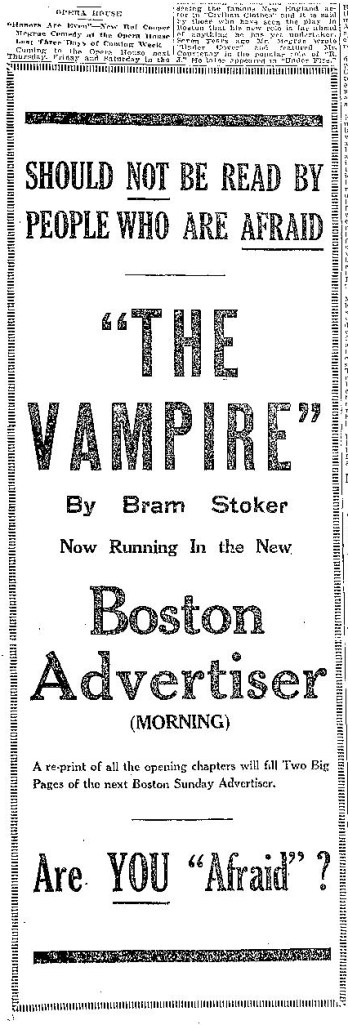
“A Dracula of the Hills” (1923) by Amy Lowell

Roger Sherman Hoar, writing as Ralph Milne Farley, published “Another Dracula?” in the September and October issues of Weird Tales. Long forgotten, the story was eventually republished in the anthology Shades of Dracula (1982), alongside various rare works by Stoker. According to editor Peter Haining, the genesis for this story actually came from Stoker himself:

Among some enthusiasts of Bram Stoker’s works there has been a persistent rumour for years that it was in his mind to bring Dracula back to life in a new story, but in America this time, rather than Europe. The rumours originate from that last trip to America and a conversation Stoker had while the company was in Boston. In the first week of December 1903, Irving was appearing at the Tremont Theatre in Boston in The Bells and, as was customary, a number of the students from nearby Harvard University were employed for ‘walk-on’ parts. Among these was a 17-year-old Freshman named Roger Sherman Hoar.

Apart from his love of the theatre which had caused him to apply for a part in The Bells, Roger was a keen reader of horror fiction and had not long before been absolutely mesmerised by Dracula. As he knew the author always travelled with Irving, he hoped that during the couse of the engagement he might meet Stoker and have a chance to talk to him about the book. Stoker, for his part, liked mingling with the students as he tells us in his biography of Sir Henry Irving, and although he makes no specific reference to any such meeting, Roger Hoar later claimed that he talked with him on several occasions. Hoar says that he expressed his admiration for Dracula and ‘Stoker told me he planned to bring Dracula over to America in another story.’ In the years which followed, the young enthusiast waited unavailingly for the sequel he felt sure would follow. On hearing of Stoker’s death in 1913, he realised sadly that the story would now never be written.

Peter Haining, Shades of Dracula (1982), 134-135

This is, as near as I have been able to determine, a complete hoax on Haining’s part. Bram Stoker did accompany Sir Henry Irving and company to Boston in December 1903 for their U.S. tour, and they did perform “The Bells” with students from Harvard—newspaper accounts agree to the dates, and Stoker himself gives the details:

That night the Tremont Theatre in Boston, where we were playing, saw an occasion unique to the place, though not to the actor. The University had proclaimed a “Harvard Night,” and the house was packed with College men, from President to jib. At the end of the performance—Nance Oldfield and The Bells—the students presented to Irving a gold medal commemorative of the occasion.

I may perhaps, before leaving the subject of Harvard University, mention a somewhat startling circumstance. It had become a custom during our visit to Boston for a lot of Harvard students to act as “supers” in our plays.

Bram Stoker, Personal Reminiscences of Sir Henry Irving

Likewise, we can confirm from yearbooks that Roger Sherman Hoar (1887-1963) attended Harvard University in Boston. However, Hoar attended Harvard in 1905, graduating in 1909; in 1903, a 16-year-old Hoar was still a student at the Philip Exeter Academy in New Hampshire. Haining does not specify where he got the data for this anecdote—which appears nowhere else before this—and considering that Hoar died nearly twenty years before it saw print, readers might be suspicious as to how Haining got this information.

Unfortunately, there are several such issues with Shades of Dracula.

For example, Haining claimed that “Walpurgis Night” (a retitled version of “Dracula’s Guest”) in the book is reprinted from the May 1914 issue of The Story Teller, but that story did not appear in that issue under that or any other title. “Dracula’s Guest” did appear under the title “Walpurgisnacht” in Ghosts Four (1978), which may have given Haining the idea. Haining also claimed in Shades of Dracula that “In the Valley of the Shadow,” which he took from The Grand Magazine June 1907 is by Stoker, but that story was uncredited in its original publication and there is no evidence Stoker wrote it. Another story, “The Seer,” was definitely written by Stoker, but Haining did not find it in The London Magazine November 1901 as he claimed, but excerpted it from Stoker’s novel The Mystery of the Sea (1902). Stoker’s “At Last” was first published in Snowbound: The Record of a Theatrical Touring Party (1908), not in Collier’s Magazine 1904 as Haining claimed. “Lord Castleton Explains” is an excerpt from The Fate of Fenella (1892), not Cassell’s Magazine 1892 as Haining claimed.

Unfortunately, Haining had a bad habit of falsifying citations, histories, and anecdotes. See Another Haining Fraud for more examples; BramStoker.org has also cataloged several of his incorrect citations. While David J. Skal treats the anecdote somewhat credulously in his Stoker biography Something in the Blood 362-363, given the inconsistencies in Haining’s anecdote about Hoar meeting Stoker and what is known of Hoar’s academic career, and Haining’s own propensity for falsifying evidence, the anecdote should probably be taken as a deliberate hoax. A good pretext, perhaps, for including “Another Dracula?” into a collection of uncollected Stoker stories. It seems likely that Roger Sherman Hoar was inspired to bring Dracula-esque vampires to the United States on his own, without any more direct prompting from Bram Stoker than reading Dracula itself.

Of course, the Americas already had their own vampires—if you knew where to look.

The Black Vampyre: A Legend of St. Domingo (1819) beat Stoker’s novel to the New World by about eighty years. The New England Vampire Panic during the late 18th and 19th centuries was still making the news while Stoker was composing Dracula—among his notes for the novel is a newspaper article on the subject (“Vampires in New England,” The New York World, 2 Feb 1896, rpt. Bram Stoker’s Notes for Dracula: A Facsimile Edition 186-193.) The New England Vampire Panic laid the foundation for vampire tales inspired by local traditions, which include H. P. Lovecraft’s “The Shunned House” (1924) and Amy Lowell’s “A Dracula of the Hills” (1923).

You might be hard-pressed to find two writers as disparate in attitude as Lowell and Lovecraft who nevertheless tackle some of the same material, each inspired by local New England folklore, each expressing themselves in their own way. Lovecraft’s attitudes regarding Lowell are well-documented, and, perhaps weirdly enough, are intimately bound up with his attitudes regarding poetry in free verse (i.e. poetry that does not conform to a particular rhyme or meter).

In the July 1915 issue of his amateur journal The Conservative, H. P. Lovecraft launched attacks on two fronts: an antisemitic reproof of the journal of In A Minor Key by Charles W. Isaacson (“In A Major Key”) and a diatribe against vers libre (“Metrical Regularity”). The two were not entirely separate, as part of Lovecraft’s argument against Isaacson was the latter’s praise of Walt Whitman, who has been called the father of free verse. So when “Concerning the Conservative” (1915) by Charles D. Isaacson was published in response, it involved a response to both Lovecraft’s racism and his disparagement of Whitman. James F. Morton, who also responded to Lovecraft’s articles in The Conservative, wrote:

Even among the Imagists, erratic though an Ezra Pound or an Amy Lowell may be in spots, there is wholesome work of its own kind, which has a legitimate place in the literary field. […] Mr. Lovecraft’s conservatism, in this as in some other matters, smacks not so much of loyalty to present accepted truths or even still current habits of thought, as of reversion to the outgrown partial and restricted views of a past age. It is in large measure reaction, rather than conservatism.

 James F. Morton, “‘Conservatism’ Gone Mad,” Letters to James F. Morton 408

Imagism was a Modernist movement in Anglo-American poetry that rejected the romantic poetry of the Victorian and Georgian periods and preferred sharp language, clear images, experimentation with different forms, and free verse. Early and leading proponents included Ezra Pound (Des Imagistes: An Anthology, 1914) and Amy Lowell (Some Imagist Poets: An Anthology, 1915).

Lovecraft ultimately decided not to make further prejudiced statements against Isaacson; when it came to free verse and the Imagists, he was a bit more tenacious:

I have lately been amusing myself by a perusal of some of the “Imagist” nonsense of the day. As a species of pathological phenomena it is interesting. The authors are evidently of approximately harmless characteristics, since so far as I know, they are all at large; but their work indicates that most of them are dangerously near the asylum gates—uncomfortable close to the padded cell. There is absolutely no artistic principle in their effusions; ugliness replaces beauty, & chaos supplies the vacant chair of sense. Some of the stuff, though, would mean something if neatly arranged and read as prose. Of the major portion no criticism is necessary, or even possible. It is the product of hopelessly decayed taste, & arouses a feeling of sympathetic sadness, rather than of mere contempt. Since “Imagism” has no relation at all to poesy, I think no lover of the Muse need entertain apprehension for his art from this quarter.

H. P. Lovecraft to Rheinhart Kleiner, 23 Aug 1916, Letters to Rheinhart Kleiner & Others 58

At this rather early point in Lovecraft’s amateur journalism career, he was very much a “metrical mechanic,” much more fixed on the correctness of form and meter than content, and his preferred style was a pastiche of the older forms of Romantic poetry that the Modernists were trying to get away from. For an individual who was clinging rather stubbornly to a swiftly fading past, the Imagists’ complete break from such styles of poetry was akin to iconoclasm. As Morton perceptively pointed out, Lovecraft was being a reactionary.

Part of the problem was no doubt that the Modernists were not just breaking the molds of poetry, they also tended to be political progressives who advocated positions that Lovecraft was opposed to. So for instance, when Albert Mordell wrote an essay on Amy Lowell for the Poetry Review of America vol. 1, no. 4 (August 1916), Mordell analyzed her anti-war poem “Patterns,” inspired by the war in Europe. For Lovecraft, who was not a pacifist (see “The Peace Advocate” (1917) by Elizabeth Berkeley), this was heaping heretical philosophy onto antithetical aesthetics:

I am not inform’d just who was the first pseudo-poet to succumb to Whitman’s malign influence; certain it is, that I never heard “free verse” mentioned seriously till an exceedingly recent date. Now, however, it seems the recognised avenue of expression for persons who cannot think clearly, or who are afflicted with concomitant symptoms of radicalism and imbecility in other forms. That the vers librists are preeminently coarse in their ideas, is what one might expect as a result of their radical tendencies. A radical of any sort is by nature an iconoclast, and is never satisfied till he breaks some established canon of reason or propriety. Democracy of thought, with its accompanying rejection of the refined and the beautiful, insidiously leads on to a glorification of the gross and the physical; for the physical body is about all that the boor and the poet have in common. Mr. Mo bids these eccentrics keep off Parnassus and build a mount of their own, but methinks they have their Pierian grove already well established on some farmer’s dunghill in Boetia! From the dissipated “Bohemian” swine of Washington Square in New York, to the more scholarly Amy Lowell, they are all of the same clay. Albert Mordell, a critic in THE POETRY REVIEW, refers to the “poem” of Mrs. Lowell’s wherein grossness hath no small part, saying, ‘that if she had written nothing else, this poem would have been sufficient to immortalize her!”

H. P. Lovecraft to the Kleikomolo, October 1916, Miscellaneous Letters 22

By this point, Lowell had edited another anthology of Imagist verse (Some Imagist Poets: An Annual Anthology, 1916), and was something of the face of Imagism in the United States, at least as far as Lovecraft was concerned. When someone suggested that literary types should unionize, part of Lovecraft’s response was:

The place of literary radicals and imagist “poets” in this Utopian scheme demands grave consideration. Since the trade union movement requires at least an elementary amount of intelligence in its adherents, and is applied mainly to SKILLED labour, these deserving iconoclasts of the Amy Lowell school would seem to be left, Othello-like, without an occupation.

H. P. Lovecraft, “The Proposed Authors’ Union” in The Conservative Oct 1916, Collected Essays 2.17

Tongue firmly in cheek. However, Lovecraft was much more serious when he penned an essay on “The Vers Libre Epidemic”:

The second or wholly erratic school of free poets is that represented by Amy Lowell at her worst; a motley horde of hysterical and half-witted rhapsodists whose basic principle is the recording of their momentary moods and psychopathic phenomena in whatever amorphous and meaningless phrases may come to their tongues or pens at the moment of inspirational (or epileptic) seizure. These pitiful creatures are naturally subdivided into various types and schools, each professing certain “artistic” principles based on the analogy of poetic thought to other aesthetic sources such as form, sound, motion, and colour; but they are fundamentally similar in their utter want of a sense of proportion and of proportionate values. Their complete rejection of the intellectual (as element which they cannot possess to any great extent) is their undoing. Each writes down the sounds or symbols of sounds which drift through his head without the slightest care or knowledge that they may be understood by any other head. The type of impression they receive and record is abnormal, and cannot be transmitted to persons of normal psychology; wherefore there is no true art or even the rudiments of artistic impulse in their effusions. These radicals are animated by mental or emotional processes other than poetic. They are not in any sense poets, and their work, being wholly alien to poetry, cannot be cited as an indication of poetical decadence. It is rather a type of intellectual and aesthetic decadence of which vers libre is only one manifestation. It is the decadence which produces “futurist” music and “cubist” painting and sculpture.

H. P. Lovecraft, “The Vers Libre Epidemic” in The Conservative Jan 1917, Collected Essays 2.20

It isn’t entirely clear what free verse Lovecraft was reading; most of it seems to have come to him either through amateur journalism or what poetry journals he had seen. There is some evidence that Lovecraft may have at least skimmed through the Imagist anthologies, perhaps even Lowell’s own third and final Some Imagist Poets anthology when it was published in 1917.

As I think I have intimated before, I do not read the new “poetry”, save when I skim over a typical collection by Amy Lowell, Ezra Pound, or some equally notorious dunce, for the purpose of obtaining material for satire. There is nothing in this radicalism—it is all so arrantly nonsensical & foolishly futile! What do the poor fools want, anyway? I wish they’d might all be chloroform’d & put out of their misery. The other day Campbell sent me a copy of The Seven Arts, a magazine almost as radical in its way as the late but little lamented Bruno’s Weekly. It opens with a treasonable anti-war essay whose classic, fluent prose contains not a single sound idea or tenable theory; continues with a silly piece of Sinn Fein raving by the Irish author Padraic Colum; has a flagrantly disloyal editorial in vers libre by James Oppehnheim—an editorial whose outre verbiage at first gives nomeaning whatever, but which boils down to a plea for a pacifist revolution when deciphered into respectable English; & contains in addition as choice a mess of soft-headed literary garbage as one might wish to behold. And what is it all for? Probably not even the editor & contributors know—yet the sport of juggling with words, ideas, & phantasies probably pleases them just as such frivolous things as games, sports, & vaudeville sometimes please us. But they carry their nonsense too far, & take it so absurdly seriously! Poor creatures!

H. P. lovecraft to Rheinhart Kleiner, 24 Sep 1917, Letters to Rheinhart Kleiner & Others 89

Despite Lovecraft’s antipathy toward free verse, many poetry editors came to accept it as a valid creative expression, publishing such verse in newspapers, magazines, collections, and anthologies. One such editor was William Stanley Braithwaite, which became a particular bone of contention when Lovecraft found out that Braithwaite was Black:

So this—this—is the fellow who hath held the destinies of nascent Miltons in his sooty hand; this is the sage who hath set the seal of his approval on vers libre & amylowellism—a miserable mulatto!

H. P. Lovecraft to Rheinhart Kleiner, 5 May 1918, Letters to Rheinhart Kleiner & Others 112

Time and experience somewhat mellowed Lovecraft’s attitudes towards free verse and Amy Lowell. While the 1922 publication of T. S. Eliot’s “The Waste Land” prompted Lovecraft to write his own satire in free verse, “Waste Paper.” For all that Lovecraft remained a lifelong devotee of traditional meters and rhyme schemes, continued interaction with poets that used free verse such as Hart Crane and Edith Miniter seems to have led him to a begrudging acceptance of the practice. When Amy Lowell died 12 May 1925, Lovecraft wrote:

When I say that Miſs Lowell wrote poetry, I refer only to the essential contents—the isolated images which prove her to have seen the world transfigured with poetic glamour. I do not mean to say that the compleat results are to be judg’d as poems in any finish’d sense—but merely that there is poetical vision in the broken & rhythmical prose & disconnected pictorial presentations which she gave us. She is also, of course, the author of much genuine poetry in the most perfect metres—sonnets & the like—which most have forgotten because of the greater publicity attending her eccentric emanations.

H. P. Lovecraft to Lillian D. Clark, 8 Aug 1925, Letters to Family and Family Friends 1.340

Later, in what might be his final comment on Amy Lowell and her poetry, Lovecraft offered what might be a philosophical perspective on her and her work:

The individual quality is not a matter of theme, but is simply the manner in which one reponds to any theme that one does respond to. The history of poetry is full of cases of writers who have lived from one age into another & changed their styles accordingly. Byron, for instance, first wrote in the Georgian manner & then wholly recast himself in the mould of the romantic revival—as did many another poet who lived int he early XIX century. And in a later age, Amy Lowell discarded the late XIX century tradition for the imaginistic thought of the early XX century. In neither case was the poet’s essential personality changed. They merely continued to express in their own respective ways the impressions which impinged upon them. The change was not in them, but in the impinging impressions.

H. P. Lovecraft to Elizabeth Toldridge, Jan 1930, Letters to Elizabeth Toldridge & Anne Tillery Renshaw 123

We do not know if H. P. Lovecraft ever read “A Dracula of the Hills.” The poem in free verse was first published in The Century magazine vol. 106, no. 2, July 1923; and reprinted in Lowell’s posthumous collection East Wind (1926), neither of which is mentioned in Lovecraft’s letters or essays. Yet it is clear that Lowell and Lovecraft were drawing on a similar well of New England folklore. Compare:

She died that night.
I mind it well, ’cause th’ whippoorwills’d be’n so loud th’ night before;
When I’d heerd ‘mdash I’d thought Florella’s time was come.

Amy Lowell, “A Dracula of the Hills” (1923)

But speech gave place to gasps again, and Lavinia screamed at the way the whippoorwills followed the change. It was the same for more than an hour, when the final throaty rattle came. Dr. Houghton drew shrunken lids over the glazing grey eyes as the tumult of birds faded imperceptibly to silence. Lavinia sobbed, but Wilbur only chuckled whilst the hill noises rumbled faintly.

“They didn’t git him,” he muttered in his heavy bass voice.

H. P. Lovecraft, “The Dunwich Horror” (1928)

The vernacular dialect both authors try to capture is so similar, that if Lowell’s hills aren’t in Lovecraft country, they’re not far off. Both authors too were writing with a conscious eye toward other contemporary works; Lowell didn’t write “A Vampire of the Hills,” but used a reference to Bram Stoker’s Dracula to shape the readers’ preconceptions, much as Lovecraft in “The Dunwich Horror” would inject the line: “Great God, what simpletons! Shew them Arthur Machen’s Great God Pan and they’ll think it a common Dunwich scandal![“] In both cases, Lovecraft and Lowell were writing to an audience that would presumably get the reference they were making and would pick up on the clues.

They also both eschewed Stoker’s novel. There is no stake to be driven into a heart, no box on hallowed earth to sleep in, for Lovecraft and Lowell’s vampires. Lovecraft was inspired at least in part by an account in Charles M. Skinner’s Myths and Legends of Our Own Land (1896), and the case of Mercy Brown in 1892; Lowell’s inspiration is a little more obscure:

In a letter to Glenn Frank, editor of Century Magazine, Lowell wrote in 1921: “THe last case of digging up a woman to prevent her dead self from killing the other members of her family occurred in a small village in Vermont in the ’80s. Doesn’t it seem extraordinary?” She said her source was the American Folk-Lore Journal.

Michael E. Bell, Food for the Dead: On the Trail of New England’s Vampires 196

Bell couldn’t locate Lowell’s exact source (and she may have been mistaken), but he made a cogent observation:

Perhaps Lowell’s choice of the specific “Dracula” instead of the generic “vampire” for her poem’s title is telling. The term “vampire” did not appear in the Journal of American Folklore articles nor in her letter to Glenn Frank in which she comments on the “extraordinary” custom. Did she make the connection herself? Or had she used other sources of the New England superstition? Her choice of the literary Dracula suggests that Lowell assumed her readers would know the novel and be able to link Florella with the Count. By the early 1920s, when Lowell had completed the poem, Dracula was well on the road to total domination of the vampire genre; the terms “Dracula” and “vampire” had become synonymous. How did this occur?

The New England Vampire tradition, as incorporated into the works of Lovecraft and Lowell, has had no discernible effect on the popular imagination. Indeed, even the impact of the European folk vampire has been less formidable than we might believe. Although the vampire was a genuine figure in the folk traditions of Europe, and remained so in isolated areas of Eastern Europe well into the twentieth century, in the urban centers of Western and Northern Europe the vampire was known principally through written communication. And writing, unlike the malleable oral tradition, freezes texts and images.

Michael E. Bell, Food for the Dead: On the Trail of New England’s Vampires 199-200

Both Lovecraft and Lowell were writing ~23-24 years Anno Dracula; they were not setting down oral folklore traditions exactly as they heard them. Even focused as they were on the native New England revenant traditions, they scribbled in the shadow of Stoker’s novel, whose influence would only grow as the authorized plays in 1924 and 1927 gave way to the first authorized film adaptation in 1931. Dracula had already come to the Americas, and Lovecraft and Lowell’s recasting of local vampire tales can be read as a response to that.

Lovecraft wrote, “Some of the stuff, though, would mean something if neatly arranged and read as prose.” So too, there are vivid images in “A Dracula of the Hills” that even Lovecraft may have savored. When she wrote:

Florella’s body was all gone to dust,
Though ‘twarn’t much more ‘n a year she be’n buried,
But her heart was as fresh as a livin’ person’s.
Father said it glittered like a garent when they took the lid off the coffin.
It was so ‘ive, it seemed to beat almost.
Father said a light come form it so strong it made shadows
Much heavier than the lantern shadows an’ runnin’ in a diff’rent direction.

Amy Lowell, “A Dracula of the Hills” (1923)

In 1947, August Derleth edited and Arkham House published Dark of the Moon: Poems of Fantasy and the Macabre. Derleth claimed it was the first collection of verse in the genre since Margaret Widdemer’s The Haunted Hour (1920), and it would be the first of several poetry collections by Arkham House focusing on the weird and fantastic. Here at long last, Lovecraft and Lowell shared space between hard covers; “A Dracula of the Hills” reprinted alongside “The Fungi from Yuggoth.” Nor were they sorry company, for all that their technique and formulation differed.

“A Dracula of the Hills” can be read for free on the Internet Archive and Google Books.


Bobby Derie is the author of Weird Talers: Essays on Robert E. Howard and Others and Sex and the Cthulhu Mythos.

Deep Cuts in a Lovecraftian Vein uses Amazon Associate links. As an Amazon Associate I earn from qualifying purchases.
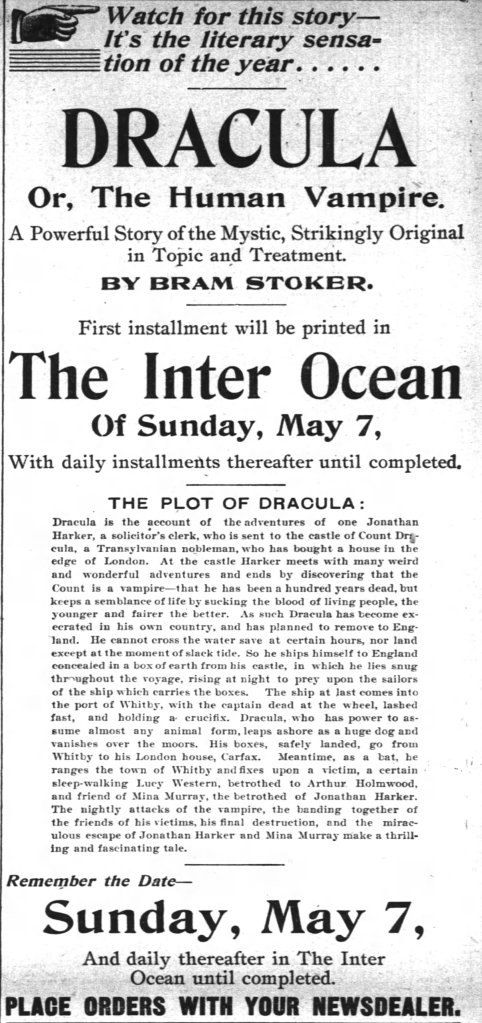
“Bat’s Belfry” (1926) by August Derleth

Vampirism is still a force to cope with; it has been in flower since Bram Stoker’s Dracula.

August Derleth, “The Weird Tale in English Since 1890” (1930) in The Ghost #3 (1945) 6

Before August Derleth pastiched H. P. Lovecraft, and coined the term “Cthulhu Mythos”; before Derleth pastiched Sherlock Holmes, and created the detective Solar Pons; before he published anything else—Derleth pastiched Bram Stoker and Dracula with “Bat’s Belfry,” his first professional sale.

Dracula in the mid-1920s was not the cultural sensation that it is today. In 1924, Hamilton Deane wrote the first authorized dramatic adaptation of Stoker’s novel. In 1927 John L. Balderston would revise the play for Broadway. American audiences thrilled to the stage production, starring Hungarian actor Bela Lugosi in the title role with a characteristic opera cape—and in 1931, director Tod Browning featured Lugosi and other actors from the production in the first Hollywood film adaptation. With each step, Dracula’s exposure increased, and the image and reputation of the Count expanded by magnitudes.

In 1925, however, Dracula was known as a modestly successful horror story, the best and most popular of Bram Stoker’s novels, still in print 13 years after his death. While readers of Weird Tales could be sure to have at least heard of the book, even if they hadn’t read it, the vampire count had not yet hit icon status. Yet a young August Derleth was inspired by Dracula to write a story—or, perhaps more accurately, to market a story he had already written:

A long time ago, it seems (the year was 1925), when I had written forty stories, none of which had sold, I thought it time to take stock I looked over everything I had written—most of it pretty bad—and selected one story which I thought might be sold. The result was felicitous.

August Derleth, foreword to Evening in Spring (1945 edition)

It isn’t exactly clear when Derleth wrote this story, and various details get muddled in the telling and retelling. Various sources claim he began writing at 13, and that “Bat’s Belfry” was written when he was 13, 14, or 15. In his personal publication record, Derleth wrote:

Later, Derleth would write:

I began at thirteen, and I sold at fifteen. The selling of my first story involved a direct challenge to the ego. I had written forty stories before I sold one, and that I should then have sold one ways purely an accident of determination. I had fixed upon the figure forty, resolving that when I had written forty stories without selling one, I would re-examine my determination to become a writer, because I had read somewhere that Charles Dickens had taken his first book to forty publishers before it was accepted. By that accident of reading, I fixed upon forty, and when I had written forty, most of them weird stories which had been duly rejected by Farnsworth Wright of Weird Tales, I looked them all over, one after the other, and endured my own private soul-struggled. On one or two rejection slips Wright had penned a brief, encouraging note—”Try us again!” or “Sorry. Try once more.”—and I read the stories thus rejected with especial interest. They did not seem to me to merit re-submission, but my eighteenth story did. I felt that it was honestly as good as many of the things which Wright had been publishing, and, if it was not up to acceptable status, it could be brought up to that level. So, firmly but politely, I resubmitted the story, stating that I felt it could be made acceptable, and in response received a most agreeable letter from Wright suggesting certain changes, calling my attention to my error in the matter of the Cockney dialect, with the felicitous result that the story, revised, was ultimately sold.

August Derleth, Writing Fiction 164-165

This version of the story, straight from Derleth, is probably the most detailed and accurate version—with a few caveats. The original title of the story wasn’t even “Bat’s Belfry,” and there was much more involved in the revision than removing a Cockney accent. Fortunately, we can track the development of the story because Derleth saved Wright’s rejection letter:

Dear Mr. Derleth:-

I have again given a careful reading to THE LOCKED BOOK. The workmanship is very uneven, almost as if you had written part of it under the fever of an urgent inspiration, and the rest merely as a matter of routine hack-work. But—I think it can be made acceptable for WEIRD TALES. The last half of the story is well handled, except the ending. You have adduced no reason why Sir Harry Barclay should wish to summon Satan, when all he wants to do is the pious deed of staking the bodies of the vampires. You have made no connection between the skeletons and the final scene where Satan appears. In other words, the whole story is left “up in the air”—you have braided a rope, but left the ends out without bringing them together in one cord. And the beginning contains altogether too much of the grocer’s conversation—I think the whole scene with the grocer is irrelevant and merely interrupts the flow of the narrative. All that the grocer incident does for the story is to establish the fact of the disappearances of four girls, and the fact that the last Baronet Lohrville was a devil incarnate. This fact can be much more naturally established than by interrupting your story to drag in a dialect-speaking grocer for two pages of conversation. Your narrative first takes on vigor and movement on page 7, where you begin: “Three days ago Mortimer came to me,” etc., and it keeps up nearly to the end, where it sags by reason that nothing is decided, and that the ending is no true denouement at all, for it has very little connection with the facts of the narrative itself, neither explaining them nor being a development or working-out or consequence of the facts of the story itself. What possible connection, the readers would think, exists between the vampire-talk that has gone before, the finding of the skeletons, the extinguishing of the lights, the bat-wings in the dark—what possible connection between these things and the ending of the story, the appearance of Satan? I fear the reader would be disappointed. The story is very well handled in part, yet awkwardly treated in other parts.

Farnsworth Wright to August Derleth, 24 Sep 1925, MSS. Wisconsin Historical Society.

At the end of its first year in business, Weird Tales was in a bad way; a company shake-up in 1924 ousted then-editor Edwin Baird, and Farnsworth Wright (formerly first reader for the magazine, who would sift through the slush pile of submissions for stories worth publishing) ended up in the editorial chair, and after the owner J. C. Henneberger was forced out of management, Wright had the creative freedom to run Weird Tales his own way. This still involved, at first, running stories bought under Baird—but as they went through the issues, Wright would be in the market for new material. Enter August Derleth.

Of immediate notice in this letter is that this isn’t the first time Derleth has submitted this story; it would become Derleth’s practice to submit and re-submit stories until they sold, and that so many of his works did sell to Weird Tales shows the value of his persistence (and Wright’s need for material). As Derleth would later tell it:

Since that time I learned fairly accurately to judge when stories were being rejected because there were a fair number of stories on hand, and the editor could afford to be more selective; and in every such case, without exception, I simply waited several months, retyped the manuscript, and submitted the story in question again, and in every case it was duly accepted on some resubmission, ranging from the first resubmission to the ninth, an opening having appeared for it and the story being good enough for filler if not feature. Something like fifty stories have been sold in this fashion, though I do not recommend it as a steady practice, and cite it only as an example of a) ego, b) a certain ability to judge from the editorial point of view as well as from that of the writer.

August Derleth, Writing Fiction 165

Derleth’s strategy worked in part because of Wright’s extreme conscientiousness as an editor. Wright’s willingness to work with a new potential writer and give detailed advice and criticism on how to improve a story was not limited to Derleth; his encouragement extended to many new writers trying their luck with Weird Tales. That was one of Wright’s more endearing characteristics, well-remembered by many writers who might otherwise just receive a pre-printed rejection slip.

For his part, Derleth seems to have taken Wright’s criticism to heart, for in the published version of the story there is no lengthy dialogue sequence. The grocer’s tale is rendered down to a single long paragraph. Later in life, Derleth would recall:

The danger in distant settings lies in inadequate knowledge. In the original version of my first published short story (Bat’s Belfry, Weird Tales, May 1926), which was set in the country down from London (which, for a beginner of fifteen, seems in retrospect to be the height of self-assurance), I introduced a pub-keeper who spoke in Cockney dialect. Possibly due to saturation reading of Conan Doyle, Sax Rohmer, Edgar Wallace, et al, I had somehow conceived the impression that most of the lower classes in England habitually dropped their h’s from many words and added them to many others where they did not belong. The late Farnsworth Wright, then editor of Weird Tales, pointed out that the Cockney dialect was limited to a bounded area within the city of London, and that it was not likely that such a speech pattern would make its appearance in the down country, or, if it did, that it would last for any length of time, since all dialects are naturally subject to change under the influence of the prevailing speech patterns. Had I checked on this simple fact before submitting the story, I would not have made an error, which now necessitated revision; but I made the mistake of taking the dialect more or less for granted—I ascribed it to a class of people rather than to a district; a little unbiased interpretation would have enlightened me even without reference to any source of information, for dialects are never a matter of class, but always of region.

August Derleth, Writing Fiction 64-65

The story was revised and resubmitted to Wright, who responded back:

Dear Mr. Derleth:-

Almost! And with a little touching up of the ending, THE LOCKED BOOK will be ready for the pages of WEIRD TALES. (And please number your pages; to avoid confusion in case the pages get misplaced).

The story is vastly improved. You are on the right track in the present ending, but you have fallen down badly just the same. For in a story of this kind, does the reader want to enjoy the spectacle of the appearance of the vampires before Barclay, or does he want ’em to appear and then finis? You know the answer. You have deliberately turned from the high spot in your story as if you had suddenly become tired of writing. You have not squeezed out all the horror you could from the situation; in fact, you have hardly squeezed out any. Drain it dry (the situation, I mean). Touch up the ending, let us see the gloating eyes of the vampires as they move on Barclay—let us see Barclay immovable under the hypnotic, glittering, evil gaze of the old Baron, and the sinuous, gliding movements of the four women as their red lips part in a smile and they gently caress those lips with a soft lapping motion of their tongues—while Barclay continues to write—let him fight the spell, let him drop his eyes and start to his feet—let the most beautiful of the vampires come before him, arms outstretch or all for at once, perhaps—I am resisting with all the power of my will, he cries—the rememberance of that parted mouth, those crimson lips remains—she is still here, in front of me, as I write; I will take one more look at her face, and then pray—I look—her face approaches mine and—My God! I no longer want to pray!—a sharp stinging sensation at my throat—my God—it is—

Some such ending. Write it yourself. You don’t need to rewrite what has gone before, hwoever.

Farnsworth Wright to August Derleth, 6 Oct 1925, MSS. Wisconsin Historical Society.

For fans who have rolled their eyes a little at the protagonist continuing to write as the horror takes them, as in H. P. Lovecraft’s “Dagon” and “The Diary of Alonzo Typer,” there is a certain irony in Wright actually suggesting such an ending to the impressionable young Derleth. For his part, Derleth took Wright’s advice on how to write the ending rather literally, presumably to give the editor exactly what he wanted:

I can not tolerate their virulence . . . . I endeavored to rise but I could not do so. . . . I am no longer master of my own will! The vampires are leering demoniacally at me. . . . I am doomed to die . . . and yet to live forever in the ranks of the Undead. Their faces are approaching closer to mine and soon I shall sink into oblivion . . . but anything is better than this . . . to see the malignant Undead around me . . . A sharp stinging sensation in my throat. . . . My God! . . . . it is—

August Derleth, “Bat’s Belfry” in Weird Tales Mar 1926

Still, this final revision did the trick:

Dear Mr. Derleth:-

Your story, BAT’S BELFRY (I prefer your new title), is acceptable for publication in WEIRD TALES, in its new form. Our minimumr ate of half a cent a word, on publication, is unfortunately our standard rate at present except in very exceptional circumstances, and we must keep this rate until we clear off the debts left us by the old company. As your story measures about 3600 words, this will amount to $18 on publication for BAT’S BELFRY. Is this satisfactory?

Farnsworth Wright to August Derleth, 15 Oct 1925, MSS. Wisconsin Historical Society.

It apparently was, and Derleth had his first professional sale. The story would be published in the March 1926 issue of Weird Tales.

One of the interesting things about “Bat’s Belfry” is its format: the first part consists of a letter, there is a brief narrative interlude, and then the rest of the story consists of excerpts from Barclay’s diary. Stoker’s use of the epistolary novel format was something of an archaic device when Dracula appeared in 1897, and was prone to misuse by inexperienced writers. Wright noted this in a follow-up letter when Derleth apparently tried to follow the success of “Bat’s Belfry” with another story in a similar format:

Dear Mr. Derleth:-

I am returning THE PIECE OF PARCHMENT. The diary form is particularly hard to use in a story, altho many of our writers, under the influence of Bram Stoker’s “DRACULA,” have tried to use it, and sometimes they succeed. But it ordinarily is the surest device for killing reader-interest.

Farnsworth Wright to August Derleth, 9 Jan 1936, MSS. Wisconsin Historical Society.

Derleth would take this advice to heart too, recapitulating this advice to others:

Very probably the success of Bram Stoker’s Dracula inspired a flood of similarly conceived stories written in the form of a diary, but on the whole, this form is very difficult to do well. That is because the writer is always caught between the necessity of getting on with his story and of keeping a semblance of verisimilitude about the entries as they are likely to be made.

August Derleth, Writing Fiction 126

More interesting perhaps is that for those familiar with Derleth’s later creative efforts, “Bat’s Belfry” has many hallmarks of his later Cthulhu Mythos fiction. Aside from the obvious characteristics of pastiche, where Derleth apes or recaps some of the key imagery or elements from Stoker’s original (compare the vampire women seducing Harker and Barclay), there is the emphasis on the library of occult books which foreshadow the development of a five-foot shelf of eldritch tomes in later Mythos fiction. This includes a very Derlethian, weirdly self-referential element when the protagonist, digging through an old trunk, comes across an early edition of Dracula! This is strongly reminiscent of how in some of his later Mythos fiction such as “Beyond the Threshold” (WT Sep 1941), Derleth would place copies of Arkham House books such as The Outsider and Others next to the Necronomicon. Indeed, the Book of Thoth in this story serves much the same function as the Necronomicon might in later Mythos fiction, being almost a prototype for the Necromonicon-as-grimoire trope.

To be frank, “Bat’s Belfry” is far from Derleth’s best work, borderline juvenalia. While it may not be hack-work, it is plainly a potboiler, and one which Wright himself seems to have partially dictated. Derleth skews from Stoker in having Barclay attempt to use actual magic against the vampires (Leon, a Catholic like Derleth himself, fares a bit better), but the diary format of the final encounter renders is a bit ridiculous. Nevertheless, the story had its attractions for editors. While it didn’t place among the best stories in the issue, it was selected for reprint in the British More Not at Night anthology by Christine Campbell Thomson. This was the first of what would be many reprints in various horror and vampire anthologies over the decades.

As his first publication, “Bat’s Belfry” became part of Derleth’s own personal legend, and on the twentieth anniversary of his becoming a writer, his people threw a party to celebrate:

The Capital Times 28 Mar 1946

Another article suggests 130 guests attended Derleth’s 20th anniversary of becoming a writer (The Capital Times 4 Apr 1946). Yet that is not the end of “Bat’s Belfry.”

In the 1970s, Marvel Comics circumvented the restrictive Comics Code Authority, which effectively prevented them from publishing adult-oriented comics, particularly horror and the more lurid and grisly sword & sorcery, by publishing full-sized comic magazines, initially under their Curtis imprint. One of these efforts was the black-and-white Vampire Tales, and in the third issue (February 1974), they published an adaptation of “Bat’s Belfry,” with writing by Don Macgregor and pencils and inks by Vicente Ibáñez.

The best that can be said of this adaptation is that Macgregor and Ibáñez highlight the most compelling and evocative images in Derleth’s story, emphasizing the Gothic atmosphere, while preserving much of Derleth’s prose. Ibáñez’ layouts in particular sometimes break from a strict grid format, to give the suggestion of action in a story that has little of it. The encounter with the grocer, for example, is no longer a paragraph in a diary, but is now a sequence where a burly man butchers a carcass and splashes bystanders with blood as he warns them about the old baron.

Because the comic adaptation was set well after the success of the 1927 play and the 1931 film, the Baron wears an opera cape and has slicked-back hair, very much in the Lugosi mold, while all of the vampires have prominent fangs—an element that first appeared in Turkish and Mexican film vampires, but gained wide popularity in the United States from the Hammer Dracula films starring Christopher Lee that began in 1958. It is characteristic of adaptions to update older bloodsuckers to fit the expectations of a contemporary audience.

H. P. Lovecraft never evinced an opinion on “Bat’s Belfry” in any surviving letter; indeed, Derleth did not ask Wright for Lovecraft’s address until after the story had been accepted. However, there is reason to believe that Lovecraft did note Derleth’s first publication in Weird Tales. In The Village Green (192?) by Edith Miniter, H. P. Lovecraft was depicted in the novel as “the man with the long chin” (in reference to Lovecraft’s prognathous jaw), and in one scene she wrote:

Indeed the large man with the long chin, who had received a letter from “Bob” Davis containing the startling words: “It (The Bats in the Belfry) is splendidly written, but it exceeds the speed limit . . . . I have been some time coming to a conclusion about this story, but I didn’t want to push the matter hastily. Even now I may be wrong. . . .” took the confession in a nonchalant manner that shocked his confreres. When he tried to introduce the Elizabethan Dramatists he was drowned by outcries, “Man you don’t know your luck. An editor owning up that he may be wrong! Ye Gods and little walruses. Send him a weird one not quite as weird.[“]

Edith Miniter, The Village Green and Other Pieces 147

The title, “The Bats in the Belfry” is too close to “The Bat’s Belfry” for coincidence. Given the talk of editors, it seems likely that “Bob” Davis in this case is based on Farnsworth Wright; possibly Derleth had shared one or more of Wright’s letters ruminating on or rejecting “Bat’s Belfry.” Or perhaps Miniter garbled Lovecraft’s message. In either case, it is an odd denouement to an odd little story, that began as “The Locked Book” and ended up as “Bat’s Belfry.”

Readers interested in the story “Bat’s Belfry” can read it online.

In 2010 Marvel Comics reprinted Vampire Tales as a collected edition in three volumes; “Bat’s Belfry” can be read in the first volume, in both hardcopy and as an ebook.


Bobby Derie is the author of Weird Talers: Essays on Robert E. Howard and Others and Sex and the Cthulhu Mythos.

Deep Cuts in a Lovecraftian Vein uses Amazon Associate links. As an Amazon Associate I earn from qualifying purchases.
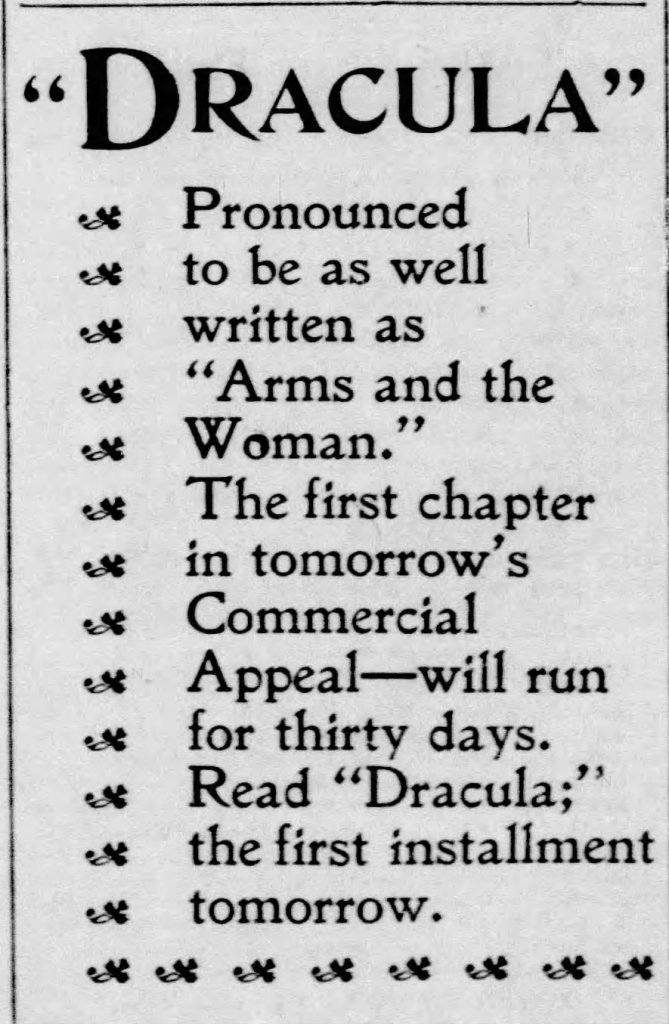
Deeper Cut: Lovecraft, Miniter, Stoker: the Dracula Revision

In The Essential Dracula (1979), Bram Stoker scholars Raymond T. McNally and Radu Florescu revealed a letter (H. P. Lovecraft to R. H. Barlow, 10 Dec 1932) that had been drawn to their attention by horror anthologist and scholar Les Daniels, where H. P. Lovecraft claimed that an old woman he knew had turned down the chance to revise Stoker’s Dracula. The letter had not been published before this. Although Lovecraft’s claim had been made in print as early as 1938, and a letter with the anecdote was published in the first volume of Lovecraft’s Selected Letters from Arkham House in 1965, this seems to be the first time the Stoker scholar community became generally aware of the claim. The authors were intrigued by the possibilities:

This is very intriguing! Lovecraft believed that someone else had written the final draft of Stoker’s book. Now that we have found Stoker’s notes, it is clear that Stoker at least did all the basic research for the book, as well as the outline of its contents. But was he capable of completing this massive re-write? If he was in the early stages of syphilis would he have been able to finish the work, or did he assign the final task to someone else?

We wrote to Professor Barton L. St. Armand of Brown University and [L.] Sprague de Camp, both the leading experts on Lovecraft, but neither could identify the “old lady.”

McNally & Florescu, The Essential Dracula 24

Without much supporting detail in Lovecraft’s letter, there was little that McNally and Florescu could do to authenticate the claim. St. Armand quotes the same letter from Lovecraft to Barlow in The Roots of Horror In the Fiction of H. P. Lovecraft (1977), two years before The Essential Dracula was published, but apparently had not found the letters identifying the potential reviser yet.

The connection between Lovecraft and Stoker, however ephemeral, and the influence this had on Lovecraft’s opinion of Stoker and his work excited some interest. While Lovecraft’s anecdote did not single-handedly invent the idea that Stoker did not write Dracula in totality, it did add fuel to the fire for those who wanted to speculate who else may have had a hand in writing the great vampire novel. Periodically Lovecraft’s claim about a Dracula revision has re-emerged in Stoker scholarship; the most extensive treatment of the story was by the late great David J. Skal in Something in the Blood (2016) 329-331.

Skal devotes several pages to the claim and cites two additional appearances of the anecdote in Lovecraft’s letters (HPL to Frank Belknap Long, Jr., 7 Oct 1923, which appeared in Selected Letters, and HPL to Donald Wandrei, 29 Jan 1927) that provide much more detail than most, as well as Lovecraft’s 1938 essay. Through these additional sources, Skal discovered that the “old lady” was noted amateur journalist Edith Miniter, and he dug into her life (his bibliography notably cites Dead Houses & Other Works by Edith Miniter), to see if there was any evidence to support the claim.

Something in the Blood zooms in on Miniter’s employment by the Boston Home Journal in January 1894 and the uncredited reviews of the Lyceum’s plays being performed in Boston at that time. Skal noted that Bram Stoker, as the business manager of the Lyceum, was also the company’s press contact and would have bought the advertising. However, Skal stops short of saying that Lovecraft’s anecdote actually happened or that any actual contact between Miniter and Stoker took place. While the idea that Stoker may have had help in drafting Dracula was intriguing—Skal addresses several theories that had been put forward about this—he obviously failed to find any convincing evidence to support Lovecraft’s claims.

Rickard Berghorn in Powers of Darkness: The Unique Edition of Dracula, traces over the same steps (and the same letters Skal quoted, as well as references in O Fortunate Floridian), and draws a hypothetical connection between the apocryphal Dracula draft and Lovecraft’s “The Rats in the Walls”:

The anecdote about Stoker’s draft apparently captured Lovecraft’s interest, and he must have asked questions of Mrs. Miniter; for example, if she could remember any differences between the draft and the finished novel. A scene like the one with the blood rite and the Count’s degenerate relatives in forgotten caves under the castle is so bizarre, original, and magnificent that Edith Miniter ought to have remembered at least that one among other scenes that might have been included in Stoker’s draft and later were deleted. (Berghorn 33)

A full response to this claim would be an essay in itself. On its face, the claim is speculative: Lovecraft never mentions Miniter or Dracula anywhere as an inspiration for the story, and no details are ever given of the draft as Miniter saw it. Even if Lovecraft wasn’t inspired by Miniter’s account, the potential influence of Dracula on “The Rats in the Walls” cannot be completely ruled out. Barton Levi St. Armand in The Roots of Horror In the Fiction of H. P. Lovecraft dedicates a long endnote on pages 94-95 to the possible influence of Dracula on the story, and also noted that Carfax, the Virginia home of the Delapores, is the same as Dracula’s English home in Stoker’s novel (St. Armand 21).

Berghorn’s further suggestion that Lovecraft may have read “The Judge’s House” in Dracula’s Guest and Other Weird Stories (1914) and that this inspired the story deserves greater attention (Berghorn 34). If Dracula or Miniter’s account of the Stoker’s unrevised draft seems an unlikely influence on “The Rats in the Walls,” then the idea that “The Judge’s House” served as inspiration seems impossible: “The Rats in the Walls” was written in 1923 and Lovecraft’s letters indicate that he did not read “The Judge’s House” until 1935, when the story was reprinted in Weird Tales (ES 2.683, DS 595). Of course, to know that, Berghorn would have had to delve through much more of Lovecraft’s published correspondence.

Which brings up the point: there are more instances in Lovecraft’s letters dealing with the speculative Dracula revision than McNally, Florescu, Skal, or Berghorn reported, or were probably aware of. Most of these instances have been noted in passing by Lovecraft scholars who, looking at what Dracula scholars have written, reported in turn that there was not enough information to confirm the anecdote. A typical annotation from Lovecraft’s published letters might help illustrate the issue; this is the one that accompanies the infamous 1932 letter to R. H. Barlow that McNally and Florescu quoted:

HPL refers to Edith Miniter (186[7]-1934), an amateur associate and the author of a professionally published novel, Our Natupski Neighbors (1916) and other works. HPL tells this story repeatedly in letters, and presumably heard it directly from Miniter, with whom he was in touch since at least 1921, but it has not been independently confirmed.

S. T. Joshi & David J. Schultz, O Fortunate Floridian 45n4

Between the two camps, there is thus a bit of a gap: the Stoker scholars largely haven’t been fully aware of or made full use of the Lovecraft material, and Lovecraft scholars have largely rested on the fact that Stoker scholars have not turned up anything new regarding the issue. Yet in the intervening years, a good deal more of Lovecraft’s letters have been published, and more data on Miniter and Stoker’s lives have emerged that provide considerable historical context to both Lovecraft’s claims and the development of Dracula.

What is needed is a joint approach. By compiling all of Lovecraft’s claims about the Dracula revision from his letters and examining them in the context of recent scholarship that shed light on Stoker’s life and the writing of Dracula, a better assessment of Lovecraft’s claims about Miniter and the Dracula revision—and whether they amount to anything—can be made.

What Lovecraft Claimed

The first reference to the Dracula revision in Lovecraft’s surviving letters dates to 1923:

Speaking of [W. Paul] Cook, he hath just lent me two books, one of which is Bram Stoker’s last production, The Lair of the White Worm. The plot idea is colossal, but the development is so childish that I cannot imagine how the thing ever got into printunless on the reputation of Dracula. The rambling and unmotivated narration, the puerile and stagey characterisation, the irrational propensity of everyone to do the most stupid possible thing at precisely the wrong moment and for no cause at all, and the involved development of a personality afterward relegated to utter insignificance—all this proves to me either that Dracula (Mrs. Miniter saw Dracula in manuscript about thirty years ago. It was incredibly slovenly. She considered the job of revision, but charged too much for Stoker.) and The Jewel of Seven Stars were touched up Bushwork-fashion by a superior hand who arranged all the details, or that by the end of his life (he died in 1912, the year after the Lair was issued) he trickled out in a pitiful and inept senility. But the book is a painful thing!

H. P. Lovecraft to Frank Belknap Long, 7 Oct 1923, Selected Letters 1.255

When H. P. Lovecraft encountered Edith Dowe Miniter (1867-1934) c. 1918, she was already a grand dame of amateur journalism, a writer who had been placing short stories, poetry, and articles in Boston newspapers and magazines since the early 1890s, and a novelist (Out Natupski Neighbors, 1916). In 1923, Lovecraft was an amateur journalist and writer of short stories who eked out a small income doing ghostwriting and revision work for popular author David Van Bush (hence “Bushwork”), which may have colored his perspective a bit.

It is worth noting that Lovecraft’s anecdote was written in 1923, before the first authorized play based on Dracula written by Hamilton Deane, which premiered in 1924 and toured for three years. American producer Horace Liveright bought the rights and John L. Balderston revised it for Broadway, which opened in New York in 1927 and went on to great success. Broadway actors like Bela Lugosi would be cast in the 1931 film from Universal Pictures. Lovecraft’s anecdote thus predates the broad popularity of Dracula as a character, when its reputation was far less than it is today, and so was likely not inspired by the later popularity of Dracula as a cultural phenomenon.

In his influential essay “Supernatural Horror in Literature” (written between 1925-1927, and later revised and expanded), his opinion of Stoker is the same as in 1923, although more politely phrased and (as it was intended for the public) without reference to Miniter or any hypothetical reviser:

Better known than Shiel is the ingenious Bram Stoker, who created many starkly horrific conceptions in a series of novels whose poor technique sadly impairs their net effect. The Lair of the White Worm, dealing with a gigantic primitive entity that lurks in a vault beneath an ancient castle, utterly ruins a magnificent idea by a development almost infantile. The Jewel of Seven Stars, touching on a strange Egyptian resurrection, is less crudely written. But best of all is the famous Dracula, which has become almost the standard modern exploitation of the frightful vampire myth. Count Dracula, a vampire, dwells in a horrible castle in the Carpathians; but finally migrates to England with the design of populating the country with fellow vampires. How an Englishman fares within Dracula’s stronghold of terrors, and how the dead fiend’s plot for domination is at last defeated, are elements which unite to form a tale now justly assigned a permanent place in English letters.

H. P. Lovecraft, “Supernatural Horror in Literature” Collected Essays 2.112

In private, however, Lovecraft leveled his charge with characteristic self-assurance:

Have you read anything of Stoker’s aside from “Dracula”? “The Jewel of Seven Stars” is pretty fair, but “The Lair of the Whie Worm” is absolutely the most amorphous & infantile mess I’ve ever seen between cloth covers; & that in spite of a magnificent idea which one would ordinarily deem well-nigh fool-proof. Stoker was absolutely devoid of a sense of form, & could not write a coherent tale to save his life. Everything of his went through the hands of a re-writer, (except, perhaps, the “White Worm”) & it is curious to note that one of our circle of amateur journalists—an old lady named Mrs. Miniter—had a chance to revise the “Dracula” MS. (which was a fiendish mess!) before its publication, but turned it down because Stoker refused to pay the price which the difficulty of the work impelled her to charge. Stoker had a brilliantly fantastic mind, but was unable to shape the images he created.

H. P. Lovecraft to Donald Wandrei, 29 Jan 1927, Letters with Donald and Howard Wandrei and to Emil Petaja 37-38

By this point, Lovecraft seems convinced that Stoker used revisers for his fiction, as when he wrote:

Stoker had creative genius but no sense of form. He couldn’t write any decent connected novel without extensive help & revision. Have you ever seen the pitiful mess “The Lair of the White Worm”? Poor Bram makes a fizzle of a truly magnificent horror idea which I’d ordinarily consider fool-proof. Do you know his “Jewel of Seven Stars”? That is much better.

H. P. Lovecraft to Donald Wandrei, 12 Apr 1927, Letters with Donald and Howard Wandrei and to Emil Petaja 89

It is worth pointing out that Lovecraft’s references to Stoker’s fiction in his letters show that he had only read Dracula and weirder stories such as The Lair of the White Worm and The Jewel of Seven Stars. When Weird Tales ran Stoker’s “The Judge’s House” in the March 1935 issue, Lovecraft wrote: “The Stoker reprint could have been worse—& it was absolutely new to me.” (ES 2.683).

Stoker’s stuff, aside from “Dracula” & “The Jewel of Seven Stars” is pretty poor. He depended almost wholly on revisers. One book of his—”The Lair of the White Worm”—is about the most puerile thing I’ve ever seen between cloth covers. Many insist that it is a dry conscious burlesque of his own work, but I feel certain that it represents his one solitary attempt to get before the public without revisers. It was, by the way, his last book. “Seven Stars” isn’t at all bad in its way.

H. P. Lovecraft to Richard Ely Morse, 28 Jul 1932, Letters to Hyman Bradofsky & Others 36

The subject of Miniter’s potential revision does not come up often in Lovecraft’s letters, but the argument, denuded of most detail, finally appeared in the original letter cited by McNally and Florescu, and so the most-cited by other Dracula scholars, in 1932:

I never heard of the Stoker book you mention—is it any good? Stoker was a very inept writer when not helped out by revisers, & his “Lair of the White Worm” is so bad that many have mistaken it for burlesque. I know an old lady who almost had the job of revising “Dracula” back in the early 1890s—she saw the original MS., & says it was a fearful mess. Finally someone else (Stoker thought her price for the work was too high) whipped it into such shape as it now possesses.

H. P. Lovecraft to R. H. Barlow, 10 Dec 1932, O Fortunate Floridian 44-45

It is worth pointing out how sparse this version of the anecdote isnot even mentioning Miniter by nameand while pithy, it may have spurred suspicions that someone other than Stoker had a hand in Dracula. R. H. Barlow was a consummate fan of weird fiction and a noted collector, even as a teenager, who wrote to pulp writers asking for autographs and manuscripts. No doubt such a query is behind Lovecraft’s response:

As for the old lady who almost revised Dracula—I know that she has not any reliquiae of the incident. She never was in direct touch with Stoker, a representative of his having brought the MS. & later taken it away when no terms could be reached.

H. P. Lovecraft to R. H. Barlow, Sep 1933, O Fortunate Floridian 81

This is the first added detail to the anecdote since Lovecraft first told it in 1923and it would make a lot of sense, if Stoker and Miniter were never in direct contact, for why there is no record of this supposed offer to revise Dracula. At times, Lovecraft would even walk back his assertion that Dracula was revised a little by noting it was a personal theory, not established fact:

About “The Lair of the White Worm”—I may have told you that my theory of its spectacular inferiority to the other Stoker products is that it represents the one thing which the author published unrevised. It is certain that all the rest were extensively gone over by others—I know someone who turned down the job of revising the original crude “Dracula” MS. Some have thought that the “White Worm” was written as a joke—a sort of satire on the terror-novel—but to me this theory is absurd & untenable.

H. P. Lovecraft to Richard Ely Morse, 29 Apr 1934, Letters to Hyman Bradofsky & Others 78

Edith Miniter died on 5 June 1934. Lovecraft wrote quite a bit about the doyenne of amateur journalism, and the reference to the Dracula revision was slipped in here and there, including for the first time a firm date:

Hope you can catch up with your correspondence—right now I owe 8 letters, have one revision job to do, & have one elegy to write . . . . the latter on Mrs. Miniter (the lady who almost revised “Dracula” in 1893), who died last June.

H. P. Lovecraft to R. H. Barlow, 1 Sep 1934, O Fortunate Floridian 173

Lovecraft also drew on his own experience as a ghost-writer or reviser when discussing Stoker, as he did in a longer discussion about those who rely on book doctors:

Systematic, long-term deception is always difficult—& before long 95% of all literary bubbles burst. The biggest surviving unburst bubble I know of is that of the late Bram Stoker. Usually, the literary parasite finds it impossible after a while to get aid from accustomed sources—so changes his reviser or tries to go on alone, & makes a spectacular flop.

H. P. Lovecraft to R. H. Barlow, 25 Sep 1934, O Fortunate Floridian 179

Which adequately describes Lovecraft’s interpretation of Stoker and The Lair of the White Worm. Lovecraft only discussed this matter with Barlow because they’d already gone over the Miniter anecdote. Mostly, however, the anecdote was repeated to those who hadn’t heard it before:

[W. Paul Cook] had with him some tremendously interesting antiquarian material—old papers of the ancestors of the late Mrs. Miniter (prominent amateur journalist who 40 years ago turned down a chance to revise “Dracula”), whose literary executor he is. The items included letters from a soldier at the front in the War of 1812, letters from 49ers in California, Civil War letters, & other documents of kindred historic value. I am now keeping this material pending the discovery of suitably appreciative blood-heirs of Mrs. Miniter.

H. P. Lovecraft to August Derleth, 4 Dec 1934, Essential Solitude 2.669

Notwithstanding her saturation with the spectral lore of the countryside, Mrs. Miniter did not care for stories of a macabre or supernatural cast; regarding them as hopelessly extravagant and unrepresentative of life. Perhaps that is one reason why, in the early Boston days, she had declined a chance to revise a manuscript of this sort which later met with much fame—the vampire-novel “Dracula”, whose author was then touring America as manager for Sir Henry Irving.

H. P. Lovecraft, “Mrs. MiniterEstimates and Recollections” (written 1934, published 1938) Collected Essays 1.381

“Mrs. Miniter—Estimates and Recollections” was the only time Lovecraft publicly asserted the claim that Miniter had been offered the chance to revise Dracula (after all, by that point both Miniter and Stoker were dead), and adds the intriguing detail that the offer was made when Sir Henry Irving was touring the United States in 4 Sep 1893-17 Mar 1894, which included a Boston leg at the Tremont Theater for four weeks starting 1 Jan 1894. Lovecraft’s continued references to 1893 suggest he wasn’t aware that the tour didn’t hit Boston until 1894, and was possibly simply counting back 30 years from 1923.

This led to a slight expansion of the original anecdote, embedded in general commentary that reveals Lovecraft’s overall opinion of Dracula as an author, apparently occasioned by some comments by young fan Lionel E. Dilbeck:

About “Dracula”—while I doubt the value of Dilbeck’s comments, I must say that I really think the novel is considerably overrated. It has some magnificent high spots—the Castle scene, & the coming of Dracula to Whitby—but as a whole it drags woefully toward the end, & is here & there pervaded by a certain mawkishness. Stoker was a queer bird—absolutely devoid of literary ability yet full of splendid ideas & images. ______ his work __________ the pitifully ludicrous “Lair of the White Worm” was revised by others. As coincidence would have it, I knew an old lady (Mrs. Miniter of Wilbraham, Mass. [the original of “Dunwich”], who died a year ago) who saw the original [MS]. version of “Dracula” in 1893, when a newspaper woman in Boston. Stoker was then in the U.S. as a manager of Sir Henry Irving’s company, & was submitting his MS. to various revisers. He offered the job to Mrs. Miniter, but she found it too difficult to accept at the offered price. She read the MS., & always said it was one of the poorest & most rambling pieces of writing she ever saw. Whatever merits of form the published book may have are due not to Stoker but to whatever unknown person did the revision. The same, of course, is true of his other better products—”The Jewel of Seven Stars”, &c.

H. P. Lovecraft to Emil Petaja, 6 Mar 1935, Letters with Donald and Howard Wandrei and to Emil Petaja 414-415

Subsequent mentions in Lovecraft’s letters are few, and add no other details:

Mrs. Miniter (who, incidentally, once turned down a chance to revise the unpublished manuscript of “Dracula” in 1893!) is buried in Wilbraham’s spectral “Dell”—not far from the grave of her robustious great-uncle George.

H. P. Lovecraft to Clark Ashton Smith, 26 Mar 1935, Dawnward Spire, Lonely Hill 596

Anent Stoker—I read “The Jewel of Seven Stars” years ago, & thought it not at all bad. On the other hand, “The Lair of the White Worm” is almost the worst novel I have ever seen in cloth covers! [Henry St. Clair] Whitehead used to insist that Stoker wrote this latter as a joke or parody—it is so much worse than anything else of his—but I convinced him that the case is probably somewhat different. The fact is that all his successful works were drastically revised—I knew an old lady, now dead, who in 1893 was offered the job of revising “Dracula” (a frightful mess in MS.) but turned it down because of the inadequate pay offered. Probably the “Lair” (his last book, published just before he died) forms his one single attempt to get across a book without revision—hence the abysmal difference from all his former tales. The idea is a splendid one, but he spoils it in the telling. I wish somebody else would write a novel on this theme!

H. P. Lovecraft to Duane W. Rimel, 12 Nov 1935, Letters to F. Lee Baldwin et al. 298

That is, barring any further discoveries among Lovecraft’s letters, all of the times Lovecraft made the claim that Miniter was offered the chance to revise Dracula. This is the body of work that needs to be evaluated.

Evaluating The Claims

The first and most critical point in evaluating these claims is that there is no direct reference to such a revision being offered in the surviving works of either Bram Stoker or Edith Miniter. H. P. Lovecraft is the sole source for this claim, which he repeated in his letters for at least 12 years (1923-1935). The lack of a direct reference from Stoker or Miniter is lamentable, as that would be first-hand, rock-solid evidence; however, the lack of such evidence is certainly plausible under the circumstances.

Lovecraft claims Stoker had no direct dealings with Miniter, and that she interacted with a representative, so Stoker might not even know who had been offered the job, if he did seek a reviser. Likewise, Miniter seldom if ever published anything about her proofreading or editing work, and what private papers remain don’t seem to concern that aspect of her life and work. Lovecraft’s statement that Miniter had “no residue” of the job offer is also plausible in context; after all, why would she keep any correspondence or notes about a job she had refused thirty years ago?

Why Lovecraft? Lovecraft and Miniter met, and probably began to correspond, c. 1920. The Dracula revision story might have been a natural anecdote to relay to a teller of weird tales, though Lovecraft never discusses the circumstances under which he heard it. Of all of Miniter’s friends and correspondents, Lovecraft is the one most remembered, most studied, and arguably most likely to spread gossip about a classic work of horror literature. So the fact that the anecdote has been preserved only through the auspices of Lovecraft’s incorrigible nature and correspondence isn’t unusual under the circumstances.

Since Lovecraft is our sole source of data for the anecdote, it has to be asked: how reliable was Lovecraft? Was he the type to make false claims, exaggerate, invent details, etc? Would the years have affected his memory?

Lovecraft did like the occasional literary hoax, such as The Battle That Ended The Century (1934) with R. H. Barlow, which was mailed anonymously to various of their friends and correspondents as a tongue-in-cheek joke. Yet he did not have a habit of inventing anecdotes in letters. Lovecraft had a penchant for prejudice in that he tended to seize on data that supported his suppositions and doggedly held to such views—it can be seen how the Miniter anecdote informed his belief that Stoker had someone revise his text, and in repeating the story and reading some of Stoker’s later work, Lovecraft became dead certain about it—and he could also be wrong. Yet he seldom knowingly spread false information in his letters (mostly related to private matters; he referred to his aunt’s case of breast cancer and mastectomy as a case of the “grippe” in letters to friends), and was generally very honest and had a good memory. While his anecdotes could wax poetic at points, he was a solid technical observer.

Concerning the Dracula revision anecdote in particular, for 12-odd years and to multiple correspondents, Lovecraft tells essentially the same story, sometimes adding a bit of detail but with no grand embellishments or ludicrous claims (beyond, possibly, the assertion that Stoker had to be revised). If Lovecraft was wrong, he was wrong from the start.

The most notable shift in the telling is the slight ambiguity of the date. In 1923, Lovecraft claims the revision offer was made “about thirty years ago”; in 1927 “before its publication” (i.e. before 1897); in 1932 “in the early 1890s”; in 1934 it was “40 years ago” and the very concrete “1893.” All of these coincide closely, but it appears Lovecraft was initially a bit ambiguous about the dating because he didn’t know, and then gelled on a more specific date (1893) later. It is perhaps notable that Lovecraft did not offer the detail that Stoker was “then touring America as manager for Sir Henry Irving” until 1934. In fact, both Miniter and Stoker were in Boston during late December 1893/January 1894, and their geographic proximity at the same time certainly makes the claim more plausible, but the lateness of the recollection might also suggest that Lovecraft shifted his date to accord with the dates of the tour.

Lovecraft’s motivation in repeating this anecdote, time and again, with slight variations and sparse additional details, was because it was interesting and because it supported his personal assessment of Stoker’s flaws as a writer. There seems little reason for Lovecraft to have invented the anecdote out of whole cloth, nor was he prone to such tall tales. Miniter, we can only presume, told the tale to Lovecraft because she thought it would interest him as an aficionado of horror fiction. There is no evidence she told it to anyone else. We have to accept the possibility that Edith Miniter told Lovecraft a fib, and he believed it wholesale. However, it seems odd that they could be friends for ~14 years and Miniter would never let Lovecraft in on the joke, if this was the case.

Accepting for the moment that Lovecraft heard the anecdote from Miniter, believed the anecdote, and reliably told the anecdote to others with little change or embellishment, how plausible is the scenario that he puts forth? What state was the Dracula manuscript in 1893/1894, would Stoker have been looking for someone to revise it, and would Edith Miniter be someone who might have been contacted to do the job?

What did the Dracula MS look like in 1893/1894?

Bram Stoker’s original notes for Dracula were sold at auction by his widow in 1913 (the year after his death) and surfaced again in 1970 when purchased by rare book dealer Abraham Rosenbach. The existence of these notes gained wider awareness when Raymond McNally and Radu Florescu reported on them in their book In Search of Dracula (1972). The entire collection of written notes, outlines, newspaper clippings, drawings, and assorted materials were reprinted in full as Bram Stoker’s Notes for Dracula: A Facsimile Edition (2013) and Drafts of Dracula (2019). A memo on an undated page notes possible titles as The Un-Dead or The Dead Un-Dead (Notes 91).

In 1984, bookseller John McLaughlin acquired the typescript draft for the novel, which was later sold at auction. The handwritten first page gives the title as The Un-Dead, and is dated 1897; this title also appears on the contract Stoker signed in 1897. The state of the draft manuscript shows a good deal of hand-correction, including by cutting and re-arranging sheets:

STOKER, Abraham (“Bram”) (1847-1912). Typescript of The Un-Dead, published as Dracula (London, 1897), WITH AUTOGRAPH ADDITIONS, CORRECTIONS AND DELETIONS IN INK BY THE AUTHOR, signed or initialed by Stoker in some 26 places, and with his name and address (“Bram Stoker, 17 St. Leonard’s Terrace, Chelsea, London”) on versos of some chapter endings, preceded by a hand-lettered title-page by Stoker (using the title The Un-Dead), dated 1897. Carbon and ribbon typescript (largely carbon, with some words, usually names of places or characters, typed directly into blank spaces), comprising Stoker’s revised typescript used as the printer’s setting copy, with the printer’s occasional blue pencil markings. Probably typed by Stoker in London and perhaps in Cruden Bay, Scotland, 1890-97.

530 sheets (comprising unnumbered title and pp. 1-541, with irregularities), lacking 8 pp. (175, 233, 297, 521, 525, 532, 534, 537), pp. 177 and 295 skipped in pagination but text continuous. Typed on the rectos of sheets of wove paper of varying size (ranging from 8.5 to 14.5 inches in height). Stoker (like his contemporary, Arthur Conan Doyle) cut and reassembled some pages of his manuscript as part of the editorial process, often adding necessary connecting text in ink (see below under “Pagination”). Several marginal notes in the text are perhaps in the hand of William Thornley Stoker, the author’s brother, some pencilled punctuation possibly added by an editor. A few marginal tears, not affecting text and without loss to paper, occasional minor soiling, otherwise IN AN EXCELLENT STATE OF PRESERVATION THROUGHOUT.

From Sotherby’s catalog entry, quoted in Simone Berni’s Dracula by Bram Stoker: The Mystery of the Early Editions 17-18

The manuscript text is followed closely by that of the published work (for comparison, a copy of the first edition, lacking ads, with a July, 1897 presentation inscription was used). Minor variations in the text occur such as “done” for “finished”, etc., all of which could have easily been altered in proofs. It seems apparent that this is a hybrid assemblage, prepared as setting copy (hence the editorial notations), but distilled from the pages of Stoker’s actual working document. The peculiar features leading to this conclusion are manifold, as follows:

Organization. Nearly all leaves bear three different page numbers; two written in Stoker’s hand, the third typewritten. Of the three, the typewritten and one handwritten numeral have been crossed off. The final hand-numbered sequence begins with page 3 (preceded by the preface note and the first page of the text) and continues through the final leaf, numbered 541. The ms. is complete save for five pages, the remaining discrepancy in the number of leaves to numbered pages accounted for in Stoker’s method of organization, some leaves bearing two consecutive numbers (more on this later). The hand-numbered page 3 also bears the partially obliterated typewritten page number 103, indicating that at one point in the evolution of the novel, the published opening was actually the 102nd page of the text. […]

Of particular interest is the method by which Stoker apparently reorganized the early form of the novel…by cutting the manuscript into pieces, then glueing it back together in the desired sequence. This practice is evident on many pages throughout the text, with gaps bridged by lengthy holograph inserts between the pasted-up portions. The second set of page numbers in Stoker’s hand might indicate that this shifting of the text was accomplished more than once. An attempt to re-assemble the work in the original order was stymied by the fact that some chapters were never numbered within the original context, but begin anew, the first page of each bearing the number 1. This occurs in chapters 19 and 23 through 27, the final chapter.

From The Book Sail 16th Anniversary Catalogue (1984)

The first thing that should be apparent is that if Edith Miniter ever saw a manuscript, it wasn’t even titled Dracula yet: both the final draft manuscript and the 1897 contract are for a book titled The Un-Dead. Dracula has been suggested to be a change insisted upon by Stoker’s publisher Archibald Constable & Co. (Berni 16), although no one really knows when it was changed between the final draft and the typesetting stage (Skal 363).

The second notable feature is that the few dates on the notes cover a broad range (1890-1896); there is reason to believe that the novel was set in the 1893 calendar year, as the dates and days of the week coincide with 1893, and Elizabeth Miller has made the cogent argument that by summer of that year “much of the novel had already taken shape” (Dracula: Sense and Nonsense). An 1896 news snippet suggests Stoker was working on the final chapters in c. June 1896 (Washington D.C. Times 21 Jun 1896), and in an 1897 interview with Jane “Lorna” Stoddard, Stoker claimed it took him three years to write the book (“Mr. Bram Stoker: A Chat with the Author of Dracula.”) That being said, even at a relatively late date (1897, the year Dracula went to press) it is evident that the manuscript was being whipped into final form with many insertions, corrections, deletions, and interpolations.

So what, hypothetically, could Miniter have seen in 1893/1894 if she had been presented with the job? The handwritten notes contain both a rough outline of the book (Notes 29-31), and synopses for several chapters (Notes 32-83), often in very fragmentary form, along with miscellaneous notes, timetables, vampire lore, etc. Much of this material cannot be effectively dated, though any pages or materials dated 1895 or later can be effectively ruled out. Theoretically, Stoker could have had the bones of the novel on paper, waiting to be written. Or he could have had a (very) rough draft, either handwritten or typed.

Robert Eighteen-Bisang and Elizabeth Miller in “Dracula: The Novel We Could Have Read” point out:

Had Bram Stoker adhered to his initial plans for his masterpiece and dashed it off with the same haste that marks many of his other works, Dracula would be a very different book. A German professor named Max Windshoeffel would confront Count Wampyr from Styria. Lucy Westerna would be engaged to Dr. Seward, and one of the vampire hunters (possibly Mina) would be slain by a werewolf.

Drafts of Dracula 287

So the plot and characters could well have been substantially different, though apparently similar enough for Miniter to recognize it in Stoker’s published novel. Even the format could have been markedly different.

Somewhere during the drafting process, the chapter or story that was later published as “Dracula’s Guest,” published after Stoker’s death, may have been cut from or spun out from the main text. In the preface to Dracula’s Guest and Other Weird Tales (1914), the widow Florence Stoker wrote:

To his original list of stories in this book, I have added an hitherto unpublished episode from Dracula. It was originally excised owing to the length of the book, and may prove of interest to the many readers of what is considered my husband’s most remarkable work.

Harry Ludlam, who mined Bram Stoker’s son Noel for family lore, added:

Florence Stoker lived to see “Dracula” become a sensation both as a play and a film—and enter the world’s language. It was she who decided to publish the forgotten chapter of “Dracula” which had been cut from the book before its publication in 1897. A former check taker at the Lyceum named Jarvis, who had been a loyal assistant to Bram, was appointed literary executor, and he discovered the manuscript while going through Bram’s papers. The episode, titled “Dracula’s Guest”, headed the short stories Bram had been selecting as he died, when the book was published in 1914.

A Biography of Dracula: The Life Story of Bram Stoker 151

Both accounts are a little lacking in detail; but it is clear that “Dracula’s Guest” is not in an epistolary format like the 1897 novel, but a rather straightforward narrative stylistically similar to Stoker’s stories written in the 1890-1892 period such as “The Squaw” (1893). Further, the characters and plot show many differences from both Stoker’s notes for Dracula and the 1897 text of the novel. Aside from Florence Stoker’s word on the matter, there is little in the story itself to suggest it was ever a part of The Un-Dead, and it is not clear when “Dracula’s Guest” was written or how it would fit into the drafting process.

Scholars like Clive Leatherdale and Elizabeth Miller have pointed out in books like Dracula Unearthed and Dracula: Sense and Nonsense the inconsistencies between short story and novel, and conjecture a more complicated relationship with “Dracula’s Guest” than as an excised chapter from the final novel. It is possible that “Dracula’s Guest” was an original story that Stoker set aside and expanded into The Un-Dead, for instance, or that it was part of a much earlier draft of the novel that lacked the epistolary format. Rickard Berghorn notes that references to the events of “Dracula’s Guest” appear to survive in the 1897 final draft, but not the 1897 novel (Berghorn 27). This suggests some version of “Dracula’s Guest” probably survived relatively late into the drafting process, but it likely wasn’t the 1914 narrative.

Whatever the case, it can be said with some certainty the working copy of The Un-Dead in 1893/1894 could not have looked much like the finished 1897 product, though several of the key characters and scenes might have been in there—enough to be recognizable to Miniter, apparently. Stoker’s notes for the novel certainly existed at the time, and that is enough to say that the idea of The Un-Dead existing in 1893/1894 as either a draft or an outline and set of chapter synopses has to be considered plausible. It is also apparent that Stoker would add to his notes and continue to write and revise the book almost right up to publication is proven by the existence and state of the 1897 draft.

Edith Miniter (through Lovecraft) is supposed to have said of Dracula as she saw it: “It was incredibly slovenly,” “a fearful mess,” and “one of the poorest & most rambling pieces of writing”—and this could possibly represent either a single sentiment refracted through the lens of Lovecraft three times or three separate statements she made. Certainly, if someone dumped a pile of handwritten notes a la the facsimile edition of the notes to Dracula in her lap, Miniter’s response might seem likely. If the manuscript was typed and in better order than that—effectively, a lost draft of The Un-Dead rather than a collection of outlines, synopses, and notes—it would be more of a reflection on Miniter’s appraisal of Stoker’s prose than anything else.

Did Bram Stoker need a reviser?

While it might not be obvious, this is actually three related questions wrapped up into one:

  • Did Bram Stoker actually write Dracula?
  • Did Stoker look for someone to proofread, edit, revise, or ghostwrite his material?
  • To what extent was Dracula written, revised, or edited by unseen hands?

Every book has to go through several hands, the text can change in any number of different ways without a record of who made the changes, and Dracula has always been lacking somewhat in the bibliographic details. We don’t know, for example, exactly how many drafts that Stoker went through from 1890 to 1897, or who all may have had a hand in it at various stages. On top of that, there has been considerable speculation on the authorship and editing of Dracula for many decades. A final determination is not possible here, but with respect to the question of where Stoker was at as a writer in 1893/1894, we can say a few things.

At the time The Un-Dead was conceived and written, Stoker’s primary occupation was as the manager of the actor Sir Henry Irving and the Lyceum Theater in London, a position which required him also to go with the company on tour, interact with press agents, etc. He found time to write both fiction and nonfiction, beginning with short stories like “The Crystal Cup” (1872) and the book The Duties of Clerks of Petty Sessions in Ireland (1879)—a rather dry and unimaginative handbook for civil servants—but encompassing everything from fairy stories for children to novels. In 1893-1894, while touring and managing Irvign’s company, collecting notes for and (possibly) drafting The Un-Dead, Stoker also wrote two rather modest novels, The Watter’s Mou’ (1895) and The Shoulder of Shasta (1895); and several short stories including “The Man from Shorrox” (1894), “A Dream of Red Hands” (1894), “The Red Stockade” (1894), “When the Sky Rains Gold” (1894), “Crooken Sands” (1894), and “Our New House” (1895).

“Modest” is a subjective assessment for Stoker’s early novels, but critics don’t offer shock and surprise that the author of The Duties of Clerks of Petty Sessions in Ireland wrote The Shoulder of Shasta. By almost universal agreement, Dracula was much more complex and polished work than any of his previous novels—and, as Lovecraft noted, better than later works such as The Lair of the White Worm (1912), which even Clive Leatherdale in Dracula Unearthed admits “bears signs of an ailing mind[.]” Was it just the fact that The Un-Dead percolated for at least six years, and went through an unknown number of drafts before it was polished into the horror gem that it is—or did somebody else have a hand in it?

To be clear, Stoker’s notes leave no doubt that the primary conception and details of Dracula were his. Even beyond the notes and annotations in his own hand on the final draft, there are themes and elements from his other work that carry through in Dracula and lend credence to his authorship of the novel. Given the long gestation of Dracula compared to his other novels and stories, which were written relatively quickly and with less careful planning, it is no surprise that the final product is much more polished than his other works, even if the final race to the finish seems to have been a rush job. Perhaps importantly, there is no evidence that Stoker ever employed a ghostwriter, or even a proofreader, to touch up any of his other works. While Bram Stoker’s other novels may be less than brilliant, he was a competent writer on his own with a distinct voice.

However, as pointed out above, the publishing process means that manuscripts go through several hands. The change of the title from The Un-Dead to Dracula is one clue that the editor at Archibald Constable & Co. might have had an influence on the final product. More than that, several small changes were apparently made to the galley proofs which make for textual differences between the 1897 final draft and the 1897 book text. The final draft would be re-typed, galleys read and corrected, then typeset for printing, at least some of which would have been outside of Stoker’s direct participation. What else might have been changed between the point where Stoker submitted the manuscript and it went to print?

It is important to recognize that the Dracula that went to print in 1897 shows all the scars of a somewhat arduous development, not the smooth and error-free prose of a work that has been gone over carefully by someone being paid to do the job. While Stoker might have benefited from a careful proofreader or detail-oriented editor or reviser making a pass at the draft, errors and contradictions in the text (none of which are very substantial to the plot) suggest that this did not happen—or if it did, that subsequent passes undid a lot of hard work.

The 1897 text contains numerous inconsistencies in spelling, geography, and detail, most of them minor, but some rather odd. For example, in the 1897 text Dracula says “I bid you welcome, Mr. Harker”—except Dracula was expecting Harker’s employer, Mr. Hawkins, and only learned Harker would replace him when Harker hands Dracula a letter. In the 1901 abridgment, this error is corrected by removing “Mr. Harker” from the line. In the 1897 final draft, a passage exists that shows Castle Dracula disappearing in a volcanic eruption; this was excised from the novel, but an earlier passage referring to volcanic energies designed to set up this climax was inadvertently retained.

Whether or not other hands than Stoker’s helped shape the text that would be Dracula, it is clear that the text of Dracula wasn’t completely sacrosanct, even after the first publication:

  • The 1901 paperback edition by Constable was abridged; Elizabeth Miller in “Shape-shifting Dracula: The Abridged Edition of 1901″ (The Green Book #5) says that it is not clear whether Stoker himself, an editor, or both were responsible for cutting ~25,000 words from the 1897 text. Part of the clean-up of the text involved correcting some of the inconsistencies and errors in the 1897 edition.
  • Various newspaper editors who serialized the text chopped it up basically as needed to fit, and sometimes added synopses (e.g. Buffalo Courier 21 Feb 1900) and variant titles (see The Forgotten Writings of Bram Stoker 8-9).
  • The 1899 American edition from Doubleday and McClure corrected some minor errors and introduced new ones.
  • An 1899 Swedish translation by the pseudonymous “A—e” was published as Mörkrets Makter (translated into English as Powers of Darkness); this adaptation, serialized in the newspaper Dagen, contains significant differences from Stoker’s novel, and a new preface claimed to be written by Stoker himself. Mörkrets Makter was later abridged in another serialization in the Swedish newspaper Aftonbladet Halfvecko-Upplaga.
  • The 1901 Icelandic edition Makt Myrkanna (also translated into English as Powers of Darkness) translated and abridged by Valdimar Ásmundsson from the abridged Swedish version of Mörkrets Makter published in Aftonbladet Halfvecko-Upplaga, was both serialized in the newspaper Fjallkonan and later published as a standalone book.
  • Other translations during Bram Stoker’s lifetime include the Hungarian (1898), Russian (1902), and German (1908) editions; these are not noted as diverging widely from the English text, though are obscure (Berni 69). Most of the early translations were likely unauthorized; only Germany was a signatory of the Berne Convention regarding international copyrights at the time, and no evidence in the form of contracts, etc. has come down to us suggesting they were authorized.
  • Stoker also wrote the first theatrical adaptation (really, a staged reading) in 1897, Dracula: or The Un-Dead to secure the performance copyright; a surviving manuscript shows excerpts from the novel’s galley proofs were amended with Stoker’s handwritten directions, very similar to the cut-and-paste method used in the 1897 final draft (Greg Buzwell, “Bram Stoker’s Stage Adaptation of Dracula).
  • Skal has suggested that Jarvis (or someone other than Florence Stoker) had a hand in editing “Dracula’s Guest” for the 1914 edition (Skal 503).

There has been some speculation that Mörkrets Makter (and thus Makt Myrkanna) was based on some earlier draft of The Un-Dead, given similarities between details present in Stoker’s notes (but not the final novel Dracula) and the Scandinavian version(s). Rickard Berghorn in “Is Mörkrets Makter Based On An Early Draft of Dracula?” in Powers of Darkness: The Unique Version of Dracula and Hans de Roos in Appendix B in Powers of Darkness: The Lost Version of Dracula highlight the character of a deaf-mute housekeeper, a police detective character, a secret red room, the odd Anglicisms in the translations, and the similarity of the blonde vampire woman in Mörkrets Makter with the golden-haired female vampire in “Dracula’s Guest” among other parallels that are including in Stoker’s notes but not in the 1897 final draft or published 1897 text. Berghorn also notes how Mörkrets Makter includes a scene strongly reminiscent of Stoker’s story “A Gipsy Prophecy” (1885).

However, nothing conclusive is drawn by Berghorn and de Roos; there is no individual element or scene which can indisputably be traced back to the notes for The Un-Dead but not to Dracula. Each individual element could be a coincidence or drawn from standard tropes of literature at the time, as Jason Colavito pointed out concerning the deaf-mute housekeeper (Why the Icelandic “Dracula” Adaptation Is Probably Not Evidence for a Lost Original Version of Bram Stoker’s Classic Vampire Novel). While the possibility remains that Mörkrets Makter was partially translated or expanded from an earlier version of the draft, it cannot be definitely proven; and Berghorn notes in particular that “Mörkrets Makter cannot be a straight translation of an early draft” (Berghorn 29); there are simply too many elements added by the anonymous Swedish translator.

An earlier draft would add another drop of ink to the already murky issue of what The Un-Dead looked like before the 1897 final draft. Taken with Stoker’s notes and the heavily annotated and cut-and-paste nature of the 1897 final draft, we get a picture of the text of The Un-Dead as fairly fluid up until its 1897 publication, and even after that, there was room for abridgment, adaptation, and translation—sometimes of a transformative nature. This both suggests that Stoker was flexible enough on the final product to accept editorial input on changes to be made and that any changes made by someone other than Stoker could well have gotten indiscernibly lost on the way to the final 1897 text.

Lovecraft’s repeated assertion that Dracula was “touched up” by someone else is based on his own private assessment of Stoker’s later fiction, inspired by Miniter’s anecdote, and informed by his own experience as a reviser and ghostwriter. That it found resonance with critics and scholars who believed someone else had a hand in Dracula must be considered a kind of atemporal synchronicity: different people coming to similar conclusions at different times. This chain of speculation that Stoker had help in writing the novel is found throughout Dracula scholarship, and various names have been offered as potentially having a hand in the final draft, such as Hall Caine (“Hommy-Beg,” to whom Dracula is dedicated). McNally and Florescu floated this possibility in The Essential Dracula 24, and Skal casts doubt on the claim in Something in the Blood 338, noting Caine’s own writing commitments at the time.

Other writers have disavowed any claim that anyone but Stoker could have written Dracula, e.g.:

Perhaps the most important effect of Stoker’s interpolations is to explode the myth, first put forth by horror writer H. P. Lovecraft, that Stoker got into such a muddle writing Dracula that he eventually found an American ghost-writer to finish it for him. Lovecraft, who spent his time ghosting other people’s material, should have known better. An admirer of Dracula, he unashamedly used its first four chapters for a whole section of his own book, The Case of Charles Dexter Ward. It is obvious that no British ghost-writer or editor, let alone an American, could have produced the text of Dracula with all of its little nudges in the ribs. The only person who could have written it is Stoker himself.

Bernard Davis, “Inspirations, Imitations and In-Jokes in Stoker’s Dracula” in Bram Stoker’s Dracula: A Documentary Journey into Vampire Country and the Dracula Phenomenon 225

Davis makes his point, though he probably takes the umbrage a bit too far. The “whole section of his own book” Davis is referring to amounts to a single paragraph in Lovecraft’s short novel:

The next card was from Klausenburg in Transylvania, and told of Ward’s progress toward his destination. He was going to visit a Baron Ferenczy, whose estate lay in the mountains east of Rakus; and was to be addressed at Rakus in the care of that nobleman. Another card from Rakus a week later, saying that his host’s carriage had met him and that he was leaving the village for the mountains, was his last message for a considerable time; indeed, he did not reply to his parents’ frequent letters until May, when he wrote to discourage the plan of his mother for a meeting in London, Paris, or Rome during the summer, when the elder Wards were planning to travel in Europe. His researches, he said, were such that he could not leave his present quarters; while the situation of Baron Ferenczy’s castle did not favour visits. It was on a crag in the dark wooded mountains, and the region was so shunned by the country folk that normal people could not help feeling ill at ease. Moreover, the Baron was not a person likely to appeal to correct and conservative New England gentlefolk. His aspect and manners had idiosyncrasies, and his age was so great as to be disquieting. It would be better, Charles said, if his parents would wait for his return to Providence; which could scarcely be far distant.

H. P. Lovecraft, The Case of Charles Dexter Ward

This probably is a nod to Dracula—Lovecraft enjoyed his in-jokes too—but to say he “unashamedly used” the first four chapters of Dracula (where Harker is at Castle Dracula) is a misrepresentation.

Details about Lovecraftian borrowings from Stoker aside, Davis’ main issue is illustrative: Lovecraft’s anecdote about a potential reviser was a claim Stoker scholars took seriously, if only so they could dismiss it. Lovecraft’s claim strengthened the belief that someone other than Bram Stoker might have had in writing Dracula. The documentary evidence, however, doesn’t seem to support this. Bram Stoker may have desperately needed a proofreader, editor, or reviser at various points while writing this novel, but he doesn’t seem to have actually had one except near the end when the final draft was prepared for publication.

Was Edith Miniter a candidate to revise Dracula?

This is really the crux of the matter. Even if Miniter and Stoker were both in Boston in 1893/1894, and Stoker had The Un-Dead in some form ready to be revised, edited, ghostwritten, or whatever, and had been on the look-out for someone to do the job for him, why would the job be offered to Edith Miniter of all people?

Edith Miniter owned and edited the Worcester County News with her husband from 1887-1890; the inexperienced couple mismanaged the business and, after being sued for libel, sold it off. Edith separated from her husband, an alcoholic, and worked several jobs as a newspaper proofreader and editor over the next several years before joining the Boston Home Journal in 1893 (see Kenneth W. Faig, Jr.’s “Edith Miniter: A Life” in Dead Houses and Other Works). At least some of her work must have involved theatre reviews, as she gave a lecture “on weekly journalism and its attitude to the theatre” to the Playgoers Club in 1898 (The Boston Globe, 14 Aug 1898); Skal in Something in the Blood notes reviews for Irving’s Boston 1894 performances in the Boston Home Journal, but as they are unattributed they cannot be tied directly to Miniter (and, oddly, weren’t even overly positive reviews). According to Lovecraft, Miniter had been employed at some point as a proofreader in Cambridge, Mass.:

[…] only last week I asked Mrs. Miniter for exact particulars of the occasional proofreading she used to do for Ginn & Co. at their plant in Cambridgeport.

H. P. Lovecraft to Lillian D. Clark, 29 Mar 1926, Letters to Family & Family Friends 2.583

Ginn & Company was an American textbook publisher; it is not clear when Miniter may have worked for them, or on what. So we can say at least that Miniter did do proofreading and editing, for newspapers, magazines, and books, possibly more or less freelance, and had at least a vague connection to the theatre as a journalist, but no proven connection to Stoker.

A notable element of Lovecraft’s claims is that “She never was in direct touch with Stoker” but with “a representative of his[.]” This makes eminent sense, considering that Stoker was on tour at the time and as Irving’s manager was probably incredibly busy with coralling actors, luggage, and setpieces between cities; managing receipts and hotels; etc. Lovecraft gives no hint to the identity of this hypothetical representative, but there was at least one common contact that both Stoker and Miniter knew or had dealings with.

William Henry Rideing was the editor of the Youth’s Companion magazine; he had bought poems from Stoker for the magazine in the 1880s, and had encouraged Stoker to write fiction (Paul Murray, From The Shadow of Dracula 147). Youth’s Companion also published some of the poetry of Edith Miniter, and she is known to have toured the magazine’s offices in 1894 (as part of an amateur journalism convention), meaning someone had the connections to arrange such a tour (The Boston Globe, 19 Jul 1894). Beyond the fact that both Stoker and Miniter were in contact with Rideing at some point in their lives, however, it isn’t clear if they both knew him at the same time. The existence of Rideing proves that there was a potential point of contact, but it doesn’t prove that Rideing was that point of contact.

While Miniter may have been in the job market for freelance proofreading, revision, and editing jobs in late 1893/early 1894, The Un-Dead would seem a poor fit for her particular talents and inclinations. Her prose fiction is marked by a concern with realistic subjects and a sardonic wit; she does not appear to have liked fantastic fiction and wrote little supernatural or Gothic fiction. At that point in her literary career she had never worked at novel length. If we conjecture that Rideing or someone else connected with Stoker made the offer directly to Miniter, they would have to be someone who knew Miniter and her professional skills, and confident of her ability to work at book length, but was ignorant of her tastes and style. It seems an ill-fit.

One particular point in Lovecraft’s claims is that Stoker’s representative “was submitting his MS. to various revisers”—the implication being that Miniter was not the only one approached for the job, but also that Miniter was not the only one to turn the job down. On the one hand, this seems perfectly reasonable and might make the claim more plausible: Miniter wasn’t singled out for her particular skills, she was one of many potential revisers approached to whip up a mass of notes or draft into publishable shape, but the pay was too low for the work. On the other hand, that also implies that multiple people were approached to revise The Un-Dead in 1893-1894 and not a single one of them mentioned it after Dracula was published in 1897 or exploded on the stage in 1927 or on the silver screen in 1931. Granted, given 30-40 years between events many of the approached revisers might have died, but it seems odd that no such claims emerged during the explosion in Dracula‘s popularity.

There is a possible resolution to this inconsistency: Stoker or his representative may have placed an advertisement in a newspaper for a proofreader or editor, which Miniter answered (or vice versa, Miniter could have placed such an ad looking for work and received an inquiry in response). Such ads were often anonymous, not using any identifiable names, but were publicly listed and could reach a wide audience. The problem with the theory is that neither Stoker nor Miniter were known to place and answer such ads, and no such advertisement has been clearly linked to either of them. So while it may fit the facts, it is, again, no more than just another conjecture without evidence, the most plausible of several unprovable scenarios.

Conclusions

The chronology of the writing of Dracula is poorly documented. We have Stoker’s notes and a final draft, but we have no idea how many drafts proceeded that, or what they look like. There is no evidence that Stoker had The Un-Dead in any shape for a reviser or editor to look at in 1893-1894, and he clearly continued to work on the book on his own right up until publication in 1897.

We know that some editing influence happened between that final draft and the text that went to print in 1897 (if only a change in title), but it is also clear that such editing, revision, or proofreading was not sufficient to address the numerous small inconsistencies that pepper the 1897 text. We don’t know if Stoker was ever even looking for a reviser, editor, or proofreader at any point prior to submitting the book for print. If he did, their influence in the text is not apparent because we don’t have any of those earlier drafts of the book. Stoker’s own hand is clearly marked in the 1897 final draft.

If you look hard enough for connections between two disparate persons, you’re likely to find some common thread or potential point of contact. To see Miniter as a possible reviser, we have to accept Lovecraft’s statements at face value, and then work from there to imagine how the pieces fit together. Yet we cannot lose sight of the fact that there is, except for Lovecraft’s letters, no evidence that Miniter and Stoker had any contact at all, even through a representative.

In the end, the addition of several more quotes from Lovecraft’s letters has not substantially improved what we know. Nothing can be confirmed or denied. There is nothing in Lovecraft’s account that directly contradicts the known facts of how Bram Stoker came to write Dracula, and there is also nothing in the known facts that directly supports Lovecraft’s second-hand anecdote. Yet by interrogating all of this evidence, we can at least show what we don’t know and why. It may even point to some potential avenues of future research: if more of Lovecraft’s letters or additional material from Edith Miniter’s papers come to light, or if Stoker’s correspondence in 1893/1894 contains some subtle hint that has been heretofore overlooked in its relevance, it might shed more light onto the drafting process of what became Dracula.

That is kind of the point of this whole exercise: it’s not just a question of what we know, but how we know it. Not just what evidence is available, but how we interpret that evidence critically and in its historical context. We may still not know much about what happened with Stoker’s unborn Dracula in 1893/1894, but now we know a lot more about Lovecraft’s anecdote.

As Stoker scholar Elizabeth Miller points out in Dracula: Sense and Nonsense, Lovecraft’s claims are hearsay. This is true. It is very interesting hearsay, if for no other reason than it scribbles in something on an otherwise blank spot in the history of the book that would be Dracula, but until some new evidence comes to light, fans and scholars alike will have to decide for themselves what they believe did or did not happen in Boston in that winter, and whether or not Edith Miniter sat down and carefully read page after page of the manuscript entrusted to her, evaluating the cost of her labor for this odd project, The Un-Dead, by Mr. Bram Stoker.

Addendum: Lovecraft on Stoker

While the majority of the references to Bram Stoker or his work in Lovecraft’s letters and essays have been quoted above, this probably gives a fairly skewed impression, and it is worth taking a moment to briefly go over what we know and don’t know regarding Lovecraft and Stoker aside from the Miniter anecdote.

Lovecraft does not appear to have read much of Stoker’s work, nor to know much of his life. This isn’t unusual given Lovecraft’s preference for weird fiction, the fact that he was only six years old when Dracula came out in 1897, and there was no biography of Stoker published until long after Lovecraft’s death. That Lovecraft heard of Stoker at all before the increased popular awareness that came with the plays and then the film is probably due entirely to the modest success of Dracula as a horror novel, cited as it was by reference works such as The Supernatural in Modern English Fiction (1917) by Dorothy Scarborough & The Tale of Terror (1921) by Edith Birkhead.

We don’t know exactly when Lovecraft first read Dracula (sometime before 1923, when he first makes mention of it in his letters) or in what edition, although it seems likely to have been an American edition and was probably a borrowed copy or read in a library, as he still didn’t have a personal copy by 1931. When it comes to Dracula, it is clear that Lovecraft enjoyed the first four chapters with Harker at Castle Dracula, but struggled to maintain interest as more characters were introduced and the melodrama heightened:

I agree very few good vampire tales exist. “Dracula” wouldn’t be so bad if it were all like the first or castle section, but unfortunately it doesn’t maintain this level. It is really very hard to work with a superstition as well-known & conventionalised as those of the vampire & werewolf. Some day I may idly try my hand, but so far I have found original synthetic horrors much more tractable.

H. P. Lovecraft to Clark Ashton Smith, 7 Nov 1930, Dawnward Spire, Lonely Hill 262

Your library acquisitions sound highly interesting. I must get “Dracula” some time; though it is really very uneven, with long slack passages & many bits of puerile sentimentality.

H. P. Lovecraft to Clark Ashton Smith, 27 Dec 1931, Dawnward Spire, Lonely Hill 338

“Dracula” isn’t bad—but it is very mediocre as compared with the real classics of supernatural literature.

H. P. Lovecraft to Natalie H. Wooley, 18 Jul 1933, Letters to Robert Bloch & Others 188

We know Lovecraft read The Jewel of Seven Stars in 1920 because he says so in a letter:

I have just finished Stoker’s “Jewel of Seven Stars”, lent me by Cook. It has defects, but is on the whole splendid—much better than Blackwood.

H. P. Lovecraft to Rheinhart Kleiner, 10 Feb 1920, Letters to Rheinhart Kleiner & Others 156

Lovecraft was also lent a copy of The Lair of the White Worm in Fall 1922 by W. Paul Cook (Selected Letters 1.255), and it was this story as much as anything that seems to have permanently spoiled Lovecraft’s conception of Stoker as a writer. It isn’t clear what else of Stoker’s that Lovecraft might have read, aside from “The Judge’s House” which was reprinted in Weird Tales in 1935 (ES 2.683, DS 595).

We know that Lovecraft had books in his library with reprints of “The Squaw” and “Dracula’s Guest,” but there is nothing in his letters about these stories. Nor is there any mention of The Mystery of the Sea or The Lady of the Shroud, though he was probably at least aware of them from his friends (Donald Wandrei mentions The Mystery of the Sea LWH 82). When Lovecraft updated his essay “Supernatural Horror in Literature” in the 1930s, he left the paragraph on Stoker as it was.

Unsurprisingly, Lovecraft seems to have generally missed the 1924 British theatre adaptation of Dracula, but when the American edition of the play was announced in 1927, a friend let him know, possibly sending him a program or newspaper announcement:

As for “Dracula”—bless my soul, but I never thought that anybody’d ever make a stage-play of it! I observe that there seem to be no castle scenes, & fear that Mr. Stoker would feel himself somewhat curtailed were he to mingle in the sophisticated throng of dramatic presentation. I shou’d bewail with much profundity my inability to witness this enactment; but as it is, I seem to have outlived all my response to the theatre—finding in it no imaginative nourishment, & never feeling really satisfied till I get the subject in visualisable form on the printed page. Therefore my periwig-rendings are less Sabazian than they might otherwise prove. If the play were in town and cost less than two bucks for a decent seat, I’d surely sop it up–but since it ain’t, I feel that I can deny myself a glimpse & still live unshadowed by any cloud likely to affec the major part of my after years. Incidentally—it will be interesting to watch the developments of the shew, & see how well your predictions regarding its vitality are verify’d.

H. P. Lovecraft to James F. Morton, 20 Oct 1927, Letters to James F. Morton 149

At this point, Lovecraft had separated from his wife and returned to Providence after his brief interlude in New York, so he no longer had access to Broadway theatres and would have had to wait for the production to travel to Rhode Island, even if he had any interest in it. The disparaging comment on Stoker and the “sophisticated throng” suggests Lovecraft might not have been aware of Stoker’s theatre connections at this point.

Lovecraft seems to have missed all the drama surrounding Nosferatu (1922) and never mentions that silent film. He did mention the the 1931 Universal Studios production of Dracula (1927):

Of the [Lon] Chaney cinemas which you list, I have seen “The Miracle Man”, “The Hunchback of Notre Dame”, & “The Unholy Three.” I believe he would have appeared in “Dracula” had he lived. I saw that film in Miami on Whitehead’s recommendation, but didn’t get much of a kick except for the castle scenes at the very beginning.

H. P. Lovecraft to J. Vernon Shea, 14 Aug 1931, Letters to J. Vernon Shea 35

Frankenstein” was the only cinema I attended during the autumn of 1931, & I was woefully disappointed. No attempt to follow the noble was made, & everything was cheap, artificial, & mechanical. I might have expected it, though—for “Dracula” (which I saw in Miami, Fla. last June) was just as bad.

H. P. Lovecraft to Clark Ashton Smith, 28 Jan 1932, Dawnward Spire, Lonely Hill 344

And the screen “Dracula” in 1931–I saw the beginning of that in Miami, Fla.—but couldn’t bear to watch it drag to its full term of dreariness, hence walked out into the fragrant tropic moonlight!

H. P. Lovecraft to Farnsworth Wright, 16 Feb 1933, Letters to Woodburn Harris & Others 78

Yes—& kindred apologies for overrating your esteem for Signor Lugosi. However—if I recall the film “Dracula” aright, this bird is far from bad. The trouble with that opus was (a) the sloppiness of Stoker himself, & (b) the infinitely greater sloppiness of the cinematic adapters. The acting was fully as good as the lousy text would permit!

H. P. Lovecraft to R. H. Barlow, 1 Sep 1934, O Fortunate Floridian 173

None of these views are a surprise (except possibly the reference to “Signor” Lugosi; Lovecraft was apparently under the misapprehension from his name that Lugosi was Italian rather than Hungarian, a not-uncommon misconception). Lovecraft was exactly the kind of literary-minded person who wanted accuracy in his adaptations, and the 1931 film, being adapted from the 1927 play which was a slimmed-down version of the 1924 play that abridged the 1897 novel in translation—well, it wasn’t aimed to please Lovecraft. One can quite imagine his displeasure as the film transitioned away from the castle scenes, and wonder how long he tolerated the drama before he slipped out of the theatre, bored and unhappy, to take in the moonlit Miamai night.

In this context—with Lovecraft so relatively ignorant of Stoker’s life and work, with Dracula not quite measuring up to what he had hoped the disappointment that was Lair of the White Worm, that Lovecraft seems to have been willing to so readily accept the Edith Miniter anecdote, and even to use it as a basis for his much more expansive declaration that everything Stoker did was revised. For Lovecraft, that was the theory that fit the facts. Of course, Lovecraft did not have all the facts—and so came to an erroneous conclusion.

Even so, Lovecraft lived and wrote in the shadow of Dracula. When he wrote about how difficult it was to write a vampire story, it was because Dracula (novel, play, and film) had increasingly defined what a vampire was and what their attributes and habits were for generations of weird fiction fans and writers. Stoker’s depiction of a vampire in Dracula set a standard in weird fiction which all other writers who came after had to deal with. When Lovecraft did eventually assay his own vampire story (“The Shunned House”), it is easy to see he was attempting something almost as far from Stoker as could be managed while still being a vampire yarn.


Bobby Derie is the author of Weird Talers: Essays on Robert E. Howard and Others and Sex and the Cthulhu Mythos.

Deep Cuts in a Lovecraftian Vein uses Amazon Associate links. As an Amazon Associate I earn from qualifying purchases.