Eldritch Fappenings
This review concerns a work of explicit adult literature. Reader discretion is advised.
There is an old legen in Ulthar, which lies beyond the river Skai, that no person can kill a cat. The legend speaks of a caravan full of strange wanderers. Some say they brought with them a blessing, others say a curse. From that day when a little boy lost his previous black kitten to an old cotter and his wife, the people of Ulthar did not dare kill a cat.
In Ulthar the cat became revered, cherished and praised. His the kind of the jungle’s lords, and heri to the secrets of hoary and sinister Africa. The Sphinx is his cousin, and he speaks her language; but is more ancient than the Sphinx, and remembers that which she hath forgotten.
As time went by, visitors to Ulthar said the cat became a powerful symbol.
—E. M. Beastly, Monstrous Lust: The Cat of Ulthar (2017)
According to Rule 34 of the Internet, there is porn of it. No exceptions. Strictly speaking, this is not true. It would be more accurate to say that the potential for erotic art and literature exists for every human conception. Diligent researchers would struggle to find, for example, a more explicit re-telling of H. P. Lovecraft’s “Sweet Ermengarde,” or lovingly rendered erotic fan-art of “Winged Death” (1934) by Hazel Heald & H. P. Lovecraft. There’s no reason for those adult works to not exist, but searchers after erotic horror will find vastly greater numbers of images dedicated to Cthulhu, Deep Ones, and shoggoths, shoggoths, shoggoths.
If porn of everything exists, it isn’t very evenly distributed. Some works and ideas attract more erotic attention and creativity than others.
Erotic works derived from Lovecraft’s “The Cats of Ulthar” exist in a relative minority compared to the erotic library spawned by “The Shadow over Innsmouth.” Lovecraft’s Dunsany-esque fantasy, part of the Dreamlands cycle, has no named characters, and as the name implies is primarily concerned with an episode involving domestic felines, told with the distinct style of a fable or just-so story. The erotic potential isn’t absent, but how to best adapt the themes and characters of the story to adult entertainment.
Well, there are the cats…
Erotic fanworks involving animal characters (expressive, talking animals, or fully anthropomorphic) have been around since at least the 1930s/1940s, when Tijuana bibles depicted erotic episodes of popular comic strip (e.g. Napoleon) and cartoon characters (e.g. Donald Duck). The emergence of an organized furry fandom from science fiction and comic book fandom would come in the 1970s and 80s, as a result of a convergence of factors, including the increased prevalence of fur-clad aliens in science fiction, the increase in shapechangers in fantasy, the success and sophistication of anthropomorphic characters in comics, cartoons, and animated films especially Disney’s Robin Hood (1973), and the late 60s/early 70s underground comic movement which included strong currents of parody, satire, and explicit sexuality that gave birth to characters like Fritz the Cat.
Technically speaking, Lovecraft got into the talking animals game in the 1920s when he wrote “The Dream-Quest of Unknown Kadath,” where the cats of the Dreamlands are not just intelligent but conversant with Randolph Carter. While Lovecraft isn’t usually seen as a precursor to contemporary furry fandom, it is clear that he was drawing from the idea of talking animals stories from stock collections of fairie tales and fables, and that he conceived the cats of Ulthar as capable of being characters in their own right. So when E. M. Beastly decided to riff off of Lovecraft for another entry in their Monstrous Lust series, the step from talking animal to anthropomorphic animal was less of a stretch than it might seem at first glance.
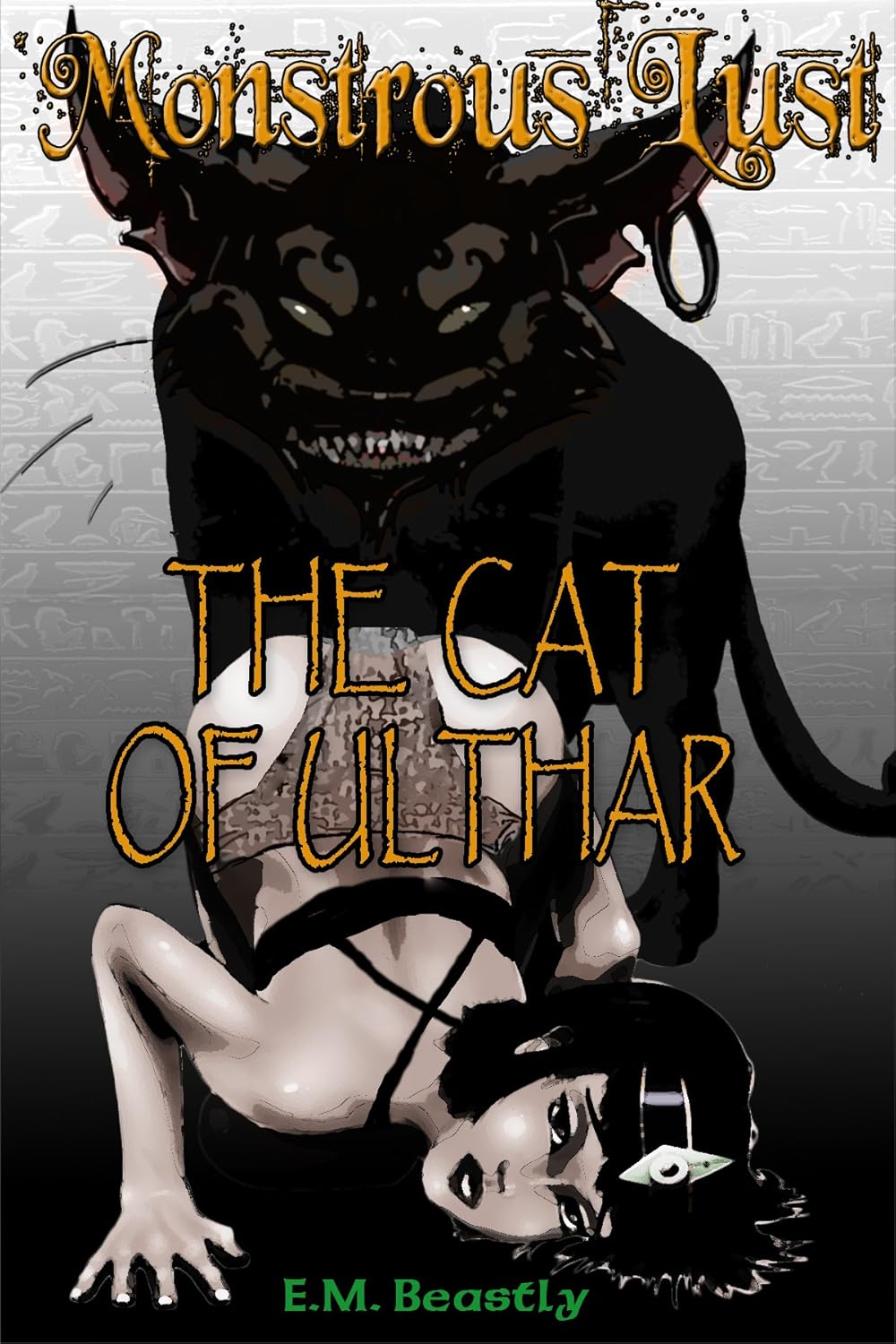
“Monstrous Lust: The Cat of Ulthar” is at once a sequel to and continuation of Lovecraft’s “The Cats of Ulthar,” and an erotic novella that takes the basic premise of the story in unexpected directions. While Lovecraft’s tale is horrible in the sense of Poe or Dunsany, Beastly takes things in a direction that seems to owe more to “The Shadow over Innsmouth,” where the cat-friendly law of Ulthar leads to more profound cultural changes, the rise of a dark cult, and finally physical expression in the bodies of the people of Ulthar. Until at last they disappear entirely, leaving behind a monstrous creature…the Cat of Ulthar.
While the concept is interesting, the execution is the real key. Here, the actual plot and writing of the story may disappoint readers. While the set-up of an Ulthar haunted by a sexy creature caught between human and cat with aspects of both has promise, in personality the eponymous Cat has a personality not unlike a sexually promiscuous version of the Cheshire Cat, and the two human characters who go to confront the creature are seduced and corrupted with a bare minimum of conflict. The stakes are low-to-nonexistent, the characters barely sketches, and the premise a bit weak. If you’re interested in passages discussing furry breasts and sexually explicit encounters between humans and a mystical cat-human hybrid, the story checks those boxes—but it doesn’t go far beyond that.
It is important to emphasize that there’s nothing inherently more taboo, weird, or perverted about anthropomorphic literature than any other kind. Nearly everyone has seen or read talking animal stories in some format, from Bambi to Br’er Rabbit, and anthropomorphism can apply to inanimate objects as easily as animals, as shown by the Transformers and Cars (2006). The same standards and good storytelling principles which apply to other literature also apply to anthropomorphic lit. As one reviewer put it:
On the surface, Bambi’s story is just what the subtitle says: A Life in the Woods. Yet one can find so much more in the story. The entire novel can be read as an existentaist parable, suggesting how one might make meaning in one’s own life. The novel is often seen as a disatribe against hunting, or more generally, a warning of the danger human beings pose to the natural world. The story can be read as castigating any system where the powerful exploit the weak, whether aristocracy or capitalism.
Yet Bambi is not a sermon. Salten’s beliefs and values are suggested on every page, but he doesn’t beat the reader over the head with them. He’s created characters that we as readers care about. Seeing them go through their struggles better enables us to contemplate our own lives. It is a story about its characters, not about issues; the issues become important to us because of the characters.
—Donald Jacob Uitvlugt, “Re-Reading a Classic: Bambi for the Furry Writer” in
A Glimpse of Anthropomorphic Literature (2016), 85-96
This is where “Monstrous Lust: The Cat of Ulthar” tends to fall flat; the characters fail to engage emotionally, and the story scenario doesn’t make sufficient use of the Lovecraftian setting and premise—which is, in Lovecraftian lit., a character in its own right. There’s humping and pumping, but without characters we care about. The setting is nominally Ulthar, but an Ulthar twisted into a Lovecraftian pastiche of itself, warped, twisted, depopulated, and barely present during the sexytimes. It is a fantasy sexual encounter that might easily be moved into any generical medieval setting with minimal effort.
Which is not to say that E. M. Beastly’s story is a failure, if that is exactly what the reader wants.
Bobby Derie is the author of Weird Talers: Essays on Robert E. Howard and Others and Sex and the Cthulhu Mythos.
Deep Cuts in a Lovecraftian Vein uses Amazon Associate links. As an Amazon Associate I earn from qualifying purchases.
 Deep Cuts in a Lovecraftian Vein