If you stay in Haiti long enough and really mingle with the people, the time will come when you hear secret societies mentioned. Nobody, of course, sits down and gives lectures on these dread gatherings. It is not in any open way that you come to know. You hear a little thing here and see a little thing there that seem to have no connection at first. It takes a long time and a mass of incidents before it all links up and gains significance.
—Zora Neale Hurston, Tell My Horse (1938)
William Seabrook’s The Magic Island (1929) was the book that launched the craze for Haitian Vodun and zombies in the United States, the direct inspiration for the film White Zombie (1932) and stories in pulp magazines like Strange Tales of Mystery and Terror such as August Derleth’s “The House in the Magnolias” (ST Jun 1932). Lovecraft read Seabrook’s book on a visit to Florida, and seems to have largely lost interest in voodoo, though he praised tales like “Mother of Serpents” (1936) by Robert Bloch.
Seabrook, however, was not the only one writing about African diaspora religions or African-American folklore. Zora Neale Hurston seems to have completely missed Lovecraft and his immediate contemporaries. In part, this was just a matter of timing; Lovecraft was dead by ’38 when Hurston’s book on Haitian Vodun, Tell My Horse, was finally published. In part, it was a reflection of segregation: as a Black woman, Hurston struggled seemingly her whole life against the prejudices of white editors and white audiences. Voodoo as a theme for Mythos fiction did not die off after the ’30s, but the Hollywood tropes of pins in dolls and zombies as reanimated corpses tended to overshadow authentic anthropology and folklore research.
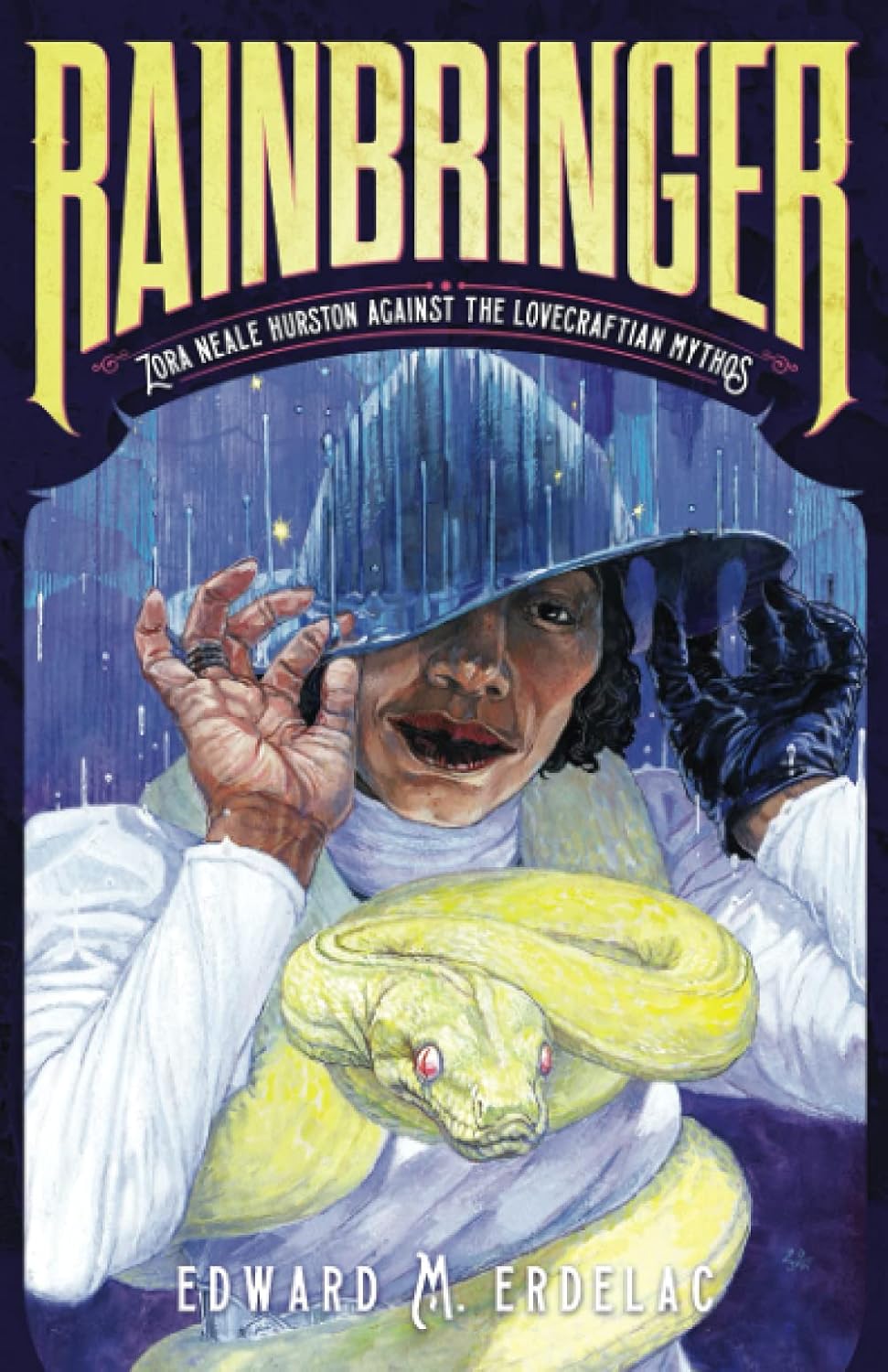
Zora Neale Hurston never really got a chance to go up against the Mythos. Not until 2021, when Edward M. Erdelac, author of the Merkabah Rider series, published Rainbringer. In this episodic novel, Erdelac wears together fact and fiction, interpolating encounters with the Mythos into Hurston’s already busy and adventurous life. Her particular career of poking her nose into hoodoo, Vodun, and other systems of belief provide a good excuse for her to stumble across the much weirder cults and entities of the Cthulhu Mythos, and the stories are inflected in their interpretation and depiction of the Mythos to reflect Hurston’s own writings.
Erdelac took pains to present a period-accurate but not discriminatory view of Black people during the period; the word “Negro” was in common use at the time, without any pejorative association. Gullah speech is presented with fair accuracy. Most of Hurston’s investigations into insular African-American communities are played straight, and the joy of exploration and discovery, the use of her wits and charisma, her respect for the people she meets and their beliefs all lend verisimilitude to the stories. Then things get a little Lovecraftian.
“An Old One?” I said, folding my arms, and thought to myself, Lord God and Papa Yig, not these motherfuckers again.
—Ed Erdelac, “Ekwensu’s Lullaby” in Rainbringer 57
Yig, in the context of the fictional Zora Neale Hurston’s career, is cast as her hoodoo patron, the figure who presided over her initiation into the occult. Yet stories like “Ekwensu’s Lullaby” are not an effort to cast African diaspora beliefs into a Mythos mold; rather, it is a story about African diaspora religion and strange survivals in an out-of-the-way place, in a universe that is Mythos-inflected.
This is much more believable, and therefore more interesting, than if Zora Neale Hurston were trying to fight Cthulhu by her lonesome. The approach is reminiscent of “Jeroboam Henley’s Debt” (1982) by Charles R. Saunders, “Hairwork” (2015) by Gemma Files, and Ring Shout (2020) by P. Djèlí Clark in that the stories are very much grounded in the African-American and African-Caribbean experience, the echoes of slavery and discrimination that have left their mark on bodies, minds, souls, and cultures. In a system of belief that already accepts the supernatural, the existence of Yig & co. doesn’t have the same sanity-blasting effect.
Erdelac was strongly inspired by Hurston’s fieldwork in writing these stories, as he mentioned in his interview Cthulhu in the Deep South on Tentacle Talk, but there is a second vein trying to balance out in these stories, and that’s weaving Zora’s adventures into the Mythos with the skill of a pasticheur. If the whole book had only been about Hurston’s dealings with Yig as her patron, that might have been interesting but slight from a Mythos perspective. However, she also encounters the Dreamlands, the “King in Yeller,” Tsathoggua, and other eldritch entities. Which sometimes adds spice to the gumbo, and sometimes is a bit of an overpowering flavor.
The strength of each episode is really in how well the story hangs together more than how many references to Hurston’s work of Lovecraft’s Mythos he can stir in. The more spiritual and dream-like episodes are balanced out with shoot-’em-up pulp action sequences, and the balance of elements shifts from episode to episode, reflecting changes in both Hurston’s real life and whatever Mythos threat Erdelac wants to put her against next. The result isn’t an exhaustive Mythos biography of Zora Neale Hurston, by any means. I could easily see Erdelac writing another story that fits in between the existing episodes, as the plot occurs to him.
Bobby Derie is the author of Weird Talers: Essays on Robert E. Howard and Others and Sex and the Cthulhu Mythos.
Deep Cuts in a Lovecraftian Vein uses Amazon Associate links. As an Amazon Associate I earn from qualifying purchases.
 Deep Cuts in a Lovecraftian Vein