Did Black people read Weird Tales during its golden age (1923-1940)?
At least some Black people in the United States wrote and read science fiction and weird fiction. W. E. B. DuBois published “The Comet” in his 1920 collection Darkwater: Voices from Within the Veil, Zora Neale Hurston’s “Spunk” (1925) appeared in Opportunity, A Journal of Negro Life, and George S. Schuyler’s novella Black Empire (1936-38) was serialized in the Pittsburgh Courier, to give just three examples. Black people’s quarters spent as well as anyone else’s at the newsstands.
There is no reason to believe that Black people did not read Weird Tales during the period. Proving that, however, is a bit tricky. Weird Tales never ran a demographic survey of readers. When researchers want to get a glimpse at who was reading the Unique Magazine, they need to look at more indirect data: who was writing letters that appeared in The Eyrie, and (after the departure of editor Farnsworth Wright in 1940, when Dorothy McIlwraith took the editor’s chair) whose names were listed as members of the Weird Tales Club? Unfortunately, names don’t generally give any hint of race—at best, it might give an overview of the gender balance of the readership (which are interesting in itself, see They Were Always Here on Turnip Lanterns).
Lacking the data to answer the question adequately, a deep dive into the archives of pulpdom suggests that while we can’t say how many Black people made up Weird Tales‘ readership, we can say that they certainly read weird fiction by some of Weird Tales‘ writers. A case in point is Edward Podolsky and “The Mummy’s Jest.”
Dr. Edward Podolsky (1902-1965) was a doctor and pulp writer whose early work included two stories in Weird Tales: “The Figure of Anubis” (WT Feb 1925) and “The Masters from Beyond” (WT Sep 1925). Both of these were fairly slight potboilers that failed to catch the reader’s attention; even Lovecraft doesn’t refer to them in his surviving letters, even though he had stories in both issues. Later, Podolsky would write science fiction stories and essays for science fiction pulps, and like his fellow weird tales writer Dr. David H. Keller, made money writing sex education books for an eager audience.
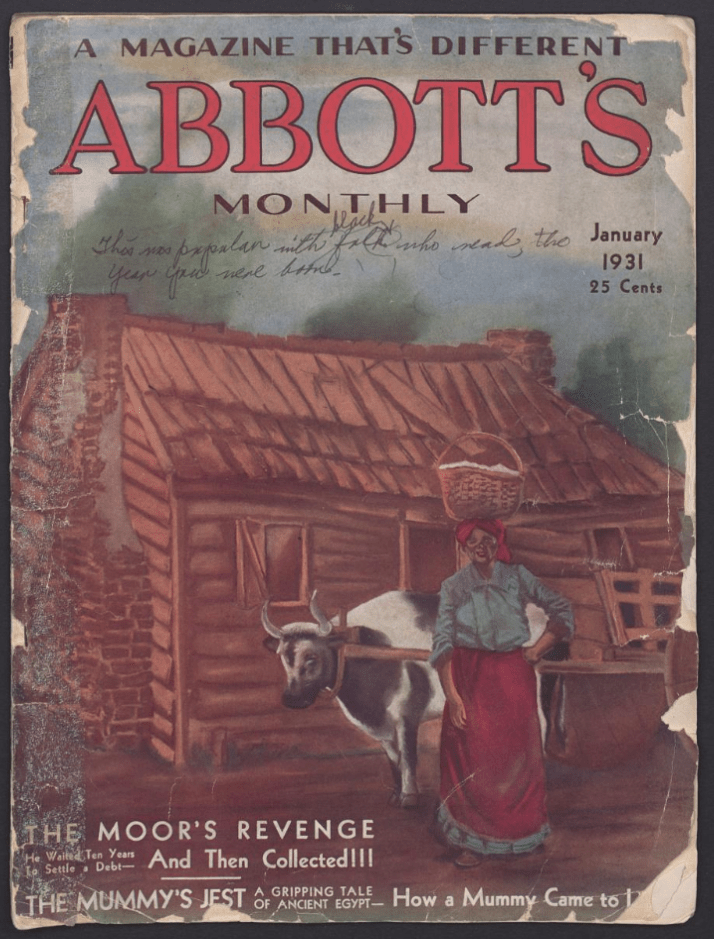
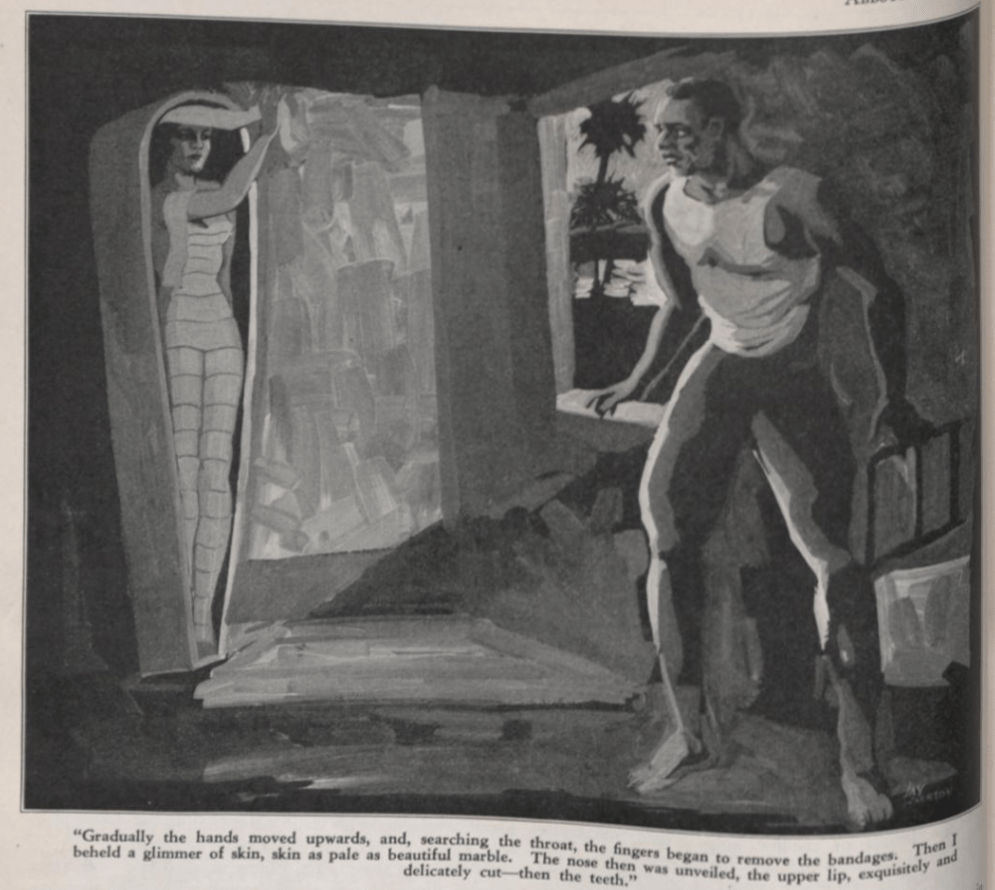
Among Podolsky’s fiction in the ’30s is “The Mummy’s Jest” (1931) for Abbott’s Monthly. Robert Sengstacke Abbott was a Black lawyer and newspaper publisher who founded The Chicago Defender in 1905; and later Abbott’s Monthly (1929-1933, changed name to Abbott’s Monthly Illustrated News, folded in 1934), a magazine combining a combination of news, fiction, and illustrations. This was a magazine primarily intended for a Black audience, and this shows in several of the topics addressed, the figures of the illustrations, etc. The illustrations for “The Mummy’s Jest,” for example, are by frequent Chicago Defender artist Jay Jackson and show a Black protagonist:

As it turns out, “The Mummy’s Jest” is well-named, and here’s the joke: give or take the occasional word, “The Mummy’s Jest” is “The Figure of Anubis,” reprinted almost verbatim from the pages of Weird Tales. Whether editor Lucius C. Harper knew he was buying an old story, or if Podolsky pulled a fast one and sold the same story twice to two different magazines isn’t clear, but I suspect the latter.
There is nothing about the text of the story to suggest a Black protagonist; Podolsky changed barely a word besides the title—and those changes that do exist between the two stories could reflect the different editorial choices of Farnsworth Wright and Lucius C. Harper in how they ran their respective magazines. So there is that sleight-of-hand there which the editor accomplished: by adding Jackson’s illustrations to Podolsky’s story, he could suggest and imply things to his presumably mostly-Black audience that aren’t in the story.
It is particularly notable that the figure of the mummy in both recensions of the story is described as having, when the bandages fall away, “skin as pale as beautiful marble.” In Weird Tales, where the default audience might expect the protagonist to be white, the discovery of a beautiful Caucasian princess from Egypt is a matter of course; it happens all the time, such as in Seabury Quinn’s “The Jewel of Seven Stones” (WT Apr 1928). In Abbott’s Monthly, however, this adds a certain frisson: the suggestion that the Black protagonist’s lost love was also white, and that they were in an interracial relationship.
It is difficult to express, at this remove, the degree to which the legal and social discrimination influenced science fiction and weird fiction in the United States during the Jim Crow period. No law expressly forbid people of one race from buying Weird Tales or Abbott’s Monthly, but the inherent biases of editors, writers, artists, and readers all factored in to influence how weird fiction was written, read, and received. “The Figure of Anubis”/”The Mummy’s Jest” is a good example of how with a little change of context, the whole reading of the story can change.
At the very least, however, while we can’t say whether anyone who picked up Abbott’s Monthly also read Weird Tales, we can definitely say that they read at least one story from the pages of the Unique Magazine.
“The Figure of Anubis” can be read here, and “The Mummy’s Jest” can be read here.
Bobby Derie is the author of Weird Talers: Essays on Robert E. Howard and Others and Sex and the Cthulhu Mythos.
Deep Cuts in a Lovecraftian Vein uses Amazon Associate links. As an Amazon Associate I earn from qualifying purchases.
 Deep Cuts in a Lovecraftian Vein