The horror crossover is a fine art. Beyond the mere marketing-stunt spectacle that such ventures often are, from Frankenstein Meets The Wolf Man (1943), House of Frankenstein (1944), House of Dracula (1945), and King Kong vs. Godzilla (1961) to Freddy vs. Jason (2003), Puppet Master vs. Demonic Toys (2004), and Alien vs. Predator (2004), there is more to these films than just a howling of werewolves and a trample of kaiju. There is a genuine sense of clashing mythos—how do you reconcile the mad science of Frankenstein’s Monster with lycanthropy and vampirism?
When you look at what world can accommodate not just the individual narratives of each weird entity, but all of them together, you’re moving past the stage of passive consumption. Like the ancient citizens on the streets of Rome, facing a bewildering array of divinities from across the known world with all of their stories and attributes, some conflicting, some paralleling one another closely…the shared universe can become richer, tying together disparate elements of their backstories, hinting at a more complex relationship with more stories waiting to be told. Then you get films like The Monster Squad (1987) and comics like Screamland (2008), works powered by something more than nostalgia and replaying the same classics.
While all the individual elements might be familiar, when you play them off against each other, something new emerges.
The Cthulhu Mythos already exists as a shared universe, and it has been remixed and crossed over with more traditional horror franchises and creations dozens, perhaps hundreds of times. Aquaman has fought Cthulhu. Sherlock Holmes has interacted the Mythos in dozens of stories and novels, including “A Study in Emerald” (1993) by Neil Gaiman. A Night in the Lonesome October (1993) by Roger Zelazny sees Holmes, the Cthulhu Mythos, and various Universal monsters play off against each other in the Game. In “From Cabinet 34, Drawer 6” (2005) by Caitlín R. Kiernan revisits “The Shadow over Innsmouth” by way of The Creature from the Black Lagoon (1954). Whether or not a horror/Mythos crossover succeeds is whether it transcends the formula of “X vs. Y”; whether it builds on its constituent elements to create something new and distinct.
“The One That Got Away” (2011) by Esther M. Friesner is that kind of story.
Damn it, it wasn’t fair! I went through just as much as that little blond chippie, and her big-shot showbiz pals knew it. Sure, they lost their star attraction, but what was stopping them from salvaging something from their losses by giving me a chance at the spitlight? I would’ve worn my native costume. I would’ve acted like I couldn’t speak a word of English so someone could pretend to translate while I recounted my terrible ordeal in his hairy clutches—even though I’d dodged those cltches pretty slickly, if I do say so myself. And if one of those puffed-up producers would’ve thought to scrape the pavement, salvage what was left of him, hire an army of taxidermists to pretty up the remains a bit, and stuck him back on stage, I would’ve screamed on cue like a champ at the results. Hell, I’ll bet I could’ve shrieked loud enough to make the audience believe—just for a moment—that he was still alive!
Esther M. Friesner, “The One That Got Away,” Asimov’s Science Fiction Apr/May 2011, 136
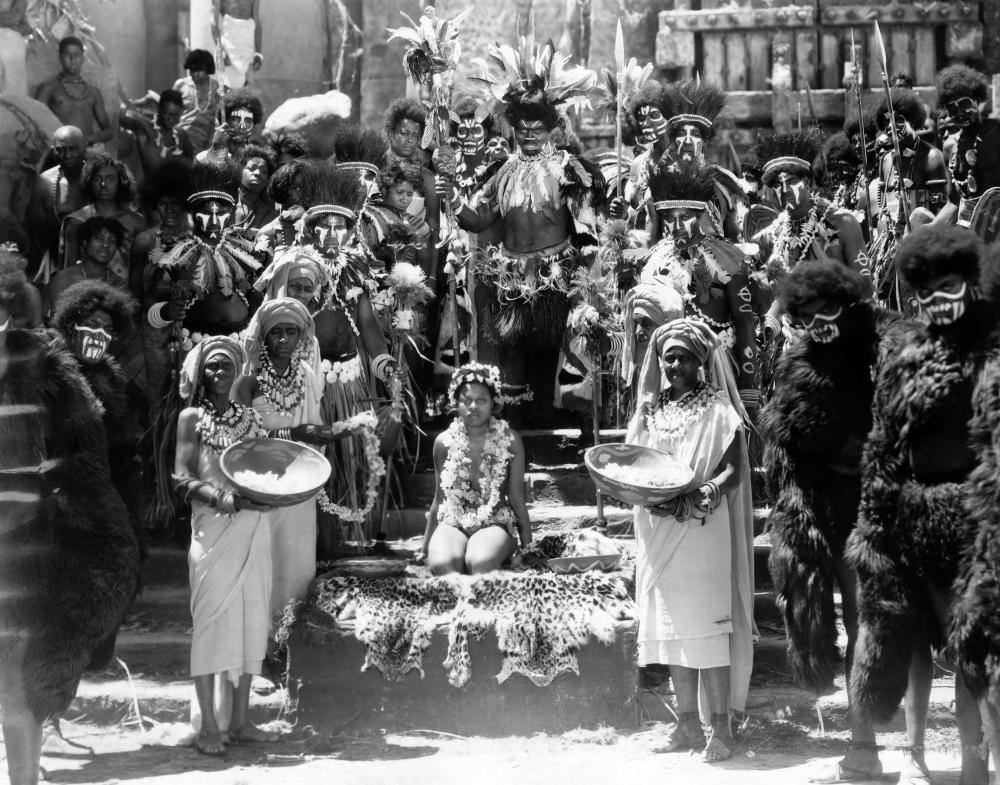
Friesner can’t come out and say things explicitly, because copyrights and trademarks are still owned by others, but the waltzing-around the subject is part of the charm of the narrative. The crossover is the premise; a nigh-forgotten character from a classic story dropped into an encounter with some Innsmouth sailors. What makes it work is the telling, and how Friesner develops the story. A young woman, late of Skull Island, left to her own devices in the United States of America during the Great Depression and Jim Crow has turned into a hardboiled woman of the world—and a surprisingly open-minded one.
Bat-winged and taloned, with what looked like an octopus boquet for a mouth, the creature reared out of the depths and strode toward me with eldritch lust in his fiery eyes.
Eh. I’d seen worse.
Esther M. Friesner, “The One That Got Away,” Asimov’s Science Fiction Apr/May 2011, 144
The tone is flippant, and the story is a play on wits worthy of the fast-talking repartee in a noir film. It is the unexpected (one might say sacrilegious if either Lovecraft or King Kong is one of your sacred cows) lightness that makes the story work. There is a darkly comic Pollyanna aspect of the narrator as she compares the cultural rituals of Innsmouth and Skull Island with gallows humor and no hard feelings.
Two mythologies meeting in unexpected ways…but also ways that are oddly fitting. For those who like to explore the culture of Innsmouth, in works like Innsmouth (2019) by Megan James, it’s nice to see what happens when the sailors get out into the wider world and encounter folks from other cultures. It is all good fun.
“The One That Got Away” by Esther Mr. Friesner was published in Asimov’s Science Fiction Apr/May 2011. It has not been reprinted.
Bobby Derie is the author of Weird Talers: Essays on Robert E. Howard and Others and Sex and the Cthulhu Mythos.
Deep Cuts in a Lovecraftian Vein uses Amazon Associate links. As an Amazon Associate I earn from qualifying purchases.
 Deep Cuts in a Lovecraftian Vein