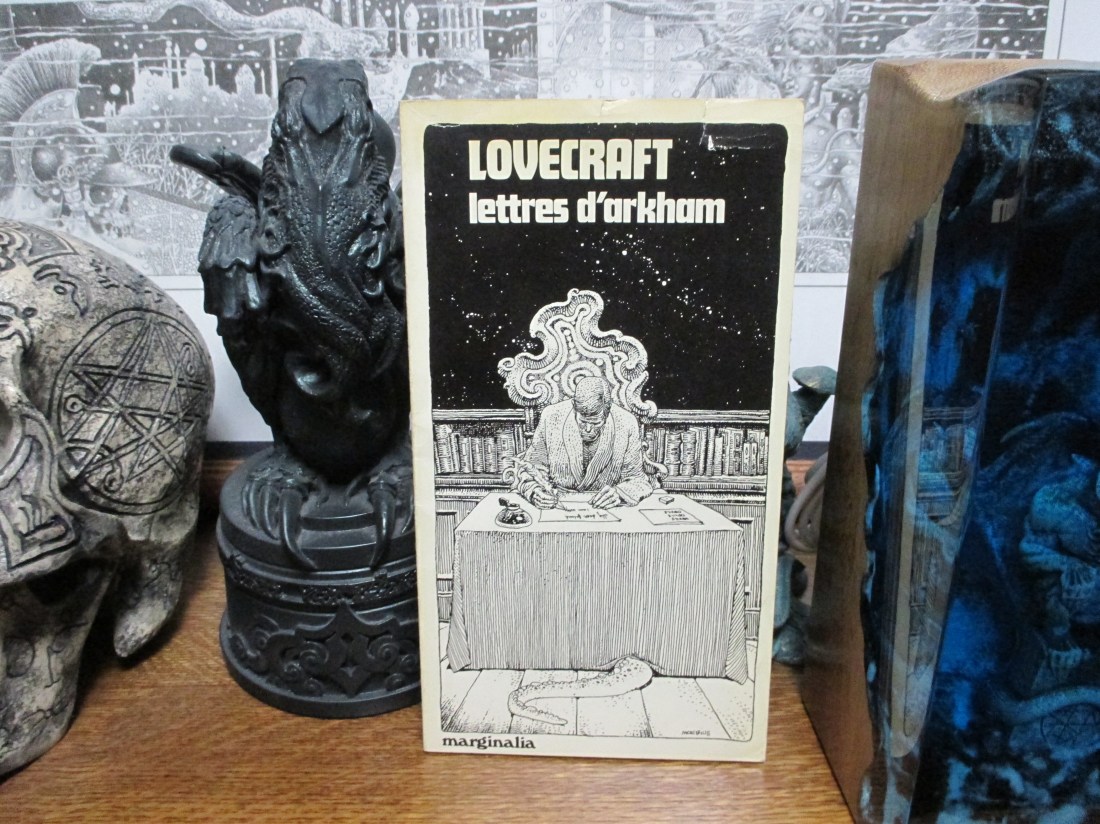
Lettres d’Arkham (1975) by H. P. Lovecraft & François Rivière

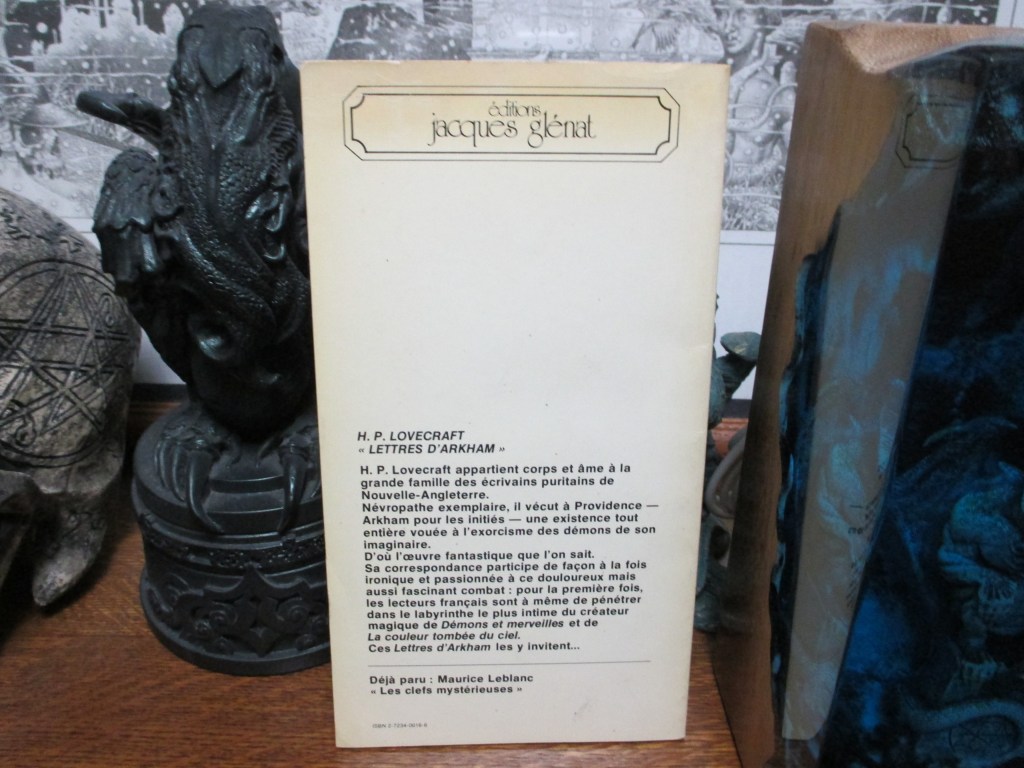
H. P. Lovecraft appartient corps et âme à la grande familie des écrivains puritans de Nouvelle-Angleterre.

Névropathe exemplaire, il vécut à Providence—Arkham pour tes initiés—une existence tout entière vouée à l’exorcisme des démons de son imaginaire.

D’où l’œuvre fantastique que l’on sait.

Sa correspondance participle de façon à la fois ironique et passionnée à ce douloureux mais aussi fascinant combat : pour la première fois, les lecteurs français sont à même de pénetrer dans le labyrinthe le plus intime du créateur magique de Démons et merveilles et di La coouleur tombée du ciel.

Ces Lettres d’Arkham les y invitent…
H. P. Lovecraft belongs body and soul to the great family of New England Puritan writers.

Exemplary neurotic, he lived in Providence—Arkham for the initiates—a life entirely devoted to exorcising the demons of his imagination.

Hence the fantastic work we all know.

His correspondence is an ironic and passionate contribution to this painful but fascinating struggle: for the first time, French readers are able to penetrate the most intimate labyrinth of the magical creator of Démons et merveilles and La coouleur tombée du ciel.

These Letters from Arkham invite them to do so…
Back cover copyEnglish translation

French audiences may have been aware of H. P. Lovecraft as early as the 1930s, when English-language books and periodicals made it to European shores; Jacques Bergier even claimed to have carried on a brief correspondence with Lovecraft, and he certainly had two letters published in the pages of Weird Tales despite living in France at the time.

Lovecraft’s major introduction to French audiences came in the 1950s with collections like La couleur tombée du ciel (“The Color from the sky”/”The Colour Out of Space”) [1954, Denoël], and Démons et merveilles (“Demons and Marvels”) [1955, Deux Rives] that translated Lovecraft’s prose into French. Both of included introductions from Bergier, who provided many readers with their first insight into Lovecraft himself—who he was, and where he came from. Both books went through many reprints and editions.

In 1964, Arkham House published the first volume of Lovecraft’s Selected Letters. This project had begun shortly after Lovecraft’s death in 1937, as August Derleth and Donald Wandrei had begun contacting Lovecraft’s correspondents and requesting letters to transcribe for future publication. The scope and cost of the project soon made actual publication of the Arkham House Transcripts—at least in their entirety—impractical; war time paper rationing and rising post-war costs delayed the project further. The first three volumes, released under the editorship of Derleth and Wandrei, represent a compromise to their original vision—but also a tremendous effort, and one nearly unique.

Lovecraft had died broke and was far from a popular or mainstream author; the publication of his letters not only kick-started real Lovecraft biographical scholarship and literary criticism, but it helped center Lovecraft himself as an individual worth reading. More of Lovecraft’s letters would be published than those of Ernest Hemingway, Dashiell Hammett, or dozens of other much more popular authors.

Of course the French had to get in on the action.

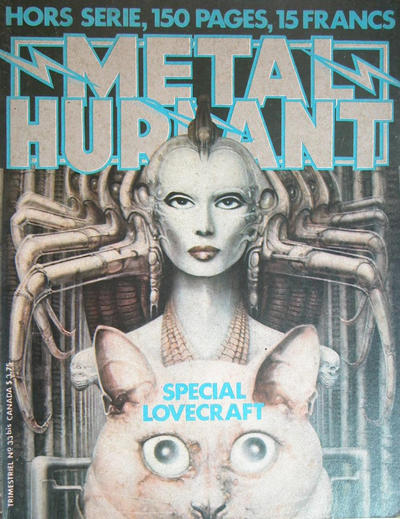
Early translations of Lovecraft’s letters into French began piecemeal, in literary and fan periodicals; the biography is a bit opaque to English-language readers living in the United States, but a special issue of L’Herne dedicated to Lovecraft in 1969 stands out for translating a few letters, amid a mass of literary and biographical material that marks the first major critical publication on Lovecraft in any language. The 1970s in France would see growing interest in Lovecraft, especially in the field of Franco-Belgian comics; the contributors of Metal Hurlant (“Howling Metal,” translated into English markets as Heavy Metal magazine), which began in 1974, was founded by Jean Giraud (Mœbius) and Philippe Druillet, both of whom would go on to fame…and through Metal Hurlant, many graphic adaptations of Lovecraft’s stories, and stories inspired by Lovecraft and his creations, would be published in the pages of Metal Hurlant and Heavy Metal, to audiences around the world.

Lettres d’Arkham (1975, Jacques Glénat), translated by François Rivière, is a slim booklet of 80 pages, counting all the introductory material. The cover is by Mœbius, and plays to Lovecraft’s legend: seated at a table, writing with a quill pen, a row of antique volumes behind him, against a starry landscape, a tail or tentacle discreetly emerging from beneath the table cloth.

Jacques Glénat had founded Glénat Éditions in 1972; it is now a major publisher of bandes dessinées, and also publishes French translations of manga and nonfiction periodicals. But this was early days, and Lettres d’Arkham was the second entry in a series titled Marginalia; the first was a reprint of Les clefs mystérieuses (“The Mysterious Keys”) by Maurice Leblanc, the creator of Arsène Lupin. This was apparently an experiment in shorter-form material, mostly fiction reprints, with Rivière as overall editor of the series. Lettres d’Arkham appears to be the sole non-fiction entry.

Given the short format, Yves Rivière apparently opted against trying to translate entire letters. Instead, after a brief initial essay (“Lovecraft, un cauchemar Américan”/”Lovecraft, an American nightmare”) and chronology of his life, Rivière presents a series of excerpts from the first two volumes of the Selected Letters, divided into individual topics.
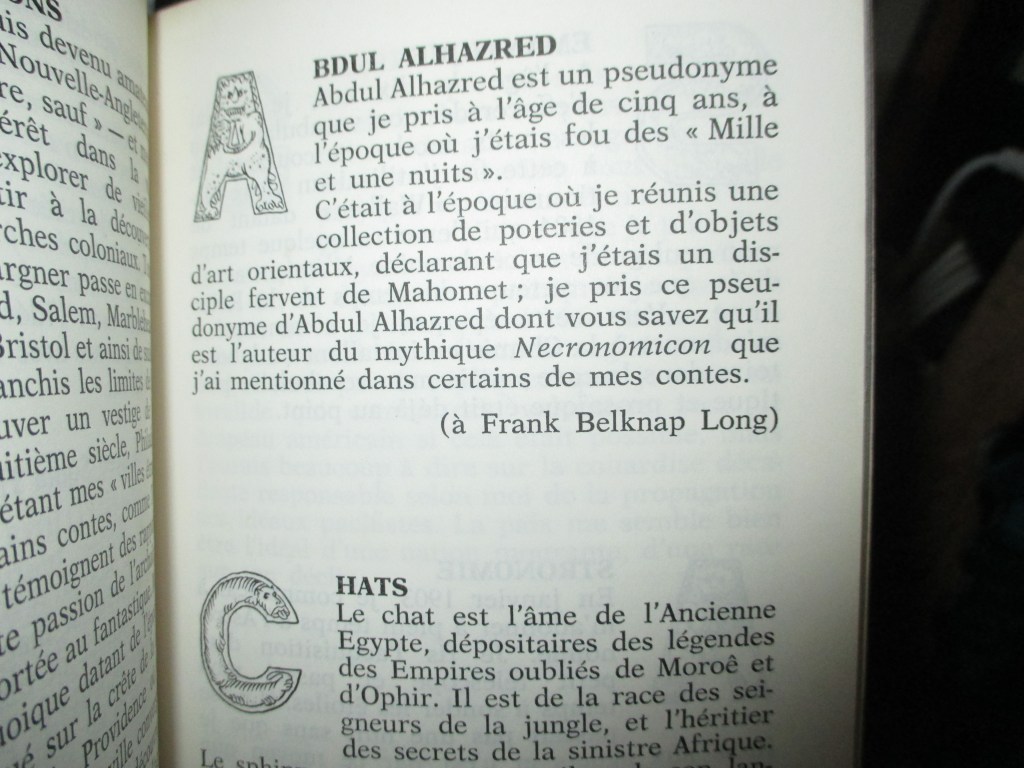
The initial letters, reminiscent of illuminated manuscripts, were created by the artist Floc’h (Jean-Claude Floch), who would become known for his many collaborations with François Rivière.

Most of the translations don’t specify date or even the recipient of the letter, so from a scholastic viewpoint Lettres d’Arkham wasn’t ideal—but translating one of Lovecraft’s letters is more difficult than translating one of his stories or poems. There is no guiding narrative, the letters are full of quirky language, obscure topical and geographic references, callbacks to previous correspondence. Even though Derleth and Wandrei had already edited and censored Lovecraft’s letters to give the excerpts in the Selected Letters volumes better readability (and to remove or downplay some of Lovecraft’s more racist sentiments), Rivière was trying to translate some pretty tricky material for an entirely new audience.
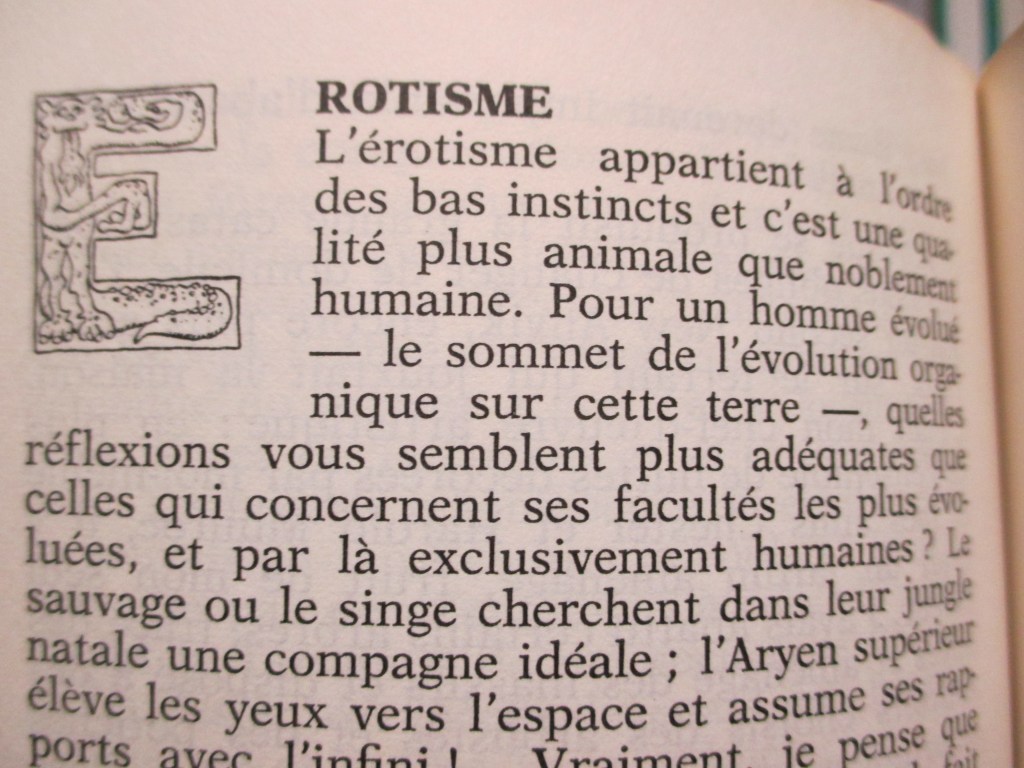
Generally speaking, Rivière seems to have done a pretty decent job of the translations. The most egregious errors are (and this might be expected), geographical. For example, the entry for Salem places it in New York instead of Massachusetts. Still, for a Lovecraft fan in 1970s France, how else were you going to read any of Lovecraft’s letters at all?

For francophone readers, that is still an issue. The vast majority of Lovecraft’s letters have never been translated into French, and might never be (one can only imagine the difficulty of trying to translate some of Lovecraft’s slang-filled letters or stream-of-consciousness sections into French). Some further attempts have been made to present a part of Lovecraft’s correspondence to a French audiences: in 1978 there was Lettres Tome 1 (1914-1936), translated by Jacques Parson, for example, but there was no Lettres 2 forthcoming. Several other collections of part of Lovecraft’s letters have been published, especially in recent years, much of the correspondence from Lovecraft’s later years, and with friends like Clark Ashton Smith, August Derleth, C. L. Moore, Fritz Leiber, E. Hoffmann Price, and Robert E. Howard, remains untranslated.

There are people working on that last one, however. A translation of the correspondence of Robert E. Howard and H. P. Lovecraft into French by David Camus and Patrice Louinet was successfully crowdfunded, and although health issues have delayed the project, it still looks fantastic.

It has to be emphasized what a labor of love translation is; it is never simply a matter of translating word-for-word, but always trying to capture the essence of what is being communicated. English-language readers have an advantage over the French in that we have practically every word that Lovecraft has written published, but as he wrote them; French readers and scholars face not only a limited amount of such material, but have to deal with multiple translations of those same stories and letters in various formats.

Considering that the whole of Arkham House’s Selected Letters has never been translated, much less any of the later, more complete volumes of letters by Necronomicon Press or Hippocampus Press, Lettres d’Arkham remained relevant in France long past the point where most Lovecraft scholarship had superseded the Arkham House Selected Letters.


Bobby Derie is the author of Weird Talers: Essays on Robert E. Howard & Others (2019) and Sex and the Cthulhu Mythos (2014).
“R. H. B.” (1978) by Andreas and Rivière


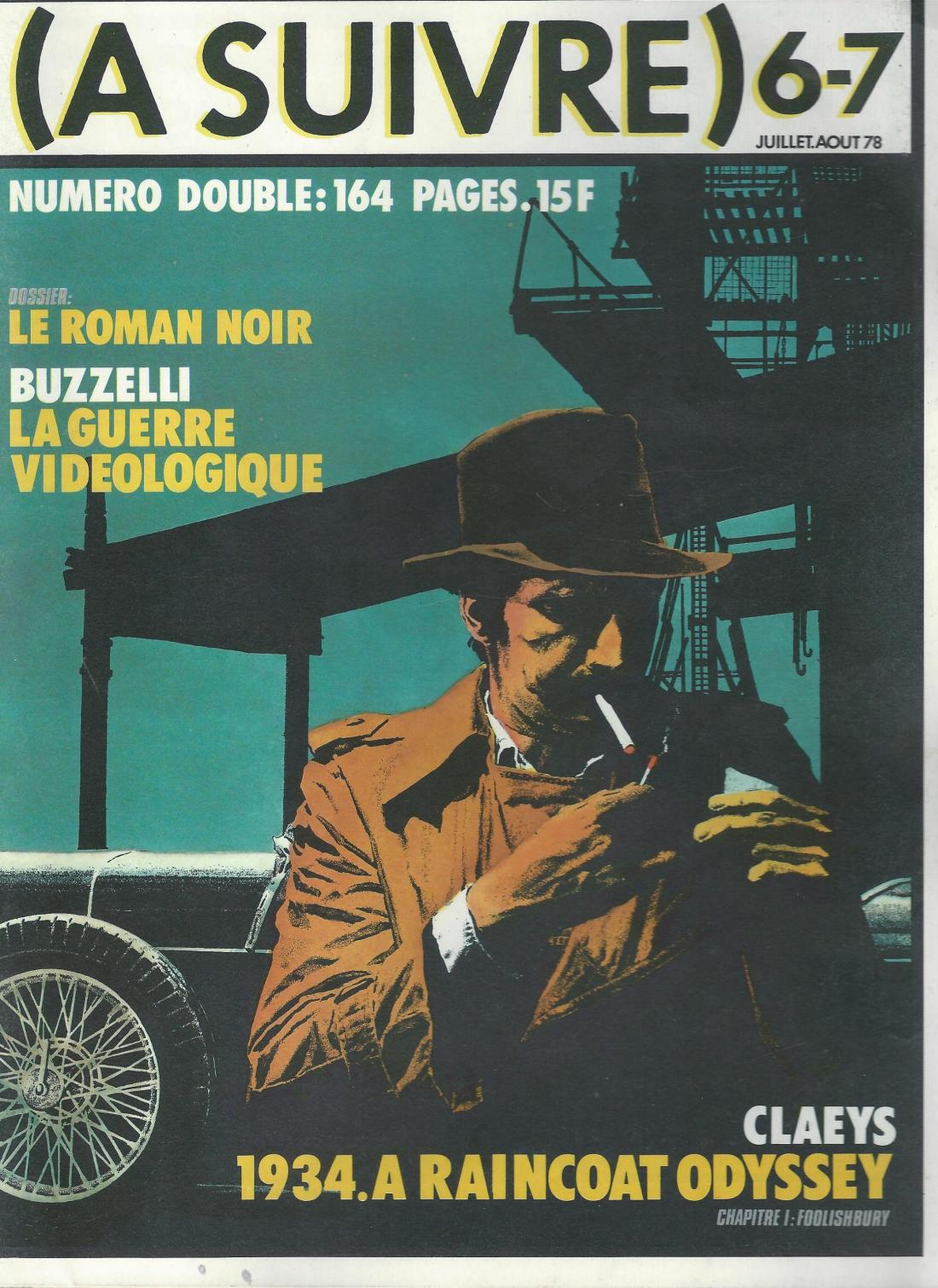
À Suivre (“To Be Continued”, 1978-1997) was one of the major Franco-Belgian comic magazines of the period, publishing such great European comics creators as Alexandro Jodorowsky, Milo Manara, Mœbius (Jean Giraud), François Schuiten, and Guido Crepax, a contemporary of magazines like Métal hurlant and Pilote, focusing on comics for a more mature audience.

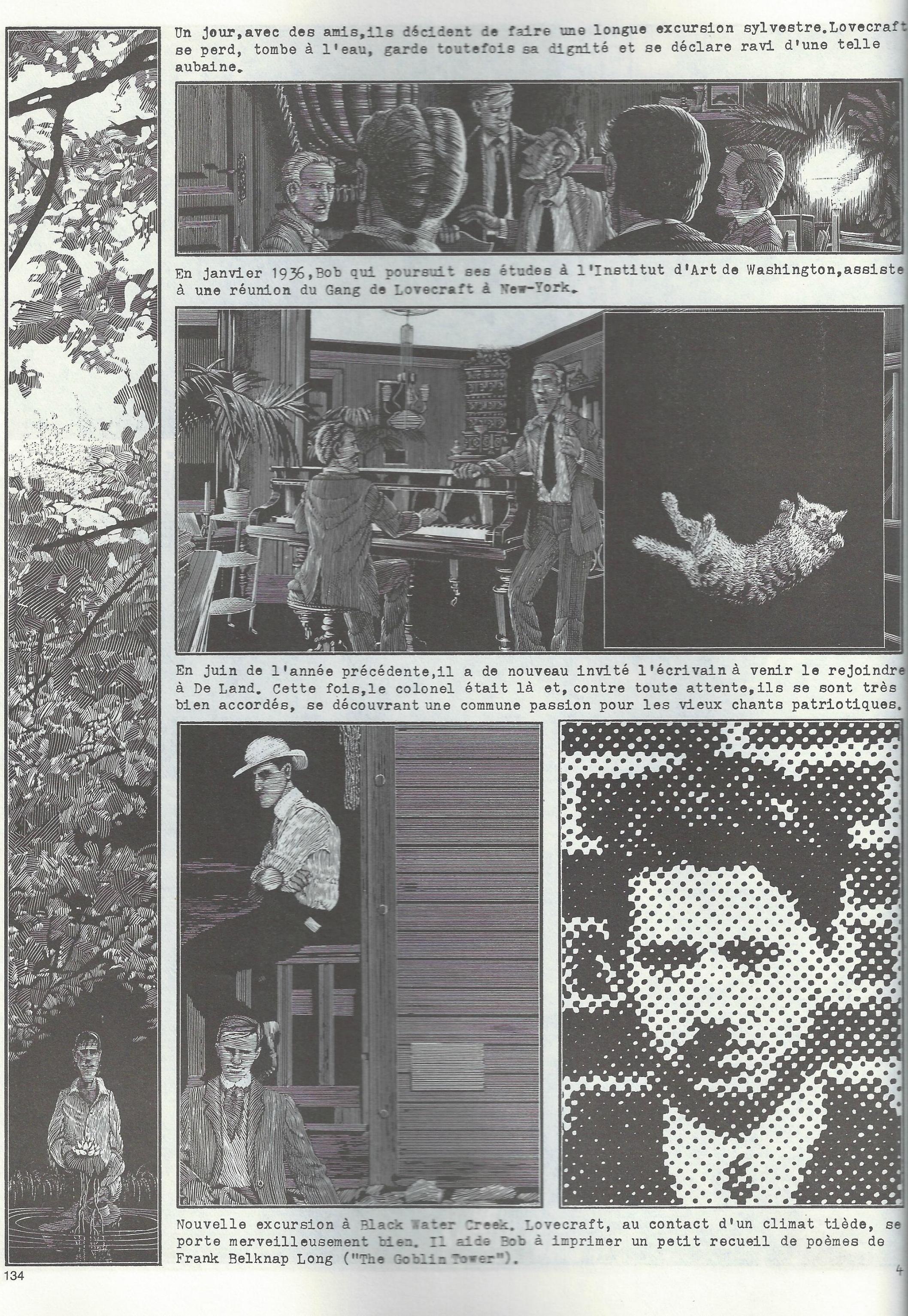
“R. H. B,” by Andreas (Andreas Martens) and Rivière (François Rivière) was published in À Suivre 6-7, the July-August double issue for 1978. The title stands for Robert Hayward Barlow, friend and literary executor to H. P. Lovecraft. This coincides with the increased enthusiasm for Lovecraft in France, particularly the publication of LETTRES, 1 (1914-1926), which was published May 1978—a translation of Lovecraft’s letters, taken from volume I and part of volume II of Arkham House’s five-volume Selected Letters series. By comparison, Métal hurlant‘s Lovecraft special issue was published in September 1978.

metal

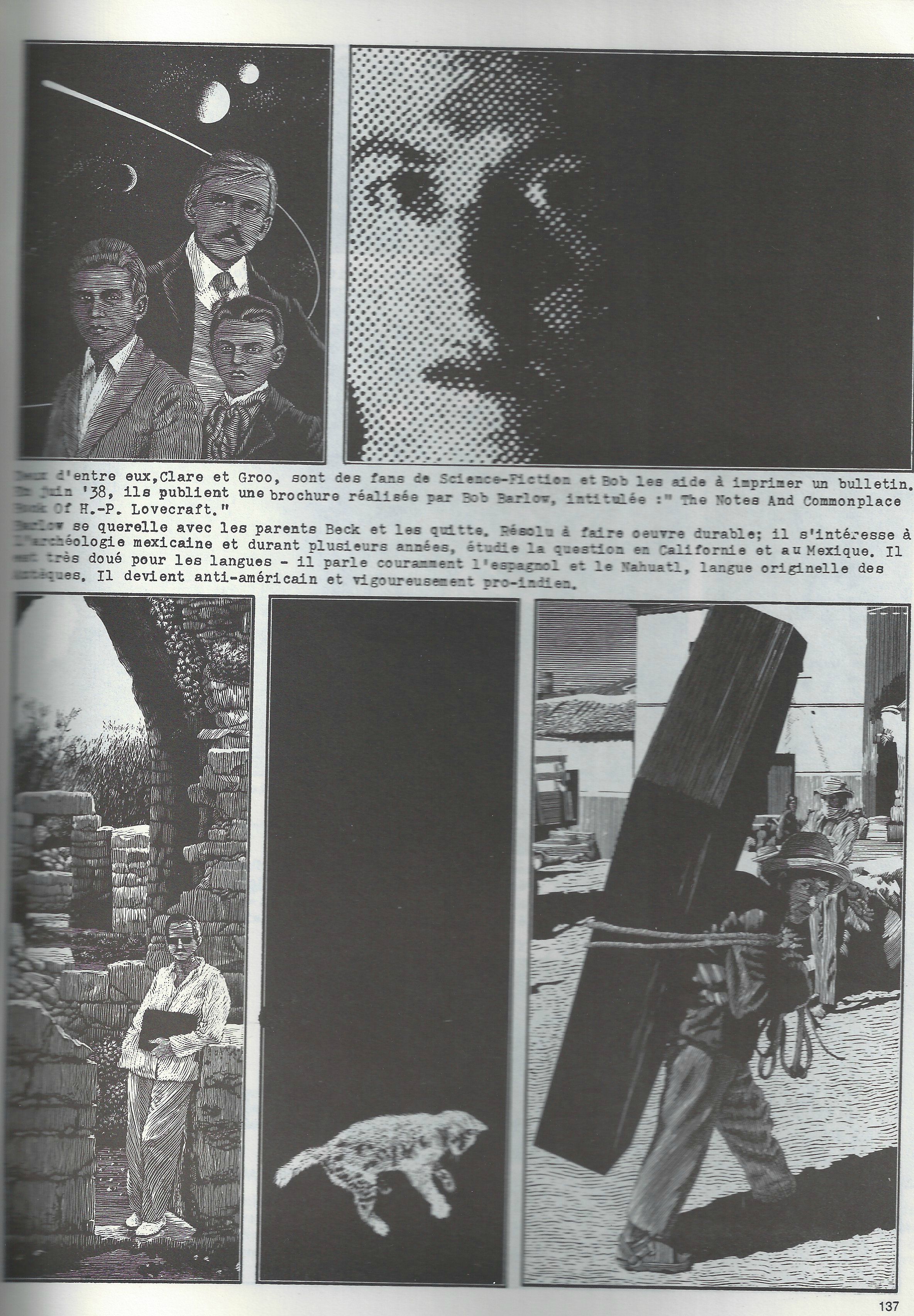
H. P. Lovecraft received a fan letter from a 13-year-old R. H. Barlow in June 1931; Lovecraft was then 41 years old, and the two continued corresponding for six years, until Lovecraft’s death in 1937. The two met in May 1934, when Lovecraft took a trip down to Barlow’s family home in DeLand, Florida, a visit which lasted seven weeks; they met again briefly in New York during the winter of 1934-1935, where Lovecraft was in the habit of meeting friends for New Years Eve, and Lovecraft repeated his trip to visit the Barlows in Florida in 1935, where he spent ten weeks with his hosts, but begged off the invitation to stay all summer. Their next visit was when Barlow came to visit Lovecraft in Providence, Rhode Island, 28 July 1936, when the teenager stayed more than a month at the boarding house behind Lovecraft’s residence. It was the last time the two would meet; Lovecraft would die of cancer on 15 March 1937. Lovecraft’s “Instructions in Case of Decease,” dating from 1936, named Barlow his literary executor…and it is through Barlow’s efforts that many of Lovecraft’s papers, unpublished stories, and letters were preserved at the John Hay Library.

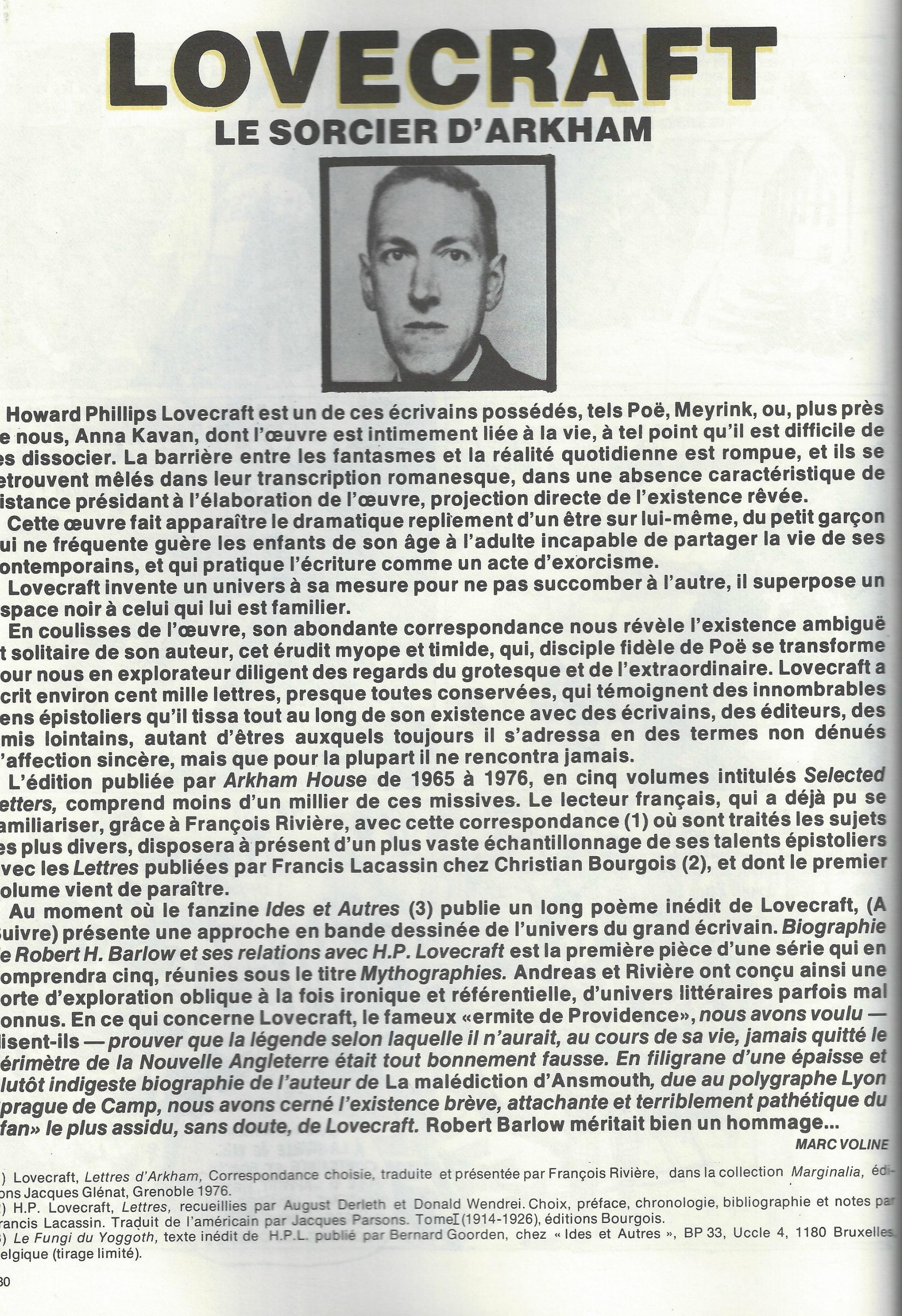
The comic proper is presaged by an introduction by editor Marc Voline:

suiver-2

At the time the Ides et Autres (“Ides and Others”) fanzine published an unpublished poem by Lovecraft (3), (A Suivre) presents a comic strip approach of the great writer universe. “Biography of Robert H. Barlow and his relationship with HP Lovecraft” is the first of a five-part series, collected under the title Mythographies. Andreas and Rivière designed this as a kind of oblique exploration, referential and ironic, of sometimes poorly known literary universe. As for Lovecraft the famous “hermit of Providence,” we wanted—they say—to prove that the legend that he would, during his life, never leaves the perimeter of New England was all simply false. From the thick and rather indigestible biography of the author of La malediction d’Ansmouth (“The Shadow over Innsmouth”) written by Lyon Sprague de Camp, we briefly identify with the existence of an endearing and terribly pathetic “fan” most assiduous without doubt Lovecraft. Robert Barlow well deserved homage …

Marc Voline

Most of the material in the comic would come from L. Sprague de Camp’s H. P. Lovecraft: A Biography (1975); this would not be available in French until 1987 when Richard D. Nolane translated it as H. P. Lovecraft ; le Roman de sa Vie, so the creators of “R. H. B.” were working through some linguistic hurdles and miscommunications. As Lettres 1 doesn’t have any actual letters from Barlow, essentially all of the material for “R. H. B.” was drawn directly from de Camp’s book, with many phrases translated directly from the English edition.

suiver-4

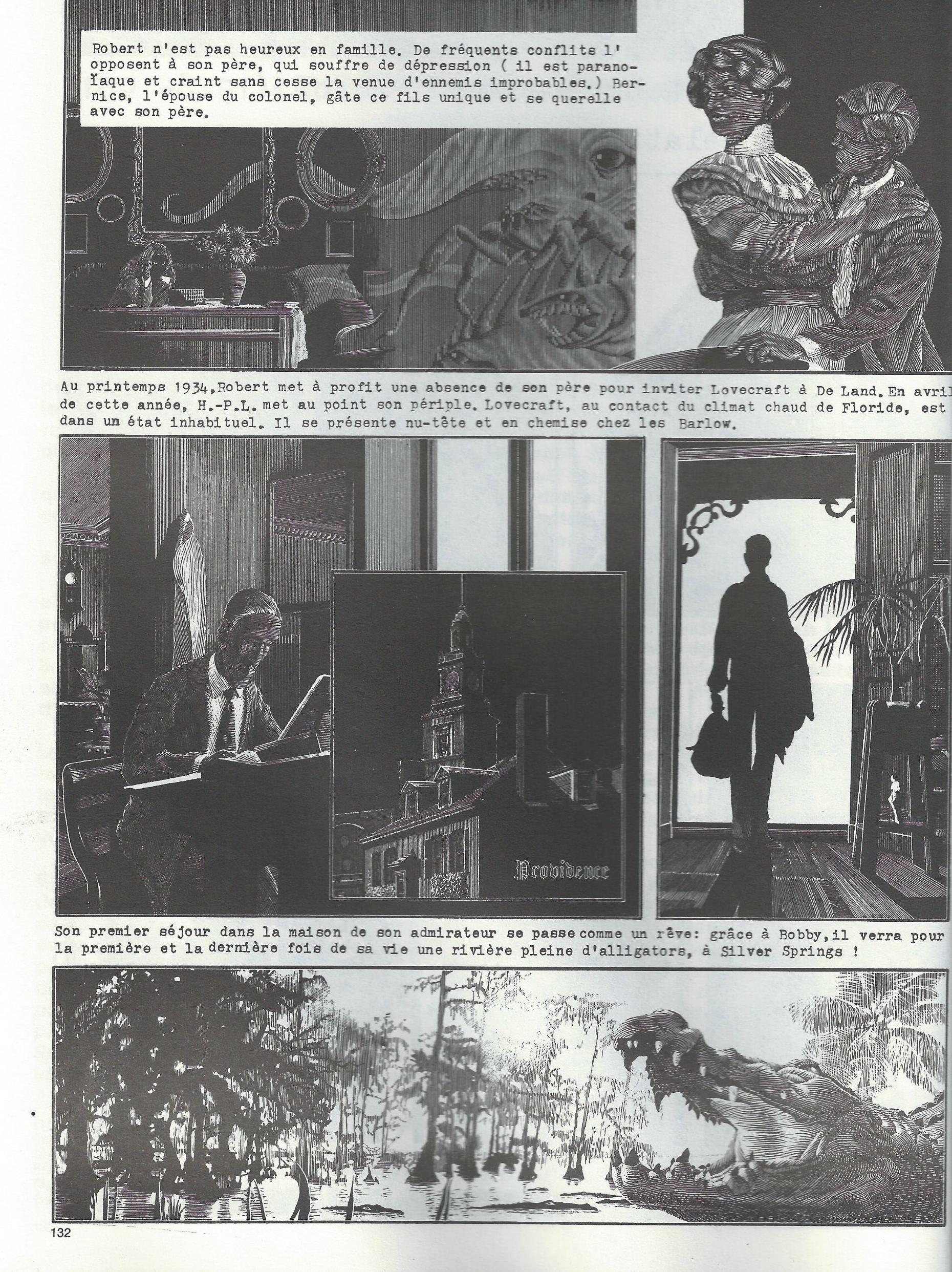
Small issues of translation aside, this is a starkly beautiful comic, with fantastic linework by Andreas, who obviously referenced what photos of Lovecraft were available. Translation of the French above:

Robert’s is not a happy family. There are frequent conflicts between him and his father, who suffers from depression (he is paranoid and continually fears the coming of improbable enemies.) Bernice, the wife of the colonel, spoiled the only son and quarreled with his father.

In spring 1934, Robert makes a profit of the absence of his father to invite Lovecraft to De Land. In April this year, HPL makes this journey. Lovecraft, in contact with the hot climate of Florida, is in an unusual state. He presents himself to Barlow with hatless and coatless.

His first stay in the house of his admirer is as a dream thanks to Bobby, he will see for the first and last time in his life a river full of alligators, at Silver Springs!

By comparison, this is how de Camp described this encounter:

The family home was at De Land, Florida, seventeen miles inland from Daytona Beach. Barlow’s father, Everett D. Barlow, was a retired U. S. Army lieutenant colonel and something of a mental case. Subject to moods of intense depression, he suffered from delusions of having to defend his home against the attacks of a mysterious Them. He was cracked on religion and on sex.

Robert Barlow got on badly with his father. At this time, he told his friends that he hated the colonel; although later, after his parents had been divorced, he carried on a friendly correspondence with him. Robert Barlow’s mother, Bernice Barlow, spoiled and pampered her son (somewhat as Lovecraft’s mother had done with him) and quarreled with her husband over the boy’s upbringing.

In the spring of 1934, Barlow and his mother were at De Land while the father, in the North, recuperated with relatives from one of his attacks. In January, Robert Barlow began urging Lovecraft to come for a visit to Florida. By April, Lovecraft had planned the trip. […] At the Barlows’, the heat stimulated Lovecraft. In high spirits he went hatless and coatless and boasted of the tan he was working up. His one disappointment was in not being able to go on to Havana. He was consoled by a trip with the Barlows to Silver Springs. There he had his first view of a jungle-shaded tropical river and even glimpsed wild alligators.
—L. Sprague de Camp, H. P. Lovecraft: A Biography 393-394

There are some errors in de Camp’s portrayal, which were repeated by Rivière. Lt. Col. Everett D. Barlow had seen action during World War I, and may have suffered from post-traumatic stress disorder; Lovecraft was aware of the elder Barlow’s mental illness and was notably more sympathetic than de Camp:

I surely am sorry that your father remains under the weather psychologically. These depressed states may be troublesome to others, & may seem exasperating when coupled with good physical health, yet they are really every inch as painful & unavoidable as any other form of illness. The victim can’t help himself any more than a victim of indigestion or cardiac trouble can. The more we know of psychology, the less distinction we are able to make betwixt the functional disorders known as “mental” and “physical.”
—H. P. Lovecraft to R. H. Barlow, 10 April 1934, O Fortunate Floridian! 125

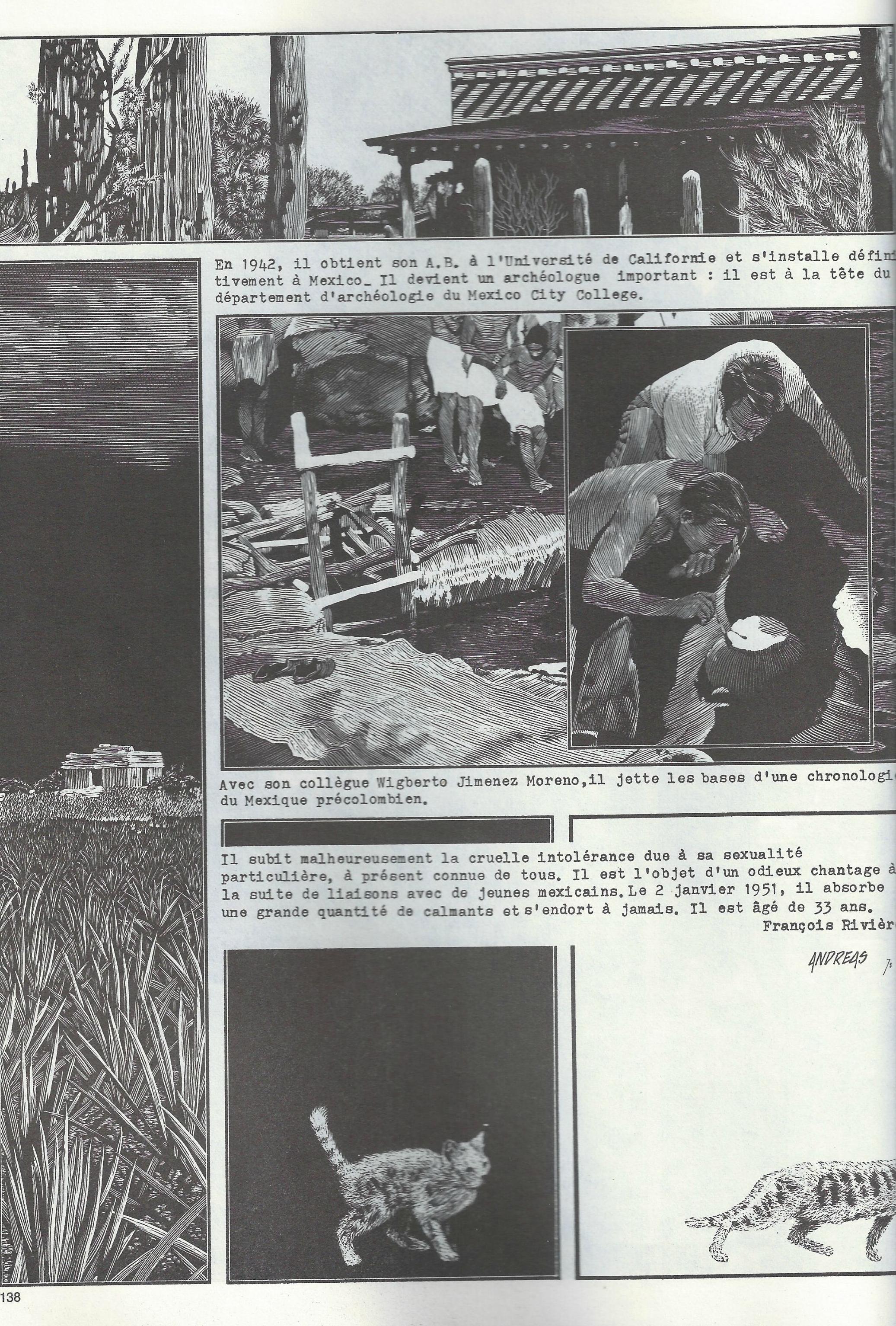
suiver-6

The narrative is, like most biographies, not some action-and-romance-packed account. Artist and writer manage to convey a sense time passing with the arrangement of the panels, particularly an extended shot of a kitten falling through perfect blackness that stretches out over several pages. While Lovecraft is the principal focus of the story because of the narrative, he dies in 1937…and Barlow’s story goes on, to his university education in Kansas, California, and then Mexico.

suiver-8

suiver-9

He unfortunately suffers the cruel intolerance due to his particular sexuality, at present known to all. It is the subject of an odious blackmail as a result of links with a Mexican youth. On 2 January 1951, it takes a large amount of sedatives and falls asleep forever. He is 33 years of age.

There are large parts of Barlow’s life that are not included in this brief but poignant bio-comic, because de Camp was more focused on those parts of Barlow’s life that concerned Lovecraft. We don’t read much about his career as a poet or writer of fiction; the issue of his sexuality and how de Camp came to publicize it was touched on in “The Night Ocean” (1936) by R. H. Barlow with H. P. Lovecraft, and here we see an example of how information spreads.

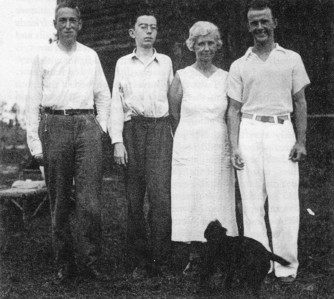
Notably absent from “R. H. B.” is an accurate depiction of R. H. Barlow himself. De Camp didn’t include any photographs in his biography for Andreas to base his depictions on, and few photos of Barlow at that point had been published.

1935-E

c. 1935

Left to right: H. P. Lovecraft, R. H. Barlow, Bernice Barlow, unknown cat, Wayne Barlow

“R. H. B.” stands as an artistic achievement, and one of (if not the first) graphic adaptations of Lovecraft’s life to feature R. H. Barlow, who did so much to preserve his legacy. Others appear in Alan Moore & Jacen Burrow’s graphic novel Providence (2015-2017); Henrik Möller & Lars Krantz’s Vägan Till NecronomiconCreation of the Necronomicon (2017); Sam Gafford & Jason Eckhardt’s Some Notes on a Nonentity (2017); and especially in Alex Nikolavitch, Gervasio, Carlos Aón, & Lara Lee’s H. P. Lovecraft: He Who Wrote in the Darkness: A Graphic Novel (2018), which showcases Lovecraft’s first encounter with Barlow in 1934…and all of these showcase how Barlow’s story has assumed its own mythical proportion, entwined with Lovecraft’s own.

While it was not uncommon for works in À Suivre to be reprinted, other than the publication in À Suivre, the only other publication of “R. H. B.”  that I have been able to confirm is in The Cosmical Horror of H. P. Lovecraft: A Pictorial Anthology (1991), a tri-lingual guide to Lovecraft comics published up to that point, which reproduces six of the eight pages of “R. H. B.” and Révélations posthumes (1980), a collection of Rivière and Andreas’ biographical comics from À Suivre.


Bobby Derie is the author of Weird Talers: Essays on Robert E. Howard & Others (2019) and Sex and the Cthulhu Mythos (2014).