And the feasting shall begin anew.
—Georgia Cook, “The Well” in From Beyond the Threshold (2023) 69
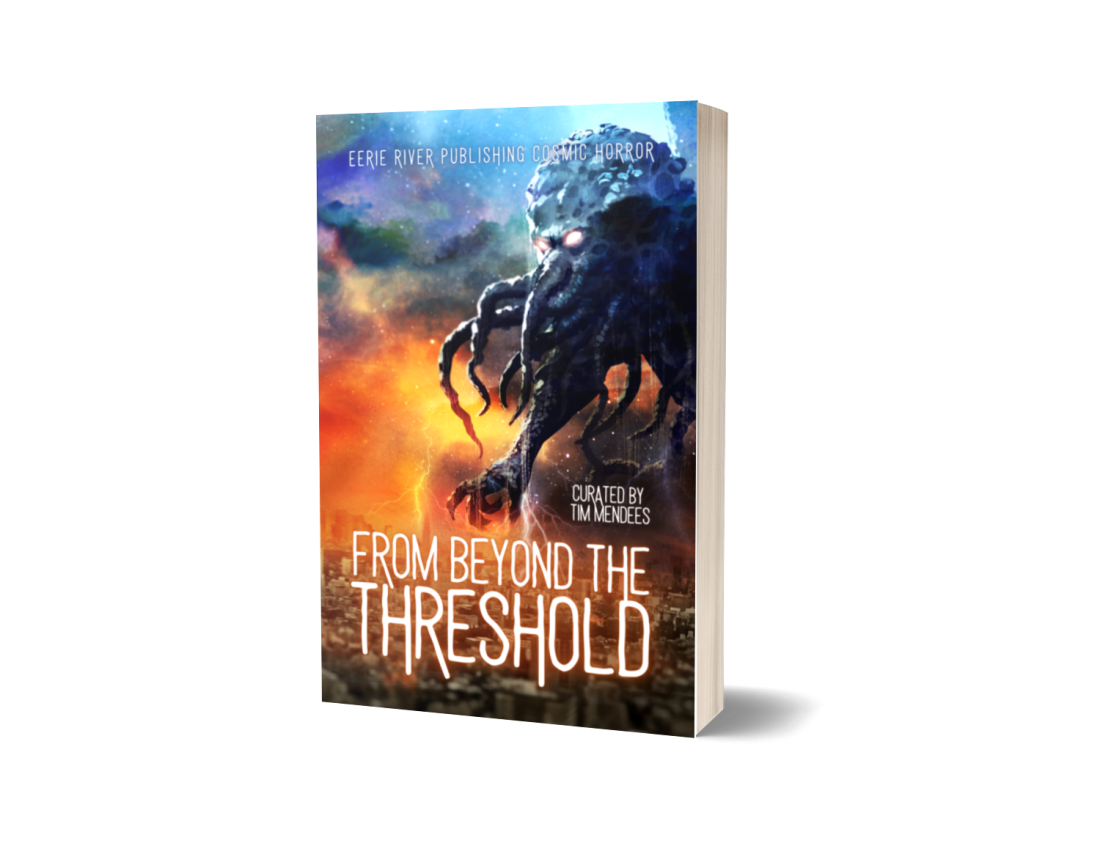
In “The Things We Did in the Dark” (2024) by Julia Darcey, two women are isolated in a special place, to service the needs of an unseen god in the dark. In that story, their position is not voluntary. They are there as a punishment, and ultimately as a sacrifice, valued only for their bodies and the work they can do. Georgia Cook’s “The Well” in the 2023 cosmic horror anthology From Beyond the Threshold by Eerie River Publishing, the situation is almost the mirror opposite. Two women, a special place, an unseen god below—but this nameless pair have been called. They are there of their own free will. Cast off everything else to embrace a life of service to the dark.
They call through loss and sorrow.
—Georgia Cook, “The Well” in From Beyond the Threshold (2023) 65
Cosmic horror, at least as Lovecraft tried to define it in his essay “Supernatural Horror in Literature,” is a kind of inversion of religious awe. It is the dark twin to wonder and glory at the face of the divine, the elucidation and humility that comes from the revelation of cosmic mystery. The sure sense or knowledge that there is something more than this life, with all of its pains and disappointments; something that by its very revelation of existence upends how we think of the world and how it works.
Yet there are those for whom darkness is a part of them. Perhaps it completes them, in a very different way than others are fulfilled by faith. While some Lovecraftian protagonists go mad from the revelation—as the trope goes—others find a kind of acceptance in the new order that the truth reveals.
A very few embrace the revelation. This is part of the discussion in “The Book of Fhtagn” (2021) by Jamie Lackey; the question of why someone would become a cultist in service to an eldritch entity and the trappings of religion that have sprung up about them. The answer in that story is a kind of parallel to this one: having become aware of the dark truth, they do not fight it, reject it, go mad, or simply go through the motions of life under the knowledge that all is pointless. They welcome it. They want to be a part of it.
In the opening to Arthur Machen’s “The White People” (1904), the great Welsh horror writer presents an opening episode on the nature of sorcery and sanctity:
‘Yes, and of the sinners, too. I think you are falling into the very general error of confining the spiritual world to the supremely good; but the supremely wicked, necessarily, have their portion in it. The merely carnal, sensual man can no more be a great sinner than he can be a great saint. Most of us are just indifferent, mixed-up creatures; we muddle through the world without realizing the meaning and the inner sense of things, and, consequently, our wickedness and our goodness are alike second-rate, unimportant.’
‘And you think the great sinner, then, will be an ascetic, as well as the great saint?’
‘Great people of all kinds forsake the imperfect copies and go to the perfect originals. I have no doubt but that many of the very highest among the saints have never done a “good action” (using the words in their ordinary sense). And, on the other hand, there have been those who have sounded the very depths of sin, who all their lives have never done an “ill deed.”‘
In a Machenian sense, the women of “The Things We Did In The Dark” are not sinners, and those in “The Well” are. Not because the women on that windswept island with the well are having murderous orgies in the swamp like Lovecraft’s Cthulhu cultists, but because they are working in their slow and deliberate way, to serve an end. They’ve turned their back on the human race…and though they harm no one directly, in their service they have tossed away everything they once knew and loved.
“…I’m not afraid,” she whispers.
“Of course you ain’t,” the old woman snaps. “S’not right to be afraid.”
—Georgia Cook, “The Well” in From Beyond the Threshold (2023) 68
There is a parallel in both stories to cloistered nuns; and nunneries were sometimes used as prisons to dispose of unwanted daughters and those who fell out of accepted society. Yet in “The Well,” the Keepers have walked willingly into their prison. There are no walls, nothing to prevent them from escaping that we can see. No rules and no enforcers.
They’re there because they want to be there.
That’s a bit marvelous and horrific. The acceptance of the darkness within. The recognition of something greater than themselves. Women who have pushed through pain and loss and out the other side, and found a place and purpose there, in the chaos beyond their old lives and every human attachment that held them there.
“The Well” by Georgia Cook was published in From Beyond the Threshold (2023) by Eerie River Publishing.
Bobby Derie is the author of Weird Talers: Essays on Robert E. Howard and Others and Sex and the Cthulhu Mythos.
Deep Cuts in a Lovecraftian Vein uses Amazon Associate links. As an Amazon Associate I earn from qualifying purchases.
 Deep Cuts in a Lovecraftian Vein