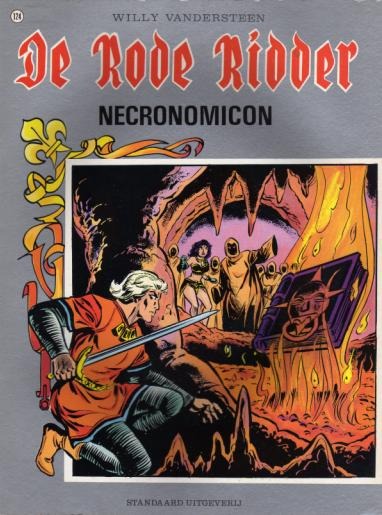
De Rode Ridder 124: Necronomicon (1987) by Karel Biddeloo

De Rode Ridder (“The Red Knight”) is a long-running Flemish-language medieval fantasy comic created by Willy Vandersteen in 1959, based on a series of children’s novels by Leopold Vermeiren in the 1940s. Roughly comparable to Prince Valiant, although not quite as consistent in storyline, as de Rode Ridder involves many standalone episodes and more fantasy and even science fiction elements. Vandersteen, who is credited with writing and drawing the strip for the first 43 albums (although gruntwork was done by others in his studio), passed it on to Karel Biddeloo, who wrote and drew the next 150 or so albums of De Rode Ridder’s adventures. About in the middle of Biddeloo’s run was album 124: Necronomicon, with Biddeloo joined by Urssla Lundmark (colorist) and Anita Schauwvlieghe (lettering).

While at sea returning from Byzantium, Johan, the Red Knight, is besieged by harpies…who are defeated with the aid of the Seal of Ishtar, which Johan acquired in the last album, Oniria. Except the amulet that de Rode Ritter pulls out from underneath his tunic may look a bit familiar:
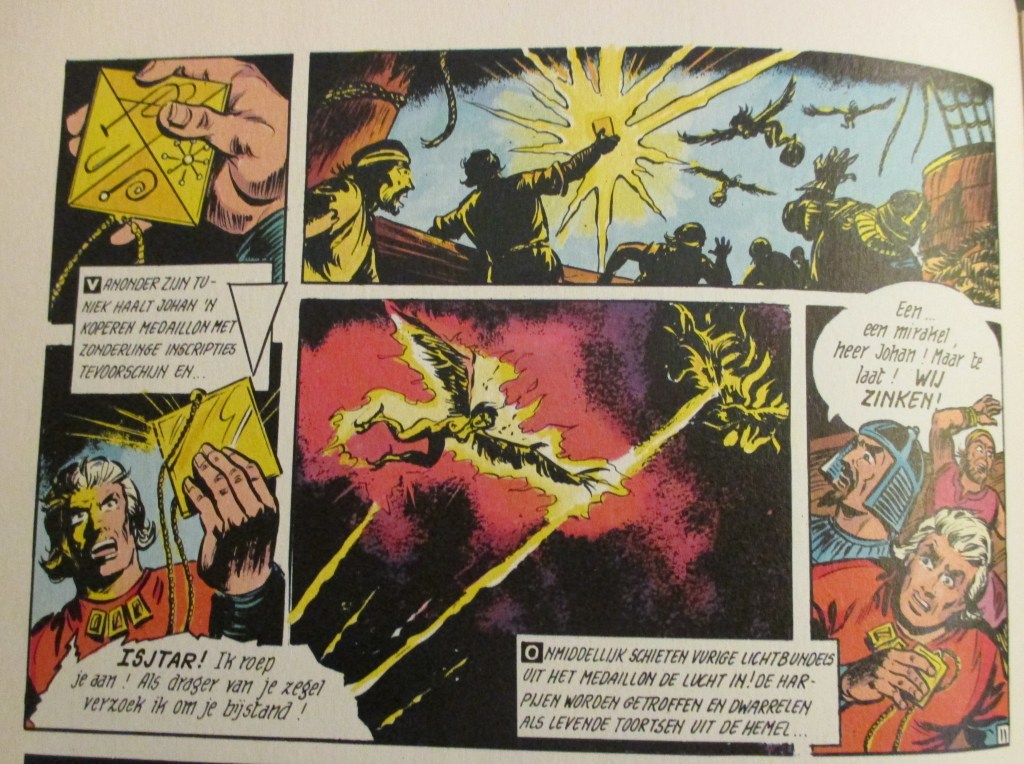
The Goddess of Venus is the most excellent Queen INANNA, called of the Babylonians ISHTAR. She is the goddess of Passion, both of Love and of War, depending on her sign and the time of her appearance in the heavens. […]

This is her Seal, which you must engrave on Copper, Venus being exalted in the heavens, with no one about watching its construction. Being finished, it is to be wrapped in the purest silk and lain safely away, only to be removed when need arises, at any time.

Simon Necronomicon 14-15
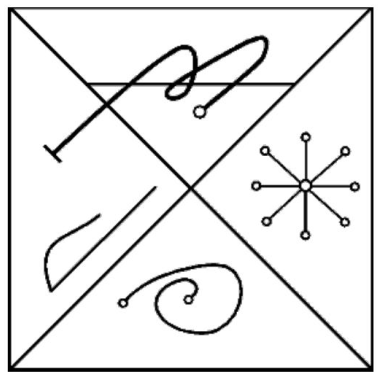
The Seal of Innana/Ishtar from the Simon Necronomicon

The Simon Necronomicon was first published in 1977, and by 1980 was released as a mass-market affordable paperback, to grace the New Age shelves of bookstores forevermore. While the impact of the Simon Necronomicon on Lovecraftian occult literature is sizable—see Dan Harms & John Wisdom Gonce III’s The Necronomicon Files for details—the artistic impact of it is often more apparent. The Gate Sigil on the cover of the book, created by artist Khem Caigan, has gone on to be appropriated by dozens or hundreds of artists for illustrations, comics, album covers, tattoos, and various and sundry merch.

The other illustrations in the book provided the first real visual occult symbols of the Mythos. While Lovecraft and Derleth had described their Elder Signs, and Robert W. Chambers had mentioned the Yellow Sign, Lord Dunsany the Sign of Mung, etc., there was no consistent popular depiction of these symbols or gestures—it was up to the readers to imagine what they would look like. Now, thanks to the Simon Necronomicon, there was a visual reference for various occult signs and talismans. Not surprising, then, that writer/artists like Karel Biddeloo opted to work them in.
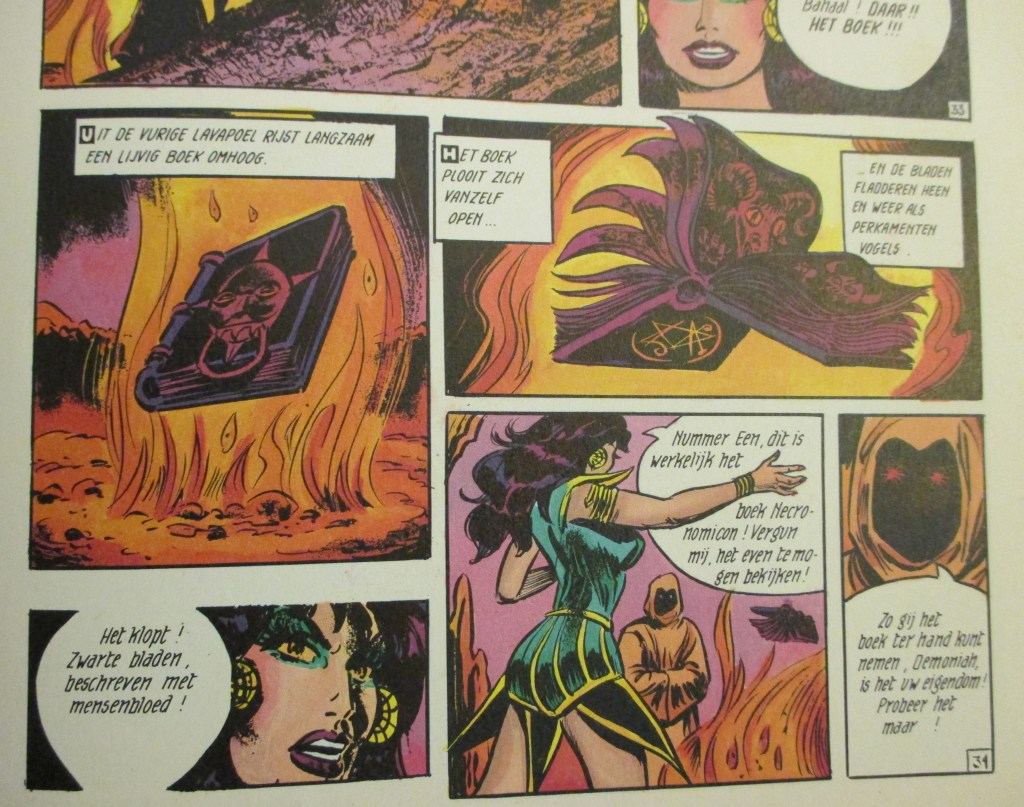
Not the Simon Necronomicon gate sigil on the back cover of the upper-right panel.

The Necronomicon of this Rode Ridder album isn’t a cheap paperback however, but a full-blown grimoire stored in a pillar of flame in a cavern beneath the earth, with a will of its own. A group of cultists working with Johan’s old foe, the sorceress Demoniah, manipulate him into retrieving the book for them. What follows is a rather typical adventure, full of action and a bit more swords & sorcery than horror—and I rather suspect that since the cultists are “der Meesters van de Swarte Kring” (“the Masters of the Black Circle”) that Biddeloo was also inspired in part by Robert E. Howard’s Conan stories, which includes “The People of the Black Circle.” The Necronomicon survived the destruction of the Swarte Kring, and would reappear in album 128: De Boeienkoning (“The Escape Artist, lit. “The King of Fetters,” much as how Houdini was sometimes billed “the Handcuff King”).
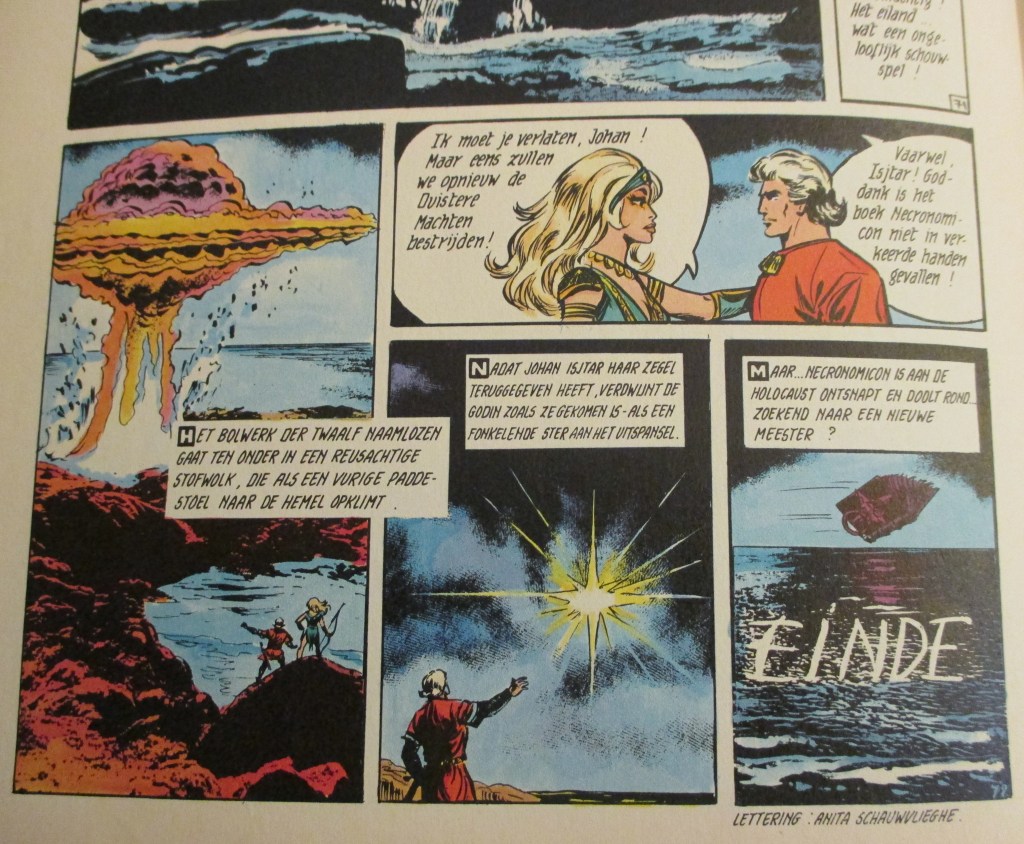
The Necronomicon literally flies off to its next adventure.

De Rode Ridder: Necronomicon is a fairly typical dip-of-the-toes into the Mythos; while Cthulhu, Yog-Sothoth, et al. don’t merit a mention, that’s probably as much as because Biddeloo was drawing from the Simon Necronomicon rather than directly from Lovecraft for inspiration; if this had been published after The Evil Dead came out in Belgium, the Necronomicon might be bound in human skin with a face on it! The book itself becomes a typical MacGuffin, since for all its portentous power it does not do much of anything by itself. For readers already familiar with the Necronomicon, it might be a fun or cute reference that gives de Rode Ridder another adventure; for those whose first experience with the Necronomicon was reading about it in this comic…perhaps this was their first step toward reading Lovecraft.

In terms of art, Karel Biddeloo is no Hal Foster, and the coloring sometimes muddies what might be better linework, yet it is still a very competent product with occasional dynamic illustrations that break out of the panel borders and breathe a little life into the work.

Regrettably, the adventures of de Rode Ridder have never been translated into English, although the Belgian albums and reprints are fairly available from European booksellers.


Bobby Derie is the author of Weird Talers: Essays on Robert E. Howard and Others and Sex and the Cthulhu Mythos.

Deep Cuts in a Lovecraftian Vein uses Amazon Associate links. As an Amazon Associate I earn from qualifying purchases.
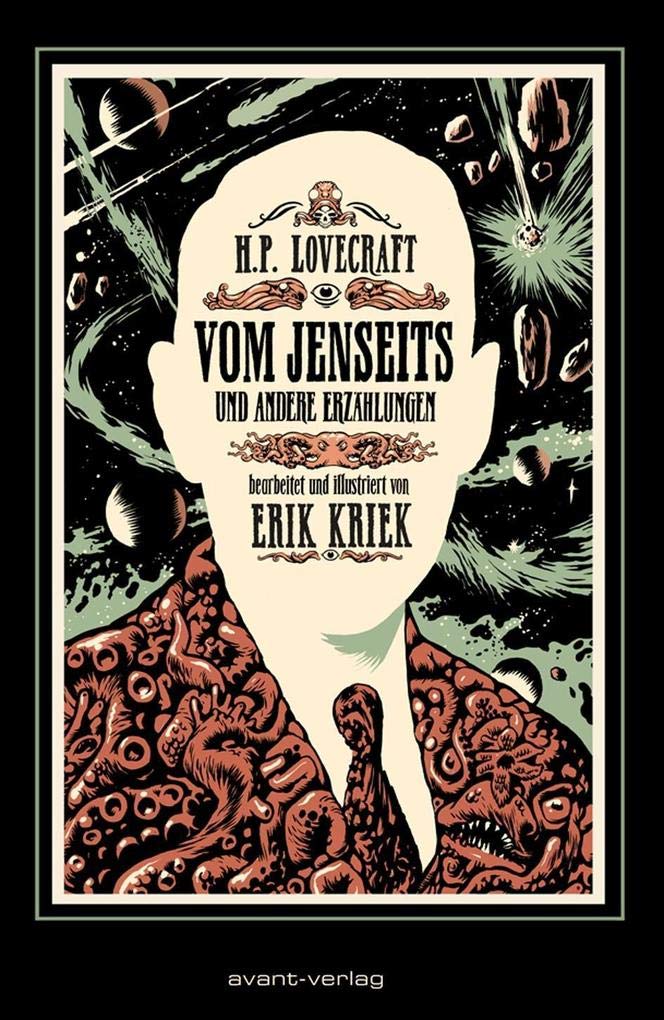
Vom Jenseits und andere Erzählungen (2013) by Erik Kriek

Erik Kriek hat etwas sehr Heikles gewagt: in Zeichnungen einzugangen, was man am besten und effektivsten der Phantasie des Lesers überlässt. Jeder, der ein Erzählung von H. P. Lovecraft, dem Meister der amerikanischen Ostküsten-Horrorgeschichten, liest, macht sich eigene Vorstellungen von den Monstern. Ich lasals kleiner Jungemeine erste Lovecraft-Geschichte, als mein Vater mir eine dicke Anthologie mit englischen und amerikanischen Horrorgeschichten schenkte: Vor und nach Mitternacht. Die sparsamen Illustrationen stammten von Eppo Doeve, unde heute, sechzig Jahre später, steht dieses Buch immer noch in meinem Regal, sind die Erzählungen in meinem Gedächtnis, befinden sich die Bilder auf meiner Netzhaut. Merkwürdige Zeichnungen, unvollständig, sparsam und, so wie es sich gehört, in Schwarzweiẞ. Das BUch hat eine lebenslange Faszination ausgelöst: Immer noch kaufe ich regelmässig Horror. Es erscheint keine Neuausgabe von Ambrose Bierce oder Roald Dahl, in die ich nicht hineinschaue, um ze sehen, ob darin – wie kurz auch immer – nicht doch etwas Neues steht.Erik Kriek has dared to do something very tricky: to capture in drawings what is best and most effectively left to the reader’s imagination. Everyone who reads a tale by H. P. Lovecraft, the master of American East Coast horror stories, creates Monsters from his own Imagination. I read my first Lovecraft story as a young boy when my father gave me a thick anthology of English and American horror stories: Before and After Midnight. The sparse illustrations were by Eppo Doeve, and today, sixty years later, this book is still on my shelf, the stories are in my memory, the images are on my retina. Strange drawings, incomplete, sparse and, as it should be, in black and white. The book triggered a lifelong fascination: I still buy horror regularly. No new edition of Ambrose Bierce or Roald Dahl appears that I don’t look into to see if there isn’t something new in it – however briefly.
Forward by Gerard SoetemanEnglish translation

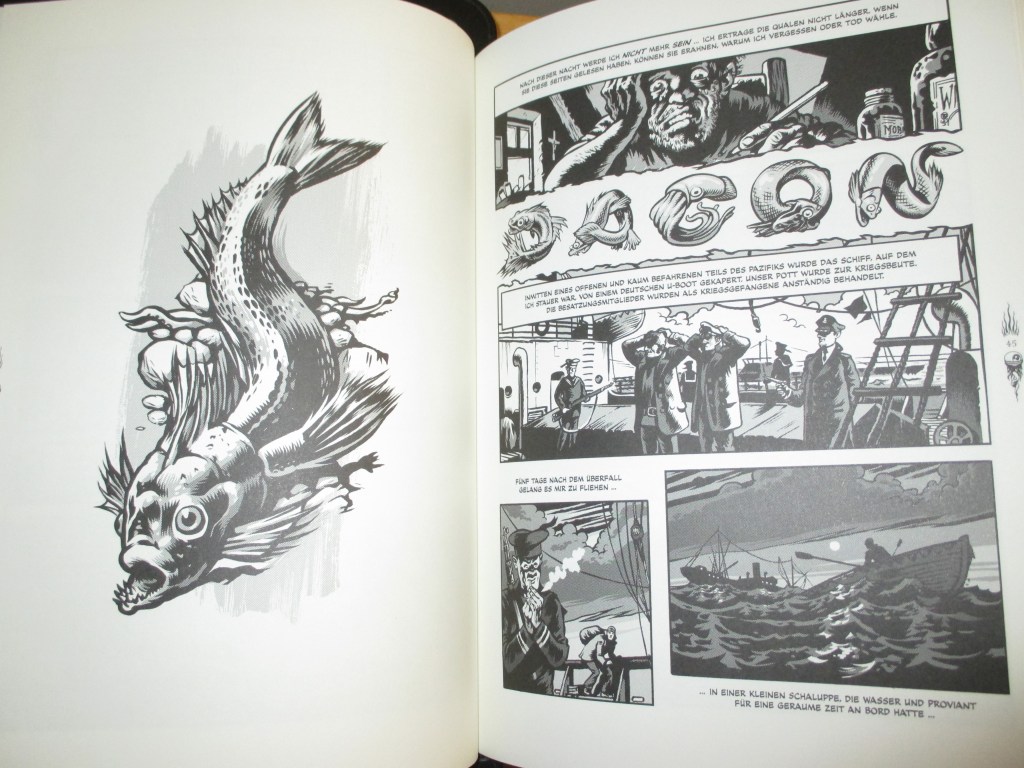
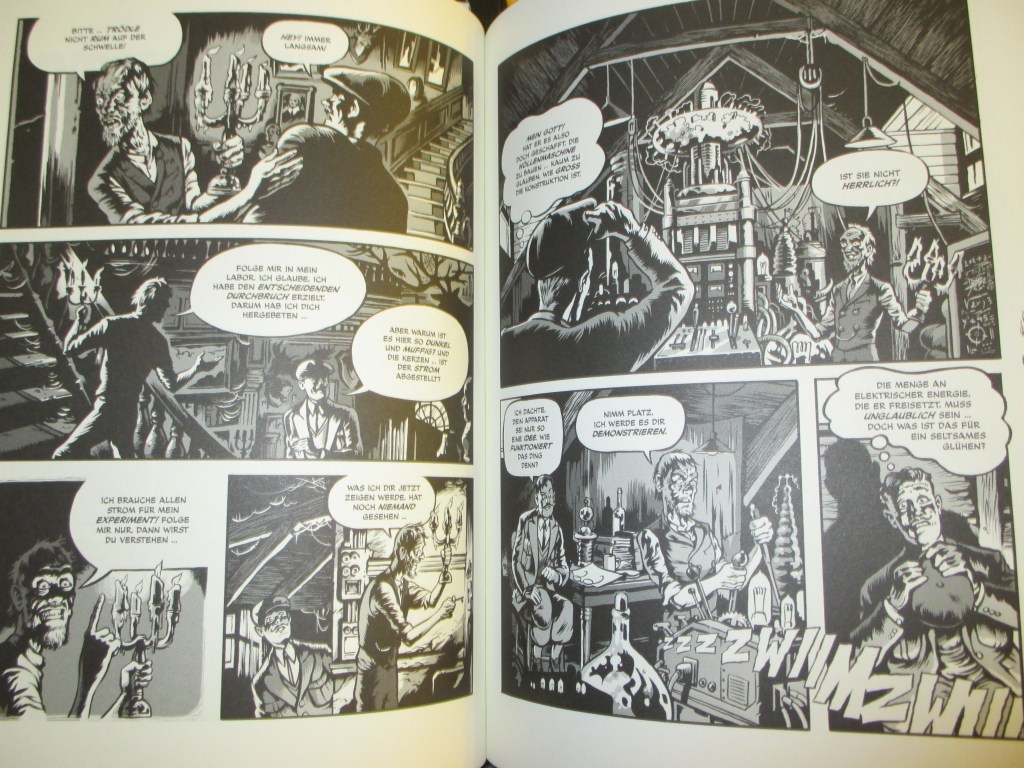
Vom Jenseits und andere Erzählungen (“From Beyond and other Tales,” 2013, Avant-Verlag) is a German-language collection of graphic adaptations of Lovecraft’s stories “The Outsider,” “The Color Out of Space,” “Dagon,” “From Beyond,” and “The Shadow over Innsmouth.” The adaptations are very faithful to the original, often down to the level of the language, which is often directly quoting from the German-language translation of Lovecraft’s stories.

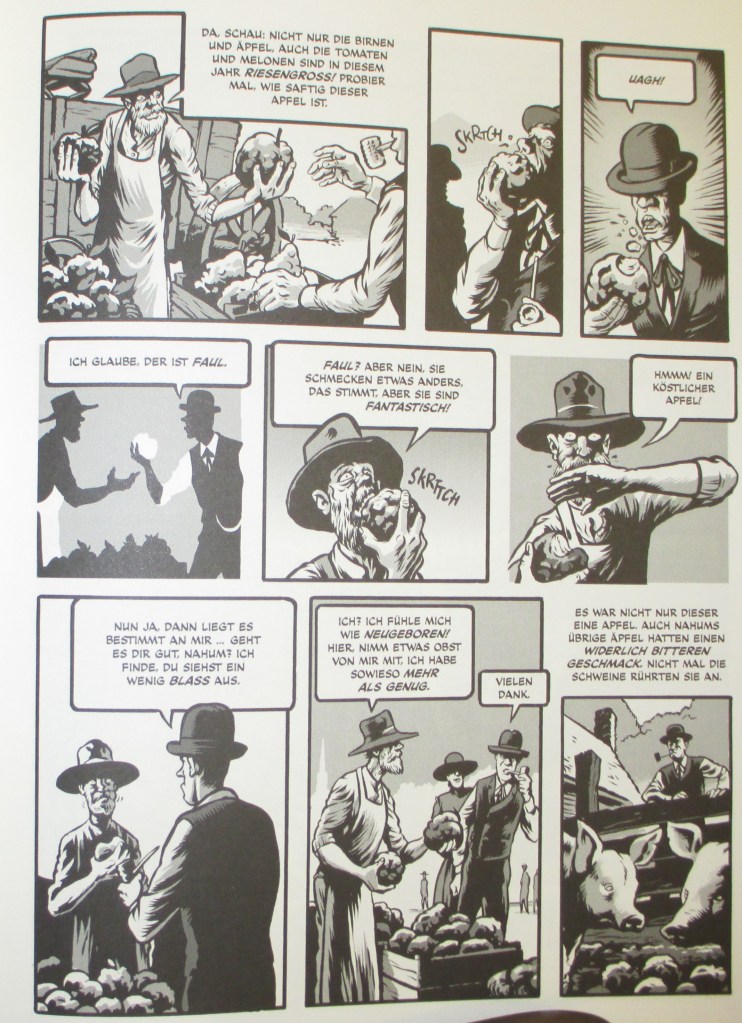
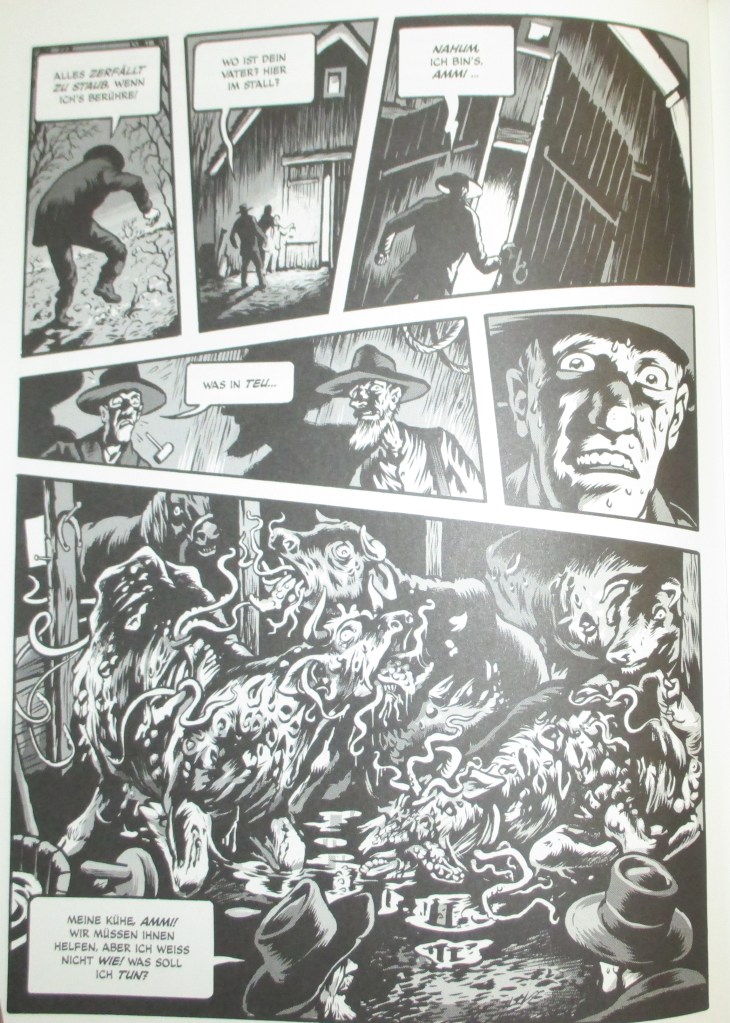
Kriek’s adaptation of “The Colour Out of Space”

Kriek, who is both writer and artist, has lavished most of his creativity on the art itself—with great care and attention to the setting and costumes of the characters, putting them in period-appropriate dress and rooms, giving them little quirks Lovecraft didn’t mention but might well have imagined. The style makes heavy use of shadows for the panes of the face and the set of the body, very reminiscent of the black-and-white artwork of 1970s Warren horror magazines like Creepy or Eerie, but cleaner and starker. The clear-cut reality of the normal frames gives Kriek’s wilder, more imaginative and fantastic pages more impact.

Note how the panels have slanted, no longer even and orderly, and the Dutch angle used. Visual rhetoric for “The world has gone wrong.”

There have been so many graphic adaptations of Lovecraft’s fiction over the years by so many artists, it is difficult to find points for fair comparison—or perhaps it is better to say, it’s hard to know where to start.

“The Outsider,” for example, is a 2,595 word short story; Kriek adapted it in six pages. Alec Preston Stevens also adapted “The Outsider” in six pages in Prime Cuts #1 (1987), so too did Bhob Stewart and Steve Harper in Monsters Attack #2 (1989), and Devon Devereaux and Tom Pomplun in Graphic Classics: H. P. Lovecraft (2002); Hernán Rodríguez did it in 14 pages (as “The Stranger”) in Heavy Metal (vol. 32, no. 8, Fall 2008), Tanabe Gou stretched it out to 24 pages for his 2007 collection …and because they are all adaptations of the same story, a really deep analysis could almost go line-by-line and panel-by-panel in comparison.

The same could be said for most of Lovecraft’s other stories. He did not leave a particularly large body of work, but nearly every story and many of the poems he wrote or had a hand in have been adapted in some fashion at some point by somebody—even relatively obscure works like the revision “Medusa’s Coil” is represented by “Medusa’s Curse” (1995) by Sakura Mizuki (桜 水樹氏) and “Nelle Spire di Medusa” (2019) by Massimo Rosi & Tommaso Campanini. Probably only Edgar Allan Poe has received better coverage in the comics.

Which might beg the question: why? What does a new graphic adaptation of Lovecraft bring to the audience that wasn’t there before? Was there something lacking about all the previous adaptations of “The Outsider” that moved Kriek to try his hand at Lovecraft in his own vivid style? Kriek’s adaptation in particular is very faithful to the original; he was not adapting the stories to his own times, not injecting any contemporary value or message into Lovecraft’s narrative. These adaptations are a genuine effort to do justice Lovecraft’s original vision, while also showcasing Kriek’s own interpretation.

The candelabra gives a Gothic touch, which makes the sudden high-tech appearance of the resonator all the more disturbing.

Which might be the answer in itself. Comic adaptations of Lovecraft exist because the stories are there in the public domain. No one can stop you. They are mountains to be climbed, caves to be spelunked. The fact that you are not the first to climb to the top of a particular mountain does not take away from the achievement of doing it. Anyone who completes a comic adaptation of “From Beyond” or “The Color Out of Space” may be competing, in some philosophical fashion, with every other artist who seeks to express the inexpressible in some fixed medium, but there is never going to be any final winner. Someone else is bound to come along and try their hand at it…but people can point to books like Vom Jenseits und andere Erzählungen and say: “Already, here’s what I did. What have you got?”

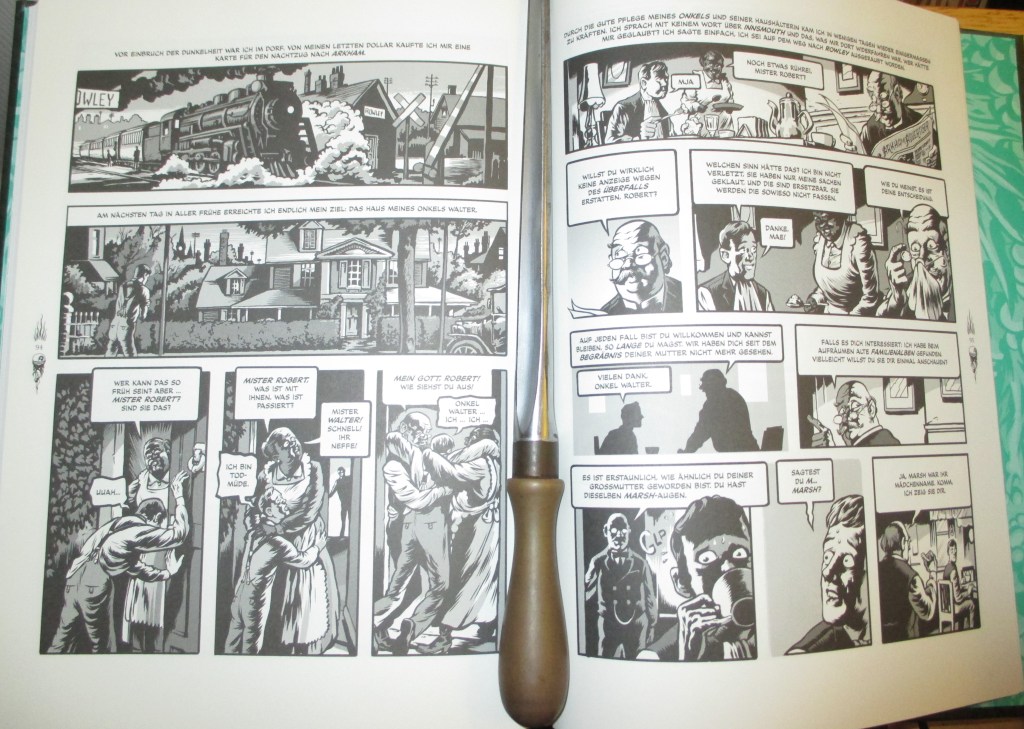
The Black housemaid, and the use of the narrator’s first name, are subtle differences from Lovecraft’s version of “The Shadow over Innsmouth.”

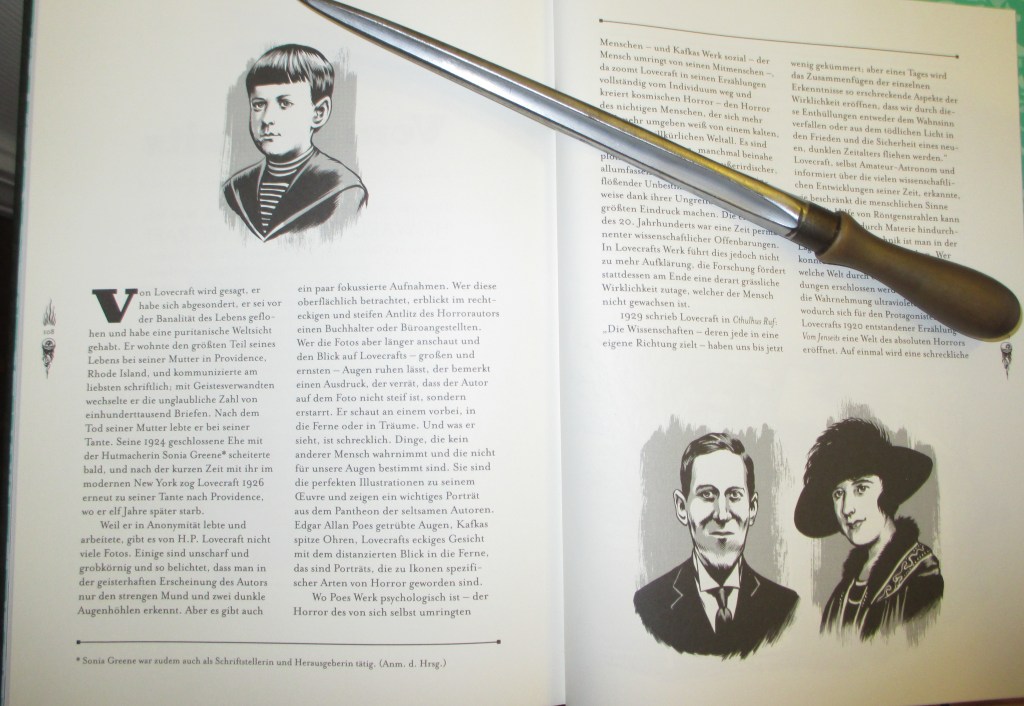
Kriek’s collection ends with “Vom Jenseits” (“From Beyond”) by Milan Hulsing, which is not the short story of the same name but a short biography of H. P. Lovecraft illustrated with a few choice pictures based on photographs of Lovecraft and his life. “Jenseits” is the German term for “on the other side” or “beyond,” but it can also refer to the afterlife, the underworld, the next world—in other words, there are some connotations that may or may not quite line up exactly with the English terms. Euphemistically, we are doing the same thing; catching a glimpse of another world…only the resonator is the book in our hands.

Addendum: I could not end this review without including this anecdote from the introduction:

Lovecrafts Erzählung Das Ding auf der Schwelle faszinierte und fasziniert mich noch immer so, dass ich sie, als eine Hollywood-Produzentin mich bat, einen Polit-Thriller zu schreiben, zu einem Drehbuch umgerbeitet habe. Um die geforderte Aktualität hineinzubekommen, dachte ich mir einen sehr wichtigen Berater eines neugewählten amerikanischen Präsidenten aus, der in einer kleinen neuenglischen Stadt à la Lovecraft landet. Man erlebt, wie er durch Seelenwanderung allmählich verrückt wird und zu glauben beginnt, dass das Ende der Welt, wenn es nicht sowieso schon bevorsteht, von ihm herbeigeführt werden muss. Als vollkommen Wahnsinniger reist er zerück nach Washington, um dort als Mitglied des Nationalen Sicherheitsrats dem Präsidenten verhängnisvolle Ratschläge zu geben … Die Produzentin lehnte das Drehbuch ab: „Wahnsinnige würden in Washington niemals in solche Positionen gelangen.“ Und dann … kam Oliver North, um Reagan zu dienen, und – später – taten Bushs Ratgeber ihre segensreich Arbeit so, dass die Vereinigten Staaten in maẞlose Schulden gestürzt wurden, um heillose Kriege zu führen und zu bezahlen … tja.Lovecraft’s tale “The Thing on the Doorstep” fascinated and still fascinates me so much that when a Hollywood producer asked me to write a political thriller, I reworked it into a screenplay. To get the required topicality in, I thought up a very important advisor to a newly elected American president who ends up in a small New England town à la Lovecraft. You see him gradually go insane through transmigration of souls and begin to believe that the end of the world, if it isn’t imminent anyway, must be brought about by him. As a complete madman, he travels back to Washington to give disastrous advice to the president as a member of the National Security Council … The producer rejected the script: “Insane people would never get into such positions in Washington.” And then … Oliver North came to serve Reagan, and – later – Bush’s advisors did their beneficent work in such a way that the United States was plunged into gross debt to wage and pay for hopeless wars … oh well.
Forward by Gerard SoetemanEnglish translation

English-language readers in the United States have a bad habit of not paying attention to what happens outside the Anglosphere, but the non-English-speaking world is large, and they pay attention to what we do here…because it affects them too. The resonator lets those from beyond see us as well as we see them; it translates both ways…and the world of H. P. Lovecraft is so much bigger and weirder than we can imagine.


Bobby Derie is the author of Weird Talers: Essays on Robert E. Howard and Others and Sex and the Cthulhu Mythos.

Deep Cuts in a Lovecraftian Vein uses Amazon Associate links. As an Amazon Associate I earn from qualifying purchases.
Lovecraft (1994) by Reinhard Kleist & Roland Hueve

Lovecraft. H. P. Lovecraft. Saft Dir das was?

Nur flüchtig.

Also, paß auf. Schriftsteller. Amerika. 1890-1937. Hat in Edgar Allen Poe—Nachfolge phantastiche Geschichten geschrieben. Origien des Grauens. Versponnen Wissenschaftler und romantische Helder gegen unheimliche und unbekannte Mächte aus den Tiefen des Universums. Ganz eigene, in sich geschlossene Mythologie. Kosmische Götter und Monstren mit merkwürdigen Namen. Azathoth, Nyarlathotep, Cthulhu…

Okay, okay. Ende des Klappentextes. Was hast Du vor?

Ich will was über die Lebensgeschichte von Lovecraft machen.

Und was?

Einen Comic.

Einen Comic? In wieviel Bänden?

Lies erst mal!
Lovecraft. H.P. Lovecraft. Mean anything to you?

Just in passing.

Okay, pay attention. Writer. America. 1890-1937. Like Edgar Allen Poe’s succesor—wrote fantastic stories. Origins of horror. Weaves scientists and romantic heroes against sinister and unknown forces from the depths of the universe. Completely separate, self-contained mythology. Cosmic gods and monsters with strange names. Azathoth, Nyarlathotep, Cthulhu…

Okay, okay. End of blurb. What are you up to?

I want to do something about Lovecraft’s life story.

And that is?

A comic.

A comic? In how many volumes?

Read it first!
Roland Hüve & Reinhard Kleist, introduction to LovecraftEnglish translation

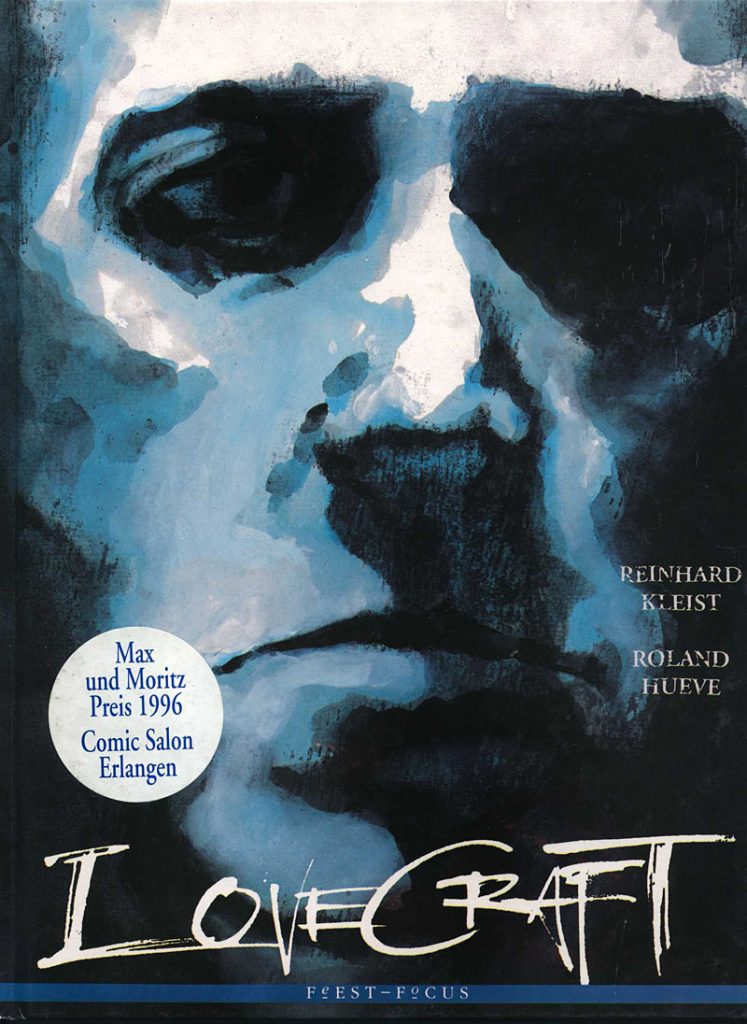
Lovecraft (1994) is a standalone German-language graphic novel in the European format normally associated with bandes dessinée—a slim, full-color hardback. The creation of Roland Hüve (script) and Reinhard Kleist (script & art), the 80-page story is focused on the idea of the character of Randolph Carter as a literary expy and alter ego for H. P. Lovecraft himself. As part of that, it adapts or partially adapts the story of “The Statement of Randolph Carter” as sort of an arching narrative of Lovecraft’s life, drawing on L. Sprague de Camp’s 1975 biography for details.

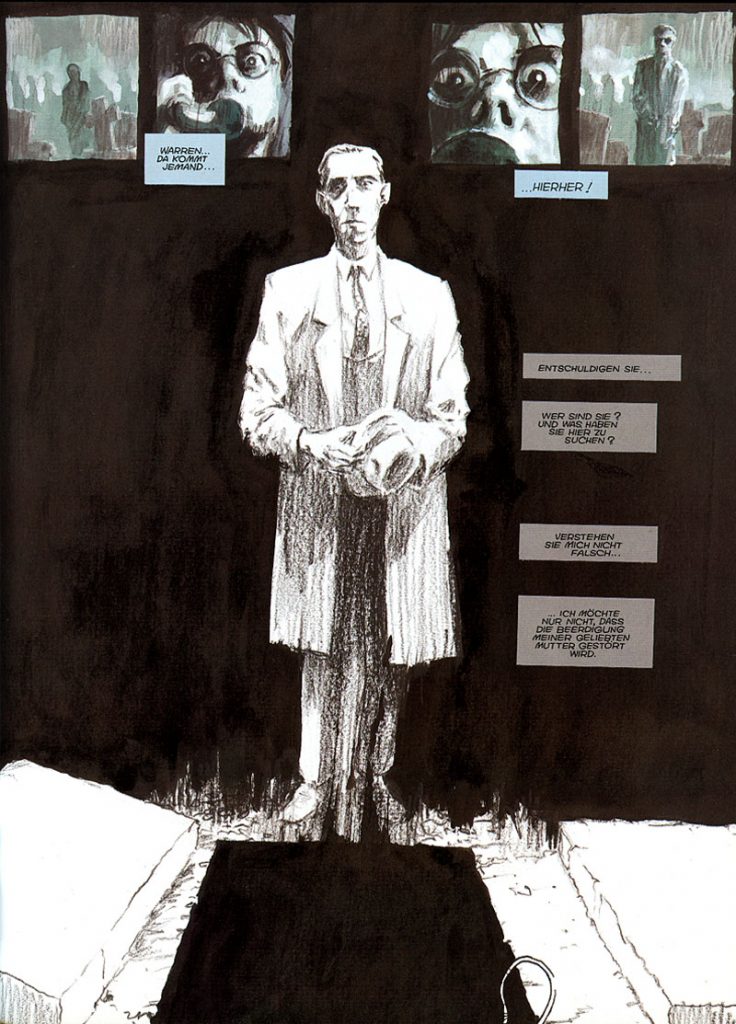
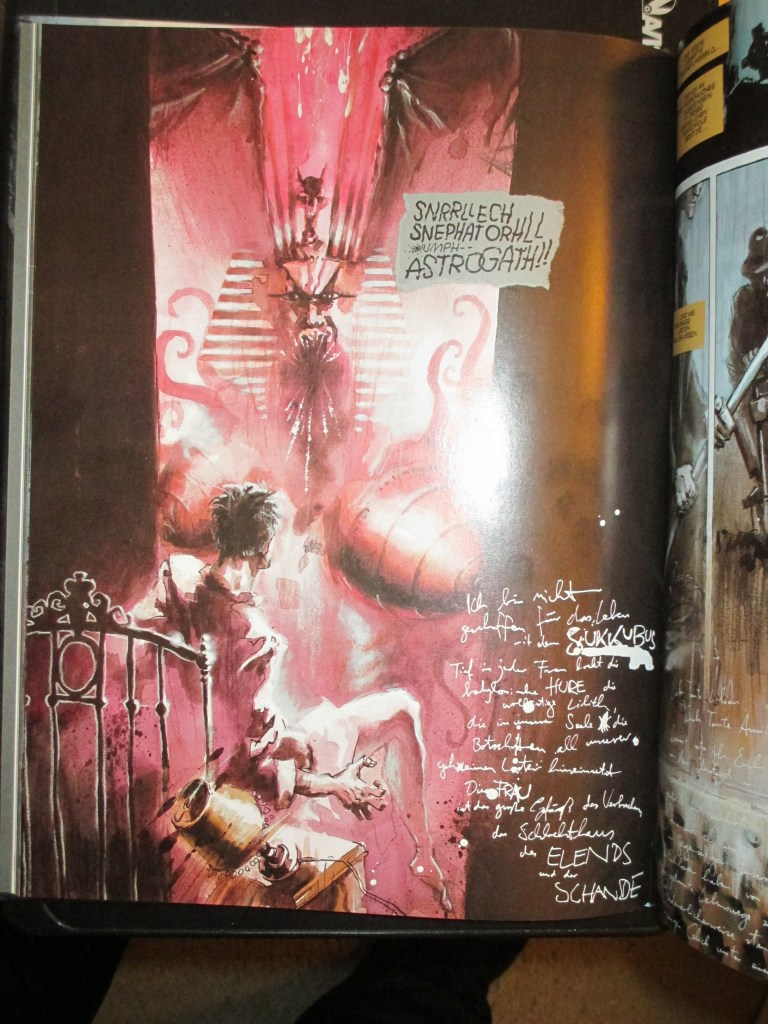
That bare description doesn’t really do the book justice. While the story is familiar—making Lovecraft himself a central character, part and parcel of the Mythos has been a favored treatment of many comic book creators—the real pleasure of the book is in Kleist’s artwork. The style is impressionistic, shifting, often mixing watercolors and frantic pencils, charcoals, and mixed media to great effect. It is a style very far away from the clean figures and lines of most comics at the time, either in Europe or North America. Much as if Dave McKean‘s lauded covers for The Sandman (1989-1996) were stretched out to fill a book.

Reinhard Kleist

Although that still might not be giving Kleist quite enough credit; as an artist, he has his own style, adaptable and varied. It is a visual feast, and readers familiar with Lovecraft’s biography will find many interesting visual references…and some amusing errors. Sonia H. Greene goes from a Juno-esque brunette who was seven years older than Lovecraft in real life to a young, ginger-haired flapper with a bob-cut…until she turns into a succubus.

Following the trend of blending real-life and fiction, more than a few liberties are taken. Don’t try to take it as a straight biography, but as what it is: a flight of fantasy spinning out from Lovecraft’s reputation as a horror writer and the rather neurotic and sexually-inhibited depiction of the man in de Camp’s flawed but ground-breaking biography.

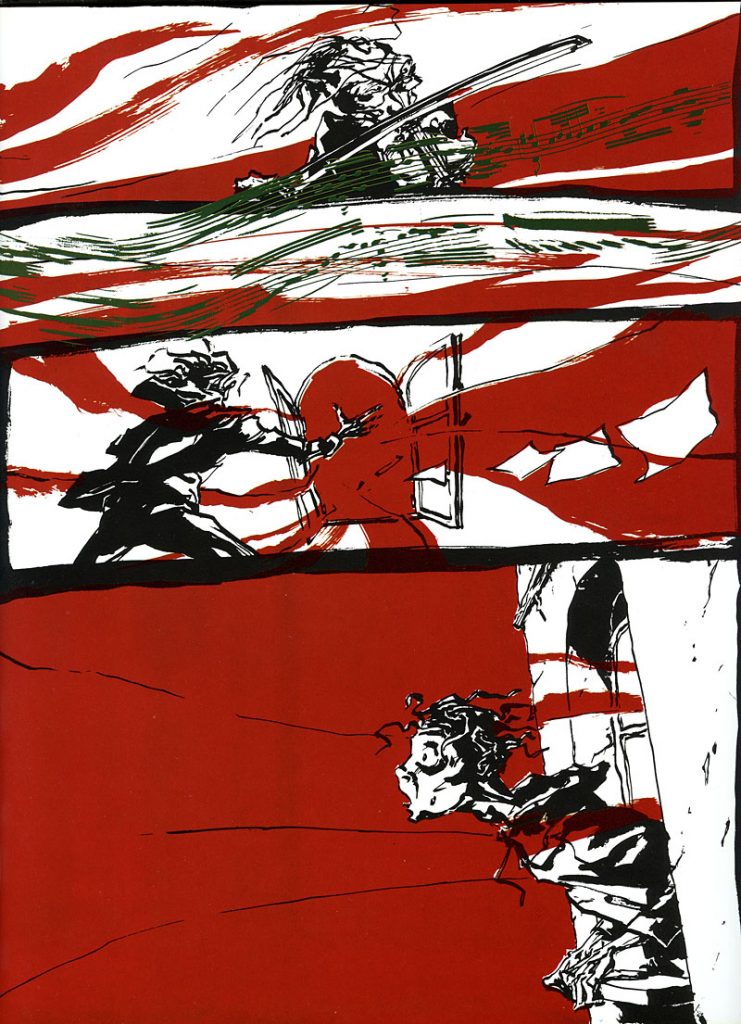
The second story in the book is a separate adaptation by Kleist alone, a much more restrained and deliberately grungier adaptation of “The Music of Erich Zann,” done in black and white and red, a much more sparse style that contrasts neatly with the rather more busy and cluttered compositions of the lead story.

Reinhard Kleist

As an adaptation, this one is rather faithful and does more to capture the mood and atmosphere of the story with its bold use of red; it’s an aesthetic choice that serves to suggest and convey the invasion from beyond in a way that a tentacle or a starry blackness doesn’t.

Like many European graphic novels, Lovecraft was never translated into English, so remains fairly obscure among English-reading audiences today. Of course, today it would have to compete with any number of competitors like Lovecraft (2004) by Hans Rodionoff, Enrique Breccia, and Keith Giffen; The Strange Adventures of H. P. Lovecraft (2010) by Mac Carter, Tony Salmons, Adam Byrne, and Keaton Kohl, and Some Notes on a Nonentity (2017) by Sam Gafford and Jason C. Eckhardt among many others.

That is a pity, because while the writing may lose something in the translation from the German, the art is compelling and might have universal appeal.


Bobby Derie is the author of Weird Talers: Essays on Robert E. Howard and Others and Sex and the Cthulhu Mythos.

Deep Cuts in a Lovecraftian Vein uses Amazon Associate links. As an Amazon Associate I earn from qualifying purchases.
1000 Ögon: Lovecraft (2014) by Jonas Anderson & Daniel Thollin

Tänk om H.P. Lovecraft hade levt idag och bott i Uppsala! Hur hade hans berättelser sett ut då? Vår bok heter helt enkelt 1000 Ögon: Lovecraft och är vår hyllning till denna skräckens mästare. Vi tolkar några av hans berättelser och placerar dem i vårt 1000 Ögon-universum. What if H.P. Lovecraft was alive today and lived in Uppsala! What would his stories look like then? Our book is simply called 1000 Eyes: Lovecraft and is our tribute to this master of horror. We interpret some of his stories and place them in our 1000 Eyes universe.
Swedish pitch on IndiegogoEnglish translation

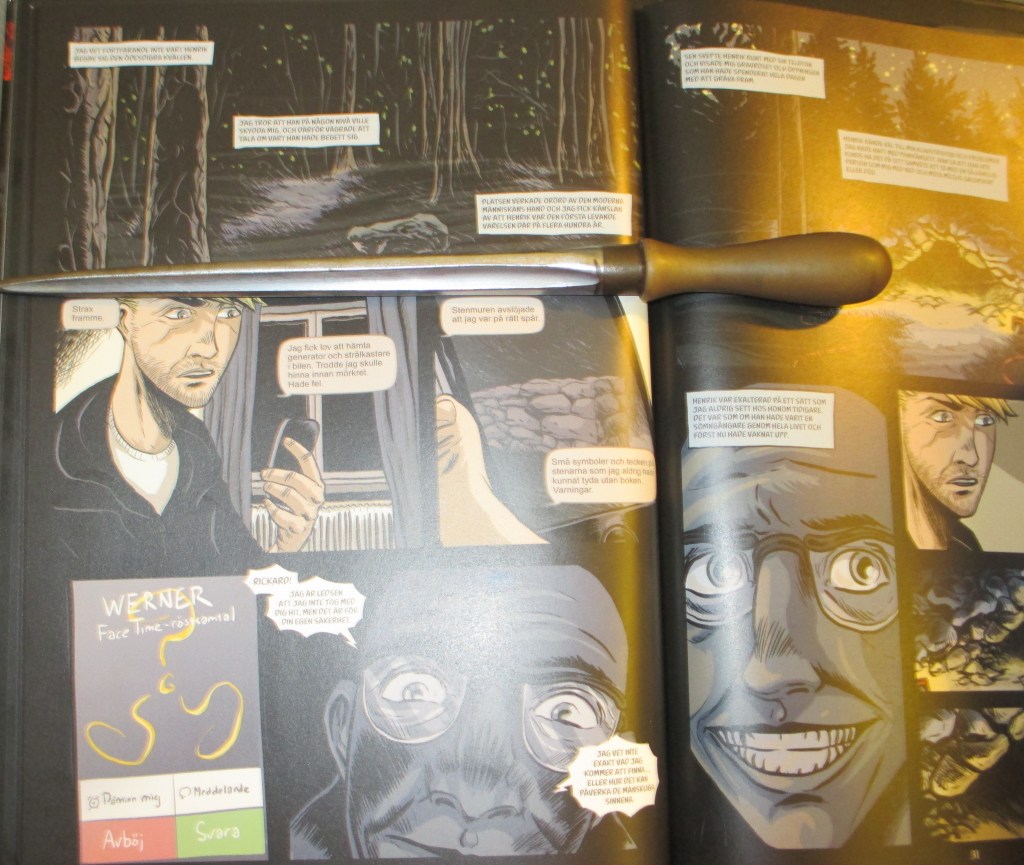
1000 Ögon (1000 Eyes) is the label for a contemporary Swedish-language series of horror graphic novels (really, thin bandes dessinée-style hardbacks) by the creative team of Jonas Anderson, Anders Björkelid, and Daniel Thollin, the last three published by Albumförlaget. Several of these have Lovecraftian influences, notably Filgia (2013), Lovecraft (2014), and Cthulhu (2015), but like a lot of non-English language publications that don’t make it into translation, they tend to get overlooked by English-reading audiences. The name “1000 ögon” is presumably a reference to the Swedish horror film Skräcken har 1000 ögon (“Fear has 1000 Eyes,” 1970).

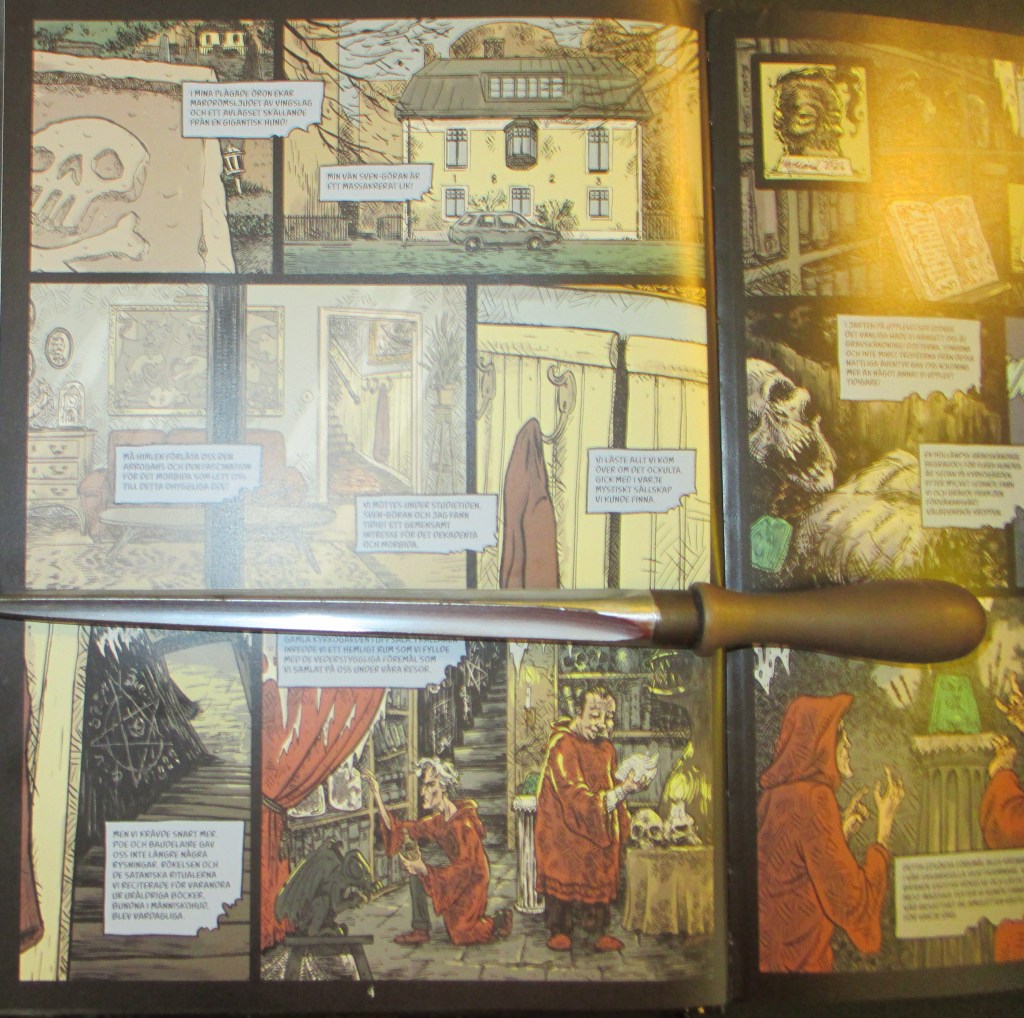
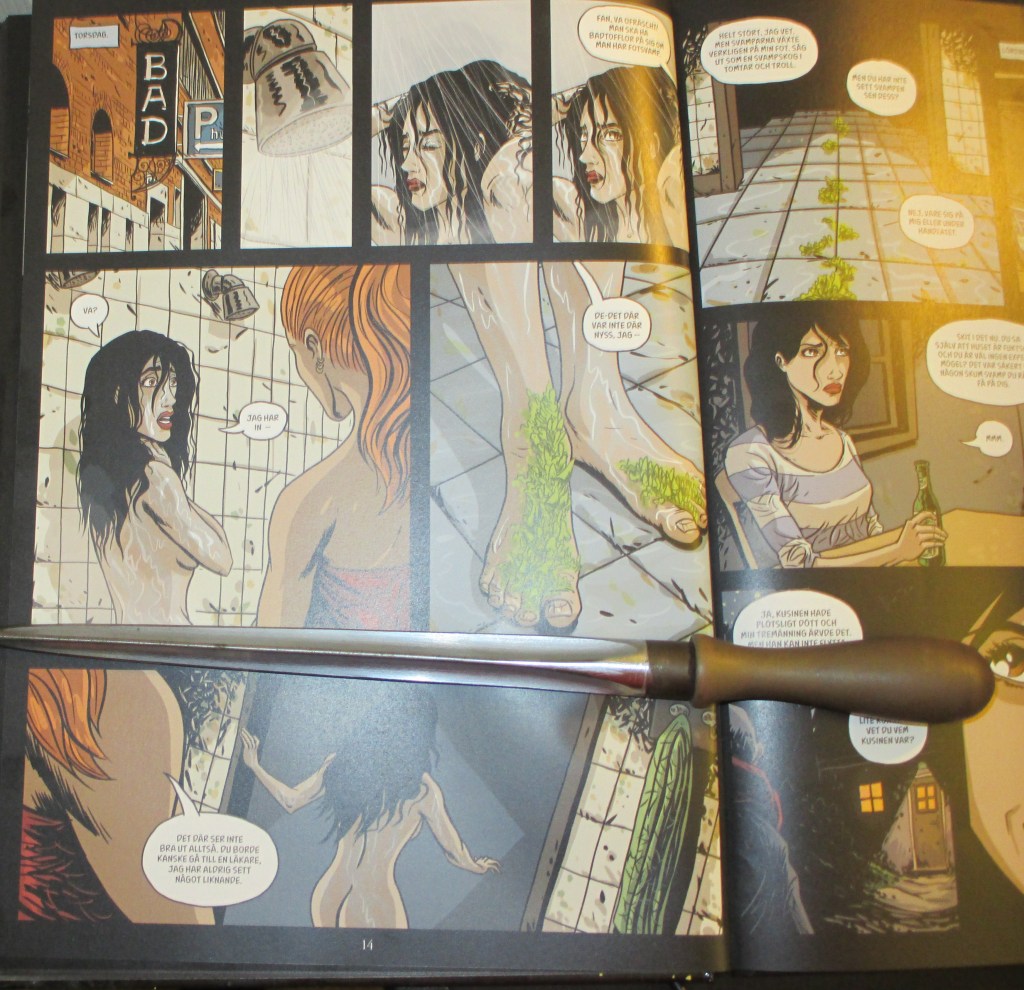
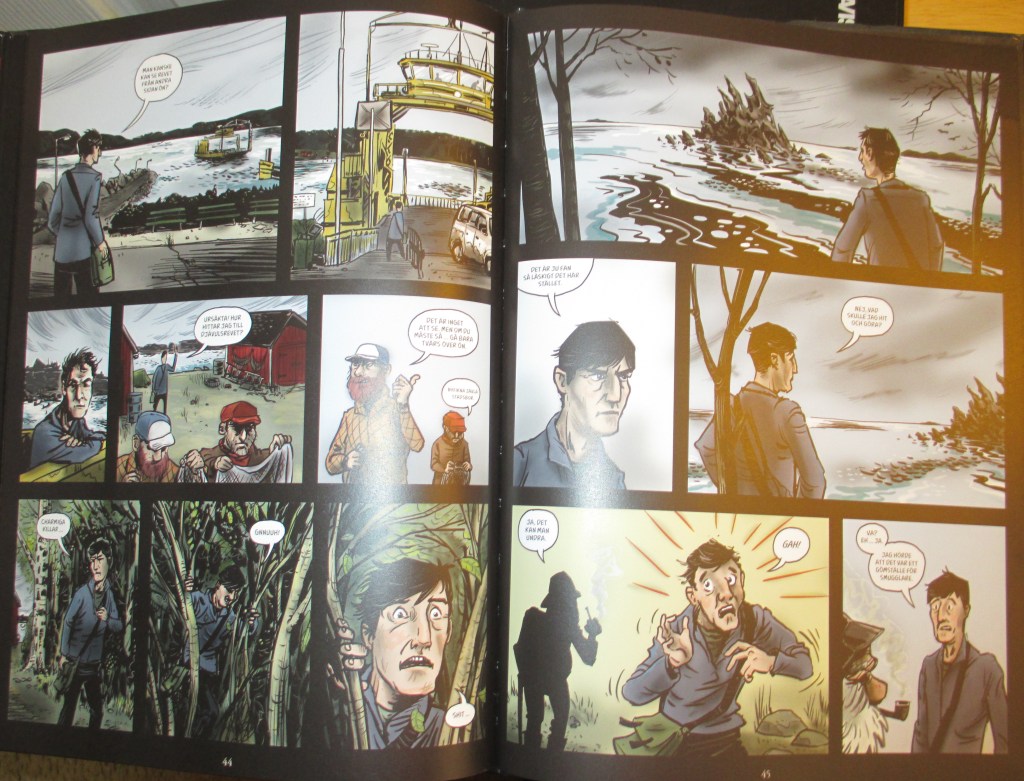
This is a bit of a shame because Lovecraft has an interesting basic premise: taking the core of four of Lovecraft’s stories (“The Hound,” “The Shunned House,” “The Statement of Randolph Carter,” and “The Shadow over Innsmouth”), and reworking them in a shared, contemporary setting, keeping what they feel is the essence of Lovecraft’s stories while freely altering the trappings and settings. In this way, the two graverobbing aesthetes of “The Hound” become more notably occult in their predilections (and apparently drive a Citroën GS); the protagonist of “The Shunned House” is a young woman named Cecilia dealing with something more than the standard mildew and black mold in the house, “The Statement of Randolph Carter” involves facetime over a smartphone rather than a field telephone, and “The Shadow over Innsmouth” takes some specific visual cues from the buildings of Uppsala and the Swedish fishing industry.

“The Hound”

Like many contemporary takes on the Mythos, Thollin and Anderson each work in references to the Cthulhu Mythos in these stories, even if there were none before. As each one writes and draws their respective episodes independently (“The Shunned House” and “The Statement of Randolph Carter” for Daniel Thollin and “The Hound” and “The Shadow over Innsmouth” for Jonas Anderson), this provides a degree of narrative continuity that might otherwise be lacking. Readers get the sense that these stories are connected, expressions of some common threat or body of myth, in a way that might not be obvious otherwise.

“The Shunned House”

For those at least passingly familiar with Swedish architecture or Uppsala in particular, the connectivity of the stories is also geographic and cultural. Which is rather the entire point of this exercise. While Lovecraft never weighed in on localization per se, he did famously note:

Searchers after horror haunt strange, far places. For them are the catacombs of Ptolemais, and the carven mausolea of the nightmare countries. They climb to the moonlit towers of ruined Rhine castles, and falter down black cobwebbed steps beneath the scattered stones of forgotten cities in Asia. The haunted wood and the desolate mountain are their shrines, and they linger around the sinister monoliths on uninhabited islands. But the true epicure in the terrible, to whom a new thrill of unutterable ghastliness is the chief end and justification of existence, esteems most of all the ancient, lonely farmhouses of backwoods New England; for there the dark elements of strength, solitude, grotesqueness, and ignorance combine to form the perfection of the hideous.

H. P. Lovecraft, “The Picture in the House”

Which is to say: horror can be found closer to home than you think. Forget for a moment all those Hollywood horrors set in the United States, don’t think yourself safe just because Lovecraft restricted himself primarily to New England. Horror can be anywhere, closer than you would like…you may be in some corner of Lovecraft Country already and not even know it.

“The Statement of Randolph Carter”

Visually, Thollin’s style is “cleaner” and closer to American-style comic figuring, while Anderson’s is a little scratchier and closer to the Franco-Belgian school, and the digital coloring on Anderson’s work in particular can look a little muddy at times. While it wouldn’t be correct to say that none of the stories being adapted lend themselves to grand visuals, it seems both Thollin and Anderson lean into a more subdued approach, focusing on the human characters and generally keeping things at their scale. So there are few grand visuals, but several clever and well-designed elements, like the stark outcropping of Devil’s Reef, which really stands out when compared to how it is normally portrayed, as barely a bump above the waterline.

“The Shadow over Innsmouth”

Lovecraft was followed up by a sequel titled Cthulhu. Whereas Lovecraft consists of four adaptations, Cthulhu is made up of two original works, both set in Uppsala, before and after the stars are right. The stories maintain much of the same artistic style and themes of the Lovecraft adaptations, but the creators have a little more free play to indulge their imaginations. Readers who dig the style and want to see what happens what Thollin and Anderson move beyond adaptation to pastiche won’t be disappointed.

While you might find Filgia, Lovecraft, and Cthulhu available online in some second-hand bookstores, the best way to order them is probably direct from Albumförlaget.


Bobby Derie is the author of Weird Talers: Essays on Robert E. Howard and Others and Sex and the Cthulhu Mythos.

Deep Cuts in a Lovecraftian Vein uses Amazon Associate links. As an Amazon Associate I earn from qualifying purchases.
Vägen till Necronomicon—Creation of the Necronomicon (2017) by Henrik Möller & Lars Krantz

After Lars’ and my collaboration on the book CREATION OF A GOD [ATT BYGGA EN GUD, 2015], the plans of a trilogy began to take shape. While CREATION OF A GOD was a cross between the works of Lovecraft and Lord Dunsany, the second book, CREATION OF THE NECRONOMICON, was pure Lovecraftian fan fiction. The third will be a kind of Clark Ashton Smith-inspired postapocalyptic dark fantasy about three pregnant outlaws running from the law after a trainrobbery [SKAPANDET AV EN MYT —CREATION OF A MYTH, 2018].

Henrik Möller, introduction to Vägen till Necronomicon—Creation of the Necronomicon (2017)

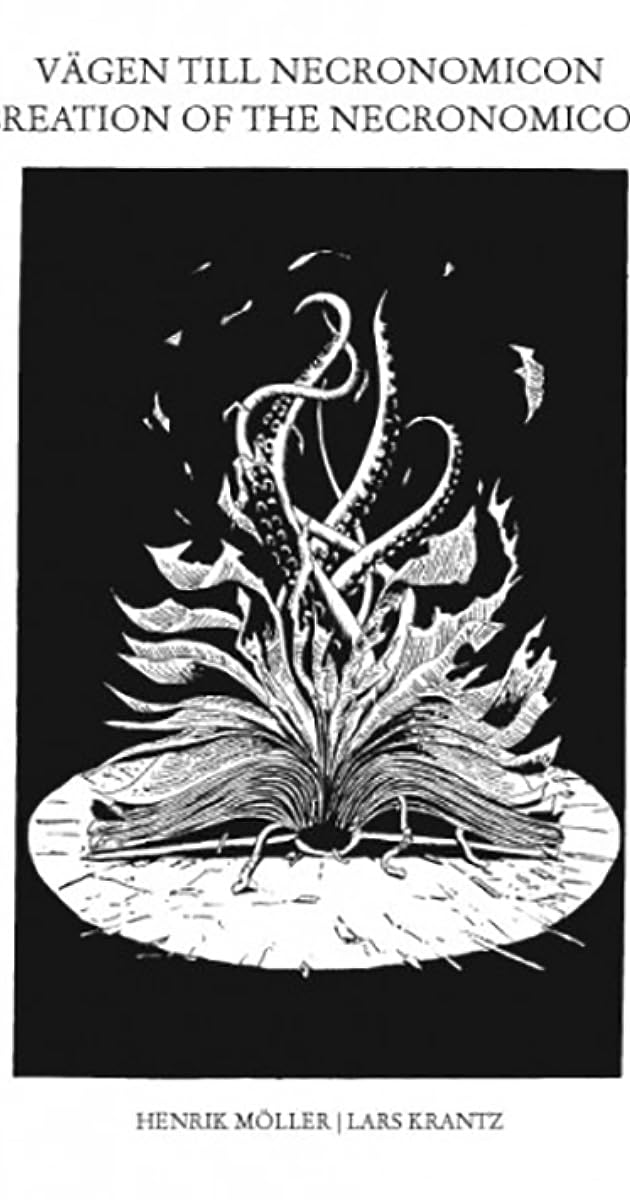
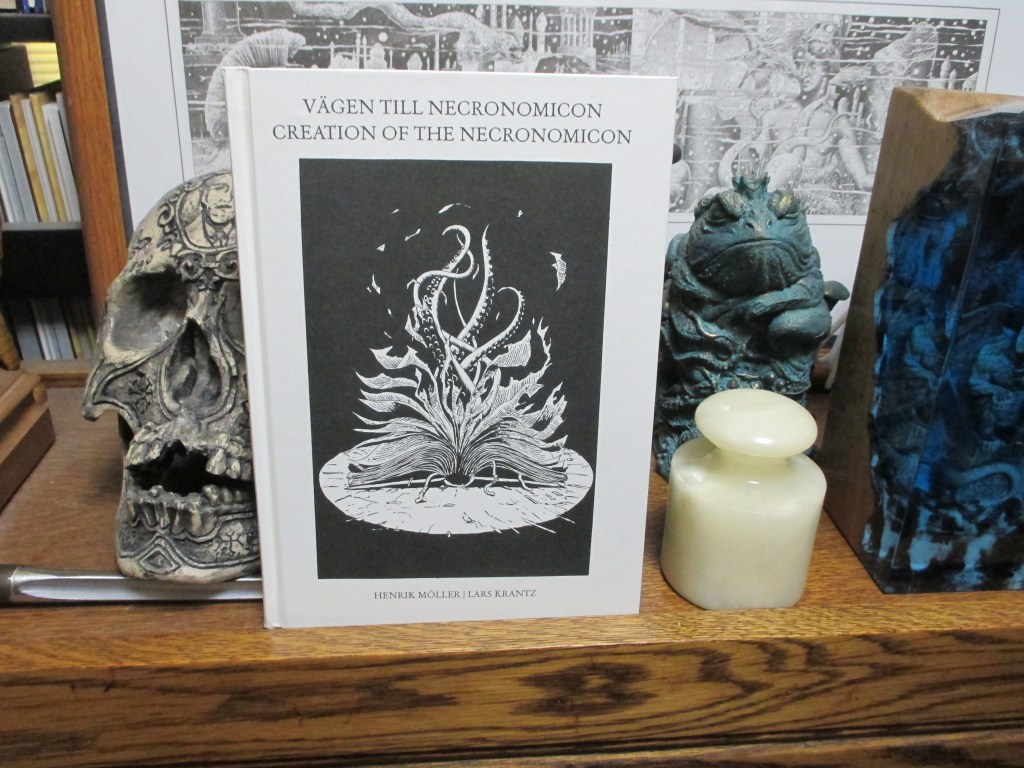
The middle of a trilogy of illustrated books, Vägen till Necronomicon—Creation of the Necronomicon (2017) consists of a text in Swedish and English by Henrik Möller, and black-and-white illustrations by Lars Krantz. While some sellers have categorized this book as a graphic novel, it would probably be more correct to label this an illustrated novel; text and image stand in contrast to one another, complementing one another: where one is sparse, the other is detailed; when one is subdued, the other is vivid. The result is as effective a work of graphic fiction as has yet been produced.

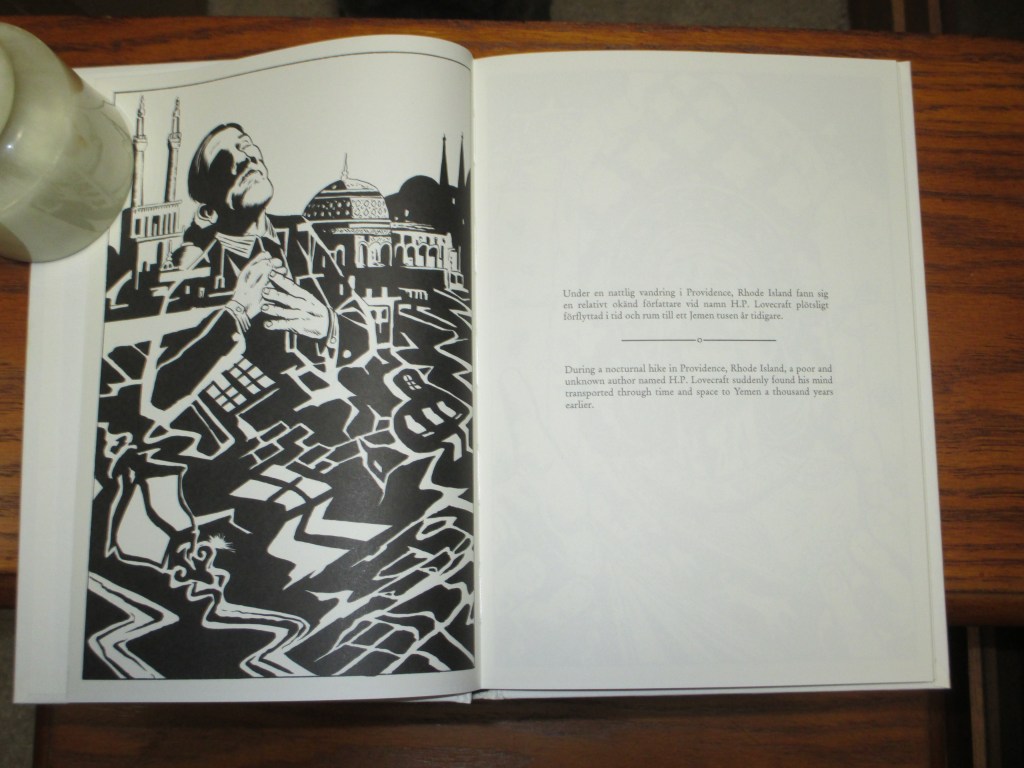
Möller’s description of the work as “fanfiction” is accurate, although that doesn’t quite do it justice. The story is an expansion of Lovecraft’s “The History of the Necronomicon,” retaining the essential elements of the story but expanding the narrative of Abdul Alhazred, adding a Vathek– or 1,001 Nights-style doomed romance. However, like many fans Möller and Krantz chose to weave fact with fiction, and the story has a framing narrative: one night in Providence, H. P. Lovecraft is out in a walk and finds his mind cast back a thousand years.

This is a not-uncommon device, the idea that Lovecraft and his fictional creation were both real, that the Mythos he created was real, at least to him—that the stories he told are occult truth, or even that he found or inherited a copy of the Necronomicon, from which he learned all this eldritch lore. The idea tends to rob Lovecraft of a certain genius, or at least agency; it makes him from a master storyteller to a kind of pulp journalist or cryptic occultist.

However, when carried out with sufficient style, the narrative convention of “the real Necronomicon!” still holds a bit of cachet. The tome, and its creators real and fiction, have achieved that legendary status where fact and fiction easily flow together. There are dozens of Necronomicons in the world today, from comic books to grimoires like Magic of Atlantis: Sauthenerom: The Real Source of the Necronomicon (1985) by Frank G. Ripel & Necronomicon: Il Libro Proibito di Abdul Alhazred (2022) by Mirando Gurzo, long novels to pillowbooks. All variations on the idea of the terrible book whose secrets are so terrible they make the skin crawl and the bright light of day a bit dimmer.

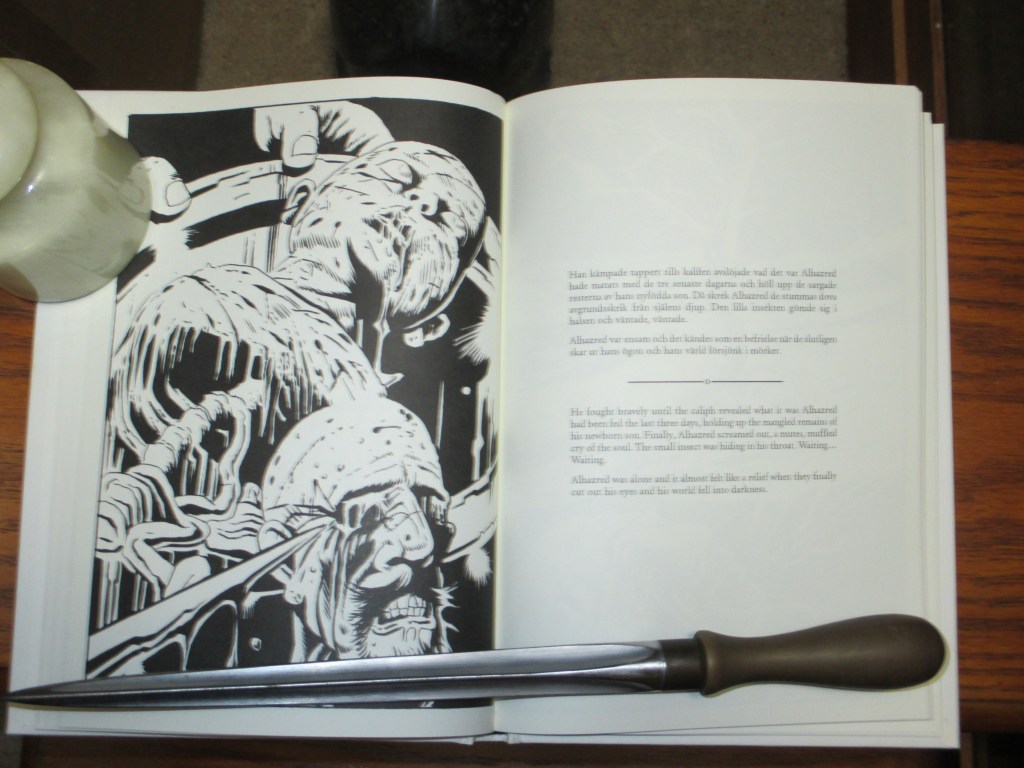
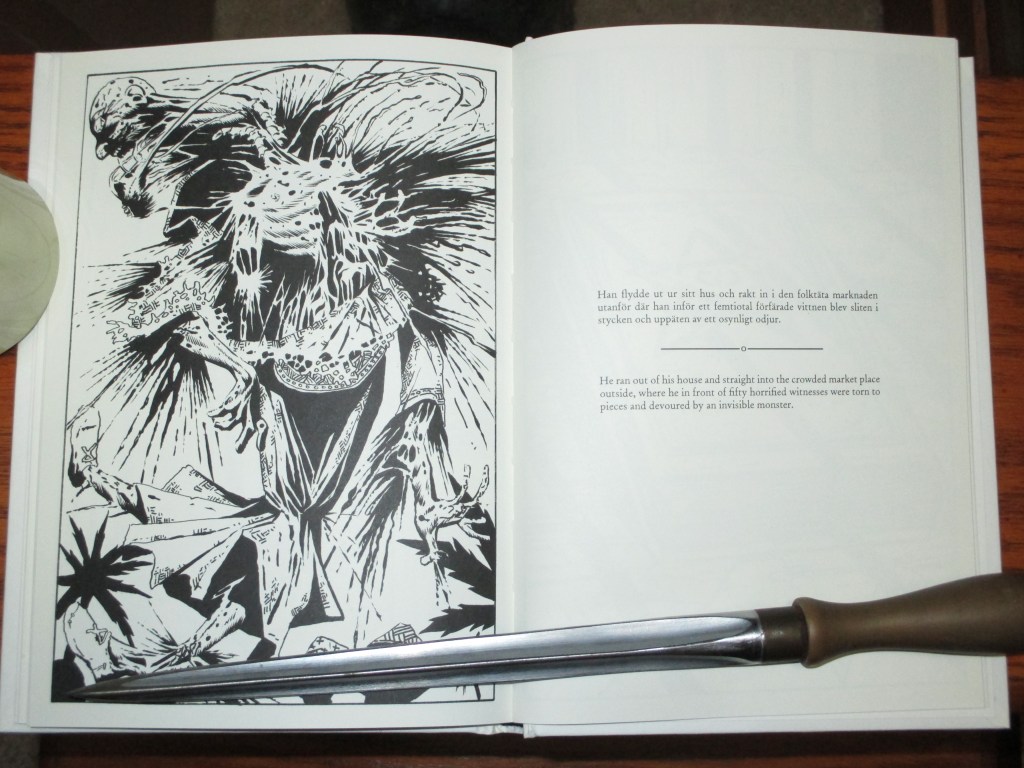
The Necronomicon is a sourcebook of horror. So it should come as no surprise that parts of Möller and Krantz’ book are appropriately horrible.

He fought bravely until the caliph revealed what it was Alhazred had been fed the last three days, holding up the mangled remains of his newborn son. FInally, Alhazred screamed out, a mutes [sic], muffled cry of the soul. The small insect was hiding in his throat. Waiting… Waiting.

Henrik Möller, Vägen till Necronomicon—Creation of the Necronomicon (2017)

This motif of the insect comes from a very small, often overlooked detail about the Necronomicon, which Lovecraft had borrowed from another source:

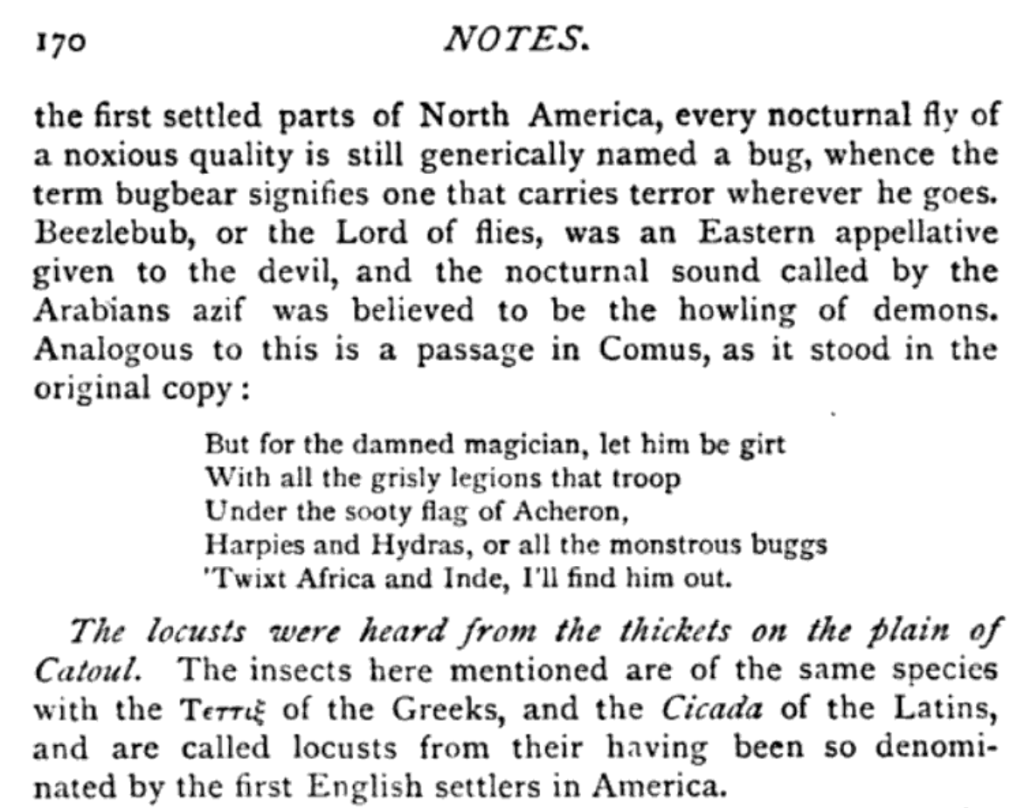
Original title Al Azif—azif being the word used by Arabs to designate that nocturnal sound (made by insects) suppos’d to be the howling of daemons.

H. P. Lovecraft, “The History of the Necronomicon

It is a small detail, often overlooked. Some authors credit Alhazred as an arch-cultist, heretic, and magician; others a hero whose dire warnings are often misinterpreted and abused; or a prophet, puppeted about by unseen powers. His life is a function with a single output: the Necronomicon. It is often the book that matters, the text itself, not necessarily where it came from or how it got into its current form.

Yet for Lovecraft, the whole point of “The History of the Necronomicon” is that the story of the text was what was important. The contents could never match the darkest depths of the readers’ imagination. Alhazred is integral to the story; it was the first such book to have a proper author and history, to be more than a strange and terrible name on the shelf in the secret library of some cultist. The story of the Necronomicon is important, because without that story, it is just another odd tome, no more special than the rest.

It is a book born in blood and mystery.

There is an epilogue. The narrative returns to the frame-story. Lovecraft at his typewriter. The temporal loop is closed. In the final pages, the story comes to a bit of an ugly and unsettling close, weaving fact and fiction again:

Finally, on his deathbed, he wrote down all of Alhazred’s writings from memory into what he called his death diary and bequeathed it to his friend Robert Barlow.

After Lovecraft’s death, Barlow took the book to Mexico where he eventually committed suicide. The book is, as of today, still missing.

Henrik Möller, Vägen till Necronomicon—Creation of the Necronomicon (2017)

The truth of Lovecraft’s “death diary” is more prosaic, and perhaps more terrible for that. It was a minute record of Lovecraft’s final, fatal illness and last days, beginning 1 January 1937. While the actual diary is missing, Barlow copied and condensed some entries, which are reproduced in Lovecraft’s Collected Essays volume 5. The entry for March 7th simply reads “hideous pain.”

The reality of the death diary puts the Necronomicon in context. We may fill it with whatever terrible cruelties and eldritch lore we may dream up. The Necronomicon Files by Daniel harms & John Wisdom Gonce III has a list; everything from the secret of telepathy to how to breed worms in the carcasses of camels. The real world is often more prosaic, but no less horrible. Lovecraft’s death diary is an account of adult fears, the yawning death in hospital beds as cancer gnaws at our bowels. A death by inches, punctuated by a thousand indignities, and then…nonexistence. Throwing the gates wide to let the Old Ones come again would at least be a choice.

Henrik Möller is also a filmmaker, and to accompany the publication of Vägen till Necronomicon—Creation of the Necronomicon (2017), he also released a short video adaptation of the work, which is still available on Youtube. The film in narrated by Möller in Swedish and English, to Krantz’ illustrations, with a soundtrack by Möller. If you cannot get the book, it is a good way to experience their story.


Bobby Derie is the author of Weird Talers: Essays on Robert E. Howard and Others and Sex and the Cthulhu Mythos.

Deep Cuts in a Lovecraftian Vein uses Amazon Associate links. As an Amazon Associate I earn from qualifying purchases.