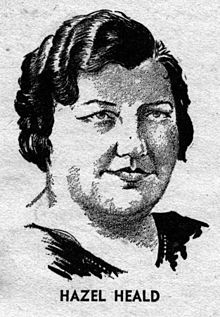
“The Horror in the Museum” (1933) by Hazel Heald & H. P. Lovecraft

I’ve just ghost-written a tale for a client in a fashion amounting virtually to original composition—about a waxwork museum or chamber of horrors where there is a rumour that not all of the fabulous monsters displayed are artificial. I’ve included Tsathoggua among the blasphemies.
—H. P. Lovecraft to Clark Ashton Smith, 28 Oct 1932, Dawnward Spire, Lonely Hill 394

After the successful sale of “The Man of Stone” (1932), Hazel Heald and H. P. Lovecraft pursued further “revisions”—which, as with his client Zealia Bishop, critics and biographers assume amounted to Lovecraft writing the story based on an idea or synopsis provided by Heald. This is certainly the case as far as Lovecraft was willing to discuss it in his letters:

Yes—the waxwork museum story is mostly my own; entirely so in wording, & also so far as concerns the background of Alaskan archaeology & antique horror. You will find Tsathoggua mentioned.
—H. P. Lovecraft to Clark Ashton Smith, 14 Jun 1933, Dawnward Spire, Lonely Hill 420

The Horror in the Museum—a piece which I “ghost-wrote” for a client from a synopsis so poor that I well-nigh discarded it—is virtually my own work. Glad you found it entertaining. There will be two more Heald tales equally dependent on my pen.
—H. P. Lovecraft to Richard Ely Morse, 28 Jul 1933, Selected Letters 4.229

There is not much to gainsay this. Other pulpsters of the period noted Lovecraft’s style without needing to be told. Heald herself does not comment on the writing of the story in any surviving letter, but she did note in a much later letter to August Derleth:

He was a severe critic but I knew that if I finally suited him in my work that the editor would usually accept it. For example— I had to rewrite “Out of the Eons” six times before he was completely satisfied!
—Hazel Heald to August Derleth, 25 Mar 1937

This would appear to jive with a comment on collaboration or revision work that Lovecraft made to another correspondent:

These alleged authors are pretty easy to handle—discard their dope little by little & substitute your own, & in the end they not only swallow it but honestly believe they wrote it themselves! Thus some of my revision clients congratulate themselves when the readers of Weird Tales praise stories (like “The Last Test”, “The Curse of Yig”, “The Horror in the Museum”, “Winged Death”, &c.) that I wrote.
—H. P. Lovecraft to James F. Morton, 28 Mar 1934, Letters to James F. Morton 350

So the possibility remains that the revision process for this story could have been a bit more involved than Lovecraft simply writing the tale from scratch based on a mostly-discarded synopsis. Presumably, the business arrangement was identical to that of Lovecraft’s other client: Heald would have paid a fixed sum for the work, and then tried to sell it to the pulp magazines for whatever she could get. None of their correspondence survives to give greater insight into this aspect of their dealings or the composition of their stories.

The idea of a waxwork museum and its chamber of horrors goes back to the 19th century, with Madame Toussads in London being the archetype and inspiration for a number of other such galleries, and the horror stories and comics eventually created in tribute to them. It is notable that the same year “The Horror in the Museum” was released, the horror film Mystery of the Wax Museum (1933, once thought lost), hit theaters. Lovecraft recalled:

Haven’t done much cinema-viewing, but I did drop in to see that “Wax Museum” thing—especially since I had revised (in fact, virtually ghost-written) a tale on a similar theme for a client. (you’ll see it in the current W.T.) As a story, the film was of course childishly cheap—but it did have some effective horror-touches—especially when the mask falls off & reveals the monstrosity beneath.
—H. P. Lovecraft to R. H. Barlow, 13 Jul 1933, O Fortunate Floridian! 67

This puts the Heald/Lovecraft story in a small but distinct media-spanning horror tradition, one which includes the 1953 and 2005 House of Wax films, Terror in the Wax Museum (1973), and “Vandoom, The Man Who Made A Creature” (Tales to Astonish #17, 1961, by Stan Lee, Jack Kirby, and Dick Ayers), as well as pulp stories such as Robert Bloch’s “Waxworks” (1939). The wax museum with its simulacra and tradition of a chamber of horrors offers a ready-made setting for a number of simple plots, perhaps the simplest and most realistic of which involves actual human remains incorporated into one or more of the figuresan idea with its parallels in real life—and thematically linked to “Pickman’s Model,” where the horrors are taken from life.

But this is an H. P. Lovecraft story, and that rather simple premise served as the bare beginnings for yet another tale of cosmic horror. As with “The Mound,” the opportunity was presented to add a major chapter to the nascent Mythos, trying together not only some of Lovecraft’s fiction; writers such as August Derleth, Clark Ashton Smith, and Robert E. Howard all noted their own creations (the Tcho-Tcho, Book of Eibon, and the Unaussprechlichen Kulten of von Junzt, respectively) mentioned, and it introduced a new entity, Rhan-Tegoth, who would go on to feature in stories by later writers.

What did Hazel Heald make of it? We don’t have her account, although the fact that it sold (and that she didn’t have to sue Weird Tales to get the money) must have been gratifying. So too, the readers of Weird Tales were enthusiastic; one wrote:

A Bouquet for Mrs. Heald

Bernard J. Kenton, of Cleveland, writes: “How can any discriminating reader find merit in other fantasy magazines when Weird Tales adds a new Poe to its columns every month or so? Of the recent writers, Hazel Heald strikes my fancy most, for whenever did anything so strikingly horrible as ‘The Horror in the Museum’ appear in print? Even Lovecraft—as powerful and artistic as he is with macabre suggestiveness—could hardly, I suspect, have surpassed the grotesque scene in which the other-dimensional shambler leaps out upon the hero.
Weird Tales “The Eyrie” May 1934

The response which most sticks out, however, was another entry in ‘The Eyrie’:

“H. P. Lovecraft’s tale of witchcraft and the elder gods, The Dreams in the Witch-House, was superb; while not far behind was Hazel Heald’s The Horror in the Museuma particularly exceptional tale for a woman to write, in that she built up the horror sequence as few women writers have ever been capable of doing.
Weird Tales “The Eyrie” Sep 1933

Weird Tales was perhaps better than other science fiction and fantasy pulps of its day with regards to women writers (such as Greye La Spina and C. L. Moore), poets (including Alice I’Anson and Grace Stillman), fans (notably Gertrude Hemcken and a young Margaret St. Clair), and artists (Margaret Brundage being a particular favorite), but a degree of sexism still existed in the pages of the magazine. To us today, with women authors like Joyce Carol Oates and Nancy Collins, who grew up reading Shirley Jackson and Alice B. Sheldon (James Tiptree, Jr.) it seems strange to imagine “few women” capable of writing a horror sequence. Even in the 1930s, readers of horror would probably have recognized Lady Cynthia Asquith and Edith Nesbit.

So, an odd comment. Perhaps Heald reconciled herself with the satisfaction that the story was popular enough to be reprinted in the “Not at Night” anthology Terror by Night (1934), and again in the Not at Night Omnibus (1937). If she was wise enough to only sell Weird Tales first American serial rights, these reprints may even have netted her some profit—although there is evidence in Lovecraft’s letters that, like Zealia Bishop, Heald had fallen behind on paying for revision services and ended up typing “The Thing on the Doorstep” for Lovecraft in lieu of part of the debt.

Whatever the exact nature of their business arrangements, they were apparently satisfactory enough that three more “revisions” would issue from Lovecraft’s pen, under Hazel Heald’s name.

“The Horror in the Museum” may be read for free online here.


Bobby Derie is the author of Weird Talers: Essays on Robert E. Howard & Others (2019) and Sex and the Cthulhu Mythos (2014).

“The Man of Stone” (1932) by Hazel Heald & H. P. Lovecraft

I’ve seen the new Wonder Stories, & agree that it seems to be improving. A revision client of mine has a story in the current issue—”The Man of Stone”—in which you may possibly recognise my prose style.
—H. P. Lovecraft to R. H. Barlow, 12 Sep 1932, O Fortunate Floridian! 37
I note, by the way, a story in the Oct. Wonder Stories (which featured my “God of the Asteroid”) which I am willing to gamble was revised and partly “ghost-written” by H.P. The tale was called “The Man of Stone,” and was signed by one Hazel Heald. It contains reference to Tsathoggua, the Book of EIbon, The Goat with a Thousand Young, etc.
—Clark Ashton Smith to August Derleth, 24 Dec 1932, Selected Letters 198

In 1932, Hazel Heald was a divorcee, working as a clerk or bookkeeper in Massachusetts. She had some aspirations to be a writer, and had developed a macabre plot:

In this same year, 1932, I formed a little New England writers’ club of my own, and one of my members, a divorcee was very anxious to succeed in the weird writing field. She sent me an original manuscript with a very passable plot, yet told unconvincingly and amatuerishly. I let Lovecraft read it when he next came to our house on Pearl Street, and he agreed that it did have possibilities.

I wrote to the Cambridge, Massachusetts, club-member and told her about H.P.L., adding that he, too, was divorced. Would she like to have him look over her manuscript, “The Man of Stone”? She would! So I gave Lovecraft a note of introduction to Hazel Heald and another chapter in his life was soon taking place.
—Muriel M. Eddy, The Gentleman from Angell Street 22-23

Lovecraft’s fiction writing had been dwindling since his collaborations with Zealia Bishop, most of which failed to find publication during his lifetime, although he had just managed to complete “The Dreams in the Witch House.” He was still doing revision work, however, and traveling as best as his means allowed. This included a very exhausting trip to Quebec on a cheap fare:

Early the following Tuesday morning, before I had gone to work, Howard arrived back from Quebec. I have never before nor since seen such a sight. folds of skin hanging froma  skeleton. Eyes sunk in sockets like burnt holes in a blanket. Those delicate, sensitive artist’s hands and fingers nothing but claws. The man was dead except for his nerves, on which he was functioning. that evening he had a dinner appointment in Somerville with a woman for whom he was doing some revision, and he had plans for things he wanted to do during the day.
—W. Paul Cook, “In Memoriam: H. P. Lovecraft” in Ave Atque Vale 59

Eddy, who apparently conceived a notion that the two divorcees might kindle a romance, provides a rose-tinted account of the meeting:

She invited him up to her house for Sunday supper and arranged to have everything that H.P.L. liked best on the menu. they ate by candlelight, and he was greatly intrigued by her thoughtfulness in not having a household of people to greet him. He used to say he could think better whn there were not too many people around to disturb his train of thought.

He tactfully explained to Hazel that her story, though very good, really needed a little touching up here and there, something to stir the reader’s imagination. Would she allow him to do it for her? He’d consider it an honor and a privilege. She agreed.
—Muriel Eddy, The Gentleman from Angell Street 23

Hazel Heald and H. P. Lovecraft would go on to collaborate on five stories, beginning with “The Man of Stone” and continuing with “The Horror in the Museum,” “Winged Death,” “Out of the Aeons,” and “The Horror in the Burying-Ground.” Lovecraft’s brief notes in his letters suggest that the latter stories were essentially ghost-written by him, based on a brief outline or idea provided by Heald, exactly as was the case with Zealia Bishop. “The Man of Stone,” however, may have started off as an actual text.

Writing on 30 September 1944 of one such story, “The Man of Stone,” the late Hazel Heald admitted, “Lovecraft helped me on this story as much as on the others, and did actually rewrite paragraphs. He would criticize paragraph after paragraph and pencil remarks beside them, and then make me rewrite them until they pleased him.” But of course Lovecraft did considerably more with Hazel Heald’s later stories: he rewrote them from beginning to end so that they are essentially Lovecraft stories, retaining only the plot or central theme of the author whose by-line appeared over the work—and not even this in every case.
—August Derleth, “Lovecraft’s Revisions” in The Horror in the Museum xi-xii

It was typical of Lovecraft in his collaborations to virtually re-write the prose, so that is not surprising; the Cthulhu Mythos references in the story are certainly his addition, and possibly Mad Dan’s whole diary portion was Lovecraft’s own invention, to explain the mechanism of the action. What then is left of Heald’s original work?

Probably quite a bit, at least in conception, overall plot, and characterization. The love triangle of the woman with an abusive spouse, enamored with a younger artist, is definitely outside of H. P. Lovecraft’s normal milieu. The latter part of the story especially, with Rose Morris’ diary providing her point of view, is very exceptional for any story Lovecraft had a hand in. Even if we can see little Lovecraftian touches (the parallels between Mad Dan’s practicing “all sorts of hellish ceremonies handed down by his mother’s people” and “The Dunwich Horror” are especially acute), it’s rare for any Lovecraftian tale to touch on the personal horror of domestic abuse:

No one will ever know what I went through as his wife. It was not simply common cruelty—though God knows he was cruel enough, and beat me often with a leather whip. It was more—more than anyone in this age can ever understand. He was a monstrous creature, and practiced all sorts of hellish ceremonies handed down by his mother’s people. He tried to make me help in the rites—and I don’t dare even hint what they were. I would not, so he beat me. It would be blasphemy to tell what he tried to make me do. I can say he was a murderer even then, for I know what he sacrificed one night on Thunder Hill. He was surely the Devil’s Kin. I tried four times to run away, but he always caught and beat me. Also, he had a sort of hold over my mind, and even over my father’s mind.
—Hazel Heald & H. P. Lovecraft, “The Man of Stone”

It is worth noting that Lovecraft would never again have quite such a strong female viewpoint in any of his works.

The story in broad strokes has parallels with “The Mask” in Robert W. Chamber’s The King in Yellow, which likewise deals with a lover’s triangle and petrification through some unsubtle alchemy. It is impossible to say if this was intentional, with Chambers’ providing inspiration or simply coincidence. Did Heald come up with the petrification bit? Or was it originally a more conventional sort of poisoning? As no manuscript, notes, or correspondence have come to light from the collaboration, we’ll probably never know for certain.

“The Man of Stone” was published in Hugo Gernsback’s Wonder Stories (Oct 1933), then being edited by David Lasser. There were few “fantastic” pulps on the market, and whether this acceptance was because Weird Tales rejected the story or if Heald submitted it to Wonder Stories first is unclear. Unfortunately, Heald eventually ran into a common problem with many writers: non-payment.

One of my clients is about to write an indignant letter to the Authors’ League concerning his financial shotcomings—though I imagine its effect will be close to zero.
—H. P. Lovecraft to Clark Ashton Smith, 2 Feb 1933, Dawnward Spire, Lonely Hill 403
Yes—my Gernsback-mulcted client is Mrs. Heald—whose story was nothing extra, although it surely deserved some remuneration.
—H. P. Lovecraft to Clark Ashton Smith, 10 Feb 1933, Dawnward Spire, Lonely Hill 404

Smith gave Lovecraft the name and address of Ione Weber, a lawyer in New York who made a specialty of suing Gernsback for non-payment; Lovecraft in turn passed the information to Heald, and Weber was apparently successful in getting her client’s money. (Dawnward Spire, Lonely Hill 483) This is perhaps why all of the subsequent Heald-Lovecraft collaborations appeared in Weird Tales. Payment from WT was on publication, which could sometimes be months or years after the story was accepted, and even that often late during the 1930s due to the pressures of the Great Depression, as a consequence, it appears Heald owed Lovecraft some monies for his ghostwriting, which she partially paid off by typing his “The Thing on the Doorstep”:

Meanwhile (my hatred of the typewriter being stronger every day) I have had a delinquent client type the story I wrote last August, & have started the carbon on the rounds of the gang–beginning with Dwyer.
—H. P. Lovecraft to J. Vernon Shea, 8 Nov 1933, Letters to J. Vernon Shea &c. 175
I lately had a client type my story of last August—”The Thing on the Doorstep” (which isn’t very satisfactory), & am circulating the carbon amongst the gang (you’ll get it in time).
—H. P. Lovecraft to R. H. Barlow, 13 Nov 1933, O Fortunate Floridian! 85

However, the stories were received with some praise by Weird Tales, even if Lovecraft’s friends quite clearly knew he had written most or all of them. One reader wrote in, unaware of the irony:

I cannot say enough in praise of the work of Hazel Heald. She is veritably a female Lovecraft. (Weird Tales Jun 1935)

It is likely that the financial and creative relationship would have gone on longer, but around 1934 Lovecraft ended it, though he and Heald continued to correspond. Lovecraft’s reasoning for this had nothing to do with the content of the writing, but personal and professional reasons:

But it doesn’t pay to do this sort of work—when one could have just as good chances of full pay with a piece nominally as well as actually one’s own. I’ve cut it out now—though the last two reliques of my collaboration (one more Heald opus & the collaboration with Sultan Malik) are yet to be printed.
—H. P. Lovecraft to Clark Ashton Smith, 9 Mar 1934, Dawnward Spire, Lonely Hill 544
I have refused point-blank to do any more such jobs for Mrs. Heald & old de Castro & others—& recently declined to collaborate with Price on a sequel to the “Gates of the Silver Key”. I simply can’t tackle so much when my time & nervous energy are so limited—& when so many stories of my own are veritably howling to be written.
—H. P. Lovecraft to Robert Bloch, Feb/Mar 1935, Letters to Robert Bloch & Others 130

This was not the end of Lovecraft’s collaborations, but it was largely the end of his remunerative collaborations; from 1934 on his revisions were often with fans, and on a non-paying basis. Of the stories “howling to be written,” only two were finished: The Shadow Out of Time and “The Haunter of the Dark” before Lovecraft’s death in 1937. Heald would write of Lovecraft in Weird Tales (Jun 1937):

I want to express my sorrow in the passing of H. P. Lovecraft. He was a friend indeed to the struggling author, and many have started to climb the ladder of success with his kind assistance. To us who really knew him it is a sorrow that mere words cannot express. His was the helping hand that started me in the writers’ game and gave me the courage to carry on under the gravest difficulties. But we must try to think that he is “just away” on one of his longest journeys and that some day we will meet him again in the Great Beyond.

Hazel Heald herself would largely drop from view; whether or not she continued to write is unknown, but no more weird or pulp stories are known from her.


Bobby Derie is the author of Weird Talers: Essays on Robert E. Howard & Others and Sex and the Cthulhu Mythos (2014).