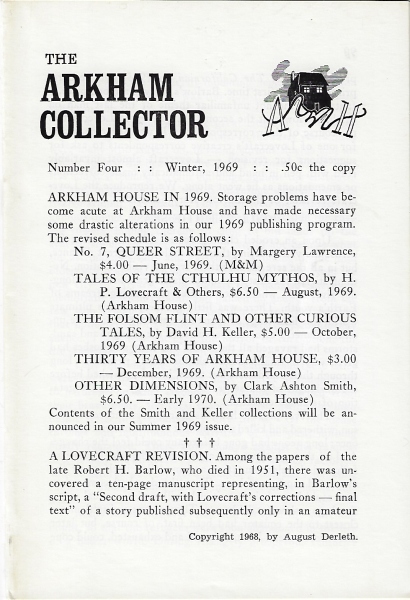
Memories of Lovecraft (1969) by Sonia H. Davis & Helen V. Sully

My memory is becoming a little bit dim; but the things of interest in my life, I still remember, and altho’ I am the widow of another man, I shall always remember H.P.L. as I would any good friend.
—Sonia H. Davis to August Derleth, 29 May 1966, Mss. Wisconsin Historical Society

To support and promote Arkham House, co-founder and editor August Derleth tried innumerable ways to get the word out about the press, publishing a vast array of ephemera to advertise the wares, attract notice from potential customers, and explain about delays or difficulties. On two occasions, Derleth attempted a regular journal to supplement and advertise the small press: the Arkham Sampler (1948-1949) and the Arkham Collector (1967-1971), both of which contained a similar mix of content: news about Arkham House and its publications, book reviews, original fiction and poetry, short essays by or about Lovecraft, etc.

There were two general problems with such publications: getting them to pay for themselves (through a combination of subscriptions and increased sales of Arkham House books), and getting enough solid content to fill an issue. It was an imposition on Derleth’s already crowded schedule, and perhaps it isn’t surprising that he occasionally cut a corner or two in an effort to save time or get an issue to press—and he did sometimes publish some exceptional content, without which Lovecraft studies would be the poorer.

In the Winter 1969 issue of the Arkham Collector are two small back-to-back articles: “Memories of Lovecraft: I” by Sonia H. Davis (Lovecraft’s ex-wife, who survived him) and “Memories of Lovecraft: II” by Helen V. Sully (who had visited Lovecraft in Providence). These are effectively filler for the issue; neither woman appears to have had a direct hand in putting them together, rather Derleth directly adapted what they had written about Lovecraft elsewhere and presented them as a series of quotes. Still, as memoirs go, each of these “Memories” has their points of interest.

“Memories of Lovecraft: I” by Sonia H. Davis

Sonia Haft Lovecraft Davis, who was married to H. P. Lovecraft in the 1920s and divorced by mutual consent late in the decade has written some paragraphs about Lovecraft in letters to the editor. The following excerpts are from her letters—
The Arkham Collector (Winter 1969) 116

This is the original opening to “Memories of Lovecraft: I.” August Derleth and Sonia H. Davis first came into contact in 1947, and while their initial interactions were rough (even antagonistic), they did eventually make peace and become friendly correspondents, which lasted through at least 1970, based on letters in the August Derleth archive at the Wisconsin Historical Society; Derleth would pass away in 1971, and Sonia in 1972. It is from this collection of letters that Derleth borrowed several personal memories of Lovecraft that Sonia had shared with him over the years.

Given that the August Derleth/Sonia H. Davis correspondence is split between the John Hay Library in Providence and the Wisconsin Historical Society, it is difficult to consolidate a lot of the information in the letters, much less easily search them, but an attempt to survey the available documents has not uncovered which letters that Derleth excerpted these quotes from. The letters may have been misplaced, or included among the Arkham House business files, but it makes it difficult to gauge how accurate the quotations are, or in what context they took place. However we can say a few things based on internal evidence and other Lovecraft materials that are available to scholars.

During our marriage we often went to theatres, sometimes to the Taormina, a favorite Italian restaurant, where H. P. L. learned to eat minestrone and spaghetti with parmesan cheese, which he loved. But he balked at the wine.
The Arkham Collector (Winter 1969) 117

In his letters to his aunts during their marriage, Lovecraft mentions the Taormina Italian restaurant three times (LFF 1.237, 264, 2.555), and the comments on Sonia introducing him to Italian food, particularly minestrone and spaghetti (with lots of parmesan cheese) are well-attested in his letters:

My taste has become so prodigiously Italianised that I never order anything but spaghetti & minestrone except when those are not to be had—& they really contain an almost ideal balance of active nutritive elements, considering the wheaten base of spaghetti, the abundant vitamines in tomato sauce, the assorted vegetables in minestrone, & the profusion of powdered cheese common to both.
—H. P. Lovecraft to Lillian D. Clark, 18 Sep 1925, LFF 1.402

Some of the comments attributed to Sonia’s letters involve information that she would not have had directly, but might have gotten through Lovecraft himself, family photographs, or conversations with his aunts; there is also evidence that her memories may be skewed somewhat by prior anecdotes or biographical notes on Lovecraft, for example:

As a child H. P. L. was not only far from being ‘hideous’ but he was a very beautiful baby with flaxen curls, beautiful brown eyes and an engaging smile. As a boy of six he was still a very handsome and interesting-looking child. […] H. P. used to speak of his mother as a ‘touch-me-not’ and once—but once only—he confessed to me that his mother’s attitude toward him was ‘devastating’. . . . In my opinion, the elder Lovecraft, having Beena travelling salesman for the Gotham Silversmiths, and his wife being a ‘touch-me-not’, took his sexual pleasures wherever he could find them; for H. P. never had a sister of a brother, and his mother, probably having been sex-starved against her will, lavished both her love and her hate on her only child.
The Arkham Collector (Winter 1969) 116-117

Winfield Scott Lovecraft (1853-1898) and Sarah Susan Phillips Lovecraft (1857-1921) were both dead by the time H. P. Lovecraft met Sonia, so this is speculation—and no doubt inspired in whole or in part by earlier memoirs or brief biographical pieces like Winfield Townley Scott’s “His Own Most Fantastic Creation: Howard Phillips Lovecraft” (1944), which included the revelation that W. S. Lovecraft (who worked as a commercial traveller for the Gorham Silver Co.) died of syphilis, and Townley’s publication of excerpts from the Letters of Clara Lovrien Hess, which was the first suggest that Susan Lovecraft disliked her son’s appearance.

The most interesting snippet is one which frankly no one else could have provided, and which appears in no other source:

H. P. was inarticulate in expressions of love except to his mother and to his aunts, to whom he expressed himself quite vigorously; to all other it was expressed by deep appreciation only. One way of expression of H. P.’s sentiment was to wrap his ‘pinkey’ finger around mine and say ‘Umph!’
The Arkham Collector (Winter 1969) 117

There is no significant doubt that Sonia did actually write these segments; several of them echo points in her long memoir The Private Life of H. P. Lovecraft (1985) by Sonia H. Davis, and can be taken as elaborations on ideas already expressed (although the ‘umph’ is new). It is unfortunate that the original letters from which they were taken have not come to light yet, as reading between the lines it seems likely that Sonia was responding to some specific point or question of Derleth’s, rather than random recollections.

“Memories of Lovecraft: I” has been republished at least twice, in Lovecraft Remembered (1998) and Ave Atque Vale (2019); in both cases, Derleth’s opening paragraph explaining the origin of the memories was not reprinted.

“Memories of Lovecraft II” by Helen V. Sully

Helen Sully (now Mrs. George Trimble of Auburn, California) a friend of Clark Ashton Smith’s, was given a letter of introduction to Lovecraft by Smith when she traveled east in the summer of 1933. She was driven to Providence to meet Lovecraft by the family of Frank Belknap Long.
The Arkham Collector (Winter 1969) 117

Derleth pointedly does not give any indication of the source of the quotes that follow. It was originally a brief memoir titled “Some Memories of H. P. L.” (now located at the John Hay Library), which Derleth then revised, cutting out some portions and rewording others, and formatting it similar to “Memories of Lovecraft: I.” To get an idea of the extent of the revisions, compare these two paragraphs:

That night, after dinner, he took me into a graveyard associated with Poe. . . . It was dark, and he began to tell me strange, weird stories in a sepulchral tone and, despite the fact that I am a very matter-of-fact person, something about his manner, the darkness, and a sort of eerie light that seemed to hover over the gravestones got me so wrought up that I began to run out of the cemetery with him close at my heels, with the one thought that I must get up to the street before he, or whatever it was, grabbed me. I reached a street lamp, trembling, panting, and almost in tears, and he had the strangest look on his face, almost of triumph. Nothing was said.That night, after dinner, he took me down into a graveyard near where Edgar Allan Poe had lived, or was he buried there? I can’t remember. It was dark, and he began to tell me strange, weird stories in a sepulchral tone and, despite the fact that I am a very matter-of-fact person, something about his manner, the darkness, and a sort of eery light that seemed to hover over the gravestones got me so wrought up that I began running out of the cemetery with him close at my heels, with the one thought that I must get up to the street before he, or whatever it was, grabbed me. I reached a street lamp, trembling, panting, and almost in tears, and he had the strangest look on his face, almost of triumph. Nothing was said.
The Arkham Collector (Winter 1969) 119Ave Atque Vale 365-366

Derleth had done this kind of quiet editing several times before, such as when he revised the ending of “Medusa’s Coil” (1939) by Zealia Bishop & H. P. Lovecraft. Sully’s brief memoir is an especially interesting read because Lovecraft’s own notes on her 1933 visit are exceedingly sparse and lacking in detail; perhaps not surprising given its brevity.

“Memories of Lovecraft: II” was reprinted in Lovecraft Remembered (1998), without Derleth’s introductory paragraph, while “Some Memories of H. P. L.” was published in Ave Atque Vale (2019). Of the two, I prefer Sully’s unedited version, although for most purposes the content is almost identical.

While they may not appear to be much—a few pages of scattered recollections covering small portions of Lovecraft’s life—these are some of the pieces to the puzzle that was Lovecraft, and have been pored over by scholars, their ideas and accounts analyzed, challenged, accepted, refuted, and incorporated into every biography of Lovecraft since their publication.


Bobby Derie is the author of Weird Talers: Essays on Robert E. Howard and Others and Sex and the Cthulhu Mythos.

Deep Cuts in a Lovecraftian Vein uses Amazon Associate links. As an Amazon Associate I earn from qualifying purchases.

Her Letters To Lovecraft: Genevieve K. Sully & Helen V. Sully

Genevieve K. Sully, who wrote to you, is the mother of Helen Sully. Helen met HPL in 1933, and also met Donald [Wandrei]. Donald, in his visit to California, spent much time at the Sully home. HPL’s letters to the Sullys, from what I have seen of them, are marvelous and show a slightly different and most lovable angle of his multi-sided personality, together with amazing knowledge of California history and western sorcery.
—Clark Ashton Smith to August Derleth, 13 Apr 1937, Eccentric, Impractical Devils 255

Genevieve Knoll was born in 1880. She married James O. Sully in 1903, the same year she graduated from the University of California – Berkeley. James Sully is listed in the 1910 U.S. Census as a year older, self-employed, and an English immigrant who had been naturalized. The Sullies had two daughters: Helen V. (b. 1904) and Marion (b. 1911). Not much is known about their life and marriage; the 1920 U.S. Census lists two Genevieve Sullies in California, with daughters Helen and Marion, one in Berkeley (with James as head of household) and one in Auburn (without), and one suspects that they were separated at this point, perhaps for economic reasons (more work in Berkeley)—there are suggestions in Clark Ashton Smith’s letters that Genevieve was splitting her time between Auburn and Berkeley, and was married at least as late as 1925 (Dawnward Spire, Lonely Hill 75). By the time of the 1930 U.S. Census, Genevieve and James were listed as divorced. While in Auburn, the Sullies met a young poet, artist, and day-laborer named Clark Ashton Smith who cared for his two aging parents:

It was in the fall of 1919 that we first met Clark and became interested in his poetry. We were all congenial from the start. We also took many walks in the foothills near Auburn, enjoying the woods, rocks and flowers, Clark Always adding to our love and appreciation of Nature.
—Genevieve K. Sully, Emperor of Dreams: A Clark Ashton Smith Bibliography 190

Genevieve was 39 in 1919; Clark Ashton Smith was 26. They remained friends—and perhaps more than that—for decades. We get only scattered references to her in Smith’s letters, and a handful of letters to her are reprinted in the Selected Letters of Clark Ashton Smith, showing that they were close friends and she was an admirer and promoter of his art. While no letters yet published have explicitly referred to a sexual relationship, their acquaintence has long been considered an affair, and at one point he had even made out a last will and testament bequeathing her his library, paintings, and art objects (EID 309). One of her most significant impacts on Smith, as far as weird fiction fans are concerned, was apparently encouraging Smith to write for Weird Tales:

One hot summer—that of 1927—when we were all wilted and tired of the heat, we invited Clark to go with us on a camping trip to the moutnains in the Donner Peak-Summit region. In order to take this trip, CLark had to make complicated arrangements for the comfort of his parents. […] It is hard for anyone to believe the primiaitive way in which the SMiths lived—no running water or electricty, and a kichen stove as the only means of heat and cooking. […]

After a few days of short walks, we proposed a longer walk—to Crater Ridge—where we had gone many times in the past, but now we were going with a companion who came under a spell of strange thought, transforming the scene into a foreboding and grotesque landscape, which Clark later used in his now famous story, “The City of the Singing Flame.” Clark wandered about among the boulders, studying the rocks and general terrain. We could all see that he was deeply affected by the place.

Later in the afternoon while Clark was still feeling a strange influence, after we had sat down to looka t the views which combine to make this place especially beautiful, I suddenly sugested that he use his powers of writing for fiction, which would be more emuneratie than poetry. His financial situation at the time was critical, and some practical advice seemed in order.
—Genevieve K. Sully, Emperor of Dreams: A Clark Ashton Smith Bibliography 190

Whether it was this exact trip or another, something like this certainly happened, for Smith confirmed it:

About eighteen months ago, I was taken to task for idleness by a woman-friend, and pledged myself to industry. Once started, the pledge has not been hard to keep.
—Clark Ashton Smith to H. P. Lovecraft, c. Jan 1931, Dawnward Spire, Lonely Hill 297

Relatively less is heard of Helen and Marion during this period, though both women graduated highschool and apparently university, with a focus on music. Both of them would also have heard of H. P. Lovecraft, for during one trip Smith read aloud one of his stories to them by campfirelight:

By the way, I read your “Picture in the House” aloud one evening by the light of our campfire in the mountains; and it was received with great enthusiasm by my hostess Mrs. Sully and her daughters.
—Clark Ashton Smith to H. P. Lovecraft, 22 Aug 1930, Dawnward Spire, Lonely Hill 227

In 1933, Helen was a 29-year old and working as a teacher of music and art at the Auburn highschool, when she decided to take a trip by boat through the Panama Canal, with a stop in Cuba, and then New York, Providence, Quebec, and Chicago for the 1933 World’s Fair. Smith was conscientious to write ahead to Providence and New York so that Helen V. Sully would have a warm welcome.

My aunt & I will be greatly pleased to welcome your friend Miss Sully if she visits Providence, & can undoubtedly display enough historic & antiquarian sights to fill a sojourn of any duration. If the East is new to her, she will find in its many evidences of long, continuous settlement a quite unique fascination.
—H. P. Lovecraft to Clark Ashton Smith, 14 Jun 1933, DS 420

I think a day will enable Miss Sully to see most of the historic high spots of urban Providence, & I shall be glad to exhibit them when she arrives. Tell her to let me know exact place & date of arrival, & I will be on hand—trusting to ingenuity in establishing identification. When she is in New York she ought without fail to look up the Longs—230 West 97th St. They are in a better position to entertain her than any other “gang” family, having a pleasant apartment, a lavish table, a car, & a servant. Sonny Belknap is one of your staunchest admirers, whatever may be his lapses as a correspondent. The Longs’ telephone is Riverside 9-3465.
—H. P. Lovecraft to Clark Ashton Smith, 29 Jun 1933, DS 423

I trust Miss Sully’s trip is proving pleasant; & shall, unless contrarily instructed, be on the lookout July 19 at 6 a.m. at the Colonial Line pier . . . . which lies right in the lee of the ancient hill’s southerly extremity, on a waterfront having considerable picturesqueness. The yellow poppy ought to facilitate identification—though it’s too bad you couldn’t have furnished some of your typical nameless vegetation from Saturn & Antares! A second day in Prov. would enable many picturesque suburbs, (& perhaps ancient Newport) as well as the city proper to be covered; thus affording an extremely [good] picture of R.I. I hope that young Melmoth & Sonny Belknap [take] part in displaying seething Manhattan to the visitor—[& if she is] not already provided with Bostonian guidance, I think that [W. Paul] Cook would be delighted to shew off the Athens of America. I [envy] Miss Sully her coming sight of Quebec—to which I fear I can’t get this year, since my aunt’s accident will probably prevent any long absences on my part.
—H. P. Lovecraft to Clark Ashton Smith, 12 Jul 1933, DS 425-426

Hope I haven’t bored Klarkash-Ton’s gifted emissary with colonial sights. We tried a new boat today–a rival to the old Sagamore. Yr obt Grandsire
Melmoth III
and Helen
—H. P. Lovecraft and Helen Sully to Donald Wandrei, 20 Jul 1933, LWP 306

Elsewhere in his letters, Lovecraft joked that his young friends Frank Belknap Long, Jr. and Donald Wandrei nearly fought a duel over the right to host Miss Sully:

By the way–a very gifted & prepossessing friend of Klarkash-Ton’s in Auburn is touring the east (after a trip through the Panama Canal & to Cuba) for the first time, & looking up his various friends & correspondents….a young gentlewoman, a teacher of music & drawing, named Helen V. Sully. She looked up Wandrei & Belknap in N.Y., & the Longs brought her here in their car when ound for Onset last Wednesday. After seeing Prov. & Newport she has gone on to Gloucester & Quebec. On the return trip she will pass through Chicago & look up Wright–& if you can get down there (about Aug. 8 or 9–I’ll let you known when she decides & notifies me), she would like very much to meet you. Try it if possible.
—H. P. Lovecraft to August Derleth, 23 Jul 1933, Essential Solitude 2.595-596

Sorry you won’t be in Chicago during Miss Sully’s brief stay there–she is an extremely intelligent & prepossessing young person, & Wandrei & Sonny Belknap nearly fought a duel (2 syllables, not rhyming with cool!) over the question of precedence in escorting her about New York during her sojourn in the place. Whether her predetermined tourist itinerary will permit of a side-trip to Sauk City I don’t know, but I’ll pass your invitation on when writing her next momentary address. She gives quite an interesting picture of good old Klarkash-Ton–who would seem to be sorely hadnicapped by poverty, parental dominance, & a generally uncongenial environment.
—H. P. Lovecraft to August Derleth, late Jul 1933, Essential Solitude 2.598-599

Helen didn’t manage to get to Sauk City to see Derleth, but she met Weird Tales editor Farnsworth Wright in Chicago before returning home.

news

The Placer Herald, 22 July 1933

The 1933 trip is perhaps more remembered by Lovecraft fans for her brief memoir of the visit, “Some Memories of H. P. L.” (originally published as “Memories of Lovecraft: II” in 1969), where she wrote that he insisted on paying for all the expenses of her brief stay in Providence, despite his economic circumstances…and for one anecdote in particular:

That night, after dinner, he took me down into a graveyard near where Edgar Allan Poe had lived, or was he buried there? I can’t remember. It was dark and he began telling me strange, weird stories in a sepulchral tone and, despite the fact that I am a very matter-of-fact person, something about his manner, the darkness, and a sort of eery light that seemed to hover over the gravestones got me so wrought up that I began running out of the cemetery with him close at my heels, and with the one thought that I must get up to the street before he, or whatever it was, grabbed me. I reached a street lamp trembling, panting, and almost in tears and he had the strangest look on his face, almost of triumph. Nothing was said.
—Helen V. Sully, “Some Memories of H. P. L.” in Ave Atque Vale 365-366

She apparently shared this sensation with Lovecraft, as he later wrote to her:

About the hidden churchyard of St. John’s—there must be some unsuspected vampiric horror burrowing down there & emitting vague miasmatic influences, since you are the third person to receive a definite creep of fear drom it….the others being Samuel Loveman & H. Warner Munn. I took Loveman there at midngiht, & when we got separated among the tombs he couldn’t be quite sure whether a faint luminosity bobbing above a distant nameless grave was my electric torch or a corpse-light of less describably origin! Munn was there with W. Paul Cook & me, & had an odd, unacountable dislike of a certain unplaceable, deliberate scratching which recurred at intervals around 3 a.m. How superstitous some people are!
—H. P. Lovecraft to Helen V. Sully, 17 Oct 1933, Letters to Wilfred B. Talman and Helen V. and Genevieve Sully 305

More important, however, was what that visit led to: a correspondence between Lovecraft and the Sullies.

The next day, I left. I wrote to thank Mr. Lovecraft for all his kindness. […] Our correspondence dated from my first letter to him. My impulse was to answer immediately. But he, in turn, always answered almost by return mail. His letters were so voluminous and must have taken so long to write and I felt his talents should be used elsewhere: and always felt guilty that he should spend so much time on me. The result was that I deliberately became less punctual about writing, to my present regret, because I do not think now that I was taking his time from more valuable work. My writing became more and more sporadic, but I think we corresponded up to a time near his death.
—Helen V. Sully, “Some Memories of H. P. L.” in Ave Atque Vale 366

The surviving correspondence consists of 25 letters, dating from immediately after Helen’s note of thanks in July 1933 until July 1936. As Clark Ashton Smith said, the letters are full of Lovecraft’s typical erudition, ranging widely in subject, going over his travels and politics, Arthur Machen’s The Hill of Dreams and Howard Wandrei’s artwork among many others. She in turn wrote of her hiking trips and visits to Clark Ashton Smith, her friends and other issues…and, perhaps, opened up to him a little about her inner life.

By mid-1934, Helen had confided to Lovecraft a sense of melancholy or oppression about life—in fact, thoughts of death, and perhaps suicide—exactly what she said is unclear, as we only have Lovecraft’s side of the correspondence, but there is a thread in their correspondence on happiness and the meaning of life where Lovecraft portrays both a sort of objective optimism about life and death, which lasted over a year. The culmination of this line of thought was in 1935, where he seems to quote from her own letters about feeling “hopeless, useless, incompetent, & generally miserable” (LTS 423)—to which Lovecraft responded by pointing out how gifted she was, and how much more miserable he should be in his own circumstances, and finally says:

So—as a final homiletic word from garrulous & sententious old age—for Tsathoggua’s sake cheer up! Things aren’t as bad as they seem—& even if your highest ambitions are never fulfilled, you will undoubtedly find enough cheering things along the road to make existence worth enduring.
—H. P. Lovecraft to Helen V. Sully, 15 August 1935, LTS 431

This is a side of Lovecraft that is rarely seen; the closest point of comparison is probably in 1936 when Lovecraft did his best to keep C. L. Moore occupied after the death of her fiancé. Perhaps it even helped; Helen V. Sully lived a long, full life. In remembering him in 1969, she ended:

Anyone who came into contact with him could not fail to realize that here was a rare and unique person, of great refinement and brilliant intellect, and one who combined the genius which produced his finest writings and the attributes of a true gentleman.
—Helen V. Sully, “Some Memories of H. P. L.” in Ave Atque Vale 366

There is far less to say about the correspondence between Lovecraft and Genevieve K. Sully. Only four letters from Lovecraft to her are known to survive, dating from 1934 to 1937, and Lovecraft may have conveyed respects to her through his letters to Helen V. Sully and Clark Ashton Smith rather than corresponding with her directly for the most part. The 1934 letters apparently were sent to commemorate trips that Mrs. Sully had taken and included gifts including an “elongated, acorn-like object which somewhat baffles my botanical ignorance” (LTS 473)—probably an immature Redwood pine cone. She also reported on Donald Wandrei’s visit to see Clark Ashton Smith in November 1934, during which Wandrei was hosted by the Sullies.

The final letter, dated 7 February 1937, is a belated response to a 1936 Christmas card or letter that Genevieve K. Sully had thought to send to him, and includes a copy of his poem “To Klarkash-Ton, Wizard of Averoigne” and reports on the local cats, and on coming into acquaintence with Jonquil & Fritz Leiber Jr. Perhaps there were other letters, now lost; the genial tone and subjects of the last epistle suggests they might have kept up a sporadic correspondence. Lovecraft signed off with: “Best 1937 wishes for all the househould.—Yrs most sincerely—H. P. Lovecraft” (LTS 487).

Nor did the Sullies forget Lovecraft in later years. Clark Ashton Smith wrote to August Derleth in the 1940s:

Don’t forget my extra copy of Beyond the Wall of Sleep. The one you sent me will go as a slightly overdue birthday gift to Mrs. Sully’s daughter Helen (Mrs. Nelson Best) who met Lovecraft through my introduction back in 1933.
—Clark Ashton Smith to August Derleth, 30 Nov 1943, EID 342

Can you send me another copy of Something About Cats and add it to my bill? I want it for a girl who once met Lovecraft.
—Clark Ashton Smith to August Derleth, 7 Dec 1949, EID 412

Many fans may only know Helen V. Sully as “a girl who once met Lovecraft,” but that rather understates the relationship. Taken together, Lovecraft’s correspondence with Genevieve K. Sully and Helen V. Sully was fairly substantial, and covered aspects of geography and philosophy which he did not broach with any other correspondent. While we can only speculate what it meant to a young woman who felt depressed in her daily life to receive a letter from a kind older man who write to her about cats and to “for Tsathoggua’s sake cheer up!”…perhaps it helped. What more can any human being do for another, when they’re feeling down?

Fourteen letters and postcards to Helen V. Sully were excerpted for volumes IV and V of the Selected Letters of H. P. Lovecraft; all twenty-five pieces of correspondence were published in full, along with the four letters from Genevieve K. Sully, in Letters to Wilfred B. Talman and to Helen V. and Genevive Sully. Several of the original letters can be viewed online.


Bobby Derie is the author of Weird Talers: Essays on Robert E. Howard and Others and Sex and the Cthulhu Mythos.

Deep Cuts in a Lovecraftian Vein uses Amazon Associate links. As an Amazon Associate I earn from qualifying purchases.