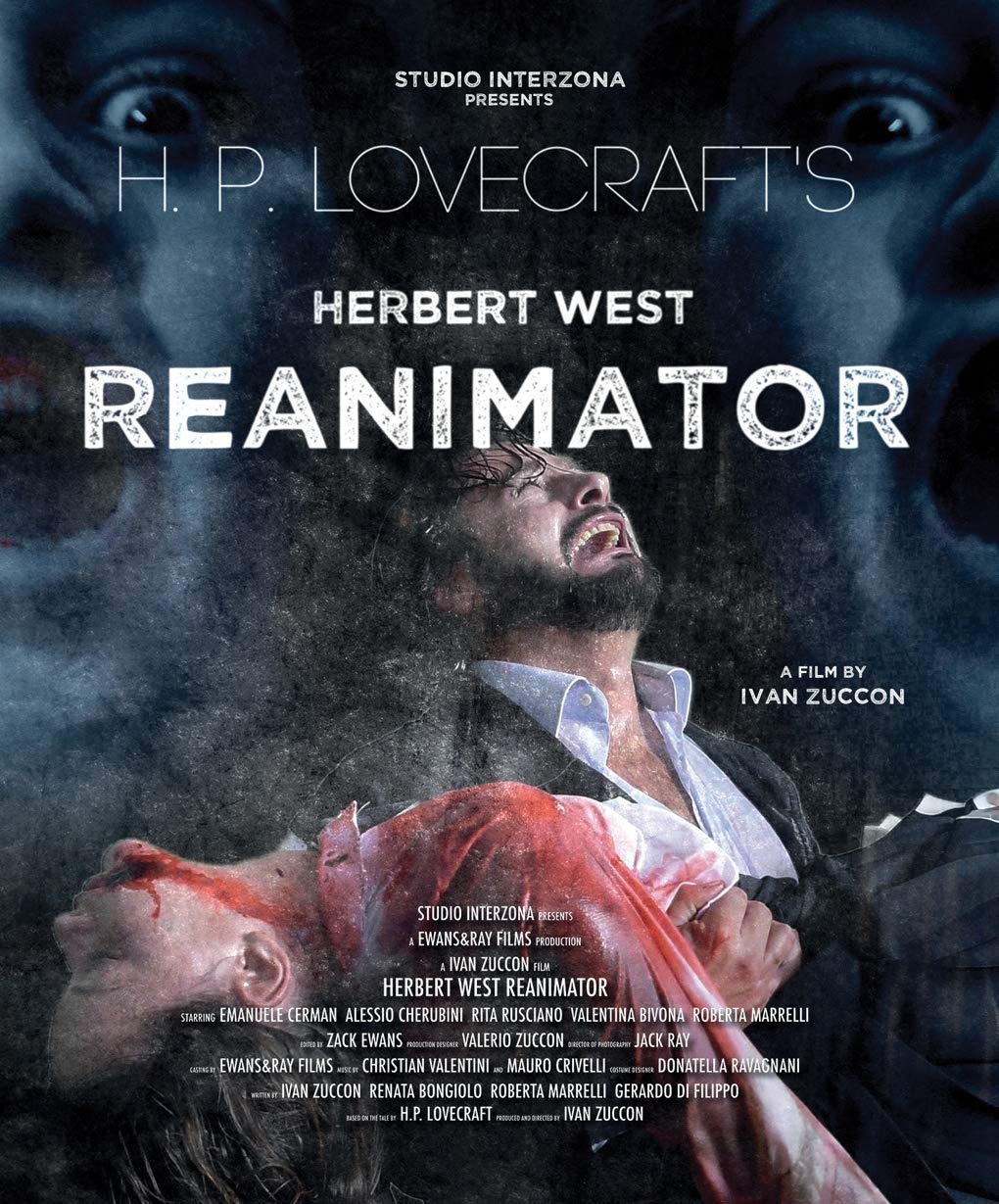
Herbert West Re-Animator (2017)

Italian director Ivan Zuccon isn’t a household name, even among the select audience of Lovecraftian film enthusiasts. Yet he should be; he has directed no less than five feature-length Lovecraftian films and adaptations:

These are all independently produced Italian horror films with modest budgets, but they have all received English-subtitled releases in some format (DVD, BluRay, and/or streaming), though the earlier ones can be more difficult to find, and few have garnered much critical attention.

That is a pity, because while Zuccon obviously is working within tight constraints in terms of budget, these are interesting films. None of them are a straight adaptation of any of Lovecraft’s stories, although La casa sfuggita and Colour from the Dark are strongly inspired by “The Shunned House” and “The Colour Out of Space,” respectively, and partially adapt those tales to an Italian setting. However, Zuccon likes to go beyond Lovecraft, to spend more time developing the characters in his stories and the weirdness they encounter. Which is particularly evident in his 2017 film Herbert West Re-Animator.

In many ways, the all Re-Animator media lives in the shadow of the breakout success of director Stuart Gordon’s classic Re-Animator (1985). Even when the pornographic parody Re-Penetrator (2004) came out, the film riffed off the iconic image of a syringe of vivid green reagent, and even Zuccon cannot completely escape that particular visual. However, Herbert West Reanimator is not a remake or adaptation of Lovecraft’s story; it is something much stranger: a film that tries to make Herbert West more Lovecraftian.

Despite Lovecraft’s original stories of Herbert West being set in Arkham, the series itself had no connection to any other aspect of his nascent artificial mythology. West doesn’t invoke Yog-Sothoth or Cthulhu, doesn’t find the formula for his reagent in the Necronomicon, never tries to resurrect a Deep One hybrid from Innsmouth or anything of that nature. Later media, especially in various comics that derive from the 1985 film, have gone back and brought Herbert West into closer contact with eldritch entities and the familiar props of Lovecraft’s Mythos.

What Zuccon has done that is different is try to capture something of the cosmic nihilism and weird aesthetic of Lovecraft in his Reanimator story, while still keeping the Mythos at arm’s length. This is Herbert West against an eldritch universe where death is but a door; but this is not Herbert West vs. Cthulhu. That approach, so different from all the others that riff off of Lovecraft’s creations as if the prop version of the Necronomicon was the source of horror instead of the creeping sense of dread, has rendered a film that is at times beautiful, bizarre, disjointed, and difficult to grasp—but is always and very importantly weird.

Emanuele Cerman plays Herbert West, and Rita Rusciano plays Elizabeth West, his daughter; they are the main viewpoint characters among the small cast, deliver solid performances, and the contrast between their narratives is key to how the film plays out. Here, rather than Herbert West’s obsession with reanimation being a coldly inhuman drive for knowledge that morphs into a morbid fascination with reanimation for its own sake, West pursues reanimation for extremely personal reasons. Nor is he the only one; unweaving the web of personal relationships between living, dead, and reanimated, and their experiences with life, death, and undeath, is the crux of the story that is revealed as viewers learn more about what awaits on the other side of the veil. This metaphysical aspect is where things get Lovecraftian in the sense of other dimensions, strange entities, and sanity-blasting knowledge.

It is still a rather modestly-budgeted independent production, so there is a certain lack of polish at points. The music by Mauro Crivelli and Christian Valentini suits the film, though it lacks the stylistic flourish to make it as memorable as Richard Band’s (who was, admittedly, borrowing heavily from Bernard Herrmann’s theme for Psycho (1960)). The impressive practical effects and almost slapstick physical acting of Stuart Gordon’s film aren’t there; the gore on display reflects more contemporary and brutal horror film conventions. Some computer-generated effects are less than convincing, but fortunately, the whole film is not shot in front of a green screen. I suspect the limitations of the production encouraged Zuccon’s creativity in trying to capture certain images and convey mood through careful shot composition, camera angles, and use of color rather than rely on CGI tentacles, and often the simpler and more stylized effects work to the film’s benefit.

When viewed in comparison to Zuccon’s previous Lovecraftian films, Herbert West Re-Animator comes across as the most polished, the one that most shows his growth as a filmmaker. While there are many fans of Lovecraft’s work that look for faithful adaptation of his stories into other media, they sometimes miss the possibilities of re-imaginings like Herbert West Re-Animator. Works that take Lovecraft’s ideas and aesthetics and run with them in a way that holds interest and keeps the viewer guessing.


Bobby Derie is the author of Weird Talers: Essays on Robert E. Howard and Others and Sex and the Cthulhu Mythos.

Deep Cuts in a Lovecraftian Vein uses Amazon Associate links. As an Amazon Associate I earn from qualifying purchases.

“ZOMBIO/死霊のしたたり” (1987) by Abe Yutaka (阿部 ゆたか)

Only a fraction of the comics that Japan produces are ever translated for English-language markets. As a consequence, Anglophones miss out on a lot of great—and sometimes terrible—manga, and sometimes get a misleading impression of the diversity and quality of Japanese comic art and writing. There is far more to horror manga, for example, than luminaries like Junji Ito and Gou Tanabe.

Monthly Halloween (月刊ハロウィン, 1985-1995) was a monthly horror comics anthology publication focused on the shōjo (teenaged girls) market; horror movies being popular among that demographic at the time. It was the first such shōjo horror magazine, but quickly inspired many imitators, and among its publications were the first appearance of Junji Ito’s Tomie. While it wouldn’t be exactly analogous to say Monthly Halloween was like Weird Tales aimed toward Japanese teenage girls, it wouldn’t be entirely inaccurate either. The tales within varied in theme from traditional Japanese ghost stories to ripped-from-the-latest-horror-film-from Hollywood. For great overviews, check out Renzo Adler’s Monthly Halloween: How American Horror was Translated for Shoujo Manga (2021) and kevndr’s Halloween Hijinks: Hollywood Horror in Japanese Comics (2022).

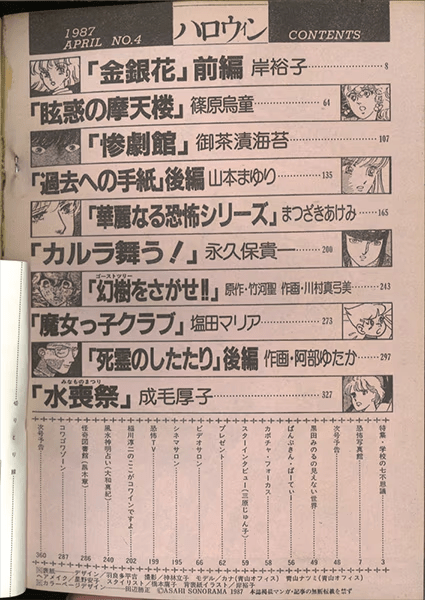
Table of contents for Monthly Halloween April 1987.
Herbert West can be seen, second row from bottom.

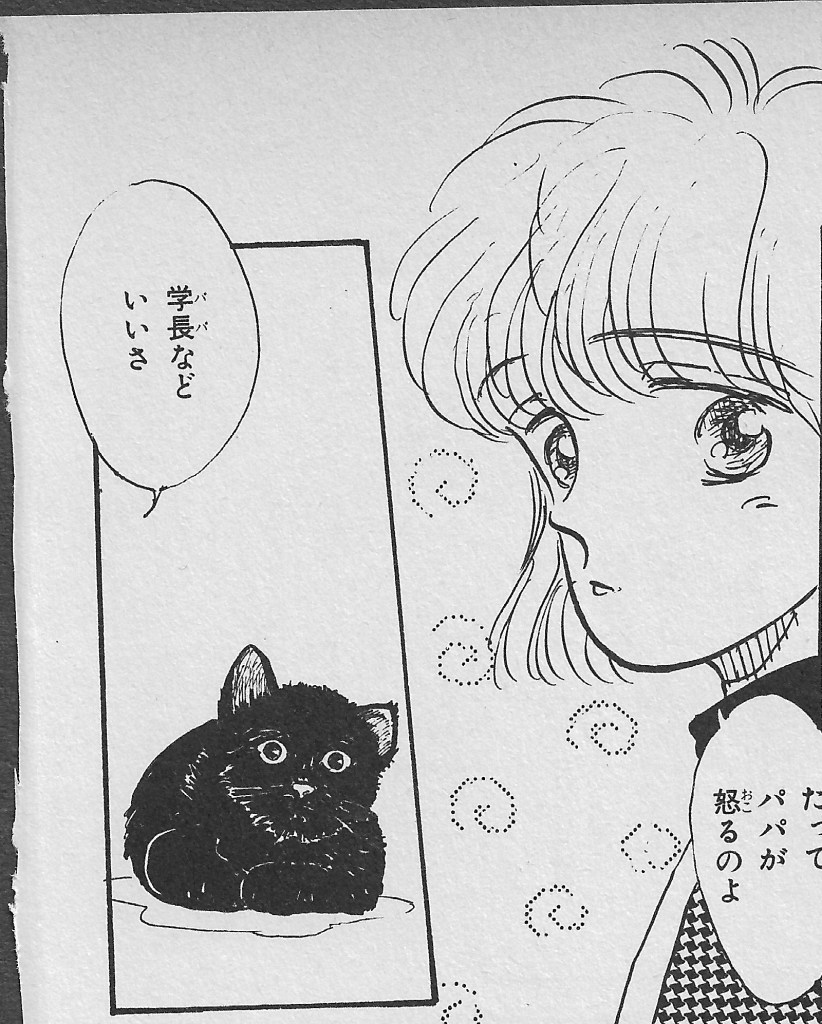
Director Stuart Gordon’s Re-Animator (1985) arrived in Japan on 14 March 1987 under the title “ZOMBIO/死霊のしたたり” (“Zombio/Dripping of the Dead”). Not coincidentally, in the March and April 1987 issues of Monthly Halloween, the story was adapted to manga by Abe Yutaka (阿部 ゆたか), probably better known to US audiences for his work on Detective Conan, who had previously adapted Day of the Dead (1985) for the magazine, which also had its Japanese release around the same time. The 64-page adaptation follows the film fairly closely, with a few artistic concessions given the intended audience, the younger characters (Herbert West, Dan Cain, and Megan Halsey) given more stereotypical teenaged appearances compared to the older characters.

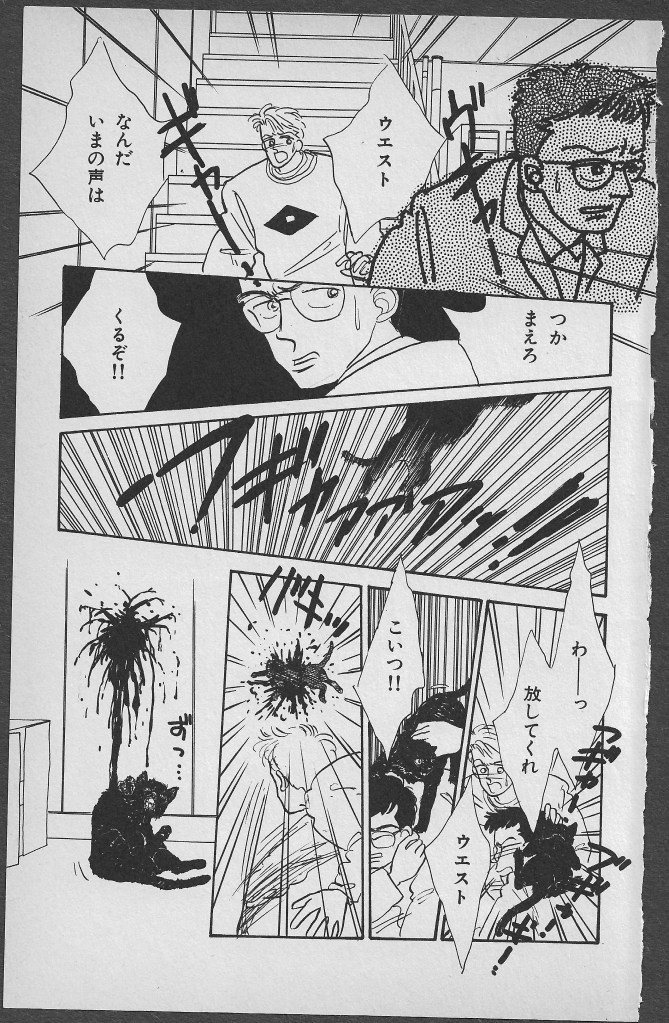
The nuances of the actors’ performances don’t really translate, but the somewhat slapstick action does, aided in no small part by an unflinching ability to depict a bit of gore and some common manga visual rhetoric that helps sell frantic energy and motion.

Top Panel:
Dan Cain: West! What is that sound?

Second Panel:
Herbert West: Grab it! Here it comes!

Third Panel:
<<Scream>>

Bottom row, right to left:
West: Ouch! Let go of me!
Dan: West!
West: Damn thing!
<<Splat>>

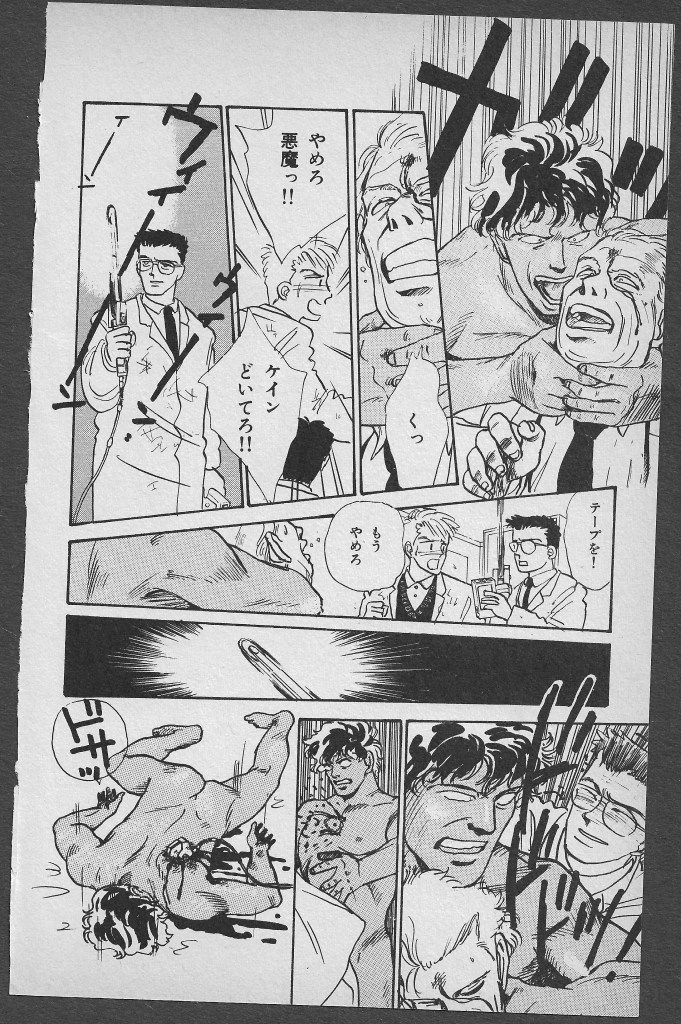
The pacing is also kept up fairly well; while there might be a bit more emphasis on the Re-Animator sub-plot where Dr. Carl Hill is trying to convince Dean Halsey to give him Megan, balancing that romance angle, they don’t skimp on the actual reanimation, even if it lacks some of the visceral oomph of the film.

Top row, right to left:
<<choking sound>>
<<gulp>>
Dan: Get off him!!
West: Move aside, Cain.
<<buzz>>

Second row:
West: Keep the tape running! Take it, man.

Bottom row:
<<cutting noises>>

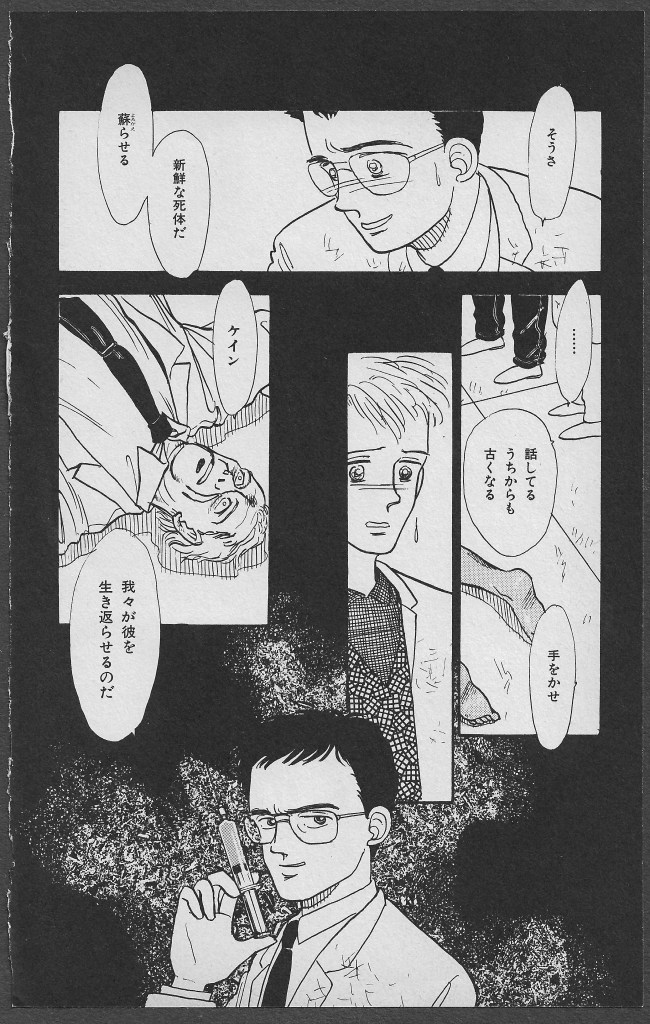
While the likenesses of the leads aren’t particularly close to the original actors, the faces are expressive and convey a lot of the emotion of the scenes, and Abe made sure to include many of the now-iconic shots from the film.

Top row, right to left:
West: You know… this is a fresh corpse. Let’s revive it.

Middle row, right to left:
West: As we speak, the corpse gets older. So give me a hand.

West: Cain. We will bring him back to life.

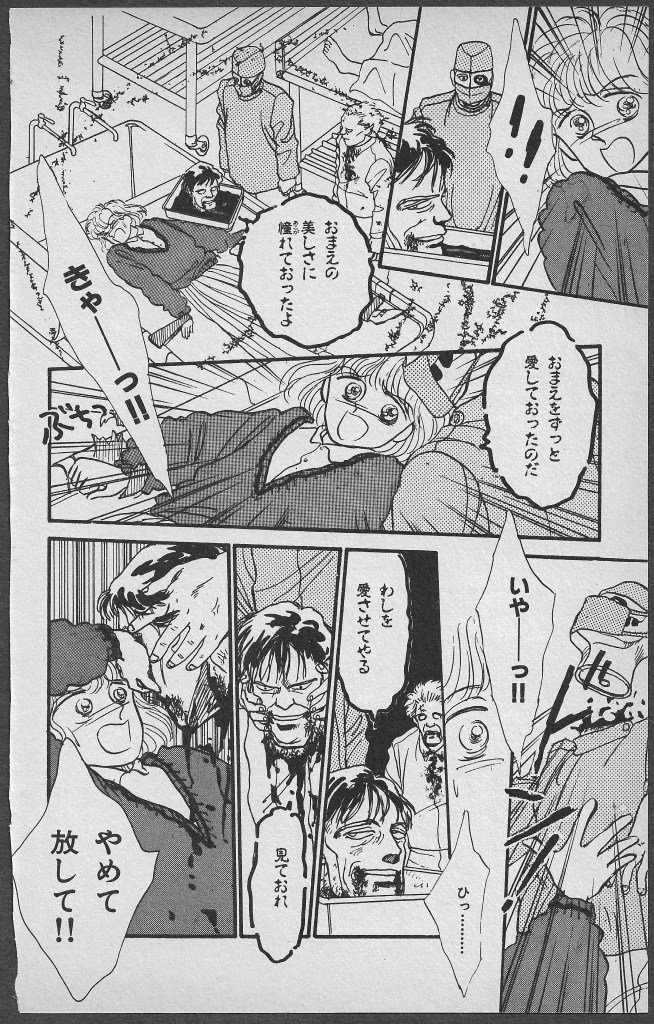
Omissions, there are a few. The infamous visual pun of the “head giving head,” which featured so prominently on some of the Japanese posters for the film (and the Ghana hand-painted equivalents) was rendered inert by keeping Megan Halsey fully clothed.

Top row, right to left:
Megan Halsey: !!
Dr. Carl Hill: I was always attracted to you…
Megan: NOOO!!

Middle row:
Hill: I have been in love with you for a long time!

Bottom row, right to left:
Megan: No!! Please…
Hill: Let me love you.
Hill: Look.
Megan: Stop it! Let me go!!

The emphasis on looking into Hill’s eyes is a reflection of a sub-plot in the film that is sometimes overlooked, that Dr. Hill has developed the power of mesmerism or hypnotism. A bit corny, but it gives him more agency than just as a disembodied head, and is implicitly how he can control his headless body through sheer will. It’s easy to see how the emphasis on the quasi-love triangle between Megan, Hill, and Dan might have appealed in adapting this story to an intended audience of young Japanese women.

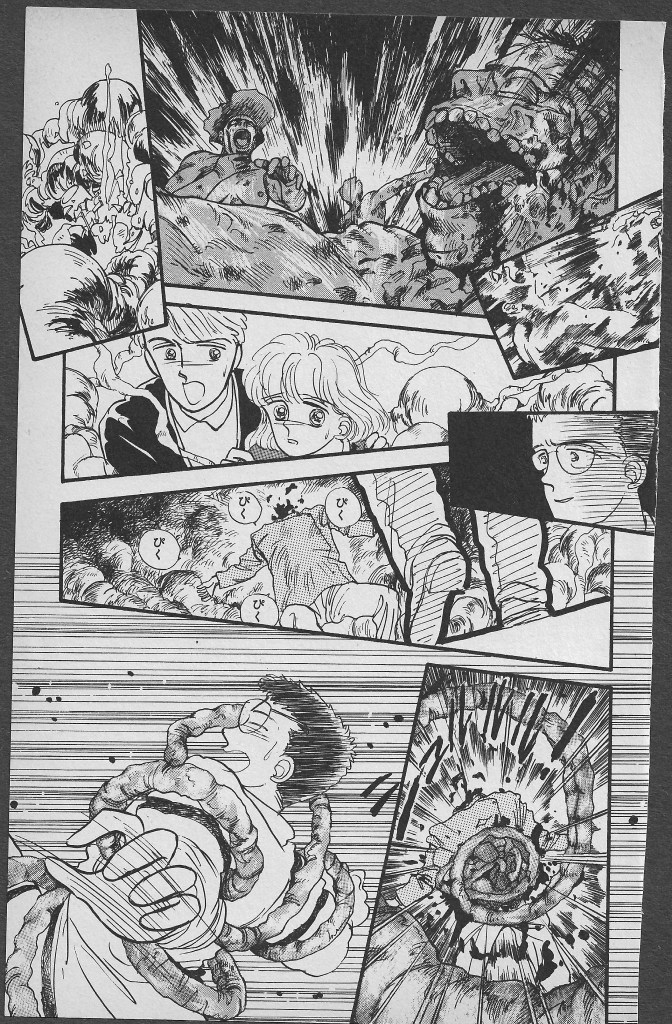
The big action scene in the morgue is a bit perfunctory, although Abe covers all the critical moments:

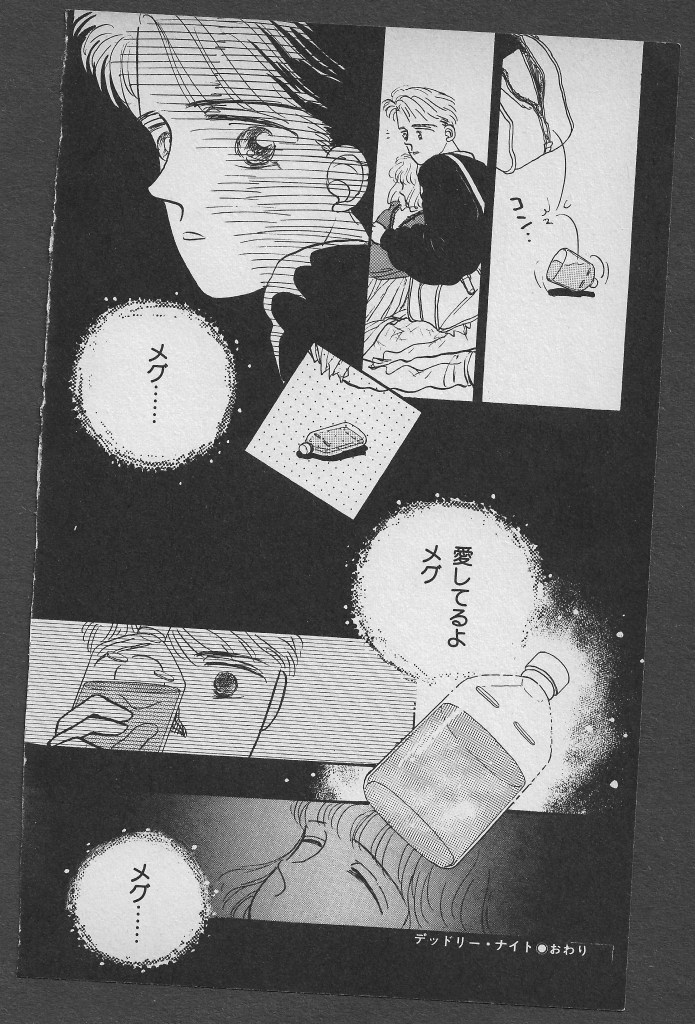
Fortunately, Abe and the editors of Monthly Halloween didn’t try to bowdlerized the ending. As in the original film, Dan Cain is left with a dead girlfriend and a choice:

Top to bottom, left to right:
<<tink>>
Dan: Meg…

Dan: I love you Meg.

Dan: Meg…

Given the limitations of the medium—it would have been nice if they could afford a splash of luminescent green for the reanimation serum—this is a very solid adaptation of the film. There isn’t any indication that Abe Yutaka had access to the 1985 novelization of the film by Jeff Rovin, and it predates the first English-language Re-Animator comic adaption from Adventure, which ran in three issues in 1991, and had the advantage of a larger page size and color.

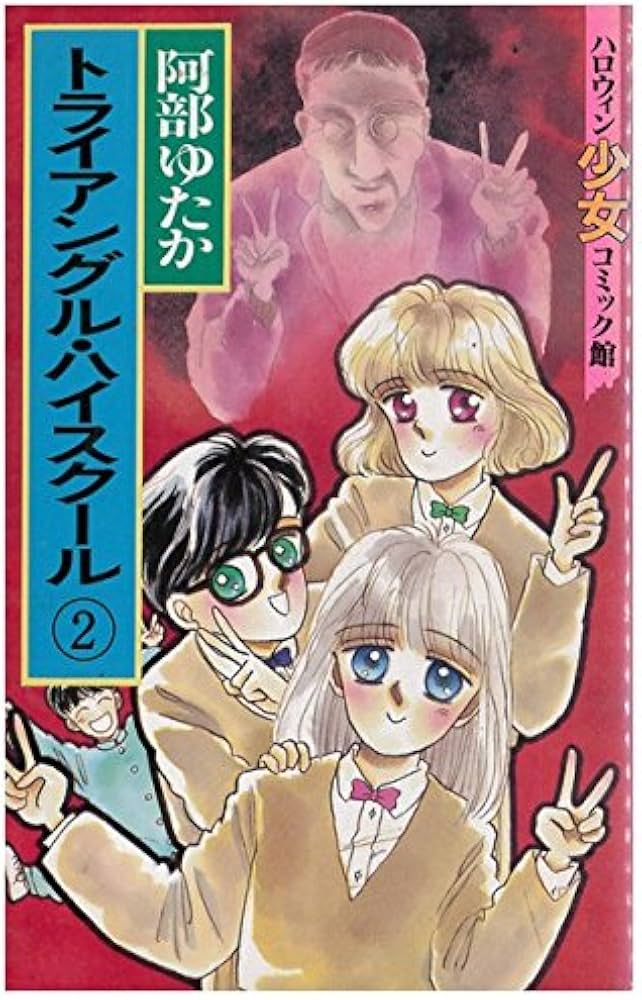
“ZOMBIO/死霊のしたたり” was reprinted in the back of トライアングル・ハイスクール 2 (Triangle High School 2), which collects another of Abe Yutaka’s series from Monthly Halloween; the first volume also collects Abe’s adaptation of Day of the Dead. Other than that, however, the Japanese manga adaptation of Re-Animator doesn’t seem to have been reprinted; it has never been officially translated into English, although raw scans have circulated on the internet for years.

With thanks and assistance to Dr. Dierk Günther of Gakushuin Women’s College for assistance and translation of the Japanese original.


Bobby Derie is the author of Weird Talers: Essays on Robert E. Howard and Others and Sex and the Cthulhu Mythos.

Deep Cuts in a Lovecraftian Vein uses Amazon Associate links. As an Amazon Associate I earn from qualifying purchases.

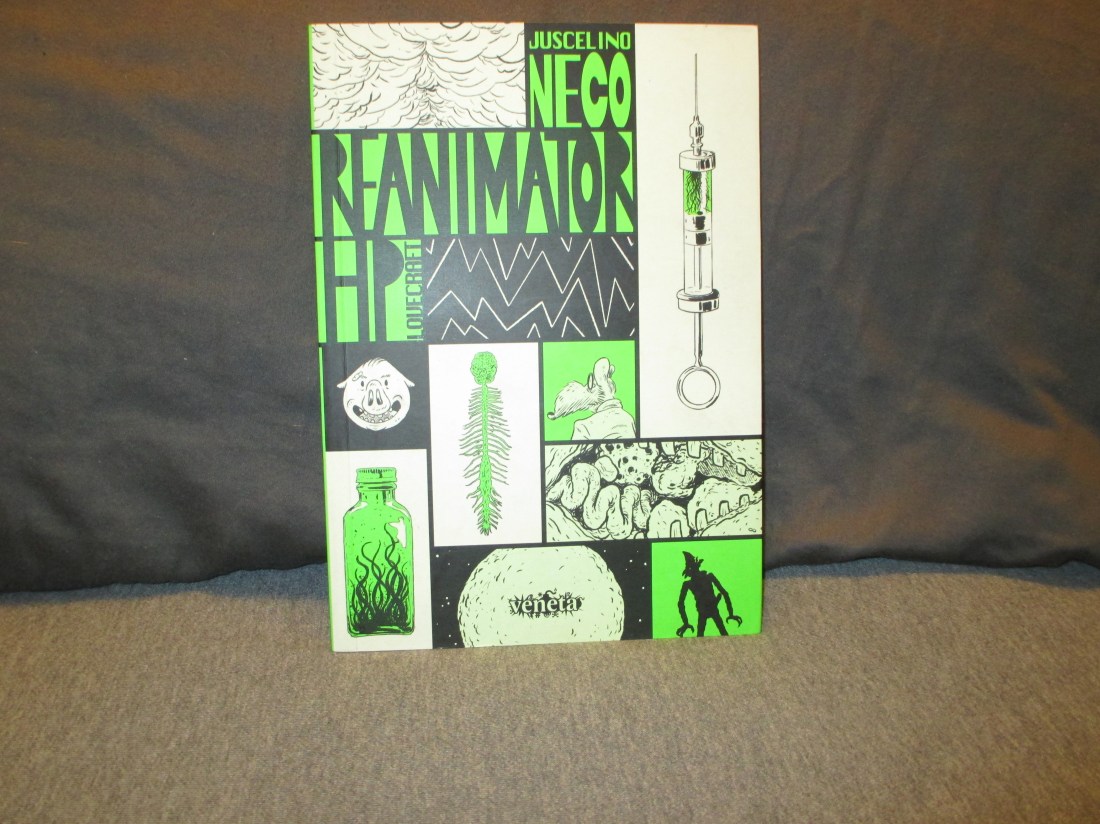
Reanimator (2020) by Juscelino Neco & H. P. Lovecraft

Eldritch Fappenings
This review deals with a work that contains excessive cartoon violence and sexuality. Selected images with cartoon depictions of body horror, violence, genitalia and/or sexually explicit contact will be displayed.
As such, please be advised before reading further.


Lovecraft não era sequer um grande astesão, mas is so também não importa, como o rock e, mais que ele, o punk rock, provou inúmeras vezes. Um artista menos dotado é perfeitamente capaz de Fazer uma obra mais oportuna, historicamente falando, do que um virtuose incapaz de pensar sua própria profissão em termos amplos. Mas isso também não era o caso de Lovecraft, um artesão obviamente limitado e um artista incapaz de seguir as veredas que ele mesmo abria a golpes desajeitados de marreta. Sua dificuldade técnica fica ainda mais evidente em Reanimator, uma de suas obras menos felizes, mas capaz de gerar tantas pérolas pelas mãos de artists mais dotados que o próprio, como o quadrinista Juscelino Neco.Lovecraft wasn’t even a great artist, but that doesn’t matter either, as rock and, more than that, punk rock, have proven time and time again. A less gifted artist is perfectly capable of making a more timely work, historically speaking, than a virtuoso incapable of thinking about his own profession in broad terms. But that wasn’t the case with Lovecraft either, an obviously limited craftsman and an artist incapable of following the paths he himself opened up with clumsy sledgehammer blows. His technical difficulty is even more evident in Reanimator, one of his less successful works, but capable of generating so many pearls in the hands of artists more gifted than himself, such as the comic artist Juscelino Neco.
Rafael Campos Rocha, foreword to Reanimator (2020)English translation

Rocha’s introduction to Juscelino Neco’s Reanimator (2020) is irreverent toward Howard Phillips Lovecraft. Yet irreverence has ironically been the cornerstone to the posthumous success of “Herbert West—Reanimator.” This minor tale of Lovecraft’s, his first commercial effort at horror fiction, has been adapted, expanded upon, reimagined, and incorporated into other works innumerable times since its first publication—something that has only been possible because artists have been free to do what they like with this story and its setting and characters, to freely distort and play with tone, characterization, and events as they see fit. To turn the grue-filled six episodes into dark comedies, zombie gorefests, introspective reflections on sexuality, and the mechanistic nature of life…all to entertain, explore, and reexamine what Lovecraft did and did not do.

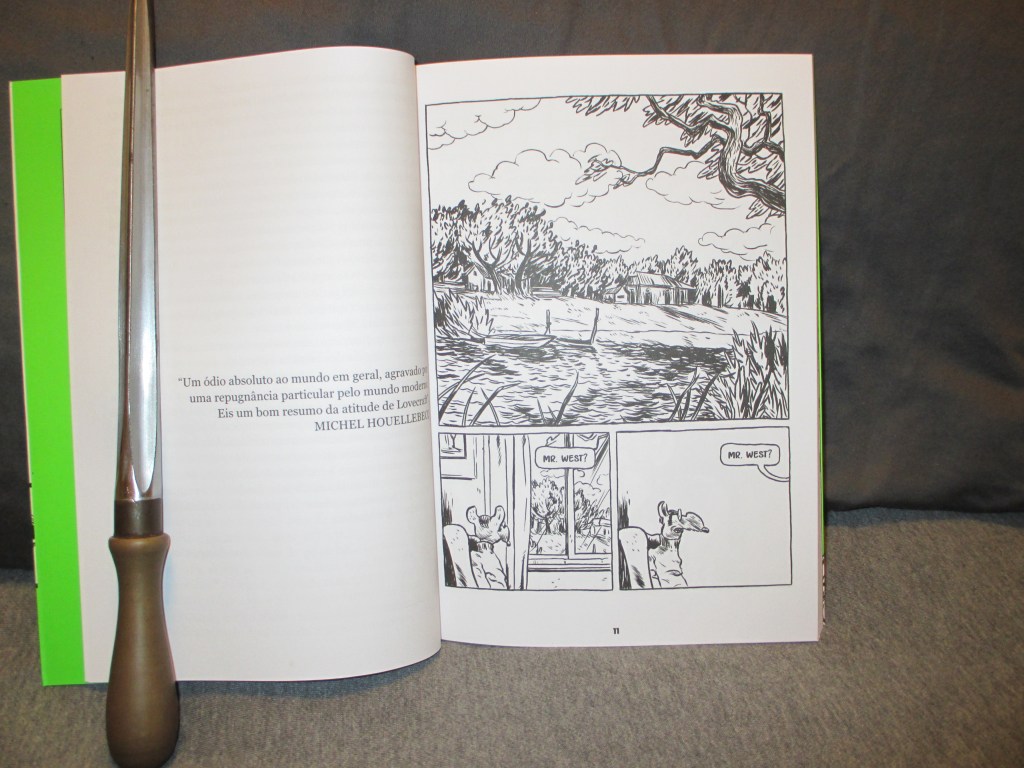
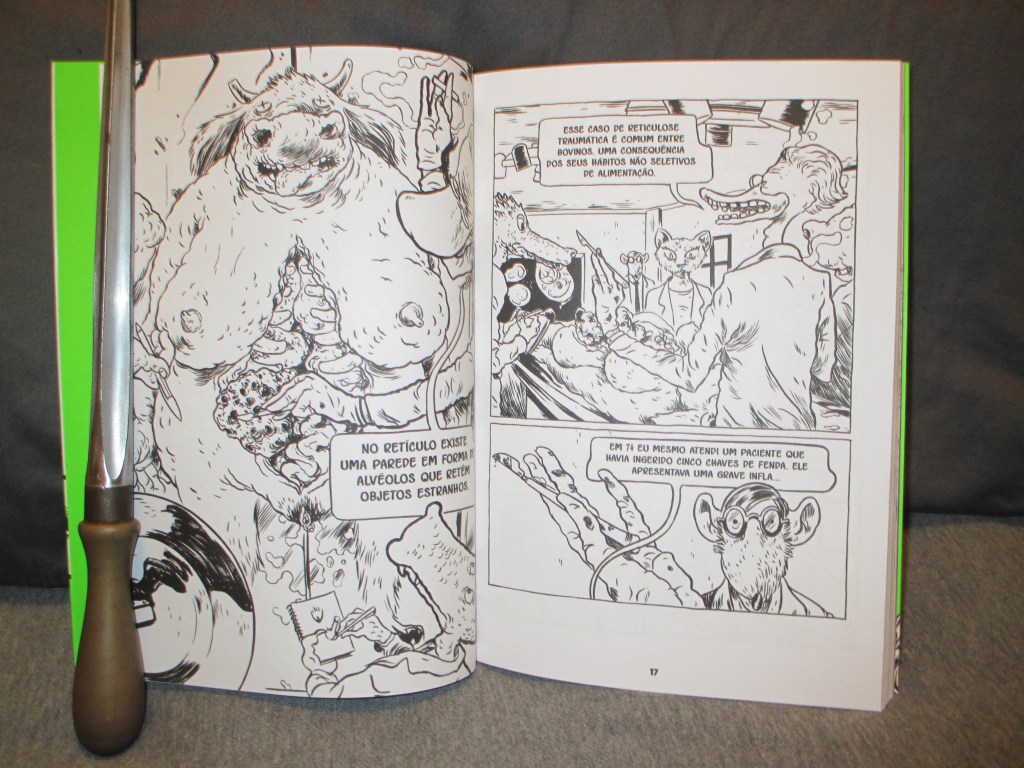
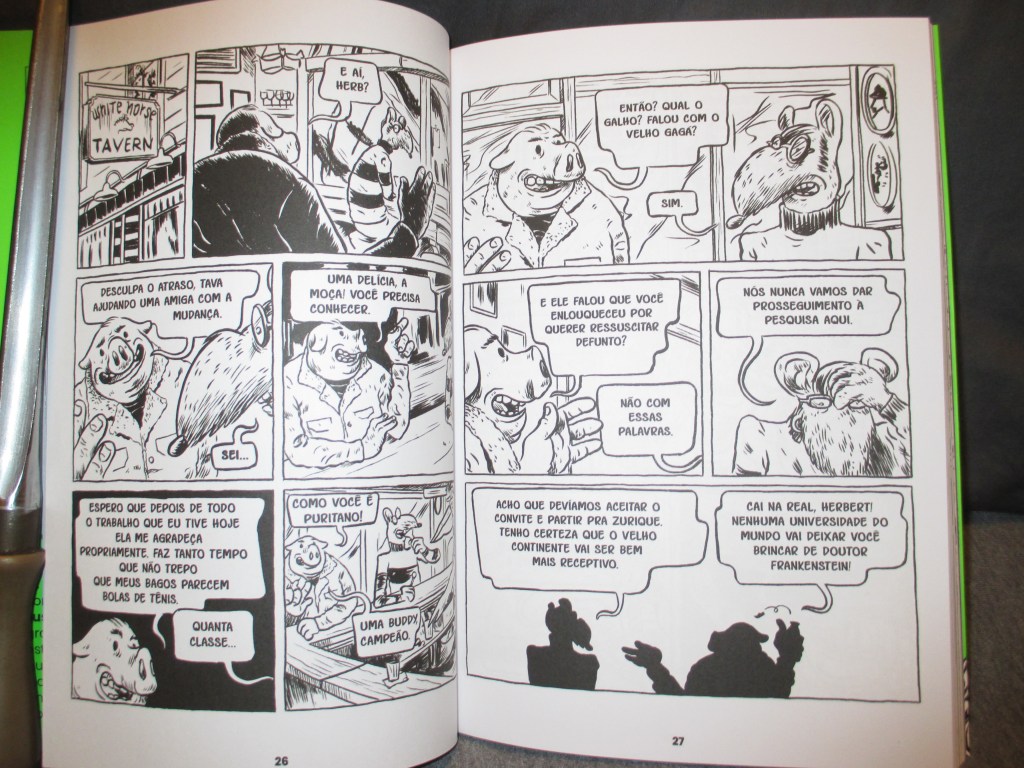
What Brazilian comic creator Juscelino Neco did was to approach “Herbert West—Reanimator” through the lens of 1960s underground comix. Herbert West and the other characters are cast as anthropomorphic animals, the grungy cousins of Mickey Mouse and Bugs Bunny, and their adventures are sexually explicit, violent, and drug-fueled. Neco put on the page everything that Lovecraft left off the page—and added a few other details of his own along the way.

The beginning is relatively restrained, Herbert West is in medical school. The broad outline of the first portion of Neco’s graphic novel follows the opening episode of Lovecraft’s story, although Neco takes many liberties with the framing of characters and events. As well as making the most of the opportunity to add a little gross-out imagery, such as a full-page pin-up of an autopsy in progress.

A vida não e um filme de terror barato.Life is not a cheap horror movie.
Reanimator p23English translation

It is difficult to express how emotive the combination of art and text can be. The instinctive comparison is something like Art Spiegelman’s Maus, but the over-the-top black humor characteristic of the film Re-Animator (1985) is still there. There will be a page of dark panels where West laments the unimaginative bureaucracy that refuses to entertain his ideas about reanimation—and then you turn the page and its West talking to himself while being the bottom in a graphically-portrayed homosexual BDSM scene.

Then West gets an assistant. Someone to help him out.

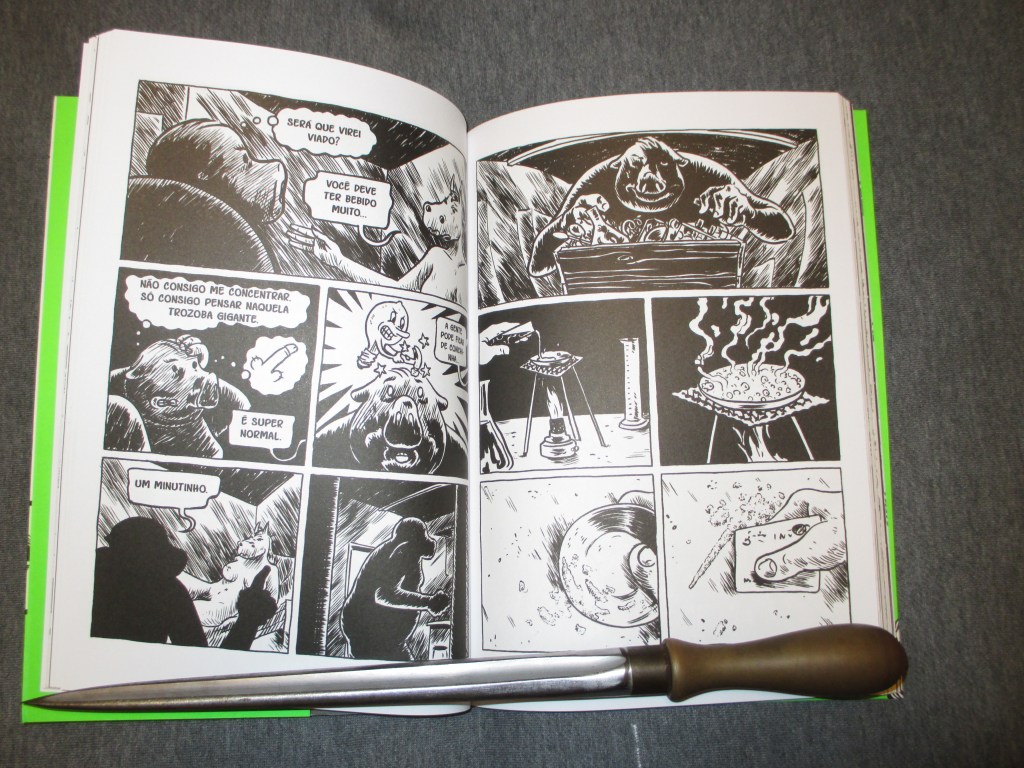
In Neco’s Reanimator, the porcine assistant is no passive observer of events, but an active partner in West’s operations. They enable West’s experiments, but also his worst impulses. Together the two secure their first victim/experimental subject—and this is where things start to get a little more punk rock. The presence of drugs and the necessity of violence start to ramp up swiftly.

Until, while with a prostitute, the assistant cooks up some reanimation agent like its crack cocaine and injects himself. It does provide new life for spent flesh, but is also suggests a new sideline for West and his friend as drug dealers.

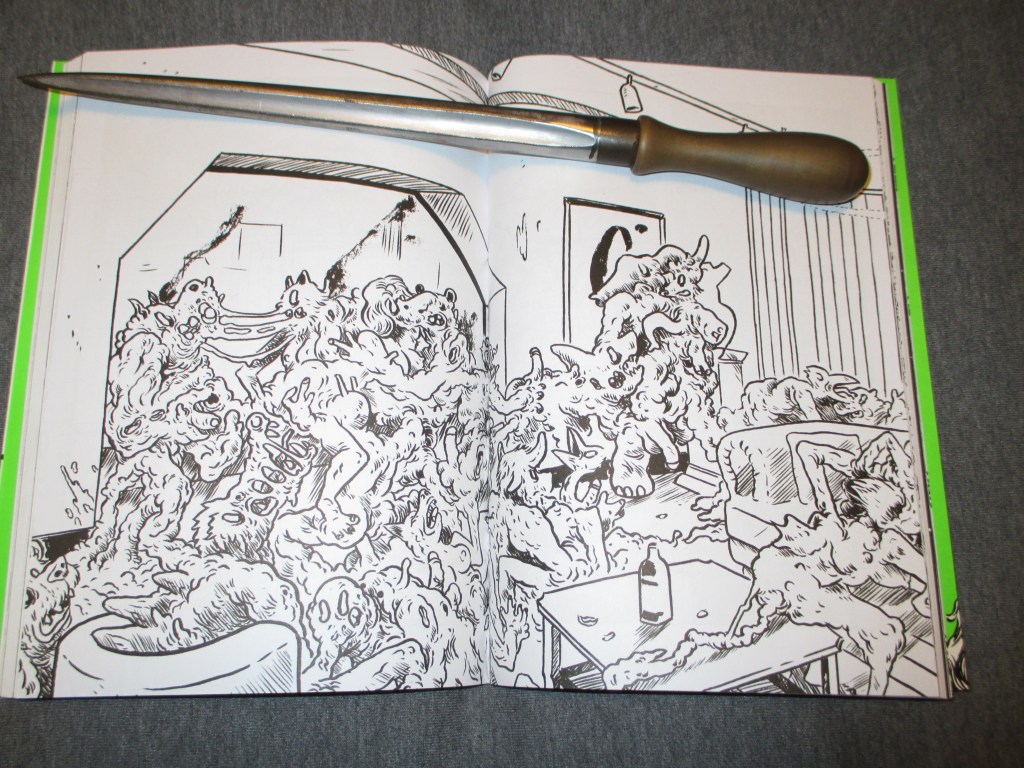
At this point, Neco’s Reanimator has completely abandoned Lovecraft’s narrative for a literal orgy of sex and violence. One that continues to try and outdo itself with almost every turn of the page. There is one scene at a reanimation drug-fueled party that is reminiscent of something like the end of Brian Yuzna’s Society (1989), where the individual ceases to exist.

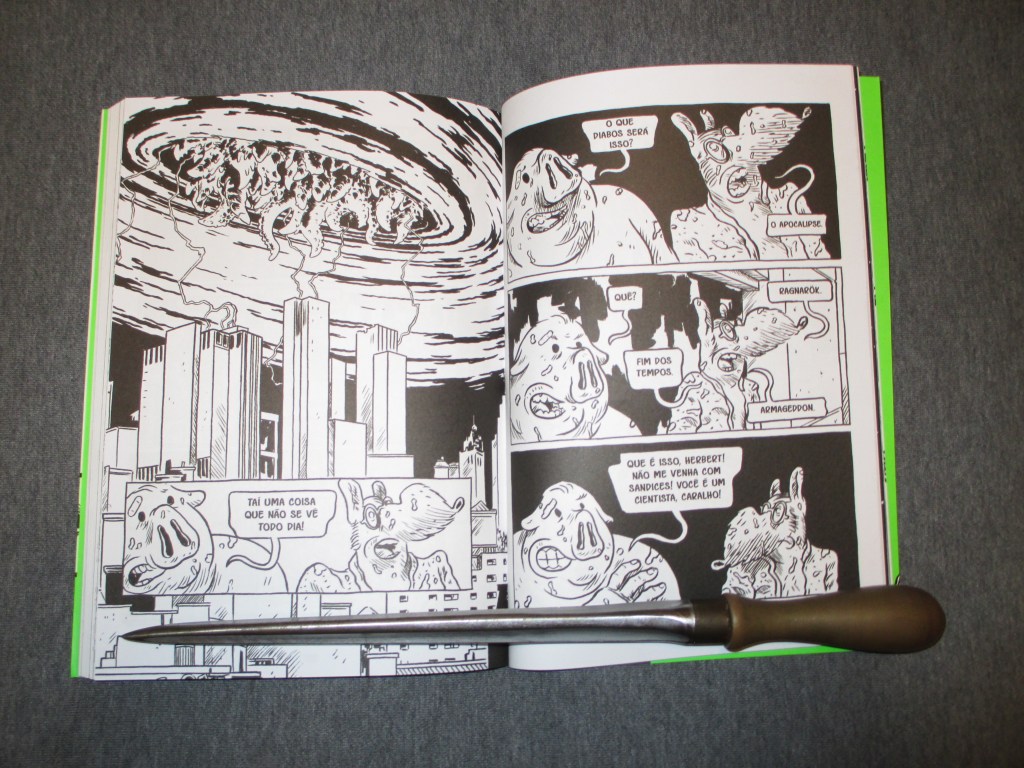
From there, Neco goes full eldritch, bringing in some of Lovecraft’s other ideas while retaining the same ’60s underground comix shock mentality.

It is never clear, at the end, whether this is something Herbert West and his friend have caused by defying the laws of nature, or just a coincidental apocalypse. In a way, it doesn’t matter. Something fundamental has changed, the scientific genie has been let loose from the bottle and they can’t put it back. The world ends…and Neco doesn’t stop there. The world is fucked. Quite literally.

What stands out about Reanimator (2020) is how fully Neco embraces the remit. Critics have read a homosexual subtext in Lovecraft’s original story, some works like “Herbert West in Love” (2012) by Molly Tanzer and “(UN)Bury Your Gays: A Queering of Herbert West – Reanimator by H.P. Lovecraft” by Clinton W. Waters have made that more explicit, but here West’s sexuality is embraced and depicted as an open part of his character. The sex and violence are over-the-top and cartoonish, but that stands in stark contrast to efforts at more realistic portrayal like Reanimator (2008) by Florent Calvez and Herbert West: Carne Fresca (2021) by Luciano Saracino & Rodrigo López.

Reanimator (2020) by Juscelino Neco works on its own terms. It’s fun, disgusting, ribald, edgy, slightly ridiculous, and in the end cosmic in its scope. Readers are left without all the answers, but there’s the impression that one man’s obsession, with the aid and assistance of a friend, has led to the destruction of an entire world. That isn’t how Lovecraft ended the story, but that is the point. To do what Lovecraft would not have done, to use his fiction as a springboard, not to limit creators to only aping what he wrote forever.


Bobby Derie is the author of Weird Talers: Essays on Robert E. Howard and Others and Sex and the Cthulhu Mythos.

Deep Cuts in a Lovecraftian Vein uses Amazon Associate links. As an Amazon Associate I earn from qualifying purchases.

Reanimator (2008) by Florent Calvez v. Herbert West: Carne Fresca (2021) by Luciano Saracino & Rodrigo López

Not all of H. P. Lovecraft’s works are of equal merit, or of equal attractiveness to readers, artists, and writers. While some stories have been adapted many times in different media, others languish in relative obscurity—reprinted in Lovecraft’s collections, but rarely in anthologies, and with less impact on popular culture. The whys and wherefores differ with each tale; generally, such works were not popular during Lovecraft’s lifetime and may have only been published after his death, have little or no direct connection to the Mythos, or represent some difficulty due to changing tastes or the prejudices expressed in the story.

As something that represents all three of these categories, “Herbert West—Reanimator” is an unexpected posthumous breakout hit for Lovecraft. Initially published as a series of six interconnected short tales in the pages of Home Brew, and not published more widely until after Lovecraft’s death when Weird Tales reprinted them, “Herbert West—Reanimator” has only slight connection to Lovecraft’s wider Mythos with the Arkham/Miskatonic University setting, and contains a chapter with one of the most baldly racist characters and characterizations in Lovecraft’s oeuvre. Written as Lovecraft’s first attempt at commercial fiction, it isn’t really typical of his later style or efforts at all.

Yet…there is something about Dr. Herbert West that has thrilled audiences and inspired writers and artists for decades. The 1985 film Re-Animator spawned a small film franchise, a novelization, comic books, and merchandise; helped launch the Lovecraftian film careers of Stuart Gordon, Brian Yuzna, Jeffrey Combs, and Barbara Crampton; and even a hardcore pornographic film: Re-Penetrator (2004). Beyond this, many writers have taken a stab at the Re-Animator, including the anthology Legacy of the Reanimator (2015), Peter Rawlik’s Reanimators (2013) and Reanimatrix (2016), “Herbert West in Love” (2012) by Molly Tanzer, “Kanye West—Reanimator” (2015) by Joshua Chaplinsky, “Herburt East: Refuckinator” (2012) by Lula Lisbon, “(UN)Bury Your Gays: A Queering of Herbert West – Reanimator by H.P. Lovecraft” by Clinton W. Waters, and “Herbert West and the Mammaries of Madness” (2015) by Dixie Pinoit, “Albertina West: Reanimator” by TL Wiswell—among many others.

Comic and graphic adaptations of “Herbert West—Reanimator” are especially fascinating, because on those rare occasions where readers get two full adaptations, of approximately equal length, for side-by-side comparison, you can see how very different two adaptations can be of the same material—and how much work goes into turning a prose text into a comic script.

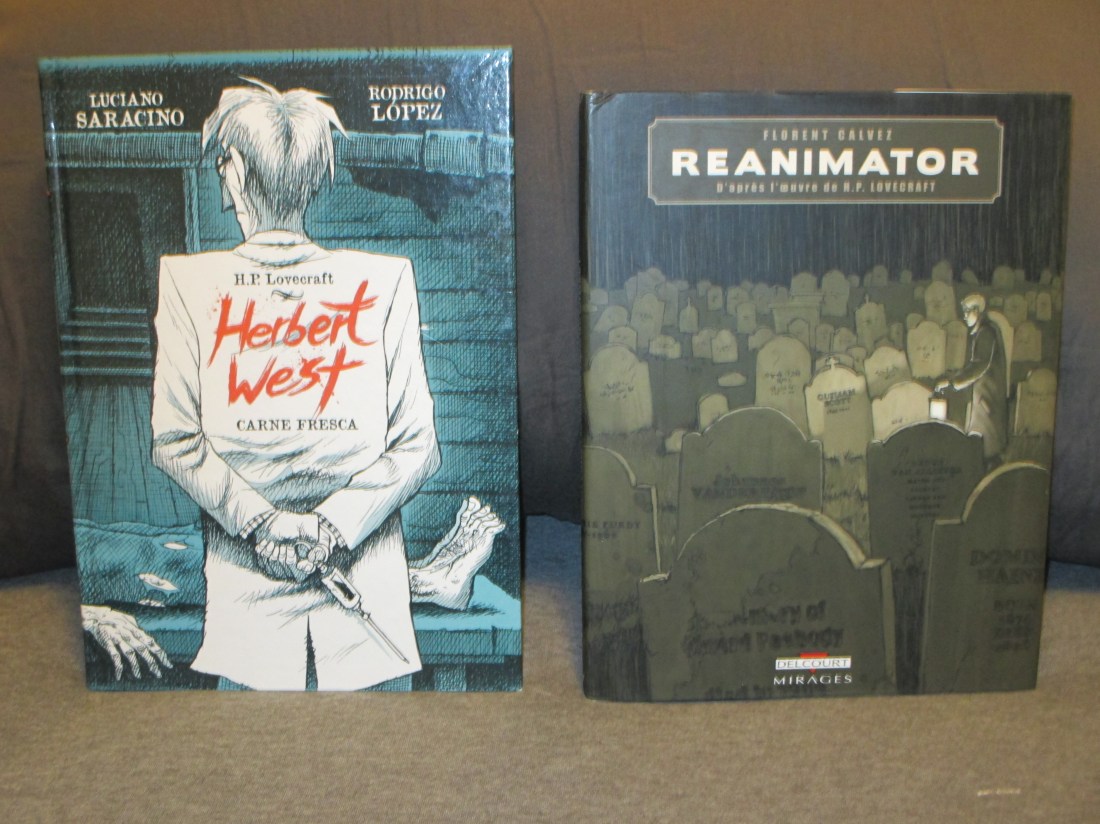
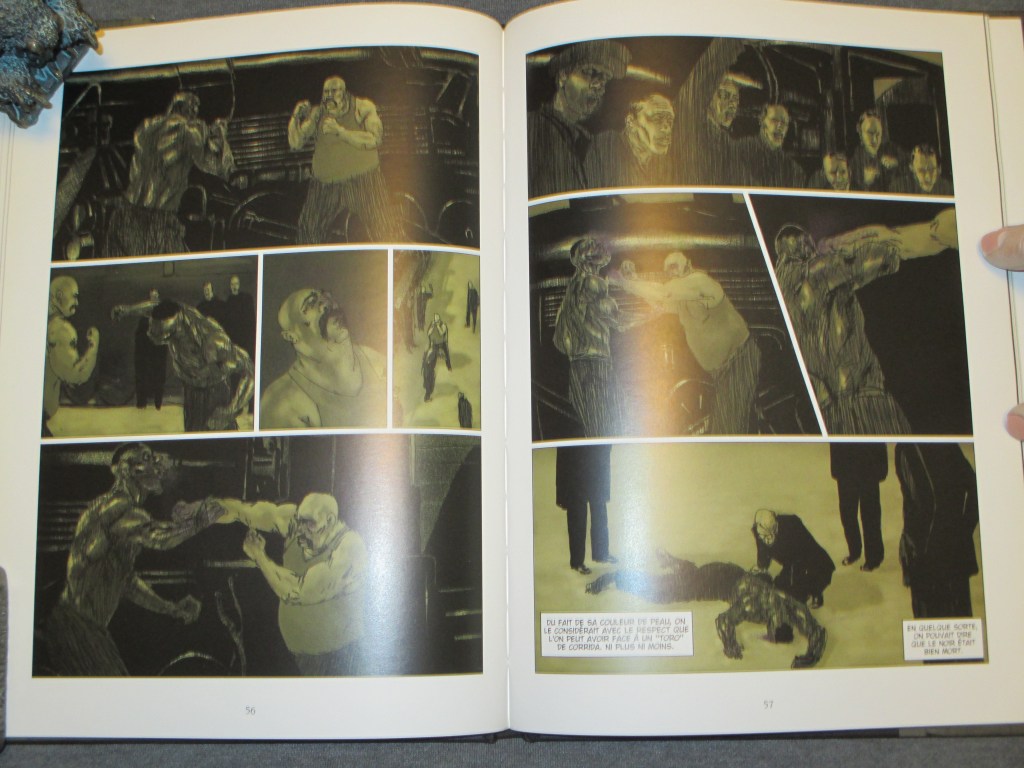
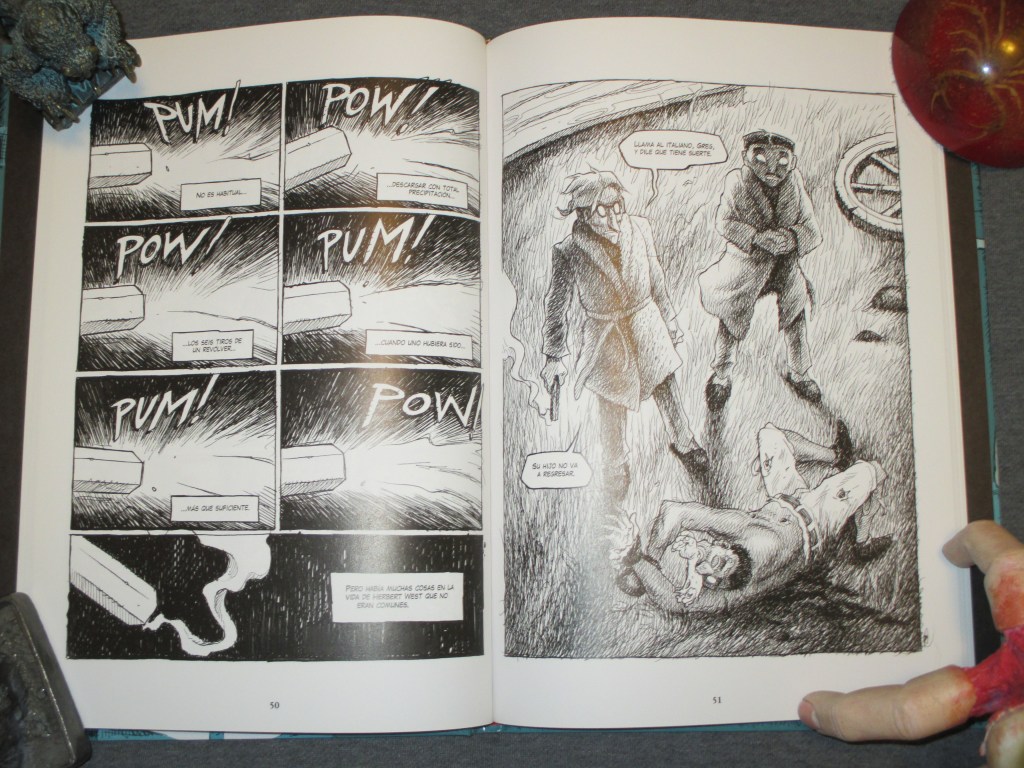
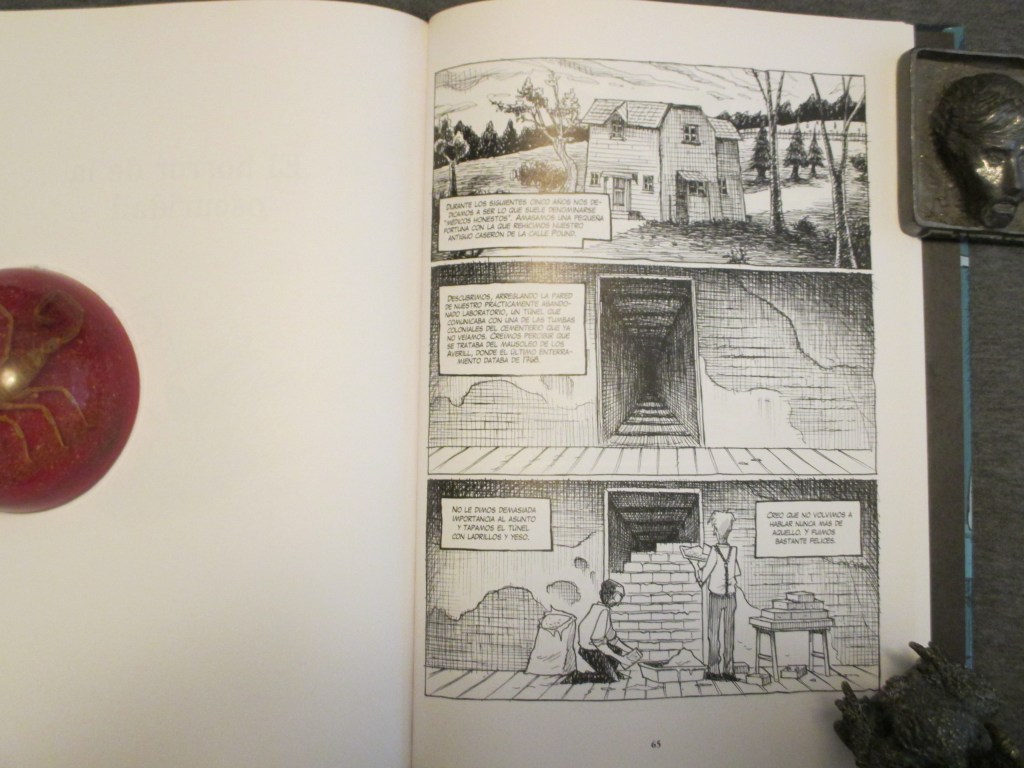
Such an opportunity presents itself with Reanimator (2008) by Florent Calvez, a hardbound 112-page French-language bande dessinee published by Delcourt, and Herbert West: Carne Fresca (“Fresh Meat”) (2021) by Luciano Saracino (script) and Rodrigo López (art), a 96-page Spanish-language hardbound album published by Dolmen. Both of these works adapt the full six episodes of “Herbert West—Reanimator” fairly faithfully—but how they do it and what they choose to emphasize is very different.

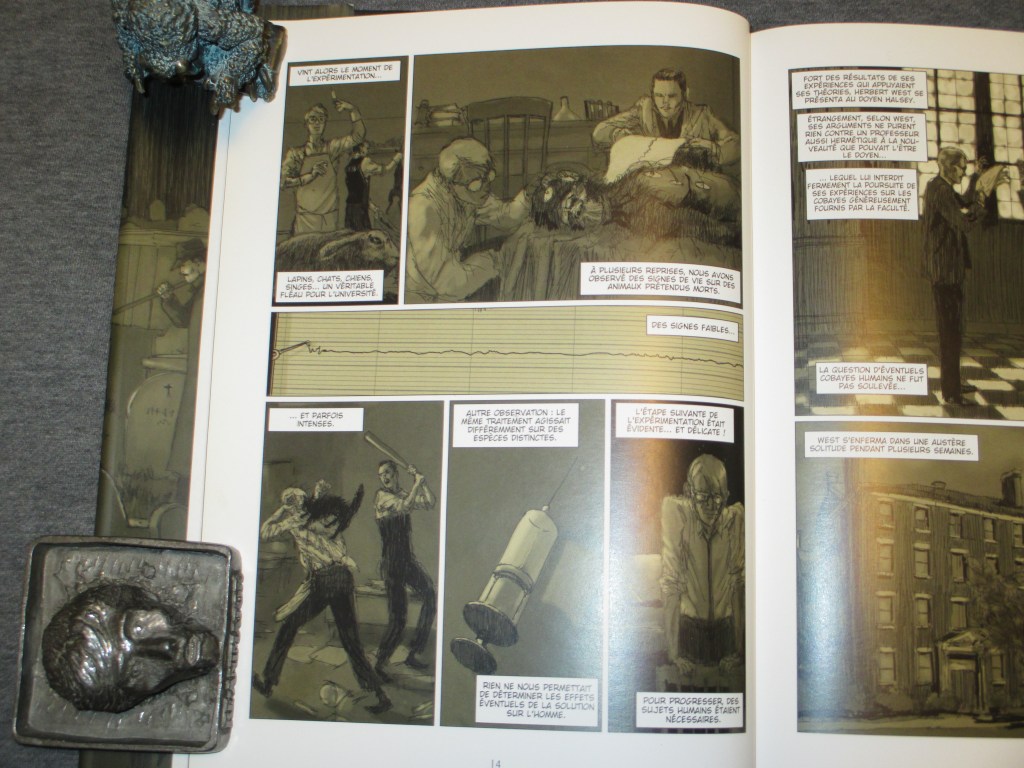
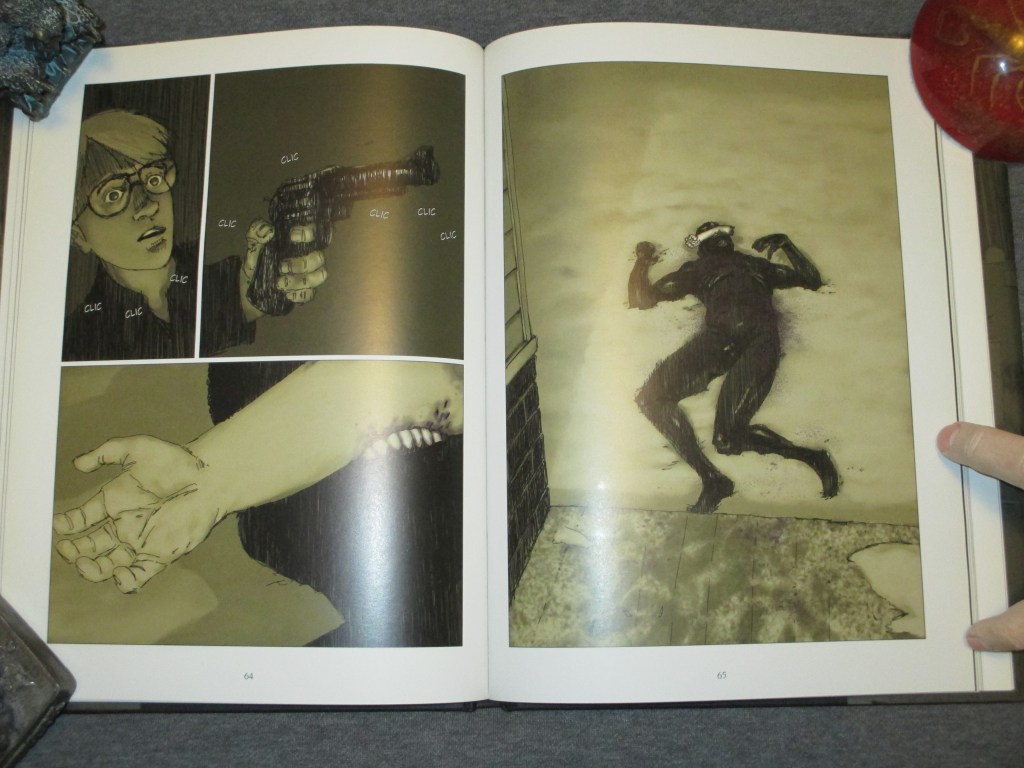
Calvez’ Reanimator is a sepia-toned period piece, starkly realistic. Unlike many later works, there are few if any visual cues or references to the 1985 film; Herbert West is blond, for example, as Lovecraft’s narrator described him, not a brunet like actor Jeffrey Combs. The most notable reference to the film is the brief shot of West being attacked by a reanimated black cat, a scene made infamous in the movie.

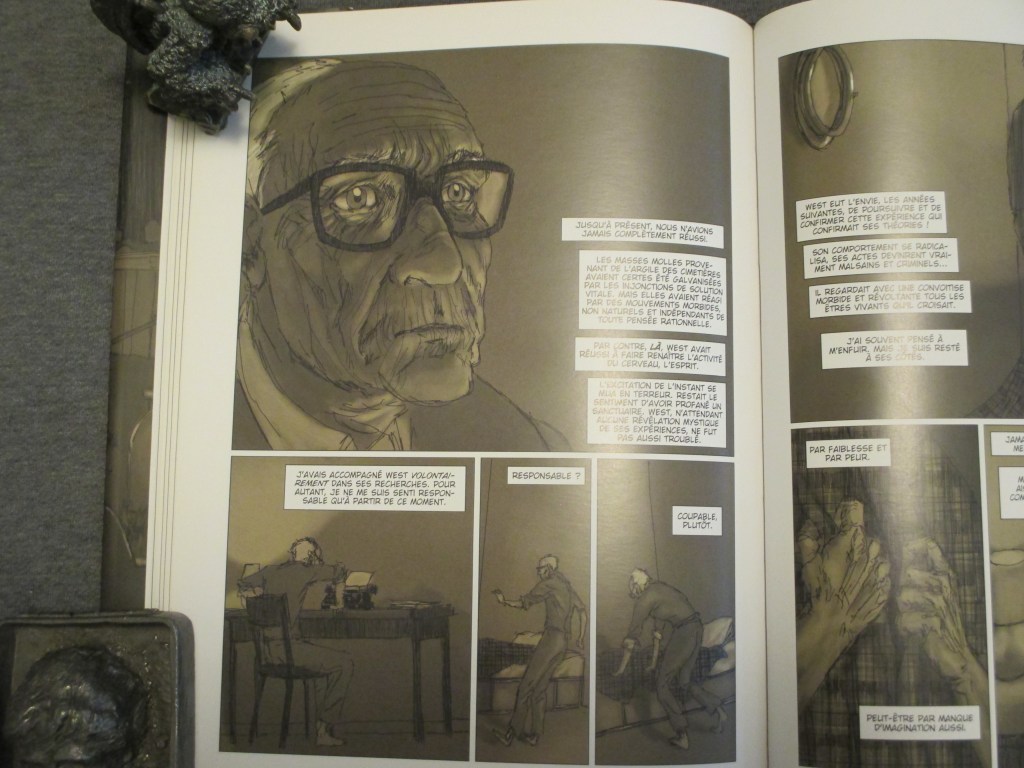
The main departure from Lovecraft’s story is that Calvez provides a framing narrative: the nameless assistant, older now, and visually similar to William S. Burroughs, is writing down his account of events on a ship. This wraparound segment helps give shape to the narrative as a Memoir, which features little speech and a great deal of exposition translated directly from Lovecraft’s text.

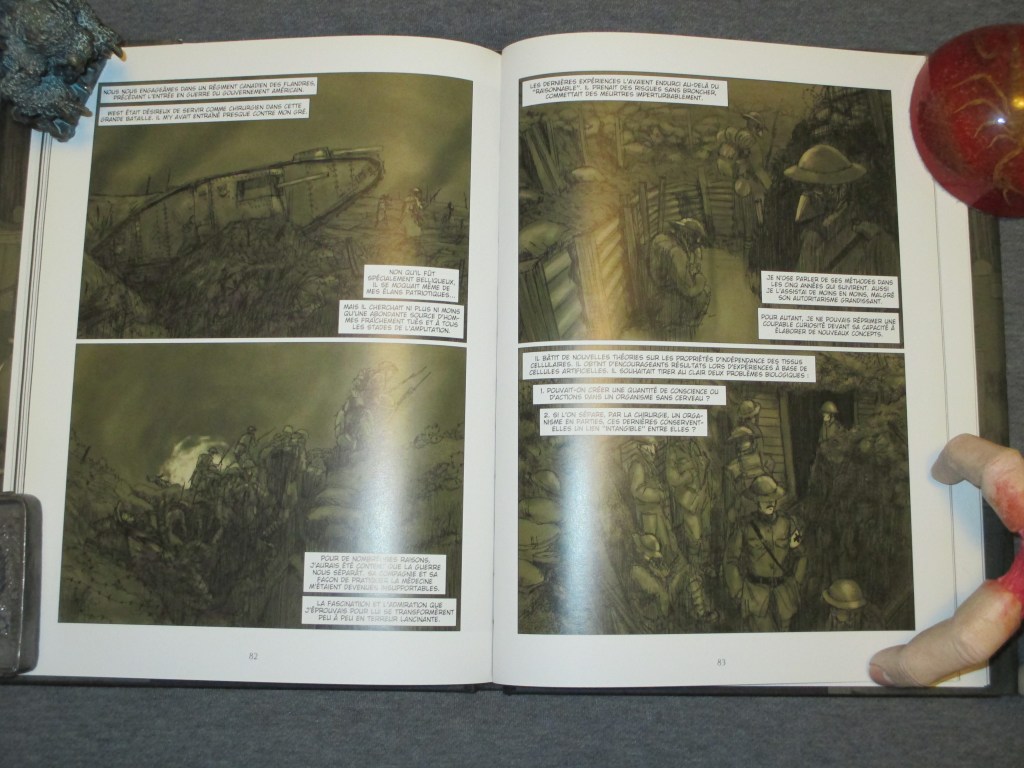
The stark realism of the work helps make the horrors stand out. There’s not a lot of gore in the traditional sense; the world of Reanimator is dark, murky, washed out like the sepia photographs of long-ago atrocities. Care and attention to detail are everywhere apparent: the details of costume and press, the architecture of houses, bits of English on newspapers and gravestones for the scenes set in the United States. It is a testament to Calvez’ skill and dedication to get the details right.

In Lovecraft’s story, we don’t see the boxing match, only the aftermath. Calvez has taken another liberty here: “Kid O’Brien” is implicitly a Jewish boxer under an Irish name, while “Buck Robinson, ‘The Harlem Smoke'” is almost a caricature of Black boxers like world heavyweight champion Jack Johnson. Boxing was a major national sport, and while Lovecraft may have cared little for it, he was certainly aware of some of the major boxers of his era, including Jackson.

The narrator’s prejudices that depicted the dead boxer in animal-like terms, and wondered if some obscure biological difference between white and black caused the failure of the reanimation experiment, Calvez leaves out. Their absence isn’t particularly noticeable, unless you know to look for them. It does not diminish the horror that marks the climax of the episode.

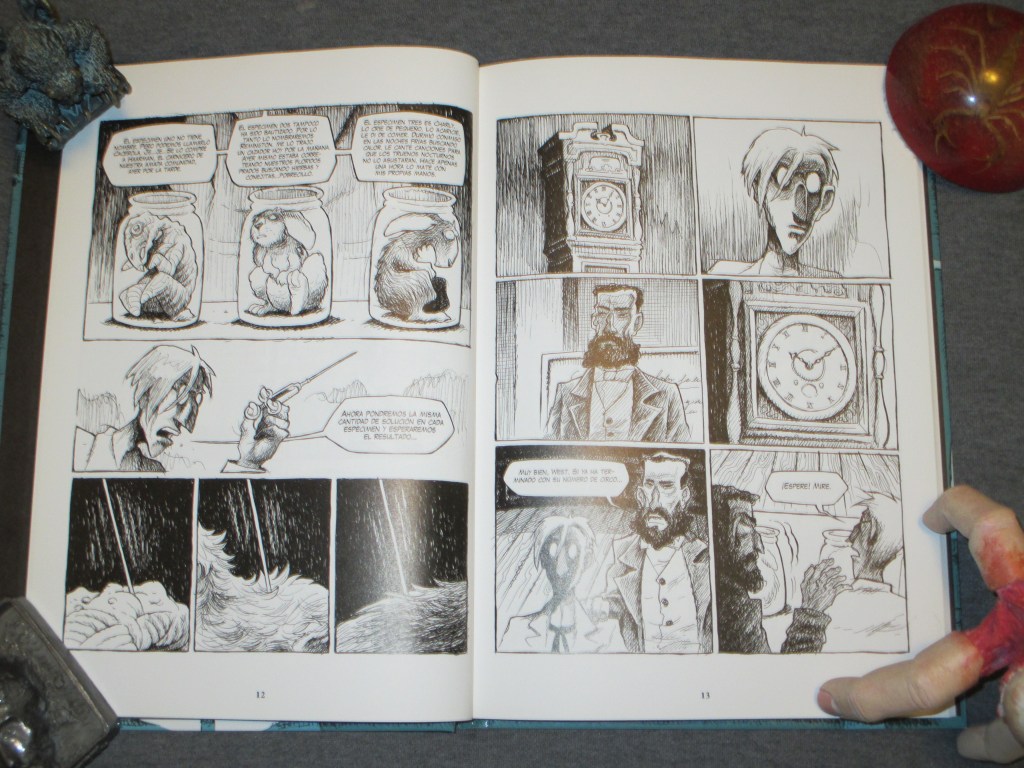
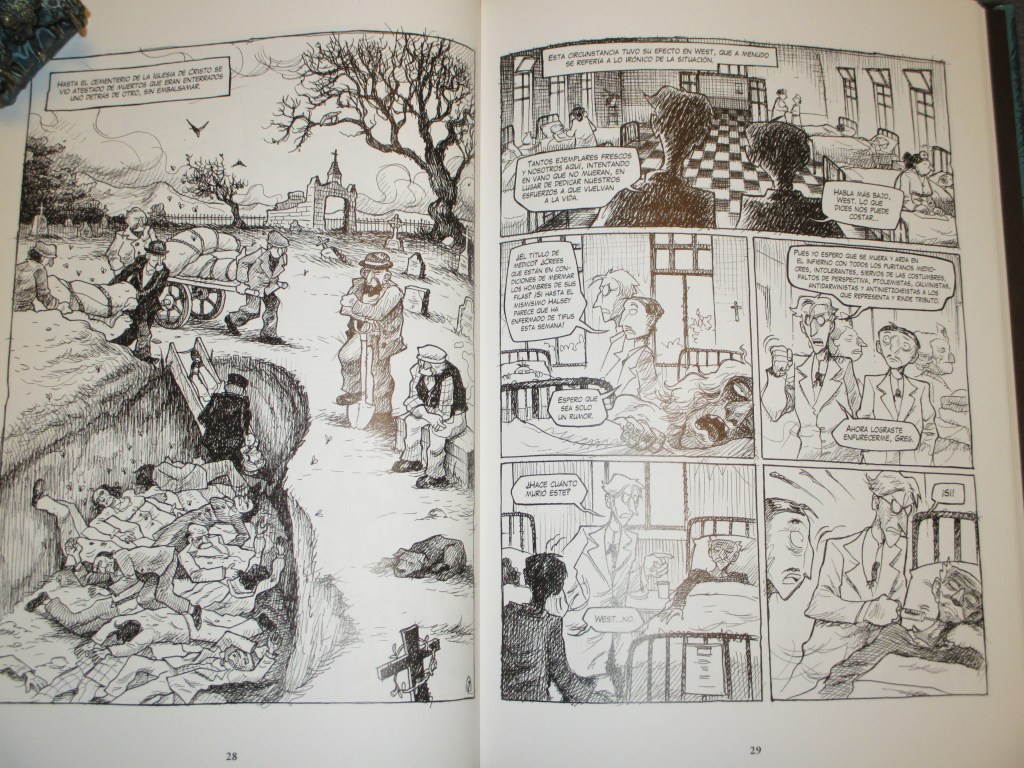
Saracino and López take a slightly different approach to Herbert West. The art style, in black and white, is more stylized. There is still great care and attention to detail, but the pages tend to more standard layouts, based around a six-panel grid, and there is much more dialogue. Herbert West himself is allowed to speak in his own words, instead of being relayed through his assistant.

So instead of doing a lot of telling, which Lovecraft was more or less forced to do by the nature of his medium, we get a lot more showing. Instead of a wraparound segment, we get more of an extended prologue, a demonstration of West’s experiments with animals.

West’s assistant gets a name and an identity beyond memoirist: Gregory Carter is a fellow medical student at Miskatonic University—and swiftly becomes West’s accomplice in his experiments—but here at least we get to see more interaction between the two. This isn’t Carter writing what has happened; the reader watches over his shoulder, so to speak, as events unfold.

Rodrigo López’ style shows a certain European influence; while the architecture, the dress, and the hairstyles are all very specifically old-fashioned in accordance with the setting, there are details that are more reminiscent of and older Europe than an older New England. There are roofs that look more like tile than anything you’d see in a New England winter, churches without steeples, police officers in kepi hats. A subtle transmigration of atmosphere that doesn’t change much of anything in the story, but reinforces the idea that this is not just an adaptation—it’s a localization.

Probably López’ best moments are when he gives himself a full page to really go while and showcase a scene, often from above to capture some of the landscape, to really play with broad white empty spaces and dark shadows. There’s a very Edward Gorey-like character to this splash pages. As always though, the horror is lurking near the climax of every episode.

As with Calvez, Saracino & López gently excise the racism expressed by the narrator. It is enough that initial injections of the reanimation serum have no effect, the body is disposed of…and it comes back.

It is interesting how both artists focused on this moment as the climax of the episode; both were determined to present the stark horror, the rare bit of action and excitement in these stories, the most arresting visual image in perhaps the whole story. Yet they do it very differently; the reanimated corpse of Robsinon here is still half-dressed, more human-like, and despite the hatching, not as dark in complexion compared to the other characters (a common issue with black-and-white, which needs hair, facial features, and other cues to help delineate race to the audience visually).

Both stories approach the end with characteristic foreshadowing. Yet in this instance, López’ formatting standardization helps set up the scene better. We see the passage that leads from the old funeral home’s basement to the nearby cemetery; we see Carter and West bricking it up. Centrally placed, a Chekov’s gun loaded and with safety off.

When you’ve read “Herbert West—Reanimator” and seen so many different adaptions and variations on it over the years, there’s rarely any surprise in the ending, just as there is no real shock when Godzilla goes on a rampage through a city. The cities in Godzilla films are there to be squashed. Yet there is an aesthetic appreciation for how the job is done, how well the adaptation captures something of the tone and feel of the story, what grue the artist can supply—and how the writer and artist together choose to portray events.

It is not a question of whether Reanimator or Herbert West: Carne Fresca is the better adaptation: they each have their strengths, and they each have their differences. To convey the geographic setting, the period, the tone and atmosphere all requires going beyond just the words printed on the page in Lovecraft’s story. The adaptors need to block out the story, episode by episode, scene by scene, finally page by page and panel by panel. How to establish where the events take place. Leaving room for dialogue, for exposition. Finding the balance between showing and telling—and, in some cases, what not to say, to remain faithful to the spirit of the text without offending present audiences with old prejudices.

Neither of these works has been translated into English; non-English adaptations of Lovecraft rarely are. Yet there are few if any graphic adaptations of “Herbert West—Reanimator” in English to really equal them.

Reanimator (2008) by Florent Calvez is available in hardcopy and as a Kindle ebook.

Herbert West: Carne Fresca (2021) by Luciano Saracino and Rodrigo López is available in hardcopy.


Bobby Derie is the author of Weird Talers: Essays on Robert E. Howard and Others and Sex and the Cthulhu Mythos.

Deep Cuts in a Lovecraftian Vein uses Amazon Associate links. As an Amazon Associate I earn from qualifying purchases.

London Lovecraft: Volume I (2023) by TL Wiswell

Festival shows are, sadly, an ephemeral lot. While some lead to full length plays, TV shows, or even films, most of them rise and fall with their creators, and said creators’ energy and willingness to sacrifice time and money getting their works on stage. This is especially sad for fans of Lovecraft, who are most receptive to works that expand the canon. It is hoped that this slim book of scripts can in some way help these plays reach a larger audience that they were able to when they were originally performed.
—Introduction, London Lovecraft: Volume I, 4

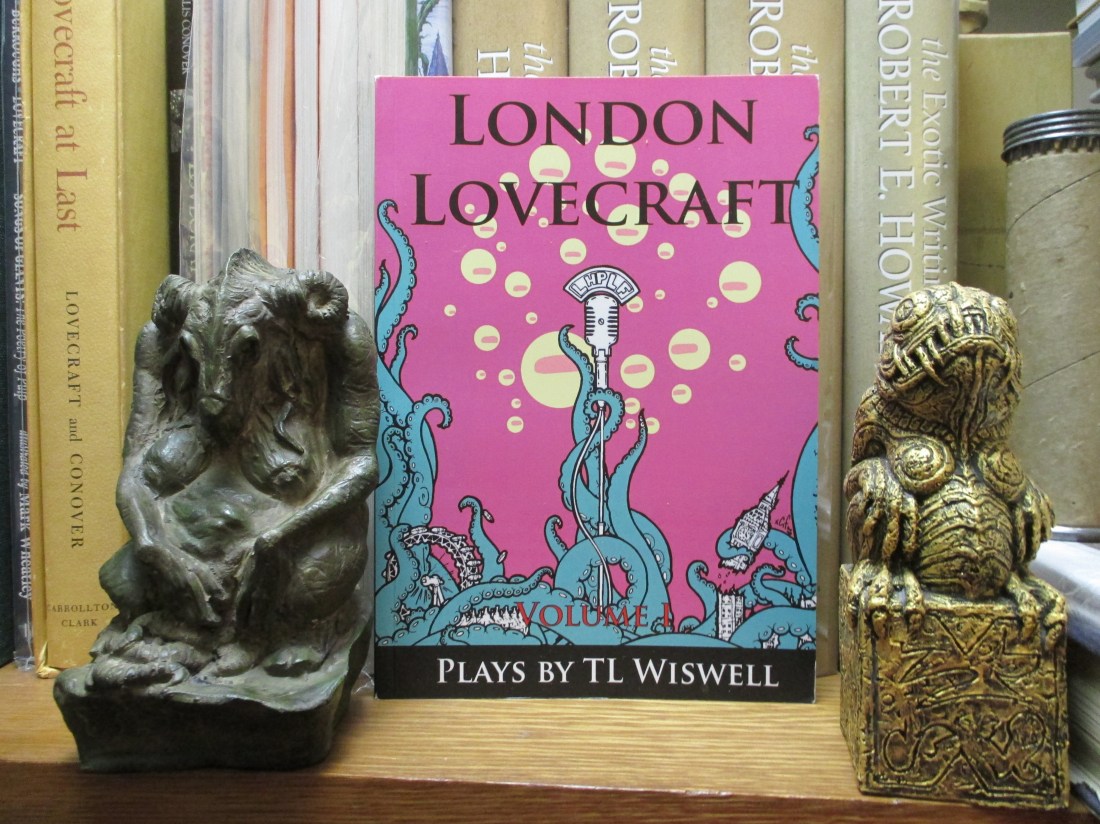
The London Lovecraft Festival has been running since 2018, though the annual festivities were interrupted by the Covid 19 pandemic. A key part of the festivities are the dramatic or theatrical presentations, which expand on or re-cast Lovecraft’s familiar works in a new light. In 2023, four of these brief plays by LLF founding producer TL Wiswell were collected into an independently-published book by Vulcanello Productions.

Each of the four works is a specific riff off a familiar Lovecraft story, condensed and adapted into short plays with typically 2 or 3 main characters. The connecting theme is that the stories are altered to focus on the female characters, either expanding on the roles and thoughts of existing characters or by gender-flipping characters (so Herbert West may become Albertina, for example).

Other writers have had similar ideas, such as in HPL 1920 (2020) by Nick O’Gorman & Tales from the Cthulhuverse #1 (2020) by Zee Romero & Luca Cicognola, but the play as a format shifts how a story can be told, and tends to zero in on the relationship between the characters portrayed by the actors. It actually works rather well for Lovecraft’s fiction as passages of expository narration in his work can be just that, whereas in comics or film they tend to cutaway into flashbacks.

Much of the stories also have to be removed, the plot boiled down and simplified to what can feasibly be acted or narrated on a small stage at a budget. That kind of condensation is an art unto itself, and as adaptations go, Wiswell treads the fine line between faithfulness, practicality, and originality.

Mountains of Madness

CHARACTERS:
Dr Willa Dyer – Geologist
Dr Pomona Peabodie – Engineering
Frances Danforth – graduate student, engineering

Setting: 1928. A lecture hall at Miskatonic University, set up with a film projector and a gramophone. WILLA DYER is behind the podium addressing the audience as if they are the audience of her lecture. All people referred to are substantially only present in her memories: Peabodie is dead; Danforth has gone mad.
—Introduction, London Lovecraft: Volume I, 10

The Miskatonic University expedition to Antarctica in Lovecraft’s At the Mountains of Madness was implicitly all white men; the reimagined expedition of Wiswell’s play took place in the decade prior. The all-female expedition raises no more comment than the all-male one did for the bulk of readers. Much of the grand cosmic backstory of the Old Ones is truncated in summation—as it would be, during a lecture—and neatly bypassed Dyer’s exclamation “They were men!” in Lovecraft’s version.

Much of this short play consists of long monologues by Dyer and Peabodie, with brief interjections by Danforth; shifts in light and focus emphasize when one character is speaking from the past (as when a recording of the dead Peabodie “plays” on the gramophone). It is an effective truncation, and shows how gender need not shape every role in one of Lovecraft’s stories.

Asenath’s Tale

CHARACTERS:
Viola Danforth
Asenath Waite Derby

Setting: New England, 1962

Suggested stage setup: two armchairs with a table between them, upon which rests a phone.
—Introduction, London Lovecraft: Volume I, 28

“The Thing on the Doorstep” features one of the more famous of Lovecraft’s women characters, Asenath Waite—but the depiction is somewhat married because of the unique gender dynamics of Waite in that story, as discussed by Joe Koch in Must I Wear This Corpse For You?: H. P. Lovecraft’s “The Thing on the Doorstep” (1937), among others. Wiswell doesn’t shy away from this; rather, she puts Asenath’s identity as a woman, and her friendship with Viola Danforth, at the center of the story.

Reading about Asenath Waite as a child in Innsmouth, her relationship with her father and with the other children, an insight into her heritage in Innsmouth, provides a humanizing perspective that is completely absent in Lovecraft’s story—where the reader never “meets” Asenath as she was in youth, but only later, as an adult, with all that implies. Wiswell makes the most of the sexism expressed by Ephraim Waite in Lovecraft’s story to frame a contentious relationship between father and daughter that goes all too badly wrong.

There is something more poignant about “Asenath’s Tale” than “The Thing on the Doorstep.” Edward Derby is almost a born victim in Lovecraft’s story, and his final act of rebellion is late in the game. Wiswell’s story with its light-hearted banter becomes something more like a tragedy; the events unfold, unstoppable, and though the players on the stage can only read their parts, those who know in the audience can see their brief, fleeting happiness and friendship for what it is: the prelude to horror.

Albertina West: Reanimator

CHARACTERS:
Dr Albertina West
Dr Isabel Milburn
The Undead: The animated corpses of Major Sir Eric Moreland Clapham-Lee and others.

All scenes set in a laboratory with a dissecting table and a sitting room in front, in Scotland and France (or maybe Belgium)

Time: 1890-1922
—Introduction, London Lovecraft: Volume I, 50

From a narrative standpoint, “Herbert West—Reanimator” is really six brief episodes strung out like an old film serial; it’s why each individual episode ends with a mini-climax, and might be separated by months or years in time. Adapting that to the stage or screen is tricky; when Dennis Paoli, William J. Norris, and Stuart Gordon put together the screenplay for Re-Animator (1985), they ended up jettisoning entire episodes while burning through the plot to fit a tightly-paced 86-minute runtime.

Wiswell’s approach rearranges the episodes in favor of focusing on a narrower thread of plot: the friendship of West and her assistant Milburn, and reanimation of Major Sir Eric Moreland Clapham-Lee during World War I, and the aftermath. Zeroing-in on this particular plotline has a lot of benefit, because it gives West an effective antagonist to play against, a monster of her own creation, not unlike Frankenstein‘s Adam.

More than that, though, it gives Bertie West’s usually nameless, gormless, and racist assistant (and the narrator of the story in Lovecraft’s version) an identity. The fact that they’re women medical doctors during the late 19th and early 20th century actually gets a bit of attention, which is nice; while these are stories to address the gender gap in Lovecraft rather than historical societal trends to misogyny as a whole, Bertie’s nod to the National Society for Women’s Suffrage and the restrictions of women in higher education and medical practice is appropriate for the character and the setting.

Period prejudice with regard to race, on the other hand, is out. Much as with “Kanye West—Reanimator” (2015) by Joshua Chaplinsky vs. “Herburt East: Refuckinator” (2012) by Lula Lisbon, we get a version of the seen of a reanimated corpse with a baby’s arm dangling out of its mouth, but the race of the reanimated is not explicitly mentioned. Horror is mixed with bathos at this point, as Milburn and West trade quips and bon mots in a style that owes a bit more to a deranged P. G. Wodehouse than H. P. Lovecraft.

More than pretty much any other of Lovecraft’s stories “Herbert West—Reanimator” seems hard to play straight; the potential for over-the-top gore and dark humor has been made too apparent.

The Dreamquest of Unknown Kadath

Unlike the others, this adaptation of Lovecraft’s The Dream-Quest of Unknown Kadath was done in collaboration with experimental musician Shivers (Sam Enthoven) and takes the form of a puppet show, narrated and accompanied by music. An audio production of the production is available on Bandcamp.

Randolph Carter has become Miranda Carter, but the gist of the plot and the character are the same as in Lovecraft’s story—albeit with a little more humor.

As she turned to go, Carter wondered why the Zoogs had stopped pursuing her. Then she noticed all the complacent cats of Ulthar licking their chops. She recalled, too, the hungry way a young Zoog had regarded a small black kitten in the street outside. And because she loved nothing on Earth more than small black kittens, she did not mourn the Zoogs.
London Lovecraft: Volume I, 68

Puppetry, especially shadow puppetry, can be singularly evocative; action that could not be feasibly acted out can be implied, with the audience’s imagination filling in the gaps. As with most of the other stories, Carter’s gender plays little role in how the events play out; it’s a change of face, but the core of Lovecraft’s tale and characterization remains intact.

While all of these plays are competently written and I’d like to see them performed sometime, the best are doubtless “Asenath’s Tale” and “Albertina West: Reanimator” specifically because those are the two stories that diverge most from Lovecraft’s characterization, while keeping true to his plots, and thus add some new dimension to the old stories.

At the moment there does not appear to be any way to purchase copies of London Lovecraft: Volume I (2023) except directly from the author. TL Wiswell was kind enough to sell me a copy during their visit to NecronomiCon Providence 2024, and I appreciate the chance to add to my small store of Lovecraftian plays, alongside works like Lovecraft’s Follies (1971).


Bobby Derie is the author of Weird Talers: Essays on Robert E. Howard and Others and Sex and the Cthulhu Mythos.

Deep Cuts in a Lovecraftian Vein uses Amazon Associate links. As an Amazon Associate I earn from qualifying purchases.

“(UN)Bury Your Gays: A Queering of Herbert West – Reanimator by H.P. Lovecraft” by Clinton W. Waters

While he was with me, the wonder and diabolism of his experiments fascinated me utterly, and I was his closest companion. Now that he is gone and the spell is broken, the actual fear is greater. Memories and possibilities are ever more hideous than realities.

H. P. Lovecraft, “Herbert West—Reanimator”

How do you go about queering Herbert West?

In 1922, before Weird Tales had ever hit the stands, H. P. Lovecraft’s first commercial work went into print: six brief tales of gruesome mad science, for which he was to be paid five dollars an episode. Commercial hack work, and Lovecraft knew it; it would not be published again until Lovecraft was safely dead and beyond objecting. From there it entered the domain of reprints, and it became the basis for the 1985 film Reanimator. The film, with the iconic performance by Jeffrey Combs as Herbert West and the glowing green reanimation agent, was a smash success. It inspired a franchise of movies, a novelization, comic books, merchandise, and stories chronicling the further adventure of the reanimator, his foes and rivals.

Herbert West has become one of Lovecraft’s breakout characters.

It is harder to pin down when the queer interpretations began. The basic building blocks were always there, from the beginning: West and his unnamed partner’s close homosocial bond, like Holmes and his Watson; Lovecraft’s typical asexuality and lack of romance in the story; the allegorical implications of men trying to create life without women, especially via the Freudian technique of injecting some of their special serum into the body. One might also add the loneliness of the outsiders, forced to hide their actions from the world, forced out onto the fringes just to be themselves without discrimination.

For queer folk, reading into the text or the adaptations something of their own experience, maybe Herbert West was always queer too. He just wasn’t out about it yet.

Brian McNaughton may have been the first to really play with the idea in “Herbert West—Reincarnated: Part II, The Horror from the Holy Land” (2000), published in Crypt of Cthulhu #106 and his collection Nasty Stories. Molly Tanzer certainly brought in the open with “Herbert West in Love” (2012). The erotic appeal was made manifest in “Herburt East: Refuckinator” (2012) by Lula Lisbon. Alan Moore & Jacen Burrows expressly coded West and his companion as queer in Providence (2017), which played off against their own queer protagonist…and there are more. The constellation of Reanimator-derived works continues to grow; some are more explicitly queer than others. Each of these interpretations is different, both in their understanding and in their depiction of what being queer means, and in what they drew from Lovecraft or what they borrowed from other media; the glowing green reagent being a common element in most stories written after 1985.

The fluid was fluorescent and green as I gently tipped the vial. A single bead of he concoction caught on the lip of the tube and then fell, splashing into the beed’s mouth.

Clinton W. Waters, “(UN)Bury Your Gays: A Queering of Herbert West – Reanimator by H.P. Lovecraft”

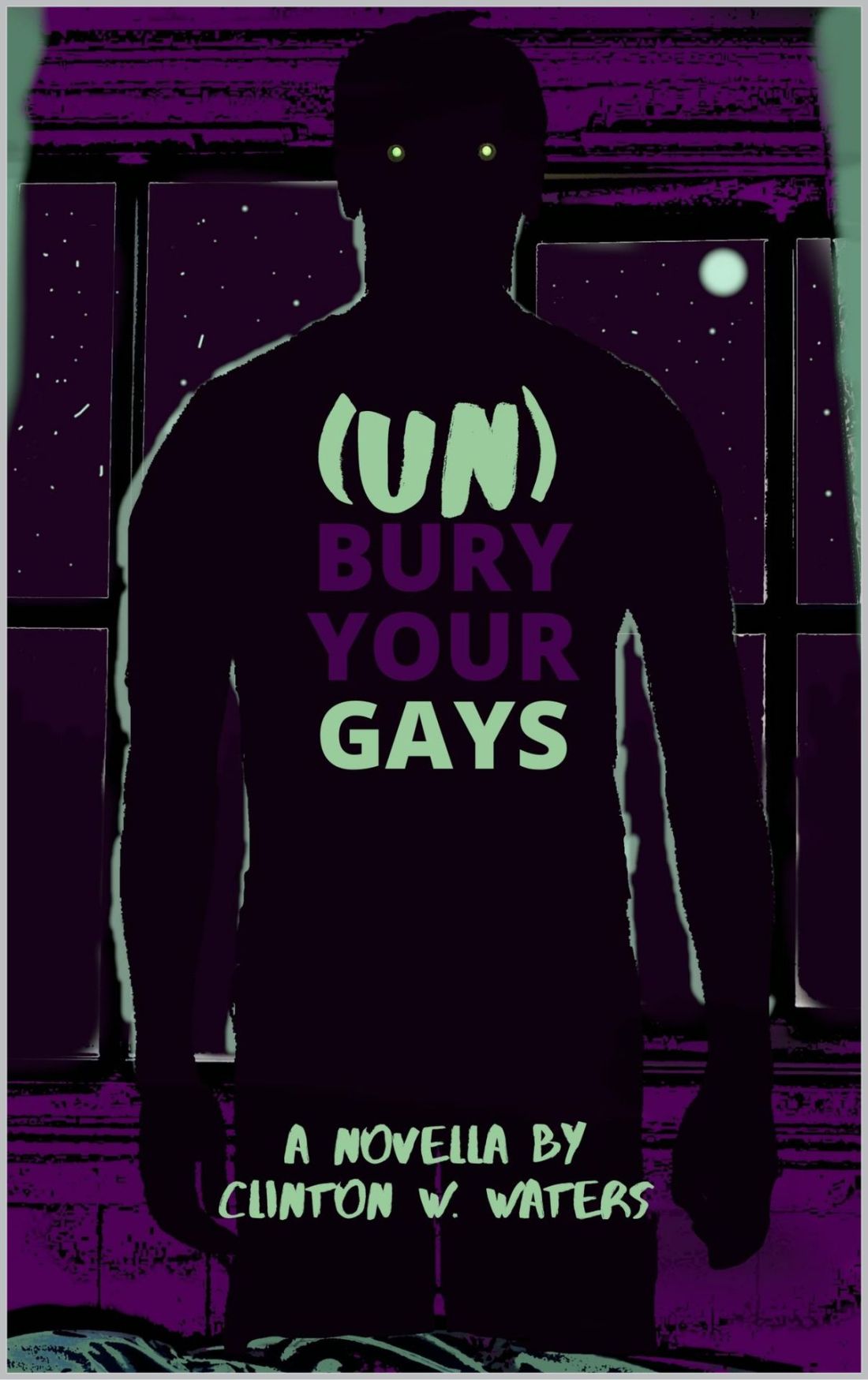
“(UN)Bury Your Gays” is a spiritual sequel to “Herbert West—Reanimator”; one that retreads a little familiar ground (it is a reanimator story, it would be more shocking if there wasn’t a reanimation), but is overall smaller, more focused: the protagonists are not simply repeating the Herbert West/unnamed assistant dynamic, but are exploring a much more complicated, nuanced, realistic friendship as the only two queer kids in high school. There is a sensibility in the story reminiscent of “Pale, Trembling Youth” (1986) by W. H. Pugmire & Jessica Amanda Salmonson; a weird sort of universality to the outsider experience which makes the characters much more sympathetic than West and his nameless assistant ever were.

Waters sets the action in the current day, and a certain pop-culture sensibility flows through the scenario: like the genre-savvy characters in the Scream films, they can picture themselves in a horror story and sometimes try to interpret what’s happening through that lens, riffing on vampirism and flesh-eating zombies in a way that Herbert West & his assistant in 1922 couldn’t. Less directly and less obviously, the two teens also approach their sexuality and relationship through the same lens. This is far and away from a Lovecraftian interpretation of Brokeback Mountain, but there are shades of the same relationship dynamics at play. What the leads have isn’t sexual, but they are tied together by their sexuality. A shared intimacy, but not exclusivity.

In a lot of ways, Waters flips Lovecraft’s script. Instead of a nameless protagonist talking about his relationship with Herbert West, we have the great-grand nephew Humphrey West telling the tale of his best friend. Where Herbert West is focused on reanimation practically to the exclusion of all else and seems to take his relationship with the unnamed narrator for granted, in “(UN)Bury Your Gays” the focus is all about the relationship between Humphrey and his friend, with reanimation a catalyst for a shift in their dynamic, and that is what the story is ultimately about.

Of Daniel “Danny” Moreland, I can only speak fondly. He was my closest companion. My champion. My single greatest achievement.

Clinton W. Waters, “(UN)Bury Your Gays: A Queering of Herbert West – Reanimator by H.P. Lovecraft”

A key point in Waters’ approach is that it is a queering, not the queering of “Herbert West—Reanimator.” This is one interpretation, one take, one possible iteration of the infinite possibilities of exploring Lovecraft’s original narrative, characters, or concepts through a queer lens. Rather than repeating what Molly Tanzer or Alan Moore wrote, Waters is presenting a different permutation on the same idea—one that is more inspired by Lovecraft’s original than a strict revisitation of the same familiar story and characters.

Because there is more than one way to be queer, and more than one way to reanimate the Lovecraftian corpus.

“(UN)Bury Your Gays: A Queering of Herbert West – Reanimator by H.P. Lovecraft” (2022) by Clinton W. Waters is available on Amazon Kindle.


Bobby Derie is the author of Weird Talers: Essays on Robert E. Howard & Others (2019) and Sex and the Cthulhu Mythos (2014).

Frankenstein; or, The Modern Prometheus (1818) by Mary Wollstonecraft Shelley

His daughter, the wife of Shelley, was much more successful; and her inimitable Frankenstein; or, The Modern Prometheus (1818) is one of the horror-classics of all time. Composed in competition with her husband, Lord Byron, and Dr. John William Polidori in an effort to prove supremacy in horror-making, Mrs. Shelley’s Frankenstein was the only one of the rival narratives to be brought to an elaborate completion; and criticism has failed to prove that the best parts are due to Shelley rather than to her. The novel, somewhat tinged but scarcely marred by moral didacticism, tells of the artificial human being moulded from charnel fragments by Victor Frankenstein, a young Swiss medical student. Created by its designer “in the mad pride of intellectuality”, the monster possesses full intelligence but owns a hideously loathsome form. It is rejected by mankind, becomes embittered, and at length begins the successive murder of all whom young Frankenstein loves best, friends and family. It demands that Frankenstein create a wife for it; and when the student finally refuses in horror lest the world be populated with such monsters, it departs with a hideous threat ‘to be with him on his wedding night’. Upon that night the bride is strangled, and from that time on Frankenstein hunts down the monster, even into the wastes of the Arctic. In the end, whilst seeking shelter on the ship of the man who tells the story, Frankenstein himself is killed by the shocking object of his search and creation of his presumptuous pride. Some of the scenes in Frankenstein are unforgettable, as when the newly animated monster enters its creator’s room, parts the curtains of his bed, and gazes at him in the yellow moonlight with watery eyes—“if eyes they may be called”. Mrs. Shelley wrote other novels, including the fairly notable Last Man; but never duplicated the success of her first effort. It has the true touch of cosmic fear, no matter how much the movement may lag in places. Dr. Polidori developed his competing idea as a long short story, “The Vampyre”; in which we behold a suave villain of the true Gothic or Byronic type, and encounter some excellent passages of stark fright, including a terrible nocturnal experience in a shunned Grecian wood.
—H. P. Lovecraft, “Supernatural Horror in Literature” (1927)

We don’t know when H. P. Lovecraft first read Mary Shelley’s Frankenstein, though it was sometime before 1920, and quite possibly was read as a child, from a copy found among the books in the family library. During his life, Lovecraft would perceive the growing influence of this critical work of science fiction and horror in pop-culture: the first film adaptation, starring Boris Karloff as the Monster, was released in 1931 and Lovecraft would see it in the theatre; and Weird Tales would serialize Shelley’s novel between May and December 1932 as part of its “Weird Reprints” series, and Lovecraft would read it then too. Various writers in the pulps, including Lovecraft himself, would show the influence of Shelley’s creation, and Lovecraft was sure to include her in his survey of weird fiction “Supernatural Horror in Literature.”

Lovecraft would not quite live to see Frankenstein’s Monster become the icon—and stereotype—that he turned into in the 1940s and 50s; for him, Shelley’s novel would always have precedence over other depictions.

The Book (1818)

By the way—my F. is a 9 ¼ x 5 ½ volume–2 columns & very thin. The date is missing, but from the typography I’d tend to place it in the 1830s. That would seem a bit late for the first Am. ed. of a  volume issued in 1818. My copy has been re-bound. On the title-page the author is very explanatorily listed as “Mrs. Mary W. Shelley, wife of Percy Busshe Shelley the Poet.”
—H. P. Lovecraft to R. H. Barlow, 20 Apr 1935, O Fortunate Floridian! 238

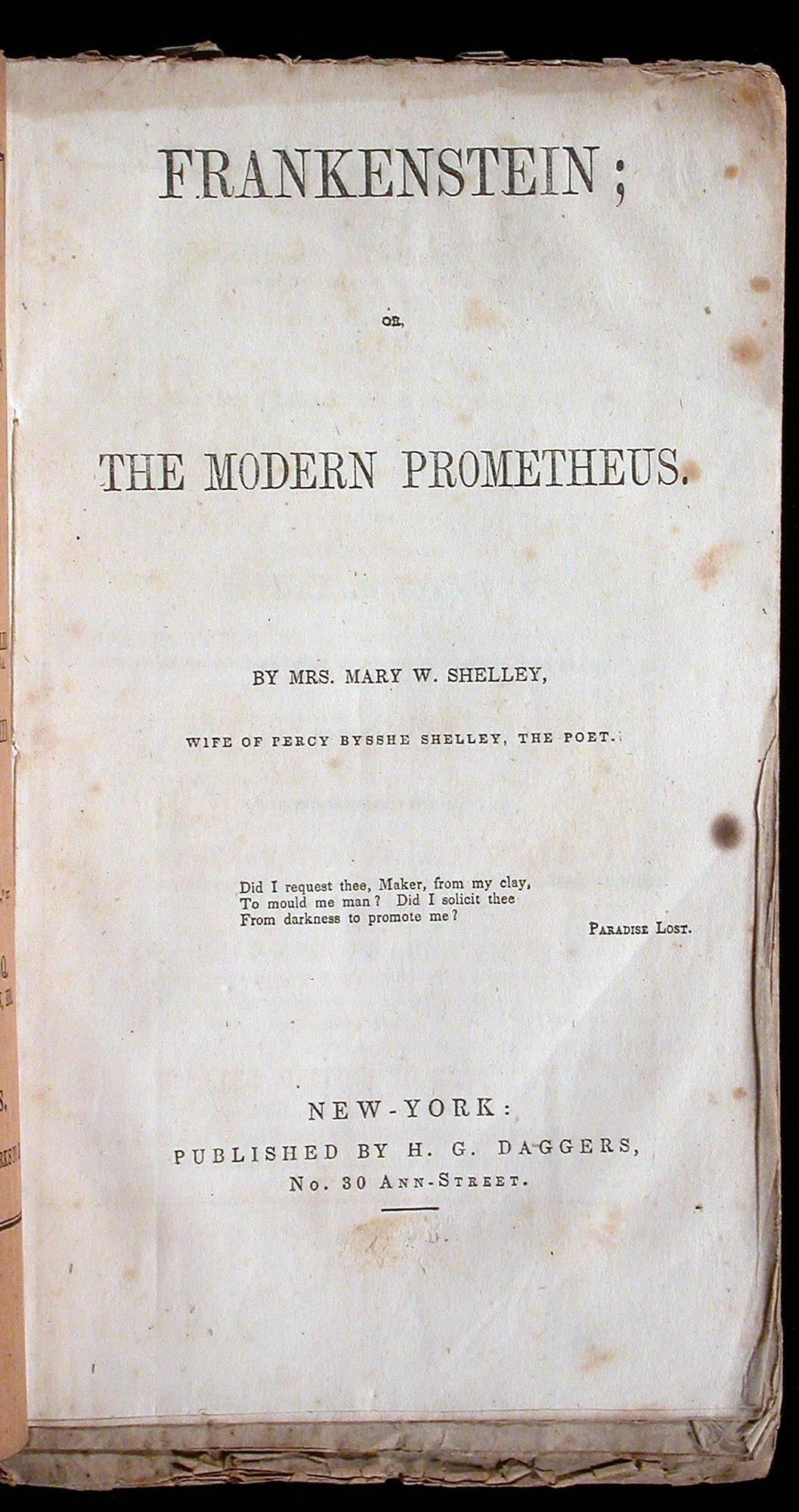
There are two main editions of the text of Frankenstein: the original edition issued in 1818, which was revised in 1823; and then heavily revised again for the 1831 one-volume edition. The 1831 text has been the most popular version of the text, and the version that ran in Weird Tales. While Lovecraft dated his personal copy to the 1830s, the details he gives—an American edition in two columns and with that byline—point to the 1845 edition by H. G. Daggers of New York.
91487_0

Title page of the 1845 H. G. Daggers edition.

Of the novel itself, Lovecraft does not write much in his letters, so we are largely left to his notes in “Supernatural Horror in Literature” as to his thoughts on the work. Nor is there any real evidence that he read The Last Man (1826) or Shelley’s other novels. There is one interesting highlight however:

As for weird reprints—I agree that short items are best. “Frankenstein” undoubtedly drags in places, yet has its tense & terrible moments—especially when the monster first comes to watch its creator at night.
—H. P. Lovecraft to R. H. Barlow, 31 Mar 1932, O Fortunate Floridian! 28

It is notable that Lovecraft cites this very same scene in his entry for “Supernatural Horror in Literature”—and, perhaps tellingly, this very scene is quoted in Dorothy Scarborough’s The Supernatural in Modern English Fiction (1917), which Lovecraft consulted before writing that essay. Which suggests either that either both Lovecraft and Scarborough were struck on the same passage…or that, perhaps, Lovecraft relied on Scarborough rather than re-reading the entire novel while composing his essay.

I saw—with shut eyes but acute mental vision—I saw the pale student of unhallowed arts kneeling beside the thing he had put togheter. I saw the hideous phantasm of a man stretched out, and then, on the working of some powerful engine, show signs of life. . . . The artist sleeps but he is awakened; and behold, the horrid thing stands at his bedside, looking on him with watery, yellow yet speculative eyes!
—Mary Wollstonecraft Shelley,
quoted in The Supernatural in Modern English Fiction 14

If Lovecraft cribbed a little, it was not because he hadn’t read or didn’t appreciate Shelley’s masterwork—quite the opposite. For example, when his friend Elizabeth Toldridge used the name “Frankenstein” in a poem she was writing, Lovecraft wrote back with a correction that would be echoed by generations of horror nerds:

In the next line remember that Frankenstein (in the novel, a Swiss medical student, Victor Frankenstein) means the creator of a destroying monsternot the monster itself. If you have that intention, it’s all right. If you mean the monster itself, better change to hydra-shapes or some equivalent.
—H. P. Lovecraft to Elizabeth Toldridge, 17 Oct 1933, Letters to Elizabeth Toldridge 257

The poem, which survives in manuscript, is titled (at Lovecraft’s suggestion) simply “Poetry”, and the line reads:

Come match your strength with steel, meassure your will with iron, your speed try out with the stars! For thine were Frankenstein hydra-shapes man-wrought foes to bear—

And powers of evil, loose in the world, shall reel and titter, in a giant juggler’s roust—

The Film (1931)

The success of Universal’s Dracula in early 1931 spurred the studio on to produce more horror films. Frankenstein was produced and hit theaters by December of the same year, with Boris Karloff in the iconic role—and the distinct heavy-lidded flat-top make-up—of the Monster. The film takes considerable liberties with Mary Shelley’s novel; Victor Frankenstein becomes Henry Frankenstein, and much of the original plot, atmosphere, and motivation is lost. Lovecraft saw the film within the first week of its opening on the East Cost, and wrote:

I haven’t been able to get around to any cinemas except “Frankenstein”—which vastly disappointed me. The book has been altered beyond recognition, & everything is toned down to an insufferable cheapness & relative tameness. I fear the cinema is no place to get horror-thrills!
—H. P. Lovecraft to J. Vernon Shea, 9 Dec 1931, Letters to J. Vernon Shea 85

Also saw “Frankenstein” last month & was vastly disappointed. The film absolutely ruins the book–which indeed it scarcely resembles!
—H. P. Lovecraft to R. H. Barlow, 23 Dec 1931, O Fortunate Floridian! 18

“Frankenstein” was the only cinema I attended during the autumn of 1931, & I was woefully disappointed. No attempt to follow the novel was made, & everything was cheap, artificial, & mechanical. I might have expected it, though—for “Dracula” (which I saw in Miami, Fla. last June) was just as bad.
H. P. Lovecraft to Clark Ashton Smith, 28 Jan 1932, Dawnward Spire, Lonely Hill 344

Lovecraft was, like many science fiction and horror fans, a bit of a purist who regretted the changes made to the material in its translation from the page to the silver screen. Time did not really mollify this opinion:

I saw the cinema of “Frankenstein”, & was tremendously disappointed because no attempt was made to follow the story. However, there have been many worse films–& many parts of this one are really quite dramatic when they are viewed independently & without comparison to the episodes of the original novel.
—H. P. Lovecraft to R. H. Barlow, 10 Jul 1932, O Fortunate Floridian! 33

As a thorough soporific I recommend the average popularly “horrible” play or cinema or radio dialogue. They are all the same–flat, hackneyed, synthetic, essentially atmosphereless jumbles of conventional shrieks and mutterings and superficial, mechanical situations. The Bat” made me drowse back in the early 1920s–and last year an alleged “Frankenstein” on the screen would have made me drowse had not a posthumous sympathy for poor Mrs. Shelley made me see red instead. Ugh!
—H. P. Lovecraft to Farnsworth Wright, 16 Feb 1933, Lovecraft Annual 8.28

Most radio and cinema versions of classics constitute a combination of high treason and murder in the first degree—I’ll never get over the cinematic mess that bore the name (about the only bond of kinship to the book!) of “Frankenstein”.
—H. P. Lovecraft to Robert E. Howard, 8 Apr 1934, A Means to Freedom 2.761

Keep in mind that Lovecraft lived before the home television and VCR revolution; his only experience of Frankenstein and other Universal horror films was if he could catch them in the theater—it was re-runs and rentals which cemented these as classic films, endlessly influential and copied. Lovecraft only caught the very beginnings of that…and, of course, he was inspired by Mary Shelley’s Frankenstein as well.

The Dream (1920)

I had a vivid dream a few nights ago–involving the possession of another distinct personality. The period was 1864, & the crux of the dream was a horror in a doctor’s secret laboratory. Think the dream-doctor was going to shew me an artificial man like M. Frankenstein’s uncomely creation, but premature waking robbed the dream of its climax. In this dream I was Dr. Eben Spencer; an army surgeon home on a furlough. The sinister experimenter was a colleague of mine, Dr. Chester. Some dream!
—H. P. Lovecraft to Rheinhart Kleiner, 23 Jan 1920, Letters to Rheinhart Kleiner & Others 154

In 1920, Lovecraft was finally coming out of his seclusion through the auspices of amateur journalism, and had built up a fairly robust correspondence with some friends. Weird Tales was still three years away from its debut issue, but he was well into his first major period of fiction which included dream-inspired stories such as “The Statement of Randolph Carter” (The Vagrant May 1920). In addition to this brief recap of the dream to Kleiner, Lovecraft included a much fuller version of the dream to his correspondence circle The Gallomo (Alfred Galpin, H. P. Lovecraft, and James F. Morton):

Speaking of the “Carter” story, I have lately had another odd dream—especially singular because in it I possessed another personality—a personality just as definite and vivid as the Lovecraft personality which characterises my waking hours.

My name was Dr. Eben Spencer, and I was dressing before a mirror in my own room, in the house where I was born in a small village (name missing) of northern New York State. It was the first time I had donned civilian clothes in three years, for I was an army surgeon with the rank of 1st Lieut. I seemed to be home on a furlough—slightly wounded. On the wall was a calendar reading “FRIDAY, JULY 8, 1864”. I was very glad to be in regular attire again, though my suit was not a new one, but one left over from 1861. After carefully tying my stock, I donned my coat and hat, took a cane from a rack downstairs, and sallied forth upon the village street.

Soon a very young man of my acquaintance came up to me with an air of anxiety and began to speak in guarded accents. He wished me to go with him to his brother—my professional colleague Dr. Chester—whose actions were greatly alarming him. I, having been his best friend, might have some influence in getting him to speak freely—for surely he had much to tell. The doctor had for the past two years been conducting secret experiments in a laboratory in the attic of his home, and beyond that locked door he would admit no one but himself. Sickening odours were often detected near the door…and odd sounds were at times not absent.

The doctor was aging rapidly; lines of care—and of something else—were creeping into his dark, thin face, and his hair was rapidly going grey. He would remain in that locked room for dangerously long intervals without food, and seemed uncannily saturnine. All questioning from the younger brother was met with scorn or rage—with perhaps a little uneasiness; so that the brother was much worried, and stopped me on the street for advice and aid. I went with him to the Chester house—a white structure of two stories and attic in a pretty yard with a picket fence. It was in a quiet side street, where peace seemed to abide despite the trying nature of the times. In the darkened parlour, where I waited for some time, was a marble-topped table, much haircloth furniture, and several pleasing whatnots covered with pebbles, curios, and bric-a-brac. Soon Dr. Chester came down—and he had aged.

He greeted me with a saturnine smile, and I began to question him, as tactfully as I could, about his strange actions. At first he was rather defiant and insulting—he said with a sort of leer, “Better not ask, Spencer! Better not ask!” Then when I grew persistent (for by this time I was interested on my own account) he changed abruptly and snapped out, “Well, if you must know, come up!” Up two flights of stairs we plodded, and stood before the locked door. Dr. Chester opened it, and there was an odour.

I entered after him, young Chester bringing up the rear. The room was low but spacious in area, and had been divided into two parts by an oddly incongruous red plush portiere. In the half next the door was a dissecting table, many bookcases, and several imposing cabinets of chemical and surgical instruments. Young Chester and I remained here, whilst the doctor went behind the curtain. Soon he emerged, bearing on a large glass slab what appeared to be a human arm, neatly severed just below the elbow. It was damp, gelatinous, and bluish-white, and the fingers were without nails.

“Well, Spencer”, said Dr. Chester sneeringly, “I suppose you’ve had a good deal of amputation practice in the army. What do you think, professionally, of this job?” I had seen clearly that this was not a human arm, and said sarcastically, “You are a better sculptor than doctor, Chester. This is not the arm of any living thing.” And Chester replied in a tone that made my blood congeal, “Not yet, Spencer, not yet!”

Then he disappeared again behind the portiere and emerged once more, bringing another and slightly larger arm. Both were left arms. I felt sure that I was on the brink of a great revelation, and awaited with impatience the tantalisingly deliberate motions of my sinister colleague. “This is only the beginning, Spencer,” he said as he went behind the curtain for the third time. “Watch the curtain!”

And now ends the fictionally available part of my dream, for the residue is grotesque anticlimax. I have said that I was in civilian clothes for the first time since ’61—and naturally I was rather self-conscious. As I waited for the final revelation I caught sight of my reflection in the glass door of an instrument case, and discovered that my very carefully tied stock was awry. Moving to a long mirror, I sought to adjust it, but the black bow proved hard to fashion artistically, and then the whole scene began to fade—and damn the luck! I awaked in the distressful year of 1920, with the personality of H. P. Lovecraft restored!

I have never seen Dr. Chester, or his younger brother, or that village, since. I do not know what village it was. I never heard the name of Eben Spencer before or since. Some dream! If that happened to Co [Edward H. Cole], he would be surely seeking a supernatural explanation; but I prefer actual analysis. The cause of the whole is clear—I had a few days before laid out Mrs. Shelley’s “Frankenstein” for re-reading.
—H. P. Lovecraft to the Gallomo, Apr 1920, Letters to Alfred Galpin 71-73
[The original lacks paragraph breaks; these were inserted for ease of reading.]

Lovecraft never fleshed out and finished this story. However, the next year, in the fall of 1921, Lovecraft would write another story that would involve two friends, doctors, with grisly experiments in reanimation which seemed strongly inspired by Mary Shelley’s Frankenstein—the serial “Herbert West—Reanimator.”


Bobby Derie is the author of Weird Talers: Essays on Robert E. Howard and Others and Sex and the Cthulhu Mythos.

Deep Cuts in a Lovecraftian Vein uses Amazon Associate links. As an Amazon Associate I earn from qualifying purchases.
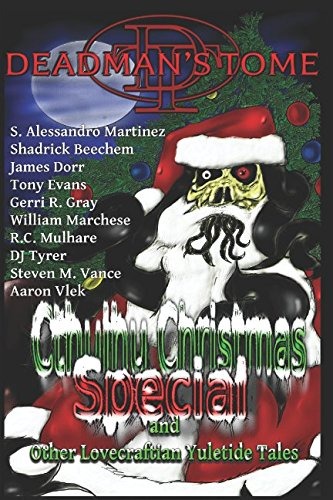
“Herbert West and the Mammaries of Madness” (2015) by Dixie Pinoit

I cannot bring myself to speak of it, so of course I must. It is with terror and that utmost thrill of lust-filled despair that I write of my wedding night, that night that wouldst,—for any average couple, be filled with so much innocent discovery, so much joy in the uncovering of what a lifetime of connubial bliss is meant to be.
—Dixie Pinoit, “Herbert West and the Mammaries of Madness” in Lovecraft After Dark 144

The soundtrack to this review is “Move Your Dead Bones” (2003) by Dr. Reanimator (Jordi Cubino).

Parody is one of the great underappreciated modes of Lovecraftian erotica. All of the factors that make it so easy to pastiche Lovecraft’s fiction—the emphasis on surface features of purple prose and melodrama, the tendency to riff off of existing elements of the mythology, and the emphasis on taboo topics—are easy to twist into parody, usually by exaggerating the already over-exaggerated until the emotional language becomes just absurd. Once you cross the line from serious pastiche into parody, adding sex is pretty natural, given how many parallels there are. “Forbidden literature,” for example, can apply equally well to pornography as it can to eldritch tomes like the Necronomicon:

Doris didn’t like the Necronomicon, although she considered herself an emancipated and free-thinking young woman. There was something sinister, or to be downright honest about it, perverted about that book—and not in a nice, exciting way, but in a sick and frightening way. All those strange illustrations, always with five-sided borders just like the Pentagon in Washington, but with those people inside doing all those freaky sex acts with those other creatures that weren’t people at all.
—Robert Shea & Robert Anton Wilson, The Eye in the Pyramid (1975), 93

“Herbert West—Reanimator!” has for whatever reason been an unusually prolific target for parody and pastiche, both erotic and otherwise, as shown by such diverse works as “Kanye West—Reanimator” (2015) by Joshua Chaplinsky vs. “Herburt East: Refuckinator” (2012) by Lula Lisbon, “The Wreck of the Charles Dexter Ward” (2012) by Elizabeth Bear & Sarah Monette, “Herbert West in Love” (2012) by Molly TanzerRe-Animator (1985) with its infamous head-giving-head scene and its various sequels, and the hardcore adult film Re-Penetrator (2004, Burning Angel). So Dixie Pinoit in “Herbert West and the Mammaries of Madness” is in good company.

As it happens, Pinoit blends a few details between Lovecraft’s original opus and the 1985 film: where Jeffrey Combs (the actor for Herbert West) is brunet, Lovecraft had West as blond in the original novella, and Pinoit has West as a blond; where Lovecraft had West’s partner as a nameless protagonist, the 1985 film gives him the name Dan Cain, so Pinoit uses Dan Cain as the name for West’s assistant. It is the kind of detail that rewards the detail-oriented Mythos enthusiast, though easy to miss when the narrative lens turns to some of the other action:

Noticing that one of Elena’s awe-inspiring breasts had somehow freed itself from its restraints, I stroked it plaintively before restoring it to what could indeed become its burial shroud unless the doctor was simply premature in his determination of death.
—Dixie Pinoit, “Herbert West and the Mammaries of Madness” in Lovecraft After Dark 145

Chekov’s corpse. There is something wonderfully straightforward about Reanimator media, in that all you really need is a body at or rapidly cooling toward room temperature for the fun to start, and there’s a great deal of fun to be had in various scenarios about how the corpse came to be and what happens when it is eventually reanimated. A great deal of Reanimator adaptations can riff on this concept pretty much nonstop, but what makes it really work is not the practice of revivifying the dead—any Frankenstein-derived or zombie story can give you the thrill of the dead coming back to life—it’s Herbert West himself, with all of his quirks and monomania, which drives the plot. A good Reanimator story is about the Reanimator as much as the reanimated.

My beloved’s corpse now stripped of the ivory lace and silk wedding dress that had once adorned her curvaceous form, stripped bare under the yellow lights to make it easier for Dr. West to inject things into her delicious upper arms while her ample breasts and small tuft of pubic hair glistened and juggled from the force of his ministrations.
—Dixie Pinoit, “Herbert West and the Mammaries of Madness” in Lovecraft After Dark 148

Readers that think they know where this is going are still in for a surprise or two; the protagonist surely was. Pinoit by this point plays a little fast and loose with the “rules” of reanimation—murderous bloodlust is out, and certain other types of lust are very much in—but the subversion of expectations, especially when transgressive and exaggerated for comedic effect, are common techniques in all parody.

Yet for all the surprises, one of the most notable is that Pinoit is obviously a fan as much as a pornographer. The nameless Lovecraftian protagonist is actually a Lovecraftian protagonist, inspired by the events of Lovecraft’s life and so the characterization—a parody of Lovecraft’s style—is really an affectionate tribute to the Old Gent himself.

Sales plummeted until the hat shop could no longer support us.

Eventually she moved away to start over. A larger town, where her curious predilections were less likely to be remarked upon amongst a larger populous, and would perhaps even be welcomed by an adventurous few.

I did not go with her.
—Dixie Pinoit, “Herbert West and the Mammaries of Madness” in Lovecraft After Dark 154

Lovecraft as the star of an erotic story might seem odd, or even off-putting at first glance, but Pinoit is far from the only one to do it; Edward Lee has used Lovecraft (or a character based on him) in several of his “Hardcore Lovecraft” novels and novellas, especially Pages Torn from a Travel Journal (2013) and Trolley No. 1852 (2010). These depictions are often exaggerated for humor as much or more than erotic value, but there is a real amount of effort put into some of these stories to embed aspect of Lovecraft’s life, style, fiction, and just plain character into the fictionalization. These are homages—and speak as much to how Lovecraft himself has become a part of his own artificial mythology.

Considering how much interest has been devoted to Lovecraft’s sex life after his death by fans and scholars alike, this aspect of his character—his sexuality and sexual experiences, real or imagined—present what might be one of the more ultimate taboos to transgress. If you as a reader are at all squicked out at the thought of H. P. Lovecraft having sex, then the author has succeeded at their goal. If you’re excited at the idea of your literary idol getting laid, then the author has also succeeded! The whole point of using a character that is such an obvious version of Lovecraft is to evoke some visceral or emotional reaction from the reader. This effect can only be achieved because of the degree of posthumous fame that Lovecraft has achieved.

While there are few people that might write the Lovecraftian equivalent to Rachel Bloom’s “Fuck Me, Ray Bradbury” (2010), the same basic idea has found expression in the Mythos. H. P. Lovecraft may be dead, but as a fictional character he can do things he never did in life; he has been in many ways reanimated himself—and the interest is not necessarily in what the literary corpse of Lovecraft does, but in why the reanimator has brought them back, and how. In many cases, like this one, it is little more than an in-joke—a nod and a wink to the dedicated Lovecraftian that found themselves coming to the end of this erotic tale—but it is also a tribute to the lasting appeal of H. P. Lovecraft as a character, that he can be inserted into a story such and expect to be recognized, without his name ever being given.

“Herbert West and the Mammaries of Madness” appeared in the erotic Cthulhu Mythos anthology Lovecraft after Dark (2015).


Bobby Derie is the author of Weird Talers: Essays on Robert E. Howard & Others (2019) and Sex and the Cthulhu Mythos (2014).

“Herbert West in Love” (2012) by Molly Tanzer

“Of Herbert West, who was my friend in college and in after life, I can speak only with extreme terror. This terror is not due altogether to the sinister manner of his recent disappearance, but was engendered by the whole nature of his life-work, and first gained its acute form more than seventeen years ago, when we were in the third year of our course at the Miskatonic University Medical School in Arkham. While he was with me, the wonder and diabolism of his experiments fascinated me utterly, and I was his closest companion.”
—H. P. Lovecraft, “Herbert West—Reanimator”

“Knew you faggots were faggots,” he said smugly. “Going on a date? To a party? I’m not surprised you suck dick by choice, West, but you, Langbroek? You might actually get a girl to look at you! That is, if you weren’t so busy sucking dick. By choice,” he added, and then laughed loudly, hurr hurr hurr.
—Molly Tanzer, “Herbert West in Love”

Readings of homosexual subtext in Lovecraft’s fiction rarely give way to text—critics are more comfortable noting the possible allegories and ambiguity of language than they are exploring those themes in a work of fiction. There are some who do have the courage and insight to go into such uncharted territories, including the graphic novel Providence (2015-2017) by Alan Moore & Jacen Burrows, “Herburt East: Refuckinator” (2012) by Lula Lisbon, and “Herbert West in Love” (2012) by Molly Tanzer. While Lisbon focuses on eroticism, Tanzer addresses the more complex social and emotional issues surrounding the realities of homosexuality in the early part of the 20th century…when gay men could often face violence and legal penalties as well as social ostracism.

Tanzer’s story works because of how well she develops the characters of the story. As a prequel to Lovecraft’s tale, it beautifully sets up a number of scenes, with a great deal of attention to little details of Lovecraftian lore in the name of streets and Miskatonic University faculty—but all of this is dressing for the main question: who or what is Herbert West in love with?

Tristan almost slipped on a patch of ice when West grabbed him by the hand and pulled him down into a kiss, right there in the snowy brightness under the lamppost, but West’s grip was like iron, and it kept Tristan steady on his feet.
—Molly Tanzer, “Herbert West in Love”

It feels like a question that shouldn’t need to be asked, that doesn’t matter, certainly not in Lovecraft’s narrative and most of the stories that follow it. Lovecraft, uninterested in romance, never gave West any romantic partners; it was a rare author that followed that did. The intensity of West’s focus on reanimation often makes him an essentially asexual character, all of his passion devoted to his work. Yet that is the crux of Tanzer’s narrative.

It isn’t a question of whether or not West is homosexual or bisexual; Tanzer and Lovecraft never get inside West’s head on the matter of his sexuality. West is only seen through the eyes of his associates, with their own emotions and prejudices coloring their perceptions. The degree of manipulation that the young reanimator shows make all of his actions suspect. We never know if West is truly attracted to his fellow student, or if sex is one more weapon that West will use to achieve his goal.

Pete Rawlik, who has carved something of a niche in this particular corner of the Mythos, described “Herbert West in Love” as “subversive” in his introduction to Legacy of the Reanimator (2015)—which it is, in a certain sense. The reader is not presented with any definitive statements on West’s sexuality, but his actions in the story frame two possibilities: either West is open to sexual encounters with men, and thus subverting the asexual character created by the largely homophobic Lovecraft; or West is far more treacherous and alien than even Lovecraft portrayed him, willing to feign homosexuality, even with all its attendant potential consequences in the early 20th century, if that will successfully manipulate his assistant.

Either reading changes our perspective on West, and how we read the reanimator from that point on.

“Herbert West in Love” was first published in the Lovecraft ezine, it has been republished in Tanzer’s collection Rumbullion ‘and Other Liminal Libations’ (2013) and the anthology Legacy of the Reanimator (2015).


Bobby Derie is the author of Weird Talers: Essays on Robert E. Howard & Others (2019) and Sex and the Cthulhu Mythos (2014).

“The Wreck of the Charles Dexter Ward” (2012) by Elizabeth Bear & Sarah Monette

Galileo and Derleth and Chen sought forbidden knowledge, too. That got us this far.
—Elizabeth Bear & Sarah Monette, “The Wreck of the Charles Dexter Ward” in Dreams from the Witch House: Female Voices of Lovecraftian Horror 238

“The Wreck of the Charles Dexter Ward” differs from its sister-stories “Boojum” and “Mongoose” in several important ways. All three stories take place in the same space opera setting, and they are interconnected by the elements of Bear & Monette’s mythos—boojums, cheshires, toves, bandersnatch, Arkhamers—but their narratives are largely independent of one another. The setting is the same, but not the cast of characters, or the plot, or the approach.

“Boojum” is essentially a sea story, of the kind that went out of style as wooden, wind-powered clipper ships disappeared at the end of the 19th century to steam and coal, a pirate tale in an exotic setting. “Mongoose” is inspired by Kipling’s “Rikki-Tikki-Tavi,” the literary DNA recombinated into something a little stranger, but it is still very much a set-piece story of a distant outpost under threat. “The Wreck of the Charles Dexter Ward” is a story of a plague ship—and a kind of inversion of H. P. Lovecraft’s story “Herbert West—Reanimator,”

Dr. Cynthia Feuerwerker is the complement to Dr. Herbert West: a medical doctor who dabbled in forbidden research and paid the price for it. Where West is callous in his pursuit of knowledge, Feuerwerker is first and foremost an attentive physician. Her intellectual intelligence is balanced by emotional intelligence, her keen scientific curiosity reined in by a moral imperative. Personal concerns outweighed by certainty of ethical responsibilities, echoed by the repeated phrase “that’s how you get war crimes.”

Sometimes, the right thing to do is disobey orders.

So instead of a story about a nameless protagonist that aids and abets a reanimator, Bear & Monette wrote a story about a doctor calling out the reanimator and tell them why they were wrong.

Haven’t you ever heard of what happened to the Lavinia Whateley?
—”The Wreck of the Charles Dexter Ward” 255

In deliberately borrowing from one of Lovecraft’s stories to essentially have a zombie-story set on a dead ship in space during a nominal salvage run, Bear & Monette also take the opportunity to peel back the onionskin on their setting a little more. Readers learn about the Arkhamers, with their arcane academic society and naming conventions, a further peek at one of the more discriminated groups in the boojumverse. They also run into names not taken from Cthulhu Mythos fiction, but from the real-life people that wrote and published those stories: Wandrei, Derleth, and Caitlín R. Kiernan.

This brand of meta-awareness, of mixing fictional creation and real-world persons in the same name-dropping fashion, is old hat in the Mythos. Lovecraft included references to Arthur Machen and Clark Ashton Smith in his stories; August Derleth included references to Lovecraft and his stories alongside the Necronomicon and other Mythos tomes. The boundary between fact and fiction was blurred a little, and that’s part of the point of doing these self-referential name drops—to push the hoax a little in the direction that maybe Lovecraft & co. were really onto something, that maybe what they wrote about does exist—a premise for works as different as Robert Bloch’s novel Strange Eons (1978) and Alan Moore & Jacen Burrows graphic novel Providence (2015-2017).

“The Wreck of the Charles Dexter Ward” is doing something a little different, though. The question asked in “Boojum” is: what does Lavinia Whateley mean in the context of this setting, that they would name a ship after her? In “Mongoose,” why are so many of the stations of similar names drawn from the Cthulhu Mythos? By ranking Derleth next to Galileo, the suggestion is that this is the future of a setting where some aspect of the Mythos was real, and was revealed by Lovecraft’s posthumous publishers. It is an evolution of Richard Lupoff’s approach in “The Discovery of the Ghooric Zone”, with a greater eye to the process of discovery and acclimatization.

The boojumverse is not Cthulhupunk, it is the step beyond that. A setting where the alien horrors of the Mythos are, if not exactly normalized, something humanity has adapted itself to. The success of Bear & Monette is not just in writing three great stories, but in looking a little further than other writers into what the exposure of the Mythos might mean if it did not immediately destroy humanity. In Moore’s script for Providence, he suggests that the Lovecraftian scholars might become Lovecraftian scientists—and the boojumverse is a setting where that might well have happened.

We live on a placid island of ignorance in the midst of black seas of infinity, and it was not meant that we should voyage far.
—H. P. Lovecraft, “The Call of Cthulhu”

Maybe that’s the worst part of human nature. Nothing ever stops us. Not for long.
—”The Case of the Charles Dexter Ward” 272

Cynthia Feuerwerker has voyaged farther than Lovecraft ever foresaw, when he wrote of Herbert West’s nominally laudable scientific inquiry and desire to achieve the medical goal of defeating death perverted and degenerated by “a soul calloused and seared.” West was willing to kill for his researches; Feuerwerker was not. Bear & Monette’s moral, if there is one, is less than comforting: someone will try again. This was not the first reanimator, nor will it be the last. Human curiosity often outstrips its ability to foresee the implications and ramifications of what it does and what it creates.

“The Wreck of the Charles Dexter Ward” was first published as an audiobook on the Drabblecast (2012). It was reprinted in The Year’s Best Science Fiction: Thirtieth Annual Collection and The Mammoth Book of Best New SF 26 (both 2013), New Cthulhu 2: More Recent Weird (2015), Dreams from the Witch House: Female Voices of Lovecraftian Horror (2016), and Chiral Mad 4: An Anthology of Collaborations (2018).

It is the third of Elizabeth Bear and Sarah Monette’s collaborations, preceded by “Boojum” and “Mongoose”.


Bobby Derie is the author of Sex and the Cthulhu Mythos (2014)