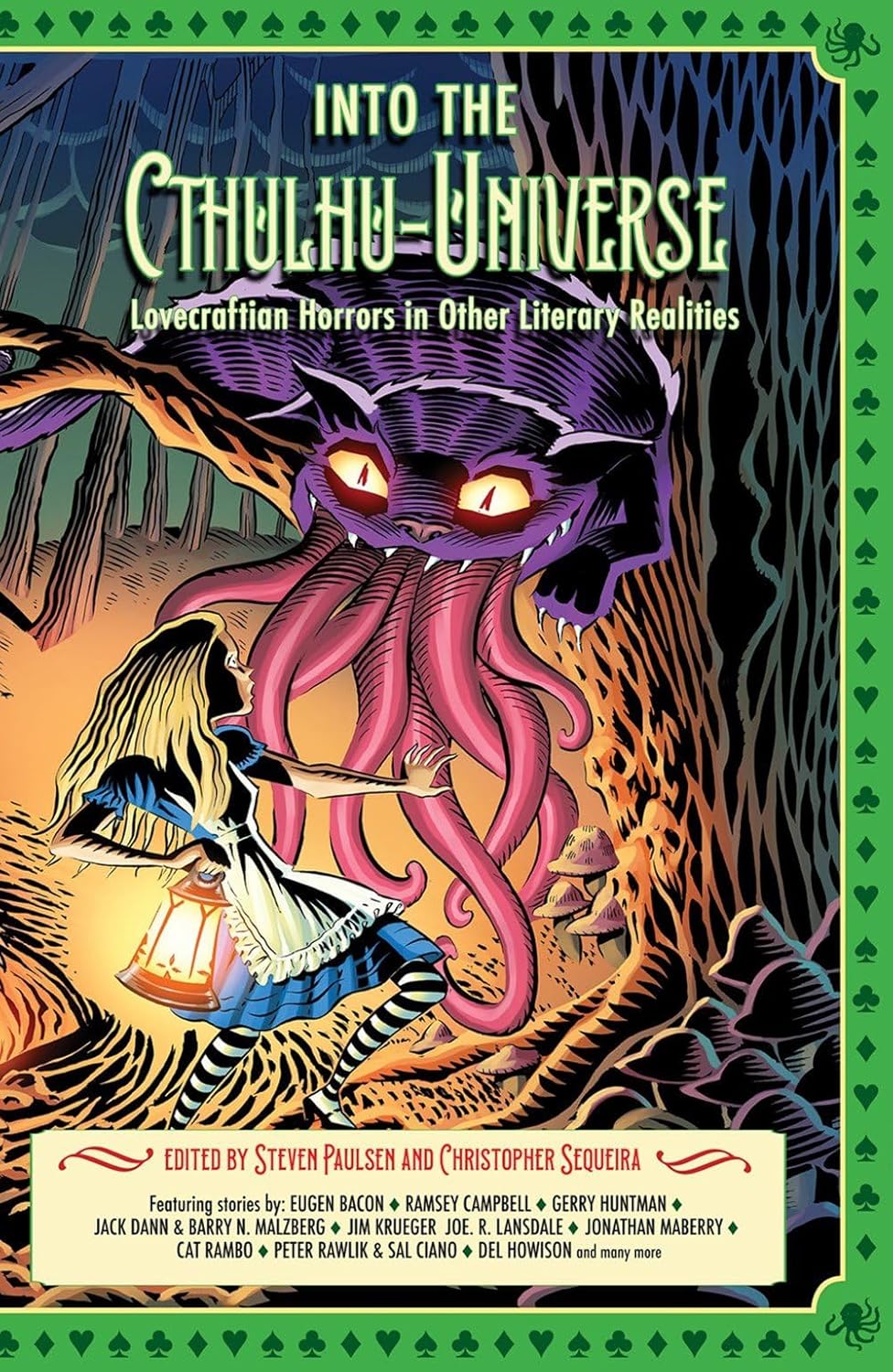
The day Oswald arrived, he called us to my father’s study and said peremptorily, “It is a truth universally acknowledged that a spinster sister with a small portion is nothing but a burden to her relatives. I want you silly women married and out of my household as soon as possible.” Then he burned my father’s extensive collection of coastal plants and butterflies and sold his library.
—Jane Routley, “Innsmouth Park” in Into the Cthulhu-Universe (2025) 76-77
We don’t like Oswald.
Jane Austen’s role in weird fiction is underappreciated, largely because she herself didn’t really write any (although Northanger Abbey is a biting satire of the Gothic novel, and a must-read for Gothic fans which even Lovecraft acknowledged, which has to at least classify Austen as weird fiction’s strange aunt.) Yet the world she described, the characters and milieu she envisioned, have been enduring and influential far beyond the genre she initially worked in. Generations of writers have called back to Austen, and mashups like Sense and Sensibility and Sea Monsters (2009) by Austen & Ben H. Winters, Regency Cthulhu (2023) by Andrew Peregrine & Lynne Hardy, and Secrets & Sacrifices: A Regency Cthulhu Novel (2024) by Cath Lauria all point to a similar rainy-day afternoon brainstorm:
Why not mix Austen and Lovecraft?
“In ’forty-six Cap’n Obed took a second wife that nobody in the taown never see—some says he didn’t want to, but was made to by them as he’d called in—had three children by her—two as disappeared young, but one gal as looked like anybody else an’ was eddicated in Europe. Obed finally got her married off by a trick to an Arkham feller as didn’t suspect nothin’. But nobody aoutside’ll hev nothin’ to do with Innsmouth folks naow. Barnabas Marsh that runs the refin’ry naow is Obed’s grandson by his fust wife—son of Onesiphorus, his eldest son, but his mother was another o’ them as wa’n’t never seed aoutdoors.
—H. P. Lovecraft, “The Shadow over Innsmouth”
Lovecraft did not live in Austen’s world, but the New England society that Lovecraft came from retained some of the same social mores and norms as in Austen’s day. Marriages were not just alliances of mutual love and affection, but involved perceptions of respectability and status, and practical concerns of money and temperament. While women in the UK have more options today than they did in the late 18th/early 19th century, the societal obsessions with marriage, reproduction, and compatibility are still there for many.
Jane Routley in “Innsmouth Park” takes this to heart. She drops an Innsmouth gent into an Austen scenario. Between the Oswalds of the world and the intelligent, meek, and slightly inhuman (but very wealthy) owner of Innsmouth Park, readers might suspect that they know the outcome of this short story before it gets three pages in. However, Routley does have a twist or two for the readers, and manages to pull off a solid story out of what could easily have been a farce.
As in any mashup, the tone tends to be rather light, and in this case favors Austen over Lovecraft. Nothing wrong with that; Austen’s strength was her setting and characters, and the Mythos is a flavor that mixes well into different settings. What makes it fun, however, are the little flourishes, the nods to both Austen and Lovecraft, and the very careful effort to build up the relationship between protagonist Eugenia and her potential suitor Rowah Marsh. We get to see things, not from the Lovecraftian point of view, but from the Austenian.
Whoever asked the Marsh daughter how she felt getting married off “by a trick?” Would she have been relieved to be out from under her domineering father, or lost and at sea among people she had never met before? Was it a step down or a step up in terms of her lifestyle and freedoms? We don’t get those questions or answers in “The Shadow over Innsmouth,” but you can be damned sure if Austen was writing that story that we would.
Routley recognizes this. While the story is filled with witty lines and little nods to her literary forebears, at the core the story is played straight. If you really did read an Austenian take on “The Shadow over Innsmouth,” it would have the same basic outlines as “Innsmouth Park.” We don’t like Oswald because he represents all the overbearing dudebro assholes we have to deal with in our own lives, but in the specific Austenian context he plays the necessary role of the manifest social norms that are forcing the woman protagonist out of the family home and into a suitable marriage (other options, such as being a governess, being considered but found unsatisfactory.)
That is really what makes “Innsmouth Park” work; the choice that is made is ultimately not driven by green or love or lust, but a practical consideration of limited options and the available alternatives. Faced with a momentous life decision, Eugenia zeroes in on what really matters to her, and the priorities may or may not surprise the Lovecraft fans—but the Austen fans will understand.
Bobby Derie is the author of Weird Talers: Essays on Robert E. Howard and Others and Sex and the Cthulhu Mythos.
Deep Cuts in a Lovecraftian Vein uses Amazon Associate links. As an Amazon Associate I earn from qualifying purchases.
 Deep Cuts in a Lovecraftian Vein