“Vyvyan’s Father” (2013) by Jayaprakash Satyamurthy

In H. P. Lovecraft’s body of work, the town of Innsmouth is mentioned by name only in four stories (“Celephaïs,” “The Shadow over Innsmouth,” “The Thing on the Doorstep,” and “The Dreams in the Witch House”) and a couple “Fungi from Yuggoth.” The core of Lovecraft’s Mythos, which so many writers have expanded upon over the decades, tends to be fairly scanty. Lovecraft country, that literary realm where the Old Ones walk, was painted in broad strokes and a few fine details, and it is everyone else who has filled in the gaps.

Writers who came after Lovecraft have, when not playing in his sandbox, carved out their own spaces. The most famous are Ramsey Campbell’s Severn Valley stories set in and around the literary Brichester and Goatswood in the United Kingdom; and W. H. Pugmire‘s Sesqua Valley and associated towns and mountains set in the Pacific Northwest of North America. Since these writers lived much longer than Lovecraft, and had more opportunity to write and publish, it might not be surprising that they have produced correspondingly more lore for their associated locales than Lovecraft did for his.

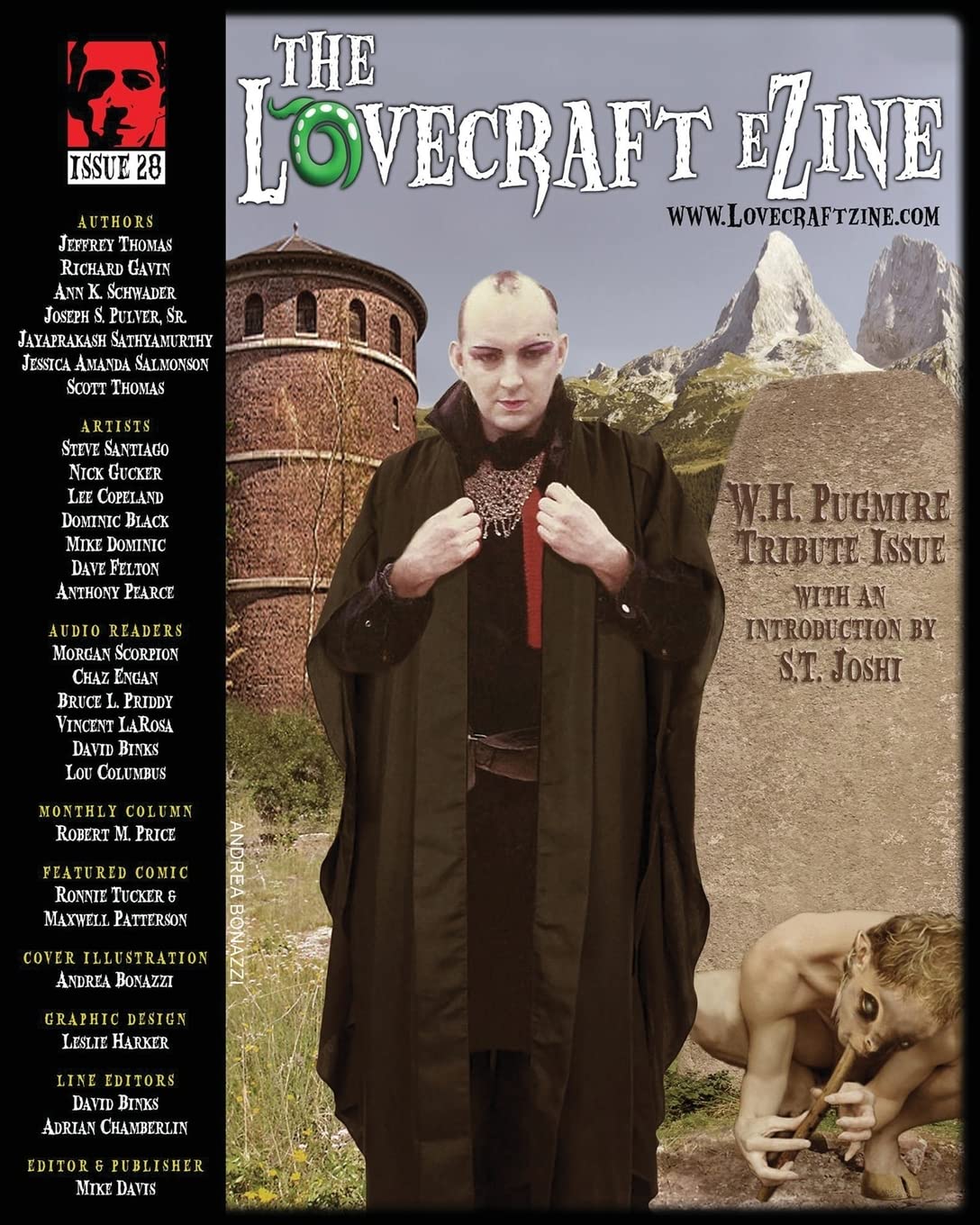
And yet, these places often feel smaller, because the voices associated with them tend to be singular. While anybody can write a tale of Innsmouth, it is generally considered uncouth to poach a living author’s copyrighted creations without permission. Some of them have consented to letting other writers splash in their ponds—Ramsey Campbell, for instance, consented to Made in Goatswood (1996), a tribute anthology; and in 2013 the Lovecraft eZine #28 did a similar tribute to W. H. Pugmire.

These tales represented a first step at a wider Sesqua Valley Mythos. New ideas, new perspectives, new angles. Pugmire was never dogmatic about his Sesqua Valley lore, preferring to expand it in hints and suggestions, a tale at a time, and there has not yet been an effort to correlate all the contents of his fiction into a single concordance or wiki. Perhaps, in the future, there will be more. For now, one particular tale from Lovecraft eZine #28 is worth discussing, because it does something different than the rest. Something very Pugmire-like in its approach to the Sesqua Valley tales.

“Vyvyan’s Father” by Jayaprakash Satyamurthy does not mention Sesqua Valley. Simon Gregory Williams and William Davis Manly do not appear on the page. Uniquely of the tribute stories in the eZine, Satyamurthy chose to write a story that is definably set in the world of Sesqua Valley—for anyone who is familiar with Pugmire’s work, at least, it is obvious from the clues and details as much as the context of the issue—without falling into the same trap of Mythos pasticheurs who load up a story with familiar names. It is an approach that echoes Pugmire’s own insistence that writing Lovecraftian fiction should echo the aesthetics of Lovecraft, not just pay lip-service to Arkham and Innsmouth, Dunwich and Kingsport, Cthulhu and the Necronomicon.

His eyes beguiled me, being slightly slanted and of a silver hue that seemed to contain particles of other shades in their pale irises.
—W. H. Pugmire, “The Horror on Tempest Hill” in An Imp of Aether 142

If his eyes were open, they would startle you with their timeless, silvery-grey depth.
—Jayaprakash Satyamurthy, “Vyvyan’s Father” in Lovecraft eZine (2013)

There is something very appropriate in how Satyamurthy’s tale is a bridge between India and Sesqua Valley; the lost child, the orphan of the Valley, is caught between two worlds in a way that echoes something of India’s own history as a crossroads of empires, with those who fall outside the established social orders caught like nuts in a pulau: a part of the whole, yet apart from the rest. This between-two-worlds tension defines Vyvyan’s character, but it also echoes the story as a whole: instead of just playing in Pugmire’s backyard, Satyamurthy builds a bridge between the setting of many of his own stories and Pugmire’s. Instead of submitting himself to Pugmire’s aesthetic, he shows how their themes can connect. Like New World tomatoes incorporated into a quintessentially Indian paneer gravy.

The slow expansion of Sesqua Valley beyond the bounds of Pugmire’s fiction is not the trauma-driven diaspora that marks much of contemporary Innsmouth tales. It is a different kind of cultural diffusion, spread by wanderers and their children, artifacts and ideas that spread out and draw strangers in. Where it goes from here…who can say?

“Vyvyan’s Father” by Jayaprakash Satyamurthy can be read online at Lovecraft eZine #28, and print edition is also available.


Bobby Derie is the author of Weird Talers: Essays on Robert E. Howard and Others and Sex and the Cthulhu Mythos.

Deep Cuts in a Lovecraftian Vein uses Amazon Associate links. As an Amazon Associate I earn from qualifying purchases.
“At the Left Hand of Nothing” (2016) by Jayaprakash Satyamurthy

That cult would never die till the stars came right again, and the secret priests would take great Cthulhu from His tomb to revive His subjects and resume His rule of earth. The time would be easy to know, for then mankind would have become as the Great Old Ones; free and wild and beyond good and evil, with laws and morals thrown aside and all men shouting and killing and revelling in joy. Then the liberated Old Ones would teach them new ways to shout and kill and revel and enjoy themselves, and all the earth would flame with a holocaust of ecstasy and freedom.
—H. P. Lovecraft, “The Call of Cthulhu”

When all is madness, there is no madness.
—Scott R. Jones, introduction to Cthulhusattva: Tales of the Black Gnosis (2016) 5

Lovecraft was a materialist; he had no belief in gods, neither those of traditional religion or of his own making, and carefully informed fans that yes, Cthulhu and the Necronomicon and all the rest were totally fictional, that he and Robert E. Howard and Clark Ashton Smith & co. had made them all up. The irony of this is that the writings of the materialist would inspire in others true faith; that his writings would be taken by some as revelations of occult truth, and others as something close to holy writ. So we have Necronomicon Gnosis: A Practical Introduction (2007) by Asenath Mason and “The Book of the Forgotten Ones” (1977) by Nema Andahadna and many other works of esotericism, accounts of spiritual revelation or occult compilation.

For all that these individuals and groups pay homage to the names and ideas that Lovecraft & co. created, few of them strive to capture or explore the philosophy behind those names. Thomas Ligotti comes to mind: “The Sect of the Idiot” and “The Last Feast of Harlequin” dig deep into the philosophic underpinnings of the Mythos. Scott R. Jones in When the Stars Are Right: Towards An Authentic R’lyehian Spirituality (2014) describes the deep understanding of the Mythos, beyond the farcical family trees of the gods and sometimes humorous mucking about with incantations and talismans, as the Black Gnosis.

Humanity, with its bilateral symmetry, tends to think in dichotomies. Good and evil, black and white, left and right. Theosophists and occultists in the early 20th century talked about black lodges and white, locked in a cycle of conflict; the devotees of “evil” revelations followed the left-hand path, the Satanists and Thelemites, while those “white magicians” followed the right-hand path. The terminology of left hand/right hand was borrowed (stolen, appropriated) from Indian tantra; Westerners like Aleister Crowley seeking to incorporate aspects of Eastern esoteric practices into their occult systems were cafeteria occultists.

Of course the Chinese mix everything up. Look at what they have to work with. There’s Buddhism, Confucianism, and Taoist alchemy and sorcery. We take what we want and leave the rest. Just like your salad bar.
—Egg Shen, Big Trouble in Little China (1986)

Every so often, however, someone comes along that reminds us that the universe is much stranger than our standard definitions, that we are limited by our conceptions. Such a work is “At the Left Hand of Nothing” by Jayaprakash Satyamurthy.

A short piece, but dense in concepts. An unnamed cultist or adept speaks to an unknown audience. Familiar terms are embedded in unfamiliar attitudes. The language is carefully chosen, the reader letting the onion peel back, layer by layer, revelation by revelation.

There is an entire literature out there dealing with the antics of these fools. It is imagined that these plots and cults are the sum of our ambition; that we exist merely to subvert normality and exalt some strang epantheon, that we want to pring a triumphal return of squamous divinity to old Earth.
—Jayaprakash Satyamurthy, “At the Left Hand of Nothing”
in Cthulhusattva: Tales of the Black Gnosis (2016) 54

The central idea of Satyamurthy’s piece harkens back to the older, original idea of left-hand and right-hand tantra. Wearing black robes and participating in orgies in the swamp isn’t the left-hand path; maybe none of the characters in any of Lovecraft’s stories had the insight and ambition to conceive of the possibilities that Satyamurthy hints at, though some of the stories that came after have characters whose feet might have turned in such directions.

It is, if nothing else, a revelation. A new way to think about the Mythos. Something to widen your preconceptions, re-calibrate how you think about stories old and new. Go back and re-read “The Call of Cthulhu” after reading this story, and see if you can experience it in a new way. Not as the naive believer in old Castro’s ramblings, but as an initiate that knows a deeper truth and can recognize him and his for what they are…and who their true undying masters must be.

“At the Left Hand of Nothing” was first published in Cthulhusattva: Tales of the Black Gnosis (2016); it has not yet been reprinted. Jayaprakash Satyamurthy has written a number of weird tales, some of which have been collected in Weird Tales of a Bangalorean (2015) and Come Tomorrow: And Other Tales of Bangalore Terror (2020). His Lovecraftian stylings can also be experienced with his band Djinn and Miskatonic.


Bobby Derie is the author of Weird Talers: Essays on Robert E. Howard & Others (2019) and Sex and the Cthulhu Mythos (2014).