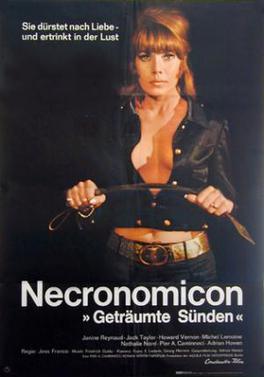
Other rejects included Jesse (Jesus) Franco’s Necronomicon (1967) AKA Succubus, an S & M flick without the slightest Lovecraft connection.
Charles P. Mitchell, The Complete H. P. Lovecraft Filmography 20
If you were thumbing through Mitchell’s excellent filmography, this dismissive reference to a film named Necronomicon – Geträumte Sünden (Necronomicon – Dreamt Sins) by Jesús Franco may catch your eye and cause a moment of pause. The film does not often appear on lists of Lovecraftian cinema, did not make an appearance in that valuable tome The Lurker in the Lobby: A Guide to the Cinema of H. P. Lovecraft, and generally gets short shrift in Lovecraftian cinematic scholarship. There are good reasons for this, but the lack of attention hides an interesting story.
The film’s title wasn’t Necronomicon. It was Green Eyes of the Devil.
Jess Franco, “From Necronomicon to Succubus: Interview with Jess Franco”
Jesús “Jess” Franco (1930 – 2013) began making films in Spain, under Gen. Francisco Franco’s tyrannical regime. Talented, adaptable, versatile, and rebellious, Jess Franco’s film career began in the 1950s, doing black-and-white films, comedies, documentaries, and musicals. Censorship dogged Franco’s early films; the conservative Spanish regime was wary of sex or anything that could be construed as a political message.
Inspired by the British film company Hammer’s Gothic horrors such as Brides of Dracula (1960) and the success of the French horror film Les yeux sans visage (1960, Eyes Without A Face), Franco’s made the pivot to horror. His earliest horror films, Gritos en la noche (1961, translated as The Awful Dr. Orloff in English), La mano de un hombre muerto (1962, The Sadistic Baron Von Klaus), Gritos, El secreto del Dr. Orloff (1964, Dr. Orloff’s Monster), and Miss Muerte (1965, The Diabolical Dr. Z) combine a mixture of medical horror, Gothic sensibility, and a voyeuristic approach to sadism. Franco exploited the marketability of sex and violence while keeping the films from being explicitly gory or pornographic. Yet Franco still had difficulty with Spanish censors.
The key to artistic freedom was international financing. In 1966, Franco came in touch with West German production manager Karl-Heiz Mannchen.
After producing the fast-pased comic srip concotion Lucky, el intrépido (Lucky, the Inscrutable) in 1967, Franco came to Mannchen with an eight-page script for a proposed erotic horror feature that would go on to be considered one of his finest films, Necronomicon.
Danny Shipka, Perverse Titillation: The Exploitation Cinema of Italy, Spain and France, 1960-1980 184
The 2006 Blue Underground release of the film includes “From Necronomicon to Succubus: Interview with Jess Franco” by David Gregory and Bill Lustig which delves into the development of the film. Shipka quotes from the interview:
“I started scouting locations in Spain and Belin and it’s there I met my second co-producer of the film because my partner was Adrian Hoven, but he had an associate a co-producer named Pier Maria Caminnecci. He was very rich, the main stockholder in Siemens. So he had quite a bit of money. And he had a magnificent house. And on his bookshelf, I discovered a book entitled Necronomicon.” Looking for ideas, Franco found a short story in the book that he felt could be translated to film. The problem was the story was only three pages long. Fusing it with a script from a horror movie he’d previously written, Franco came up with a complete screenplay.
Danny Shipka, Perverse Titillation: The Exploitation Cinema of Italy, Spain and France, 1960-1980 186
There are issues with this narrative. For one, the actual interview on the DVD tells a different and much more involved story about the Necronomicon being an actual book published by the University of Vienna based on an ancient fragment by an Arab named Al Azrad. Weird Tales: Jess Franco meets the Elder Gods describes this as “bullshitting on a heroic scale,” which seems correct. Shipka was paraphrasing and left out all the blatantly myth-making bits. But assuming there is a core of truth there, what book, exactly, could Franco have supposedly found in Caminnecci’s library?
Arkham House had begun to promote translations of Lovecraft’s fiction in languages other than English after World War II; collections appeared in French in the 1950s, and in German, Italian, and Spanish in the mid-1960s (although as a caveat, it should be noted unauthorized translations of English-language Weird Tales were appearing in South America in the late 1930s and 1940s, such as the Argentinian pulp magazine Narraciones Terrorificas). The problem is that none of these collections used the title Necronomicon. Indeed, this was before the rise of the hoax Necronomicons. L. Sprague de Camp’s hoax Al Azif was published in 1973; Schlangekraft would not publish the Simon Necronomicon until 1977; The Necronomicon: The Book of Dead Names edited by George Hay appeared in 1978, a full decade after Franco’s film. H. R. Giger’s artbook Necronomicon would also not be published until 1977.
A clue to the puzzle may lie in the story mentioned. Based on length and relevance, the most likely piece would be Lovecraft’s “History of the Necronomicon.” In the mid-1960s, that work was relatively obscure; while it had first seen print as a fan-made pamphlet in 1937, Arkham House did not publish it in book form until Miscellaneous Writings in 1995, and it isn’t listed in any of the non-English collections or anthologies during the time when Franco might have seen it. However—in 1967, Mark Owings of Mirage Associates published The Necronomicon: A Study, an oversized chapbook that collected what was known about the Necronomicon from what had been published up to that point, including Lovecraft’s “History of the Necronomicon.”
However, there is no occult grimoire to be seen in Franco’s Necronomicon, nor is one referred to in the script. No omniscient narrator conveys the action as if it were some forbidden text, magickal lore plays no part in the story, and there are no Arabs screaming curses to ward off daemonic other-dimensional monstrosities. Essentially, Franco just loved the word, although he did claim that he based the story on a genuine grimoire called “The Necronomicon” discovered in fragmentary form and kept by the University of Vienna! Some observers may put this down to Franco’s taste for teasing reviewers, or his dedication to blurring the line between fact and fiction. If it’s the latter, it’s entirely in keeping with the theme of the film, which is precisely the permeable membrane between reality and fantasy.
Stephen Thrower, Murderous Passions: The Delirious Cinema of Jesús Franco, Vol. 1 133-134
Thrower points to why Jess Franco’s Necronomicon is something of a black sheep of Lovecraftian cinema: regardless of where Franco picked up the name, like the hoax grimoires and Giger’s artbook listed about, it is a Necronomicon in name only. There is nothing Lovecraftian in its cinematic DNA.
Except… for about a decade or so, this was the only Necronomicon widely available. It was certainly the only film with the title until the 1993 film Necronomicon: Book of the Dead. However, this is a legacy that might easily be lost on English audiences. In the United States, the film was cut by Terry Van Tell for Titan Productions, Inc., and aside from numerous differences from Franco’s cut of the film, it was also retitled to the much more generic Succubus, negating even the label of a Lovecraftian connection.
Then Ameerican International, who bought the film for the US, Canada, and other territories wanted to change the title. They explained the title Necronomicon was not commercial enough in the US because no one knows what it means. So they adopted the title Succubus. That’s even more bizarre than the original title.
Jess Franco, “From Necronomicon to Succubus: Interview with Jess Franco”
Necronomicon – Geträumte Sünden helped make Jess Franco’s reputation, both in terms of controversy and appeal. Franco had successfully “dragged up” an erotic film into something like mainstream prominence by making it a nightmarish art house horror film; a water mark in the emergence of sexploitation cinema that would lead to what has been called Eurotrash or Eurosleaze in the 1970s…and, perhaps Franco’s eventual devolution, his artistic sensibilities increasingly spent low-budget and quasi-pornographic or outright pornographic efforts. While Franco would never revisit Necronomicon directly, he would sometimes reference it in later films.
Franco’s Necronomicon was ahead of the curve in another way, which doesn’t get discussed much: the 1960s was a time when Lovecraft cinema was focused on adaptations of existing works like The Shuttered Room (1966). The tangential Lovecraftian tie-in film, the kind that may have only a trivial connection to Lovecraft or his works—but whose connections, however brief and overlooked, are sometimes tantalizing—basically didn’t exist on the big screen until Franco’s Necronomicon was released. While some folks claim Caltiki, The Immortal Monster (1959) or The Quatermass Xperiment (1955) as Lovecraftian films, they speak of themes or vibes, not even a vague connection like a Necronomicon prop-book.
So Franco’s Necronomicon stands as at least a spiritual forebear to works like Italian filmmaker Lucio Fulci’s “Gates of Hell” trilogy: Paura nella città dei morti viventi (1980, City of the Living Dead), …E tu vivrai nel terrore! L’aldil (1981, The Beyond ), and Quella villa accanto al cimitero (1981, The House by the Cemetery). These films have, in turn, inspired others, some without Lovecraft connections such as Saint Ange (2004, House of Voices) to those that are explicitly Lovecraftian such as L’altrove (2000, Darkness Beyond) and Maelstrom – Il figlio dell’altrove (2001, Unknown Beyond). Fulci’s films have also inspired literature like “Phantasmagore” (2021) by H. K. Lovejoy.
That is the nature of influence: an insidious chain of connections; ripples in a pond that echo out far beyond the sight or control of whoever or whatever stirred the waters in the first place. Jess Franco’s Necronomicon may not be Lovecraft’s Necronomicon—but Franco’s Necronomicon is also no less the Necronomicon than Simon’s or H. R. Giger’s, and if it hasn’t quite spawned the cult following as some of the other Necronomicons, it is no less a testament to the enduring influence of Lovecraft’s work, in all of its unexpected permutations.
Bobby Derie is the author of Weird Talers: Essays on Robert E. Howard and Others and Sex and the Cthulhu Mythos.
Deep Cuts in a Lovecraftian Vein uses Amazon Associate links. As an Amazon Associate I earn from qualifying purchases.
 Deep Cuts in a Lovecraftian Vein