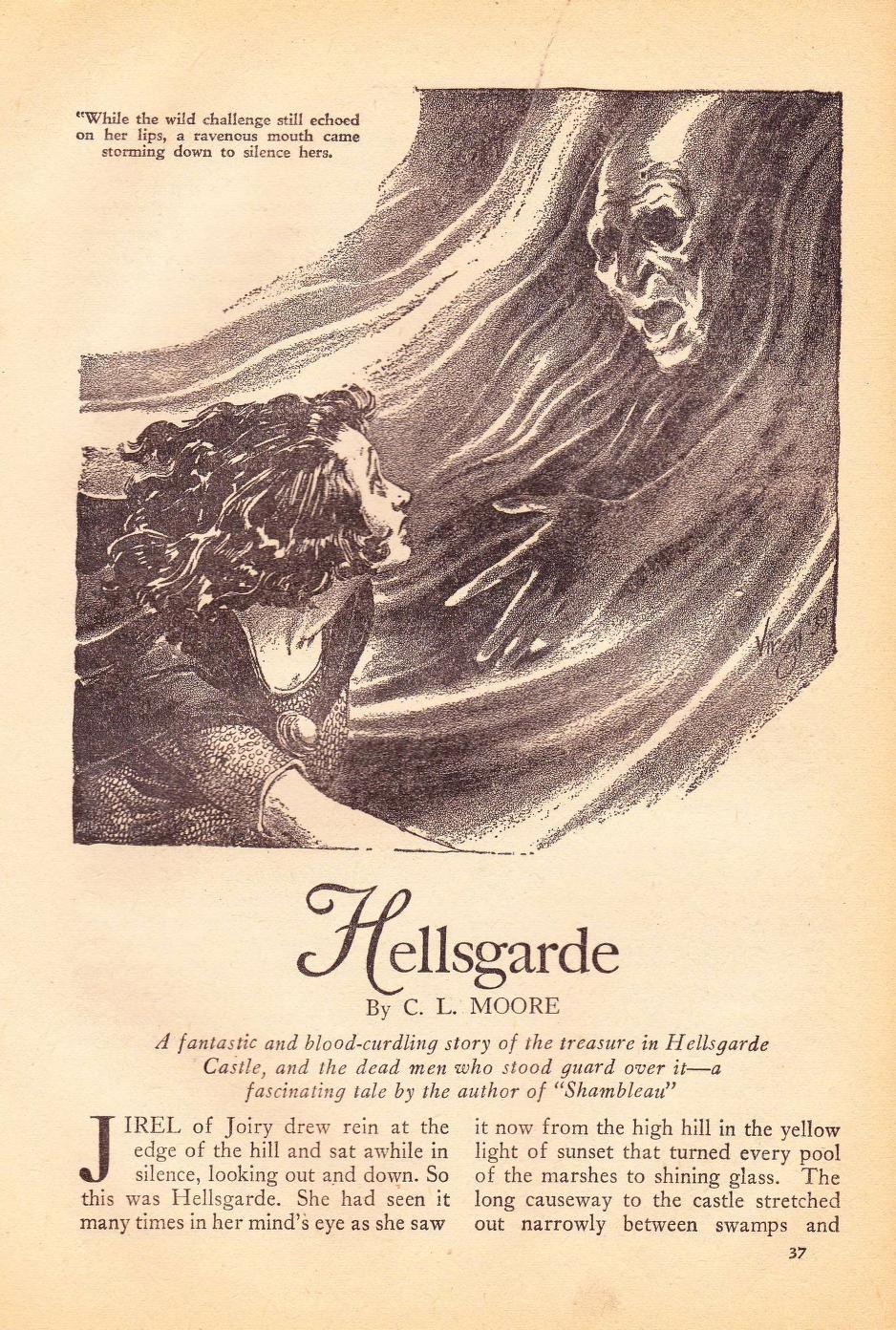
“Hellsgarde” (1939) by C. L. Moore

“You’ll find it by sunset only, my lady,” Guy of Garlot had told her with a sidelong grin marring his comely dark face. “Mists and wilderness ring it round, and there’s magic in the swamps about Hellsgarde. Magic—and worse, if legends speak truth. You’ll never come upon it save at evening.”
—C. L. Moore, “Hellsgarde” in Weird Tales (Apr 1939)

The last Jirel of Joiry story came out 15 months after the previous story, “Quest of the Starstone.” In that time, Moore had been publishing less. The market was changing. New fantasy and weird fiction magazines were out, Weird Tales had been sold and the offices moved to New York City; the editor Farnsworth Wright would soon be fired and, in 1940, would die. Moore’s connections to the magazine were fraying. But there was this one last hurrah.

While it wouldn’t be quite correct to say that the Jirel of Joiry tales to this point were formulaic, they did share very similar plots: Jirel would travel to some other land or dimension, face a supernatural peril, and overcome it through ingenuity and sheer spirit. The details varied, and sometimes she faced sorceresses or wizards and other times alien spirits and gods, but it was a common theme, one largely shared with several early Northwest Smith yarns. “Hellsgarde” still has that theme, but it is developed in a very different way, and with much more style and plot, than the previous tales—and for a good reason.

This is a horror story.

There are strong Gothic setting elements, and readers might well see it as an old dark house tale, with the decaying castle and the creepy family. Yet without sacrificing any of the adventurous elements—Jirel of Joiry is a woman of action, even when trapped in a cell, and her escape is murderous and bloody—this is definitely a story that emphasizes the creepy above the fantasy. It is the darkest of the original Jirel stories, and with neither a typical ghost or typical ghost-hunters, but something much more deliciously weird.

“With the passage of years the spirits of the violent dead draw farther and farther away from their deathscenes. Andred is long dead, and he revisits Hellsgarde Castle less often and less vindictively as the years go by. We have striven a long while to draw him back— but you alone succeeded. No, lady, you must endure Andred’s violence once again, or—”
—C. L. Moore, “Hellsgarde” in Weird Tales (Apr 1939)

The peril to Jirel in this story is exquisite. Once again, she is in a scenario where swordplay is of limited use. She is bound by loyalty to her retainers, she is physically trapped in the castle by the hunters after Andred’s spirit, and her vitality is a beacon to Andred’s ghost itself. It isn’t the first time that something about Jirel’s violent life has attracted supernatural attention (cf. “The Dark Land” (1936) by C. L. Moore), but the threat is more visceral this time, more rapacious. That adds a sense of personal danger, a threat of sensual violence to a tale that is already designed to unnerve. And like a great writer of the weird, C. L. Moore knows enough to leave the last horror unknown, only hinted at.

It’s a wonderful story, and the readers thought so too:

Hellsgarde was the most welcome story of the current issue, for it has the qualities one associates with C. L. Moore: beauty of style, an owtré air, and narrative unpredictability […]
—J. Vernon Shea in “The Eyrie,” Weird Tales (Jun-Jul 1939)

Hellsgarde was a superb, grand and everything else kind of story; I loved it to the very last exciting word.
—Ethel Tucker in “The Eyrie,” Weird Tales (Jun-Jul 1939)

And C. L. Moore gives us the one and only Jirel of Joiry! Boy! Whatanissue! I hope that C. L. Moore delights us in future issues with more stories of Northwest Smith and Jirel.
—John V. Baltadonis in “The Eyrie,” Weird Tales (Jun-Jul 1939)

You do give us thrill-mad fans such nice ‘oogy’ stories. Look at Jirel of Joiry—she certainly does get around. How about getting her and Northwest Smith to meet again. They did quite some time ago. They should get better acquainted, don’t you think?’
—Elaine McIntire in “The Eyrie,” Weird Tales (Jun-Jul 1939)

There would be no sequel. Jirel of Joiry had run her course under Moore, and there was little left of Northwest Smith. Which doesn’t mean that the story of “Hellsgarde” ends here.

In 1967, “Hellsgarde” was reprinted in The Man from U.N.C.L.E. Magazine (Nov 1967). This digest was published by Leo Margulies, who had bought the rights to Weird Tales, and edited by Cylvia Kleinman Margulies, his wife. Back numbers from Weird Tales tended to fill out the issues in the “Department of Lost Stories.” However, probably for reasons of space, when “Hellsgarde” was reprinted it was significantly abridged, and in parts rewritten. This was likely done by the editor, as reprints of “Hellsgarde” in Moore’s own collections follow the 1939 text.

Did Moore intend “Hellsgarde” as a send-off for Jirel? Did she lose contact with the character, after so many years and stories? Or was it just that she lost contact with Weird Tales, and focused her energies on the future—to her upcoming marriage with Henry Kuttner, and the career they would build together? We may never know.

“Hellsgarde” was published in the April 1939 issue of Weird Tales. Scans of this issue are available on the Internet Archive.

A comparison of the 1939 vs. 1967 texts of “Hellsgarde” is also available on the Internet Archive.


Bobby Derie is the author of Weird Talers: Essays on Robert E. Howard and Others and Sex and the Cthulhu Mythos.

Deep Cuts in a Lovecraftian Vein uses Amazon Associate links. As an Amazon Associate I earn from qualifying purchases.
“Quest of the Starstone” (1937) by C. L. Moore & Henry Kuttner

Glad to hear that you & C L M are collaborating on a dual masterpiece. The result certainly ought to be powerful enough! Staging a meeting betwixt the mediaeval Jirel & the future Northwest Smith will call for some of your most adroit time-juggling—but with two keen imaginations at work no obstacle is likely to be unsurmountable. Good luck to both of you aesthetically & financially!
—H. P. Lovecraft to Henry Kuttner, 8 Feb 1937, Letters to C. L. Moore & Others 262

In May 1936, just three months after the death of C. L. Moore’s fiancé, H. P. Lovecraft wrote to his correspondent Henry Kuttner and asked if he could forward some material to C. L. Moore. This began a correspondence between Kuttner and Moore that would, in 1940, lead to their marriage. Yet during Lovecraft’s brief time together, he heard about their forthcoming collaboration—even if he didn’t live to see it.

The collaboration came at an odd time in both of Kuttner and Moore’s careers. Moore’s output for Weird Tales was declining; the last Jirel of Joiry tale was “The Dark Land” (WT Jan 1936), the last Northwest Smith story was “Tree of Life” (WT Oct 1936). So when “Quest of the Starstone” was published in Weird Tales Nov 1937, it had been over a year since either character had appeared. A year since C. L. Moore had graced the Unique Magazine.

Kuttner got his professional start in the pulps in 1936. In the space of less than two years, 27 stories from him appeared in the pulp magazines, 11 in Weird Tales. In his early career, Kuttner struggled to find his own voice; while prolific, he put out pastiche work like “The Salem Horror” (WT May 1937), riffing off of Lovecraft’s Mythos, and collaborated with Robert Bloch on “The Black Kiss” (WT Jun 1937). It was Kuttner, devoting much of his time to writing, who recommended the collaboration with Moore:

Chacal: Rumor has it that you didn’t particularly care for the story in which Jirel met Northwest, “Quest of the Star Stone.” Could you give us a little background on the tale: the how and why of it? 

Moore: I’d forgotten that I maybe like “Quest of the Star Stone ” least—that doesn’t mean dislike. If I said so, I expect it’s true. And if true, my guess would be that in this first Kuttner/Moore collaboration the machinery of working together had to be refined and worked over more before it functioned well. Hank and I had met, I think, a short time before this. Or had we met at all? Or only corresponded? Anyhow, he was urging me to do another Jirel and sent on a kind of opening situation to see if I would feel any interest. I did and we sent the ms. back and forth to the best of my very dim recollection until we were ready to submit it. Remember this was all 40 years ago and a lot has happened since.

[…]

Chacal: Did you ever have any reservations about collaborating with Kuttner? 

Moore: Nope. “The Quest of the Star Stone,” our first, worked out well enough to show us we could do it and after that we never gave it much thought. We just went ahead and wrote, either separately or together, depending on how that particular piece of work progressed. Remember, we weren’t turning out stories for posterity, but for this month’s rent. I so often hear of collaborators who tear down each other’s work—even successful, long-established collaborators. We didn’t have time for that kind of nonsense. We just traded typewriters; when one got stuck the other took over with a minimum of rewriting. Often none at all. Usually none at all. With us, at least, it worked out fine. It was also very nice to have somebody who could take over when the other guy got stuck. We sincerely loved each other’s writing and enjoyed tremendously what came out of the other guy’s typewriter. It was a fine relationship. 
—”Interview: C. L. Moore Talks To Chacal” in Chacal #1 (1976), 30

Crossovers of series characters were rare in the pulps, but not unheard of. Robert E. Howard’s Kull of Atlantis and Bran Mak Morn had met in “Kings of the Night” (WT Nov 1930). This crossover, however, also involved a collaboration, and ends up somewhat disjointed. The opening rhyme is uncharacteristic of Moore’s work, while the Jirel segment is very characteristic of stories like “Jirel Meets Magic” (1935). However, there are references there which seem to owe more to Kuttner than Moore:

“Bel’s curse on you, Joiry! […] Me you may not fear, Joiry,” the wizard’s voice quavered with furty, “but by Set and Bubastis, I’ll find one who’ll tame you if I must go to the ends of space to find him—to the ends of time itself![“]
—C. L. Moore & Henry Kuttner, “Quest of the Starstone” (WT Nov 1937)

Bel and Set were gods from Robert E. Howard’s Hyborian Age stories of Conan the Cimmerian. The Egyptian god Bubastis were notably used in the early Mythos fiction of Kuttner’s collaborator Robert Bloch, especially in “The Brood of Bubastis” (WT Mar 1937). The second section, with Northwest Smith and Yarol on Mars, drinking segir-whiskey and listening to The Green Hills of Earth was certainly in keeping with Moore’s style for stories like “Dust of the Gods” (1934)—but how much of that was driven by Moore’s habit, or Kuttner’s more fannish tendencies to repetition? It’s hard to tell; Moore was still herself, and Kuttner an effective mimic. Working as they did, their styles tend to blend.

The story moves fairly quickly, establishing the essential conflict, introducing the leads, and then effecting the meeting of the dual protagonists in short order via a bit of magic. Unusually for a Jirel story, it is peppered with bits of French—for all that it is set in medieval France about the year 1500 (the only time we get a hard date), Moore rarely bothered with trying to insert the language into the stories. There is a certain fun interplay here; neither Smith or Jirel are stupid, both are formidable, and both are, in their way, rogues. It is neither love or hate at first sight, but a kind of chess match of greed and wits.

Then they are somewhere else, in one of those transports to other dimensions that showcases so many stories of Jirel and Smith. Perils are faced and overcome, a warlock gets their just desserts, a macguffin is unleashed, and it all ends, if not happily, then with a kind of melancholy correctness of everything back in its accustomed place. Unusually for a Northwest Smith story, Jirel survives—or at least, presumably goes back to her own time and place, as Smith did. Yet in the end he thinks:

Behind the closed lids flashed the remembrance of a keen, pale face whose eyes blazed with some
sudden violence of emotion, some message he would never know—whose red streaming hair was a banner on the wind. The face of a girl dead two thousand years in time, light-years of space away,
whose very dust was long lost upon the bright winds of earth.
—C. L. Moore & Henry Kuttner, “Quest of the Starstone” (WT Nov 1937)

Well, light-minutes, but that’s a quibble. While technically a story where fantasy meets science fiction, where Northwest Smith learns a spell but still carries a raygun, the story leans more heavily toward magic; and while the viewpoint switches, it is mostly a Northwest Smith story in which Jirel appears, since most of the viewpoint is Smith’s. Maybe that is part of the reason it feels “off” compared to the previous Jirel stories. Or maybe it’s just the literal deus ex machina, as the Starstone gives up its secret.

When compared to “Tryst in Time” (1936), Moore’s previous time-travel story, there are certain similar elements in common: an adventurer is bored, an offer is made and accepted, a trip through time results in an encounter with a beautiful woman—but here, there is no instant bond, no sense of soul-mates or reincarnations. Jirel and Smith are alike and respect each other, but there is no sense that they complete each other or need each other. It is a meeting of equals.

Gertrude Hemken, one of the most vocal fans and a prolific letter-writer to Weird Tales, praised the story:

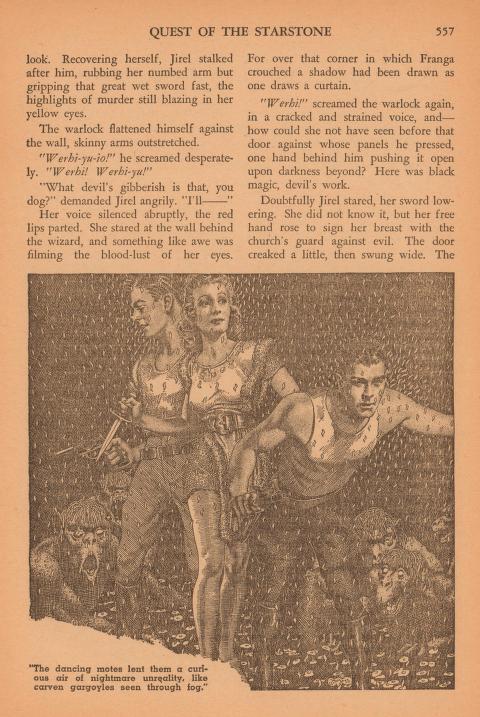
The story of the issue is all I’ve expected it to be—and more. I’ve been curious all these months to learn by what methods and under what circumstances would Jirel and Northwest Smith meet. The story is somewhat lovely—seems as though I awakened from a fantastic dream after I had read it. The abstract lives bro’t to mind the yarns of Aladdin’s lamp and its genie. The illustration is superb. Jirel looks like a screen heroine—and the two men seem rather 20th Century in attire and general aopearance. The dancing flame-stars seem like a very strange rain. Needless to say—The Quest of the Starstone is outstanding, in my opinion.
Weird Tales Jan 1938

Clifford Ball, who had published some sword & sorcery stories for Weird Tales himself, added:

The Quest of the Starstone was a fast-moving, interest-holdiqg, well-balanced piece of work and easily the best story in the current issue even if the famed charaaers of Smith and Jirel are possibly unknown to the later readers. I trust these two authors will be encouraged to continue their partnership. They have the knack of producing masterpieces. But I wish to humbly suggest that
they do not attempt to bring N. S. or J. J. together again, for that might spoil the superb effect of this last story. Not that I mean they should discontinue the characterizations; either one is too magnificent to allow extermination.
Weird Tales Jan 1938

How little he knew. “Quest of the Starstone” was voted the best tale in the November 1937 issue, and readers wanted more. Well, they would get more of Moore & Kuttner—this collaboration proved that they could work successfully together, combining his swift plotting and Moore’s imagination and style—but not much more of Jirel of Joiry or Northwest Smith.

“Quest of the Starstone” was published in the November 1937 issue of Weird Tales. Scans of this issue are available on the Internet Archive.


Bobby Derie is the author of Weird Talers: Essays on Robert E. Howard and Others and Sex and the Cthulhu Mythos.

Deep Cuts in a Lovecraftian Vein uses Amazon Associate links. As an Amazon Associate I earn from qualifying purchases.
“The Dark Land” (1936) by C. L. Moore

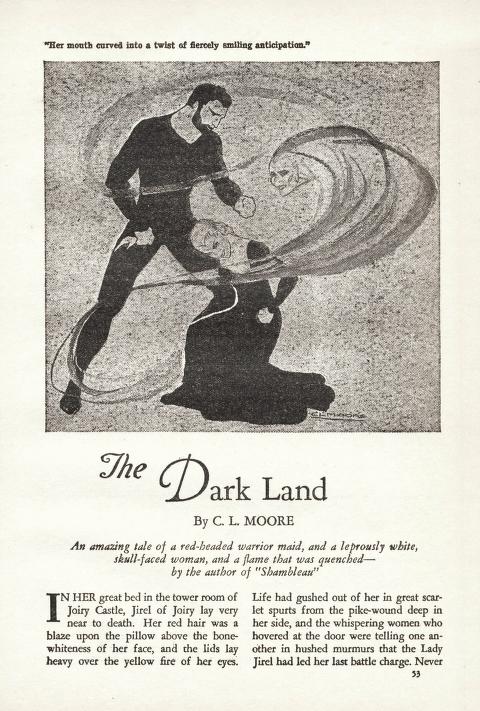
Glad you liked “The Dark Land”. I made the drawing a long time ago, and wrote the story so I could bring it in, with the addition of a cadaverous head and a swirl of vagueness.
—C. L. Moore to H. P. Lovecraft, 30 Jan 1936, Letters to C. L. Moore and Others 108

We don’t know much about how C. L. Moore came to write “The Dark Land,” the fourth published adventure of Jirel of Joiry, and saw print in the January 1936 issue of Weird Tales, except that it drew on ideas Moore had at some point before she first conceived of Jirel, and which she now turned to for inspiration:

Jirel’s Guillaume whom I so ruthlessly slew in the first of her stories, yet whom I can’t quite let die, was patterned after the drawing of Pav of Romne with which I illustrated her latest story, “The Dark Land” in Weird TalesI made that drawing somewhere in the remote past, and have cherished it all these years in the confidence that someday it would come in handy. I meant to use it to illustrate “Black God’s Kiss,” first of the Jirel tales, but somehow the story got out of hand, and I’ve never since been able to introduce a situation it would fit until “The Dark Land.”
—C. L. Moore, “An Autobiographical Sketch of C. L. Moore,” Echoes of Valor 2, 37-38

Like most of Moore’s series stories, this tale was effectively a standalone episode; and like many of them, Jirel swiftly finds herself in another dimension, facing a supernatural threat wildly beyond her abilities.

“Our dear lady has dabbled too often in forbidden things,” he murmured to himself above the crucifix. “Too often. . . .”
—C. L. Moore, “The Dark Land” in Weird Tales (Jan 1936)

Once again, Jirel of Joiry is up against a dangerous, domineering suitor—an echo of the overbearing Guillaume in “Black God’s Kiss” (1934) by C. L. Moore. The central conflict is effectively a weird social drama, a contest of wills (literally) between Pav of Romne and Jirel of Joiry, as the alien king seeks to seduce or dominate Jirel without destroying her. In that, more than most of Jirel’s stories, there is a fierce resistance that is emblematic of the character that would become Red Sonja, who would give herself to no man who had not bested her in combat.

“Give me a weapon! There is no man alive who is not somehow vulnerable. I shall learn your weakness, Pav of Romne, and slay you with it. And if I fail—then take me.”
—C. L. Moore, “The Dark Land” in Weird Tales (Jan 1936)

It is sword & sorcery without much swordplay; Jirel is weaponless in the traditional sense, but then she is facing enemies that cannot be slain with a yard of steel. Like many of Moore’s stories, it deals with entities that are both vastly alien from human conception, and yet peculiarly attracted to either the human form or spirit. It is an aspect of sword & sorcery, the indomitable nature of the human spirit, that separates the swordswomen from the damsels in distress.

While the fans received “The Dark Land” positively, this tendency toward spiritual or psychic warfare was noted:

The Dark Land, by C. L. Moore, gets my vote for first place. . . . For originality of ideas in fantastic realms, Moore takes first place. However, can C. L. Moore discover something else instead of the hero’s (or heroine’s, as the case may be) tremendous will-power, to beat the foe?
—Michael Liene in The ‘Eyrie,’ Weird Tales (Mar 1936)

Another reader noted another running theme in Moore’s stories:

Can’t C. L. Moore write anything but woman-witch-halfbreed stories? Shambleau, The Dark Land, Yvala, ye gods!
—Willis Conover in The ‘Eyrie,’ Weird Tales (Mar 1936)

“The Dark Land” also aroused little comment from Moore’s peers, beyond polite acknowledgement. it wasn’t a bad story, but it lacked the vast originality of her earliest stories in Weird Tales.

I read your “Dark Land”, and liked it well.
—Forrest J Ackermann to C. L. Moore, 12 Feb [1936]

Jan. & Feb. W T issues very poor—saved only by Moore stories.
—H. P. Lovecraft to Emil Petaja, 1 Apr 1936, LEP 472

Have skimmed recent W T issues—though I suppose another is out today. Jan. & Feb. poor—each redeemed only by a Moore story.
—H. P. Lovecraft to Duane W. Rimel, 1 Apr 1936, LFB 316

Moore herself doesn’t comment on how she felt about this story; but there is a notable gap between “The Dark Land” and the next two (and final) Jirel of Joiry stories, “Quest of the Starstone” (WT Nov 1937) and “Hellsgarde” (WT Apr 1939) and when she returns to the character it is with a very different plot.

“The Dark Land” was published in the January 1936 issue of Weird Tales. Scans of this issue are available on the Internet Archive.

Thanks to Marcos Legaria for his help.


Bobby Derie is the author of Weird Talers: Essays on Robert E. Howard and Others and Sex and the Cthulhu Mythos.

Deep Cuts in a Lovecraftian Vein uses Amazon Associate links. As an Amazon Associate I earn from qualifying purchases.
“Jirel Meets Magic” (1935) by C. L. Moore

And WT is publishing in July either the Smith story which Wright has entitled THE COLD GREY GOD, all about a lovely Venusian named Judai, or else a Jirel story we have been revising for months. He hasn’t decided yet which to use.
—C. L. Moore to R. H. Barlow, 20 Mar 1935, MSS. Brown Digital Repository

Farnsworth Wright, editor of Weird Tales, chose “Jirel Meets Magic,” the third published adventure of Jirel of Joiry, for the July 1935 issue. The story itself is a standalone adventure, making no direct reference to the previous episodes, “Black God’s Kiss” (WT Oct 1934) and “Black God’s Shadow” (WT Dec 1934), though Jirel notes that “She had met magic before.” It opens on an action-filled scene as Jirel invades a castle, seeking the wizard Giraud…who has fled in a most peculiar manner:

Feet had trodden in that blood, not the mailed feet of armed men, but the tread of shapeless cloth shoes such as surely none but Giraud would have worn when the castle was besieged and failing, and every man’s help needed. Those bloody tracks led straight across the room toward the wall, and in that wall—a window.

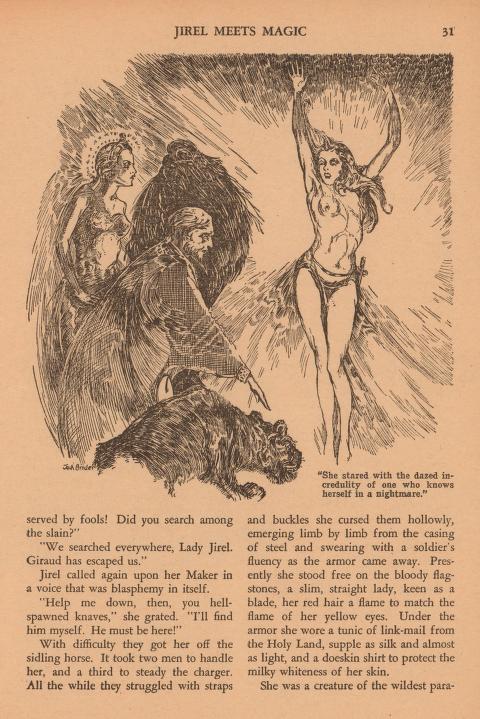
Jirel stared. To her a window was a narrow slit deep in stone, made for the shooting of arrows, and never covered save in the coldest weather. But this window was broad and low, and instead of the usual animal pelt for hangings a curtain of purple velvet had been drawn back to disclose shutters carved out of something that might have been ivory had any beast alive been huge enough to yield such great unbroken sheets of whiteness. The shutters were unlatched, swinging slightly ajar, and upon them Jirel saw the smeaar of bloody fingers.
—C. L. Moore, “Jirel Meets Magic” in WT Jul 1935

The idea of a massive piece of ivory recalls Lord Dunsany’s “Idle Days on the Yann” and Lovecraft’s “The Doom That Came to Sarnath”; the overall plot of a sorcerer escaping through a door or window, followed by their avid pursuer into a strange world, strongly recalls Clark Ashton Smith’s “The Door to Saturn” (Strange Tales of Mystery and Terror Jan 1932)—and it has to be admitted, fits a formula for the Jirel and Northwest Smith stories, which often see the protagonists head into other dimensions.

Yet Moore puts her own spin on things. For the first time, she gives Jirel a woman antagonist in the sorceress Jarisme, and the utter cattiness of the first encounter emphasize’s Jirel’s imp of the perverse.

“I am the sorceress Jarisme, and high ruler over all this land. Did you think to buy me, then, earth-woman?”

Jirel smiled her sweetest, most poisonous smile.

“You will forgive me,” she purred. “At the first glance at you I did not think your price could be high….”
—C. L. Moore, “Jirel Meets Magic” in WT Jul 1935

It is worth noting that while fans often refer to Jirel and Conan together, Jirel is not a barbarian. She is strong, obstinate, determined, vengeful, and bold, but not a barbarian, nor does Moore develop the themes in her stories in quite the way Robert E. Howard does. “Jirel Meets Magic” is simply a journey for vengeance in a magical land, swordswoman versus sorceress, but it is not couched as part of some greater conflict or some historical or philosophical clash, only a conflict of personalities.

Jirel’s quest for vengeance has the outlines of familiar quest-narratives from heroic fantasy, overcoming obstacles through cleverness, luck, a swift blade, and sheer bloody force of will. There’s also a prophecy, though that comes so late in the story as to be almost an afterthought. It is a competent enough story, and the many details of Jirel’s encounters with magic do much to make it an enjoyable one, though it lacks a touch of the originality of the “Black God’s Shadow,” being essentially yet another quest for vengeance, this one more bloody and less intimate.

Weird Tales readers seemed to appreciate “Jirel Meets Magic,” which placed as the #3 favorite story in the issue. One reader noted:

C. L. Moore, with a long line of successes already to her credit, certainly gave us the best to date in Jirel Meets Magic. Moore’s stories are following, more and more, a trend toward sheer fantasy, of which there is a pitiful lack in present-day fiction. Parts of this story were strongly reminiscent of A. Merritt’s imaginative descriptions, and I hardly believe a better compliment could be given a writer than to compare one with the incomparable.
—B. M. Reynolds, “The Eyrie,” WT Sep 1935

The comment is accurate; while Moore’s Northwest Smith stories were very much science-fantasy, with gods and magic impinging on an interplanetary setting, science fiction was not impinging on the adventures of Jirel of Joiry at all. She was not traveling to different planets, and the sorcerers and wizards were not using sufficiently advanced technology; this was sorcery more akin to something out of Bullfinch’s Mythology, with a healthy dose of imagination.

It is a distinction that arch-fan Forrest J. Ackerman probably appreciated, since he was usually disinclined to fantasy splashing over into science fiction:

Just liked your JIREL MEETS MAGIC. It is unfortunate I have to read a number of stories in snatches; so that I had to cut off, and continue later, about five times on MAGIC. As it was almost entirely strange-sensations and alien-vistas—little action—I found it rather hard to get into the story anew each time. but even at that, I completed it last nite and rate it Good.
—Forrest J. Ackerman to C. L. Moore, 6 Jul 1935

It is probably notable that in their future collaborations, the emphasis was on the sci-fi, not the magic. H. P. Lovecraft was also a bit more stinting in his praise:

Read July W T recently—a distinctively mediocre issue, even though Hectograph Eddie [Edmond Hamilton] does get hold of another old plot to run into the ground. The translation from Meyrink has a great idea—& the Moore item presents excellent dream material.
— H. P. Lovecraft to August Derleth, 15 Jul 1935, Essential Solitude 2.704

July W T doesn’t amount to much, though the Moore item has its moments.
— H. P. Lovecraft to Emil Petaja, 31 Jul 1935, Letters with Donald & Howard Wandrei and to Emil Petaja 446

July W T is pretty mediocre—though it was refreshing to see Hectograph Eddie with a new plot. The Moore item was excellent—even though it seems to shew a tendency of C L M’s to drop into a rut.
— H. P. Lovecraft to Duane W. Rimel, 4 Aug 1935, Letters to F. Lee Baldwin et al. 281

“Jirel Meets Magic” was written at a time when series characters rarely experienced much in the way of character growth, and plots were not always developed over multiple episodes. It is very much a story written that could have been Jirel’s last, if the reader response was weak, and C. L. Moore was obviously still plotting on a story-by-story basis, not looking ahead to long narrative arcs, or to develop a distinct setting in the way Howard was doing with his Conan tales. We never get the backstory of where Guichard is in relation to Joiry, or why Giraud decided to ambush her men, for example.

Which may be why “Jirel Meets Magic” seems, in hindsight, like an example of a very generic heroic fantasy story, years before these things became common. The story is a solid, enjoyable potboiler. It’s unfortunate we don’t have more information on why Wright sent it back for revision. Not enough plot? Too explicit, with the naked dryad dying? Something obviously didn’t click, the first time he read it. But the readers like it, and clamored for more. So C. L. Moore would give them more…and, in time, it would even inspire a bit of fan-art.

“Jirel Meets Magic” may be read online for free at the Internet Archive.

Thanks to Marcos Legaria for his help.


Bobby Derie is the author of Weird Talers: Essays on Robert E. Howard and Others and Sex and the Cthulhu Mythos.

Deep Cuts in a Lovecraftian Vein uses Amazon Associate links. As an Amazon Associate I earn from qualifying purchases.
“Black God’s Shadow” (1934) by C. L. Moore

I’m so glad you liked Jirel and the BLACK GOD’S KISS. You know, I never can tell when a story’s good or not. It never fails to surprise me when people are complementary. Jirel was considerable fun, but I hadn’t considered the story is very good. Somehow it seems—along with the rest of my later efforts, to lack the unity that SHAMBLEAU, BLACK THIRST and, in a smaller measure, SCARLET DREAM had. And I am awfully sorry, but I’ve already finished a sequel. I can hear you gritting your teeth, but please, mister, a girl has to live. You can shut your eyes and hold your nose, if necessary, when it comes out, but Mr. Wright was very much enthused about Jirel and wants more. And when he cracks the whip I’ve got to jump.
—C. L. Moore to R. H. Barlow, 5 Jul 1934, MSS. Brown Digital Repository

“Black God’s Kiss” (Weird Tales Oct 1934), the first tale of Jirel of Joiry, had been published a scant two months before. If Farnsworth Wright, editor of Weird Tales, had already suggested C. L. Moore write a sequel, starting what was effectively a second series character in the magazine before the first episode had even been published, suggests he had great faith in both Moore and the character.

Unlike with Northwest Smith, whose subsequent stories so far have been largely disconnected episodes with no strict continuity, “Black God’s Shadow” was a direct sequel to “Black God’s Kiss.” Appropriately, the story begins with a brief recap of the first, as Jirel regrets her supernatural vengeance on Guillaume, who had sought to conquer her. Jirel is haunted by her decision—and Guillaume’s ghost. So Jirel resolves to return to the dark land and save his damned soul, if she can.

If “Black God’s Kiss” was an echo of Alice’s Adventures in Wonderland (1865), then “Black God’s Shadow” is reminiscent of Through the Looking Glass (1871); sufficiently self-contained for new readers, but retreading familiar themes. There is no solid mythology here as in “Dust of the Gods” (1934) or Lovecraft’s Mythos, Jirel experiences these things and interpreted them through instinct as much as her rational mind, but there is no secret history, no account of forbidden names—but there is an elemental, spiritual struggle which is the hallmark of most of Moore’s stories so far, a contest of the human spirit against something inhuman.

If this be sword & sorcery, it was not quite in the same vein as Robert E. Howard’s Conan the Cimmerian; Jirel’s sword avails her little during her trek to the underworld, but there is a certain similarity of character that the two share. For when Conan says:

Let teachers and priests and philosophers brood over questions of reality and illusion. I know this: if life is illusion, then I am no less an illusion, and being thus, the illusion is real to me. I live, I burn with life, I love, I slay, and am content.
—Robert E. Howard, “Queen of the Black Coast” (Weird Tales May 1934)

It seems to presage when Jirel feels:

She remembered laughter, and singing and gayety—she remembered slaughter and blood and the wild clang of mail—she remembered kisses in the dark, and the hard grip of men’s arms about her body.
—C. L. Moore, “Black God’s Shadow” (Weird Tales Dec 1934)

At the end of the story, Jirel is content, much as Conan had somber satisfaction after meting out death to what killed his own lover, Bêlit. Yet there the parallels end; Conan does not replay the descent of Inanna, and Jirel’s quest is one of mercy—or at least, freedom from the memory of Gillaume that haunts her—and that supernatural adventure is as much an assuage to her grief as it is an exorcism.

While Roy Thomas & co. never say so explicitly, “Black God’s Shadow” may have another Conan connection, as one line in it strongly recalls the character of Red Sonja‘s insistence that no man shall have her unless she be beaten in battle:

For she had been the commander of the strongest fortress in the kingdom, and called no man master, and it was her proudest boast that Joiry would never fall, and that no lover dared lay hands upon her save in answer to her smile.
—C. L. Moore, “Black God’s Shadow” (Weird Tales Dec 1934)

Jirel is less than virginal, a point that C. L. Moore never lingers on but makes apparent, even in this second episode. Like Northwest Smith, she is presented neither as a slut or a nun, and shows no shame at sexual desire, but neither is she ruled by it, nor does any moral punish her for it. In an age of flappers who flaunted sexual norms, Jirel perhaps represents the kind of woman that many wished they could be.

Moore worried about how this second character would be received:

What did you think of BLACK GOD’S KISS? And B. G.’S. SHADOW? Jirel doesn’t seem to have gone over so well, though Mr. Wright thought B.G.’S. K. the best I had done up to that time. I’m working on another Jirel story now.—Oh, I was forgetting. You haven’t read all my stories, have you?
—C. L. Moore to Forrest J. Ackerman, 3 Dec 1934

This is especially true in Moore’s letters to R. H. Barlow, who was trying to gently nudge her from falling into the trap of pulp pap.

I am terrified every time I think about your warnings not to get hackneyed. You’ll have to let me know when I begin to show signs of it. You must, tho, give me a little latitude in the matter of continuing Smith and Jirel stories ad nauseam. I know how you hate it. Keen an eye on me, tho, and tell me all my faults. I get such an awful swelled-head when people flatter me that I do need someone to say flatly, “That’s awful!” sometimes. All of which I’ve remarked on before, of course. Not that I don’t enjoy the compliments you relay too.
—C. L. Moore to R. H. Barlow, 31 Dec 1934, MSS. Brown Digital Repository

There was enough support for Jirel in the ‘Eyrie’ to give Moore a swelled head, even if it was slightly less effusive than for Northwest Smith:

Jirel of Joiry

Gertrude Hemken, of Chicago, writes: “About C. L. Moore and The Black God’s Kiss: that Amazon, Jirel, is a gal after my own heart, by gum. Somehow I always preferred women of that type, to clinging vines, or sweet little ones who shudder at the thought of killing a fly. Of course, it isn’t supposed to be nice for women to curse a blue streak as Jirel did, but, shucks, it makes her all the more interesting (to me). And now we find Jirel again in this issue (December). Gosh, I could stand her for every issue, and keep yelling for more. She’s just that kind of a girl. What more can I say but that I am immensely fond of her, and stand a bit in awe of such a maid, although fictitious? Long live C. L. Moore, who has the ability to create such dynamic characters as Jirel of Joiry and Northwest Smith.[“]
—The ‘Eyrie’, Weird Tales Feb 1935

Lovecraft was slightly less effusive in his praise, though he wrote to several correspondents that the Jirel sequel was the second-best story in the issue, e.g.

The December W T is strikingly better than its mediocre predecessor. Klarkash-Ton’s fascinating “Xeethra” easily leads, with “The Black God’s Shadow” as a fair second.
—H. P. Lovecraft to F. Lee Baldwin, 7 Dec 1934, Letters to F. Lee Baldwin, etc. 114

In a later letter, Lovecraft expanded slightly:

“The Black God’s Kiss”, despite overtones of conventional romance, is great stuff. The other-world description & suggestions are stupendous. “Black God’s Shadow” not quite up to it.
—H. P. Lovecraft to Duane W. Rimel, 22 Dec 1934, Letters to F. Lee Baldwin, etc. 248

Which is fair. “Black God’s Kiss” had novelty on its side, and the romantic schmaltz that Lovecraft disliked never really came in until the end. In “Black God’s Shadow,” Moore starts out where she left off, and drags Jirel back down through the same passage. Twice, however, was enough. When next Jirel of Joiry returned, it would be with a new and more original adventure.

“Black God’s Shadow” may be read online for free at the Internet Archive.

Thanks to Marcos Legaria for his help.


Bobby Derie is the author of Weird Talers: Essays on Robert E. Howard and Others and Sex and the Cthulhu Mythos.

Deep Cuts in a Lovecraftian Vein uses Amazon Associate links. As an Amazon Associate I earn from qualifying purchases.
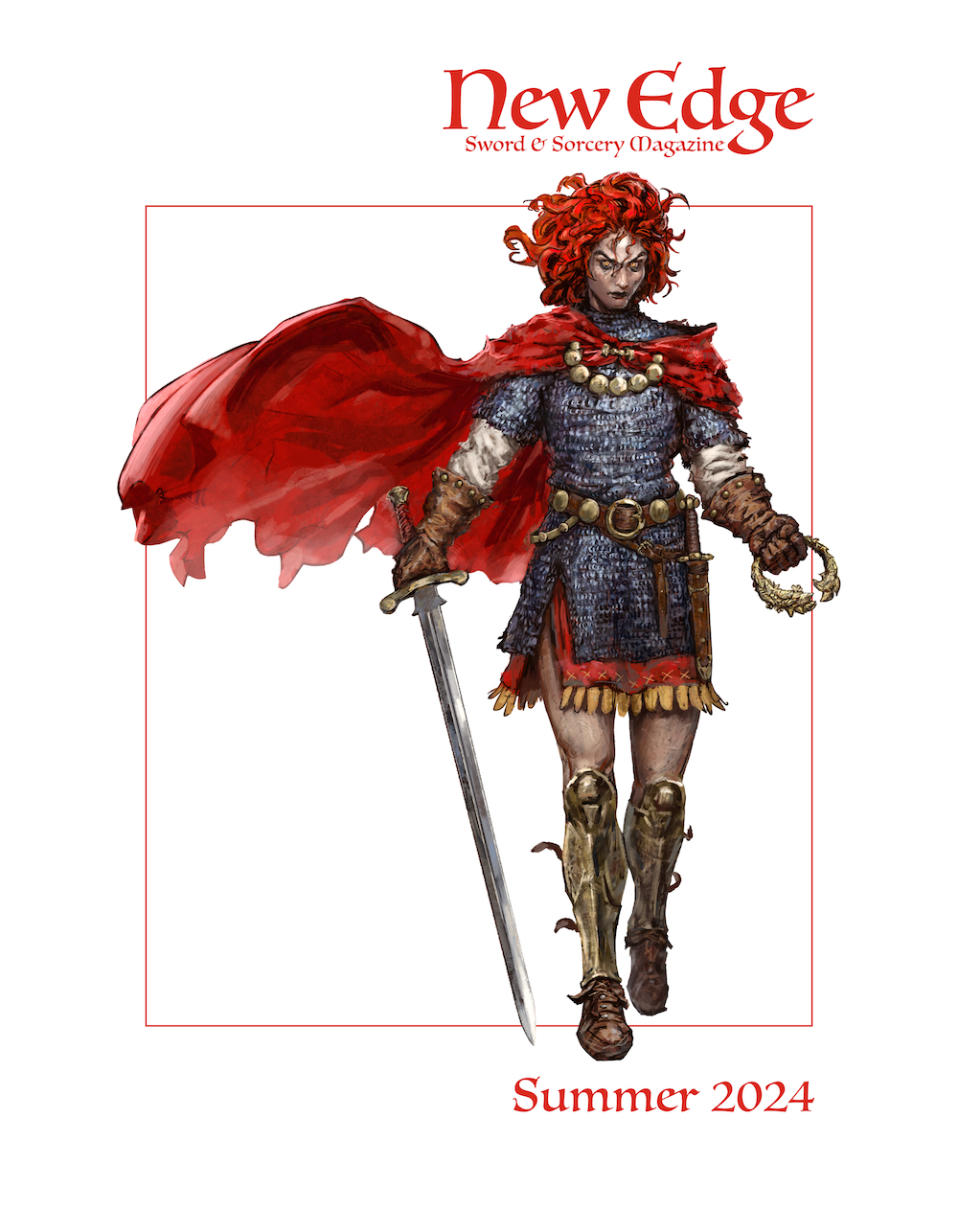
“Jirel and the Mirror of Truth” (2024) by Molly Tanzer

“You have succeeded today;” it said, “but you have lost yourself, Jirel, once of Joiry.[“]
—Molly Tanzer, “Jirel and the Mirror of Truth” in New Edge Sword & Sorcery #3

Jirel of Joiry appeared in Weird Tales with “Black God’s Kiss” (1934) by C. L. Moore. That style of story had no name yet, and very few peers to compare it to. Readers immediately saw in Jirel a warrior akin to Conan the Cimmerian and Kull of Atlantis, embattled against wizards and stranger foes that blended adventure and horror, might thews and magic, swords and sorcery.

As a consequence, the initial spate of adventures from C. L. Moore’s typewriter were a bit raw. There was little continuity and less worldbuilding. Jirel herself was a boldly sketched character, and her personal trials shaped her development—yet Moore never tried to portray her at different ages as Robert E. Howard had done with Conan, never sought to reconcile her fantastic France with the real world, and the adventures she went on were the definition of episodic. Where readers could look forward to Conan as a king and know he spent a varied career as a thief, pirate, and mercenary soldier, Jirel was little different in her last adventure than she was at her first.

Jirel of Joiry had no destiny, no future, almost no past to speak of.

So when Molly Tanzer received permission from C. L. Moore’s heirs to do a new authorized Jirel story, she had some decisions to make. Ninety years of steady development has refined heroic fantasy fiction far from its roots in pulp fiction. There have probably been a hundred stories about mystic Mirrors of Truth, not least because Robert E. Howard had a go at the idea with “The Mirrors of Tuzun Thune” (1929), and the pages of at least ten thousand paperback novels is stained with the blood of cunning wizards and magical gewgaws who learned, far too late, what the tip of the blade feels like as it cleaves their liver (or black heart, or festering brain, etc.) in two.

In this respect, “Jirel and the Mirror of Truth” reads like a fairly competent and well-written sword & sorcery story in a fairly old-school mode. If the heroine wasn’t Jirel, readers would still have no doubt that Jirel’s literary DNA was in the mix, much as most barbarians in fiction have a little bit of Howard’s Cimmerian in them. If it lacks something of the raw and sensual language of C. L. Moore, that’s because Tanzer is a smart enough writer not to fall in the trap of trying to pastiche Moore’s prose style. Better, it shows a solid understanding of one of Moore’s central themes: the Jirel stories are always about a contest of spirit as much (or more) than flesh.

It doesn’t take much genre savviness to glance at the title and decide the question will emerge, sooner or later, “Who is Jirel of Joiry?” The answer, however, might surprise a few folks. Molly Tanzer doesn’t regurgitate bits of old Moore stories, though she draws on elements of them; she illustrates who Jirel is through her actions and interactions with others, especially her new companion, Thevin Galois. Less a girlfriend and more than a sidekick, Thevin is a kind of Enkidu to Jirel’s Gilgamesh; the two are alike, but they complement each other. Perhaps they reflect one another’s strengths and weaknesses, their potentialities. Thevin is what Jirel might have been; Jirel is what Thevin might yet be.

When it came to amorous matters, Thevin preferred the company of women, and did not give much notice to men’s attentions.
—Molly Tanzer, “Jirel and the Mirror of Truth” in New Edge Sword & Sorcery #3

Tanzer likes LGBTQ+ characters in her stories, and in this respect Thevin as a lesbian works well. Her sexuality is stated, there’s a hint of tension and attraction with Jirel, but this isn’t Thirsty Sword Lesbians or Dagger Kiss where the question is whether they’ll kiss. If anything, it’s nice to just see the representation of a character where their sexuality is relevant to their character but not the main focus of the story or present just to fulfill a lurid scene or two—there is actual porn out there for folks that want erotic tales of lesbian swordswoman. Tanzer is focused on telling Jirel’s story.

For readers who start with “Black God’s Kiss” and read through the whole C. L. Moore-penned Jirel of Joiry saga to “Hellsgarde” (1939), “Jirel and the Mirror of Truth” might be a bit of a jolt in style. There’s a bit more of Michael Moorcock and Joanna Russ in the style than Robert E. Howard and C. L. Moore. Yet it is a well-written story, and a cut above the pastiche of yesteryear. With a little luck, Jirel’s new adventures may have just begun.

“Jirel and the Mirror of Truth” by Molly Tanzer was published in New Edge Sword & Sorcery #3 (Summer 2024).


Bobby Derie is the author of Weird Talers: Essays on Robert E. Howard and Others and Sex and the Cthulhu Mythos.

Deep Cuts in a Lovecraftian Vein uses Amazon Associate links. As an Amazon Associate I earn from qualifying purchases.
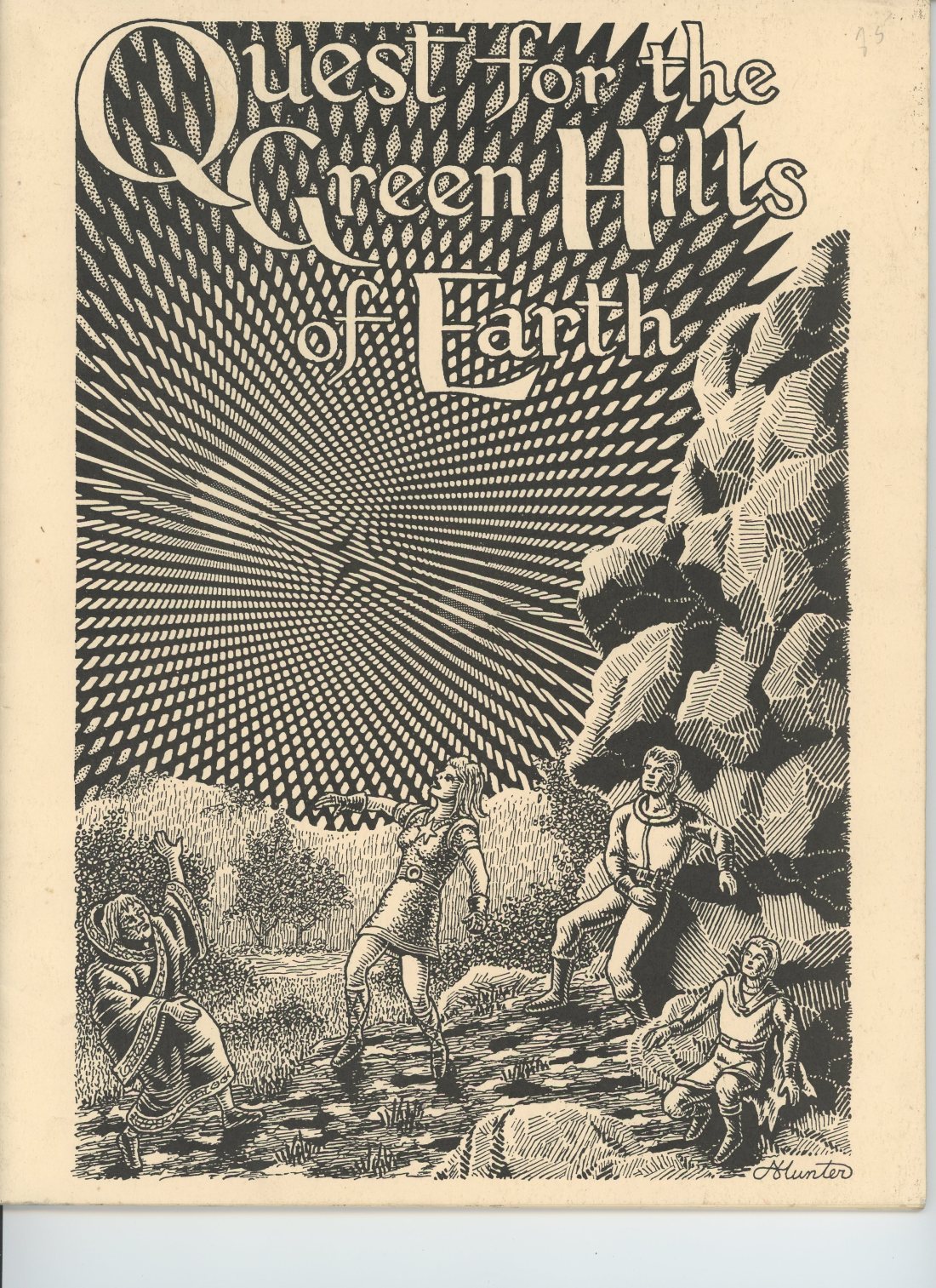
Quest for the Green Hills of Earth (1995) by Ned Brooks

Chacal: Rumor has it that you didn’t particularly care for the story in which Jirel met Northwest [Smith], “Quest for the Star Stone.” Could you give us a little background on the tale; the how and why of it?

Moore: I’d forgotten that I maybe like “Quest of the Star Stone” least—that doesn’t mean I dislike. If I said so, I expect it’s true. And if true, my guess would be that in this first Kuttner/Moore collaboration the machinery of working together had to be refined and worked over more before it functioned well. Hank and I had met, I think, a short time before this. Or had we met at all? Or only corresponded? Anyhow, he was urging me to do another Jirel and sent on a kind of opening situation to see if I would feel any interest. I did and we sent the Ms. back and forth to the best of my very dim recollection until we were ready to submit it. remember this was all 40 years ago and a lot has happened since.

“Interview: C. L. Moore Talks To Chacal” in Chacal #1 (1976), 28

They were not yet married. Catherine Lucille Moore had broken into Weird Tales with “Shambleau,” the first story of Northwest Smith, interstellar outlaw, in 1933; her fantasy heroine Jirel of Joiry followed in “Black God’s Kiss” in 1934. Henry Kuttner broke into Weird Tales with “The Graveyard Rats” in 1936. Both Moore and Kuttner were correspondents of H. P. Lovecraft. After C. L. Moore’s fiance died in February 1936, through Lovecraft she and Kuttner came into correspondence…and not immediately, but over time, that grew into something more. They married in 1940, and would go on to become one of the most famous writing teams in science fiction. Yet their first collaboration was one of their weirdest, and has arguably the oddest legacy.

“Quest of the Starstone” was published in the November 1937 issue of Weird Tales; the two characters Northwest Smith and Jirel of Joiry had heretofore occupied completely separate settings with no connective elements, but there was a precedent for an author bringing two disparate characters together. Robert E. Howard had brought the Pictish king Bran Mak Morn and King Kull of Atlantis together in “Kings of the Night” (Weird Tales November 1930). Howard had a habit of developing common themes, backgrounds, and connective elements between many of his stories, so that such a chance meeting was less incongruous than it might have been.

Weird Tales Oct 1937 advert

Moore was nowhere near as devoted to building a consistent setting, but she had one advantage. Her stories of Northwest Smith and Jirel of Joiry never drew a hard line between science fiction and fantasy. It was not uncommon for Jirel to end up in some other dimensional, dealing with an alien entity; nor was it strange for Northwest Smith to turn his raygun against alien gods or sorcerers. In both stories, science and sorcery were part of the same spectrum, and either worked well as an explanation. Henry Kuttner, especially early in his career, was adept at pastiche and able to turn his hand to nearly anything. While that did mean he sometimes struggled to find his own voice, when it came to collaboration, his prose often flowed seamlessly with his partner’s.

As their first collaboration, “Quest of the Starstone” is a bit stiff. While the prose is competent, neither Kuttner or Moore is at their best, and the sensual, often dreamlike prose that characterized Moore’s solo efforts at both characters is often missing in a rather straightforward plot to get the two heroes to meet, team-up, and overcome a mutual for in a way that would become familiar to generations of superhero comics fans. Yet there is one passage in particular that had a longer and odder life.

Homesickness he would not have admitted to anyone alive, but as he sat there alone, morosely facing his dim reflection in the steel wall, he found himself humming that old sweet song of all Earth’s exiled people, The Green Hills of Earth:

Across the seas of darkness
The good green Earth is bright—
Oh, star that was my homeland
Shine down on me tonight. . . .

Words and tune were banal, but somehow about them had gathered such a halo of association that the voices which sang them were sweeter and softer as they lingered over the well-remembered phrases, the well-remembered scenes of home. Smith’s surprizingly good baritone took on undernotes of a homesick sweetness which he would have died rather than admit:

My heart turns home in longing
Across the voids between,
To know beyond the spaceways
The hills of Earth are green. . . .

What wouldn’t he give just now, to be free to go home again? Home without a price on his head, freedom to rove the blue seas of Earth, the warm garden continents of the Sun’s loveliest planet? He hummed very softly to himself,

—and count the losses worth
To see across the darkness
The green hills of Earth. . . .

C. L. Moore & Henry Kuttner, “Quest of the Starstone”

Who wrote this bit? Moore was the poet of the pair, but Kuttner was no slouch, and the title itself is a callback to two previous tales. In “Shambleau” Moore wrote: “[…] he hummed The Green Hills of Earth to himself in a surprisingly good baritone”; and in “The Cold Gray God” (1935):

No one sang Starless Night any more, and it was the Earth-born Rose Robertson’s voice which rang through the solar system in lilting praise of The Green Hills of Earth.

That could be the kind of detail that a good pasticheur like Kuttner would pick up and expand upon. Yet it wouldn’t be surprising if they both had a hand in the final version of this scene.

“Quest” was also almost the final appearance for both characters. Northwest Smith’s final appearance would be in “Song in a Minor Key” (1940), where Moore alludes to his exile and spoke of Earth as “a green star high in alien skies.” When Jirel of Joiry returned in “Hellsgarde” (1939), she does not mention Northwest Smith…but then, chronological continuity was seldom the strong point in either the Northwest Smith or Jirel of Joiry stories, except that “Black God’s Shadow” followed “Black God’s Kiss.” Like oil and water, the two characters drew apart.

For many years thereafter the story was quite scarce—Moore did not collect it in any her Northwest Smith or Jirel of Joiry collections in the 1950s or 60s. However, Sam Moskowitz claims:

When Robert Heinlein read the story, he never forgot the phrase which became the title of one of his most famous short stories and of a collection, The Green Hills of Earth.

Sam Moskowitz, Seekers of Tomorrow (1967), 312

“The Green Hills of Earth” ran in The Saturday Evening Post for 8 Feb 1947, and provided the title for Heinlein’s 1951 collection of science fiction. Heinlein himself claimed that he didn’t consciously realize he had lifted the phrase until after the story was published:

Two weeks after the sale was made, Vida Jameson was in bed with a cold, and Heinlein dug out some of his old Weird Tales pulps so she could read his favorite Northwest Smith stories by C. L. Moore. In the middle of reading, she sat up in bed, startled: she had discovered the title of Heinlein’s Post story in a passage in “Shambleau” where Northwest Smith is humming “The Green Hills of Earth” to himself.

Heinlein immediately apologized to Catherine Kuttner for unconsciously appropriating her intellectual property and asked for a formal release to use the song title.

The Kuttners, too, were delighted to learn about the sale to the Post and happy to make the release. They wrote him gloating congratulations.

William H. Paterson, Robert A. Heinlein: In Dialogue with His Century, Volume 1 (2010) 403

Subsequent publications would include the acknowledgment:

The phrase The Green Hills of Earth derives froma story by C. L. Moore (Mrs. Henry Kuttner), and is used here by her gracious permission

Heinlein did not reiterate Moore & Kuttner’s verses, but came up with his own—and attributed it to an author, the blind poet Rhysling. Both “The Green Hills of Earth” (song) and Rhysling would be mentioned in some of Heinlein’s other works, such as Farmer in the Sky (1950) and Time Enough for Love (1973). Heinlein’s work gained much more recognition than Moore and Kuttner’s, and his fictional poet Rhysling would in 1978 lend their name to the Rhysling Awards, an annual award for the best science fiction, fantasy, or horror poem—and in an unknown number of poems and filk music devoted to that enigmatic but evocative song, “The Green Hills of Earth.”

This is where Quest of the Green Hills of Earth (1995) comes in. Edited by Ned Brooks and illustrated by Alan Hunter, this is the kind of standalone chapbook that is a hallmark of science fiction and fantasy fandom. It reprints “Quest of the Starstone” in its entirety, Heinlein’s verses from “The Green Hills of Earth,” and three fan-made versions—one by Chuck Rein, George Heap, “and other fans of the 1960s”; one by Don Markstein (“late 60s”), and one by Steve Sneyd (Oct 1992). There is a brief article by Brooks tracing various recensions of the song to various tunes, both original and familiar—it has been sung to everything from “Greensleeves” to “Puff, the Magic Dragon,” and various dramatic presentations of “The Green Hills of Earth” or its song have been made and even marketed commercially. Brooks ends the booklet with sheet music for two versions, one composed by George Heap and the other by Joseph Kaye.

Curious listeners can listen to several versions of these songs, most based on Heinlein’s verses.

Why does it work? Why do just a few simple words strung together resonate with the hardboiled Northwest Smith, who could never go home again; and the blind poet Rhysling burned by radiation; and for all those generations of fans? I like to think it works because Moore, Kuttner, and Heinlein recognized a key aspect of science fiction: more than the hard science, the human emotion, the narrative of what it feels like to a person to go out to that distant frontier, matters.

I had thought that going into space would be the ultimate catharsis of that connection I had been looking for between all living things—that being up there would be the next beautiful step to understanding the harmony of the universe. In the film “Contact,” when Jodie Foster’s character goes to space and looks out into the heavens, she lets out an astonished whisper, “They should’ve sent a poet.” I had a different experience, because I discovered that the beauty isn’t out there, it’s down here, with all of us. Leaving that behind made my connection to our tiny planet even more profound.

William Shatner, “William Shatner: My Trip To Space Filled Me With Sadness,” Variety 6 Oct 2022

As it turns out, before we ever had an astronaut in orbit, a few poets did launch themselves into the great dark…for a little while, anyway…and captured something of that longing for home.


Bobby Derie is the author of Weird Talers: Essays on Robert E. Howard and Others and Sex and the Cthulhu Mythos.

Deep Cuts in a Lovecraftian Vein uses Amazon Associate links. As an Amazon Associate I earn from qualifying purchases.
“Jirel of Joiry: Into The Violet World” (1987) by C. L. Bevill and “Werewoman” (1994) by Roy Thomas, Robert Brown, Rey Garcia, and Susan Crespi

Why aren’t there more C. L. Moore comics?

Catherine Lucille Moore was a contemporary and correspondent of Robert E. Howard and H. P. Lovecraft; she was published in the same pulp magazine, Weird Tales, even collaborated with them on the round robin “The Challenge From Beyond” (1935). Her first story, “Shambleau” (1933), was an immediate hit with readers and weird fiction writers alike, and introduced the world to Northwest Smith, who would go on to star in a series of tales from Moore’s typewriter. Her next creation for Weird Tales, the flame-tressed swordswoman Jirel of Joiry in “Black God’s Kiss” (1934), was hailed as a female Conan.

In general outline, the Conan and Jirel publishing timeline largely lines up as well. Conan’s last original story in Weird Tales was in 1936; Jirel’s in 1939. Gnome Press published the first Conan hardcover in 1950, and the Jirel hardcover collection in 1954; paperback reprints for both appeared for both characters in the 60s as part of the general paperback Sword & Sorcery/fantasy boom. Sure, there were more Conan stories and they were more popular—is that the only reason why Robert E. Howard’s Conan the Cimmerian got the big break into comics when Jirel didn’t?

The boring, practical answer is probably “money.” Licensing a character, even an old pulp character, costs money, and anyone who did want to license Jirel for comics would have gone through C. L. Moore’s agent. Even relatively big publishers like Marvel had to balance cost versus popularity; according to Roy Thomas in Barbarian Life vol. 3, Marvel first approached Lin Carter’s agent about licensing Thongor of Lemuria because they thought Conan would be too expensive. Demographics might also have played a role; women warriors in fantasy have a long history, but in print and in comics, male characters dominated, as Nancy Collins noted when a very different red-haired swordswoman hit the page:

I was thirteen years old when I first saw Red Sonja. It was her debut appearance in the Conan the Barbarian comic book written by Roy Thomas and illustrated by Barry Windsor-Smith, back in 1973, and she was wearing a slightly more practical scale-mail tunic and leather hot-pants ensemble, but all the elements of her basic personality were there: bravery, skill with a sword, and the brashness necessary to go make a name for herself in the savage, male-dominated world of Robert E. Howard’s Hyborian Age.

She immediately grabbed my attention because there were so few strong female heroic characters back then, not just in comics but popular culture in general. (Moreover, the fact this outspoken and capable woman of action and I shared the same hair color did not hurt.) [I]t may be hard for today’s audience to understand, but in the 1960s and 1970s, with the notable exception of Wonder Woman and the Black Widow, most of the female characters in comics were either the girlfriends/wives whose role was to be menaced and/or kidnapped by the arch-nemesis of their heroic Significant Other (Lois Lane, Iris Allen, Gwen Stacy), young and far less seasoned distaff versions of well-established male heroes (Supergirl, Batgirl, Hawkgirl, Mary Marvel), superheroines with powers that precluded physical strength (Saturn Girl, Marvel Girl, Sue Storm, Dream Girl), or were symbolically devaluing (Shrinking Violet, The Wasp.)

Nancy Collins, foreword to Drawn Swords: An Unauthorized Exploration of Red Sonja and the Artists who Brought her to Life vii

Red Sonja as a property has enjoyed on-again/off-again success; the audience for a strong female character-led fantasy comic has been there since she first debuted, but the will and ability to keep her published in her own ongoing series hasn’t always been. Other swordswoman characters spun off from Conan like Age of Conan: Bêlit (2019, Marvel), Age of Conan: Valeria (2020, Marvel), and Bêlit & Valeria: Swords vs. Sorcery (2022, Ablaze) have enjoyed much less success in standalone miniseries—and maybe Jirel of Joiry would suffer the same fate, not quite clicking with audiences. It has to be remembered that of the thousands of characters created for pulp and magazine fiction, only a rare few like Doc Savage, Tarzan, The Shadow, Conan the Cimmerian, and Elric of Melniboné enjoy long-term popular and economic success.

So where does that leave Jirel? In the hands of the fans.

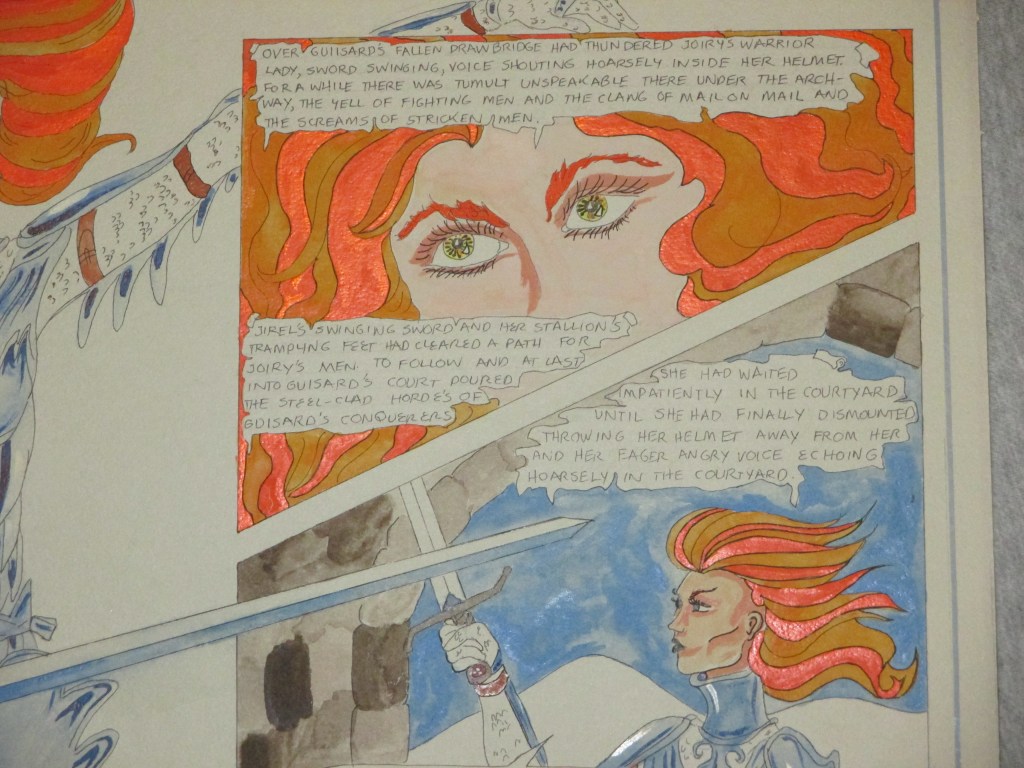
Jirel of Joiry: Into The Violet World (1987)

JIREL OF JOIRY: INTO THE VIOLET WORLD

Panel 1: Over Guiisard’s [sic] fallen drawbridge had thundered Joiry’s warrior lady, sword swinging, voice shouting hoarsely inside her helmet. For a while there was umult unspeakable. There under the archway, the yellow of fighting men and the clang of mail on mail and the screams of stricken men.

Jirel’s swinging sword and her stallion’s tramping feet had cleared a path for Joiry’s men to follow and at last into Guisard’s court poured the steel-clad hordes of Guisard’s conquerors.

Panel 2: She had waited impatiently in the courtyard until she had finally dismounted. Throwing her helmet away from her and her eager angry voice echoing hoarsely in the courtyard.

Jirel: Giraud! Make haste, you varlets! Bring me Giraud!

Panel 3: There was such bloodthirsty impatience in that hollowly booming voice that the men who were returning from searching the castle hung back as they crossed the court toward the lady in reluctant twos and threes, failure eloquent on their faces,

Below: Based on a story ‘Jirel Meets Magic’ by C. L. Moore

This piece came to me via eBay, the only comic art of Jirel I’d ever seen, and illustrating a bit of her third adventure “Jirel Meets Magic” (Weird Tales July 1935). For a couple years I’ve just enjoyed it, but eventually I decided to look up the artist—easy enough as it’s signed and dated—and was surprised to find out that it is author C. L. Bevill. Even better, she was willing to answer a few questions about this piece, how it came to be, and how I ended up with it:

When my sister and I were kids in the 70s we loved, loved, loved all things sword and sorcery. Conan, Robert Howard, Lord of the Rings, you name it. Both of us were artists and we did our own comics. So one of our favorite authors was C.L. Moore, who was a pulp writer in the 30s. Her most famous work is the Jirel of Joiry stories. I think she did those as a serial. (Forgive me if you’ve already looked up the information.)

I believe I did the piece for my sister as a birthday gift, but I don’t recall exactly. I don’t think she liked it but she was too nice to say anything. She died in March 2020 and I found the piece in her stuff, hidden away with a few other things she didn’t like from me. (I don’t hold it against her.) So I cleaned out her stuff after she died and was completely overwhelmed. (If you noticed the date, it was right at the beginning of Covid and she probably died from that.) Her landlord offered to take care of all the stuff and subsequently either sold it in a yard sale or gave it to charity. So if you got it from Washington state that’s likely how it ended up on ebay.

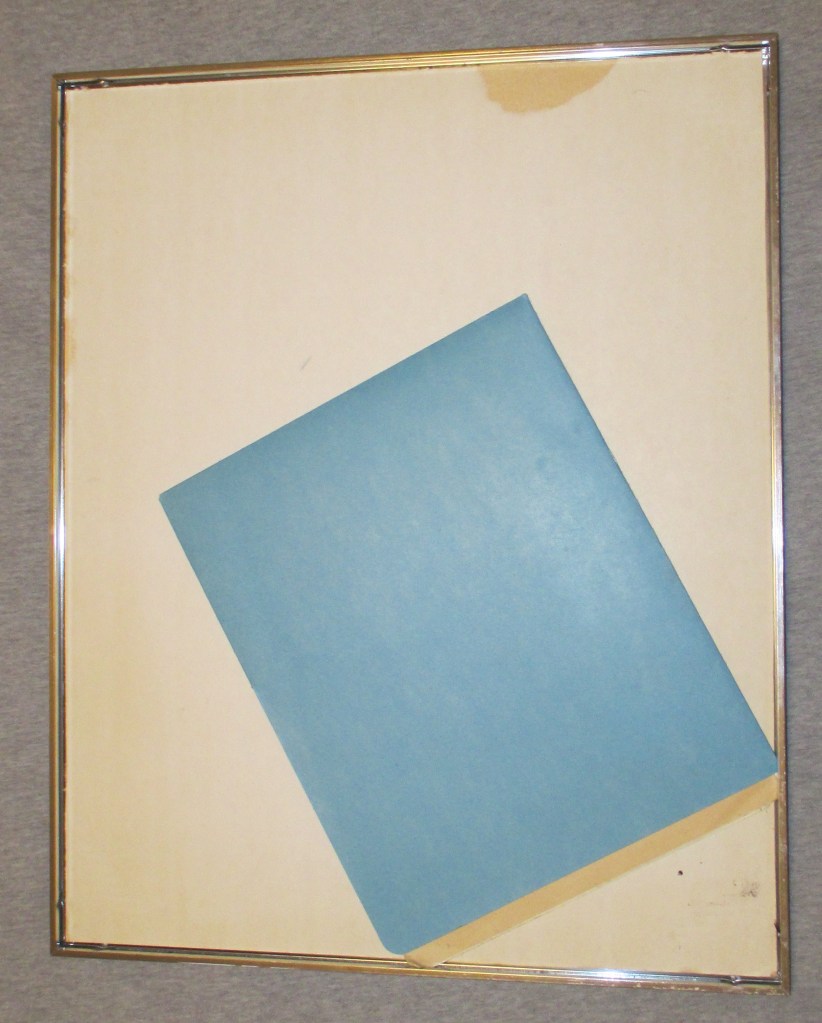
[…] if it’s still in a silver frame, there’s some comic artwork on the inside of the back there that I stuck in there for my sister. It was stuff we did as kids. I’m curious if it’s still there. […] Oh, we were incurable romantics as kids so the comic art in the back is something from a movie we liked as kids. Grayeagle. Terrible movie but we were very young.

C. L. Bevill, personal communication

That last note made me curious as well, so I popped open the frame:

Note: “Sure can tell where your artwork stopped & mine began. Love you, C”

On the back of the piece is a faint inscription:

To Cat,
with Love
your sister
Caren
Dec 25th 1987
—one year too late
Sorry
Dec 25th 1988
Still Love you
Cackie!

Close-up detail.

It is a lovely piece of fan-art, and I’m glad to finally have the story behind it—and the secret it has been hiding all these years.

“Werewoman” (1994)

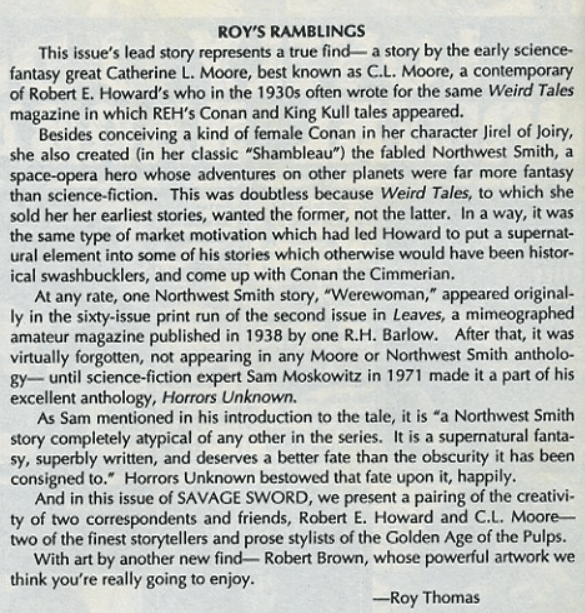
By a quirk of publishing, “Werewoman” (1938) by C. L. Moore was first published in a fan-magazine, and fell into the public domain. This fact was not immediately recognized for some decades, but the ever-enterprising fan/scholar/anthologist Sam Moskowitz took advantage of this lapse to to republish it (without Moore’s permission or compensation) in his anthology Horrors Unknown (1971). While this has widely been considered as somewhat uncouth, it was technically legal—and if Moskowitz could do it, so could anyone else.

So it was in 1994 “Werewoman” was adapted to graphic format for Savage Sword of Conan #121 (May 1994). Roy Thomas provided the script, Robert Brown, pencils; Rey Garcia, inks; and Susan Crespi, lettering. Originally a story of Northwest Smith and set on Mars, the revamped story was adapted to feature Robert E. Howard’s Conan the Cimmerian in place of Smith, and the setting changed to a rather generic fantasy corner of the Hyborian Age.

Roy Thomas was at this point a veteran hand at such adaptations. When he had started out writing Conan the Barbarian for Marvel, it had been adapting Howard’s original stories and filling in the gaps on his own; later the series would adapt works by other authors, either non-Howard Conan stories like Lin Carter and L. Sprague de Camp’s novel Conan of the Isles (1968), which became a graphic novel of the same name, or non-Conan fantasy stories such as Gardner F. Fox’s Kothar and the Conjurer’s Curse (1970), which became Conan the Barbarian #46-51.

So why do C. L. Moore?

1994 was well into the Dark Age of Comics, and Robert Brown’s artwork is strongly reminiscent of Rob Liefeld’s work on X-Force and Youngblood, but aggressively 90s as it is, and lacking the more somber depth of shadow or evocative linework that characterized many of the better stories in Savage Sword, it kind of works, especially with Rey Garcia’s inks adding some real depth and definition to the lines.

While it may seem odd to adapt a Northwest Smith story as a Conan tale—imagine replacing Harrison Ford with Jason Mamoa in Star Wars—the hazy, dreamlike atmosphere of the story lends itself well to a kind of fever-dream episode in the adventures of everyone’s favorite Cimmerian, while the inherent wildness of running with the pack is almost more suitable to Conan than to Smith. As a Conan story, it’s middling; as a C. L. Moore adaptation, it’s better than nothing—which is, by an large, what readers have lived with.

Readers interested in the full story can find it reprinted in Savage Sword of Conan Omnibus Vol. 21.

Aside from these two works, there is little else to say about C. L. Moore in the comics. A few early horror comics may be unofficial adaptations of or inspired by her works, though this is based on similarity of plot more than anything else. There is another notable graphic adaptation of C. L. Moore’s “Shambleau” that was published in France in 1955, but that is worthy of a longer and more in-depth look on its own.


Bobby Derie is the author of Weird Talers: Essays on Robert E. Howard and Others and Sex and the Cthulhu Mythos.

Deep Cuts in a Lovecraftian Vein uses Amazon Associate links. As an Amazon Associate I earn from qualifying purchases.

“Black God’s Kiss” (1934) by C. L. Moore

As to the work of C. L. Moore—I don’t agree with your low estimate. These tales have a peculiar quality of cosmic weirdness, hard to define but easy to recognise, which makrs them out as really unique. […] In these tales there is an indefinable atmosphere of vague outsidesness & cosmic dread which marks weird work of the best sort. How notably they contrast with the average pulp product—whose bizarre subject-matter is wholly neutralised by the brisk, almost cheerful manner of narration! Whether the Moore tales will keep their pristine quality or deterioriate as their author picks up the methods, formulae, & style of cheap magazine fiction, still remains to be seen.
—H. P. Lovecraft to William F. Anger, 28 Jan 1935, Letters to Robert Bloch & Others 227

C. L. Moore burst into the pages of Weird Tales in 1933 with “Shambleau”—a science fantasy that earned universal praise and introduced her character Northwest Smith. She followed that success with three more tales of Smith: “Black Thirst” (WT Apr 1934), “Scarlet Dream” (WT May 1934), and “Dust of the Gods” (WT Aug 1934). These stories were all self-contained, with a common setting and characters, but with no strong narrative continuity. These episodes all took place during Smith’s life as an interstellar outlaw, but there was no overarching plot between episodes, and few if any clues to put them in any order aside from order of publication.

Then in the October 1934 issue of Weird Tales, Moore introduced a new character—a fiery, red-headed warrior-woman in medieval France—Jirel of Joiry. In later years, recalling the character, Moore remembered:

Long, long ago I had thoughts of a belligerent dame who must have been her progenitor, and went so far as to begin a story which went something like this: “The noise of battle beating up around the walls of Arazon castle rang sweetly in the ears of Arazon’s warrior lady.” And I think it went no farther. So far as I know she stands ther eyet listening to the tumult of an eternal battle. Back to her Jirel of Joiry no doubt traces her ancestry.

Jirel’s Guillaume whom I so ruthlessly slew in the first of her stories, yet whom I can’t quite let die, was patterned after the drawing of Pav of Romne with which I illustrated her latest story, “The Dark Land” in Weird Tales. I made that drawing somewhere in the remote past, and have cherished it all these years in the confidence that someday it would come in handy. I meant to use it to illustrate “Black God’s Kiss,” first of the Jirel tales, but somehow the story got out of hand, and I’ve never since been able to introduce a situation it would fit until “The Dark Land.”
—C. L. Moore, “An Autobiographical Sketch of C. L. Moore,” Echoes of Valor 2, 37-38

Weird Tales v27 n01 [1936-01]_0054

Weird Tales Jan 1936

In later years, she would write of her two most famous redheads:

Shambleau and Jirel bear a close relationship to each other, and both, I believe, unconsciously reflect the woman I wish I could have been. I owe a great deal of my literary outpourings to Himself, My Unconscious.
—C. L. Moore, The Faces of Science Fiction

The basic plot, of a strange journey and a Faustian bargain, are familiar enough elements from a dozen weird fiction stories. Female protagonists, especially swordswomen, were rare. Robert E. Howard had included Bêlit in “Queen of the Black Coast” (WT May 1934), and long-time readers might recall R. T. M. Scott’s “Nimba, The Cave Girl” (WT Mar 1923), so it wasn’t as if Jirel was exactly the first to grace the pages of the Unique Magazine—but Moore brought her own unique style.

At least, H. P. Lovecraft thought so, and wasn’t shy to tell others about it:

Black God great stuff—real nightmare outsideness.
—H. P. Lovecraft to R. H. Barlow, 7 Oct 1934, O Fortunate Floridian 183

Oct. W.T. about average, on the whole. The Moore item is really very notable—full of a tensity & atmospheric suggestion of encroaching dream-worlds which none of the other authors seem able to achieve. I’ll try to look up the item in Astounding, even though it be les from the the hackneyed & conventional.
—H. P. Lovecraft to R. H. Barlow, 26 Oct 1934, O Fortunate Floridian 187

“The Black God’s Kiss”, despite overtones of conventional romance, is great stuff. The other-world descriptions & suggestions are stupendous.
—H. P. Lovecraft to Duane W. Rimel, 22 Dec 1934, Letters to F. Lee Baldwin et al. 248

Nor was Lovecraft alone in his praise, as the story received praise in “The Eyrie,” Weird Tales‘ letters pages, such as:

I (and I’m sure many others) want to hear a great deal more of Jirel. She’s the kind of person I’d like to be myself. A sort of feminine version of Conan the Cimmerian. He, too, is one of my favorites.
—Mary A. Conklin, Weird Tales Dec 1934

The creator of Cthulhu’s admiration for the tale can be easily understood; this is easily the most Lovecraftian of C. L. Moore’s early stories. Jirel’s descent into the tunnel recalls stories like Lovecraft’s “The Rats in the Walls” and “The Festival,” and her description is as pure an effort at non-Euclidean geometry as anything Lovecraft attempted:

There was something queer about the angles of those curves. She was no scholar in geometry or aught else, but she felt intuitively that the bend and slant of the way she went were somehow outside any other angles or bends she had ever known.
C. L. Moore, “Black God’s Kiss” in Weird Tales Oct 1934

The comparison of Jirel with Conan is one that would be made again, as Jirel and the Cimmerian’s adventures continued. They were contemporaries, and their creators thought a bit alike, as they would find out through correspondence, when Robert E. Howard let her read his own story about a flame-haired French swordswoman, Dark Agnes de Chastillon. Moore’s Jirel stories tend to lean more into the sorcery than the swordplay; while she has a sword and uses it in “Black God’s Kiss,” her quest is a very un-Conan-like one for a sorcerous weapon to aid her where force of arms has failed, and in many of her other stories she faces supernatural threats where her blade is useless.

If many of the readers liked “Black God’s Kiss,” at least one of them did not:

The Black God’s Kiss was by far the poorest C. L. Moore story yet. The first three of C. L. Moore’s tales were excellent, but the last two were rather pediculous.
—Fred Anger, Weird Tales Dec 1934

William F. Anger’s sour note in “The Eyrie” might be forgotten, except for one coincidence: he had become a correspondent of H. P. Lovecraft. Though Lovecraft had not yet started to correspond with C. L. Moore, as he later would, he felt obliged to defend the merits of Moore’s fiction, including “Black God’s Kiss”:

Regarding the Moore stories—one has to separate the undeniably hackneyed & mechanical romance from the often remarkable background against which it is arrayed. “The Black God’s Kiss” had a vastly clever setting—the pre-human tunnel beneath the castle, the upsetting of gravitational & dimensional balance, the strange, ultra-dimensional world of unknown laws & shapes & phenomena, &c. &c. If that could be taken out of the sentimental plot & made the scene of events of really cosmically bizarre motivation, it would be tremendously powerful. The distinctive thing about Miss Moore is her ability to devise conditions & sights & phenomena of utter strangeness & originality, & to describe them in a language conveying something of their outre, phantasmagoric, & dread-filled quality. That in itself is an accomplishment possessed by very few of the contributors to the cheap pulp magazines. For the most part, allegedly “Weird” writers phrase their stories in such a brisk, cheerful, matter-of-fact, colloquial, dialogue-ridden sort of style that all genuine ene of shadow & menace is lost. So far, Miss M. has escaped this pitfall; though continued writing for miserable rags like the current pulps will probably spoil her as it has spoiled Quinn, Hamilton, & all the rest. The editors will encourage her worst tendencies—the sticky romance & cheap “Action”—& discourage everything of real merit (the macabre language, the original descriptive touches, the indefinite atmosphere, the brooding tension, &c.) which her present work possesses. Nothing will ever teach the asses who peddle cheap magazines that a weird story should not & cannot be an “action” or “character” story. The only justification for a weird tale is that it be an authentic & convincing picture of a certain human mood; & this means that vague impressions & atmosphere must predominate. Events must not be crowded, & human characters must not assume too great importance. The real protagonists of fantasy fiction are not people but phenomena. The logical climax is not a revelation of what somebody does, but a glimpse of the existence of some condition contrary to nature as commonly accepted.
—H. P. Lovecraft to William F. Anger, 16 Feb 1935, LRBO 229

While Lovecraft never wrote these exact words to C. L. Moore, when they did get to corresponding she had her own response:

Also, since I’m disagreeing with everything today, I’ll have a shot at your dislike for romance contrasted with your love and understanding of fantasy. You don’t ahve to take Dumas any more literally than you do Dunsany. Of course lots of people probably do look persistently through rose-colored glasses, but then dear, sincere old Lumley believes implicitly in his phantasms. To me it’s just as pleasant to imagine during the duration of the story that there is a loely springtime world people exclusively by handsome heroes and exquisite heroines and life is one long romp of adventure with no unpleasant attribtues at all, as it is to believe for the length of the story that time, space and natural law can be elastic enough to permit the existence of a Shambleau or a Cthulhu (have I spelled him right?). Your point, of course, is that to be acceptable as release-literature the hapenings must be incredibly outside, not aganst the phenomena of nature. Does that mean that you can’t with self-respect, enjoy Howard’s gorgeous Conan sagas, which are surely pure romance for the most part?
—C. L. Moore to H. P. Lovecraft, 11 Dec 1935, Letters to C. L. Moore and Others 88-89

A large part of the charm in the early Moore stories, be they tales of Northwest Smith or Jirel of Joiry or science fiction tales like “The Bright Illusion” (Astounding Stories Oct 1934) is the imaginative and lush descriptions, often trying to capture in words some utterly alien emotion or experience above and beyond what anyone might imagine a young woman working as a secretary in an Indianapolis bank during the Great Depression might ever dream of. Yet she did dream them, and her early fantasies made a mark.

There are two interesting sequels to “Black God’s Kiss.” The first is quite literally a direct sequel: “Black God’s Shadow” was published only a couple months later in the December 1934 issue of Weird Tales. This would be the first direct sequel she had ever written, a step away from the disconnected adventures of Northwest Smith—and while she never developed the setting of Joiry with as much depth as Robert E. Howard did the Hyborian Age for Conan, it was still a step in the direction of the fantasy worlds that would follow in coming decades.

The second sequel is more complicated. In early 1934, Lovecraft’s young friend R. H. Barlow began to correspond with C. L. Moore. Barlow learned that Moore was in talks with William Crawford to try and publish some of her stories. Barlow was an amateur printer and bookbinder, and wanted to publish a small edition of her stories. The correspondence between C. L. Moore and Lovecraft actually began when Barlow enlisted Lovecraft’s aid to try and convince here to give Barlow the good stories:

I shall be glad to cooperate in any way possible, & will endeavour at the earliest opportunity to write the authoress such a letter as you suggest—pointing out sound as distinguished from commercial lines of development, yet avoiding any air of supercilious fault finding or lack of appreciativeness. There is no question but that her work possesses a strain of authentic cosmic alienage & extreme originality found in no other weirdist since Klarkash-Ton—a pervasive atmospheric tension, & a curious facility in evoking images of utter trangeness & suggesting monstrous gateways from the tri-dimensional world to other spheres of entity.
—H. P. Lovecraft to R. H. Barlow, 16 Mar 1935, O Fortunate Floridian 217

There was some finagling, but eventually Barlow and Lovecraft convinced Moore to allow Barlow to publish a small edition containing “Shambleau,” “Black Thirst,” and “Black God’s Kiss”—Lovecraft considered her best stories at the time. As it happened, neither Barlow or Crawford’s volumes ever came to press, although Barlow did print and bind some other works of Moore’s, notably a few copies of “Were-Woman.”

Without “Black God’s Kiss” and Jirel of Joiry, H. P. Lovecaft and C. L. Moore may never have begun to correspond—which would have changed the trajectory of both their lives.


Bobby Derie is the author of Weird Talers: Essays on Robert E. Howard and Others and Sex and the Cthulhu Mythos.

Deep Cuts in a Lovecraftian Vein uses Amazon Associate links. As an Amazon Associate I earn from qualifying purchases.