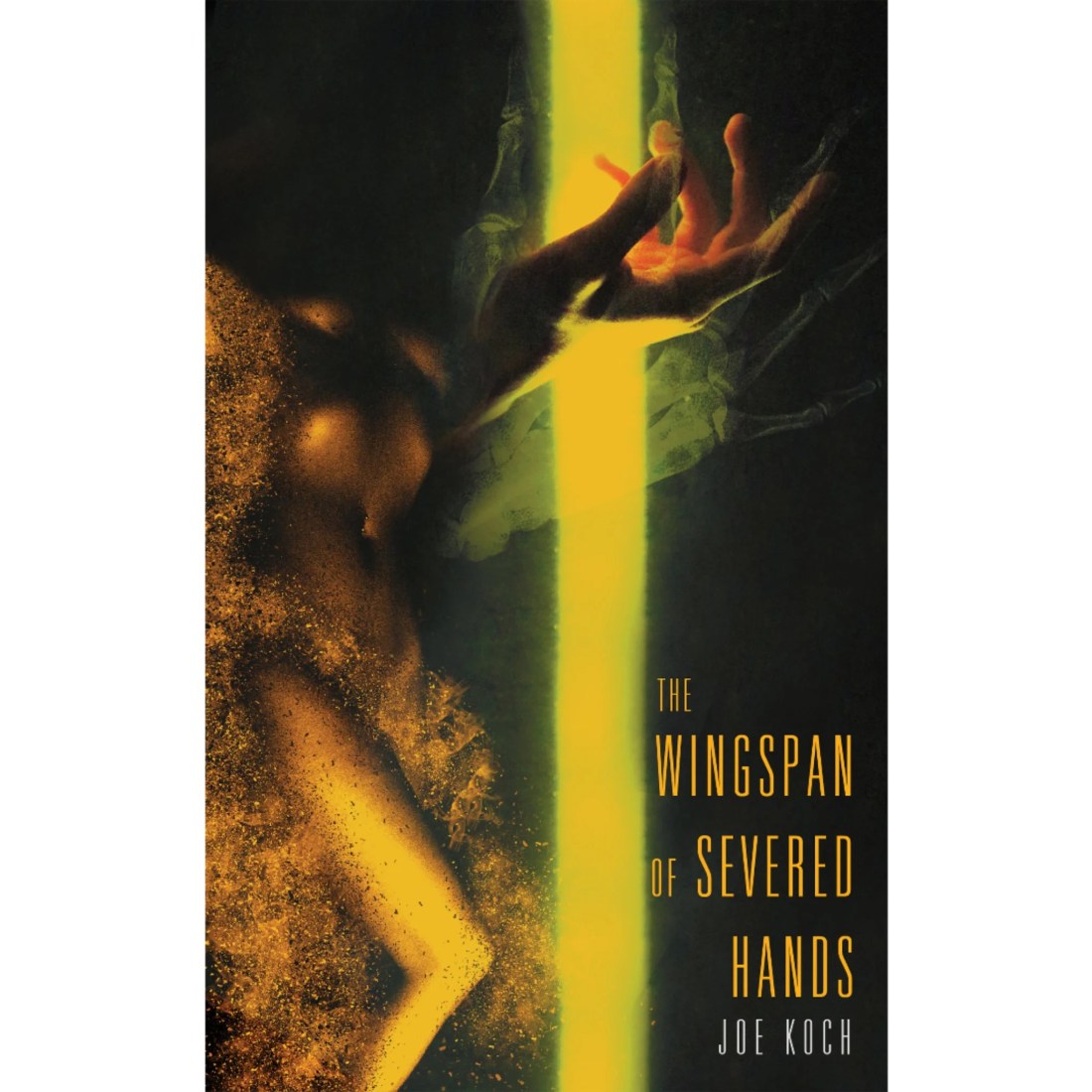
The Wingspan of Severed Hands (2020) by Joe Koch

My lost heart bled beneath the sands
Of distant, dead Carcosa.
My heart, once buried, fed the land
That grew the oak Carcosa.

The oak was felled and burned to light
Those dim shores of Carcosa.
Love’s but a candle. Soon I’ll die
To wander lost Carcosa.

My love’s a dream, and dreams must die
To resurrect Carcosa.
My dream is dead. My queen’s alive.
She conquers bright Carcosa.
—Joe Koch, The Wingspan of Severed Hands 79

A dry description of The Wingspan of Severed Hands might be something like: “a short novel that reimagines Robert W. Chambers’ mythology of The King in Yellow with distinct feminist themes, a nonlinear narrative, and surreal imagery.” Which would not do justice to the language or the story. This is a story with texture and attitude, occupying a grey area between cosmic horror, body horror, magical realism, surrealism, and splatterpunk. Like a gelatinous eyeball, it’s not easy to nail down; and it resists easy labeling.

Much of the effectiveness of the story lies in its deliberately ambiguous, unsettled nature. The narrative shifts from familiar scenes and scenarios to nightmarish episodes, the transition often seamless and in a condition of otherwise banal reality, so that the readers are left wondering how much is really happening and how much is undiagnosed psychotic episode or hallucination. There is a loving richness to the description of mutilation, decay, graphic violence, bodily corruption, and growth that is a stylistic hallmark of Koch’s work, an evident love and appreciation for the language and imagery of transformation.

Trying to capture in words that fascinating process of transition. From girl to woman, life to death, caterpillar to butterfly, steak to ground beef, health cell to cancerous, girlfriend to ex. Wrapped up in and around a reinterpretation of the Yellow Mythos.

There are, broadly speaking, two horizons of the Yellow Mythos. The first horizon derives directly from Robert W. Chambers’ The King in Yellow (1895) and the mythology of the same. Folks might expand on it, re-intrepret it, but it is distinctly tied to the original snippets of the play. Works of this sort include “Cordelia’s Song from The King in Yellow” (1938) by Vincent Starrett & “Evening Reflections, Carcosa” (2011) by Ann K. Schwader, “Slick Black Bones and Soft Black Stars” (2012) by Gemma Files, and Black Stars Above (2019) by Lonnie Nadler & Jenna Cha. They’re not all consistent, the authors aren’t all in communion with each other, but they’re all drawing more or less directly on Chambers.

The post-Classical horizon of Yellow Mythos stories comes to the Yellow Mythos more indirectly, usually through popular culture like the Call of Cthulhu Roleplaying Game, which popularized images like the three-limbed figure of the Yellow Sign designed by Kevin Ross in 1989, or the American Gothic sensibilities of the first season of True Detective created by Nic Pizzolatto. Post-Classical is less beholden to Chambers, more directly influenced by the imagery and ideas of what the Yellow Mythos is in the popular consciousness—which can be both very freeing and very constraining, depending on whether the creator hews close to what someone else has done or pushes outward to define their own space. A good example of this might be the Alagadda series of the SCP-wiki, which draws inspiration from the first horizon stories but is more adjacent to it than directly connected.

The Wingspan of Severed Hands is in the second horizon. It’s a post-Kevin Ross piece, the three-legged image of the Yellow Sign derived from the roleplaying game; the Queen in Yellow is similar to the Hanged King in the Alagadda series, a new riff on a familiar concept. Yet the actual references to Chambers are few; Koch draws more strongly off the mass of post-Chambers ideas than Chambers himself. There’s no play, no Cordelia, and the madness inspired by the Yellow Sign is an outbreak more in line with an RPG in mid-apocalypse.

The Yellow Mythos in this story is a kind of lifeline to the reader. Something familiar that they can keep a hold of during a narrative that changes perspective as it winds its way through time and space. Yet at the same time, it’s not Chambers’ mythos. There are surprises in store, odd pieces that might not jive with what a reader familiar with Yellow Mythos stories thinks is going on.

It is, all in all, much more personal.

Three women. One battle.

A world gone mad. Cities abandoned. Dreams invade waking minds. An invisible threat lures those who oppose its otherworldly violence to become acolytes of a nameless cult. As a teenage girl struggles for autonomy, a female weapons director in a secret research facility develops a living neuro-cognitive device that explodes into self-awareness. Discovering their hidden emotional bonds, all three unveil a common enemy through dissonant realities that intertwine in a cosmic battle across hallucinatory dreamscapes.

Time is the winning predator, and every moment spirals deeper into the heart of the beast.
—Joe Koch, The Wingspan of Severed Hands back cover copy

This is a story focused on women. There aren’t many male characters, and while the actions of the men and boys are not peripheral to the story, we don’t get their viewpoint and their actions are critical largely with regard to how they treat the women who are the viewpoint characters. We don’t see husbands, fathers, brothers, or sons; there’s an implicit matriarchial arrangement to the story. Mothers, daughters, and grandmothers are the main relationships, and that’s the emotional heart of the book. The suffering that goes into these toxic relationships, invisible to so many, that finds manifestation in so many little ways.

Yet at the same time, the relationships in the book represent a closed circle. The viewpoint characters don’t really have any women friends to turn to, no support network. They are isolated, locked in—in a trailer, in a bunker, in a cage, in a decaying body, in a cycle of expectations and recriminations, haunted by a past that they cannot escape until the climax.

The end of The Wingspan of Severed Hands is the beginning of a new life. An opportunity for at least some of the viewpoint characters to move on, out of the shadow of motherly expectations, grief, and trauma. The reward for all the gooey, gory, traumatic, painful growth and transformation in the story is…the potential for more growth. Maybe even to be happy, although the ending is not itself exactly happy.

One of the themes suggested, but not fully explored, in The Wingspan of Severed Hands is the nature of The King in Yellow itself. So many writers have focused on what Chambers did, what he wrote, the things he hinted at. Yet if one day, if you opened up a book marked with the Yellow Sign on its spine, and found it blank—how would you fill the pages? What would you write? What would The King in Yellow be in your own words?

The Wingspan of Severed Hands (2020) by Joe Koch was published by Weird Punk Books.


Bobby Derie is the author of  Weird Talers: Essays on Robert E. Howard and Others  and  Sex and the Cthulhu Mythos .

Deep Cuts in a Lovecraftian Vein uses Amazon Associate links. As an Amazon Associate I earn from qualifying purchases.

Must I Wear This Corpse For You?: H. P. Lovecraft’s “The Thing on the Doorstep” (1937) by Joe Koch

Let’s start at the end of the story, when the woman is already dead. Not just dead, but self-disinterred, reduced to a mass of “liquescent horror,” a few bones, and a crushed skull. Dental records will identify the skull as belonging to Asenath Waite, the small, dark, witchy woman who seduced and manipulated the narrator’s best friend Edward. She’s one of Lovecraft’s few prominent female characters, and a very striking figure both visually and emotionally according to the other people in the story. Although “The Thing on the Doorstep” owes some conceptual devices to “The Fall of the House of Usher,” Asenath Waite seems very unlike Madeline Usher and more a literary descendant of Poe’s Ligeia, with all the romance removed. There’s nothing beautiful about the woman’s demise in Lovecraft, no ecstatic mourning of the beloved dead; only, as in real life, a malodorous heap of unrecognizable remains.

But wait a minute. There’s some sleight of hand at work here. We’re talking about Asenath Waite the way she’s presented early in the story, when in fact Asenath is not really in the story at all. Asenath’s father Ephraim has hijacked her body by magic, locked her mind or soul away in his own aging body, and killed it. All of this happened before the story began. Now Ephraim, from within Asenath’s body, is trying to affect the same scenario with the narrator’s best friend Edward. In fact, Edward and Ephraim (posing as Asenath) are married.

We’re introduced to Asenath as “she” and the pronouns and gendering stick even when, less than halfway through the story, the spirit or mind inhabiting Asenath is recognized as Ephraim by his underground coven. A few paragraphs later, as Edward continues to rant after waking from this involuntary mind exchange with Asenath/Ephraim that has taken his body into the coven’s ceremonial pit of shoggoths, he lays out his suspicions plainly through questions such as “Asenath…is there such a person?” and “Was it old Ephraim’s soul that was locked in? Who locked in whom?

I’m struck in re-reading this story how difficult it is to see Asenath as Ephraim when I’m in the thick of the narrative, despite the pointed physical descriptions comparing his/her expression to a wolf, despite clocking frequent, overt parallels between Ephraim and Asenath’s behaviors, and despite the fact that I already know how it’s going to end.

Nothing in the story is kept secret for long, and yet Asenath’s absence eludes me. It’s a testimony to how minds trained to see the world according to binary heteronormative preconceptions cling to this conditioning in knee-jerk fashion. We see what we’ve been taught looks like a woman or a man, and we mentally make a label based on that snap judgment.

Asenath—or the Asenath suit that’s being worn by her father—is referred to as a woman and given predominantly female pronouns throughout the story, even in Edward’s final epistolary confession. Occasionally, Asenath/Ephraim is referred to as “it.” Twice we encounter the construction “he, she…it” as Edward grapples with the knowledge that his wife is not his wife. We see Asenath—who is really Ephraim—only through the narrator Dan’s binary perception and through Edward’s misgendering and denial-ridden reports. The repeated use of incorrect female pronouns applied to the entity that is Ephraim performs a narrative magic trick, making the woman disappear.

Misogyny in early twentieth-century American writing is no surprise, nor is it an unexpected element in Lovecraft. Men are almost exclusively the protagonists of his stories, and women most often appear as names in genealogies or barely mentioned relations with little or no character development or agency. Even in our example, Lovecraft hasn’t given the real Asenath Waite a voice or an active role in determining the fate of her soul, or the uses to which her body is put during her short life and after her death; but I think this story presents an interesting, if unintentional, counter-example of misogyny, despite the “woman in the refrigerator” outcome. Perhaps even because of it. As someone historically mistaken for a woman, it highlights for me some of what’s driving our current cultural arguments about transgender bodies.

Asenath Waite, as shown on the page early on, is a vivid and compelling character. I’d hang out with her. She has the Bohemian, decadent crowd at Miskatonic eating out of her hand. She knows all sorts of dark secrets, winks shamelessly, and leads the occult gatherings rather than being a follower. The narrator Dan finds her repugnant for the same reasons I like her as a modern reader, because she violates Dan’s (and perhaps Lovecraft’s) idea of rigid gender norms. Exhibiting stereotypically male assertiveness, her duality is meant to be uncanny or monstrous, although, writing in 1933, after the sexual freedom of the jazz age, after the women’s suffrage movement had begun, after the founding of Planned Parenthood, Lovecraft was not without positive models of nonconforming women, including his ex-wife. The story requires Asenath be attractive and dynamic enough to seduce Edward and control him for years, as she—or rather he—does.

He, she…it: the binary breaks down as Edward tries to describe how Asenath puts her mind in his body. Except it’s Ephraim in Asenath’s body who is acting upon Edward, acting from within a disguise. The further Edward’s speech moves away from the strict binary and blurs the distinct line between male versus female, the less Dan believes him. Edward denies his own direct experience of reality, too, despite an abundance of evidence. He stays in the torturous relationship for years enduring Ephraim’s mental penetration like a victim of supernatural domestic violence. (Another interpretation is that Edward is gay, and the unique situation facilitates his denial while allowing him a gay marriage. Exploring the implication of a gay love triangle between Dan, Edward, and Ephraim is, however, outside the scope of this essay.) Either way, unable to admit Asenath is really Ephraim, adherence to the heteronormative binary blinds Edward to the facts, hides the villain, and erases Asenath’s true fate as a murder victim.

The pronoun trick works on the reader, using our gender expectations to heighten the story’s impact. It’s interesting that in the real world of contemporary America, some people want to perform—and demand performance of—a similar trick. We see commentators and politicians very upset by nonbinary pronouns, fearful of transgender people who do not fit clearly into rigid biological ideas of male and female. As if we are some sort of uncanny monsters, they seek to control thought and behavior by eliminating words that describe our direct lived experience as nonbinary, gender-questioning, or otherwise gender-fluid people.  Why are they so afraid of our words? Our bodies? In life as in the story, let’s ask who this denial of a rich, flexible, and varied language might serve.

In the story, it’s Ephraim. In contemporary America, it’s the people behind numerous bills like North Dakota’s proposed SB2199 that would mandate employers who receive state funding (as well as schools, institutions, and state agencies) to use only male or female pronouns based on DNA testing. The bill states words must fit “the individual’s determined sex at birth, male or female.” Using anything other than state-assigned pronouns, such as using they/them, would incur a fine of $1,500.

This isn’t unique to North Dakota. Rampant across the United States, new laws about the words we can use and how we can use them are clogging up court dockets. Other laws ban books that merely mention anything other than heteronormative gender from libraries and schools. And let’s not even try to figure out what bathroom we’re allowed to use or what team we can play on if we’re nonbinary. In conjunction with laws regulating—and as an outcome of forced detransition, eliminating—transgender bodies, these proposals are medically irresponsible and shockingly repressive. I grew up during the Cold War, when the Soviet “thought police” were supposed to be the bad guys. Rather than dwell on the mystery of what motivates this seemingly anti-American terror of inclusive language and bodily autonomy, let’s return to Ephraim in “The Thing on the Doorstep,” an obsessively gendered story about who controls bodies, how they do it, and what is the goal of such sorcery.

Edward loses control of his body with greater frequency as Ephraim practices inhabiting it. Ephraim believes he needs a white male body and brain to further his magic practice and achieve full power. Eventually, Edward succumbs completely, losing his body to a man masquerading as his wife. His final missive, written with the shaky hand of Asenath’s decaying corpse, calls for Dan to “kill that thing–kill it.”

Shall we call Ephraim a rapist? He fits the horror movie trope of a dangerous man in a dress we’ve been trained to fear and feel disgust for in films like Psycho (1960), Dressed To Kill (1980), and Silence of the Lambs (1991). He doesn’t obtain consent from Edward, who (finally!) fights back, killing the body of Asenath to eliminate Ephraim. But the specter of the murderer or rapist who masquerades as a woman can’t be killed in the story any easier than we can expurgate it from popular imagination. Even though transgender women are more likely to be sexually assaulted or murdered than any other LGBTQ+ group, we’re told by contemporary news media that they are evil men donning a deliberate disguise to sneak into women’s spaces and attack. They’ve created an imaginary bathroom monster, a lurker in the stall, by inverting facts and employing the divisive binary thinking habit that pits women against men and vice versa. Many well-meaning people unwittingly further this narrative.

Ubiquitous divisive humor and dialogues reinforce common heteronormative binary thinking. Jokes about genital size or sexual prowess; dialogues about coping with threats or neediness couched as specific to one gender; reproductive rights conversations excluding every non-woman with a uterus. The same thinking that judges manhood by sexual performance or womanhood by fertility and chest measurements is the soft fascism that says a man can’t have a uterus and a woman can’t have a penis. It’s tied in with eugenicist ideas about race, ethnicity, ability, weight, and so forth that pretend there is one ideal and correct type of body, rather than an infinite number of (beautiful) variations. It’s how Ephraim thinks.

Ephraim is a man stuck inside a woman’s body, but he’s not transgender. Rather, he’s representative of the misconception that bodies must conform to a rigid set of physical standards to be permitted to speak their own language or be seen (alive) in society. The language that traps Edward (and the reader) in complicity with Ephraim solidifies his disguise as Asenath. Wearing a mask is the opposite of being transgender, in which we live authentically, and throw off a wrongly imposed disguise. We experience ourselves as more variable, nuanced, unstructured, or nonbinary than common cultural stereotypes presume possible. I highly recommend it, and hope the government never forces my detransition. Edward and Asenath’s fates show us the result of people coerced into a wrong disguise.

As the patriarch of the Waite family, Ephraim uses vulnerable, female, and non-white bodies to perpetuate his power and avoid death. Edward is described as child-like, dependent, and physically weak, and through scattered bits of history, we get a picture of Asenath that Lovecraft has coded as biracial: half-white, half-Innsmouth hybrid sea creature. She’s held in captivity for her whole life, bred for the purpose of housing his consciousness. The real Asenath screams from behind the door of her locked “padded attic room,” trapped in the wrong body until her death.

Strip away the false veneer of gendered, stolen, and exploited flesh, and we’re really not reading a story about a man stuck in a woman’s body, or a man masquerading as a woman, but about power masquerading opportunistically behind multiple facades; power hiding its true face for the sake of perpetuating systemic control. Ephraim is patriarchy itself, spanning generations and holding power by controlling the bodies of others.

We’re back where we started, at the end of the story with Asenath, a woman reduced to nothing, a thing disintegrating on the doorstep. Her physical, psychic, and textual obliteration indicts Ephraim—and therefore the patriarchy—much more damningly than if she had spoken or survived. We’re meant to remember her. Her name is the last word of the story. It lingers along with the image of her corpse, dead for three months and thrust upon Edward, who is not a man masquerading as a woman, but a man forced to wear a quick-rotting corpse that will kill his soul in disguise.

“The Thing on the Doorstep” can be read for free online at hplovecraft.com.


Joe Koch writes literary horror and surrealist trash. Shirley Jackson Award finalist and author of The Wingspan of Severed Hands, The Couvade, and Convulsive, their short fiction appears in publications such as Vastarien, Southwest Review, PseudoPod, Children of the New Flesh, and The Queer Book of Saints. Joe co-edited the art horror anthology Stories of the Eye and has collaborated with several other authors and poets on short writing projects. He/They. Find Joe online at horrorsong.blog and on Twitter @horrorsong.

Copyright 2023 Joe Koch