Her Letters to August Derleth: Lilith Lorraine

Lilith Lorraine was the pseudonym of Mary Maude Dunn Wright (1894-1967), a prolific poet, pulp fiction writer, editor, publisher, and early science fiction fan. It isn’t clear when exactly Lorraine and Derleth became aware of each other, though they shared interests in common, particularly fantastic poetry. If Derleth did not see any of her stories that were published in the 1930s, he would have heard of Lilith Lorraine at least in late 1943, when Clark Ashton Smith mentioned her to him in a letter (EID 341). Derleth would also probably have noticed her poems “The Acolytes” (1946) and “The Cup-Bearer” (1951), but they do not appear to have had direct contact with one another, since as late as 1950 Clark Ashton Smith was still offering to act as a go-between (EID 417). For her own part, based on Smith’s letters Lorraine was clearly aware of Derleth as the editor and co-founder of Arkham House.

The file of correspondence at the Derleth Archive of the Wisconsin Historical Society is a bit thin: 11 pieces of correspondence, mostly notes and postcards, most undated, in Box 32, Folder 9. There may well have been other bits of correspondence over the years that was lost or misfiled, but based on the contents this correspondence seems to have covered roughly 1959-1963, which coincides with the latter years of publication of Lorraine’s poetry magazine Flame (1954-1963), which later merged with another ‘zine to become Cycle*Flame. At the same time, Derleth was trying to promote his own poetry ‘zine Hawk & Whippoorwill (1960-1963) and publish the anthology Fire and Sleet and Candlelight (1961, Arkham House), and the crux of the correspondence seems to cover their mutual selling of poems to each other and promoting their respective magazines.
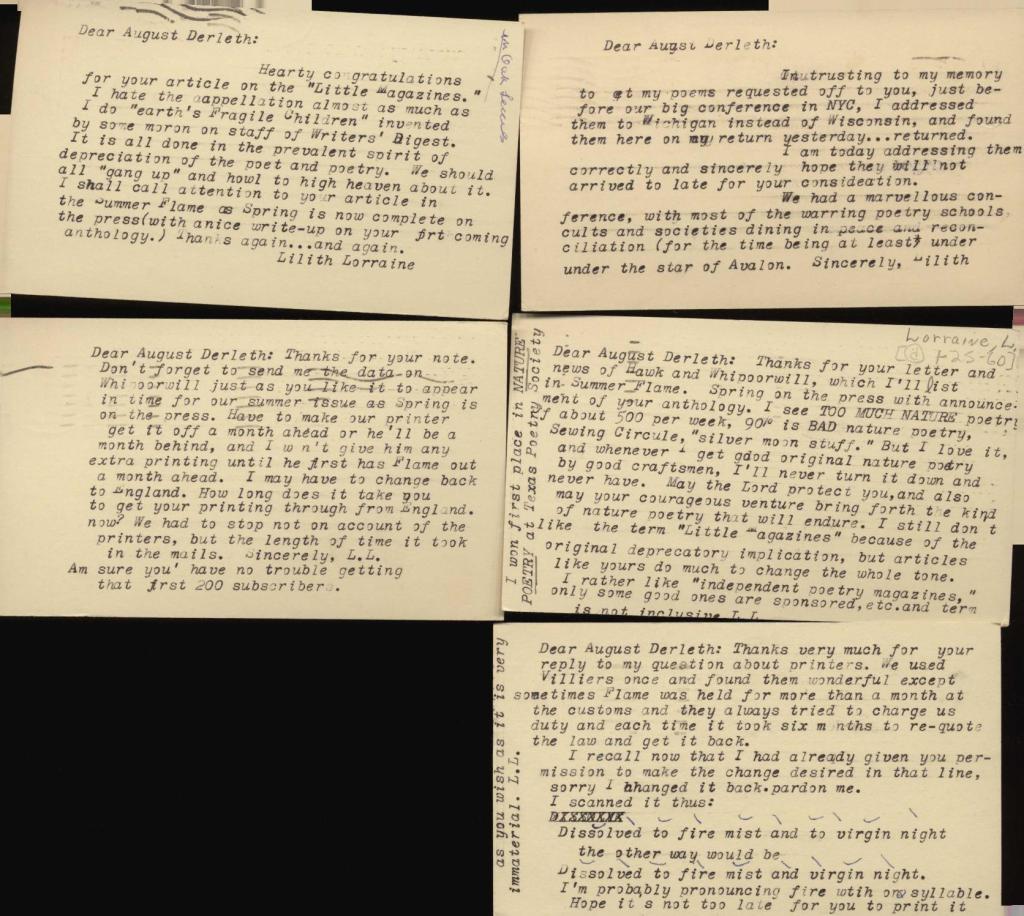
Sample of Lilith Lorraine’s postcards to August Derleth.

The “article on the ‘little magazines'” that Lilith Lorraine mentions might be “Hawk & Whippoorwill: Poems of Man and Nature,” a form letter that was sent out to advertise Derleth’s new poetry magazine; curious readers can find it reproduced as Item 65 in Arkham House Ephemera.

It is not clear how many poems Derleth actually placed in Flame, as there is neither a complete index to the magazine nor a complete index to Derleth’s poetry. Three poems were definitely published: “Moon and Fog” (Summer 1959), “Fox by Night” (Spring 1960), and “Satelite” (Winter 1961). The letters and notes suggest the acceptance of “Lantern in the Winter Woods,” but if that was published in Flame, I have not yet located the issue.

For his part, Derleth solicited and accepted five of Lorraine’s poems for his poetry anthology Fire and Sleet and Candlelight, including “Case History,” with the correction she noted:


CASE HISTORY
by Lilith Lorraine

When all his seas with serpents were aflame
And he was God trapped in his universe,
A dark and shadowed loneliness, whose name
Wavered like plumes above a phantom hearse,

The hearse moved on and six phantasmal steeds,
Pawed the gray emptiness of outer space.
And scattered all his comets and his creeds,
With muted thunder and malignant grace.

His mind constricted to the planet’s core,
Dissolved to fire mist and virgin night,
Until upon a sea without a shore,
He stood ungarmented, a naked light,
Alone once more upon the terrible coasts,
And desperately tired of gods and ghosts.

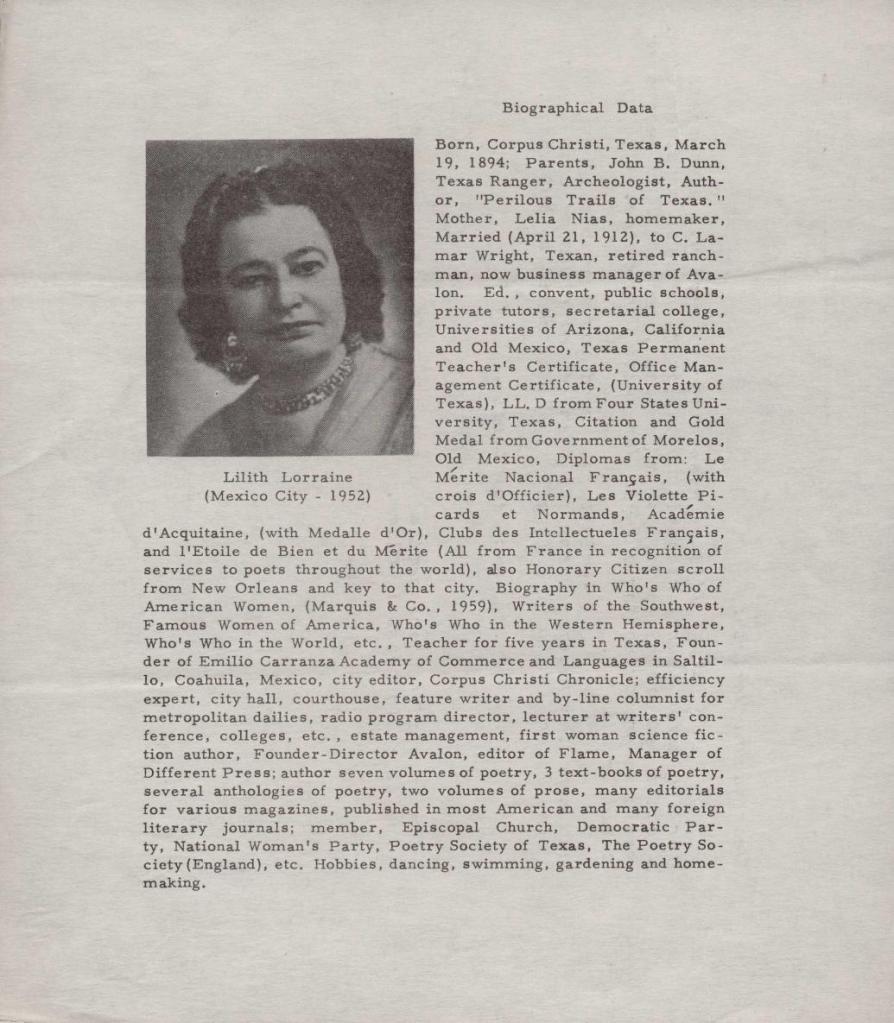
There is a printed biographical flyer in the folder of correspondence, and Lorraine may have sent this to Derleth in response to a request for biographical data for the back pages of Fire and Sleet and Candlelight, which includes the entry:

LILITH LORRAINE was born in Texas and still lives there, where she edits Flame and manages the Different Press. She has written extensively in the field of science-fiction, and is an active proponent of the best in poetry, at the same time serving as an exponent of the traditional in verse as opposed to obscurantist and incoherent experimentation. She is founder-director of Avalon. She is the author of several books, among them Wine of Wonder, Not for Oblivion, The Lost Word, and Character Against Chaos, and has for several years edited the annual Avalon anthology She has been distinguished for her activity all her life in behalf of poetry.
—August Derleth, Fire and Sleet and Candlelight 232
For the most part these brief letters and notes are cordial, but largely impersonal. Friendly, but not revealing great details of each other’s lives. These missives were written with a specific purpose, the horse-trading of poetry editors who are also poets themselves, and they seemed to get along well with one another.

Why did the correspondence cease? Perhaps time and energy in their personal and professional lives just led to a drop-off, since Derleth was no longer publishing a poetry journal or anthology, and Flame had gone on to its new incarnation. We are left with only a brief glimpse into the lives of two poets and editors, who ironically wrote little to each other of art or aesthetics, but who apparently appreciated one another’s work. After all, they each published the other.

Thanks to David E. Schultz for his help with this one.


Bobby Derie is the author of Weird Talers: Essays on Robert E. Howard and Others and Sex and the Cthulhu Mythos.

Deep Cuts in a Lovecraftian Vein uses Amazon Associate links. As an Amazon Associate I earn from qualifying purchases.

“The Cup-Bearer” (1951) by Lilith Lorraine

Lilith Lorraine, to whom I sent a copy of Out of Space and Time, writes that she will review the book in the January issue of her quarterly, The Raven. She is a kindred spirit, and highly appreciative, and I doubt if I’m likely to find a more favorable reviewer. Her poetry is splendid from what I have read of it.
—Clark Ashton Smith to August Derleth, 21 Nov 1943, Eccentric, Impractical Devils 341

Lilith Lorraine (Mary W. Wright) was a pulp fiction writer and poet contemporary with H. P. Lovecraft, Robert E. Howard, August Derleth, Clark Ashton Smith and the rest of the Weird Tales circle, but her handful of professional sales were in science fiction magazines such as Wonder Stories, and she didn’t begin to correspond with folks like Clark Ashton Smith and August Derleth until the 1950s, but she was active in science fiction fandom in the 1940s and 50s, supply poems for fanzines, books, magazines, etc. such as “The Acolytes” (1946). She also published her own poetry journals and issued collections of her work as well.

In Fall 1951, the fanzine Asmodeus published its second number, a special issue devoted to Clark Ashton Smith. Among the articles and poems was Lilith Lorraine’s poetic tribute to the Bard of Auburn:

The Cup-Bearer
(To Clark Ashton Smith)

The light of other worlds is in his eyes,
His voice is like a sunken temple chime,
And many a moon that sings before it dies
Has heard him in the catacombs of time

Such souls come only when the cycles close,
When the dark wine of ages mellowed long,
blends terribly the tiger and the rose,
Seraph and satyr, savagery and song.

Such souls come only when the dreamer wakes
Alone beneath a decomposing sky,
Before the dream dissolves in crystal flakes
To hold new lamps for gods to travel by.

And just before the old dream turns to dust,
He holds again the dark, delirious grail,
The lethean wine of loveliness and lust,
Of tenderness and terror; should he fail

The dream would vanish and the wavering world
Shorn of its wonder, shaken to the core
Back to the “Never-has-been” would be hurled. . . .
Sing with him softly, lest you sing no more.

As poetic tributes go, there is no doubt that Lilith Lorraine knew her subject well. “The Cup-Bearer” touches on many of the themes that are a hallmark of Smith’s poetry and fiction: satyrs (Nyctalops”), seraphs (“The Ghoul and the Seraph”), wine (“The Tears of Lilith”), dreams (“The Hashish-Eater”), memory (“Lethe”), necromancy and necrophilia (“Necromancy”), and strange distant stars (“Lament of the Stars”). It is a fitting tribute, because it is of a piece with Smith’s work, and complements it.

Lilith Lorraine must have liked “The Cup-Bearer” well enough, for she included it in Wine of Wonder (1952), her thin collection of poetry on themes of poetry and science fiction. She wasn’t the only one. Various editors provided lengthy endorsements on the inside cover flap, and on the back:

The summer lightning of fantasy, the storm-piercing levin of imagination, illume these superbly wrought poems. Lilith Lorraine remembers the ancient wonder and magic, but walks intrepidly the ways that modern science has opened into the manifold infinites.

From the mystic lyric beauty of Termopolis and Only the Black Swan Knows, she turns to such clarion-like annunciations of things to be as Master Mechanic and The Matriarchs. Notable, too, for its plangent irony, is Post-Atomic Plea for Euthanasia. A searching and claivoyant sensitivity is shown in the poems on paintings by Dalí and George Gross. Not too often has one art been interpreted so revealingly in terms of another as in these magnificent verse.

WINE OF WONDER can be recommended unreservedly both to poetry lovers and deotees of scientific fiction. Seldom if ever have the Muses of lyricism and science united their two fold afflatus to a result so distinguished.
—CLARK ASHTON SMITH, Author of [Out of] Space and Time, widely known poet and science fiction author.

Lilith Lorraine is fascinating as an author who outside the normal circle of H. P. Lovecraft, Clark Ashton Smith and co., only to at occasional interval swoop in within their orbits, bright as a comet…and then out again, forgotten until once more she comes around. Yet hers was a fascinating career, and she deserves to be remembered.

Lorraine bio

Biographical page, date unknown, from the August Derleth collection at the Wisconsin Historical Society


Bobby Derie is the author of Weird Talers: Essays on Robert E. Howard and Others and Sex and the Cthulhu Mythos.

Deep Cuts in a Lovecraftian Vein uses Amazon Associate links. As an Amazon Associate I earn from qualifying purchases.

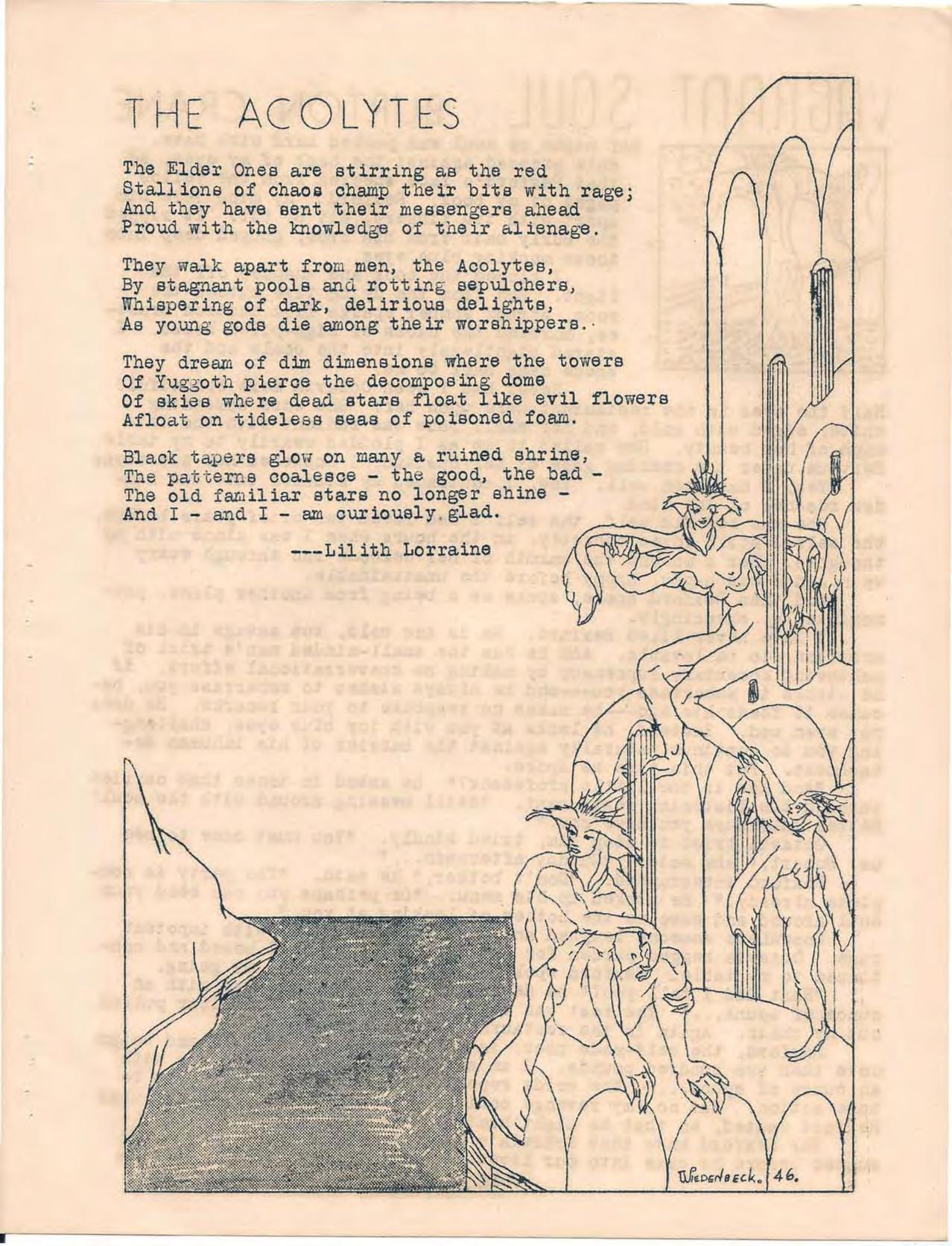
“The Acolytes” (1946) by Lilith Lorraine

The Elder Ones are stirring as the red
Stallions of chaos champ their bits with rage;
And they have sent their messengers ahead
Proud with the knowledge of their alienage.

They walk apart from men, the Acolytes,
By stagnant pools and rotting sepulchers,
Whispering of dark, delirious delights,
As young gods die among their worshippers.

They dream of dim dimensions where the towers
Of Yuggoth pierce the decomposing dome
Of skies where dead stars float like evil flowers
Afloat on tideless seas of poisoned foam.

Black tapers glow on many a ruined shrine,
The patterns coalesce – the good, the bad –
The old familiar stars no longer shine –
And I – and I – am curiously glad.
—Lilith Lorraine, “The Acolytes” in The Acolyte (Spring 1946)

Mary Maude Wright (née Dunn) wrote under a number of pseudonyms, at least three of them masculine. She wrote pulp fiction for some of the same magazines as H. P. Lovecraft and Clark Ashton Smith, but among early science fiction fandom she had her greatest esteem as a poet, for she was prolific and skilled. As a correspondent of August Derleth and Clark Ashton Smith, like Margaret St. Clair, she was on the fringes of the Weird Tales circle. She was likewise associated with The Acolyte, Francis T. Laney’s prominent 1940s fanzine devoted to Lovecraft and his contemporaries, sharing space with Virginia “Nanek” Anderson, Fritz Leiber, Jr., E. Hoffmann Price and other pulp fans and professional pulpsters.

Sgt. R. A. HOFFMAN. Acolyte art editor, reports from “Somewhere in Tex- Texas” on his visit to the home of Lilith Lorraine, noted poet:

…I Visited San Antonio, which I found to be a primitive, degenerate town, and telephoned Lilith Lorraine, mentioning that CAS had insisted I look her up… She and her husband met me in their car, and drove me out to their Shrine (Avalon Poetry Shrine. — eds.). As we entered the grounds, I heard the barking of what seemed to be myriad dogs, though it turned out to be only three— two of them Russian wolf and the other a crossbreed between Russian wolf and spitz. All were beautiful creatures and very friendly. Inside I was startled to find a veritable menagerie. A large parrot was quietly perched inside its huge cage which sat on the floor, and two cats were snarling at each other. They also have a monkey, but it was asleep in bed at the time, though later she brought it out.

Miss Lorraine is a most amazing person, and going out there was a most fascinating adventure. She and her husband have been married 33 years, but she says she is all the time receiving love letters from strangers. She prefers her pen-name so much that even her husband calls her Miss Lorraine sometimes! They are both native Texans, and she is complete with drawl and all. She has a charming personality and a fine sense of humor.

I had only 2 1/2 hours before my bus, and every minute was spent in incessant conversation or in listening to Lilith read us some of her verse. She read me selections from her then as yet unpublished book The Day of Judgement (Banner Press, 1944), and I was completely caught in her spell, totally swept away with them. She showed me the shrine itself, and the sunken garden, though unfortunately it was late at night, and the floodlights did not give the proper perspective we would have desired….Miss Lorraine thinks CAS the finest American poet since Poe….

Lilith Lorraine’s previous poems in The Acolyte were “On Walking in the Tomb” (Fall 1943) and “Black Cathedrals” (Spring 1944), but “The Acolytes” was a little different. It came in the final issue (#14) of the ‘zine, and is a tribute to those who contributed to the important little magazine…those who, through their efforts kept interest in H. P. Lovecraft and Robert E. Howard going after their death, who began the study of their work and the creation of original fiction and poetry of the Mythos.

The last lines of the poem are strangely appropriate; evocative of Lovecraft and perhaps Robert W. Chambers’. The Acolyte was extinct with this issue, but the Acolytes, that first post-Lovecraft generation of fans and scholars survived and flourished. The stars were right…and Lilith Lorraine was there, to capture a moment in verse.

The_Acolyte_14_v04n02_1946-Spring_0011


Bobby Derie is the author of Weird Talers: Essays on Robert E. Howard & Others (2019) and Sex and the Cthulhu Mythos (2014).