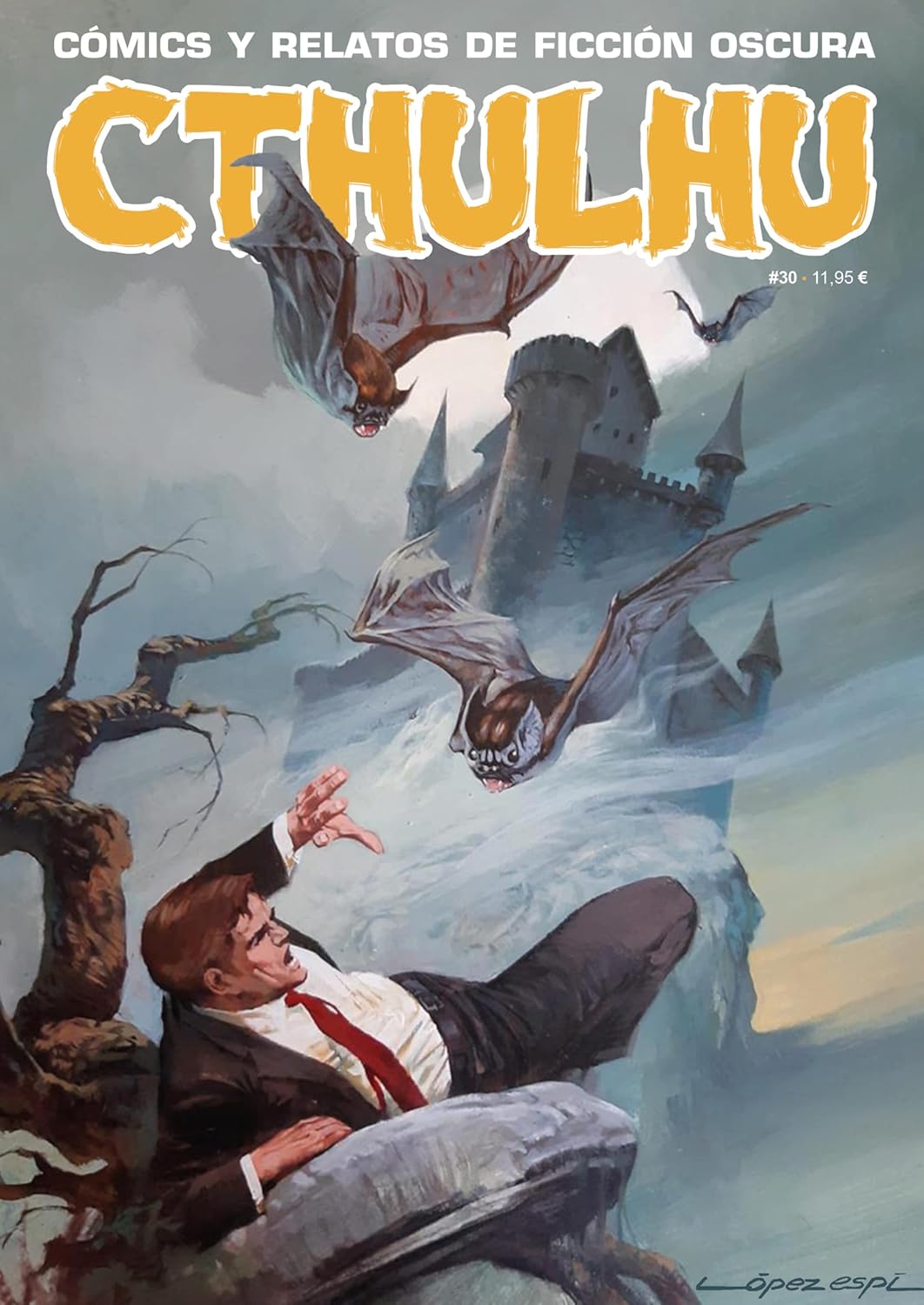
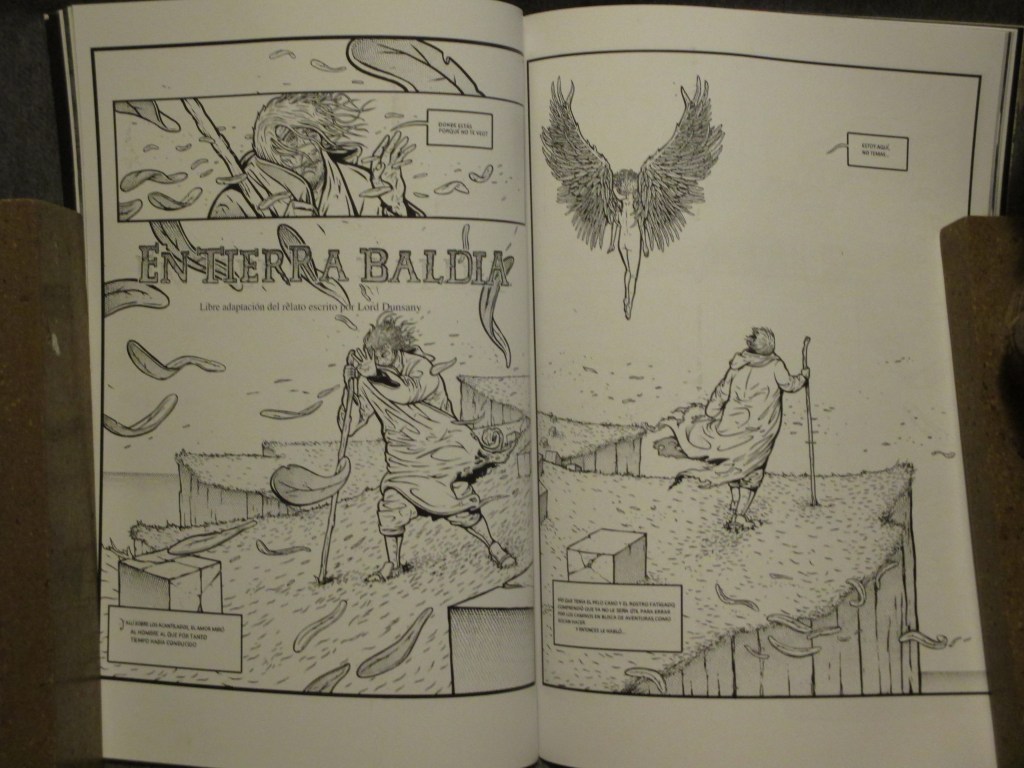
“En Tierra Baldía” (2024) by Miguel Almagro & Lord Dunsany

Libre adaptación del relato escrito por Lord DunsanyFreely adapted from the story by Lord Dunsany
Cthulhu #30 (2024)English translation

“On the Dry Land” by Lord Dunsany was first published in the small magazine Neolith #4 (Aug 1908), and was collected in The Sword of Welleran and Other Stories that same year. It is the last story in the book, and it is one of those Dunsany short-shorts that is more than a drabble but less than a tale. Call it a prose poem or flash fiction; it has a certain poetry to it, and there is more that is left unsaid than is said. It has a mythic quality, but it is not a story of any particular mythology, whether of Pegāna or any other tradition. A kind of story so universal in its outlines it might slip easily into the tradition of any culture that has the concept of love and death.

How do you illustrate that? How do you put into images and words, the unspoken understanding, the loneliness and heartache?

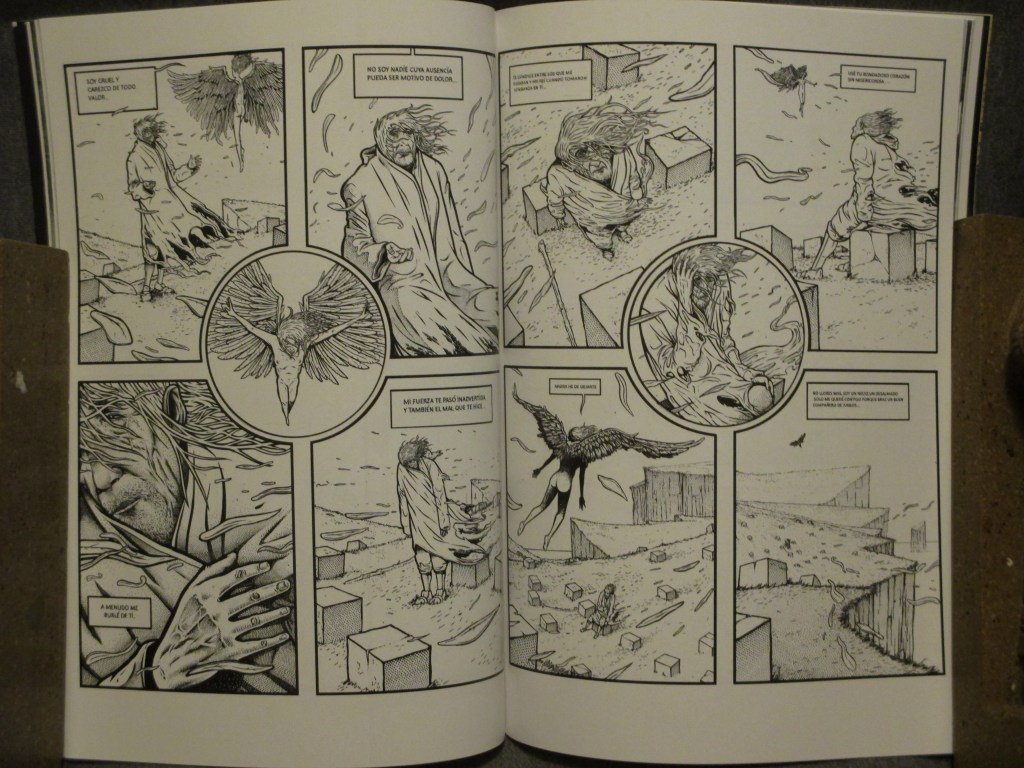
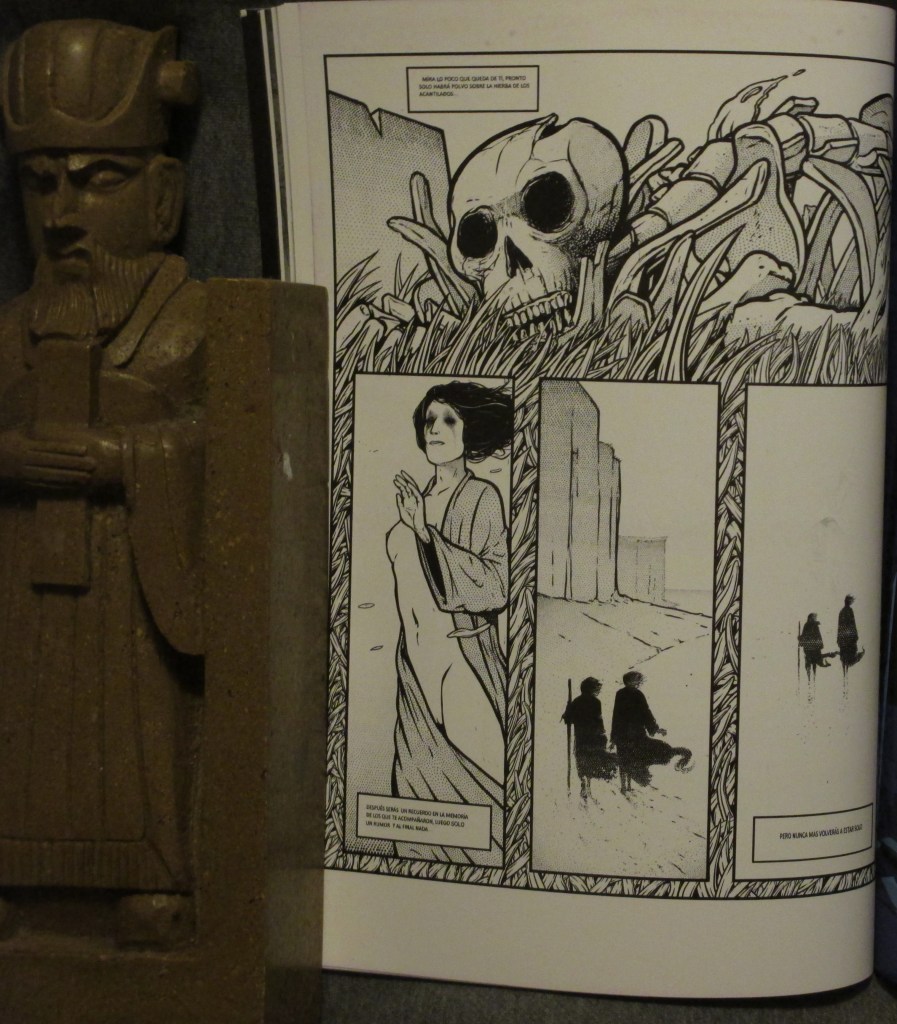
For one, the adaptation allows the text to be decompressed. Dunsany’s pithy text is stretched out by Miguel Almagro into 9 black-and-white pages. For two, the scene and many details are expanded to silently add to the storytelling. Rather than the marsh where Dunsany had first set the scene, the story unfolds on a cliff overlooking the sea; the blowing of grass and the stance of the unnamed man show the direction of the wind that blows strongly throughout, and blocks of stone suggest some ancient construction or ruin, marks of the passage of time. The layout of the panels helps control the pacing of the story.

Te conduje entre los que me odíaban y me reí cuando tomaron venganza en tí…

Usé tu bondadoso corazón sin misericordia…

Ahora he de dejarte

No llores más, soy un necio, un desalmado, solo me quedé contigo porque eras un buen compañero de juegos…
I led you among those who hate me and laughed when they took revenge on you…

I used your kind heart without mercy…

Now I have to leave you

Don’t cry anymore, I’m a fool, a heartless man, I only stayed with you because you were a good playmate…
Cthulhu #30 (2024)English translation

As a free adaptation, Almagro is not making an attempt at an exact replication of Dunsany’s text; lines are told out of sequence, rearranged to meet the needs of the artistic arrangement. Maintaining the core of the short short while shifting the representation. So for example, this scene as Dunsany wrote it:

And Love said to the old man, ‘I will leave you now.’

And the old man made no answer, but wept softly.

Then Love was grieved in his little careless heart, and he said: ‘You must not be sorry that I go, nor yet regret me, nor care for me at all.

‘I am a very foolish child, and was never kind to you, nor friendly. I never cared for your great thoughts, or for what was good in you, but perplexed you by leading you up and down the perilous marshes. And I was so heartless that, had you perished where I led you, it would have been nought to me, and I only stayed with you because you were good to play with.

‘And I am cruel and altogether worthless and not such a one as any should be sorry for when I go, or one to be regretted, or even cared for at all.’

And still the old man spoke not, but wept softly; and Love grieved bitterly in his kindly heart.

And Love said: ‘Because I am so small my strength has been concealed from you, and the evil that I have done. But my strength is great, and I have used it unjustly. Often I pushed you from the causeway through the marshes, and cared not if you drowned. Often I mocked you, and caused others to mock you. And often I led you among those that hated me, and laughed when they revenged themselves upon you.
—Lord Dunsany, “On the Dry Land”

Pero nunca mas volverás a estar soloBut you will never be alone again.
Cthulhu #30 (2024)English translation

As with “Donde suben y bajan las mareas” (1978) by Alberto Breccia, Carlos Trillo, and Lord Dunsany, we have to read this from the perspective of both a translation and an adaptation. Dunsany’s title “On the Dry Land” is a key to the story because the dry land represents the end of journey and parting of ways; the nameless man with Love has been wading through the marshes, the wet lands, and that trudge and effort and peril are metaphorically, life and hardship and struggle. The dry land is what comes after. The Spanish title, “La tierra baldía” translates most literally to “The Wasteland,” which isn’t quite the same meaning, suggesting as it does barrenness, though the metaphor still works: the nameless man has come to the undiscovered country:

To grunt and sweat under a weary life,
But that the dread of something after death,
The undiscover’d country from whose bourn
No traveller returns, puzzles the will
And makes us rather bear those ills we have
Than fly to others that we know not of?
—Shakespeare, Hamlet, Act III, Scene 1

Dunsany is putting his own spin on it; rather than clinging to life, the man is clinging to Love, despite all the pain that has come from clinging to love, and dreads the loss of it. Yet there is that reassurance, that final promise, of a more constant, faithful, and comparing companion—a character more akin to Death in Terry Pratchett’s Discworld novels than the medieval grim reaper, or even Death as sometimes personified in Dunsany’s other stories.

In adaptation, Miguel Almagro is taking that story in translation and moving it a bit further. It is not a wasteland in the sense that there is nothing living; there is grass, insects, but it is devoid of people or shelter, a land gone fallow and wild. Even the sky and sea are empty and desolate. Death, when she appears, is not frightening, merely a dark-eyed psychopomp—and the man has accepted Death, even as he has accepted the loss of Love. Dunsany wrote in the last line:

And after a while, with his face towards the morning, Death out of the marshes came up tall and beautiful, and with a faint smile shadowy on his lips, and lifted in his arms the lonely man, being gentle with him, and, murmuring with his low deep voice an ancient song, carried him to the morning to the gods.

Almagro foregoes the song, and the gods; the last we see of them are two shadows side by side on a new and different journey. There is something more poignant in that image, that acceptance and continuance. Perhaps a man literally cannot live without Love, but so too, now Love can no longer hurt him.

Thanks to Martin Andersson for his help.


Bobby Derie is the author of Weird Talers: Essays on Robert E. Howard and Others and Sex and the Cthulhu Mythos.

Deep Cuts in a Lovecraftian Vein uses Amazon Associate links. As an Amazon Associate I earn from qualifying purchases.
“Donde suben y bajan las mareas” (1978) by Alberto Breccia, Carlos Trillo, and Lord Dunsany

Sasturain: Mais mesure un peu l’influence que peut avoir un regard critique sur ton oeuvre: dans les années 1960, tu as tout laissé tomber jusqu’à ce qu’apparaissent des gens qui te lisaient, te suivaient, t’appreciaient. Qu t’ont renvoyé un écho positif de ce que tu avais fait. Ce n’est qu’en 1968, à la sortie du livre de Martínez Peyrou, puis celui de Masotta, qu’on t’apprécie, qu’on reconnaît ta valeur. Ton travail est reconnu en Europe, tu retrouves une stimulation. La réaction de l’extérieur te motive, t’encourage.

Breccia: Et j’ai trouvé un marché où proposer des choses dont tout le monde se fichait ici. Quand j’ai fait L’Éternaute, on m’a tiré dessus à boulets rouges. Mort Cinder n’a pas eu de succés. Richard Long est passé completèment inaperçu. Je veux dire par là que toutes ces ouevres relativement valables, tout le monde s’en battait l’oeil, en Argentine, alors qu’elles ont eu du succès en Europe. Si je propose Le Couer révélateur ici, personne ne le publie. Il est paru dans Breccia Negro, édité par Scutti, mais c’est moi qui l’ai imposé. À cette époque, Scutti publiait n’importe quoi. Je lui ai dit: «Faisons un livre», et c’etait parti. Le cas de Là où la marée monte et se retire, l’adaptation de la nouvelle de Lord Dunsany, par exemple, montre qu’un tas de choses n’ont pas reçu non plus un bon accueil en Europe, elles sont restées et restent inédites. Mais c’est vrai que ce genre-là m’a intéressé. Après, quand j’ai voyagé en Europe et que j’ai vu ce qui se passait la-bas, tout a changé, j’ai découvert qu’il existait un marché immense, un public qui attendait des oeuvres différentes, et qu’on pouvait faire du neuf. Un endroit où la bande dessinée était très respectée, pas comme ici, où elle demeure encore aujourd’hui un genre marginal.
Sasturain: But consider the influence that a critical eye can have on your work: in the 1960s, you dropped everything until people appeared who read you, followed you, appreciated you. Who gave you a positive response to what you had done. It was only in 1968, with the release of Martínez Peyrou’s book, then Masotta’s, that you were appreciated, that your value was recognized. Your work was recognized in Europe, you found stimulation. The reaction from outside motivated you, encouraged you.

Breccia: And I found a market where I could offer things that nobody cared about here. When I did The Eternaut, I was shot at with red-hot cannonballs. Mort Cinder was not a success. Richard Long went completely unnoticed. I mean by that that all these relatively valid works, nobody cared about them, in Argentina, while they were successful in Europe. If I offer “The Telltale Heart” here, nobody publishes it. It appeared in Breccia Negro, published by Scutti, but I was the one who insisted on it. At that time, Scutti published anything. I told him: “Let’s make a book,” and that was it. The case of “Where the Tide Ebb and Flow,” the adaptation of Lord Dunsany’s story, for example, shows that a lot of things were not well received in Europe either; they remained and remain unpublished. But it’s true that this genre interested me. Then, when I traveled to Europe and saw what was happening there, everything changed, I discovered that there was a huge market, an audience that was waiting for different works, and that we could do something new. A place where comics were very respected, not like here, where they still remain a marginal genre today.
Breccia: Conversations avec Juan Sasturain (2019) 306English translation

Alberto Breccia, a comic artist now hailed as a master and whose work is internationally recognized and translated into myriad languages, got his start like pretty much every other artist: wherever he could. When opportunities in his native Argentina were few, Breccia turned to Europe, which welcomed international talent. His fame in the English-speaking world largely rests on a series of nine adaptations of H. P. Lovecraft’s stories that he first completed and published in the 1970s, but while these have gained fame and been published and republished, they were part of a broader turn in his career toward adapting classic works of horror and fantasy into the medium of comics during the 70s.

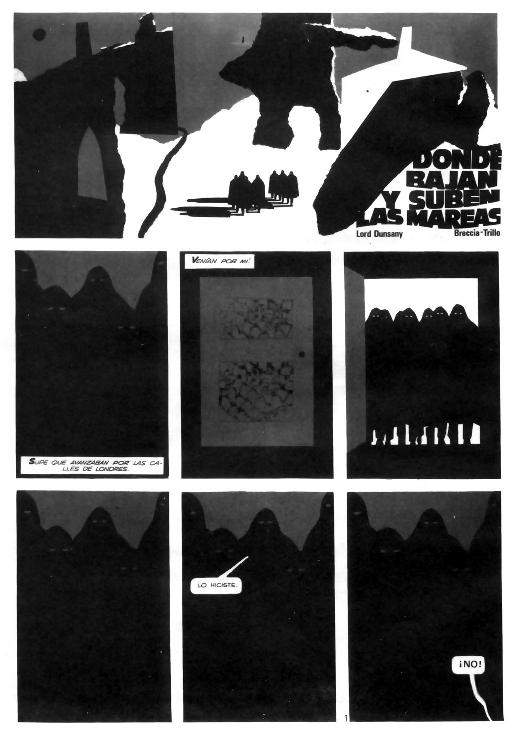
One of the more obscure of these adaptations, especially to English-language audiences, is “Donde suben y bajan las mareas” (1978), adapted from Lord Dunsany’s “Where the Tides Ebb and Flow” from A Dreamer’s Tales (1910). The script was written by Carlos Trillo, and Breccia did the artwork using a collage method; a technique that provides a certain texture to his more experimental 70s works. At a scanty 8 pages, it was probably intended for an Italian market like Il Mago, but as near as I can determine the first—and for a long time only—publication was in the now rare Breccia Negro (1978), a collection of his unpublished and scarce work, which has itself never been reprinted.

Supe que avanzaban por las calles de Londres.
Venían por mí.
Lo hiciste.
¡NO!
I knew they were advancing through the streets of London.
They were coming for me.
You did it.
NO!
Informe sobre ciegos y otras historias 101English translation

The effect is dark, almost minimalist, a chiaroscuro nightmare. As in Dunsany’s tale, it is told primarily from the view of the protagonist, who cannot see the faces of his friends and executioners clearly. Only their eyes, only the numberless mass of them who come to execute justice for the unspoken crime. When in Europe in the 70s, Breccia went to Great Britain to stand on the banks of the Thames.

Sasturain: Un jour, tu m’as raconté que tu étais allé à Londres pour chercher…

Breccia: Pour chercher la boue de la Tamise, celle de Là où la marée monte et se retire. Je suis allé voir ça de nuit. Et j’ai marché dans les ruelles de Soho, tu vois? Les ruelles de Jack l’Éventreur. Tue sais que je ne suis pas vraiment un rigolo. (Rires) J’ai suivi la piste de Lord Dunsany et de Jack l’Éventreur. Mais la ville de Lonres m’a plu tout entiere, tout ce que j’ai vu de l’Angleterre m’a plu.
Sasturain: One day, you told me that you went to London to look for…

Breccia: To look for the mud of the Thames, the one Where the tide ebbs and flows. I went to see it at night. And I walked in the alleys of Soho, you see? The alleys of Jack the Ripper. You know I’m not really a joker. (Laughs) I followed the trail of Lord Dunsany and Jack the Ripper. But I liked the whole city of London, everything I saw of England I liked.
Breccia: Conversations avec Juan Sasturain (2019) 366English translation
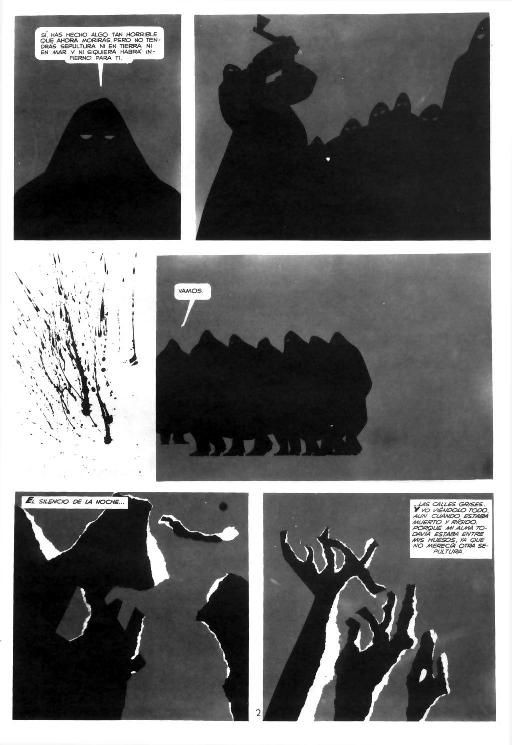
Sí. Has hecho algo tan horrible que ahora morirás. Pero no tendrás sepultura ni en tierra ni en mar y ni siquiera habrá infierno para ti.

Vamos.

El silencio de la noche…

…las calles grises yo viéndolo todo. Aun cuando estaba muerto y rígido. Porque mi alma todavía estaba entre mis huesos, ya que no merecía otra sepultura.
Yes. You have done something so horrible that now you will die. But you will have no burial on land or sea, and there will not even be hell for you.

Let us go.

The silence of the night…

…the gray streets, I saw it all. Even when I was dead and stiff. Because my soul was still among my bones, for it deserved no other grave.
Informe sobre ciegos y otras historias 102English translation

I dreamt that I had done a horrible thing, so that burial was to be denied me either in soil or sea, neither could there be any hell for me.

I waited for some hours, knowing this. Then my friends came for me, and slew me secretly and with ancient rite, and lit great tapers, and carried me away.

It was all in London that the thing was done, and they went furtively at dead of night along grey streets and among mean houses until they came to the river. And the river and the tide of the sea were grappling with one another between the mud-banks, and both of them were black and full of lights. A sudden wonder came in to the eyes of each, as my friends came near to them with their glaring tapers. All these things I saw as they carried me dead and stiffening, for my soul was still among my bones, because there was no hell for it, and because Christian burial was denied me.
—Lord Dunsany, “Where the Tides Ebb and Flow”

Truncated, translated; in dark blacks on greys and stark whites, Breccia sought to capture, not the cityscape of London or the lushness of Dunsany’s prose, but that shadowy limbo in which the murdered man was caught. In describing this style, Laura Caraballo wrote:

En premier lieu, les papiers lisses constituent des aplats et sont souvent utilisés pour créer des figures elliptiques qui se détachent du fond créant aussi une réversibilité entre les deux, comme on peut le voir dans Là où la maree monte et se retire (adaptation de la nouvelle de Lord Dunsany, Where the Tides Ebb and Flow), où le collage est la seule technique apploquée. Dans ces séquences, la qualité tangible des couches de papier est mise en avaunt. Breccia ajoute un élément qui redonne son caractère palpable au papier collé, notamment la trace du papier arraché qui vient à la fois avertir sur la technique et fonctionner comme accent de lumière ciblée au niveau de la composition. Dans cest formes construites par la technique du papier arraché, on peut donc retracer le geste de l’auteur qu exerce un mouvement intempestif au moment de définir ses plans et ses figures en coupant brusequement le papier. Il explore ainsi, avec une quantité minimale d’éléments et trois valeurs achromatiques, la possibilitié de construire des images avec des atmosphères très pesantes et un état d’esprit déscenchanté, tout comme la voix du narrateur dans le text de Lord Dunsany, à l’origine de cette adaptation. Le collage oscille alors entre sa fonction de trace de la technique en elle-même et de contiguïté physique avec le geste, et sa fonction mimétique, par exemple pour représenter l’impact de la lumière sur les objets.In the first instance, smooth papers are used as solids, often to create elliptical figures that stand out from the background, also creating a reversibility between the two, as can be seen in Là où la maree monte et se retire (an adaptation of Lord Dunsany’s short story, “Where the Tides Ebb and Flow”), where collage is the only technique applied. In these sequences, the tangible quality of the layers of paper is brought to the fore. Breccia adds an element that restores its palpable character to the collaged paper, notably the trace of the torn paper which both warns about the technique and functions as an accent of targeted light at the level of the composition. In these forms constructed using the torn paper technique, we can therefore trace the author’s gesture, which exerts an untimely movement at the moment of defining his planes and figures by abruptly cutting the paper. He thus explores, with a minimal quantity of elements and three achromatic values, the possibility of constructing images with very heavy atmospheres and a disenchanted state of mind, just like the voice of the narrator in Lord Dunsany’s text, at the origin of this adaptation. The collage then oscillates between its function as a trace of the technique itself and of physical contiguity with the gesture, and its mimetic function, for example to represent the impact of light on objects.
Alberto Breccia, le Maître Argentin Insoumis 46-47English translation

The result is a rather stark, dark tale, in keeping with the mood of Breccia and Trillo’s other adaptations of Edgar Allan Poe and the like; probably the grimmest adaptation of any story by Lord Dunsany to comics to date, though they preserve Dunsany’s ending. While no one would claim this is one of Breccia’s masterworks—the collage technique is effective but lacks some of the energy and brilliance of his pen and mixed media art—it is an effective adaptation, and one that deserves more attention.

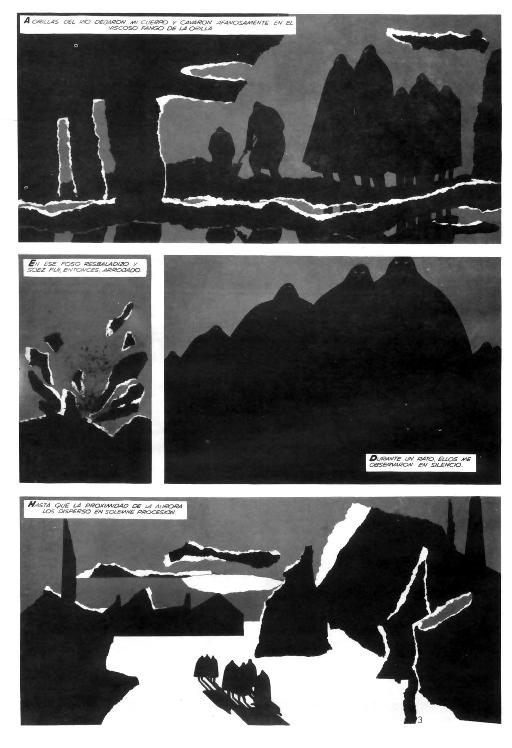
A orillas del río dejaron mi cuerpo y cavaron afanosamente en el viscoso fango de la orilla.

En ese foso resbaldizo y soez fui, entonces arrojado.

Durante un rato, ellos me observaron en silencio.

Hasta que la proximidad de la aurora los disperso en solemne procession.
On the banks of the river they left my body and dug busily in the slimy mud of the shore.

Into that slippery and foul ditch, I was then thrown.

For a while, they watched me in silence.

Until the approach of dawn dispersed them in solemn procession.
Informe sobre ciegos y otras historias 103English translation

“Donde suben y bajan las mareas” has been reprinted and translated into several languages, but the only English-language adaptation I could locate is Alberto Breccia Sketchbook (2003, Ancares Editora), a bilingual edition in English and Spanish, but difficult to locate as it was published in Argentina and is now out of print. Most curious readers will have to satisfy themselves with the Spanish-language version reprinted in collections like Informe sobre ciegos y otras historias if they wish to read this tale.

A Note: I am aware that the Breccia interviews conducted with his occasional collaborator Juan Sasturain were originally done in Spanish, but the only edition I have of them is in French. Sometimes we have to work with what we have on hand.


Bobby Derie is the author of Weird Talers: Essays on Robert E. Howard and Others and Sex and the Cthulhu Mythos.

Deep Cuts in a Lovecraftian Vein uses Amazon Associate links. As an Amazon Associate I earn from qualifying purchases.
“The Message of Thuba Mleen” (1911) by Aleister Crowley

“Was it because of the Desert’s curse?” I asked. And he said, “Partly it was the fury of the Desert and partly the advice of the Emperor Thuba Mleen, for that fearful beast is in some way connected with the Desert on his mother’s side.”
—Lord Dunsany, “The Hashish-Man” in A Dreamer’s Tales (1910)

To properly review “The Message of Thuba Mleen” (1911) by Aleister Crowley requires a little background on Crowley’s relationship with the Cthulhu Mythos and Lovecraft’s references to Crowley in his letters. Since this background is a bit long with numerous quotes, some handy links are provided above to help readers navigate to whichever section they want to go to.

Crowley & Cthulhu

Aleister Crowley (1875-1947) never met H. P. Lovecraft (1890-1937) in life. Crowley was an English occultist, writer, poet, and artist who became notorious both for personal life and his mystical philosophy, which coalesced into the development of Thelema in the early 20th century. After his death, his systems of ceremonial magic and philosophy were developed by various successors and fed into the growing interest during the post-WWII spiritual awakening. Notably, his secretary Kenneth Grant worked to expand and integrate Crowley’s system of “magick” with other esoteric practices and even fictional material from writers like H. P. Lovecraft.

Although Lovecraft seems to have been unacquainted with Crowley’s work, it is evident that both were in touch with a source of power, ‘a prater-human intelligence’, capable of inspiring very real apprehension in the minds of those who were, either through past affiliation or present inclination, on the same wavelength. Whether this Intelligence is called Alhazred or Aiwaz (both names, strangely enough, evoking Arab associations) we are surely dealing with a power that is seeking ingress into the present life cycle of the planet.
— Kenneth Grant, “Dreaming Out of Space” in Man, Myth, and Magic (1970), vol. 23, 3215

Grant wasn’t the first to draw associations between weird fiction and magic; Le Matin des magicians (1960) by Louis Pauwels and Jacques Bergier referenced the perceived connection between Arthur Machen’s fiction and his membership in the Hermetic Order of the Golden Dawn (an occult organization of which Crowley was also a member). However, Grant did more than draw parallels; in his writing, he directly associated his understanding of Lovecraft’s Mythos into his exegesis of Crowley’s magick.

Fiction, as a vehicle, has often been used by occultists. Bulwer Lytton’s Zanoni and A Strange Story have set many a person on the ultimate Quest. Ideas not acceptable to the everyday mind, limited by prejudice and spoiled by a “bread-winning” education, can be made to slip past the censor, and by means of the novel, the poem, the short story be effectually planted in soil that would otherwise reject or destroy them.

Writers such as Arthur Machen, Brodie Innes, Algernon Blackwood and H. P. Lovecraft are in this category. Their novels and stories contain some remarkable affinities with those aspects of Crowley’s Cult deal with in the present chapter, i.e. themes of resurgent atavisms that lure people to destruction. Whether it be the Vision of Pan, as in the case of Machen and Dunsany, or the even more sinister traffic with denizens of forbidden dimensions, as in the tales of Lovecraft, the reader is plunged into a world of barbarous names and incomprehensible signs. Lovecraft was unacquainted both with the name and the work of Crowley, yet some of his fantasies reflect, however, distortedly, the salient themes of Crowley’s Cult. The following comparative table will show how close they are:
— Kenneth Grant, The Magical Revival (1972), 114

Grant then followed with a table of correspondences he perceived between Crowley and Lovecraft. A similar, though distinct, table was also included in the Necronomicon (1977) written by “Simon.” This was the first commercial hoax Necronomicon which was also explicitly a grimoire, something that was intended to mimic other collections of ceremonial magic rites, sigils, lore, etc. intended for use by practicing occultists. The introduction by “Simon” leaned heavily on the supposed correspondences between Lovecraft’s Mythos and Crowley’s magick.

We can profitably compare the essence of most of Lovecraft’s short stories with the basic themes of Crowley’s unique system of ceremonial Magick. While the latter was a sophisticated psychological structure, intended to bring the initiate into contact with his higher Self, via a process of individuation that is active and dynamic (being brought about by the “patient” himself) as opposed to the passive depth analysis of the Jungian adepts. Lovecraft’s Cthulhu Mythos was meant for entertainment. Scholars, of course, are able to find higher, ulterior motives in Lovecraft’s writings, as can be done with any manifestation of Art.
— “Simon” (Peter Levenda), Necronomicon (1977) xii

The ceremonial magic presented in the Simon Necronomicon was distinct from that in Grant’s system derived from Crowley; though they shared some common references in Lovecraft and Crowley’s respective mythos & magick. This unexpected complexity invited comparison, and sometimes fusion. From a metafictional perspective, it became the beginning of a parallel body of literature alongside the growing body of Cthulhu Mythos fiction: a Lovecraftian occult scene. One that started to flower when another Necronomicon, edited by George Hay, was published in 1978:

I had also been reading the works of Aleister Crowley—collected by my friend Roger Staples of Michigan University—and found the parallels so striking that I owndered if Lovecraft and Crowley had been acquainted.

Derleth was positive that they had never met—in fact, he doubted whether Lovecraft had ever heard of ‘the Great Beast’. If he had, Derleth seemed to think, he would have dismissed him as a charlatan and a poseur.
— Colin Wilson, “Introduction,” The Necronomicon: The Book of Dead Names (1978), 14

Wilson refers to a meeting with Derleth in 1967; later in the same introduction, he cites Grant’s merging of Lovecraftian Mythos with Crowleyian magick. The introduction was written with all the care of a good hoax; starting from a basis of facts and gradually weaving in fictional elements, to build up to the idea that Lovecraft’s Necronomicon wasn’t just a fictional book, but had been based on a genuine occult document from the Middle East—which is what the Hay Necronomicon was presented as.

So as the 1980s dawned and the Simon Necronomicon became available in an affordable paperback edition to grace New Age shelves forevermore, would-be Lovecraftian occultists had at least three separate sources to draw upon. All of them tried to tie H. P. Lovecraft to Aleister Crowley. The two men, who had never met in life, found elements of their legends entwined posthumously.

With the advent of the internet, it became easier for misinformation to spread. Colin Law’s Necronomicon Anti-FAQ (1995) was, like Wilson’s introduction, just a bit of fun—but it fostered certain misconceptions about Crowley and Lovecraft, despite repeated debunkings:

In 1918 Crowley was in New York. As always, he was trying to establish his literary reputation, and was contributing to The International and Vanity Fair. Sonia Greene was an energetic and ambitious Jewish emigre with literary ambitions, and she had joined a dinner and lecture club called “Walker’s Sunrise Club” (?!); it was there that she first encountered Crowley, who had been invited to give a talk on modern poetry. […]

In 1918 she was thirty-five years old and a divorcee with an adolescent daughter. Crowley did not waste time as far as women were concerned; they met on an irregular basis for some months.

In 1921 Sonia Greene met the novelist H.P. Lovecraft, and in that same year Lovecraft published the first novel where he mentions Abdul Alhazred (“The Nameless City”). In 1922 he first mention the Necronomicon (“The Hound”). On March 3rd. 1924, H.P. Lovecraft and Sonia Greene married.

We do not know what Crowley told Sonia Greene, and we do not know what Sonia told Lovecraft. 

Edwin C. Walker (1849-1931) was a radical liberal who founded the Sunrise Club in 1889; this interracial club held dinner meetings at which speakers were invited to discuss on a wide range of topics. According to L. Sprague de Camp’s H. P. Lovecraft: A Biography (1975), Sonia joined the club c. 1917 (160-161); and there is a reference to Sonia’s membership in one of Lovecraft’s letters (LFF 1.83). I have yet to find any reference to Crowley addressing or attending the club. Given he lived in the United States from 1914-1919 and was often living in New York City at the time, it is possible, if not necessarily plausible that he could have attended some evening.

There is no reference to Crowley in any of Sonia’s surviving letters, essays, or autobiography; no mention of grimoires or the Necronomicon. The idea that Lovecraft got the idea of the Necronomicon from Crowley by way of Sonia is unsupported by any evidence and relies on the idea that the Necronomicon bears some similarity to Crowley’s The Book of the Law—the same supposition pushed by Grant and Simon, among others. It is rather telling that nothing in Crowley’s own writings supports his meeting with Sonia either, and that all references to the idea of their meeting ultimately derive from Low. For more on this and other Necronomicon-related hoaxes and occult history, see The Necronomicon Files by Daniel Harms & John W. Gonce III.

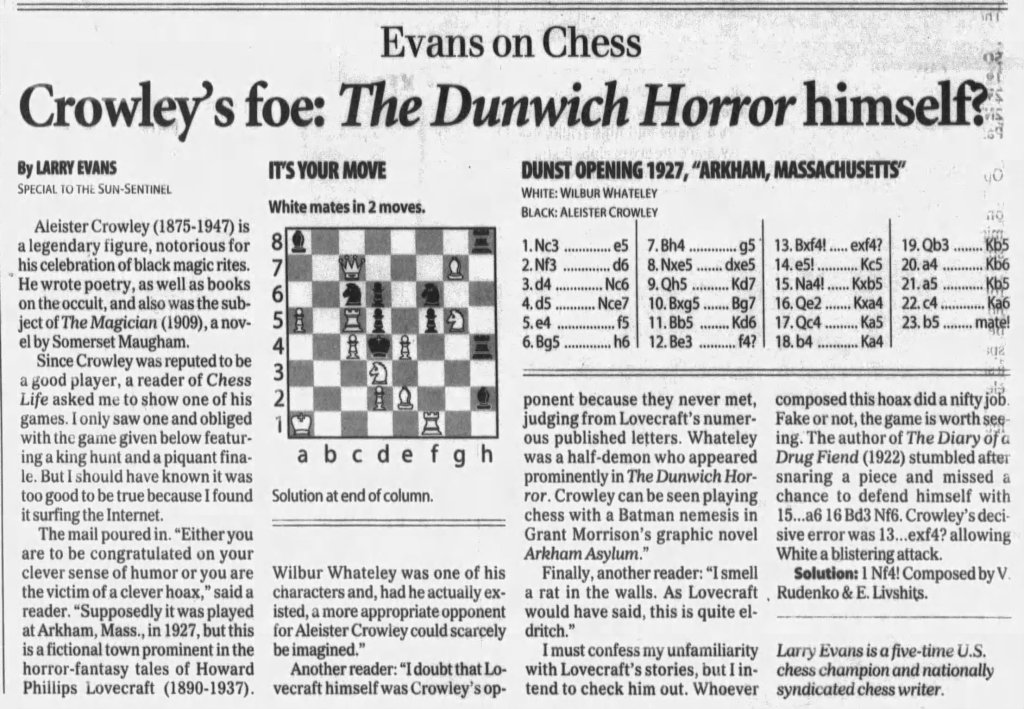
It’s easy to go on, although facts and fiction get furiously muddled. Despite Grant’s assertion that Lovecraft had never heard of Crowley and Derleth’s assertion (as related by Wilson) that Lovecraft may not have heard of Crowley and certainly never met him, fictional meetings between the writer of the weird and the prophet of Thelema have increasingly featured in books and comics, one notable example being The Arcanum (2007) by Thomas Wheeler. Yet my favorite hypothetical meeting is a 1927 chess game between Aleister Crowley and Wilbur Whateley:

If Derleth did tell Colin Wilson that he doubted Lovecraft had ever heard of Crowley and this wasn’t another part of the hoax, then he was badly mistaken and should’ve known better. Lovecraft’s letters give considerable detail on his thoughts regarding Aleister Crowley.

H. P. Lovecraft on Aleister Crowley

The Crowley cutting is interesting. What has the poor devil-worshipper been up to now? When I was in Leominster (near Athol) with Cook & Munn last month, calling on a bookseller, I saw a copy of a book by Crowley—“The Diary of a Drug-Fiend.” The merchant informed me that it has been suppressed by some branch of the powers that be—though he agreed to part with his copy for three thalers. I did not take him up—but I told Belknap about the offer.
–H. P. Lovecraft to Wilfred B. Talman, [8 Jun 1929], LWT 114

In 1929, French authorities deported Crowley, which led to sensationl articles (Why France Finally Kicked Out the High Priest of the Devil Cult), and a similar cutting was no doubt passed to Lovecraft. From this first reference in Lovecraft’s letters, it isn’t clear when exactly the Old Gent from Providence became aware of Aleister Crowley, but the suggestion seems to be that Lovecraft was at least passingly familiar with the magus by the late 1920s, probably from similar newspaper clippings. From Lovecraft’s comments, his friend Frank Belknap Long, Jr. had an interest in Crowley…a greater interest than Lovecraft himself had:

Aleister Crowley still keeps in the news! Don’t take any especial trouble to send the clipping unless you find it lying around, for my interest in the gent is perhaps less intense than Belknap’s.
–H. P. Lovecraft to Wilfred B. Talman, [7 Jul 1929], LWT 116

In 1930, Percy Reginald Stephensen’s The Legend of Aleister Crowley: Being a Study of the Documentary Evidence Relating to a Campaign of Personal Vilification Unparalleled in Literary History was published, ostensibly to ameliorate Crowley’s reputation. Lovecraft apparently caught a few reviews:

And speaking of your precious files—have you seen reviews of the new book about that suave diabolist Aleister Crowley? Belknap sent me a cutting from the Tribune. The biographer—abetted by the reviewer—(Hebert S. Gorman, who claims to have dined with Crowley) tries to depict the reputed ally of Satan as a much-wronged and basically blameless poet—whose eccentricities are merely the harmless foibles of genius!
–H. P. Lovecraft to Wilfred B. Talman, [Sep 1930], LWT 133-134

Years passed. Crowley’s infamy was such that he served as the basis for several fictional magicians, most notably the character of Oliver Haddo in Somerset Maugham’s The Magician (1908); the black magician Oscar Clinton in H. R. Wakefield’s “He Cometh and He Passeth By” (1928) (and later, Apuleius Charlton in “The Black Solitude” (1951)); and, though Lovecraft never lived to see it, Rowley Thorne in the stories fellow Weird Tales writer Manly Wade Wellman, in one such story, “The Letters of Cold Fire” (WT May 1944), Thorne attempts to obtain a copy of the Necronomicon!

Lovecraft had not read Maguham’s novel, but was aware of its association with Crowley:

I’ve never seen the Ramuz & Maugham items. Poor old Crowley figures more than once in fiction—for I believe it is her upon whom the villain in Wakefield’s “He Cometh & He Passeth By” is modelled.
–H. P. Lovecraft to Richard Ely Morse, 22 Mar 1932, LHB 42

“Ramuz” may be a reference to C. F. Ramuz La Regne de l’esprit Malin (1917) tr. by James Whitall as The Reign of the Evil One (1922). The novel seems to draw no direct inspiration from Crowley, being about a stranger (who might be the devil himself) who comes to a small Swiss town and turns it into hell.

Lovecraft did read Wakefield, however, and was appreciative.

Wakefield’s stuff is generally very good, & I’m glad you’ve had an opportunity to read it. Of the tales in the first book my favourites are “He Cometh & He Passeth By” (the villain in which is a sort of caricature of the well-known living mystic & alleged Satanist Aleister Crowley), “The Red Lodge”, “The 17th Hole at Duncaster[“], & “And He Shall Sing”.
–H. P. Lovecraft to Robert Bloch, [22 Jul 1933], LRBO 62

Glad to see the item about Crowley. What a queer duck! He is the original of Clinton in Wakefield’s “They Return at Evening.”
– H. P. Lovecraft to Clark Ashton Smith, [14 Dec 1933], DS 507

Wakefield is pretty good—I’ll enclose “They Return at Evening” as a loan in the coming shipment. You’l probably find at least four of the tales especially absorbing—“The Red Lodge”, “He Cometh & He Passeth By” based on Aleister Crowley), “And He Shall Sing”, & “The Seventeenth Hole at Duncaster.”
–H. P. Lovecraft to Clark Ashton Smith, [Jan 1934], DS 515

Clark Ashton Smith, when he read the “He Cometh and He Passeth By,” gave his own opinion to Lovecraft:

I read one of the Wakefield stories last night—“He Cometh and he passeth by—” and found it excellent, especially in the suggestion of the diabolic Shadow. Crowley is surely a picturesque character, to have inspired anything like Clinton! I know little about Crowley myself, but wouldn’t be surprised if many of the more baleful elements in his reputation were akin to those in the Baudelaire legend . . .  that is to say, largely self-manufactured or foisted upon him by the credulous bourgeoisie.
– Clark Ashton Smith to H. P. Lovecraft, [Jan 1934], DS 520

Lovecraft’s reply reveals something new—an acquaintances of his had actually met Crowley:

As for Aleister Crowley—I rather thought at first that his evil reputation was exaggerated, but Belknap says that Harré has met him & has found him indescribably loathsome in mind, emotions, & conduct. This from Harré is quite a damning indictment, for Belkanp tells me that T. Everett himself is far from squeamish or fastidious in his language & anecdotes when amidst the sort of company that dissolves inhibitions. But Crowley was too much for him. He didn’t relate particulars—but said that the evil magus made him so nauseated that he left abruptly. I guess Crowley is about as callous, unclean-minded, & degenerate a bounder as one can often find at large—though he undoubtedly has talents & scholarship of a very high order. It seems to me I heard that he is in New York now—London won’t stand him any longer. And this reminds me that I forgot to return that old cutting of yours which mentions him—permit me to repair the omission now.
–H. P. Lovecraft to Clark Ashton Smith, [11 Feb 1934], DS 525

In 1933-1934, Crowley appears to have primarily been in London, dealing with a libel suit (which he lost). I have not discovered anything to suggest he went to New York at this time. However, Harré’s papers contain a folder associated with Aleister Crowley, so they may well have met or interacted at some point. It is also known that Harré and Crowley were published together in The International in 1915, so possibly the meeting occurred over a decade and a half earlier, when Crowley was in New York, and Lovecraft misunderstood.

Smith responded:

Judging from Harré’s reactions, it would appear that Aleister Crowley is a pretty hard specimen. I had discounted the legends on general principles, knowing nothing whatever about the mysterious magus.
–Clark Ashton Smith to H. P. Lovecraft, [Mar 1934], DS 536

At this point, Crowley became a reference point for diabolists and occultists of all stripes.

The case of the Boer lady—Mevrouw van de Riet—certainly offers dark food for the imagination. She seems to be a sort of female Aleister Crowley—or a striga, lamia, empusa, or something of the sort.
–H. P. Lovecraft to Clark Ashton Smith, [18 Nov 1933], DS 479

The subject would next come up when Lovecraft began corresponding with the young fan Emil Petaja in 1935, when the subject turned toward the Black Mass, Satanism, and the occult. Lovecraft was an atheist and materialist, but he had read something of the occult for research purposes over the years, and picked up other tidbits:

In the 1890’s the fashionable decadents liked to pretend that they belonged to all sorts of diabolic Black Mass cults, & possessed all sorts of frightful occult information. The only specimen of this group still active is the rather over-advertised Aleister Crowley . . . . who, by the way, is undoubtedly the original of the villainous character to H. R. Wakefield’s “He Cometh & He Passeth By.”
–H. P. Lovecraft to Emil Petaja, 6 Mar 1935, LWP 414

Petaja apparently pursued the subject with Lovecraft, who responded at greater length, apparently still under the misconception that Crowley was in New York:

Regarding the Black Mass & its devotees—it is really even more repulsive than fascinating. The whole thing is described minutely in Joris-Karl Huysmans’ “Las Bas”—which was posthumously translated into English in 1923 & promptly suppressed. The Black Mass consisted in general of a malevolent & incredibly obscene parody on the Catholic Mass—involving public actions & natural substances almost impossible to describe in print. It originated in the Middle Ages, & has [ev]er since been secretly celebrated by groups of half-crazed, psychologically degenerate sensation-seekers—largely in the great metropolitan centres. Paris, Berlin, London, & New York are probably its greatest centres today. It seems to draw its devotees almost equally from the decadent artist class & from the general run of over-sophisticated psychopathic personalities. Aleister Crowley is a now-elderly Englishman who has dabbled in this sort of thing since his Oxford days. He is really, of course, a sort of maniac or degenerate despite his tremendous mystical scholarship. He has organised secret groups of repulsive Satanic & phallic worship in many places in Europe & Asia, & has been quietly kicked out of a dozen countries. Sooner or later the U.S. (he is now [in] N.Y.) will probably deport him—which will be bad luck for him, since England will probably put him in jail when he is sent home. T. Everett Harré—whom I have met & whom Long knows well—has seen quite a bit of Crowley, & thinks he is about the most loathsome & sinister skunk at large. And when a Rabelaisian soul like Harré (who is never sober!) thinks that of anybody, the person must be a pretty bad egg indeed! Crowley is the compiler of the fairly well-known “Oxford Book of Mystical Verse”, & a standard writer on occult subjects. The story of Wakefield’s which brings him in (under another name, of course) is in the collection “They Return at Evening”, which I’ll lend you if you like.
–H. P. Lovecraft to Emil Petaja, 5 Apr 1935, LWP 420-421

The Oxford Book of English Mystical Verse (1918) was compiled by D. H. S. Nicholson and A. H. E. Lee; but the book contains three poems by Crowley. The reference to “phallic worship” suggests that Harré may have confided something to Lovecraft about Crowley’s practice of sex magick, but this is as close as Lovecraft would ever come to mentioning the subject. Lovecraft apparently lent Petaja a cutting about Crowley:

Keep the review of the O’Donnell book—& here’s another from the Times. I’d like to see the Crowley one again—though there’s no hurry.
– H. P. Lovecraft to Emil Petaja, 31 May 1935, LWP 433

Elliott O’Donnell was a well-known collector of ghost and haunted house stories.

As it turned out, Lovecraft wasn’t the only one who knew someone that knew Crowley:

Conversation with one who has known the fabulous Aleister Crowley must surely have been interesting! I’ve seen several articles on this curious & repulsive entity, & am familiar with the portrayal in “He Cometh & He Passeth By”—though I have not read Maugham’s “Magician.” One other side-light comes from the amiable & picturesque source T. Everett Harré—editor of “Beware After Dark.” Harré has met Crowley; & although himself something of a specialist in corpological diction & anecdote, avers that the Hellish Archimage actually sickened him with the tone & subject-matter of his conversation. And anything or anybody capable of sickening the hard-boiled & perpetually pickled T. Everett must be—in the language of Friend Koenig—pretty strong meat! Crowley is evidently a tragic example of diseased & degenerate development in certain lines. Whether such a mass of psychological putrescence ought to be allowed at large is a sociological question too tough for a layman to tackle. The answer would really depend upon just how much social effect he has. But in any case he is obviously one of those “gamey” specimens who are much pleasanter to read & speculate about than to meet! Of his genius—of a sort—there can be no doubt. I believe he is an important contributor to a standard anthology which I’ve never read—“The Oxford Book of Mystical Verse.”
–H. P. Lovecraft to Richard Ely Morse, 25 Apr 1936, LHB 125

This is Lovecraft’s final published letter on Aleister Crowley—and it’s interesting to note that Lovecraft’s information is entirely second- or third-hand. At no point does he give any indication of having read any of Crowley’s prose or poetry, much less any of his magickal writings. To Lovecraft, Crowley was already essentially a living legend. There is no indication that any information passed between them.

Which doesn’t mean there isn’t a connection between Aleister Crowley and the Lovecraft Mythos.

“The Message of Thuba Mleen” (1911)

Many believe that it was a message from Thuba Mleen, the mysterious emperor of those lands, who is never seen by man, advising that Bethmoora should be left desolate.
—Lord Dunsany, “Bethmoora” in A Dreamer’s Tales (1910)

In 1911, Aleister Crowley was in France, writing prolifically as he finished the books of Thelema, a considerable body of poetry, and the occasional review. One work that particularly caught his imagination was A Dreamer’s Tales (1910) by Lord Dunsany. This was the fourth collection of Dunsany’s fantasies, and a strong influence on H. P. Lovecraft. Crowley was inspired by the book to write a review titled “The Big Stick,” published in his own magazine The Equinox in 1911. Appended to the review is Crowley’s poem “The Message of Thuba Mleen.”

The Message of Thuba Mleen

I.

Far beyond Utnar Véhi, far beyond
The Hills of Hap,
Sits the great Emperor crowned with diamond,
Twitching the rosary in his lap—
The rosary whose every bead well-conned
With sleek unblinking bliss
Was once the eyeball of an unborn child of his.

II.

He drank the smell of living blood, that hissed
On flame-white steel.
He tittered while his mother’s limbs were kissed
By the fish-hooks on the Wheel
That shredded soul and shape, more fine than mist
Is torn by the bleak wind
That blows from Kragua and the unknown lands behind

III.

As the last flesh was flicked, he wearied; slaves
From bright Bethmoora
Sprang forward with carved bowls whose crimson craves
Green wine of hashish, black wine of datura,
Like the Yann’s earlier and its latter waves!
These wines soothed well the spleen
Of the Desert‘s bastard brother Thuba Mleen.

IV.

He drank, and eyed the slaves “Mwass, Dagricho, Xu-Xulgulura,
Saddle your mules!” he whispered, “ride full slow
Unto Bethmoora
And bid the people of the city know
That that most ancient snake,
The Crone of Utnar Véhi, is awake.”

V.

Thus twisted he his dagger in the hearts
Of those two slaves
That bore him wine ; for they knew well the arts
Of Utnar Véhi—what the grey Crone craves!—
Knew how their kindred in the vines and marts
Of bright Bethmoora, thus accurst,
Would rush to the mercy of the Desert’s thirst.

VI.

I would that Māna-Yood-Sushāī would lean
And listen, and hear
The tittering, thin-bearded, epicene.
Dwarf, fringed with fear,
Of the Desert’s bastard brother Thuba Mleen!
For He would wake, and scream
Aloud the Word to annihilate the dream

Thuba Mleen appeared in two of the stories in A Dreamer’s Tales: “Bethmoora” and “The Hashish Man.” Lovecraft never used the mysterious emperor directly, but Bethmoora appeared in a long list of names and places:

I found myself faced by names and terms that I had heard elsewhere in the most hideous of connexions—Yuggoth, Great Cthulhu, Tsathoggua, Yog-Sothoth, R’lyeh, Nyarlathotep, Azathoth, Hastur, Yian, Leng, the Lake of Hali, Bethmoora, the Yellow Sign, L’mur-Kathulos, Bran, and the Magnum Innominandum—and was drawn back through nameless aeons and inconceivable dimensions to worlds of elder, outer entity at which the crazed author of the Necronomicon had only guessed in the vaguest way.
—H. P. Lovecraft, “The Whisperer in Darkness” (1931)

So it was that Crowley and Lovecraft shared at least one influence; and in Lord Dunsany they both found inspiration, and they both created new works that tied into his dreamer’s tales—and by extension, because they were both building off Dunsany’s Dreamlands, so did their own dreams touch, or were in communion, all unknowing. “The Message of Thuba Mleen” stand easily with any of the other dream cycle stories and verses inspired by Dunsany and Lovecraft, with their strange names and dark, suggestive hints.

Many occultists looked for a common source between the two, and sought to create a shared origin for the Necronomicon and the Book of the Law; to tie Crowley to Cthulhu, and Magick to Mythos. Yet the shared Mythos was there all along, in a half-forgotten poem. The two were not tied together by any dark secret or occult truth, but by an appreciation for the great fantaisiste, Lord Dunsany.

And always will be, ’til wakes Māna-Yood-Sushāī.


Bobby Derie is the author of Weird Talers: Essays on Robert E. Howard and Others and Sex and the Cthulhu Mythos.

Deep Cuts in a Lovecraftian Vein uses Amazon Associate links. As an Amazon Associate I earn from qualifying purchases.
Her Letters to Lovecraft: Alice M. Hamlet

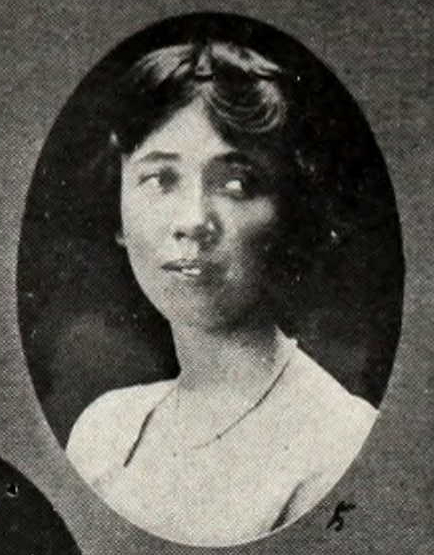
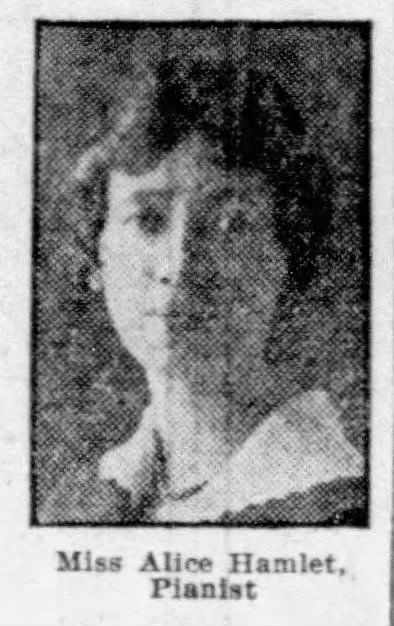
Alice Marion Hamlet was born 24 April 1897, the only child of Lanna and Grace Hamlet, in Boston, Massachusetts, where she would live most of her life. Most of her life was devoted to music; she was a graduate of the New England Conservatory of Music, where she also did advanced studies. U.S. Federal census records for 1930, 1940, and 1950 list her profession as “music teacher” or “piano teacher,” and the newspapers in Massachusetts, New York, and New Hampshire are dotted with notices for her students’ recitals and other notices. Her obituary showed she worked as a music teacher for some 60 years, and never married or had children.

What the census and newspaper data does not show is the other side of Alice M. Hamlet. The literary side of her which found expression in amateur journalism, the reader of fantasy who became a critical influence on H. P. Lovecraft, with whom she corresponded for some years. Exact details of this side of Alice Hamlet are sketchy; none of her letters to Lovecraft or from Lovecraft to her are known to survive, so we are left with a very incomplete picture of their relationship. Yet what we can piece together, through references in Lovecraft’s correspondence and essays, paints a picture of two people who found common interests and enthusiasms.

The first notice we have of Alice M. Hamlet in Lovecraft’s works is a note in the United Amateur for March 1917:

“Pioneers of New England”, an article by Alice M. Hamlet, gives much interesting information concerning the sturdy settlers of New Hampshire and Vermont. In the unyielding struggles of these unsung heroes against the sting of hardship and the asperity of primeval Nature, we may discern more than a trace of that divine fire of conquest which has made the Anglo-Saxon the empire builder of all the ages. […]

[145] “To a Friend”, by Alice M. Hamlet, is particularly pleasing through the hint of the old school technique which its well-ordered phrases convey. The one weak point is the employment of thy, a singular expression, in connexion with several objects; namely, “paper, pen, and ready hand”. Your should have been used. The metre is excellent throughout, and the whole piece displays a gratifying skill on its author’s part.

H. P. Lovecraft, “Department of Public Criticism” in United Amateur 16, No. 7 (Mar 1917), Collected Essays 1.141, 145

Lovecraft had been elected president of the United Amateur Press Association in 1917; based on these comments Alice M. Hamlet was already a member of the United, although David Whittier later claimed to have recruited her in 1919 (see Lovecraft and Lord Dunsany). The comments on her poetry are typical for Lovecraft of the period; he was a stickler for metrical regularity and language, but less expressive of the content of poetry. Perhaps this notice started their correspondence, perhaps that came later.

It interests me to hear of your first perusal of “A Dreamer’s Tales.” Mine was in the fall of 1919, when I had never read anything of Dunsany’s, though knowing of him by reputation. The book had been recommended to me by one whose judgment I did not highly esteem, & it was with some dubiousness that I began reading “Poltarnees—Beholder of Ocean.” The first paragraph arrests me as with an electric shock, & I had not read two pages before I became a Dunsany devotee for life.

H. P. Lovecraft to Clark Ashton Smith, 14 Apr 1929, Dawnward Spire, Lonely Hill 172

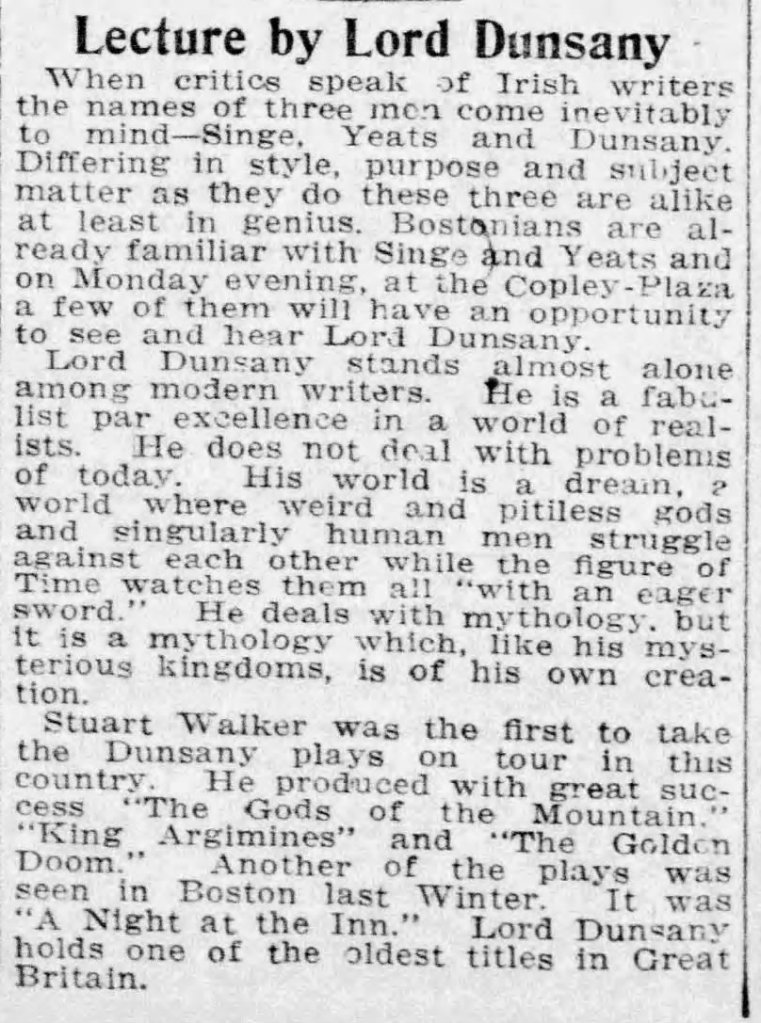
By the fall of 1919, Hamlet and Lovecraft were apparently corresponding and such good friends that she began to recommend or lend books to him. An envelope from Hamlet to Lovecraft postmarked 12 October 1919 survives, which attests to the correspondence. Perhaps it was that letter when she informed him that Lord Dunsany was coming to Boston, and invited Lovecraft to come hear him speak.

Lovecraft would recount the adventure in some detail in a letter:

At 7:00 a party consisting of Miss H., her aunt, young Lee, & L. Theobald set out for the great event. Arriving early at the Copley-Plaza, we obtained front seats; so that during the address I sat directly opposite the speaker, not ten feet from him. Dunsany entered late, accompanied & introduced by Prof. George Baker of Harvard. […]

[146] Egged on by her aunt, Miss Hamlet almost mustered up courage enough to ask for an autograph, but weakened at the last moment. Of this more anon. For mine own part, I did not seek a signature; for I detest fawning upon the great. […] Of course, I could have taken the Prov. train at the adjacent Back Bay, but I hate that bleak barn, & wished to get in the train as soon as it was made up; enhancing myself in a seat & beginning to read Dunsany’s “The Gods of Pegãna”, which Miss H. had kindly lent me. The H.’s invited me to stay all night, but I am a home-seeking soul & the hour was not late. […]

[147] The one sequel to the lecture does not concern me, but deserves narration (an unconsciously egotistical sentence!). Mss H. could not quite give up the idea of an autograph, so on the following day wrote a letter to Dunsany, enclosing several tokens of esteem for him & for his wife; the greatest of which was a genuine autograph letter of Abraham Lincoln. Soon afterward she received a most courteous reply from His Lordship, written personally with his celebrated quill, & containing a pleasant enclosed note from Lady Dunsany! Of this letters from so great an author, Miss H. is justly proud in the extreme; & she will doubtless retain it as a treasure of priceless worth. I will here present a verbatim transcription!

“My dear Miss Hamlet:—

Thank you very much for your kind letter & present, & for the charming little presents to my wife. I had not seen the Lincoln letter before, & I am very glad to have it. It is a stately letter, & above all, it is full of human kindness; & I doubt if any of us by any means can achieve anything better than that.

With many thanks,
Yours very sincerely,
Dunsany

P. S. I’ll write plenty more for you.”

H. P. Lovecraft to Rheinhart Kleiner, 9 Nov 1919, Letters to Rheinhart Kleiner and Others 145, 146, 147

The aunt was Eva Thompson, who lived with Alice and her parents in Dorchester; “young Lee” is unidentified; and “L. Theobald” was one of Lovecraft’s pseudonyms. As well as the Lincoln letter, Alice M. Hamlet had sent Dunsany a copy of the Tryout (Nov 1919) that contained Lovecraft’s poem “To Edward John Moreton Drax Plunkett, 18th Baron Dunsany.” Dunsany replied graciously to this poetic dedication with a letter that was published in the Tryout (Dec 1919). The episode also produced an unexpected sequel:

Well, I got news this trip, fellas! EDWARD JOHN MORETON DRAX PLUNKETT, 18th BARON DUNSANY, is the 1920 Laureate Judge of Poetry for the United Amaeur Press Association! Yep—’s true! I thought of the thing a month or two ago, but did not dare write Ed. THen I decided that he might prove kind if he letter came from one with whom he had previously corresponded, so I asked Miss Hamlet to write him, which she did ℅ the J. B. Pond Lyceum Bureau. For a long time no answer came, and we gave him up for lost. Miss Durr asked asked me to find another judge, and I wrote a Capt. Fielding-Reid of Baltimore, one of the Bookfellows. But Friday Miss Hamlet received a telegram from Ed accepting the post!!!

H. P. Lovecraft to the Gallomo, Apr 1920, Miscellaneous Letters 101

Miss Durr is Mary Faye Durr, president of the UAPA for the 1919-1920 term. Alice Hamlet later gave her impressions of Lovecraft and the Dunsany lecture:

From then on I was one of the “amateurs”. Eventually I put out a little mimeographed paper in conjunction with a John Smith of Orondo, Washington. It was probably through that little literary effort that Mr. Lovecraft became interested in my work. He was very helpful and friendly in his criticisms and suggestions and I greatly appreciated it. But on to Mr. Lovecraft himself: As I remember him he was tall and large-boned—with a long jaw—or perhaps I should say chin—from the lower lip downward. He was rather dark complexioned and was extremely pale. Evidently he was not in very good health. He had severe headaches and never was known to go far from his home—except to hear Lord Dunsany at my invitation. Mr. Lovecraft’s style of writing was highly imaginative as was Dunsany’s and I thought Mr. Lovecraft would greatly enjoy hearing the Irish poet. There was this difference between the writers’ literary output—Lovecraft resembled Edgar Allan Poe, with his stark and wild imaginings: Dunsany wrote in almost Biblical style, with prose that was almost poetry. Mr. Lovecraft’s vocabulary was very extensive, at times Johnsonian, and his letters were long and examples of a skilled writer who knew what he wanted to say and how to say it. The attendance at the Dunsany lecture was surely a milestone in his life—and a great inspiration to me and one of my treasured memories. The young man who went with us was Ed Lee. He was not “literary” and probably Mr. Lovecraft and I were both a sort of gentle amusement to him!

As far as I can remember, he (Lovecraft) went back to Providence the night of the Dunsany lecture. He was immensely impressed and I can well imagine the occasion was a spur to his writing professionally. I never considered Mr. Lovecraft handsome and I am sure he was never interested in me as a girl! We merely had similar tastes which made for a congenial acquaintance. He was always courteous—“the old school gentleman”—although he must have been in the early thirties (his age) when I knew him.

quoted from “Lovecraft and Lord Dunsany”

This lecture and its aftermath were not the end of Lovecraft and Hamlet’s association, which continued through their mutual involvement in the United. Hamlet herself was one of the manuscript managers for the association, along with Olga Zeeb. When Lovecraft addressed a recruit to the amateur organization, he wrote:

I trust you will call upon our MS. Managers, Misses Hamlet & Zeeb, whenever you need copy.

H. P. Lovecraft to Arthur Harris, 16 May 1920, Letters to Rheinhart Kleiner and Others 242

Alice M. Hamlet would enter United politics herself, being elected 2nd Vice President in 1920, when Lovecraft served as Official Editor. They seemed to still be on good terms, as he apparently gifted her a copy of Oscar Wilde’s Fairy Tales and Poems in Prose (1918), along with a poem “With a Copy of Wilde’s Fairy Tales.”

The culmination of their growing friendship occurred 4-5 July 1920, when Lovecraft came to Boston to attend a gathering of amateurs who could not attend that year’s national convention in Cleveland. It was the first time since 1901 that he had slept under someone else’s roof away from home (LWH 49-50)—as a guest of Alice M. Hamlet (chaperoned by her aunt); Edith Miniter amusingly referred to the arrangement in her coverage of the get-together:

I was tucked up in my crib hours before the house was still. Mrs. THompson and her niece, Miss Hamlet, took Mr. Lovecraf with them to Dorchester, ’cause he said he’d just go[t] to have a “quiet room to himself,” and there’s no such thing here, though there’s 18 rooms and 6 halls in this establishment.

Edith Miniter, “Epgephi Maisuings” in Epgephi (Sep 1920)

Perhaps the book was a gift on this occasion, or soon after as thanks for her hospitality. By the end of the year, Lovecraft noted:

Our new Second Vice-President, Miss Alice M. Hamlet, is taking a post-graduate course at the New England Conservatory of Music, and bids fair to become one of Boston’s most accomplished musical instructors.

H. P. Lovecraft, “News Notes” in United Amateur 20, No. 2 (November 1920), Collected Essays 1.264

Despite her studies, Hamlet was apparently still active in amateur journalism, and even worked to recruit new members such as Myrta Alice Little, who would also become one of Lovecraft’s correspondents.

For securing Miss Little as a member, credit is due to our energetic Second Vice-President, Alice M. Hamlet.

H. P. Lovecraft, “News Notes” in United Amateur 20, No. 3 (January 1921), Collected Essays 1.268

On 17 August 1921, Lovecraft made another trip to Boston to visit his amateur friends. At this point, political divisions between the United and National Amateur Press Associations had risen (and within the United itself), which made for a bit of awkwardness when visiting. Lovecraft wrote of the trip:

The Hub Club meeting was yesterday, but on account of the increasing political gap betwen the (Nationalite) Hub element & the United, she set Wednesday as the day for conferring at length with the United element—W. V. Jackson, Miss Hamlet, Mrs. McMullen, &c. Naturally, the United Day was my day! The conference was to be held at 3 p.m. at the Curry School of Expression on Huntington Ave. near the village square—just across the street from Mr. Copley Plaza’s boarding house where I heard Dunsany lecture in 1919. This hour would have been very convenient for me; but Miss Hamlet, who had also been notified, asked me to precede the event with a Dorchester call—since she did not care to attend the session for fear of meeting some of the National members whom she detests so thoroughly. Alas for the complexity of local feuds! […]

Reaching Back Bay at 1:44, I proceeded to Dorchester for a brief call of courtesy—when lo! I found that my tardiness had set awry a disconcerting amount of preparation which had been made, all unknown to me, in my honour. It seems that the Hamlets had arranged a flying motor trip to Quincy to see poor Mrs. Bell the impoverished invalid, & that they had waited for me until just six minutes before my belated arrival; finally departing lest they disappoint their aged hostess. As a matter of prosaic fact, my loss of this trip caused me no very profound grief; but the Dorcastrians seemed amazingly disappointed. The aunt, Mrs. Thompson, insisted on calling up Miss H. at the Quincy City Home, & Miss H. appeared to view the exploded schedule as little short of calamitious. Considering my insignificance, such concern was of course flattering—but I could not politely leave the telephone & proceed to Copley Square till I had consumed to make another Boston trip before Labour Day, for which the Hamlets wish to prepare some picnic or special event to make up for the present fiasco. Such super-hospitality is very pleasingvbut it does not pay any railway fares! Incidentally—Miss H. has taken upon herself the humane task of trying to rescue Mrs Bell from the institution which so humiliates her. She is trying to look up Bell relatives—the family is old & prominent—& to interest the Uniterian church to which Mrs. B. belongs. A worthy task, though possibly a futile one.

H. P. Lovecraft to Annie E. P. Gamwell, 19 Aug 1921, Letters to Family & Family Friends 1.38

Lovecraft did manage to visit the Hamlets later on the trip:

And speaking of bores—as I puffed out of Haverhill the Hamlet call still lay ahead of me. I had given a forewarning that I might be “unavoidably” delayed till evening, and hoped my prospective hosts would not do anything elaborate—but Gawd ‘elp us! When I finally reached there via B. & M., elevated, and surface car, I found that they had a near-conventions tagged for me! There was an ambitious dinner of lamb and sundry fixings, and many reproaches at my “unavoidable” tardiness. As a local delegate Miss Hamlet had unearthed a literary proteged of hers—the Mildred LaVoie whose name has lingered inactively on our lists since 1916, and who is a young person of undistinguished aspect and ancestry; not uncomely, but more suggestive of the artless nymph than of the fictional titan. This quiet and unassuming individual writes stories, but is afraid to send them anywhere—even to TRYOUT—for publication; hence has remained an amateur nonentity for five years despite the efforts of Miss Hamlet to bring her genius to the world’s notice. I was not vey enthusiastic about the process of LaVoian assimilation till after the maid in question had departed, and Miss H. produced a story of hers which she had secured surreptitiously. Then I perceived that the work was not half bad in its way—shewing at least clear observation, command of detail, and a keener picture of the subject matter than mere words. It is surely with printing, and I shall accommodate Miss Hamlet by placing it somewhere where its appearance will duly surprise its over-modest creator—Lawson’s WOLVERINE ought to stand for it. But after all, I was paid for my politeness in making the Dorcastrian detour. Just before I beat it for the 11:45 I was given the loan of a new book which I am told is the msot horrible collection of short stories recently issued! It is called “The Song of the Sirens” [1919], and is by one Edward Lucas White, who claims he dreamed all the ghoulish things described.

H. P. Lovecraft to the Gallomo, 31 Aug 1921, Miscellaneous Letters 116

No overnight stay this time around—and this was effectively the final direct reference to Alice M. Hamlet in Lovecraft’s letters, though there are a few oblique references to her having introduced him to the works of Lord Dunsany. Why their friendship seems to peter out at this point is uncertain, although it has to be pointed out that Lovecraft met his future wife Sonia H. Greene at an amateur convention in Boston in 1921, and the rise of that relationship seemed to spell the dwindling of Lovecraft’s connections with women amateur journalists such as Winifred Virginia Jackson.

Rumors have connected Lovecraft romantically to nearly every female amateur journalist of approximately his own age he ever interacted with, but Alice M. Hamlet’s connections with him have been too vague to suggest anything concrete in that direction. They must, at the least, have appreciated one another, as the exchange of books showed a remarkable taste for fantasy and weird fiction, rare enough in amateur circles. Whether the friendship continued in letters for a while, or drifted apart as their lives took different directions, we just don’t know.

It is difficult to overstate the impact Hamlet had on Lovecraft, however unintentionally: Lord Dunsany was a powerful and formative influence on his fiction, one which Lovecraft would emulate, and then work diligently to not emulate and find his own voice, throughout his life. She helped draw him further out of his reclusive shell that he had fallen into after his failure to attend college or find a job as an adult. Amateur journalism put him in touch with people he had never met, exposed him to ideas he had never heard of, challenged his views in many ways—and Alice M. Hamlet was a part of that. With that experience, with that encouragement, Lovecraft would ultimately travel further, experience more, think harder, and write better than he ever had before.

Alas, there is too little to say much more about their friendship. The letters are lost to us.


Bobby Derie is the author of Weird Talers: Essays on Robert E. Howard and Others and Sex and the Cthulhu Mythos.

Deep Cuts in a Lovecraftian Vein uses Amazon Associate links. As an Amazon Associate I earn from qualifying purchases.
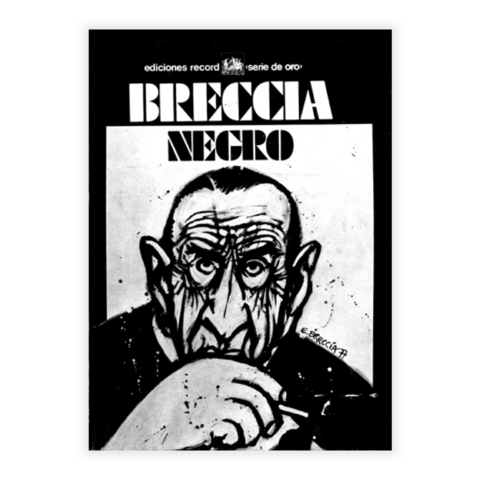
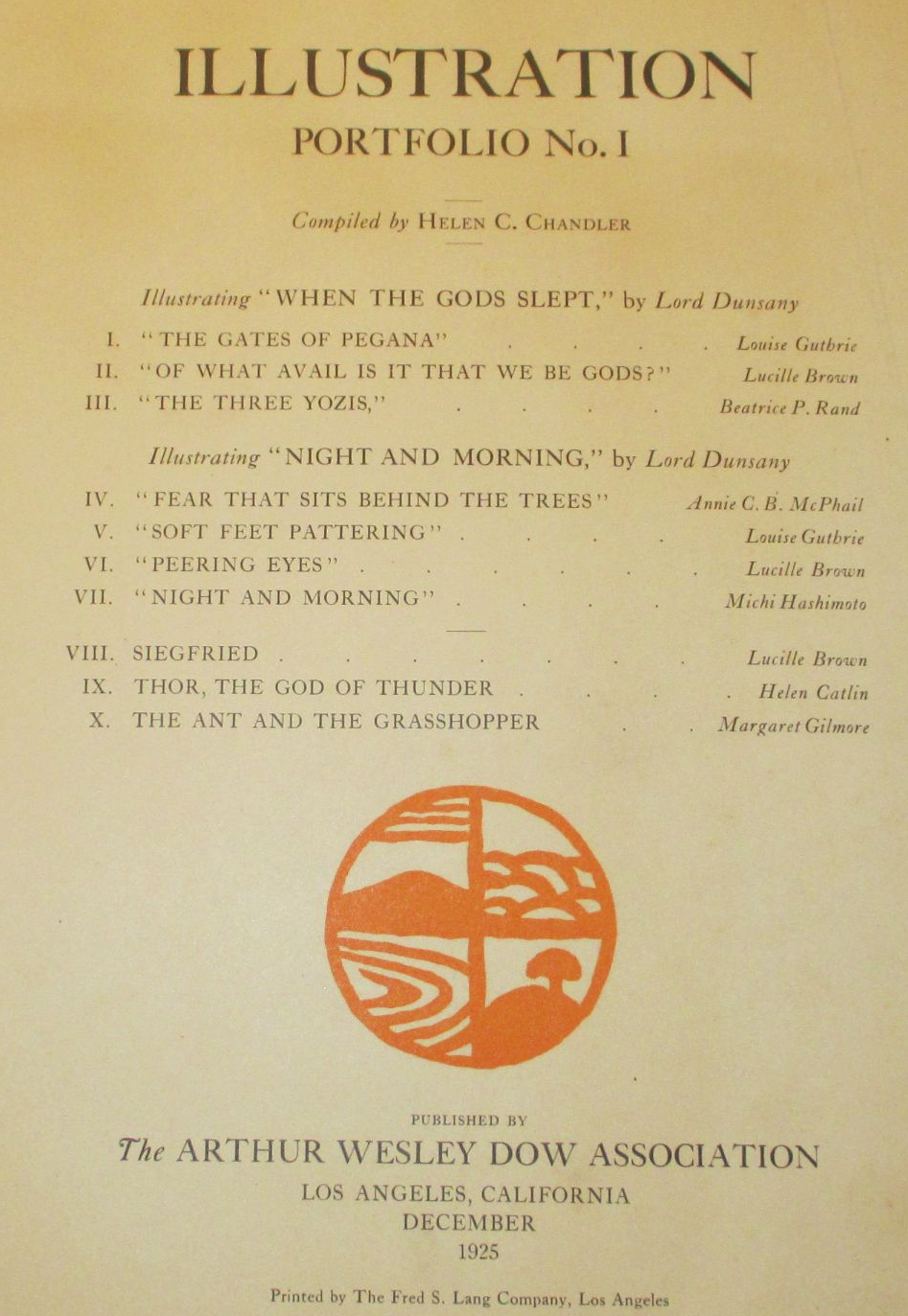
Illustration Portfolio No. 1 (1925) by The Arthur Wesley Dow Association

There’s no use in my trying to tell you what they were like, because the awful, the blasphemous horror, and the unbelievable loathsomeness and moral foetor came from simple touches quite beyond the power of words to classify. There was none of the exotic technique you see in Sidney Sime, none of the trans-Saturnian landscapes and lunar fungi that Clark Ashton Smith uses to freeze the blood.
—H. P. Lovecraft, “Pickman’s Model”

When fans think of the artwork most associated with the literary works of Lord Dunsany, the first and last name is Sidney H. Sime, whose fantastic illustrations graced The Gods of Pegāna (1905) and most of Dunsany’s other fantasies. Sime also contributed art to illustrate works by Arthur Machen and William Hope Hodgson, and Lovecraft held him up in his fiction and letters as an artistic genius. Today, when fantastic art is so widely available online, and of such a high quality due to the proliferation in books and courses of technique and the availability of tools and materials, readers might lose sight of how rare and precious really good fantasy art was back in Lovecraft’s time…yet even in 1925, when Weird Tales was only a couple of years old and still finding its feet, Lord Dunsany’s fantasies inspired a group of women artists…and found publication.

The Arthur Wesley Dow Association was founded at the University of California, Southern Branch (now UCLA) in 1922. Materials related to this portfolio (presumably the original art or proofs) are still held at the UCLA library. This portfolio appears to have been begun as early as 1923, and was published in 1925. Compiled by Helen C. Chandler, a professor of arts at the University of California.

Dow1

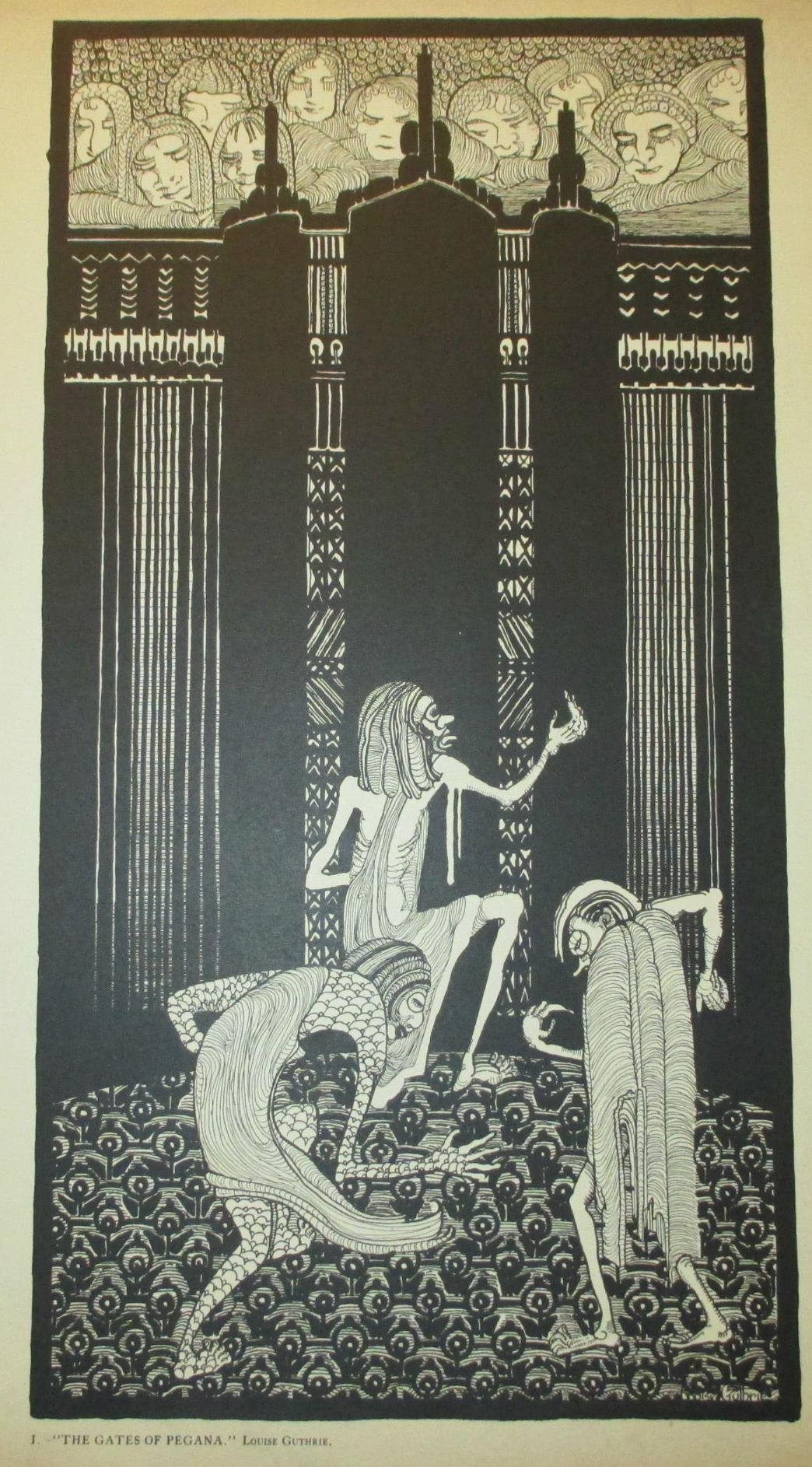
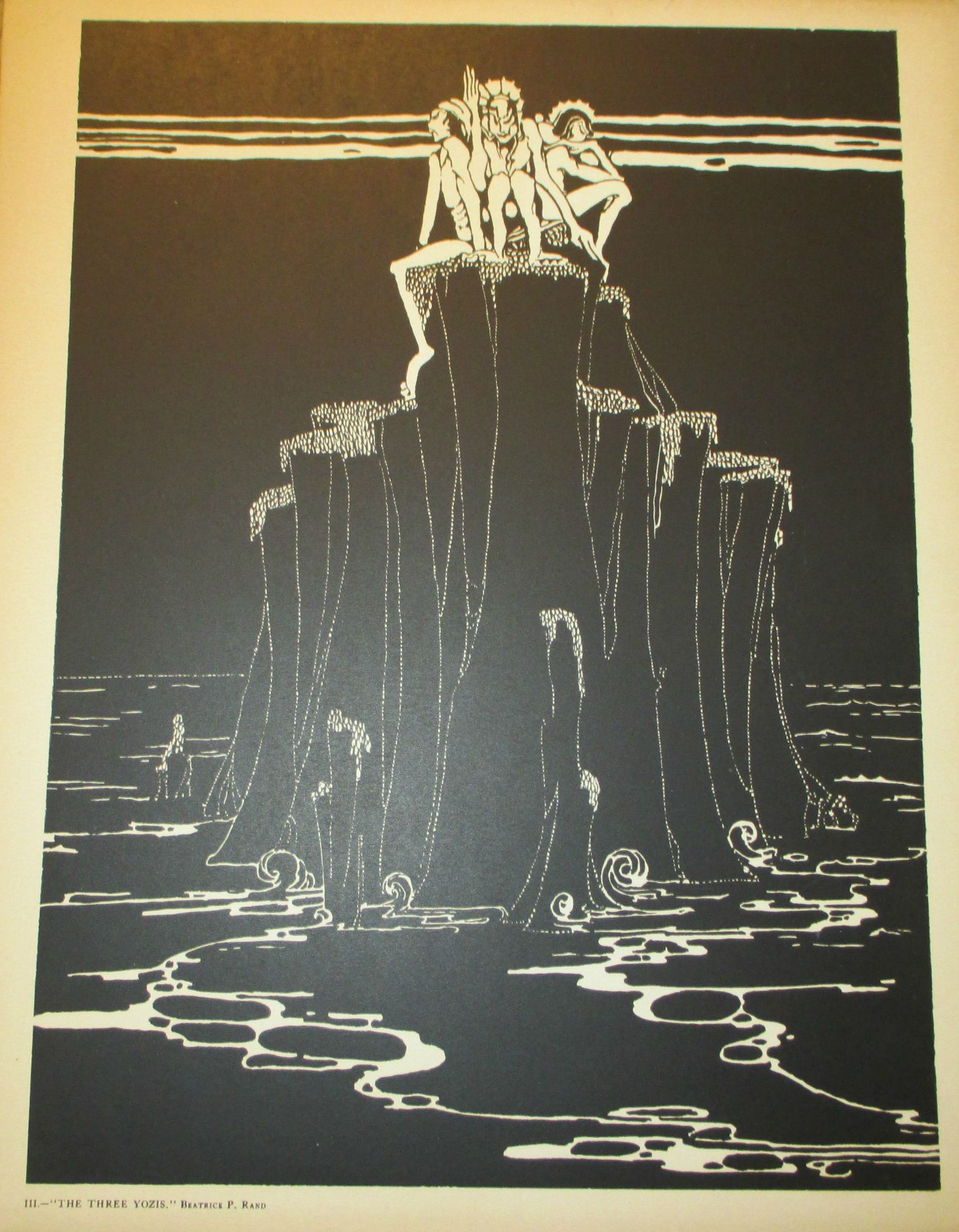
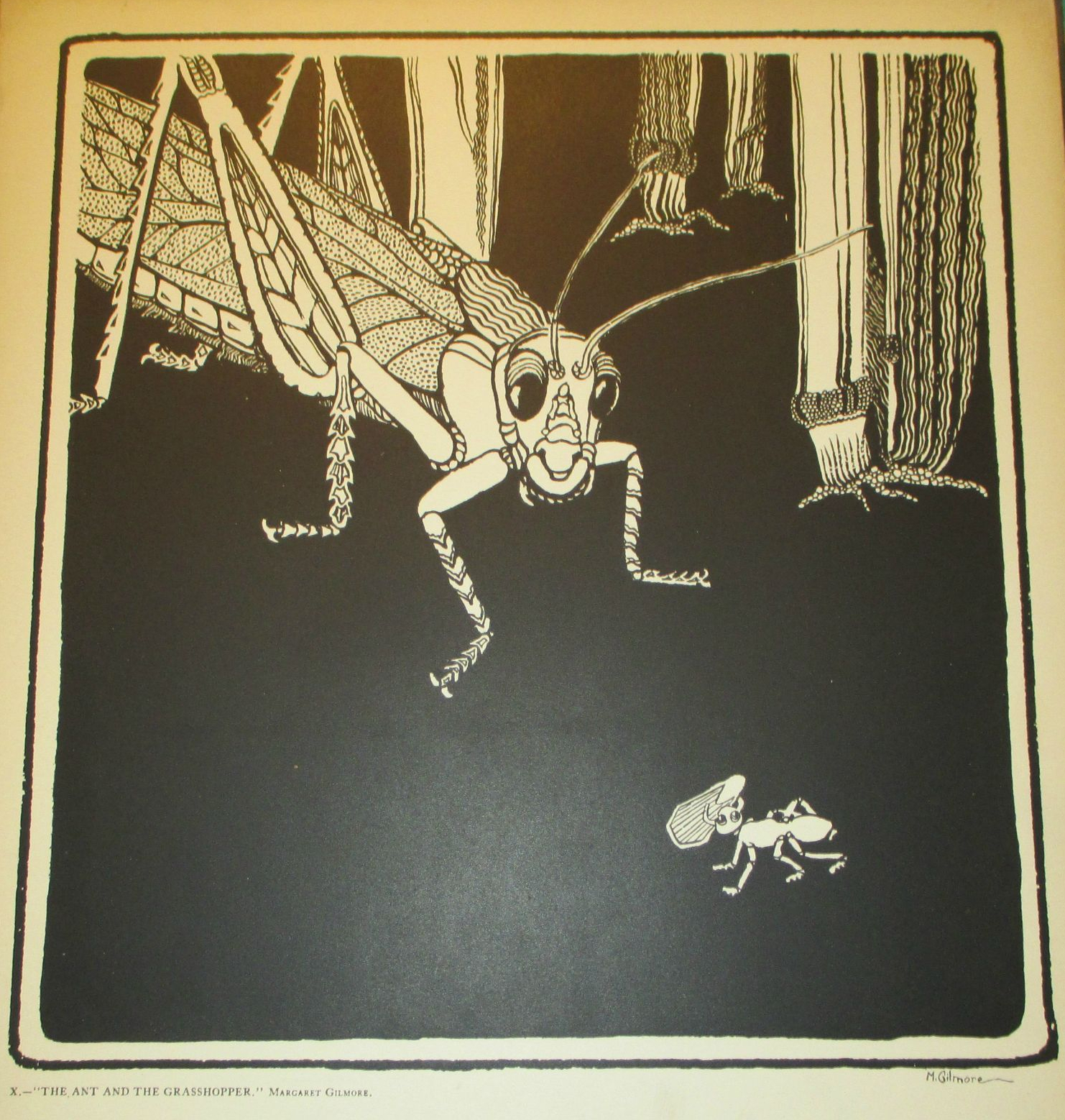
In form, this is ten unbound black-and-white plates—seven plates by five artists illustrate two stories drawn from Lord Dunsany’s collection Time and the Gods (1906). They represent interpretations of Lovecraft’s work. Not copying Sime, but presenting their own interpretations, in their own medium and style.

Dow2

All the gods were sitting in Pegāna, and Their slave, Time, lay idle at Pegāna’s gate with nothing to destroy, when They thought of worlds, worlds large and round and gleaming, and little silver moons. Then (who knoweth when?), as the gods raised Their hands making the sign of the gods, the thoughts of the gods became worlds and silver moons. And the worlds swam by Pegāna’s gate to take their places in the sky, to ride at anchor for ever, each where the gods had bidden. And because they were round and big and gleamed all over the sky, the gods laughed and shouted and all clapped Their hands. Then upon earth the gods played out the game of the gods, the game of life and death, and on the other worlds They did a secret thing, playing a game that is hidden.
—Lord Dunsany, “When the Gods Slept”

Today, artwork like this might be classified by some as “fanart.” The term is often somewhat derogatory, regardless of the skill, imagination, or time put into the piece. The distinction between “art” and “fanart” grew up in the organized science fiction fandom of the 1930s, at the same time when lines were drawn between “fan” and “pro”—those writers and artists who were good enough to graduate from amateur efforts to actually sell their work professionally to magazines. At the time these works were made, the distinction did not exist. There were, certainly, amateur writers and artists in abundance—but the hallmark of the work was its quality, not necessarily who or why it was made.

Dow3

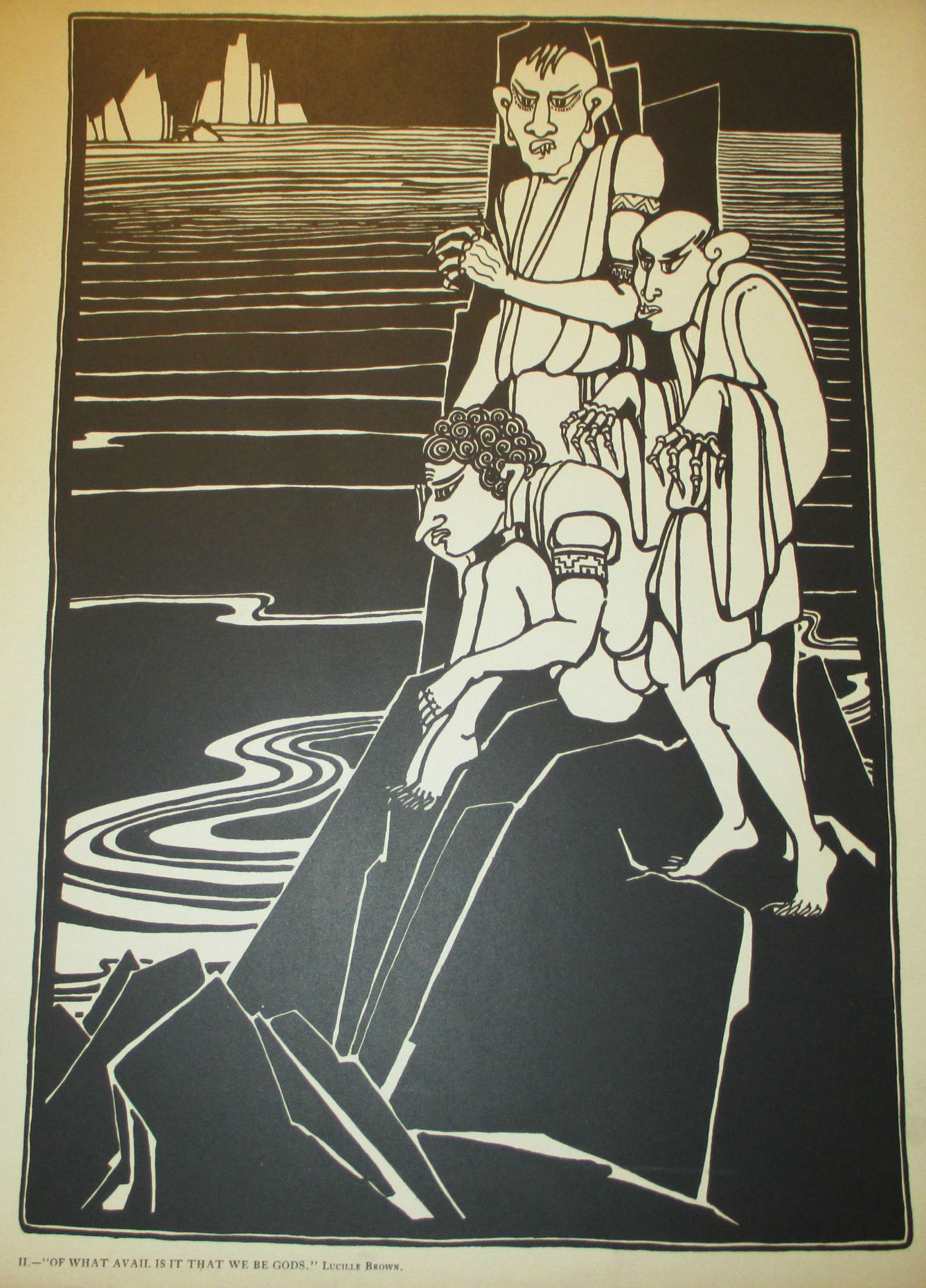
Thus the Yozis became gods, having the power of gods, and they sailed away to the earth, and came to a mountainous island in the sea. There they sat upon the rocks, sitting as the gods sit, with their right hands uplifted, and having the power of gods, only none came to worship. Thither came no ships nigh them, nor ever at evening came the prayers of men, nor smell of incense, nor screams from the sacrifice. Then said the Yozis:

“Of what avails it that we be gods if no one worship us nor give us sacrifice?”

And Ya, Ha, and Snyrg set sail in their silver galleons, and went looming down the sea to come to the shores of men.
—Lord Dunsany, “When the Gods Slept”

It is significant that the artists in this portfolio were women, because women were generally underrepresented as artists in fantasy and weird fiction at this time (and would continue to be for decades after), prominent exceptions like Margaret Brundage not withstanding. Yet the art itself is not distinctly “feminine” any more than it is “fanart.” These are labels that we as readers, trying to fix this art into a familiar framework, might hang on these pieces, but by themselves they are starkly beautiful, with the vast solid expanses of black still vivid after nearly a century, even though the cover of the portfolio has faded and some of the page-edges are soiled and torn.

Dow4

But as the gods slept, there came from beyond the Rim, out of the dark and unknown, three Yozis, spirits of ill, that sailed up the river of Silence in galleons with silver sails. Far away they had seen Yum and Gothum, the stars that stand sentinel over Pegāna‘s gate, blinking and falling asleep, and as they neared Pegāna they found a hush wherein the gods slept heavily. Ya, Ha, and Snyrg were these three Yozis, the lords of evil, madness, and of spite. When they crept from their galleons and stole over Pegāna‘s silent threshold it boded ill for the gods.
—Lord Dunsany, “When the Gods Slept”

In creating his own mythology, moving outside of the established gods and monsters of familiar myth and legend, Dunsany was breaking some of the rules and conventions. He is often very nondescriptive of the entities in his stories, letting the reader fill in the blanks. The Yozis in their different incarnations do not attempt to directly map to any traditional form of stock evil; they are not pitchfork-carrying devils with horns and bifurcated tails in their literary descriptions, nor do the artists attempt to render them as such. Left without much traditional guidance, each artist is forced to imagine and depict them in her own way.

Dow5

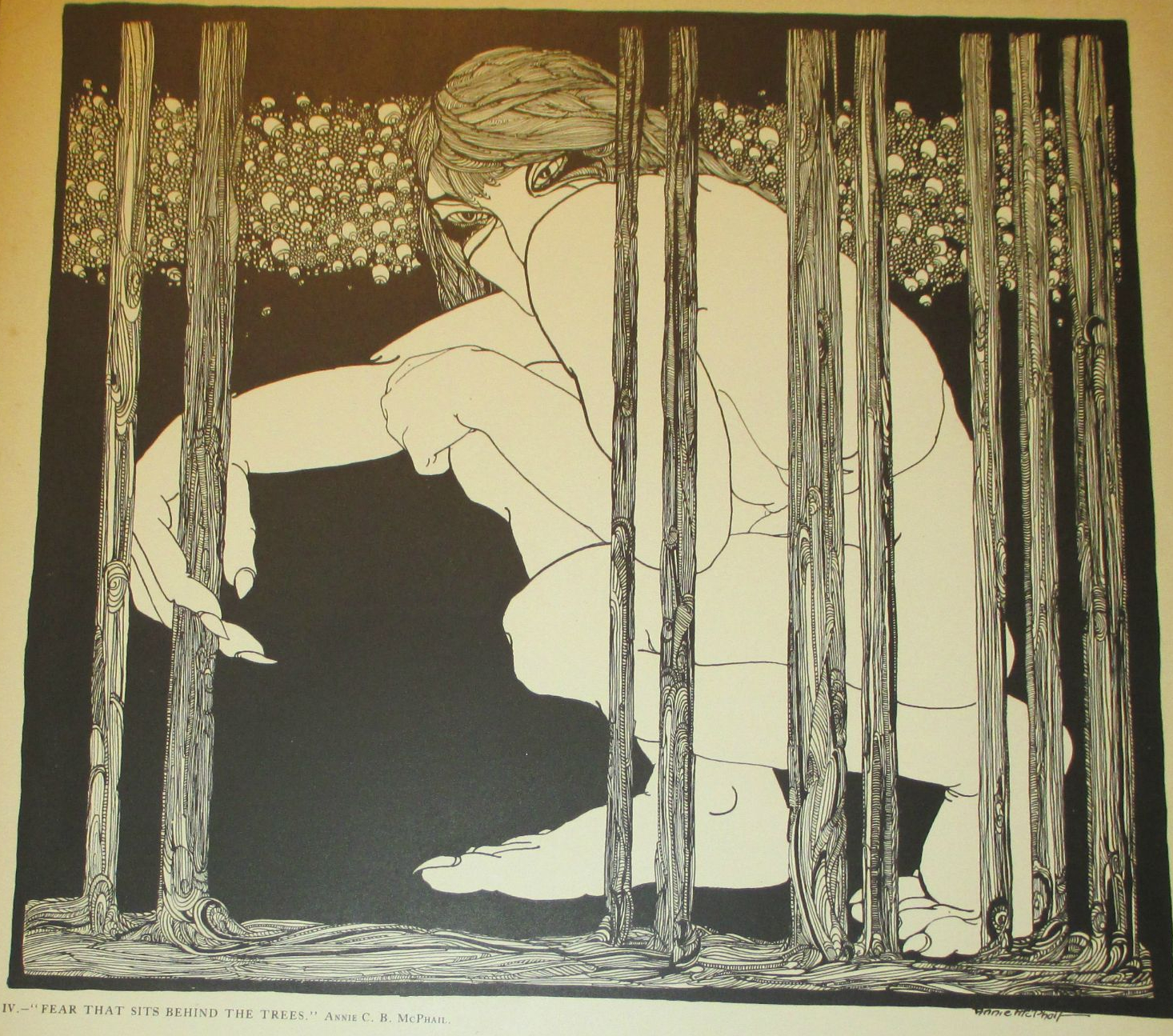
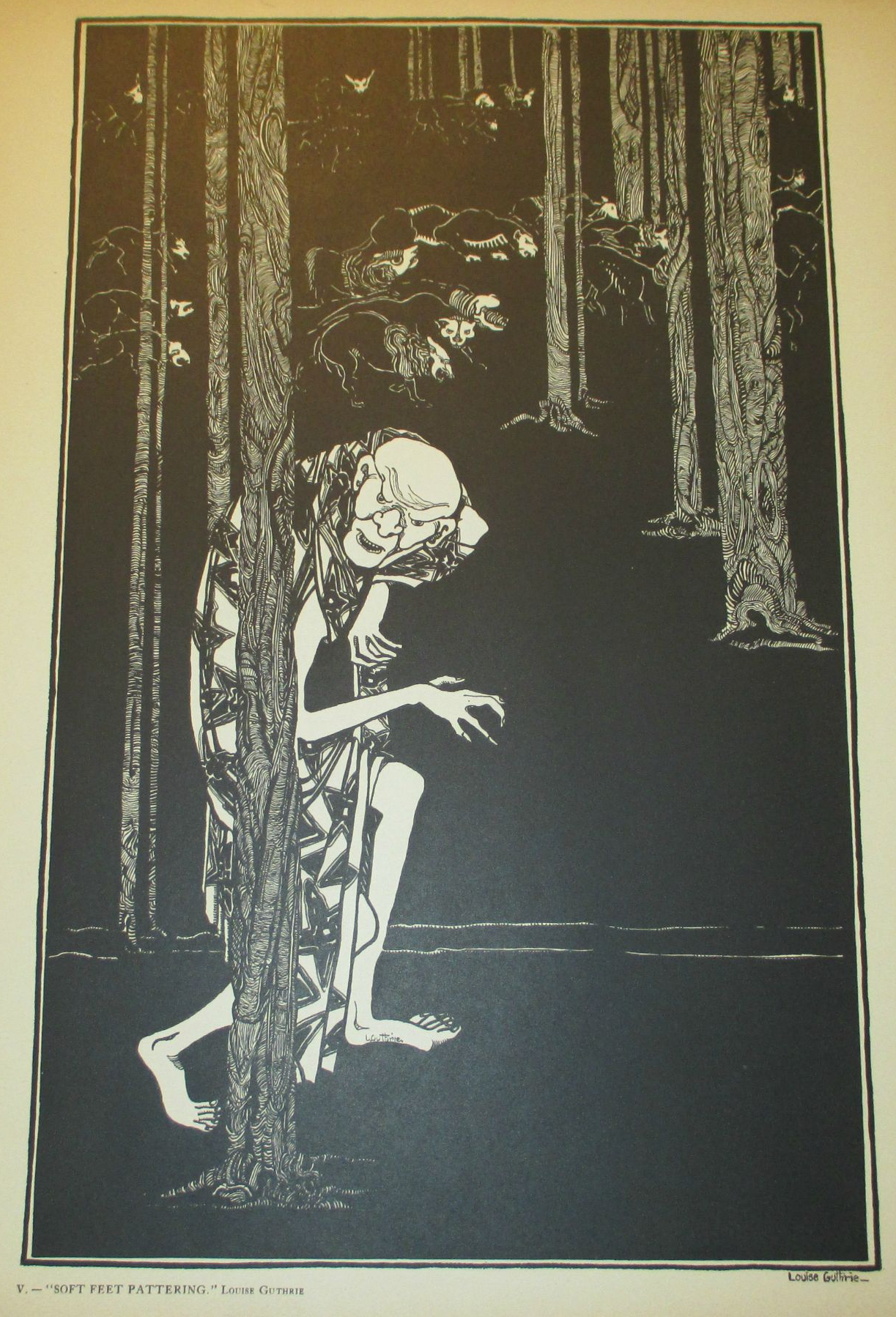
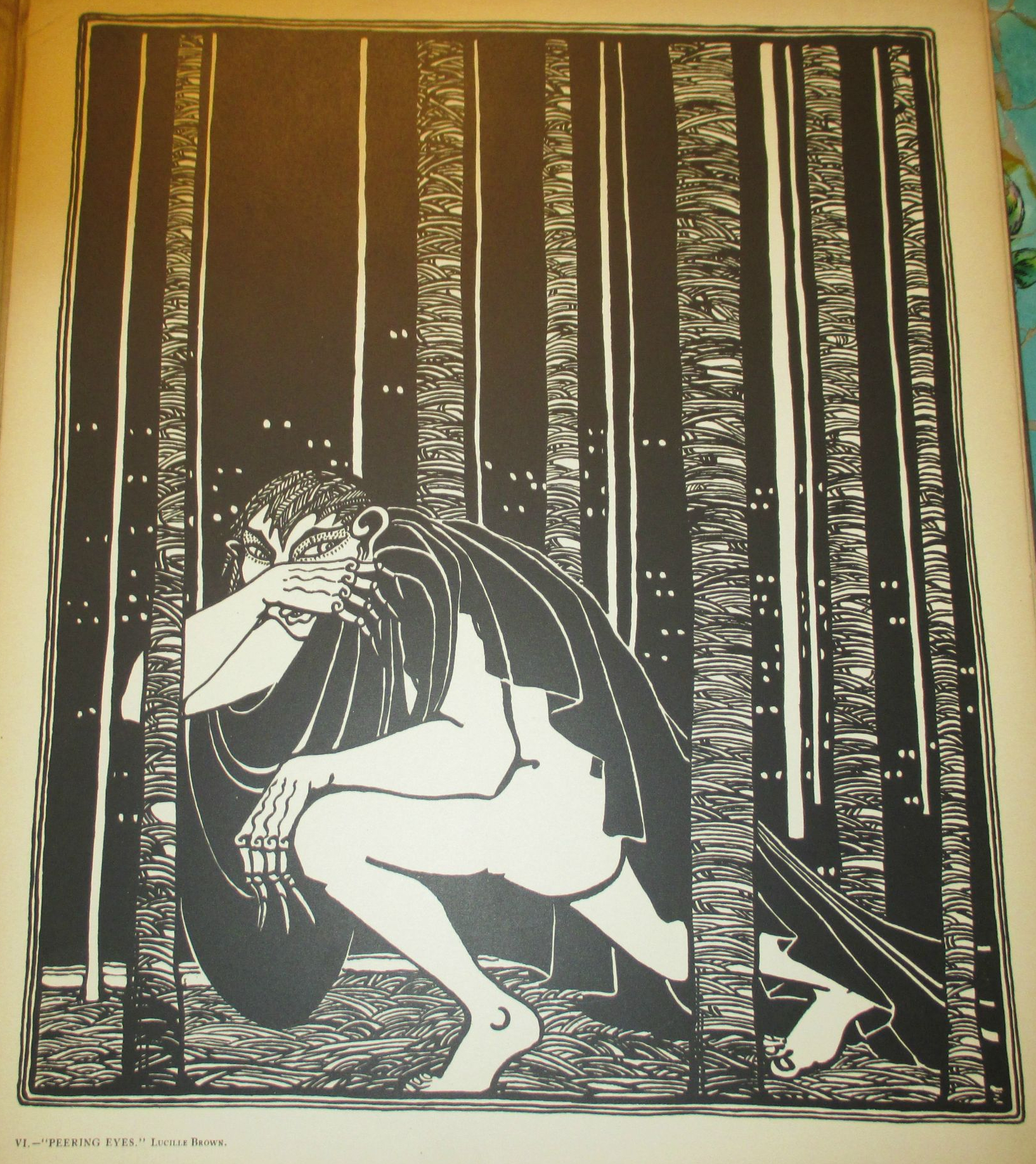
And Night spoke of the forest and the stirring of shadows and soft feet pattering and peering eyes, and of the fear that sits behind the trees taking to itself the shape of something crouched to spring.
—Lord Dunsany, “Night and Morning”

Free of restriction to normal conventions of what such fantastic scenes might look like, some of the artists experimented with depictions of scale and contrast. There is an exaggeration of the human form in the crouched figure staring out of the page that recalls Aubrey Beardsley.

Dow6

Look at the trees, how the different artists defined their bark and roots. There’s nothing wrong with the fact that each chose her own means of expression; they were not collaborating on a single narrative, but each offering their own interpretations. If Lord Dunsany wrote the myth, then these artists were each storytellers, presenting the stories in their own way.
 

Dow7

And Night spoke of the forest and the stirring of shadows and soft feet pattering and peering eyes, and of the fear that sits behind the trees taking to itself the shape of something crouched to spring.
Lord Dunsany, “Night and Morning”

Different is good. While many fans such as H. P. Lovecraft sincerely appreciated the combination of Lord Dunsany and S. H. Sime, that is still only one possible combination—other artists, working on their own, might find their own way to express what visions Dunsany’s prose gives to them, and it detracts nothing from Sime to say that some other artist might find something in their own work that lacks from his. They are only different points of view, not in competition.

Dow8

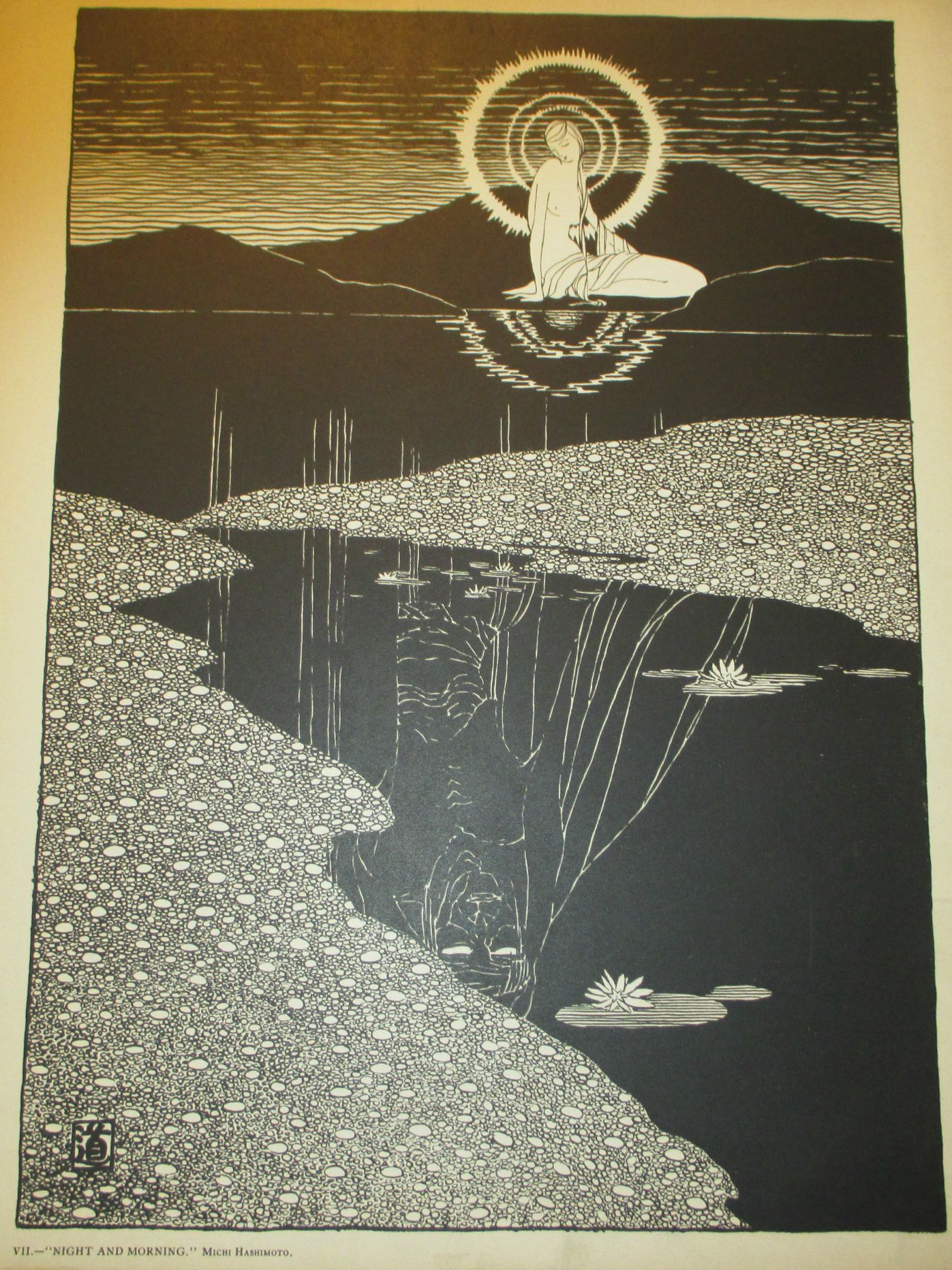
Once in an arbour of the gods above the fields of twilight Night wandering alone came suddenly on Morning. Then Night drew from his face his cloak of dark grey mists and said: “See, I am Night,” and they two sitting in that arbour of the gods, Night told wondrous stories of old mysterious happenings in the dark. And Morning sat and wondered, gazing into the face of Night and at his wreath of stars.
Lord Dunsany, “Night and Morning”

Michi Hashimoto is the only Japanese-American in this portfolio; she had graduated from UCLA in 1924. Her interpretation draws deliberately on both Japanese and Western aesthetics—fitting, given how extensively Dunsany himself drew on traditions of exoticism and Orientalism to lend an air of the exotic to his stories. There is some irony there, almost, in an artist capturing something of the “authentic” exotic to this scene.

Dow9

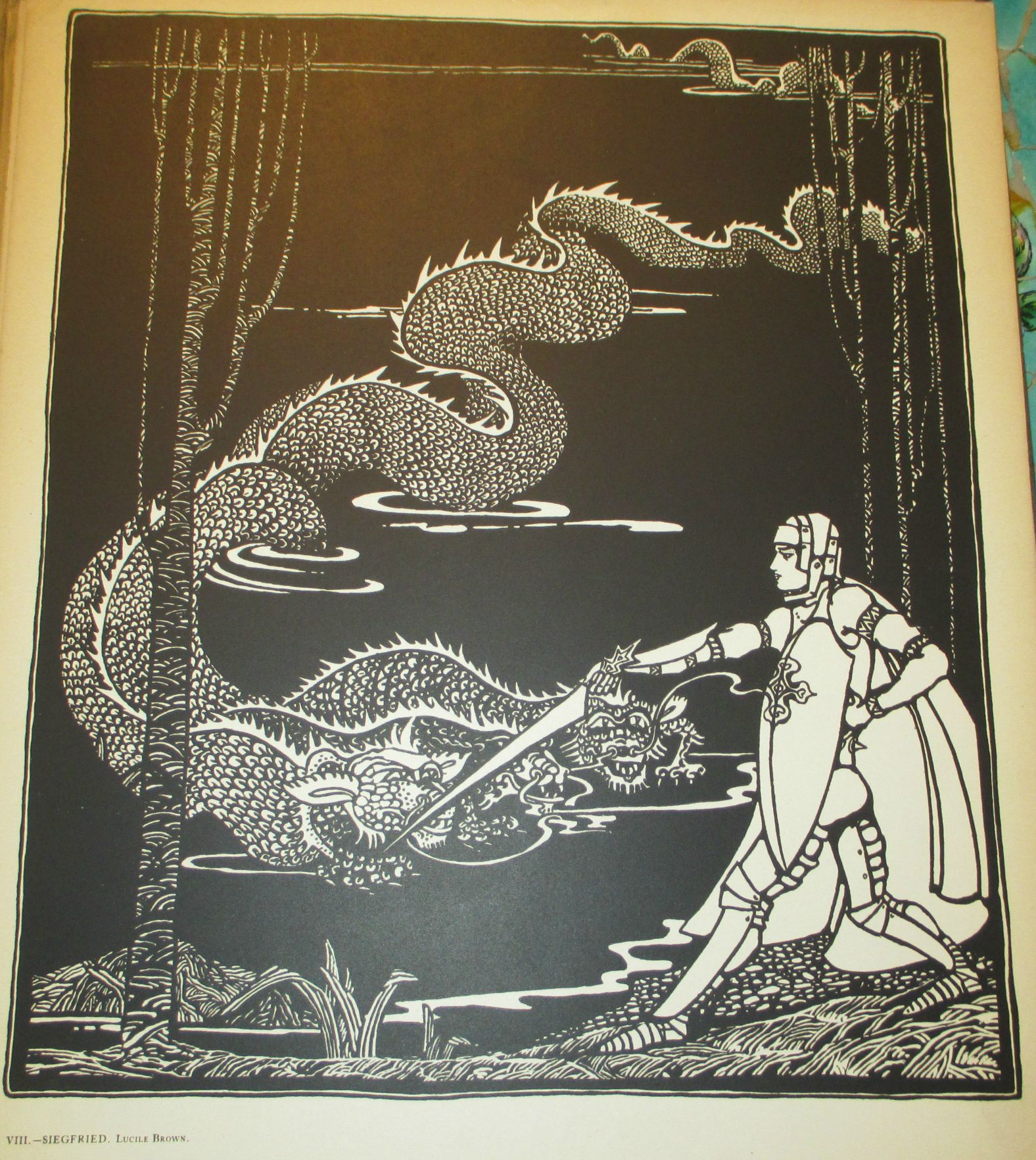
Compare this scene, with the hero of the Nibelunglied (a Western fantasy if there ever was one), encountering a three-headed dragon that obviously draws on depictions of Chinese dragons. This kind of correspondence and amalgamation  can work—compare with the Monster Girl Encyclopedia II (2016) by Kenkou Cross (健康クロス)—but there is definite juxtaposition of incongruous elements in having the Western hero/knight facing an Eastern dragon in this interpretation.

Dow10

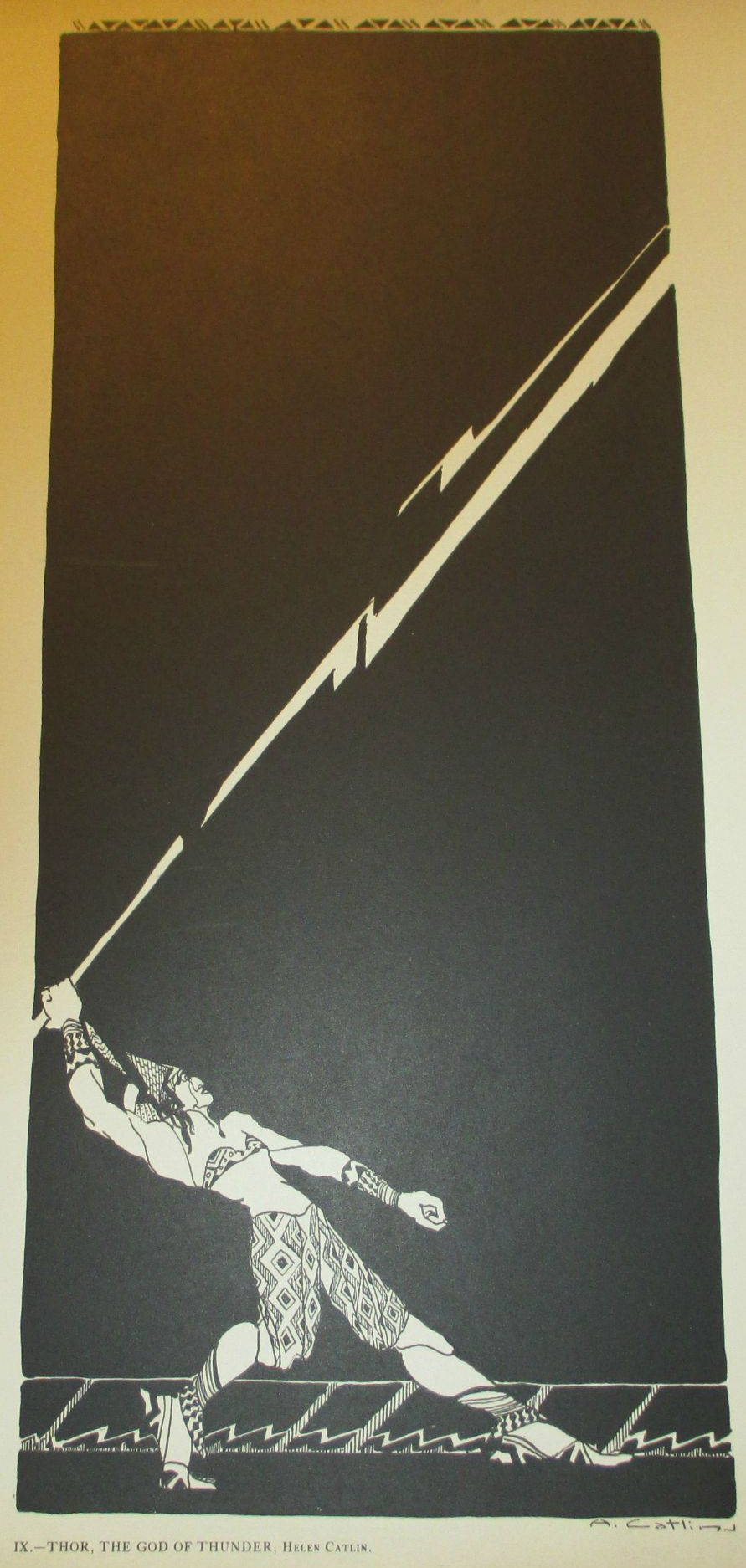
This atypical (per-Marvel Comics, at least!) interpretation of Thor underscores the overall theme of this portfolio: these are myths. Some old, some contemporary, but for all that just stories to be told and retold—and they aren’t set in stone. How we look at a Mythos can change based on the syntax of our lives. There is no one true canon depiction of Thor, or the Yozis, or Cthulhu.

Dow11

Illustration Portfolio No. 1 needs not have any particular moral or lesson. The artists of this volume were producing art, and left no particular comment on how it should be interpreted or understood. Yet by its very existence, and looking at these works, readers might do well to reflect on the nature of art and interpretation in the Mythos. Sometimes, there is no one right answer, no single truth.

There are only many different people working out their vision, in their own styles and with their own influences, and the different combination of art and text can sometimes mean more than either does separately.


Bobby Derie is the author of Weird Talers: Essays on Robert E. Howard & Others (2019) and Sex and the Cthulhu Mythos (2014).

“Lord Dunsany’s Teapot” (2011) by Naomi Novik

In September [1917] I went to the 7th 8th Battalion of the Inniskilling Fusiliers. we used to be in front of Croisilles, when we were in the line, and in a sunken road through the village itself when we were in reserve. When we were out of the line we lived at a place that had been Ervillers, four miles back, where the bombing planes used to call us every morning, but never hit us. That was in the desert of the Somme.  We never saw any animals there except mice, and an army horse or two; and, when the rooks flew over at evening, they passed out of our sight before they could find trees. There was something melancholy in watching this flight over a land that for centuries had been fertile: it was pleasanter to look at our aeroplanes returning at about the same hour, like adventurous mountaineers descending cloud-mountains. Sometimes we met American soldiers there, who for some while had been arriving in large numbers, men with red healthy faces.
—Lord Dunsany, Patches of Sunlight (1938) 296

The success of The Thackery T. Lambshead Pocket Guide to Eccentric & Discredited Diseases (2003) led to a sequel: The Thackery T. Lambshead Cabinet of Curiosities (2011). The first book is essentially a standalone volume similar to The Starry Wisdom Library (2014): a collection of short fictional works done in the style of a reference guide, with all the fantastic, science fiction, weird, and supernatural ailments and symptoms pretending to co-exist in the same setting. The Cabinet of Curiosities is nominally framed along the same lines, as items in the fictional Thackery T. Lambshead’s eccentric collection, but the guidelines on what constitutes an “entry” are less rigid…so what it really turns out to be is a collection of disconnected pieces of various lengths and styles. Some resemble actual write-ups like one might find in a good SCP wiki entry, and others are simply short stories with, perhaps, a note at the end that explains how it got to be part of Lambshead’s collection. Some of them don’t even have that.

The trench had scarcely been dug. Dirt shook loose down upon then, until they might have been part of the earth, and when the all-clear sounded at last out of long silence, they stood up still equals under a coat of mud, until Russel bent down and picked up the shovel, discarded, and they were again officer and man.

But this came too late: Edward trudged back with him, side by side, to the more populated regions of the labyrinth, still talking, and when they had reached Russell’s bivouac, he looked at Edward and said, “Would you have a cup of tea?”
—Naomi Novik, “Lord Dunsany’s Teapot” in The Thackery T. Lambshead Cabinet of Curiosities 118

Edward John Moreton Drax Plunkett, 18th Baron of Dunsany, was one a writer’s writer. Never a bestseller, he was still highly esteemed by many as one of the greatest fantasists to ever live, and one of the most influential. His stories of “beyond the fields we know,” written briefly around the turn of the century, would provide the inspiration for H. P. Lovecraft’s Dreamlands and for “The Call of Cthulhu.” During his service in the British Army during World War I, the 39-year old Anglo-Irish peer was appointed a Captain in the Royal Inniskilling Fusilliers, and spent time in the trenches in France, where this story is set.

After the war was over, Lord Dunsany would travel on a tour of the United States. In Boston in 1919, a 29-year old H. P. Lovecraft would be too self-conscious to ask his idol for an autograph.

You come to the trenches out of strangely wasted lands, you come perhaps to a wood in an agony of contortions, black, branchless, sepulchral trees, and then no more trees at all. The country after that is still called Picardy or Belgium, still has its old name on the map as though it smiled there yet, sheltering cities and hamlet and radiant with orchards and gardens, but the country named Belgium—or whatever it be—is all gone away, and there stretches for miles instead one of the world’s great deserts, a thing to take its place no longer with smiling lands, but with Sahara, Gobi, Kalahari, and the Karoo; not to be thought of as Picardy, but more suitably to be named the Desert of Wilhelm. Through these sad lands one goes to come to the trenches. Overhead floats until it is chased away an aëroplane with little black crosses, that you can scarcely see at his respectful height, peering to see what more harm may be done in the desolation and ruin. Little flashes sparkle near him, white puffs spread out round the flashes: and he goes, and our airmen go away after him; black puffs break out round our airmen. Up in the sky you hear a faint tap-tapping. They have got their machine guns working.
—Lord Dunsany, “A Walk to the Trenches” in Tales of War (1918)

For all that Dunsany’s fiction has been lauded by the likes of Lovecraft & co., the writer himself never quite developed the same mythology about him. There are fewer stories about Dunsany the man than there are about Lovecraft. This may in part be due to the fact that Lord Dunsany himself was around for quite a bit longer: his writing career of 50+ years was longer than Lovecraft himself was alive, and Dunsany produced several volumes of autobiography…much of which, perhaps strangely, failed to touch on his inner life. He had been a sportsman, who hunted game big and small all over the world; chessmaster; heir to an old title in the British peerage; a soldier, a husband and father, a writer of poetry, fiction, wartime propaganda, plays…he corresponded with a young Arthur C. Clarke, and if her didn’t invent the club story with his Jorkins tales, he may well have perfected it.

There’s been quite a bit written about Dunsany, and he himself wrote quite a bit, but he failed to really make that leap into myth that had others write about him in the same way as Lovecraft. Which is one of the things that makes Naomi Novik’s story stand out in the second Lambshead anthology. That rare story that touches on Dunsany the myth.

He lifted off the lid and showed Edward: a lump fixed to the bottom of the post, smooth, white, glimmering like a pearl, irregular yet beautiful, even with the swollen tea-leaves like kelp strewn over and around it.
—Naomi Novik, “Lord Dunsany’s Teapot” in The Thackery T. Lambshead Cabinet of Curiosities 122

The magic of the teapot to me is more that it offers dreams, fantastical ones, and for both of them, in the midst of that dreadful war, to be able to dream and for a little while escape the reality of the grinding machinery of death, that was what brought them both peace.
—Naomi Novik, Year’s Best 2012: Naomi Novik on “Lord Dunsany’s Teapot” (Erin Stocks)

Ironically, if there is a problem with “Lord Dunsany’s Teapot” as a story, it’s not nit-picks about army life or the state of the Somme in the fall and winter of 1917, or any other fact of the real world or Dunsany’s life. It’s the implications of the teapot itself. As totemic artifacts go, 1917 is a bit late in Dunsany’s career to come into possession of the thing. Lord Dunsany had written nearly all of his fantasy fiction before his service in World War I, and relatively rarely ventured back there afterwards. If it had come to him during the Second Boer War (1899-1902), before he wrote The Gods of Pegāna (1905), it would be more fitting to explain his fantasy output.

Of course Novik never suggests that the teapot at all inspired Dunsany’s fantasies—his writing is never actually mentioned in the story itself—and that’s kind of its own little oddity too. It definitely feels like a story where the reader is expected to shoulder a good bit of the narrative heavy lifting: and that is sort of characteristic with many of H. P. Lovecraft’s fictional appearances—Lovecraft works as a character because of the familiarity of his image with fans. Lord Dunsany doesn’t quite have that much exposure. Readers are presumably supposed to recognize the name in the title (Lord Dunsany) and then know or intuit that Edward is Edward Plunkett, Lord Dunsany. Anything beyond that is presumably getting into the weeds.

Then again, the real hardcore Lord Dunsany fan knows that it should probably have been not a teapot, but a hat:

He cannot explain a flight of fancy, save to call it what it is, and thus can’t tell the “source” for Pegāna, which is probably just as well. But he does put forth a wealth of information about his writing methods,* his artistic credo, his early experiences in the theatre, and his interests in literature.

* One, which he doesn’t bother to mention, but which Lady Dunsany related to Sprague de Camp, was that he always sat on a crumpled old hat while composing his tales. Perhaps it had magical properties; but, alas, some visitor to Dunsany Castle made off with it, so we’ll never know.
—Darrell Schweitzer, Pathways to Elfland: The Writings of Lord Dunsany 139

This is one of those anecdotes that is almost impossible to source, but L. Sprague de Camp does mention his friendly relationship and correspondence with Lord Dunsany’s wife (and later widow) Beatrice, Lady Dunsany, so there’s no reason to discount it out of hand. Like Tolkien’s ashtray, it’s one of those odd real-life artifacts about which the speculation is probably much more fun and interesting than the reality.

“Lord Dunsany’s Teapot” is illustrated with a single picture, which bares a curious caption:

Yishan Li’s depiction of Lurd Dunsany’s Teaport, from the forthcoming Novik-Li graphic novel “Ten Days to Glory: Demon Tea and Lord Dunsany.”
The Thackery T. Lambshead Cabinet of Curiosities 119

Said graphic novel never came out, although Naomi Novik and Yishan Li did collaborate on another graphic novel, Will Supervillains Be On The Final? (2011). Publishing projects fall apart all the time, but despite the nitpicks above, it’s unfortunate that this didn’t happen. At longer length, with such a talented artist, “Lord Dunsany’s Teapot” could have been a really interesting work—and if there is a paucity of good stories about Lord Dunsany as a fictional character, he and his works are hardly ever adapted to comics or graphic novels.

“Lord Dunsany’s Teapot” was first published in The Thackery T. Lambshead Cabinet of Curiosities (2011) and was reprinted in The Year’s Best Dark Fantasy and Horror: 2012 Edition (2012).


Bobby Derie is the author of Weird Talers: Essays on Robert E. Howard & Others (2019) and Sex and the Cthulhu Mythos (2014).

“The Man Who Sold Rope To The Gnoles” (1951) by Margaret St. Clair

A HYMN OF HATE

Margaret St. Clair, of Berkeley, California, writes: “I’ve been a good quiet uncomplainng reader of WEIRD TALES for about ten years—but the prospect of another story by Edmond Hamilton moves me to hysterical outcry. He makes me want to scream and bite my nails—’captured thirty-six suns’ indeed! His style is nothing but exclamation marks; his idea of drama is something involving a fantastic number of light-speeds; he is, in the words of one of my favorite comic strip characters, flies in my soup. He is science-fiction at its worst: all WEIRD TALES needs to make the science-fiction atmosphere perfect is a letter from Forrest J. Ackerman and a story by Hamilton. Oh, and another gripe—I dislike the blurbs you are printing at the first of the stories. They are just a waste of space. I hate vampire and werewolf stories—my blood refuses to congeal for any number of undead clammily hooting about. There was a time when I could be made to shiver by the mention of garlic, but now it’s just something to put in salad. Things like Shambleau are what I like. As long as WT prints stories by Clark Ashton Smith, however, I’ll keep on reading it. His tales have a rounded jewel-like self-containedness that is, artistically, a delight. … And Smith’s drawings are, I think, by far the best in the magazine. … In conclusion, Jules de Grandin is a pain in the neck.”
—WEIRD TALES, June 1934

Margaret St. Clair could be considered a peripheral member of the gang of writers commonly called “the Lovecraft Circle.” She met Clark Ashton Smith while a student at the University of California at Berkeley, and began corresponding with him as early as 1933. (Selected Letters of Clark Ashton Smith 208n1) St. Clair broke into the pulps after World War II, and her stories graced the pages of Weird Tales beginning in 1950, one of the last new voices to find a home at the magazine before its inevitable demise.

“The Man Who Sold Rope To The Gnoles” (first published in The Magazine of Fantasy and Science Fiction, Oct 1951), is one of Margaret St. Clair’s most famous stories. Her tale is inspired by and directly references Lord Dunsany’s own famous jocular fantasy “How Nuth Would Have Practiced His Art Upon the Gnoles” (The Book of Wonder, 1912). Dunsany was a substantial influence on Lovecraft’s early fiction, and some later writers have worked to tie the Lovecraft Mythos more directly to Dunsany, such as “My Boat” (1976) by Joanna Russ and “Meet Me on the Other Side” (2002) by Yvonne Navarro.

Margaret St. Clair is drawing directly from Dunsany here, pursuing her own homage to the British master of fantasy instead of trying to tie it into anything larger, expanding his Mythos but staying true to the spirit of the original story. There is something essential of Postwar America in the piece, a lightness of tone and a focus on money and its pursuit, with an ironic dark twist at the end reminiscent of Charles Addams’ The Addams Family and Robert Bloch’s light-hearted Mythos story “Philtre Tip” (1961).

Nuth looked on for a while from the corner of the house with a mild surprise on his face as he rubbed his chin, for the trick of the holes in the trees was new to him; then he stole nimbly away through the dreadful wood.
—Lord Dunsany, “How Nuth Would Have Practiced His Art Upon The Gnoles”

The gnoles were watching him through the holes they had bored in the trunks of trees; it is an artful custom of theirs to which the prime authority on gnoles attests.
—Margaret St. Clair, “The Man Who Sold Rope To The Gnoles”

Dunsany has inspired any number of writers, Lovecraft not least among them. The error most writers make is trying to write like Dunsany, to capture something of his style. Like pasticheurs who ape the cosmetic aspects of Lovecraft’s prose and miss the deeper stylistic structures, themes, and philosophical underpinnings which make his fiction work. St. Clair here does not attempt pastiche, but homage: she pays reverence to Dunsany’s story and the details he gave, while writing her own, in her own voice.

Which is why this is one of the few “Dunsanian” stories which works.

It is not by any stretch of the imagination a story that Dunsany would have written, which is half the point. J. R. R. Tolkien once criticized Dunsany’s story “The Distressing Tale of Thangobrind the Jeweller”, also published in The Book of Wonder, lamenting:

Dunsany at his worst. Trying so hard for the shudder. But not for a moment making the tale ‘credible’ enough

Whether or not Dunsany was trying for a shudder or a chuckle, readers can decide for themselves. St. Clair by contrast was militantly angling for the lighter side, and the way in which she does so showcases, perhaps, how closely allied some of Lovecraft’s style of hinting was to Dunsany’s:

It was the parlor the gnole led him to. Mortensen’s eyes widened as he looked around it. There were whatnots in the corners, and cabinets of curiosities, and on the fretwork table an album with gilded hasps; who knows whose pictures were in it?
—Margaret St. Clair, “The Man Who Sold Rope To The Gnoles”

The juxtaposition of the Gnoles, strange and terrible as they are, having a very British or American-style parlor full of knickknacks and an album is the same sort of intimate contrast of “the fields we know” and the exotic and impossible which is such a hallmark of Dunsany’s early work. St. Clair’s leading question is in line with the unspoken horrors which Tolkien was so displeased with and which Lovecraft often used to such great effect: letting the reader’s imagination fill in the blanks.

The gnoles, it seemed, would be regular customers; and after the gnoles, why should he not try the Gibbelins? They too must have a need for rope. (ibid.)

“The Hoard of the Gibbelins” immediately proceeds “Gnoles” in The Book of Wonder, and St. Clair’s references to it in this story could have been a step toward stitching together some of Dunsany’s standalone stories into something like a larger Mythos, though she never pursued such a design. It is something readers of Lovecraft take almost for granted—didn’t Lovecraft borrow elements from Dunsany, Arthur Machen, Robert W. Chambers (and Chambers himself from Ambrose Bierce)?

Certainly Margaret St. Clair, who was reading Weird Tales so early and so long, knew what she was doing.


Bobby Derie is the author of Weird Talers: Essays on Robert E. Howard & Others (2019) and Sex and the Cthulhu Mythos (2014).

“Meet Me on the Other Side” (2002) by Yvonne Navarro

Bethmoora,” Paul said. “And no, it’s not Israeli. Actually, the roots aren’t traceable to any specific language or dialect. But it’s still…foreign.”
– Yvonne Navarro, “Meet Me on the Other Side” in The Children of Cthulhu 141

Four million people asleep, dreaming perhaps. What worlds have they gone into? Whom have they met? But my thoughts are far off with Bethmoora in her loneliness, whose gates swing to and fro. To and fro they swing, and creak and creak in the wind, but no one hears them.
– Lord Dunsany, “Bethmoora” in A Dreamer’s Tales (1910)

A few years after the birth of the 21st century, Anglo-Irish aristocrat Lord Dunsany was inspired to create his own artificial mythology⁠—not a substitute national mythos a la J. R. R. Tolkien’s The Lord of the Rings, but something new and largely unprecedented. He combined the love of the commonplace with the desire for the exotic, and wrapped it together in language reminiscent of the King James Bible and ancient Grecian odes. Stories like “Idle Days on the Yann” directly inspired the dream-quests of Lovecraft’s Randolph Carter…and many others besides.

For Yvonne Navarro, the questers are Paul and Macy.

“Meet Me on the Other Side” is smarter than just an update of Dunsany’s old formula where seekers tired of mundane life look for the key of dreams, the path that leads Beyond the Fields We Know, escape from the here and the now. Like many a goof Mythos story, it mixes fact with fiction; Paul first finds reference to Bethmoora in that ancient and terrible tome the Encyclopedia Cthulhiana (1994) by Dan Harms. The questers too are not run down by everyday life—they’re thrill-seekers, adventurers, explorers in their own right.

Bethmoora was out there, all right. Just waiting to be rediscovered.
Revitalized.
And they were just the people to do it.
– Yvonne Navarro, “Meet Me on the Other Side” in The Children of Cthulhu 144

The discoveries and revelations when they come are almost perfunctory; old tropes dusted off and brought out because that’s the cycle of a Mythos story: Macy is the latest Lavinia, destined for a bit of cosmic miscegenation and birthing of eldritch abominations. Yet the response is different, and what makes the story.

Paul and Macy like a challenge.

Navarro is an old pro at genre fiction; she could easily have spun this story off into an entire novel. Urban explorers in the not-quite-abandoned city in the Dreamlands, flashbacks to old adventures, the slow peeling-of-the-onion, one layer of revelation coming at a time as things build inevitably to a climax—instead, she rips the bandaid off in a couple paragraphs of exposition. The backstory is something Mythos fans have read again and again for decades. “Meet Me on the Other Side” seeks to give the readers something new, and it delivers.

The benefit of having tropes and formula is that they’re building blocks, stepping stones and shortcuts that writers can use to go beyond—and one of the great failures of many Mythos writers is that they try to only ape Lovecraft or Dunsany, to regurgitate old ideas rather than to subvert expectations or push forward with fresh takes.

Navarro does make the leap. How many other writers have had their protagonists look on conceiving and birthing tentacled horrors and the inevitable end of the world as a challenge? It is absolutely a subversion of the typical Lovecraftian attitude that humans are so small in the grand scheme of things that there is little they can do…and not an unwelcome one. The Dreamlands stories do not all embrace or express Lovecraft’s cosmicism, nor need every echo of his work embrace nihilistic horror.

“Meet Me on the Other Side” was published in The Children of Cthulhu (2002), and has not been reprinted. Navarro’s other Lovecraftian fiction includes the novelization of the film Hellboy (2004) and “Feeding the Masses” (1992) and “WWRD” (2018).


Bobby Derie is the author of Weird Talers: Essays on Robert E. Howard & Others (2019) and Sex and the Cthulhu Mythos (2014).