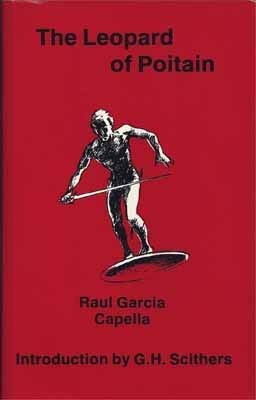
“Scritch, Scratch” (2014) by Lynne Hardy

Scritch, scratch, see the rat,
Bright eyes and twitching tail,
Scritch, scratch, chase the rat,
‘Cross hill, and stream, and dale.
—Lynne Hardy, “Scritch, Scratch” in Cthulhu Lives! 158

In the April 1924 issue of Weird Tales a story appeared by H. P. Lovecraft titled “The White Ape.” It wasn’t Lovecraft’s title. In conscious imitation of Edgar Allan Poe, Lovecraft’s original title had been “Facts Concerning the Late Arthur Jermyn and His Family.” An annoyed Lovecraft explained to the editor Edwin Baird on “The White Ape”:

I wish I could convert you to my point of view regarding the annoying literalness and flaccidity of that latter title…but all I can do is say that it is the only title which I could never possibly have applied to that particular tale; that it is at war with the spirit and internal harmonies of the narrative, and clashes fearsomely with the effect of the opening paragraph. One thing—you may be sure that if I ever entitled a story The White Ape, there would be no ape in it. There would be something at first taken for an ape, which would not be an ape. But how can one ever get those subtleties across?
—H. P. Lovecraft to Edwin Baird, 3 Feb 1924, Selected Letters 1.294

The problem with “The White Ape” is that it gives the game away at the start. For Lovecraft, the point was to stave off the moment of ultimate revelation, to let the reader’s imagination fill in the details while building up the events, letting things sink in. Readers can certainly read “Arthur Jermyn” more than once, and appreciate what Lovecraft does with the story, but the revelation can only really be experienced once.

The effectiveness of this approach can be seen in another of Lovecraft’s stories: “The Rats in the Walls” (Weird Tales Mar 1924). The title might be the greatest trick that Lovecraft ever pulled: there are no rats in the story, not a one, though the narrator reads of them, dreams of them, and thinks he hears them scurrying about. The rats, it turns out, are not the ultimate horror of it all…

…which brings us to Lynne Hardy and her story. Which isn’t about rats either, exactly.

“Scritch, Scratch” works as much as it does because it is essentially an update on the old moral about progress sweeping away old traditions which ought not to be fucked with, and that hoary old Aesop slots well into a Lovecraftian milieu. Readers can sense what’s coming, the only question is the specifics, and Hardy delivers without either rushing it or drawing it out too long.

The story is an appropriate “eldritch tribute” to Lovecraft without falling into the domain of pastiche. Hardy hints, but doesn’t show her hand; there are no gods with strange names, no tentacles, not even any cults or strange tomes, as such. It is close to folk horror, and with a little bit of work could easily have become a full-blown part of the Mythos and a pastiche. Genre-savvy readers could easily see an investigator dropped into the strange goings-on, more of the history of the strange little church and its carvings discovered, some solution discovered before the end…

That would be a very different and less effective work of fiction. It might make for a decent game.

Hardy has a long history with roleplaying games, having written extensively for the Cthulhu Mythos Roleplaying Game and Achtung! Cthulhu. In 2018 for Free RPG Day she and Chaosium released a version of “Scritch, Scratch” adapted for play, which readers can download for free. It’s worth pointing out that what works for a standalone Lovecraftian story doesn’t necessarily work for a roleplaying game: the story itself doesn’t have a protagonist as such, while the player characters in the game very much like to think of themselves as protagonists and want to accomplish something. In that regard, Call of Cthulhu cases like “Scritch, Scratch” (2018) become interactive storytelling experiences: the players aren’t just reliving the events of “Scritch, Scratch” (2014), they get to have a say in events.

The basis for this scenario came about as the result of a bit of an emergency. I was just about to set off to the airport for a convention when I received a message from the organizer—one of their guests was no longer able to attend, but was supposed to be running a tailor-made Call of Cthulhu scenario for a Kickstarter backer. Could I step into the breach?

So, on the plane, I got my head together with my husband, Richard, and, after batting a few ideas around, decided to base it on a short story I’d written for the Cthulhu Lives anthology, published by Ghostwoods Books. Not exactly the same—that wouldn’t work—but looking at the events from a different viewpoint. Following its successful premiere at OrcaCon, the scenario has been run at a number of conventions with the pre-generated investigators provided. It’s always great fun to see how different groups tackle the character interaction and their investigators’ fate.

I hope you enjoy it, too.
—Lynne Hardy, “Foreword” in “Scritch, Scratch” (2018)

The scenario has to go into a little more explicit detail than the story. Readers who enjoy the mystery should probably give it a pass; some of the glamour of the Mythos tends to be lost when it’s packed into the relatively dry explanations that are sort of necessary. While readers of the story don’t need to know what’s going on to appreciate Hardy’s prose, gamemasters who are supposed to be running the event absolutely do.

“Scritch, Scratch” was published in Cthulhu Lives!: An Eldritch Tribute to H. P. Lovcraft (2014). It has not yet been reprinted.


Bobby Derie is the author of Weird Talers: Essays on Robert E. Howard & Others (2019) and Sex and the Cthulhu Mythos (2014).
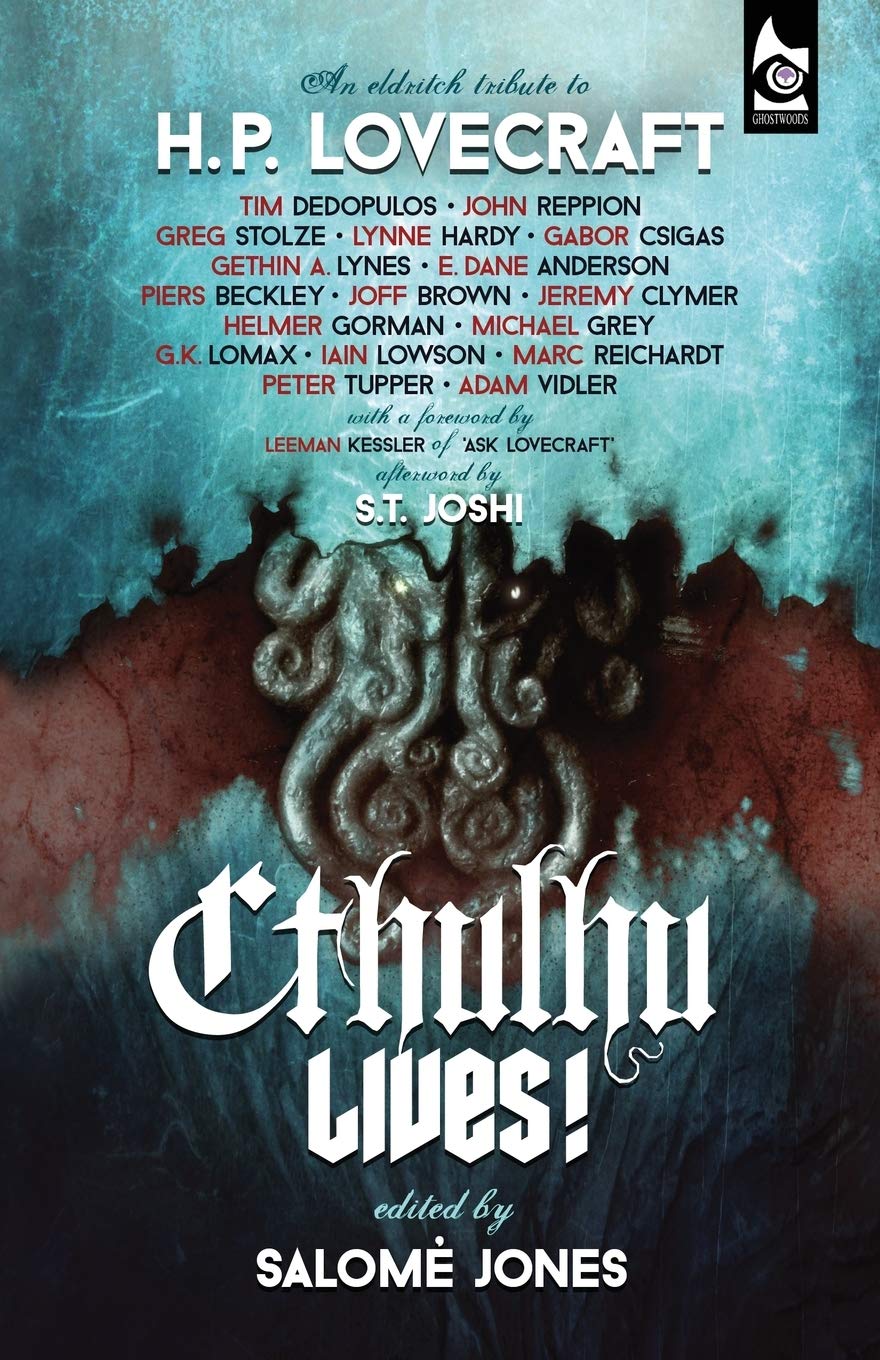
“Beckoner of the Nightwatch” (1989) by Jessica Amanda Salmonson

To the many authors who fired my sense of wonder as a child, and to the anthologists who drew my youthful attention to the best stories of the time. These people, some living, some gone, are cumulatively responsible for those stories of mine that I call “little horrors,” the kind mainly selected for the present collection. A handful of these people are named in dedications for individual stories.
—dedication in John Collier and Fredric Brown Went Quarrelling Through My Head

for H. P. Lovecraft and Robert Bloch
—dedication to “Beckoner of the Nightwatch” (ibid. 103)

Jessica Amanda Salmonson gives the date that “Beckoner of the Nightwatch” was given as 1974. She was 24 years old then, editor of The Literary Magazine of Fantasy and Terror, and coming out as transgender—one of the first fans to do so—and continued on to a long career as writer, poet, editor, and anthologist.

“Beckoner” was either only published once, fifteen years after it was written, or it was published the first time in 1974 in a ‘zine so scarce as to have been missed by catalogers, and then again for the final time in 1989. Such things happen; not every story finds a home or an audience the year it is written. It is a slight tale; at three-and-a-half pages it definitely counts as a “short-short,” and despite the dedication the story has no overt connections to the Mythos that might otherwise have guaranteed it a slot in innumerable anthologies.

Which is rather interesting in itself. What is it about this story, so brief and yet complete in itself, that speaks to Salmonson—and to readers—of Bloch and Lovecraft? Those names together bring to mind their quasi-collaboration “Satan’s Servants” (1949), their triptych of Mythos stories “The Suicide in the Study” (1935), “The Shambler from the Stars” (1935), and “The Haunter of the Dark” (1936). Yet “Beckoner” doesn’t quite suggest those.

It is reminiscent of, if anything, Lovecraft’s “The Unnamable” or “The Picture in the House”, or Bloch’s “The Unspeakable Betrothal” (1949). “Little horror” is as good a descriptor as any; the scene is set and the action begins not someplace and time long ago and far away, but in the now, right here. The kind of horror that can find you at work, or in the apartment building, when it’s dark and you’re alone; where your own imagination may be playing tricks at you as something moves in the dark and you fill in the details of what might cause those sounds.

Yet this isn’t a sedate M. R. James ghost story. The horror, when it appears on the page at last, stepping into the light of a flashlight, beckoning for the protagonist to follow, blood oozing from the bullet holes in its belly…is real. Some solid, physical thing. A real horror, however uncanny. That was the transition, the hand-off from Lovecraft to Bloch in many ways. It wasn’t all clanking chains and bloody bones, horror could be, had to be both of the mind and have a physical existence outside of it; had to both repel and attract us. Perhaps that’s what Salmonson was trying to capture here. Because at the end, we still don’t know what the Beckoner was trying to beckon us to.

[…] intent rather than length is what define’s “little.” In my earlier collection of little horrors, HAG’S TAPESTRY published in England, I called them cyanide-laced candies in a chocolate sampler, as opposed to a condemned man’s final banquet. Hardly earth-shaking in importance, but entertaining. Although I admit to numerous influences or inspirations, I trust the end result is strictly my own.
—Author’s notes in John Collier and Fredric Brown Went Quarrelling Through My Head

In “The Picture in the House,” Lovecraft famously began: “Searchers after horror haunt strange, far places.” Yet his point was that there were plenty of horrors right at home, if you cared to look. In 1984, Salmonson wrote a poem titled “Searchers After Horror (Paraphrasing Lovecraft),” which serves as the proem to this book, which begins:

We searchers after horror haunt strange, far places:

We. There’s a sense of community among horror readers. An affection for old familiar horrors, the thrill of the chase in hunting down obscure books and films, a recognition of that inexplicable drive that sets us apart to look for and experience the ghastly, the morbid, the dark and grotesque…yet it is also the same sense of community that lets us delight in the Addams Family, The Nightmare Before Christmas, Gahan Wilson, Warren Magazines and Famous Monsters of Filmland, Mike Mignola and Eric Powell and Steve Niles.

Not every horror story has to be epic in scale. Cthulhu need not rise from the depths every story, the zombies need not overrun the world in every episode. If they did, then the shock and awe and grandeur of those horrors gets lost; one of those things Neil Gaiman hinted at in Only the End of the World Again. In this sense, little horrors are necessary for we searchers after horror.

Jessica Amanda Salmonson’s “The Beckoner of the Nightwatch” was published in John Collier and Fredric Brown Went Quarrelling Through My Head (1989). It has not been republished.


Bobby Derie is the author of Weird Talers: Essays on Robert E. Howard & Others (2019) and Sex and the Cthulhu Mythos (2014).
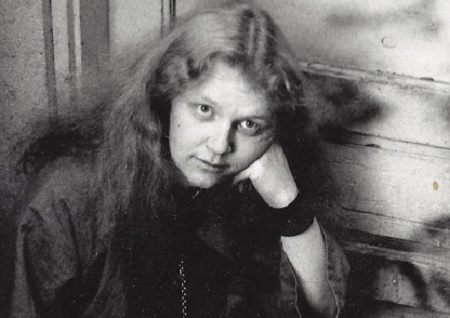
“Paedomorphosis” (1998) by Caitlín R. Kiernan

“Oh,” Annie said and sat down on the rug, grateful for something between her and the concrete. “Where are you from, anyway?”

The loose flap of cloth falling back in place, once again concealing the crack, and “Massachusetts,” Elise replied, “but no place you’ve probably ever heard of.”
—Caitlín R. Kiernan, “Paedomorphosis” in Song of Cthulhu 93

Music, lesbians, a muggy Georgia summer, and white blind things in the dark. “Paedomorphosis” is a story of mood and affect, intimation almost to the point of deliberately hiding things. If it wasn’t published in a Mythos anthology…if it wasn’t published by Caitlín R. Kiernan…there are certain connections which might not be made at all. Like “She Flows” by Takeuchi Yoshikazu (竹内義和) the story lives in that liminal space between telling and showing and knowing. It’s not a horror story by any stretch, but there are the bones of horror story technique there: the way the story and characters are built up, like fossils emerging from dry rock of an ancient river bed, and there are only a few people that can read those old bones and reconstruct something of what happened.

To a degree, all stories are reflections of their authors. We read about Lovecraft’s life and we look for the echoes of events and ideas in his fiction; as his life becomes more well-known through biographies, Lovecraft himself has become a kind of character in the fictional universe, fragments of his life and thought cropping up here and there in stories, some more explicit than others.

With “Paedomorphosis,” readers may well ask how much of Kiernan herself is reflected in the story. The setting of Athens, Georgia, where she lived. Elise-from-Massachusetts with her interest in paleontology; Kiernan herself a paleontologist. The imagery of drowning, repeated in some stories, especially her later novel The Drowning Girl: A Memoir (2012). The lesbian characters and her own sexuality.

“I thought dykes were supposed to be all tough and fearless and shit,” she said.

Annie shook her head, swallowed before she spoke. “Big ol’ misconception. right up there with the ones about us all wanting dicks and pickup trucks.”
—Caitlín R. Kiernan, “Paedomorphosis” in Song of Cthulhu 93

The story has the feel of something cribbled together from bits of life; people and places known rather than imagined. A bit of sexual longing, fulfilled. Drugs and rock and roll. And it takes Annie…and the audience…somewhere they never expected, gives them a glimpse of a world they never imagined might exist, those strange caverns measureless to man, the porous world spoken of so cryptically in “Machines Are Digging” (2009) by Reza Negarestani.

The title is never explained; look up the definition on your own time. The story ends with, of all things, a quote from Tolkien:

There are strange things living in the pools and lakes in the hearts of mountains…
—J. R. R. Tolkien, quoted in “Paedomorphosis” in Song of Cthulhu 98

But not the whole of it:

There are strange things living in the pools and lakes in the hearts of mountains: fish whose fathers swam in, goodness only knows how many years ago, and never swam out again, while their eyes grew bigger and bigger and bigger from trying to see in the blackness; also there are other things more slimy than fish. Even in the tunnels and caves the goblins have made for themselves there are other things living unbeknown to them that have sneaked in from outside to lie up in the dark.
—J. R. R. Tolkien, The Hobbit, Chapter V “Riddles in the Dark”

The story captures a mood, but the mood itself is almost inexpressible in anything less than the story. There are things to think about, long after the last page is turned. What might have happened, if Annie had been fearless enough to take the plunge? Who is the subject of paedomorphosis in the story? These are questions that Kiernan doesn’t answer in this story…but in some of her other stories, we catch hints of what might have happened, in love affairs that lasted a little longer and got a little weirder.

“Paedomorphosis” was first published in The Urbanite #10 (1998), it has been reprinted in Kiernan’s collection Tales of Pain and Wonder (2000, 2002, & 2008); Song of Cthulhu (2001); and Rock On: The Greatest Hits of Science Fiction & Fantasy (2012).


Bobby Derie is the author of Weird Talers: Essays on Robert E. Howard & Others (2019) and Sex and the Cthulhu Mythos (2014).

“The Opera Singer” (2015) by Priya J. Sridhar

Strictly speaking, “The Opera Singer” is not a Mythos story. Mythos by association only. No invocation of strange and terrible and familiar names, nary a tentacle to be seen. Yet it is a Lovecraftian story; those who are initiated into the Mythos, who have read Lovecraft’s “The Colour Out of Space,” can draw their own connections, their own conclusions.

Nor is it entirely unprecedented.

Brian Lumley’s “Big ‘C'” (1990) is a brother-from-another-mother-with-a-thousand-young to Sridhar’s story. The two have parallels, similar ideas but carried out very differently. A combination of adult fears and something alien, intrusive, other. For “Big ‘C'” it is cancer; for “The Opera Singer” it’s the stroke that landed the protagonist Circe in a wheelchair. That terrible biological betrayal, body turned against itself. Sridhar does a better job than Lumley in showcasing a woman with a disability; living with the body as a cage. Lumley is focused on a bigger picture, fewer emotional attachments. Different takes on the idea.

Readers might also compare “The Opera Singer” with “While The Black Stars Burn” (2015) by Lucy A. Snyder; both involve a glimpse into the life of the trained musician, talent toned with tragedy. Even exceptional musicians rarely rise to rock-star fame; they take gigs, pour their heart into operas and rehearsals, watch the money go to other people. Musicians are like athletes, their bodies a part of the performance, and as they get older bits wear out. Singers can no longer hit the same notes. Snyder and Sridhar touch on some of the same points there as well, although they are going in different directions; while readers might suspect more than cosmic accident to what happens to the protagonist in “The Opera Singer,” Sridhar gives no hint of actual conspiracy.

Sridhar gives a Lovecraftian frame to the story as well; the revelation unfolds, a bit at a time, and at the beginning of the story it isn’t even clear that there are things to reveal. Call it Chekov’s wheelchair: if you show the protagonist struggling in a wheelchair in the first act, you have to show how they got there by the end of it—but even that might be too simple. To understand how the protagonist lives, it isn’t just important to show how she got in the wheelchair, but what she lost in the process.

There are names involved too—Circe, the protagonist, lives under the shadow of the Circe from Greek myth, has odd connections with 34 Circe. Significant? Hard to say. The human talent for pattern recognition comes into play; what seems like a pattern could be random chance. The Mythos is dependent on pattern recognition, of readers recognizing associations between names, places, critters, ideas.

What else is this review but an effort to place this story within the wider framework of Lovecraftian fiction, finding the points that seem to fit?

There is always that danger with labeling something Lovecraftian fiction: a false positive. Maybe Priya J. Sridhar never meant a Lovecraftian connection at all when she wrote the piece, and it just happened to find a home in a Mythos anthology. It is always possible to read meaning and intent in a piece, especially if the net of comparable fiction is cast wide enough. Still, it is in a Mythos anthology now. The association is set.

Priya J. Sridhar’s “The Opera Singer” was first published in She Walks In Shadows (2015) and its paperback American edition Cthulhu’s Daughters (2016); it was also published in Nightmare Magazine (Dec 2016), where it may be read online for free.


Bobby Derie is the author of Weird Talers: Essays on Robert E. Howard & Others (2019) and Sex and the Cthulhu Mythos (2014).

“The Vale of Lost Women”(1967) by Robert E. Howard

I was fortunate enough to locate, last year, the bulk of the long lost Howard files. This includes a number of unpublished items, some of which appear in this issue. The unpublished fragment was among these papers; it is impossible to definitely determine whether this is an unfinished story or whether the remaining portion has been lost. Conan fans will be pleased to learn that several previously unpublished Conan stories were found: “Wolves Beyond the Border”, “The Snout in the Dark”, “The Hall of the Dead”, “The Hand of Nergal” and “The Vale of Lost Women”. Only the latter was finished; L. Sprague de Camp has completed the first three titles, while Lin Carter has finished “The Hand of Nergal.” “The Hall of the Dead” has been accepted by The Magazine of Fantasy and Science Fiction , while “The Vale of Lost Women” will appear in Magazine of Horror. All titles will appear in the Lancer Conan series in due course.
—Glenn Lord, The Howard Collector #9 (Spring 1967), 2-3

We know almost nothing about the origins of “The Vale of Lost Women.” There are two drafts extant, one unfinished (17 pages) and one complete (21 pages), with editing marks not in Howard’s hand, both undated. It is mentioned in none of Howard’s surviving correspondence, and if it was ever submitted to Farnsworth Wright at Weird Tales, no records of its submission or rejection have come to light. Howard scholar Patrice Louinet has stated in his essay “Hyborian Genesis” that the story was written circa February 1933—before Howard took Otis Adelbert Kline as his agent, and at the end of the first period of writing Conan stories (The Coming of Conan the Cimmerian 450).

Reader response to the “new” story—unearthed after thirty years and in the midst of the Howard boom of the 1960s—was mixed.

Charles Hidley writes: “The so-called ‘Conan’ story with its fantasy domino slightly askew is a thinly-masked ‘porny’ of the cheapest sado-sexual variety and doesn’t belong in your pages and wasn’t, I’m sure, authored by Robert E. Howard. Sick as that lad may have been, he at least was an author with imagination and writing skill—of sorts—and had the taste and discretion to flesh out his erotic fetishes with some semblance of narrative—and that in a category that could be honestly labelled macabre, outre, fantastic. If this was Howard (and I seriously challenge that labeling) it was surely a segment of something of greater length and depth—and less spuriousness.”

Carrington B. Dixon, Jr., writes from Texas: “1967 seems to be a good year for Conan. First FANTASTIC reprints People of the Black Circle, and now both MOH and FANTASY AND SCIENCE FICTION bring out new Conan stories! Of the two new ones, however, yours is 100% Howard, and it is easily the better of the two. I cannot imagine why The Vale of Lost Women was not published during Howard’s lifetime; unless it was that he did not live to submit it. It is certainly one of Howard’s better works. It is somewhat atypical for a Conon [sic] story but magnificent nonetheless. The fact that it is told in third person limited from Livia’s point of view adds a great deal to the story. The fight scenes still have gusto, but something has been added. The descent into the Vale has a chill missing in most Conan stories; we know that, no matter what the odds, Conan will come out with a whole skin, but women do not always fare so well…. This was easily the outstanding story of the issue.”
The Magazine of Horror #16 (Summer 1967), 119-120

The mixed opinion have much to do with the combination of racial and sexual dynamics in the story, which reflect a mix of Howard’s influences and themes. The story is, somewhat unusually, told from the perspective of Livia, an Ophirian woman held captive:

As she lay on the angareb in the great hut, her state bordered between delirium and semi-unconsciousness. Outward sounds and movements scarcely impinged upon her senses. her whole mental vision, though dazed and chaotic, was yet centered with hideous certitude on the naked, writhing figure of her brother, blood streaming down the quivering thighs.
—Robert E. Howard, “The Vale of Lost Women” in The Coming of Conan 303

“Angareb” is a Sudanese word for a low, wooden-framed bed, which Howard probably picked up from the pages of Adventure; the image of the tortured, probably castrated, brother comes from what Patrice Louinet considers the story’s likely inspiration: the story of Cynthia Ann Parker and her brother John, who were captured by the Comanche in 1836. Robert E. Howard was familiar with versions of the story, which he mentioned to H. P. Lovecraft as early as 1931, and related in some detail to August Derleth in a letter written around January 1933 (Collected Letters of Robert E. Howard 3.4-9) In adapting the story to the Hyborian Age, however, the captors are not Native Americans but black people.

This was before Howard published his essay “The Hyborian Age,” but it is evident in the story that he had generally conceived of the broad outlines and some of details of the geography in Conan’s world, specifically:

South of Stygia are the vast black kingdoms of the Amazons, the Kushites, the Atlaians and the hybrid empire of Zembabwei.

The black people in this story are thus portrayed as black Africans in all but name; despite the confusion of names (which Lovecraft sometimes chided Howard for), the Kushites here should be seen as more or less metaphorical ancestors of the Kingdom of Kush, located in Nubia south of Egypt; hence the use of a Sudanese term like angareb, and the presence of bamboo is another detail suggesting the general geographic locale of the story.

If it seems weird to contemporary readers that Native Americans may be portrayed as Africans in this manner—it would not be the last time Howard made such a racial transposition. Most notably, in the Conan story “Beyond the Black River” the Picts—one of Howard’s favorites, appearing in not just the Conan stories but the Bran Mak Morn and Kull tales, as both historical Picts of the British Isles and as mythological predecessors from Lemuria and Atlantis—essentially take the place of Native Americans, a theme that John Bullard explored in “Beyond the Black River”: Is It Really “Beyond the Brazos River”? In general, it can be argued that one of the ways that Howard kept the Conan series fresh was by continually adapting different genres and settings to the Hyborian Age, and part of that involves the odd transpositions, as in the case of “The Vale of Lost Women.”

The transposition would have been easier for Howard’s intended audience because of popular pulp (and in general Colonialist fiction) depictions of indigenous peoples of both Africa and the Americas as “savage.” The idea hold connotations beyond the immediately obvious; in the 1930s to be a barbarian was to be juxtaposed to “civilization,” but to be savage was to be incapable of civilization. Even seemingly ambivalent terms like “Noble Savage” have inherent in them the basic racist bias that the people so described would never obtain civilization by their own skill or effort. This is perhaps more important for stories like Howard’s “The Moon of Skulls,” which features a black African kingdom living in the remnants of an ancient Atlantean outpost, but it is implicit in many works from many writers of this period, and one reason why it was “easy” for Howard to translate the Comanche to the Kushites in this story is because they were both, in his understanding, “savages.”

The contrast of savage vs. barbarian vs. civilized, white vs. black, is presented by Howard in very stark relief in “The Vale of Lost Women.”

The hut door opened, and a black woman entered—a lithe pantherish creature, whose supple body gleamed like polished ebony, adorned only by a wisp of silk twisted about her strutting loins. The whites of her eyeballs reflected the firelight outside, as she rolled them with wicked meaning.
—Robert E. Howard, “The Vale of Lost Women” in The Coming of Conan 303

Most of the women in this story are either underdressed or nude; Robert E. Howard had learned by this point that Farnsworth Wright preferred a nude or near-nude female character in a scene for the cover illustration, so the use of a nude character in a Conan story is not itself unusual or weird—Seabury Quinn and other writers at Weird Tales were doing the same thing. What sets this scene and interaction apart is the contrast between the white woman, embarrassed at her nudity, and the black woman who flaunts it. This depiction between woman light and dark (not always white and black, but light-haired and brunette, etc.) is a recurring theme in Howard’s fiction, Charles Hoffman discusses this tendency in his essays “Return to Xuthal,” “Blood Lust: Robert E. Howard’s Spicy Adventures,”  and “Elements of Sadomasochism in the Fiction and Poetry of Robert E. Howard,” and it can be seen more clearly developed in later Conan stories like “The Slithering Shadow” and “Red Nails.”

The combination of racial and sexual elements centers now on Livia. Jim Crow was alive and well in the United States of the 1930s; the K.K.K. would be vocal about the need for the “color line” and many jurisdictions had laws against interracial marriage. Racist stereotypes about the supposed licentiousness of African-Americans were rampant, and underlay the accusations of the Scottsboro Boys Trial. Social attitudes, however, were sexist as well as racist; many white male Americans found it acceptable for a white man to visit black female sex workers. The distinction makes up a particularly poignant passage in Howard’s life:

“Every man has to uphold his race and protect his women and children,” Bob said earnestly. “He has to build the best damn world he can. You mix and mingle the races, and what do you get? You get a mongrel race—a race that’s not white and not black.”

It seemed to me he was leaving out something important. “Very well, then,” I said flatly. “If a man’s going to fight to keep his race pure, don’t let him go down to the flat and leave a half-white, half-black child down there.”

Bob jerked the steering wheel so abruptly that we almost ran off the road.

“Well, damn it,” he groaned. “There’s something there that you don’t understand.”

He looked at me, ran his hand over his face, and glared. “Well, sometimes a man—Well, damn it. Sometimes a man has to—”
—Novalyne Price Ellis, One Who Walked Alone 96

So, it’s not just that Livia is being held captive, but she is being sexually threatened in a way that would specifically speak to the (presumably primarily white and male) audience of Weird Tales—and the nature of this threat is not strictly heterosexual either:

The young black woman laughed evilly, with a flash of dark eyes and white teeth, and with a hiss of spiteful obscenity and a mocking caress that was more gross than her language, she turned and swaggered out of the hut, expressing more taunting insolence with the motions of her hips than any civilized woman could with spoken insults.
—Robert E. Howard, “The Vale of Lost Women” in The Coming of Conan 304

Howard’s specific understanding of lesbianism was tied up in contemporary interpretations of homosexuality as a psychological disorder; he appears to have associated lesbianism with both the adoption of masculine attributes (as with his character Dark Agnes in “Sword Woman”) and with sadism, where it represents distorted sexual appetites (for more on this subject, see “Conan and Sappho: Robert E. Howard on Lesbians”). This in particular can be seen in the relationships between women in “The Moon of Skulls,” “The Slithering Shadow,” and “Red Nails”—all three of which dovetail with the light/dark female dichotomy already mentioned as a theme in Howard’s work. The presence of a “mocking caress” in this context then is not surprising—but unusually, in this case it also serves as a foreshadowing of the events later in the story.

Nor is this the only case of racial stereotypes being used in this story:

On an ivory stool, flanked by giants in plumed head-pieces and leopard-skin girdles, sat a fat, squat shape, abysmal, repulsive, a toad-like chunk of blackness, reeking of the dank rotting jungle and the nighted swamps. The creature’s pudgy hands rests on the sleek arch of his belly; his nape was a roll of sooty fat that seemed to thrust his bullet head forward. His eyes gleamed in the firelight, like live coals in a dead black stump. Their appalling vitality belied the inert suggestion of the gross body.
—Robert E. Howard, “The Vale of Lost Women” in The Coming of Conan 304

This description of Bajujh, king of Bakalah, is not far off from the first shot of Jabba the Hutt as portrayed in Return of the Jedi (1983)—and there is a similar logic at work. Howard, through the gaze of Livia, is setting up Bajujh as the epitome of disgust. Like in “Mother of Serpents” (1936) by Robert Bloch, Howard is building up this individual as a visceral ultimate expression in the minds of the readers. Robert E. Howard was more than capable of describing black characters in many different ways—from obsequious to defiant, young to old, powerful to weak, intelligent and wise to animalistic—and many of his stories build up particular characters as particularly capable or dangerous to the protagonists. Yet Bajujh is not a rival for Conan—he is established as an opposite, a study in contrasts for the Cimmerian who he wanders onto the page a few paragraphs later.

Conan’s interactions with the Kushites deserves attention:

He was clad like his followers in leopard-skin loin-clout and plumed head-piece, but he was a white man. […] He himself, with a few of his chiefs, sat with Bajujh and the headmen of Bakalah, cross-legged on mats, gorging and guzzling. She saw his hands dipped deep into the cooking pots with the others, saw his muzzle thrust into the beer vessel out of which Bajujh also drank.
—Robert E. Howard, “The Vale of Lost Women” in The Coming of Conan 305

Bajujh treats Conan as an equal, and by his actions Conan shows no discrimination with sitting and feasting with the Kushites, even to the point of drinking from the same vessels. To Livia, this is a display of Conan’s power, but to the audience the interaction could be seen as more ambiguous: after all, here is essentially a scene of racial equality and getting-along. Lingering Colonialist attitudes may be at play in this depiction, since Conan is depicted as a white man among chiefs, and accorded respect as such; the idea of white men being deemed special and equivalent to black leaders was also a theme in several Solomon Kane tales set in Africa. Yet it is clearly Livia’s own preconceptions about race that are at work when she notes:

But she made no effort to classify his position among the races of mankind. It was enough that his skin was white.
—Robert E. Howard, “The Vale of Lost Women” in The Coming of Conan 306

It’s worth mentioning that in 1933, not all European nationalities and ethnicities were seen as equal, even if they were often nominally “white.” Ethnic sentiment against Jews, Italians, Irish, and Eastern Europeans was still widespread, sometimes flaring into violence. So unspoken in this statement is that sentiment that Livia places herself at or near the top of “whiteness”—but that ethnic considerations fade when, outnumbered and alone, she sets up the stark racial dichotomy of white vs. black, us vs. them. This is her view of the world, in this situation, which the readers are expected to recognize and sympathize with. That’s important to set up what comes next.

“You care naught that a man of your own color has been foully done to death by these black dogs—that a white woman is their slave! Very well!” She fell back from him, panting, transfigured by her passion.

“I will give you a price!” she raved, tearing away her tunic from her ivory breasts. “Am I not fair? Am I not more desirable than these soot-colored wenches? Am I not a worthy reward for blood-letting? Is not a fair-skinned virgin a price worth slaying for?[“]
—Robert E. Howard, “The Vale of Lost Women” in The Coming of Conan 307-308

Robert Bloch in the November 1934 issue of Weird Tales would already be lamenting “Conan the Cluck” who every issue “won a new girlfriend, each of whose penchant for nudism won her a place of honor, either on the cover or on the inner illustration.” The idea that the hero wins the girl at the end is part of the casual misogyny of pulp fiction—and of much fiction generally. Livia’s offer is playing very specifically and deliberately to reader’s expectations, based on the almost formulaic trope of the good guy getting the girl and them living happily ever after, and reinforced by the racial and sexual aspects of the story already established.

Which is why Conan’s response catches readers by surprise.

“You speak as if you were free to give yourself at your pleasure,” he said. “As if the gift of your body had power to swing kingdoms. Why should I kill Bajujh to obtain you? Women are cheap as plantains in this land, and their willingness or unwillingness matters as little. You value yourself too highly. If I wanted you, I wouldn’t have to fight Bajujh to take you. He would rather give you to me than to fight me.”
—Robert E. Howard, “The Vale of Lost Women” in The Coming of Conan 308

The response utterly deflates Livia; while Howard would not have put it in such terms, she comes face to face with her own white privilege, and the shock of realizing that her assumptions regarding her value and relationships with other people just because of her gender and skin color aren’t absolute values is crushing to her self-esteem. Her essential powerlessness, carefully developed throughout the first part of the story, and her offer of her virginity are designed to appeal to what white male Americans expected of white female Americans. Livia had wanted to be Helen of Troy, she ended up as Briseis. As one critic noted about this exchange, Conan’s is:

A realistic attitude, but one that is rarely encountered in most sword-and-sorcery. Usually women are masterminds who plot and deceive, using their sex as a weapon. As Howard summed it up best shortly afterward, “In spite of all Livia had experienced, she had still instinctively supposed a woman’s consent the pivotal point of such a game as she proposed to play.”
—Robert Weinberg, The Annotated Guide To Robert E. Howard’s Sword & Sorcery (1976), 106

Winter Elliott in his essay “Life, Liberty and the Pursuit of Women: Gender Dynamics in the Hyborian World” describes how Livia has “so clearly internalized her society’s consumerist construction of a woman’s sexuality.” (Conan Meets the Academy 62), and it is the transactional nature of the exchange which is at play here: Livia sees herself, and especially her body and virginity, as things of value which are to be exchanged for other things.

Livia, however, is trying to sell herself; she is not participant in an exchange between men, so her offer has no value. It does, however, correctly suggest that she has internalized her society’s view of female flesh as a commodity to be sold. […] In fact, the supposedly barbaric culture in which she finds herself has acted perfectly in accordance with her own civilization; her own society might more delicately treat her as property, but she would still be a possession. […] Livia’s captivity derives not from any fault of her own but from the weakness of her male guardians, who were unable to sustain their hold on their property in the face of fiercer male competition.
—Winter Elliot, ibid. 63

So Livia is not approaching this exactly in the sense of sex work. Having been raised to value herself and think of herself in these terms, she is still not yet cognizant of the fact that she does not really own herself and her own sexuality. The bargain she seeks to strike is emotional and presupposes that she and Conan share more than just skin color, but common values and assumptions of gender roles.

There’s a volatile mix of racial, gender, and sexual politics at play here. If Livia had been a man instead of a woman (or Conan a woman, or homosexual), the same offer and exchange would almost certainly not have taken place—at least, not in 1933 with any hope of getting published in Weird Tales. If Livia had been a been black, Asian, multiracial, or something other than “white,” the sexual offer might still have been part of the appeal for rescue, but not with the specific racial overtones which were such a part of Colonialist rhetoric. With the character of Livia, Howard has very carefully set up exactly this moment of conflict, and specifically so that Conan can poke a hole in it.

The subversion of expectations that takes place can still be framed as sexist; the whole exchange emphasizes the complete lack of power that Livia has as a woman, even over her own body, and serves as a kind of masculine sexual fantasy. Howard may be bending the rules by not having Conan play the noble hero willing to risk all for sexual intercourse with a white woman right away, but he’s still operating well within the general frame of preconceptions that led eventually to John Norman’s Gor and Anne Rice’s Sleeping Beauty novels. Once it’s clear who is in charge, Conan goes on:

But I am not such a dog as to leave a white woman in the clutches of a black man; and though your kind call me a robber, I never forced a woman against her consent. […] If you were old and ugly as the devil’s pet vulture, I’d take you away from Bajujh, simply because of the color of your hide.

“But you are young and beautiful, and I have looked at black sluts until I am sick at the guts. I’ll play this game your way, simply because some of your instincts correspond with mine.[“]
—Robert E. Howard, “The Vale of Lost Women” in The Coming of Conan 308-309

There’s a lot to unpack here. These are the first racist statements made by Conan himself in the entire story, if not exactly his entire career to this point; Howard had already written “The Queen of the Black Coast,” which involves Conan joining the crew of Bêlit and her black corsairs, although it wouldn’t see print until 1934, so it wasn’t that he hadn’t interacted with black characters at this point, but it emphasizes that while he might lead them and interact relatively equally with them, Conan isn’t above all the prejudices of his own time. Certainly the “black sluts” comment implies sexual experience with black women, illustrating the same double-standard Howard faced in Texas in the 1930s. The language isn’t necessarily too “blue” even for Weird Tales, other stories would use the word “slut.”

The last phrase, “because some of your instincts correspond with mine” echoes the language of H. P. Lovecraft, who would use similar but not identical phrasing in some of his letters to describe the racial homogeneity of different nationalities (cf. A Means to Freedom 1.77) It wouldn’t be the only time some of the arguments and discussions from their letters made their way into Howard’s fiction (or maybe vice versa), “The God in the Bowl” echoes aspects of Lovecraft and Howard’s discussions on the inequalities of justice and policing.

Racism is not just about epithets and depictions, but also absence. In this story, the black characters are almost all unnamed and never have a speaking role. In large part, this is because the story is told from Livia’s perspective: Conan can speak the same language as the Kushites, Livia cannot, so in her narrative they are either silent or voice obscenities and animalistic cries. Livia’s worldview does not encompass how they think or view themselves, except in relation to their interactions with her—which are minimal. The only hint we have at their history and inner life is through her, as it impacts her own life.

The second twist in the story is Livia’s flight from Conan as she imagines him coming to claim her, bearing the price she asked for sexual access to her body. A parallel could be drawn here with the earlier story “The Frost-Giant’s Daughter,” though unlike in that story, Conan has already stated he has no intention of rape, the fear of it drives Livia into the supernatural menace which Weird Tales would require, the eponymous “Vale of Lost Women”:

[…] she thought of a valley of which the blacks had spoken with fear; a valley to which had fled the young women of a strange brown-skinned race which had inhabited the land before the coming of the ancestors of the Bakalas. There, men said, they had turned into white flowers, had been transformed by the old gods to escape their ravishers. There no black man dared go.
—Robert E. Howard, “The Vale of Lost Women” in The Coming of Conan 313

The legend has echoes with Greek myth, particularly that of Daphne in Ovid’s Metamorphoses, and likewise echoes Howard’s “brown race” of Atlantis as being distinct from both white- and black-skinned peoples in “The Moon of Skulls,” or the discussion of the Boskop Man in his letters with Lovecraft (cf. A Means to Freedom 1.141, 159, 169, 183); Lovecraft himself would refer to the “general of the great-headed brown people who held South Africa in B.C. 50,000” in “The Shadow out of Time.”

The appearance of a third race queers the binaries of Livia’s world in more ways than one:

The lithe brown women were all about her. One, lovelier than the rest, came silently up to the trembling girl, and enfolded her with supple brown arms. Her breath was scented with the same perfume that stole from the great white blossoms that waved in the starshine. Her lips pressed Livia’s in a long terrible kiss.
—Robert E. Howard, “The Vale of Lost Women” in The Coming of Conan 313-314

It’s interesting to compare this lesbian kiss with that in “Red Nails.” Both sexual displays are part of or prelude to occult ritual, or have some supernatural effect. Salacious as the scene may be, Howard’s reserve for such overt displays of homosexuality between women to part of a distinctly weird and supernatural scene may in effect have been his effort to get them past the censor. Or perhaps he felt the broaching of sexual taboos complemented and gave weight to scenes that were set to violate natural laws; his letters are generally silent on the subject.

The denouement is almost perfunctory. Conan’s unusually talkative explanation encompasses the demon from the Outer Dark, how he decided it wasn’t appropriate to hold Livia to her bargain, and that he’s sending her home nearly in the same breath. It is anticlimactic in more than the sense that the last action beat has passed.

Conan’s assurance that “I saw that to hold you to your bargain would be the same as if I had forced you” is in keeping with his previous statement that he had never forced a woman, but there is a thread here which neither Livia nor Conan delve into, which is that due to Livia’s status as a slave it is impossible for her to give consent; they are in an unequal power relationship, and Conan is the one in a position of dominance. One could draw parallels with slave women in the South before and during the American Civil War: Livia’s ability to say “No” is meaningless if Conan chooses not to respect it, and Conan (and Howard) appear perspicacious enough to realize that.

So, Conan’s decision doesn’t change the essential relationship: Conan is still the one making all the decisions about Livia and her body. If they’re not having sex, it’s because that’s what he decided, regardless of her feelings in the matter. Things might be looking up for Livia, in that she’s headed home, but she still has almost no agency as a person and hasn’t learned any particular lesson regarding being racist or assuming privilege for being white and female—since Conan is basically affirming all that by giving her exactly what she wanted for just the reasons she thought he should.

One suspects that there was a desire to give a happy ending which yet left Conan unencumbered by any sort of ongoing romantic relationship; which underscores how Conan circumvents the tropes by not ending up with the woman at the end, and is in stark contrast to the eventual fate of Cynthia Ann Parker. So rather than a tragic ending, or the expected sexual conquest, Howard ends “The Vale of Lost Women” with a gruff masculine joke:

“Crom, girl,” grunted Conan, embarrassed, “don’t do that, you’d think I was doing you a favor by kicking you out of this country; haven’t I explained that you’re not the proper woman for the war-chief of the Bamulas?”
—Robert E. Howard, “The Vale of Lost Women” in The Coming of Conan 317

When picked apart like this, it is easier to see how “The Vale of Lost Women” came to be, from a rough idea translated to the Hyborian Age, to the addition of various commercial elements (nudity, check; weird monster, check), and some of Howard’s common themes (light and dark women, a possible reference to ancient Atlantis, echoes of his discussions of race and civilization with Lovecraft). On top of this, there is the unusual interplay of gender, racial, and sexual dynamics—aspects which Howard doesn’t always get credit for, as noted in “Black Canaan” vs. “Black Cunjer.”

On a cold read, however—how much of that would actually come across? This story was published the year before the Civil Rights Act of 1968; would African-American readers have appreciate a story where they exist only to be either subservient to a white Conan and/or slaughtered? Second-wave feminism was pushing reforms for women in post-WWII America as well, questioning previous popular media images of women as solely homemakers and housewives and pushing for equal access to education and equality in the workplace. Howard may have been relatively liberal for 1930s Texas, but a story poking at tropes of the hero ending up with the girl in 1933 reads very differently in 1967. Or 2020.

Not terribly surprising then that critical reception of the story in the ensuing decades since its publication has been almost uniformly negative. To give a handful of reactions:

Two Conan stories, “The Vale of Lost Women” and “Shadows in Zamboula,” are typical antiblack hysterics. Reading them is like having a front-row seat at a Ku Klux Klan rally. In their depiction of blacks as savages, cannibals, and slaves, these stories deserve a place of dishonor beside Edgar Rice Burroughs in the lowly annals of racist literature.
—Charles R. Saunders, “Die, Black Dog!” (1975)

“The Vale of Lost Women” is probably the worst of the Conan stories and it is not surprising that it was never published during Howard’s lifetime. The supernatural element just seems to be added as an afterthought. The plotting is basic formula, with little complexity. However, the story does have a few noteworthy graces.
—Robert Weinberg, The Annotated Guide To Robert E. Howard’s Sword & Sorcery (1976), 106

Rejected for obvious reasons. Certainly this is the worst Conan story, with the possible exception of “Pool of the Black One.” But it does shed some light on Conan’s career as a chief of the Blacks.
—Darrell Schweitzer, Conan’s World and Robert E. Howard (1978) 52

Not surprisingly, the story failed to sell. If Howard was trying to discreetly infuse some of his growing interest in Western lore into the Conan stories, he was perhaps too subtle: it is impossible to detect the source without having access to peripheral documents. The powerful story of Cynthia Anne and John Parker was lost between the unconvincing supernatural threat and Livia’s penchant for nakedness. As to the racial overtones of the story, while the violent ethnocentricism of the tale is understandable when we recognize its origin in the nineteenth-century Anglo-Saxon settler viewpoint, with the blacks standing in for Indians, it makes for unsettling reading for the modern audience. At any rate, Howard’s first foray into the American southwest version of the Hyborian Age was a failure, and it would be another year before he made another attempt.
—Patrice Louinet, “Hyborian Genesis” in The Coming of Conan (2003) 450

Racial overtones aside (the tribesmen of Ersatz-Africa stand-in for the Native Americans, leading to some really strong “anti-Kushite” rhetoric on Conan’s part), what draws the most heat from this story is Conan bartering to rescue the captive Livia in exchange for a roll in the hay. No one looks good in this story. Not Robert, not Conan, not even Livia. No one. This is perhaps the worst Conan story and a real low point for the series. The commercial elements all misfire, and the allegory of “Kushites = Native Americans” when Kush has previously equaled Africa doesn’t work at all. Worst of all is the insulting and contrived hackneyed ending. “Oh, I was going to kill all of the tribesmen anyway, and how dare you think that I’d bed you as payment, even though I’ve given you no reason to suspect otherwise?” Honestly, this reads more like Robert trying to work out a story, or at least work something out in this story.
—Mark Finn, Blood & Thunder: The Life & Art of Robert E. Howard (2013) 226

This story, “The Vale of Lost Women,” contains some of the most problematic—and racist—passages in Howard’s work.
—Winter Elliott, “Life, Liberty and the Pursuit of Women” in
Conan Meets the Academy (2013) 65n5

“Vale of Lost Women” doesn’t stand in the top rank of Howard’s Conan tales. Some might say it is the worst. But best and worst are relative. In “Vale”, Howard’s prose crackles with poetic lyricism, even at the tale’s grimmest moments. The story, so crude and harsh outwardly, rests on a foundation of myth springing from mankind’s basic fears and needs. By any standard “Vale of Women” is a memorable tale that draws in a reader with furious intensity and edge-of-the-seat suspense. If this is Howard at his worst, then he has earned his accolades.
—Dave Hardy, “Hither Came Conan: Dave Hardy on ‘The Vale of Lost Women'” (2019)

The assumption is that the story was rejected. If so, it was not necessarily because of the racial or sexual elementsWeird Tales certainly had both in its pages, and it is hard to say where the line was on such tales. Howard and many other writers had included racism before, nudity was often accepted (even encouraged), suggestions of lesbian interaction were not unknown. Perhaps Howard himself thought the story didn’t come together and chose not to submit it.

We don’t know.

The lesbian touches in “The Vale of Lost Women” has sometimes also been subject to some rather unusual takes, a couple of which are worth examining:

Written in the 1930s, this story was not published until much later, most likely because of its explicit lesbian content. Conan comes upon a  young white woman captive of a tribe of black Africans. Conan rescues the woman, but when he comes to collect her as his reward she has other ideas. Rejecting the brutality of men, she flees to the Valley [sic] of Lost Women, an idyllic all-women society. She finds, to her dismay, that the valley is filled with lesbian natives who seduce her despite her fears. Again, Conan rescues her, and chivalrously allows her to retain her virginity. Sexist and racist.
Eric Garber and Lyn Paleo, Uranian Worlds (1983) 65

Perhaps because of this story’s length and deceptively simple plot, many readers have dismissed it as one of the lesser stories of the canon, some even going so far as to designate it the worst Conan story. It is not—and by quite a margin. It is necessary to correct this oversight by examining his, one of Howard’s most underrated stories. […] When Livia flees from Conan to the vale of lost women, she is fleeing not only her captors, but the male sex as well. […] What Howard seems to be saying is that, although men and women constantly brutalize each other physically and mentally, they belong together nonetheless. To seek refuge from the battle of the sexes in either homosexuality or asexuality is to deny one of the most important constants of the human condition. At best, it can bring about spiritual emptiness; at worst, it can cause spiritual degradation. When Conan rescues Livia, he saves her not from any physical harm, but from a shadowy existence without a soul.

“The Vale of Lost Women” is an interesting counterpoint to “The Frost-Giant’s Daughter.” Composed around the same time, both were among the first stories in the Conan series to be written. Neither story was published during Howard’s lifetime, almost certainly owing to their explicit sexual themes. But, though sexuality lies at the heart of each short tale, in execution they are polar opposites. […] Howard unflinchingly shows his own sex at its absolute worst, wallowing in rapine, murder, and wanton cruelty. Driven to attempt rape in “The Frost-Giant’s Daughter,” Conan opposes it in word and deed in “The Vale of Lost Women.” He turns against sworn allies to keep Livia’s body unsullied by her rapist-captor, he battles a monster to prevent her spirit from being violated, and finally he forsakes any ulterior motives of his own concerning her.

The story’s denouement is that Livia will be returned home; Conan has reestablished normalcy in her life. By keeping her body and spirit inviolate, and by restraining his own passions, Conan also symbolically restores Livia’s normal sexuality.
Marc A. Cerasini & Charles Hoffman,
Robert E. Howard: Starmont Reader’s Guide 35 (1987) 77-79

The take given in Uranian Worlds seems to be a misreading. Part of the problem is that the majority of the lesbian content focuses on the supernatural section, which is relatively brief. The brown women are utterly speechless except for their alien, inhuman song, and we basically get nothing of their inner life or motivations for trying to sacrifice and/or convert Livia. Far from the uranian utopia Garber and Paleo would have it be, there is no indication that the Vale of Lost Women is a human society in any sense. While it might be interesting to see a piece that actually explores the Vale of Lost Women from that perspective—it is interesting to think of the implications of the Vale of Lost Women (Lost to whom? In what way?), the story itself does not really support the reading in Uranian Worlds.

Cerasini and Hoffman’s reading has simply aged badly; based on the idea of homosexuality or asexuality as deviations from heterosexuality rather than equally valid and natural. Such an interpretation still fails to address the essential lack of agency that Livia has in the story; the idea that she needs a man to “rescue” her from homosexuality is just as misogynistic as the idea that Livia has no right to refuse Conan sex. They are correct in that it is a fundamentally different approach to the pursuit of sex that characterizes “The Frost-Giant’s Daughter,” and the attitude that Conan displays in this story toward refusing to take sex by force would be one of the most important legacies of “The Vale of Lost Women.”

It did have a legacy. In 1979, “The Vale of Lost Women” was adapted for the Marvel comic book Conan the Barbarian #104 (Roy Thomas, John Buscema, Ernie Chan, Ben Sean, Joe Rosen), set chronologically after the events of “The Queen of the Black Coast,” when Conan was adventuring among the black kingdoms of Kush.

After those three original stories, I got a chance in #104 to adapt another REH story: “The Vale of Lost Women.” This was not one of Howard’s best—in fact, not a few of his admirers consider it the worst Conan story he ever wrote. Some editor somewhere may have agreed; the tale wasn’t published until three decades following the author’s suicide in 1936. Still, it was a Howard Conan story, so I was bound and determined to adapt it—and it really didn’t make a bad comic book issue.

Two things commend this story to my memory. One is the fact that it contains the only mention ever by Howard of “Kheshatta, City of Magicians,” a mysterious locale in Stygia. The phrase always fascinated meas it doubtless did sometime Conan prose writer Lin Carter, who in the late 1960s had scribed a paperback novel titled Thongor and the City of Magiciansand I wondered what a city with a sobriquet like that might possibly be like! After all, it’s not as if the rest of Stygia was exactly lacking in the black magic department—so a whole “City of Magicians” must really be something to see! Alas, Howard, gives no clue—for the story’s heroine Livia is captured by the savage Bakalah en route to the place, and never gets there! (It was thus left to me to set a multi-part tale in Kheshatta when I became scripter of The Savage Sword of Conan again in the 1990s—and it was one of my favorite story arcs.)

The other thing I loved about “The Vale of Lost Women” was a line of dialogue Conan speaks near the end of the story. After killing the “demon from the dark” that tries to fly off with Livia, he casually dismisses the creature as just one of many: “They’re thick as fleas outside the belt of light that surrounds this world.” Howard had a real way with a phrase, and this disparagement by Conan of the fanged, bat-winged monstrosity he’s just slain strikes precisely the right note.
Roy Thomas,
The Chronicles of Conan Volume 13: Whispering Shadows and Other Stories (2007),  145-146

By setting this in the context of Conan’s travels, and toning down or jettisoning some of the more overt violence, nudity, and racism, the result is indeed a pretty good comic book, while keeping the essentials of the plot and much of Howard’s prose. In part, this is because of the familiarity of the character as Roy Thomas, John Buscema & co. had built him up to this point; the look and voice of Conan is consistent with the character from previous issues, and seeing the fear and reactions of Livia makes her much more sympathetic as a character. The reader response was also positive…and in-depth:

Dear Roy, John, and Ernie,

Ish #104 was great, as usual, both in art and in Roy’s story adaptation, but something struck me about that particular adaptation that had never registered before. Roy, you and I rarely see eye to eye on the liberties you take with Howard’s stories, but this time I owe you a long overdue apology and a heartfelt thank-you.

As much as I love Robert E. Howard’s work and idolize his greatest creation, the Conan saga, there is one thing about the creator of Conan that I cannot stand. Simply put, the man was a bigot.

This fact is painfully obvious to anyone who has read Howard’s original stories. They are full of derogatory remarks about blacks, rife with racial slurs. And although the Conan stories are not as anti-black as some of his earlier works, they too contain their share of prejudice. “The Vale of Lost Women” has always stood out in my mind as one of the worst. As I was reading issue #104, I prepared myself several times for the racial insults I knew to be forthcoming, but, lo and behold, no slurs! Then and only then did I realize that you had edited the derogatory racial barbs from other Conan stories as well as this one. For this, yo u have my eternal gratitude.

Howard was a bigot, this is true, but he died over four decades ago. He lived before Dr. Martin Luther King Jr. and the Civil Rights movement, back when we had to sit in the back of the bus and drink from separate water fountains, and his writing reflects this. Howard was a product of his times. I understand this and overlook his hatred of my people; others may not.

If you hadn’t cut out Howard’s bigotry and allowed the genius of his writing to shine through, you certainly would have antagonized every black in Conan’s reading audience and many liberal-minded whites as well. Most people would have attributed this bigtory to Conan, not to his creator, and this would have been tragic because the best comic magazine in history would have been cancelled long ago.

Once again, thanks Roy—and I’m sorry it took me so long to get around to it.

—Dale Armelin, “The Hyborian Page” in Conan the Barbarian #110 (May 1980)

The matter of racism in Sword & Sorcery, and the pulp revival in general, was alive and well when Conan the Barbarian was being published, when the Conan paperbacks filled displays at bookstores. African-Americans were customers too, and there really was a conversation to be had about how Howard’s racism would be translated; Charles R. Saunders in “Die, Black Dog!” specifically called out L. Sprague de Camp and Lin Carter both for ameliorating racism in Howard’s work when they edited/rewrote it—and for not taking the same care to avoid repeating the racism of the 1930s in their own contemporary fiction.

The conversation about race & Robert E. Howard (and Lovecraft, and weird fiction, sword & sorcery, etc. in general) is never over. It is a conversation that must be had continually, if only because the fiction these people wrote in the 1930s still finds an audience, and those who wish to expand and adapt their fictional worlds.

Roy Thomas & co. would go on to make Kheshatta, City of Magicians an established part of the Hyborian World, both in the Conan comic books and subsequent media. Likewise, the attitude of Conan toward “the demons of the Outer Dark” would strongly influence later interpretations of the character. While there had from the very first Conan story (“The Phoenix on the Sword”) been an element of sword against sorcery, that immortal horrors might yet be susceptible to cold steel, this cocksure attitude that a man like himself with a sword is a match for such entities would lay the groundwork for many monster-of-the-issue (or novel, or episode, etc.) takes on Conan.

More important, perhaps, is Conan’s attitude toward women. While Conan is far from exactly chivalrous in his attitudes in “The Vale of Lost Women,” his assertion that he won’t take a woman against her will is significant in a setting where slavery is commonplace. Conan has ever been a sexual entity in all of his incarnations, and many depictions of him have no particular qualms about employing sex workers—but it is that particular characteristic that Conan won’t force a woman to have sex against her will has shaped his contemporary depictions.

In the pages of Savage Avengers Annual (2019), for example, when Conan finds himself in contemporary South America, he refuses to sleep with sex workers being held against their will, and automatically sets about on a quest to destroy the human sex trafficking ring that enslaved them. While this might seem a bit of an obvious attitude to take for many contemporary readers, it’s a canonical approach that was embraced as a core tenet of Conan’s ethos that after it had appeared in “The Vale of Lost Women”—and arguably may have been a part of Robert E. Howard’s own evolving attitude toward women in his fiction.


Bobby Derie is the author of Weird Talers: Essays on Robert E. Howard & Others (2019) and Sex and the Cthulhu Mythos (2014).

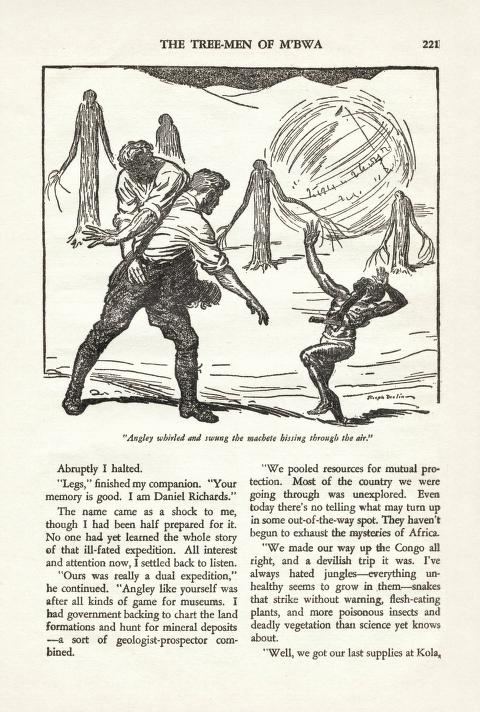
“The Tree-Men of M’bwa” (1932) by Donald Wandrei

I recently saw a newer and better Wandrei tale, The Tree-Men of M’Bwa, which he should have no difficulty selling to either Bates or Wright.
—August Derleth to H. P. Lovecraft, 14 Aug 1931, Essential Solitude 1.360

[…] I must congratulate you on the novel & original cosmic thrills, & the extremely effective climax, of The Tree-Man. I surely hope this has found—or will find—favour with the editorial fraternity.
—H. P. Lovecraft to Donald Wandrei, 25 Sep 1931,
Letters With Donald and Howard Wandrei and to Emil Petaja 271

“The Tree-Men of M’bwa” by Donald Wandrei was published in the February 1932 issue of Weird TalesIt is neither explicitly a tale of the Cthulhu Mythos nor not a Mythos tale. As with “The Fire Vampires” (WT Feb 1933), Wandrei makes no specific reference to Cthulhu, the Necronomicon, etc. But “The Tree-Men of M’bwa” involves some very Lovecraftian elements, passing references to Atlantis and Mu, and uses the incredibly ambiguous term “Evil Old Ones.” The ambiguity has helped ensure the general obscurity of the story: it has never been published in any English-language Mythos anthology. Indeed, it would probably not be considered part of the Mythos at all except that it was posthumously adopted as part of the Mythos by the Call of Cthulhu Roleplaying Game, appearing as part of the “African Mythos” in works such as Malleus Monstrum (2006), Secrets of Kenya (2007), and The Masks of Nyarlathotep Companion (2014).

The desire to incorporate “The Tree-Men of M’bwa” into the Mythos likely has less to do with the relative merits of the story than the general lack of Mythos fiction dealing with Africa in general. Lovecraft ghost-wrote “Winged Death” for Hazel Heald and “Imprisoned with the Pharaohs” for Harry Houdini, but there are extraordinarily few stories from the first generation of Mythos-writers set in Africa, unless you count Robert E. Howard’s adventures of Solomon Kane, which do not deal with the Mythos directly.

Even then, there is nothing particularly special about this story that separates it from any other weird tale set in Africa and that doesn’t directly contradict any other bit of Mythos-lore, except that Donald Wandrei was part of the circle of Lovecraft’s correspondents and did write at least one actual Mythos story. Hugh B. Cave’s “The Cult of the White Ape” (Weird Tales Feb 1933) might as easily have been borrowed into the Mythos, but as Cave corresponded only briefly with Lovecraft it is generally forgotten, whereas “The Tree-Men of M’bwa” has gone on to its weird literary afterlife.

In context, “The Tree-Men of M’bwa” is a typical “mysteries of darkest Africa” story, where intrepid great white hunters and explorers (led by at least a dozen of the indigenous people who have been there their entire lives and know pretty much where everything is and why you don’t want to muck about with the crashed aliens, etc.) stumble into some unknown peril. The focus of these stories is almost solely on the white people who are telling the narrative, and center it on themselves; the black people are often little more than an afterthought, and Wandrei does not vary from formula.

Most of the country we were going through was unexplored. Even today there’s no telling what may turn up in some out of the way spot. They haven’t begun to exhaust the mysteries of Africa.
—Donald Wandrei, “The Tree-Men of M’bwa”

How much actual research Wandrei did for the story is debatable. The geography is roughly correct, if one makes general allowances (i.e. that the fabled Mountains of the Moon” referred to are the Rwenzori Mountains of Uganda, and “Kola” is actually “Kole,” a town closer to the border) it’s safe to say that he at least glanced at a map. I have not yet found a people in the region named “Neguchi” or similar; either Wandrei picked the name out of an obscure text or made it up. The word “M’bwa” is Swahili, and means “dog.” Whether Wandrei knew that or not is, again, unknown; he may have simply liked the sound of it as sufficiently alien to English.

“M’bwa” is the only African named in the story. The indigenous guides are only the “Neguchi boys,” which turn of phrase could be read as discriminatory when applied by a white man to a group of black men in the 1930s. Africa itself is veritably a character in this story, hostile and alien to the white men who seek to probe its mysteries; Wandrei emphasizes early on:

Why my boat had stopped in this filthy hell-hole on the Gold Coast, I don’t know, but here we were overnight and I had gone ashore to break the monotony of scalding days at sea. It wasn’t much imporvement, even after sunset. Fierce, steamy heat that made you boil with sweat. An unpleasant smell, half-native, half-decayed vegetation, that every village seemed to have. (ibid.)

There are a couple of interesting details to the encounter with M’bwa and the Whirling Flux. The first is the number of trees—despite this being an “unexplored” part of Africa, it is quite evident that there have been at least twenty “explorers” there before him, and the indigenous peoples seem well-informed of the spot in general. The earliest visitors were an Atlantean, an Egyptian, and a Roman—in the 1930s, that would implicitly mean “three white men,” although such racial divisions would have been meaningless in ancient Rome or Egypt. The one tree-man that speaks to Daniel Richards did so apparently in English, suggesting he too was white.

The word zombie is never used in the story to refer to M’bwa, although the dead man has many of the attributes of the revenant; the word was just coming into vogue with the publication of William Seabrook’s The Magic Island (1929), and the film White Zombie (1932) which it inspired; many writers at Weird Tales penned zombie stories during this period, and readers would have been aware of that, even without a voodoo connection.

“The Tree-Men of M’bwa” is arguably not as bad as “The Cult of the White Ape” or “Mother of Serpents” (1936) by Robert Bloch in terms of its portrayal of black people, but neither did Wandrei go out of his way to give an informed or sympathetic portrayal either. It is a white person’s story, written by a white person for what would presumably be a white audience, and it reads like that. That it has been seized on by the Call of Cthulhu roleplaying crowd as a component of the “African Mythos” speaks more to the general paucity of such material available than to any particular merit of the story itself.

Donald Wandrei’s “The Tree-Men of M’bwa” was first published in Weird Tales (Feb 1932); it was reprinted in Wandrei’s collections The Eye and the Finger (1944, Arkham House) and Don’t Dream: The Collected Horror and Fantasy of Donald Wandrei (1997, Fedogan & Bremer; paperback edition 2017). The long gap between publications is one reason why this story has remained so obscure for many decades, but now that it is more available perhaps it will find a new audience.


Bobby Derie is the author of Weird Talers: Essays on Robert E. Howard & Others (2019) and Sex and the Cthulhu Mythos (2014).
“She Flows” by Takeuchi Yoshikazu (竹内義和)

I told him I saw no need to broaden, i.e., to dilute, my understanding of “Lovecraftian.” […] I realize that genres grow and develop by an incremenetal process of transgressions of inherited genre conventions. Thus it is no crime to do something different and still call it “Lovecraftian.” What passes for Lovecraftian tomorrow may seem quite different from what the term denotes today. But I can’t pretend to see how you get there from here.
—Robert M. Price, foreword to “She Flows,” Straight to Darkness 193-194

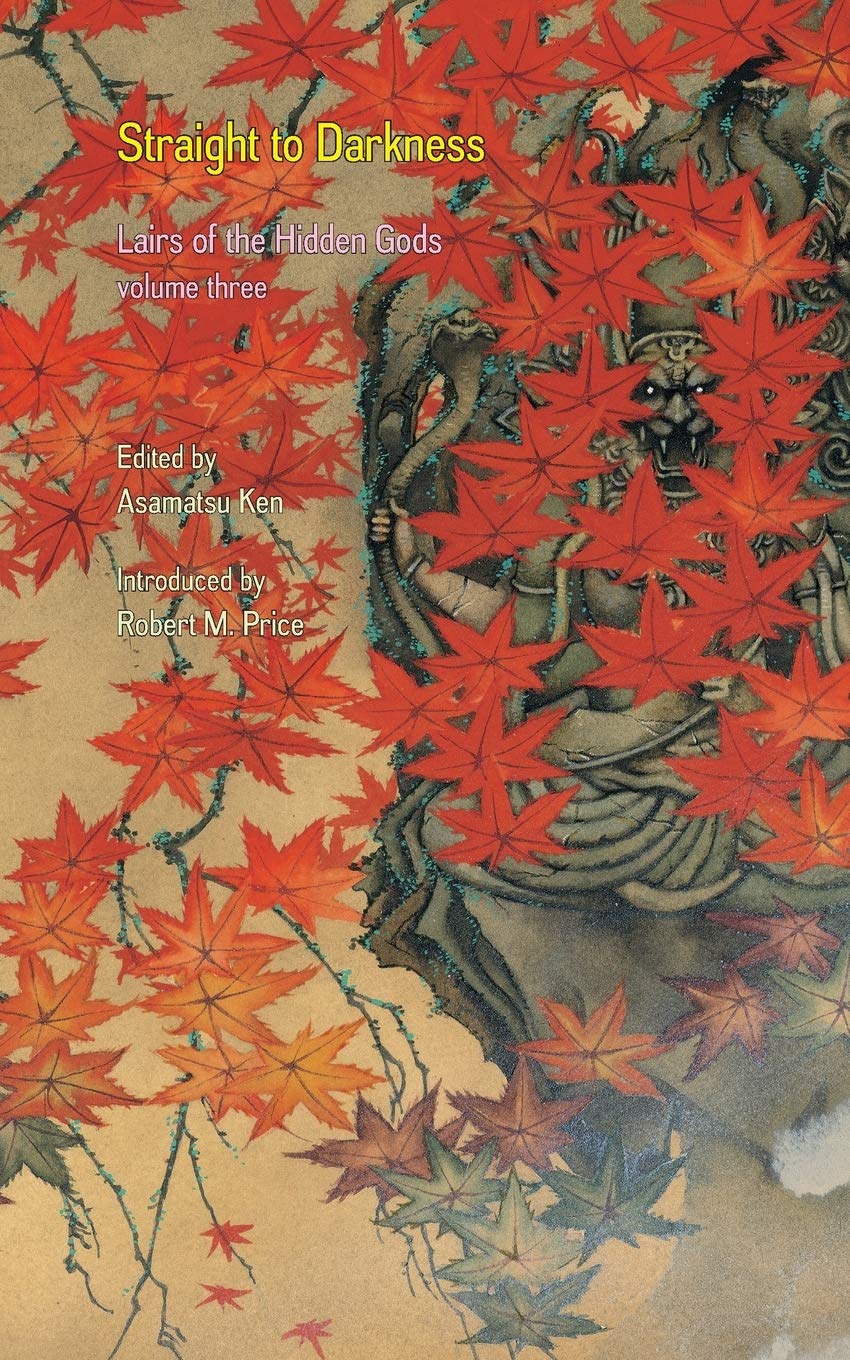
“She Flows” (2006) by Takeuchi Yoshikazu (竹内義和) was published in the third volume in the Lairs of the Hidden Gods series from Kurodahan Press, edited by Asamatsu Ken (朝松健). It is the English-language translation of the 2002 story 清・少女 (Se Shojō); the translator was Nora Stevens Heath.

The Mythos as a concept is a struggle for definition. What makes a Mythos tale? Does it have to use specific words, deliberate tie-ins? What are the minimal requirements? The status of “Mother of Serpents” (1936) by Robert Bloch as a Mythos story hangs on a single word. “Hypothetical Materfamilias” (1994) by Adèle Olivia Gladwell is a Lovecraftian tale with three. “Red Goat, Black Goat” (2010) by Nadia Bulkin has none, though we recognize the shadow of Shub-Niggurath without ever reading the name of the Black Goat of the Woods. Does any story become a Mythos story if it includes the Necronomicon? Can a story be Mythos but not Lovecraftian, if it uses the right words but in a vary un-Lovecraftian way?

Rhetorical questions. There is no set canon to the Mythos, no strict definition as to what is or is not Lovecraftian. Every individual carries a canon in their head, maybe multiple canons. You the reader decide whether a story is Mythos or Lovecraftian to you. Don’t let anyone else decide for you.

“She Flows” is challenging in this regard. There are, as Robert M. Price notes in his foreword, no explicit connections to the Mythos. The implicit connections are filtered through what feels like a different cultural lens: compensated dating, alcoholic parents, abusive parents, depression. Two girls with eyes a little too wide apart.

People with monstrous faces, long red tongues.

The reader has to make their own connections. Takeuchi’s approach is showing more than telling. Never says “Deep One,” or “Innsmouth.” But they write:

My theme is the ocean.

All I sing are songs about the ocean. You know that folksong, “My Bonnie lies over the ocean”? I liked that one. I remember my dad always used to sing it softly into my ear when I was little.

So maybe that’s why all the songs I write are about the ocean.
—Takeuchi Yoshikazu, “She Flows,” Straight to Darkness 206

Where does the reader’s mind go? A European folksong. A mother who hates her daughter’s face. Was her father a Deep One…or a Caucasian? It’s a story about the ambiguity. Reading between the lines. The reader bringing their own understanding to complete the story. Robert M. Price in his foreword wondered if this was a Deep One story; couldn’t quite make up his mind because there is nothing definite there.

Yet in context, this is a story in a Mythos anthology. Had it been placed in an anthology of yōkai stories, would it have been received differently? It would not be difficult to see these creatures as some form of yōkai, or as some delusion of a mind unhinged by child abuse. The story is weaponized ambiguity. It cuts those who want it to mean more than what it is, who want it to connect to something larger than itself.

Is “She Flows” Lovecraftian? It is if you want it to be.


Bobby Derie is the author of Weird Talers: Essays on Robert E. Howard & Others (2019) and Sex and the Cthulhu Mythos (2014).
“There Are More Things” (1974) by Jorge Luis Borges

Horatio
Oh, day and night, but this is wondrous strange.

Hamlet
And therefore as a stranger give it welcome.
There are more things in heaven and earth, Horatio,
Than are dreamt of in our philosophy.
—William Shakespeare, Hamlet, Act 1, Scene 5

To the memory of H. P. Lovecraft
—Jorge Luis Borges, dedication to “There Are More Things” (1975)

The picture painted by Barton Levi St. Armand in “Synchronistic Worlds: Lovecraft and Borges” is of a man both familiar with Lovecraft’s work and life, yet willing to disavow such knowledge; at once appreciative and critical. The great Argentinian writer of Ficciones (1944) and El Aleph (1945), which was translated and published as Labyrinths (1962) in English, was born nine years and a world apart from Lovecraft, yet like astronomical objects their orbits were destined for the occasional collision. Borges would afford Lovecraft space in his Introduction to American Literature (1971), for example, he wrote:

In his stories one meets beings from remote planets and from ancient or future epochs who dell in human bodies to study the universe, or, conversely, souls of our time who during sleep explore monstrous worlds, distant in time and space. Among his works we shall recall “The Color from Space,” [sic] “The Dunwich Horror,” and “The Rats in the Wall.” [sic]

We don’t know when and where Borges first met Lovecraft, in a literary sense. Some translation in a Spanish or Argentinean magazine, perhaps; an inclusion in some anthology maybe, or a lonely Arkham House title that had made its way to Buenos Aires. The stories he mentioned were all included in The Outsider and Others (1939), so it is possible.

The details don’t really matter; Borges read Lovecraft. Borges wrote a story dedicated to Lovecraft. It first appeared in the magazine Crisis (May 1974), and then was published in his collection El libro de Arena (1975, “The Book of Sand”); appeared in The Atlantic Monthly the same year. In 1977, in New York City, the makers of the Simon Necronomicon took care to note:

In the July, 1975, issue of The Atlantic Monthly, there appeared a story entitled “There Are More Thing”, written by Jorge Luis Borges, “To the memory of H. P. Lovecraft”. this gesture by a man of the literary stature of Borges is certainly an indication that Lovecraft has finally ascended to his rightful place in the history of American literature, nearly forty years after his death. (xi)

Given his own love of literary hoaxes, one can only wonder what Borges would make of his own name being used to supplement one of the most prolific hoaxes ever published regarding Lovecraft’s most famous literary creation.

“There Are More Things” is set in Turdera, in Lomas de Zamora Partido in Buenos Aires; the narrator a doctor of philosophy from the University of Texas at Austin. The details of the setting and the people are drawn from life; you could picture Borges walking those streets, talking to those people. Hinting rather than telling anything outright.

A house is the first focus of the story—the Red House, descended from Edgar Allan Poe’s House of Usher, from Lovecraft’s Shunned House and Exham Priory in “The Rats in the Walls.” Things are hinted at but not explained; as with many of Lovecraft’s works, it has the form of a detective story, the protagonist spiraling in toward the central mystery.

Like most Lovecraft stories, there is little of plot. The narrator follows compulsion rather than plan, is driven by events, none of the people who meet him tell him anything although they all clearly know or think they know something. It is a wonderful sentiment of taboo, the line that must not be crossed which is inevitably crossed. The reader follows him as enters the Red House. What he finds in there…maybe some meditation on “The Dunwich Horror” which no other author had thought to imagine:

[…] a second great siege of carpentry went on at the old house. It was all inside the sealed upper part, and from bits of discarded lumber people concluded that the youth and his grandfather had knocked out all the partitions and even removed the attic floor, leaving only one vast open void between the ground story and the peaked roof.
—H. P. Lovecraft, “The Dunwich Horror”

The dining room and library of my recollections were now (the dividing wall having been torn out) one large ruinous room, with pieces of furniture scattered here and there. I will not attempt to describe them, because in spite of the pitiless white light I am not certain I actually saw them. Let me explain: In order truly to see a thing, one must first understand it. An armchair implies the human body, its joints and members; scissors, teh act of cutting. What can be told from a lamp, or an automobile? The savage cannot really perceive the missionary’s Bible; the passenger does not see the same ship’s rigging as the crew. If we truly saw the universe, perhaps we would not understand it.
—Jorge Luis Borges, “There Are More Things”

Many of Lovecraft’s works have touched on the horror unseen, or sometimes literally unseeable—as in “The Dunwich Horror” and “The Colour Out of Space.” A tradition that Lovecraft borrowed from Guy de Maupassant’s “Le Horla” (1887), Ambrose Bierce’s “The Damned Thing” (1893), Algernon Blackwood’s “The Willows” (1907), and other stories. Borges delighted in these questions of perception, the hypothetical infinities made manifest in his stories such as “The Book of Sand.” His tribute to the memory of Lovecraft is to sketch at the shadows such strangely-dimensioned monsters might cast, and to let the reader draw their own conclusions.

The final sentence is a sentiment that fans of Lovecraft may wish to meditate on:

Curiosity got the better of fear, and I did not close my eyes.

If you were the protagonist in a Lovecraftian story…if you had an opportunity to see Cthulhu rise from the depths, or to breach the forbidden upper story where the Dunwich Horror was imprisoned, to go down that stair in Red Hook, leaf through the brittle pages of the Necronomicon, or follow the carved steps beneath the altar in Exham Priory…would you?

As much as we may joke about how protagonists act in a horror story or film, descending into peril, touching the cursed idol, reading the forbidden book, etc., would our own curiosity overpower our fears? To be blasted like the Nazis in Raiders of the Lost Ark, destroyed for our impertinence…or to experience for ourselves that awesome culminating revelation which we had only felt distant, shuddering echoes of in the italicized final sentences of a Lovecraft story?

Well, it’s something to think about.


Bobby Derie is the author of Weird Talers: Essays on Robert E. Howard & Others (2019) and Sex and the Cthulhu Mythos (2014).
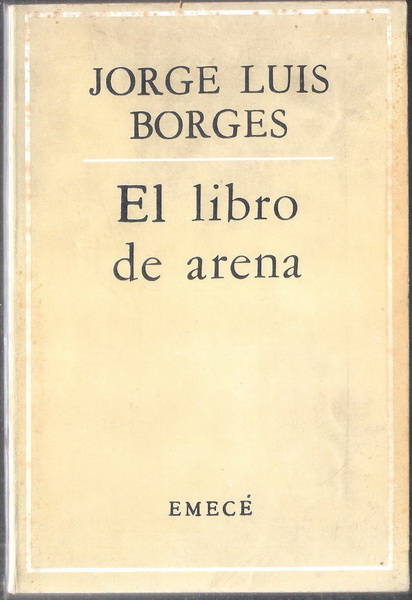
“The Book of the Forgotten Ones” (1977) by Nema Andahadna

There cometh the Book of the Forgotten Ones. This shall be for the priests of Maat.
In the name of creation and that which is before it, Aumgn!
—NAHADA 62, “The Forgotten Ones”
The Cincinnati Journal of Ceremonial Magick, Vol. I, No. II, 59

If a reader were to browse through the chapter on Lovecraftian magick in Robert North’s New Flesh Palladium (2006, 4th edition) or The Book of Lies: The Disinformation Guide to Magick and the Occult (2008), or peruse Kenneth Grant’s later Typhonian Trilogies, especially Outside the Circles of Time (1980), they would come across references to a supposed Lovecraftian occult text or work called The Book of the Forgotten Ones. One of the rituals is discussed briefly in The Necronomicon Files (2003). Yet unlike Necronomicon Gnosis: A Practical Introduction (2007) by Asenath Mason, you cannot exactly go online and buy a nice hardcopy edition of this particular occult text.

Some years ago I received a communication from the Maatian gestalt via the mediumship of Soror Andahadna (Nema).
—Allan Holub, “The Second Book of the Forgotten Ones”
The Cincinnati Journal of Magick, Vol. II, No. VI, 33

The Book of the Forgotten Ones is a channeled text, received by the medium Soror Andahadna (Nema, Maggie Ingalls). The reception of texts from a divine or supernatural source is accepted by many religions and occult groups, examples include Joseph Smith and the Book of Mormon or Kenneth Grant and the Book of the Spider. One can even draw a Lovecraftian parallel with the images of Cthulhu created by sensitive artists in “The Call of Cthulhu.”

Nema was a practitioner of Thelema, the system of ceremonial magick created by Aleister Crowley and extended by Kenneth Grant and others, and in 1974 had channeled the book Liber Pennae Praenumbra: The Book of the Foreshadowing of the Feather, which established her own “Maat” current, based on Thelemic principles. She joined the Bates Cabal in Ohio, helped write and publish The Cincinnati Journal of Ceremonial Magick in 1976, co-founded the Horus-Maat Lodge in 1979, and published a number of works on her Ma’atian magick. She was a member of Kenneth Grant’s Typhonian Order for several years, and alongside Michael Bertiaux became one of Grant’s favorite examples of Lovecraftian occults in his Typhonian trilogies.

Soror Andahadna, a contemporary priestess of Maat, has received snatches from beyond the Abyss, and they comprise The Book of the Forgotten Ones. It contains allusions to mysteries that first appeared in the writings of Frater Achad [Charles Stansfield Jones]. It would appear that there exists just without the circle of mundane awareness a complete grimoire of magical formulae. It is perhaps from this lost grimoire that artists and poets have been drawing with increasing frequency over the past century, or since the ‘first whirlings’ of the New Aeon were adumbrated more than four hundred years ago in the writings of Rabelais, and earlier initiates.
—Kenneth Grant, Outside the Circles of Time 46-47

“Snatches” is perhaps the best description of it, because if The Book of the Forgotten Ones has ever been a single complete text, I’ve found no record it. What we have are three separate chapters which were published over the space of a decade in the Cincinnati Journal of Ceremonial Magick, alongside much other Thelemic and Ma’atian material by Nema and the Bates Cabal.

The first chapter is “The Forgotten Ones,” published in Vol. 1, no. 2, pp.59-63 as by NAHADA 62. The text is dated 16 July 1971, which would make this earlier than the Liber Pennae Penumbra, and contains no overt references the Lovecraft Mythos, being for the most part a long series of short declarative sentences and instructions, for example:

Ye know Me, though my name be forgotten, in the dread of impending events. I am the motion of a leaf blown down an empty street. I am the sender of omens.

Chant the incantation of My Name.

It will destroy you. Pronounce My Name aloud, in repetition—it will banish all but pure Awareness.

Descend into My Temple, meet yourself. Bear thence the Wand of the Papyrus, and the sword, the shield of mine devise, and the eye Globe. Ye are twain therein, and learn the Alchemy and Mass of No*.
—NAHADA 62, “The Forgotten Ones”
The Cincinnati Journal of Ceremonial Magick, Vol. I, No. 2, 60

These could be taken as instructions for a ritual, couched in symbolic language for adepts. As to who the “Forgotten Ones” are, Nema would later expand on that slightly in her work Maat Magick: A Guide to Self-Initiation (1995), with a bit of a Jungian approach:

I call our survival urges the Forgotten Ones (FO) because our intellects tend to forget them or to trivialize them. Our individual and collective Egos are artifacts of intellect; it’s ego’s vanity that blinds intellect to the power of the FO. […] The Forgotten Ones include, but are not limited to, the instincts of hunger, sex, fight-or-flight, clanning, communication, curiosity, altruism and religion, all those imperatives or actions ensuring survival of self, offspring, and species. The gods our ancestors worshipped are rooted in the Forgotten Ones, given typical human personalities, then made larger and more powerful than humans. […] The gods and goddesses of the old pantheons gained independent life through centuries of worship and did play a directing role in the spiritual, moral and social lives of their devotees.

The second chapter is “Return of the Elder Gods: An Invocation of the Forgotten Ones” in The Cincinnati Journal of Ceremonial Magick vol. 1, no. 3, pp.17-26 (1978), as by “Nema and the Shadow.” Unlike the previous chapter, this is a completely different style, much more expositional and less ceremonial; it discusses the Elder Gods, their relation to the Forgotten Ones, and how (and why) to invoke the latter to aid against the invasion of the former. This is the ritual discussed in The Necronomicon Files (2003, 120-1); the paragraph in The Book of Lies 145 seems based directly on The Necronomicon Files. In one of those “as above, so below” turnabouts, it seems that:

In the Macrocosm, these forces are the Elder Gods; in the Microcosm, they are the Forgotten Ones. to  our present Consciousness, these gods are Qlipothic, constituting the Dark aspects of the anti-Universe and the human Unconscious respectively. Admittedly, there is a certain danger inherent in contact them; but there is sure disaster in neglecting to do so.
—Nema and the Shadow, “Return of the Elder Gods”
The Cincinnati Journal of Ceremonial Magick, Vol. I, No. 3, 17

While not explicitly Mythos-related (unless you count the term ‘Elder Gods’ in a sense Lovecraft never used), there are details of the work that suggest Nema was definitely being inspired by the work of Kenneth Grant, particularly Cults of the Shadow (1976) and Nightside of Eden (1977). It is notable that in Maat Magick, Nema writes:

Mr. Grant expresses a dangerous experience in Nightside, one that can be approached “in person” only from above the Abyss. […] He speaks more eloquently on the subject than anyone since H. P. Lovecraft. Unlike H.P. L., Mr. Grant is a conscious adept and priest of the eldrich [sic] dark; rather than speak of unspeakable horrors, he presents useful information about the denizens of the tunnels and the dangers of the Nightside. (209)

What really brought all this together was “The Second Book of the Forgotten Ones” in The Cincinnati Journal of Magick vol. II, no. 6, pp.33-53 (1988) by Allen Holub. This essay is an exegesis on Nema’s channeled text, along with a channeled text of his own received 7 January 1976, and directly connects these workings with the Lovecraft Mythos…sortof:

By way of introduction; this essay discusses a collection of forces deemed variously the Elder Gods, the Old Ones, and the Forgotten Ones. The two former names are unfortunate as they associate these forces with the writings of H.P. Lovecraft. Though Lovecraft may or may not have been in contact with these beings, his fearful ravings are of little use to the practicing magician. As far as I can determine, the forces discussed below have no relation whatever with the begins contacted by Lovecraft, even though some of them bear the same names. This similarity of nomenclature may be attributed to Lovecraft having indeed reached the Portal, that is, the verge of true communication with the Dark Forces. However, instead of communicating with them, he was eaten by them. The forces Lovecraft represents in his stories are not the true Elder Gods at all but are the shadows of the Elder Gods distorted to the point of unrecognizability by madness. For these reasons, the forces here will be called the Forgotten Ones, a name they choose for themselves. These are not the gods of the Lovecraft Mythos.
—Allen Holub, “The Second Book of the Forgotten Ones”
The Cincinnati Journal of Magick, Vol. II, No. VI, 33-34

Holub’s forceful assertion that the Forgotten Ones/Elder Gods are not the same as any entities in Lovecraft’s fiction appears to be a direct confirmation that some people did see the connections. Kenneth Grant appears to blithely ignore this entirely in his chapter on “The Forgotten Ones” in Outside the Circles of Time, and given the relative scarcity of the original journals, it’s possible few people were the wiser. Whether Holub was ever speaking for Nema on the matter is unknown.

In content, these snippets of The Book of the Forgotten Ones are both disappointing and interesting. The original channeled text and ritual by Nema appear to represent her genuine spiritual and occult leanings and practice, related as they are to the Ma’at current; Holub and Grant both seized on these as inspiration and raw material for their own expansion of the material. In the case of Kenneth Grant—who was apparently eager to seize on any magical practice vaguely related to his own Lovecraftian leanings—this resulted in the rather wider dissemination of The Book of the Forgotten Ones than it would otherwise have gotten.


Bobby Derie is the author of Weird Talers: Essays on Robert E. Howard & Others (2019) and Sex and the Cthulhu Mythos (2014).

The Leopard of Poitain (1985) by Raul Garcia-Capella

“Just—Irem. Ah, I see by your expression you too know of my namesake, that legendary place—”

You have heard of the city called ‘Irem’?”

“I’ve read esoterica about the City of Magicians. ‘Tis said to be but fancy, master. But a poet never forswears such dreams.”
—Raul Garcia-Capella, “Caravan to Kuthchemes” in The Leopard of Poitain 57

The fictional worlds of Robert E. Howard and H. P. Lovecraft are intertwined, one Mythos shading into another. In his long and varied career Conan faced Lovecraftian horrors such as the tentacled monster Thog in the lost city of Xuthal, and dealt with wizards birthed on Dagoth Hill which might have been cousins to Wilbur Whateley. Lovecraft himself put small references to Valusia, Bran Mak Morn, and the Serpent Men into his fiction…so it is not too much of a gloss to say that the Howardian heroes existed in the same world as nameless Lovecraftian protagonists.

Fans took note of this, and the Lovecraftian element has never quite left Howardian fiction even to this day.

I was born in Puerto RIco and brought up in San Juan in P.R., and in Miami. My paternal grandmother, a schoolteacher, taught me my first couple of grammar school years. Mom and Dad were readers; Dad was also a movie fna. As a kid, I’d read fairy tales to my younger cousins, while Dad introduced me to the serials, some of which were the Buster Crabbe Flash Gordon and the Nyoka serials, not to mention a number of Tarzan movies, Westerns, etc. Here’d by books for Christmas, and by the time I was eight had read Tarzan of the Apes and 20,000 Leagues Under the Sea in Spanish.
—”An Interview with Raul Garcia-Capella” by James Van Hise
in Sword & Fantasy #6, 44

Raul Garcia-Capella is better known as an illustrator for science fiction and fantasy books and magazines, with dozens of covers and interior art to his credit, sometimes under the name Ray Capella or R. Garcia Capella. Born in 1933, his family arrived in Brooklyn in the 1940s, just in time for the last decade-and-a-half of the pulp magazine craze.

DID YOU READ WEIRD TALES AT THE TIME?

No. Weird Tales didn’t attract me, I knew it was horror and my interest was more for science fiction/adventure. Through collecting and coming across Lovecraft’s work in the Boys High Library I realized HPL and Howard had written for Weird Tales.

I’d buy writers that had appeared in WT but I didn’t get the magazine itself, as when I did, I never could get through an entire issue. Later, I discovered Clark Ashton Smith and began appreciating the quality of material published by it. but I never got into collecting it. (ibid., 47)

This was during the period Dorothy McIlwraith was editor at Weird Tales, where she dropped science fiction and adventure stories. It wasn’t until about 1960 that Garcia-Capella became involved with Howard fandom, in the pages of the prominent fanzine Amra, and it was there that he began to write:

I wrote the brief autobiogrpahy of an Argossean; a fanciful bunch of ideas featuring a character who lived in the Hyborean Age. I thought it’s be presumptious to mess with Conan, who could only be done by Howard. So my creation tried to add more color to Conan’s world without altering it. In a word, it was a tribute. But [George H.] Scrithers wouldn’t let me off the hook because I’d outlined stories and titles. He kept nudging me by mail whenever I contributed illos or articles. Although hesitant to do it, when I finally started, the tales wrote themselves. It was great fun. I was reading Howard and Brackett and all the people that influenced me. But it was just—boom; they came out. (ibid., 51)

“The Leopard of Poitain” was published in the April 1960 issue of Amra, the outline inspired by “A Probable Outline of Conan’s Career” (P. Schuyler Miller & John D. Clark, 1938). This was followed up over a period of years with other adventures of Arquel of Argos. They were fun; Raul Garcia-Capella was a competent fantasist, and he knew what he wanted to write—action-driven sword & sorcery inspired by Robert E. Howard, Leigh Brackett, A. Merritt, and Fritz Leiber. Arquel himself, the eponymous “Leopard of Poitain,” is no Conan-clone or pastiche. An adventurer, certainly, but like Leiber’s Gray Mouser more interested in the thaumaturgical and wizardly side of things than the Cimmerian.

Working in another man’s story-world is a tricky business. […] Capella wisely—very wisely—uses Howard’s world without using Howard’s principal characters in on-stage rôles. Arquel is neither Conan nor an imitation of him; Capella is no Howard—he’s far saner, far easier to know and like. In doing so, Capella has illuminated corners of the Hyborean world that Howard overlooked: what was going on behind the scenes; why the enemies were foiled in their attempt to launch a sneak attack or to bring into being a evil, magical past best left buried; and how magic and magicians can work for good as well as for evil.
—George H. Scithers, “Introduction” to The Leopard of Poitain ii

The book-length collection The Leopard of Poitain (1985) is a bit of a hybrid. The first half (“Book I”) is a stitch-up novel that collects all of the Arquel adventures published in the pages of Amra and Fantasy Book up to that point, and pieces them together with brief episodes (“Witch’s Pebbles”) that forecast the new and longer novella (“The Winds of Acheron”) which makes up the second half (“Book II”), and takes place in and around the events of the final Conan novel, The Hour of the Dragon (1936). As he put it:

Jim Kelly, a fantasy fan who wanted to get into publishing, wrote asking why no one had put all the Arquel stories into one volume. The editors forward the letter to me. While exchanging letters, I let Jim know the project would need the final novella; it hadn’t been written. He agreed to wait and sent an advance check when the book was ready. The rest you know. Morgan Holmes proposed using the novella—”The Winds of Acheron”—and I did some polishing on it for that edition.
—”An Interview with Raul Garcia-Capella” by James Van Hise, 53

Explicit Lovecraftian references in Garcia-Capella’s Arquel stories are few—a reference to Irem here, a Serpent Man there—and he made no attempt to create new entities and tomes as was common in Mythos pastiches of the period. One of the most Lovecraftian is “Turutal” (1965), which involves a lost dwarf race known as the Ituru awakened from a curse to reclaim their miniature citadel; shades of Robert E. Howard’s “Little People” stories and Conan tales such as “The Devil in Iron” and “Shadows in the Moonlight,” although it has no direct connections to either.

As a result, The Leopard of Poitain is often overlooked and forgotten compared to the Howardian pastiche novels published by L. Sprague de Camp, Lin Carter, Björn Nyberg, Poul Anderson, Karl Edward Wagner, Andrew J. Offutt, and Robert Jordan of the period. Yet it is no less than any other work expanding the world that Howard created, and by extension is a serviceable a sword & sorcery offshoot of the Mythos as any other—and more conscientious of the source material and style than most pasticheurs. As he put it:

[Robert E. Howard’s] style balances mood and action almost seamlessly. Whether he’s doing horror or adventure, he has a flair for making scenes segue almost so well that you’re carried headlong. You can’t stop, go back, catch a gltich in the plot or—in the case of the “spicy” stories, for instance—an unevenness about the relationship between the characters. But you don’t care. In other words—his pacing is some of the best there is, in the pulp era or now.

In Moorcock’s aricles on fantasy, he traced the influences of gothic horror and the manner in which a description set story mood or was made to reflect the feelings of the characters involved. Lovecraft overdid it. C. L. Moore did this more lengthily than Brackett; Howard learned how to do it with a few words. In “The Devil in Iron,” the fisherman loosens the knife in its scabbard at the beginning of the opening paragraph—which ends with a sentence that sets the mood. Conflict comes first; mood closely follows and is interspersed through the fisherman’s exploration to his climactic demise. (ibid., 55)

Raul Garcia-Capella continued to write and illustrate, including other “Hyborian Age” tales such as “The Lair” (2006). He died in 2010.


Bobby Derie is the author of Weird Talers: Essays on Robert E. Howard & Others (2019) and Sex and the Cthulhu Mythos (2014).