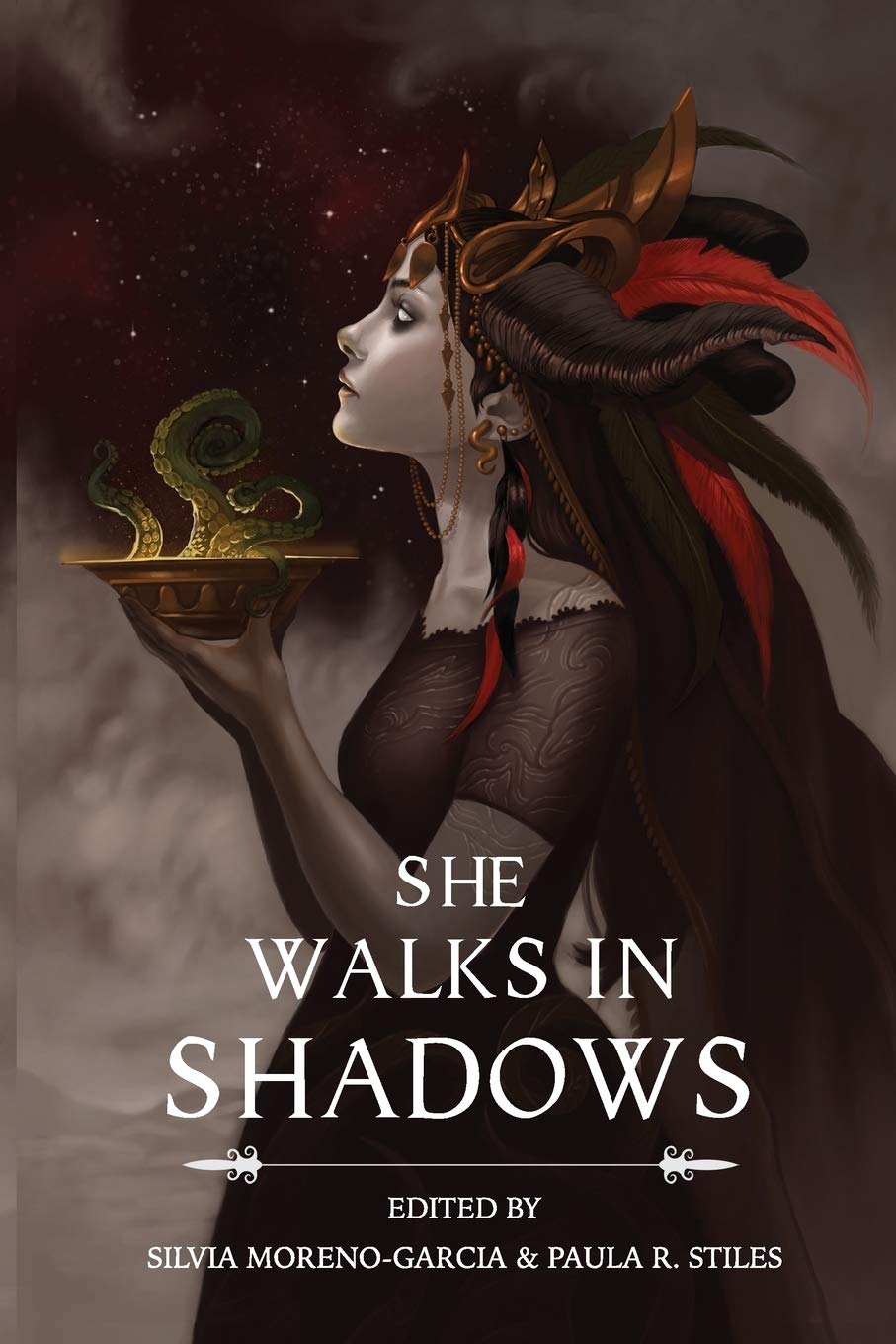
“Chosen” (2015) by Lyndsey Holder

Brown Jenkin was agitated, running circles around me, climbing up my back and crawling down into my lap, staring at me with his beady black eyes. I reached out to him tentatively and he nuzzled my hand, stirring a strange kind of love in my heart.
—Lyndsey Holder, “Chosen” in She Walks in Shadows (2015) 160

Familiar horrors inspire a kind of wish-fulfillment. Thousands of readers of Bram Stoker’s Dracula and Anne Rice’s The Vampire Lestat have imagined what it would be like to be undead, ageless and powerful, bound by night and loosed from the morals of humanity. Roleplaying games like Werewolf: the Apocalypse let fans of werewolf movies and lore vicariously embody the power and ferocity of the change. Contemporary witches look back at the witch trials and pay tribute to those hypothetical ancestors, sometimes drawing imaginary connections to the persecuted of Salem Village in the Province of Massachusetts Bay.

Lovecraftian horrors are not so familiar as vampires and werewolves, and so there are fewer who wish to truly meet or embody those horrors. Fewer readers express a desire to be Pickman-esque ghouls than to become vampires, though more than a few would happily undergo the change into a Deep One and dwell in wonder and glory forever beneath the waves. While there are a few Lovecraftian witches, occultists like Keziah Mason and Joseph Curwen are often still figures of horror, not mentors or figures of nostalgia akin to Dracula.

“Chosen” by Lyndsey Holder thus enters a rather scarce territory. We very often see Keziah Mason presented as the stereotypical witch, the old hag with the familiar, steeped in the blood libel of child sacrifice from old legends. Sometimes, rarely, we see her as the archetypal Lovecraftian witch, the one who embodies the kind of freedom, wisdom, and power—and attracts the kind of prosecution—that embodies the more mythical ancestors of contemporary Wiccans, as inspired by The Witch-Cult in Western Europe (1921) by Margaret A. Murray.

Holder’s story is very short, just six pages long, short and to the point, and all too easy to spoil. The biggest unanswered question might be why the nameless girl protagonist is a child in Vancouver, very far from Arkham as the broom flies. However, Lyndsey Holder is herself Canadian. Maybe there’s a bit of wish-fulfillment in this story, a fictional accounting of a pilgrimage she would have taken if the dreams had come to her. Certainly, Mythos fans can appreciate why they might save and scrimp to travel thousands of miles just to be there, where horror once walked. More than a few fans stride the streets of Providence and Salem every year, after all, thinking of Lovecraft and witches.

The horror in this story doesn’t really come from Keziah Mason or her familiar Brown Jenkin. They are familiar figures, and there is something comforting in their portrayal. The horror in the story is how the protagonist reacts to them, how her life changes when they become a part of it. The ending is certainly a fitting one. Not every Lovecraft fan would choose that way to become a part of the Mythos, but for those who are given a chance to be part of the story…well, a few readers at least will understand.

“Chosen” by Lyndsey Holder was published in She Walks in Shadows (2015) and its reprints, it has not otherwise been republished.


Bobby Derie is the author of Weird Talers: Essays on Robert E. Howard and Others and Sex and the Cthulhu Mythos.

Deep Cuts in a Lovecraftian Vein uses Amazon Associate links. As an Amazon Associate” I earn from qualifying purchases.
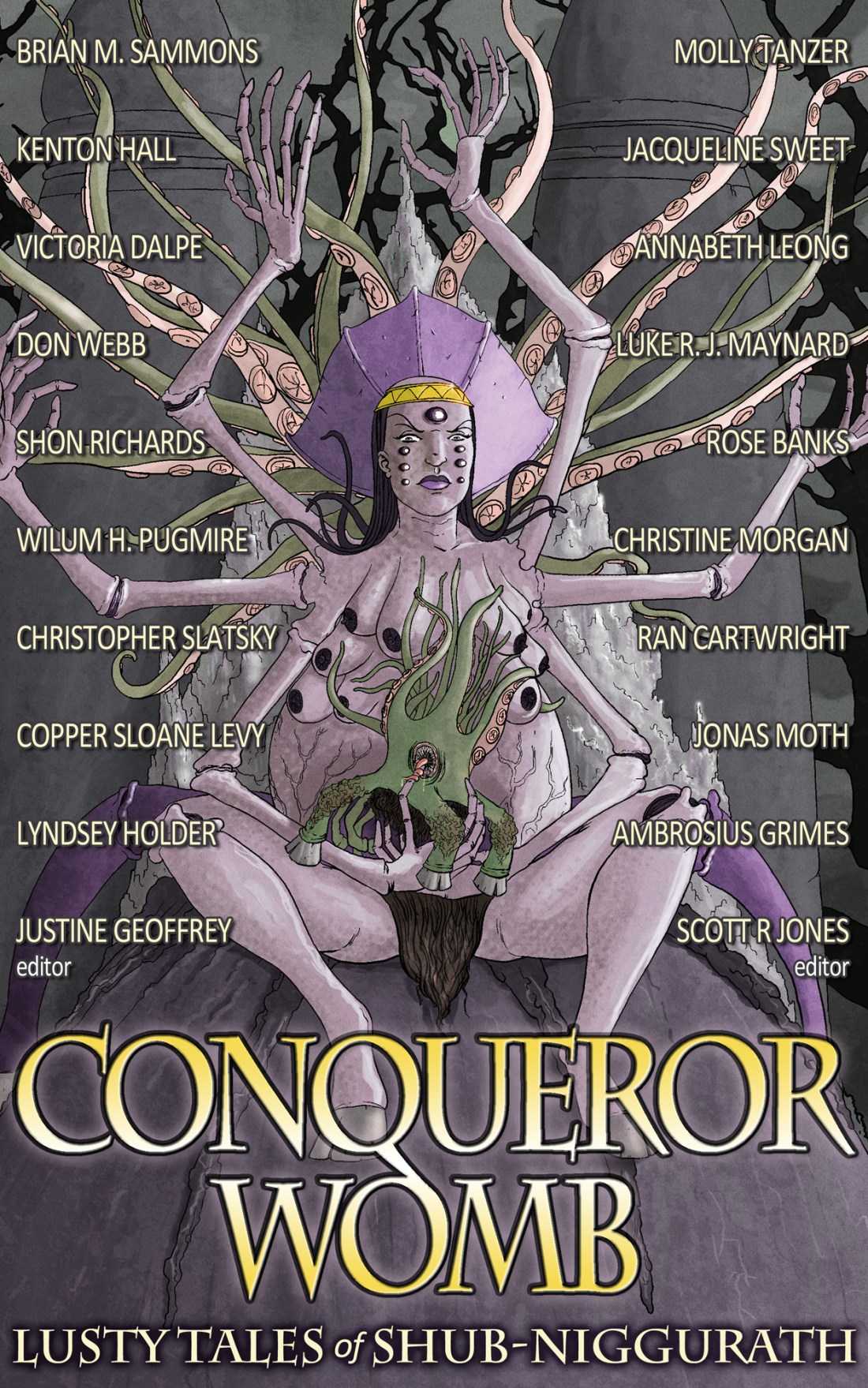
“This Human Form” (2014) by Lyndsey Holder

(A BUZZING IMITATION OF HUMAN SPEECH)

Iä! Shub-Niggurath! The Black Goat of the Woods with a Thousand Young!
—H. P. Lovecraft, “The Whisperer in Darkness”

You call me black, but I am beyond black. I am the space between the stars, the darkness that lies on the edge of your dreams, the sound of death in small spaces.

You say I am from the woods, but my woods contain no trees or birds, no peaceful sounds of wind and stream, no quiet rustle of delicate creatures. My forest pulsates, vibrates, glistens. […]

You call me a goat, and sometimes I am.
⁠—Lyndsey Holder, “This Human Form” in Conqueror Womb: Lusty Tales of Shub-Niggurath

More of a prose-poem or an invocation than a short story, Lyndsey Holder’s “This Human Form” reminds me of “The Elder Sister-like One, Vol. 1” (2016) by Pochi Iida (飯田ぽち。)“Red Goat, Black Goat” (2010) by Nadia Bulkin, and “Cthulhu Sex (ahem!)—a poem—” (1998) by Katherine Morel. Works that take inspiration from the Mythos, but don’t lean heavily on them; they forge their own lore, not bound by any convention of the Mythos and yet still strongly connected to it thematically.

Holder’s first-person account is only implicitly that of the Black Goat of the Woods with a Thousand Young, reveling more in sensation and imagery than any concrete connections to any other story in the Mythos. The connection is stronger by association: the story is in a Mythos anthology, which makes the imagery more apparent. But stick this story in a dark fantasy or horror magazine and would people still get it? Would their minds still make the connection? Probably not, if they weren’t already initiated in Mythos-lore and familiar with Shub-Niggurath, her aspects and attributes. But they could still enjoy the story.

“This Human Form” is exemplary of how in a largely disorganized way, the Mythos has evolved organically into something which the SCP wiki has done by considered design. While it has been said there is no canon to the Mythos, it would be more accurate to say there is no one canon. Certainly, Lovecraft’s Dreamlands stories are fairly consistent in themselves, as are Ramsey Campbell’s Severn Valley tales, Brian Lumley’s Titus Crow stories, W. H. Pugmire’s Sesqua Valley, Charles Stross’ the Laundry Files, etc. Peter Rawlik has curated a canon centered around “Herbert West—Reanimator,” and Shane Ivey has spent considerable time doing much the same with the Delta Green setting.

Most of these works are independent, interconnected, sometimes conflicting. Myths do that. Conflict, arguably, might even be essential to the Mythos: it forces the reader to engage with it, to juggle different concepts, maybe try to reconcile them.

There is on thing you do not call me: mother. My body has sent a thousand children into this world, a thousand mewling, crawling things, suckling and whining, slithering down silvery dream-threads into the soft comfort of your warm beds.
—Lyndsey Holder, “This Human Form”

It is rare to get a first-person take from a Mythos entity, although far from unknown. Neil Gaiman famously did it with I, Cthulhu, or, What’s a Tentacle-Faced Thing Like Me Doing in a Sunken City Like This (Latitude 47° 9′ S, Longitude 126° 43′ W)? (1987) (later publications have quite reasonably shortened this to “I, Cthulhu”). Gaiman’s take, of course, is a quiet taking of the piss. The idea of Cthulhu addressing the user is the main joke. For Mythos entities that are largely defined as ineffable and unknowable, the first-person narrative rather kills the mystery…unless, as Holder does, the meat of the text is salacious, sensation-driven, and suggestive. Making telling feel like showing.

Lyndsey Holder’s “This Human Form” was published in Conqueror Womb: Lusty Tales of Shub-Niggurath (2014). Her other Mythos fiction includes “Parasitosis” (2015) and “Chosen” (2015).


Bobby Derie is the author of Weird Talers: Essays on Robert E. Howard & Others (2019) and Sex and the Cthulhu Mythos (2014).