“The Passionate Fantasophile” (1979) by Janice Arter & “To the Shade of HPL” (1981) by Margaret Carter

Dr. Jeanne Keyes Youngson founded the Count Dracula Fan Club in 1965 after a trip to Romania; this was before the publication of McNally and Florescu’s In Search of Dracula (1972), but after the first full biography of Stoker, Harry Ludlam’s A Biography of Bram Stoker: Creator of Dracula (1962). It was the beginning of a serious opening-up of Dracula scholarship, serious scholarship that had fans and researchers scouring archives, uncovering Stoker’s original notes and manuscript, critically annotating and comparing different editions of the text. The work was international, and the fan club contained both enthusiastic vampire fiction fans and literary historians, and it published official journals and other publications.

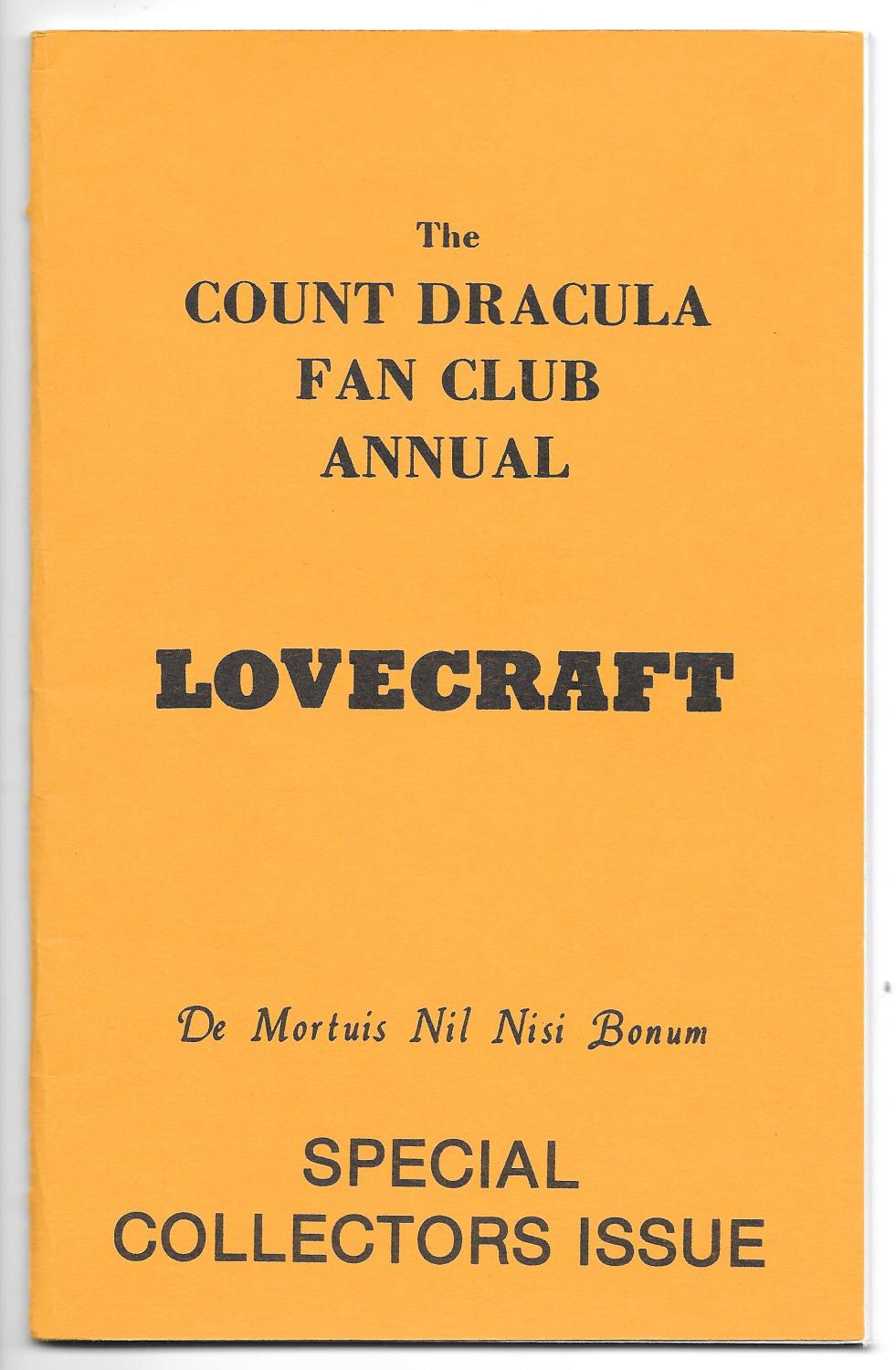
In 1985, the Count Dracula Fan Club published an annual, a special Lovecraft-themed collectors issue. The highlight of the issue might be Kenneth W. Faig, Jr.’s brief article “The Revision of Dracula”—the first real address of the Lovecraft/Miniter Dracula revision anecdote from the Lovecraftian scholar’s point of view. However, it was full of more than that, including two neat little Mythos poems by women authors, “The Passionate Fantasophile” by Janice Arter and “To the Shade of HPL” by Margaret Carter.

“The Passionate Fantasophile” by Janice Arter

Published for the first time in The Further Perils of Dracula (1979), a Count Dracula Fan Club poetry anthology, Arter’s 18-line poem is a lyric poem, opening with the invitation “Come live with me and drink my blood,” and working through a list of familiar activites, including:

Come live with me and we shall learn
The power to make the oceans burn,
The secrets of the Scroll of Thoth,
The chant to summon Yog-Sothoth,
And we shall be as one.

This is a poem for lovers in multiple senses of the term. It is a very romantic invitation, of one horror fan to another, inviting activities that would be horroric to anyone except another horror fan. By the 70s, Lovecraft’s Mythos was being woven into the pantheon of familiar horrors, and Yog-Sothoth could comfortably rub shoulders next to vampires and witches. It is the kind of opening-of-the-heart that would only really work from one true horror fan to another, someone who will both get the references and the appeal of going to the Sabbath or dwelling in unimagined space with someone else who gets it.

“To the Shade of HPL” by Margaret Carter

Published for the first time in Daymares from the Crypt (1981), a chapbook collection of Carter’s poetry, and was re-released in an ebook of the same-name in 2012. Carter’s verse takes the form of an ode in 12 lines, a tribute to Lovecraft and the Mythos he had spawned, which Carter herself had contributed to over the years, and would continue to do so in the years to come. Some of the imagery is in the same vein as Arter’s poem, emphasizing the Mythos experience and aesthetic:

The hand that traced those tales of nameless lore
Never lent its grave-chilled touch to me—
Yet I have groped my way down Arkham’s hills
To watch the rites of Innsmouth by the sea.

The difference is, Carter isn’t just evoking Lovecraft’s Mythos, but Lovecraft himself. The Old Gent had already become a part of his own Mythos, his growing legend entwined with the stories he had written, and the artificial mythology being slowly expanded by fans and pros alike. Carter isn’t directly inviting the reader to participate in nameless rites or to dance with ghouls, but is expressing her own experience of doing so, made possible only by H. P. Lovecraft.

While both of these poems are fairly minor in the grand scheme of fantasy and horror literature, they are examples of the growing acceptance of Lovecraft and the Mythos in the 1980s, even in Dracula fandom, which was only tangential to Lovecraft.


Bobby Derie is the author of Weird Talers: Essays on Robert E. Howard and Others and Sex and the Cthulhu Mythos.

Deep Cuts in a Lovecraftian Vein uses Amazon Associate links. As an Amazon Associate I earn from qualifying purchases.
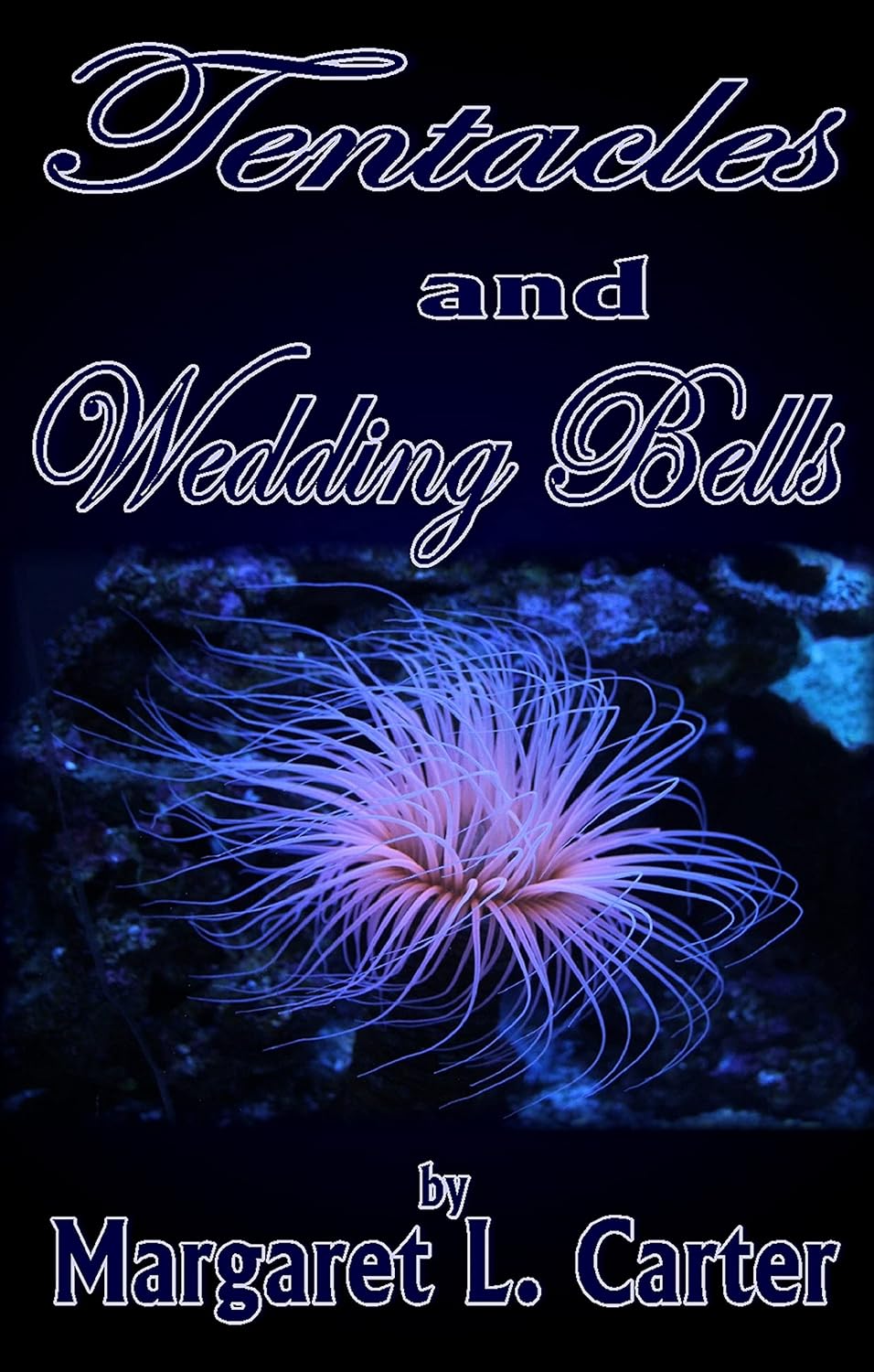
Tentacles and Wedding Bells (2022) by Margaret L. Carter

“What’s tentacle porn?”

“You don’t want to know,” he muttered.

M. L. Carter, “In the Tentacles of Love” in Tentacles and Wedding Bells (2022)

In Sex & the Cthulhu Mythos, there is a section of about 11 pages tracing the thematic history of tentacles and erotica as it applies to the development of weird fiction. For those curious, go read it. There are citations for those who wish further reading and scholarly sources.

For the purposes of this review, it suffices to say that tentacles have been associated with weird fiction in general since around the turn of the century, and with the Mythos in particular since the days of H. P. Lovecraft, Robert E. Howard, Clark Ashton Smith, C. L. Moore, and August Derleth. Tentacles were depicted as alien and unnatural…especially when, as the popularity of Japanese anime and manga boomed in the 1980s and 1990s in the United States and other markets, tentacle erotica became increasingly more available and conspicuously a part of the erotic vernacular lexicon, even if it remained a niche interest.

Tentacle erotica is often mentioned with an expression of disgust, perversion, and transgression against the natural order, and the beings equipped with tentacles are typically inhuman, malign, and rapacious. Quite literally; “tentacle rape” has become a byword for the whole mode of tentacle erotica. It’s become almost a farcical joke: Tentacle Grape soda is a product that uses the nod-and-wink toward the trope of sexual violation by faceless phallic feelers as a selling point. Many later works have leaned into this and begun to play it for sexual titillation or laughs, as in Booty Call of Cthulhu (2012) by Dalia Daudelin or “Le Pornomicon” (2005) by Logan Kowalsky.

Yet what you don’t often see is a sex-positive take on tentacle sex.

Tentacles and Wedding Bells (2022) by Margaret L. Carter is a combination of two light-hearted and sexy novelettes that had previously been published at Ellora’s Cave, an early 2000s ebook publisher that focused on romance and erotica, and which shut down in 2016. While some might cheer Amazon’s dominant share of the market, this does come at the cost of less variety from smaller independent publishers like Ellora’s Cove. Yet now, they are available once again, this time collected together.

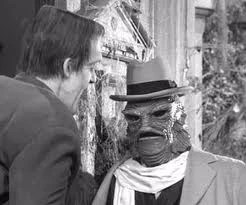
“Tentacles of Love” (2007) focuses on a wedding, where protagonist Lauren meets her future husband Blake’s family—a Mythos-inflected version of the Addams family or the Munsters, with Uncle Dexter from Innsmouth, Aunt Lavinia from Dunwich, Great-Aunt Asenath from Arkham, and of course, her fiancé’s twin brother Wilbur in the attic.

Uncle Gilbert, The Munsters (1965)

Only Wilbur takes more after their father:

A translucent mound of rainbow-colored bubbles filled the space, emitting blue and violet sparks whenever its surface rippled. A pseudopod oozed outward for a second, then withdrew into the mass, leaving a glittery trail on the floorboards.

M. L. Carter, “In the Tentacles of Love” in Tentacles and Wedding Bells (2022)

Wilbur, it turns out, is a shy, introverted soul who lives on the internet, listens to jazz, and enjoys Japanese anime (“Especially the giant robots and the creatures with tentacles.”) Pretty much like any NEET twenty-something. And Wilbur isn’t the only one with tentacles, as his brother soon reveals. For fans of “The Dunwich Horror” who have guessed at the purpose of Wilbur Whateley’s odd anatomy, M. L. Carter has the answers to your questions.

“Weird Wedding Guest” (2013) is the direct sequel; it’s Lauren and Blake’s wedding, and Wilbur meets bridesmaid Roxanne, who had been corresponding with Wilbur over email. In the dim and distant past of 2013 there was no internet dating service for the spawn of Yog-Sothoth, so the meet-cute is a little awkward…but it works.

Okay, so my email pal is half alien. He’s not really scary when you get past that fact.

M. L. Carter, “In the Tentacles of Love” in Tentacles and Wedding Bells (2022)

There are two reasons that these stories work. First, Margaret L. Carter knows her Lovecraft, and all the in-jokes and even the lore is spot-on. Fans of the Mythos will enjoy the Easter eggs and attention to detail, and the imagination at play. Second, the stories are played straight as spicy romance stories with women protagonists. These aren’t Derlethian pastiches, nor outright farces. These are women who take a great deal of weirdness in stride, and slowly come to explore some novel erotic circumstances…and their emotional attachment to their odd-looking but loveable paramours grows deeper. It’s a familiar story; like Beauty and the Beast, but more domestic.

Yet that’s why it works. Carter plays the tropes of the spicy romance off of the Lovecraftian callbacks beautifully. The sex scenes are creative and original, but more important than that they feel earned. This isn’t a story of sexual assault by eldritch entities, but a sex-positive exploration of new sensations between two willing and considerate partners.

Tentacle and Wedding Bells isn’t cosmic horror, but it is fun and intelligent. Carter is very deliberately subverting expectations in this story; the references to Wilbur’s interest in tentacle porn make a lot of sense for unstable congeries of iridescent bubbles that can exude pseudopods that double as genitalia.

It is nice, after all these years, to see both parts of Tentacles and Wedding Bells (2023) together at last and relatively available, either through Amazon or other retailers.


Bobby Derie is the author of Weird Talers: Essays on Robert E. Howard and Others and Sex and the Cthulhu Mythos.

Deep Cuts in a Lovecraftian Vein uses Amazon Associate links. As an Amazon Associate I earn from qualifying purchases.
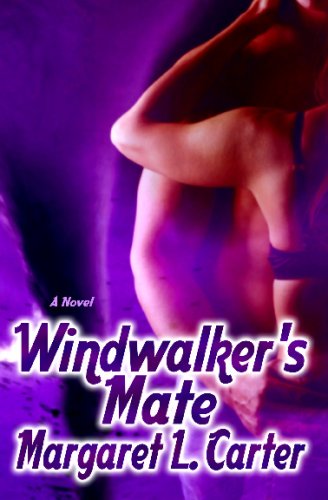
Windwalker’s Mate (2008) by Margaret L. Carter

She had been chose, she said, to be sacrificed to Ithaqua, the wind-walking elemental which the Stillwater people are said to have worshipped, and she had decided that she would flee, rather than die for a pagan god, of whsoe existence even she was not too sure.
—August Derleth, “The Thing That Walked on the Wind,” Strange Tales of Mysery and Terror Jan 1933

Ithaqua is one of August Derleth’s original contributions to the Mythos; the story that introduced him is first mentioned to Lovecraft in 1930, after Wright apparently rejected it (ES1.277). The sort of chequered history has dogged the Windwalker down the decades; few writers have made much use of Derleth’s creation, although Brian Lumley has made good use of Ithaqua—and given that entity a penchant for spawning children, a la Yog-Sothoth and “The Dunwich Horror”—in works such as “Born of the Winds” (1975) and Spawn of the Winds (1978).

It is Lumley’s interpretation that almost certainly inspired M. L. Carter’s dark paranormal romance novel Windwalker’s Mate (2008), although she puts her own spin on the proceedings. Shannon is a survivor; after the Rite of Union, she left the cult that was trying to bring strange Mythos entities to overrun this world—and forty weeks later she gave birth to her son Daniel, never knowing if his father was Nathan, the son of the culture leader who had participated in the rite with her, or the Windwalker who had possessed him.

Romance may seem an odd genre for Lovecraftian fiction; Lovecraft himself saw little of it in his life and his stories focus very little on those kind of human relationships. Nor were many of Lovecraft’s followers very inclined toward such things. Yet there is a thin substratum of genuine Mythos romance, dealing with the complex tangle of human relationships in a Mythos milieu—and much more seriously than “I Wore The Brassiere Of Doom” (1986) by Sally Theobald or “Love’s Eldritch Ichor” (1990) by Esther M. Friesner. These are works that tend to get overlooked by the main audience of Mythos writers; stuff like Tide of Desire (1983) by Sheena Clayton, Arkham Dreams (2011) by Robin Wolfe, Widdershins (2013) by Jordan L. Hawk…and one might even include The Dunwich Romance (2013) by Edward Lee, although that gets a little more hardcore than the others.

There are a few steamy moments in Windwalker’s Mate. It is far from the elaborate sexual fantasies of, say, Shoggoth Butt Invasion (2016) by Jason Wayne Allen. The sex scenes serve the plot as much as the reader; Shannon is reconnecting with Nathan, worried about her kidnapped son, placing her hope that coitus will re-establish their telepathic bond (it makes sense in the context of the book)…

He deepened the kiss, drawing her back into the present. her tongue darted eagerly to meet his. His hand cupped her breast through the T-shirt and thin bra. The tingling in the nipple zapped to the pit of her stomach and the V between her legs. The explosion of colors crashed over her again.

Then she saw stars falling like snowflakes and the sky behind them splitting open.
—Margaret L. Carter, Windwalker’s Mate 105

…yet the emotional core of the novel is very serious. Shannon is trying to save her son; she’s a lonely single mother, the cops are useless, and the former cult leader is trying to use Daniel to summon Ithaqua and the Ancient Ones into the world…there is a great deal of drama, both of the mind-numbingly mundane and weird kind.

It works. Opinions will vary on the approach, but M. L. Carter succeeds at what she set out to do: write a paranormal romance with the Mythos as a setting. If Chaosium ever published a sequel to The Ithaqua Cycle (1998/2006), this would not be out of place. The basic premise is much like the question of what happens after Rosemary’s Baby? only with Rosemary having the hard practicality to not stay with the Satanic cult because she had a baby to think of now. Daniel might well be the spawn of the Windwalker, but he isn’t a Wilbur Whateley-esque monster…not yet, anyway.

Windwalker’s Mate was published in 2008 by Amber Quill Press. Carter’s other Lovecraftian works include “Prey of the Goat” (1994) and the erotic novella Tentacles of Love (2009).


Bobby Derie is the author of Weird Talers: Essays on Robert E. Howard & Others (2019) and Sex and the Cthulhu Mythos (2014).

“Prey of the Goat” (1994) by Margaret L. Carter

…so from the wells of night to the gulfs of space, and from the gulfs of space to the wells of night, ever the praises of Great Cthulhu, of Tsathoggua, and of Him Who is not to be Named. Ever Their praises, and abundance to the Black Goat of the Woods. Iä! Shub-Niggurath! The Goat with a Thousand Young!
—H. P. Lovecraft, “The Whisperer in Darkness” (Weird Tales Aug 1931)

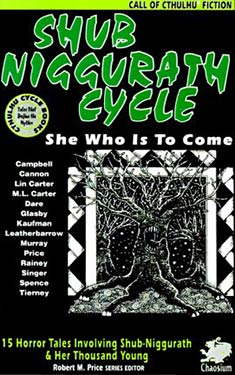
RP_shubniggFew of the entities of the Cthulhu Mythos created by Lovecraft & his correspondents in the 1930s were implicitly or explicitly female; of those the most enduring in the imagination of Mythos writers and fans is Shub-Niggurath. Mother Hydra, whatever her literary charms, has not inspired multiple anthologies dedicated to her. Shub-Niggurath is itself nebulous, never appearing on the scene, but as an element of ecstatic worship and invocation in several of Lovecraft’s stories; in “The Mound” Shub-Niggurath is portrayed as a “sophisticated Astarte,” in Clark Ashton Smith’s “The Holiness of Azédarac” the familiar epithet is given a masculine twist as “the Ram with a Thousand Ewes”;  it is only in his letters Lovecraft described Shub-Niggurath explicitly:
Yog-Sothoth’s wife is the hellish cloud-like Shub-Niggurath, in whose honour nameless cults hold the rite of the Goat with a Thousand Young. By her he has two monstrous offspring—the evil twins Nug and Yeb. He has begotten hellish hybrids upon the females of various organic species throughout the universes of space-time (cf. “The Dunwich Horror”) [. . .]
—H. P. Lovecraft to Willis Conover, 1 Sep 1936, Selected Letters
 5.303

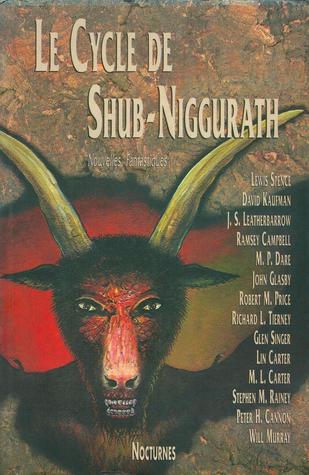
Most of the stories about Shub-Niggurath that have been published are written by men. This may not be terrible surprising: most Cthulhu Mythos published has been written by men. When “Prey of the Goat” first appeared in The Shub-Niggurath Cycle (1994), M. L. Carter was the only woman whose work was represented among the offerings.

24516480The horrors of Lovecraft were, by and large, of equal terror to all—you don’t need to be a white male to appreciate cosmic horror, and assigning sex and gender to some of the more alien creatures of the Mythos may be a somewhat laughable enterprise—a diminution of these eldritch deities to prosaic human concerns. But there is a caveat: sex exists in Lovecraft’s fiction, and with the purpose: procreation. Female characters, be they willing participants or victims, may lay with and beget monsters. Important segments of Lovecraftian fiction fall into the familiar cycles of the “demon lover” or “rape fantasy,” which Margaret L. Carter recognized:


H. P. Lovecraft, who was strongly influenced by Arthur Machen, has a wizard’s daughter raped by the outcast dark divinity, Yog-Sothoth, in “The Dunwich Horror.” The girl gives birth to twins, one a queerly repulsive boy who grows at an impossible rate but looks outwardly human, the other an invisible monstrosity, formed of elements alien to this universe. Asenath in “The Thing on the Doorstep” is the result of a union between a blasphemously evil necromancer and a “thing from the sea.”
—M. L. Carter, introduction to Demon Lovers and Other Strange Seductions (1972)


Carter brings this understanding and approach to the sexuality of the Cthulhu Mythos to “Prey of the Goat.” As a horror story, it hits familiar beats: a strange, horrible old artifact. Disturbing dreams. Carnal acts that hint at possession. Prayer and invocations. A victory…with an aftermath. The “demon’s” name is Shub-Niggurath, but the aesthetics are not beholden to Lovecraft; this is the erotic nightmare in a Christian Episcopal mold, a new priest facing an old Catholic terror without even a rite of exorcism in his arsenal. The Mythos elements are prominent, but reserved; Carter seeds a few connections without going overboard. This is a story that ties in to the larger Cthulhu Mythos, but its world is intimate, focused on just two people and their relationship.

The protagonist is Father Michael Emeric, the recipient of the amulet of Shub-Niggurath is his wife Terri. Much of the fine detail in the plot is not devoted to Mythos minutiae, but on the dynamics of the relationship between the two, their respective roles of husband and wife, man and woman; Michael tries not to overstep, to respect Terri’s agency, but when he does feel the need to undermine it finds it surprisingly easy. There’s an undercurrent in the story when it demonstrates how easy it is for Michael to slip into stereotypical masculinity to get what he wants, yet also how reluctant he is to do that. Terri for her part shares a distinct parallel with the female protagonist of  Tina L. Jens’ “In His Daughters’ Darkling Womb (1997)”:

If they could have had a baby—but years of trying had produced no conception, with infertility tests failing to reveal the cause. Now that Terri was past thirty, they’d given up.

Infertility as a literary device has its uses: it it obviates the question of why characters do not have children, it makes conception (if it does happen) all the more miraculous or unholy. Yet there is a fundamental difference in approach between how Carter and Jens use it in these stories—in Jens’ story, the protagonist is female, the miscarriages she suffers are a result of failing to carry to term rather than failure to conceive; in Carter’s the protagonist is male, and the cause of the infertility is more ambiguous. If the infertility tests have failed to reveal a cause, is that because the cause lies not within her, but within her husband?

Carter essentially is putting the infertility fear on the other foot: not the feminine fear of miscarriage, or inability to have children, or birthing a monster, but the masculine fear of being cuckolded. The title “Prey of the Goat” forces the reader to ask the question: who is the prey, Michael or Terri? Certainly, the pastor’s wife is the one possessed by Shub-Niggurath, the one who has to suffer through the terrible erotic dreams where:

Then the goat stepped down into the crowd. She grabbed the first man and forced him to—forced him into her. He screamed.

But Terri tells her husband, when he asks her role in the dream, “I was the goat!” Later on, Michael wakes to find his possessed wife riding him—a rare example of rape of a man by a woman in Mythos fiction—the first dream is revealed as foreshadowing. Terri is the focus of the supernatural activity of the story, but the plot involves both of them, and this feeds into the ambiguous sexuality of Shub-Niggurath, who blends male and female characteristics in its appearance here. Whether Michael is threatened by the superior masculine aspect of Shub-Niggurath, or by the sexual dominance asserted by Terri under the Goat’s influence, the unexpected menage has Michael questioning his inadequacy, an attitude that carries right through to the foreboding end of the story. Abortion is ruled out by faith, but also by Michael’s impotent clutching at straws: “Besides, she might be wrong. It might be mine.”

“Prey of the Goat” almost never appeared at all; it was originally accepted for Lin Carter’s Weird Tales published by Zebra Books, but that series ended in 1983. If not for The Shub-Niggurath Cycle a decade later, it might never have seen publication at all. Which is a shame since it is a deceptively simple plot which is well worth deeper consideration. Carter has returned to the Mythos a few times, most notably with the romance novel Windwalker’s Mate (2008) and the erotic novella Tentacles of Love (2009).


Bobby Derie is the author of Sex and the Cthulhu Mythos (2014)