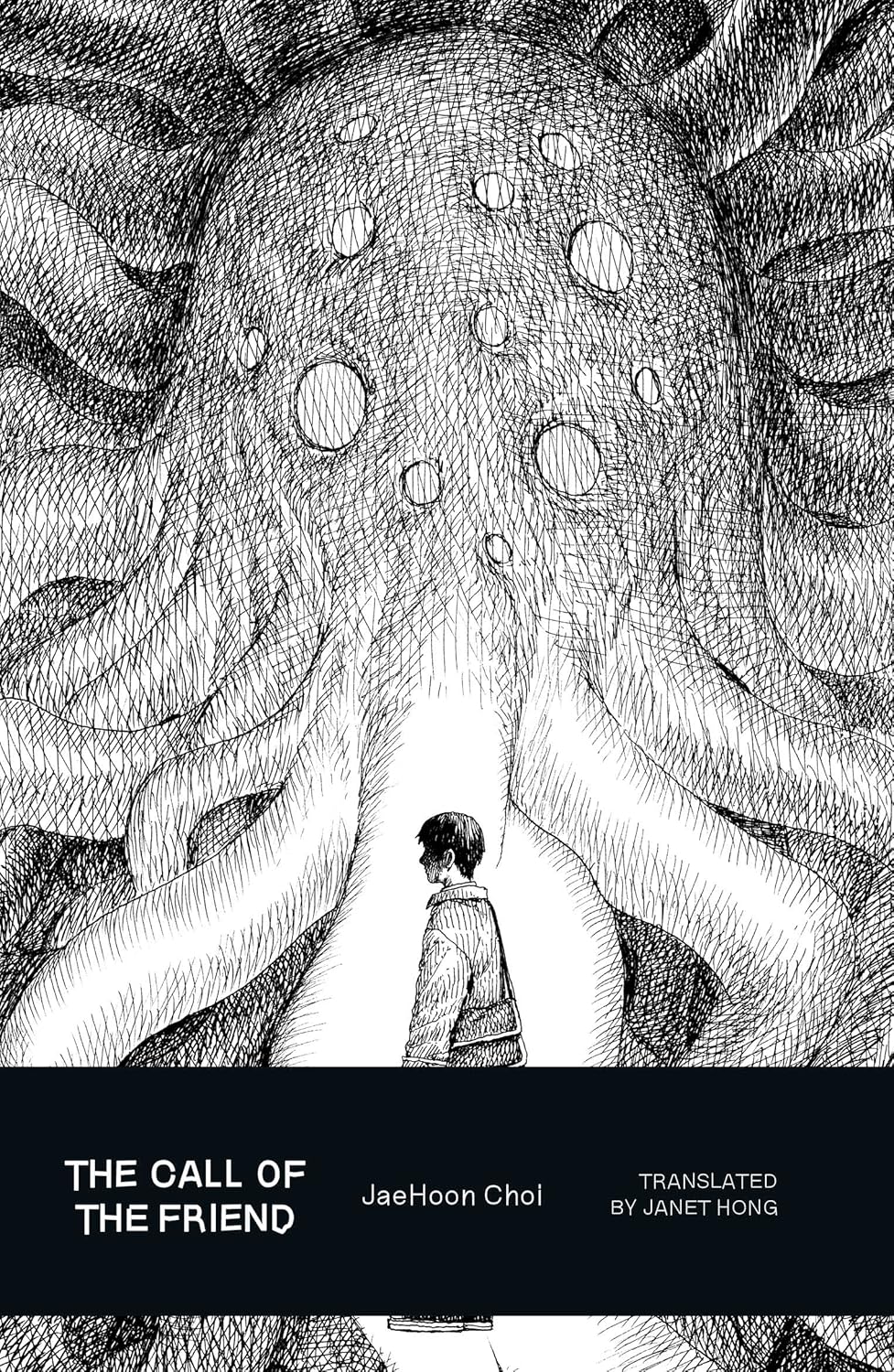
THE CALL OF THE FRIEND is part of the Lovecraft Reanimated project, where leading Korean speculative fiction writers reimagine the works of horror master H.P. Loveccraft, while honoring his eerie, grotesque imagery and the blurred boundaries between reality and fantasy, they update his ideas for a global audience.
—The Call of the Friend (2025), inside cover flap
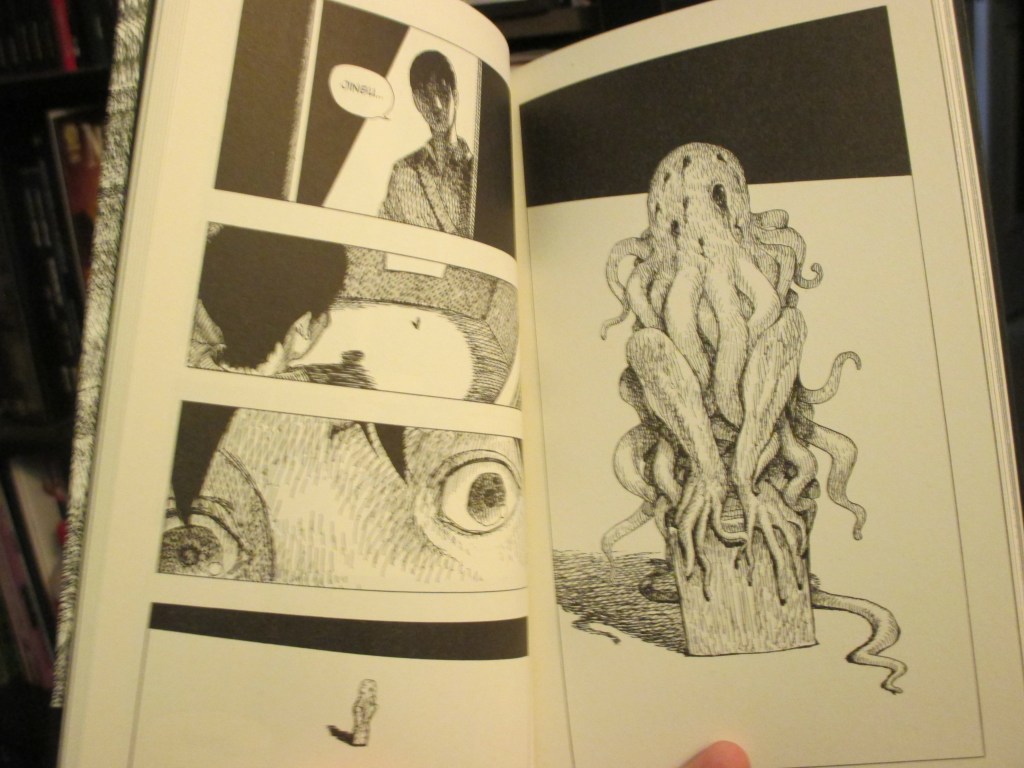
The Call of the Friend (친구의 부름) is a standalone black-and-white graphic novel by Korean comic artist and writer JaeHoon Choi (최재훈), first published in 2020. The English translation by Janet Hong was published in 2025 by Honford Star. The story is set in contemporary urban Korea, where university student Wonjun checks in on his friend Jingu, whose sister (a K-pop idol) has recently committed suicide, implicitly because of a scandalous affair. It is in Jingu’s apartment that Wonjun spots a strange idol.
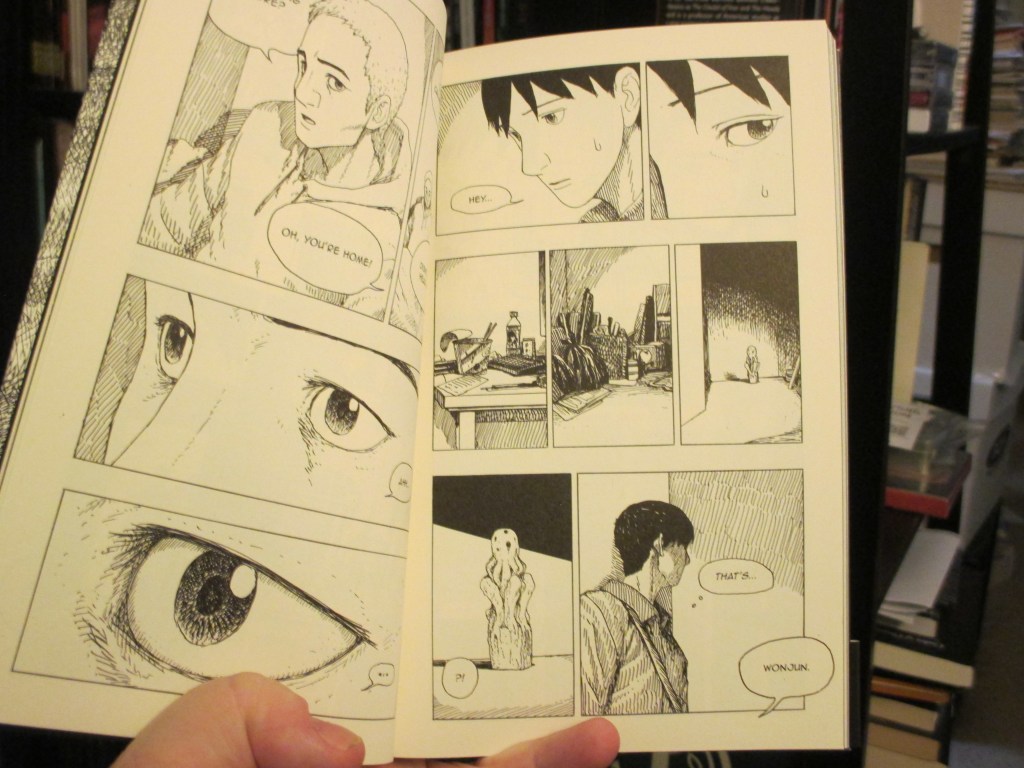
The story that unspools is not a straightforward linear narrative. It is intimate, focused on Wonjun, with everyone other than Jingu essentially faceless. Readers get pieces of the puzzle, but the full story isn’t spelled out for them, readers are forced to interpret the evidence as best they can. In this, they are given a single helpful hint in a short essay at the end of the book:
Some live a life of violence, while others make every effort to avoid stepping on an insect. But no matter the severity or type of sin, the moment we realize we have sinned, we experience fear. The fear isn’t so much the dread of punishment or retribution. It stems from the knowledge that we’ve hurt someone or caused their unhappiness, and the sin manifests as fear. Depending on the intensity of this fear, we can either be liberated from our guilt or ensnared by it.
While I don’t want the theme to be too obvious in this story, I hope readers might be able to tangibly experience Wonjun’s guilt. These long, nocturnal reflections on our current human condition, set against H. P. Lovecraft’s world of unexplained fears, have prompted me to contemplate the words we’ve spoken, the conflict and guilt we’ve endured, as well as the subsequent death and feat they cause.
—The Call of the Friend (2025), 104-105
As an essay, it is slightly reminiscent of Arthur Machen’s prologue to “The White People” on ‘sorcery & sanctity.’ The idea of fear as a fundamental response to a transgression—an instinctive response to some imbalance caused by action or inaction—and that this fear can liberate or ensnare guilt, has its attractions. Yet how does this philosophical approach jive with Lovecraft’s famous proclamation that “the strongest kind of fear is fear of the unknown”?
When you don’t know what the sin was. When the only way you have to measure how badly you’ve hurt someone is the measure of the fear you feel in response to it. Whether this is what JaeHoon Choi intended with The Call of the Friend I cannot say, but the presence of the Cthulhu Mythos in this story is suggestive of something that goes beyond tawdry K-pop star drama and the suicide of the sister of a friend. It suggests that there’s something much bigger at work here, something unseen and unknowable, and it threatens to ensnare Wonjun entirely.
The Call of the Friend is somewhat reminiscent of Minetaro Mochizuki’s Hauntress (1993) in general outline—both of them deal with young university students living on their own, the one checking in on the other to whom something has happened, and with a supernatural horror creeping into their lives—and more importantly, that sensation of an urban legend unfolding in a space of familiar, contemporary surroundings. These are characters ill-equipped to deal with the psychological terrors of their experiences. They have no strong faith, no occult skills or leanings. They are regular people, with limited resources, facing the uncanny.
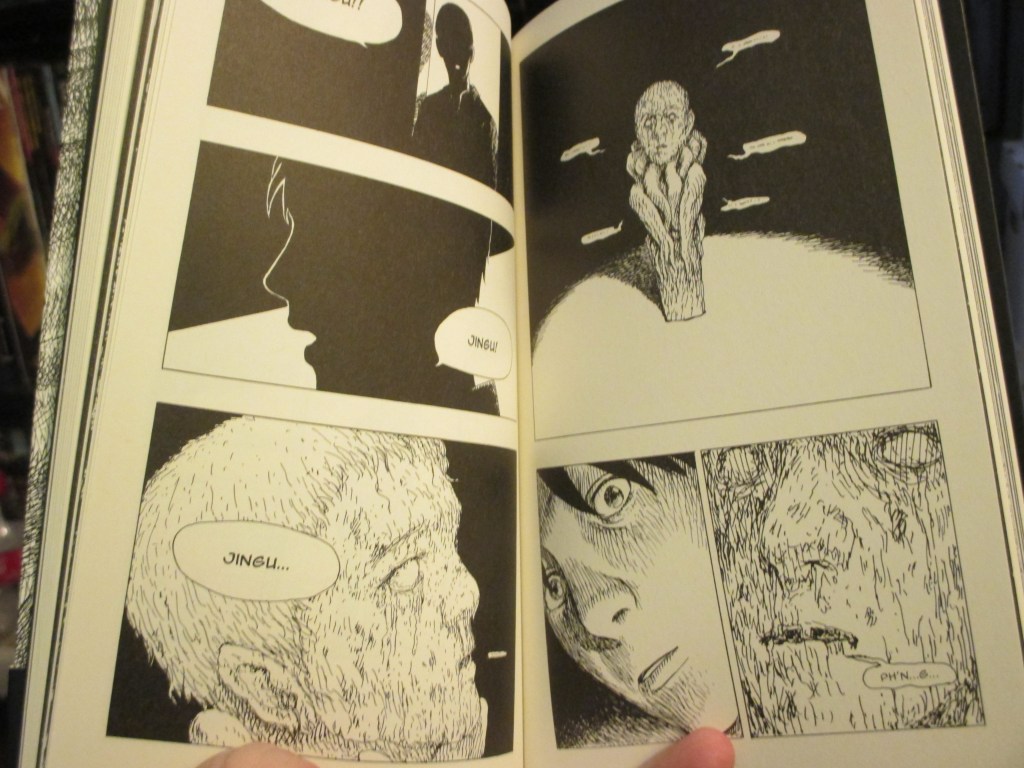
That works. JaeHoon Choi takes advantage of the prosaic setting and characters to make the distortions of perception all the more disturbing for taking place in setting of absolute reality. Readers will question how much of this is in Wonjun’s head, will wonder when we slip into dream, hallucination, or twisted memory. The idol forms a locus of manifestation, a central image to embody what it is happening, but even until the end, readers have to decide how much of this is really happening.
The comic ends like an unresolved chord. Readers don’t get answers. Only the impression that they have witnessed something. Perhaps that is the answer itself.
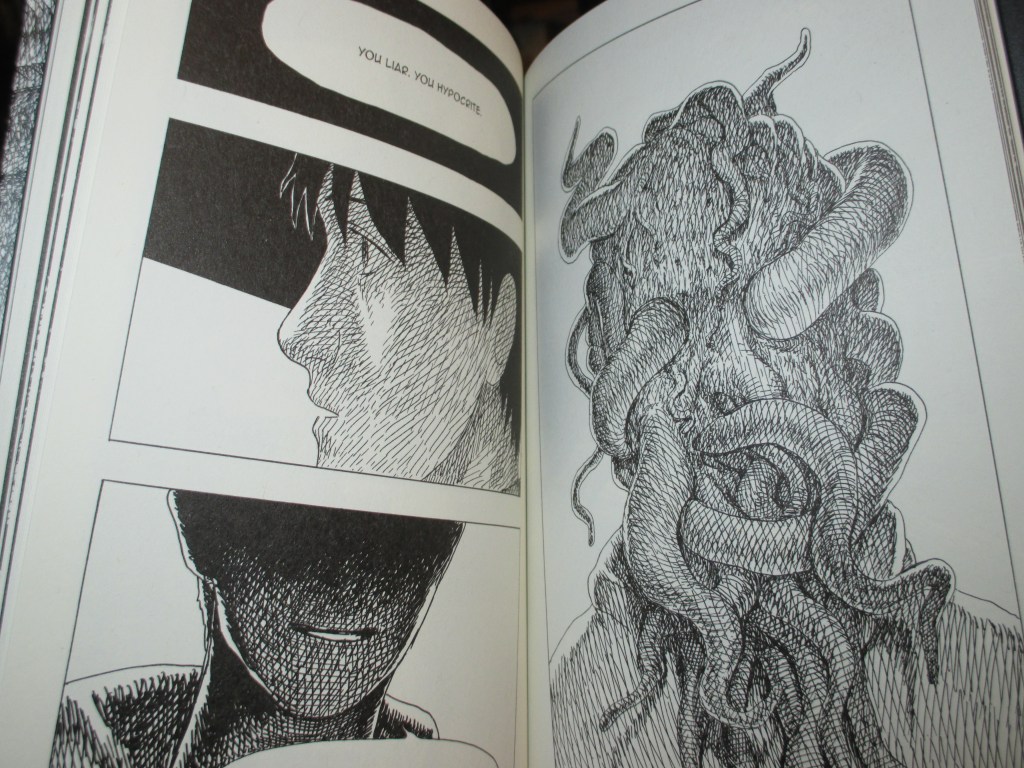
Janet Hong’s translation of the graphic novel into English is very readable and smooth. While most of the graphic novel itself has relatively sparse dialogue, the essay at the end is very clear and easy to understand, and a valuable key to understanding the work.
The Call of the Friend (2025) by JaeHoon Choi and translated by Janet Hong is available at the Honford Star website as an ebook or softcover.
Bobby Derie is the author of Weird Talers: Essays on Robert E. Howard and Others and Sex and the Cthulhu Mythos.
Deep Cuts in a Lovecraftian Vein uses Amazon Associate links. As an Amazon Associate I earn from qualifying purchases.
 Deep Cuts in a Lovecraftian Vein