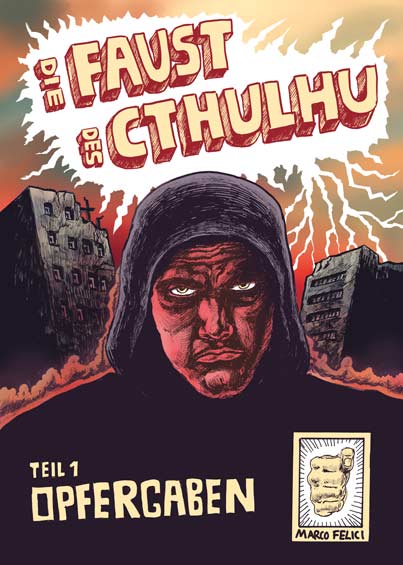
| In naher zukunft existiert die menschliche zivilisation, wie wir sie kennen, nicht mehr. Alte wesen sind aus ihrem schlaf erwacht und haben die herrschaft über die erde übernommen. Die wenigen überlebenden ergaben such der beuen religion und ihrer propheten. Dies ist die geschichte eines mannes, der sich nicht unterwirft, sondern den kampf gegen die neuen mächte aufnimmt. | In the near future, human civilization as we know it will no longer exist. Ancient beings have awakened from their sleep and have taken control of the earth. The few survivors surrendered to the new religion and its prophets. This is the story of a man who does not submit, but takes up the fight against the new powers. |
| Back cover of Die Faust des Cthulhu 1. | English translation |
Die Faust des Cthulhu (The Fist of Cthulhu) is an independently published, black-and-white, German-language post-apocalyptic action-horror comic from writer/artist Marco Felici (lettering by Till Felix, cover colors & title design for issues 2-4 by Olaf Hänsel). Published irregularly, the series appears to consist of four separate issues and a collected edition:
- Teil 1: Opfergaben (Part 1: Offerings) (2014)
- Teil 2: Offenbarung (Part 2: Epiphany) (2015)
- Teil 3: Untergang (Part 3: Downfall) (2018)
- Teil 4: Übermacht (Part 4: Superiority) (2020)
- Sammelband (Collected) (2022)
(Note: the listing I’ve seen for the collected edition says it collects the first five issues, so I may well be missing one.)
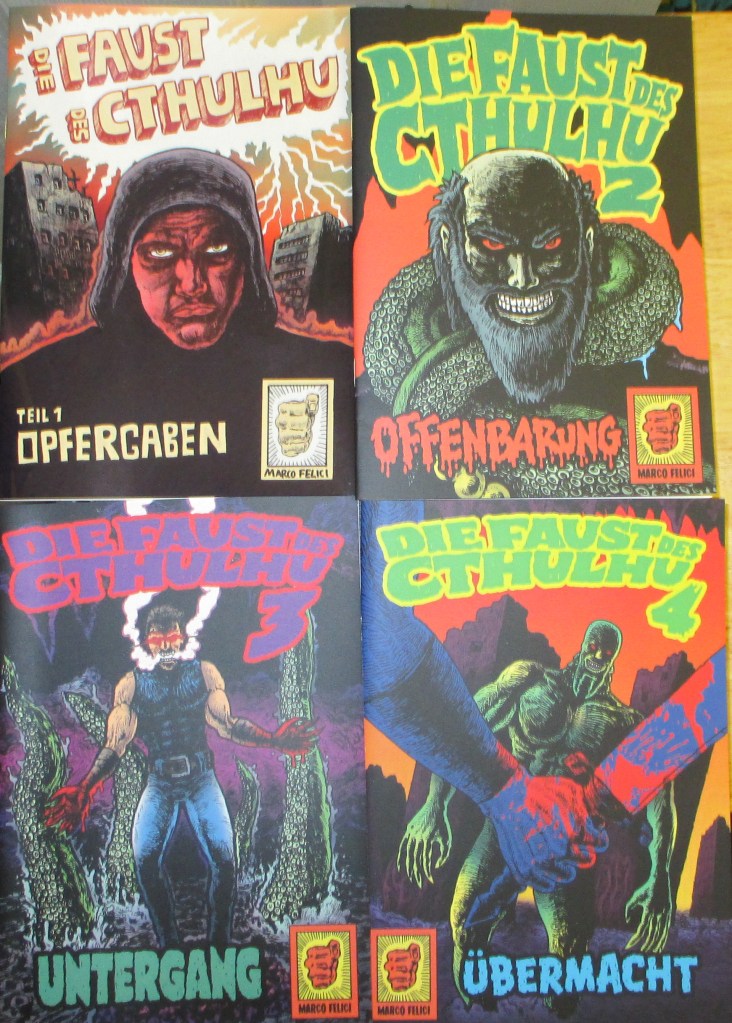
The art and story are strongly reminiscent of American underground comix of the 1970s-1980s, with the occasional shade of Richard Corben (especially in the color covers on issues 2-4), or Eastman and Laird’s early, relatively grungy-looking black-and-white issues of Teenage Mutant Ninja Turtles, long before the children’s cartoon softened their image and sensibilities. Story-wise, there may also be more than a touch of a manga influence, with shades of Fist of the North Star or other post-apocalyptic action-adventure series. Surprisingly, there’s also a touch of luchador influence, with the humanoid monsters sometimes going masked, at least initially.
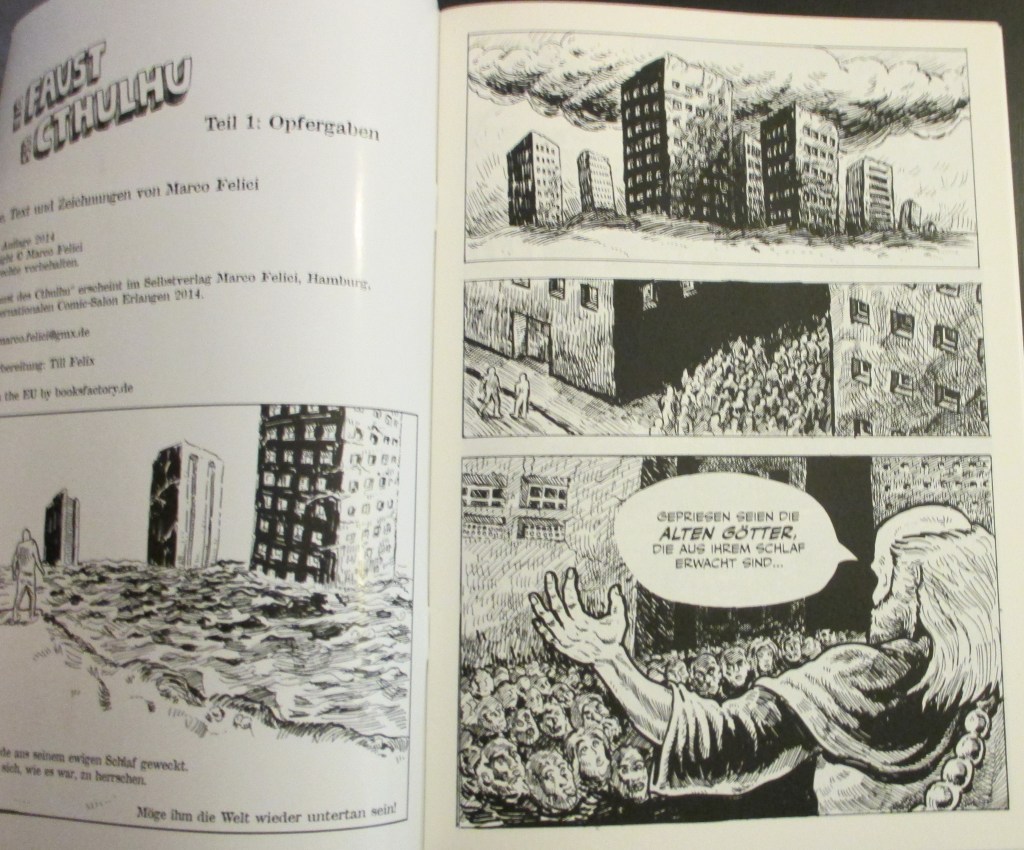
Fundamentally, the story is straightforward: a mysterious stranger takes exception to one of the regular innocent sacrifices to the Old Ones, and deals with a cultist and his minion—a half-human spawn of elder beings. Of course, our hero soon shows that he isn’t entirely human either…imagine if Wilbur Whateley decided he related more with his mother than Yog-Sothoth and chose to try and rid the world of eldritch horrors, and you’ve about got the scope of the series. Along the way, a kid sees him fight and becomes witness-cum-sidekick as they travel through the hellscape of the future.
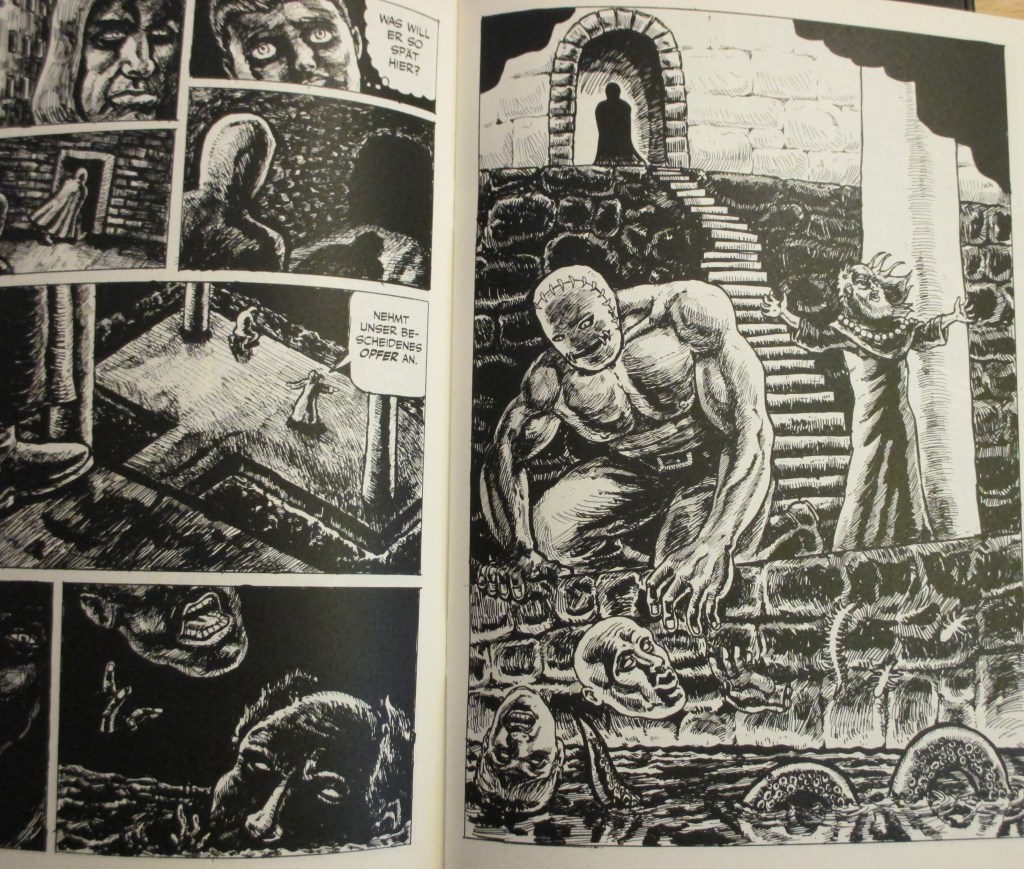
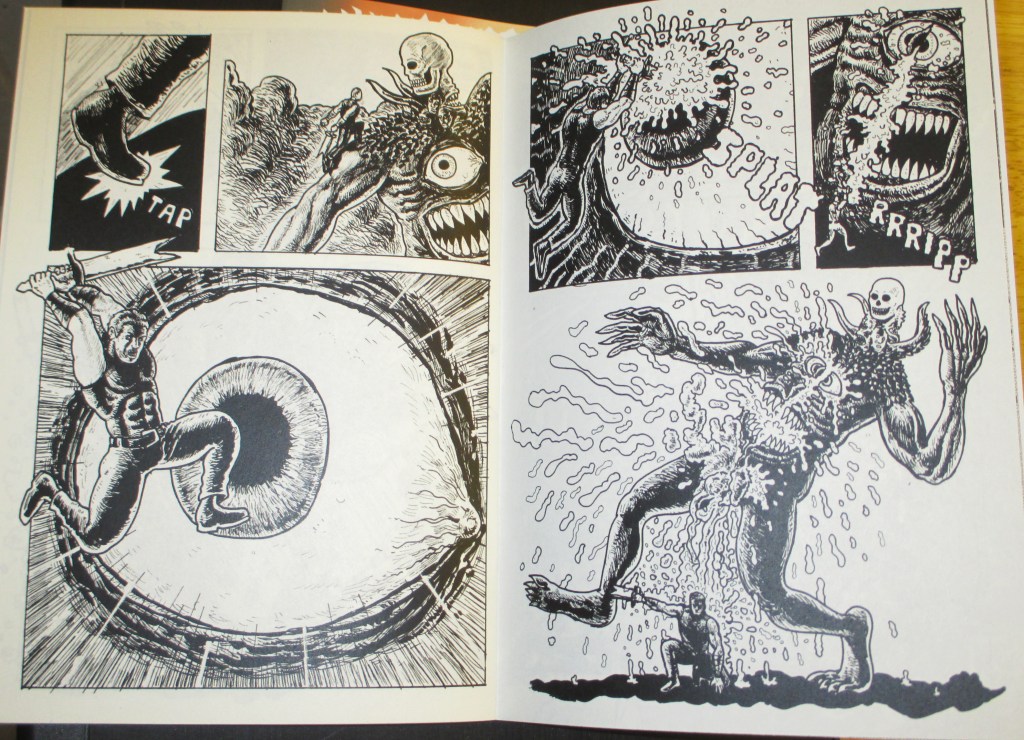
The art is a mix of that underground comix serviceable-enough grunginess and moments of interesting character and creature design. Backgrounds tend to give way to action lines or solid blocks of black or white, which makes sense in black-and-white comics where the focus is on the figures more than the surroundings.
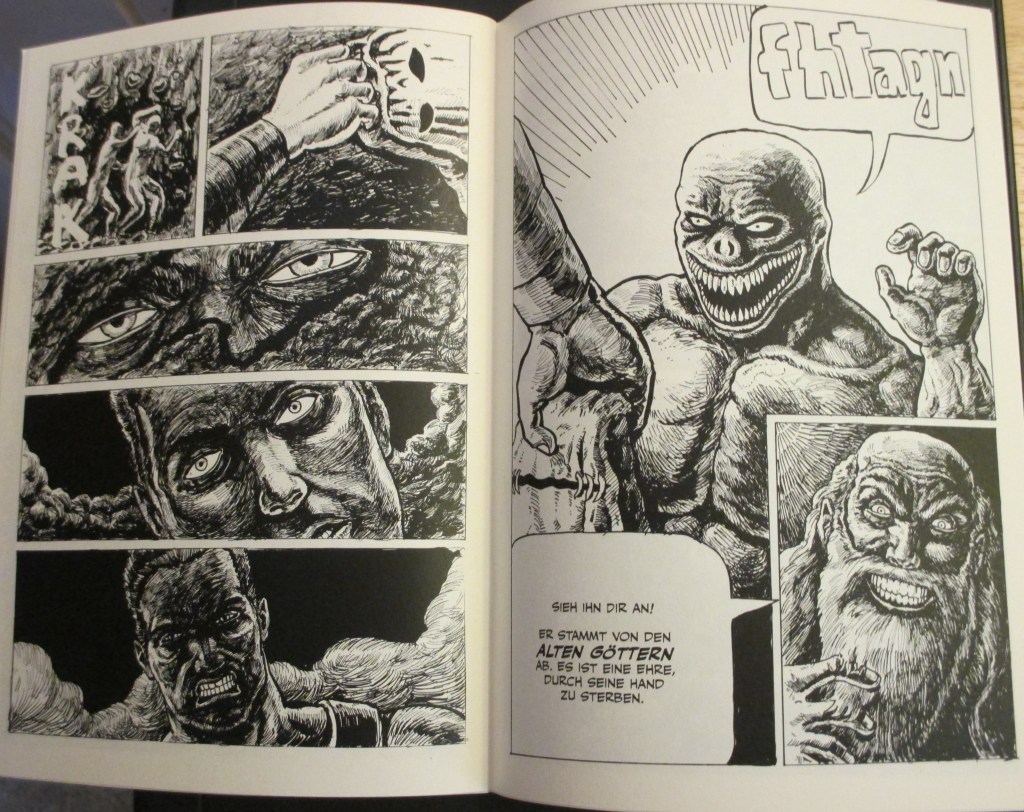
Mythos references are a bit scanty; Die Faust des Cthulhu isn’t a pastiche in the sense that it wants to expand on the lore in vast detail, and while there is a bit of exposition the actions tend to speak louder than words, and the explicit connections to the Mythos are usually relegated to a few exclamations in the heat of battle. There is more of an element of Robert E. Howard to the story than Lovecraft; the nameless hero is of the same mind as Conan that if something bleeds then it can die, even if the thought is not expressed in so many words. Readers hoping for deep pathos or character development may be disappointed, but primarily this is fun. A guy with a pair of knives wrestles tentacled monsters and cuts them apart. It’s closer to sword and sorcery than cosmic horror.
Sometimes that’s silly. Sometimes that’s awesome.
It is not clear how many copies of a given issue are printed, but given the scarcity probably not many; readers interested in tracking down a few should check out German comic shops or eBay.
Bobby Derie is the author of Weird Talers: Essays on Robert E. Howard and Others and Sex and the Cthulhu Mythos.
 Deep Cuts in a Lovecraftian Vein