
When Mrs. Phillips Gamwell, Howard Phillips Lovecraft’s aunt, returned to Providence from Cambridge, Mass., she and H.P.L. took an apartment on College Street near my dwelling. I had heard of Mrs. Gamwell before, so it was not long before I was visiting her, thusly bringing about my acquaintance with her nephew.
—Marian F. Bonner, “Miscellaneous Impressions of H. P. L.”
in Rhode Island on Lovecraft (1945) 23
The heart ceases to beat.
The last breath is released.
The countdown begins.
When someone dies, all that is left of them are the physical records—the letters, manuscripts, and other writings—and the memories of them in those still living who knew them. Both are perishable. Unless efforts are taken to preserve them, both will be lost. However, the living memories are the more fragile, the more liable to fade or shift with age, and once the person who holds them gone, they are gone forever, unless some effort was made to save them in fixed form. Some efforts were made to save H. P. Lovecraft’s written legacy: his stories, poems, letters, even the scraps were saved by friends and heirs.
The memories of his life, however, were not systematically preserved. Friends, neighbors, and acquaintances wrote and published their impressions of H.P.L. sporadically; there was no attempt to interview his surviving aunt Annie Gamwell while she was alive, for instance. In hindsight, that looks like an oversight—but in truth, it is the rare individual whose memory is preserved long after their death, except in census records and government databases, dusty family bibles and photo albums. Lovecraft, at least, inspired sufficient publication to catch a few recollections and memoirs before those who knew him passed on themselves.
Marian F. Bonner was Lovecraft’s neighbor and correspondent, although she was primarily a friend of his aunt. In 1945 she put together a brief memoir for the collection Rhode Island on Lovecraft. Bonner was not, apparently, a reader of his fiction; seemed entirely outside of the posthumous cult of personality that was Lovecraft’s fandom, or the politics of amateur journalism. Her random collection of recollections and impressions does not speak to any particular image or issue in Lovecraft by anyone else. It is a brief sliver of a life, and several of her impressions were apparently absorbed from Annie Gamwell, rather than directly from interactions with H.P.L.:
His aunt once told me of the meals he would pick up at various, unearthly hours, perhaps at a diner. He abused his digestion horribly according to her reports. His use of sugar in his favorite beverage, coffee, was enormous.
—Marian F. Bonner, “Miscellaneous Impressions of H. P. L.”
in Rhode Island on Lovecraft (1945) 24
At the time “Miscellaneous Impressions of H. P. L.” was published, none of Lovecraft’s correspondence with Bonner had seen print. Lovecraft’s letters would confirm much of what Bonner had said—the letters with the cat heads that Lovecraft had drawn on them, the Gaol Lane anecdote, the 1936 Christmas tree, his tendency to practically cover a postcard with tiny writing.
It is only a short memoir, and there is almost nothing in it that isn’t covered elsewhere by other memoirs or letters. Yet it captures her relationship with Lovecraft and his aunt. We are richer for its existence than we would be without it, for it is a piece of Lovecraft’s life we wouldn’t have had, otherwise.
As an addendum, at the John Hay Library at Brown University, a note survives which is attributed to Bonner:
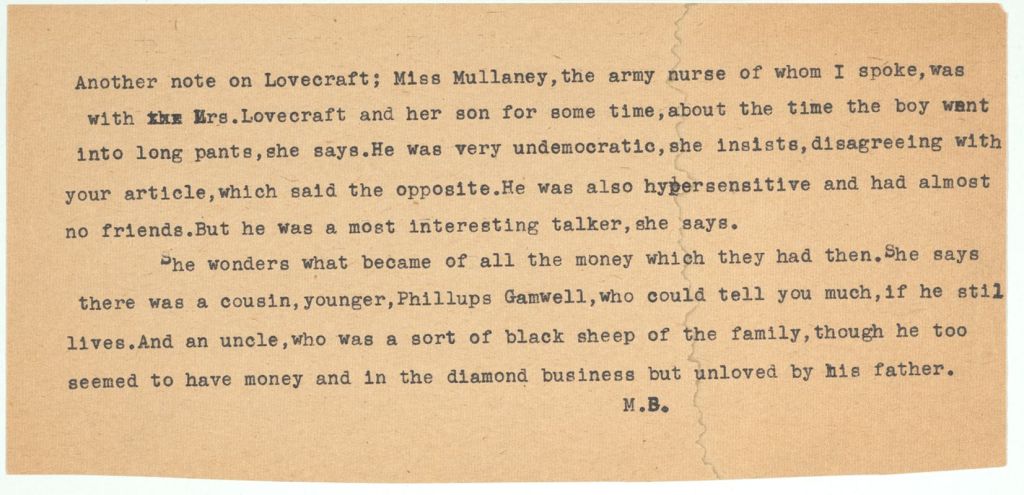
Bridget Mullaney was one of the Lovecraft family’s servants during the 1890s. She was apparently unaware that Lovecraft’s cousin Phillips Gamwell had died in 1916, or the cause of the family’s slow financial dissolution. The black sheep uncle was Edwin Phillips. It is interesting to compare these third-hand impressions of a young H. P. Lovecraft with the recollections of the Letters of Clara Lovrien Hess.
“Miscellaneous Impressions of H. P. L.” was first published in Rhode Island on Lovecraft (1945) and the 1946 second edition; it was subsequently reprinted in Lovecraft Remembered (1998), Ave Atque Vale (2018), and Lovecraft Annual #9 (2015), alongside her letters with Lovecraft. It has also been translated into German by Malte S. Sembten for Namenlose Kulte (2006).
Rhode Island on Lovecraft can be read for free at the Internet Archive.
Bobby Derie is the author of Weird Talers: Essays on Robert E. Howard and Others and Sex and the Cthulhu Mythos.
Deep Cuts in a Lovecraftian Vein uses Amazon Associate links. As an Amazon Associate I earn from qualifying purchases.
 Deep Cuts in a Lovecraftian Vein