Dear Ms. Hollow. You don’t know me, but you and I share a mutual acquaintance, through whom I had the opportunity to read the draft of your horror story about the exotic fruit that turns pain signals into pleasure. I much enjoyed the prose of your story, but I have some relevant information that I would like to share with you.
—Mary Hollow, No One Came For Me: Weird and Primal Horror Stories
Lines of literary descent are not always easy to trace. If a writer goes out of their way to mention Cthulhu or the Necronomicon, then we can say with some certainty that they’ve read Lovecraft, or that they’ve read somebody that read Lovecraft, and so on. Without such concrete citations, it can be tricky to assign influences with any certainty. Would we say that Jeff Vandermeer’s Annihilation owes a debt to H. P. Lovecraft’s “The Colour Out of Space?” Well, probably not within earshot of Vandermeer.
Fiction is like that. Writers can play with the same subjects, but may arrive at parallel approaches. We can only note the parallels. Fortunately, in this case, in the afterword to her collection, Mary Hollow gives thanks to Thomas Ligotti, so it is easy to say that yet, “Neural Mechanisms of Analgesia” (2023) is a story in the Ligotti lineage of weird fiction.
There’s a relation to Lovecraftian fiction, a similarity, but a distance as well. Hollow doesn’t cite the Necronomicon or Arkham, doesn’t try to fit her work into someone else’s mythology. As a medical horror, there is a distant echo of “From Beyond” and other gland stories, the clinical detachment that threads its way to a kind of sublime understanding regarding some fundamental function of life.
If you prick us, do we not bleed?
—William Shakespeare, The Merchant of Venus Act 3, Scene 1
The story takes the form of a letter to Hollow herself. The epistolary format offers some advantages; like with “Machines Are Digging” (2009) by Reza Negarestani, there is that fine frisson as scientific citation and rational argument segues into something else. That moves beyond science fiction and touches on something else, something that goes beyond science in a direction that approaches—not the mystical, but a kind of revelation that limits rather than expands the possibilities of life. The opposite of wonder is not terror, but a kind of disenchantment that negates wonder, cancels it out.
The book offers up the pholosophical conundrum of what it means to have an experience that evaporates as soon as it is over.
—Mary Hollow, No One Came For Me: Weird and Primal Horror Stories
There is that aspect of—not exactly pessimism, but the kind of microscopic focus of ultra-sanity that strips away the comforting illusions of life, or even of weird fiction. There is no Elder Sign to ward of the neurological realities of the pain response in humans, no resonator to smash to hide from what was always around us all the time. Imagination can offer no comfort, and when stripped away there is only a kind of philosophical numbness. The reader ends the story burdened with knowledge, but there is nothing to do with that knowledge.
Does it matter if Hollow draws from Lovecraft or Ligotti? Only insofar as we can recognize the connection, the thematic parallels with their works. Hollow is working in a tradition, though not borrowing from anyone’s mythology in doing so. A reminder that as fun as the Mythos is, there is much more to Lovecraftian literature than just the Mythos.
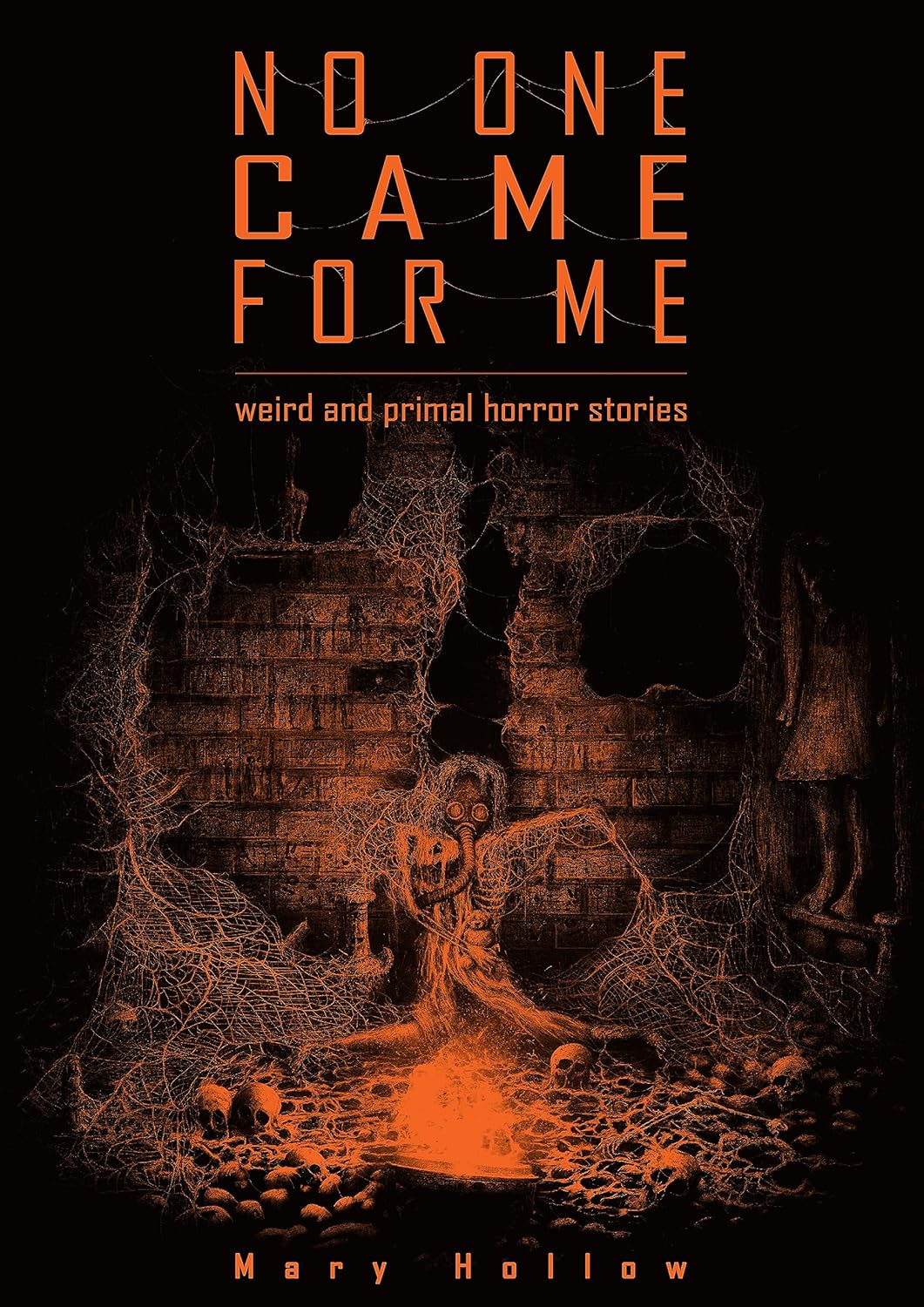
“Neural Mechanisms of Analgesia” is published in Mary Hollow’s collection No One Came For Me: Weird and Primal Horror Stories (2023). It has not yet been reprinted.
Bobby Derie is the author of Weird Talers: Essays on Robert E. Howard and Others and Sex and the Cthulhu Mythos.
Deep Cuts in a Lovecraftian Vein uses Amazon Associate links. As an Amazon Associate I earn from qualifying purchases.
 Deep Cuts in a Lovecraftian Vein