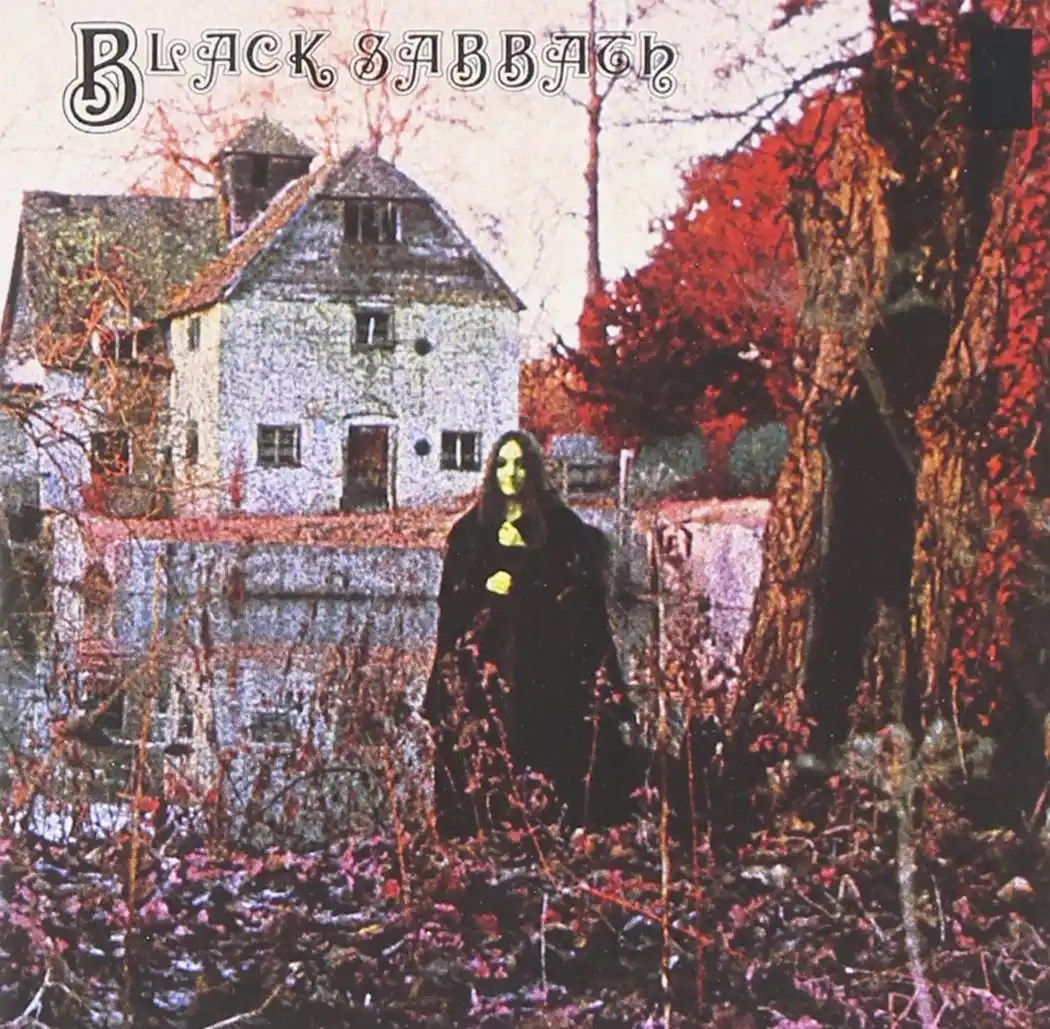
“Behind the Wall of Sleep” (1970) by Black Sabbath

Now from darkness, there springs light
Wall of sleep is cool and bright
Wall of sleep is lying broken
Sun shines in, you have awoken
—Black Sabbath, “Behind the Wall of Sleep”

England. August 1969. The cinema across the street was playing the Italian horror anthology film I tre volti della paura (1963, “The Three Faces of Fear”), rendered into English as Black Sabbath. Or maybe it was just a poster of the film. Recollections, years later, differ. That became the title of the band, and the lead song on the album they recorded in November of that year. The basis of the band was blues-based rock & roll, with heavier guitar riffs, less melodic and more distorted. Lyrically, the band borrowed from horror and fantasy as much as they did the grimy street life of drugs; shades of Tolkien in “The Wizard,” Dennis Wheatley in “Black Sabbath” and “N.I.B.,” H. P. Lovecraft in “Behind the Wall of Sleep.”

Guitarist Tony Iommi had lost the tips of two fingers in a workplace accident, and down tuned the guitar to make playing easier, but played aggressively; Geezer Butler, on bass, was used to playing a guitar and followed Iommi’s riffs, but was also the band’s chief lyricist. Bill Ward on drums set the tempo, alternately driving or (in the case of “Black Sabbath”) with dirge-like slowness; Ozzy Osbourne provided lead vocals and harmonica. Iommi, Butler, Ward, and Osbourne all had working-class backgrounds, done stints in factories and abattoirs. They were young, a bit raw, and played and sang hard and fast and loud—and saw something in the rising interest in horror and fantasy.

The ’60s saw a rise in interest in horror and fantasy fiction, alternative spirituality, and the occult. Wicca gained traction in the United Kingdom and United States; the works of Aleister Crowley were reprinted; the Hobbit and the Lord of the Rings, first released as hardbacks, found new life in paperback. British writer Dennis Wheatley published an entire library of occult fantasies like The Devil Rides Out. Old pulp authors like H. P. Lovecraft likewise found a new generation of enthusiasts for horror and fantasy as Arkham House hardbacks were reprinted as affordable paperbacks, like Dagon and Other Macabre Tales (1969) by British publisher Panther, which contained “Beyond the Wall of Sleep.” When asked about the matter, Geezer Butler responded:

I think I may have borrowed the title “Behind the Wall of Sleep” from “Beyond the Wall of Sleep” (of which I have a first edition), but it’s so long ago, I can’t really remember. The lyrics came from a dream I had, hence hte title. Most of my inspiration in those days came from books by Dennis Wheatley, rather than Lovecraft or Poe.
—Butler, quoted in Gary Hill’s The Strange Sound of Cthulhu 44

Reportedly the working title of the track on the masters was “Beyond the Wall of Sleep” (The Routledge Handbook of Progressive Rock, Metal, and the Literary Imagination 74); who made the change and why has likely been lost to time and memory.

The one-day studio recording session for their eponymous debut album, produced by Rodger Bain (who provided the Jew’s harp on “Sleeping Village”), was almost a live album, with a few effects added to “Black Sabbath” and some double-tracked guitar solos for “N.I.B.” and “Sleeping Village.” No complicated audio engineering, no elaborate orchestration; listeners have noted a jazz-like quality to the rhythm swings, the few chords by the several key changes that give variety to the sound (Experiencing Black Sabbath 4). It is still very clearly based in twelve-bar blues and lyrically draws from the tradition of psychedelic rock, but it is also clear the musicians are trying to get away from that, breaking formulas. The music and the aesthetic came together to make something different than the typical prog-rock offerings.

On 29 November 1969, Black Sabbath’s set for the Top Gear radio show played; “Black Sabbath”, “N.I.B.”, “Behind the Wall of Sleep” and “Sleeping Village.” The first time the public heard the new sound. By the time the album was released on Friday the 13th (13 Feb 1970), the marketing was already spinning the band’s darker image, playing up links to Satanism, witchcraft, and the occult, and “Black Sabbath” climbed the charts. On the North American release, “Behind the Wall of Sleep” and “N.I.B” was divvied up as “Wasp / Behind the Wall of Sleep / Bassically / N.I.B.”—probably by the production company for royalty purposes (Experiencing Black Sabbath 4); “Behind the Wall of Sleep” has a jazz waltz-like opening and ends with a bass solo, so you can see where the idea for “Wasp” and “Bassically” came from, even though they are just the opening and closing to “Behind the Wall of Sleep.”

At least some listeners picked up on the Lovecraft reference:

The newest from that far-out band known as Black Sabbath is now available on LP album and both cartridge and cassette tape form. This newest album is appropriately entitled “Black Sabbath” and offers such new goodies from the group as “The Wizard”, “Wicked World” and a title taken from one of the late H. P. Lovecraft’s stories, “Behind the Wall of Sleep.”

The group is in its usual sardonic turn of mind, and of course, their music is a fine example of just what can be done with unusual nad bizarre sound when coupled with some rather weird lyrics.

Good stereophonic effects abound in the album and the fidelity of the Warner Brothers recording is clean and sparkling.
“Sights and Sounds,” The Robesonian, Lumberton, NC, 11 Aug 1971, p.14

Lyrically, “Behind the Wall of Sleep” has little to do with Lovecraft’s story. The song is about death, or perhaps a death-like sleep brought about by opium (“Visions cupped within the flower / Deadly petals with strange power”). Butler was likely more inspired by the title than the story itself, though Osbourne makes the lyrics work.

Black Sabbath can be fairly claimed to be the first heavy metal album—and highly formative and influential on many other subgenres, from black metal to stoner rock—and buried in there, the third track on the A-side, was a reference to H. P. Lovecraft. They weren’t the first band to take inspiration from H.P.L.; the U.S. psychedelic/folk rock band H. P. Lovecraft (1967-1969) was earlier. Nor was Lovecraft ever the focus of Black Sabbath. Yet they did get the ball rolling—Lovecraft and metal would meet, again and again, over the decades to come, and many metal bands credited Black Sabbath for their influence, musical and Lovecraftian.

Black Sabbath est à notre connaissance le premier group aujourd’hui classé dans le catégorie « metal » à faire allusion à l’œuvre de Lovecraft. Malheureusement, à l’exception de cette chanson, il n’y a dans la discographie des Anglais de Birmingham aucune trace d’influence lovecraftienne. Aujourd’hei, comme nouse le signalons parfois dans les pages de cet ouvrage, un certain nombre de formations inspirées par le maître de Providence justifient leur emprunt par l’antériorité de Black Sabbath. D’autres se sont meme interéssés à l’écrivain grâce à cette chanson du quautor.Black Sabbath is, to our knowledge, the first band now classified as “metal” to allude to Lovecraft’s work. Unfortunately, with the exception of this song, there is no trace of Lovecraftian influence in the discography of the English band from Birmingham. Today, as we sometimes point out in the pages of this book, a number of bands inspired by the master of Providence justify their borrowing by the precedent of Black Sabbath. Others have even become interested in the writer thanks to this song by the quartet.
Sébastien Baert, Cthulhu Metal: l’influence du Mythe 281English translation

Black Sabbath was a beginning, not an ending. The years after its release would see Black Sabbath develop their style and glamour, inspiring generations of metalheads.

“I cannot speak longer, for the body of Joe Slater grows cold and rigid, and the coarse brains are ceasing to vibrate as I wish. You have been my only friend on this planet—the only soul to sense and seek for me within the repellent form which lies on this couch. We shall meet again—perhaps in the shining mists of Orion’s Sword, perhaps on a bleak plateau in prehistoric Asia, perhaps in unremembered dreams tonight, perhaps in some other form an eon hence, when the solar system shall have been swept away.”
—H. P. Lovecraft, “Beyond the Wall of Sleep”

John Michael “Ozzy” Osbourne
3 December 1948 – 22 July 2025
R.I.P.


Bobby Derie is the author of Weird Talers: Essays on Robert E. Howard and Others and Sex and the Cthulhu Mythos.

Deep Cuts in a Lovecraftian Vein uses Amazon Associate links. As an Amazon Associate I earn from qualifying purchases.
“Lovecraft in Brooklyn” (2008) by The Mountain Goats

And then the girl behind the counter
She asks me how I feel today
I feel like Lovecraft in Brooklyn
—final chorus

“Lovecraft in Brooklyn” is the eighth track on Heretic Pride (2008, 4AD) the eleventh studio album by The Mountain Goats, an indie/folk-rock project by singer/songwriter John Darnielle and his collaborators. The song was written and performed by Darnielle, and produced by Scott Solter and John Vanderslice. The tense 3:49 recording is narrated by an individual in a city, expressing muted frustration and horrific fantasies. References to Lovecraft and his work are few and vague, beginning with the second chorus:

Rhode Island drops into the ocean
No place to call home anymore
Lovecraft in Brooklyn

And ending with a reference to what might be the Fungi from Yuggoth:

Someday something’s coming
From way out beyond the stars
To kill us while we stand here
It’ll store our brains in Mason jars

…or perhaps just a paranoid ramble from an undiagnosed schizophrenic. While nothing happens in the narrative of the song, there is the implicit promise of violence about to occur, and “Lovecraft in Brooklyn” is the narrator’s common reference point for how they feel, a reference that they expect others to understand.

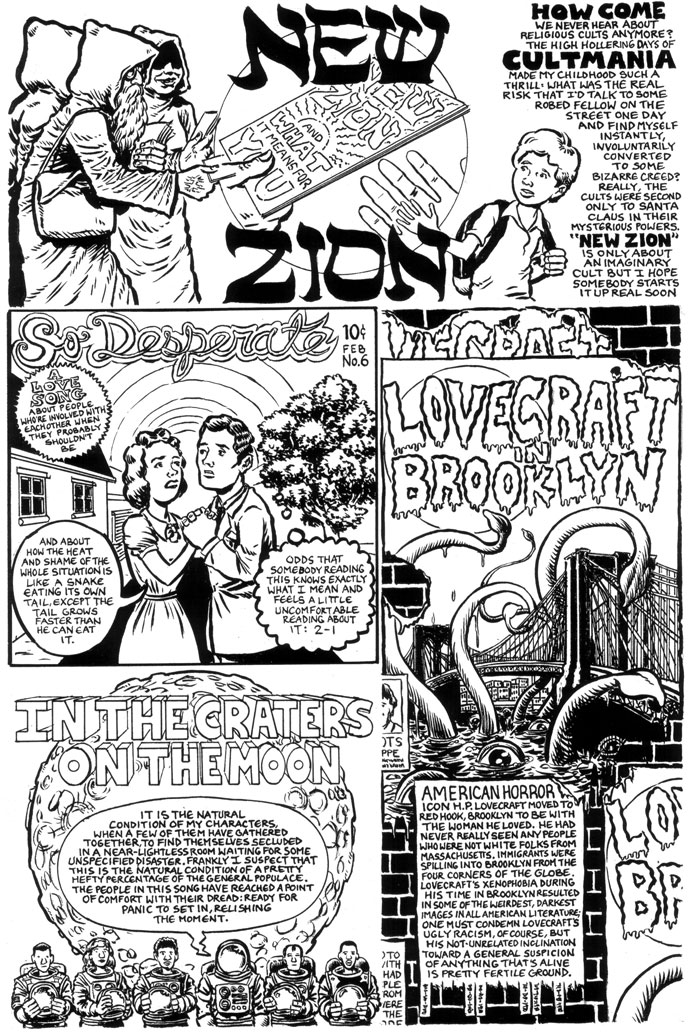
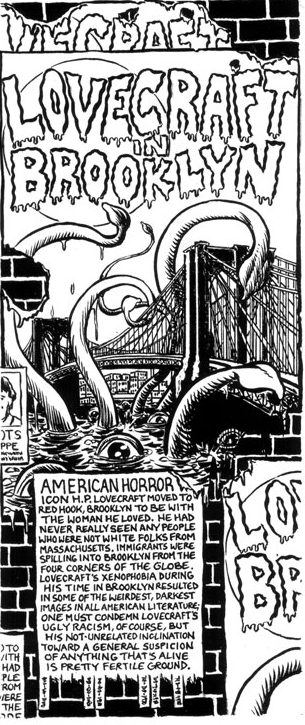
As part of the promotion of the album, comic book artist Jeffrey Lewis produced a three-page comic illustrating Darnielle’s notes about the songs.

American horror icon H. P. Lovecraft moved to Red Hook, Brooklyn to be with the woman he loved. He had never really seen any people who were not white folks from Massachusetts. Immigrants were spilling into Brooklyn from the four corners of the globe. Lovecraft’s xenophobia during his time in Brooklyn resulted in some of the weirdest, darkest images in all American literature; one must condemn Lovecraft’s ugly racism, of course, but his not-unrelated inclination toward a general suspicion of anything that’s alive is pretty fertile ground.

In a 2008 interview about the science fiction influence on his work, Darnielle was asked specifically about the song:

[Charlie Jane Anders]: Your new album includes a song about H.P. Lovecraft, “Lovecraft In Brooklyn.” Why should we identify with H.P. Lovecraft’s feelings of alienation and xenophobia during his exile in Red Hook? What about that image appeals to you? In Lovecraft’s case, that alienation leads to all his best speculative horror… do you think xenophobia creates better speculative fiction than xenophilia?

[John Darnielle]: Well the song is not really about Lovecraft — it’s sung by a guy who’s identifying with Lovecraft at his most xenophobic and terrified. Why does that appeal? I think I’m just attracted to hermits in general — to people who don’t feel like they’re part of the world, who have a hard time feeling like they’re really present in the same space as everybody else.
—Charlie Jane Anders, “The Mountain Goats Explain Why Ozzy Osbourne Is A Scifi Visionary” (Gizmodo, 27 Mar 2008)

An apocryphal account of the 22 March 2008 live session The Mountain Goats played at the Black Cat club in Washington, D.C. captures an opener John Darnielle gave before playing this song:

Once again, to express my affection for you, I’d like to play this song about a fellow who is really so filled with anger and rage that the mere sight of other human beings makes him feel even more angry. He’s angry already when he wakes up, before he remembers that there’s other people on the planet. But once he thinks of those other people, then he starts to really get going. And heaven help you if he should have to go and get some kleenex or whatever from the corner store, then he will really be filled with a special kind of contempt. Why? Because you have bodies and they make him sick. That’s what this song is about. I know everyone can relate to the tender feelings expressed in it.

John Darnielle is not a Lovecraft scholar; his understanding of Lovecraft as represented in the promotional materials, lyrics, and intra-show commentary reflects a popular depiction of Lovecraft as an angry xenophobe trapped in a place surrounded by people who weren’t like him, and it made him go crazy. “Lovecraft in Brooklyn” reflects the legend of Lovecraft’s 1924-1926 sojourn to New York, much like Victor LaValle’s “The Ballad of Black Tom” (2016) represents an interpretation of “The Horror at Red Hook,” one of the stories Lovecraft wrote during that period, with an emphasis on Lovecraft’s racism.

The reality was more complicated. 1924 wasn’t the first time Lovecraft had been to New York; it wasn’t the first time Lovecraft had been out of state, or seen people of color or different ethnicities. Lovecraft had experiences leading up to his 1924 elopement with Sonia H. Greene, who gave her version of their married life in The Private Life of H. P. Lovecraft (1985), which he thought prepared him for life in New York.

As it happened, Lovecraft was wrong. He failed to find employment; soon after marriage, his wife fell ill and required hospitalization and then rest. Without either of them working, money swiftly became an issue. Sonia eventually found a job out in the Midwest, but Lovecraft would not follow her there, so he was left alone, in the poor Red Hook neighborhood of Brooklyn. Largely alone, unable to make his own way, dependent on a wife he didn’t see for weeks and distant aunts, Lovecraft tried to make the best of it with his local friends.

Then thieves broke into his apartment.

Letters from Lovecraft to his aunts Lillian D. Clark and Annie Gamwell show how unhappy he was. While he never blamed the immigrants or people of color for his own failures, his letters to them during this period show how much Lovecraft’s prejudices were exacerbated during this final, stressful period in New York…until, at last, his aunts and wife prevailed upon him to return to Providence, Rhode Island, where he could be happier.

So he did.

Most of Lovecraft’s New York experiences did not make it into his fiction; not even the fiction he wrote while living in and set in the city. “The Horror at Red Hook” is unusual because through Lovecraft’s letters and various anecdotes in memoirs we can trace it back to a specific incident—overhearing some hardboiled toughs talking a little too loudly about criminal goings-on at a local cafeteria—from which Lovecraft spun out his fantasy of an immigrant gang-cum-cult involved in human trafficking, murder, and more esoteric activities.

“The Horror at Red Hook” reads pretty baldly racist; the equivalent today might be a story of an MS-13-type group that was also a survival of ancient Aztec religion that still practiced human sacrifice. That was very explicitly fiction, though—a play on contemporary prejudices, not Lovecraft just putting his own prejudices onto the paper. A fine distinction for a lot of readers who don’t always like to distinguish between what Lovecraft thought and how he portrayed things in the pages of Weird Tales.

New York-based rapper and producer Aesop Rock (Ian Matthias) did a remix of “Lovecraft in Brooklyn,” which at 3:31 retains all of Darnielle’s lyrics but quickens the beat and reworks the soundscape with added effects to add to the tension and air of alienation of the song, and providing a densely-packed fourth verse of his own. The added lyrics are grounded much more firmly in Brooklyn itself, and suggest a deeper understanding of Lovecraft’s time in New York (“Summer lovin’ snuck him toward the tarnished arms of liberty”), and perhaps reflect W. Paul Cook’s assessment that Lovecraft’s time in New York was pivotal toward his development as a writer (“Little Howie’s parachute has flowered down the rabbit hole”).

“Lovecraft in Brooklyn” is an expression of the pop cultural phenomenon that is Lovecraft; his legend used to evoke certain ideas, attitudes, and aesthetics completely rather than any attempt to relate a distinct biographical episode from his life. It showcases how Lovecraft’s reputation as a bigot and xenophobe has become so rampant; of course, the fact that he was racist (if not always to the degree or in the way folks like Darnielle portray) cannot be ignored and shouldn’t be downplayed.

While Darnielle’s particular impression of Lovecraft may be factually incorrect, Darnielle was right in that Lovecraft’s legacy continues to be fertile ground for artists to fuel their own imaginations.

“Lovecraft in Brooklyn” – The Mountain Goats (Youtube link)

“Lovecraft in Brooklyn” (remix) – The Mountain Goats / Aesop Rock (Youtube link)


Bobby Derie is the author of  Weird Talers: Essays on Robert E. Howard and Others  and  Sex and the Cthulhu Mythos .

Deep Cuts in a Lovecraftian Vein uses Amazon Associate links. As an Amazon Associate I earn from qualifying purchases.

Skinny Dipper (2023) by Sex and Monsters

Eldritch Fappenings

This review deals with a work of art that includes nudity. As part of this review, selected images with nudity will be displayed. As such, please be advised before reading further.


It was many and many a year ago,
   In a kingdom by the sea,
That a maiden there lived whom you may know
   By the name of Annabel Lee;
And this maiden she lived with no other thought
   Than to love and be loved by me.
—Edgar Allan Poe, “Annabel Lee” (1849)

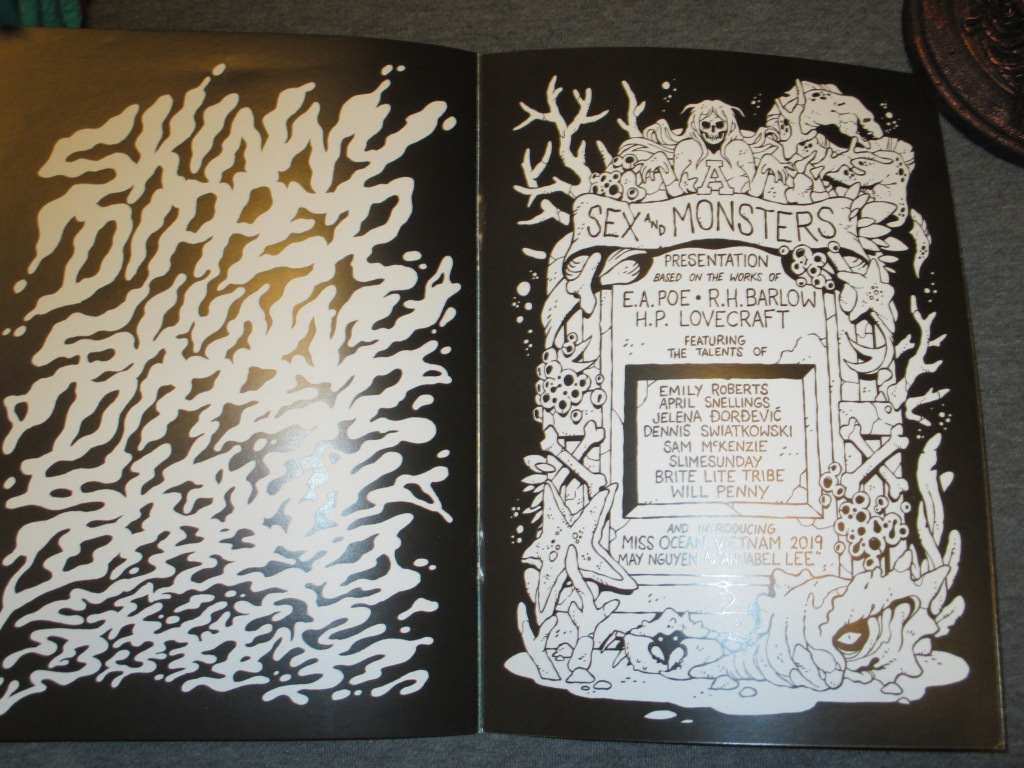
Skinny Dipper was a successfully crowdfunded multimedia project by Sex and Monsters, who are best known for their retro chic combinations of horror, pulp fiction, and tiki culture to produce works like the comic/cocktail booklet Tiki Surf Witches Want Blood.

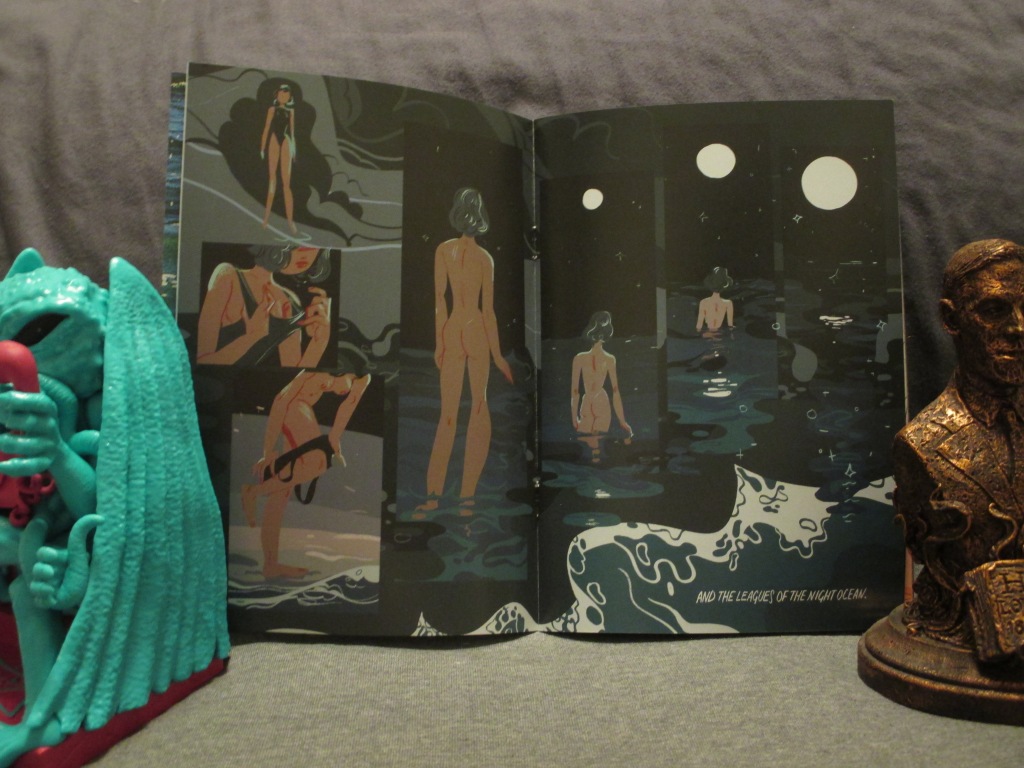
The form of this particular project is a 32-page mixed-media comic ‘zine that remixes Poe’s “Annabel Lee” and “The Night Ocean” (1936) by R. H. Barlow with H. P. Lovecraft, re-imagining them against a palette of mixed comic and photographic work by Emily Roberts, April Snellings, Jelena Đorđević, May Nguyen, Dennis Swiatkowski, Sam McKenzie, Slime Sunday, Brite Lite Tribe, and Will Penny; and a 7″ vinyl record by Nite Jewel that contains a soundtrack to accompany the piece. Various Kickstarter bonuses to the campaign add decals, instant film shots of May Nguyen, and other goodies.

The crux of the re-imagining is model May Nguyen, who appears both in photographs and as the character model for the character of Annabel Lee in the story. Told in sparse, evocative images, Annabel Lee shifts from the bright and crowded daylit beach to a lonely moonlit scene, to go skinny dipping alone in the night ocean.

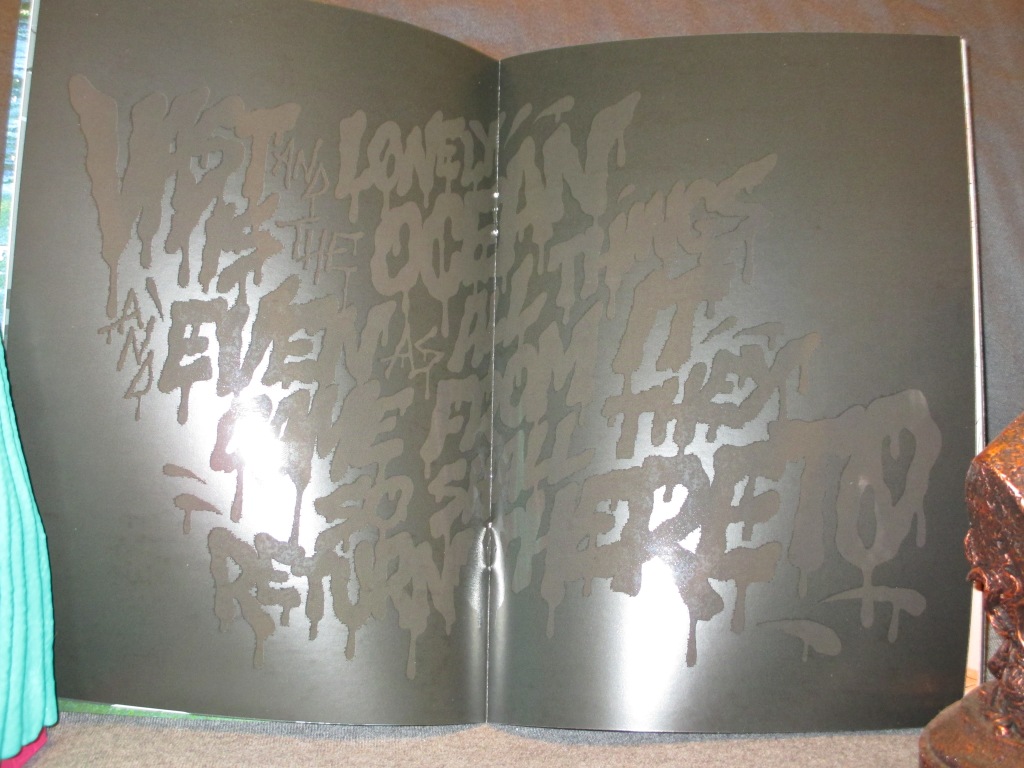
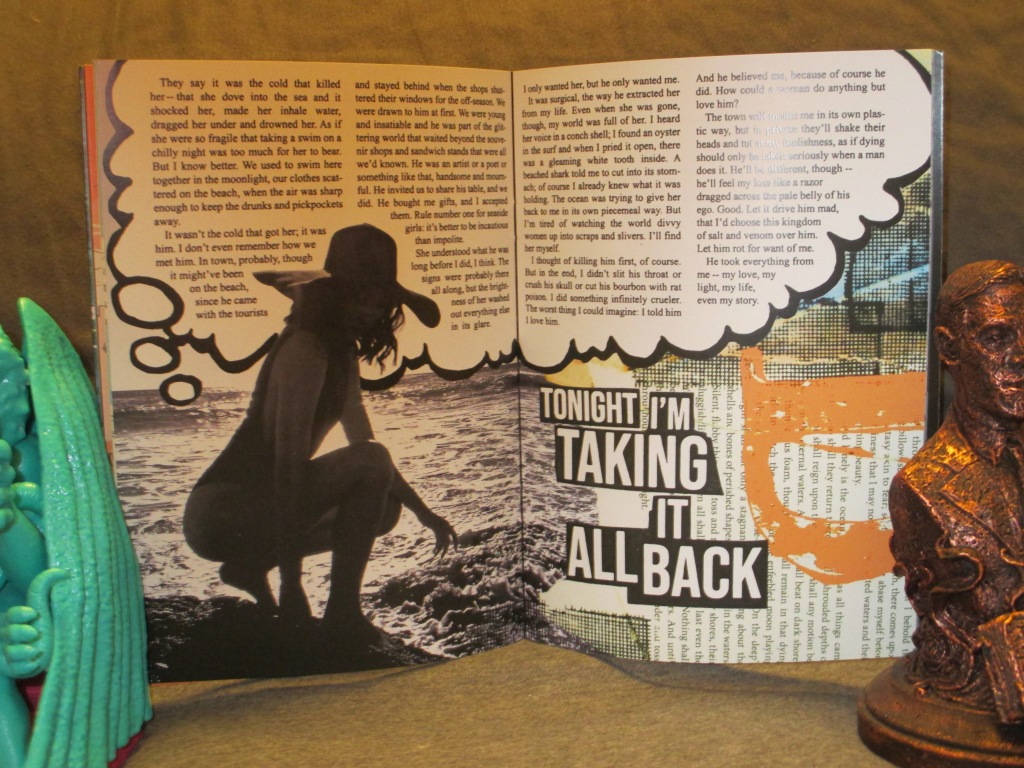
Chunks of Poe’s and Barlow and Lovecraft’s texts are taken out of context and reframed as poetry. The artists are each distinctive in their style and approach to the material; the center black-lettering on black-pages at the center of the story is incredibly evocative of the dark abysses hinted at in poem and short story, here rendered visually—and the combination of Poe’s verse and select snippets from Barlow and Lovecraft work well together with the visuals, terribly suggestive of far more than appears on the page.

Kitsch is a dirty word, but in this case the artists are trying to recapture specific moods and art styles, from the Charles Atlas bully-kicks-sand-in-your-face comics of the 50s to 80s glossy magazine photo spreads that are terribly suggestive of exotic vacations, where the sea foom can lap at your feet as you read and relax on holiday. It is a deliberate effort to reproduce an aesthetic that existed, even if that exact place never did.

One thing that both “Annabel Lee” and “The Night Ocean” capture is a sense of loneliness and longing; that may be why giving Annabel in Skinny Dipper such a distinctive face adds something to the text. May Nguyen provides a sense of reality that might have been missing if this a more traditionally-made comic book; there’s a fotonovella-style sense that these could be stills to some ancient straight-to-video movie that graced the shelves of mom & pop video stories.

It is not horror in any strict sense; not int he bloody bones and a shark coughing up a limb. It’s closer to a vacation where all the time away reminds you that the one thing ou can’t get a vacation from is yourself, can’t get out of your own head. That loneliness and the endless, ageless warm waters of the ocean might swallow you up forever, given half a chance.

Nite Jewel’s Skinny Dipper single is a soundtrack to the story; I’d call it synthwave or retrowave, while the tags for the album on call it chillwave and hypnogogic pop. Combined with the stylistic flourishes of the comic, it grounds the reader in that almost-never-when promised in a thousand 80s and early 90s magazines, comics, films, and music videos. The idea of the beach as this place of escape, the music a poppy invitation that’s a bit more upbeat than tiki exotica, but holds many of the same audio cues, just for a later generation.

At this time of writing, the album is the only thing available for direct purchase, although many stills and videos associated with the project are located on Sex and Monsters’ Facebook page.

Skinny Dipper is an interesting collaboration, one that showcases the abilities and visions of the individual artists that went into it. Copies are still available through the Kickstarter store (click “Order Now”), and will hopefully receive a wider release in the near future.


Bobby Derie is the author of  Weird Talers: Essays on Robert E. Howard and Others  and  Sex and the Cthulhu Mythos .

Deep Cuts in a Lovecraftian Vein uses Amazon Associate links. As an Amazon Associate I earn from qualifying purchases.