Well, here was Earth beneath him. No longer a green star high in alien skies, but warm soil, new clover so near his face he could see all the little stems and trefoil leaves, moist earth granular at their roots. —C. L. Moore, “Song in a Minor Key”
“The Green Hills of Earth” is as close to an anthem as C. L. Moore gave to Northwest Smith. His adventures take place almost exclusively on alien worlds. He is an outlaw, an adventurer, a hard man and not necessarily a noble one, but not without his honor or his principles. Raymond Chandler wrote in “The Simple Art of Murder” (1944) that the protagonists of hardboiled tales must be “the best man in his world and; a good enough man for any world.” He didn’t write that about Northwest Smith, but he might have.
What is “Song in a Minor Key?” It is the last of Moore’s works about Northwest Smith. It might have been a fragment of a story never completed, it might have been a coda. In a series that is never marked by any particular notions of continuity or character development, it offers both. Not a reflection on Smith’s adventures, but of the mysterious past never really spoken of elsewhere, and of a future: Smith is back on Earth. He’s there amid his green hills at last. Why, and for how long, we don’t know.
In a way, “Song in a Minor Key” is reminiscent of H. P. Lovecraft’s “The Silver Key.” Both are stories that deal with a reflection on childhood, happier times, but where Randolph Carter’s dream is to retrieve that key and relive the past, Northwest Smith’s approach to such nostalgic wishing is harsh. He knows who he is and what he has done; he knows, too, that he could not have done anything different. Faced with the same circumstances, even with all the knowledge of twenty years on the run, he would kill again—and end up right where we saw him, in dingy Martian spaceports or hunkering in a Venusian alley, exploring dead cities and strange worlds.
Maybe this was a goodbye to the character that had launched C. L. Moore into her pulp career, even though it feels like the opening of a new adventure. Which, perhaps, is fitting. Series characters in the pulps rarely had arcs; they rarely had a definite retirement or death. When Robert E. Howard wrote the adventures of characters like Solomon Kane, Kull of Atlantis, Bran Mak Morn, and Conan the Cimmerian, he never wrote their deaths—he might jump back and forth to different points in their lives, show Conan as a brash young thief in one tale and a conquering monarch in the next—and there was the certain sense that in the fullness of time these men were mortal and they would die. We even see the cult of Bran Mak Morn rise up, with the knowledge that he died on some ancient battlefield. But we never see it, we never get the send-off, the heroes do not ride off into the sunset and tell us that this is the end.
For the readers of Weird Tales who thrilled to the adventures of Northwest Smith for six years, the tales just…stopped. There were no more. The magazine itself changed its focus. “Song in a Minor Key” was published in the fanzines Scienti-Snaps (Feb 1940). She was still Catherine Lucille Moore when this was published; she would marry Harry Kuttner on 7 June 1940, in New York City. Moving on into the next phase of her life, and her writing career. Much of what she wrote from this point on would be with Kuttner, her husband and writing partner, and would appear under his name or a shared pseudonym. Relatively few works were signed C. L. Moore after 1940.
This was one of the last pieces we can say was truly her own voice, unalloyed.
Glad to hear that you & C L M are collaborating on a dual masterpiece. The result certainly ought to be powerful enough! Staging a meeting betwixt the mediaeval Jirel & the future Northwest Smith will call for some of your most adroit time-juggling—but with two keen imaginations at work no obstacle is likely to be unsurmountable. Good luck to both of you aesthetically & financially! —H. P. Lovecraft to Henry Kuttner, 8 Feb 1937, Letters to C. L. Moore & Others 262
In May 1936, just three months after the death of C. L. Moore’s fiancé, H. P. Lovecraft wrote to his correspondent Henry Kuttner and asked if he could forward some material to C. L. Moore. This began a correspondence between Kuttner and Moore that would, in 1940, lead to their marriage. Yet during Lovecraft’s brief time together, he heard about their forthcoming collaboration—even if he didn’t live to see it.
The collaboration came at an odd time in both of Kuttner and Moore’s careers. Moore’s output for Weird Tales was declining; the last Jirel of Joiry tale was “The Dark Land” (WT Jan 1936), the last Northwest Smith story was “Tree of Life” (WT Oct 1936). So when “Quest of the Starstone” was published in Weird Tales Nov 1937, it had been over a year since either character had appeared. A year since C. L. Moore had graced the Unique Magazine.
Kuttner got his professional start in the pulps in 1936. In the space of less than two years, 27 stories from him appeared in the pulp magazines, 11 in Weird Tales. In his early career, Kuttner struggled to find his own voice; while prolific, he put out pastiche work like “The Salem Horror” (WT May 1937), riffing off of Lovecraft’s Mythos, and collaborated with Robert Bloch on “The Black Kiss” (WT Jun 1937). It was Kuttner, devoting much of his time to writing, who recommended the collaboration with Moore:
Chacal: Rumor has it that you didn’t particularly care for the story in which Jirel met Northwest, “Quest of the Star Stone.” Could you give us a little background on the tale: the how and why of it?
Moore: I’d forgotten that I maybe like “Quest of the Star Stone ” least—that doesn’t mean dislike. If I said so, I expect it’s true. And if true, my guess would be that in this first Kuttner/Moore collaboration the machinery of working together had to be refined and worked over more before it functioned well. Hank and I had met, I think, a short time before this. Or had we met at all? Or only corresponded? Anyhow, he was urging me to do another Jirel and sent on a kind of opening situation to see if I would feel any interest. I did and we sent the ms. back and forth to the best of my very dim recollection until we were ready to submit it. Remember this was all 40 years ago and a lot has happened since.
[…]
Chacal: Did you ever have any reservations about collaborating with Kuttner?
Moore: Nope. “The Quest of the Star Stone,” our first, worked out well enough to show us we could do it and after that we never gave it much thought. We just went ahead and wrote, either separately or together, depending on how that particular piece of work progressed. Remember, we weren’t turning out stories for posterity, but for this month’s rent. I so often hear of collaborators who tear down each other’s work—even successful, long-established collaborators. We didn’t have time for that kind of nonsense. We just traded typewriters; when one got stuck the other took over with a minimum of rewriting. Often none at all. Usually none at all. With us, at least, it worked out fine. It was also very nice to have somebody who could take over when the other guy got stuck. We sincerely loved each other’s writing and enjoyed tremendously what came out of the other guy’s typewriter. It was a fine relationship. —”Interview: C. L. Moore Talks To Chacal” in Chacal #1 (1976), 30
Crossovers of series characters were rare in the pulps, but not unheard of. Robert E. Howard’s Kull of Atlantis and Bran Mak Morn had met in “Kings of the Night” (WT Nov 1930). This crossover, however, also involved a collaboration, and ends up somewhat disjointed. The opening rhyme is uncharacteristic of Moore’s work, while the Jirel segment is very characteristic of stories like “Jirel Meets Magic” (1935). However, there are references there which seem to owe more to Kuttner than Moore:
“Bel’s curse on you, Joiry! […] Me you may not fear, Joiry,” the wizard’s voice quavered with furty, “but by Set and Bubastis, I’ll find one who’ll tame you if I must go to the ends of space to find him—to the ends of time itself![“] —C. L. Moore & Henry Kuttner, “Quest of the Starstone” (WT Nov 1937)
Bel and Set were gods from Robert E. Howard’s Hyborian Age stories of Conan the Cimmerian. The Egyptian god Bubastis were notably used in the early Mythos fiction of Kuttner’s collaborator Robert Bloch, especially in “The Brood of Bubastis” (WT Mar 1937). The second section, with Northwest Smith and Yarol on Mars, drinking segir-whiskey and listening to The Green Hills of Earth was certainly in keeping with Moore’s style for stories like “Dust of the Gods” (1934)—but how much of that was driven by Moore’s habit, or Kuttner’s more fannish tendencies to repetition? It’s hard to tell; Moore was still herself, and Kuttner an effective mimic. Working as they did, their styles tend to blend.
The story moves fairly quickly, establishing the essential conflict, introducing the leads, and then effecting the meeting of the dual protagonists in short order via a bit of magic. Unusually for a Jirel story, it is peppered with bits of French—for all that it is set in medieval France about the year 1500 (the only time we get a hard date), Moore rarely bothered with trying to insert the language into the stories. There is a certain fun interplay here; neither Smith or Jirel are stupid, both are formidable, and both are, in their way, rogues. It is neither love or hate at first sight, but a kind of chess match of greed and wits.
Then they are somewhere else, in one of those transports to other dimensions that showcases so many stories of Jirel and Smith. Perils are faced and overcome, a warlock gets their just desserts, a macguffin is unleashed, and it all ends, if not happily, then with a kind of melancholy correctness of everything back in its accustomed place. Unusually for a Northwest Smith story, Jirel survives—or at least, presumably goes back to her own time and place, as Smith did. Yet in the end he thinks:
Behind the closed lids flashed the remembrance of a keen, pale face whose eyes blazed with some sudden violence of emotion, some message he would never know—whose red streaming hair was a banner on the wind. The face of a girl dead two thousand years in time, light-years of space away, whose very dust was long lost upon the bright winds of earth. —C. L. Moore & Henry Kuttner, “Quest of the Starstone” (WT Nov 1937)
Well, light-minutes, but that’s a quibble. While technically a story where fantasy meets science fiction, where Northwest Smith learns a spell but still carries a raygun, the story leans more heavily toward magic; and while the viewpoint switches, it is mostly a Northwest Smith story in which Jirel appears, since most of the viewpoint is Smith’s. Maybe that is part of the reason it feels “off” compared to the previous Jirel stories. Or maybe it’s just the literal deus ex machina, as the Starstone gives up its secret.
When compared to “Tryst in Time” (1936), Moore’s previous time-travel story, there are certain similar elements in common: an adventurer is bored, an offer is made and accepted, a trip through time results in an encounter with a beautiful woman—but here, there is no instant bond, no sense of soul-mates or reincarnations. Jirel and Smith are alike and respect each other, but there is no sense that they complete each other or need each other. It is a meeting of equals.
Gertrude Hemken, one of the most vocal fans and a prolific letter-writer to Weird Tales, praised the story:
The story of the issue is all I’ve expected it to be—and more. I’ve been curious all these months to learn by what methods and under what circumstances would Jirel and Northwest Smith meet. The story is somewhat lovely—seems as though I awakened from a fantastic dream after I had read it. The abstract lives bro’t to mind the yarns of Aladdin’s lamp and its genie. The illustration is superb. Jirel looks like a screen heroine—and the two men seem rather 20th Century in attire and general aopearance. The dancing flame-stars seem like a very strange rain. Needless to say—The Quest of the Starstone is outstanding, in my opinion. —Weird Tales Jan 1938
Clifford Ball, who had published some sword & sorcery stories for Weird Tales himself, added:
The Quest of the Starstone was a fast-moving, interest-holdiqg, well-balanced piece of work and easily the best story in the current issue even if the famed charaaers of Smith and Jirel are possibly unknown to the later readers. I trust these two authors will be encouraged to continue their partnership. They have the knack of producing masterpieces. But I wish to humbly suggest that they do not attempt to bring N. S. or J. J. together again, for that might spoil the superb effect of this last story. Not that I mean they should discontinue the characterizations; either one is too magnificent to allow extermination. —Weird Tales Jan 1938
How little he knew. “Quest of the Starstone” was voted the best tale in the November 1937 issue, and readers wanted more. Well, they would get more of Moore & Kuttner—this collaboration proved that they could work successfully together, combining his swift plotting and Moore’s imagination and style—but not much more of Jirel of Joiry or Northwest Smith.
“Quest of the Starstone” was published in the November 1937 issue of Weird Tales. Scans of this issue are available on the Internet Archive.
C. L. Moore is an extremely gifted young woman of 25—a fact as well as fiction writer. Her stories are rivaled (now that Bob Howard is dead) only by Klarkash-Ton’s, & contain a highly unique element of convincing unreality—which could be still better but for a certain stereotyped romanticism & occasional concession to the pulp ideal. —H. P. Lovecraft to Virgil Finlay, [25 Sep 1936], Letters to Hyman Bradofsky & Others 447
“Tree of Life,” published in the October 1936 issue of Weird Tales, isn’t technically the last of the Northwest Smith stories. Yet for many readers, it would have been seen as practically the last. Smith would not appear in print again until “Quest of the Starstone” (WT Nov 1937), a full year later, and the final brief coda “Song in a Minor Key” would only see print in a fanzine in 1940. So too, Moore’s star at Weird Tales was waning. This would be her 13th story published at Weird Tales in just three years, but in the next four years she would publish only three more stories in the magazine.
What changed? The death of Moore’s fiancé in early 1936, her ongoing need to provide for her family with her real job, Weird Tales‘ slow payments and her shift to other pulp markets likely all had their part to play. Yet that was in the future. For now, readers could enjoy this tale and imagine the many other adventures of Northwest Smith that the future might hold for them.
It was an unusually elaborate well, and amazingly well preserved. Its rim had been inlaid with a mosaic pattern whose symbolism must once have borne deep meaning, and above it in a great fan of time-defying bronze an elaborate grille-work portrayed the inevitable tree-of-life pattern which so often appears in the symbolism of the three worlds. Smith looked at it a bit incredulously from his shelter, it was so miraculously preserved amidst all this chaos of broken stone, casting a delicate tracery of shadow on the sunny pavement as perfectly as it must have done a million years ago when dusty travelers paused here to drink. —C. L. Moore, “Tree of Life” (WT Oct 1936)
In broad strokes, “Tree of Life” looks like several other Northwest Smith stories. The opening is reminiscent of “Werewoman” (1938), with Smith on the run. A ruin that rests between two worlds, as in “Julhi” (1935). A pattern that transports Smith between worlds, as in “Scarlet Dream” (1934). The story lives in that space that Moore carved out between science and sorcery, between the interplanetary tale and sheer fantasy.
One of the things that stands out in the story is the strange and terrible Thag—who is reminiscent, thematically, of the monster Thog in Robert E. Howard’s “The Slithering Shadow” (WT Sep 1933), who likewise keeps an entire population in fear. So what are the odds of Robert E. Howard calling one of his tentacled horrors Thog, and C. L. Moore calling one of hers Thag? Is it just coincidence, or was one borrowing from the other?
In many ways, Robert Ervin Howard and Catherine Lucille Moore were operating on the same wavelength. While he wrote for Weird Tales earlier and more prolifically, both of them had a way of lighting on similar themes. Erotic tentacles appear in Howard’s “The Slithering Shadow” (WT Sep 1933) and in Moore’s “Shambleau” (WT Nov 1933). Both would conceive of French swordswomen in “Black God’s Kiss” (WT Oct 1934) and “Sword Woman” (written c.1934, but not published until after Howard’s death), and create series characters that would be remembered by generations of Weird Tales fans
Technically they were in competition from 1933-1936, but in reality Howard wrote more, and sold more, during that period. Moore had a day job, while Howard was a full-time writer. They admired one another, and had similar themes. C. L. Moore’s “science fiction” stories of Northwest Smith, while set on distant planets and involving force-guns and spaceships, were written like fantasies with ancient gods, sorcerers, and creatures from Outside. Howard’s fantasies, by contrast, sometimes came up very close to science fiction: the city of Xuthal in “The Slithering Shadow” is lit by radium-lamps, and golden wine quaffed by Conan recalls super science medicines as much as some alchemical potion
Howard’s Thog is not exactly cast in the mode of any earlier entity, but the name might have been influenced by weird precursors like H. P. Lovecraft’s Yog-Sothoth and Clark Ashton Smith’s Tsathoggua; a similar entity named Thaug appeared in another Conan tale, “A Witch Shall Be Born” (WT Dec 1934). He would also use similar names for entirely different creatures, the ape-man Thak in “Rogues in the House” (WT Jan 1934), and the god Thak, the Hairy One, in the posthumously published Almuric (WT May-Jun-Aug 1939)—so perhaps he derived the name, or simply came up with it on his own and liked the sound of it.
If “Thog” and “Thaug” were inspired by Tsa-THOG-ga, it would not be a great surprise. Many of names in the early Mythos fiction invoke some of the same elements; the “-oth” ending for example appears in Sheol-Nugganoth (Lord Dunsany); Yog-Sothoth, Azathoth, Rhan-Tegoth, shoggoth (Lovecraft); Abhoth, Rlim Shaikorth (Smith); Gol-goroth, Bal-Sagoth (Howard). Lovecraft, Howard, and Smith also made a particular habit of working variations on their names—in Howard’s case, in “The Moon of Skulls” (WT Jun-July 1930) the ancient god is Golgor, in “The Children of the Night” (WT Apr-May 1931) and “The Gods of Bal-Sagoth” (WT Oct 1931) the god is named Gol-goroth.
C. L. Moore left no record of similar-sounding names for her horrors; her approach to naming was by her own account more spontaneous. She also did not, except for one round-robin story, play the kind of game that Lovecraft, Smith, and Howard did by putting references to one another’s works in her fiction of Northwest Smith or Jirel of Joiry. Yet at the same time, if Moore drew some thread of inspiration from that game and worked up a similar-named entity for her own fiction—she did make it her own.
While Thog and Thag both prey on their captive populations, that is about where the similarities end. Thog is monstrous but definitely material, able to be cut and chopped and stabbed, while Thag is something altogether weirder, vulnerable at only a single point. While both stories may be classed as science-fantasy, “The Slithering Shadow” leans more toward sword-and-sorcery than “Tree of Life”; as outclassed as Conan and Northwest Smith might be, there is more of a focus on battle and human drama in Howard’s story. Northwest Smith destroyed or defeated Thag, but Conan made Thog bleed.
Read together, the choice of names is less interesting than how each writer pursued a similar theme, each in their own way…and showcased how these two writers could, coming at similar ideas from different perspectives, create two different but equally enjoyable narratives—and in the end Northwest Smith returned to Mars, to live and fight another day.
I was glad to see the return of Northwest Smith. —John V. Baltadonis, The ‘Eyrie’ in Weird Tales (Dec 1936)
Moore never disappoints, having that rare gift of imagination inexhaustible which keeps this author’s yarns different. —B. M. Reynolds, The ‘Eyrie’ in Weird Tales (Dec 1936)
Fan response was positive, based on the letters published in The ‘Eyrie.’ Lovecraft’s appreciation was more muted, but honest:
C L M’s “Tree of Life” adheres more or less to her formula, though it has effective atmospheric touches —H. P. Lovecraft to R. H. Barlow, 31 Sep 1936, OFF 367
“Tree of Life” runs a bit to the Moore formula, but is distinctive for all that. —H. P. Lovecraft to Duane W. Rimel, 24 Oct 1936, LFB 334
Moore item is average, & “House of Duryea” has a clever ending. —H. P. Lovecraft to August Derleth, 24 Oct 1936, ES2.752
In Oct. the high spots were C L M’s “Tree of Life” & Bloch’s yarn—the Quick, Peirce, & Kuttner efforts deserving honourable mention. —H. P. Lovecraft to Richard F. Searight, 19 Nov 1936, LPS 432
Lovecraft, who was still corresponding with C. L. Moore all through the turmoil of 1936, probably had a better idea of what she was going through than most. It’s not clear what impact their correspondence had on Moore’s writing—was Lovecraft’s gentle suggestion to pursue writing for artistic sake rather than commercial reasons part of the reason why Moore would cease writing Northwest Smith and Jirel of Joiry? We may never know. Yet to describe “Tree of Life” as an “average” Moore story for the period is no insult. It is still a solid piece of writing, reflecting Moore’s interests and personality, showcases her effort to straddle the lines of multiple genres to produce something truly weird.
Today I sent off a gory horror-tale to Kline for marketing, the first and only story I’ve had time to write since I got home. I don’t know if I’ll ever have time to write another. —C. L. Moore to R. H. barlow, 19 May [1936], MSS. Brown Digital Repository
My own writing is practically at a standstill. Am making rather feeble efforts to write for the horror-tale and sugary love-story markets to get some money, and hve finished one story of the former type which Kline has very competently critciized for me and suggested specific revisions. I may get around to it someday. I have neither time nor inclination to write about anything any more. I suppose it will come back ,but the hour is not yet. Though there has been one opus of about 2000 words or so which I wrote about a month ago, with no thought of sale. All about mysterious doings in a holly wood. Once when I was very small a letter from relatives in California around Christmas time reported that someone had gone down to Hollywood to get some holly, and I quite naturally thought, how lovely and convenient, and pictured the aunt in question wandering thru the deep, dark glossy wood of holly, with the growing scarlet light of the berries reflecting from the shining leaves, a place of gloom and greenness and glows of crimson. The image has returned to me time and again, and I finally had to do something about it. —C. L. Moore to H. P. Lovecraft, 26 May 1936, LCM 113
My recent writings seem to have bogged down completely. In the last five months I have produced one trashy horror which Kline ages ago asked me to rewrite, thinking he could sell it in a revised form and which I haven’t touched since, and a drippy love-story which languished away and ceased half-finished some six weeks ago. The weather is partly responsible, but I must admit a sort of mental vacuum which shows no promise of change. I devote seven and a half hours daily to my secretarial duties and spend the rest of the time sewing desultorily, knitting a very handsome afg[h]an, attending about three movies weekly, induling in endless gossip with friends. How long this cloistered and nun-like seclusion will continue I wish I knew. I suspect that if my brain were functioning I would find myself bored to a horrible death, and rather dread the awakening. A few non-commercial attempts which I mentioned I should be very happy to have you read if I could ever get them finished to my satisfaction. I am writing and rewriting them over and over, in moments of comparative consciousness, and am far from satisfied even yet. However, to quote Mr. Penner once again, There’ll come a day. —C. L. Moore to H. P. Lovecraft, 24 Jun 1936, LCM 143
Early 1936 was a tumultuous time in the life of C. L. Moore. In February, her fiancé of at least three years, (Herbert) Ernest Lewis, died from a self-inflicted gunshot wound to the head. In June just a few months later, her correspondent and fellow pulpster Robert E. Howard also died by a self-inflicted gunshot wound to the head. Moore understandably struggled to write anything during this time—kept going in part by a trip to Florida, during which H. P. Lovecraft sent her long letters, and she attempted to writer stories to order for Otis Adelbert Kline, a literary agent.
None of Moore’s letters from the period that I have seen give any insight into the origin of “Lost Paradise,” either when it was written and submitted to Farnsworth Wright, editor of Weird Tales, or what may have inspired it. In format, the story is a typical Northwest Smith tale—a drink at a bar, a sudden bit of action, uncovering an ancient mystery—but the idea it is wrapped around, the story-within-a-story, seems to owe more to “The Bright Illusion” (1934) and “Greater Glories” (1935). The central focus is around the Seles:
They live somewhere in the remotest part of Asia, no one knows exactly where. But they’re not Mongolian. It’s a pure race, and one that has no counterpart anywhere in the solar system that I ever heard of. —C. L. Moore, “Lost Paradise” in Weird Tales Jul 1936
Race in Moore’s Northwest Smith stories is an odd point, and worth a moment’s consideration. The peoples of Earth, Mars, and Venus are all presented as essentially human in body and mind, if not culture; while we aren’t privy to interplanetary marriages, there is the implication that they are more or less one human species, even if separated into different races in 1930s terms. C. L. Moore generally avoids getting more specific; Northwest Smith is implicitly Caucasian, and she generally avoids depicting or referring to Black people, Asians (“Mongoloids” or “Mongolians” in 1930s racial parlance), Native Americans, or any other specific 1930s racial groupings. There are other sentient beings, more or less human-like, such as Shambleau (“Shambleau”) and the Alendar (“Black Thirst”), and at least some of the god-like entities can conceive children, such as Nyusa (“Nymph of Darkness”). For the most part, however, the majority of Northwest Smith’s interplanetary setting seems populated by human beings, and are treated more like exotic cultures and peoples in the 1930s than, say, the random inhabitants of the Mos Eisley cantina in Star Wars.
In the context of 1930s pulp fiction, “Lost Paradise” is a variation of the “Lost Race” or “Lost World” plot; the only difference is that instead of physically traveling to some isolated valley, cavern, island, or moon, Northwest Smith and Yarol are sent back in time—mentally, at least, a bit like Lovecraft’s Great Race of Yith in The Shadow out of Time (Astounding Stories Jun 1936).
Be it remembered that ail who come to pay the race’s debt and buy anew our favor that their world may live, must come to us willingly, with no resistance against our divine hunger—must surrender without struggle. And be it remembered that if so much as one man alone dares resist our will, then in that instant is our power withdrawn, and all our anger called down upon the world of Seles. Let one man struggle against our desire, and the world of Seles goes bare to the void, all life upon it ceasing in a breath. Be that remembered! —C. L. Moore, “Lost Paradise” in Weird Tales Jul 1936
As in “Dust of the Gods” (1934), Northwest Smith once more confronts three ancient gods of a lost world—the story is, like all of the Northwest Smith tales so far, effectively standalone with no direct continuity to the others, so neither Smith nor Yarol make any comment about this coincidence. Moore sets up the eventual struggle with typical skill (Chekov’s prophecy: you can’t set a condition for the total destruction of a world without pulling the trigger).
And once again C. L. Moore puts a dream on paper—a lovely fantasy. Northwest Smith remains one of the greatest fiction characters yet created. —Donald Allgeir, The ‘Eyrie’ in Weird Tales Nov 1936
I do not like Lost Paradise. What I like is plain old-fashioned gjhost stories, werewolf stories and vampire stories. —J. J. Hammond, The ‘Eyrie’ in Weird Tales Nov 1936
Response to “Lost Paradise” in The ‘Eyrie,’ Weird Tales‘ letter page, was slight and mixed; the story wasn’t bad, but it had the misfortune to be published in the same issue as “Necromancy in Naat” by Clark Ashton Smith and the first part of “Red Nails” by Robert E. Howard, which rather overshadowed it. Lovecraft was even more sparse with praise than usual:
Klarkash-Ton & C L M dominate the July issue. —H. P. Lovecraft to Richard F. Searight, 27 Aug 1936, LPS 426
(The only reason Lovecraft doesn’t praise Robert E. Howard is because he never read serials until he had all the parts.)
While “Lost Paradise” is a fair story, in comparison with Northwest Smith’s other adventures it’s notable how passive he is here. It is Yarol that goes after the Seles, Yarol that wants the Secret, and Yarol who ultimately shoots the old priest in the back. Smith was just drinking segir-whiskey and people-watching in New York when he suddenly had to resist the vampiric impulses of some ancient alien entities. It really reads like a Northwest Smith frame wrapped around a different story altogether.
Was there ever such a duel in the whole universe as the one between Northwest Smith and the nameless being that fought him in that Martian room?—a gripping tale by the author of “Shambleau” —Epigraph to “The Cold Gray God” in Weird Tales (Oct 1935)
Summer in the Midwest, before the widespread adoption of air conditioning, could be sweltering. The very air gets sticky, even nights could be stifling and sweaty. C. L. Moore hadn’t been slacking during the summer of 1935, but Northwest Smith had been absent from the pages of Weird Tales. Wright had the story that would be “The Cold Grey God” on hand at least as early as March, but he sat on it, apparently waiting for the right time, and thinking of the right title. That came with the October 1935 issue.
And WT is publishing in July either the Smith story which Wright has entitled THE COLD GREY GOD, all about a lovely Venusian named Judai, or else a Jirel story we have been revising for months. He hasn’t decided yet which to use. —C. L. Moore to R. H. Barlow, 20 Mar 1935, MSS Brown Digital Repository
On the subject of titles, I envy you your ability. The most painful part of writing, so far as I’m concerned, is naming the stories. Mr. Wright more or less takes it out of my hands sometimes, as in the case of a story scheduled for mid-summer sometime, which he is calling “The Cold Gray God”. I’m getting a regular spectrum of colored gods, staring with black and working slowly upward thru grey toward goodness knows what. —C. L. Moore to H. P. Lovecraft, 7 May 1935, Letters to C. L. Moore and Others 34
The story starts with snow on Mars. A femme fatale. Northwest Smith, unable to repress his curiosity, goes to her house. The aesthetic borrows aspects of hardboiled fiction, of Oriental stories, the details adapted to the extraterrestrial setting. The idea of an ancient religion buried in the hearts and minds of an exotic culture was not uncommon in stories like Robert E. Howard’s “Skull-Face” (WT Oct-Nov-Dec 1929) and Robert W. Chambers’ The Slayer of Souls (1920); here it was applied to Martians.
“The Cold Gray God” is not set up as an archaeological horror; it’s set up as a weird heist story, in the strange criminal underworld of Mars. As in “Dust of the Gods” (1934), he’s hired to do a not-quite-legal job. Unlike in that story, the job itself isn’t the problem. A noirish sensibility of a web of secrets unfolds the narrative, and once again ensnares Northwest Smith in a plot of ancient space gods, strange survivals from a dim and distant past, and one with an unspeakable name:
And he knew why the men of Mars never spoke their cold god’s title. They could not. It was not a name human brains could grasp or human lips utter without compulsion from Outside. […] Nor was the name wholly gone, even now. It had withdrawn, for reasons too vast for comprehension. But it had left behind it shrines, and each of them was a little doorway into that presence; so that the priests who tended them furnished tribute. Sometimes they were possessed by the power of their god, and spoke the name which their devotees could not hear, yet whose awful cadences were a storm of power about them. And this was the origin of that strange, dark religion which upon Mars has been discredited for so long, though it has never died in the hearts of men. —C. L. Moore, “The Cold Gray God” in Weird Tales (Oct 1935)
Which is a neat way to get around coming up with a mouthful of letters like Cthulhu or Tsathoggua. While C. L. Moore never deliberately added to the Mythos of the Necronomicon and Unaussprechlichen Kulten, she very much absorbed the ideas of Lovecraft and co., and adapted those tropes to her own use. This is not unlike Northwest Smith’s version of “The Call of Cthulhu,” or an homage to the same. The stars were right—then came the raygun.
If there’s a criticism of the story, it’s that it is very similar to Smith’s other adventures. This isn’t the first god he’s faced down, or the first time he’s struggled against an alien will. It is a standalone episode; while there are elements of the setting that are shared with other stories, there is still no continuity. This encounter does not cause Smith to reflect on any other encounters; this experience does not hinge on any previous one. So while the setting expands a bit with each story, the series itself maintains the same episodic nature as that other great stalwart of Weird Tales, Jules de Grandin. Readers weren’t looking for character development, no origin or ending, and writers weren’t going for character arcs for the most part.
“The Cold Gray God” is well-written, a good example of a Northwest Smith story. It just lacks a bit of novelty.
Nor did readers complain about that, although they complained about other things:
I read “Cold Gray God” last night, and liked it good. My only objections are personal: I don’t like “cooed” as a word; and I can’t stand “clean death”. For some obscure reason, I don’t fancy a girl cooing; whilst during the past year or so it seems to me all the fictional characters have gone overboard about having a “good, clean death”—by a “cool, clean sword”, “clean, consuming fire”…or good clean, clean, clean—like a clank, clank, clank—will drive me clean coo-koo, so help me, if I come across it about oncemore!!! —Forrest J. Ackerman to C. L. Moore, 2 Oct 1935
Readers in “The ‘Eyrie'” were more positive, with one writing simply:
I surely enjoyed The Cold Gray God by C. L. Moore. I like stories of Mars. —Orby Martin, Weird Tales Dec 1935
Among Moore’s pulp peers, H. P. Lovecraft counted it among the best stories in the issue. A typical version of his response:
W T is rather lousy of late. In the Sept. issue “Vulthoom” & “Shambler from the Stars” barely save it from being a total loss, while “Cold Grey God” & “Last Guest” perform a similar service for the Oct. number. —H. P. Lovecraft to Lee McBride White, 28 Oct 1935, Letters to J. Vernon Shea et al.362
If he noted the similarity to some of his own ideas, it hasn’t survived in any letter that’s seen print. At some point, Lovecraft conveyed the essence of this to Moore herself:
I’m so glad you approved of my “Cold Grey God” (which is Wright’s title, not mine.) —C. L. Moore to H. P. Lovecraft, 16 Oct 1935, Letters to C. L. Moore and Others 68
One thing seems clear: both the readers and Lovecraft had come to appreciate Moore as a reliable writer, one of Weird Tales‘ more familiar and recognizable names for quality. Farnsworth Wright, the editor, was content to keep buying her stories. With this, her 13th published story in a pulp magazine or fanzine, Moore herself seems to have achieved a comfortably high level of confidence and competence.
Mr. Wright has accepted the new story, JULHI. (Pronounce it! I can’t.) All about a very peculiar one-eyed female of a hitherto unknown race, with an immovable mouth perpetually stretched open in a heart-shaped arch, thru which she speaks by humming in various keys and intensities. You’ve heard people make a violin talk, haven’t you? Saying “I don’t know,” and “What?” and that sort of thing, the way one does without opening the mouth. Well, anyhow, she lives on sensation, somewhat as the Alendar lived on beauty. Then there’s a city which exists simultaneously in two worlds thru some obscure sort of magic. Only in one world time moves faster than in the other, so , if you know the way, you can step out of crumbling ruins into the same city still standing in the other plane. All very complicated. —C. L. Moore to R. H. Barlow, 10 Sep-9 Oct 1934, MSS. Brown Digital Repository
By 1935, C. L. Moore was fairly well-established at Weird Tales, having placed 5 stories in 1934 and establishing two series characters, Northwest Smith and Jirel of Joiry, both of whom were well-received by both the general readership and among her peers. At the same time, Moore was now in contact with R. H. Barlow, Lovecraft, Forrest J. Ackerman, and others in pulp circles, and receiving conflicting advice. The Great Depression was still going, she still needed to bring in money with her writing, but Lovecraft and Barlow were talking about her development as an artist.
The fifth published adventure of Northwest Smith, “Julhi,” seems another concession to Farnsworth Wright’s demand for more Northwest Smith stories than a tale that demanded to be told. Moore even provided one of her own illustrations for the story:
I’ve just sent in a drawing for JULHI which I really do think is good. Don’t know if he’ll take it, but darnit, it is one of the best I’ve ever done. She said modestly. —C. L. Moore to R. H. Barlow, 10 Sep-9 Oct 1934, MSS. Brown Digital Repository
The story itself shows Moore’s continued flagrant flouting of any division between science fiction and fantasy. The opening is almost that of a hardboiled detective tale or Oriental adventure: back on Venus once more, Northwest Smith has been kidnapped and awakes, unarmed and with a local girl in the ancient ruins of Vonng, a city raised by sorcery. There is a distinct echo with “Black Thirst” and other Northwest Smith stories—the doomed young woman Apri; the supernatural alien Julhi with her strange, vampiric hunger; and Smith as the fly in the ointment.
Like every Northwest Smith story so far, this is a standalone episode; there is no reference to the events of “Shambleau” or “Dust of the Gods,” no comparison to Smith’s other weird adventures. There is a lot of exposition and little enough plot; long paragraphs of description and sensuous language, but not surfeit of characters and events. Names and details suggest a broader setting; perhaps not as coherent as Robert E. Howard’s Hyborian Age or Clark Ashton Smith’s Averoigne, but fairly consistent. And at the end, Smith has won the battle and lost the girl, so to speak.
There is a strong echo of stories like A. Merritt’s “The Metal Monster” (1920) in this comparatively brief tale—while Moore gets Smith into the action swiftly, once Smith crosses over to the other side, he acts as witness to something alien, beyond his understanding, and serves as the audience’s surrogate as he learns something of the secret of Julhi and ancient Vonng—the was Julhi’s vampiric qualities take on the shape of some new and unguessed cosmic sin or taboo. Even for readers who have already read similar confrontations in “Shambleau” and “Black Thirst,” it works:
And then — Julhi, by that writer of writers, C. L. Moore. The plot is terrible, yes — it smacks of his other stories — but oh ! the way in which Julhi is written! Of any stories of Mr. Moore’s I’ve read, Julhi — for its beautiful prose — certainly is a masterpiece. I’ve read it over several times, and every time I find more beautiftd phrases than before. Mr. Moore writes in such a quiet yet vivid style. One realizes that he is not showing off his use of an exceptional vocabulary, but that he writes naturally, easily and gracefully. I give Julhi my vote for first choice in the March issue of Weird Tales.” —Michael Liene, ‘The Eyrie’ in Weird Tales May 1935
Reader response for “Julhi” was less universally positive than for previous tales, but all the more interesting for all that. Several readers had picked up on Moore’s use of ancient gods and alien terrors and made comparisons to the work of Lovecraft and other Mythos writers, such as Mrs. E. W. Murphy:
I have gotten so that I am even a little tired of the Old Ones, the whole family of them; and I am sincerely sorry, because so many of the best writers write about them. An exception is the Northwest Smith series; when Northwest encounters an elder race, it is not a formless, dark mind or a weird beast, but it is something unique. —Mrs. E. W. Murphy, ‘The Eyrie’ in Weird Tales May 1935
One of the more interesting responses was from a young Henry Kuttner, who in 1936 would break into Weird Tales, and in five would marry C. L. Moore.
Best story was the shortshort, What Waits in Darkness by Loretta Burrough. Second best is C. L. Moore’s yarn. I note especially the great part adjectives play in Moore’s stories. Oddly, while they help achieve a weird effect, I chose Burrough’s story for the simple, direct manner in which the good story was told. […] There is a wealth of top-notch material waiting to be converted into modern stories, as Cahill did with an old legend in his recent yarn, Charon, Maybe I’ll write one myself and send it to you. After all, C. L. Moore was your ‘find’ for 1934, and you’ll need a new find for the new year, won’t you? —Henry Kuttner, ‘The Eyrie’ in Weird Tales May 1935
I also read “Julhi”, which is better than the B.I., though a bit sentimentalised, clogged by direct, continuous explanatory matter, & inclined to repeat the Shambleau formula. Klarkash-Ton isn’t greatly stuck on it, & expresses a fear that Catherine the Great may develop into a single-plot artist like Ed Ham, Ward, & Morgan. —H. P. Lovecraft to R. H. Barlow, [16 Mar 1935], O Fortunate Floridian 218
Kuttner’s note of the difference between her style and Burrough’s would somewhat reflect the difference between Moore’s style and his own—though they would, as a writing team, learn to marry their personal strengths together as well.
In the Lovecraft circle, “Julhi” elicited several longer comments from H. P. Lovecraft than usual, who noted:
“Julhi” is pretty much a formula yarn, despite Miss Moore’s undeniable power to [evoke utter] strangeness, & to suggest monstrous ____________[. However,] Wright’s propaganda in favour of popular action stuff, plus the author’s own weakness for 1900-esque romantic slush, are combining with deadly effect—so that perhaps another single-plotter is to be added to the ranks already adorned by Messrs. Hamilton, Ward, Morgan, et al. Little Ar-E’ch-Bei—the premier Moore fan—is quite concerned about the slipping of the new luminary; & is urging the gang to find some excuse to shoot her tactful words of advice counteracting the tradesmanlike recommendations of Satrap Pharnabozus . . . . . & the philistinic suggestions of Prince Effjay of Akkamin, who has been volunteering collaboration! —H. P. Lovecraft to Clark Ashton Smith, [26 Mar 1935], Dawnward Spire, Lonely Hill 595
(The letter was somewhat damaged, henced the blanks.) Ar-E’ch-Bei is R. H. Barlow; Satrap Pharnabozus is Farnsworth Wright, editor of Weird Tales; Effjay of Akkamin is Forrest J Ackerman; and the authors are Edmond Hamliton, Harold Ward, and Basset Morgan. Farnsworth Wright did indeed appear to be leaning more into pulpish weird-adventure stories in 1934 and 1935, and Lovecraft and Barlow feared that Moore was following suit.
If “Julhi” is a formula yarn, however, it was Moore’s own formula, which even Lovecraft would admit:
Regarding “Julhi”—I wouldn’t tend to give it an extreme classification in either direction. It certainly displays very well the author’s peculiar power to evoke images & conceptions of utter strangeness, & to suggest monstrous gateways from the tri-dimensional world to other spheres of entity, yet somehow doesn’t have quite the concentrated explanation, & the central idea is largely a repetition of “Shambleau” & “Black Thirst”. There is too much literal & concentrated power of the Shambleau them. I would tend to rate it above “Black God’s Shadow”, but below “Black God’s Kiss”. It is hard to measure a story absolutely—there are so many points to consider. The real test is simply that of ability to awake & sustain a certain mood in the discriminating reader. “Julhi” falls short of certain other Moore yarns because there is something just the least expected about the various twists & touches—of course a sort of conventional romanticism hovers over the whole thing. However—the story of course rises miles above the lifeless, mechanical tripe forming the bulk of W T’s contents. As for the illustration—it is of course nothing notable, though it would have to go a long way to take the cellar championship from some of the other “Art” work in the magazine. —H. P. Lovecraft to William F. Anger, 27 Mar 1935, Letters to Robert Bloch et al. 230
Even with Lovecraft’s reservations, he rated it one of the best stories in the issue, second only to Robert E. Howard’s Conan yarn “Jewels of Gwahlur”:
March W T is pretty fair on the whole—honours divided among “Jewels of Gwahlur”, “Julhi”, & “The Sealed Casket”. — H. P. Lovecraft to Duane W. Rimel, 16 Apr 1935, Letters to F. Lee Baldwin et al. 268
Because Moore was drawn into the circle of correspondents of Lovecraft and Weird Tales, we sometimes get details on her from other sources than her direct correspondence. E. Hoffmann Price, a friend of Lovecraft and Howard who had been trying to make ends meet as a full-time pulp writer, informed Lovecraft that Moore was considering joining the American Fiction Guild:
Also got a line from C.L. Moore in response to my solicitation in behalf of the American Fiction Guild. A very pleasant young lady, judging from her letter; and if she turned her talents to more profitable fields, I doubt not that she could do well—though I feel that a bit of discipline in plotting, in writing a “tighter” story would help. Still, I remember Shambleau as one of the outstanding weird tales, and N.W. Smith as one of the few interplanetary characters I can remember more than .0005 part of a second. And doubtless she knows what she is doing. But if she has any any [sic] ambitions to be a fictioneer—which I think she has—she would do well to make herself a few other markets to guard her against the day when the weird tales gods will boot her into the outer darkness and she will find out that writing and selling and living by the sweat of one’s typewriter is tough stuff, when one has become deeply rutted in the weird tales method of story telling. Somehow, one can’t very long do both kinds of fiction, and one can’t live on weird tales a-tall! Not unless some people get very much more “preferred” rates than I ever got! —E. Hoffmann Price to H. P. Lovecraft, 19 Apr 1935, MSS Brown Digital Repository
Price was at this point a bit sour on Weird Tales for personal and professional reasons, especially how little they paid and how late they were in paying it. To which Lovecraft responded, in exactly the opposite attitude.
And so Miss Moore is considering the A.F.G.? Young Bobby Barlow is afraid she’ll go commercial & lose the potency & freshness which come of spontaneous, non-formula writing—which may be so, especially since she uses stock romantic characters & situations anyhow, as a result of a womewhat unclassical taste. Her work seems to be like that of Two-Gun Bob in spirit—accidentally suited to the herd’s taste, yet motivated by a genuine self-expressive instinct. If she became a general fiction-factory she’d lose the distinctive merit she now has—though possibly turning out an acceptable grade of formula-junk. One can never tell in advance about any given case. —H. P. Lovecraft to E. Hoffmann Price, 4 May 1935, Letters to E. Hoffmann Price etc. 179
Moore was being tugged in different directions by several well-meaning but philosophically antipodal friends. The interplay of influences—from Barlow and Lovecraft on one hand, and Price and Ackerman on the other—would help shape her subsequent fiction as she struggled to find her own path between commercial necessity and artistic expression.
Whatever else was going on, everyone wanted to see what C. L. Moore would write next.
The fan-letters for “Scarlet Dream” were still being run in Weird Tales when the fourth adventure of Northwest Smith was announced, to appear in the August 1934 issue. While it sold readily enough to Farnsworth Wright, Moore herself had misgivings about the story:
An August tale, DUST OF GODS, is pretty poor, I’m sorry to say. —C. L. Moore to R. H. Barlow. n.d. (early Apr 1934), MSS Brown Digital Repository
The young fan Barlow had been in touch with Moore for a few months,
Which brings us round to your query about revamping some of my tales. If you think they’re worth while, and if the necessity arises, I’ll try, tho it’ll be like pulling teeth. The mental sloven again. Yes, the Guardian of the cave in DUST OF GODS was rather unnecessary. You’re not telling me anything about my own defects that I don’t know already. That story was written just at the drag-end of a very blank period, and patched painfully together. Maybe that’s why I hate it so—it was so hard to write. The Guardian, I still think, could have been quite effective if handled more carefully. The idea came from no less a personage than the Sea-Hag’s Goon (I suppose Popeye graces your Floridan funnies?) Did you ever notice that the Goon, even in the darkest night, never seems affected by shadows at all? It’s as if the creature belonged to another state of being so remote from ours that the dark can’t touch it. I don’t believe “Segar” intended that effect, for he doesn’t shade his other characters either, but the Goon’s shadowless state so impressed me that I thought something should be done. You observe the sad result, tho if I’d been in a fresher state of mind I might have been able to write a whole story around such a being. It was a good idea, anyhow, don’t you think? —C. L. Moore to R. H. Barlow, 5 Jul 1934, MSS Brown Digital Repository
C. L. Moore was still working a full-time job, writing stories whenever she could find the time. Like with many of her other stories at this point, she took impromptu inspiration from everyday events:
I think the funniest, tho, was the god Lsa who appeared briefly in DUST OF GODS. When I wrote that story I happened to see an ad for the L. S. Ayres & Company department story of Indpls. in a newspaper, and grabbed at the initials. Dust of Gods itself happened by accident. I was typing “Gold Dust” and accidentally left out the “l”, and it struck me how interesting “god dust” sounded. —C. L. Moore to R. H. Barlow, 10 Sep-9 Oct 1934, MSS Brown Digital Repository
In “Shambleau,”“Black Thirst,” and “Scarlet Dream,” Northwest Smith falls into adventure essentially by random chance. By contrast, “Dust of the Gods” opens up like a hardboiled crime story, as Smith and his partner Yarol look for a job to afford their next bottle of segir-whiskey. They get an offer to find the dead gods of a lost planet, and embark on what in another context would be an epic fantasy quest. One with distinctly Lovecraftian overtones.
So you see the old gods have not died utterly. They can never die as we know death: they come from too far Beyond to know either death or life as we do. —C. L. Moore, “Dust of the Gods”
Northwest Smith has a welcome skepticism and practicality to this revelation. He had, at this point, seen several alien species, had his mind and soul tugged at by different creatures that would have been eldritch entities in a Mythos story, and sought and found adventure on many worlds. Dead gods and fifty thousand dollars (plus expenses) was just another Tuesday.
The story quickly takes on an Indiana Jones-esque twist, with some gorgeous moments:
“I saw it once carved in the rock of an asteroid,” went on Yarol in a whisper. “Just a bare little fragment of dead stone whirling around and around through space. There was one smooth surface on it, and this same sign was cut there. The Lost Planet must really have existed, N. W., and that must have been a part of it once, with the god’s name cut so deep that even the explosion of a world couldn’t wipe it out.” —C. L. Moore, “Dust of the Gods”
Moore plays a little fast and loose with the physics, and much of the story is pure description, speculation, and exposition. Yet it works well enough for its purpose. A small adventure into a fragment of Big Time, to find the fossils of ancient, pre-human gods lost in the wastelands of Mars. It veers from the formula of Moore’s previous stories—no sexy alien women here, to seduce Northwest Smith or fall in love with him—but it gives him more time and repartee with Yarol, to deepen the characterization of their partnership and to expand on the setting, the ancient Mars that was once green, and now is not, where even the most ancient and forbidden god is now little more than a common cussword.
By this point, Moore had established sufficient reputation that H. P. Lovecraft was looking forward to her next story:
I got the new W.T. yesterday, but have not had time even to glance at it. Doubt if it amounts to much except for the Moore & Howard offerings. —H. P. Lovecraft to Robert Bloch, [11 Aug 1934], Letters to Robert Bloch & Others 109
Lovecraft was not disappointed:
Read the Aug. W. T., & fancy it is a trifle above the average. Howard, Moore, & Flagg items all notable from bizarre standpoint. —H. P. Lovecraft to R. H. Barlow, [14 Aug 1934], O Fortunate Floridian 163
I’ve now read the August W T, & would say it stands a little above the average. I’d group the redeeming items in this order: Moore, Howard, Cave, Flagg. Miss Moore certainly is the discovery of the last half-decade—the most distinguished accession to the noble company since Howard appeared in 1925. —H. P. Lovecraft to Richard Ely Morse, 15 Aug 1934, Letters to Hyman Bradofsky 89
Nor was Lovecraft alone:
C. L. Moore certainly must be a genius—I liked her Dust of Gods almost better than any of the tales so far published. My one objection is the omnipresent ray-gun, whose use seemed particularly unnecessary in this tale, since the dust could better have been ignited by some secret device installed aeons agao to protect it from desecration. —Clark Ashton Smith to R. H. Barlow, 10 Sep 1934, To Worlds Unknown 256
Smith was being, perhaps, a little disingenuous here. He had done his share of interplanetary adventures for the pulps, including those set on Mars and dealing with brooding, ancient, alien horrors, such as “The Vaults of Yoh-Vombis” (Weird Tales May 1932), and if he didn’t use a lot of rayguns, he and more were both very much tapping into some of the same atmosphere of interplanetary horror, of a setting on distant worlds that were lived-in and grimy, not perfect and unblemished.
Average fans praised Moore, though “Dust of the Gods” took second place to Robert E. Howard’s “The Devil in Iron” for the best story in the issue. Still, Moore was cognizant of the quiet efforts by R. H. Barlow against falling into pulp conventions and formulaic stories.
And speaking of Cabell, wait till you read my May story! I hadn’t realized until I read over the proof-sheets they sent me last week how closely it follows the Cabell-Dunsany phraseology. For instance “—so it might have been no mortal twilight, but some strange and lovely evening in a land where the air was suffused with colored mists, and no winds blew”. It’s almost trite, it’s so Cabellian-Dunsanyesqe. (Heavens! Excuse that! I didn’t mean to coin words so flagrantly.) —C. L. Moore to R. H. Barlow, 28 Apr 1934 MSS Brown Digital Repository
The third tale of Northwest Smith after “Shambleau” (Weird Tales Nov 1933) and “Black Thirst” (WT Apr 1934) followed in the very next issue after the second episode, appearing in the May 1934 issue of Weird Tales. Smith is once again on Mars, though at this point there is no strict chronology in the series, no reference to previous episodes. Each is essentially a standalone story, a separate episode in Smith’s checkered career, much as Robert E. Howard’s characters Conan the Cimmerian and Solomon Kane did not have episodes that followed in any strict chronological order.
In gist, “Scarlet Dream” follows several familiar tropes: an exotic market, a strange purchase, a fabulous dream. Yet the tropes are those of fantasy, adapted to the science fiction setting. There are hints of worldbuilding—a Martian emperor, ivory from Jupiter’s largest moon, a unit of currency called a cris that is more than five dollars—some of which have appeared in previous stories and will appear in future ones, and others which are throwaway details. The idea of a cloth or pattern as a focus of strangeness was nothing new either: “The Yellow Wallpaper” (1892) by Charlotte Perkins Gilman, “The Diary of Mr. Poynter” (1919) by M. R. James, and “The Cloth of Madness” (1920) by Seabury Quinn all being iterations of that idea.
Yet for Northwest Smith, the cloth does not bring madness, but transportation. This was the first of Moore’s stories that would feature the protagonist on a journey to a different world in the sense of another dimension rather than just another planet; a transition fundamentally different from rocketships and standard interplanetary tales fare. However, it is couched in the sort of imagery of Dunsany or Lovecraft’s Dreamlands tales, like “The Silver Key” (1929):
“There are many dream countries,” she said, “many nebulous, unreal half-lands where the souls of sleepers wander, places that have an actual, tenuous existence, if one knows the way. . . . But here—it has happened before, you see—one many not blunder without passing a door that opens one way only. And he who has the key to open it may come through, but he can never find the way into his own waking land again. Tell me—what key opened the door to you?” —C. L. Moore, “Scarlet Dream”
There’s a woman; nameless and beautiful, tragic and doomed. While many fans and critics will point out the women in Howard’s Conan tales, Northwest Smith is seldom at a loss for a beautiful woman, whether human or otherwise, though his relationships tend to be brief and often marked by strangeness, she was not averse to the possibilities of romance that Lovecraft shunned in his own fiction, nor prone to the kind of nudity, bondage, or flagellation that marked the stories of Seabury Quinn and Robert E. Howard when they sought to make the cover of Weird Tales with a particularly enticing scene.
The nameless Thing that stalks the dream-world, preying as it will, recalls in part Robert E. Howard’s “The Slithering Shadow” (WT Sep 1933), where the amorphous Thog preys upon the dreamers of the city of Xuthal. Whether that was direct inspiration or coincidence, Moore never makes clear in any letter. It is interesting to think of this story as a kind of complement to Howard’s tale; as Conan deals with a city of sleepers and the horror that stalks them, Northwest Smith deals with a dreamer and the shadowy predator that hunts them, and both find a way to hurt their foe, and to escape. Yet it would probably be more accurate to say that without deliberately tying her Northwest Smith story to any Mythos of Lovecraft or Howard’s, Moore was drawing on familiar elements in crafting her own unique tale.
The fan-response was, once more, very positive, though there was a slight trend against interplanetary stories—the criticism being aimed more at Edmond Hamilton than C. L. Moore. “Scarlet Dream” was voted the favorite tale of the issue, beating out Robert E. Howard’s Conan tale “Queen of the Black Coast.” Among her writer peers, H. P. Lovecraft noted the story’s excellence in brief:
“Scarlet Dream” is also the real stuff—full of the tension & mystery needed by a weird tale. —H. P. Lovecraft to Clark Ashton Smith, [May/June 1934], Dawnward Spire, Lonely Hill 557
The May W T was much above the average, with “Scarlet Dream”, “Queen of the Black Coast” & “The Tomb Spawn”. —H. P. Lovecraft to Duane W. Rimel, 1 Jun 1934, Letters to F. Lee Baldwin, et al. 180
The plot of “Scarlet Dream” is relatively slight, though evocatively written; if there’s a criticism to be made, then it has to do with the episodic nature of what was now quite clearly a series. All three stories feature broadly the same three-act structure: Northwest Smith is minding his own business; falls into some strange business involving a beautiful woman, has a horrific encounter with some alien entity; and then emerges with the woman dead and Smith strangely affected by an experience beyond normal human ken. Beauty and vampirism are recurring themes. Something that her fellow-Weird Talers noticed:
I can’t get excited over Moore; too feminine stories, for one thing, and the effect rests too much on being outside this earth. — August Derleth to CAS, 22 May [1934], Eccentric, Impractical Devils 221
Personally, I rather like the Moore stories; though I notice that the three already published all have the same recipe of ingredients. The ray-gun stuff is a drawback. What I do like is the hint of unearthliness. After all, very few writers achieve anything that even suggests the possibility of non-terrestrialism; and I admit that I value this particular imaginative quality. — Clark Ashton Smith to August Derleth, 4 Jun 1934, Eccentric, Impractical Devils 222-223
Not that there’s anything wrong with that; far from it. The stories had sold and been well-received by fans. Formula by itself is often misinterpreted as a drawback, which it is when someone tries to define and follow it too rigidly. Moore was taking inspiration from her favorite weird fiction and filtering it through her own imagination. What she was concerned about, however, was growing stale.
I was tremendously pleased at your confidence about Mr. Lovecraft’s flattering opinion of me. So much so that I’m ashamed to have you read the sort of stuff I’m turning out now. Those first three of mine I did think were pretty fair, but I just don’t have ideas like that all the time, and meanwhile have got to eat, you know. I mean that quite literally. —C. L. Moore to R. H. Barlow, 1 Jun 1934, MSS Brown Digital Repository
Farnsworth Wright, editor of Weird Tales, was apparently pleased with what he had read and published so far, and another Moore story would be published just a few months later.
C. L. Moore’s “Scarlet Dream” can be read for free online here.
JE: Did the success of “Shambleau” generate numerous requests for additional stories?
CLM: No, not really. The editor of Weird Tales, Farnsworth Wright, simply told me that he would like to see more of my work. No other editors, at the time, wrote to me requesting additional stories. My success in the science-fiction field came gradually and only after the publication of several other stories. […] I didn’t want it to be known at the bank that I had an extra source of income. I wrote “Shambleau” in the midst of the Depression. The bank was a very paternalistic organization. It was already firing those people whose services weren’t really needed. I had the feeling that they might have fired me had they known that I was earning extra income. So I kept it a deadly secret. Using my initials was simply a means of obscuring my identity. —“C. L. Moore: POET OF FAR-DISTANT FUTURES” by Jeffrey M. Elliot in Pulp Voices(1983) 46-47
“Shambleau” (WT Nov 1933) struck like a lightning bolt—boldly original, and meeting almost universal acclaim. Yet the pages of Weird Tales are littered with one-hit wonders, authors who sold a single story and never made another sale, or who did sell again but could never recapture the power and promise of that first story. With C. L. Moore’s second tale, readers would find out whether “Shambleau” was a lucky accident or not. Within a few months, they found out.
BLACK THIRST by C. L. Moore
Another weird and thrilling tale about Northwest Smith, by the author of “Shambleau”—an astounding story of ultimate horror. —”Coming Next Month,” Weird Tales Mar 1934
Between November 1933 and March 1934, C. L. Moore had not been idle. The Great Depression was still raging, she was still working in her secretarial position in Indianapolis, and she now had a new, unexpected source of income if she could continue to sell stories. According to a 1976 interview with Chacal, her second story, “Werewoman,” was rejected; whether or not this was quite the order of events is unclear as some of her later interviews are contradictory on this matter, but it seems clear that she was emboldened to write several new stories and submit them to Weird Tales; editor Farnsworth Wright bought some of them and relatively quickly brought them to press.
“Black Thirst” appeared in the April 1934 issue of Weird Tales. It is the second published tale of Northwest Smith; the one-off space outlaw was now officially a series character. Set on Venus rather than Mars, with Earth as no more than a green star in the sky, it follows a similar mix of beauty mingled with horror, ray-gun action, and alienation—not repeating the plot of “Shambleau,” but strongly evocative of the elements that had made that story work, somewhat remixed. From some subsequent comments, it is apparent that Moore was at this point more likely to write by the seat of her pants than plot, and take advantage of sudden bursts of inspiration:
You ask for manuscripts. If what you mean is the original draft, all scribbled over, the only one I have now is the medieval-lady opus. I’ll enclose it when I return your magazines. It’s not a very accurate original, tho, for when I typed it for publication I made a good many changes as I went along. And as I remember, I changed my mind in the middle a couple of times, and deflected the course of the story. You see, I never know until I’m half-way through how it’s going to end, and usually have to go back and alter the first a little to hitch up with the last. I was nearly thru with SHAMBLEAU before I had the remotest idea how I was going to rescue Smith from her clutches. And in BLACK THIRST the Alendar’s relapse into primeval ooze was as much of a shock to me as to any of the characters in the sotry. I didn’t know until I had actually begun that scene on the edge of the underground sea how I was going to overcome the Alendar. Smith’s hairbreadth escapes were quite literally harbreadth, for I’m usually breathless with apprehension as I snatch him just in time from the awful dangers that beset him. Tho that’s all past tense now, I suppose. —C. L. Moore to R. H. Barlow, 1 Jun 1934, MSS Brown Digital Repository
By the way, speaking of the Alendar, I wonder how other people find the odd names they want for characters. I usually glance around ind esperation and seize on the first hting I see. Alendar is simply Calendar with the C left off. And N. W.’s friend Yarol is a transpostion of the name on the Royal typewriter I wrote the story on. —C. L. Moore to R. H. Barlow, 10 Sep-9 Oct 1934, MSS Brown Digital Repository
There is also a suggestion that Farnsworth Wright, following his editorial habits (see “Bat’s Belfry” by August Derleth), was revising Moore’s manuscripts as they came in. The exact nature of these revisions is unclear, though typically he asked writers to tighten up overwordy passages or would silently remove references to sex.
I trust your revisions may make Mrs. Moore’s second story as striking and interesting as this one. —H. P. Lovecraft to Farnsworth Wright, 21 Nov 1933, Letters to Woodburn Harris 86
The story is slightly more daring than typical Weird Tales entries. The third paragraph includes a bald reference to “Venusian street-walkers,” and the story deals with human-trafficking and eunuch-guarded harems in a way strongly reminiscent of Yellow Peril stories of white slavery and seraglios, an alien eugenics that treats the breeding of human beings like humans breeds cows or cats, and an almost homosexual element when the Alendar considers Northwest Smith:
“I realized how long it had been since I tasted the beauty of a man. It is rare, so different from female beauty, that I had all but forgotten it existed. And you have it, very subtly, in a raw, harsh way…” —C. L. Moore, “Black Thirst”
More than “Shambleau,” the expanding Interplanetary setting that C. L. Moore sketches echoes fantasy as much or more than science fiction. She speaks of the three planets (Mars, Venus, and Earth), but there are kings, castles, courts, and courtesans; payment is expected in gold coins; and Smith looks for swords and daggers as much as rayguns. If “Shambleau” was drawing heavily on Westerns, then “Black Thirst” seems to draw as much from her quasi-medieval fantasy setting in her pre-pulp writing. If there is a criticism to the story, it might be that it hews a little too close to the plot of “Shambleau.” Once again, Northwest Smith finds himself facing an almost spiritual as well as physical peril from a vampiric alien. While not quite formulaic, readers could definitely see how strongly it echoed some of the notes of Moore’s first tale.
Yet they loved it.
Donald Allgeier, of Springfield, Missouri, writes: “This letter is written primarily because of Black Thirst. I have a thirst (black or not) for more like it. I hope the next story by Moore is as good as this. . . . Who is C. L. Moore, anyway? Surely he’s not a brand-new author—not when he can write as he does. Could he perhaps be a new pseudonym for some famous writer? I thought he had just about reached the ultimate in his first story, but the second proved my mistake. Most authors would carefully avoid description of all those beautiful girls, but Moore handles it beautifully, delicately, and marvelously. The Alendar, too, is a worthy creation. I’d like to see a novel by Moore. —”The Eyrie,” Weird Tales June 1934
There were many more fan-comments in that vein, and Wright had already seen the promise of his new discovery and bought more stories from Moore–and Wright was careful at this point to follow her wishes and not reveal her gender, though that bit of gossip would soon make the rounds in fan-circles. Even her pulp peers were impressed by Moore’s sophomore effort; Lovecraft praised it to many of his friends. Though most of Lovecraft’s comments are brief, a few are fuller:
The present issue, I think, is far above the average—with your tale, the splendid Bruks reprint, the powerful Smith yarn with self-drawn illustration, and the strikingly potent, original, and distinctive “Black Thirst”. —H. P. Lovecraft to Robert E. Howard, 3 Apr 1934, A Means to Freedom 2.727
The recent WT is distinctly above average—“Black Thirst” perhaps leading because of the utter originality of its conception, the vividness of its unfolding, & the ever-brooding air of hidden, transcendent horror just beyond one’s sight. A little less conventionality of the popular-romance setting & mood would increase the power of the tale. —H. P. Lovecraft to R. H. Barlow, 10 Apr 1934, O Fortunate Floridian 129
“Black Thirst” has a lot of conventional stuff, but the atmosphere of utterly unknown evil & menace is extremely distinctive. —H. P. Lovecraft to Clark Ashton Smith, [13 Apr 1934], Dawnward Spire, Lonely Hill 552
In 1935 when R. H. Barlow was thinking of re-printing the story for Moore through his small press, he apparently considered revising the tale—which Lovecraft disagreed with:
As for revision—some of the tales would take careful thought indeed. “Black Thirst” couldn’t be revised except by striking at its very core—cutting out the vapid idea of human-looking beauties on another planet (unless descent from a remote terrestrial source is suggested, &c.), &c. It might be wisest to let some of the tales alone, & hope that later specimens will avoid the flaws which they possess. But all that is for later consideration. —H. P. Lovecraft to R. H. Barlow, [25 Mar 1935], O Fortunate Floridian 229
As a young man, Lovecraft had grown up on adventurous “planetary romances” like Edgar Rice Burrough’s A Princess of Mars, which featured lots of action and improbably human-looking aliens with princesses that could procreate quite readily with Earth-born heroes. Biologically, this is as bunk as Star Wars and Star Trek‘s rubber-forehead aliens, and as an adult Lovecraft was very critical of the idea of Earth-like worlds that evolved Earth-like humanoids, as expressed in Lovecraft’s “Some Notes on Interplanetary Fiction.” So Lovecraft was not strongly drawn to the Burroughs-esque elements that may have appealed to Weird Tales fans; for him, it was the sheer alien weirdness and horror that was the true appeal of Moore’s first couple stories.
There is every indication that Wright knew he had another hit on his hands with “Black Thirst,” because he had already bought other stories that was destined to appear in subsequent issues of Weird Tales. Yet the Unique Magazine brought with it more than acceptances and (eventually) welcome checks; Moore also made new friends, as fan-letters from Weird Tales turned into correspondences with folk like R. H. Barlow.
I hope you will not be too much disappointed in the stories that follow. Perhaps, when you have read those appearing in the April and May issues, you will write again to tell me what you thought of them. —C. L. Moore to R. H. Barlow, 8 Mar 1934, MSS Brown Digital Repository
Through Barlow, Moore would come to correspond with Lovecraft, Robert E. Howard, and Clark Ashton Smith, among others. It connected her to a wider community of writers, whom she would both influence and be influenced by. If “Shambleau” marked C. L. Moore’s arrival on the scene, “Black Thirst” helped her swiftly gain acceptance into the world of weird and science fiction pulp writers.
C. L. Moore’s “Black Thirst” can be read for free online here.
C. L. Moore (1911-1987) made her debut in Weird Tales with “Shambleau” (1933); and her stories were immediately lauded for their vivid language and distinctive imagination. With her marriage to Henry Kuttner in 1940, Moore would appear to vanish from the scene—she and her husband formed a prolific writing team, with most of their shared output published under his name or one of their joint pseudonyms. Yet during that period when Moore was on her own, she also collaborated on a round robin titled “The Challenge From Beyond” (1935) with A. Merritt, H. P. Lovecraft, Robert E. Howard, and Frank Belknap Long, Jr.; “Quest of the Starstone” (1937) with Henry Kuttner; and two stories with Forrest J Ackerman: “Nymph of Darkness” (1935) and “Yvala” (1936).
Forrest J Ackerman (1916-2008) was the early archfan of science fiction; he became heavily involved in organized science fiction fandom (notably engaging in a brief flame war with Clark Ashton Smith and H. P. Lovecraft in the pages of The Fantasy Fan), a cornerstone of the Los Angeles Science Fiction Society, and closely involved with science fiction and fantasy filmmaking and reporting in Hollywood—notably as editor of Famous Monsters of Filmland (1958-1983). He also co-created the character of Vampirella and was very briefly editor of a revamped Weird Tales in 1984.
Forry had the advantage over Moore in that he lived longer, and had more opportunities to weigh in on their collaborations in the 1930s. Yet from what has emerged, we can see that it was an interesting—if brief—partnership, which Ackerman continued to capitalize on for decades.
“Nymph of Darkness” (1935)
I’ll send you a drawing I’ve just made for FANTASY MAGAZINE. In collaboration with Forrest J. Ackerman, who’s been writing to me for some time, I’ve written a story for them, and Mrs. Schwartz, who edits the magazine, is going to fix things up so he can publish the illustration for it to. All this gratis, of course, for the WT issue of FANTASY. Mr. Ackerman’s idea was so good I just had to write the story. He seems to be bulging with good ideas, and wants to team up with me for WT, but I won’t be able to. Have so little time to write I have to cash in on every minute of it, and as long as I have ideas of my own can’t afford to use someone else’s and split the profits.
Let’s see now. That’s the JULHI drawing, BRIGHT ILLUSION and NYMPH OF DARKNESS I’ve promised. If I can find them. You can keep them all if you want. All three will be the original trial drawing, so I shan’t have any copy of my own, and I suppose you’ll return them if by any remote chance I need them again. I’m far too lazy to make copies of them, and anyhow will be glad to get rid of the things. They just clutter up my already unspeakably cluttered files (what I need is a nice, neat-minded secretary) and [. . .]
C. L. Moore to R. H. Barlow, 31 Dec 1934 – 11 Feb 1935, MSS. John Hay Library
“Nymph of Darkness” by C. L. Moore and Forrest J Ackerman first appeared in Fantasy Magazine April 1935, the Weird Tales special issue. Fantasy Magazine was a neatly-published semiprozine put together by Julius Schwartz (who would go on to become Lovecraft’s agent, and later an editor of DC comics), the same that would publish “The Challenge from Beyond.” It isn’t clear when exactly Moore and Ackerman came into correspondence, although it was probably 1934, possibly through The Fantasy Fan or another fanzines, possibly through Farnsworth Wright at Weird Tales, who sometimes forwarded fan mail to authors.
It was probably Ackerman that had the idea for a collaboration; while he was an avid fan of science fiction and wrote considerable prose, he wasn’t particularly noted as a fiction writer, and he had managed to collaborate with other writers by providing an initial idea and criticism on the work—while the writer did all the writing. Ackerman confirmed this as the general process in a letter:
Thank you for your complimentary remarks about NYMPH OF DARKNESS, which was from my plot. I contrived Nyusa, and her pursuer, and Dolf, et.c, and sent suggestions as Catherine while she was working on the story. After it was all finished and in New York and I had an autographed copy, I thot of the part at the conclusion about Nyusa giving NW a kiss, and C. was so enthusiastic about it and said it gave the story just the proper punch, etc., that she typed an extra page-insert about it and rusht off to FM.
Forrest J Ackerman to Mrs. Burnhill, 7 May 1935
In a 1948 issue of Ackerman’s fanzines Shangri-LA #4, he published “The ‘Nymph’ o’ Maniack,” which reprints some of Ackerman and Moore’s correspondence involved in the process. While labeled as being from 1936, these letters were probably from early 1935:
“Dear Forrie: Happy New Year. And by the way, if you heard a new year’s horn blowing extra loudly just at midnight, your time, and couldn’t locate it—that was me. I blew a special blast for you at about 2:00 a.m. or thereabouts, as nearly as I can remember now—of New Year’s morning just as the radio announced that it was at that moment midnight in Los Angeles. I never quite believe things like that—different times, I mean. Of course, know that you lose a day going round the world, and all that—but somehow can’t quite [268] believe it anyway. I read a story somewhere once in which someone in New York phoned someone in London, and over the wire ‘the late afternoon New York traffic vibrated weirdly in the stillness of the London night.’ It seems impossible, if you see what I mean.
[. . .]
Here is the outline I sent to Catherine when she was living in Indianapolis and working in a bank vault:
THE NYUSA NYMPH—One short and exciting experience in the adventure-filled life of Northwest Smith . . . Of a fleeing figure in the nite that bumped into NW at the Venusian waterfront—an unseen form—that of Nyusa, the girl who was born invisible! Further details: The business of the squat creature who came swiftly slinking thru the street, short on the heels of the figure in NW’s arms, with the strange lite-tube in its hands flashing from side to side (it would have caused Nyusa to become visible, you know—the lite from the tube) . . . and of Nyusa, whose abnormally high body-temperature kept her comfortable free from clothing; so that invisible she remained, as born—And from what she fled, and how NW was of service to her, etc.—I will leave to you.
MOORE to Ackerman: I think I know why the pursuer’s flash made Nyusa visible. Did you ever notice the peculiar colors one’s skin turns under different lights? A violet-ray machine turns lips and nails—as I remember—a sickly green, adn the blue lights they use in photographers shops, sometimes, make you purple. I once figured out why, but can’t remember and haven’t time now to go into it. Something about complementary colors and mixing yellow and blue, and whatnot. Well, you remember in Bierce’s The Damned Thing his invisible monster was a color outside our range of perception. Coudln’t this flash-light be of some shade which, combined with Nyusa’s peculiar skin-tone, produce a visible color? * And Venus is the Hot Planet anyhow, so no need to increase her body temperate above normal tomake it possible fo there to run about in the altogether. * Smith had met her in the absolute black dark of the starless Venusian night. She came tearing down the street and bumped into him, and, tho considerably astonished to find his arms full of scared and quite unadorned girl, he of course didn’t realize her invisibility then. Afterward came this squat, dark pursuer, flashing his greenish glowing ray to and fro. When he’d gone by she heard another sound—origin yet unknown, to me or anyone else—which [269] so alarmed her that she pulled Smith into a run and guided him at top speed thru [the spellings “thru” & “tho” are Catherine’s] devious byways and into an unlighted room. “Lift me up,” said she, “so I can reach the light.” ANd when it goes on he realizes that he is holding in midair a beautifully muscular, firmly curved armful of nothingness. He had just dropped her onto the floor and staggered back, doubting his sanity. What happens next I don’t know. * If you have any more ideas, they’ll be welcome. This is the stage of a story when I usually sweat blood for several days, racking an absolutely sterile brain for ideas. Thens something takes fire and the whole story just gallops, with me flying along behind trying to keep up with it. Very strenuous. & Think hard and see if you can find any possible reasons, sane or insane, as to what the noise was she had heard, why it alarmed her so, whether she is invisible just by a freak of nature or whether by some mysterious mastermind’s intent. I suspect she is in the power of some insiduous villain, but I don’t know yet. * All thru the preface of the story I’ve made some veiled hint about the nameless horrors which stalk by night along the waterfront of Ednes, that said villain might be almost anything—some horror out of the ages before man, or some super-brain of the far advanced races we know nothing of, or an unhappy medium like the Alendar. (That reminds me—Vaudir is the infinitive of–as I remember my college days—the French verb wish. I presume Nyusa is purely original with you, so you deserve more credit than I, for it’s a grand name.) [“Thank you kindly, ma’am,” said the 18-year-old lad. “There is no truth to the rumor that I made it up from the initials of our major metropolis, N.Y. U.S.A.”]
[…]
MOORE to Ackerman: Thanks for the further suggestions. I had already gone on past my stopping point when I wrote you, so can’t use all your ideas, but have incorporated Dolf and the dancing-girl idea. It seems Nyusa is—sorry—really innately invisible, being the daughter of a Venusian woman and a Darkness which is worshipped by a queer race of slug-like, half-human beings which dwell under the Venusian city of Ednes. (Incidentally, Ednes, the city where in the Minga stood, is simply lifted bodily out of the middle of Wednesday.) Anyhow, Nyusa is forced by the preists to dance in their ritual worship under a peculiar light which renders her visible in a dim, translucent way. And because of her mixed breed she has access into other worlds from which her masters bar her out by their own strange mental powers because she’d never return to dance for them if she once got away. Dolf guards her for the same reason. I think now that Nyusa’s captors drive her too far sometime, and she realizes that after all she is half divine, and calls upon the strain of Darkness within her to burst [270] the bonds they have imposed. Smith, attacked by Dolf as he hides in their temple watching the ritual dance, fights with the worshippers and kills the high priest, whereupon their power over Nyusa is weakened and she exerts her demi-divinity to escape. Thus, tho Smith doesn’t get the fortune you suggested, he at least is spared the expense of buying her any clothes, which was a very practical idea on your part.
ACKERMAN to Moore: I have a suggestion about the ending. Shambleau stunned Smith; to this day he had probably not forgotten “it.” Sweet, was the girl of the Scarlet Dream. While in the Black Thirst, he gazed upon beauty incredible. But Shambleau was to be shunned; and the girl of the Dream . . . Vaudir dissolved. So, let the Nymph—Nyusa—just before she escapes . . . couldn’t she—kiss Smith? A kiss never to be forgotten: a kiss . . . so cool, with a depth drawn out of Darkness. And yet, a kiss of fire—from her Venusian strain—hot, alive, searing Northwest’s lips. A kiss, of delicious semi-divinity . . . a fond caress of frozen flame. Making it, under your care, Catherine, a kiss smothering with extra-mundane emotion, leaving the readers gasping. Smith’s reward, the kiss becomes famous and concludes the story.
MOORE to Ackerman: I do wish I had had your suggestion about the parting kiss before I finished. I wasn’t able to expand the idea as fully as I’d have liked to, both because of the space-saving necessity and because to give it the attention it deserved I’d have had to write the story toward it from the beginning. It was a grand idea and would have given the story just the punch it needed at the end. Oh well, no story of mine is complete unless I leave out some major point until too late. I meant to make Shambleau’s eyes shine in the dark, and to play up the idea of the Guardians in Black Thirst.
Conceived and plotted in my den of scientifiction in San Francisco, the actual writing was done by Catherine Moore 3000 miles away at lunchtime in the vault of the bank where she worked as a clerk. (76)
It is not too much to say that Forry’s version of events has essentially been the only one put forward…but there is a bit more to the story. The initial reaction to “Nymph of Darkness” in Fantasy Magazine wasn’t entirely positive:
I read “Nymph of Darkness” in Leedle Shoolie’s mag, & wonder how much Price had to to with it. Full of hokum, & inclined to repeat parts of “Black Thirst”, yet not without a touch of the vividness & originality which one may regard as typically Mooresque.
“Price” is E. Hoffmann Price, a fellow-pulpster, friend, and correspondent of H. P. Lovecraft, C. L. Moore, Clark Ashton Smith, Robert E. Howard, and others. Unlike Lovecraft, who was an auteur, Price in the 1930s dedicated himself to becoming ap professional pulp author who could make a living off of his fiction writing—reasoning that you cannot eat artistic sensibilities. While that commercial mindset served him for a while, it came at the detriment to his fiction; Lovecraft worried about Price’s influence on the young and impressionable Moore, who showed tremendous promise as a writer.
After Lovecraft’s death in 1937, Weird Tales editor Farnsworth Wright arranged with August Derleth to publish some of Lovecraft’s fiction that had appeared in fan magazines. Due to copyright law at the time, this work was technically in the public domain, but the modest sum would go toward Lovecraft’s surviving aunt. Seeing these stories published gave Ackerman the idea that maybe there was an opportunity to earn a few bucks on his own:
How’s about submitting Nymph of Darkness to Weird Tales? I’ll supply U a copy, if U’r in accord; I suggest the title b changed to Nyusa (like Yvala), I want my name to appear without the period after “j”, & I’d recommend, in order to enhance the value of the original, that U do not include Ur illustration for Nod’s first public appearance. Now . . . as for the check (if any): Accurately as I can recall U were responsible for about 4/5ths the story—so simply a proportionate 20% to me?
Forrest J Ackerman to C. L. Moore, 2 August 1938 (draft letter)
“4e” had a fondness for simplified spelling.
What kind of arrangement Moore and Ackerman came to is not clear, but Wright apparently accepted it by September 1938, and “Nymph of Darkness” was published in slightly expurgated form over a year later in Weird Tales December 1939—one of Wright’s final issues. While there are a few changes in formatting, punctuation, and spelling between the Fantasy Magazine and Weird Tales versions, the most notable difference between the two texts is a handful of changes to remove reference to Nyusa’s nudity:
Fantasy Magazine
Weird Tales
His startled arms closed about a woman—a girl—a young girl, beautifully made, muscular and firmly curved under his startled hands—and quite naked.
His startled arms closed about a woman—a girl—a young girl, beautifully made, muscular and firmly curved under his startled hands.
I did not know you, save that I think you are of Earth, and perhaps—trustworthy.
I did not know you, save that I think you are of Earth, and perhaps trustworthy.
“No. But a Martian, or one of my own countrymen, would not so quickly have released a girl who dashed into his arms by night—as I am.”
In the dark Smith grinned. It had been purely reflexive, that release of her when his hand realized her nudity. But he might as well take credit for it.
“No. But a Martian, or one of my own countrymen, would not so quickly have released a girl who dashed into his arms by night.”
In the dark Smith grinned.
It was a blasphemy and an outrage against the eyes, against all that man hopes and believes and is. The darkness of the incredible, the utterly alien and opposed.
It was a blasphemy and an outrage against the eyes, against all that man hopes and believes and is; the darkness of the incredible, the utterly alien.
The readers of Weird Tales received this new Northwest Smith story more positively, but possibly Moore sided more with Lovecraft—or simply didn’t care for the collaboration. It is notable that “Nymph of Darkness” was not included in any of the English-language collections of Moore’s Northwest Smith stories during her lifetime, and really only reprinted near the end, in the Denvention II program book, where Moore was scheduled as a guest of honor.
After Moore died in 1987, Ackerman and others published the story (which was in the public domain) more widely; and in most instances the text used was the unexpurgated version from Fantasy Magazine, with afterword and explanatory essay by Forry. In Sci-Fi Womanthology(2002) and Expanded Science Fiction Worlds of Forrest J Ackerman and Friends, Ackerman even managed to finally give it the title he wanted: “Nyusa, Nymph of Darkness.”
As far as the story itself…to say that the idea of a lithe, naked, invisible young woman that falls into the hero’s arms is a very Ackerman conceit would be an understatement. Forry would revisit the idea several times in other stories, most notably in “The Girl Who Wasn’t There” (1953) by Tigrina & Ackerman, and “The Naughty Venusienne” (1956) by Morgan Ives (Marion Zimmer Bradley) and “Spencer Strong” or “Otis Kaye” (Ackerman), depending on the publication. The idea is fairly fannish, forcing a slightly antiheroic sci fi series character into close quarters with a naked young woman.
The prose, however, is all Moore’s, and Moore takes the idea and runs with it. While not as original as many of her other stories from the 30s, “Nyusa” falls firmly into the science-fantasy field, where a rogue of the space ways might well encounter the cult of an obscure god and the hybrid child. While it isn’t quite “Northwest Smith goes to Dunwich,” there are broadly similar ideas that are being repurposed into a space opera concept, and Moore does her best with the bare bones of a plot that Forry provided.
“Yvala” (1936)
Unlike “Nymph of Darkness,” C. L. Moore’s Northwest Smith story “Yvala” was first published in Weird Tales February 1936 issue—and under her own byline, with no mention of Ackerman’s involvement. Unlike “Nymph of Darkness,” “Yvala” made the cut for the 1954 collection Northwest of Earth that collected most of Moore’s other non-collaboration Smith stories, and it was reprinted several times during her lifetime. We get a hint of Ackerman’s involvement in “Yvala” from his 1938 letter to Moore above (“suggest the title b changed to Nyusa (like Yvala)”). After Moore died in 1987, Ackerman wrote:
En passant, it is a virtually forgotten fact—except by Sharane Yvala Dewey, a woman I knew as a little girl, who was so named by her science fiction author father G. Gordon Dewey, who was captivated by the name of A. Merritt’s heroine in The Ship of Ishtar and the Yvala of Catherine Moore’s Northwest Smith adventure of the same name—it is a practically unknown fact that I created the character (pronounced Ee-vah-lah). I hope it’s not unchivalrous to suggest it, with dear Catherine so mentally decimated by Alzheimer’s disease that she has not known me or herself of what she wrote for two years or more (1987), but reflecting on the origin of the story it occurs to me I might retroactively be entitled to a byline on “Yvala” because in retrospect I feel I contributed about as much inspiration and plot gimmick to it as I did to “Nymph.” I will not belabor the point, however, since Catherine’s memory is a blank book and she is in no position to agree or disagree with my observation.
A decade and change later, Ackerman published the story as by “C. L. Moore and Amaryllis Ackerman,” and slightly expanded on this explanation:
Amaryllis? I confess: ’tis I, FJA. Had I been born a girl, that is the name my parents had selected for me. So what is my byline doing on this strange interplanetary story from the pages of Weird Tales in 1936? Because I have just walked up to the realization, 66 years later, that I was as much a collaborator on this story as on “Nyusa, Nymph of Darkness”! I contacted Catherine, under the spell of the Russian screen siren Anna Sten, and outlined the plot and named the character. Some years later when I met a Mr. & Mrs. G. Gordon Dewey, I recognized the name of one of their daughters, Julhi, as being a CLMoore name, but the middle name of Sharane (Merritt’s The Ship of Ishtar heroine) beffled me. “Eve-uh-lah? How do you spell that?” “Y-v-a-l-a.” “Ee-vah-la!” I exclaimed. “Why, I made up that name!” Today Sharane Yvala Dewey is nicknamed Syd and is a grandmother living in the Hawaiian islands. Yvala’s inspiratory, glamorous Anna Sterm (whose first husband was an Esperanto korespondanto of mine in Kiev)—ascended to anglehood several years ago—but not before being on all-fours in my living room playing with out cat Meetzi.
No details on the inspiration or writing of “Yvala” have appeared in any of Moore’s surviving correspondence that I have seen, so we really have only Forry’s word on it. Reading the story, it is difficult to pick out Ackerman’s influence, except possibly by the seediness—Smith and Yarol are hired to go to an alien planet to kidnap women into sex slavery. That slavery exists in the Northwest Smith series was firmly established in “Black Thirst,” so that’s not necessarily unusual; but where that was something like an Oriental harem out of the Thousand and One Nights set, this one is closer to a sex trafficking tale of the more unpleasant pulp variety. There is something of “Black Thirst” too in the character of Yvala, a kind of embodiment of the inhuman beauty sought by the Alendar in that tale.
What saves “Yvala” is pure description and characterization; Moore throws herself into the description of Smith, the spaceport, and the strange alien world they land on. The climactic battle of wills echoes similar contests in “Shambleau,” “Werewoman,” and other stories. If it isn’t one of Moore’s better stories of the period, it is only because it is a little too derivative in the nature of the threat and the final conflict, which Northwest Smith once again barely survives.
We do not know why the “collaborations” did not continue, although the date “Yvala” was published might give a clue: February 1936 was when C. L. Moore’s fiance died from a self-inflicted gunshot wound to the head, and she was depressed and unable to write for some months afterward—and then she came into correspondence with Henry Kuttner.
A Word on Forrest J Ackerman & #MeToo
In 2018 during the #MeToo movement, allegations surfaced of Forrest J Ackerman sexually harassing female fans, at least some of whom were underage. Given some of Ackerman’s proclivities over the decades, including his preference for young and scantily-clad or unclad women, this doesn’t really come as a huge surprise in hindsight. At the time it came as a shock to many that “Uncle Forry,” who had long been a public face for fandom of science fiction and monsters in general, subjected women and girls to unwanted sexual touching and other forms of harassment.
Does this knowledge change how we read “Nymph of Darkness,” “Yvala,” and the whole relationship of collaboration between a young Forrest J Ackerman and C. L. Moore? Is there a certain additional skeeviness to the depiction of Nyusa, whose age is never given, as being naked all the time…or is that a more garden-variety bit of taboo-daring sensuality that Moore was happy to roll with? Given that Ackerman had several more decades to put forth his narrative on these stories, we may never know the full details of their collaboration, whether Ackerman’s account is accurate, or what other interactions they had when they met in person or through continued correspondence.
[“C. L. Moore.” Perret, Patti. The Faces of Science Fiction: Intimate Portraits of the Men and Women Who Spahe the Way We Look at the Future. New York: Bluejay Books, 1984.] (Ackerman ghosted this piece for the then-ailing Moore.)
The page in question can be viewed online. I don’t know O’Brien’s source for this claim, though it is believable. Moore suffered terribly from Alzheimer’s in her last few years, with failing memory; Ackerman also has a piece in the book; and Moore’s piece itself seems to be stitched together from bits and pieces of what she had written elsewhere about herself over the years, not really adding anything new. Yet even if written with the best of intentions, it showcases the way in which Forry was still shaping the narrative, and it adds a layer of distrust.
We know so little of Moore’s later life, that we have no idea what her actual relationship with Forry was like after the 1930s. Whether they had a falling-out or drifting-apart, if they remained friends, if he did something inappropriate…we don’t have Moore’s side of the story. Lacking that, and with Ackerman’s own known proclivities to emphasize his part, and even to put words in Moore’s mouth—how much do we really know about these stories and their collaboration at all?
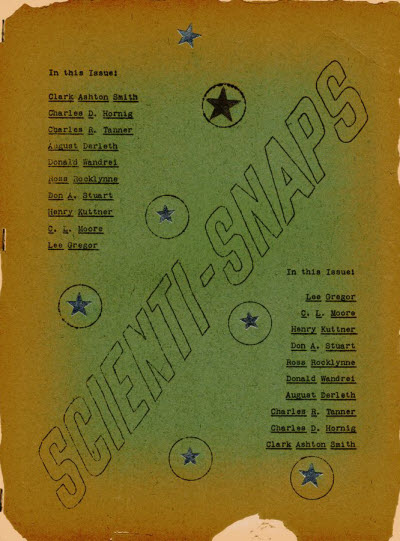
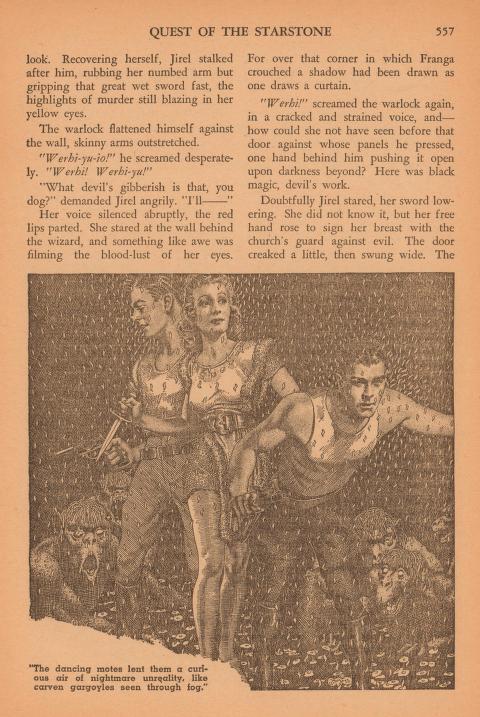
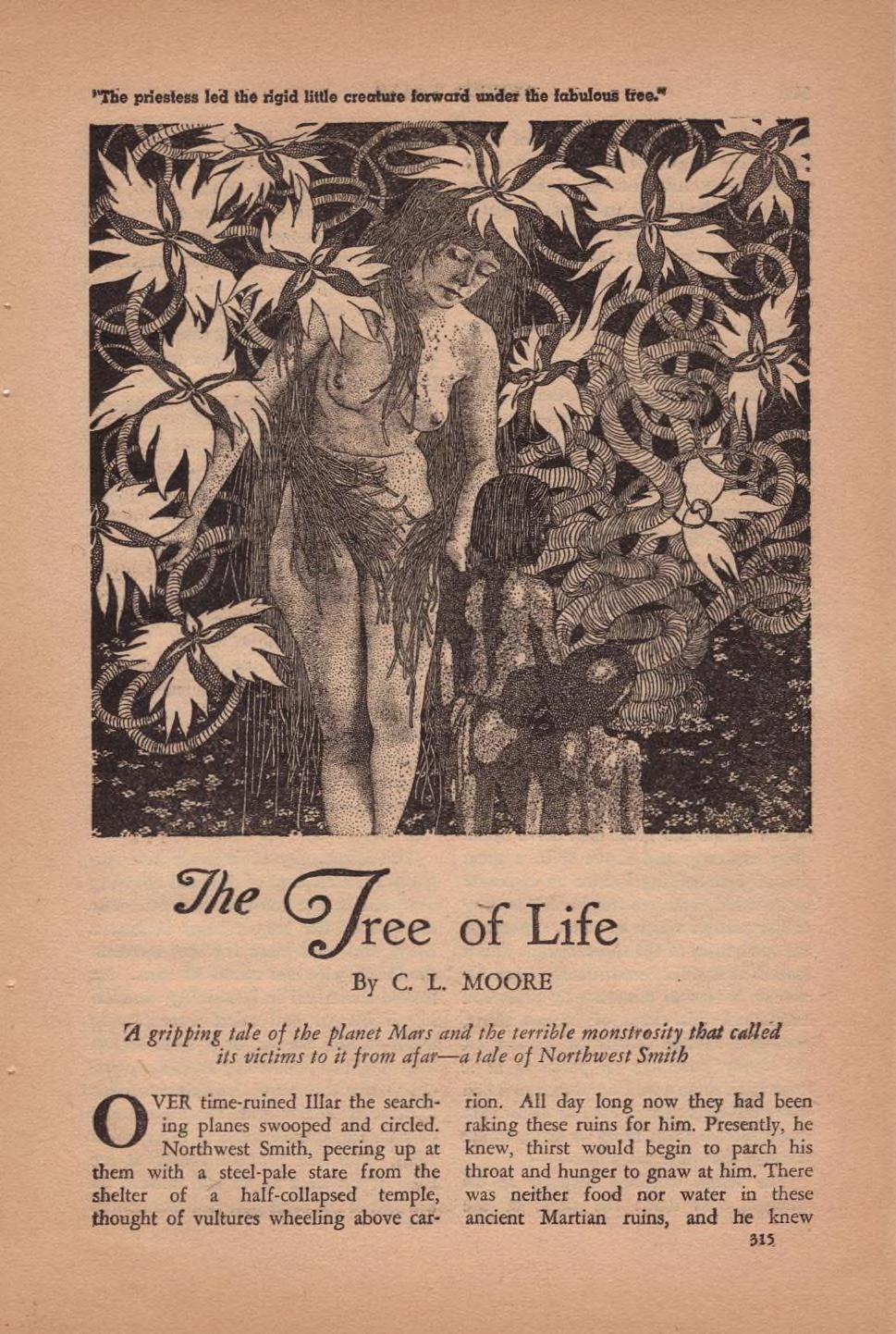
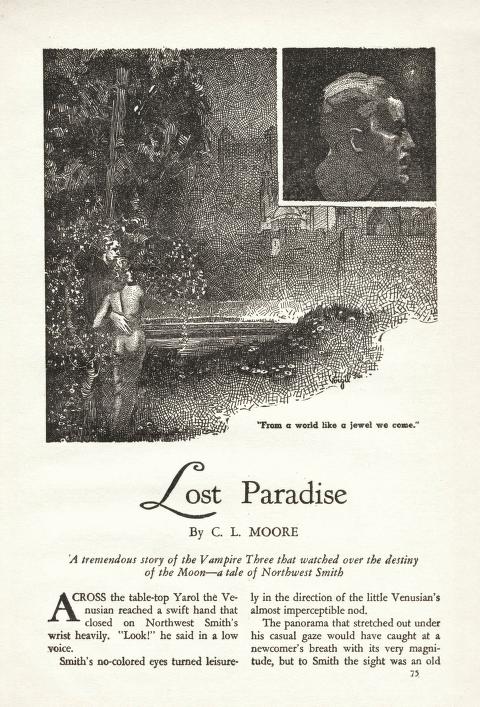
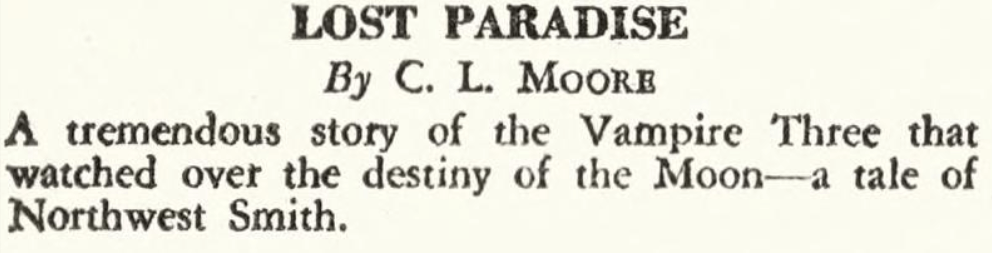
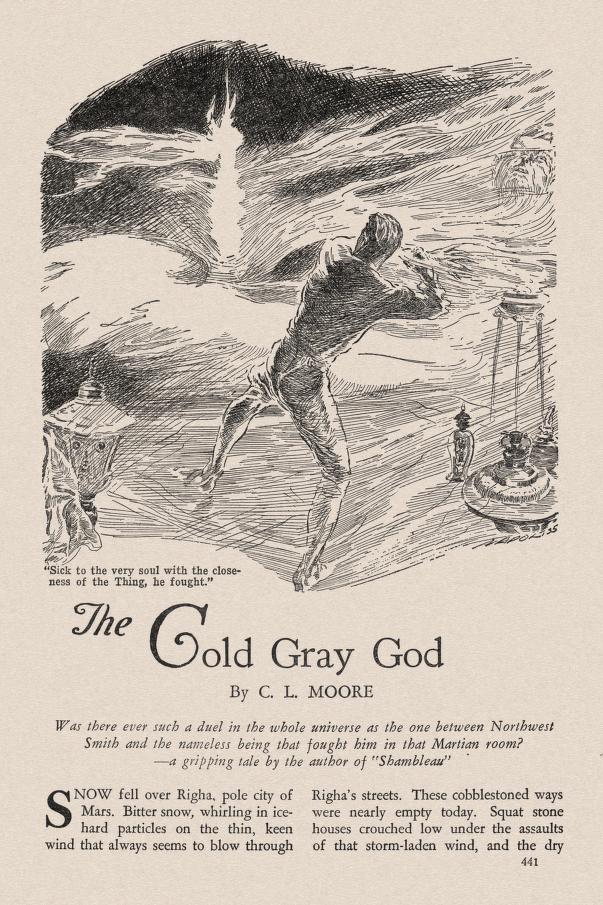
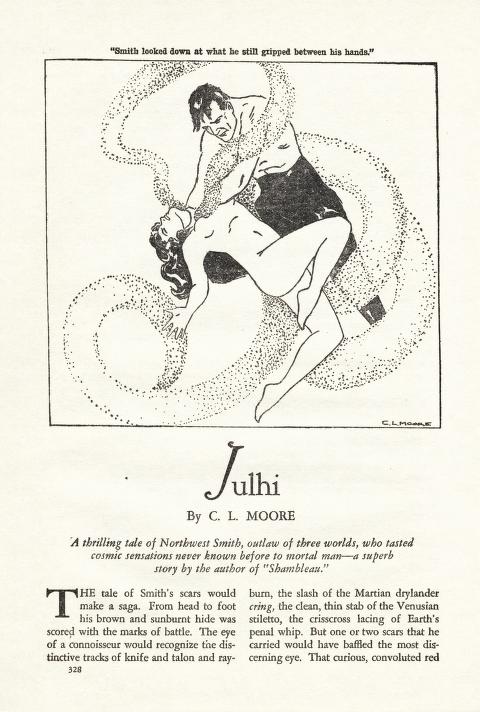
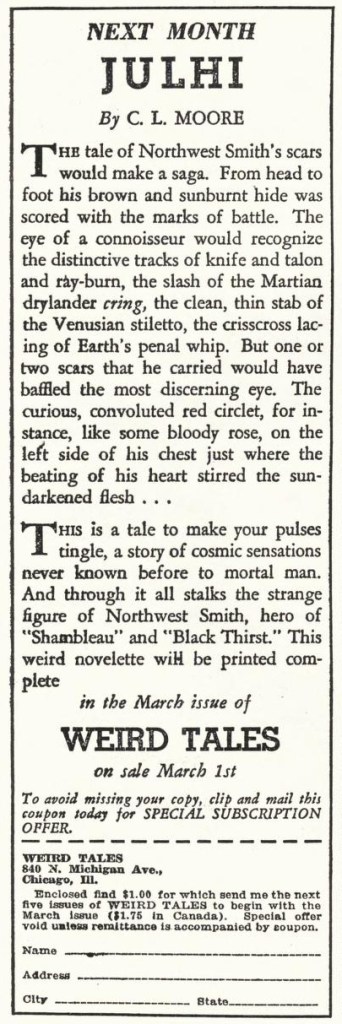
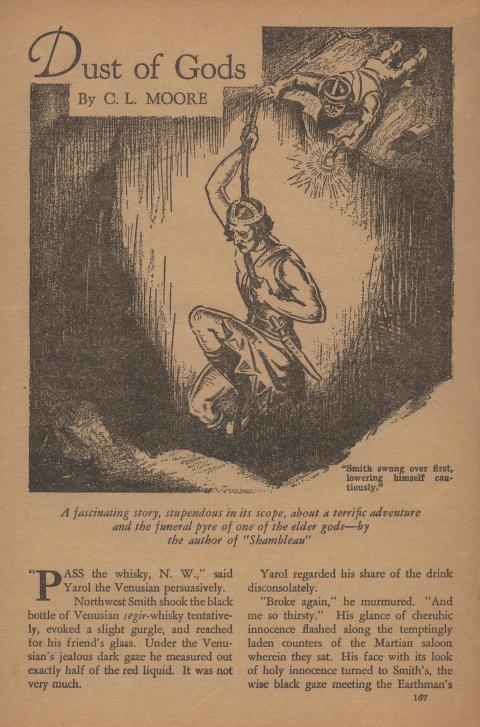
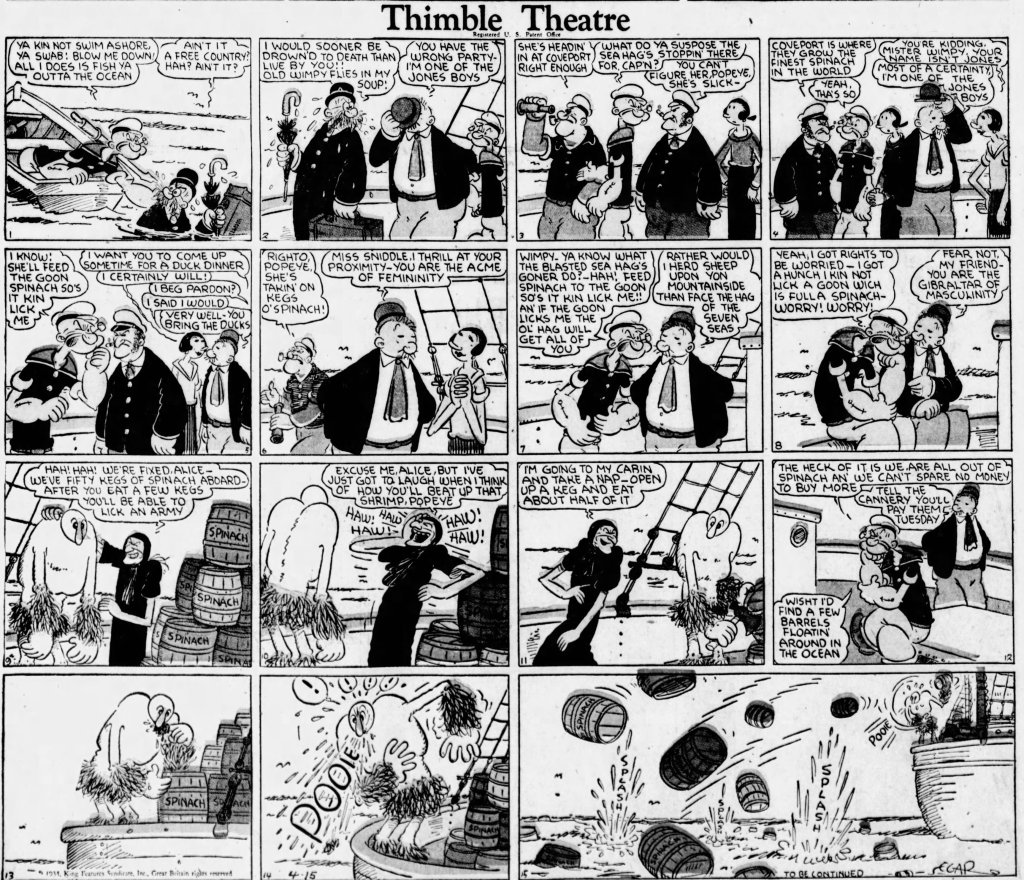
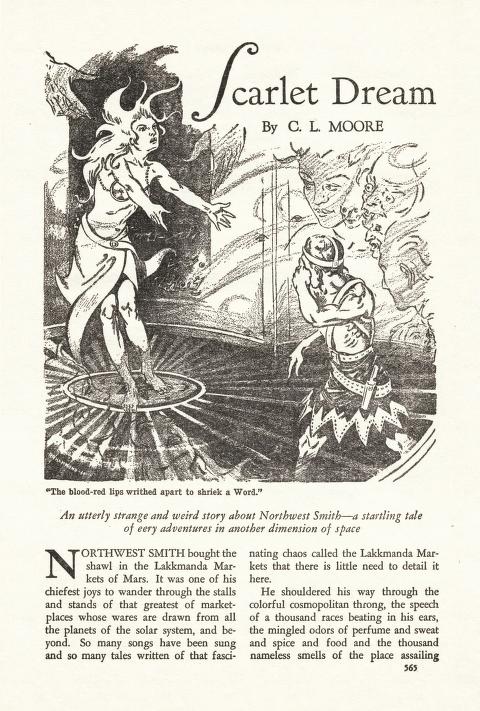
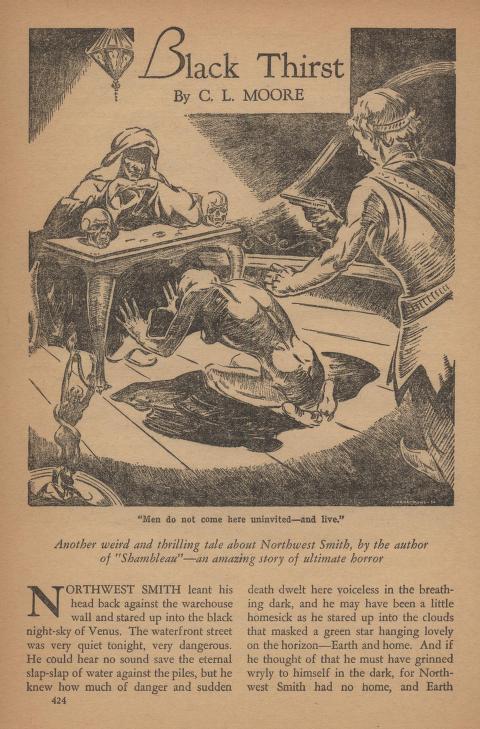
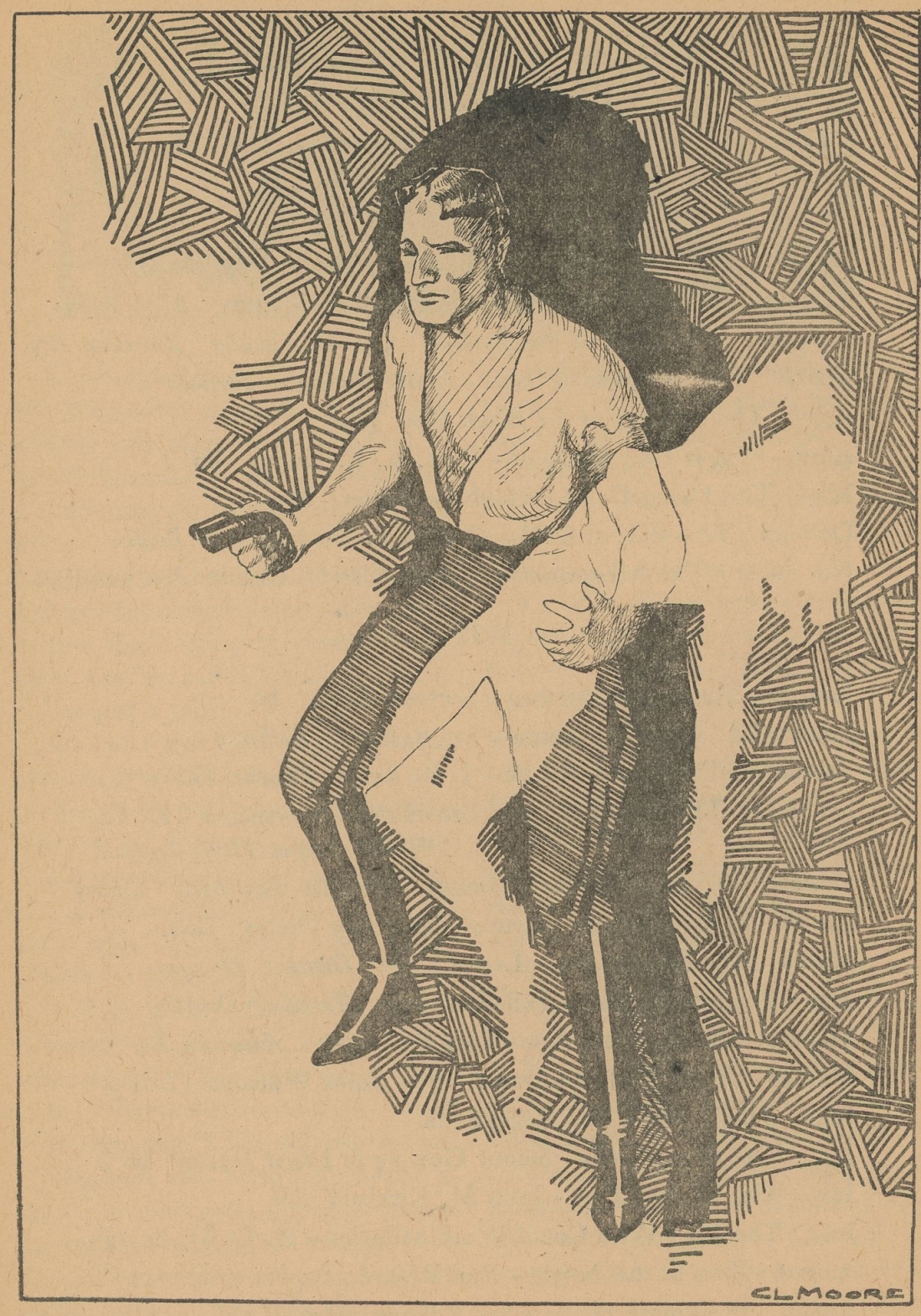

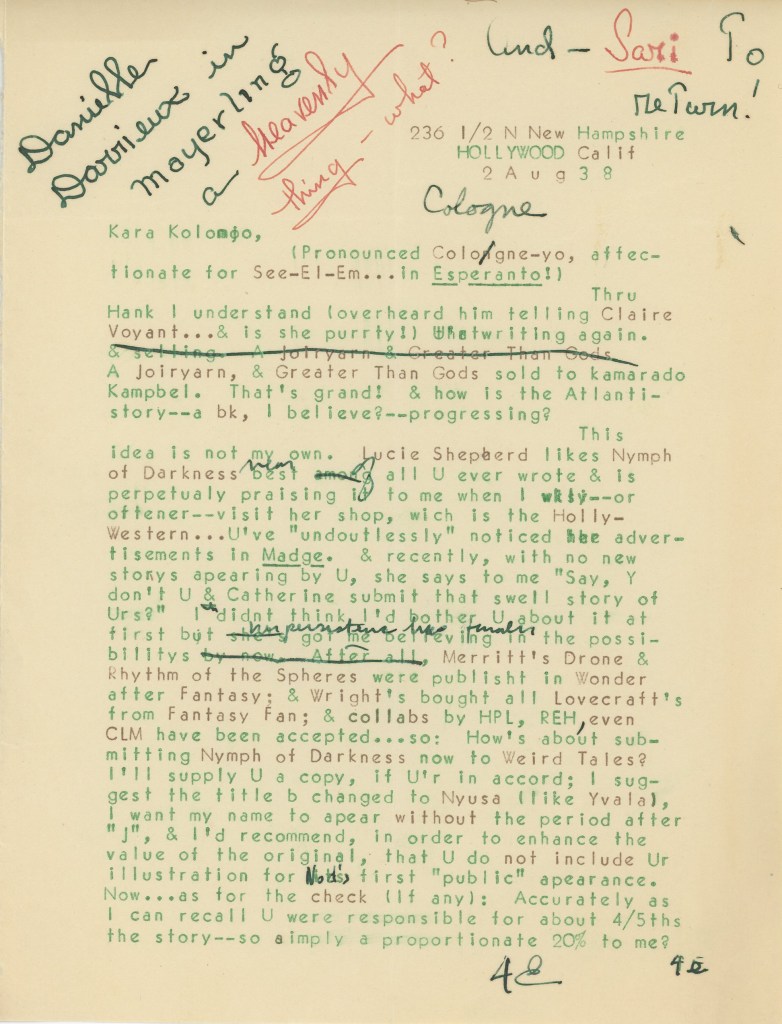
 Deep Cuts in a Lovecraftian Vein