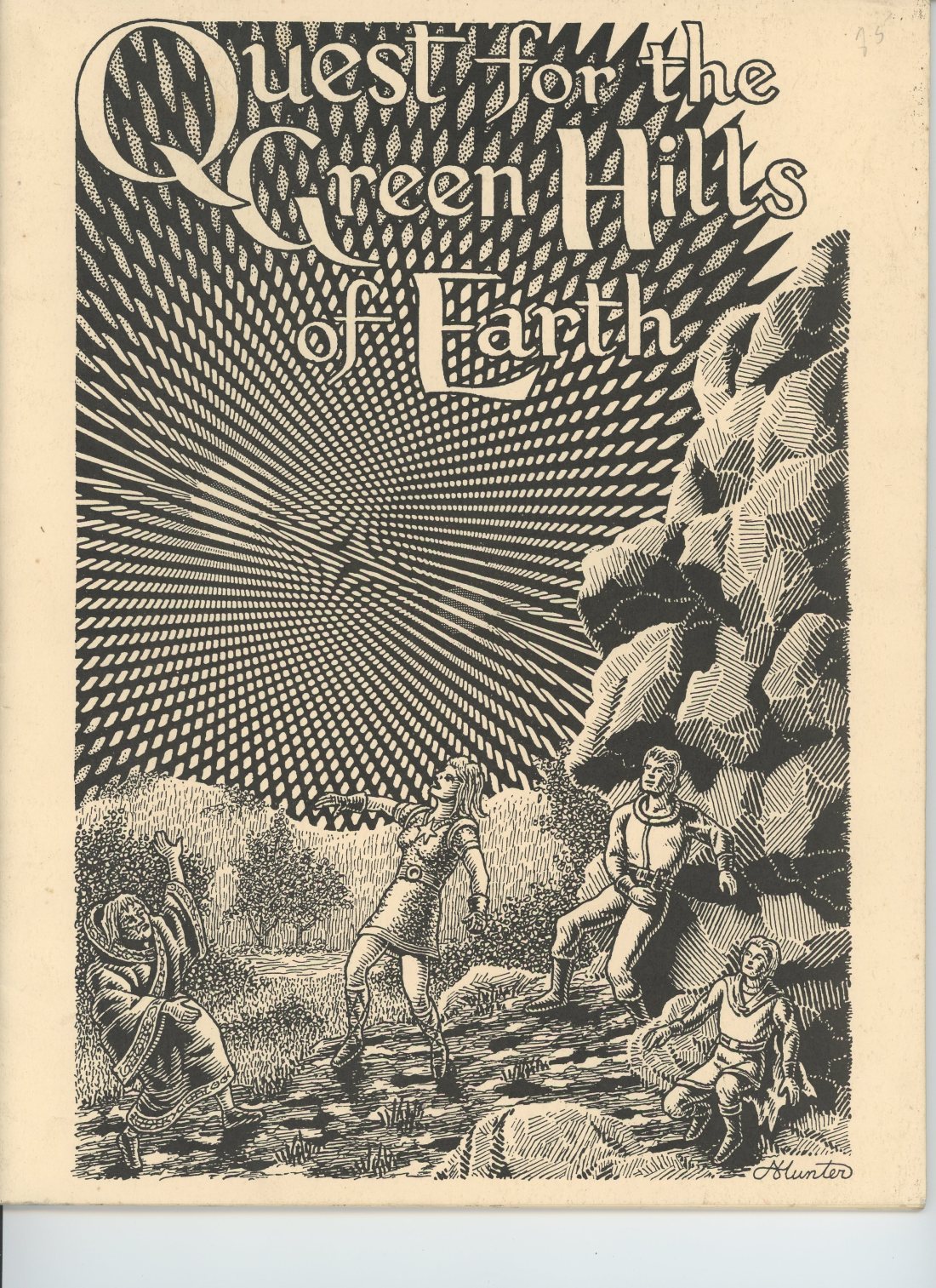
Quest for the Green Hills of Earth (1995) by Ned Brooks

Chacal: Rumor has it that you didn’t particularly care for the story in which Jirel met Northwest [Smith], “Quest for the Star Stone.” Could you give us a little background on the tale; the how and why of it?

Moore: I’d forgotten that I maybe like “Quest of the Star Stone” least—that doesn’t mean I dislike. If I said so, I expect it’s true. And if true, my guess would be that in this first Kuttner/Moore collaboration the machinery of working together had to be refined and worked over more before it functioned well. Hank and I had met, I think, a short time before this. Or had we met at all? Or only corresponded? Anyhow, he was urging me to do another Jirel and sent on a kind of opening situation to see if I would feel any interest. I did and we sent the Ms. back and forth to the best of my very dim recollection until we were ready to submit it. remember this was all 40 years ago and a lot has happened since.

“Interview: C. L. Moore Talks To Chacal” in Chacal #1 (1976), 28

They were not yet married. Catherine Lucille Moore had broken into Weird Tales with “Shambleau,” the first story of Northwest Smith, interstellar outlaw, in 1933; her fantasy heroine Jirel of Joiry followed in “Black God’s Kiss” in 1934. Henry Kuttner broke into Weird Tales with “The Graveyard Rats” in 1936. Both Moore and Kuttner were correspondents of H. P. Lovecraft. After C. L. Moore’s fiance died in February 1936, through Lovecraft she and Kuttner came into correspondence…and not immediately, but over time, that grew into something more. They married in 1940, and would go on to become one of the most famous writing teams in science fiction. Yet their first collaboration was one of their weirdest, and has arguably the oddest legacy.

“Quest of the Starstone” was published in the November 1937 issue of Weird Tales; the two characters Northwest Smith and Jirel of Joiry had heretofore occupied completely separate settings with no connective elements, but there was a precedent for an author bringing two disparate characters together. Robert E. Howard had brought the Pictish king Bran Mak Morn and King Kull of Atlantis together in “Kings of the Night” (Weird Tales November 1930). Howard had a habit of developing common themes, backgrounds, and connective elements between many of his stories, so that such a chance meeting was less incongruous than it might have been.
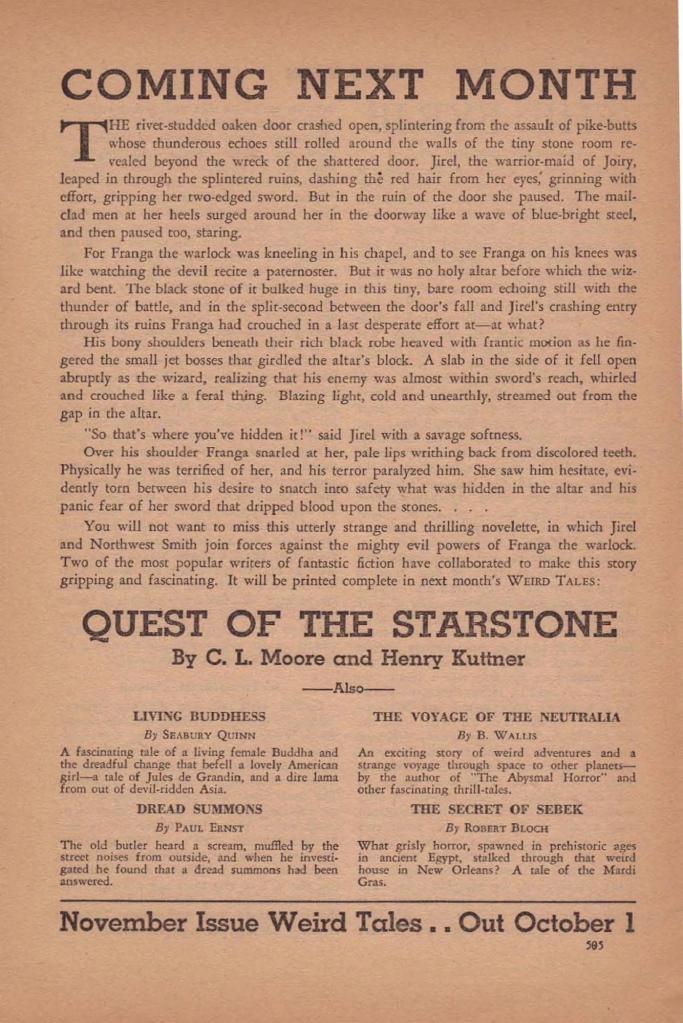
Weird Tales Oct 1937 advert

Moore was nowhere near as devoted to building a consistent setting, but she had one advantage. Her stories of Northwest Smith and Jirel of Joiry never drew a hard line between science fiction and fantasy. It was not uncommon for Jirel to end up in some other dimensional, dealing with an alien entity; nor was it strange for Northwest Smith to turn his raygun against alien gods or sorcerers. In both stories, science and sorcery were part of the same spectrum, and either worked well as an explanation. Henry Kuttner, especially early in his career, was adept at pastiche and able to turn his hand to nearly anything. While that did mean he sometimes struggled to find his own voice, when it came to collaboration, his prose often flowed seamlessly with his partner’s.

As their first collaboration, “Quest of the Starstone” is a bit stiff. While the prose is competent, neither Kuttner or Moore is at their best, and the sensual, often dreamlike prose that characterized Moore’s solo efforts at both characters is often missing in a rather straightforward plot to get the two heroes to meet, team-up, and overcome a mutual for in a way that would become familiar to generations of superhero comics fans. Yet there is one passage in particular that had a longer and odder life.

Homesickness he would not have admitted to anyone alive, but as he sat there alone, morosely facing his dim reflection in the steel wall, he found himself humming that old sweet song of all Earth’s exiled people, The Green Hills of Earth:

Across the seas of darkness
The good green Earth is bright—
Oh, star that was my homeland
Shine down on me tonight. . . .

Words and tune were banal, but somehow about them had gathered such a halo of association that the voices which sang them were sweeter and softer as they lingered over the well-remembered phrases, the well-remembered scenes of home. Smith’s surprizingly good baritone took on undernotes of a homesick sweetness which he would have died rather than admit:

My heart turns home in longing
Across the voids between,
To know beyond the spaceways
The hills of Earth are green. . . .

What wouldn’t he give just now, to be free to go home again? Home without a price on his head, freedom to rove the blue seas of Earth, the warm garden continents of the Sun’s loveliest planet? He hummed very softly to himself,

—and count the losses worth
To see across the darkness
The green hills of Earth. . . .

C. L. Moore & Henry Kuttner, “Quest of the Starstone”

Who wrote this bit? Moore was the poet of the pair, but Kuttner was no slouch, and the title itself is a callback to two previous tales. In “Shambleau” Moore wrote: “[…] he hummed The Green Hills of Earth to himself in a surprisingly good baritone”; and in “The Cold Gray God” (1935):

No one sang Starless Night any more, and it was the Earth-born Rose Robertson’s voice which rang through the solar system in lilting praise of The Green Hills of Earth.

That could be the kind of detail that a good pasticheur like Kuttner would pick up and expand upon. Yet it wouldn’t be surprising if they both had a hand in the final version of this scene.

“Quest” was also almost the final appearance for both characters. Northwest Smith’s final appearance would be in “Song in a Minor Key” (1940), where Moore alludes to his exile and spoke of Earth as “a green star high in alien skies.” When Jirel of Joiry returned in “Hellsgarde” (1939), she does not mention Northwest Smith…but then, chronological continuity was seldom the strong point in either the Northwest Smith or Jirel of Joiry stories, except that “Black God’s Shadow” followed “Black God’s Kiss.” Like oil and water, the two characters drew apart.

For many years thereafter the story was quite scarce—Moore did not collect it in any her Northwest Smith or Jirel of Joiry collections in the 1950s or 60s. However, Sam Moskowitz claims:

When Robert Heinlein read the story, he never forgot the phrase which became the title of one of his most famous short stories and of a collection, The Green Hills of Earth.

Sam Moskowitz, Seekers of Tomorrow (1967), 312

“The Green Hills of Earth” ran in The Saturday Evening Post for 8 Feb 1947, and provided the title for Heinlein’s 1951 collection of science fiction. Heinlein himself claimed that he didn’t consciously realize he had lifted the phrase until after the story was published:

Two weeks after the sale was made, Vida Jameson was in bed with a cold, and Heinlein dug out some of his old Weird Tales pulps so she could read his favorite Northwest Smith stories by C. L. Moore. In the middle of reading, she sat up in bed, startled: she had discovered the title of Heinlein’s Post story in a passage in “Shambleau” where Northwest Smith is humming “The Green Hills of Earth” to himself.

Heinlein immediately apologized to Catherine Kuttner for unconsciously appropriating her intellectual property and asked for a formal release to use the song title.

The Kuttners, too, were delighted to learn about the sale to the Post and happy to make the release. They wrote him gloating congratulations.

William H. Paterson, Robert A. Heinlein: In Dialogue with His Century, Volume 1 (2010) 403

Subsequent publications would include the acknowledgment:

The phrase The Green Hills of Earth derives froma story by C. L. Moore (Mrs. Henry Kuttner), and is used here by her gracious permission

Heinlein did not reiterate Moore & Kuttner’s verses, but came up with his own—and attributed it to an author, the blind poet Rhysling. Both “The Green Hills of Earth” (song) and Rhysling would be mentioned in some of Heinlein’s other works, such as Farmer in the Sky (1950) and Time Enough for Love (1973). Heinlein’s work gained much more recognition than Moore and Kuttner’s, and his fictional poet Rhysling would in 1978 lend their name to the Rhysling Awards, an annual award for the best science fiction, fantasy, or horror poem—and in an unknown number of poems and filk music devoted to that enigmatic but evocative song, “The Green Hills of Earth.”

This is where Quest of the Green Hills of Earth (1995) comes in. Edited by Ned Brooks and illustrated by Alan Hunter, this is the kind of standalone chapbook that is a hallmark of science fiction and fantasy fandom. It reprints “Quest of the Starstone” in its entirety, Heinlein’s verses from “The Green Hills of Earth,” and three fan-made versions—one by Chuck Rein, George Heap, “and other fans of the 1960s”; one by Don Markstein (“late 60s”), and one by Steve Sneyd (Oct 1992). There is a brief article by Brooks tracing various recensions of the song to various tunes, both original and familiar—it has been sung to everything from “Greensleeves” to “Puff, the Magic Dragon,” and various dramatic presentations of “The Green Hills of Earth” or its song have been made and even marketed commercially. Brooks ends the booklet with sheet music for two versions, one composed by George Heap and the other by Joseph Kaye.

Curious listeners can listen to several versions of these songs, most based on Heinlein’s verses.

Why does it work? Why do just a few simple words strung together resonate with the hardboiled Northwest Smith, who could never go home again; and the blind poet Rhysling burned by radiation; and for all those generations of fans? I like to think it works because Moore, Kuttner, and Heinlein recognized a key aspect of science fiction: more than the hard science, the human emotion, the narrative of what it feels like to a person to go out to that distant frontier, matters.

I had thought that going into space would be the ultimate catharsis of that connection I had been looking for between all living things—that being up there would be the next beautiful step to understanding the harmony of the universe. In the film “Contact,” when Jodie Foster’s character goes to space and looks out into the heavens, she lets out an astonished whisper, “They should’ve sent a poet.” I had a different experience, because I discovered that the beauty isn’t out there, it’s down here, with all of us. Leaving that behind made my connection to our tiny planet even more profound.

William Shatner, “William Shatner: My Trip To Space Filled Me With Sadness,” Variety 6 Oct 2022

As it turns out, before we ever had an astronaut in orbit, a few poets did launch themselves into the great dark…for a little while, anyway…and captured something of that longing for home.


Bobby Derie is the author of Weird Talers: Essays on Robert E. Howard and Others and Sex and the Cthulhu Mythos.

Deep Cuts in a Lovecraftian Vein uses Amazon Associate links. As an Amazon Associate I earn from qualifying purchases.
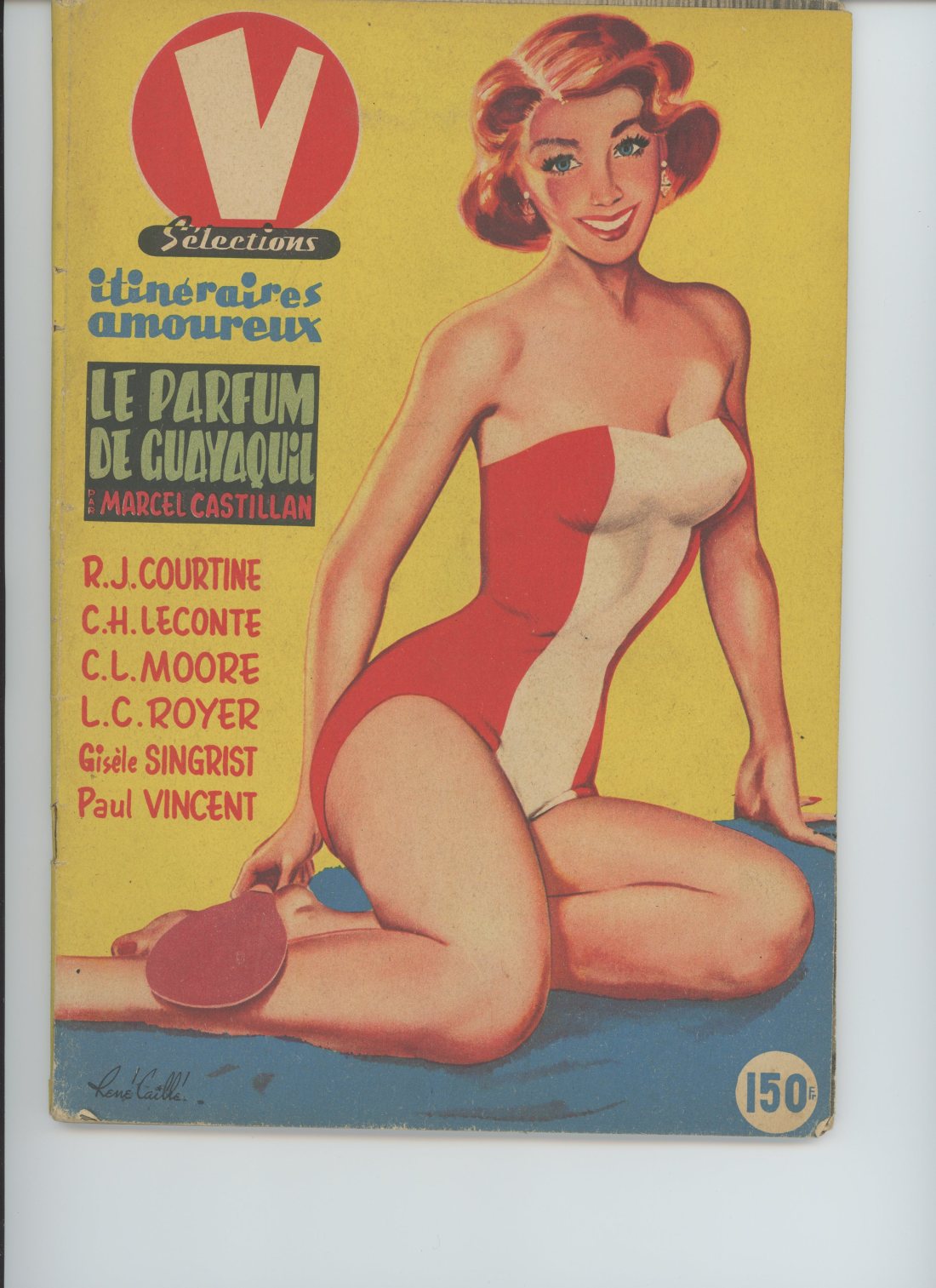
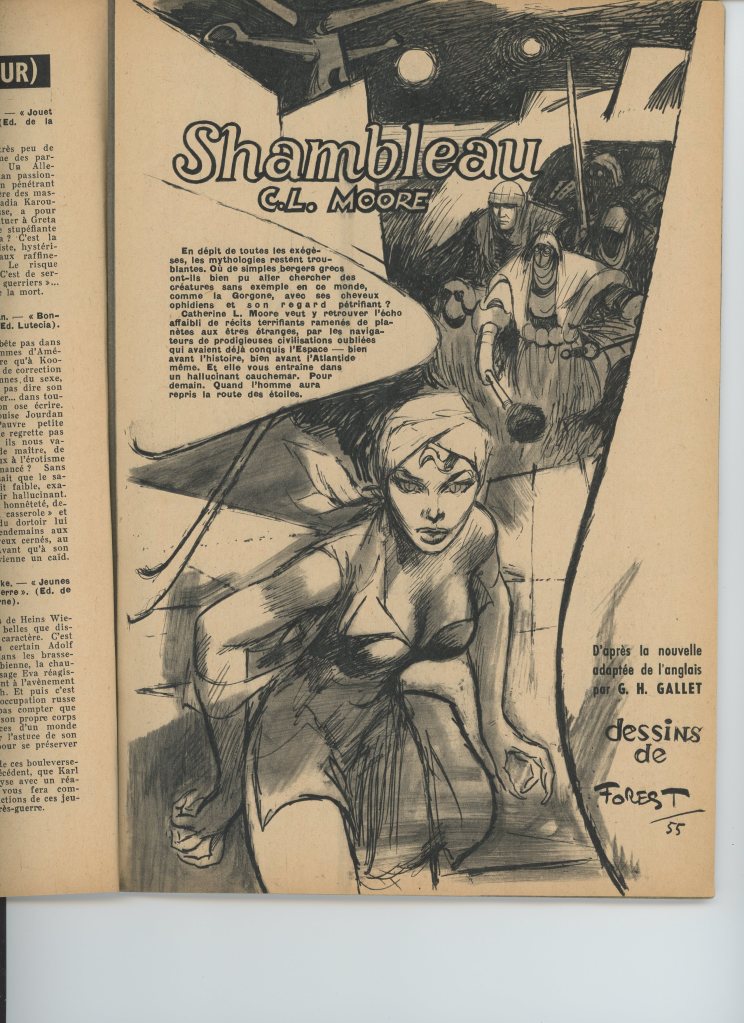
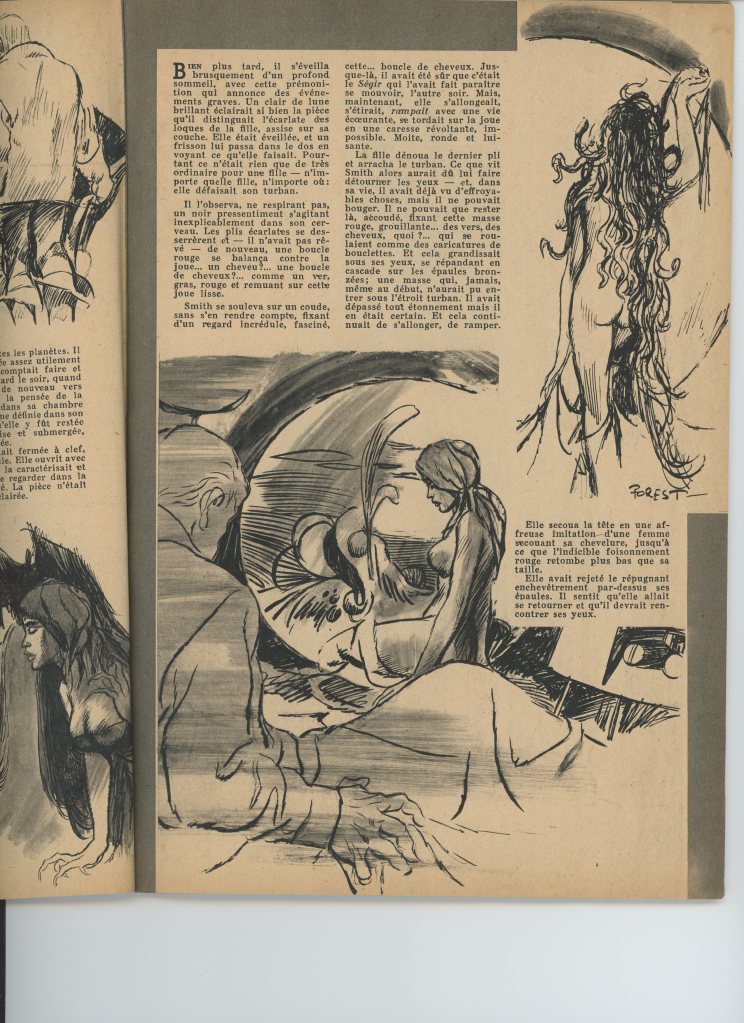
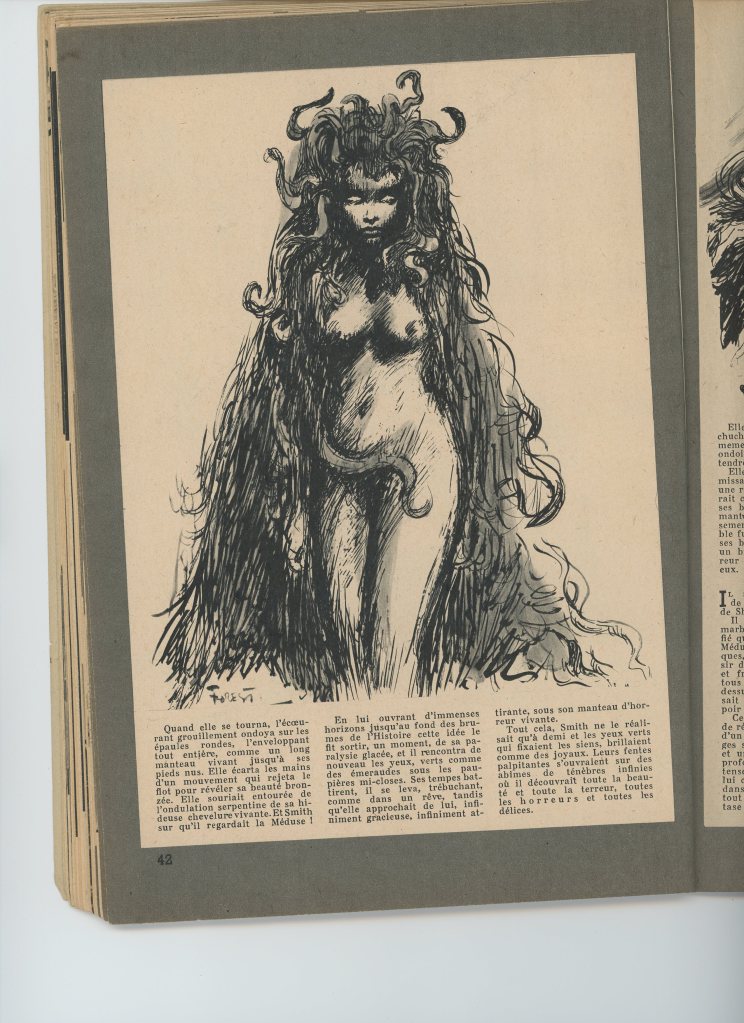
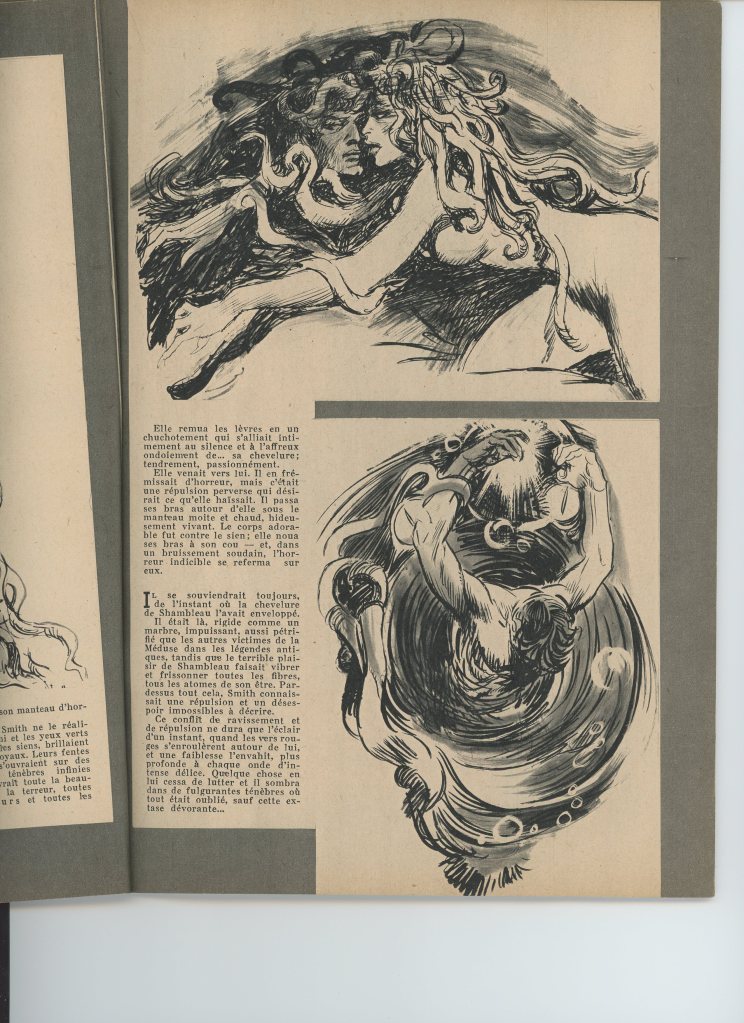
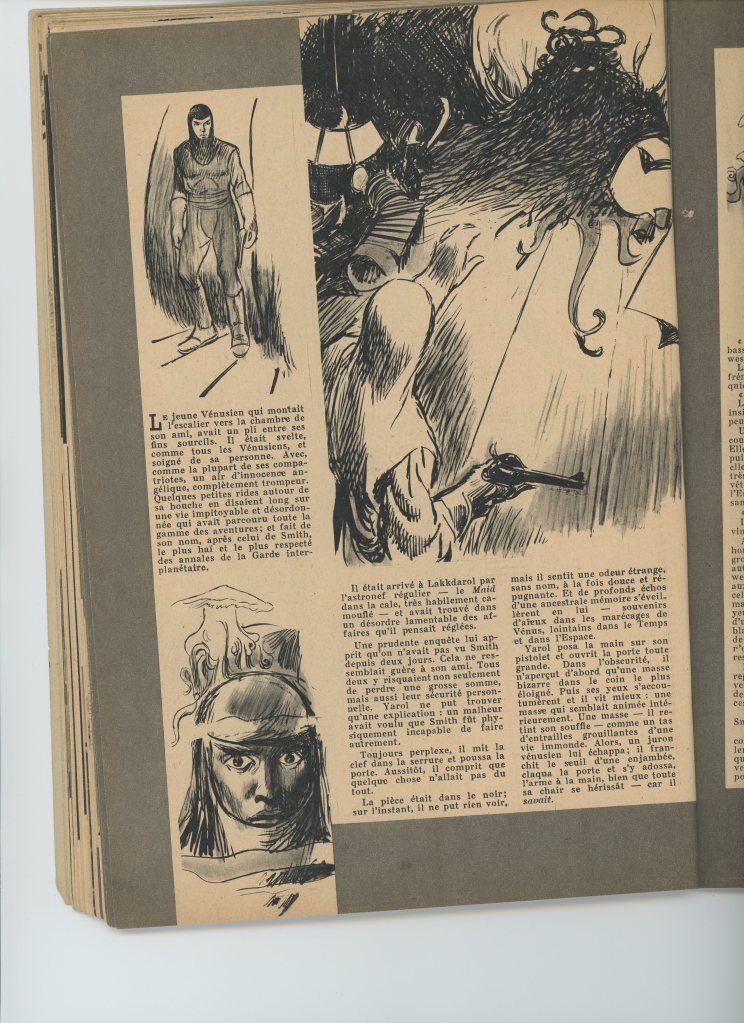
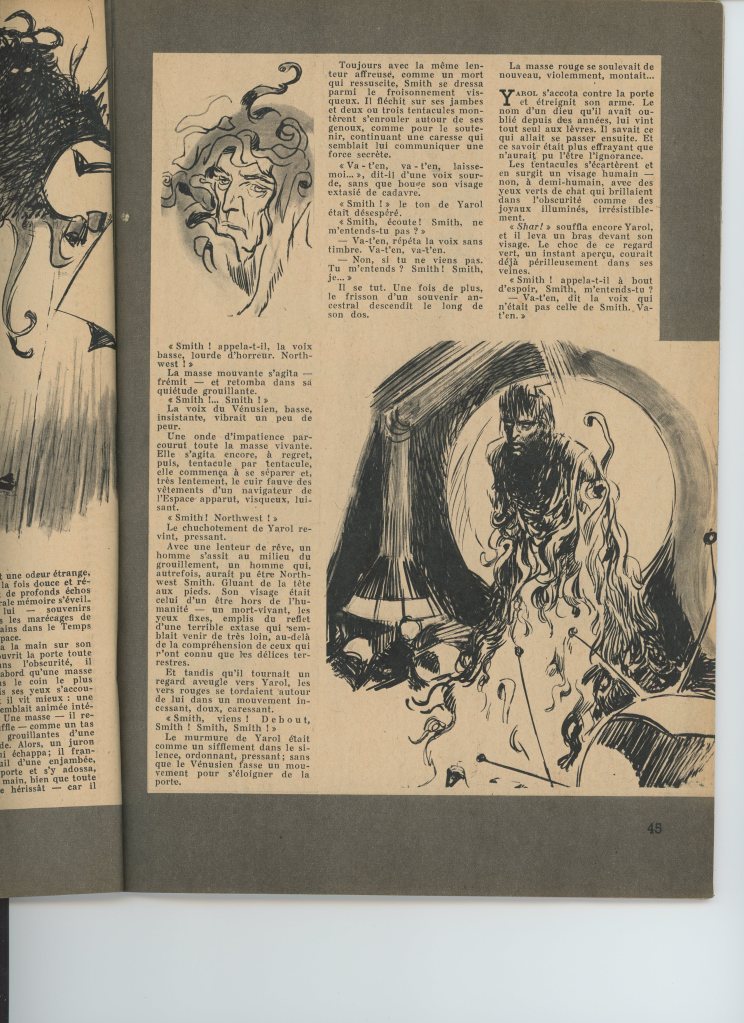
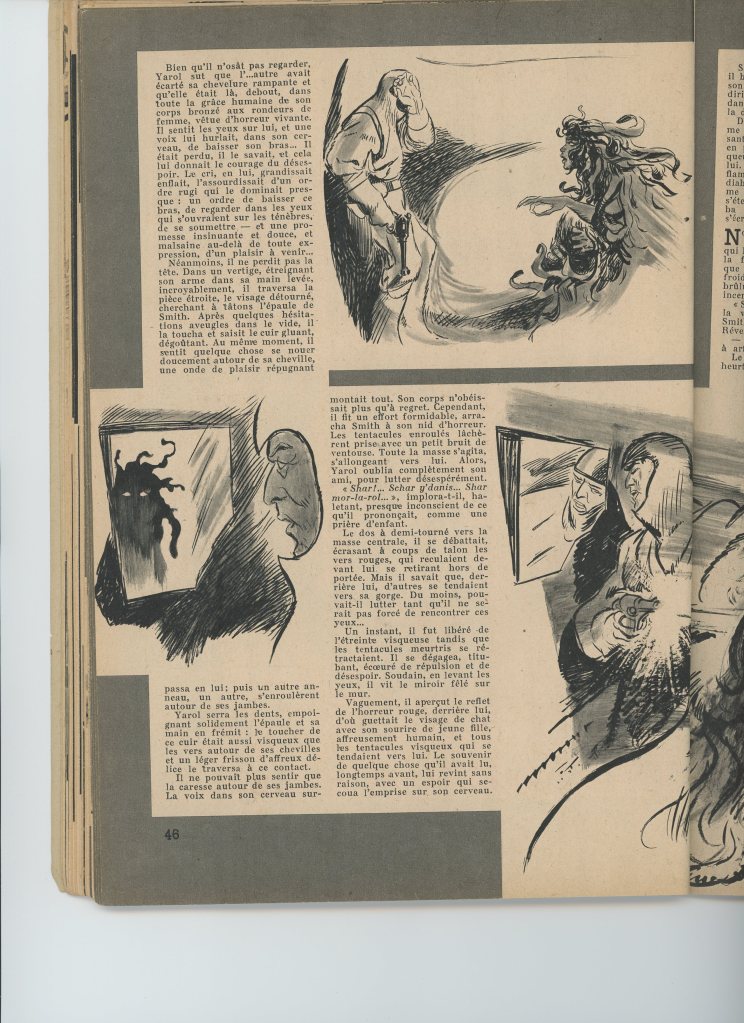
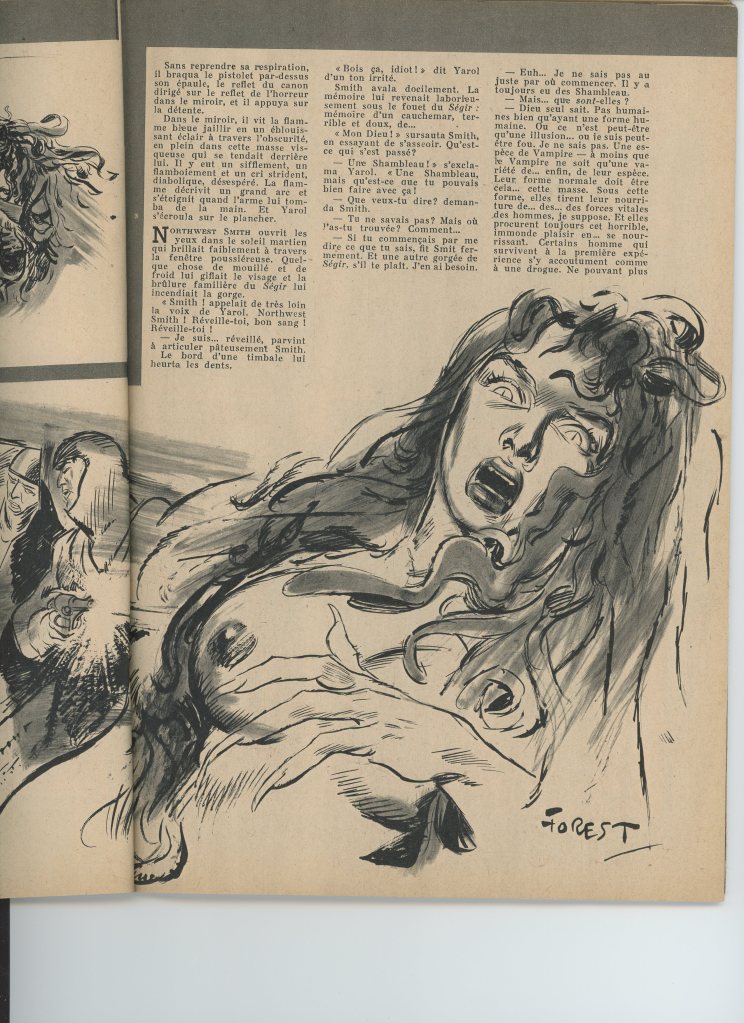
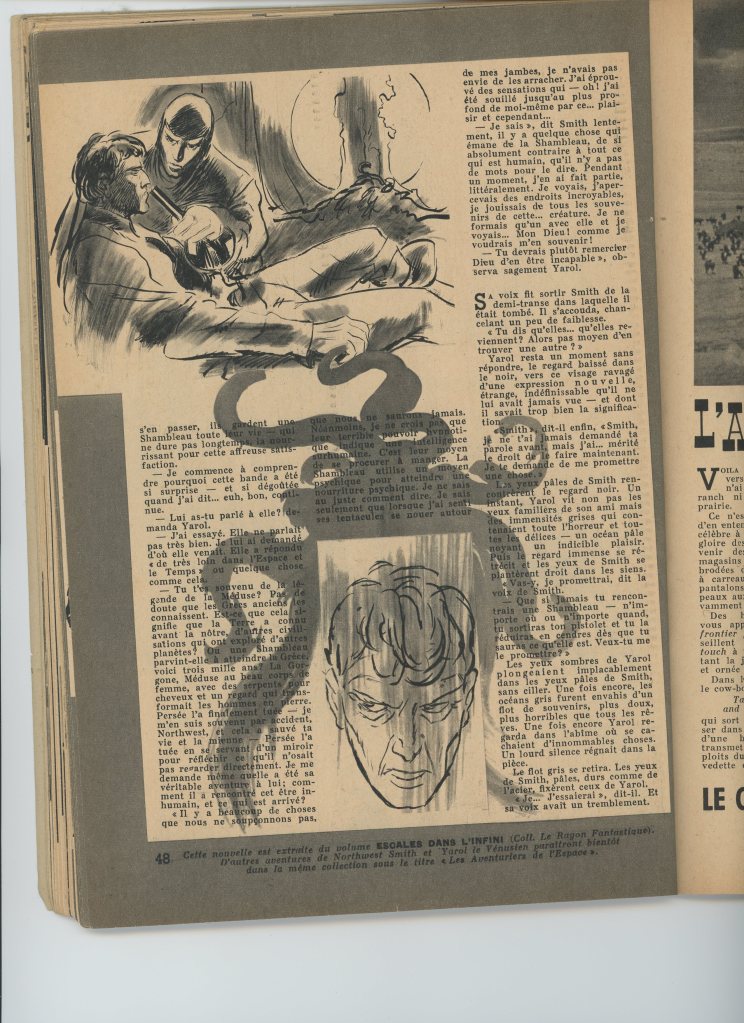
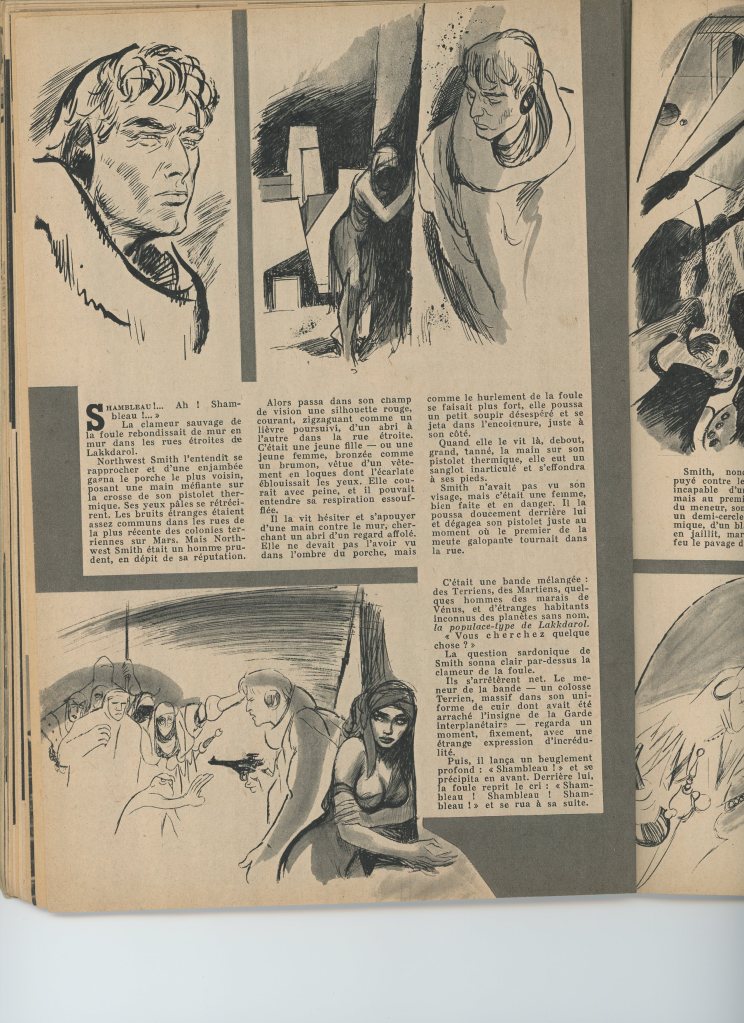
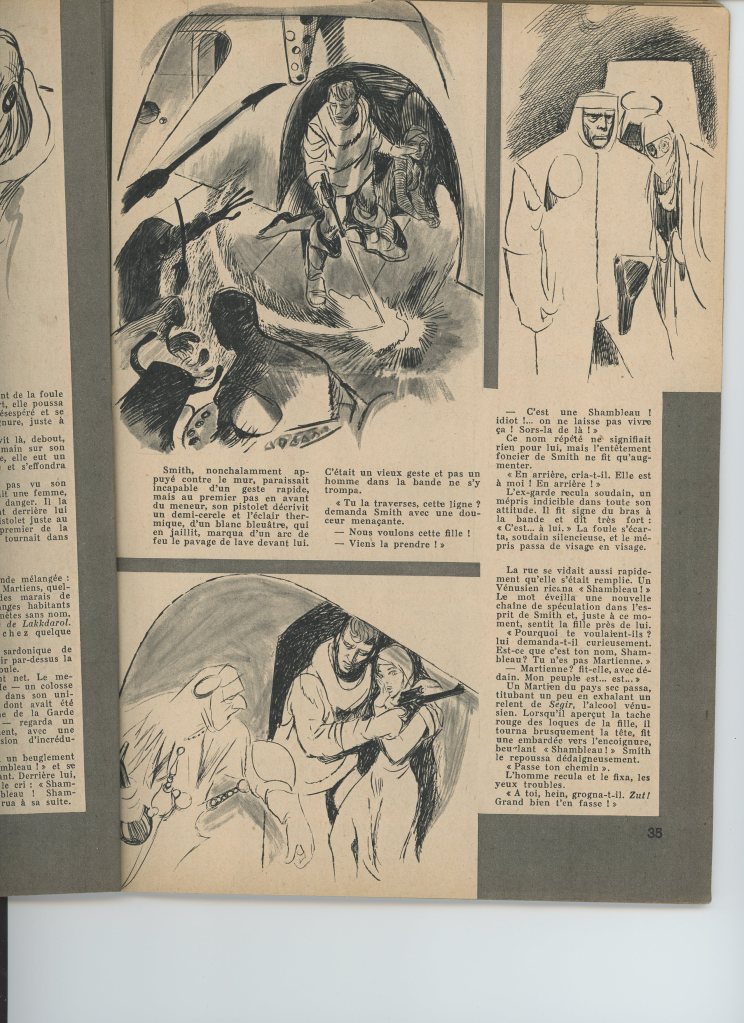
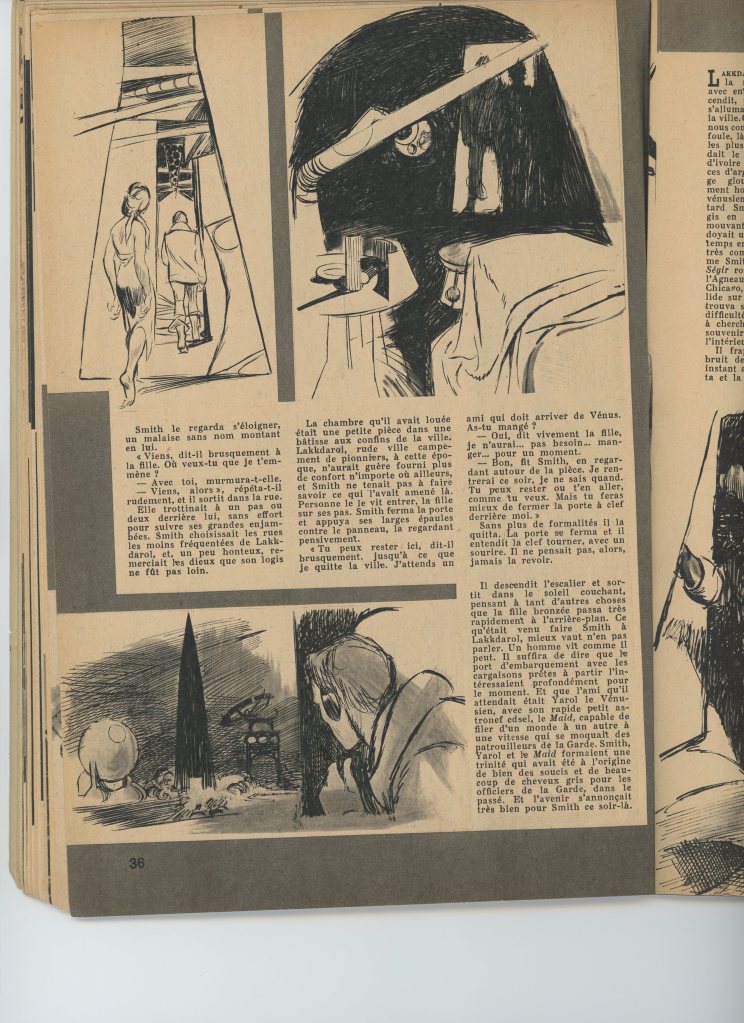
“Shambleau” (1955) by C. L. Moore & Jean-Claude Forest

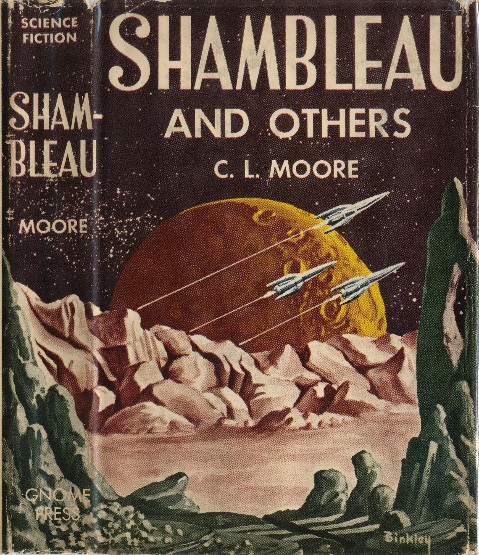
In 1933, C. L. Moore burst into the pages of Weird Tales with “Shambleau,” to immediate acclaim. The story was reprinted a couple of times over the ensuing decades, and formed the headline of Shambleau and Others (1953, Gnome Press), Moore’s first hardcover collection of her early Weird Tales fiction. The first foreign translation was in France in 1954, when it was translated for the anthology Escales dans l’infini (“Stopovers in Infinity”), translated by editor Georges H. Gallet.

The next year, Gallet’s translation was reprinted in V Sélections Été (Summer) 1955 issue.

V began publication as a weekly magazine in France in 1944 and went through several different names and editorial regimes, including V, V magazineVoir magazineVoirMLN illustrated magazine, and L’Hebdomadaire du reportage. V also spun-off several sister-titles, including V Cocktail, V Sélections, and V Spécial. All of the magazines in the V family seem to have shared the prominent feature of the female form, usually as a pin-up on the cover and as black-and-white photographs, illustrations, and cartoons throughout. G. H. Gallet was the editor-in-chief of the magazines.

The overall tone and audience is often hard to judge at this remove, like American men’s magazines of about a decade later, they appear to be a mix of general interest articles, fiction, slightly racy featurettes with nudes, and the kind of mildly risque cartoons that seem a bit innocent today. These were not, by any stretch of the imagination, pornography: each issue featured tasteful nudes, pin-ups, and bawdy jokes intermixed with a great deal of other articles, interviews, and features…and they had an eye for talent, sometimes featuring artists who would go on to a bit of fame and notoriety.

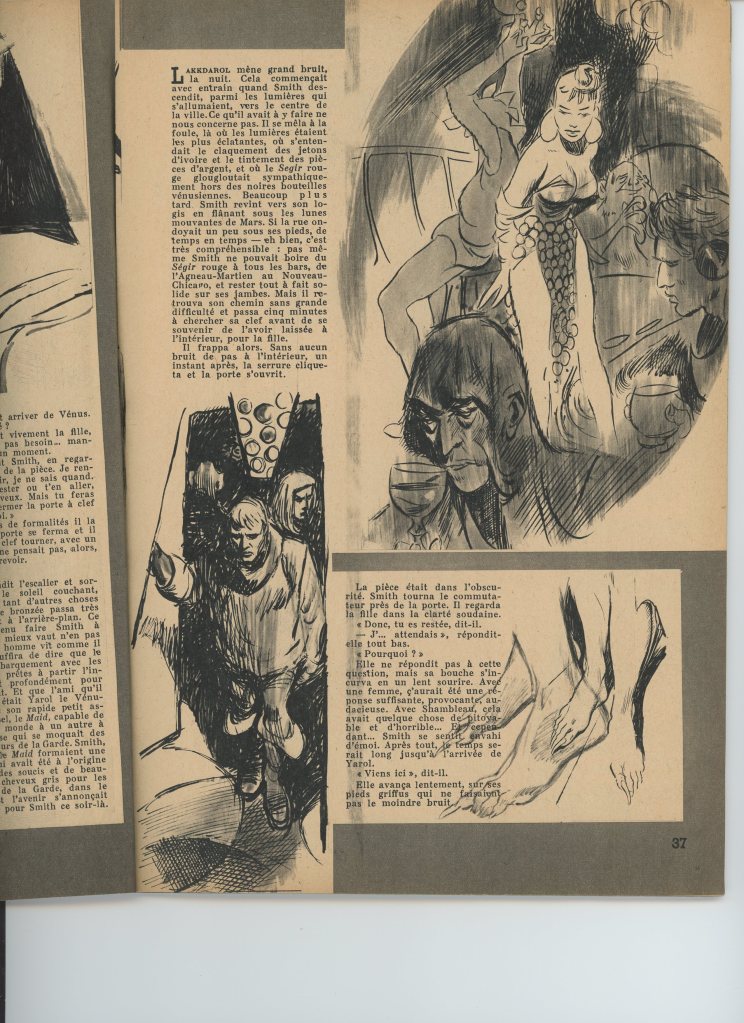
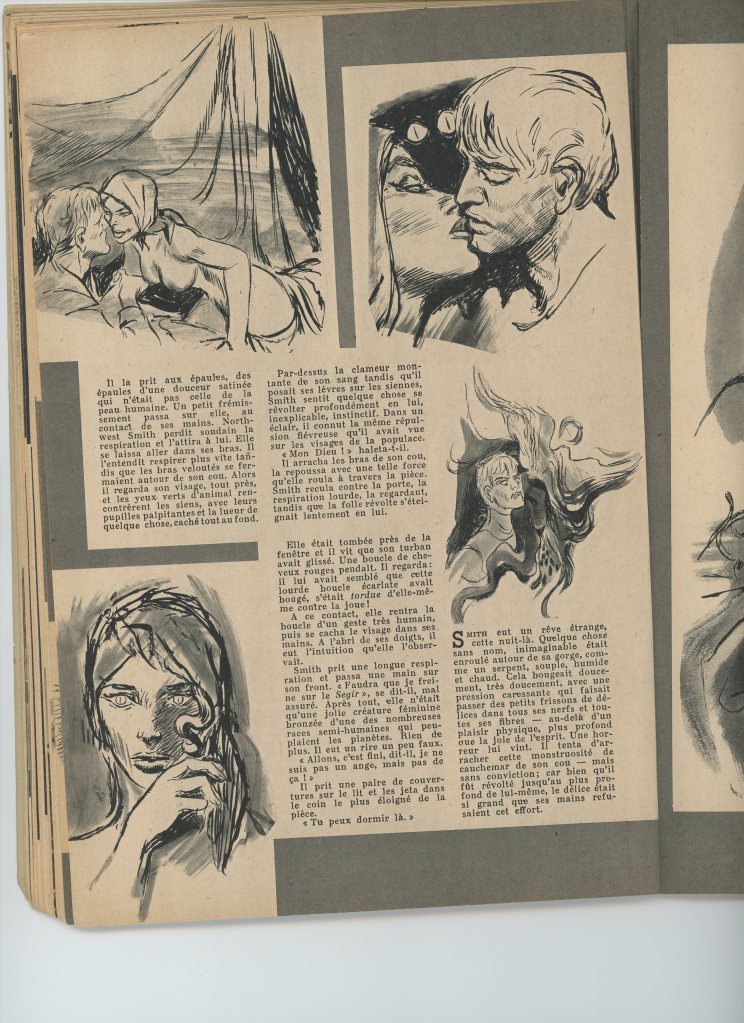
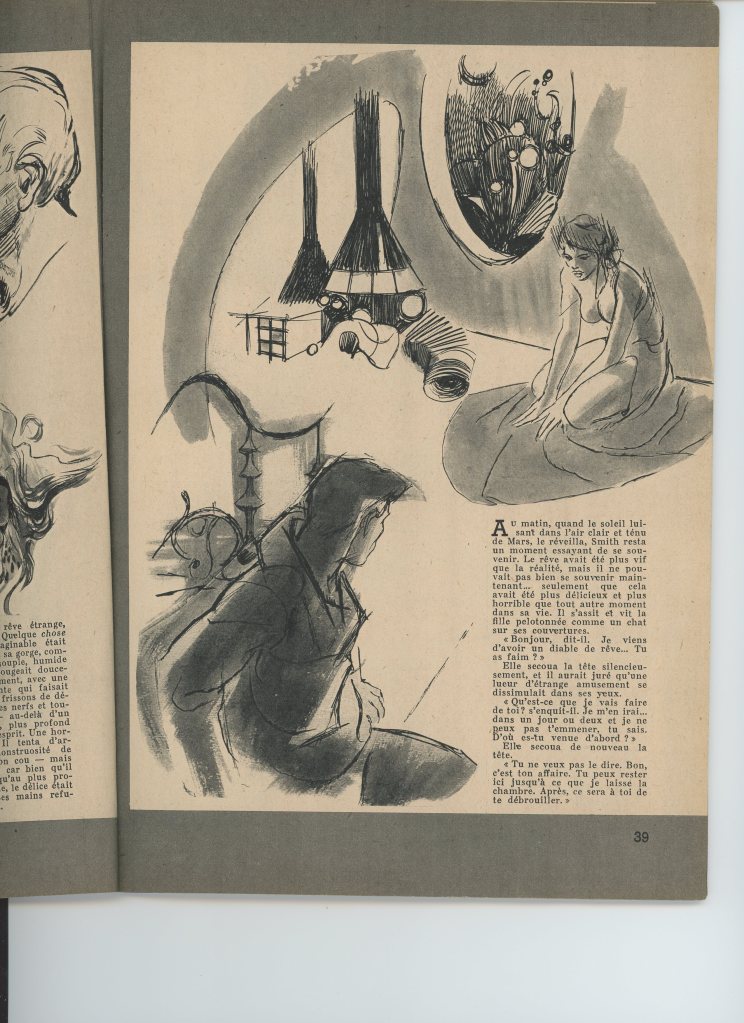
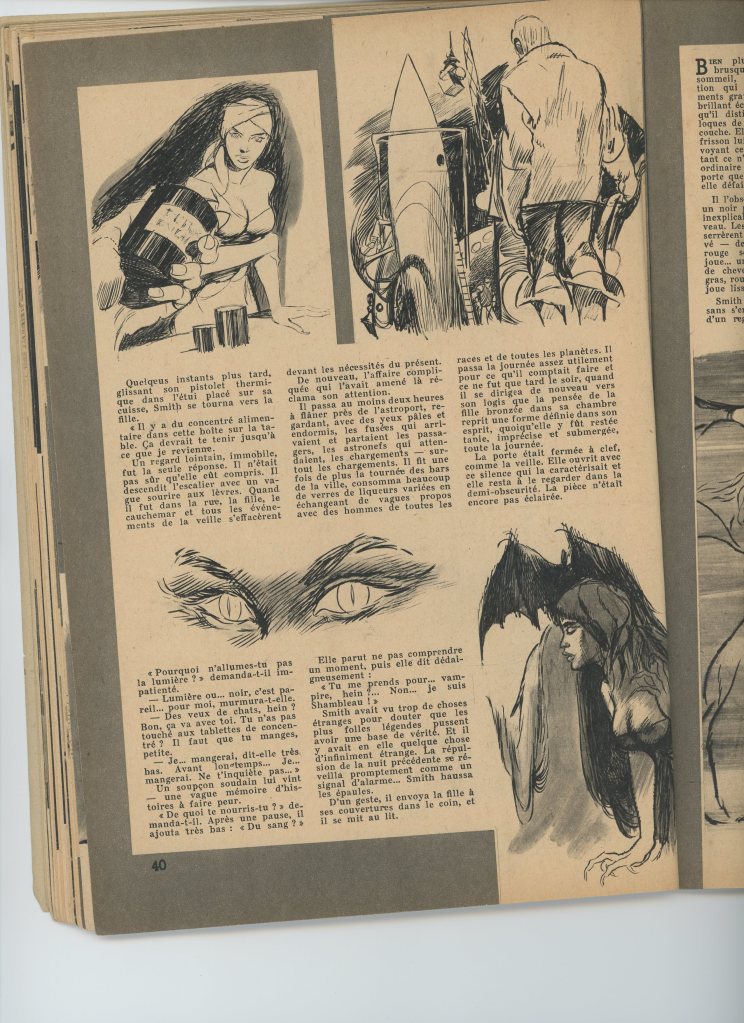
Jean-Claude Forest was born in 1930, and began working as an illustrator in the early 1950s. Like Gallet, Forest had a deep love of science fiction, and would become a renowned cover artist for the French sci-fi paperback series Le Rayon Fantastique, and achieve international fame for his sexy sci-fi epic Barbarella, created for V in 1962—his list of works, achievements, projects, and accolades is too long to go into here. Yet before Barbarella, he illustrated “Shambleau.”

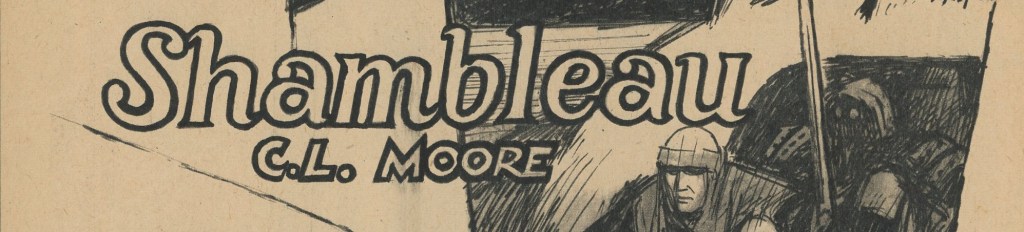
Forest’s illustrations are a classic example of raygun gothic sensibility, and the same clear, sparse line work, framing, and figure-work will be familiar to fans of his comic strips. Yet he also took the opportunity to emphasize the sensuality and horror that is Shambleau, the scattered layout adds a certain dynamism to the blocks of justified text—and when Shambleau stands revealed, the text almost seems to give way before the tentacle-writhed woman who stands bold and stark on the page, eyes shadowed, rough as a crayon-sketch in places.

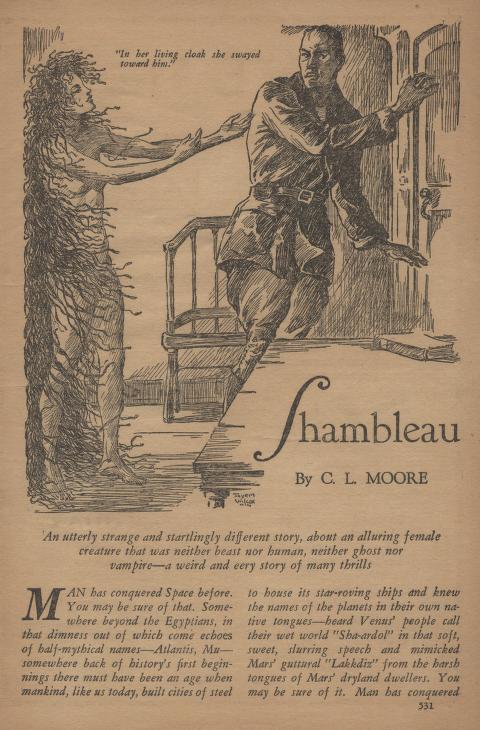
Forest seems to have taken relatively little inspiration from previous illustrations in Weird Tales—may not even have seen them—but appears to have at least been aware of the 1953 Gnome Press cover. Compare, for example, the characteristic shape of the “S” in the title at the opening of the story, and the “S” on the cover of the 1953 Gnome Press collection by Ric Binkley:

There is a certain irony to the fact that while non-English-reading audiences sometimes have to wait longer to get classic works of English-language weird fiction (and vice versa), sometimes when those works are finally made available, they are graced with the creative energies of more skilled artists and dedicated designers and editors. The original audience rarely gets a chance to appreciate this kind of art, since it is rarely translated back into English-language products.

Fortunately, in 2023, the original art by Forest was combined with Moore’s English-language text and an introduction by Jean-Marc Lofficier, and published by Hexagon Comics and Black Coat Press as The Illustrated Shambleau. While this lacks the dynamic swatches of grey and the distinct layout of the original, English-language readers who want to appreciate Forest’s art and Moore’s prose together can finally do so.

Better scans of the original pages can be seen at Cool French Comics, and those curious about the full magazine that “Shambleau” first appeared in can download it from here.


Bobby Derie is the author of Weird Talers: Essays on Robert E. Howard and Others and Sex and the Cthulhu Mythos.

Deep Cuts in a Lovecraftian Vein uses Amazon Associate links. As an Amazon Associate I earn from qualifying purchases.
“Jirel of Joiry: Into The Violet World” (1987) by C. L. Bevill and “Werewoman” (1994) by Roy Thomas, Robert Brown, Rey Garcia, and Susan Crespi

Why aren’t there more C. L. Moore comics?

Catherine Lucille Moore was a contemporary and correspondent of Robert E. Howard and H. P. Lovecraft; she was published in the same pulp magazine, Weird Tales, even collaborated with them on the round robin “The Challenge From Beyond” (1935). Her first story, “Shambleau” (1933), was an immediate hit with readers and weird fiction writers alike, and introduced the world to Northwest Smith, who would go on to star in a series of tales from Moore’s typewriter. Her next creation for Weird Tales, the flame-tressed swordswoman Jirel of Joiry in “Black God’s Kiss” (1934), was hailed as a female Conan.

In general outline, the Conan and Jirel publishing timeline largely lines up as well. Conan’s last original story in Weird Tales was in 1936; Jirel’s in 1939. Gnome Press published the first Conan hardcover in 1950, and the Jirel hardcover collection in 1954; paperback reprints for both appeared for both characters in the 60s as part of the general paperback Sword & Sorcery/fantasy boom. Sure, there were more Conan stories and they were more popular—is that the only reason why Robert E. Howard’s Conan the Cimmerian got the big break into comics when Jirel didn’t?

The boring, practical answer is probably “money.” Licensing a character, even an old pulp character, costs money, and anyone who did want to license Jirel for comics would have gone through C. L. Moore’s agent. Even relatively big publishers like Marvel had to balance cost versus popularity; according to Roy Thomas in Barbarian Life vol. 3, Marvel first approached Lin Carter’s agent about licensing Thongor of Lemuria because they thought Conan would be too expensive. Demographics might also have played a role; women warriors in fantasy have a long history, but in print and in comics, male characters dominated, as Nancy Collins noted when a very different red-haired swordswoman hit the page:

I was thirteen years old when I first saw Red Sonja. It was her debut appearance in the Conan the Barbarian comic book written by Roy Thomas and illustrated by Barry Windsor-Smith, back in 1973, and she was wearing a slightly more practical scale-mail tunic and leather hot-pants ensemble, but all the elements of her basic personality were there: bravery, skill with a sword, and the brashness necessary to go make a name for herself in the savage, male-dominated world of Robert E. Howard’s Hyborian Age.

She immediately grabbed my attention because there were so few strong female heroic characters back then, not just in comics but popular culture in general. (Moreover, the fact this outspoken and capable woman of action and I shared the same hair color did not hurt.) [I]t may be hard for today’s audience to understand, but in the 1960s and 1970s, with the notable exception of Wonder Woman and the Black Widow, most of the female characters in comics were either the girlfriends/wives whose role was to be menaced and/or kidnapped by the arch-nemesis of their heroic Significant Other (Lois Lane, Iris Allen, Gwen Stacy), young and far less seasoned distaff versions of well-established male heroes (Supergirl, Batgirl, Hawkgirl, Mary Marvel), superheroines with powers that precluded physical strength (Saturn Girl, Marvel Girl, Sue Storm, Dream Girl), or were symbolically devaluing (Shrinking Violet, The Wasp.)

Nancy Collins, foreword to Drawn Swords: An Unauthorized Exploration of Red Sonja and the Artists who Brought her to Life vii

Red Sonja as a property has enjoyed on-again/off-again success; the audience for a strong female character-led fantasy comic has been there since she first debuted, but the will and ability to keep her published in her own ongoing series hasn’t always been. Other swordswoman characters spun off from Conan like Age of Conan: Bêlit (2019, Marvel), Age of Conan: Valeria (2020, Marvel), and Bêlit & Valeria: Swords vs. Sorcery (2022, Ablaze) have enjoyed much less success in standalone miniseries—and maybe Jirel of Joiry would suffer the same fate, not quite clicking with audiences. It has to be remembered that of the thousands of characters created for pulp and magazine fiction, only a rare few like Doc Savage, Tarzan, The Shadow, Conan the Cimmerian, and Elric of Melniboné enjoy long-term popular and economic success.

So where does that leave Jirel? In the hands of the fans.

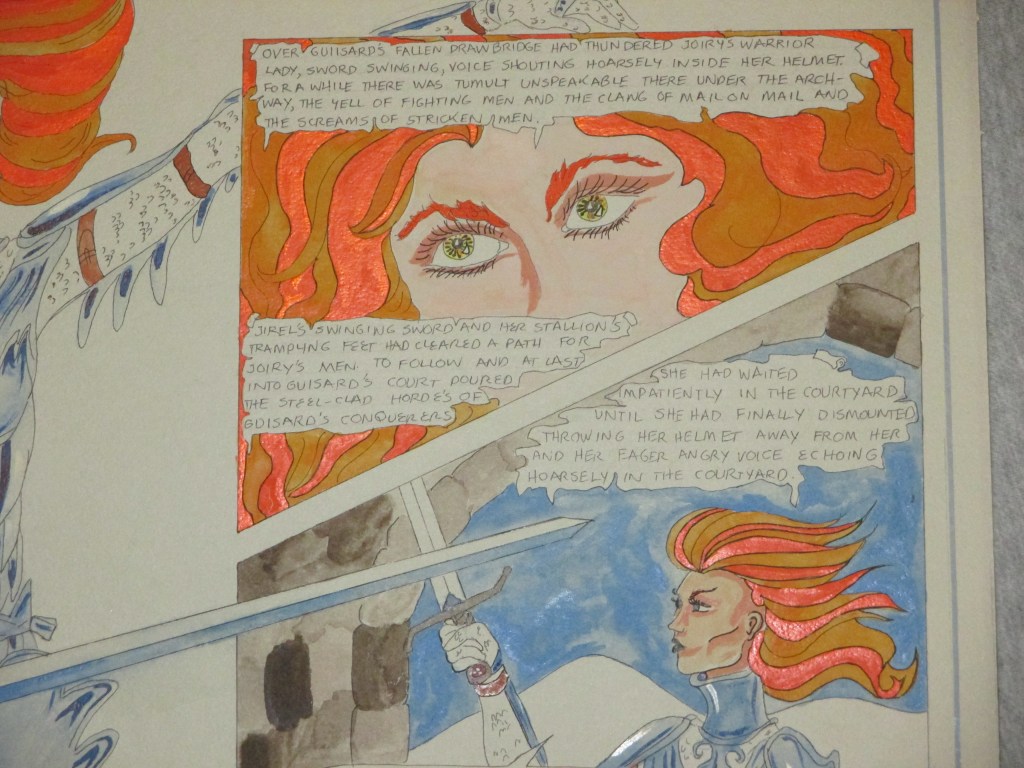
Jirel of Joiry: Into The Violet World (1987)

JIREL OF JOIRY: INTO THE VIOLET WORLD

Panel 1: Over Guiisard’s [sic] fallen drawbridge had thundered Joiry’s warrior lady, sword swinging, voice shouting hoarsely inside her helmet. For a while there was umult unspeakable. There under the archway, the yellow of fighting men and the clang of mail on mail and the screams of stricken men.

Jirel’s swinging sword and her stallion’s tramping feet had cleared a path for Joiry’s men to follow and at last into Guisard’s court poured the steel-clad hordes of Guisard’s conquerors.

Panel 2: She had waited impatiently in the courtyard until she had finally dismounted. Throwing her helmet away from her and her eager angry voice echoing hoarsely in the courtyard.

Jirel: Giraud! Make haste, you varlets! Bring me Giraud!

Panel 3: There was such bloodthirsty impatience in that hollowly booming voice that the men who were returning from searching the castle hung back as they crossed the court toward the lady in reluctant twos and threes, failure eloquent on their faces,

Below: Based on a story ‘Jirel Meets Magic’ by C. L. Moore

This piece came to me via eBay, the only comic art of Jirel I’d ever seen, and illustrating a bit of her third adventure “Jirel Meets Magic” (Weird Tales July 1935). For a couple years I’ve just enjoyed it, but eventually I decided to look up the artist—easy enough as it’s signed and dated—and was surprised to find out that it is author C. L. Bevill. Even better, she was willing to answer a few questions about this piece, how it came to be, and how I ended up with it:

When my sister and I were kids in the 70s we loved, loved, loved all things sword and sorcery. Conan, Robert Howard, Lord of the Rings, you name it. Both of us were artists and we did our own comics. So one of our favorite authors was C.L. Moore, who was a pulp writer in the 30s. Her most famous work is the Jirel of Joiry stories. I think she did those as a serial. (Forgive me if you’ve already looked up the information.)

I believe I did the piece for my sister as a birthday gift, but I don’t recall exactly. I don’t think she liked it but she was too nice to say anything. She died in March 2020 and I found the piece in her stuff, hidden away with a few other things she didn’t like from me. (I don’t hold it against her.) So I cleaned out her stuff after she died and was completely overwhelmed. (If you noticed the date, it was right at the beginning of Covid and she probably died from that.) Her landlord offered to take care of all the stuff and subsequently either sold it in a yard sale or gave it to charity. So if you got it from Washington state that’s likely how it ended up on ebay.

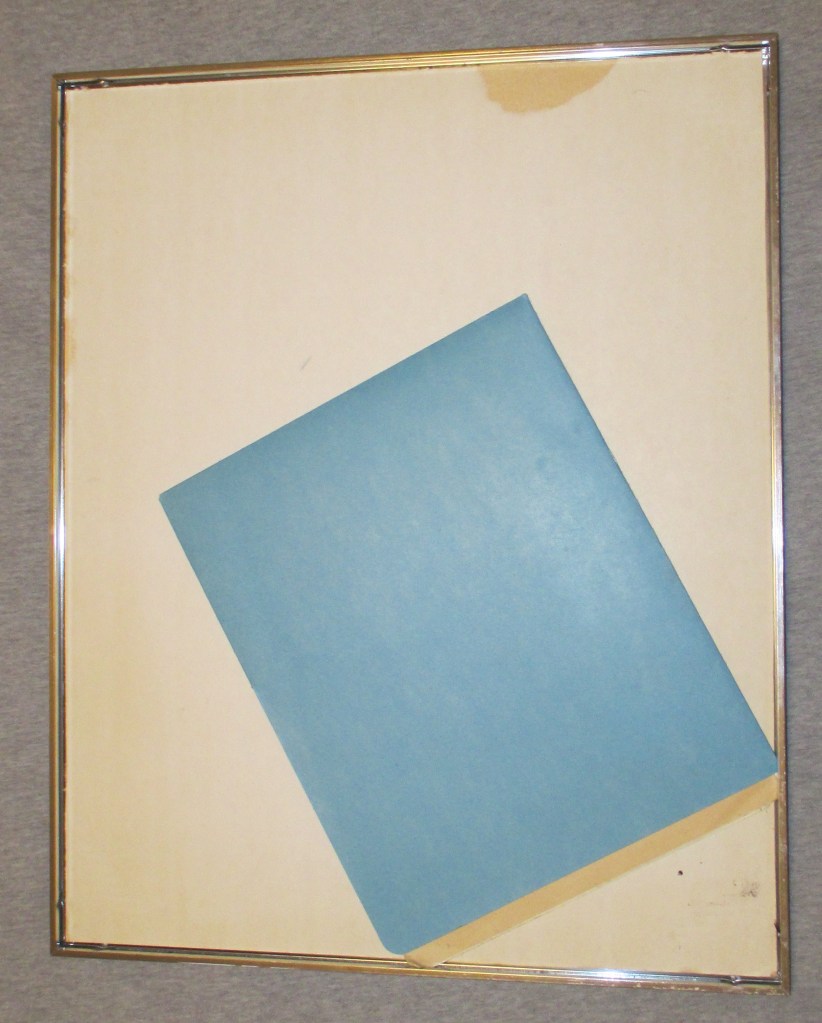
[…] if it’s still in a silver frame, there’s some comic artwork on the inside of the back there that I stuck in there for my sister. It was stuff we did as kids. I’m curious if it’s still there. […] Oh, we were incurable romantics as kids so the comic art in the back is something from a movie we liked as kids. Grayeagle. Terrible movie but we were very young.

C. L. Bevill, personal communication

That last note made me curious as well, so I popped open the frame:

Note: “Sure can tell where your artwork stopped & mine began. Love you, C”

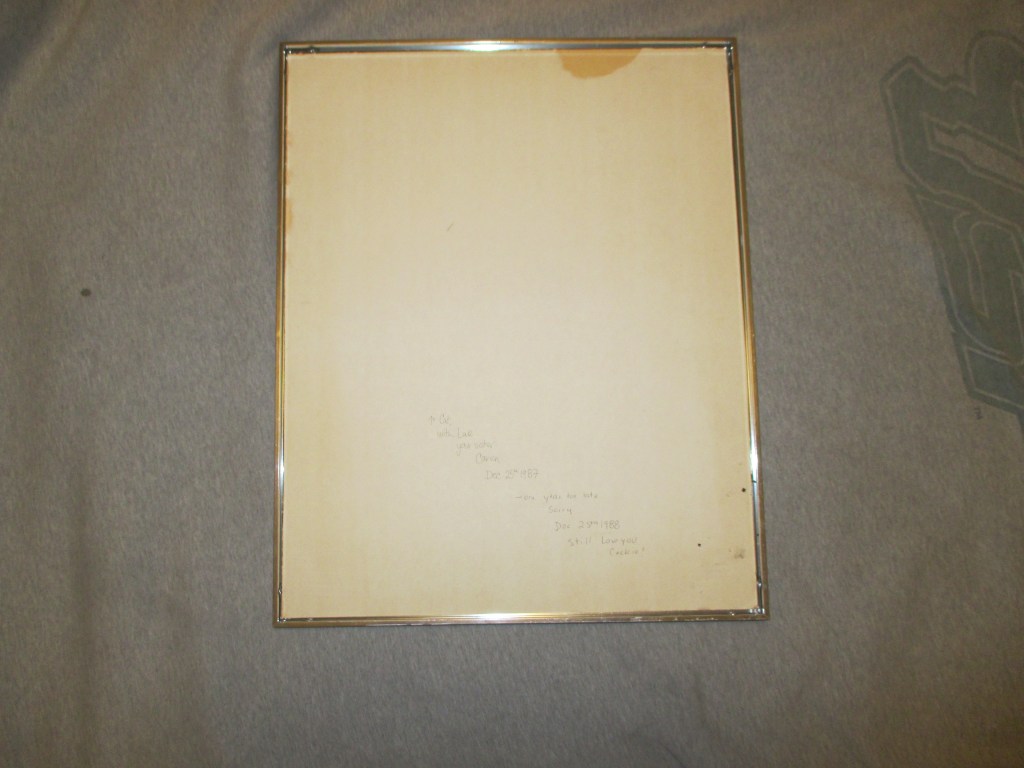
On the back of the piece is a faint inscription:

To Cat,
with Love
your sister
Caren
Dec 25th 1987
—one year too late
Sorry
Dec 25th 1988
Still Love you
Cackie!

Close-up detail.

It is a lovely piece of fan-art, and I’m glad to finally have the story behind it—and the secret it has been hiding all these years.

“Werewoman” (1994)

By a quirk of publishing, “Werewoman” (1938) by C. L. Moore was first published in a fan-magazine, and fell into the public domain. This fact was not immediately recognized for some decades, but the ever-enterprising fan/scholar/anthologist Sam Moskowitz took advantage of this lapse to to republish it (without Moore’s permission or compensation) in his anthology Horrors Unknown (1971). While this has widely been considered as somewhat uncouth, it was technically legal—and if Moskowitz could do it, so could anyone else.

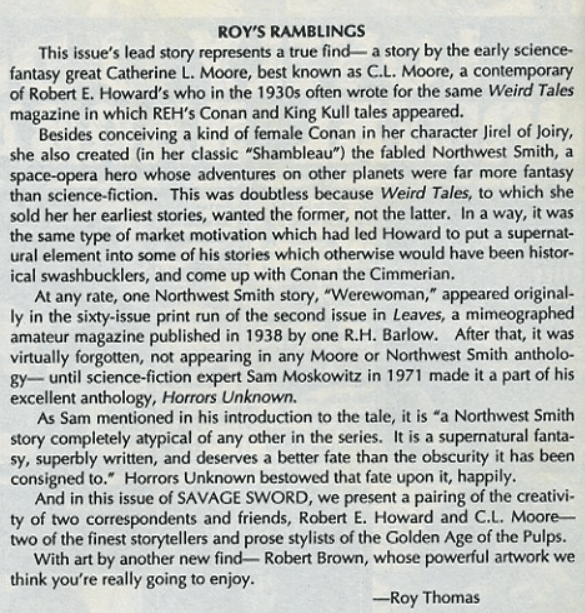
So it was in 1994 “Werewoman” was adapted to graphic format for Savage Sword of Conan #121 (May 1994). Roy Thomas provided the script, Robert Brown, pencils; Rey Garcia, inks; and Susan Crespi, lettering. Originally a story of Northwest Smith and set on Mars, the revamped story was adapted to feature Robert E. Howard’s Conan the Cimmerian in place of Smith, and the setting changed to a rather generic fantasy corner of the Hyborian Age.

Roy Thomas was at this point a veteran hand at such adaptations. When he had started out writing Conan the Barbarian for Marvel, it had been adapting Howard’s original stories and filling in the gaps on his own; later the series would adapt works by other authors, either non-Howard Conan stories like Lin Carter and L. Sprague de Camp’s novel Conan of the Isles (1968), which became a graphic novel of the same name, or non-Conan fantasy stories such as Gardner F. Fox’s Kothar and the Conjurer’s Curse (1970), which became Conan the Barbarian #46-51.

So why do C. L. Moore?

1994 was well into the Dark Age of Comics, and Robert Brown’s artwork is strongly reminiscent of Rob Liefeld’s work on X-Force and Youngblood, but aggressively 90s as it is, and lacking the more somber depth of shadow or evocative linework that characterized many of the better stories in Savage Sword, it kind of works, especially with Rey Garcia’s inks adding some real depth and definition to the lines.

While it may seem odd to adapt a Northwest Smith story as a Conan tale—imagine replacing Harrison Ford with Jason Mamoa in Star Wars—the hazy, dreamlike atmosphere of the story lends itself well to a kind of fever-dream episode in the adventures of everyone’s favorite Cimmerian, while the inherent wildness of running with the pack is almost more suitable to Conan than to Smith. As a Conan story, it’s middling; as a C. L. Moore adaptation, it’s better than nothing—which is, by an large, what readers have lived with.

Readers interested in the full story can find it reprinted in Savage Sword of Conan Omnibus Vol. 21.

Aside from these two works, there is little else to say about C. L. Moore in the comics. A few early horror comics may be unofficial adaptations of or inspired by her works, though this is based on similarity of plot more than anything else. There is another notable graphic adaptation of C. L. Moore’s “Shambleau” that was published in France in 1955, but that is worthy of a longer and more in-depth look on its own.


Bobby Derie is the author of Weird Talers: Essays on Robert E. Howard and Others and Sex and the Cthulhu Mythos.

Deep Cuts in a Lovecraftian Vein uses Amazon Associate links. As an Amazon Associate I earn from qualifying purchases.
“Werewoman” (1938) by C. L. Moore

To your boundless amazement I shall now take typewriter in hand and write you a letter. Still further to shock you, I am enclosing the story you so kindly inquired about, and also—did I or didn’t I send you WEREWOMAN? This burning question has haunted me all day, ever since I delved industriously into the stack of boxes and bales which I laughingly term my files and produced every story I ever wrote with the exception of the famous WW. I am probably being even more hen-brained than usual, but will enclos the carbon of WW which I have somewhere around, tho lurking in the back of my subconscious is a suspicion that I have already sent you the original. If so, pay no attention. Surely you have sufficient aplomb to withstand a sudden deluge of werewomen.
—C. L. Moore to H. P. Lovecraft and R. H. Barlow, 20 Aug 1935, LCM 56

In the summer of 1935, H. P. Lovecraft was staying with R. H. Barlow and his family in DeLand, Florida. At Barlow’s urging, Lovecraft and C. L. Moore had begun their correspondence (Her Letters To Lovecraft: Catherine Lucille Moore), with Lovecraft full of praise for stories like “Shambleau” (1933) and “Black God’s Kiss” (1934). Barlow, as was typical, asked her for manuscripts and drawings…and in 1934 received an unusual reply:

I’m having rather a set-back in my attempts to illustrate my own stories. The one Mr. Wright liked so well was a drawing for the story, which, as you know, he returned. WERE-WOMAN. The drawing was pretty good, but the story, I must admit, rather terrible. It’s heartening to know that the more established writers get things back too, but I can’t pretend that the fault was anybody’s but my own in this case, and I really expected it back when I sent it. It was a grand idea, I still think, but somehow it just wouldn’t jell. Mr. Wright has inquired about it several times and has asked me to re-write it, but my mind is a perfect vacuum whenever I try.
—C. L. Moore to R. H. Barlow, 1 Jun 1934, MSS. John Hay Library

It isn’t clear when exactly Moore wrote “Werewoman” (sometimes spelled “Were-Woman”)—in later interviews, she claimed it was her second Northwest Smith story after “Shambleau,” and the first to be rejected by Farnsworth Wright, editor of Weird Tales, but her memory issues later in life make such claims somewhat questionable; the 1934 date of this letter suggests “Werewoman” may have been written and submitted somewhat later. At some point, Moore sent the “Werewoman” typescript to Barlow, who presumably showed it to Lovecraft during his visit…along with another rejected story:

Well, have just received my first flat rejection from Wright. A harmless little tale about a sorcerer king of antediluvian time, his mysterious witch-queen and a time-traveler with a startling resemblance to a certain Mr. Smith whom I may have mentioned once or twice before, tho no names were named in the story. Ah well, life is full of disappointments.
—C. L. Moore to R. H. Barlow, 31 May 1935, MSS. John Hay Library

This story appears to be lost, but Moore apparently also sent this story to Barlow, who forwarded it to Lovecraft, who had finally taken his leave of Florida. We know this because of Lovecraft’s answering letter:

Well—anyhow, I’ve read the enclosed story, & think it distinctly good in places—though the rather conventional dialogue & general layout put it below “The Were Woman”. I presume the interepid [sic] & leather-clad time-traveller is none other than our old friend Northwest Smith. The other-wordly suggestion & description of vague, non-human forms are excellently managed—despite a slight sense of disappointment in the climax. It beats most recent Mooreiana, though scarcely attaining the “Shambleau”-”Black Thirst”-”Were-Woman” level. Most distinctly does it bear the impress of pulp influence. However—both stories are good, & I can unhesitatingly praise them in writing the author.
—H. P. Lovecraft to R. H. Barlow, 24 Aug 1935, OFF 286

In another letter, we find out where and when Lovecraft must have read “Werewoman”: shortly after leaving the Barlows, in St. Augustine:

Aunt just forwarded “Werewoman”, for which abundant thanks. Glad you’re getting the decent text before the thing is pulpised. I recall reading it on a bench in San Agustin—in the Plaza de la Constitutción.
—H. P. Lovecraft to R. H. Barlow, 2 Jan 1936, OFF 313

R. H. Barlow had convinced C. L. Moore to allow him to publish “Werewoman,” which he eventually did in his amateur journal Leaves #2 (Winter 1938). He also separately printed and bound a small edition, one copy of which is listed in The Book Sail 16th Anniversary Catalogue:

493. MOORE, C[athereine] L[ucille]. Werewoman. 1934. Privately prepared, typewritten ribbon copy on the rectors of [iii] 29 [ii] pages, 8 ½” x 11″. Inscribed by Moore and bound in half morocco and heavy paper-covered boards, with an additional inscription on an adhesive label affixed to the front fly. A notation appears on the final leaf, indicating that this is one of three copies.

The literary afterlife of “Werewoman” after its initial printing is a messy affair; pulp scholar Sam Moskowitz had noted that the story was in the public domain and republished it without seeking Moore’s permission, which rather soured Moore on Moskowitz (and in turn, Moskowitz on Moore) in a dispute that went on for decades, with Moskowitz getting the final word after Moore’s death. Dave Goudsward tracks the accusations and animosity in his article “A Tale of Two Stories” in Pulp Adventures #36 (2020), which also reprints “Werewoman.”

Lovecraft never wrote anything more about the story; he might have written about it to Moore and his letter lost, but as the story had not seen print during his lifetime he could scarcely write about it to anyone else. Despite Moore’s own low opinion of the tale, he ranked it among her better ones…and while “Werewoman” might not be the best of the Northwest Smith tales, it is undoubtedly among the weirdest.

C. L. Moore never spoke of the inspiration for this story; though the term “were-woman” or “werewoman” had cropped up rarely in Weird Tales before then, notably in Robert E. Howard’s “Worms of the Earth” (WT Nov 1932), and the werewoman inviting Northwest Smith as her mate recalls the interaction Bêlit and Conan in “The Queen of the Black Coast” (WT May 1934). It eschews any direct connection to the other Northwest Smith stories, and is hard to place in any kind of chronology. Ironically, that probably made it easier when Roy Thomas adapted the story for Conan the Barbarian in Savage Sword of Conan #221 (1994).

While space opera had few absolute conventions in the early 1930s, “Werewoman” defies most of them: on an unknown planet, Northwest Smith encounters werewolves and ancient alien sorcery. It wouldn’t be the first or last time that Moore mixed superscience with the supernatural, but there is absolutely no hesitancy or winking at the audience. The division between fantasy and science fiction as distinct sub-genres was already beginning to be established, but weird tales could and did mix and mingle both.

Lovecraft no doubt loved the rich description, the absolute weirdness of the conception and execution of the story. If a reader can suspend their disbelief about the incongruence of settings, there is much to enjoy in the story. Once again, outer space outlaw Northwest Smith has stumbled into an ancient mystery, one that involves a beautiful woman and a danger to body and soul alike. In terms of tone, the presentation of Smith as an “adventurer,” the story is closer to the kind of sword & sorcery tales of Robert E. Howard or Fritz Leiber, Jr. than the space operas of E. E. “Doc” Smith or Edmond Hamilton.

Moore’s werewoman is different than that of most of the other werewolves Lovecraft had encountered written by women. She is not solitary, but the leader of a pack; more than a killer, she shows admiration and acceptance for Northwest Smith. Like White Fell in The Were-Wolf (1896) by Clemence Housman, she seems to embrace her nature, but rather than defy gender roles she seems to embrace and embody her position as the leader of the pack. No wailing or gnashing of teeth over her fate, no men fighting over her: she likes being a wolf, and chooses whom to love. The result is a sympathetic portrayal of a strong woman that goes for what she wants—not unlike Moore’s heroine Jirel of Joiry.

“Werewoman” has been reprinted many times over the decades, but the confusion about its copyright status appears to have largely prevented the text from being widely available online. The text in Pulp Adventures #36 is a true and accurate copy of the original 1938 printing from Leaves. Being a mimeographed publication, Leaves does not scan well, but anyone that wants to strain their eyes can attempt to make their way through this scan. A full reprint of Leaves and Barlow’s other amateur journal The Dragon-Fly was published by S. T. Joshi and can be found here.


Bobby Derie is the author of Weird Talers: Essays on Robert E. Howard and Others and Sex and the Cthulhu Mythos.

Deep Cuts in a Lovecraftian Vein uses Amazon Associate links. As an Amazon Associate I earn from qualifying purchases.
“Shambleau” (1933) by C. L. Moore

[…] it was a rainy afternoon in the middle of the Depression, I had nothing to do—but I really should’ve looked busy because jobs were hard to get! I didn’t want to appear that I wasn’t earning my daily keep! To take up time, I was practicing things on the typewriter to improve my speed—things like ‘the quick brown fox jumped over the lazy dog.” That got boring, so I began to write bits of poetry I remembered from my college courses…in particular, I was quoting a poem called “The Haystack in the Flood.” […] The poem was about a woman in 13th century France who is being pursued by enemies of some kind…she was running across a field and these men were after her. I had misquoted a line in my mind, as well as on the typewriter, and referred to a “Red, running figure.” […] At the time I thought, “Ha! A red, running figure! Why is she running? Who is she running from and where is she running to? What’s going to happen to her? Strangely enough, I just swung from that line of poetry into the opening of “Shambleau.”
⁠—”Interview: C. L. Moore Talks To Chacal” in Chacal #1 (1976), 26

Red running lions dismally
Grinn’d from his pennon, under which,
In one straight line along the ditch,
They counted thirty heads.
—William Morris, “The Haystack in the Floods”

Then into his range of vision flashed a red running figure, dodging like a hunted hare from shelter to shelter in the narrow street. It was a girl — a berry-brown girl in a single tattered garment whose scarlet burnt the eyes with its brilliance.
—C. L. Moore, “Shambleau” in Weird Tales November 1933

Catherine Lucille Moore was was 22 years old in 1933, and engaged to be married. The Great Depression had nixed her short-lived effort to go to college, and she had gotten a job as a typist at the Fletcher Trust Company in her native Indianapolis—where her fiance also worked. In her spare time, she read pulp magazines like Amazing Stories, Wonder Stories, Astounding, and Weird Tales—and began to write and submit stories to them.

“Shambleau” was the first tale of Northwest Smith to hit print; the protagonist was inspired by a depositor at her company, who signed their letters as “N. W. Smith.” (“C. L. Moore and Henry Kuttner” in Science Fiction Writers 161-167), and originally was meant for an entirely different genre:

I have remotest glimmers of memory about a wild, wild Western that never went beyond the idea that there ought to be a One-Eyed Jack, (possibly of hearts) and a Northwest Smith on a ranch called the Bar-Nothing. Thence the name, but whence the character no one knows, least of all myself. When I first began to consider him as a space-ranger, I was guilty of a saga which started out,

Northwest Smith was a hard-boiled guy
With an iron fist and a roving eye—

of which the less is said the better.
—C. L. Moore, Echoes of Valor II, 37

Northwest Smith would not be quite a space cowboy, but the literary genesis makes sense. The Martian town presented is the spaceport equivalent of a little town out west, maybe up by the Canadian border or down south near Mexicothe kind of place that attracts lean, hungry operators who reach for the heat-gun on their hips as easily as a shootist might reach for the big iron on their hip. Other details of the story were more prosaic; for instance, Moore maintained that the name “Yarol” had derived from the Royal typewriter she was using to type the story (C. L. Moore to R. H. Barlow, 10 Sep-9 Oct 1934).

The manuscript for the story ended up on the desk of Farnsworth Wright, editor of Weird Tales:

The peak was reached in 1933, when he handed me something by one C. L. Moore.

“Read this!” he commanded, the moment I stepped into the new editorial rooms at 840 North Michigan Avenue, in Chicago.

I obeyed. The story commanded my attention. There was no escape. I forgot that I needed food and drink—I’d driven a long way. […] The stranger’s narrative prevailed until, finally, I drew a deep breath, exhaled, flipped the last sheet to the back of the pack, and looked again at the by-line. Never heard of it before.

“For Christ’s sweet sake, who and what is this C. L. Moore?”

He wagged his head, gave me an I-told-you-so-grimace.

We declared C. L. Moore day. I’d met Northwest Smith, and Shambleau.
—E. Hoffmann Price, Book of the Dead 16

The story was ~11,000 words. Farnsworth Wright wrote to Moore and offered $100; a cent-per-word, payable on publication, was the average for a Weird Tales story.

[…] after I sent it off to WT, I more or less forgot about it. One day I came home from work and there was a long letter on the hall table for me. I opened it up and it said that they were going to pay me a hundred dollars. And that was like TEN THOUSAND dollars at that time. I screamed at the top of my voice! My father came charging downstairs thinking that I had been murdered or something (laughter) and nobody believed it until they read the letter. Then joy was completely unconfined—everyone was so happy about it.
⁠—”Interview: C. L. Moore Talks To Chacal” in Chacal #1 (1976), 27

It wasn’t her first publication, because Moore had a few things published during her brief time at college, but it was her first professional sale…but she couldn’t quit her dayjob just yet.

I used the initials “C. L.” simply because I didn’t want it to be known at the bank that I had an extra source of income. I wrote “Shambleau” in the midst of the Depression.  The bank was a very paternalistic organization. If was always firing those people whose services weren’t really needed. I had the feeling they might have fired me had they known I was earning extra income. Using my initials was simply a means of obscuring my identity.
Pulp Voices; or Science Fiction Voices #6 47

“Shambleau” saw print in the November 1933 issue of Weird Tales. Competition in the issue was stiff: regulars and fan favorites like Edmond Hamilton, E. Hoffmann Price, Clark Ashton Smith filled the issue…yet it was “Shambleau” and C. L. Moore which garnered the most attention, the most praise. For the sixteen years that Farnsworth Wright edited Weird Tales, he kept a tally of the most popular stories of all time—and not only was “Shambleau” the most popular story of the issue—it was the most popular story of 1933, and the second-most popular story to ever run in the magazine, beating out “The Outsider” by H. P. Lovecraft (3rd place), and second only to A. Merritt’s “The Woman of the Wood” (Weird Tales Aug 1926).

It was the most impressive arrival that any writer ever had at Weird Tales…and it’s easy to see why.

Shambleau! Vaguely of French origin, it must be. And strange enough to hear it from the lips of Venusians and Martian drylanders, but it was their use of it that puzzled him more. “We never let those things live,” the ex-Patrolman had said. It reminded him dimly of something … an ancient line from some writing in his own tongue . . .  “Thou shalt not suffer a witch to live.” He smiled to himself at the similarity, and simultaneously was aware of the girl at his elbow.
—C. L. Moore, “Shambleau” in Weird Tales November 1933

The world is rich, lived-in, and perhaps a little like the Martian stories that Clark Ashton Smith had begun to write, such as “The Vaults of Yoh-Vombis” (Weird Tales May 1932) and “The Dweller in the Gulf” (Wonder Stories March 1933). Aliens, Medusa, and Mars were all familiar to readers of weird fiction in the 1930s, and even the tentacle’d horror was no stranger to Weird Tales, though rarely in so sexually suggestive a manner; Robert E. Howard had beaten her to the punch with “The Slithering Shadow” (Weird Tales September 1933) just a couple months before, but both offered the readers suggestions of new and thrilling sins:

A dark tentacle-like member slid about her body, and she screamed at the touch of it on her naked flesh. It was neither warm nor cold, rough nor smooth; it was like nothing that had ever touched her before, and at its caress she knew such fear and shame as she had never dreamed of. All the obscenity and salacious infamy spawned in the muck of the abysmal pits of Life seemed to down her in seas of cosmic filth.
—Robert E. Howard, “The Slithering Shadow” in Weird Tales September 1933

And something . . . some nameless, unthinkable thing . . . was coiled about his throat . . . something like a soft snake, wet and warm. It lay loose and light about his neck . . . and it was moving gently, very gently, with a soft, caressive pressure that sent little thrills of delight through every nerve and fiber of him, a perilous delight—beyond physical pleasure, deeper than joy of the mind. That warm softness was caressing the very roots of his soul with a terrible intimacy. The ecstasy of it left him weak, and yet he knew—in a flash of knowledge born of this impossible dream—that the soul should not be handled. . . .  And with that knowledge a horror broke upon him, turning the pleasure into a rapture of revulsion, hateful, horrible—but still most foully sweet.
—C. L. Moore, “Shambleau” in Weird Tales November 1933

There were few hard lines between science fiction and fantasy in the 1930s, and C. L. Moore didn’t give a damn for any such distinctions; her Northwest Smith stories often involve encounters with alien gods, sorcerers, and other supernatural elements. Her characters are often driven to terrible experiences that tax and imperil the mind and spirit as much the physical body, seek to describe such states of mingled ecstasy in horror with fantastic, poetic language. In one letter she wrote:

I know now why my fiance looked at me in that peculiar way after he’d read “Shambleau”—the first and only one of my stories he was ever persuaded to read. I know now what he was thinking. What kind of a person is this who can think of such things?
—C. L. Moore to H. P. Lovecraft, 12 Nov 1935, Letters to C. L. Moore and Others 73

H. P. Lovecraft read the November 1933 issue of Weird Tales, and his initial reaction to the story was modest:

There is a germ of originality, despite much commonplaceness, in “Shambleau” […]
—H. P. Lovecraft to August Derleth, Nov 1933, Essential Solitude 2.613

The argument over “commonplaceness” probably has much to do with the general setting with its humanoid aliens and inhabitable planets; Lovecraft’s essay “Some Notes on Interplanetary Fiction” poo-pooed many of the tropes of Space Opera and Sword & Planet fiction which feature in “Shambleau.” However, to the editor of Weird Tales he offered effusive praise:

Shambleau is great stuff, too. It begins magnificently, on just the right note of terror, and with black intimations of the unknown. The subtle evil of the Entity, as suggested by the unexplained horror of the people, is extremely powerful—and the description of the Thing itself when unmasked is no letdown. Like “The House of the Worm”, it has real atmosphere and tension—rare thing amidst the pulp traditions of brisk, cheerful, staccato prose and lifeless stock characters and images. The one major fault is the conventional interplanetary setting. That weakens and dilutes the effect of both by introducing a parallel or rival wonder and by removing it from reality. Of course a very remote setting had to be chosen for so unknown  marvel—but some place like India, Africa, or the Amazon jungle might have been used…with the horror made more local. I trust your revisions may make Mrs. Moore’s second story as striking and interesting as this one.
—H. P. Lovecraft to Farnsworth Wright, 21 Nov 1933, Lovecraft Annual 8.38-39

Wright published an excerpt from this letter in the Jan 1934 issue of Weird Tales, along with other praise for “Shambleau.” The editor of Weird Tales  wrote to Moore requesting more of her work. By March 1934, she had sold two more stories (“Black Thirst” and “Scarlet Dream”) to Wright, and she had gotten in touch with her first fan—Robert H. Barlow. (C. L. Moore to R. H. Barlow, 8 Mar 1934)

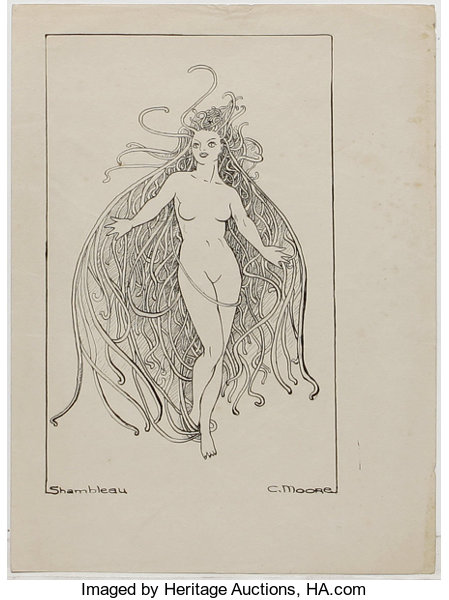
Barlow was a friend and correspondent of Weird Tales writer H. P. Lovecraft and E. Hoffmann Price, and in the early 1930s had begun writing to authors like Robert E. Howard requesting copies of the manuscripts for their stories. Boldly, he asked her for the draft of “Shambleau,” but Moore told him the draft had been destroyed. (C. L. Moore to R. H. Barlow, 28 Mar 1934) Instead, she sent him a drawing she had made of Shambleau:

Shambleau original art

Lovecraft commented on this as well:

Yes—C. L. Moore is certainly the most powerful & genuinely weird new writer secured by W.T. in many years. She is indeed of the feminine gender, the C. standing for Catherine. It is her wish, however, not to have this widely known—since she hopes to conceal the fact of her writing from her regular employers. She has a secretarial job with some corporation in Indianapolis, & fears she will be fired if it is known that she has another source of income. Miss Moore is also an artist of ability—last month she sent Barlow a drawing of Shambleau which displays phenomenal power.
—H. P. Lovecraft to Duane W. Rimel, 17 June 1934, Letters to F. Lee Baldwin, etc. 184-185

As to Miss Moore’s drawings—“Shambleau” is extremely well done, though not as subtly horrible & richly potent as Howard Wandrei would have made it. It is pen & ink, & so far as I know all her other drawings are. She most certainly has great & enviable talents.
—H. P. Lovecraft to Duane W. Rimel, 23 July 1934, Letters to F. Lee Baldwin, etc. 195

Ar E’ch Bei shewed me the “Shambleau” sketch, which certainly displays vast cleverness even if it lacks the indefinable menace & cosmic remoteness that you or Howard Wandrei would put into it. As a writer, Miss Moore is certainly the discovery of the last few years. No other newcomers is even in the running.
—H. P. Lovecraft to Clark Ashton Smith, 30 Sep 1934, Dawnward Spire, Lonely Hill 571-572

Lovecraft’s admiration was by all accounts sincere, and he held “Shambleau” among the best stories Moore had written until the end of his life. In time they would collaborate on the round-robin “The Challenge From Beyond” (1935), and they would correspond briefly (see Her Letters To Lovecraft: Catherine Lucille Moore). He would comfort her after the death of her fiance in 1936, and introduce her to her future husband Henry Kuttner; she would inform him of the death of Robert E. Howard, create the Sword & Sorcery character Jirel of Joiry, inspire Robert A. Heinlein’s “The Green Hills of Earth” (1947), and go on to a writing career that would last decades…and all, perhaps, because of this story, “Shambleau” and its singular reception.

It is interesting to compare this tale with Lovecraft’s revision “Medusa’s Coil” (1939) by Zealia Bishop. “Medusa’s Coil” is often considered one of Lovecraft’s worst stories and “Shambleau” one of Moore’s best, so a comparison of the prose tells us little, but it’s interesting to see how develops their themes. Neither story makes any effort to lift straight from the the ancient Greek myth, except by visual inspiration: a woman with deadly hair. This sets these tales apart from stories like Clark Ashton Smith’s “The Gorgon” (Weird Tales Apr 1932). Both Lovecraft and Moore explore what makes these women dangerous, and yet attractive. They suffer prejudice, for different reasons, and we get only limited hints of the female characters’ viewpoints because the perspective comes from men…and mostly their victims relay what little we know of their words and character.

Like Lovecraft’s, Moore’s story is not a moral tale in any strict sense. Northwest Smith’s action in saving the persecuted Shambleau was heroic; his efforts to care for her without taking advantage of the situation sexually is, if not commendable, at least shows Smith as not the worst of criminals…but the purpose of the story is not to show that Smith should have let the mob have the alien woman, though some readers may take that away from the ending. The “no good deed goes unpunished” interpretation of the narrative is a rather weak “I told you so,” and it doesn’t stop Smith from getting into other troublesome situations in later stories. Likewise, the “transgression” of marrying Marceline Bedard is not the focus of “Medusa’s Coil”—it’s just how the Medusa-character is brought into the story.

The difference is, at the end of “Medusa’s Coil,” nobody is alive to marry the Medusa-character again. The act cannot be repeated. With “Shambleau,” the horror is not Shambleau’s alien appendages or strange appetites, but the addiction to her terrible feeding. What Northwest Smith knows and fears is that he has become a junkie, and if the opportunity comes again—he might embrace it. That is rare territory for a weird tale, especially with the feeding so explicitly pseudo-sexual in nature—and shows something of the different approach both brought to their respective works. With Lovecraft, the horror rises from the grave, but with Moore, it might dash through the next Martian alley, a red, running figure…and Northwest Smith unable to stop himself as it plays out again.

C. L. Moore’s “Shambleau” can be read for free online here.


Bobby Derie is the author of Weird Talers: Essays on Robert E. Howard & Others (2019) and Sex and the Cthulhu Mythos (2014).