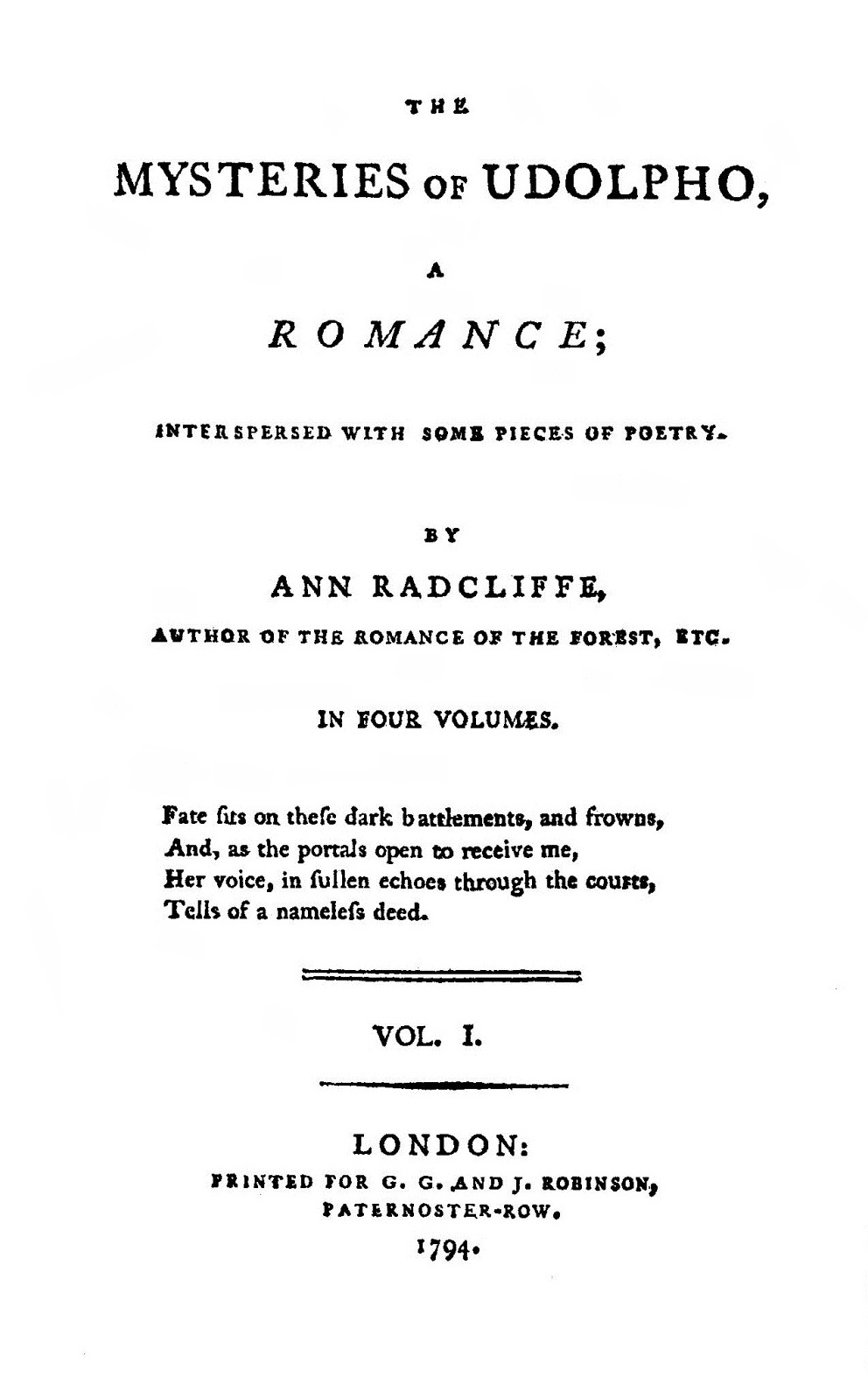
The Mysteries of Udolpho (1794) by Ann Radcliffe

up 8 p.m.—Read Mysteries of Udolpho—retire 9 a.m. Friday

H. P. Lovecraft’s 1925 diary, entry for 3 December, Collected Essays 5.173

Fate sits on these dark battlements, and frowns,
And, as the portals open to receive me,
Her voice, in sullen echoes through the courts,
Tells of a nameless deed.

Epigraph to Ann Radcliffe’s The Mysteries of Udolpho

In 1764, Horace Walpole kicked off the Gothic novel craze with The Castle of Otranto: A Gothic Story. Thirty years later, Otranto would serve as the blueprint for Ann Radcliffe’s fourth novel, The Mysteries of Udolpho, A Romance (1794). Radcliffe had begun her literary career in 1789 at age 25, first publishing anonymously, and then eventually using her own name as her novels grew in popularity and commanded higher prices from publishers. Immensely popular during her own life despite only publishing five novels in that time, Udolpho which would go on to rival Otranto as the archetypical Gothic novel, to the point of being satirized in Jane Austen’s Northanger Abbey (1817).

To H. P. Lovecraft, Radcliffe was essential reading in the history of horror literature; although he did not first encounter her by reading the whole novel:

Belknap, having sharper eyes than his old Grandpa, picked up a book which I would have given much to have seen first—”Tales of Mystery”, composed of extracts from the most celebrated horror novelists of the 18th century—Walpole, Mrs. Radcliffe, Lewis, &c. He will later lend his prize to me—just as I am lending him my own prizes.

H. P. Lovecraft to Lillian Clark, 29 Sep 1922, Letters to Family & Family Friends 1.80

Tales of Mystery (1891) was an anthology edited by George Saintsbury collecting excerpts from the Gothic romances of Radcliffe (including bits of Udolpho), Matthew Gregory Lewis, and Charles Maturin. Frank Belknap Long, Jr., who had spied the book first at a bookstall during Lovecraft’s trip to New York, would later gift it to his friend as at Christmas 1922:

I’ve been eating up Gothick stuff lately—all the posterity of “Otranto”. Miss Reeves’ “Old English Baron” (1777) is infernally tame, but in damned good Georgian English. Radcliffe stuff is vastly—immeasurably—superior in interest & atmosphere, though the language is more stilted. (And yet beats Reynolds by a mile!) I’m reading that volume of selections which Little Belknap picked up right under his Old Grandpa’s nose at the shop in Vesey-Street, & which he magnanimously gave the poor old gentleman as a Christmas gift.

H. P. Lovecraft to James F. Morton, 5 Apr 1923, Letters to James F. Morton 35

In 1925, now living in New York, Lovecraft was asked by W. Paul Cook to write the article that would become “Supernatural Horror in Literature.” While Lovecraft would learn relatively heavily on The Tale of Terror (1921) by Edith Birkhead for his section on Gothic novels, among the books we know he read was The Mysteries of Udolpho. He later noted that his friend, the bookseller Goerge Kirk, gave him a copy of Udolpho (LWP 180), and his diary entry for 9 May 1925includes the notation “GK call—Udolpho” (CE 5.158), which may be when he received his copy, although he didn’t devour the noel until December:

I waded through the whole of “Udolpho” last week, & am now on the hunt for Maturin’s “Melmoth”.

H. P. Lovecraft to Clark Ashton Smith, 12 Dec 1925, Dawnward Spire, Lonely Hill 92

From this reading, Lovecraft would write:

[…] all existing lamps are paled by the rising of a fresh luminary of wholly superior order—Mrs. Ann Radcliffe (1764–1823), whose famous novels made terror and suspense a fashion, and who set new and higher standards in the domain of macabre and fear-inspiring atmosphere despite a provoking custom of destroying her own phantoms at the last through laboured mechanical explanations. To the familiar Gothic trappings of her predecessors Mrs. Radcliffe added a genuine sense of the unearthly in scene and incident which closely approached genius; every touch of setting and action contributing artistically to the impression of illimitable frightfulness which she wished to convey. A few sinister details like a track of blood on castle stairs, a groan from a distant vault, or a weird song in a nocturnal forest can with her conjure up the most powerful images of imminent horror; surpassing by far the extravagant and toilsome elaborations of others. Nor are these images in themselves any the less potent because they are explained away before the end of the novel. Mrs. Radcliffe’s visual imagination was very strong, and appears as much in her delightful landscape touches—always in broad, glamorously pictorial outline, and never in close detail—as in her weird phantasies. Her prime weaknesses, aside from the habit of prosaic disillusionment, are a tendency toward erroneous geography and history and a fatal predilection for bestrewing her novels with insipid little poems, attributed to one or another of the characters.


Mrs. Radcliffe wrote six novels; The Castles of Athlin and Dunbayne (1789), A Sicilian Romance (1790), The Romance of the Forest (1791), The Mysteries of Udolpho (1794), The Italian (1797), and Gaston de Blondeville, composed in 1802 but first published posthumously in 1826. Of these Udolpho is by far the most famous, and may be taken as a type of the early Gothic tale at its best. It is the chronicle of Emily, a young Frenchwoman transplanted to an ancient and portentous castle in the Apennines through the death of her parents and the marriage of her aunt to the lord of the castle—the scheming nobleman Montoni. Mysterious sounds, opened doors, frightful legends, and a nameless horror in a niche behind a black veil all operate in quick succession to unnerve the heroine and her faithful attendant Annette; but finally, after the death of her aunt, she escapes with the aid of a fellow-prisoner whom she has discovered. On the way home she stops at a chateau filled with fresh horrors—the abandoned wing where the departed chatelaine dwelt, and the bed of death with the black pall—but is finally restored to security and happiness with her lover Valancourt, after the clearing-up of a secret which seemed for a time to involve her birth in mystery. Clearly, this is only the familiar material re-worked; but it is so well re-worked that Udolpho will always be a classic. Mrs. Radcliffe’s characters are puppets, but they are less markedly so than those of her forerunners. And in atmospheric creation she stands preëminent among those of her time.

H. P. Lovecraft, “Supernatural Horror in Literature”

It is easy to see both what Lovecraft would have enjoyed and deplored in Radcliffe’s Udolpho, which was the only complete novel of hers he had read at the time of writing. The moralistic tone of the story with its sappy ending and romances were largely anathema to his aesthetic style. Many characters, not least of them the heroine Emily, are prone to fainting and melodramatics, the story is peppered with bits of verse, quotes from Milton and Shakespeare, and some convoluted linguistic expressions typical of the period which probably earned a bemused smile from Lovecraft. Yet there are also many vivid descriptions hinting of terrible horrors and revelations to be made, of castles and battlements, and old family histories with their buried secrets.

For critical analysis, Lovecraft would have had The Tale of Terror, and it was from Birkhead that he probably drew his facts about Radcliffe’s life and her other novels, but his impressions appear to be his own. The note about her “insipid little poems” is interesting in particular because Radcliffe later wrote an essay “On the Supernatural in Poetry” (1826), which Lovecraft apparently never read, where she wrote:

The wild attire, the look not of this earth, are essential traits of supernatural agents, working evil in the darkness of mystery. Whenever the poet’s witch condescends, according to the vulgar notion, to mingle mere ordinary mischief with her malignity, and to become familiar, she is ludicrous, and loses her power over the imagination; the illusion vanishes.

A sentiment that echoes some of Lovecraft’s sentiments in “Supernatural Horror in Literature,” and which he might well have appreciated. As it was, at the time Lovecraft had read only Udolpho and some excerpts from Radcliffe’s other novels, and his literary opinion was set on that…although it was sufficient that when August Derleth was looking for recommendations, he would write:

Incidentally—have you read other early horror work? If not, let me advise the following as worthy ingredients (if only for historical reasons) for any fantaisiste’s library:

Mysteries of Udolpho (1793) by Anne Radcliffe
The Monk (1795) by Matthew Gregory Lewis

H. P. Lovecraft to August Derleth, 2 Sep 1926, Essential Solitude 1.34

In other letters, Lovecraft gives a few more details on his private thoughts on Radcliffe and Udolpho, spurred in large part by a course on Gothic fiction that Donald Wandrei was taking:

As to “Melmoth”—of course it dags in places, like all the interminable novels of its time; but it seems to me to hold a certain convincing kinship with horrors beyond the veil which we find lacking in its predecessors—such as “Udolpho”, “The Monk”, &c.

H. P. Lovecraft to August Derleth, 7 Nov 1926, Essential Solitude 1.47

You’re lucky to get hold of “The Romance of the Forest”—the only Radcliffian oeuvre which I’ve ever seen in toto is “Udolpho”, now being lent to Dwyer. Yes—her gentle melancholy is certainly both romantic & hydraulic!

H. P. Lovecraft to Donald Wandrei, 22 Oct 1927, Letters wth Donald and Howard Wandrei 172

Of the Goths, only Maturin had the sense of unholy outsideness developed to any considerable degree—you couldn’t bribe me to swallow all the sobbing Radcliffery which your course is forcing upon you. The few selections in an anthology by George Sainstbury are all I want—though I have read Udolpho through. (Just now, by the way, I’ve lent it to Dwyer.)

H. P. Lovecraft to Donald Wandrei, 3 Nov 1927, Letters wth Donald and Howard Wandrei 179-180

Dwyer is just forming the acquaintance of our gushing friend Mrs. Radcliffe through my copy of “Udolpho”, & expresses the opinion that she is unsurpassed in imparting horror to a frowning castle landscape. Cook is going to lend me “The Italian” shortly.

H. P. Lovecraft to Donald Wandrei, 25 Nov 1927, Letters wth Donald and Howard Wandrei 184

Your Radcliffian satiation is scarcely an encouraging emotion to confront me as I stand on the brink of “The Italian” & “The Romance of the Forest”—lent me by Cook—but I do not think I shall let it deter me from at least a skimming. The author of a standard treatise on supernatural horror in literature ought to read—as a matter of duty—one or two of the volumes he has analysed & appraised so sagely. You & Dwyer can work up an interesting controversy about the sombre & sentimental Mother Anne, for “Udolpho” had made him a shouting Radcliffe-fan of the first & foremost order. He is, of course, right so far as the sheer weaving of vague, terrible impressions of cyclopean mystery & imminent nightmare is concerned; & we ought not to let the peterings-out or the salt lakes of “poetic” sensibility deter us from giving credit where credit is due.

H. P. Lovecraft to Donald Wandrei, 19 Dec 1927, Letters wth Donald and Howard Wandrei 189

Lafcadio Hearn averred that Gothic cathedrals frightened him with their bulk and mystical design. They seemed to him about to rise from the ground. Of this quality of size-terror I fancy Mrs. Radcliffe is, as you say, the chief exponent. Certainly, it recurs throughout her work.

H. P. Lovecraft to Bernard Austin Dwyer, 14 Feb 1928, Letters to Maurice W. Moe and Others 469

Lovecraft did eventually read Radcliffe’s novels The Romance of the Forest (1791) and The Italian (1797), which were lent to him by W. Paul Cook in 1928, noting:

I have also read lately those old Radcliffe standbys—”The Italian” & “The Romance of the Forest”—neither of which is really weird according to my standard.

H. P. Lovecraft to August Derleth, 20 Aug 1928, Essential Solitude 1.153

In truth, the supernatural element in Radcliffe’s novels was always a false one, like the ghosts and ghouls in the typical Scooby Doo episode, at the end the mask will come off and a rational explanation offered. Yet she showed great skill in the build-up of such terrors, and this is nowhere as prominent as in The Mysteries of Udolpho. Lovecraft, to his credit, appeared to recognize that Radcliffe had earned her place in the pantheon of weird fiction authors for her work:

Also—are you familiar with the so-called “Gothic” novels of the later 18th & early 19th centuries—Mrs. Radcliffe’s “Udolpho”, Lewis’s “Monk”, Maturin’s “Melmoth”, &c? Some years ago I wrote an article on the history of the weird tale, mentioning the titles of things which had particularly impressed me. If you’d like to see this as a guide to weird reading I might be able to dip up a duplicate to lend you.

H. P. Lovecraft to Robert Bloch, 22 Apr 1933, Letters to Robert Bloch & Others 20

It is difficult to say how much Lovecraft was influenced by The Mysteries of Udolpho; there is certainly a deliberate echo of the Gothic manse in “The Rats in the Walls,” which was written after he read the Saintsbury Tales of Mystery but before he read the full novel. It might be fair to say that Lovecraft’s study of the Gothics confirmed in him the lessons of what not to do. No fainting heroines, little to no romances, something more than drafty castles at work. Nor did Lovecraft follow Radcliffe in explaining away every mystery with a rational explanation:

“I perceive,” said Emily, smiling, “that all old mansions are haunted; I am lately come from a place of wonders; but unluckily, since I left it, I have heard almost all of them explained.”

Ann Radcliffe, The Mysteries of Udolpho, Vol. 3, Chapter XII

The syntax of horror shifts through the years, decades, and centuries; in Lovecraft’s day, the old familiar terrors of Radcliffe’s Udolpho no longer held the same power as they did when they were fresh and new in the late 18th century—yet they were a part of the legacy of horror to which Lovecraft was an inheritor, and so too are both Radcliffe and Lovecraft part of the genealogy of horror fiction today, literary ancestors whose works have been often lampooned and satirized, adapted and criticized, but still read, still relevant to us today.

What better measure of their power and influence?


Bobby Derie is the author of Weird Talers: Essays on Robert E. Howard and Others and Sex and the Cthulhu Mythos.

Deep Cuts in a Lovecraftian Vein uses Amazon Associate links. As an Amazon Associate I earn from qualifying purchases.
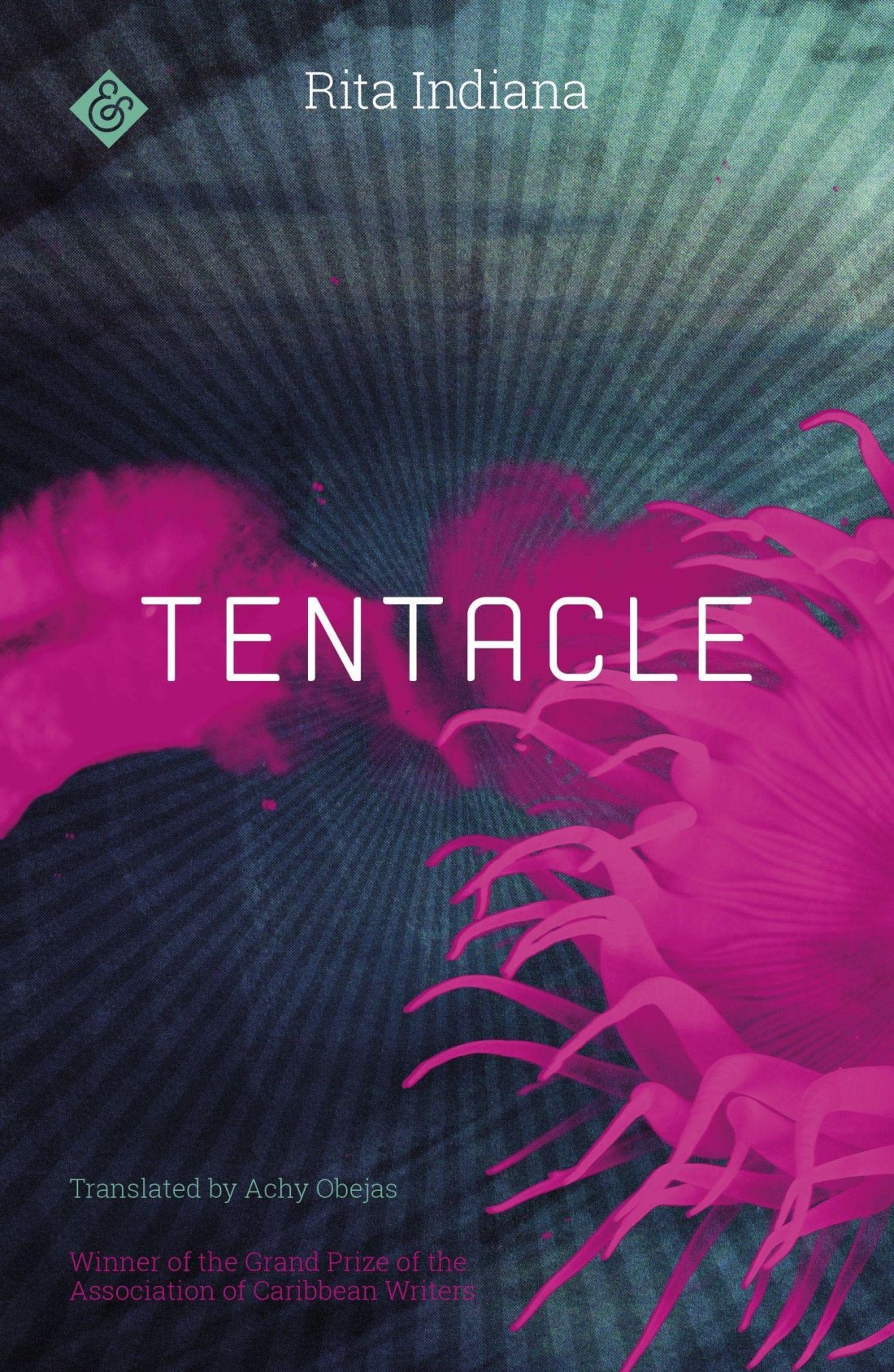
Tentacle (2019) by Rita Indiana

I also took a trip over neighbouring coral reef in a glass-bottomed boat which gave splendid view of the exotic tropical flora & fauna of the ocean floor—grasses, sponges, corals, fishes, sea-urchins, crinoids, etc. […] If I use the tropic setting for any kind of tale, it will be one involving brooding mysteries on one of those low coral keys which lie in spectral desertion just off the shore.

H. P. Lovecraft to August Derleth, 17 Jun 1931, Essential Solitude 1.349

In the summer of 1931, Lovecraft traveled down to Florida, as far south as Key West—he had hoped to make it to Cuba to see Havana, but lacking the funds for the passage, made his way back up the East Coast by bus, taking with him the memories which inspired Devil’s Reef, when he came to write “The Shadow over Innsmouth” in the winter of that year. Perhaps Lovecraft was still thinking of the Florida he saw outside the bus window when he wrote:

Once in a while I noticed dead stumps and crumbling foundation-walls above the drifting sand, and recalled the old tradition quoted in one of the histories I had read, that this was once a fertile and thickly settled countryside. The change, it was said, came simultaneously with the Innsmouth epidemic of 1846, and was thought by simple folk to have a dark connexion with hidden forces of evil. Actually, it was caused by the unwise cutting of woodlands near the shore, which robbed the soil of its best protection and opened the way for waves of wind-blown sand.

H. P. Lovecraft, “The Shadow over Innsmouth”

As much as Lovecraft loved the outdoors, the proto-environmentalism sentiment in some of his stories did not come from any active idea of man-made pollution, overfishing, overfarming, overgrazing, or other ill-use of the land in the sense that readers today would think of. During Lovecraft’s lifetime the nation was just coming to terms with the potential extinction of the American bison, and it was several decades before Silent Spring would see print. “The Colour Out of Space,” for example, was a freak accident, not a buried radioactive waste dump, for all that the insidious pollution carries some of the hallmarks of environmental horror. For Lovecraft, the environmental desolation around towns like Dunwich and Innsmouth are a reflection of the human ills within, much as how in Edgar Allan Poe’s “The Fall of the House of Usher” the decay of the physical dwelling-place reflects the moral decay of the family within.

There is a certain parallel there with today’s environmental horrors: environmental devastation is human sin made manifest.

What would Lovecraft say if he could see those same Caribbean coral reefs, now bleached white and dead, silent and no longer home to the teeming wildlife that once swam beneath the glass-bottomed floor? Would he be reminded of “Til A’ The Seas” by R. H. Barlow, which Lovecraft had commented on, offering comments and suggestions. Or perhaps he would recall “The Shadow Out of Time” and wonder…what if?

Tentacles (2019) by Rita Indiana is the English-language version of her 2015 short novel La mucama de Omicunlé (The Maid of Omicunlé), translated by Achy Obejas. The story is set in the Dominican Republic in three periods: in a post-apocalyptic future where a terminally-online populace chokes in the middle of a dead Caribbean, a contemporary period before the disaster has happened, and the deep Colonial past, when the island of Hispaniola was a wild frontier for European empires, already drenched in the blood of the indigenous Taino.

The story that unfolds, the heroic effort to prevent the disaster, involves a syncretised cult, a sex worker who goes from turning tricks to planning a heist to facilitate their nanotech-powered gender transition, the last remnant of the indigenous peoples, the play of race, class, and sexuality that has made the island such a dynamic and divided place, and the tentacles of a sacred anemone that may have the secret to everything:

According to the letter, black Cubans called a certain marine creature Olokun. It could travel back in time, dude, very Lovecraftian.

Rita Indiana trans. Achy Obejas, Tentacle 105

The concept is a little Lovecraftian, but the execution is distinct. Whereas Lovecraft had very little interest in characters, writing his story more about phenomena rather than those who experienced them, Tentacle is really all about the intertwining nature of people and the environment. Some of the characters are short-sighted and self-indulgent to an extreme, too wrapped up in their own affairs to care about the ramifications of their actions; others are long-planning and self-sacrificing to an extreme that borders on fanatical. Yet ultimately, all of them play their part in the events that lead up to a key moment—the point where one person, at the right place and the right time, with the correct connections and resources, might be able to make a difference and change the future.

In terms of content and approach, Tentacle is not Lovecraftian in the usual sense of the word, for all that it once invokes Lovecraft. There is nothing of Lovecraft’s Mythos or atmosphere in this novel, and while there is a similarity in some of the themes addressed, the execution and style are completely different. Like Flowers for the Sea (2021) by Zin E. Rocklyn, this is not exactly cosmic horror as Lovecraft & co. envisioned it—because while the big horrors of environmental disaster are vast and impersonal, it is the very personal horrors of racism, sexism, and human greed and lust which are the more immediate threats and drivers of the plot.

With the gender transition and the time travel aspect, certain comparisons might be made with Robert A. Heinlein’s “‘—All You Zombies—'” (1959)—but Tentacle is not so self-consciously attempting to be as complicated or as clever. Gender reassignment in Heinlein’s story is a sort of inevitable accident; in Indiana’s novel, it is the main character’s stated and most urgently desired goal. The paradoxical loop in Heinlein’s story is never quite closed in Tentacle; in fact, the established rules of time travel in the story rather prohibit Heinleinian shenanigans, at least for the most part.

It is somewhat telling that when Lovecraft handled time travel with “The Shadow Out of Time,” he did not address the possibility of time paradoxes. The Great Race was constantly looking forward, not backward, and whatever the future had in store for them they adapted to that new environment, not striving to change the past to fix the future to their design. The final revelation at the end of the story was implicitly always there, just waiting to be discovered after untold millions of years. Indiana’s solution to the potential consequences of changing the future is ultimately a very human one—and if it isn’t the most satisfying, it does rather fit the themes of the novel, and the unspoken moral is the one that underlies nearly every piece of environmental writing:

Don’t wait for some miraculous savior. If you want change to happen, you need to do it now, before it’s too late.


Bobby Derie is the author of Weird Talers: Essays on Robert E. Howard & Others (2019) and Sex and the Cthulhu Mythos (2014).

Deep Cuts in a Lovecraftian Vein uses Amazon Associate links. As an Amazon Associate I earn from qualifying purchases.

The Coming of Cormac (1974) by Caer Ged & The Seductress of Eden (1982) by Mark Farris

Eldritch Fappenings
This review deals with works of pornography, and the history of erotic art and writing. As part of this review, selected passages involving sexually explicit activites will be included.
As such, please be advised before reading further.


“Personally,” I said, “I shared Bloch’s opinion of the stories. There was too much emphasis placed on sex. Once I wrote a very critical letter to Editor Wright about the prevalence of sex in some Weird Tales stories, citing the Conan stories as an example.

Willis Conover, 14 Aug 1936, Lovecraft at Last 43

About the Conan tales—I don’t know that they contain any more sex than is necessary in a delineation of the life of a lusty bygone age. Good old Two-Gun didn’t seem to me to overstress eroticism nearly as much as other cash-seeking pulpists—even if he did now & then feel in duty bound to play up to a Brundage cover-design.

H. P. Lovecraft to Willis Conover, 14 Aug 1936, Letters to Robert Bloch & Others 382

In the 1930s editor of Weird Tales Farnsworth Wright recognized that sex sells—or at least, that a tasteful nude on the cover seemed to improve sales. Yet Weird Tales was not in any sense a pornographic magazine, and the “delineation of the life of a lusty bygone age” that Lovecraft spoke about was relatively prudish compared to an episode of Game of Thrones. Robert E. Howard would have an occasional female character disrobed, might hint at sex, but it would have been impossible to publish anything relating to male genitalia, penetration, or any oral sex beyond a passionate kiss in the 1930s, even if he had been so inclined to write such things. Even Howard’s stories for the Spicy magazines, which promised more sizzling sex than other pulps, were more likely to involve a particularly hard spanking than coitus, and paragraphs would peter out into ellipses before getting to any sort of explicit description.

Robert E. Howard’s hardboiled fantasy stories of Conan the Cimmerian would long survive him and grow in popularity, and as restrictions on sex in publishing eased (particularly after Grove Press, Inc. v. Christenberry, 1959), sword & sorcery fiction began to gradually grow more explicit. Fritz Leiber’s “The Sadness of the Executioner” (1973) for example, features “a deliciously slender girl of no more than sixteen, unclad save for four ornaments of silver filigree” as a violent and insane member of a mad king’s harem, and Leiber doesn’t mind describing her anatomy—but he stops short of pornography. Again, there were limitations to what most publications would accept.

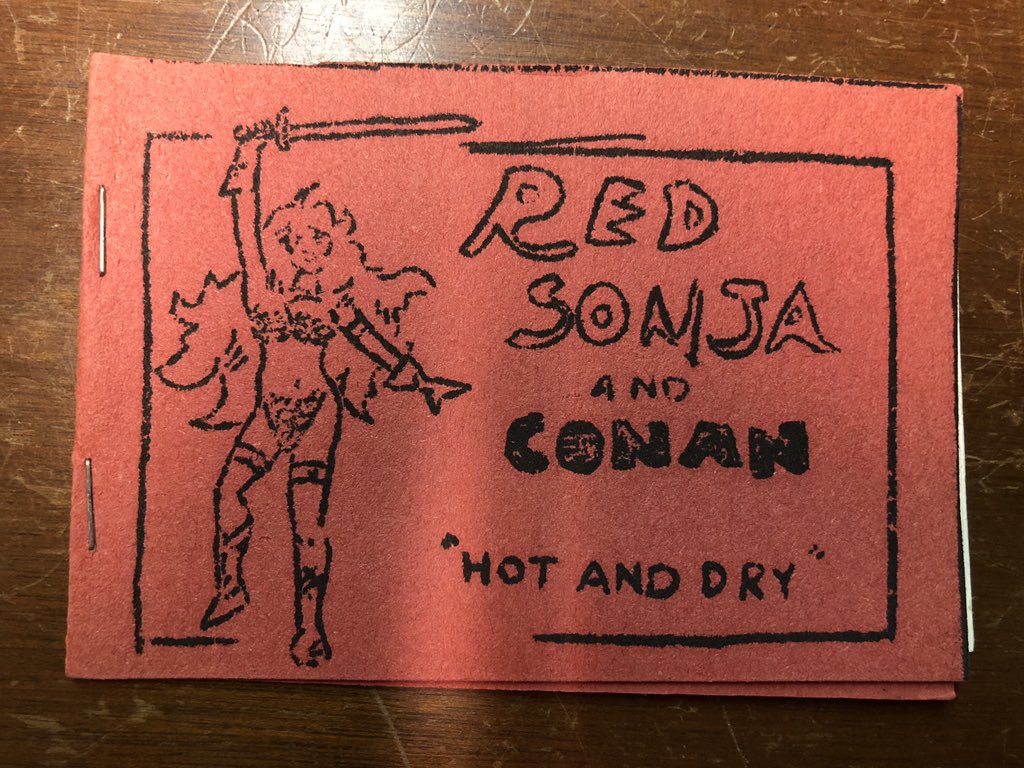
The earliest sexually explicit efforts in that vein were, oddly enough, probably inspired by Marvel’s Conan the Barbarian comic, which began publication in 1970. “Gonad the Horney” was published in the San Francisco Ball in 1972, and the Tijuana bible style Red Sonja and Conan – Hot and Dry was published in 1977. Both of these sexually explicit little comics were parodies of the Marvel material, much as how in later years Hustler would create This Ain’t Conan the Barbarian (2011). Tongue was firmly in cheek, and the point was generally amusement rather than titillation or telling a good story.

Yet with the boom in paperback fantasy in the 1960s through the 1980s, the market for adult-oriented Sword & Sorcery grew…and a few pornographic novels were published to meet that market segment. Two in particular stand out as of particular interest to fans of Robert E. Howard and H. P. Lovecraft, The Coming of Cormac (1974) and The Seductress of Eden (1982) by Mark Farris—and these novels are worth consideration and comparison.

The Coming of Cormac (1974) by Caer Ged

During the fifth cycle of man, before the cataclysm that drove Atlantis from the depths of the sea and split the face of the earth, there was a oneness of the land called Augura by its inhabitants. Though darkness and its creatures and daemons still walked unchained, there rose five kings who rallied civilization and its boundaries. These kingdoms were called Telus,Nebula, Waldrop, Agila and Valana, and war was constant among them.

Beyond these boundaries of man was wilderness. To the south was Sartar with burning deserts and steaming jungles inhabited by savage men of black skin. To the east was the Land of Shadows with the Mountains of Krath barring entrance. To the west were the unknown waters of the Great Sea. And to the north was the frozen wasteland called Bifrost with its warring barbarians.

It was from this bitter land of cold that Cormac came to seek his fortune in the cities of civilization . . .

from The Book of Cormac, Aram Akkad.

Caer Ged, The Coming of Cormac 1

“KNOW, oh prince, that between the years when the oceans drank Atlantis and the gleaming cities, and the years of the rise of the Sons of Aryas, there was an Age undreamed of, when shining kingdoms lay spread across the world like blue mantles beneath the stars—Nemedia, Ophir, Brythunia, Hyperborea, Zamora with its dark-haired women and towers of spider-haunted mystery, Zingara with its chivalry, Koth that bordered on the pastoral lands of Shem, Stygia with its shadow-guarded tombs, Hyrkania whose riders wore steel and silk and gold. But the proudest kingdom of the world was Aquilonia, reigning supreme in the dreaming west. Hither came Conan, the Cimmerian, black-haired, sullen- eyed, sword in hand, a thief, a reaver, a slayer, with gigantic melancholies and gigantic mirth, to tread the jeweled thrones of the Earth under his sandalled feet.”
—The Nemedian Chronicles

Robert E. Howard, “The Phoenix on the Sword”

The Coming of Cormac was billed as “the first ‘sword and sorcery’ book to ever hit the stands—with plenty of hot far-out, uncensored sex!”—and that statement may well stand the test of time, because while it is not the first erotic speculative fiction novel, it is the earliest one I’ve seen that was blatantly and obviously based on Robert E. Howard’s Conan stories (the title no doubt a reference to The Coming of Conan, an early collection). Cormac of Bifrost is essentially a clone of Conan the Cimmerian (and not far off from another Howard character, Cormac Mac Art). The basic premise of the tale, which involves rescuing a princess and some encounters with giant snakes, a witch, undead, and “demons” along the way is very much in the mold of the 1970s Sword & Sorcery pastiche, right down to casual references to “savage men of black skin,” the very sort of thing that Charles R. Saunders noted in his essay “Die, Black Dog! A Look At Racism In Fantasy Literature” (1975). Take out the naughty bits and the story could essentially have run in any fantasy magazine or as a script in Marvel’s Conan comics.

The story is very sexually explicit indeed. Like most erotic novels, that is both the promise and the problem: stopping the plot every few pages for a lengthy sex scene tends to disrupt the flow and pacing of the story, while trivial attempts at titillation are more likely to be eye-rolling than enticing:

A half-clad amazon hastened to the summons. The top-heavy girl panted as she trotted before the priestess of Krath. Her massive tits bounced and bobbed beneath thin veils of black gossamer cloth.

Caer Ged, The Coming of Cormac 94

In terms of content, a great deal of focus is on rape of one sort or another; the princess Avalona gets used and abused in more way than one before Cormac can rescue her, fulfilling the dark promise of such villains. Cormac, once he is inevitably captured, is likewise abused. Not every encounter is nonconsensual, but this is very much the kind of story where the gaze is unflinching…and that is the point. This is all the kind of X-rated stuff that Robert E. Howard and most fantasy authors that came after him could at best hint at, but never put on the page.

The actual action sequences—such as when Cormac is fighting Yog-Sarez, the great serpent who is the son of the serpent-god Seth—are decently written. There is comedy in the book, although it is not quite what readers might expect. For example, at one point Cormac is in The Labyrinth, “a section of the city known for its thieves, robbers, and assassins” (plainly based on “The Maul from Howard’s “The Tower of the Elephant”) and encounters a pair of familiar characters:

To the barbarian’s left a large, blonde northerner, who looked no older than the Bifrostian, shared a table with a smaller youth dressed in grey garments. The two chattered endlessly of their adventures. Like magpies, they tried to out-brag the other, while guzzling bottles of cheap waterfront wine. Eventually, their ramblings turned to Avalona and a brazen plan to steal the princess from under Onard’s nose and to return her to Heres for the reward. The grey-clad youth’s fingers seemed to trace a path across a yellowed parchment spread before them. Slowly but surely, teh wine took its effect and the pair passed out, sprawled across the table.

Caer Ged, The Coming of Cormac 83-84

The pair are patently intended to be Fritz Leiber’s sword & sorcery heroes Fafhrd & the Gray Mouser. Their appearance here isn’t unprecedented; Roy Thomas and John Buscemea had joking inserted “Fafnir and Blackrat” into Conan the Barbarian #6 (1971), and there’s reason to believe that the author here was more than familiar with comic books. At one point Avalona is kidnapped by a rapacious madman with a singing sword looking for his wife Aleta—a reference to Prince Valiant—and later in the novel the witch-priestess summons four demons from the far future who turn out to be, basically, the Fantastic Four. That eventually turns out to be the witch’s X-rated undoing:

Abruptly, the thing stopped and roared. Its gigantic hands fell to tis waist and clawed at the flimsy cloth covering its sex. The blue material tore away, revealing a cylindrical organ of living stone, fully a foot long, hung like a pachydrem. As the creature’s boulder-shattering roars continued, the shaft jerked upward in a throbbing path.

Caer Ged, The Coming of Cormac 148

As Conan pastiche novels go, The Coming of Cormac is a bit below the level of Lin Carter’s Thongor series. The worldbuilding is sparse, the sorcery sparser, and the plot is a bit perfunctory, episodic, and often failing to build tension. The tongue-in-cheek pop culture inclusions are the sole real humor in what is otherwise a fairly cheerless novel of a feckless princess who is passed around and used by one person after another, but without any philosophical meditation a la the Marquis de Sade’s Justine. It accomplishes what it set out to do, but not much more.

“Caer Ged” is an obvious pseudonym, which has been attributed to George Wyatt Proctor, a fantasy fan and novelist. I’m not entirely sure what the basis for this identification is, although a contemporary fanzine Godless #8 (1974) claims “Caer Ged” is also “Lee Wyatt,” which is another pseudonym attributed to Proctor.

The Seductress of Eden (1982) by Mark Farris

My friends say that I am a man who was born out o fhis time, that I should have been one of the Trojan warriors or Hyperborean adventurers I have devoted my life to studying.

Mark Farris, The Seductress of Eden 5

Where The Coming of Cormac was set in a prehistoric past, akin to Robert E. Howard’s Hyborian Age, The Seductress of Eden is set very firmly in the contemporary 1980s. Enter Joseph Kade, a Canadian anthropologist with an interest in fantasy who decides to do some first-hand anthropological exploration of the dark underworld of sex—and ends up in a pulpy adventure that will take him all over the world, meeting (and bedding) all manner of beautiful women, almost getting killed multiple times, and finally stumbling into the ruins of a lost civilization in the Australian Outback while searching for the Phallus of the Old Ones.

If the principal focus of The Coming of Cormac is Robert E. Howard, the focus of The Seductress of Eden is Lovecraft, although the author slips in sly references to the works of Clark Ashton Smith and Howard as well. Kade is caught up in a quest for an eldritch artifact, and the story tends to careen from passionate sexual act to almost gratuitous violence and back again. The pulp aesthetic firmly establishes this as a Lovecraftian fantasy, but one that veers closer to Howardian action, despite references to the Necronomicon and the odd serpent-man:

It stood like a man, about six feet tall, but it resembled a lizard It had green, scaly skin and the head of a snake. It hissed at me and a long, forked tongue slithered out. Its unblinking eyes stared into mine and it raised clawed hands and moved toward sme, dragging an eight-foot tail behind it. […]

“Father was doing experiments with evolution,” said Gloria. “it was his theory that we all evolved from the basic forms of life, encompassing reptiles, and that it was not only possible forus to communicate with them but to evolve back to their forms. This was one of his experiments.”

“Jesus!”

“Father also believed that the continent of Eden was partially inhabited by a prehistoric race of snake-men. This experiment added credibility to that theory.”

Mark Farris, The Seductress of Eden 111-112

The Seductress of Eden is very fast and loose with the Cthulhu Mythos; this is not quite the setting readers familiar with Lovecraft and Howard will be familiar with. Instead of shoggoths, for example, there are shontothes; and instead of Cthulhu, there is quite literally Satan. The Howardian sword & sorcery elements don’t really come in until very late in the novel, though there they are rather explicit, once Kade picks up an ancient axe:

And I had wielded it before…in other lifetimes. I had fought with it on the steps of Atlantis, protecting my queen. I had wielded it on the wastelands of Cimmeria, a barbarian defending his homeland. I had struck with it in the depths of Nemordia, to free my mate from the lair of a wizard. And now I was using it to save a goddess…

Mark Farris, The Seductress of Eden 235

The main problem with The Seductress of Eden is that all of those past lives, reminiscent as they are of Howard’s James Allison stories, sound like more exciting and titillating adventures than the one chronicled in the book. While the action moves fast, it’s not a particularly deep plot, and the post-climax ending where Kade confesses his sins to a priest feels bowdlerized. A huge chunk of exposition at the end of the novel finally lays bare the writer’s version of what’s going on with the Phallus of the Old Ones, and it is so far from anything a Lovecraft fan might recognize it is almost parody.

Except that is the main difference between The Coming of Cormac and The Seductress of Eden: the story is played straight. This isn’t Howardian pastiche except for a couple of paragraphs near the end, nor is it a Lovecraftian pastiche despite the references to the Necronomicon. There are no tongue-in-cheek drop-ins of Prince Valiant and the Fantastic Four. It is an original story which plays out with as much seriousness as it can muster considering that Kade and his new girlfriend have to literally hump their way to their final goal.

Yet when the story assails the reader the Vatican assassins, the sex mutants, the mercenaries, the monsters, the repeated gangbangs, and a sex toy which is quite literally “What if H. R. Giger made a Sybian?,” the result is more like an X-rated serial than a coherent novel. The Seductress of Eden is very much a collision of fantastical pulp elements with hardcore sexuality, and the end result strains belief long before we get to the shontothes or the Golden Phallus of the Old Ones.

“So,” I went on, “now we try to get the scroll and map. And this Contessa has … the scroll?”

“Yes.”

“And I have to seduce her to get it?”

“That’s right.”

“This,” I said for about the millionth time, “is amazing!”

Mark Farris, The Seductress of Eden 73-74

As with Cormac in The Coming of Cormac, the protagonist Joe Kade isn’t a rapist—but there’s a lot of rape in the book. Weirdly enough, for all that the story is predicated on Kade encountering the darkest and most lurid parts of the sexual underground, the actual content is a bit vanilla: there are relatively few kinks on display, not many taboos presented or broken. Kade isn’t forced to expand his sexual horizons very far…and that is probably by design. The attraction of this book is the weirdness of its plot more than the weirdness of the sex itself.

The Seductress of Eden was published under the Tigress Books imprint, which also published Brian McNaughton’s Sheena Clayton novels such as Tide of Desire (1983). All of the Clayton novels had Mythos references in them, and it’s possible that “Mark Farris” was a house name that was used by McNaughton as well—however, the other Mark Farris novels for Tigress aren’t known to have Mythos references, and McNaughton himself never made any claim to the name. More to the point, The Seductress of Eden doesn’t read much like a McNaughton novel, who was prone to be much darker and less heavy-handed in his use of Mythos lore.

Women In The Novels

Both The Coming of Cormac and The Seductress of Eden are told primarily from the point-of-view of the male protagonists, although Cormac has a few chapters dedicated to Princess Avalona’s viewpoint—those chapters where she is raped. Which presents a substantial difference between the two novels worth discussing.

The recovery of Princess Avalona in The Coming of Cormac is the point of the novel, the central driving plot. She begins the novel as a blushing virgin, and through several chapters of degradation and forced sexual intercourse is used and abused, transported against her will, and finally, after many lives have been lost and the major villains are dead, is comfortable enough in her own sexuality to make advances on Cormac himself. It is not exactly a bildungsroman, but as a tale of Avalona growing up it parallels in some ways a much more X-rated and darker version of Queen Yasmela in Robert E. Howard’s “Black Colossus.” While Avalona never quite gets Yasmela’s agency, she at least comes to overcome her initial sexual trauma and take charge of her own sexual needs and desires.

By contrast, Gloria in The Seductress of Eden starts out the novel as a high-priced escort raised in a family of sex mutants with aspirations to gain the Phallus of the Old Ones to become a goddess, and her every action in the story is bent exclusively toward the goal. There is no innocence to be lost, no self-discovery, and ultimately no redemption of the character. She enters into the novel utterly confident in her own sexuality and repeatedly unfazed by any effort to degrade her through rape or any other form of sexual violence. In comparison with The Coming of Cormac, Gloria has more in common with the witch-priestess Sheheit than she does to Avalona—and that kind of represents part of the odd characterization of women in both stories.

In both The Coming of Cormac and The Seductress of Eden present sexuality as inherently positive, at least the relatively limited sexuality on display here. Cormac has no idea why the civilized people are so hung up about the whole virginity business, Kade is protective of Gloria because he loves her, but not overly jealous when she ends up having sex with someone else. While it isn’t quite the aftermath of the free love of the 1960s, sex is definitely not presented as a phenomenon that only happens within the confines of legal matrimony. Yet the women characters who have most embraced their sexuality or try to use sex for their own ends are presented as the ultimate villains.

It is not an uncommon characterization in pornographic works: sexual experience and lack of sexual mores is generally seen as a positive trait, but aggressive or self-serving sexuality is a hallmark of an evil character. This isn’t entirely unusual in fantasy either—in Howard’s “A Witch Shall Be Born” one of the key differences between Queen Taramis and her evil sister Salome is that the latter is sexually active and open about it—but in the context of a pornographic novel, it rather highlights the disparity between male and female characters. Cormac and Kade’s sexual exploits to sate their lusts don’t mark them out as sluts deserving of some dark fate, and they are rarely forced into sex against their will. By contrast, the women in these stories face most of the sexual violence, and most of the consequences of sex, including pregnancy and death.

Conclusions

Publishing has come a long way since Robert E. Howard first wrote the Conan stories. Softcore sword & sorcery novels like Lin Carter’s Tara of the Twilight (1979) have given way to explicit sexual scenes in George R. R. Martin’s A Song of Ice and Fire novels. There is more permissiveness in what can be openly published than ever before—yet the fundamental narrative problem of how (and if, and why) to weave hardcore eroticism into the story remains. For The Coming of Cormac and The Seductress of Eden, the sex is the point, it’s how they were marketed.

It is really odd to look back at erotica produced before the age of the Internet. While a writer’s imagination might be unlimited, and fanzines were free to publish the occasional nude drawing or naughty limerick without too much fear of the postal censor, as a commercial prospect any sort of really weird fiction or sword & sorcery-based pornographic novel had to be a bit of a daunting prospect—not because it couldn’t be done, but because you had to be able to both advertise that work to the correct audience and make something worth reading. In that respect, The Coming of Cormac and The Seductress of Eden are both game attempts to try and meet the needs of a very small and speculative market…and in doing so, they demonstrate how hard it is to produce commercial literature on demand.

Both novels suffer from trying to balance hardcore sex with their pulpy adventures. Howard’s original Conan stories sometimes include lingering gazes at the female form or hints of sexual activities that may happen or are about to happen, but these are largely small titillations that don’t affect the flow of the stories. Erotic fantasy adventure is a difficult prospect at the best of times, as the litany of B-movie sword-and-sorcery films that have struggled to pass muster with rampant female nudity and threadbare plots and acting can well attest.

What’s striking about both of these novels is that they’re coming from about the same place, and even if they don’t use quite the same means, they’re headed for the same goal: to try and capture some of the energy and tropes pulp fiction while injecting hardcore eroticism. On the surface, this shouldn’t be terribly difficult. Read Howard’s description:

Bêlit sprang before the blacks, beating down their spears. She turned toward Conan, her bosom heaving, her eyes flashing. Fierce fingers of wonder caught at his heart. She was slender, yet formed like a goddess: at once lithe and voluptuous. Her only garment was a broad silken girdle. Her white ivory limbs and the ivory globes of her breasts drove a beat of fierce passion through the Cimmerian’s pulse, even in the panting fury of battle. Her rich black hair, black as a Stygian night, fell in rippling burnished clusters down her supple back. Her dark eyes burned on the Cimmerian.

She was untamed as a desert wind, supple and dangerous as a she-panther. She came close to him, heedless of his great blade, dripping with blood of her warriors. Her supple thigh brushed against it, so close she came to the tall warrior. Her red lips parted as she stared up into his somber menacing eyes.

Robert E. Howard, “Queen of the Black Coast”

A lot of what makes pulp fiction work is that readers have to use their imagination. Nothing any writer comes up with will be able to match the sex that Bêlit and Conan have in the reader’s mind. Like the unnamable horrors so often attributed to Lovecraft, to render them in exquisite and clinical detail—to measure Conan’s sword to the nearest millimeter—is to rob them of some of their mystery and magic. If the mating dance of Bêlit in “Queen of the Black Coast” had turned to actual coitus, the entire tone of the story might not have shifted, but the infinite possibilities in the reader’s mind would have collapsed into a single certainty. The possibilities are often much more tantalizing than the execution.

But it ultimately depends on what you’re going for. The Coming of Cormac and The Seductress of Eden draw these comparisons specifically because, like erotic fanfiction they rely to a greater or lesser extent on existing properties. Without Conan, there is no Cormac or Kade. They invite comparison to Robert E. Howard because they are riffing off of Howard. Original works without trying to ape the themes of older fiction might have more leeway to forge their own balance with a more explicit tone, as Martin did in his Song of Ice and Fire series and as Karl Edward Wagner did in his Kane series.


Bobby Derie is the author of Weird Talers: Essays on Robert E. Howard & Others (2019) and Sex and the Cthulhu Mythos (2014).

Deep Cuts in a Lovecraftian Vein uses Amazon Associate links. As an Amazon Associate I earn from qualifying purchases.

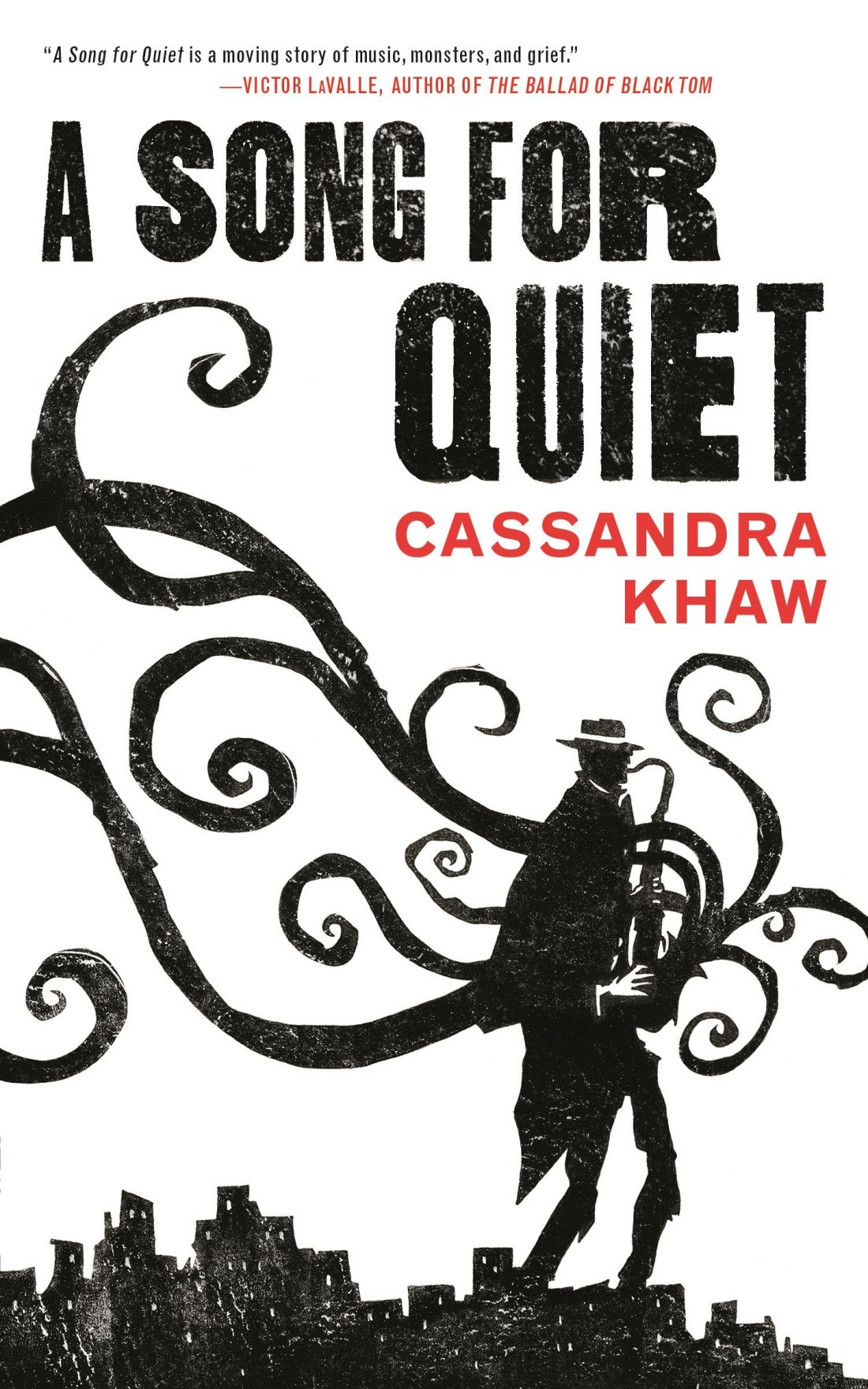
A Song for Quiet (2017) by Cassandra Khaw

Blues is about wanting and not having, about putting that need into someone else’s hands for a little while so you can pause and breathe.

Cassandra Khaw, A Song for Quiet 35

In Hammers on Bone (2016) by Cassandra Khaw, an eldritch abomination walks around in a human suit, playing hardboiled private detective John Persons, a monster who works against other monsters, working for its own inscrutable reasons against Lovecraftian incursions. A Song for Quiet is a standalone novella in the same setting, though a continent away and decades prior, with Persons relegated to an ambiguous supporting role as the narrative shifts to focus on rambling bluesman Deacon James.

Any more detail would give away the plot of the story, and it has little to spare.

In terms of theme and content, A Song for Quiet is a distant literary descendent of “The Music of Erich Zann,” the essential theme reworked and woven with considerable skill and imagination into a new context, a cousin to stories like “The Opera Singer” (2015) by Priya J. Sridhar and “While The Black Stars Burn” (2015) by Lucy A. Snyder—in part because music is the language and the medium by which the weirdness from Outside penetrates this reality, but because music doesn’t just happen. You need a figure on the threshold, like Erich Zann, who has the skills to play and faces the choice to do so. That places a very human conflict in the midst of what might otherwise be a very impersonal cosmic struggle. Ultimately, the musician on the threshold has to decide if to play.

Khaw’s choice to center the narrative on one such threshold-character, Deacon James, comes with advantages and drawbacks. The advantage is that Khaw is a skillful writer who really gets into James’ head, and the world seen through his eyes is a part of the world in stories like The Ballad of Black Tom (2016) by Victor LaValle, Lovecraft Country (2016) by Matt Ruff, and Ring Shout (2020) by P. Djèlí Clark—where Black people, even in a relatively unsegregated northern city like Arkham, have to step carefully, watch their words and actions, because any wrong step could mean violence and death. Jim Crow America was an ugly place with its very mundane horrors, without adding any Lovecraftian horrors to the mix.

The downside is, James knows nothing about the Lovecraftian aspect of the setting and doesn’t learn much of anything by the book’s end. Hammers on Bone worked so well in part because John Persons was an insider on the occult world of the Mythos, readers got their point of view and many things could be explained or accepted because of that. A Song for Quiet, seen mostly through the bluesman’s eyes, is like much in life a puzzle for which many pieces are missing and which will never be complete. John Persons in this book is one piece that doesn’t seem to fit (unless the reader has read Hammers on Bone at some point); he appears from nowhere, does things, explains almost nothing, and this is all perfectly in keeping with how the character might appear to James, but it’s as damnably frustrating as a poorly-played non-player character in a session of the Call of Cthulhu roleplaying game, enigmatic to a fault.

Another piece that doesn’t quite fit is Arkham itself. As a setting, Khaw does a tremendous job of expressing the unease a Black man might feel traveling to and being in a relatively unknown northern city; used to the more openly segregated South, Deacon James is only really at ease in Black spaces. Why it features in the story is another question entirely: Arkham is the backdrop, but it could almost as easily have been Boston, New York, or even London. While an American city makes sense, since blues music is an African-American creation, by the 1940s the geographic remit of blues music and players had gone global. There’s nothing special about Arkham in this regard—it is the place name to cement a Lovecraftian connection, but Deacon James isn’t playing to an audience of hip Miskatonic University students or anything like that. So the setting feels a bit superfluous; like a film that drops a few Lovecraftian place names but doesn’t really connect to Lovecraft’s stories about those places.

This isn’t a damning criticism: many stories have only peripheral connections to the wider Mythos, and that’s fine. The first and most important thing is whether or not the story is good, the amount of Mythos lore dropped is not a primary measure of story quality. The lament here is that it could have been better. Khaw’s take on Arkham through James’ POV is intriguing, it’s something that the novella could have used more of, and if that setting had tied more strongly into the plot it would have been smashing…or perhaps it would have turned a tightly written and fast-paced novella into a bloated short novel.

There is a lot to like about this story; Khaw’s prose is alternately poetic and grounded, using music metaphors to give shape and texture to things seen and unseen, and the characters are well-defined. As another episode of the Persona Non Grata series, it expands the world of Hammers on Bone without stepping on any toes, far enough away in time and space so that the two stories can work independently, but taken together suggesting a wider, more complex world. Thematically, the ending is a strong focus on the human conflict of the musician on the threshold, but the missing pieces of the puzzle leave a bit of tension, like a chord that refuses to resolve.

Cassandra Khaw’s A Song for Quite (2017) was published as part of Tor.com’s Lovecraftian novella series including Hammers on Bone (2016) by Cassandra Khaw, The Dream-Quest of Vellitt Boe (2016) by Kij Johnson, The Ballad of Black Tom (2016) by Victor LaValle, and Agents of Dreamland (2017) by Caitlín R. Kiernan.


Bobby Derie is the author of Weird Talers: Essays on Robert E. Howard and Others and Sex and the Cthulhu Mythos.

Deep Cuts in a Lovecraftian Vein uses Amazon Associate links. As an Amazon Associate I earn from qualifying purchases.
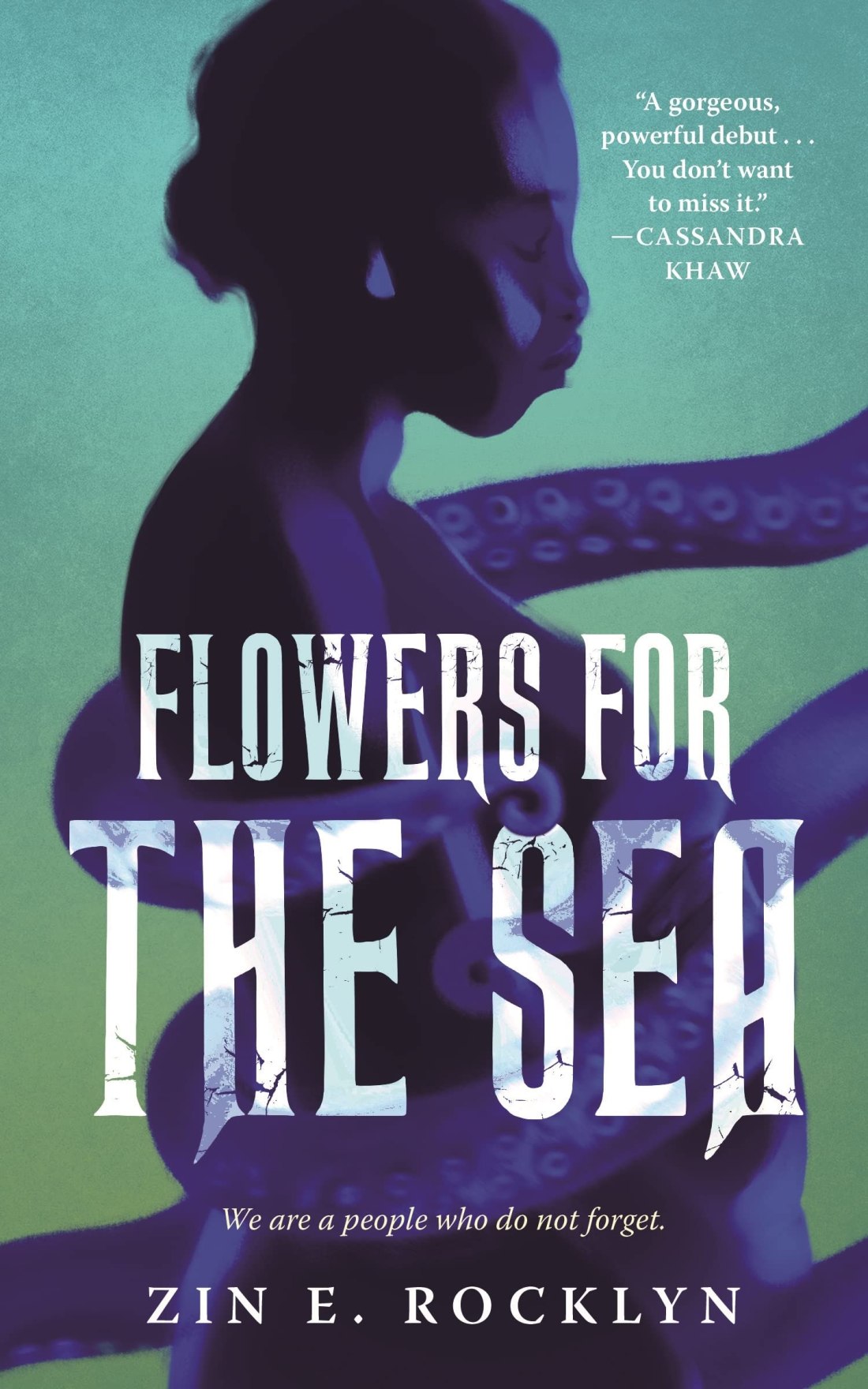
Flowers for the Sea (2021) by Zin E. Rocklyn

My stories always feature a Black woman lead, no matter how hard history tries to erase us and our contributions. I speak to my experiences in my stories as a way to flush them out as well as show the world that we are here, we matter, we are worthy.
Women in Horror Month Fiction Fragments: Zin E. Rocklyn (26 Feb 2021) by Michelle R. Lane

Perspective in any story is more than just the race or gender of the protagonist: it is a way of looking at the world. The history of slavery in the United States, for example, looks different from the perspective of the slave than it does from the perspective of the slaver and abolitionist. The experience and the stakes are different. It leaves its mark on individuals and generations in a way that is almost inescapable, and it shapes the way people understand and pass on their own stories and histories.

Persecution is not something Lovecraft thoroughly understood or expressed in his stories. While his life featured great hardships and poverty, he and his family never experienced systemic prejudice or discrimination. In stories like “The Festival,” he alludes to the hangings at Salem Village and the quiet diaspora of witches, but the witches are not sympathetic victims, even from the perspective of their descendants. There is no rancor at the injustice done, because to Lovecraft there was no injustice: they were witches, after all. Likewise, the fate of the people of Innsmouth is not presented as a crime amounting almost to genocide akin to the forced relocation of the Native Americans, though in all particulars it certainly approaches it.

Chronological distance offers one axis for reflection: “The Doom That Came to Innsmouth” (1999) by Brian McNaughton & “The Litany of Earth” (2014) by Ruthanna Emrys both shift the narrative on “The Shadow over Innsmouth,” seeing in the Innsmouth camps parallels to the Japanese internment camps and the Holocaust of World War 2. These stories deal with individuals who survived true persecution, the personal trauma and the breakup of families, and deal with the psychological and cultural consequences.

As a more diverse set of authors came to Lovecraftian fiction, they brought with them different points of view. The City We Became (2020) by N. K. Jemisin exists, in part, as a rejection and refutation of Lovecraft’s perspective and specific prejudices; “The Ballad of Black Tom” (2016) by Victor LaValle and “Jeroboam Henley’s Debt” (1982) by Charles R. Saunders focus on the perspective of the marginalized Black men who faced the discrimination in the 1920s and 30s that Lovecraft never knew or attempted to depict.

What Zin E. Rocklyn brings to her stories is not necessarily a need to counter, refute, reimagine, or even mention Lovecraft and his Mythos, but her existence and perspective as a Black woman writing weird fiction. As she puts it, when asked about whether she puts broader messages on race into her work:

By default, my presence within horror and writing horror is a message unto itself. Me showing up is message enough, so there’s no definitive way for me to divorce myself from that ongoing narrative.
Women in Horror Month Fiction Fragments: Zin E. Rocklyn (26 Feb 2021) by Michelle R. Lane

Which is absolutely the case for her short novel Flowers for the Sea (1921). Readers familiar with Lovecraft might well identify this story, which is set in an ambiguous time and place, as a left-handed descendant of “The Shadow over Innsmouth,” by way of ecological disaster fiction like “Till A’ the Seas” by R. H. Barlow with H. P. Lovecraft. Iraxi is one of the last survivors of a persecuted minority with rumored supernatual powers and ties to the sea, a literary cousin to the survivors of the Innsmouth diaspora in stories like “All Our Salt-Bottled Hearts” (2016) by Sonya Taaffe—but, the details aren’t quite right. There is a visceral reality to the persecution often missing from Innsmouth stories, ugly details like this one:

They called us nims. A word with hardly any meaning other than to spit upon its victim.

It morphed, much like forked tongues who spoke it, an encapsulating slure that reduced one to shreds, to the foam of the sea we feared, to nothing but the scent of a bowel movement.
—Zin E. Rocklyn, Flowers from the Sea 15

Slurs in science fiction and fantasy are not to be created lightly; too often they tend to mask real-world prejudices, and be substituted for them. Yet in this story, it serves the purpose of an introduction to the history of persecution that has brought Iraxi to this point, the beginning of the end of the pregnancy she didn’t want aboard a dying ship, hated by and hating those around her.

There is no calm, philosophical Lovecraftian indifference in this story. Anger is a major theme, sometimes ugly and sometimes righteous, but never unjustified. There is history behind that anger, long history, some of which is only hinted at…and it isn’t over. The people around her on the ship tolerate her, use her, but she is only and ever a resource to be managed, not a person to be respected…until, at last, it is too late.

Hate has its place in every life; it is a natural reaction to the pain of loss. An excess of hate can lead to terrible consequences; it is what leads to the transformation of Tommy Tucker in “The Ballad of Black Tom,” and nearly damns Maryse Boudreaux in her fight against the Ku Kluxes in Ring Shout (2020) by P. Djèlí Clark. Through Rocklyn’s prose, we get Iraxi’s struggle with her own hatred…but if she becomes a monster, it is because the monsters around her have made her one. The people that burned down her home, killed her family, called her people names for generations, and finally forced her to carry a child she didn’t want…it was their monstrous deeds that stoked the furnace of her rage and honed her cruelty to a sharp point.

There are counter-narratives that might be considered, since we only have Iraxi’s viewpoint for the whole novel. The ship is dying, women unable to bear children, and in this context Iraxi is an ungrateful madonna, given the best food while the others slowly starve. Should she not be thankful for the life she is to give birth to? Is she an unreliable narrator, self-centered and toxic, unable to appreciate what others sacrifice for her sake? Or how her individual sacrifice is for the greater good, for the survival of all?

The problem with these counter-narratives is that they run up hard against issues of bodily autonomy. How grateful should a slave be, to bear the child of her master to increase his wealth? Why should she submit herself and her own needs and desires for the good of a people who see her as little more than a particularly stubborn breeding cow? That is the presence Rocklyn brings to the tale. The arguments against Iraxi’s perspective are ultimately ugly because what Iraxi suffers is, by and large, an extrapolation of the horrors and indignities that women, especially Black women, have suffered for centuries in the United States and the Caribbean.

While we’re seen as sexual beings, we’re rarely seen as sensual beings. We’ve been used and abused for hundreds of years for the sake of personal slavery to the advancement of science, but never as human beings who own their bodies and their sexuality. Even in contemporary thought, there is the myth of the Strong Black Woman who needs no partner, no love, and it simply isn’t true. It’s a bastardisation of a mantra that means we won’t put up with bullshit. I want my fiction to make that distinction, that we crave and deserve love and nurturing.
Interview: Zin E. Rocklyn by Gordon B. White in Nightmare 107 (Aug 2021)

So it is with Inaxi, though her desire for love is never requited…hence the depth and intensity of her hatred. The issues of desire for love and bodily autonomy for women, especially within the context of pregnancy, are seldom made explicit in Lovecraftian fiction; stories like “In His Daughter’s Darkling Womb” (1997) by Tina L. Jens and “A Coven in Essex County” (2016) by J. M. Yales touch on them, but Flowers for the Sea is particularly vivid not only in its microscopic emphasis on the horrors of an unwanted pregnancy, approaching splatterpunk levels of grue when the chapter arrives for the birth, but in the implications. Iraxi is not just a Black Lavinia Whateley; her experience comes out of a very distinct experience of Black Womanhood.

Which is ultimately something that sets Flowers for the Sea apart from many other “Lovecraftian” tales. “The Shadow over Innsmouth” is not so much a distant ancestor as it is the raw material for a tube of Mummy brown that Rocklyn uses to paint her own distinct picture.

Flowers for the Sea by Zin E. Rocklyn was published in 2021 by Tor. Readers might also enjoy her fiction “teatime” (2020) and “The Night Sun” (2020).


Bobby Derie is the author of Weird Talers: Essays on Robert E. Howard and Others and Sex and the Cthulhu Mythos.

Deep Cuts in a Lovecraftian Vein uses Amazon Associate links. As an Amazon Associate I earn from qualifying purchases.
The Were-Wolf (1896) by Clemence Housman

Clemence Housman, in the brief novelette “The Were-wolf”, attains a high degree of gruesome tension and achieves to some extent the atmosphere of authentic folklore.
—H. P. Lovecraft, “Supernatural Horror in Literature”

Clemence Housman was a British author, illustrator, and suffragette; The Were-wolf (1896) is her first novel. Lovecraft included Housman under chapter IX, “The Weird Tradition in the British Isles”—marking out Housman alongside such weird luminaries as Oscar Wilde, Bram Stoker, and M. P. Shiel.

When and where Lovecraft first read Housman is unclear; she is not mentioned by Scarborough & Birkhead, nor does Lovecraft mention the book many times in his letters. Yet we know he must have read The Were-wolf before 1927 (when the first version of “Supernatural Horror in Literature” was published, Housman reference included), and a rare discussion of the novel may give us another clue:

Also, I have a book by Clemence Housman, “The Werewolf”. which is probably as good as that kind of story can be. It failed to make much of an impression on me.
—Clark Ashton Smith to H. P. Lovecraft, c.24-30 Oct 1930, DS 253

I have read Clemence Housman’s “Werewolf”—George Kirk has it—& thought it rather good—though not so good a werewolf tale as Biss’s “Door of the Unreal”, which Cook, Munn, & Morton own.
—H. P. Lovecraft to Clark Ashton Smith, [7 Nov 1930], DS 259

George Kirk was a New York bookseller and a good friend of Lovecraft’s, a member of the Kalem Club which was Lovecraft’s literary circle. Probably, Kirk picked up a copy during his bookdealing, knew Lovecraft was researching weird fiction, and lent it to Lovecraft to read. As friends do.

Lovecraft’s description of The Were-wolf is accurate but bare-bones. Housman’s novel is set vaguely in Scandinavia, based mostly on inference, and without a set period. Since there are no references to modern inventions or events it could be set at any point from the 19th century to any time after the Christianization of the Nordic countries—because this is, without a doubt, a Christian horror story.

As a mode of fiction, Christian horror is not all homilies and pale hellfire; though there is plenty of pap for those who fall back on God as the ultimate power in the victory over every evil, where the recital of a Bible verse, waving of a cross, or a few drops of holy water defeats the vampire or exorcises the evil spirit. Christian horror stories tend to expand on the psychological framework of Christianity while exploring or developing a supernatural fringe beyond accepted dogma; sometimes incorporating elements of pre-Christian belief into the mix—and a happy outcome is not in any way guaranteed. So it is with The Were-wolf.

What Lovecraft leaves out of his description is the nature of the werewolf; for unlike The Thing In the Woods (1924) by Harper Williams, this werewolf is female…or at least, femme:

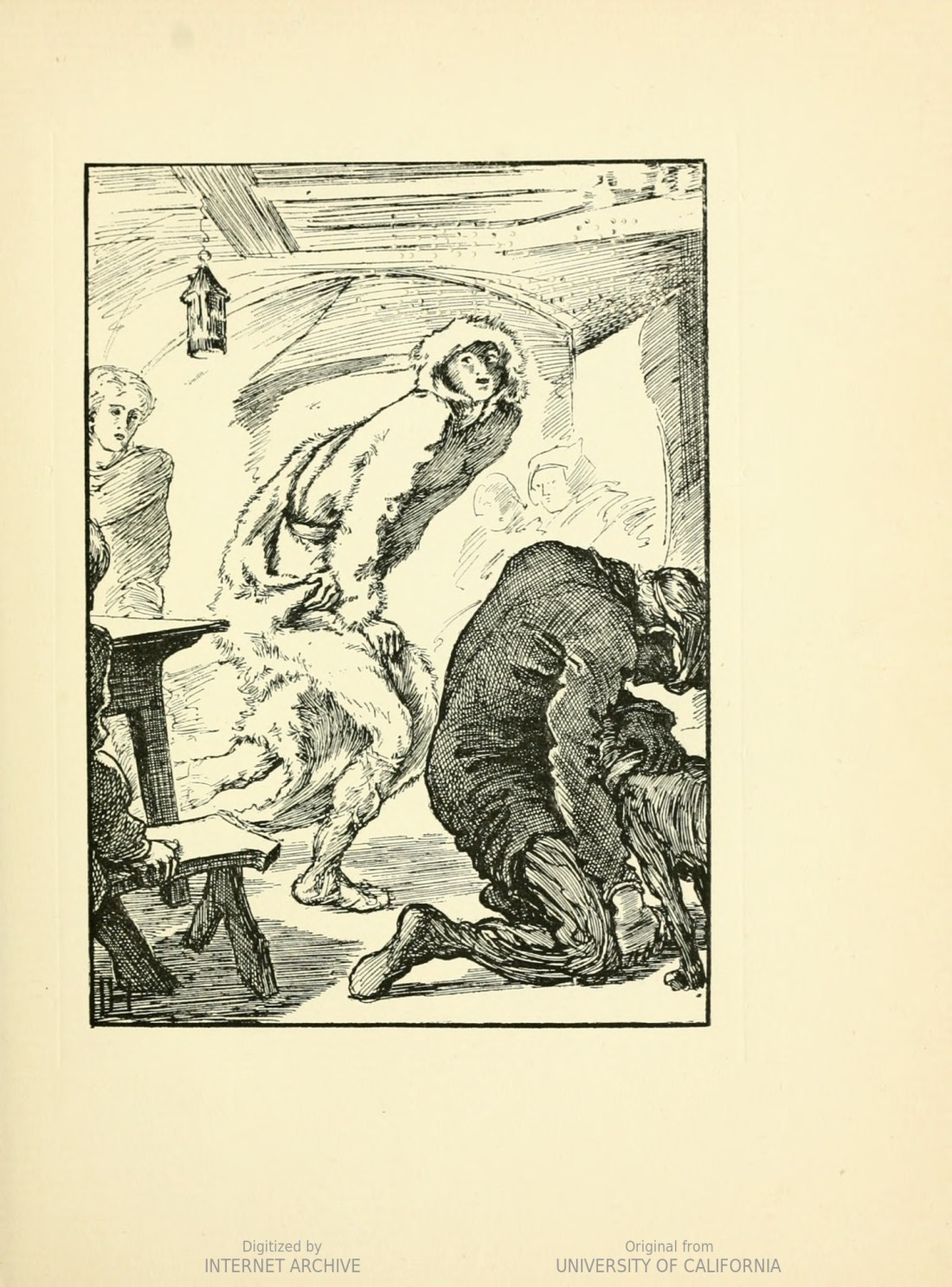
She was a maiden, tall and very fair. The fashion of her dress was strange, half masculine, yet not unwomanly. A fine fur tunic, reaching but little below the knee, was all the skirt she wore; below were the cross-bound shoes and leggings that a hunter wears. A white fur cap was set low upon the brows, and from its edge strips of fur fell lappet-wise about her shoulders; two of these at her entrance had been drawn forward and crossed about her throat, but now, loosened and thrust back, left unhidden long plaits of fair hair that lay forward on shoulder and breast, down to the ivory-studded girdle where the axe gleamed.
—Clemence Housman, The Were-wolf

Her name was White Fell, and metaphorically she is the literal serpent in this icy Scandinavian garden, who intrudes on the idyllic home life and sets brother against brother. Yet in some ways, White Fell represents something of the fierce freedom and independence that Clemence Housman campaigned for, the woman that could cross a hundred leagues of snow and ice hunting game, confident and independent and not constrained by either skirts or customs. Melissa Purdue in “Clemence Housman’s The Were-Wolf: A Cautionary Tale for the New Woman” argues convincingly that this is deliberate, and her detailed analysis is worth reading.

How much of this would Lovecraft have picked up on? We don’t know; gender dynamics in fiction were never his forte, and he discussed and played with such ideas very seldom. One interesting note is that Housman shifts in describing White Fell as a human woman to a “Thing”:

 The dreadful Thing in their midst, that was veiled from their knowledge by womanly beauty, was a centre of pleasant interest.
—Clemence Housman, The Were-wolf

Compare this to how Lovecraft has a character describe Asenath Waite in “The Thing on the Door Step”:

[“]I’ll kill that entity . . . her, him, it . . . I’ll kill it! I’ll kill it with my own hands!”
—H. P. Lovecraft, “The Thing on the Doorstep”

In both cases, Housman and Lovecraft are deliberately denying not just female identity, but basic humanity: White Fell and Asenath Waite are both cast as fiends in human shape. Whether Housman was an influence on Lovecraft in this regard, or whether both were expressing in their different ways the particular syntax of their era which struggled to define individuals who violated the known order as anything other than monsters or genderless (but not sexless) “things”—that might be splitting hairs. It is amusing that Edward Pickman Derby does describe Asenath as “that preying wolf in my body,” which might be taken as a metaphor, or might suggest a closer link in Lovecraft’s mind between Asenath and lycanthropy.

A final word on Lovecraft and Housman involves a bit of a flub:

Yes—I noted with regret the Housman misprint, which came in an eleventh-hour appendix sent in too late for proofreading. In such copies as I have personally distributed, I have made pen-&-ink correction.
—H. P. Lovecraft to Vincent Starrett, 6 Dec 1927, Letters to Maurice W. Moe 524

In that rare first printing of “Supernatural Horror in Literature,” the name Clemence had been erroneously printed as Clarence.

Clemence Housman’s The Were-wolf is in the public domain, and may be read online.


Bobby Derie is the author of Weird Talers: Essays on Robert E. Howard and Others and Sex and the Cthulhu Mythos.

Deep Cuts in a Lovecraftian Vein uses Amazon Associate links. As an Amazon Associate I earn from qualifying purchases.
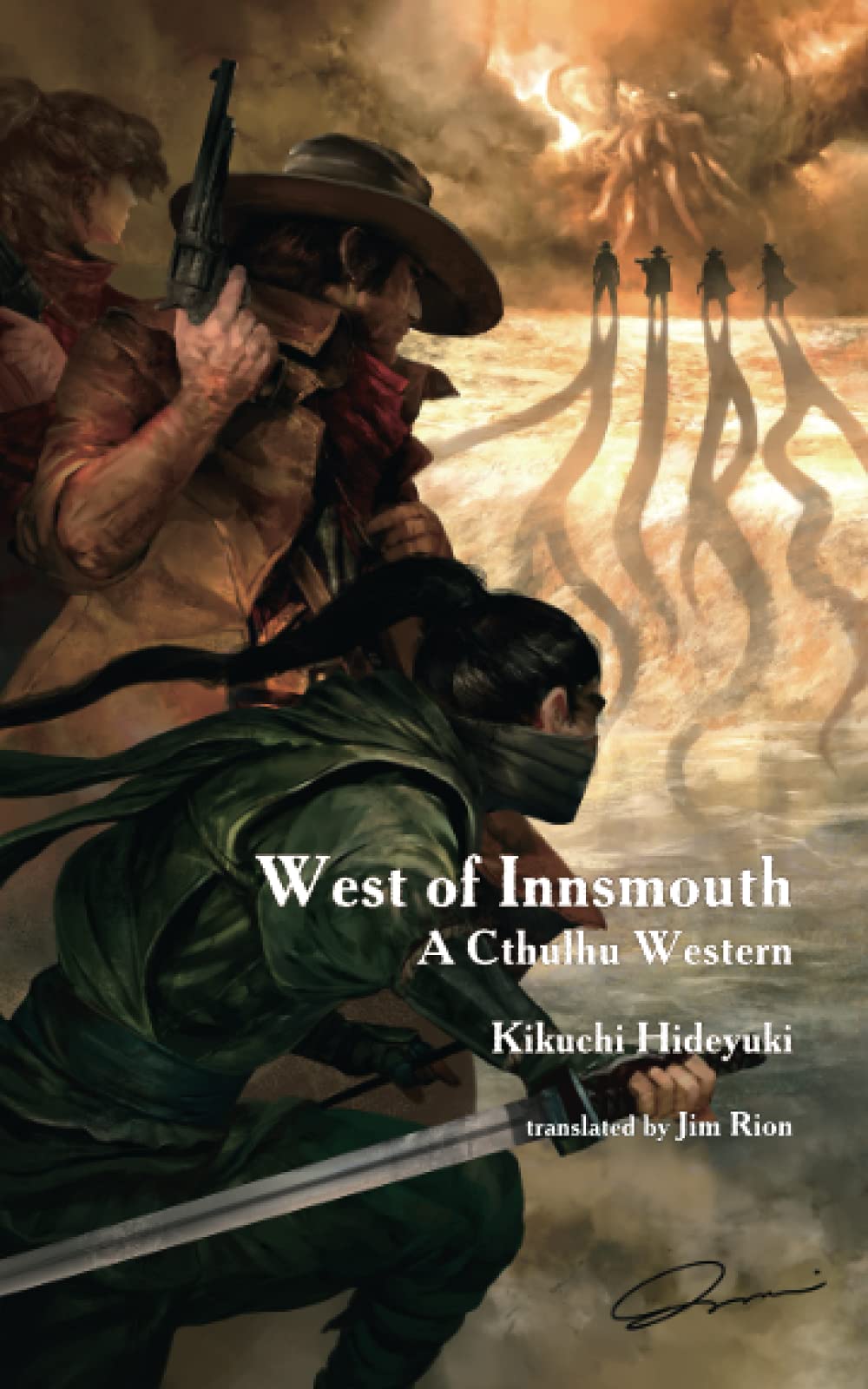
West of Innsmouth: A Cthulhu Western (2021) by Kikuchi Hideyuki (菊地 秀行)

I had long thought I wanted to crate an authentic Western. […] Japan has a similar genre in the jidai shōsetsu (historical samural novels), but their high point, the sword duel, can take such a huge variety of shapes that the wirten word can easily match movies when it comes to tension. […] Even so, I never gave up that dream of writing a Western. I wanted to capture the blood-pounding, muscle-flexing excitement I’d felt as a kid watching famous Westerns in novel form.
—Kikuchi Hideyuki (trans. Jim Rion), “Afterward” in West of Innsmouth 211

Kikuchi Hideyuki (菊地 秀行) may be one of the most prolific and original Japanese authors of Cthulhu Mythos fiction. Unfortunately, like a lot of the popular fiction created for Japan, almost none of it is translated for English-speaking audiences. Fans of anime may recognize him as the author behind the series of Vampire Hunter D novels, or the mind behind Wicked City and Demon City Shinjuku which have become classics of horror anime films and Original Video Animation.

West2

In 2015, his novel Jashin Kettō-den (Legend of the Duel of Evil Gods) was published, a Weird Western which sees a a ninja and a bounty hunter mixed up in a bit of occult business with the Esoteric Order of Dagon…and along the way they pass through Dodge City and Tombstone, and places in between. In 2021 the novel, translated by Jim Rion, was published by Kurodahan Press, who have also published many other Mythos works, such as Kthulhu Reich (2019) by Asamatsu Ken (朝松健).

Kikuchi Hideyuki has done his homework, and if some of that research was done reading classic Westerns, it still shows. This is not an historical samurai epic in an exotic locale; this is a post-Unforgiven Western, gritty and realistic in parts, with an eye for detail…but with allowances for a few specific callbacks to stories and details that Western fans would recognize. For example, in real life Wyatt Earp probably did not carry a Buntline special—but he does here, and the character is none the worse for.

While the addition of a ninja to a Western milieu may seem odd—or perhaps an episode out of the 1970s Kung Fu television series—there’s no anachronism involved. Japan has had contact with North and South America for centuries, and while that contact was lessened during the isolationist sokaku period, by the 1870s gunboat diplomacy had re-established trade and travel, and some Japanese were among the many Asian peoples that immigrated to North America. A more serious and interesting question is the addition of weird elements.

Iä! Iä! Ph’nglui mglw’nafh
Cthulhu R’lyeh wgah’nagl western!
—Kikuchi Hideyuki (trans. Jim Rion), “Afterward” in West of Innsmouth 214

Does West of Innsmouth actually work as a novel? As a weird western, it plays a balancing act between the realistic and the fantastic. Supernatural entities appear, but many of them are perfectly susceptible to a .45 caliber bullet between the eyes or through the heart. The essential plot—what is going and and why the characters do what they do—is actually very solid, with only one quibble: the Japanese co-protagonist is hunting four unusual characters because they killed his brother in Japan at the orders of the Marshes of Innsmouth…but the same characters are being hunted by the American co-protagonist who is working for the Esoteric Order of Dagon. Not an irreconcilable plot hole, but it feels like this is a detail that was overlooked. 

Where the narrative sometimes trips is the extraneous weirdness that tends to crop up along the way. The reader doesn’t need (or get) an explanation for everything, but this ends up being a much more magical Wild West than most readers may be used to, somewhat similar Edward M. Erdelac’s Mekabah Rider series, and there’s perhaps a bit too much of an element of chance in the plot than strictly necessary; too many coincidences, and perhaps too many odd elements that show up briefly and unnecessarily. For example, one antagonist turns out to have learned muay boran from a Thai martial artist in St. Louis…and what are the odds of that?

The Cthulhu Mythos elements are ultimately handled in a very thematic way, with strong visual images for given scenes and repeated motifs that are consistent and have some very effective scenes of horror, but the lore itself handled lightly. The name of Cthulhu is thrown around more often, there is more open talk of spells and incantations, but no one breaks out a Necronomicon or starts giving detailed geneaologies of Innsmouth families; nor does anyone go insane from the revelations. The odd result is that the use of Mythos elements is somewhat restrained, but also much more openly “magical” than you might expect.

In the afterward, Kikuchi Hideyuki admits The Kouga Ninja Scrolls as an inspiration, and you can see some definite thematic resonance there. This is a novel which I think would almost benefit from being longer, or perhaps serialized as a few novellas. The pacing is almost too quick, the challenges all end up being rather short and bloody…but then, this is the Old West, and gunfights often don’t last more than the end of a paragraph, nor should they.

“I can’t figure women for the life of me,” I said. “They give me more fright than Cthulhu himself, maybe.”
—Kikuchi Hideyuki (trans. Jim Rion), West of Innsmouth 194

Sexism and racism were realities in the American Old West, but with today’s audiences a certain balance has to be maintained. So in contemporary Western cinema and literature it’s a fine line between accuracy to the period and necessity to the plot. West of Innsmouth does fairly well overall; the various Native American characters depicted are generally antagonistic, but they aren’t stepping straight out of Hollywood Westerns of the 1950s, 60s, or 70s (although ironically given Hollywood’s penchant for redface, a couple of times Asian characters are mistaken for Native Americans in the novel.) Black characters are mostly absent, and figure very little into events, but aren’t depicted as caricatures. There are several women supporting characters, including a brief but memorable cameo by Belle Starr. Overall, it is a balancing act, and I would say Kikuchi Hideyuki leans on the side of being less prone to putting old-timey racism in his characters’ mouths, although keeps enough prejudice in the story to demonstrate that yet, it was present in the Old West.

There are few enough Weird Westerns that deal with the Cthulhu Mythos, and compared to works like “Showdown at Red Hook” (2011) by Lois H. Gresh, or Weird Trails (2004)West of Innsmouth is certainly more ambitious than most. As a novel it compares favorably with works like Cthulhu Armageddon: A Post Apocalypse Western (2016) by C. T. Phipps, and if it is not perfect, it is never boring, nor does it devolve into white hats versus black hats. Overall, it’s fair to say that Kikuchi Hideyuki succeeded in writing a real western.


Bobby Derie is the author of Weird Talers: Essays on Robert E. Howard and Others and Sex and the Cthulhu Mythos.

Deep Cuts in a Lovecraftian Vein uses Amazon Associate links. As an Amazon Associate I earn from qualifying purchases.
Trolling Lovecraft (2021) by V. McAfee

As for seriously-written books on dark, occult, & supernatural themes—in all truth, they don’t amount to much. That is why it’s more fun to invent mythical works like the Necronomicon & Book of Eibon. The magical lore which superstitious people really believed, & which trickled down to the Middle Ages from antiquity, was really nothing more than a lot of childish invocations & formulae for raising daemons &c., plus systems of speculation as dry as the orthodox philosophies.
—H. P. Lovecraft to Willis Conover, 28 July 1926, Letters to Robert Bloch & Others 378

People have always believed in magic, even if they haven’t always called it magic. This was rarely the kind of magic we might associate with fantasy fiction today; practitioners generally weren’t throwing fireballs. The form and goals of magic have always changed to match the syntax of the era. In ancient Rome, someone might scratch a curse on a tablet of lead, or have a diviner root around in entrails to answer a personal question, or wear an amulet to ensure an easy childbirth. In Lovecraft’s lifetime, they might check their horoscope in the newspaper, carry a rabbit’s foot on their keychain, or let someone hypnotize them.

When most people think of “real” magic, they think less of this kind of superstition and pseudoscience, as Lovecraft would put it, and more on specific tropes of grimoires, spellcasting, magic circles, maybe witchcraft and cults as described in The Witch-Cult in Western Europe (1921) by Margaret A. Murray. Ancient traditions passed down, either in oral traditions or crumbling books and manuscripts, or both. Lovecraft lived and wrote during the period called the Third Great Awakening which saw the rise of organized occultism (in the form of the Hermetic Order of the Golden Dawn, the Theosophical Society, and other groups), an increased focus on Spiritualism and other new religious movements, increased interest in ancient religions thanks to advances in archaeology, scientific interest in supernatural phenomena (as explored by the Society for Psychical Research and other groups), and wider publication of occult literature to an increasingly literate public. Owen Davies explores the magical world of Lovecraft’s era in his book A Supernatural War: Magic, Divination, and Faith during the First World War.

After World War II, magic continued to be popular. Aleister Crowley, a member of the Hermetic Order of the Golden Dawn, had developed its system of ceremonial magick into an influential system of belief called Thelema. Gerald Gardner and Doreen Valiente, among others, formulated and organized contemporary witchcraft as Wicca. Interest in psychic phenomena, Eastern spirituality, and more new religious movements increased during the 1960s. Aleister Crowley’s secretary Kenneth Grant rose to prominence by expanding the system of ceremonial magic—and incorporating in elements of Lovecraft’s fictional Mythos. Anton LeVay, who founded the Church of Satan in 1966, also worked some Lovcraftian material in. In New York City in 1977, a Necronomicon appeared that purported to be a genuine grimoire. For more on such developments, check out The History of British Magick After Crowley and The Necronomicon Files.

While some might argue that all occult literature is in some sense fiction, the development of the Lovecraftian occult was different from claims to have found an ancient magical manuscript and translated it, or to have received a communication from some spirit from “outside.” While some of it (like the Simon Necronomicon) was deliberately fraudulent, the Lovecraftian occult proved to be no different, in the end, to any material derived from traditional sources. A little weird, maybe, and consciously derived from the works of a dead pulp writer rather than some medieval magician, but for people who found defined gods as ideas, concepts, and symbols—what was the difference between a traditional goddess such as Isis and a fictional one like Shub-Niggurath? If you believed enough, and if the rituals you worked around the idea worked well enough for you—why not be a Lovecraftian magician?

This postmodern approach to magick, where prospective magicians were not restricted to traditional systems but pursued a more individual, personal, even eclectic and experiential approach has sometimes been called Chaos magick. Lovecraftian occultism has incorporated by many chaos magicians (or chaotes) into their personal mythology, most notably by Phil Hine in The Pseudonomicon. This approach has in turn inspired takes on Lovecraftian spirituality, notably When the Stars Are Right: Toward an Authentic R’lyehian Spirituality by Scott R. Jones, and Lovecraftian occultism has influenced Lovecraftian fiction.

Which is a very long prologue to begin talking about Trolling Lovecraft by V. McAfee.

I’m not really familiar with his history
enough to do that…
but I guess I could give it a shot. Like go
back to when he was a kid and haunt him
with weird bs?
—V. McAfee, Trolling Lovecraft 5

McAfee’s debut novel is told from the perspective of Dyl, a working chaos magician. It is occult fiction in the sense that it follows the precepts of chaos magic, without explaining the terminology or many of the concepts. Readers who aren’t familiar with sigil-making, or how you might charge an orgone accumulator, are going to miss a few things. While I wouldn’t be surprised if McAfee was very familiar with Hine and the Pseudonomicon, the focus of the novel is not some exegesis on Lovecraftian occultism…it’s the use of chaos magic for a very specific purpose: trolling Lovecraft.

There are a lot of ways for dealing with life, the things it throws at you, and historical figures like H. P. Lovecraft. Many writers have addressed Lovecraft and his work in many ways in fiction, from reverence to revulsion, ridicule to reimagining. None of these are wrong; a writer might express their appreciation for Lovecraft by creating a fictional version of them in their story, as Robert Silverberg did in “Gilgamesh in the Outback”, or work out frustration by calling out his racism as N. K. Jemisin did in The City We Became. Chaos magic is as valid an approach as any other—and maybe as valid a goal for chaos magic as any other operation.

He took his copy of a collection of Lovecraft’s prose off the shelf and found Beyond the Wall of Sleep, one of his favorites and one of the original pieces that he was going to mess with. He read through it quickly and found it unchanged, just as Her Greatness had said. Then, Dyl pulled up a transcription on the web and found that the phrase ’empire of Tsan-Chan’ had in fact been changed to ’empire of Fiat-Nox’.
—V. McAfee, Trolling Lovecraft 67

While trolling Lovecraft is the premise of the novel, the focus is on Dyl and the consequences of his actions. Like many magicians, he’s young, male, egotistical, often horny, and perpetually getting himself into deeper and deeper shit through poor life choices. This is not a magical adventure in the sense that Dyl has to find an ancient grimoire bound in human skin and has to defeat Cthulhu before the evil cult can summon him into the real world; this is an extraordinarily personal journey about someone who becomes unmoored from his personal reality because he decided to troll Lovecraft…and while many other people might not believe in it, it’s real for him.

Which is what chaos magic is all about.

Trolling Lovecraft was written by V. McAfee for NaNoWriMo 2020, and a print edition was successfully funded and delivered on Kickstarter in 2021. Digital copies can be purchased at the Gate Zero shop on Etsy and Gumroad.


Bobby Derie is the author of Weird Talers: Essays on Robert E. Howard and Others and Sex and the Cthulhu Mythos.

Deep Cuts in a Lovecraftian Vein uses Amazon Associate links. As an Amazon Associate I earn from qualifying purchases.

The Song of Bêlit (2020) by Rodolfo Martínez

Believe green buds awaken in the spring,
That autumn paints the leaves with somber fire;
Believe I held my heart inviolate
To lavish on one man my hot desire.
—The Song of Bêlit

Robert E. Howard’s novellette “Queen of the Black Coast” was published in Weird Tales May 1934. It was the ninth story of Conan the Cimmerian published in Weird Tales, and is notable as one of the most popular, critically lauded, and most influential of the Conan adventures. The story by itself is very tightly contained, with Conan and Bêlit meeting, falling in love, and being separated by death all within five quick-paced chapters. The story and characters have been adapted several times in comics, with the writers and artists stretching out the narrative inserting additional episodes so that more of the adventures (and romance) of Conan and Bêlit can be explored. The story provided the inspiration for the first Conan comic, La Reina de la Costa Negra, and in 2019 Marvel Comics published a prequel series Age of Conan: BelitPoul Anderson wrote an entire authorized novel, Conan the Rebel (1980) which similarly takes part between the first and second parts of “Queen of the Black Coast.”

In that dead citadel of crumbling stone.
Her eyes were snared by that unholy sheen,
And curious madness took me by the throat,
As of a rival lover thrust between
—The Song of Bêlit

As the name implies, and the “Song of Bêlit” that opens each chapter, Bêlit herself is a character coeval with Conan for this story—it is her story as much as it is his, and can be compared to “The Phoenix on the Sword” in how she is presented through her song as already a legend to the readers. While Conan would be involved with many women throughout the series as written by Howard (and expanded on by various others), Bêlit represents his first, and for most of his initial run in Weird Tales, only real equal: a woman, warrior, and queen as fierce as himself. In authorized and unauthorized materials, writers and artists have explored and expanded on her character and characterization.

Was it a dream the nighted lotus brought?
Then curst the dream that bought my sluggish life;
And curst each laggard hour that does not see
Hot blood drip blackly from the crimsoned knife.
—The Song of Bêlit

Fandom and literary criticism have both borrowed the term canon to refer to those texts in a particular series or body of works which are considered, for whatever purposes may be put to them, to be “true” in any given sense. The idea of canon gets murkier when you consider that anyone can potentially write their own sequel, prequel, etc. to a given story, they can take an established character and put them in an entirely new story of their own invention, or take their character and put them into an established setting. Different writers can draw connections between their work, as Lovecraft and Robert E. Howard did by slipping references to each other’s fictional worlds into their own stories, so that Howard’s Hyborian Age is technically a node of the Cthulhu Mythos shared universe…

How much of that is canon? It depends. Pretty much everyone agrees that what Robert E. Howard wrote and published during his life is as “canon” as Conan gets. What about his unpublished works, like “The God in the Bowl?” What about unfinished works, which were completed by later authors? What about works that were officially commisioned and licensed by Conan’s estate or their agents, like the aforementioned comic books and Conan the Rebel? What about works which are set in the period but don’t feature Conan at all, like The Leopard of Poitain (1985) by Raul Garcia-Capella?

The question closely parallels (and in places, overlaps) with questions of canonicity in the Cthulhu Mythos. Lovecraft’s fiction is generally considered as canonical Mythos as you can get, and Lovecraft includes references to Howard’s stories: does that make Conan & company Mythos-canon by extension? All or none of these might be “canon,” depending on whom you ask. In terms of fandom, you yourself as the reader are the final arbiter for what you consider canon.

The intellectual property lawyers might have other ideas.

The shadows were black around him,
The dripping jaws gaped wide,
Thicker than rain the red drops fell;
But my love was fiercer than Death’s black spell,
Nor all the iron walls of hell
Could keep me from his side.
—The Song of Bêlit

Intellectual property law is complicated, and there is money invested in copyrights and trademarks. It’s not just a question of publishing collections of Howard’s original stories: all the writers, artists, inkers, colorists, letterers, editors, etc. who produce new works of Conan are contributing to the total body of Conan-related work, and there are rights, percentages, and real money, issues of creative control and branding that are at stake. While it’s nice to think that Conan and Bêlit’s ongoing appeal is due to Robert E. Howard’s original story alone, the reality is that there decades of work by many individuals that have gone into the ongoing promotion, adaptation, and development of the Conan properties…but, eventually, copyrights expire and a work falls into the public domain.

In the European Union “Queen of the Black Coast” is in the public domain. That doesn’t just mean that publishers can freely translate and publish it, but that authors can take the original text and transform them into original works in various ways. Which is exactly what Rodolfo Martínez did.

Now we are done with roaming, evermore;
No more the oars, the windy harp’s refrain;
Nor crimson pennon frights the dusky shore;
Blue girdle of the world, receive again
Her whom thou gavest me.
—The Song of Bêlit

Martínez is a Spanish fantasy and science fiction writer and translator, perhaps most notable to English-language audiences for his Sherlock Holmes pastiche The Wisdom of the Dead (2019). The Song of Bêlit is a pastiche of and expansion of Howard’s “Queen of the Black Coast”—literally reproducing essentially the entirety of the text of Howard’s novelette, but wrapped around and combined with original chapters that extend and expand the scope of the original story.

Except for the chunks of pure Howard, the story is a pastiche in the purest sense: Martínez is familiar with Howard’s entire Conan ouevre, including the stories that had not yet been written when “Queen of the Black Coast” was, and in addition to Conan and Bêlit other familiar characters poke their head in to the narrative, which is considerably lengthened and convoluted. It’s a fun story, and doesn’t come up to Howard’s original prose, but then no one but Howard could do that. There are a few errors, no doubt more from translation issues than anything else; the wizard Thoth-Amon from “The Phoenix on the Sword” is here as “Toth-Amon.” There are a few references to Isis and Osiris that might have made even Howard wince—but then again, perhaps not.

Rodolfo Martínez was cognizant of all the criticism he might receive for doing this, and discusses the issues involved in some depth in an essay at the end of the book. One of the most interesting things is that Martínez did not just sit down and write the novel; he mapped out the blank space between the beginning of “Queen of the Black Coast” and the end, the three years which Howard had said separated Conan and Bêlit’s meeting and their parting. Howard later alluded to some of the events that happened during this period in later stories, and those had to happen, but beyond that Martínez wished to deliberately avoid the plot that Roy Thomas had written when he expanded on that missing period during his run on Marvel’s Conan the Barbarian.

The approach is very Sherlockian: finding the gaps in the existing canon, trying to fill it with something new while not reproducing someone else’s work. Which is what makes The Song of Bêlit a kind of recension—a variation on a text, part of a group of texts. Martínez was trying to fill in the gaps without contradicting anything that Howard wrote (although he does a little judicious shuffling of paragraphs for narrative purposes). So consider this a “might have been”…and, perhaps more importantly, a glimpse at what might yet be.

Believe green buds awaken in the spring,
That autumn paints the leaves with somber fire;
Believe I held my heart inviolate
To lavish on one man my hot desire.
—The Song of Bêlit

By itself, The Song of Bêlit is an oddity: a Spanish fantasy novel based on a public domain English pulp novelette, now translated into English and available to buy and read. Yet in making that transatlantic crossing to the United States of America where copyright law is different, it gives readers a first taste of what is to come.

Because when they enter the public domain, that means that anyone can play with Howard’s original text, and write original stories with Howard’s characters. We’ve already seen something of the explosion of creativity that has led to with regard to Lovecraft and his Mythos. Who can forget Kanye West—Reanimator (2015) by Joshua Chaplinsky & “Herburt East: Refuckinator” (2012) by Lula Lisbon? We have seen far from the last of Bêlit, whether in her own adventures or with Conan by her side, readers will no doubt see much, much more of their characters…and then they will have to decide for themselves which stories fit into their canon.


Bobby Derie is the author of Weird Talers: Essays on Robert E. Howard and Others and Sex and the Cthulhu Mythos.

Deep Cuts in a Lovecraftian Vein uses Amazon Associate links. As an Amazon Associate I earn from qualifying purchases.
The Shuttered Room (1966) by Julia Withers

Incidentally, I’ve just sold Heritage Productions THE SHUTTERED ROOM. No doubt they’ll flesh out the “romance” between Dunwich boy and Innsmouth girl to give it “body” and we’ll have a shilling shocker out of it, but I couldn’t care less, really….
—August Derleth to Ramsey Campbell, 6 Feb 1964, Letters to Arkham 170

“The Shuttered Room,” the title story for the collection The Shuttered Room and Other Pieces (1959), is arguably Derleth’s greatest work of fanfiction. While originally billed as one of Derleth’s “posthumous collaborations,” and Derleth had claimed to base it on unspecified notes by Lovecraft. In one letter, Derleth described it as:

[…] wedding of the Innsmouth and Dunwich themes, as manifestly HPL intended to do, judging by his scant notes.
—August Derleth to Felix Stefanile, August 11, 1958, MSS. Wisconsin Historical Society

Whether or not these notes actually existed is open to speculation; no surviving letters suggests Lovecraft had any intention to unite the two themes. Nevertheless, in 1958 Derleth sat down to write the story (A Look Behind the Derleth Mythos 215, 231). The result is not his best Mythos story, or even his best pastiche, but probably the best fanfiction story that Derleth would ever write, a literal union of the Whateley and Marsh family trees from “The Dunwich Horror” and “The Shadow over Innsmouth,” paying detailed homage to both.

In the 1960s, August Derleth and Arkham House began to have some success in selling the film rights to various Lovecraft & related properties, resulting in five films:

Despite the fact that every film except The Shuttered Room was distributed by American International Productions, this wasn’t an early effort at a cinematic universe or franchise along the lines of the Universal monsters. While a couple of the films shared a few elements such as the Necronomicon, each was produced separately and without any direct tie-ins to the others in the form of characters, sets, props, or storylines.

The films all received different marketing promotions and led to the creation of associate media: Die, Monster, Die! got a comic book adaptation and there was an Italian fotonovela created for Curse of the Crimson Altar, for example. In 1966, released before the film came out, The Shuttered Room received a film novelization—as a kind of Gothic romance.

The novel was written by “Julia Withers,” a pseudonym used by prolific novelist and ghostwriter Jerrold Mundis who had worked on several different screenplay novelizations in the late 1960s. It’s difficult to tell how successful the slim paperback (only 156 pages) was. It is even more difficult to tell if Mundis ever bothered to read Derleth’s original story. Probably not; there is little enough let of Derleth’s original story in the screenplay by D. B. Ledrov and Nathaniel Tanchuck. Much of the best writing in the short story is in the descriptive passages that Derleth wrote so well, and the best part of the film is the cinematography; the novel lacks both.

The Shuttered Room (novel) is a very barebones kind of contemporary thriller dressed up (at least in terms of the cover) as a kind of Gothic romance, where family secrets, an old building, and a family curse threaten a nice young couple. There is no Mythos content beyond the name of Dunwich itself—here an isolated island rather than a town. Even “Whateley” is rendered as “Whately,” and there is no reference to Innsmouth at all. What Mundis does add above and beyond what is in the film is a touch of the grotesque, some backstory that either never made it to the final film or was cut out, and one important thing…

There, squatting in the midst of the tumbled bedding from that long-abandoned bed, sat a monstrous, leathery-skinned creature that was neither frog nor man, one gorged with food, with blood still slavery from its batrachian jaws and upon its webbed fingers—a monstrous entity that had strong, powerfully long arms, grown from its bestial body like those of a frog, and tapering off into a man’s hands, save for the webbing between the fingers…
—August Derleth, “The Shuttered Room” in The Watchers Out of Time 158

Something vaguely resembling a woman crouched in that doorway. Its hair was long and matted and tangled. A tattered filthy garment hung from its twisted body. Its eyes were large and bulbous. Its nose was non-existent, only two gaping holes. A slit with jagged teeth served for a mouth. It’s skin was leathery and cracked—scale-like, actually—and it glistened with moisture.
—Julia Withers (Jerrod Mundis), The Shuttered Room 149

Imagine trying to describe a Deep One/Whateley hybrid, in a setting which has already expunged every reference to Innsmouth and to an audience that has no familiarity with “The Dunwich Horror.” The solution in Mundis’ The Shuttered Room was to describe the nameless Whately child as a monstrous freak: “stillborn…or it should have been…but it lived.”

“Ontogeny recapitulates phylogeny,” as Lovecraft would put it. The idea was that living things re-experience the stages of evolution as they grow; so that human embryos have gills…tails…which are lost as they develop. The idea that an embryo might get “stuck” at a certain stage and yet successfully be born and grow to adulthood is not unique to The Shuttered Room novel. In fact, it is strongly reminiscent of the 1953 horror film The Maze—and one has to wonder if Derleth might not have taken a bit of inspiration from this film too. Some years after Derleth wrote “The Shuttered Room,” Ramsey Campbell mentioned the film to Derleth:

There have been movies with a definite slant toward the conceptions of the Mythos, however […] there was the one starring Richard Carlson titled THE MAZE, which was about the hideous frog-creature which is kept and fed in an ancient castle, and finally turns out to be the first in a line who now live in the castle!
—Ramsey Campbell to August Derleth, 10 Aug 1961, Letters to Arkham 12-13

Did Derleth borrow from The Maze? Did Jerrold Mundis? In such a case as this, where the original work has been so translated, and so changed in the transformation from short story to screenplay to short novel, it’s difficult to say…but the various works stand as distinct iterations of a very odd cadet line of the Mythos.

The film was not so creative. Or perhaps it just wasn’t in the budget. The company forewent any supernatural or preternatural explanation; there was no monster, and almost no explanation. In that sense, at least, the novel is an improvement on the film, or at least a step closer to Derleth’s original story. The idea of a madwoman trapped in the attic is closer to Jane Eyre than Cthulhu; perhaps that’s why the marketing of The Shuttered Room (novel) bears the hallmarks of the Gothic romances of its day, rather than any effort to market it to Lovecraft fans. The novel stands as an example of how truly weird and diffuse Lovecraftian influence can get.


Bobby Derie is the author of Weird Talers: Essays on Robert E. Howard & Others (2019) and Sex and the Cthulhu Mythos (2014).