We are living in the only period in history in which it is considered fashionable to be a witch. Given this complete public acceptance, an understandable tendency towards fadism develops. The once-stigmatizing label of “witch” has become a title of positive intrigue and has attained a status never before realized.
—Anton Szandor LaVey, The Satanic Witch (1989), 1
In his book The Triumph of the Moon (1999), Ronald Hutton traces the history of modern pagan witchcraft, and how a combination of factors and personalities in the late 19th/early 20th century—the shift to urban living which caused a romantic attitude toward nature and rural areas, the spiritual awakenings that weakened the grip of Christianity and encouraged the spread of new religious movements and ceremonial magic, the anthropological re-evaluation of myth in George Frazer’s The Golden Bough (1890) which inspired The Witch-Cult in Western Europe (1921) by Margaret A. Murray—all came together in the mid-century as individual practitioners like Gerald Gardner and Doreen Valiente shaped the core practices that would characterize Wicca and other modern pagan witchcraft systems.
Lovecraftian witchcraft is an interesting concept. H. P. Lovecraft’s views on witchcraft were largely shaped by Murray’s Witch-Cult Hypothesis as set forth in The Witch-Cult in Western Europe; there’s no evidence he read her later book The God of the Witches, and while Lovecraft had some understanding of the history of ceremonial magic based on Éliphas Lévi’s The History of Magic (1922, trans. by A. E. Waite), he was never an occultist or member of any group like the Hermetic Order of the Golden Dawn. When asked by one Salem witch descendant for magical secrets hinted at in his fiction, Lovecraft had to politely confess he made it all up. While Lovecraft made much of the Salem witch diaspora in his stories, connecting characters like Keziah Mason (“The Dreams in the Witch House”), Joseph Curwen (The Case of Charles Dexter Ward), and the founders of Dunwich (“The Dunwich Horror”) among others with the cult, that religion is uniformly depicted as dark, secretive, and often violent and malevolent. Keziah Mason even sacrifices children, repeating the old blood libel.
Most of Lovecraft’s contemporaries and immediate followers were not much better. Robert E. Howard’s Stregoicavar in Turkey in “The Black Stone” (1931) is a degenerate, alien, bloodthirsty religion. Henry Kuttner’s “The Salem Horror” (1937) strongly echoes “The Dreams in the Witch House,” with Abigail Prinn standing in for Keziah Mason. The image of the witch as a positive figure for female empowerment hadn’t really formed yet, though it was on its way with novels like Conjure Wife (1943) by Fritz Leiber. Over the decades, as the image of witchcraft shifted, Lovecraftian media often shifted to reflect the syntax of the time.
When exactly modern witches began to incorporate Lovecraftian elements into their work is a matter of debate. Doreen Valiente’s first book, Where Witchcraft Lives (1962), includes an invocation of the Old Ones during a full-moon ritual, which Hutton notes is nowhere in Gerald Gardner’s Writings and is very Lovecraftian (321). Any prospective witch who picked up Anton LaVey’s The Compleat Witch (1971; later reprinted as The Satanic Witch), could have used the Lovecraftian rites presented for the Church of Satan in The Satanic Rituals (1972) a year later. Kenneth Grant, one of the heirs of Aleister Crowley, threaded the needle of working references to witchcraft and Lovecraft into his system of ceremonial magick in The Magical Revival (1972). In 1977, Schlangekraft published the Necronomicon by Simon, which included a very Murray-esque witch cult into its Lovecraftian version of magical history as well.
So from the mid-to-late 1970s at least, modern pagan witches have had a vast amount of Lovecraftian occultism and lore to potentially draw on and incorporate into their own practices, if they so choose. Most of them do not. Daniel Harms and John W. Gonce in The Necronomicon Files noted that Doreen Valiente was familiar with Lovecraft and Lovecraftian occultism because she published an article on it: “Necronomicon—the Ultimate Grimoire?” that appeared in Prediction magazine (Apr 1982), which referenced a few of Lovecraft’s occult connections but gave little shrift to the Necronomicon as a genuine reality. As Harms & Gonce put it:
Most present-day Wiccans won’t give the Necronomicon (Simon or anyone else’s) the time of day. Other members of the Neopagan community also seem to give the Simon book short shift. Many of them see themselves as followers of the Light just as much as Christians do, and have no use for a “dark” grimoire. (209)
Modern pagan witchcraft in general has sometimes been derided as “cafeteria paganism” where practitioners pick and choose elements of their personal religion, and replaced any effort toward authenticity with fantasy, but the high degree of individualism and adaptability is a genuine strength for the movement as a whole. There is no hard canon for most would-be witches to get hung up on, and syncretization of Wiccan practices with other themes, or the incorporation of different magical and ceremonial practices into a Wiccan framework is fairly common.
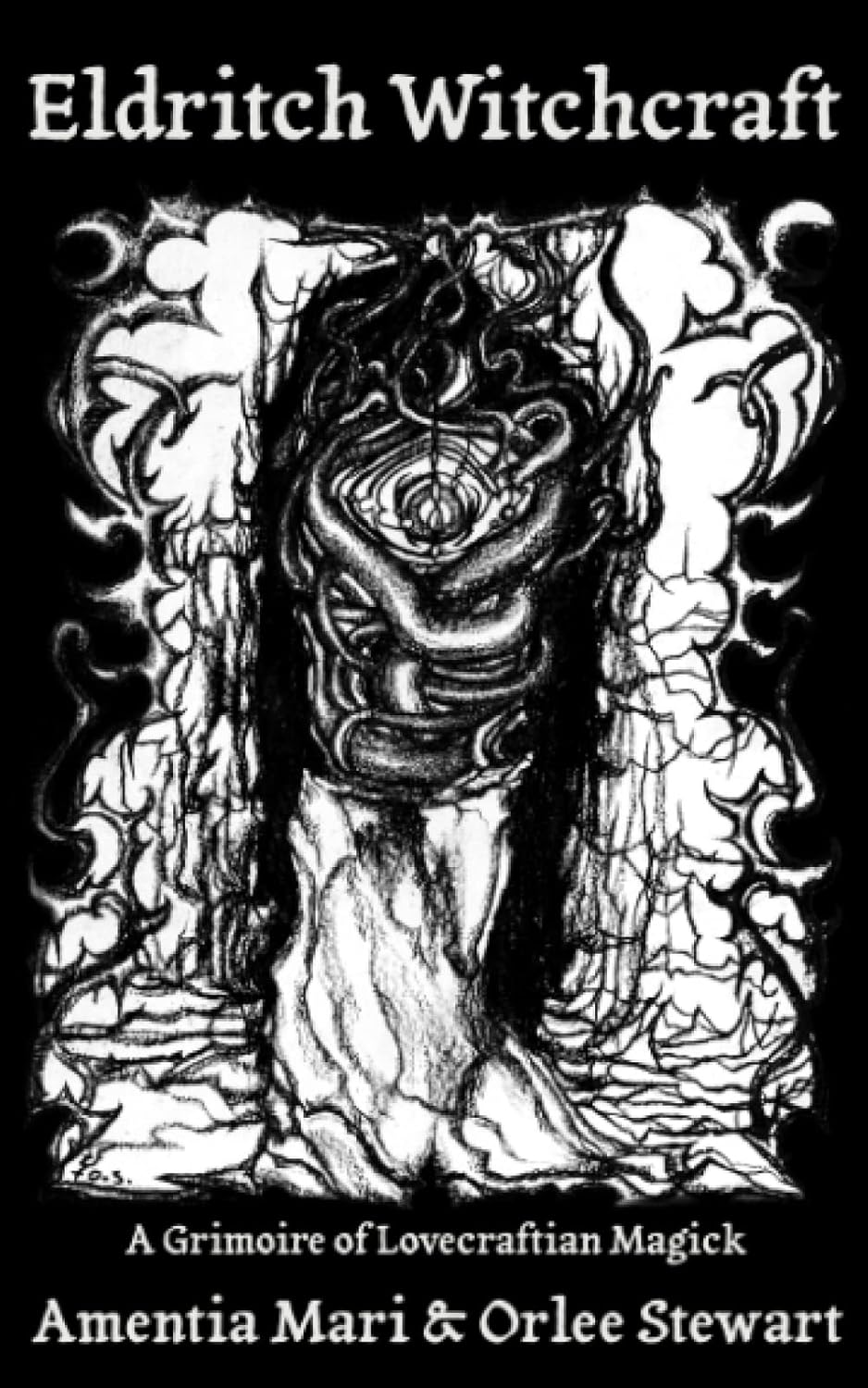
Which brings us to Eldritch Witchcraft: A Grimoire of Lovecraftian Magick (2023) by Amentia Mari & Orlee Stewart. This slim (38 pages) POD-published workbook is relatively light on Lovecrafian lore (a 3-page essay on “Eldritch Witchcraft” that discusses witches in some of Lovecraft’s stories, and mentions influential occultist Austin Osman Spare), and the rest of the book consists of magical recipes, rituals, sigils, and illustrations divided into five chapters:
- Rite to Become An Eldritch Witch: A Lovecraft Mythos-themed rite for solo initiation.
- The Eldritch Candle Prayer of Chaos: A variation on a prayer candle, with Lovecraftian trappings.
- Calling the Outer Gods: Sigils and incantations to invoke various Lovecraftian entities (Azathoth, Yog-Sothoth, Nyarlathotep, Shub-Niggurath, and Nahab (Keziah Mason)).
- Spells of Yog-Sothothery: Collection of recipes and charms: a ritual to consecrate your altar and tools, creating an amulet consecrated to Nyarlathotep, compounding a “witch’s unguent” of unspecified purpose, making the incense of Zkauba, making a dream pillow associated with Keziah Mason, and brewing dream tea. Many of the materials require the information from the previous two sections.
- Heart of Stars Meditation: A meditation intended to provide contact with alien intelligences via automatic writing; uses some of the materials in the “Spells of Yog-Sothery.” Ends with a brief personal account by Orlee Stewart of her experiences using this ritual, including contact with an entity that she speculates might be Nyogtha from “The Salem Horror.”
As a workbook for solo witches go, this book presumes a level of familiarity with the terminology and basic practices of contemporary witchcraft. Probably many Wiccans could fold it into their practice fairly easily; the gist is basic enough and familiar enough to magical practices by Austin Osman Spare, Thelemites, etc. that many occultists would have little difficulty adapting it to their own practices as well (though the Heart of Stars Meditation, it should be added, is written only for women in its current form).
Perhaps surprisingly, Eldritch Witchcraft doesn’t borrow heavily from Aleister Crowley, Kenneth Grant, or the Simon Necronomicon; instead it takes inspiration from the Necronomicon (1978) edited by George Hay, which is presented as translations from a fictitious medieval grimoire that is claimed to be the original from which Lovecraft derived the Necronomicon in his fiction.

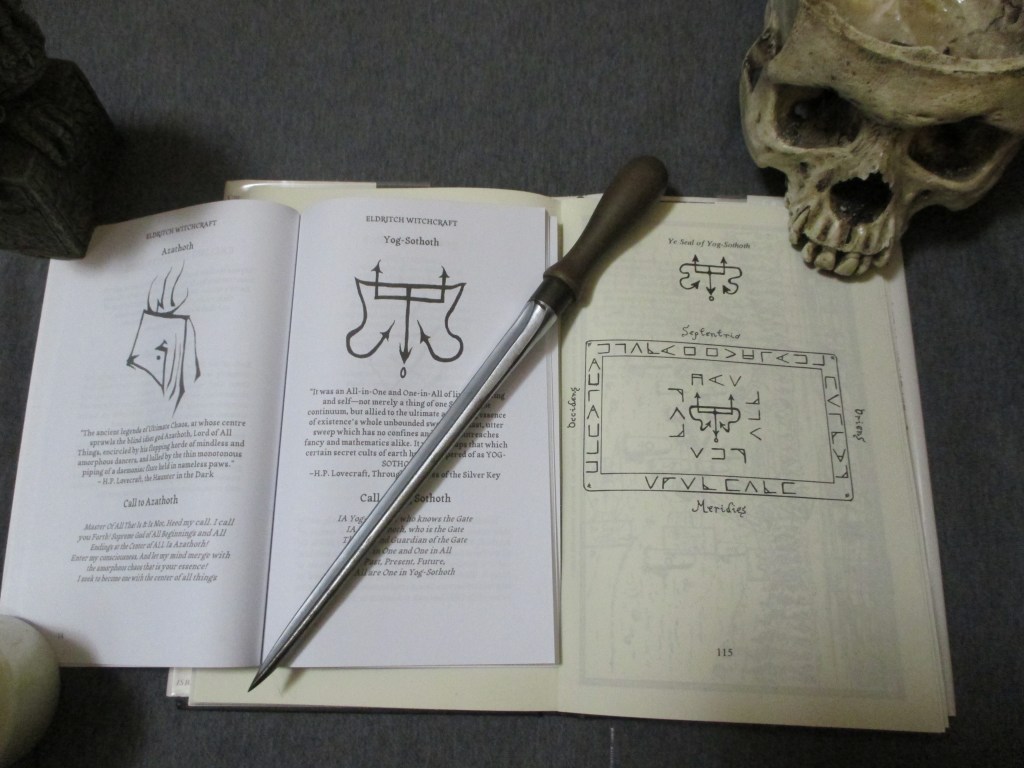
Many elements from the Hay Necronomicon have proven popular among artists and creators and both been re-used and inspired similar depictions. While the majority of the sigils and all of the artwork in Eldritch Witchcraft is original, it’s clear that the authors were drawing on the Hay Necronomicon when developing some of their practices.
Perhaps most notably absent in Eldritch Witchcraft are the trappings and religious underpinnings commonly associated with contemporary pagan witchcraft; neither is there any extended effort to pronounce Lovecraft’s Mythos as real or his stories as representing literal truth. The direct use of fictional characters in place of more traditional deities and the prominence of Austin Osman Spare suggests the influence of chaos magick, and a certain level of pragmatism: this is a practical collection of spells and materials designed to build one on the other, not a quasi-philosophical work like Phil Hine’s Pseudonomicon or Scott R. Jone’s When the Stars Are Right: Toward An Authentic R’lyehian Spirituality. Readers get the how, but not necessarily the why.
Which leaves open the question: what is the viewpoint of a Lovecraftian witch? How would a contemporary pagan witch reconcile their ideology and practice Lovecraft’s Mythos? Which tradition(s), if any, do they blend into their own practices? Eldritch Witchcraft provides one possible answer to the latter, but the other questions the reader will have to figure out for themselves.
Bobby Derie is the author of Weird Talers: Essays on Robert E. Howard and Others and Sex and the Cthulhu Mythos.
Deep Cuts in a Lovecraftian Vein uses Amazon Associate links. As an Amazon Associate I earn from qualifying purchases.
 Deep Cuts in a Lovecraftian Vein