I am very sorry that I did not keep his letters, but moving around from place to place made it impossible. As some of them were personal I did not wish them to be around for others to read perhaps after I left this earthly life. Letters are sometimes left that seem sacred to the owners, but others see it in a different light.
—Hazel Heald to August Derleth, 31 Mar 1937, MSS. Wisconsin Historical Society
Hazel Drake Heald was arguably H. P. Lovecraft’s most successful and prolific revision client. Between 1932 and 1937, five weird tales appeared under the name of Hazel Heald, the last of them being published only a month or so after his death, and all of them having Lovecraft’s hand in them to a greater or lesser extent. Yet for all that, relatively little is known about their correspondence: Lovecraft does not appear to have kept her letters, and she did not keep his. So once again we are left with a bit of detective-work, piecing together what we can of their relationship through Lovecraft and Heald’s other correspondence…and the framework of their relationship seems built around the timeline of their stories:
In this same year, 1932, I formed a little New England writers’ club of my own, and one of my members, a divorcee was very anxious to succeed in the weird writing field. She sent me an original manuscript with a very passable plot, yet told unconvincingly and amateurishly. I let Lovecraft read it when next he came over to our house on Pearl Street, and he agreed that it did have possibilities.
I wrote to the Cambridge, Massachusetts, club-member and told her about H.P.L., adding that he, too, was divorced. Would she like to have him look over her manuscript, “The Man of Stone”? She would! So I gave Lovecraft a note of introduction to Hazel Heald and another chapter in his life was soon taking place.
—Muriel C. Eddy, “The Gentleman from Angell Street” 22-23
I was a beginner and happened to be lucky enough to find HPL who certainly was the best to be found. He was a severe critic but I knew that if I finally suited him in my work that the editor would usually accept it. For example— I had to rewrite “Out of the Eons” six times before he was completely satisfied!
—Hazel Heald to August Derleth, 25 Mar 1937, MSS. Wisconsin Historical Society
In 1932, Hazel Heald was 36 years old, divorced, and working as a clerk or bookkeeper; but she had aspirations to be a writer. Her friend Muriel Eddy put her in touch with H. P. Lovecraft. We do not know exactly when and how Lovecraft and Heald began to correspond, although it seems likely to have been early 1932. The first mention of one of their stories in Lovecraft’s published correspondence is from August 1932 (Essential Solitude 2.497), in reference to “Winged Death”—but the first published story was “The Man of Stone,” which hit the stands in September of that year.
Given publishing times in the pulps, this tells us two things: that at least two stories had been written prior to September 1932, and that the stories seem not to have been submitted directly to Weird Tales—because “The Man of Stone” was published at Wonder Stories, and “Winged Death” was first submitted to Harry Bates at Strange Tales of Mystery & Terror. If Lovecraft followed his normal mode for revision clients, their initial letters would have involved many notes on the story or stories involved, genteel discussion of rates and terms, and suggestions for where and how to market the story. Having been subject to the capricious whims of Farnsworth Wright in the past, it wouldn’t be surprising if Lovecraft initially recommended other pulps who might pay more, and more promptly, than his “old standard.”
In September 1932, Lovecraft took advantage of a special low-cost ticket to visit Montreal and Quebec (Sep 2-6). Traveling on the cheap, Lovecraft gave little thought and less money to food and amenities:
Early the following Tuesday morning, before I had gone to work, Howard arrived back from Quebec. I have never before nor since seen such a sight. folds of skin hanging froma skeleton. Eyes sunk in sockets like burnt holes in a blanket. Those delicate, sensitive artist’s hands and fingers nothing but claws. The man was dead except for his nerves, on which he was functioning. that evening he had a dinner appointment in Somerville with a woman for whom he was doing some revision, and he had plans for things he wanted to do during the day.
—W. Paul Cook, “In Memoriam: H. P. Lovecraft” in Ave Atque Vale 59
The dinner appointment was with Hazel Heald. Muriel Eddy gives her version of events:
She invited him up to her house for Sunday supper and arranged to have everything that H.P.L. liked best on the menu. they ate by candlelight, and he was greatly intrigued by her thoughtfulness in not having a household of people to greet him. He used to say he could think better when there were not too many people around to disturb his train of thought.
He tactfully explained to Hazel that her story, though very good, really needed a little touching up here and there, something to stir the reader’s imagination. Would she allow him to do it for her? He’d consider it an honor and a privilege. She agreed.
—Muriel Eddy, “The Gentleman from Angell Street” 23
Eddy must have her dates wrong, because by September 1932 “The Man of Stone” was already written and accepted by Hugo Gernsback at Wonder Stories. But they might well have discussed other revisions, since one had already been submitted and accepted. Heald would describe their revision process in this way:
Lovecraft helped me on this story as much as on the others, and did actually rewrite paragraphs. He would criticize various paragraphs and pencil remarks beside them, and make me rewrite them until they pleased him. I certainly slaved on that story—my first! But all of my later stories he revised in the same way. I was so elated when it was accepted. They said I would have to send them a photograph of myself. I had special pictures taken, then when the magazine came out, there was a caricature of myself that even my mother wouldn’t recognize! I felt so hurt that the readers would think of me like that, and HPL was a good one to ease that hurt in his kind way. He said that no one ever recognized themselves from their artist’s drawing. He also advised me to get a lawyer for the payment of my check.
—Hazel Heald to August Derleth, 30 Sep 1944, MSS. Wisconsin Historical Society
While Lovecraft does not discuss any specific meetings with Heald in his letters, in her own letters she suggests that he made at least one, if not more visits to her corner of Massachusetts:
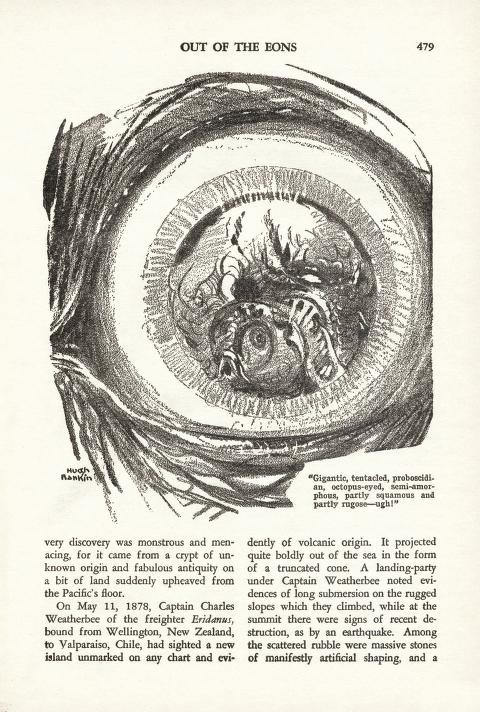
I was interested in Paul Cook’s account of Lovecraft’s Boston visit, and how he made him rest up before coming over to my house. He certainly did not act tired, and ate very well, although Cook said he gave him a good meal before he came. I wonder if he thought that he would be starved at my house? He seemed to enjoy himself a lot. Soon after that he came again, and we visited all of the museums together. That was where I conceived the idea for OUT OF THE EONS.
—Hazel Heald to August Derleth, 14 Oct 1944, MSS Wisconsin Historical Society
It is not clear which museums they might have visited, or when this might have occurred, although both the Museum of Fine Arts in Boston and the Semitic Museum in Cambridge, Massachusetts are possibilities, with collections of Egyptian artifacts and mummies that might have inspired the fictional Cabot Museum.
“Out of the Æons” might have been conceived over dinner in early September, but “The Horror in the Museum” was finished by October:
I’ve just ghost-written a tale for a client in a fashion amounting virtually to original composition—about a waxwork museum or chamber of horrors where there is a rumour that not all of the fabulous monsters displayed are artificial. I’ve included Tsathoggua among the blasphemies.
—H. P. Lovecraft to Clark Ashton Smith, 28 Oct 1932, Dawnward Spire, Lonely Hill 394
In any case, Farnsworth Wright accepted “The Horror in the Museum” by mid-November 1932 (DS 397)—but by February 1933 a problem had arisen where Gernsback did not pay Heald for “The Man of Stone” (DS 404). At this point, Lovecraft had written at least three stories with or for Heald (“The Man of Stone,” “Winged Death,” and “The Horror in the Museum”), and one had been accepted and published, one rejected, and one accepted pending publication; but we don’t know if Heald had paid Lovecraft for any of them. Without their letters, we don’t know the exact details of their business arrangements—but the lack of payment from Gernsback could not have helped the business side of their relationship.
Still, Lovecraft must have had some confidence in his client, because by the time “The Horror in the Museum” hit the stands, “Out of the Æons” was written, submitted, and accepted by Weird Tales:
Glad you enjoyed the Witch House and Museum story. Another tale which I revised for the “Museum” author, and which Wright has accepted, brings in von Juntz and his black book as almost the central theme. It concerns a mummy found in the crypt of a Cyclopean stone temple of fabulous antiquity; volcanically upheaved from the sea.
—H. P. Lovecraft to Robert E. Howard, 24 Jul 1933, A Means to Freedom 2.619
Weird Tales paid only on publication, and in the 1930s as the Depression worsened, often the payment was long after publication. It seems quite likely that by this point, Heald must have been in arrears to Lovecraft—and perhaps found a way to make up for it in kind:
Meanwhile (my hatred of the typewriter being stronger every day) I have had a delinquent client type the story I wrote last August, & have started the carbon on the rounds of the gang—beginning with Dwyer.
—H. P. Lovecraft to J. Vernon Shea, 8 Nov 1933, Letters to J. Vernon Shea &c. 175
I lately had a client type my story of last August—”The Thing on the Doorstep” (which isn’t very satisfactory), & am circulating the carbon amongst the gang (you’ll get it in time).
—H. P. Lovecraft to R. H. Barlow, 12 Nov 1933, O Fortunate Floridian! 85
HPL helped me in return for typing his tale “Dreams at Witch House.” I also typed his “The Thing on the Doorstep.” His writing was familiar to me, so it was much easier than for strangers.
—Hazel Heald to August Derleth, 31 Mar 1937, MSS Wisconsin Historical society
Heald also eventually, at Lovecraft’s suggestion, contacted New York lawyer Ione Weber to sue Gernsback for her money, and got it by November 1933 (DS 404).
Although Lovecraft does not mention it, “Winged Death” must eventually have been submitted to Wright at Weird Tales and accepted for publication; it hit the stands in the March 1934 issue…and that appears to have been pretty much the end of the professional side of Heald and Lovecraft’s relationship:
“Winged Death” is pretty much a ghost-written Ech-Pi-El-ism. All that honest Mrs. Heald had to start with was a cloudy idea about somebody killing somebody with bugs. Then she got a medical friend to shed some light on poisonous African insects, & decided to give the tale an African cast. That was all I had to go on. The plot—with the idea of transferred personality & the returning & ceiling-writing death-envoy—is entirely my own. But it doesn’t pay to do this sort of work—when one could have just as good chances of full pay with a piece nominally as well as actually one’s own. I’ve cut it out now—though the last two reliques of my collaboration (one more Heald opus & the collaboration with Sultan Malik) are yet to be printed.
—H. P. Lovecraft to Clark Ashton Smith, 9 Mar 1934, DS 544
The “one more Heald opus” is presumably “Out of the Æons,” which Wright would hold onto without publishing (or paying for) until 1935. Still, though Lovecraft gave up ghostwriting and fiction revision as a business in 1934, his stories with Heald had a bit of an afterlife that they would have discussed in their letters: “The Horror in the Museum” was reprinted in the Not at Night anthology Terror by Night (1934), and reprinted in the Not at Night Omnibus (1937).
As far as the writing of “Out of the Æons” goes, Lovecraft would write when it was published:
Regarding the scheduled “Out of the Æons”—I should say I did have a hand in it…..I wrote the damn thing! The original museum-mummy story submitted for revision was so utterly lousy (some crap about a Peruvian miner trapped underground) that I had to discard it altogether & prepare a fresh tale. But it’s really foolish to attempt jobs so extensive, when with the same amount of work one could write an acknowledged story of one’s own. This is the last collaboration of the sort I shall ever attempt—indeed, I’ve turned a deaf ear to all further suggestions from Sultan Malik, Mrs. Heald, Kid Bloch, & others.
—H. P. Lovecraft to Clark Ashton Smith, 26 Mar 1935, DS 594
Glad you like “Out of the Æons”—which is, as I may have mentioned, virtually an original story of mine. All that survives from the initial Heald outline (worthy Mme. H. never bothered to write out any actual text for it!) is the basic idea of a living brain discovered in an ancient mummy.
—H. P. Lovecraft to Clark Ashton Smith, 11 Apr 1935, DS 603
Ironically, fan response to Heald’s stories in Weird Tales were often more vocal than for Lovecraft’s contributions under his own name.
We can only speculate as to what might be in Lovecraft and Heald’s letters between 1934 and 1937; her name is notably absent from his 1934 list of correspondents to whom he was sending postcards on his travels (Collected Essays 5.267), but we know she wrote to him while he was in Florida in 1934 (thanks to a surviving envelope), so it’s likely they would have discussed their lives, travels, and writing. The best evidence for their continued correspondence was that in January 1937, Lovecraft still had a current address for her when fan John Weir asked for submissions for a new fanzine:
Sorry I can’t dig up any more material at the moment—am wallowing in a morass of tasks & staggering under what seems like a variant of grippe. Hope you can assemble sufficient copy for #1, & am glad you have an illustration for future issues.[…] Glad you’ve received at least some material from those I recommended. Come to think of it, you might get a short story (fairly long as such things go) from Mrs. Hazel Heald, 15 Carter St. Newtonville, Mass. Ask her for “In the Gulfs of N’Logh” or some other tale which didn’t land professionally.
—H. P. Lovecraft to John Weir, 28 Jan 1937, MSS. John Hay Library
“Some other tale” is where things get interesting. In her letters to August Derleth and elsewhere, Hazel Heald mentions “In the Gulf of N’Logh” (193?) and “Lair of Fungous Death” (193?), and her story “An Heir of the Mesozoic” was eventually published by Weir in his fanzine Fantasmagoria. Were any of these were stories that Lovecraft had a hand in, either through offering revision comments or fully ghostwriting, between 1932 and 1934? We don’t know, but their very existence suggests a correspondence that was more busied and complicated than just the four stories mentioned above would indicate—much like his correspondence with another revision client, Zealia Bishop.
H. P. Lovecraft died on 15 March 1937; it’s not clear when Heald became aware of his passing, but she wrote to Weird Tales shortly after:
Hazel Heald writes from Newtonville, Massachusetts: “I want to express my sorrow in the passing of H. P. Lovecraft. He was a friend indeed to the struggling author, and many have started to climb the ladder of success with his kind assistance. To us who really knew him it is a sorrow that mere words cannot express. His was the helping hand that started me in the writers’ game and gave me courage to carry on under the gravest difficulties. But we must try to think that he is ‘just away’ on one of his longest journeys and that some day we will meet him again in the Great Beyond.”
—Weird Tales, “The Eyrie” Jun 1937
Mrs. Hazel Heald writes from Newtonville, Massachusetts: “A brain like H. P. Lovecraft’s seldom was found—uncanny in its intelligence. He was ever searching for more knowledge, gleaning by endless hours of study a richer and fuller understanding of people and of life. Being a great traveler, he reveled in the study of old cities and their hidden lore and would walk many miles to inspect some historic spot. He was a real friend to all who knew him, always ready to give his valuable time to aid some poor struggling author—a true guiding star. He was very partial to dumb animals, especially cats, signifying that interest in several of his tales. He would step out of his way to pat some forlorn alley cat and give it a friendly word, and the kittens of a neighbor furnished him unbounded enjoyment. He was an ardent lover of architecture and all the fine arts, and a day spent in a museum with him was time well spent. By endless hours of toil eh worked far into the night giving the world masterpieces of weird fiction, sacrificing his health for his work. Lovecraft was a gift to the world who can never be replaced—Humanity’s Friend.”
—Weird Tales, “The Eyrie” Aug 1937
In the May 1937 issue of Weird Tales, Heald’s fifth story was published: “The Horror in the Burying Ground.” Without Lovecraft around to comment, we know nothing of when or how it was written, although it is popularly supposed from internal evidence that he had a hand in it. If he did write it, or at least revise it, sometime around 1932-1933, it would be one more example of the fruitfulness of their creative endeavors…and of the quiet failures and rejections that were masked by their successful sales.
My HORROR IN THE BURYING GROUND was rejected once by Wright, then several years later I rewrote it in several places and he accepted it. He said I had too much dialect to read easily.
—Hazel Heald to August Derleth, 14 Oct 1944, MSS. Wisconsin Historical Society
Little is known of Hazel Heald’s later life; her letters to August Derleth fall off after 1937, but pick up again in the early 1940s as he sought to obtain permission to republish her stories among Lovecraft’s revision tales. She continued to attempt a literary career, mentioning efforts to publish stories in the pulps without success, but for regular employment was forced to be a housekeeper.
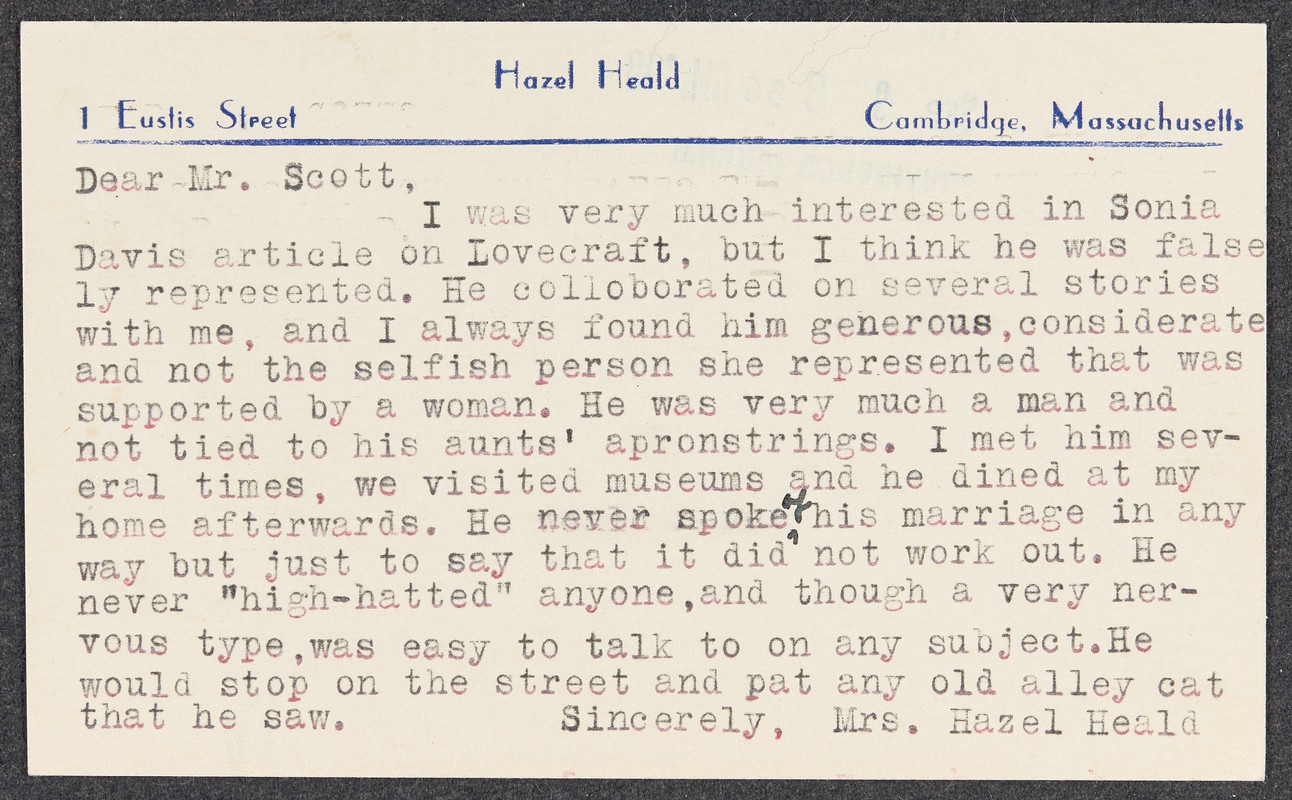 Hazel Heald to Winfield Townley Scott, 8 Sep 1948, MSS. John Hay Library
What did Lovecraft mean to Hazel Heald? What little correspondence that survives from Heald in library archives is entirely because of her connection to Lovecraft, in one form or another. In truth, we might not remember Heald at all if not for her position as Lovecraft’s revision client, and it could well be she knew that it was the Lovecraft connection which was responsible for the small attention she got from fans like John Weir and editors like August Derleth. Unlike Zealia Bishop or Adolphe de Castro, she never seems to have had the resources to consider seriously self-publishing, didn’t have the writing chops to get accepted by commercial magazines, and had no connection with fanzines beyond Weir’s Fantasmagoria. She sold a couple manuscripts to a dedicated fan, and apparently kept in touch with the Eddys, but that is about as far as the Lovecraft connection took her.
Bobby Derie is the author of Weird Talers: Essays on Robert E. Howard & Others (2019) and Sex and the Cthulhu Mythos (2014).

 Deep Cuts in a Lovecraftian Vein