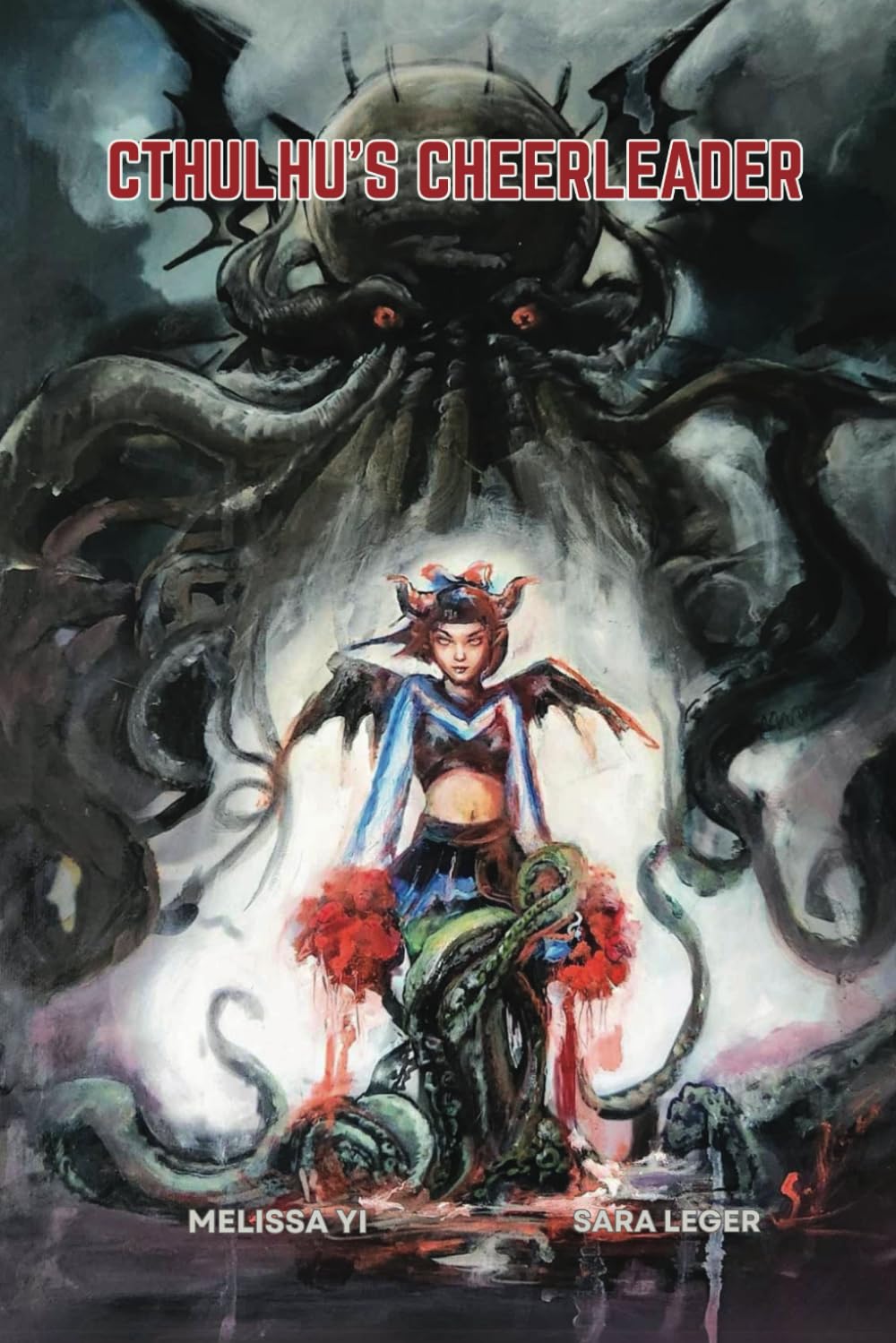
Cthulhu’s Cheerleader (2025) by Melissa Yi & Sara Leger

Why not mash up H.P. Lovecraft with poetry and art that reflects the diversity of the 21st century?

One poem for each month of the year, as an ebook, a book, a calendar, or a day planner, accompanied by nine pieces of art and this note from the artist herself.
—Melissa Yi & Sara Leger, Cthulhu’s Cheerleader (2025)

The work and person of H. P. Lovecraft has been inspiring poetry for a long time (e.g. “H. P. Lovecraft” (1937) by Elizabeth Toldridge, “Shadow Over Innsmouth” (1942) by Virginia Anderson & “The Woods of Averoigne” (1934) by Grace Stillman, etc.) and the form and nature of those works have been diverse, covering nearly every style and format of poem, from Cthulhu on Lesbos (2011) by David Jalajel to “Lovecraft Thesis #5” (2021) by Brandon O’Brien, from reflections on Lovecraft’s racism to new stories set in Lovecraft’s Mythos.

Melissa Yi (also published as Melissa Yuan-Innes) and artist Sara Leger bring their skills together for this small art project, which consists of 12 original poems in various styles (from Shakespearan sonnet to Japanese haiku), 10 of the poems that inspired those poems, and 9 original illustrations that capture something of the feel and aesthetic of the poems. The nature of these poems might be best illustrated by a side-by-side comparison of a poem and its source:

What happens to those interned?
Is she tucked in a
Straightjacket at night?
Or dunked in ice water—
If he puts up a fight?
Do you extract her lady parts
Plus her frontal lobe—
Or electroshock him and restart?
Perhaps seclude them in cells
’til they do what they’re told.
Or do they grow bold?
What happens to a dream deferred?
Does it dry up
like a raisin in the sun?
Or fester like a sore—
And then run?
Does it stink like rotten meat?
Or crust and sugar over—
like a syrupy sweet?
Maybe it just sags
like a heavy load.
Or does it explode?
“Arkham” (November) by Melissa Yi“Harlem” by Langston Hughes

Hughes’ “Harlem” (1951) is one of the most recognized and influential poems of the 20th century, not in least because it inspired the title to Lorraine Hansberry’s play A Raisin in the Sun (1959). The metaphor of the raisin in the sun speaks to the social and psychological forces that Black Americans and communities have, and continue, to face in a culture and society that holds high ideals of freedom while continuing to perpetuate prejudice and inequality at every level.

By taking “Harlem” as her model for “Arkham,” Yi is implicitly drawing on both the familiar poem’s form and its imagery by inference. Her “Arkham” is not the witch-haunted city, as Robert E. Howard wrote about in his poetic tribute, but the sanitarium, the good-bye-box where people who don’t fit in are locked away and subject to treatments and mistreatment, deprived of liberty and rights, subject to physical and psychological efforts to get them to conform to what society wants them to be.

“Arkham” doesn’t quite have the rhythm of “Harlem,” even though it is an obvious echo of Hughes’ trumpet blast. The imagery is pointed, but the target is hazy; lobotomies and electroconvulsive therapy weren’t a feature of mental health treatment in Lovecraft’s time, and ice-dunking and clitorectomies suggest still older institutions. So “Arkham” isn’t referencing a single institution at a given place or time, but the idea of the mental asylum, the sanitarium, the Bedlam of all times and places, the institutional limbo where a few of Lovecraft’s characters have ended up (which has become a literary trope).

It is a fun experiment. Not every poem works well on its own, but pairing them up with the originals does help show the work. Sara Leger‘s artwork is fun, though the print-on-demand publication doesn’t show it off to its best effect. The single best piece is the cover, with the eponymous Cthulhu’s Cheerleader striding forward, bloody pomp-poms in hand, wings spread, as the Big C looks on. While some folks might argue that Cthulhu doesn’t need a cheerleader, if he is to remain relevant into the 21st century and beyond, I think Cthulhu will need every cheerleader he can get.

Cthulhu’s Cheerleader (2025) by Melissa Yi & Sara Leger was published by Windtree Press.


Bobby Derie is the author of Weird Talers: Essays on Robert E. Howard and Others and Sex and the Cthulhu Mythos.

Deep Cuts in a Lovecraftian Vein uses Amazon Associate links. As an Amazon Associate I earn from qualifying purchases.
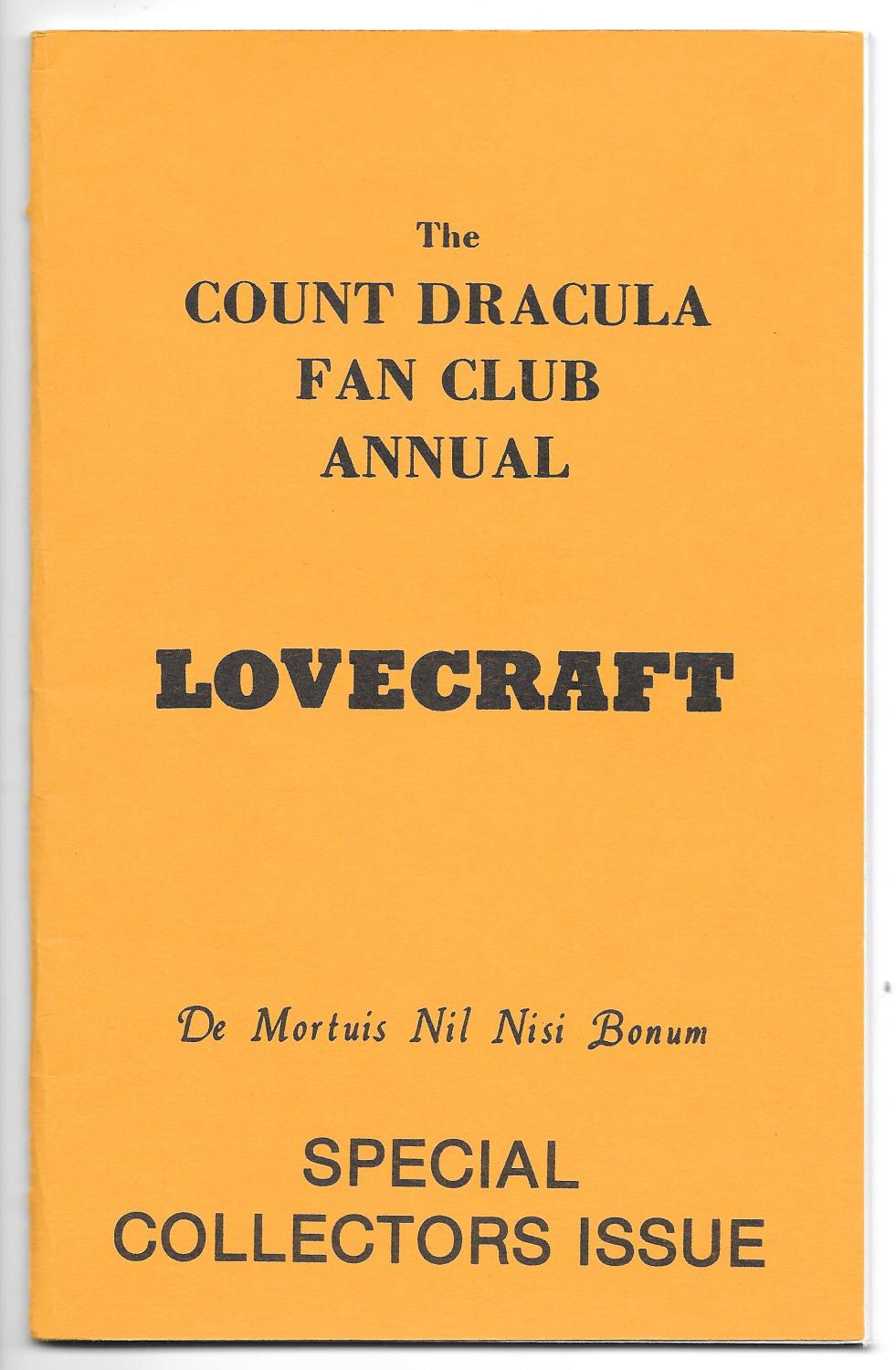
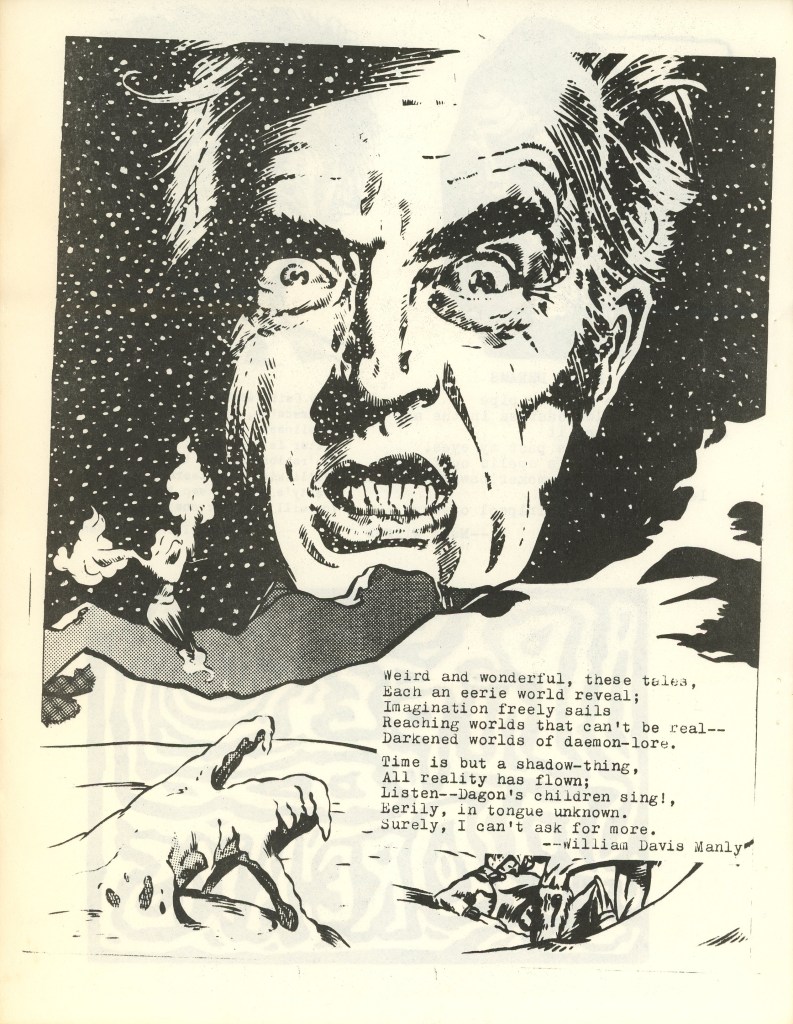
“The Passionate Fantasophile” (1979) by Janice Arter & “To the Shade of HPL” (1981) by Margaret Carter

Dr. Jeanne Keyes Youngson founded the Count Dracula Fan Club in 1965 after a trip to Romania; this was before the publication of McNally and Florescu’s In Search of Dracula (1972), but after the first full biography of Stoker, Harry Ludlam’s A Biography of Bram Stoker: Creator of Dracula (1962). It was the beginning of a serious opening-up of Dracula scholarship, serious scholarship that had fans and researchers scouring archives, uncovering Stoker’s original notes and manuscript, critically annotating and comparing different editions of the text. The work was international, and the fan club contained both enthusiastic vampire fiction fans and literary historians, and it published official journals and other publications.

In 1985, the Count Dracula Fan Club published an annual, a special Lovecraft-themed collectors issue. The highlight of the issue might be Kenneth W. Faig, Jr.’s brief article “The Revision of Dracula”—the first real address of the Lovecraft/Miniter Dracula revision anecdote from the Lovecraftian scholar’s point of view. However, it was full of more than that, including two neat little Mythos poems by women authors, “The Passionate Fantasophile” by Janice Arter and “To the Shade of HPL” by Margaret Carter.

“The Passionate Fantasophile” by Janice Arter

Published for the first time in The Further Perils of Dracula (1979), a Count Dracula Fan Club poetry anthology, Arter’s 18-line poem is a lyric poem, opening with the invitation “Come live with me and drink my blood,” and working through a list of familiar activites, including:

Come live with me and we shall learn
The power to make the oceans burn,
The secrets of the Scroll of Thoth,
The chant to summon Yog-Sothoth,
And we shall be as one.

This is a poem for lovers in multiple senses of the term. It is a very romantic invitation, of one horror fan to another, inviting activities that would be horroric to anyone except another horror fan. By the 70s, Lovecraft’s Mythos was being woven into the pantheon of familiar horrors, and Yog-Sothoth could comfortably rub shoulders next to vampires and witches. It is the kind of opening-of-the-heart that would only really work from one true horror fan to another, someone who will both get the references and the appeal of going to the Sabbath or dwelling in unimagined space with someone else who gets it.

“To the Shade of HPL” by Margaret Carter

Published for the first time in Daymares from the Crypt (1981), a chapbook collection of Carter’s poetry, and was re-released in an ebook of the same-name in 2012. Carter’s verse takes the form of an ode in 12 lines, a tribute to Lovecraft and the Mythos he had spawned, which Carter herself had contributed to over the years, and would continue to do so in the years to come. Some of the imagery is in the same vein as Arter’s poem, emphasizing the Mythos experience and aesthetic:

The hand that traced those tales of nameless lore
Never lent its grave-chilled touch to me—
Yet I have groped my way down Arkham’s hills
To watch the rites of Innsmouth by the sea.

The difference is, Carter isn’t just evoking Lovecraft’s Mythos, but Lovecraft himself. The Old Gent had already become a part of his own Mythos, his growing legend entwined with the stories he had written, and the artificial mythology being slowly expanded by fans and pros alike. Carter isn’t directly inviting the reader to participate in nameless rites or to dance with ghouls, but is expressing her own experience of doing so, made possible only by H. P. Lovecraft.

While both of these poems are fairly minor in the grand scheme of fantasy and horror literature, they are examples of the growing acceptance of Lovecraft and the Mythos in the 1980s, even in Dracula fandom, which was only tangential to Lovecraft.


Bobby Derie is the author of Weird Talers: Essays on Robert E. Howard and Others and Sex and the Cthulhu Mythos.

Deep Cuts in a Lovecraftian Vein uses Amazon Associate links. As an Amazon Associate I earn from qualifying purchases.

Deeper Cut: C. L. Moore Before The Pulps

Well. . . when I was in my early adolescence, I had a series of fairly serious illnesses and I had to be taken out of school. I spent a great deal o f time in bed, entertaining myself by reading everything 1 could get my hands on. It’s strange, but I don’t know how I ever got my hands on Weird Tales because it was strictly frowned on in my family—it was trash! But somehow, I did and I was thoroughly delighted with them. They were a brand new marvelous world. I’m sure I must have been thinking about those things for some years after I recovered. . . after I had finally gone through school and college. I had to stop college after three semesters and was very fortunate in finding a job. Still, I hadn’t done a lot of writing in this field, although I had written a bit for my own amusement at various times-melodramatic stuff, very adolescent and fun to do.
—C. L. Moore, “Interview: C. L. Moore Talks To Chacal” in Chacal #1 (26)

Catherine Lucille Moore’s first professional publication in pulp magazines was “Shambleau” (1933), in the pages of Weird Tales. The immense acclaim of her initial spate of stories from 1933-1940, when she married Henry Kuttner, has become part of the legendry of pulp fiction. Yet while C. L. Moore seems to have emerged full-grown like Aphrodite upon the waves, what this really means is that a great deal of what she wrote before she began her professional pulp career has sadly been lost—either never published, or published and largely forgotten.

The earliest such work is technically juvenilia, though it extended into adulthood:

Ever since we were about nine a friend and I have been evolving a romantic island kingdom and populating it with a race which, inevitably, is a remnant of Atlanteans. We’ve a very detailed theology and mythology, maps all water-colored and scroll-bordered and everything, a ruling house whose geneology and family tree and so forth has been worked out in tbales and charts from the year minus—oh, just about everything that two imaginative girls could think of over the space of fifteen years. (Heavens, has it been that long?) We have songs and long sagas of heroes, and a literature full of tradition and legends, and we even made and colored a series of paper dolls to illustrate the different types and their costumes, and then there were wars and plans of battle, and we have the maps of all our favorite cities, and we’ve written a good deal of history. And that history is what I take seriously.

We centered on a favorite period, around 1200-1250, and the history gradually became the biography of the outstanding man of that generation, and for the past ten years at least I have been writing, off and on, about this rather picaresque hero and his adventures. If I think of it I’ll send you a sample or two. It mostly comes in short snatches, just as the mood seized me. And of course a lot of it is romantically school-girlish, and a lot full of undergraduate tragics, because it’s grown up with me and has a long way to grow yet.

Odear, now you have me started—I hadn’t thought of this for nearly a year, since my friend moved out of town and I took up the fantasy writing. Gee, it was fun. The hero’s name was Dalmar j’Penyra, and he had red hair and black eyes and was a priate and a duke and a mighty lover and quite invincible in anything he chose to undertake. How we used to thrill over his escapades. He died in 1256, at the age of 35 (that seemed to use the absolute ultimate at which a man might remain even remotely interesting) and we almost wept whenever we thought of it. Bless him, he does seem awfully real. We used to make sad little songs about it—The girls who died for Dalmar, tonight they sleep a chill—the honey lips are dust now, the throbbing throats are still, and peace is on the high hearts that beat for him so warm, and peace is on the black heads that lay on Dalmar’s arm. Their hearts have ceased from sorrowing, their tears no longer fall—the narrow bed, the cold bed, the grave enfolds them all. Oh, girls who died for Dalmar, and lie tonight so low—
—C. L. Moore to R. H. Barlow, 10 Sep 1934, MSS. Brown Digital Repository

In a later interview, Moore specified this friend was her cousin:

What happened was that I had a cousin with whom I was very close, and we used to make up romantic tales of mythical kingdoms. We would take, long, long walks in the neighborhood under the trees—it was a lovely time in the world to be alive—and we each worked out or own fantasy kingdom with dashing young heroes and lots of swashbuckling adventure. Then we began separately to write it out. It was not anything that either of us considered offering for publication; it never occurred to us. I found some of it not too long ago, some writing from back in my early teens. The writing style has not changed very much except for one thing: I never said anything once when I could say it five times. It was intolerably dull to read. The writing is all right, but the repetition is hideous!

[…]

I think my cousin with whom I developed the mythical kingdom and I would have gone on in that Vein if she hadn’t had to move away and if I hadn’t had the job. But it was there, and it would have to have come out one way or another.
—”CA Interview,” Contemporary Authors vol. 104 (1982), 326-327

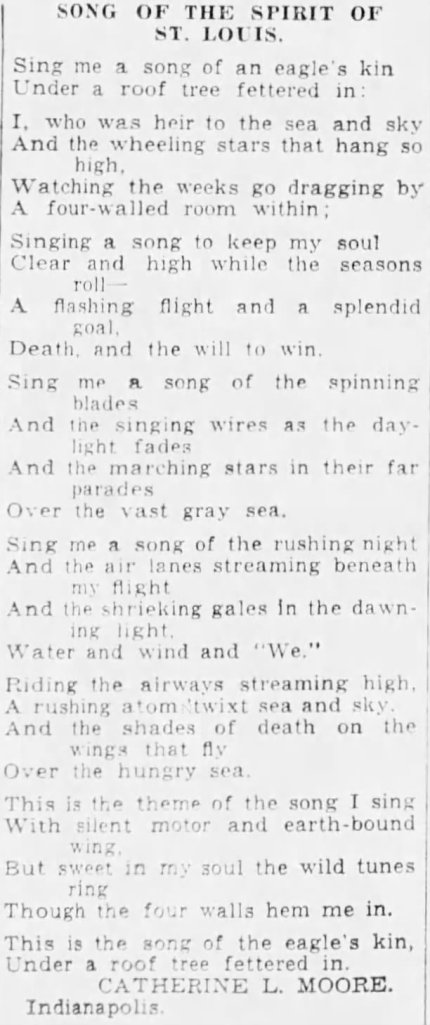
Bits and pieces of these poems about Dalmar j’Penyra are included in some of Moore’s letters to R. H. Barlow and H. P. Lovecraft in the period, and those fragments to Lovecraft in Letters to C. L. Moore and Others are the only ones published. Moore did not publish much poetry during her pulp career, but like many other Weird Talers she had a knack for it. One poem believed to have come from Moore’s typewriter made it into newsprint:

The Spirit of St. Louis with pilot Charles Lindbergh had completed the first nonstop transatlantic flight in 1927; pilots could be heroes in the 1920s, and there is more than a hint of fantasy in this verse.

At age 18, C. L. Moore enrolled at the local Indiana University and took classes for three semesters (Fall 1929, Spring 1930, and Fall 1930). However, Black Tuesday struck in October 1929, signalling the beginning of the Great Depression, and her family’s finances required her to leave school and gain employment, which she did. While associated with the university, however, Moore contributed to its school magazine The Vagabond, publishing three short stories: “Happily Ever After” (The Vagabond Nov 1930), “Semira” (The Vagabond Mar 1931), and “Two Fantasies” (The Vagabond Apr 1931). The University has since made these public domain materials available online.

In 2013, these three stories saw print commercially in the Galaxy’s Edge magazine, issues #2 (May 2013, “Happily Ever After”), #3 (July 2013, “Two Fantasies”), and #6 (January 2014, “Semira”), as well as best-of and omnibus editions.

None of these fragments and short works—the Dalmar stories, “The Spirit of St. Louis” poem, or the three amateur fantasies during her brief university period—have any obvious direct connection with C. L. Moore’s pulp fiction. That is, Northwest Smith does not appear to be Dalmar j’Penyra with a raygun, and if there was a prototype of the flame-haired Jirel of Joiry, she isn’t obvious. (There are certain interesting parallels between Dalmar and Henry Kuttner’s Elak of Atlantis, but Moore is not known to have had a hand in those stories and the parallels might well be coincidental.) Yet what these works make clear is that before C. L. Moore made her pulp debut she had already done years of prep work, reading and writing fantasy and adventure stories, developing her poetic sense, crafting the skills that would serve her well in her pulp career.

Such insight into developing writers is rare; readers today might be a bit spoiled with how much of the early and private work, even the juvenilia, of pulp writers like H. P. Lovecraft, Robert E. Howard, and Clark Ashton Smith is available for the right price. Most pulpsters, however, are blanks before their professional debut. We are fortunate to have these early examples of C. L. Moore’s work, which give us a glimpse at her process and development. For while she would polish her prose and improve her style and speed during her legendary career, it is evident that she was building on a foundation that went right back to childhood fantasy worlds, drawing on her love of fantasy, mythology, and adventure until—at last—she took the chance to submit something for publication.


Bobby Derie is the author of Weird Talers: Essays on Robert E. Howard and Others and Sex and the Cthulhu Mythos.

Deep Cuts in a Lovecraftian Vein uses Amazon Associate links. As an Amazon Associate I earn from qualifying purchases.
Her Letters to August Derleth: Lilith Lorraine

Lilith Lorraine was the pseudonym of Mary Maude Dunn Wright (1894-1967), a prolific poet, pulp fiction writer, editor, publisher, and early science fiction fan. It isn’t clear when exactly Lorraine and Derleth became aware of each other, though they shared interests in common, particularly fantastic poetry. If Derleth did not see any of her stories that were published in the 1930s, he would have heard of Lilith Lorraine at least in late 1943, when Clark Ashton Smith mentioned her to him in a letter (EID 341). Derleth would also probably have noticed her poems “The Acolytes” (1946) and “The Cup-Bearer” (1951), but they do not appear to have had direct contact with one another, since as late as 1950 Clark Ashton Smith was still offering to act as a go-between (EID 417). For her own part, based on Smith’s letters Lorraine was clearly aware of Derleth as the editor and co-founder of Arkham House.

The file of correspondence at the Derleth Archive of the Wisconsin Historical Society is a bit thin: 11 pieces of correspondence, mostly notes and postcards, most undated, in Box 32, Folder 9. There may well have been other bits of correspondence over the years that was lost or misfiled, but based on the contents this correspondence seems to have covered roughly 1959-1963, which coincides with the latter years of publication of Lorraine’s poetry magazine Flame (1954-1963), which later merged with another ‘zine to become Cycle*Flame. At the same time, Derleth was trying to promote his own poetry ‘zine Hawk & Whippoorwill (1960-1963) and publish the anthology Fire and Sleet and Candlelight (1961, Arkham House), and the crux of the correspondence seems to cover their mutual selling of poems to each other and promoting their respective magazines.

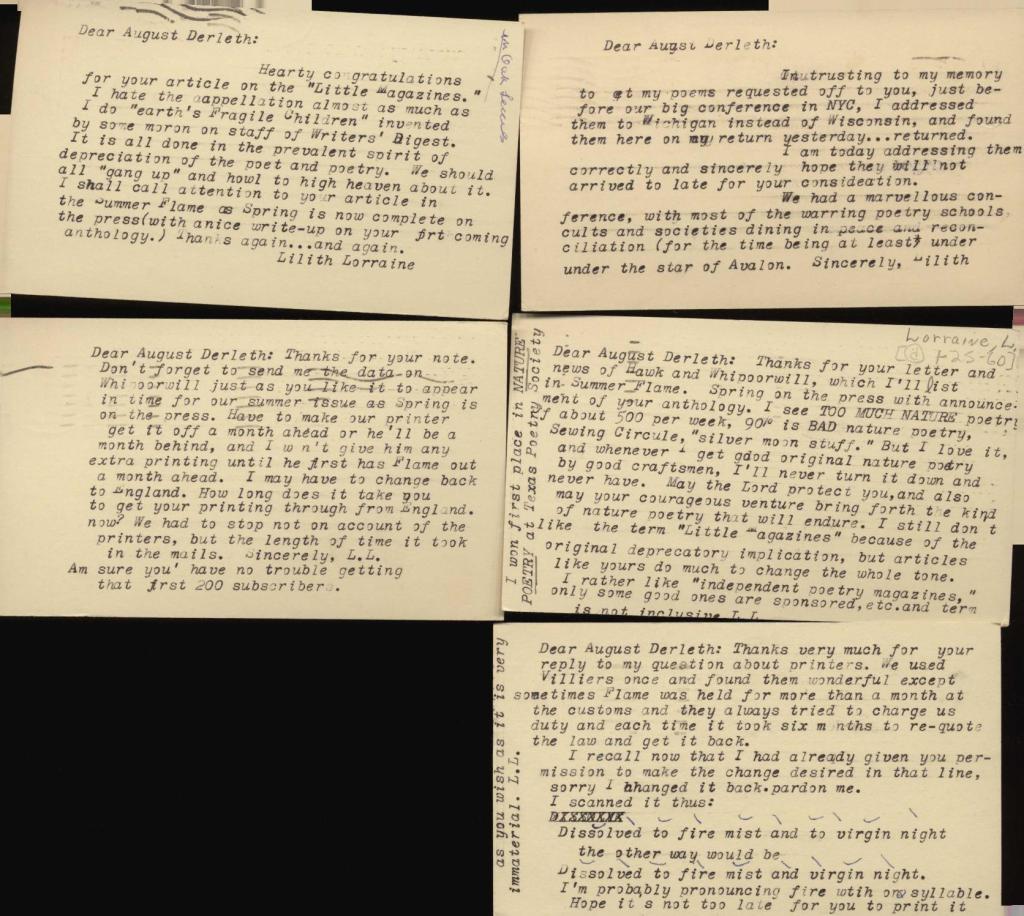
Sample of Lilith Lorraine’s postcards to August Derleth.

The “article on the ‘little magazines'” that Lilith Lorraine mentions might be “Hawk & Whippoorwill: Poems of Man and Nature,” a form letter that was sent out to advertise Derleth’s new poetry magazine; curious readers can find it reproduced as Item 65 in Arkham House Ephemera.

It is not clear how many poems Derleth actually placed in Flame, as there is neither a complete index to the magazine nor a complete index to Derleth’s poetry. Three poems were definitely published: “Moon and Fog” (Summer 1959), “Fox by Night” (Spring 1960), and “Satelite” (Winter 1961). The letters and notes suggest the acceptance of “Lantern in the Winter Woods,” but if that was published in Flame, I have not yet located the issue.

For his part, Derleth solicited and accepted five of Lorraine’s poems for his poetry anthology Fire and Sleet and Candlelight, including “Case History,” with the correction she noted:


CASE HISTORY
by Lilith Lorraine

When all his seas with serpents were aflame
And he was God trapped in his universe,
A dark and shadowed loneliness, whose name
Wavered like plumes above a phantom hearse,

The hearse moved on and six phantasmal steeds,
Pawed the gray emptiness of outer space.
And scattered all his comets and his creeds,
With muted thunder and malignant grace.

His mind constricted to the planet’s core,
Dissolved to fire mist and virgin night,
Until upon a sea without a shore,
He stood ungarmented, a naked light,
Alone once more upon the terrible coasts,
And desperately tired of gods and ghosts.

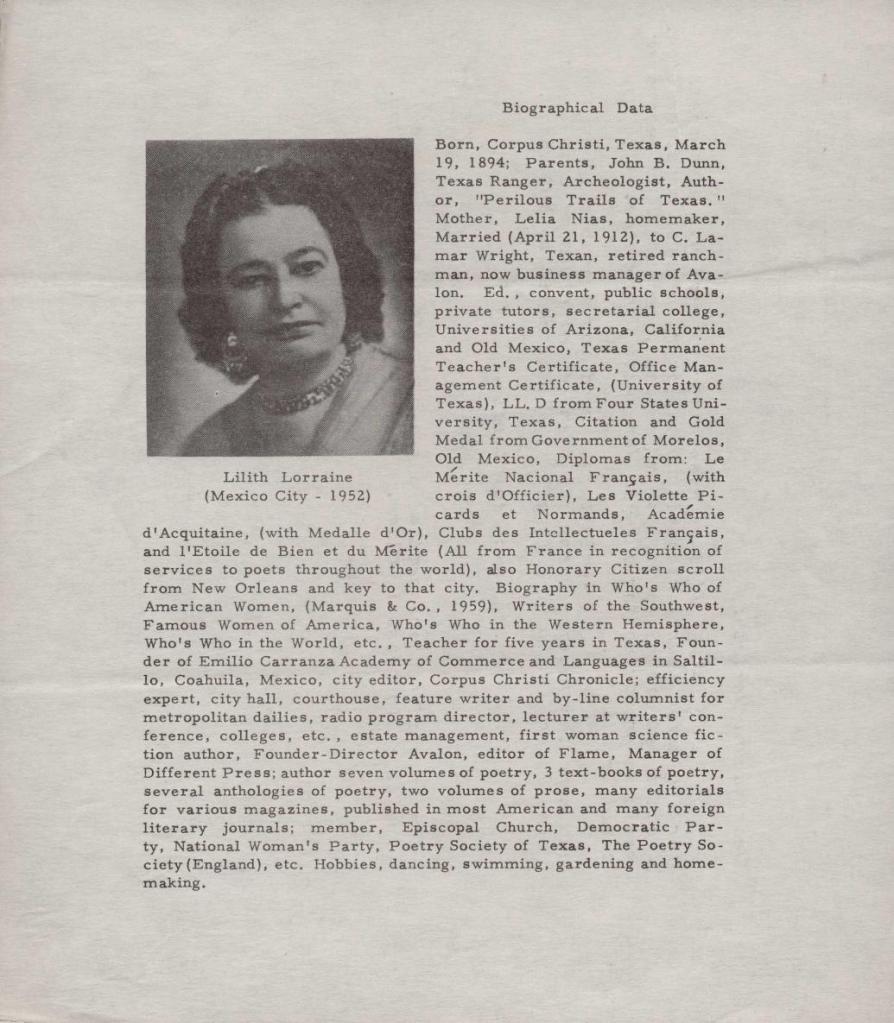
There is a printed biographical flyer in the folder of correspondence, and Lorraine may have sent this to Derleth in response to a request for biographical data for the back pages of Fire and Sleet and Candlelight, which includes the entry:

LILITH LORRAINE was born in Texas and still lives there, where she edits Flame and manages the Different Press. She has written extensively in the field of science-fiction, and is an active proponent of the best in poetry, at the same time serving as an exponent of the traditional in verse as opposed to obscurantist and incoherent experimentation. She is founder-director of Avalon. She is the author of several books, among them Wine of Wonder, Not for Oblivion, The Lost Word, and Character Against Chaos, and has for several years edited the annual Avalon anthology She has been distinguished for her activity all her life in behalf of poetry.
—August Derleth, Fire and Sleet and Candlelight 232

For the most part these brief letters and notes are cordial, but largely impersonal. Friendly, but not revealing great details of each other’s lives. These missives were written with a specific purpose, the horse-trading of poetry editors who are also poets themselves, and they seemed to get along well with one another.

Why did the correspondence cease? Perhaps time and energy in their personal and professional lives just led to a drop-off, since Derleth was no longer publishing a poetry journal or anthology, and Flame had gone on to its new incarnation. We are left with only a brief glimpse into the lives of two poets and editors, who ironically wrote little to each other of art or aesthetics, but who apparently appreciated one another’s work. After all, they each published the other.

Thanks to David E. Schultz for his help with this one.


Bobby Derie is the author of Weird Talers: Essays on Robert E. Howard and Others and Sex and the Cthulhu Mythos.

Deep Cuts in a Lovecraftian Vein uses Amazon Associate links. As an Amazon Associate I earn from qualifying purchases.

Requiem for a Siren: Women Poets of the Pulps (2024) ed. Jaclyn Youhana Garver & Michael W. Phillips, Jr.

Dorothy Quick was one of almost three hundred women who published fiction and poetry in sci-fi and horror pulp magazines before 1960.

Have you heard of her?
—”Introduction: A Place for Wild Women” in Requiem for a Siren (2024) 1

The pulp reprint anthology has long had a place in genre fiction. In the 1920s and 30s, the Not at Night series and its imitators mined Weird Tales to package pulp stories for audiences in hardback. In the 1960s and 1970s, as fantasy and science fiction boomed, authors like H. P. Lovecraft, Robert E. Howard, and Clark Ashton Smith found a strange afterlife alongside the paperback reprints of The Lord of the Rings and Edgar Rice Burrough’s Tarzan and John Carter of Mars novels. Editors like Helen Hoke, Margaret Ronan, and Betty M. Owen were not above reprinting pulp tales to fill out their anthologies for youngsters, and as copies of pulps decayed and rose in price, anthologists like Sam Moskowitz and Peter Haining saw a market in reprinting classic tales from the pulps.

They were right. There was a market for repackaging the best of Weird Tales from the 30s in hardback or paperback, and readers were eager to read the science fiction of the 40s, or themed anthologies of evil plants, drug use, vampire tales. Anthologies proliferated, and continue to proliferate—because now many of the contents of those original pulps have entered the public domain, their text has been scanned, transcribed, and posted online. Every laptop is capable of word processing, layout, and desktop publishing work that used to take an entire office, or at least a some dedicated space in the garage; print-on-demand publishing and ebooks mean it has never been easier for free content to be collated, packaged, and presented for sale at prices that range from the bargain-basement for a cheap ebook with content pulled from Wikipedia to a substantial sum for a high-end hardback, like Weird Tales: The Best of the 1920s (2024, Centipede Press).

The question presented is one of value: what have the editors and publishers provided in their anthology that makes it worth the reader’s hard-earned dollars? Does it save them time or effort? Is there some unique insight provided in the way of explanatory essays? Or is it merely a luxury good, designed to be enjoyed as an aesthetic experience for its own sake, and priced accordingly?

Personally, I tend to be leery of cheap pulp reprints in the print-on-demand era. The return on investment for the cheapest work seems to be low, so the folks attracted to that market are either bottomfeeders or rank amateurs, and the products reflect that. Aim a little higher, however, at the level of some of the self-published scholars and small independent presses, however, and some much more interesting books start to emerge.

Night Fears: Weird Tales in Translation (2023, Paradise Editions), edited by Eric Williams, is a collection of the non-English weird fiction that was translated and published in Weird Tales during the 20s and 30s, with explanatory essays and notes on the works. While you could go out and find the individual stories, these aren’t works that were ever published together before, and the essay adds history and context to why and how they appeared in the Unique Magazine.

So too, the women of Weird Tales, who so often never got collections of their own during their lifetimes when their male counterparts did, are finally getting some posthumous recognition in print. Today, those who want to read Francis Stevens can pick up The Citadel of Fear (2022, Flame Tree) with scholarly introduction by Melanie R. Anderson; Everil Worrell’s The Canal and Other Weird Stories (2023, Weird House) with introduction by S. T. Joshi; Greye la Spina’s Fettered and Other Tales of Terror (2023, From Beyond Press), with introduction by Michael W. Phillips, Jr.; Dorothy Quick’s The Witch’s Mark and Others (2024Sarnath Press), also introduced by Joshi.

Collecting these disparate stories from half-forgotten authors and bringing them together with a bit of information about their lives and works produces a whole that is more than the sum of the parts, because it effectively presents these women authors of weird fiction in the same way that their male counterparts have often been presented. In effect, it gives readers a chance to get to know an entire body of work by an author, instead of randomly running across a story or two, often presented without context.

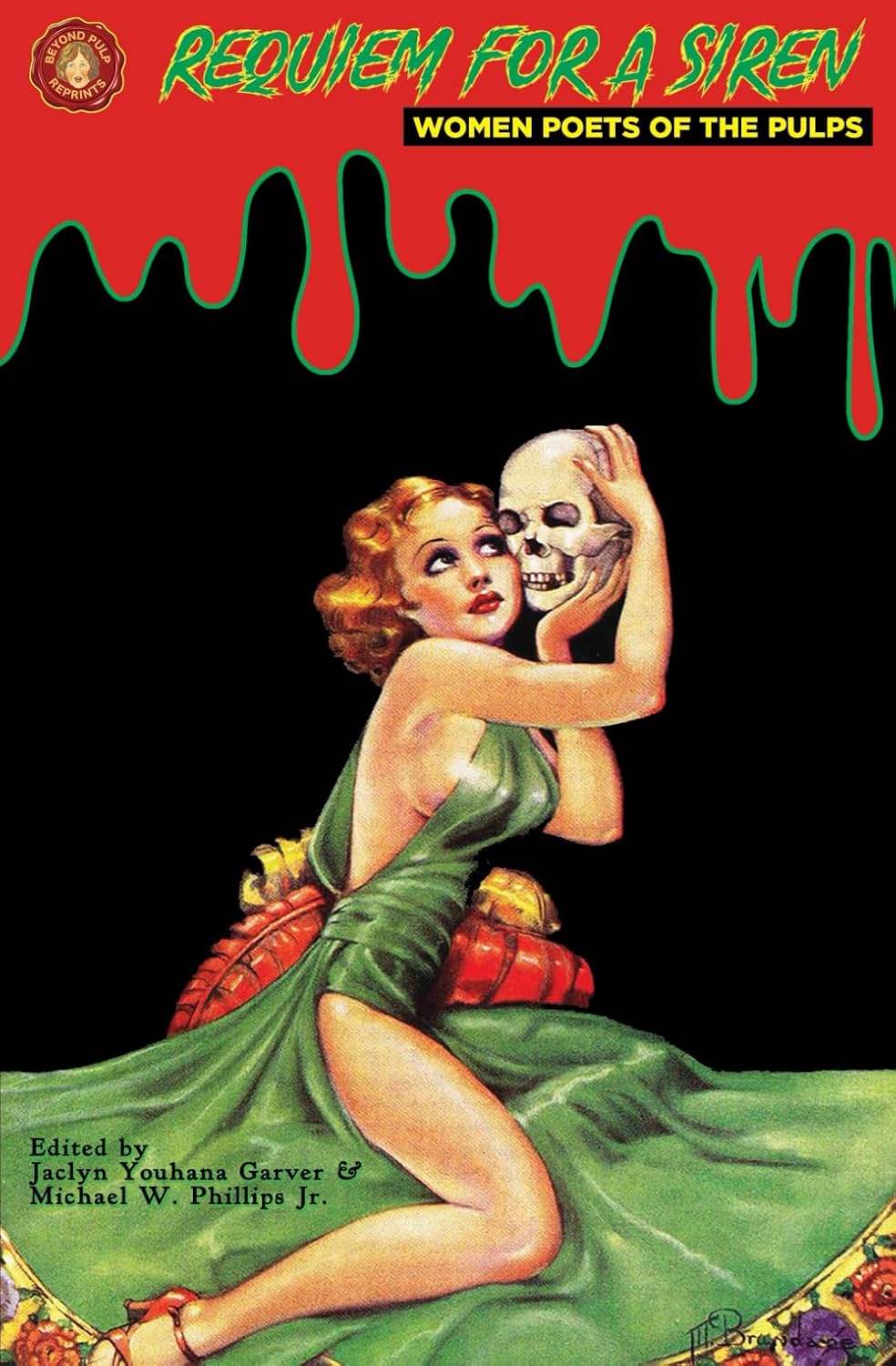
Requiem for a Siren: Women Poets of the Pulps (2024, From Beyond Press) is representative of the best of this impulse to not just reproduce the work of women pulpsters in danger of being forgotten, but to arrange and comment on them in a way that highlights both the publishing history of poetry in pulp magazines and the lives of these women. While many of the poems are taken from Weird Tales, including “The Woods of Averoigne” (1934) by Grace Stillman and “The Eldritch One” (1948) by Pauline Booker, the collection also includes science-fiction poetry from the pages of Amazing Stories and other pulps. Much of the background information for the women is credited to Terence E. Hanley’s Tellers of Weird Tales blog, which is good as Hanley has put in tremendous work into his biographies of the authors and artists of Weird Tales.

Full disclosure at this point:

I would like to thank Bobby Derie, proprietor of the blog Deep Cuts in a Lovecraftian Vein (deepcuts.blog), for his invaluable assistance in researching the introduction to this chapter, and Timaeus Bloom for reading an early draft.
Requiem for a Siren (2024) 1

My help consisted solely of a few brief discussions on social media, to try and help provide a few sources; I had no input into the selection or editing process. The final product is due to the hard work of the editors Haclyn Youhana Garver & Michael W. Phillips Jr., who made an effort to present a representative core sample of poetry by women in the fantastic pulps, covering not just multiple genres and themes, but tone and mood. The black humor of Lilith Lorraine’s “Mutation” to the fey rhythms of Frances Elliott’s “The Hill Woman,” the utter silliness of Julia Boynton Green’s “Radio Revelations” to the somber antique mystery of Alice I’Anson’s “Teotihuacan.” The brief biographies and introductory essays in between sections are functional and sometimes insightful.

Is it a perfect volume? I would have preferred an index of titles and/or first lines, to assist in finding a particular poem again without having to flip through the whole book. The selection is overall solid, but certain names predominate—as was the case in Weird Tales. Poets like Leah Bodine Drake, Dorothy Quick, and Cristel Hastings dominate a bit. If I had my druthers, I would have included more fan poetry, include Virginia “Nanek” Anderson, and perhaps Lilith Lorraine’s “The Acolytes” (1946) or “The Cup-Bearer” (1951)—but that would have been going outside of their own self-circumscribed ambit. This was a look at the women pulp poets, not all genre poetry from the period.

Requiem for a Siren: Women Poets of the Pulps provides value for the money. More than just saving the reader the time of flipping through thousands of pages of pulp magazines and reading a vast amount of dross, this curated collection of poetry is presented in a way to highlight not just some of the best weird and science fiction poetry of the period, but to highlight the women poets as well.


Bobby Derie is the author of Weird Talers: Essays on Robert E. Howard and Others and Sex and the Cthulhu Mythos.

Deep Cuts in a Lovecraftian Vein uses Amazon Associate links. As an Amazon Associate I earn from qualifying purchases.
“The Message of Thuba Mleen” (1911) by Aleister Crowley

“Was it because of the Desert’s curse?” I asked. And he said, “Partly it was the fury of the Desert and partly the advice of the Emperor Thuba Mleen, for that fearful beast is in some way connected with the Desert on his mother’s side.”
—Lord Dunsany, “The Hashish-Man” in A Dreamer’s Tales (1910)

To properly review “The Message of Thuba Mleen” (1911) by Aleister Crowley requires a little background on Crowley’s relationship with the Cthulhu Mythos and Lovecraft’s references to Crowley in his letters. Since this background is a bit long with numerous quotes, some handy links are provided above to help readers navigate to whichever section they want to go to.

Crowley & Cthulhu

Aleister Crowley (1875-1947) never met H. P. Lovecraft (1890-1937) in life. Crowley was an English occultist, writer, poet, and artist who became notorious both for personal life and his mystical philosophy, which coalesced into the development of Thelema in the early 20th century. After his death, his systems of ceremonial magic and philosophy were developed by various successors and fed into the growing interest during the post-WWII spiritual awakening. Notably, his secretary Kenneth Grant worked to expand and integrate Crowley’s system of “magick” with other esoteric practices and even fictional material from writers like H. P. Lovecraft.

Although Lovecraft seems to have been unacquainted with Crowley’s work, it is evident that both were in touch with a source of power, ‘a prater-human intelligence’, capable of inspiring very real apprehension in the minds of those who were, either through past affiliation or present inclination, on the same wavelength. Whether this Intelligence is called Alhazred or Aiwaz (both names, strangely enough, evoking Arab associations) we are surely dealing with a power that is seeking ingress into the present life cycle of the planet.
— Kenneth Grant, “Dreaming Out of Space” in Man, Myth, and Magic (1970), vol. 23, 3215

Grant wasn’t the first to draw associations between weird fiction and magic; Le Matin des magicians (1960) by Louis Pauwels and Jacques Bergier referenced the perceived connection between Arthur Machen’s fiction and his membership in the Hermetic Order of the Golden Dawn (an occult organization of which Crowley was also a member). However, Grant did more than draw parallels; in his writing, he directly associated his understanding of Lovecraft’s Mythos into his exegesis of Crowley’s magick.

Fiction, as a vehicle, has often been used by occultists. Bulwer Lytton’s Zanoni and A Strange Story have set many a person on the ultimate Quest. Ideas not acceptable to the everyday mind, limited by prejudice and spoiled by a “bread-winning” education, can be made to slip past the censor, and by means of the novel, the poem, the short story be effectually planted in soil that would otherwise reject or destroy them.

Writers such as Arthur Machen, Brodie Innes, Algernon Blackwood and H. P. Lovecraft are in this category. Their novels and stories contain some remarkable affinities with those aspects of Crowley’s Cult deal with in the present chapter, i.e. themes of resurgent atavisms that lure people to destruction. Whether it be the Vision of Pan, as in the case of Machen and Dunsany, or the even more sinister traffic with denizens of forbidden dimensions, as in the tales of Lovecraft, the reader is plunged into a world of barbarous names and incomprehensible signs. Lovecraft was unacquainted both with the name and the work of Crowley, yet some of his fantasies reflect, however, distortedly, the salient themes of Crowley’s Cult. The following comparative table will show how close they are:
— Kenneth Grant, The Magical Revival (1972), 114

Grant then followed with a table of correspondences he perceived between Crowley and Lovecraft. A similar, though distinct, table was also included in the Necronomicon (1977) written by “Simon.” This was the first commercial hoax Necronomicon which was also explicitly a grimoire, something that was intended to mimic other collections of ceremonial magic rites, sigils, lore, etc. intended for use by practicing occultists. The introduction by “Simon” leaned heavily on the supposed correspondences between Lovecraft’s Mythos and Crowley’s magick.

We can profitably compare the essence of most of Lovecraft’s short stories with the basic themes of Crowley’s unique system of ceremonial Magick. While the latter was a sophisticated psychological structure, intended to bring the initiate into contact with his higher Self, via a process of individuation that is active and dynamic (being brought about by the “patient” himself) as opposed to the passive depth analysis of the Jungian adepts. Lovecraft’s Cthulhu Mythos was meant for entertainment. Scholars, of course, are able to find higher, ulterior motives in Lovecraft’s writings, as can be done with any manifestation of Art.
— “Simon” (Peter Levenda), Necronomicon (1977) xii

The ceremonial magic presented in the Simon Necronomicon was distinct from that in Grant’s system derived from Crowley; though they shared some common references in Lovecraft and Crowley’s respective mythos & magick. This unexpected complexity invited comparison, and sometimes fusion. From a metafictional perspective, it became the beginning of a parallel body of literature alongside the growing body of Cthulhu Mythos fiction: a Lovecraftian occult scene. One that started to flower when another Necronomicon, edited by George Hay, was published in 1978:

I had also been reading the works of Aleister Crowley—collected by my friend Roger Staples of Michigan University—and found the parallels so striking that I owndered if Lovecraft and Crowley had been acquainted.

Derleth was positive that they had never met—in fact, he doubted whether Lovecraft had ever heard of ‘the Great Beast’. If he had, Derleth seemed to think, he would have dismissed him as a charlatan and a poseur.
— Colin Wilson, “Introduction,” The Necronomicon: The Book of Dead Names (1978), 14

Wilson refers to a meeting with Derleth in 1967; later in the same introduction, he cites Grant’s merging of Lovecraftian Mythos with Crowleyian magick. The introduction was written with all the care of a good hoax; starting from a basis of facts and gradually weaving in fictional elements, to build up to the idea that Lovecraft’s Necronomicon wasn’t just a fictional book, but had been based on a genuine occult document from the Middle East—which is what the Hay Necronomicon was presented as.

So as the 1980s dawned and the Simon Necronomicon became available in an affordable paperback edition to grace New Age shelves forevermore, would-be Lovecraftian occultists had at least three separate sources to draw upon. All of them tried to tie H. P. Lovecraft to Aleister Crowley. The two men, who had never met in life, found elements of their legends entwined posthumously.

With the advent of the internet, it became easier for misinformation to spread. Colin Law’s Necronomicon Anti-FAQ (1995) was, like Wilson’s introduction, just a bit of fun—but it fostered certain misconceptions about Crowley and Lovecraft, despite repeated debunkings:

In 1918 Crowley was in New York. As always, he was trying to establish his literary reputation, and was contributing to The International and Vanity Fair. Sonia Greene was an energetic and ambitious Jewish emigre with literary ambitions, and she had joined a dinner and lecture club called “Walker’s Sunrise Club” (?!); it was there that she first encountered Crowley, who had been invited to give a talk on modern poetry. […]

In 1918 she was thirty-five years old and a divorcee with an adolescent daughter. Crowley did not waste time as far as women were concerned; they met on an irregular basis for some months.

In 1921 Sonia Greene met the novelist H.P. Lovecraft, and in that same year Lovecraft published the first novel where he mentions Abdul Alhazred (“The Nameless City”). In 1922 he first mention the Necronomicon (“The Hound”). On March 3rd. 1924, H.P. Lovecraft and Sonia Greene married.

We do not know what Crowley told Sonia Greene, and we do not know what Sonia told Lovecraft. 

Edwin C. Walker (1849-1931) was a radical liberal who founded the Sunrise Club in 1889; this interracial club held dinner meetings at which speakers were invited to discuss on a wide range of topics. According to L. Sprague de Camp’s H. P. Lovecraft: A Biography (1975), Sonia joined the club c. 1917 (160-161); and there is a reference to Sonia’s membership in one of Lovecraft’s letters (LFF 1.83). I have yet to find any reference to Crowley addressing or attending the club. Given he lived in the United States from 1914-1919 and was often living in New York City at the time, it is possible, if not necessarily plausible that he could have attended some evening.

There is no reference to Crowley in any of Sonia’s surviving letters, essays, or autobiography; no mention of grimoires or the Necronomicon. The idea that Lovecraft got the idea of the Necronomicon from Crowley by way of Sonia is unsupported by any evidence and relies on the idea that the Necronomicon bears some similarity to Crowley’s The Book of the Law—the same supposition pushed by Grant and Simon, among others. It is rather telling that nothing in Crowley’s own writings supports his meeting with Sonia either, and that all references to the idea of their meeting ultimately derive from Low. For more on this and other Necronomicon-related hoaxes and occult history, see The Necronomicon Files by Daniel Harms & John W. Gonce III.

It’s easy to go on, although facts and fiction get furiously muddled. Despite Grant’s assertion that Lovecraft had never heard of Crowley and Derleth’s assertion (as related by Wilson) that Lovecraft may not have heard of Crowley and certainly never met him, fictional meetings between the writer of the weird and the prophet of Thelema have increasingly featured in books and comics, one notable example being The Arcanum (2007) by Thomas Wheeler. Yet my favorite hypothetical meeting is a 1927 chess game between Aleister Crowley and Wilbur Whateley:

If Derleth did tell Colin Wilson that he doubted Lovecraft had ever heard of Crowley and this wasn’t another part of the hoax, then he was badly mistaken and should’ve known better. Lovecraft’s letters give considerable detail on his thoughts regarding Aleister Crowley.

H. P. Lovecraft on Aleister Crowley

The Crowley cutting is interesting. What has the poor devil-worshipper been up to now? When I was in Leominster (near Athol) with Cook & Munn last month, calling on a bookseller, I saw a copy of a book by Crowley—“The Diary of a Drug-Fiend.” The merchant informed me that it has been suppressed by some branch of the powers that be—though he agreed to part with his copy for three thalers. I did not take him up—but I told Belknap about the offer.
–H. P. Lovecraft to Wilfred B. Talman, [8 Jun 1929], LWT 114

In 1929, French authorities deported Crowley, which led to sensationl articles (Why France Finally Kicked Out the High Priest of the Devil Cult), and a similar cutting was no doubt passed to Lovecraft. From this first reference in Lovecraft’s letters, it isn’t clear when exactly the Old Gent from Providence became aware of Aleister Crowley, but the suggestion seems to be that Lovecraft was at least passingly familiar with the magus by the late 1920s, probably from similar newspaper clippings. From Lovecraft’s comments, his friend Frank Belknap Long, Jr. had an interest in Crowley…a greater interest than Lovecraft himself had:

Aleister Crowley still keeps in the news! Don’t take any especial trouble to send the clipping unless you find it lying around, for my interest in the gent is perhaps less intense than Belknap’s.
–H. P. Lovecraft to Wilfred B. Talman, [7 Jul 1929], LWT 116

In 1930, Percy Reginald Stephensen’s The Legend of Aleister Crowley: Being a Study of the Documentary Evidence Relating to a Campaign of Personal Vilification Unparalleled in Literary History was published, ostensibly to ameliorate Crowley’s reputation. Lovecraft apparently caught a few reviews:

And speaking of your precious files—have you seen reviews of the new book about that suave diabolist Aleister Crowley? Belknap sent me a cutting from the Tribune. The biographer—abetted by the reviewer—(Hebert S. Gorman, who claims to have dined with Crowley) tries to depict the reputed ally of Satan as a much-wronged and basically blameless poet—whose eccentricities are merely the harmless foibles of genius!
–H. P. Lovecraft to Wilfred B. Talman, [Sep 1930], LWT 133-134

Years passed. Crowley’s infamy was such that he served as the basis for several fictional magicians, most notably the character of Oliver Haddo in Somerset Maugham’s The Magician (1908); the black magician Oscar Clinton in H. R. Wakefield’s “He Cometh and He Passeth By” (1928) (and later, Apuleius Charlton in “The Black Solitude” (1951)); and, though Lovecraft never lived to see it, Rowley Thorne in the stories fellow Weird Tales writer Manly Wade Wellman, in one such story, “The Letters of Cold Fire” (WT May 1944), Thorne attempts to obtain a copy of the Necronomicon!

Lovecraft had not read Maguham’s novel, but was aware of its association with Crowley:

I’ve never seen the Ramuz & Maugham items. Poor old Crowley figures more than once in fiction—for I believe it is her upon whom the villain in Wakefield’s “He Cometh & He Passeth By” is modelled.
–H. P. Lovecraft to Richard Ely Morse, 22 Mar 1932, LHB 42

“Ramuz” may be a reference to C. F. Ramuz La Regne de l’esprit Malin (1917) tr. by James Whitall as The Reign of the Evil One (1922). The novel seems to draw no direct inspiration from Crowley, being about a stranger (who might be the devil himself) who comes to a small Swiss town and turns it into hell.

Lovecraft did read Wakefield, however, and was appreciative.

Wakefield’s stuff is generally very good, & I’m glad you’ve had an opportunity to read it. Of the tales in the first book my favourites are “He Cometh & He Passeth By” (the villain in which is a sort of caricature of the well-known living mystic & alleged Satanist Aleister Crowley), “The Red Lodge”, “The 17th Hole at Duncaster[“], & “And He Shall Sing”.
–H. P. Lovecraft to Robert Bloch, [22 Jul 1933], LRBO 62

Glad to see the item about Crowley. What a queer duck! He is the original of Clinton in Wakefield’s “They Return at Evening.”
– H. P. Lovecraft to Clark Ashton Smith, [14 Dec 1933], DS 507

Wakefield is pretty good—I’ll enclose “They Return at Evening” as a loan in the coming shipment. You’l probably find at least four of the tales especially absorbing—“The Red Lodge”, “He Cometh & He Passeth By” based on Aleister Crowley), “And He Shall Sing”, & “The Seventeenth Hole at Duncaster.”
–H. P. Lovecraft to Clark Ashton Smith, [Jan 1934], DS 515

Clark Ashton Smith, when he read the “He Cometh and He Passeth By,” gave his own opinion to Lovecraft:

I read one of the Wakefield stories last night—“He Cometh and he passeth by—” and found it excellent, especially in the suggestion of the diabolic Shadow. Crowley is surely a picturesque character, to have inspired anything like Clinton! I know little about Crowley myself, but wouldn’t be surprised if many of the more baleful elements in his reputation were akin to those in the Baudelaire legend . . .  that is to say, largely self-manufactured or foisted upon him by the credulous bourgeoisie.
– Clark Ashton Smith to H. P. Lovecraft, [Jan 1934], DS 520

Lovecraft’s reply reveals something new—an acquaintances of his had actually met Crowley:

As for Aleister Crowley—I rather thought at first that his evil reputation was exaggerated, but Belknap says that Harré has met him & has found him indescribably loathsome in mind, emotions, & conduct. This from Harré is quite a damning indictment, for Belkanp tells me that T. Everett himself is far from squeamish or fastidious in his language & anecdotes when amidst the sort of company that dissolves inhibitions. But Crowley was too much for him. He didn’t relate particulars—but said that the evil magus made him so nauseated that he left abruptly. I guess Crowley is about as callous, unclean-minded, & degenerate a bounder as one can often find at large—though he undoubtedly has talents & scholarship of a very high order. It seems to me I heard that he is in New York now—London won’t stand him any longer. And this reminds me that I forgot to return that old cutting of yours which mentions him—permit me to repair the omission now.
–H. P. Lovecraft to Clark Ashton Smith, [11 Feb 1934], DS 525

In 1933-1934, Crowley appears to have primarily been in London, dealing with a libel suit (which he lost). I have not discovered anything to suggest he went to New York at this time. However, Harré’s papers contain a folder associated with Aleister Crowley, so they may well have met or interacted at some point. It is also known that Harré and Crowley were published together in The International in 1915, so possibly the meeting occurred over a decade and a half earlier, when Crowley was in New York, and Lovecraft misunderstood.

Smith responded:

Judging from Harré’s reactions, it would appear that Aleister Crowley is a pretty hard specimen. I had discounted the legends on general principles, knowing nothing whatever about the mysterious magus.
–Clark Ashton Smith to H. P. Lovecraft, [Mar 1934], DS 536

At this point, Crowley became a reference point for diabolists and occultists of all stripes.

The case of the Boer lady—Mevrouw van de Riet—certainly offers dark food for the imagination. She seems to be a sort of female Aleister Crowley—or a striga, lamia, empusa, or something of the sort.
–H. P. Lovecraft to Clark Ashton Smith, [18 Nov 1933], DS 479

The subject would next come up when Lovecraft began corresponding with the young fan Emil Petaja in 1935, when the subject turned toward the Black Mass, Satanism, and the occult. Lovecraft was an atheist and materialist, but he had read something of the occult for research purposes over the years, and picked up other tidbits:

In the 1890’s the fashionable decadents liked to pretend that they belonged to all sorts of diabolic Black Mass cults, & possessed all sorts of frightful occult information. The only specimen of this group still active is the rather over-advertised Aleister Crowley . . . . who, by the way, is undoubtedly the original of the villainous character to H. R. Wakefield’s “He Cometh & He Passeth By.”
–H. P. Lovecraft to Emil Petaja, 6 Mar 1935, LWP 414

Petaja apparently pursued the subject with Lovecraft, who responded at greater length, apparently still under the misconception that Crowley was in New York:

Regarding the Black Mass & its devotees—it is really even more repulsive than fascinating. The whole thing is described minutely in Joris-Karl Huysmans’ “Las Bas”—which was posthumously translated into English in 1923 & promptly suppressed. The Black Mass consisted in general of a malevolent & incredibly obscene parody on the Catholic Mass—involving public actions & natural substances almost impossible to describe in print. It originated in the Middle Ages, & has [ev]er since been secretly celebrated by groups of half-crazed, psychologically degenerate sensation-seekers—largely in the great metropolitan centres. Paris, Berlin, London, & New York are probably its greatest centres today. It seems to draw its devotees almost equally from the decadent artist class & from the general run of over-sophisticated psychopathic personalities. Aleister Crowley is a now-elderly Englishman who has dabbled in this sort of thing since his Oxford days. He is really, of course, a sort of maniac or degenerate despite his tremendous mystical scholarship. He has organised secret groups of repulsive Satanic & phallic worship in many places in Europe & Asia, & has been quietly kicked out of a dozen countries. Sooner or later the U.S. (he is now [in] N.Y.) will probably deport him—which will be bad luck for him, since England will probably put him in jail when he is sent home. T. Everett Harré—whom I have met & whom Long knows well—has seen quite a bit of Crowley, & thinks he is about the most loathsome & sinister skunk at large. And when a Rabelaisian soul like Harré (who is never sober!) thinks that of anybody, the person must be a pretty bad egg indeed! Crowley is the compiler of the fairly well-known “Oxford Book of Mystical Verse”, & a standard writer on occult subjects. The story of Wakefield’s which brings him in (under another name, of course) is in the collection “They Return at Evening”, which I’ll lend you if you like.
–H. P. Lovecraft to Emil Petaja, 5 Apr 1935, LWP 420-421

The Oxford Book of English Mystical Verse (1918) was compiled by D. H. S. Nicholson and A. H. E. Lee; but the book contains three poems by Crowley. The reference to “phallic worship” suggests that Harré may have confided something to Lovecraft about Crowley’s practice of sex magick, but this is as close as Lovecraft would ever come to mentioning the subject. Lovecraft apparently lent Petaja a cutting about Crowley:

Keep the review of the O’Donnell book—& here’s another from the Times. I’d like to see the Crowley one again—though there’s no hurry.
– H. P. Lovecraft to Emil Petaja, 31 May 1935, LWP 433

Elliott O’Donnell was a well-known collector of ghost and haunted house stories.

As it turned out, Lovecraft wasn’t the only one who knew someone that knew Crowley:

Conversation with one who has known the fabulous Aleister Crowley must surely have been interesting! I’ve seen several articles on this curious & repulsive entity, & am familiar with the portrayal in “He Cometh & He Passeth By”—though I have not read Maugham’s “Magician.” One other side-light comes from the amiable & picturesque source T. Everett Harré—editor of “Beware After Dark.” Harré has met Crowley; & although himself something of a specialist in corpological diction & anecdote, avers that the Hellish Archimage actually sickened him with the tone & subject-matter of his conversation. And anything or anybody capable of sickening the hard-boiled & perpetually pickled T. Everett must be—in the language of Friend Koenig—pretty strong meat! Crowley is evidently a tragic example of diseased & degenerate development in certain lines. Whether such a mass of psychological putrescence ought to be allowed at large is a sociological question too tough for a layman to tackle. The answer would really depend upon just how much social effect he has. But in any case he is obviously one of those “gamey” specimens who are much pleasanter to read & speculate about than to meet! Of his genius—of a sort—there can be no doubt. I believe he is an important contributor to a standard anthology which I’ve never read—“The Oxford Book of Mystical Verse.”
–H. P. Lovecraft to Richard Ely Morse, 25 Apr 1936, LHB 125

This is Lovecraft’s final published letter on Aleister Crowley—and it’s interesting to note that Lovecraft’s information is entirely second- or third-hand. At no point does he give any indication of having read any of Crowley’s prose or poetry, much less any of his magickal writings. To Lovecraft, Crowley was already essentially a living legend. There is no indication that any information passed between them.

Which doesn’t mean there isn’t a connection between Aleister Crowley and the Lovecraft Mythos.

“The Message of Thuba Mleen” (1911)

Many believe that it was a message from Thuba Mleen, the mysterious emperor of those lands, who is never seen by man, advising that Bethmoora should be left desolate.
—Lord Dunsany, “Bethmoora” in A Dreamer’s Tales (1910)

In 1911, Aleister Crowley was in France, writing prolifically as he finished the books of Thelema, a considerable body of poetry, and the occasional review. One work that particularly caught his imagination was A Dreamer’s Tales (1910) by Lord Dunsany. This was the fourth collection of Dunsany’s fantasies, and a strong influence on H. P. Lovecraft. Crowley was inspired by the book to write a review titled “The Big Stick,” published in his own magazine The Equinox in 1911. Appended to the review is Crowley’s poem “The Message of Thuba Mleen.”

The Message of Thuba Mleen

I.

Far beyond Utnar Véhi, far beyond
The Hills of Hap,
Sits the great Emperor crowned with diamond,
Twitching the rosary in his lap—
The rosary whose every bead well-conned
With sleek unblinking bliss
Was once the eyeball of an unborn child of his.

II.

He drank the smell of living blood, that hissed
On flame-white steel.
He tittered while his mother’s limbs were kissed
By the fish-hooks on the Wheel
That shredded soul and shape, more fine than mist
Is torn by the bleak wind
That blows from Kragua and the unknown lands behind

III.

As the last flesh was flicked, he wearied; slaves
From bright Bethmoora
Sprang forward with carved bowls whose crimson craves
Green wine of hashish, black wine of datura,
Like the Yann’s earlier and its latter waves!
These wines soothed well the spleen
Of the Desert‘s bastard brother Thuba Mleen.

IV.

He drank, and eyed the slaves “Mwass, Dagricho, Xu-Xulgulura,
Saddle your mules!” he whispered, “ride full slow
Unto Bethmoora
And bid the people of the city know
That that most ancient snake,
The Crone of Utnar Véhi, is awake.”

V.

Thus twisted he his dagger in the hearts
Of those two slaves
That bore him wine ; for they knew well the arts
Of Utnar Véhi—what the grey Crone craves!—
Knew how their kindred in the vines and marts
Of bright Bethmoora, thus accurst,
Would rush to the mercy of the Desert’s thirst.

VI.

I would that Māna-Yood-Sushāī would lean
And listen, and hear
The tittering, thin-bearded, epicene.
Dwarf, fringed with fear,
Of the Desert’s bastard brother Thuba Mleen!
For He would wake, and scream
Aloud the Word to annihilate the dream

Thuba Mleen appeared in two of the stories in A Dreamer’s Tales: “Bethmoora” and “The Hashish Man.” Lovecraft never used the mysterious emperor directly, but Bethmoora appeared in a long list of names and places:

I found myself faced by names and terms that I had heard elsewhere in the most hideous of connexions—Yuggoth, Great Cthulhu, Tsathoggua, Yog-Sothoth, R’lyeh, Nyarlathotep, Azathoth, Hastur, Yian, Leng, the Lake of Hali, Bethmoora, the Yellow Sign, L’mur-Kathulos, Bran, and the Magnum Innominandum—and was drawn back through nameless aeons and inconceivable dimensions to worlds of elder, outer entity at which the crazed author of the Necronomicon had only guessed in the vaguest way.
—H. P. Lovecraft, “The Whisperer in Darkness” (1931)

So it was that Crowley and Lovecraft shared at least one influence; and in Lord Dunsany they both found inspiration, and they both created new works that tied into his dreamer’s tales—and by extension, because they were both building off Dunsany’s Dreamlands, so did their own dreams touch, or were in communion, all unknowing. “The Message of Thuba Mleen” stand easily with any of the other dream cycle stories and verses inspired by Dunsany and Lovecraft, with their strange names and dark, suggestive hints.

Many occultists looked for a common source between the two, and sought to create a shared origin for the Necronomicon and the Book of the Law; to tie Crowley to Cthulhu, and Magick to Mythos. Yet the shared Mythos was there all along, in a half-forgotten poem. The two were not tied together by any dark secret or occult truth, but by an appreciation for the great fantaisiste, Lord Dunsany.

And always will be, ’til wakes Māna-Yood-Sushāī.


Bobby Derie is the author of Weird Talers: Essays on Robert E. Howard and Others and Sex and the Cthulhu Mythos.

Deep Cuts in a Lovecraftian Vein uses Amazon Associate links. As an Amazon Associate I earn from qualifying purchases.
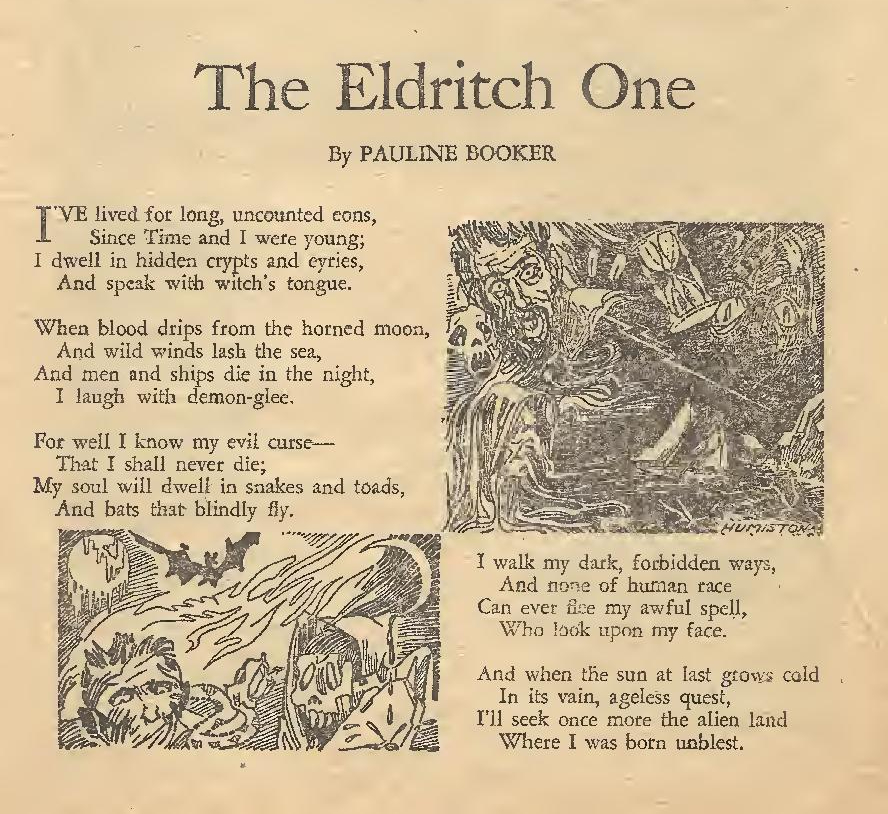
“The Eldritch One” (1948) by Pauline Booker

I’ve lived for long, uncounted eons
Since Time and I were young;
I dwell in hidden crypts and eyries,
And speak with witch’s tongue.

When blood drips from the horned moon,
And wild winds lash the sea,
And men and ships die in the night,
I laugh with demon-glee.

For well I know my evil curse—
That I shall never die;
My soul will dwell with snakes and toads,
and bats that blindly fly.

I walk my dark, forbidden ways,
And none of human race
Can ever flee my awful spell,
Who look upon my face.

And when the sun at last grows cold
In its vain, ageless quest,
I’ll seek once more the alien land
Where I was born unblest.
—Pauline Booker, “The Eldritch One”

Pauline Booker was a pulp poet during the 1940s and 50s with a long list of verse published in magazines like All-Story Love, Love Book Magazine, Max Brand’s Western Magazine, New Love Magazine, Rangeland Romances, Romance Western, Sweetheart Love Stories, Star Western—and three poems in Weird Tales. Of her life and broader career, practically nothing is known. All we can say for certain is that she had her finger on the pulse of weird fiction, at least a little.

H. P. Lovecraft did not coin the word “eldritch”—did not even use it in the majority of his stories, and only once or most twice in any given story (although he did use it three times in “Supernatural Horror in Literature.”) Yet it is a keyword that has become associated with Lovecraft and his mode of fiction as surely as “cosmic horror,” “squamous,” “non-Euclidean,” or “tentacle.” Eldritch has become part of the vocabulary of cosmic horror, used and abused with love and affection by all manner of writers.

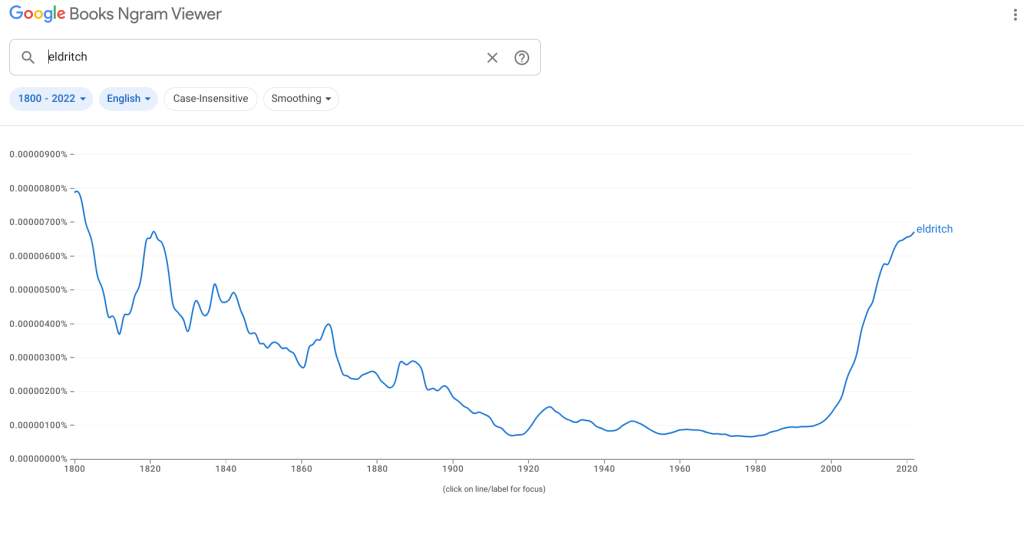
When did that transition happen? Google’s n-gram viewer is a handy snapshot for a word’s use, and the word was decreasing in frequency, almost at the nadir of its use until the 1910s—and forms a little peak around the time when Weird Tales began to be published in 1923. Is the recent spike in usage all down to Lovecraft and the fiction he inspired? Maybe. Andrew Eldritch, lead singer of Sisters of Mercy, and Philip K. Dick’s The Three Stigmata of Palmer Eldritch (1964) probably also contributes to the trend. Yet Pauline Booker was writing during a period when “eldritch” was on the decline again, at least outside of Mythos pastiches.

Yet how many fans of Lovecraft and weird fiction would not have caught her meaning, just from the title?

While it is tempting to try and connect “The Eldritch One” to some specific inspiration from Lovecraft, the imagery of the poem is rather traditional, combining favorite elements from Weird Tales, and not anything specific to one of Lovecraft’s stranger horrors. There are hints of witchcraft, of gorgons, immortality or the undead. A miscellany of horror, a real witch’s brew of familiar elements, but nothing concrete. Yet in its own way, as with all good poetry, it is timeless, as relevant and enjoyable to horror fans now as it was then.

Weird Tales May 1948 (art by Fred Humiston)

“The Eldritch One” was published in Weird Tales May 1948. It has not been reprinted.


Bobby Derie is the author of Weird Talers: Essays on Robert E. Howard and Others and Sex and the Cthulhu Mythos.

Deep Cuts in a Lovecraftian Vein uses Amazon Associate links. As an Amazon Associate I earn from qualifying purchases.
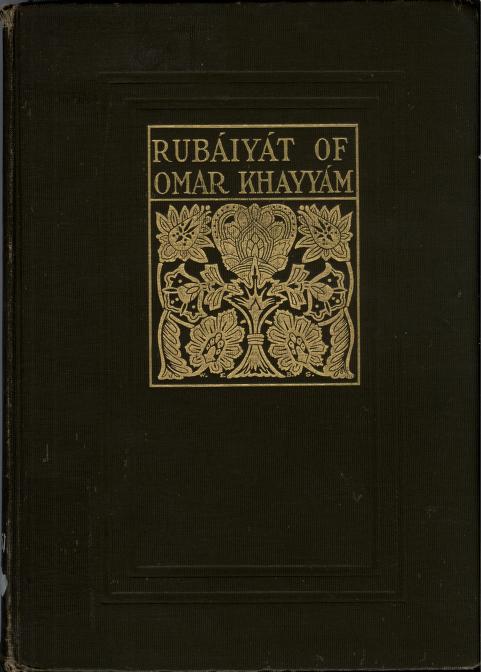
Rubáiyát of Omar Khayyám (1898) trans. Edward FitzGerald

The Persian word رباعی (rendered rubāʿī in English) refers to a poem of four lines or parts; in English terms, a quatrain. Following the traditional conventions of Persian poetry these were composed using one of two thirteen-syllable meters. رباعيّات (rubāʿiyyāt) is the plural form; so the Rubáiyát of Omar Khayyám could be literally rendered as The Quatrains of Omar Khayyám—but where’s the style in that?

In the 1850s, English poet and writer Edward FitzGerald was involved in translations of Spanish and Persian poetry and plays into English. In 1856-7, Edward Byles Cowell, a former professor under whom FitzGerald had studied the Persian language, sent him transcripts of two Persian manuscript with a series of quatrains by Omar Khayyám (1048-1131), a Persian polymath who lived in the Seljuk Empire. How much of the poetry which is attributed to Khayyám that he actually wrote is a matter of conjecture and debate. There are no known original manuscripts from Khayyám containing poetry, only verses that were quoted by others, decades or centuries after his death. So the poems that FitzGerald translated were from much-later collations of extant verse, some or all of which may never have been written by Khayyám itself.

FitzGerald took a free hand to translation; he rendered each rubāʿī into a four-line quatrain, often rhyming in an AABA form. The result was published as the Rubáiyát of Omar Khayyám in 1859, to little notice. However, subsequent editions were published over the years and decades, with FitzGerald taking advantage of the reprints to expand subsequent editions with more poems, and to tweak the translations. By the end of the 19th century, the work had achieved monumental popularity, reflecting in part the expansion of the British Empire and the pervasive Orientalism that occasionally peaked into popular phases, like the Egyptomania that swept the English-speaking world after the discovery of King Tutankhamun’s tomb.

In addition to the authorized editions by FitzGerald, which could differ substantially from each other, there were innumerable other translations and pirated editions. The language and even numbering of the quatrains differ between editions. As a result, like the Christian Bible, it is difficult to talk about the Rubáiyát of Omar Khayyám as a single text, but rather as a corpus of related works within which are distinct traditions. For our purposes, the text of FitzGerald’s 5th (1898) edition appears most influential.

Given the immense popularity of the Rubáiyát of Omar Khayyám in the late 19th and early 20th centuries, it shouldn’t be surprising that several Weird Tales writers during the 1930s read and enjoyed some version of this book, and that it influenced them to greater or lesser degree, including the three most-remembered today: H. P. Lovecraft, Robert E. Howard, and Clark Ashton Smith.

H. P. Lovecraft

The w. k. Khayyam-Fitzgerald reference to philosophy seems to shew an under-appreciation of the pure joy of argument. However—the genial maker of tents was none one to appreciate anything truly intellectual in a detached way.
—H. P. Lovecraft to Rheinhart Kleiner, 23 Feb 1918, LRKO 105-106

The first reference to the Rubáiyát of Omar Khayyám in Lovecraft’s letters shows a familiarity with FitzGerald’s translation; the last name Khayyám had been literally translated as “Tentmaker”, hence Lovecraft’s reference to the “genial maker of tents.” The quatrain in question is probably:

Myself when young did eagerly frequent
Doctor and Saint, and heard great argument
About it and about: but evermore
Came out by the same door where in I went.
XXVII. Rubáiyát of Omar Khayyám (5th ed, 1898)

It is not exactly clear when Lovecraft read Khayyám/FitzGerald, although it seems to have been several years before 1918:

As to the Rubaiyat of Omar & FitzGerald, it is so long since I read the thing that I have forgotten its details. I did not especially like it—which is doubtless the reason I never perused it a second time.
—H. P. Lovecraft to Rheinhart Kleiner, 11 Jun 1920, LRKO 167-168

Lovecraft doesn’t explain further, but there are certainly some aspects of Khayyám’s poetry that might have rubbed the weird writer the wrong way—his meticulousness for meter, Khayyám’s topics including love and drinking, the obtuseness of some of the translated images—and perhaps the sheer prosaicness of the poetry, which were far less fantastic than the 1,001 Nights.

During the course of discussion [George Kirk] gave me two books—one a fine sidelight on colonial life at Princeton College, & the other a variorum edition of the Rubaiyat which I wanted to send my correspondent Woodburn Harris—an Omar enthusiast. Nothing could make him take pay for either.
—H. P. Lovecraft to Lillian D. Clark, 27-28 May 1930, LFF 2.855

Kirk was a bookseller and friend of Lovecraft’s; Harris was another correspondent, unfortunately none of their published letters attest to any conversations on Khayyám. Lovecraft’s final word on the poet and his work appeared in his suggestions for a reading guide, the final chapter for Anne Tillery Renshaw‘s textbook Well Bread Speech (1936), which never made it into the finished product:

In the Oriental field we do not have to be asked to read the Arabian Nights or Fitzgerald’s translation of Omar’s Rubiyat.
—H. P. Lovecraft, Collected Essays 2.186

Lovecraft’s reading list didn’t necessarily reflect his personal tastes, only his professional assessment of what books qualified as those people should read as part of a literary education. It is a reflection of his acknowledgement of the tremendous popularity and influence of Khayyám’s poetry in FitzGerald’s translation as much as anything else.

It’s a pity we don’t have more of Lovecraft’s thoughts on Khayyám, and especially whether the Persian poet’s poetry was any inspiration at all to that of his famous Arabic poet, Abdul Alhazred and his Al Azif—which was at least partially written in poetry. Though aside from the common geographic origin in the Middle East (albeit different parts of it) and being poets, the biographies of Alhazred and Khayyám show few similarities.

Robert E. Howard

In the words of Omar Khayyam: “East is East and West is West To a ramblin’ gay galoot.”
—Robert E. Howard to Tevis Clyde Smith, 8 Jun 1923, CL1.3

In the first surviving letter from Robert E. Howard, he mentions Omar Khayyám by name—although the poetic reference is actually to Rudyard Kipling’s “The Ballad of East and West” (1889). Howard’s interest in poetry is often overlooked, but poetry pervades his fiction, and Howard himself was lauded as a poet of considerable power by Lovecraft.

Howard’s letters to his friend Tevis Clyde Smith include a great deal of off-the-cuff poetry (some of it ribald, jocular, or doggerel verse), as well as quotations from other verses that Howard had read, heard, or memorized. For example:

“Methought a voice within the temple cried, 
When all the temple is prepared within, 
Why loiter drowsy worshippers outside?” 
“I tell you this, when started from the goal, 
Over the flaming shoulders of the foal, 
Of heaven’d Parwin and Mushtari they flung, 
In my predestined plot of dust and soul.” 
“A book of verses underneath a bough, 
A loaf of bread, a jug of wine and thou, 
Beside me singing in the wilderness, 
Ah, wilderness were Paradise enow!” 
“Look to rose about us,” Lo,
“Laughing,” she says, “Into the world I blow, 
“At once the silken tassel of my purse, 
Tare [sic], and my treasures to the garden throw.

— Robert E. Howard to Tevis Clyde Smith, 6 Aug 1925, CL1.61-62

These are lines for quatrains II, LXXV, XII, and XIV of the 5th (1898) edition. It isn’t clear if Howard read this specific edition, but he seems to have read at least some version derived from the 5th edition text. Howard scholar Steve Trout noted Howard’s quotations may have come from Little Blue Book #1, which followed the text of FitzGerald’s 5th edition (Howard History).

In more serious letters, Howard would praise Khayyám, e.g.:

I have carefully gone over, in my mind, the most powerful men — that is, in my opinion — in all of the world’s literature and here is my list: 

Jack London, Leonid Andreyev, Omar Khayyam, Eugene O’Neill, William Shakespeare. 

All these men, and especially London and Khayyam, to my mind stand out so far above the rest of the world that comparison is futile, a waste of time. Reading these men and appreciating them makes a man feel life not altogether useless.
—Robert E. Howard to Tevis Clyde Smith, week of 20 Feb 1928, CL1.166

Howard also wrote to Lovecraft, listing Khayyám among his favorite poets (MF1.510/ CL2.419). Although Howard was still just as likely to take the poet’s name in vain for the sake of a joke:

“Old Stiff had a friend, Hatrack by name;
The life he led was a sin and a shame.
He, lounged like Omar beneath a bough,
With a whore and jug of beer — and how!”
—Robert E. Howard to Tevis Clyde Smith, c. Mar 1929, CL1.319

The reference is to one of the most famous of Khayyám’s quatrains:

 A Book of Verses underneath the Bough,
 A Jug of Wine, a Loaf of Bread—and Thou
 Beside me singing in the Wilderness—
 Oh, Wilderness were Paradise enow!
XII. Rubáiyát of Omar Khayyám (5th ed, 1898)

One of Howard’s greatest tributes to Khayyám and FitzGerald was to quote from the Rubáiyát of Omar Khayyám‘s 1898 edition in the opening chapters of the serial “Skull-Face” (Weird Tales OctNovDec 1929). And in One Who Walked Alone (1986) by Novalyne Price Ellis, it is written:

Bob’s attention was centered on a copy of The Rubáiyat. He already had a copy, but he said he might come back next week and pick up that book and another one—that one by Cabell. (92)

Price would herself quote from Rubáiyát of Omar Khayyám in her memoir.

Upon his death, Howard’s father donated his library to Howard Payne University in nearby Brownwood; this included a copy of the Rubáiyát of Omar Khayyám, a later edition which combined the aspects of FitzGerald’s previous translations, and is listed as “the First and Fifth versions.”

Clark Ashton Smith

Then I began to write verse, including, I remember, some rather lame imitations of the Rubaiyat. Gradually I acquired a feeling for meter and rhythm; and at sixteen or seventeen was able to sell a few poems to magazines.
—Clark Ashton Smith to Samuel J. Sackett, 30 Jun 1939, SLCAS 359

Poe, not Omar Khayyam, was the first poet who impressed me, and I’ll never forget the thrill of finding his poems in a grammar-school l ibrary at the age of thirteen. I remember too that the librarian commented reprovingly on my morbid and unhealthy taste in reading-matter!
—Clark Ashton Smith to Samuel J. Sackett, 11 Jul 1950, SLCAS 364

I did a lot of boyhood scribbling, imitations of Omar, lurid Oriental romances, etc;, and at 17 sold several pseudo-Orientales to the Black Cat and the Overland Monthly.
—Clark Ashton Smith to L. Sprague de Camp, 21 Oct 1953, SLCAS 371

Compared to Lovecraft and Howard, Smith was the most accomplished poet of the three, having collected and published a good deal of his poetry during his lifetime, and having achieved some small measure of fame for his poetry while breathing. Smith was not as hidebound as early Lovecraft was, and more experimental than Howard, even to the point of translating and writing poetry in other languages. His rich vocabulary, striking images, and the mentorship of poets like George Sterling steered made Clark Ashton Smith a weird poet par excellance—and Sterling was well-versed in poetry enough to comment on a perceived lift, intentional or not:

But here is your excellent poem to comment on, which I’ll venture to the extent of saying I like it very much, but am of the opinion that it’s first line is too suggestive of that which begins “The Rubaiyat.”
— George Sterling to Clark Ashton Smith, 14 Jul 1914, SU 109, SLCAS 23

You’re quite right about the resemblance of the first line of my poem to the one in the Rubaiyat:—“Before the phantom of false morning died,” which begins the second quatrain of that poem. It’s strange that I’d not noticed the reminiscence before. I’ve not thought of a new line, so far.
— Clark Ashton Smith to George Sterling, 27 Jul 1914, SU 110

Before the phantom of False morning died,
Methought a Voice within the Tavern cried,
“When all the Temple is prepared within,
“Why nods the drowsy Worshiper outside?”
Ere yet the soaring after-fire was flown,
I found a city in the twilight lone—
Asleep in lapse of some forgotten land
And griping horizons of deserts prone.
II. Rubáiyát of Omar Khayyám (5th ed, 1898)“A Phantasy of Twilight” by Clark Ashton Smith

Unfortunately, Smith’s maturation as a poet came at a time when U.S. tastes in poetry were shifting away from his preferred style. As a consequence, despite initial fame as a young poet, Smith struggled throughout his adult life with poverty and the difficulty of making a living and supporting his parents. Selling poems and fiction were two ways Smith worked during the 1910s-1920s to sustain himself and his family, as well as gifts from friends, manual labor, and efforts to self-publish his own verse (among his enthusiastic customers were Lovecraft and Howard). Smith had literary appetites, but little cash to feed it.

Most of my reading now will have to be in the form of re-reading, since I can’t afford new books. The prices have gone up astoundingly. . . . I spent yesterday afternoon with Omar and Leopardi (the latter the volume you sent me) and found them better company than ever.
— Clark Ashton Smith to Samuel Loveman, 7 Nov 1918, BUS 132

My table is covered with a litter of borrowed books—“The Rubaiyat of Hafiz,” “Thus Spake Zharathtustra,” [sic] “A Feast of Lanterns,” and others . . . Do you know this rendering of Hafiz, by L. Cranmer-Byng? Much of it is excellent (d—d if I can see much difference between Hafiz and Omar, in regard to thought and feeling) and one stanza haunts me:

“That night we wrought Love’s miracle again;
For one brief gloom one soul was born of twain:
Now Death shall weary at the springs of Youth,
By singing water that he sealed in vain.”
— Clark Ashton Smith to Samuel Loveman, 15 Dec 1918, BUS 142-143

The Rubáiyát of Hafiz is another collection of Persian quatrains rendered into English. Hafiz (also as Hafez) had been translated into English before Khayyám, but the success of the Rubáiyát of Omar Khayyám encouraged further translations of Persian poetry in the now-familiar mold of FitzGerald’s translations. Good marketing strategy, if nothing else.

Khayyám forms one of Smith’s poetic touchstones, at least in his letters, no doubt because of his re-reading of his poetry. The quotations from and allusions to Khayyám’s verses all seem to come from FitzGerald’s 1898 text, or a text derived from that edition.

It desolates me to hear that you have been unwell. There’s d—d little in life, beyond the brief Epicurean category of Omar’s stanza, “A book of verses underneath the bough, etc.” Even art is a kind of Barmecides-feast, when one is sick, or indisposed. As for the rest—the “wine” and “bread” are worse than mockery to a sick and queasy stomach. And love—love is the shadow of a dead, forgotten dream,—or a ravenous, writhing, serpent-shapen flame from the cauldron-fires of Malebolge.
— Clark Ashton Smith to Samuel Loveman, 12 Aug 1919, BUS 169

I can’t imagine what the place is like now, even with such oases, and “wells amid the waste” as will continue to exist.
— Clark Ashton Smith to George Sterling, 28 Aug 1919, SU 174

 A Moment’s Halt—a momentary taste
 Of BEING from the Well amid the Waste—
 And Lo!—the phantom Caravan has reach’d
 The NOTHING it set out from—Oh, make haste!
XLVIII. Rubáiyát of Omar Khayyám (5th ed, 1898)

Clark Ashton Smith shared Lovecraft’s love of the fantasy Middle East and Near East of the 1,001 Nights, but unlike his friend, Smith was very much fond of alcohol and the company of women, and so was more able to marry Khayyám into his fantasy Orientalist mindset:

I can readily imagine you in Alexandria or Lesbos, or, in a later incarnation, wandering through the Baghdad of Haroun or Almansour, after the journey of the Persian wastes. . . . Alas, for Omar, and Saddi, and Shiraz with its golden wine and golden roses! I wish we were there in Shiraz or Baghdad or Ispahan, with “Time’s purple” a thousand years deep between us and this nightmare of the modern world!
— Clark Ashton Smith to Samuel Loveman, 29 Aug 1919, BUS 171

In time, Smith’s appreciation of Khayyám/FitzGerald’s bore poetic fruit:

I’ve completed two longer poems, which I’ll send you in my next. One is an ode to Omar Khayam [sic], the other a fantastic dialogue entitled “The Ghoul and the Seraph.”
— Clark Ashton Smith to Samuel Loveman, 31 Aug 1919, BUS 191

The poem was “To Omar Khayyam.” It was well-received by Smith’s friends, but faced some initial difficulty getting published, apparently due to the stigma of Prohibition:

“Asia” has returned my “Omar” ode. They seemed to like the poem, but, I dare say, thought its publication in their pages not “advisable.” It might “get them in bad” with many of their readers. The hedonism (not to mention the pessimism) of the poem would be anathema to a lot of people in this Puritan paradise. It’s incredible, but ch is the fact . . . Even in San Francisco, people are being fined or imprisoned for carrying pocket-flasks! The old Blue Laws were nothing to some of these new statutes. I dare say they’ll want to stop the publication of such books as “The Rubaiyat.” Why not, when it’s against the law to publish or disseminate recipes for the manufacture of wine or beer, or even to use the word “beer,[”] “whiskey,” etc in an advertisement or label, or on a bill-board!
— Clark Ashton Smith to Samuel Loveman, 25 Feb 1920, BUS 202-203

Smith eventually sold the poem to The Lyric West in 1921 for $5. However, the magazine sat on the poem for years, so the first publications was actually Smith’s own 1922 self-published poem collection Ebony and Crystal, where Lovecraft and Howard would have read it. In June 1926, The Lyric West finally published Smith’s ode. It was well-received.

I won a poetry prize the other day, much to my amazement. I was awarded fifty dollars for the best poem published in volume 5 of “The Lyric West”, a Los Angeles poetry magazine. The poem was “To Omar Khayyam”, which they had held for years before printing. I had forgotten all about it, in fact.
— Clark Ashton Smith to Donald Wandrei, 13 Mar 1927, TWU 53

Three Weird Talers. Three different takes on the Rubáiyát of Omar Khayyám. While an 11th/12th century Persian poet (as filtered through a 19th century Englishman) might not be the most obvious of influences, this work was part of the shared cultural heritage of weird fiction in the 1920s and 30s.


Bobby Derie is the author of Weird Talers: Essays on Robert E. Howard and Others and Sex and the Cthulhu Mythos.

Deep Cuts in a Lovecraftian Vein uses Amazon Associate links. As an Amazon Associate I earn from qualifying purchases.
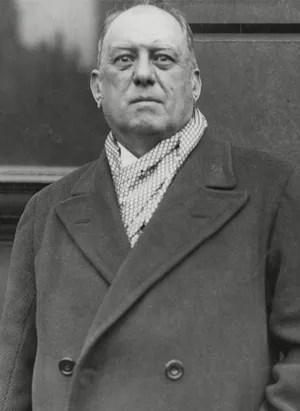
Untitled poem (1976) by William Davis Manly

In the summer of 1976, a one-shot ‘zine of of weird poetry and art emerged from 5115 South Mead St., Seattle Washington. The publisher titled it Visions of Khroyd’hon, which probably meant nothing to anyone at the time, and it was published in the spirit of good fun:

There are many interesting poetry publications popping up every now & then, and I thought it wou’d be fun if I join’d—if only for a moment—ye crowd and publish’d this first and only issue of VOK. I’ve assembled lots of good poetry here, with a number of talented youngsters contributing clever rhymes, love sonnets, and exciting verse. There’s something for everyone’ I’m sure each reader will be able to find some moments of entertainment.
—W. H. Pugmire, Visions of Khroyd’hon 1

Among the contributors were luminaries such as Brian Lumley, H. Warner Munn, J. Vernon Shea, Jessica Amanda Salmonson, and William Davis Manly, the latter of whom included several untitled verses, including this one:

Weird and wonderful, these tales,
Each an eerie world reveal;
Imagination freely sails
Reaching worlds that can’t be real—
Darkened worlds of daemon-lore.

Time is but a shadow-thing,
All reality has flown;
Listen—Dagon’s children sing!,
Eerily, in tongue unknown.
Surely, I can’t ask for more.
—william davis manly

It is a poem in praise of weird fiction, from someone who loves the strange, eerie, horrific, and awesome. A paean from one Mythos fan to every other. The artist is unknown, but the subject is writer Fritz Leiber, Jr., and appears to be traced from a scene from the 1970 film Equinox.

Equinox has several parallels with Evil Dead II, including a recording of a professor (Leiber) who unwisely reads aloud an incantation from a very evil book…although the book in Equinox is not specifically called the Necronomicon.

The hidden joke is that William Davis Manly is, like Robert E. Howard’s Justin Geoffrey or H. P. Lovecraft’s Abdul Alhazred, not a flesh-and-blood poet at all, but a character in Pugmire’s stories—a staple name in what would become the Sesqua Valley stories. Pugmire had begun producing poetry under the name William Davis Manly in the 1970s, probably first “The Cryptic Power” in the ‘zine Bleak December #8. The first bit of fiction referencing Manly was “From ye Journal of William Davis Manly” (Old Bones #1, Summer 1976), and in “The Thing in the Glen” (Space and Time Sep 1977) the story begins with a poetic epigraph:

“Beneath the old narcotic moon
It preys upon mortality,
Hungry to devour hope,
And whispering to darkness.”
—William Davis Manly, Visions of Khroyd’hon
(quoted from Dreams of Lovecraftian Horror 57)

So Pugmire’s poetry ‘zine became, in the context of his Mythos fiction, a volume of poetry, much like Justin Geoffrey’s People of the Monolith in Robert E. Howard’s “The Black Stone.” William Davis Manly (or at least, his legend) would grow and develop in Pugmire’s tales, as would his slightly more diabolical counterpart, the sorcerer Simon Gregory Williams.

There is no definitive collection of W. H. Pugmire’s poetry, and maybe such a thing would be difficult to put together, given how much of it was published in ‘zines and scattered hither and yon. The quality and focus of it varies considerably, as Pugmire was equally disposed to either fulfilling some weird and fantastic corner of the Mythos or just praising his aunt in verse, but for readers who enjoy his fiction, Pugmire’s poetry is an indelible part of his larger body of work.

As far as I have yet been able to determine, the untitled poem from Visions of Khroyd’an has only ever been reprinted in the chapbook Sesqua Rising (2016) by Graeme Davis, which collects many other early Pugmire rarities.


Bobby Derie is the author of  Weird Talers: Essays on Robert E. Howard and Others  and  Sex and the Cthulhu Mythos .

Deep Cuts in a Lovecraftian Vein uses Amazon Associate links. As an Amazon Associate I earn from qualifying purchases.
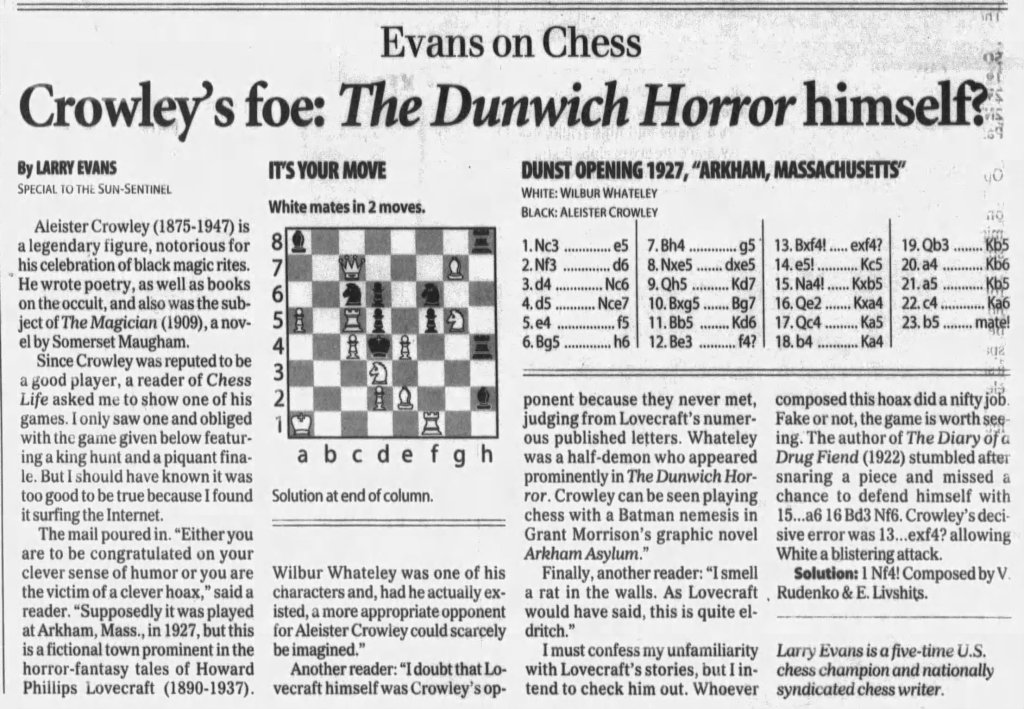
“To Clark Ashton Smith” (1951) by Evelyn Thorne

TO CLARK ASHTON SMITH

I think quicksilver leaps along his veins,
And if you look too deeply in his eyes,
You’ll see behind the ice-thin laughter there
The smouldering glimpse of fateful sorceries.

I think that if you listen while he speaks
You’ll catch a foreign ac[c]ent on his tongue,
That hints a language built of stars and wine
A syntax all with fiery jewels strung.

I think that if you miss him some dark night
You should not be surprised or wonder where
He’s gone; look up, Arcturus greenly burns—
Do you not see him on that shining stair?
—Evelyn Thorne

The second issue of Alan H. Pestetsky and Michael DeAngelis’ fanzine Asmodeus (Fall 1951) was devoted primarily to Clark Ashton Smith. Lovecraft had been receiving accolades in The Acolyte in the 1940s, so it was only fair. The issue republished a poetic tribute by Lovecraft to his friend, as well as “The Cup-Bearer” (1951) by Lilith Lorraine, and buried among other works was the above dedication by Eveyln Thorne.

While she is mostly forgotten now, in the 1950s Evelyn Aixa Thorne was actively involved with science fiction fandom, not necessarily a Big Name Fan, but not insignificant either. A brief biographical essay in Poets in the South says she was born in Nebraska in 1898, educated in the College of Puget Sound and the University of Arizona, and lived all over the country “working as an interior decorator, an X-ray txnician, and a botancial illustrator” (78). She married William Richmond Tullos in 1946, they divorced in 1952, remarried in 1954, and remained married until his death in 1974.

Thorne is probably best-remembered as co-publisher/co-editor of the New Athenaeum Press with Will Tullos, which published Epos: A Quarterly of Poetry, from 1949 until 1975, which published three of Clark Ashton Smith’s poems. She was also associate-editor of Challenge (1950-1951) under Lilith Lorraine, who also published some of Thorne’s poetry elsewhere. Her books of poetry were Design in a Web (1955), Ways of Listening (1969), and Of Bones and Stars (1982); she also published anthologies of poetry from Epos.

There is a certain incestuous quality to fantastic poetry in the 1950s, an intersection between the “little magazine” movement and science fiction/fantasy fanzines which echos the intersection between amateur journalism and science fiction fandom in the 1930s. That Evelyn Thorne knew and appreciated Clark Ashton Smith as a poet is clear. The reference to “Arcturus” in particular is curious; Smith refered to Arcturus in three poems first published in The Star-Treader and Other Poems (1912): “To the Sun,” “The Song of a Comet,” and “Saturn”—all cosmic poems that echoed or were influenced by Smith’s mentor George Sterling’s “The Testimony of the Suns” (1903).

A detail Smith no doubt appreciated, when he read that tribute.


Bobby Derie is the author of  Weird Talers: Essays on Robert E. Howard and Others  and  Sex and the Cthulhu Mythos .

Deep Cuts in a Lovecraftian Vein uses Amazon Associate links. As an Amazon Associate I earn from qualifying purchases.