Giant spiders are traditional. The square-cube law be damned.
In “The Fortress Unvanquishable, Save For Sacnoth” (1908), the hero Leothric deals with an oversized arachnid. In “The Tower of the Elephant” (1933) by Robert E. Howard, a young Cimmerian faced eight-legged death. In “The Seven Geases” (1934) by Clark Ashton Smith, Atlach-Nacha spins their web endlessly in the dark. In “The Dream-Quest of Unknown Kadath,” H. P. Lovecraft wrote of the bloated purple spiders that warred with the almost-men of Leng, and in J. R. R. Tolkien’s The Hobbit (1937), the giant spiders of Mirkwood nearly put an end to Bilbo and his party—and they’re nothing compared to Shelob, who guards the threshold of Mordor in The Lord of the Rings (1955).
Spiders work on many levels. They are first and foremost predators, not scavengers or placid eaters of vegetables or waste. Alien in outline, fascinating in their anatomy and habits. Some leap, some spin, some are venomous. Fantasy spiders tend to all three; like the giant serpents of Sword & Sorcery, they combine and maximize the attributes and horrors of everyday attercops and exaggerate them past any natural bound. A normal spider, if scared, may bite; their venom may hurt, but few spiders are a serious threat to humans. A human need not fear being wrapped up in their web like a fly, their fluids sucked out, until a mummified corpse is left trapped forever.
In a Sword & Sorcery setting? Well, the human might be the fly. But the fly might also have a sword.
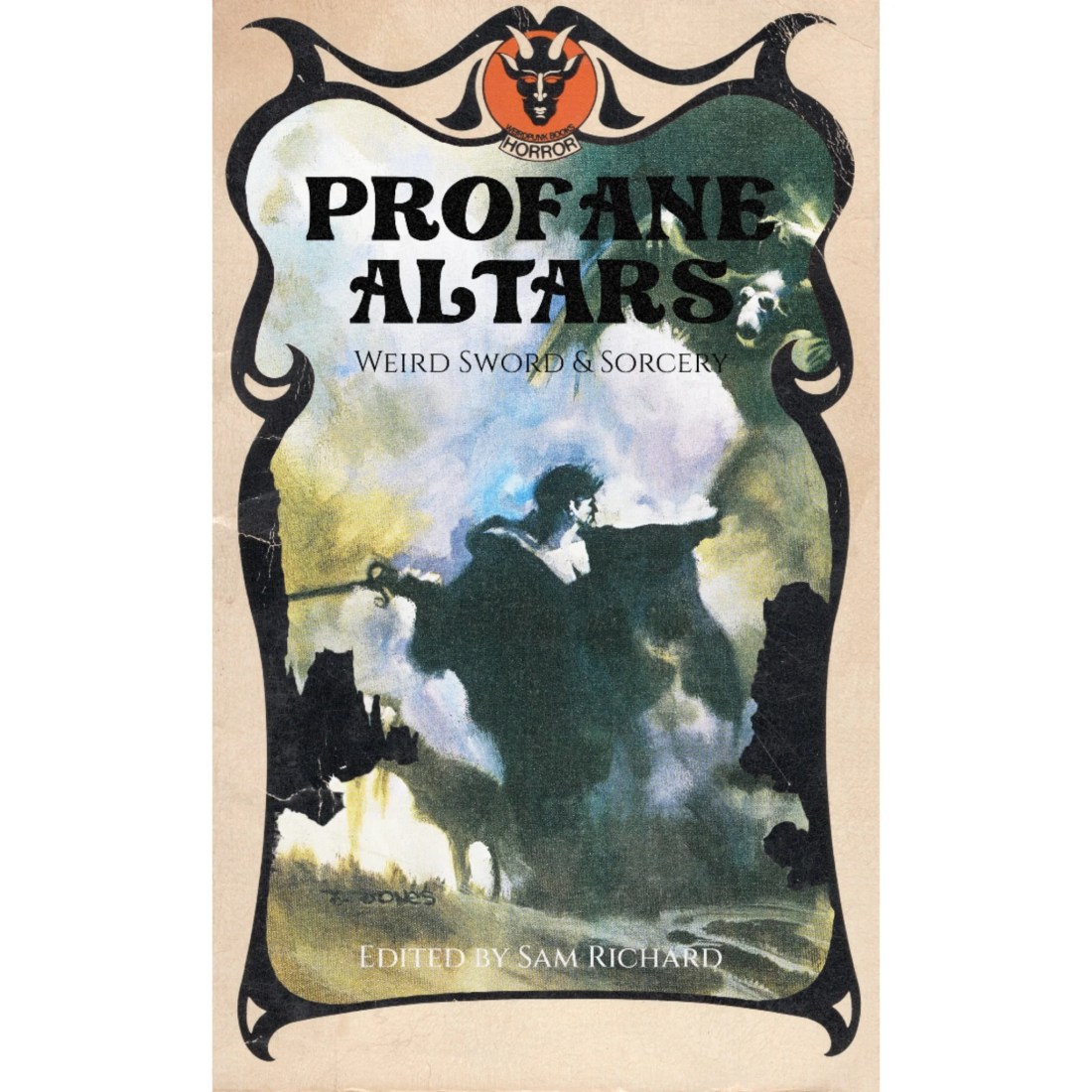
“Never Threaten A Spider” (2024) by Sara Century advertises to the readers what is about to come. It’s right there in the title. Readers who pick up a copy of Profane Altars: Weird Sword & Sorcery will not be disappointed by false advertising. Yet the giant spider in this story isn’t quite a box-tick on some giant list of Sword & Sorcery tropes, either.
Writers and readers of Sword & Sorcery (or Heroic Fantasy, Epic Fantasy, or however you chose to label that squirming grey cross-genre where fantasy, horror, and adventure fiction have mixed and mingled) today face a different problem than Robert E. Howard & co. did in the 1930s. Howard’s Conan basically defined a genre; peers like C. L. Moore’s Jirel of Joiry, Clifford Ball’s Duar the Accursed and Rand the Rogue, Fritz Leiber Jr.’s Fafhrd and the Grey Mouser, Henry Kuttner’s Elak of Atlantis, Michael Moorcock’s Elric of Melniboné, Karl Edward Wagner’s Kane, Manly Wade Wellman’s Kardios, Joanna Russ’ Alyx…a whole chain of swordsmen, swordswomen, and sorcerers have entrenched expectations of what an S&S tale is, can, and must be.
Robert E. Howard and C. L. Moore didn’t have to worry so much. They were inventing, not imitating. Tolkien’s major competition at novel-length were works like The Worm Ouroboros (1922) by E. R. Eddison and The Broken Sword (1954) by Poul Anderson. There were no Tolkienian imitators; his readers had few expectations. They were allowed to be awed, excited, amused, and entertained.
Several decades and hundreds of fantasy stories, novels, roleplaying games, comics, cartoons, and films later, and readers tend to be a bit more jaded. They’ve seen it all before. They recognize the tropes. Writers have to struggle against expectations. What should be in a fantasy adventure story? What’s too old-fashioned? How to buck expectations?
“Never Threaten A Spider” feels like it tiptoes on those questions. At a straight read, it is a straightforward adventure yarn, with a thin skein of worldbuilding, a little horror, a little action, not too heavy on the sorcery, and perhaps with a slightly unfinished feel. Not everything is explained and not all of the names are a random conglomeration of syllables, both of which are endearing. Not everything has to be explained. Writers are allowed a little mystery, to hint instead of explaining every detail. We don’t need three thousand years of history about the dead queen and the jewel of the nameless spider-god.
On deeper consideration, however, this almost by-the-numbers S&S tale is anything but. It is a subtle subversion of expectations: a swordswoman who loses her sword early on. A thief who doesn’t really want to steal anything, and ultimately doesn’t. A hardboiled protagonist saved by a cute little bunny rabbit.
The hero of the story, a woman named Viy, isn’t some thinly-reskinned version of Conan, or Jirel of Joiry, Red Sonja, or Alyx. Warrior, thief, and outlaw, yes, but not her cynicism is balanced with homesickness, her rage by kindness. The readers don’t see her at her best in terms of skill and accomplishment: sans sword and thieve’s tools, she spends much of the story half-naked and wet, and she resorts at the penultimate struggle to picking up a club and to try and beat her foes to death.
Yet she’s smart enough to know when to run. That some fights aren’t winnable. That murder isn’t the job. For a genre that can sometimes exult in the murder hobo lifestyle, there is a real subversion in having a protagonist that doesn’t need to be a barbarian hero slaying all gods and monsters and macking on the nearest princess. There is something much more realistic about Viy’s failures, her flaws, and at last her triumphant escape with life and a jewel, even if it isn’t the one she came to the god-haunted swamp to steal.
Perhaps, if we’re lucky, we’ll read more of Viy’s adventures in the years to come.
“Never Threaten A Spider” by Sara Century was published in Profane Altars: Weird Sword & Sorcery (2024, Weirdpunk Books).
Bobby Derie is the author of Weird Talers: Essays on Robert E. Howard and Others and Sex and the Cthulhu Mythos.
Deep Cuts in a Lovecraftian Vein uses Amazon Associate links. As an Amazon Associate I earn from qualifying purchases.
 Deep Cuts in a Lovecraftian Vein