When Providence, R.I. journalist Winfield Townley Scott published his first biographical essay on H. P. Lovecraft in the Providence Journal in 1943, it was with the caveat that he had not been able to contact Lovecraft’s wife, Sonia H. Davis. After publication, they got in touch, and through Scott’s efforts Sonia’s memoir of her marriage to Lovecraft was published in the 28 August 1948 edition of the Providence Journal as “Howard Phillips Lovecraft As His Wife Remembers Him.”
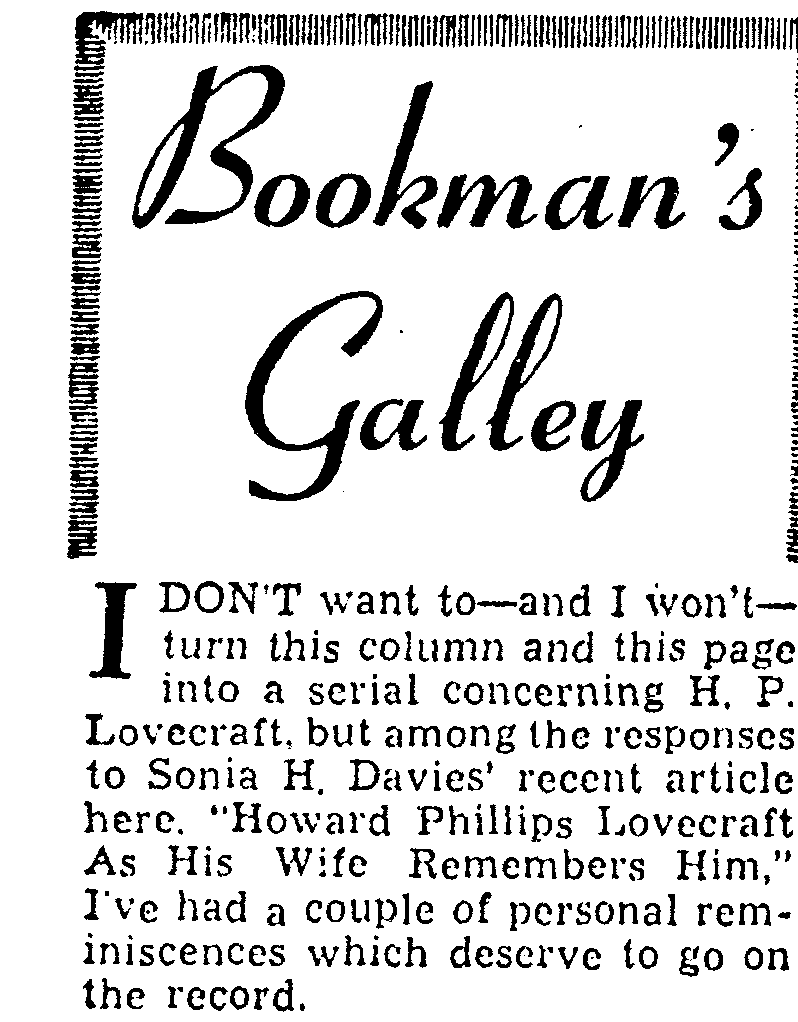
The publication of Sonia’s memoir drew immediate responses from those who knew Lovecraft, some of which Scott published in his regular column in the 19 Sep 1948 issue of the Providence Journal. Letters had come in from Muriel Eddy, Hazel Heald, and seven long paragraphs from Clara L. Hess about her childhood with Lovecraft and his family.
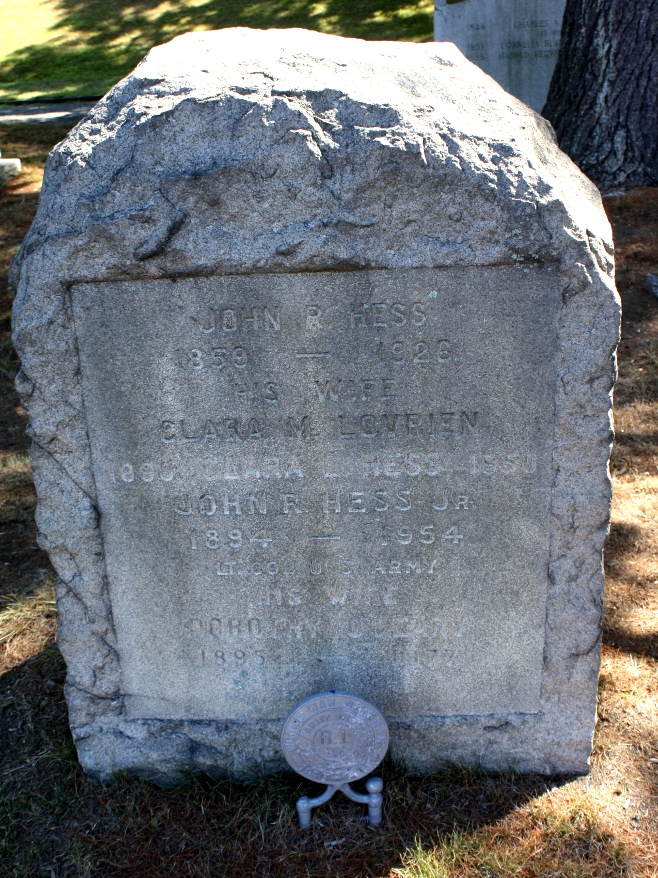
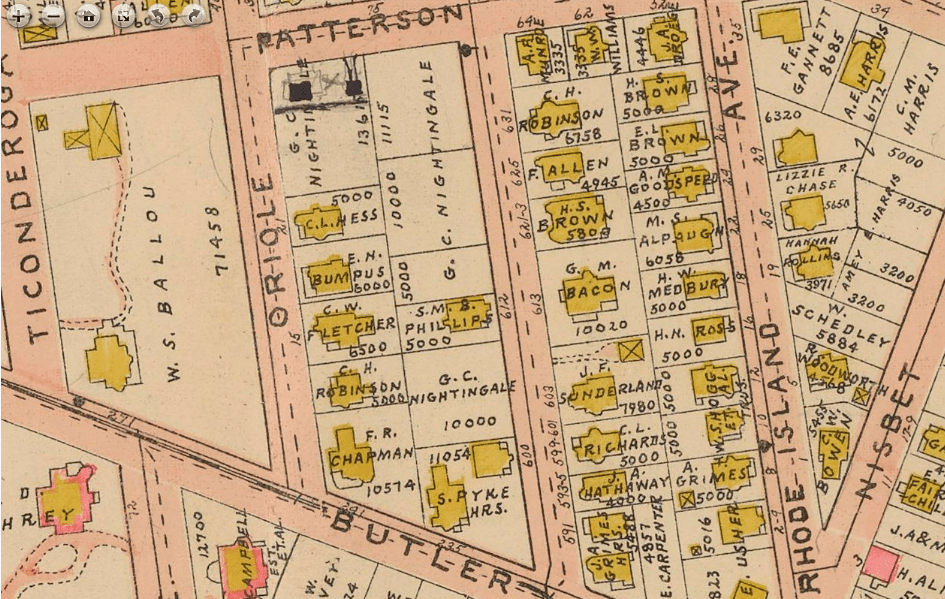
Clara Lovrien Hess (2 Jun 1889 – 5 Apr 1950) was the eldest child of John R. Hess, a newspaper editor for the Providence Journal, and Clara Maud Lovrien Hess, a housewife. Her family lived in the same neighborhood at the same time as H. P. Lovecraft did; Federal censuses from 1900-1920 place her family on Oriole Avenue, one street over from Angell St. where Lovecraft lived until 1924. None of Lovecraft’s letters mention Clara Hess, although this is not unusual, as very few of his letters mention any of the children in the neighborhood he grew up in, and when they do it is the boys. Lovecraft does mention her younger brother Jack Hess (John R. Hess Jr., 28 Apr 1894 – 7 Jan 1954) in Letters to J. Vernon Shea et al. 193 and Letters to Family & Family Friends 1.35.
According to Federal census data, after graduating from school Hess became a schoolteacher; and according to newspaper accounts, remained active in various clubs. She never married or had any children.
In 1928, Clara L. Hess moved to Warwick Neck, R.I.; she was there when Sonia’s memoir of Lovecraft was published, and was inspired to write a letter about her own experiences that ended up on Winfield Townley Scott’s desk, who subsequently published a part of it. This in turn caught the eyes of others; a letter survives from Margaret M. Wallace to Winfield Towley Scott, 24 Sep 1948, where she wrote:
I liked Clara Hess’s letter about Mr. Lovecraft. I didn’t live as near as she did to him, but I remember seeing him on the streets, and I thought he had a very disagreeable face. One should know that he would write the kind of books he did. Did Miss Hess know that you were going to quote her?
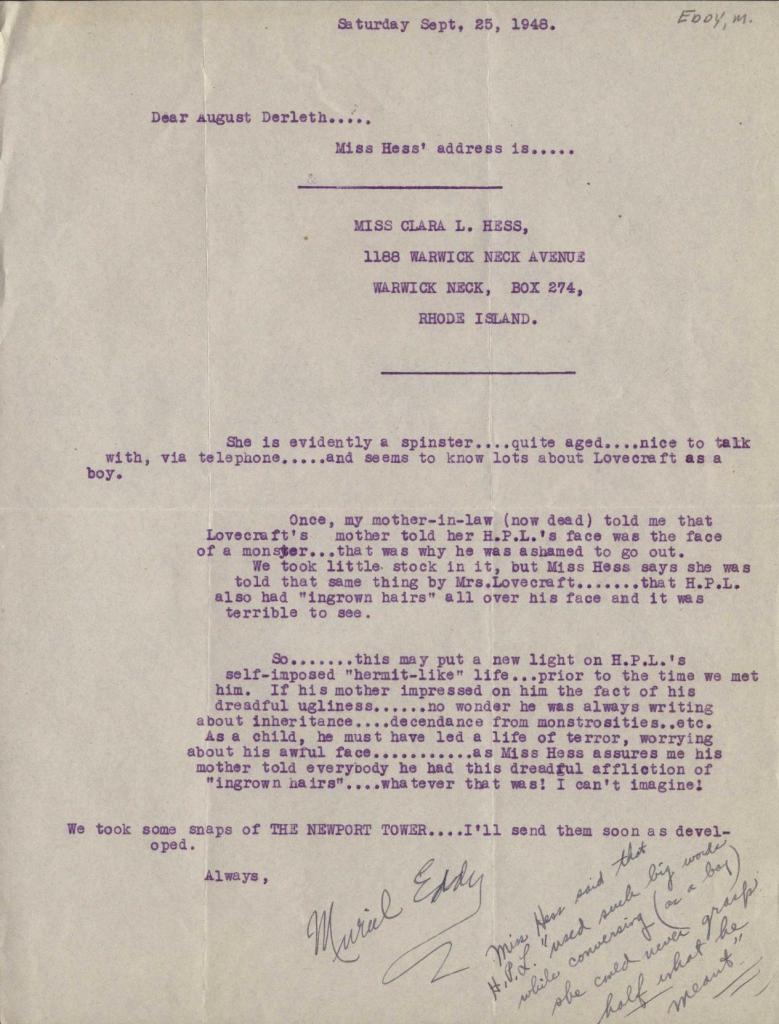
August Derleth apparently wrote to Muriel E. Eddy about Hess, who provided an address:
For the remaining 18 months or so of her life, Clara L. Hess and August Derleth conducted an intermittent correspondence, mostly focused on Lovecraft, his mother, and Derleth’s writing. Derleth quotes from Hess’ letters in his essay “Lovecraft’s Sensitivity” was that was published in Something About Cats (1949). The original letters themselves, however, have never been published in full, and are split between the John Hay Library at Brown University in Providence and the August Derleth archive at the Wisconsin Historical Society. The small cache of 9 letters is in many cases our only source for certain details on Lovecraft’s childhood, and his mother’s illness.

※
[0] Clara Hess to the Providence Journal (n.d.)
It was with great interest that I read the story of Howard Phillips Lovecraft as written by Sonia Davis for the Sunday Journal.
Howard Lovecraft and I grew up in the same “old time” East Side neighborhood in Providence when there was often fields covered with butterflies and daisies in the Butler Avenue—Angell Street-Orchard Avenue area. Although of a younger generation, I knew Howard’s mother better than I knew Howard who even as a young boy was strange and rather a recluse, who kept by himself and hid from other children because, as his mother said, he could not bear to have people look upon his awful face. She would talk of his looks (it seemed to be an obsession with her) which would not have attracted any particular attention if he had been normal as were the other children in the community who because of the strangeness of his personality kept aloof and had little to say to him.
I first remember meeting Mrs. Lovecraft when I was a very little girl at the home of the late Mr. and Mrs. Theodore Phillips on Angell Street where I visited often.[1] At that time Mrs. Lovecraft was living in the corner of Angell Street and Elmgrove Avenues.[2] She was very pretty and attractive, with a beautiful and unusually white complexion which it was said she obtained by eating arsenic, although whether there was anything to this story I do not know. She was an intensely nervous person.
Later when she moved into the little downstairs flat in the house on Angell Street [3] around from Butler Avenue I met her often on the Butler Avenue cars, and one day after many urgent invitations I went in to call upon her although she was considered as becoming rather odd. My call was pleasant enough but the house had a strange and shut up air and the atmosphere seemed weird and Mrs. Lovecraft talked continuously of her unfortunate son who was so hideous that he hid from everyone and did not like to walk upon the streets where people could gaze at him.[4] When I protested that she was exaggerating and that he should not feel that way she looked at me with a rather pitiful look as though I did not understand about it. I remember that I was glad to get out into the fresh air and sunshine and that I did not repeat my visit! Surely it was an environment suited for the writing of horror stories but an unfortunate one for a growing youth who in a more wholesome environment might have grown to be a more normal citizen.
Howard used to go out into the fields in back of my home to study the stars. [5] One early fall evening several of the children in the vicinity assembled to watch him from a distance. Feeling sorry for his loneliness I went up to him and asked him about his telescope and was permitted to look through it. But his language was so technical that I could not understand it and I returned to my group and left him to his lonely study of the heavens.
After a time one did not meet Mrs. Lovecraft very often. There was a mail box at the corner of Butler Avenue and Angell Street. (probably still is) Sometimes when going around the corner to mail a letter on an early summer evening one would see a dark figure fluttering about the shrubbery of her home and I discovered that it was Mrs. Lovecraft.
Sometimes I would see Howard when walking up Angell Street but he would not speak and would stare ahead of him with his coat collar turned up and his chin down.
After awhile I heard that Mrs. Lovecraft was ill and was away and that the aunts had taken over. [6] I knew nothing more about them until I heard of Howard’s marriage [7] which was wondered at by some of those who had known him.
c. l. h.
Notes: Sent before 19 Sep 1948, when selections were published in the Providence Journal. Available at the Brown Digital Repository.
[1] Theodore Winthrop Phillips (24 Jun 1836 – 26 Jun 1904) and his wife, Sarah Marsh Phillips (16 Feb 1835 – 4 Mar 1904) lived at 612 Angell St., the lot almost directly behind Clara L. Hess’ childhood home on Oriole Ave. Theodore Phillips was the son of Whipple Phillips, the great-great-uncle of H. P. Lovecraft.
[2] 454 Angell St., the Phillips family home where Lovecraft was born in 1890.
[3] 598 Angell St. After the death of Lovecraft’s grandfather Whipple Van Buren Phillips, Lovecraft and his mother were forced to move into smaller quarters.
[4] Many of Hess’ memories cannot be verified against other sources. R. Alain Everts in “Howard Phillips Lovecraft and Sex: or The Sex Life of a Gentleman” apparently asked Lovecraft’s ex-wife Sonia about these assertions and took her comments as confirmation; however, it must be remembered that Sonia only began courting Lovecraft after his mother’s death, so her memories may have been influenced by Clara Hess’ published accounts.
[5] Hess never gives any dates, but the 1908 map of Providence shows what appears to be open fields in that section, which would have been better for stargazing. Howard’s appreciation of astronomy from a young age is well known, so this could presumably have been any period from ~1900-1907.
[6] Sarah Susan Phillips Lovecraft (17 October 1857 – 24 May 1921) was admitted to Butler Hospital on 13 Mar 1919, after an apparent nervous breakdown. She died there two years later, following surgery to remove her gallbladder.
[7] H. P. Lovecraft left Providence, R.I. and married Sonia Haft Greene in New York City on 3 March 1924.
[1] Clara Hess to August Derleth, 9 Oct 1948
Warwick Neck,
Rhode Island,
October 9th, 1948.My dear Mr. Derleth:—
Of course, you may quote from my letter to the Sunday Journal about Howard Lovecraft and his mother. I feel greatly honored.
I do not know that Mrs. Lovecraft ever spoke to her son directly about his “ugliness” but I think he must have known how she regarded him. Howard resembled his mother. She had a peculiarly shaped nose which rather fascinated me as it gave her a very inquiring expression. Howard looked very much like her.
In looking back I cannot ever remember to have seen Mrs. Lovecraft and her son together. I never heard one to the other. It probably just happened that way but it does seem rather strange as we were neighbors for a considerable period of time.
I remember the aunts who came to the little house on Angell Street often, as I recollect, quiet, determined, little New England women, quite different from Mrs. Lovecraft, although Mrs. Lovecraft was a very determined person.
I remember that Mrs. Lovecraft spoke to me about weird and fantastic creatures that rushed out from behind buildings and from corners at dark and that she shivered and looked about apprehensively as she told her story. She asked me what I thought it and I told her it wasn’t so!
The last time I saw Mrs. Lovecraft we were both going “down street” on the Butler Avenue car. She was excited and apparently did not know where she was. She attracted the attention of everyone one. One old gentleman acted as if he were going to jump out of the car every minute. I was greatly embarrassed as I was the object of all of her attention.
Mr. Ronald K. Upham, 51 Adelphi Avenue, Providence might be able to throw some light upon the tragic Lovecraft story. [1] I believe that at one time he used to visit Howard at the little Angell Street flat.
I have not read you biography of Howard Lovecraft [2] but intend to do so and I am now looking forward to the publication of the Selected Letters.
Also, I am looking forward to reading your book “Sac Prairie People”. [3] I have never been west and Wisconsin, I know, is a very beautiful state.
If I come across any additional information about the Lovecraft family I’ll be glad to send it on to you.
To you
Sincerely,
Clara L. Hess
Notes: Available at the Brown Digital Repository.
[1] Ronald Kingsley Upham (4 Aug 1892 – 30 Jan 1958), one of Lovecraft’s boyhood friends. See also Letters to Rheinhart Kleiner & Others 192, Letters to J. Vernon Shea et al. 193, Miscellaneous Letters 111, Essential Solitude 1.323, Letters to Family & Family Friends 1.42, 113, 378
[2] H. P. L.: A Memoir (1945).
[3] Sac Prairie People (1948), a collection of short stories, part of Derleth’s Sac Prairie Saga about his native region of Sauk City and Prairie-du-Sac, Wisconsin.
[2] Clara Hess to August Derleth, 18 Oct 1948
Warwick Neck,
Rhode Island,
October 18th, 1948.Mr dear Mr. Derleth:—
Your letter of October 12th has been received—Certainly, you may quote from anything I may write to you. It won’t be necessary for you to send me copy to read although of course, I would like very much to see it. If I do not find the published biography I’ll let you know.
I was much interested in what you wrote about Mrs. Gamwell [1] and it was very nice that you were able to help her in placing some of Howard’s work after his death. [2] I did not know that she was in straitened circumstances although I realize that fortunes often have a way of disappearing. [3]
I do not remember how Howard obtained his education. He had a cultured background. His people were old fashioned gentlefolk which meant considerable in the old aristocratic Providence East Side neighborhood prior to World War I. He was a real student and a great reader. I thought of him as a genius and believed that he would make a name for himself as an astronomer.
I hope that you will hear from Ronald Upham as I think he will have some information to give about Howard.
The Lovecraft story is an intensely interesting story and I am glad that I have been able to be of some help to you. If I can be of any further assistance let me know. I’ll be glad to help in any way that I can.
Sincerely,
Clara L. Hess
Notes: Available at the Brown Digital Repository.
[1] Anne Emeline Phillips Gamwell (10 Jul 1866–29 Jan 1941), H. P. Lovecraft’s younger aunt, who survived him.
[2] After Lovecraft’s death, Derleth acted as agent with Weird Tales to publish some of his fiction, sending the monies to Annie Gamwell.
[3] After the death of Whipple Van Buren Phillips, none of the Phillips women worked or had living husbands to support them, and H. P. Lovecraft was unable to hold a regular job, so they lived off of the savings with meager income until the family entered a state of genteel poverty.
[3] Clara Hess to August Derleth, 31 Jan 1949
Warwick Neck
Rhode Island
January 31st, 1949My dear Mr. Derleth:—
For several weeks I have been intending to write you that I obtained a copy of your book about Howard Lovecraft at the Providence Public Library, also a collection of Howard’s stories and a copy of “Village Daybook” [1]—I was not able to obtain your Book of the Month club story [2]—
Of course, I was greatly interested in your account of H.P.L.—It was very beautifully written and I am looking forward to your coming publication about Howard—the collection of stories—but by special permission with a possible charge of 10 cents a day (if kept too long) I did not find too satisfactory of the print was so fine that I could only read it with the aid of a magnifying glass! And so was not able to read very much of it.
I am still reading “Village Daybook” which is quite delightful and unusual, we have many birds, rabbits, fox and an occasional deer here at Warwick Neck. But we do not have wild strawberries. [3] Some years ago I was in Connecticut for a summer and one day came across a large meadow almost completely covered with them. I spent many hours gathering the berries and made most of them into jam to take home for the family food shelf. But sad to relate, a school chum of my brother came by to visit and when he discovered my jam he refused to eat anything but bread and butter and strawberry jam all through his visit (although we had very good meals) and when the jam was all eaten up he decided to go home—I had not thought of Elliot for some years until I read your account of Wisconsin berries but I suddenly remember his visit at Putnam Heights—the last I heard of him he had become very successful in the journalistic field down in Washington.
I believe that your coming book about Howard Lovecraft will be of great interest in Rhode Island—All at once everyone is talking about Howard—the stories about him in the Sunday Journal Book page have excited a great deal of interest.
Please be sure to let me know the date of publication of your book as, of course, I am looking forward to it.
Sincerely,
Clara L. Hess
Notes: Available at the Wisconsin Historical Society.
[1] The “Lovecraft collection” is probably Best Supernatural Stories of H. P. Lovecraft (1945); Village Daybook: A Sac Prairie Journal (1947) by August Derleth, a Sac Prairie Book.
[2] Sac Prairie People (1948) was recommended by the Book-of-the-Month Club in 1948.
[3] “Another new experience was picking strawberries—& in late August. I had never before seen these well-known commodities in the process of growth.” —H. P. Lovecraft to Annie E. P. Gamwell, 27 Aug 1921, LFF1.45
[4] Clara Hess to August Derleth, 24 Feb 1949
Warwick Neck,
Rhode Island,
February 24th, 1949My Dear Mr. Derleth:—
Your gift of the autographed copy of “Village Year” and the collection of Howard Lovecraft’s Supernatural Stories came as a very welcome surprise. They are quite the nicest gift I have received for a long time and I very much appreciate your thought in sending them to me.
Your foreword about Howard was kindly and beautifully written. I have not as yet read all of Howard’s stories the collection but “The Outsider” made a great impression upon me. It is one of the most remarkable stories I have ever read. I have re-read it several times and I am going to read it again. of course, Howard knew nothing of our Atom Bomb and the more recent frightful inventions of man. Yet all I could think of was the Atom Bomb when reading “Colour Out of Space”.
The day that your books came I heard from the librarian at our Warwick Neck Library—the Old Warwick League Library—that your Book of the Month Club book which the book committee had ordered at my request had finally come in and that she had saved it for me but that someone had gotten off with it after all. So people in this vicinity are becoming acquainted with Sac Prairie People in Wisconsin. Mrs. Jerrett—our librarian—said there was evidently some difficulty in obtaining your book as it took so long to come through.
I’ll have to admit that I turned with relief from Howard’s dark and sombre tales to your book of village and country life. I’m enjoying reading it very much. You wrote that you consider it better than its successor—I like them both—they are books that are good to own and to have to re-read. Your story of the Dragonflies—(“Glowing Needles”)—The seeing of fireflies legs together—I was told as a child here in Rhode Island and I believed it for sometime! But my father who told the story came from Erie, Penn. so settlers not in Pennsylvania evidently knew that old saying, too.
Again thanking you for your gifts of two such unusual books—one dark and fantastic—the other, real and beautiful—I am
Sincerely, Clara L. Hess
Notes: Available at the Wisconsin Historical Society.
[5] Clara Hess to August Derleth, 27 Mar 1949
Warwick Neck,
Rhode Island,
March 27th, 1949My dear Mr. Derleth:—
I am looking forward to reading your copy—I know that anything I have written about Howard will be all right to quote—I am glad that I have been of some assistance and feel quite proud to have your quote from my letter. [1]
The book “Sac Prairie People” I have gotten from our little library and I like your short stories very much. I especially like “Expedition to the North”, “Moonlight in the Apple Tree”, “Now the Time for All Good Men” and “The Night Light at Vorden’s”—(There are many women like Bianca—I have known several—One wonders how they happen to become like that.) It’s a sad and tragic tale and very beautifully written.
I made the mistake about the Book of the Month Club Book—But why wasn’t it—I made the error when reading the folder which I have to our librarian for our book committee. Now I am going to read some of your novels. My robins disappeared after a late blizzard but I think they are with other song birds in the brush in the swampy land below me. I did not know we had killdeer her but I am told that there are a few around although I have to see one.
Last evening I heard frogs piping in chorus so I know that spring has really come to Warwick Neck— I hope that spring has arrived on time in Sac Prairie, Too.
Sincerely,
Clara L. Hess
Notes: Available at the Wisconsin Historical Society.
[1] Regarding “Lovecraft’s Sensitivity” by August Derleth in Something About Cats (1949), which quotes from Hess.
[6] Clara Hess to August Derleth, 6 Apr 1949
Warwick Neck,
Rhode Island,
April 6, 1949My dear Mr. Derleth:—
I had just finished reading “The Thing on the Doorstep”–a story as powerful and disturbing as Howard’s own powerful and disturbing personality—when your letter and draft of the paper, Lovecraft’s Sensitivity came. It was all intensely interesting to me and it makes me feel very important. Mrs. Wright (Virginia Williams) a younger neighbor—I knew well and I was impressed by her recollections of Howard. [1] I met her a short time ago (after some years) at a Sunshine Society auction in our little Warwick Neck library and immediately we began to visit about old times and about H. P. L. Unlike Virginia I never was afraid of Howard but to young children he must have appeared a dark spectre when rushing through the dusk—a weird figure in the quiet New England setting of that period.
I wonder what Howard would think of the old fashioned New England neighborhood now with stores and apartment houses and newer homes built close together—there are many people of Jewish extraction in the Providence old East Side to-day. I felt sorry that H.P.L.’s former wife wrote of his racial prejudice, especially at this time when there is so much made of racial prejudice—a thing as cruel as it is unjust. But in the environment of Howard’s youth (and of mine) it would have been impossible To escape the teachings of the time and it is quite understandable that youth of a naturally kind and gentle disposition should have absorbed the ideas of the older generation about him.
I had a friend who grew up in the vicinity who continued to live in her family homestead after an almost all Jewish settlement sprang up around her. She would watch the children going by to school and noticed one child who was shoved about and pushed into the gutter time after time. Finally she went out and indignantly asked why that little boy was being treated in such fashion and the answer was, “Oh, we can’t walk with him, he isn’t a Jew”—So there can be two sides to a story after all.
You asked me to comment on your chapter about H. P. L.’s Sensitivity. I have re read it very carefully several times and it all seems very right to me—I repeat that I am very glad to have been of help in your study of Howard’s life and that I am looking forward to the publication of your book.
We are having a wild Southeast storm here this morning but the birds are singing in the rain. I heard a minister speaking over the radio Sunday morning who stated that if a man could become a bird and teach the birds how to live and take care of themselves how wonderful it would be for the birds. I thought of the story ( whose I do not remember but you probably know) “Who is the greatest of all God’s creatures?”—The answer, “man”—the question, “Who says so?” and the answer, “man”—
Wishing you continued success with your writing I am
Sincerely
Clara L. HessAre all the characters in your stories real people or do you just make them all seem real—
Notes: Available at the Wisconsin Historical Society.
[1] Virginia Williams Wright (30 Dec 1901 – 9 Oct 1993), born on Paterson St. in Providence, R.I., was a neighbor of H. P. Lovecraft’s. She sent a letter from Wright to Winfield Townley Scott which survives at the Brown Digital Repository, dated 23 Sep [1948]; Scott published an excerpt from it in the Providence Journal for 3 Oct 1938:
As a little girl I was scared to death of him for he used to walk rapidly up & down Angell St. at night just as a group of us were playing “Hare & Hounds” at the corner of Angell & Paterson Strs. His appearance always frightened me. he was certainly the neighborhood mystery—He never would speak to me or any of us but kept right on with his head down. Once in a while I would pass him in the daytime but never could get him to say hello.
[7] Clara Hess to August Derleth, 17 May 1949
Warwick Neck,
Rhode Island,
May 17th, 1949.My dear Mr. Derleth:—
Inclosed [sic] is a story about H. P. L. which was forwarded to me by a friend who knew that I am interested in the study of the life of H. P. L.—you may have it—anyway, I thought it might possibly be of some interest to you–
Sincerely,
Clara L. Hess
Notes: Available at the Wisconsin Historical Society. No enclosure in the file, so unclear who or what this was.
[8] Clara Hess to August Derleth, 7 Jan 1950
1188 Warwick Neck Avenue,
Warwick Neck,
Rhode Island,January 7th, 1950.
My dear Mr. Derleth:—
“Something About Cats and Other Pieces” I am reading with great interest and I am learning much about Howard Lovecraft that I did not know before—you have given a great deal of time and thought in assembling so much interesting material and the result is certainly most satisfactory. You must feel very much pleased with the result of all of your work.
The volume came on Monday December 26th as I was leaving to have a second Christmas dinner with friends in Warwick Neck who have a New York City background and who did not know Howard. I took my book with me—my host spent a good half of the evening reading about Howard and in telling us about his visit in New Orleans—then he insisted upon keeping my book. But I went over for it several days later and I have asked our Warwick Neck librarian to obtain a copy for our library as I know there are many people here who will want to read it. Also it will be of value for the library to own.
Again may I repeat that I am honored to be in such distinguished company and that I am glad to have been able to contribute something of interest about Howard and his family. With all good wishes to you for the year 1950 I am
Sincerely Clara L. Hess
Notes: Available at the Wisconsin Historical Society.
※
How reliable are Clara L. Hess’ recollections of Lovecraft and his mother? We can confirm from census data that she was in the right place at the right time, so there is little doubt that she was a neighbor of H. P. Lovecraft and Susie Lovecraft as a child, teenager, and adult. Some of her observations agree with other accounts of the Lovecraft’s life—such as H. P. L.’s interest in astronomy, and the move from 454 to 598 Angell St.—for all that she was looking back 40+ years, the material we can verify show Hess’ recollections appear to be fairly accurate.
Several of Hess’ personal anecdotes cannot be verified, including her various encounters with Susie Lovecraft. How accurate is the image that Hess paints of a mentally unstable woman rumored to take arsenic, hallucinating, and who finds her son’s appearance disturbing? At this point (1948), the most that had been written of Susie Lovecraft was by Winfield Townley Scott, who painted her as a “weak sister,” and Lovecraft as a “mama’s boy.” Hess’ comments did not help Susie Lovecraft’s image, and most subsequent portrayals of Lovecraft’s mother in biography and fiction are based on that image that Hess and Scott had presented, and which Derleth helped codify in “Lovecraft’s Sensitivity” (1949).
Probably the most revealing section of Hess’ letters that did not make it into print is her comment on racial prejudice. The anecdote reveals more about Hess than it does Lovecraft; the impulsive desire to push back against accusation of racial prejudice by saying “Hey, these Jews can be racist too!” speaks more to the pervasiveness of antisemitism among Lovecraft’s environment than a counter to Sonia H. Davis’ allegations about her ex-husband.
While we lack Derleth’s letters to Hess—it is not clear what happened to her papers after she died—it doesn’t appear that he pressed her closely on details regarding dates, etc., though he was careful to get permission for what he quoted from her. Read in context, we can perhaps better appreciate how near the end of her life, Clara L. Hess cast her mind back to younger days in the old neighborhood, and the strange kid who stood out from among the others.
Thanks to Donovan Loucks for his help.
Bobby Derie is the author of Weird Talers: Essays on Robert E. Howard and Others and Sex and the Cthulhu Mythos.
Deep Cuts in a Lovecraftian Vein uses Amazon Associate links. As an Amazon Associate I earn from qualifying purchases.
 Deep Cuts in a Lovecraftian Vein