“Chosen” (2015) by Lyndsey Holder

Brown Jenkin was agitated, running circles around me, climbing up my back and crawling down into my lap, staring at me with his beady black eyes. I reached out to him tentatively and he nuzzled my hand, stirring a strange kind of love in my heart.
—Lyndsey Holder, “Chosen” in She Walks in Shadows (2015) 160

Familiar horrors inspire a kind of wish-fulfillment. Thousands of readers of Bram Stoker’s Dracula and Anne Rice’s The Vampire Lestat have imagined what it would be like to be undead, ageless and powerful, bound by night and loosed from the morals of humanity. Roleplaying games like Werewolf: the Apocalypse let fans of werewolf movies and lore vicariously embody the power and ferocity of the change. Contemporary witches look back at the witch trials and pay tribute to those hypothetical ancestors, sometimes drawing imaginary connections to the persecuted of Salem Village in the Province of Massachusetts Bay.

Lovecraftian horrors are not so familiar as vampires and werewolves, and so there are fewer who wish to truly meet or embody those horrors. Fewer readers express a desire to be Pickman-esque ghouls than to become vampires, though more than a few would happily undergo the change into a Deep One and dwell in wonder and glory forever beneath the waves. While there are a few Lovecraftian witches, occultists like Keziah Mason and Joseph Curwen are often still figures of horror, not mentors or figures of nostalgia akin to Dracula.

“Chosen” by Lyndsey Holder thus enters a rather scarce territory. We very often see Keziah Mason presented as the stereotypical witch, the old hag with the familiar, steeped in the blood libel of child sacrifice from old legends. Sometimes, rarely, we see her as the archetypal Lovecraftian witch, the one who embodies the kind of freedom, wisdom, and power—and attracts the kind of prosecution—that embodies the more mythical ancestors of contemporary Wiccans, as inspired by The Witch-Cult in Western Europe (1921) by Margaret A. Murray.

Holder’s story is very short, just six pages long, short and to the point, and all too easy to spoil. The biggest unanswered question might be why the nameless girl protagonist is a child in Vancouver, very far from Arkham as the broom flies. However, Lyndsey Holder is herself Canadian. Maybe there’s a bit of wish-fulfillment in this story, a fictional accounting of a pilgrimage she would have taken if the dreams had come to her. Certainly, Mythos fans can appreciate why they might save and scrimp to travel thousands of miles just to be there, where horror once walked. More than a few fans stride the streets of Providence and Salem every year, after all, thinking of Lovecraft and witches.

The horror in this story doesn’t really come from Keziah Mason or her familiar Brown Jenkin. They are familiar figures, and there is something comforting in their portrayal. The horror in the story is how the protagonist reacts to them, how her life changes when they become a part of it. The ending is certainly a fitting one. Not every Lovecraft fan would choose that way to become a part of the Mythos, but for those who are given a chance to be part of the story…well, a few readers at least will understand.

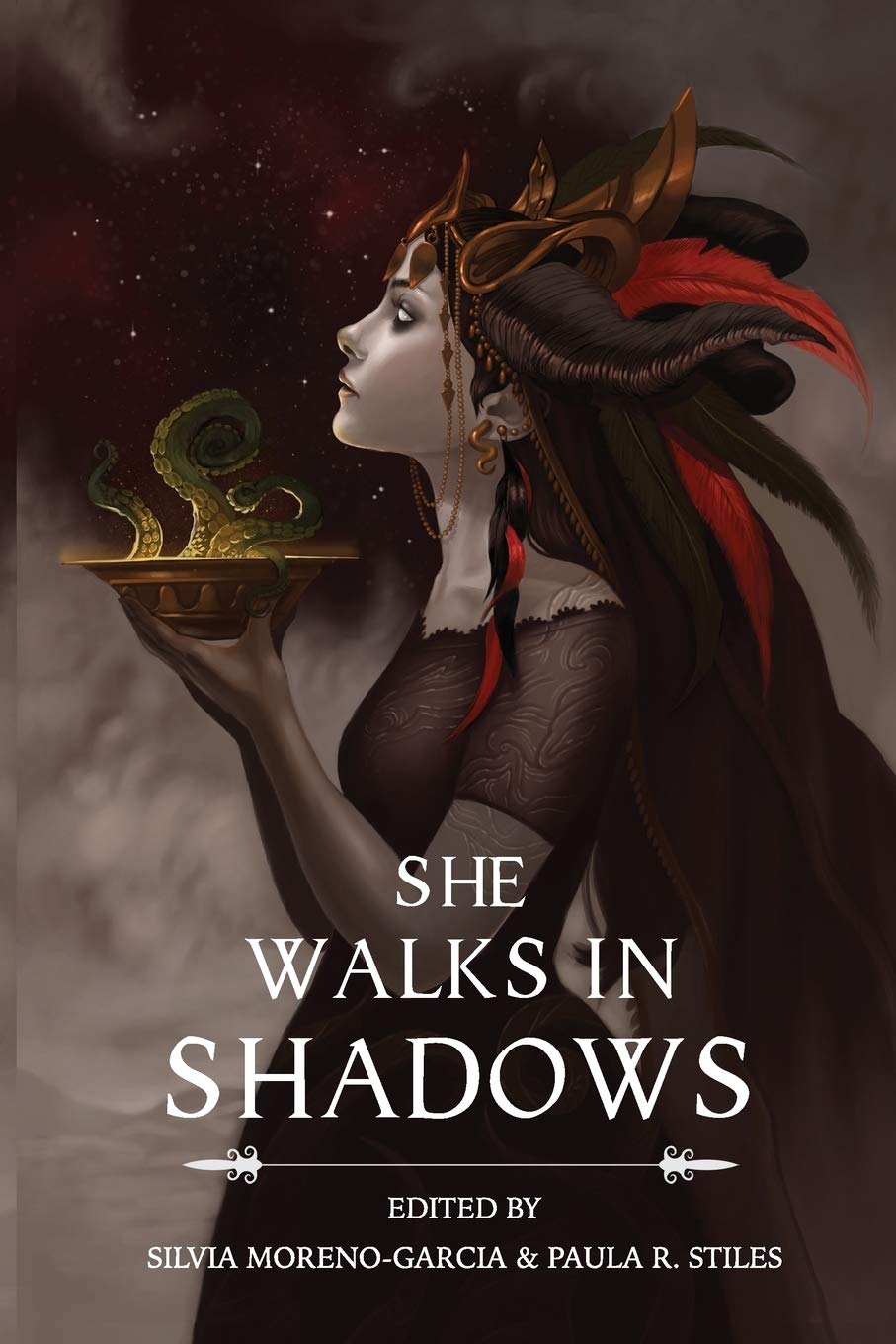
“Chosen” by Lyndsey Holder was published in She Walks in Shadows (2015) and its reprints, it has not otherwise been republished.


Bobby Derie is the author of Weird Talers: Essays on Robert E. Howard and Others and Sex and the Cthulhu Mythos.

Deep Cuts in a Lovecraftian Vein uses Amazon Associate links. As an Amazon Associate” I earn from qualifying purchases.
“Body to Body to Body” (2015) by Selena Chambers

Every woman’s body is a story, you see.
—Selena Chambers, “Body to Body to Body” in She Walks in Shadows (2015) 132

Lovecraftian genealogical narratives tend to focus on a single, often the paternal, line. What that tends to exclude is a large number of other ancestors and relatives: mothers, grandmothers, aunts, cousins, sisters, half-sisters, and step-siblings. Writers following Lovecraft were not averse to filling out and following other branches of various family trees. August Derleth’s “The Shuttered Room” (1959) follows some Whateley cousins, for example, and Lavinia Rising (2022) by Farah Rose Smith expands on Lavinia Whateley’s background.

These Mythos family reunion stories are often a bit contradictory; that’s the point. By expanding on unspoken relations, authors have the opportunity to give alternative narratives, fresh viewpoints, different and more complex takes on a set of events or individuals. That’s how myth cycles—and, more often than not, family stories, repeated in games of telephone down generations—tend to work. Readers get to balance the narratives and decide for themselves what “really” happened.

Yes, he knew about the Innsmouth blood now.
—H. P. Lovecraft, “The Thing on the Doorstep”

“Body to Body to Body” by Selena Chambers is set up chronologically as an immediate sequel to Lovecraft’s “The Thing in the Doorstep,” and narratively is structured in parallel: the police are interviewing a suspect, and she tells her tale. What marks this story as different is that the interviewee is Asenath Waite’s half-sister—from before their mother’s marriage to Ephraim Waite—and so the events she relates are largely a prequel to Lovecraft’s tale, expanding on Asenath’s background and childhood. How she became who she became, in every sense of the word.

Like “The Thing on the Cheerleader Squad” (2015) by Molly Tanzer and other stories that spin out of Lovecraft’s original, this story explores a different relationship dynamic with Asenath and Ephraim. In Lovecraft’s original story, questions of identity ultimately make Asenath a victim, overpowered and replaced by her father’s mind; stories like Tanzer and Chambers give Asenath more agency, and more of an identity of her own distinct from her father’s.

Chambers’ depiction of the Waite’s home life makes no bones about Ephraim Waite as a bigoted old occultist; it feels like there might be a hint of Lovecraft in the portrayal, reminiscent of how Mexican Gothic (2020) by Silvia Moreno-Garcia borrows some characterization from Lovecraft for its villain. However, the real delight in the story is the little details from the protagonist’s point of view, the hints of Innsmouth culture that go beyond Mythos lore and speak of lived experience in the town. And it offers an alternative ending to “The Thing on the Doorstep” which is more hopeful than Lovecraft’s vision.

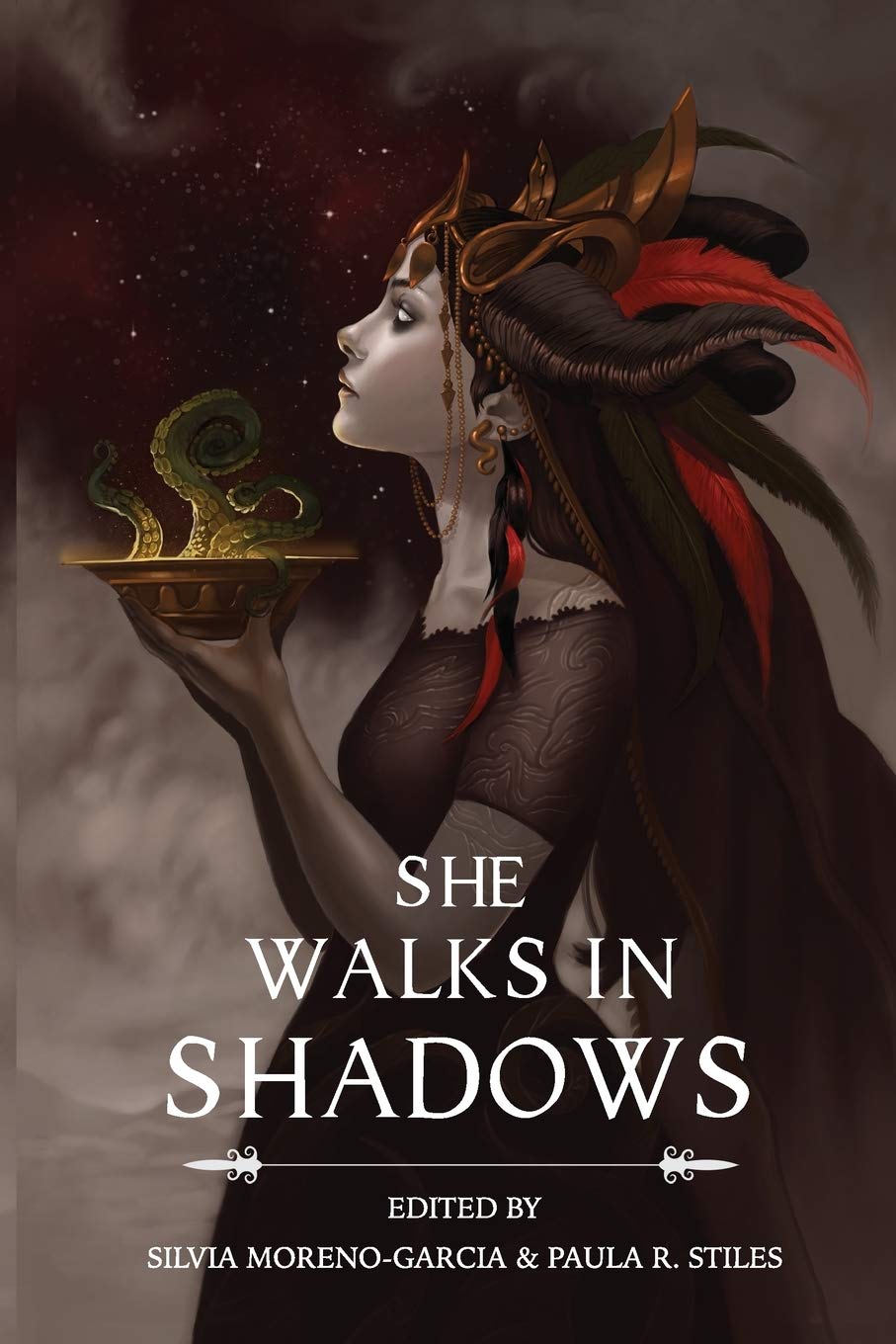
“Boby to Body to Body” by Selena Chambers was published in She Walks in Shadows (2015) and its variations. It has not otherwise been reprinted.


Bobby Derie is the author of Weird Talers: Essays on Robert E. Howard and Others and Sex and the Cthulhu Mythos.

Deep Cuts in a Lovecraftian Vein uses Amazon Associate links. As an Amazon Associate” I earn from qualifying purchases.

“The Thing on the Cheerleader Squad” (2015) by Molly Tanzer

The friend whose daughter had gone to school with Asenath Waite repeated many curious things when the news of Edward’s acquaintance with her began to spread about. Asenath, it seemed, had posed as a kind of magician at school; and had really seemed able to accomplish some highly baffling marvels. She professed to be able to raise thunderstorms, though her seeming success was generally laid to some uncanny knack at prediction. All animals markedly disliked her, and she could make any dog howl by certain motions of her right hand. There were times when she displayed snatches of knowledge and language very singular—and very shocking—for a young girl; when she would frighten her schoolmates with leers and winks of an inexplicable kind, and would seem to extract an obscene and zestful irony from her present situation.
—H. P. Lovecraft, “The Thing on the Doorstep”

The most subtly pervy moment in all of Lovecraft’s fiction is near the end of this paragraph, when the reader realizes that the mind of an old man is trapped in a young woman’s body as she goes to high school. It’s the kind of body-swapping setup that could serve as the premise for bad porn…or, in the hands of a competent writer, for a particular kind of tongue-in-cheek horror story. But who would write such a tale?

Molly Tanzer.

There has been considerable discussion about whether or not “The Thing on the Doorstep” is a transgender story (see: Must I Wear This Corpse For You?: H. P. Lovecraft’s “The Thing on the Doorstep” (1937) by Joe Koch ), but there is general agreement that Lovecraft deliberately avoided or elided any question of sexual attraction or the sex act itself in the tale. The pornographic possibilities went unrealized, but so did any potential interrogation of the character’s sexual identities with regard to gender. That has left a blank space on the Lovecraftian map for other writers more comfortable with such ideas to explore.

There’s a definite element of the quintessential queer film But I’m a Cheerleader! (1999) in the mix of influences Tanzer is drawing on, and the first half of the story plays it relatively straight when prudish, sheltered Victoria comes to terms with the complicated feelings aroused when her cousin Asenath reappears at Miskatonic High dressing like a boy and going out with girls. But Tanzer only plays out the high school melodrama and teenage angst so long, and even then, it’s with tongue-very-much-in-cheek.

Veronica rolled her eyes. “So what—you’re Laura Palmer now?”

“Maybe Bobby Briggs,” Asenath lowered her voice.
—Molly Tanzer, “The Thing on the Cheerleader Squad” in She Walks in Shadows 122

The plot in this story is very slight, Veronica’s treacle-sweet faith in Jesus and her utter frustration at how Asenath’s bad reputation is affecting her own showcase the kind of general ignorance, vapid insecurities, and rampant cruelty that are the hallmarks of high school. The story is told well; Tanzer keeps the pace ticking, doesn’t get too bogged down in secondary characters, or feel the need to jam a shoggoth out of left field into act three. The surprises, when they come, feel like they’ve always been there, waiting to be discovered.

What makes it work is the ending. Readers of “The Thing on the Doorstep” have their preconceptions of what is going on and how events will play out; those familiar with narratives of homosexual awakening might imagine that Tanzer is going to take the But I’m a Cheerleader! route with a Lovecraftian twist. The truth is, this was always a horror story, and the finale brings together all the elements in a way that readers probably won’t expect.

Is this a transgender story? When considering it in the context of Lovecraft’s original story, there’s a definite argument to make that it is more of a trans story than “The Thing on the Doorstep.” Asenath never comes out and makes the claim to be transmasculine directly, but that ambiguity is part of what makes the story work. The reader sees, through Veronica’s eyes, how Asenath acts and dresses and presents, and must make their own determination of which gender Asenath identifies with. That still leaves plenty of room for other authors to play with the unrealized possibilities of sex and gender in “The Thing on the Doorstep.”

“The Thing on the Cheerleader Squad” by Molly Tanzer was first published in She Walks in Shadows (2015) and its paperback reprints, and was also published in Transcendent: The Year’s Best Transgender Speculative Fiction (2016).


Bobby Derie is the author of Weird Talers: Essays on Robert E. Howard and Others and Sex and the Cthulhu Mythos.

Deep Cuts in a Lovecraftian Vein uses Amazon Associate links. As an Amazon Associate I earn from qualifying purchases.

“Lockbox” (2015) by E. Catherine Tobler

There are not a vast number of women mentioned in H. P. Lovecraft’s “The Rats in the Walls.” However, two stand out:

The worst characters, apparently, were the barons and their direct heirs; at least, most was whispered about these. If of healthier inclinations, it was said, an heir would early and mysteriously die to make way for another more typical scion. There seemed to be an inner cult in the family, presided over by the head of the house, and sometimes closed except to a few members. Temperament rather than ancestry was evidently the basis of this cult, for it was entered by several who married into the family. Lady Margaret Trevor from Cornwall, wife of Godfrey, the second son of the fifth baron, became a favourite bane of children all over the countryside, and the daemon heroine of a particularly horrible old ballad not yet extinct near the Welsh border. Preserved in balladry, too, though not illustrating the same point, is the hideous tale of Lady Mary de la Poer, who shortly after her marriage to the Earl of Shrewsfield was killed by him and his mother, both of the slayers being absolved and blessed by the priest to whom they confessed what they dared not repeat to the world.
—H. P. Lovecraft, “The Rats in the Walls”

While it wouldn’t be quite accurate to say that Lovecraft scholarship has ignored these women, it would be accurate to say that the picklocks of literary critics and historians haven’t turned up any particular connections or likely historical or literary inspirations for Margaret Trevor and Mary de la Poer. While we know Lovecraft drew inspiration for this tale from Sabine Bearing-Gould’s “S. Patrick’s Purgatory” in Curious Myths of the Middle Ages, and while there is no lack of mysterious ladies therein, one stands out as a possible inspiration:

It is worthy of remark that the myth of S. Patrick’s Purgatory originated among the Kelts, and the reason is not far to seek. In ancient Keltic Mythology the nether world was divided into three circles corresponding with Purgatory, Hell, and Heaven ; and over Hell was cast a bridge, very narrow, which souls were obliged to traverse if they hoped to reach the mansions of light. This was—

“The Brig o’ Dread, na brader than a thread.”

And the Purgatory under consideration is a reflex of old Druidic teaching. Thus in an ancient Breton ballad Tina passes through the lake of pain, on which float the dead, white robed, in little boats. She then wades through valleys of blood. (248-249)

This is speculative; Lovecraft borrows some of the imagery for “The Rats in the Walls,” and it includes a woman recalled in a ballad associated with pain and blood, which may have been the seed from which Margaret Trevor and Mary de la Poer (and their respective ballads) grew. One might also wonder if the legend of Elizabeth Bathory worked on Lovecraft’s imagination, or any of the prospective cultists included in Margaret Murray’s The Witch-Cult in Western Europe, and these are certainly possible. The image is, in both cases, of women of the line who do not shrink away from the family cult, but become active participants.

Trish Thawer in The Witches of BlackBrook (2015) famously wrote: “We are the daughters of the witches you weren’t able to burn.” While that may not be historically true (convicted witches during the Salem Witch hysteria were hung, not burned at the stake), there is a sentiment that applies to readers and writers in Lovecraft’s Mythos: who are the daughters and granddaughters of Lovecraft’s women cultists, who had such a bad reputation that they haunted the ballads of the country for centuries thereafter?

Which is the theme that E. Catherine Tobler assays in “Lockbox,” one of the stories in She Walks in Shadows. The brief story is a return to Exham Priory by a female descendant of the de la Poer (or Shrewsfield) line and her not-quite-trustworthy lover…and the thing that makes the story work is that it is her story, her reconnection with this ancestor and all the mystery and horror that Margaret Trevor of Cornwall represents, not as a member of the cult she was marrying into, but as a black saint in her own right:

The worst thing was, despite the horrors around her, Margaret Trevor was something to be worshipped, a glory even in the blood and ruin that streaked her. The stories said that she loved the old cults well, but had taken a passive role beside her husband. But here, in the horrible cellar with the collapsing girders, she was a gold-and-silver goddess while her husband cowered.
—E. Catherine Tobler, “Lockbox” in She Walks in Shadows 94-95

The story is told with many footnotes, many caveats, things that cannot be said and perhaps dare not be remembered. It gives the suggestion of a maddening experience that has snapped a thread of sanity and memory, but the title is the crux of the story, because it is a mystery and a memory that the narrator can choose to recall whenever she wishes—whenever she is ready to leave her placid isle of ignorance and remember what really happened down there, in the buried ruins of Exham Priory.

“Lockbox” by E. Catherine Tobler was first published in She Walks in Shadows (2015) and its reprints, and was also reprinted in Wilde Stories 2016: The Year’s Best Gay Speculative Fiction.


Bobby Derie is the author of Weird Talers: Essays on Robert E. Howard and Others and Sex and the Cthulhu Mythos.

Deep Cuts in a Lovecraftian Vein uses Amazon Associate links. As an Amazon Associate I earn from qualifying purchases.

“De Deabus Minoribus Exterioris Theomagicae” (2015) by Jilly Dreadful

On page 50, quire E, on the 7th leaf, on the face of one of the only decorative plates in the book, an illustration, beneath which these handwritten words appear (Translations are my own):

Idh-yaa Lythalia Vhuzompha
Shub-Niggurath Yaghni Yidhra (names of lesser outer goddesses)
Dare licentiam ad ut eam in servitium vestrum Arma capere milites,
(Give her permission to arem soldiers in your service.)
—Jilly Dreadful, “De Deabus Minoribus Exterioris Theomagicae”
in She Walks In Shadows (2015) 51

There is a strong strain of bibliophilia that runs right through the heart of the Mythos, its authors and readers. Part of the game was creating eldritch tomes like the Necronomicon and Unaussprechlichen Kulten, some of them with detailed backstories, strange and terrible authors, and blasphemous contents that were often only hinted at—secret histories, oddly effective spells, sanity-sapping diagrams and illustrations.

Yet very few Mythos tomes are written by women. Even fewer are written for women.

The patriarchal bias in the Mythos tome bookshelf is largely an unconscious one. It wasn’t that Lovecraft and his contemporaries couldn’t conceive of women mystics and magicians, they just didn’t make them the authors of any books. Likewise, female-presenting Mythos entities were in the minority, and didn’t start to increase in number, variety, and importance until relatively late, with the introduction of entities like Cthylla (see “In His Daughter’s Darkling Womb” (1997) by Tina L. Jens) and Ammutseba (see “Ammutseba Rising” (2015) by Ann K. Schwader), and the expansion of entities like Mother Hydra (see “Objects From the Gilman-Waite Collection” (2003) by Ann K. Schwader) and Shub-Niggurath (see “In Xochitl in Cuicatl in Shub-Niggurath” (2014) by Nelly Geraldine García-Rosas).

How women interacted with the male-dominated cult space of the Mythos, and why they did so, may seem like questions directly born out of second-wave feminism—but while there have been efforts to address those issues, directly or indirectly (see “A Coven in Essex County” (2016) by J. M. Yales), in practice such explorations have been relatively rare and limited in scope. Because beyond writing a feminist lore for the Mythos, there needs to be a narrative attached to it, a story that demands telling that uses that lore in some essential way.

That’s what makes Jilly Dreadful’s “De Deadbus Minoribus Exterioris Theomagicae” so much fun. The experimental format is the breadcrumb trail of a bibliophilic investigation, but the mythology is different in focus from the typical Mythos lore. What it outlines is a representative undercurrent to the popular literary cults of Cthulhu, Hastur, Nyarlathotep, and other Mythos entities normally presented in a male aspect; and that aspect has not to do with gender than sex.

Woodcut features worm-like Idh-yaa; sylvan Lythalia; Vhuzompha covered in multiple sets of eyes, mouths, as well as male and female genitalia; horned goat goddess Shub-Niggurath suckling infant devil at breast; many-tentacled Yaghni; and beautiful dream-witch Yidhra.
—Jilly Dreadful, “De Deabus Minoribus Exterioris Theomagicae”
in She Walks In Shadows (2015) 53

If it were just another story of yet another researcher finding yet another eldritch tome and falling prey to its influence, that wouldn’t be terribly original; something to be judged on the execution, like a panel of judges marking their scorecards. However, there is a shift near the end—a final twist of the knife which, if it isn’t entirely foreshadowed, rather makes the piece. It breaks a wall that is rarely broken in Mythos fiction, and addresses the reader directly.

There is room for more elaboration on the secret history and alternate Mythos theology suggested by this story; perhaps some other writer will pick up the ball and sketch their own elaboration, add their own little flourish to what Jilly Dreadful has started here. That is how the Mythos grows, after all.


Bobby Derie is the author of Weird Talers: Essays on Robert E. Howard and Others and Sex and the Cthulhu Mythos.

Deep Cuts in a Lovecraftian Vein uses Amazon Associate links. As an Amazon Associate I earn from qualifying purchases.

“Violet is the Color of Your Energy” (2015) by Nadia Bulkin

Absence of much conversation is probably a permanent feature of my style, because the tales I write concern phenomena much more than they concern people.
—H. P. Lovecraft to Natalie H. Wooley, 24 Oct 1933, LRBO 193

“The Colour Out of Space” is one of Lovecraft’s most evocative and best-loved stories. It has been interpreted by different folks as an environmental horror, as a rural Gothic, a precognitive flash of the dangers of nuclear radiation. It was not set in the far ago and the long away; H. P. Lovecraft set most of his horrors in his here and now. In the 1920s and 30s, close to home in Rhode Island, Massachusetts, and New York. They were horrors of the moment, and while he largely eschewed flappers and rumrunners, they took on the syntax of the time and place.

Which makes them interesting to update. How many horror stories would be different, if they took place after the invention of cell phones, or the advent of the internet, birth control pills, the Civil Rights Movement? How might that change the story? Not the phenomenon itself, but the people’s response to the phenomenon. Their perspective and understanding of it.

As is appropriate for a story that’s a reworking of H.P. Lovecraft’s “The Colour Out of Space,” “Violet is the Color of Your Energy” is named after two songs centered on color: 311’s laidback, beachy “Amber,” and Hole’s angry, feminist “Violet.” I doubt that MRA types would like this story. In my defense, though, “The Colour Out of Space” practically demanded a feminist revision. It’s fundamentally a story about a cranky farmer who keeps his family increasingly isolated, then imprisoned, resulting in the deaths of all. There’s a neighbor who seems to check in a lot. Oh yeah, and something’s off about the water and the crops. And the woman locked in the attic is the crazy one?
—Nadia Bulkin, “Violet is the Color of Your Energy” [The Playlist]

Nadia Bulkin’s “Violet is the Color of Your Energy” is, in effect, a contemporary re-telling of “The Colour Out of Space.” One that leaves out Arkham, and shifts the point of view focus to Abigail Gardner (née Cuzak), who followed her college-educated husband to Cripple Creek to try and make a go of an old-fashioned family farm. The shift in time and space and perspective skews the story from the phenomenon (Lovecraft’s interest) to the individual. Zeroes in from the impersonal observation of everything going on to the very personal look at how this phenomenon affects Abby and her relationship with her husband and children.

“Are you sleeping with him?”

“What?” her voice broke. “Nate, the boys are right . . . .”

His shout punched down like a hammer of God. “Answer me, Abby! Was this some whore’s bargain? Said you’d jump into bed if he’d just cut your poor idiot husband a break?”
—Nadia Bulkin, “Violet is the Color of Your Energy” in She Walks In Shadows 39

The result is something like Christina’s World by Andrew Wyeth in prose. Things said and unsaid. A woman trapped by the decisions she’s made, the man she trusted, until she has no decisions left at all; yet this is not a morality play about a woman who made the wrong decision. Something is happening, something he won’t tell her about. This isn’t just a tale of spousal abuse, or stress turned to paranoia. Something happened, in the opening paragraph, reverberating throughout the short story. Something that works, unseen, on the corn, the animals, the water, her husband…and her.

If you haven’t read “The Colour Out of Space,” the ending might be confusing. A Shirley Jackson-esque non sequitur, like a needle skipping across a record, jumping straight to the last track. It is like a variant telling of an old and familiar myth, reminiscent of “His Mouth Will Taste Of Wormwood” (1990) by Poppy Z. Brite in that sense. Not a replacement for Lovecraft’s story, but a complement to it; an old campfire tale told to a new generation of campers, a riff on the old motif, recycled and made new again.

Boys and dogs alike asked for things—food, drink—and eventually, after the sun began to set, Teddy put down his American History book and asked for an explanation of Croatoan.
—Nadia Bulkin, “Violet is the Color of Your Energy” in She Walks In Shadows 39

There is a certain synchronicity between “Violet is the Color of Your Energy” and the 2019 film The Color Out of Space; both seek to update and adapt Lovecraft’s text, both keep the story small, centered on what a small family farm looks like in the 2010s, the breakdown that occurs as something happens beyond their control or capability to understand. The beats are not the same, but they’re working in a similar groove with a sense of isolation and desperation. Of things that have suddenly and inexplicably gone wrong, and the added stress has cracked the facade of normality, to show that maybe, things weren’t right this entire time.

“Violet is the Color of Your Energy” by Nadia Bulkin was first published in She Walks In Shadows (2015), and republished in the paperback edition Cthulhu’s Daughters (2016), as well as Year’s Best Weird Fiction: Volume Three (2016), and Bulkin’s collection She Said Destroy (2017).


Bobby Derie is the author of  Weird Talers: Essays on Robert E. Howard and Others  and  Sex and the Cthulhu Mythos .

Deep Cuts in a Lovecraftian Vein uses Amazon Associate links. As an Amazon Associate I earn from qualifying purchases.

“The Adventurer’s Wife” (2015) by Premee Mohamed

Whatever by the case, it is clear the African ethnology and history are a tangled and obscure affair; involving many a dramatic surprise for the future historian and archaeologist. It is not for nothing that Africa has been labelled a continent of mystery.

H. P. Lovecraft to Robert E. Howard, 30 Jan 1931, A Means to Freedom 1.141

We have better maps of Africa today than they did in 1931. Archaeologists have excavated the ancient cities, dug up the bones of primal ancestors. A few have even listened to the indigenous peoples, to take down their own history in their own words. With colonization and de-colonization, the myth of Africa has greatly retreated. Like the Old West, the period of the White Explorer Archetype and the Scramble for Africa is long over—and like the Old West, the tales spun out of that period have continued for far longer than the actual time when they might have held a grain of truth.

“The Adventurer’s Wife” by Premee Mohamed is a deliberate play on the established tropes. Details are deliberately a bit vague; if Mohamed drew any inspiration from any of the “African Mythos” stories like “Winged Death” (1934) by Hazel Heald & H. P. Lovecraft, she kept it largely off the page. There are old gods, and there are shoggoths, but no proper names to conjure by or places on the map a reader can point to and say “yes, this is where things happened.”

The vagueness is no doubt deliberate; in the great jigsaw puzzle of the Cthulhu Mythos, the story is a piece that can fit into many different puzzles, and become a part of many different pictures. The ambiguity plays to the strengths of the storytelling; the protagonist Mr. Greene, here to interview the adventurer’s wife, has preconceptions and prejudices that are set up and knocked down…and there is much that is hinted at but not spoken of openly, and some interestingly subtle subversion.

In many stories featuring the white explorer archetype, the focus is on the explorer: they are the protagonist, they are the adventurer. Allan Quartermain is one of the most famous, though Tarzan has likely eclipsed him. Even in stories where the explorer is dead, the focus is generally on their exploits, as revealed by journals or diaries, or as in the case of “Facts Concerning the Late Arthur Jermyn and His Family,” in wilder stories, gossip, and legend. Notably, we rarely get the viewpoint of the adventurer’s wife, someone who shared in the adventure and had their own viewpoint. It is hard to say more without giving the game away entirely, and the story is slight enough as it is that would be a disservice to those who haven’t read it.

Published in She Walks In Shadows (2015), it is a story that benefits from its place in the anthology as much as the anthology benefits from its inclusion. The theme of this being a woman’s story, a woman’s perspective, an often ignored and unspoken side of the narrative, serves it well in relation to other stories of that type. If it wasn’t in a Mythos anthology, it might feel out of place, or having made too many assumptions for the casual reader; but in that context, alongside stories like “Magna Mater” (2015) by Arinn Dembo, it feels like another facet on a jewel, another piece in a puzzle that may never be complete, but which is all the more intriguing because a few pieces have gone missing.

“The Adventurer’s Wife” was first published in She Walks In Shadows (2015), and has since been reprinted in the US paperback reprint Cthulhu’s Daughters (2016), online where it may be read for free at Nightmare Magazine (Apr 2017), adapted as an audiobook in Far-Fetched Fables No. 152 (2017), and in Premee Mohamed’s collection No One Will Come Back For Us and Other Stories (2023).

Premee Mohamed’s other Lovecraftian fiction includes “Fortunate” (2017, Ride The Star Wind), “The Evaluator” (2017, A Breath From The Sky), and “Us and Ours” (2019, A Secret Guide To Fighting Elder Gods).


Bobby Derie is the author of Weird Talers: Essays on Robert E. Howard and Others and Sex and the Cthulhu Mythos.

Deep Cuts in a Lovecraftian Vein uses Amazon Associate links. As an Amazon Associate I earn from qualifying purchases.

“Bring the Moon to Me” (2015) by Amelia Gorman

I wasn’t afraid of the storms or earthquakes that visited the bay. I wasn’t afraid of the depths of the sea or the dark things that swam there. The shadows in our house made me anxious. They came out of the corners when my mother sang and knit, and flew across her face and hands. She sang about shepherds and Hastur and the sweet smell of lemon trees at night.

Amelia Gorman, “Bring the Moon to Me” in She Walks in Shadows 31

One of my favorite early pieces of Lovecraft criticism is the very brief essay “Cosmic Horror” (1945) by Dorothy Tilden Spoerl, who discovered that knitting was a cure to the eldritch horrors of H. P. Lovecraft. Amelia Gorman has taken that idea and inverted it: instead of exorcism, an invocation.

As a story, there is a vast amount that remains unsaid. The core is as perfectly beautiful and simple as Arthur C. Clarke’s “The Nine Billion Names of God” (1952), but it is framed through women’s history. Knitting was often relegated to women’s work. So was computing. As Margot Lee Shetterly wrote about in Hidden Figures (2016), it was women at NASA who checked and double-checked the calculations and code for the early space missions. You the reader don’t need to know that to understand the story, but it may deepen their appreciation to know that this isn’t some random programmer; this is a story implicitly set in that point of history where women’s work was transitioning outside the home or the factory and into government offices and research labs. Education was becoming more available, and while glass ceilings and discrimination still existed, the women were in the workforce to stay after World War II, as old trades died away and new careers in computing were just beginning to take shape.

The Mythos elements in this piece are few. Hastur’s appearance is an old, old call back to an often-forgotten aspect of his artificial mythology. Before August Derleth made him a counterpart to Cthulhu; before Robert W. Chamber’s borrowed some names for The King in Yellow (1895), Hastur was a god of shepherds in Ambrose Bierce’s “Haïta the Shepherd” (1891). Shepherds have sheep, sheep make wool. It is the kind of idea so obvious you might wonder why nobody thought to put the pieces together before.

Drawing down the moon is a Wiccan practice. Witchcraft was often seen as the domain of women as well…and while the unnamed protagonist and her mother are not skinning down to dance around outside, or making candles of unbaptized baby fat, there is a current of witchy thought to the whole story. The way that women of two different generations finally learn to communicate, despite the disconnect between their lives; the passing on of secret knowledge, the suggestion of how this knowledge and power can be used against those who discriminate against them because of their gender, all partake of the idea of witchcraft without breaking out a broomstick or pointy hat or Book of Shadows.

It’s a story that works on so many different levels, but perhaps most surprisingly, it’s a story that only really works because it’s told from a woman’s perspective. A young man working as a programmer at NASA talking to his father about weaving fishing nets isn’t facing the same prejudices, the same societal expectations; “the context wouldn’t work nearly so well.

“Bring the Moon to Me” by Amelia Gorman was published in She Walks in Shadows (2015) and its paperback reprints; it was adapted as an audiobook on PseudoPod #538 in 2016.


Bobby Derie is the author of Weird Talers: Essays on Robert E. Howard and Others and Sex and the Cthulhu Mythos.

Deep Cuts in a Lovecraftian Vein uses Amazon Associate links. As an Amazon Associate I earn from qualifying purchases.

“Turn Out The Light” (2015) by Penelope Love

A re-imagining of the life and death of Sarah Susan Phillips Lovecraft

Penelope Love, epigraph of “Turn Out The Light” in She Walks In Shadows 15

H. P. Lovecraft’s mother is part of the myth. Like Igraine, who bore the boy that would grow up to be King Arthur, she plays her essential role—but there are relatively few stories of her. Unlike Lovecraft’s thousands of letters, little of Sarah Susan Phillips Lovecraft survives, and she was not treated kindly by biographers. Art and fiction have seldom been more beneficent.

The Mythos has permeated H. P. Lovecraft’s biography to such an extent that in fiction it bleeds out into everything else. His conception, birth, upbringing, adolescence, and early adulthood—all aspects of his life that Susie played an active part in—have been re-cast by authors as supernatural terrors that cast a long shadow on the impressionable young lad, and inspired what he wrote. As if a writer of horror could not simply put their imagination to work. That there had to be some reality behind it.

Susie’s part in these little reality plays is often unpleasant. When they re-tell the story of the hallucinations her husband Winfield S. Lovecraft supposedly suffered before he was put away in a sanitarium, such as “Recognition” by Alan Moore, her fictional alter-ego is raped. She may go mad and die insane in the same sanitarium after reading the Necronomicon, as in Lovecraft by Hans Rodionoff, Keith Griffen, and Enrique Breccia. What little facts we have tend to mingle with the distorted ideas of biographies, and then fantasy makes of Susie Lovecraft a caricature, more false face than real.

There is, often enough, very little sympathy for a single mother left alone to raise her son. Even before the shoggoths are brought into the business.

So when a reader turns the page and begins to read Penelope Love’s “Turn Out The Light,” the thing that jumps off the page immediately is empathy. It is not the most accurate, or even the most sympathetic, portrayal of Susie Lovecraft to be published. There is nothing in the limited biographical information we have to suggest that Susie did or thought some of the things that Love suggests she may have, in this story. For example:

In her traveling salesman husband’s absence—philanderer, snob, spineless, whore—her father had spoiled his grandson, told him stories, given the boy the black cat, then given it such a vulgar name.

She had never liked that cat. The one blessing out of all that loss was that the rooming house would not let them keep it. She arranged for it to be drowned, although she told her son it ran off.

Penelope Love, “Turn Out The Light” in She Walks In Shadows 17

This is pure invention. We don’t know what Susie actually thought of Lovecraft’s pet cat with the unfortunate name, there’s no indication she was behind it’s disappearance. Yet that is rather the point: in the absence of hard data, Penelope Love has tried to get inside Susie’s head, to provide a point of view for her. It may not be entirely accurate (her brother Edwin Phillips and sister Annie Gamwell are not mentioned at all), but it isn’t just regurgitating the same old stories either.

Even so, there are parallels between “Turn Out The Light” and works like “Night-Gaunts” (2017) by Joyce Carol Oates. Natural parallels because they are, in a real sense, both working from the same material in similar lines of thought. Retreading the grounds of Lovecraft’s childhood, his fiction; drawing lines and linkages between later works and earlier events and persons. Creating variations on the same myth, like villages in Greece that each have slightly different stories of Herakles. Love’s version of events is a little more subtle, a little less overtly fantastic, and her depiction of Susie Lovecraft a bit more real, though nowhere as sympathetic as “Wife to Mr. Lovecraft” (2017) by Lucy Sussex.

Yet Susie Lovecraft could use a little empathy. She may have born H. P. Lovecraft into the world, but she died just as he began to flower with his stories of the Dreamlands and Randolph Carter, but before Weird Tales came into being. “Turn Out The Light” captures some of the tragedy that is often unspoken about Susie’s relationship with her son. The reason why he did not visit her at the hospital during her last illness is one of those mysteries that will never be revealed, as Lovecraft did not write of such a personal matter, yet it evokes pathos when she begs him not to let them turn out the light…and there is one more thing.

“If I should die, please mark the symbols on the front steps here as you did for your grandfather—and the cat. I know it is nonsense. Just do this for me, please. I would like to think that I could follow the straight line between the stars and come back.”

Penelope Love, “Turn Out The Light” in She Walks In Shadows 26

Some people find immortality of a sorts through their children. Others, through their works. Their name and memory is kept alive. Susie Lovecraft is remembered today through her son, and a tenuous, ghostly, and distorted as that memory may be through the lens of biographers and the liberties of writers and artists—H. P. Lovecraft has secured at least that much for her. With her paintings lost, and no heirs to her body, works like this are the only offerings likely to be made to her memory, to keep it evergreen and safe from final oblivion.

“Turn Out The Light” by Penelope Love was first published in She Walks In Shadows (2015). It has not been republished, except in the paperback editions of that book.


Bobby Derie is the author of Weird Talers: Essays on Robert E. Howard and Others and Sex and the Cthulhu Mythos.

Deep Cuts in a Lovecraftian Vein uses Amazon Associate links. As an Amazon Associate I earn from qualifying purchases.

“Ammutseba Rising” (2015) by Ann K. Schwader

This is the second story in this collection that takes place in Boulder; it is also the second appearance of Ann’s Great Old One Ammutseba. The first was in the poem “The Coming of Ammutseba”, which will be published in the forthcoming anthology From Kadath to Carcosa, by Mythos Books. Ann describes Ammutseba as “a very dark version/perversion of the Egyptian skygoddess Nut.” She also blames Joseph Pulber for encouraging her to create her own Mythos “book and beastie”. Her tome is included in this story as well: The Gate of All Lost Stars, the quotes from which are Ann’s own corruption of The Book of the Dead. Ann further informs me that the Obscura Gallery in the story is based on a real establishment, though it doesn’t have quite the same name, and it isn’t located in Boulder. She also did a great deal of research for this story, much of which came from Stanley C. Sargent, whose knowledge of Egyptology is simply phenomenal.

Ammutseba is one of only a handful of female Mythos deities. Most are simply mentioned; only five others have actually appeared in stories: Shub-Niggurath, Yidhra, Cthylla, Hydra, and Coatlicue. This may be due, at least in part, to the unspoken chauvinism that has pervaded the Mythos; it may also be due in part to the patriarchal nature of the existing pantheon. Whatever the reasons, however, Ammutseba is a most welcome addition (what am I saying?!) and I personally would like to see more of her.

Robert M. Price, introduction to “Lost Stars” by Ann K. Schwader in Strange Stars & Alien Shadows: The Dark Fiction of Ann K. Schwader (2003) 219

From Kadath to Carcosa never appeared; Mythos Books shut its doors. “The Coming of Ammutseba” was finally published in Twisted in Dream: The Collected Weird Poetry of Ann K. Schwader (2011). In 2015, “Ammutseba Rising” was published in She Walks in Shadows, as a kind of opening invocation:

At first, a spectral haze against the darkness,

some appairtion less of mist than hunger

made visible afflicts our evening. Stars

within it flicker, fettered by corruption

we sense but dimly. Terrible & ancient,

it murmurs in the dreams of chosen daughters.

Not it, but She […]

Opening lines of “Ammutseba Rising” by Ann K. Schwader, She Walks in Shadows 13

Taken together, we might call “Lost Stars,” “The Coming of Ammutseba,” and “Ammutseba Rising” as the Ammutseba Cycle, or possibly the Devourer of Stars Mythos. Relatively late additions to the wider body of Lovecraftian fiction, plagued by publishing delays, and currently not collected together—but such small details have hardly mattered.

Ammutseba exists…and in the days of the internet, has proliferated in odd ways. David Conyers refers to Ammutseba in the Call of Cthulhu roleplaying book Secrets of Kenya (2007); a Finnish metal guitarist has adopted her name, and so did a Maltese metal band (they later changed their name to Nokturnal Void), while there is an Amnutseba in France; J. Nathaniel Corres borrowed the name for an independently published space opera/Mythos novel, Elder Offensive: The Ammutseba Protocol (2018), Ed Russo borrows Ammutseba for his novel The Nameless Monster (2019). DeviantArt and other online galleries include plentiful fanart, some of it not even algorithmically generated.

In the spirit of the game that Mythos authors play, most of these later borrowings are at best impolite. Ammutseba is not in the public domain, as is the case of Lovecraft, whose Cthulhu and Necronomicon and whatnot are acknowledged as communal property. Back when most Mythos authors knew each other, it would be expected that at least some sort of permission would be asked and given first. This probably isn’t the case for most of the above. It is the nature of the internet that it makes it very easy to share information, but also very easy to steal ideas, intentionally or not.

It is easy to lose sight of Ammutseba as Schwader first depicted her—in part because there is no single consolidated source, no Bullfinch’s Mythology for these territories. In large part, this is because the Mythos is still living, growing, and evolving. Physical encyclopedias go out of date, online wikis and websites succumb to too many hands, or web rot as sites are abandoned, not backed up, and finally lost. Such things have happened before.

The eldritch entity Rhogog supposedly first appeared in the story “Sacristans of Rhogog” by Michael Saint-Paul. Call of Cthulhu roleplaying game writer Scott David Aniolowski liked the idea so much he worked it into a scenario, and from there Rhogog has proliferated. Unfortunately, that original story only appeared on a blog in the 1990s, never in print, and the blog long ago disappeared. As of this writing, no one has been able to find the original story or its author.

Her mystery eclipses tarnished stars

we kept for wishing on. Perhaps our daughters

will walk in shadow gladly, holding hunger

inside them for a weapon. […]

Lines from “Ammutseba Rising” by Ann K. Schwader, She Walks in Shadows 14

There is something terribly appropriate in having “Ammutseba Rising” open She Walks in Shadows. The idea of a goddess who bucks the patriarchy of cultists and eldritch entities, whose cosmic horrors can also connect, so very intimately, with the horror and experiences so unique to women, as Schwader demonstrated in “Lost Stars.” A Mythos entity that does not deserve to be forgotten, or misremembered.

“Ammutseba Rising” by Ann K. Schwader was first published in She Walks in Shadows (2015) and reprinted in Schwader’s collection Dark Energies (2015).


Bobby Derie is the author of Weird Talers: Essays on Robert E. Howard and Others and Sex and the Cthulhu Mythos.

Deep Cuts in a Lovecraftian Vein uses Amazon Associate links. As an Amazon Associate I earn from qualifying purchases.