Les Ombres de Thulé (2023) by Patrick Mallet, Lionel Marty, & Axel Conzalbo

How can I wear the harness of toil
And sweat at the daily round,
While in my soul forever
The drums of Pictdom sound?
—Robert E. Howard, “The Drums of Pictdom,” Collected Poetry 2.72

Today, historians and archaeologists tell us that real-life Picts were a people in what is now Scotland during the early Middle Ages, who in time merged with or were subsumed by the other peoples in the region. When a 13-year-old Robert E. Howard ran across the mention of them in a New Orleans library in 1913, however, the Picts were a mysterious race. Pseudohistories like the Pictish Chronicle mingled with scientific racialism, and the early archaeological and anthropological theories of the British Isles to made the Picts a race apart from Gaelic peoples like the Irish and Welsh; Germanic invaders like the Angles, Saxons, and Jutes; Nordic raiders a-viking from Scandinavia; or more southernly European invaders like the Romans. The underdogs of the ancient world, the last hold-outs as waves of invaders washed over the British Isles, driven at last to one distant corner…and at last, snuffed out, to leave only a few enigmatic stone monuments behind.

Howard, with a penchant for underdogs, was enamored from the first.

Picts are one of the near-constants of Robert E. Howard’s imagination. They feature in nearly every era of his fantastic fiction, from the tales of Brule the Spear-Slayer and other Picts who aided King Kull in Valusia, to the howling tribespeople in the Pictish wilderness across the Black River in the age of Conan the Cimmerian, they play a major part in the history of the Hyborian Age, to Bran Mak Morn who fought the invasion of the Romans in the British Isles, to the time of Brian Boru when Turlough Dubh O’Brien encountered them among the small islands to the north of Britain, and into the modern day when a rumor of a surviving cult of Bran Mak Morn came in “The Children of the Night.”

Over the course of his writing career, Howard’s conception of the Picts changed and evolved. His initial depictions of them drew comparisons with the Little People, the elves and fairies of British folklore, but when he began a correspondence with H. P. Lovecraft in 1930, Howard began to differentiate the two concepts (see “Conan and the Little People: Robert E. Howard and Lovecraft’s Theory”), which eventually led to one of Howard’s most powerful stories: “Worms of the Earth,” which mingles references to Lovecraft’s Mythos with Howard’s Pictish lore (Lovecraft would return the favor by including the cult of Bran Mak Morn among others in his story “The Whisperer in Darkness.”)

While Picts are an important part of Robert E. Howard’s work, they do not tend to fare so well in adaptation and in the writing of others. Henry Kuttner, not long after Howard’s dead, began the Elak of Atlantis stories in Weird Tales, which included an antagonistic people called “Pikhts.” The success of the Conan the Barbarian comics, and by-blows like Kull the Conqueror, have seen many Pictish characters in the Hyborian and Thurian Ages, but these depictions tend to borrow from Native American imagery (which to be fair, Howard did himself in “Beyond the Black River”—see John Bullard’s article “‘Beyond the Black River’: Is It Really ‘Beyond The Brazos River?'”) Bran Mak Morn, Howard’s most singularly developed Pictish character, has had notable adaptations in the comics as well, especially two adaptations scripted by Roy Thomas: “Worms of the Earth” (art by Tim Conrad), and “Kings in the Night” (art by David Wenzel), and in prose was the subject of three notable pastiches: Legion from the Shadows (1976) by Karl Edward Wagner, For the Witch of Mists (1981) by David C. Smith & Richard Tierney, and Bran Mak Morn: Red Waves of Slaughter (2024) by Steven L. Shrewsbury.

For all that might sound like a lot, given the hundreds of Conan comics and dozens of novels, and even the dozens of Kull and Solomon Kane comics, the Picts might fair be said to have often been overlooked. Because Howard’s themes for the Picts evolved over time—covering so many disparate periods, and often involving stories not published until after his death—there isn’t really a cohesive Pictish Mythos in fiction, despite the fact that they are more of the connective tissue of Howard’s fantasy fiction than nearly anything else.

This is all a very long way to say that it’s nice to see some other creators take an interest.

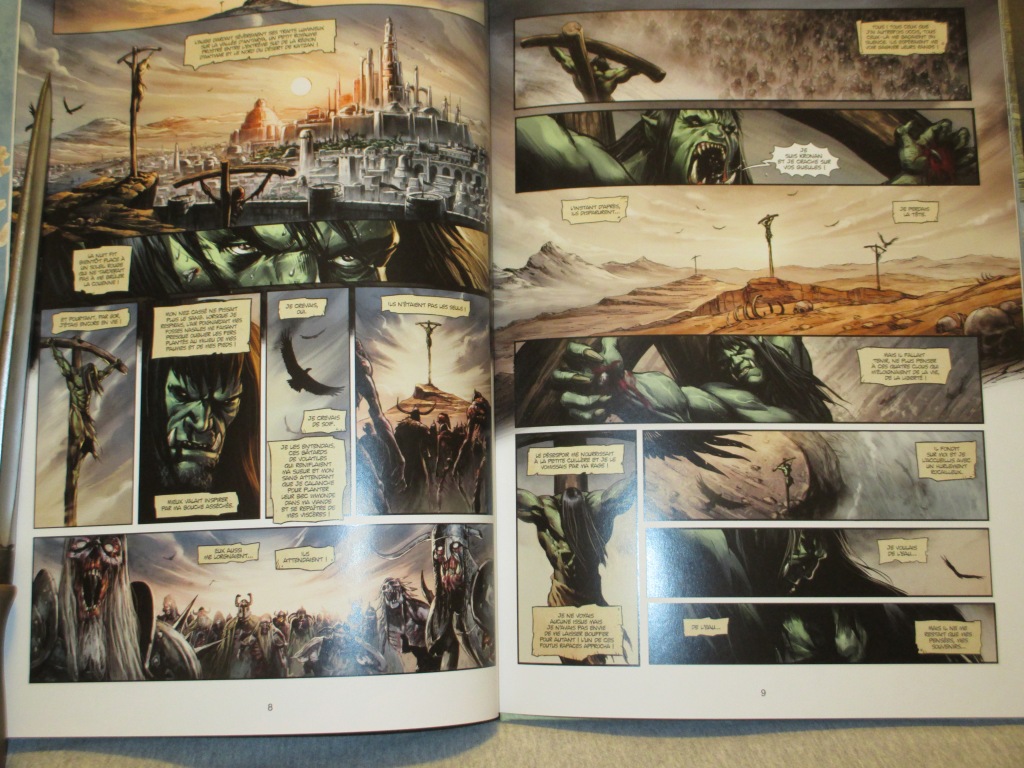
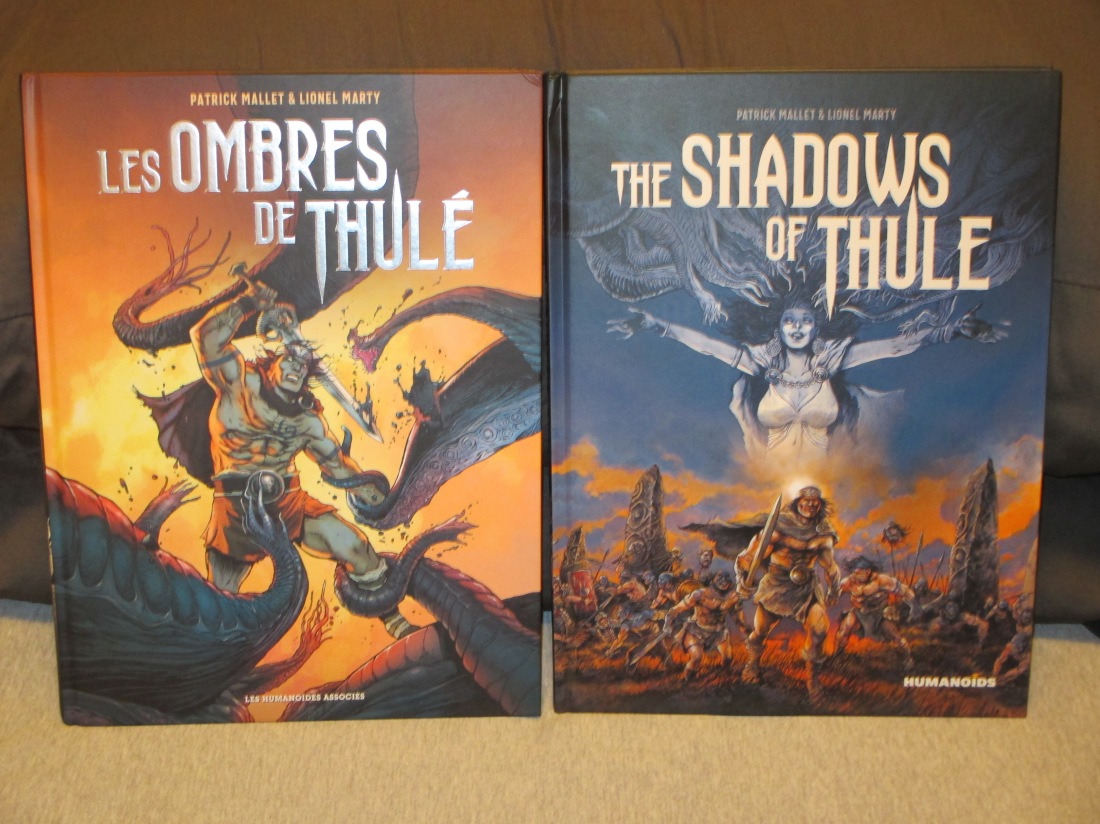
Les Ombres de Thulé (2023) by Patrick Mallet (script), Lionel Marty (art), & Axel Conzalbo (colors) is a French-language bande dessinée; there is also an English-language translation available, The Shadows of Thule, released the same year, translated by Montana Kane. The story is not an adaptation of any Howard tale, nor is it specifically tied to Howard’s setting or chronology, but it is clear that Mallet & Marty took inspiration from Howard and Lovecraft, and the tale contains many Echoes of “Worms of the Earth,” “Kings of the Night,” and “The Dunwich Horror.”

The Romans have pushed deep into Britain, and they’re here to stay. The Picts are a fading people, ancient, barbarous, and wise with magic, but more desperate every year. A Roman general is manipulated by a necromancer into releasing an ancient Lovecraftian horror that had been sealed away long ago…and it might take all the swords and sorcery of the King of the Picts to deal with this old enemy.

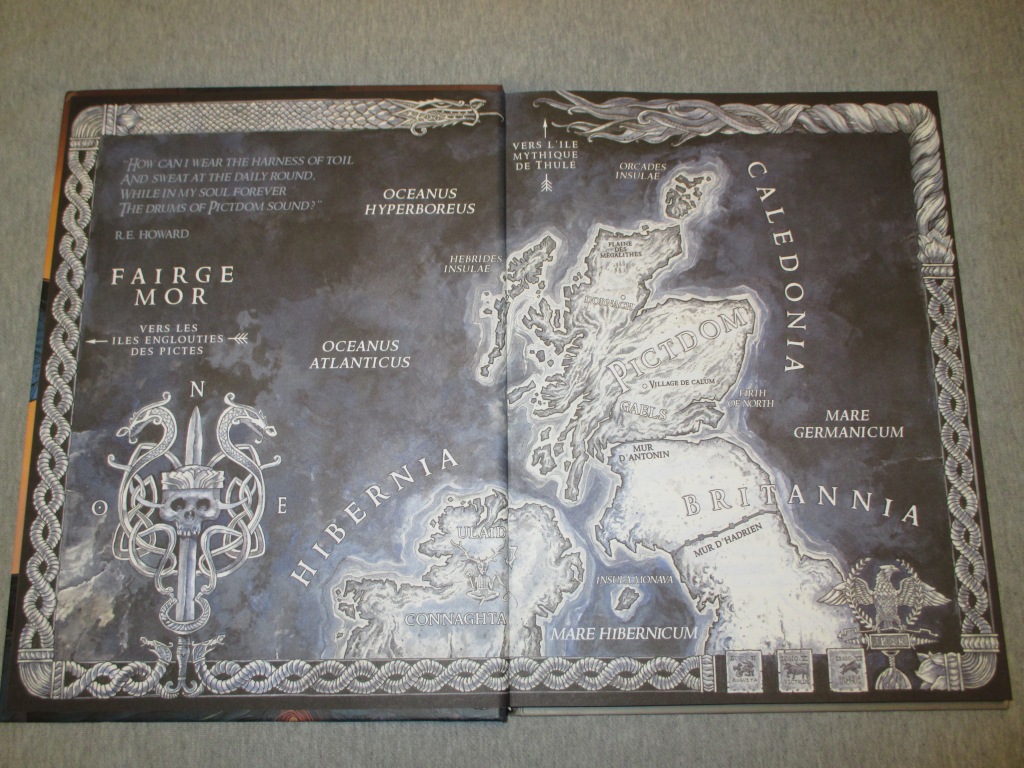
Map on the inner pages of the French edition; not included in the English translation.

If it sounds familiar, it is because it is. his is not quite as dark and brooding as Howard’s tales of Bran Mak Morn, and the scale of the action and magic owes more to the popular depictions of contemporary fantasy than to some of the more realistic or restrained proportions of older works. Readers today expect glowing eyes, towering tentacled terrors, and headlopping…and Les Ombres de Thulé delivers on all three.

Conzalbo uses color to heighten the distinction between the old man’s vision and the real-world scenes.

Like other bandes desinees such as Orcs et Gobelins T11: Kronan (2021) by Jean-Luc Istin, Sébastien Grenier, and J. Nanjan and Crom (2022) by Raule, Jaunfra MB, & Alejandro TM, there is a certain aesthetic that pervades this book. Digital coloring adds a certain studied muddiness to some of the artwork that looks better than plain, flat colors but doesn’t quite replicate the texture of real paint. Minor nudity is taken for granted, as are splashes of gore. While some of the pages may seem crowded with panels, there are often huge splash pages that give moments to admire the detail that larger page sizes allow.

Mallet and Marty wear their influences on their sleeves. This is a love-letter to Howard and Lovecraft as much as anything else. An original story, but also a remix that combines some of the highlights from their favorite weird fiction. If it dips into a bit more of Celtic myth (there are some definite overtones of Michael Moorcock’s Corum Jhaelen Irsei tales), or some Dungeons & Dragons-style mucking about with eldritch blasts and healing spells than Howard or Lovecraft would have had it, that speaks to how the fantasy aesthetic has changed in the hundred years since Weird Tales began publication.

Back covers of the French (left) and English (right) editions.

Les Ombres de Thulé / The Shadows of Thule is a fun experience, in French or English. Kane’s translation appears faithful to the original text and in keeping with the spirit of the work, not always an easy balance to achieve. It is nice to see creators who take inspiration from Howard and Lovecraft’s work without necessarily being slavishly devoted to a long and convoluted Mythos.


Bobby Derie is the author of Weird Talers: Essays on Robert E. Howard & Others (2019) and Sex and the Cthulhu Mythos (2014).
Deep Cuts in a Lovecraftian Vein uses Amazon Associate links. As an Amazon Associate I earn from qualifying purchases.

Orcs et Gobelins T11: Kronan (2021) by Jean-Luc Istin, Sébastien Grenier, and J. Nanjan

Antarya traverse une crise des plus graves depuis que la reine Nawell a perdu la raison. Lors d’une trahison de haut vol, elle fait exécuter ses soldats. L’orc Kronan, capitaine de sa garde en réchappe. Pour lui, celle qui dit se nommer Nawell est une usurpatrice et il compte bien le prouver mais aussi se venger. Et quand Kronan se venge, il trace toujours un sillon de sang sur son chemin.Antarya is going through a serious crisis since Queen Nawell lost her mind. In a high-level betrayal, she has her soldiers executed. The orc Kronan, captain of his guard, escapes. For him, the woman who says her name is Nawell is a usurper and he intends to prove it but also take revenge. And when Kronan takes revenge, he always leaves a trail of blood in his path.
Back cover copy for Orcs et Gobelins T11: KronanEnglish translation

The publication of J. R. R. Tolkien’s works The Hobbit (1937), The Lord of the Rings (1954-1955), and The Silmarillion (1977, with Christopher Tolkien and Guy Gavriel Kay) fundamentally changed the landscape of contemporary fantasy. Not just because of what J. R. R. Tolkien created and its enduring popularity, but because his approach to fantasy races and world-building set a high standard which many writers then took as a template for their own works. While Tolkien was not alone in creating fantasy worlds—Lord Dunsany’s The Gods of Pegāna (1905), E. R. Eddison’s The Worm Ouroboros (1922), and Poul Anderson’s The Broken Sword (1954) all preceded The Lord of the Rings—Tolkien’s conception of elves, dwarves, hobbits, ents, orcs, goblins, et al. strongly influenced the public imagination. This can especially be seen in tabletop games like Dungeons & Dragons and Warhammer Fantasy, computer games inspired by those works such as World of Warcraft, and novels such as Dennis L. McKiernan’s Mithgar series.

Robert E. Howard’s fantasy in the pages Weird Tales in the 1920s and 30s represents a very different kind of fantasy. There are fewer distinct fantasy races in Howard’s work; there are no elves and goblins per se. The Children of the Night from “Worms of the Earth” (Weird Tales Nov 1932) and other tales are inspired by the Little People stories of Arthur Machen, but shaped by Howard’s correspondence with Lovecraft, have taken a very different form. They are not servants of a Satanic Morgoth or Sauron, nor are they corrupted elves or even inherently evil in a purely good-and-evil sense. The morality of Howard’s tales is always murkier, the racial politics more complicated, and that tarnished air, that hardboiled sensibility where there is no true good and evil, no ultimate victory for the forces of light or darkness, just men and women and things beyond human ken interacting according to their own needs and desires is part of what sets Howard’s fantasy distinctly apart from Tolkien.

Whether you call it sword & sorcery, heroic fantasy, or something else, Howard’s bloodier, grimier, but very approachable brand of fantasy had an equal influence with Tolkien on later writers. Tolkien may have helped define orcs, elves, and dwarves for a few generations, but Howard helped define the thief, barbarian, and mercenary man-at-arms as iconic roles. They both had their own contributions in terms of magic rings and magic swords, and they had a penchant for taverns and themes of kingship. While their ethos and style sometimes clash, their joint influence on fantasy is undeniable…and sometimes more strongly felt together.

In 2013, French comics publisher Soleil began producing a series of bandes dessinées: Elfes Tome 1: Le Crystal des Elfes Bleus was published in 2013, and became popular enough to become an ongoing series. These were set in a very generic Dungeons & Dragons-derived fantasy world called Arran. The series was popular enough to merit several spin-off series of various levels of popularity: Nains (Dwarves, 2015), Orcs & Gobelins (Orcs and Goblins, 2017), Mages (2019), Terres d’Ogon (Lands of Ogon, 2022), and Guerres d’Arran (Wars of Arran, 2023). As with D&D itself, this is very specifically riffing off of the popular conception of fantasy races derived from Tolkien, but the world is grimier, more visceral, a bit more hardboiled—Tolkien as filtered through Howard, in a sense.

Jean-Luc Istin is a veteran of the series, having written several of the preceding volumes of Elfes and Orcs & Gobelins, and for the 11th tome in the O&G series, he partnered up with Sébastien Grenier (artist) and J. Nanjan (colorist) to produce something kind of special: a re-telling of Robert E. Howard’s “A Witch Shall be Born” (Weird Tales December 1934) set in the world of Arran, and starring not Conan the Cimmerian, but Kronan the Orc.

Copyright law in France works a little differently than in the United States. During Robert E. Howard’s lifetime, the Berne Convention would guarantee his works would remain under copyright for at least 50 years after his death (since Howard died in 1936, that would mean 1986); in France, the general term is 70 years after the author’s death (i.e. 2006). Either way, Howard’s works are generally considered in the public domain in France (although international trademarks may still apply). Even if copyright was an issue, Kronan might still pass as an homage…but not a parody.

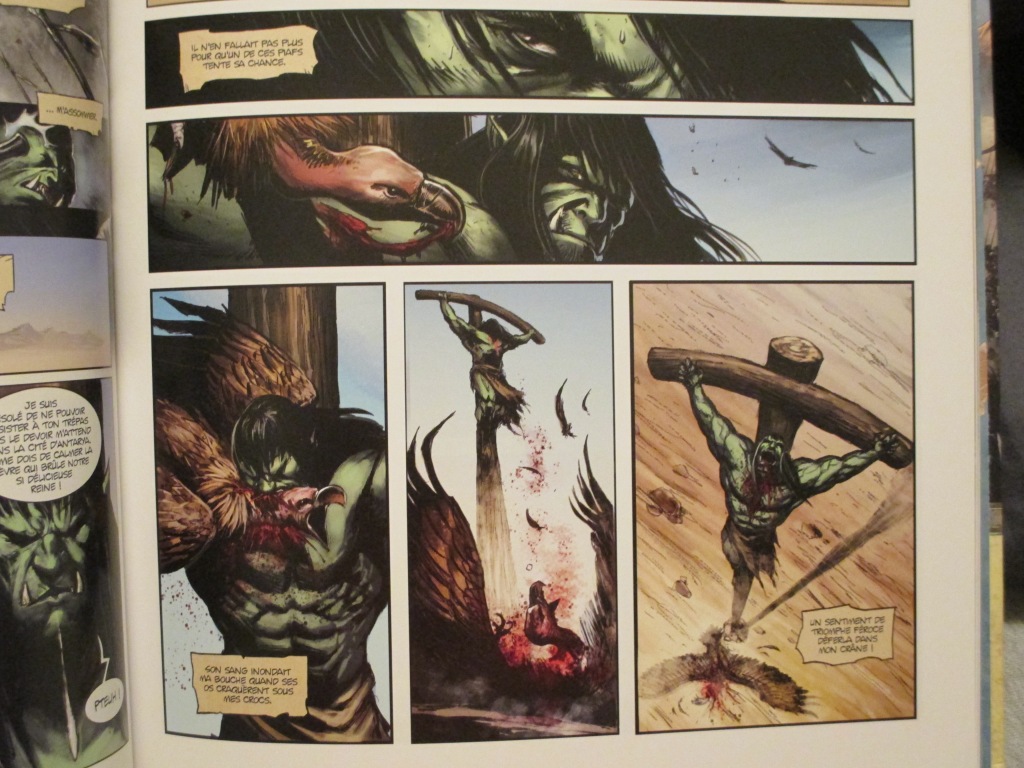
While the concept of Conan as an orc might sound silly, the creative team between Kronan plays it very straight. Kronan is a hulking, musclebound figure that takes very strong artistic influence from the fantasy bodybuilder culture that Frank Frazetta’s paperback covers, John Buscema’s comic book Conan for Marvel, and Arnold Schwarzenegger’s turn as Conan in Conan the Barbarian (1982) all helped to inspire, and readers can clearly see in the absolutely ripped muscles, the deep-set eyes, and long hair various influences from all three mashed together. Yet this is not just Conan with tusks and green face paint.

While Kronan follows the general outline of Howard’s story, and includes adaptations of many of the famous scenes—including Kronan on the cross, which was borrowed into the 1982 film—in adapting the story from Hyboria to Arran, the creators have shifted many of the details to fit the new setting. Instead of Crom, Kronan swears by the Orc deity Gor, for one example. In adapting the prose text to comic format, they’ve also veered away from some of the hallmarks of Howard’s narrative style in this story.

It is a weird penchant in Howard’s works that in several of the Conan stories, Conan himself takes a while to appear. The first chapter of “A Witch Shall Be Born” doesn’t mention Conan at all; it features Queen Taramis in her bed chamber, confronted by her twin sister. When Conan is first mentioned in chapter two, it is just that—a mention. The soldier Valerius is telling his sweetheart what happened. So we don’t actually see Conan in the story proper until he is crucified and on the cross.

In Kronan, by contrast, the narrative device is shifted: it is an older orc on a throne that is telling the story. We skip the bedroom scene with the queen (Nawell in place of Taramis) and see her attack her loyal army and citizens, and has Kronan crucified (as seen in a flashback-within-a-flashback). Where Howard had chapter 3 as a letter written to Nemedia about what all has happened, in the comic Kronan meets someone who tells him some these things, and we get a glimpse of Kronan doing some investigations of his own, breaking into a library to learn a bit of eldritch lore at knife-point.

Some aspects of the story are removed or simplified; we don’t actually see Kronan pull the nails out of his own flesh, as we did when Roy Thomas and John Buscema first adapted “A Witch Shall Be Born” to comics in Savage Sword of Conan #5 (1975); the crystal ball and acolyte by which the witch surveys the battle doesn’t feature either. Much of the architecture and landscaping is, for lack of a better term, more generically fantasy in aspect, with huge towers and walls, vast arched libraries carved into the solid earth, huge domed chambers like pagan cathedrals, etc. Arms and armor are likewise much more generic fantasy in design, less realistic than Howard’s descriptions, but more in keeping with the setting of Arran.

Eldritch entities are decidedly less toad-like.

However, we do get some rather inspired artistic decisions. Kronan is the only Orc in the entire book, much as Conan was the only Cimmerian in Howard’s series; the one greenskin among a group of otherwise human characters makes him stand out all the more. Also, the occasional epic page-spread that really gives a sense of scale worthy of the series.

Taken together, the changes streamline the story and focus it more on Kronan himself. A lot of the exposition where a character talks about Conan become tales told to Kronan, or scenes that the reader sees directly; Kronan takes a more active and central role in unraveling the central mystery of the witch in the narrative, and there are fewer secondary characters to keep track of. The bones of Howard’s story are there, but Kronan is much more the focus, and the world is much more one familiar to gamers and Tolkienian fantasy fans than the Hyborian Age.

Yet for all that, it’s fun. There’s never been an adaptation quite like this, and never one that didn’t veer into winking at the reader or lapsing into parody, as when Mark Rogers adapted Howard’s Conan tale “Beyond the Black River” (Weird Tales May-Jun 1935) as “Beyond the Black Walnut” in The Adventures of Samurai Cat (1984). It is faithful to the mood and tone of Howard’s story, and Howard’s conception of Conan, while also making allowances for the different medium, the different setting, and the artistic allowance where a fantasy orc barbarian can ride a massive horned ox into battle while wielding a fifty-pound sword one-handed.

To the memory of Robert E. Howard.

Perhaps needless to say, this is also fun. Sébastien Grenier’s art hits that sweet spot between the almost self-parody of Warhammer Fantasy and the more realistic tone or the Dungeons & Dragons 3rd edition Player’s handbook. J. Nanjan’s coloring work is solid; while I might like to see what a black & white version looks like some day, the vividness of the colors used on the cover really makes the banners pop, and the use of light and darkness on the interiors in muted tones really works. I think a different colorist would have been tempted to make things brighter or darker, which would have ruined the effect and made the whole work much too cartoonish.

While the series has begun to be translated into English, Orcs & Gobelins Tome 11: Kronan is still available primarily in French.


Bobby Derie is the author of Weird Talers: Essays on Robert E. Howard and Others and Sex and the Cthulhu Mythos.

Deep Cuts in a Lovecraftian Vein uses Amazon Associate links. As an Amazon Associate I earn from qualifying purchases.

“Sob As Trevas” (2020) by Douglas Freitas & Chairim Arrais and “Aeons” (2019) by Salvador Sanz

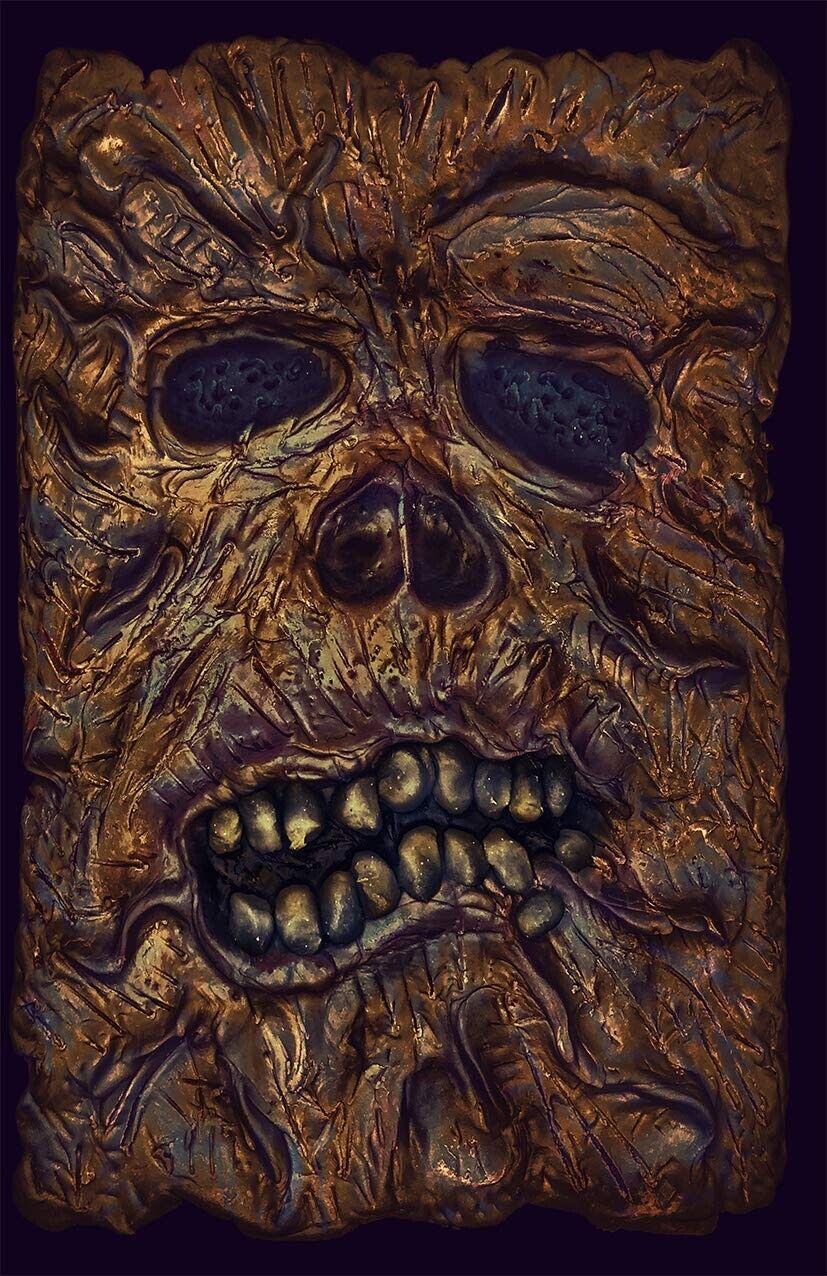
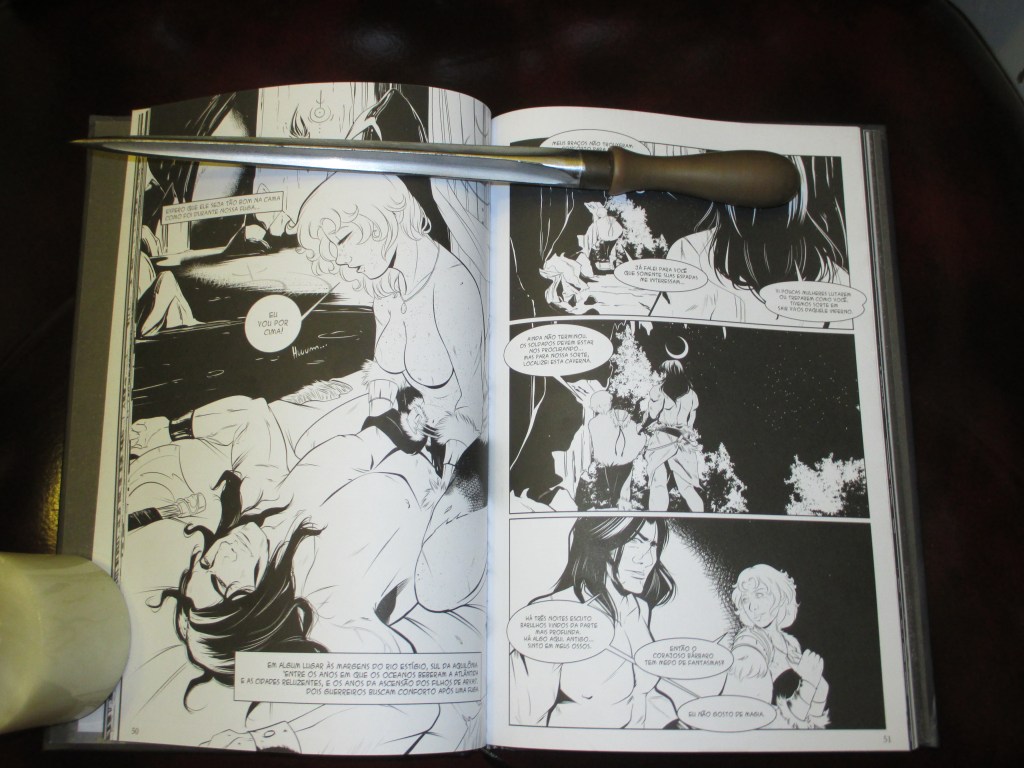
Os Mitos de Lovecraft (2020) is a crowdfunded Brazilian black-and-white graphic anthology edited by Douglas P. Freitas and published by Skript, probably best known for the deluxe hardcover edition which has a cover modeled on the bound-in-human-skin Necronomicon ex Mortis from Evil Dead 2 and Army of Darkness. Like its fellow Brazilian Lovecraftian anthology O despertar de Cthulhu em Quadrinhos (2016), while there is a common theme in terms of subject, the style and tone of the individual works inside varies considerably. Every style of comic art and horror can be represented under the broad remit of Lovecraftian comics, from straight adaptations of Lovecraft in exquisite realistic depiction to splatterpunk-esque gore fests with plenty of airbrush-style gore streaks to lighter works with more cartoonish tentacled Cthulhu-esque characters.

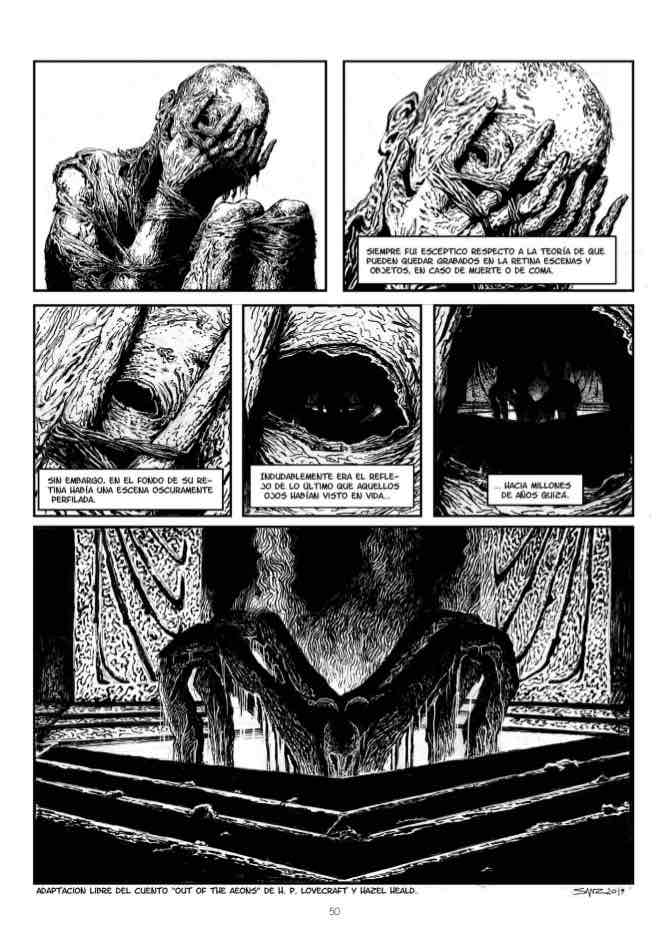
The anthology begins with an absolute masterpiece in two pages, by Argintenean artist Salvador Sanz, which originally appeared in the Spanish-language graphic horror anthology Cthulhu 23; for this anthology, it was translated into Brazilian Portuguese by Aline Cardoso and re-lettered by Johnny C. Vargas. This is a distillation of “Out of the Æons” (1935) by Hazel Heald & H. P. Lovecraft, subtracting all the human characters, the drama, and the fantastic history deciphered from the scroll in exchange for focusing on a masterful rendering of the mummy who caught a glimpse of Ghatanothoa—and paid the price.

In a cinematic journey, the reader is taken closer and closer to the ancient petrified horror. The panels zoom in on the one eye that peeks out between gnarled fingers. To the dark image that is still captured there, on the retina. The detail on the art, the pacing, and the execution of the concept, which boils down the essence of the Lovecraft/Heald horror story into two pages, is exquisite.

Freitas’ own contribution to Os Mitos de Lovecraft is “Sob As Trevas” (“Beneath the Darkness”), in collaboration with illustrator and comic creator Chairim Arrais. This is a tongue-in-cheek 8-page sword & sorcery story involving a nameless Cimmerian warrior and their female partner Ruivas (“Red”/”Red-hair”). Freitas & Arrais are clearly referencing Robert E. Howard’s most famous creation, Conan the Cimmerian, and aren’t coy about it:

Os Mitos de Lovecraft pp.51-52
Em algum lugar às margens do rio Estígio, sul da Aquilônia, ‘entre os anos em que os oceanos beberam a Atlântida e as cidades reluzentes, e os anos da ascensão dos filhos de Aryas’. Dois guerreiros buscam conforto após uma fuga.Somewhere on the banks of the River Styx, south of Aquilonia, ‘between the years when the oceans drank Atlantis and the gleaming cities, and the years of the rise of the sons of Aryas’. Two warriors seek comfort after an escape.
Os Mitos de Lovecraft page 51English Translation
“KNOW, oh prince, that between the years when the oceans drank Atlantis and the gleaming cities, and the years of the rise of the Sons of Aryas […]”
—Robert E. Howard, “The Phoenix on the Sword”

The character Ruivas is depicted similarly to the eponymous character in Arrais’ standalone comic “Red+18”; whether this is intended as an unofficial crossover, an Easter egg for fans of Arrais’ work, or just a coincidence—the character could as easily be a play on Red Sonja for the Marvel Comics, albeit sans the trademark mail bikini—is unclear, and maybe unimportant.

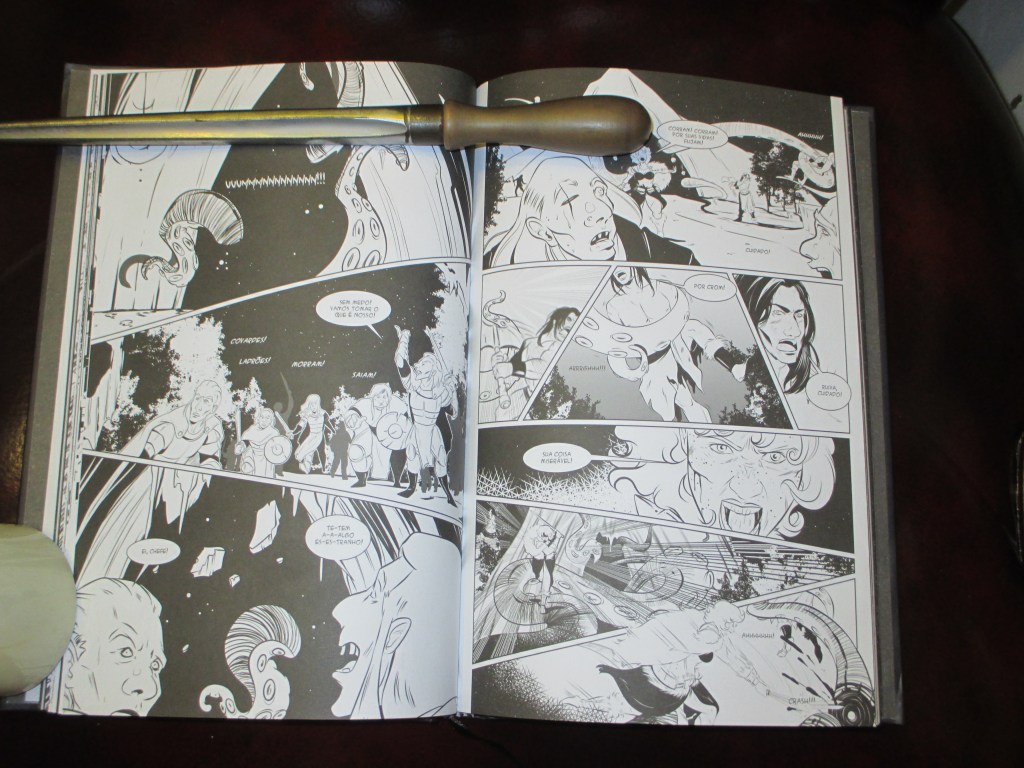
The story itself is fairly slight and straightforward: after successfully stealing a jewel, the pair of thieves hide out in a convenient cavern…which ends up being occupied by some nameless eldritch horror.

Ei, Chefe!

Te-tem a-a-a-algo es-es-tranho!
Hey, Boss!

Th-there’s s-s-something s-strange!
Os Mitos de Lovecraft page 54English translation

The story really wanted more pages; there’s little opportunity to really develop any atmosphere before the tentacles emerge from the darkness, and the action sequences are correspondingly cramped and staccato-like, crammed into increasingly more panels per page. With the in media res debut, the titillation, and the swift conclusion, this is strongly reminiscent of the kind of back-up feature that sometimes ran in Savage Sword of Conan, more of a sketch of an interlude than a full-fledged story.

Yet what there is there is fun. The writing is light-hearted, the chemistry between legally-not-Conan and Ruivas is alternately playful and rocky, and Arrais’ artwork does everything the script calls for. The brief sword & sorcery interlude sets a different tone than the other stories in the anthology, featuring more sex and action than horror or outright comedy. While I would have liked for it to delve more into the Howardian vibe of horror that permeated tales like “Xuthal of the Dusk” or “Red Nails,” limitations of space have to be acknowledged. Still, it would be nice if Freitas & Arrais had the opportunity to revisit the idea at a longer length more suitable to develop the characters and story at some point.


Bobby Derie is the author of Weird Talers: Essays on Robert E. Howard and Others and Sex and the Cthulhu Mythos.

Deep Cuts in a Lovecraftian Vein uses Amazon Associate links. As an Amazon Associate I earn from qualifying purchases.

The Coming of Cormac (1974) by Caer Ged & The Seductress of Eden (1982) by Mark Farris

Eldritch Fappenings
This review deals with works of pornography, and the history of erotic art and writing. As part of this review, selected passages involving sexually explicit activites will be included.
As such, please be advised before reading further.


“Personally,” I said, “I shared Bloch’s opinion of the stories. There was too much emphasis placed on sex. Once I wrote a very critical letter to Editor Wright about the prevalence of sex in some Weird Tales stories, citing the Conan stories as an example.

Willis Conover, 14 Aug 1936, Lovecraft at Last 43

About the Conan tales—I don’t know that they contain any more sex than is necessary in a delineation of the life of a lusty bygone age. Good old Two-Gun didn’t seem to me to overstress eroticism nearly as much as other cash-seeking pulpists—even if he did now & then feel in duty bound to play up to a Brundage cover-design.

H. P. Lovecraft to Willis Conover, 14 Aug 1936, Letters to Robert Bloch & Others 382

In the 1930s editor of Weird Tales Farnsworth Wright recognized that sex sells—or at least, that a tasteful nude on the cover seemed to improve sales. Yet Weird Tales was not in any sense a pornographic magazine, and the “delineation of the life of a lusty bygone age” that Lovecraft spoke about was relatively prudish compared to an episode of Game of Thrones. Robert E. Howard would have an occasional female character disrobed, might hint at sex, but it would have been impossible to publish anything relating to male genitalia, penetration, or any oral sex beyond a passionate kiss in the 1930s, even if he had been so inclined to write such things. Even Howard’s stories for the Spicy magazines, which promised more sizzling sex than other pulps, were more likely to involve a particularly hard spanking than coitus, and paragraphs would peter out into ellipses before getting to any sort of explicit description.

Robert E. Howard’s hardboiled fantasy stories of Conan the Cimmerian would long survive him and grow in popularity, and as restrictions on sex in publishing eased (particularly after Grove Press, Inc. v. Christenberry, 1959), sword & sorcery fiction began to gradually grow more explicit. Fritz Leiber’s “The Sadness of the Executioner” (1973) for example, features “a deliciously slender girl of no more than sixteen, unclad save for four ornaments of silver filigree” as a violent and insane member of a mad king’s harem, and Leiber doesn’t mind describing her anatomy—but he stops short of pornography. Again, there were limitations to what most publications would accept.

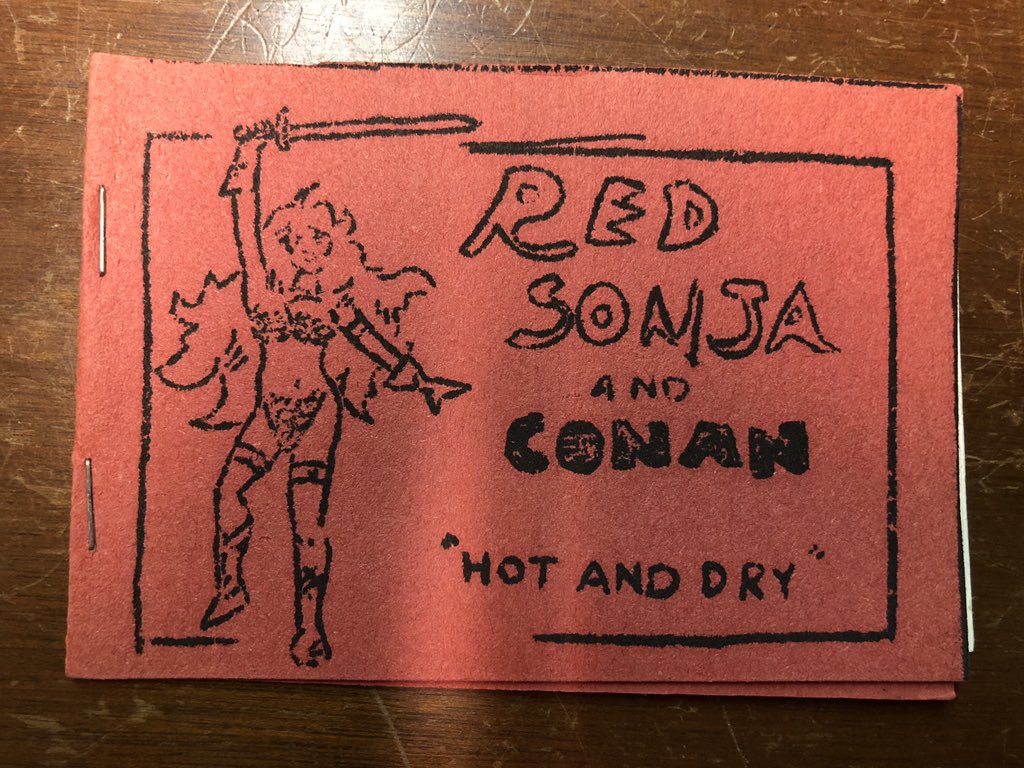
The earliest sexually explicit efforts in that vein were, oddly enough, probably inspired by Marvel’s Conan the Barbarian comic, which began publication in 1970. “Gonad the Horney” was published in the San Francisco Ball in 1972, and the Tijuana bible style Red Sonja and Conan – Hot and Dry was published in 1977. Both of these sexually explicit little comics were parodies of the Marvel material, much as how in later years Hustler would create This Ain’t Conan the Barbarian (2011). Tongue was firmly in cheek, and the point was generally amusement rather than titillation or telling a good story.

Yet with the boom in paperback fantasy in the 1960s through the 1980s, the market for adult-oriented Sword & Sorcery grew…and a few pornographic novels were published to meet that market segment. Two in particular stand out as of particular interest to fans of Robert E. Howard and H. P. Lovecraft, The Coming of Cormac (1974) and The Seductress of Eden (1982) by Mark Farris—and these novels are worth consideration and comparison.

The Coming of Cormac (1974) by Caer Ged

During the fifth cycle of man, before the cataclysm that drove Atlantis from the depths of the sea and split the face of the earth, there was a oneness of the land called Augura by its inhabitants. Though darkness and its creatures and daemons still walked unchained, there rose five kings who rallied civilization and its boundaries. These kingdoms were called Telus,Nebula, Waldrop, Agila and Valana, and war was constant among them.

Beyond these boundaries of man was wilderness. To the south was Sartar with burning deserts and steaming jungles inhabited by savage men of black skin. To the east was the Land of Shadows with the Mountains of Krath barring entrance. To the west were the unknown waters of the Great Sea. And to the north was the frozen wasteland called Bifrost with its warring barbarians.

It was from this bitter land of cold that Cormac came to seek his fortune in the cities of civilization . . .

from The Book of Cormac, Aram Akkad.

Caer Ged, The Coming of Cormac 1

“KNOW, oh prince, that between the years when the oceans drank Atlantis and the gleaming cities, and the years of the rise of the Sons of Aryas, there was an Age undreamed of, when shining kingdoms lay spread across the world like blue mantles beneath the stars—Nemedia, Ophir, Brythunia, Hyperborea, Zamora with its dark-haired women and towers of spider-haunted mystery, Zingara with its chivalry, Koth that bordered on the pastoral lands of Shem, Stygia with its shadow-guarded tombs, Hyrkania whose riders wore steel and silk and gold. But the proudest kingdom of the world was Aquilonia, reigning supreme in the dreaming west. Hither came Conan, the Cimmerian, black-haired, sullen- eyed, sword in hand, a thief, a reaver, a slayer, with gigantic melancholies and gigantic mirth, to tread the jeweled thrones of the Earth under his sandalled feet.”
—The Nemedian Chronicles

Robert E. Howard, “The Phoenix on the Sword”

The Coming of Cormac was billed as “the first ‘sword and sorcery’ book to ever hit the stands—with plenty of hot far-out, uncensored sex!”—and that statement may well stand the test of time, because while it is not the first erotic speculative fiction novel, it is the earliest one I’ve seen that was blatantly and obviously based on Robert E. Howard’s Conan stories (the title no doubt a reference to The Coming of Conan, an early collection). Cormac of Bifrost is essentially a clone of Conan the Cimmerian (and not far off from another Howard character, Cormac Mac Art). The basic premise of the tale, which involves rescuing a princess and some encounters with giant snakes, a witch, undead, and “demons” along the way is very much in the mold of the 1970s Sword & Sorcery pastiche, right down to casual references to “savage men of black skin,” the very sort of thing that Charles R. Saunders noted in his essay “Die, Black Dog! A Look At Racism In Fantasy Literature” (1975). Take out the naughty bits and the story could essentially have run in any fantasy magazine or as a script in Marvel’s Conan comics.

The story is very sexually explicit indeed. Like most erotic novels, that is both the promise and the problem: stopping the plot every few pages for a lengthy sex scene tends to disrupt the flow and pacing of the story, while trivial attempts at titillation are more likely to be eye-rolling than enticing:

A half-clad amazon hastened to the summons. The top-heavy girl panted as she trotted before the priestess of Krath. Her massive tits bounced and bobbed beneath thin veils of black gossamer cloth.

Caer Ged, The Coming of Cormac 94

In terms of content, a great deal of focus is on rape of one sort or another; the princess Avalona gets used and abused in more way than one before Cormac can rescue her, fulfilling the dark promise of such villains. Cormac, once he is inevitably captured, is likewise abused. Not every encounter is nonconsensual, but this is very much the kind of story where the gaze is unflinching…and that is the point. This is all the kind of X-rated stuff that Robert E. Howard and most fantasy authors that came after him could at best hint at, but never put on the page.

The actual action sequences—such as when Cormac is fighting Yog-Sarez, the great serpent who is the son of the serpent-god Seth—are decently written. There is comedy in the book, although it is not quite what readers might expect. For example, at one point Cormac is in The Labyrinth, “a section of the city known for its thieves, robbers, and assassins” (plainly based on “The Maul from Howard’s “The Tower of the Elephant”) and encounters a pair of familiar characters:

To the barbarian’s left a large, blonde northerner, who looked no older than the Bifrostian, shared a table with a smaller youth dressed in grey garments. The two chattered endlessly of their adventures. Like magpies, they tried to out-brag the other, while guzzling bottles of cheap waterfront wine. Eventually, their ramblings turned to Avalona and a brazen plan to steal the princess from under Onard’s nose and to return her to Heres for the reward. The grey-clad youth’s fingers seemed to trace a path across a yellowed parchment spread before them. Slowly but surely, teh wine took its effect and the pair passed out, sprawled across the table.

Caer Ged, The Coming of Cormac 83-84

The pair are patently intended to be Fritz Leiber’s sword & sorcery heroes Fafhrd & the Gray Mouser. Their appearance here isn’t unprecedented; Roy Thomas and John Buscemea had joking inserted “Fafnir and Blackrat” into Conan the Barbarian #6 (1971), and there’s reason to believe that the author here was more than familiar with comic books. At one point Avalona is kidnapped by a rapacious madman with a singing sword looking for his wife Aleta—a reference to Prince Valiant—and later in the novel the witch-priestess summons four demons from the far future who turn out to be, basically, the Fantastic Four. That eventually turns out to be the witch’s X-rated undoing:

Abruptly, the thing stopped and roared. Its gigantic hands fell to tis waist and clawed at the flimsy cloth covering its sex. The blue material tore away, revealing a cylindrical organ of living stone, fully a foot long, hung like a pachydrem. As the creature’s boulder-shattering roars continued, the shaft jerked upward in a throbbing path.

Caer Ged, The Coming of Cormac 148

As Conan pastiche novels go, The Coming of Cormac is a bit below the level of Lin Carter’s Thongor series. The worldbuilding is sparse, the sorcery sparser, and the plot is a bit perfunctory, episodic, and often failing to build tension. The tongue-in-cheek pop culture inclusions are the sole real humor in what is otherwise a fairly cheerless novel of a feckless princess who is passed around and used by one person after another, but without any philosophical meditation a la the Marquis de Sade’s Justine. It accomplishes what it set out to do, but not much more.

“Caer Ged” is an obvious pseudonym, which has been attributed to George Wyatt Proctor, a fantasy fan and novelist. I’m not entirely sure what the basis for this identification is, although a contemporary fanzine Godless #8 (1974) claims “Caer Ged” is also “Lee Wyatt,” which is another pseudonym attributed to Proctor.

The Seductress of Eden (1982) by Mark Farris

My friends say that I am a man who was born out o fhis time, that I should have been one of the Trojan warriors or Hyperborean adventurers I have devoted my life to studying.

Mark Farris, The Seductress of Eden 5

Where The Coming of Cormac was set in a prehistoric past, akin to Robert E. Howard’s Hyborian Age, The Seductress of Eden is set very firmly in the contemporary 1980s. Enter Joseph Kade, a Canadian anthropologist with an interest in fantasy who decides to do some first-hand anthropological exploration of the dark underworld of sex—and ends up in a pulpy adventure that will take him all over the world, meeting (and bedding) all manner of beautiful women, almost getting killed multiple times, and finally stumbling into the ruins of a lost civilization in the Australian Outback while searching for the Phallus of the Old Ones.

If the principal focus of The Coming of Cormac is Robert E. Howard, the focus of The Seductress of Eden is Lovecraft, although the author slips in sly references to the works of Clark Ashton Smith and Howard as well. Kade is caught up in a quest for an eldritch artifact, and the story tends to careen from passionate sexual act to almost gratuitous violence and back again. The pulp aesthetic firmly establishes this as a Lovecraftian fantasy, but one that veers closer to Howardian action, despite references to the Necronomicon and the odd serpent-man:

It stood like a man, about six feet tall, but it resembled a lizard It had green, scaly skin and the head of a snake. It hissed at me and a long, forked tongue slithered out. Its unblinking eyes stared into mine and it raised clawed hands and moved toward sme, dragging an eight-foot tail behind it. […]

“Father was doing experiments with evolution,” said Gloria. “it was his theory that we all evolved from the basic forms of life, encompassing reptiles, and that it was not only possible forus to communicate with them but to evolve back to their forms. This was one of his experiments.”

“Jesus!”

“Father also believed that the continent of Eden was partially inhabited by a prehistoric race of snake-men. This experiment added credibility to that theory.”

Mark Farris, The Seductress of Eden 111-112

The Seductress of Eden is very fast and loose with the Cthulhu Mythos; this is not quite the setting readers familiar with Lovecraft and Howard will be familiar with. Instead of shoggoths, for example, there are shontothes; and instead of Cthulhu, there is quite literally Satan. The Howardian sword & sorcery elements don’t really come in until very late in the novel, though there they are rather explicit, once Kade picks up an ancient axe:

And I had wielded it before…in other lifetimes. I had fought with it on the steps of Atlantis, protecting my queen. I had wielded it on the wastelands of Cimmeria, a barbarian defending his homeland. I had struck with it in the depths of Nemordia, to free my mate from the lair of a wizard. And now I was using it to save a goddess…

Mark Farris, The Seductress of Eden 235

The main problem with The Seductress of Eden is that all of those past lives, reminiscent as they are of Howard’s James Allison stories, sound like more exciting and titillating adventures than the one chronicled in the book. While the action moves fast, it’s not a particularly deep plot, and the post-climax ending where Kade confesses his sins to a priest feels bowdlerized. A huge chunk of exposition at the end of the novel finally lays bare the writer’s version of what’s going on with the Phallus of the Old Ones, and it is so far from anything a Lovecraft fan might recognize it is almost parody.

Except that is the main difference between The Coming of Cormac and The Seductress of Eden: the story is played straight. This isn’t Howardian pastiche except for a couple of paragraphs near the end, nor is it a Lovecraftian pastiche despite the references to the Necronomicon. There are no tongue-in-cheek drop-ins of Prince Valiant and the Fantastic Four. It is an original story which plays out with as much seriousness as it can muster considering that Kade and his new girlfriend have to literally hump their way to their final goal.

Yet when the story assails the reader the Vatican assassins, the sex mutants, the mercenaries, the monsters, the repeated gangbangs, and a sex toy which is quite literally “What if H. R. Giger made a Sybian?,” the result is more like an X-rated serial than a coherent novel. The Seductress of Eden is very much a collision of fantastical pulp elements with hardcore sexuality, and the end result strains belief long before we get to the shontothes or the Golden Phallus of the Old Ones.

“So,” I went on, “now we try to get the scroll and map. And this Contessa has … the scroll?”

“Yes.”

“And I have to seduce her to get it?”

“That’s right.”

“This,” I said for about the millionth time, “is amazing!”

Mark Farris, The Seductress of Eden 73-74

As with Cormac in The Coming of Cormac, the protagonist Joe Kade isn’t a rapist—but there’s a lot of rape in the book. Weirdly enough, for all that the story is predicated on Kade encountering the darkest and most lurid parts of the sexual underground, the actual content is a bit vanilla: there are relatively few kinks on display, not many taboos presented or broken. Kade isn’t forced to expand his sexual horizons very far…and that is probably by design. The attraction of this book is the weirdness of its plot more than the weirdness of the sex itself.

The Seductress of Eden was published under the Tigress Books imprint, which also published Brian McNaughton’s Sheena Clayton novels such as Tide of Desire (1983). All of the Clayton novels had Mythos references in them, and it’s possible that “Mark Farris” was a house name that was used by McNaughton as well—however, the other Mark Farris novels for Tigress aren’t known to have Mythos references, and McNaughton himself never made any claim to the name. More to the point, The Seductress of Eden doesn’t read much like a McNaughton novel, who was prone to be much darker and less heavy-handed in his use of Mythos lore.

Women In The Novels

Both The Coming of Cormac and The Seductress of Eden are told primarily from the point-of-view of the male protagonists, although Cormac has a few chapters dedicated to Princess Avalona’s viewpoint—those chapters where she is raped. Which presents a substantial difference between the two novels worth discussing.

The recovery of Princess Avalona in The Coming of Cormac is the point of the novel, the central driving plot. She begins the novel as a blushing virgin, and through several chapters of degradation and forced sexual intercourse is used and abused, transported against her will, and finally, after many lives have been lost and the major villains are dead, is comfortable enough in her own sexuality to make advances on Cormac himself. It is not exactly a bildungsroman, but as a tale of Avalona growing up it parallels in some ways a much more X-rated and darker version of Queen Yasmela in Robert E. Howard’s “Black Colossus.” While Avalona never quite gets Yasmela’s agency, she at least comes to overcome her initial sexual trauma and take charge of her own sexual needs and desires.

By contrast, Gloria in The Seductress of Eden starts out the novel as a high-priced escort raised in a family of sex mutants with aspirations to gain the Phallus of the Old Ones to become a goddess, and her every action in the story is bent exclusively toward the goal. There is no innocence to be lost, no self-discovery, and ultimately no redemption of the character. She enters into the novel utterly confident in her own sexuality and repeatedly unfazed by any effort to degrade her through rape or any other form of sexual violence. In comparison with The Coming of Cormac, Gloria has more in common with the witch-priestess Sheheit than she does to Avalona—and that kind of represents part of the odd characterization of women in both stories.

In both The Coming of Cormac and The Seductress of Eden present sexuality as inherently positive, at least the relatively limited sexuality on display here. Cormac has no idea why the civilized people are so hung up about the whole virginity business, Kade is protective of Gloria because he loves her, but not overly jealous when she ends up having sex with someone else. While it isn’t quite the aftermath of the free love of the 1960s, sex is definitely not presented as a phenomenon that only happens within the confines of legal matrimony. Yet the women characters who have most embraced their sexuality or try to use sex for their own ends are presented as the ultimate villains.

It is not an uncommon characterization in pornographic works: sexual experience and lack of sexual mores is generally seen as a positive trait, but aggressive or self-serving sexuality is a hallmark of an evil character. This isn’t entirely unusual in fantasy either—in Howard’s “A Witch Shall Be Born” one of the key differences between Queen Taramis and her evil sister Salome is that the latter is sexually active and open about it—but in the context of a pornographic novel, it rather highlights the disparity between male and female characters. Cormac and Kade’s sexual exploits to sate their lusts don’t mark them out as sluts deserving of some dark fate, and they are rarely forced into sex against their will. By contrast, the women in these stories face most of the sexual violence, and most of the consequences of sex, including pregnancy and death.

Conclusions

Publishing has come a long way since Robert E. Howard first wrote the Conan stories. Softcore sword & sorcery novels like Lin Carter’s Tara of the Twilight (1979) have given way to explicit sexual scenes in George R. R. Martin’s A Song of Ice and Fire novels. There is more permissiveness in what can be openly published than ever before—yet the fundamental narrative problem of how (and if, and why) to weave hardcore eroticism into the story remains. For The Coming of Cormac and The Seductress of Eden, the sex is the point, it’s how they were marketed.

It is really odd to look back at erotica produced before the age of the Internet. While a writer’s imagination might be unlimited, and fanzines were free to publish the occasional nude drawing or naughty limerick without too much fear of the postal censor, as a commercial prospect any sort of really weird fiction or sword & sorcery-based pornographic novel had to be a bit of a daunting prospect—not because it couldn’t be done, but because you had to be able to both advertise that work to the correct audience and make something worth reading. In that respect, The Coming of Cormac and The Seductress of Eden are both game attempts to try and meet the needs of a very small and speculative market…and in doing so, they demonstrate how hard it is to produce commercial literature on demand.

Both novels suffer from trying to balance hardcore sex with their pulpy adventures. Howard’s original Conan stories sometimes include lingering gazes at the female form or hints of sexual activities that may happen or are about to happen, but these are largely small titillations that don’t affect the flow of the stories. Erotic fantasy adventure is a difficult prospect at the best of times, as the litany of B-movie sword-and-sorcery films that have struggled to pass muster with rampant female nudity and threadbare plots and acting can well attest.

What’s striking about both of these novels is that they’re coming from about the same place, and even if they don’t use quite the same means, they’re headed for the same goal: to try and capture some of the energy and tropes pulp fiction while injecting hardcore eroticism. On the surface, this shouldn’t be terribly difficult. Read Howard’s description:

Bêlit sprang before the blacks, beating down their spears. She turned toward Conan, her bosom heaving, her eyes flashing. Fierce fingers of wonder caught at his heart. She was slender, yet formed like a goddess: at once lithe and voluptuous. Her only garment was a broad silken girdle. Her white ivory limbs and the ivory globes of her breasts drove a beat of fierce passion through the Cimmerian’s pulse, even in the panting fury of battle. Her rich black hair, black as a Stygian night, fell in rippling burnished clusters down her supple back. Her dark eyes burned on the Cimmerian.

She was untamed as a desert wind, supple and dangerous as a she-panther. She came close to him, heedless of his great blade, dripping with blood of her warriors. Her supple thigh brushed against it, so close she came to the tall warrior. Her red lips parted as she stared up into his somber menacing eyes.

Robert E. Howard, “Queen of the Black Coast”

A lot of what makes pulp fiction work is that readers have to use their imagination. Nothing any writer comes up with will be able to match the sex that Bêlit and Conan have in the reader’s mind. Like the unnamable horrors so often attributed to Lovecraft, to render them in exquisite and clinical detail—to measure Conan’s sword to the nearest millimeter—is to rob them of some of their mystery and magic. If the mating dance of Bêlit in “Queen of the Black Coast” had turned to actual coitus, the entire tone of the story might not have shifted, but the infinite possibilities in the reader’s mind would have collapsed into a single certainty. The possibilities are often much more tantalizing than the execution.

But it ultimately depends on what you’re going for. The Coming of Cormac and The Seductress of Eden draw these comparisons specifically because, like erotic fanfiction they rely to a greater or lesser extent on existing properties. Without Conan, there is no Cormac or Kade. They invite comparison to Robert E. Howard because they are riffing off of Howard. Original works without trying to ape the themes of older fiction might have more leeway to forge their own balance with a more explicit tone, as Martin did in his Song of Ice and Fire series and as Karl Edward Wagner did in his Kane series.


Bobby Derie is the author of Weird Talers: Essays on Robert E. Howard & Others (2019) and Sex and the Cthulhu Mythos (2014).
Deep Cuts in a Lovecraftian Vein uses Amazon Associate links. As an Amazon Associate I earn from qualifying purchases.

Editor Spotlight: Interview with Oliver Brackenbury of New Edge Sword and Sorcery Magazine

New Edge Sword & Sorcery is an upcoming magazine which hopes to showcase not just the sword & sorcery fiction of yesteryear, but what sword & sorcery can be. Editor Oliver Brackenbury has been kind enough to answer a few questions for us about what New Edge is, the new magazine, and their approach to editing. One note before we begin:

Oliver Brackenbury: Up front I want to stress that when I’m discussing my attitudes and methods in this interview, discussing them is all I’m doing. I’ve been reminded lately how easily this can come off as a critique of others, or my suggesting there is only one correct attitude and approach. If people take something valuable from what I say, great, but I’m not being prescriptive here.

What is the one-sentence pitch for New Edge Sword & Sorcery Magazine?

OB: New Edge Sword & Sorcery magazine will feature brand new sword & sorcery short stories as well as intriguing non-fiction related to the genre’s past, present, and future!”

If I can be cheeky and slip in a second sentence, this is our definition of the idea of New Edge Sword & Sorcery, which informs everything done within the magazine:

“New Edge Sword & Sorcery takes the genre’s virtues of its outsider protagonists, thrilling energy, wondrous weirdness, and a large body of classic tales, then alloys inclusivity, mutual creator support, a positive fan community, and enthusiastic promotion of new works into the mix.”

What are your favorite classic Sword & Sorcery stories and why?

OB: Ah, that’s a tough one! I’ll limit myself to three tales, with the caveat that on any given day I might slot one out and slot another in.

Going back to the big man himself, “People of the Black Circle” is my favorite Conan tale.While I suspect Howard had stage plays in mind, if any other storytelling medium, this is hands down the most cinematic of his tales—that pacing!—and as a screenwriter I appreciate that. Nobody in the story is without compelling motivation or some kind of arc, not even Conan’s “mad Afghulis” who lack individual names but are given great purpose and entertaining turns as their loyalty to Conan understandably wavers. The way Conan and Devi Yasmina part on terms of mutual respect, admiration, and competition is a moment I am absolutely chasing in my own writing, I enjoy it so much, and the strong thematic backbone to the tale, the classic “personal desire vs responsibility to others”, is explored with great skill.

C.L. Moore’s “Black God’s Kiss” deserves its excellent reputation, and it deserves to be more broadly known. Moore’s dreamland of an underworld is gripping, as is the emotional throughline of Jirel’s seeking revenge for that forced “kiss”, and the imagery—oh that imagery! The Ace Fantasy edition’s cover, by Stephen Hickman, with the blind horses galloping, fleeing, flowing around Jirel is the only one for me.

My third choice is “Ring of Black Stone” by Pat McIntosh—and really all five Thula tales in total. Bloody shame they haven’t been collected yet, you can only read them one at a time across the first five of Carter’s The Year’s Best Fantasy Stories anthologies. McIntosh’s war-maid protagonist, Thula, reminds me a little of Russ’s Alyx the pick-lock, both seemingly straightforward characters who reveal intriguing depths while inferring even greater ones, with seemingly simple motivations which you often realize are different than what they’re telling everyone, and who show a great deal more evolution in a few short tales than some S&S protagonists do in their whole careers, yet are still sufficiently recognizable as the person you started with—maybe she hasn’t really changed at all, maybe you’ve just gotten to know Thula better! I find myself thinking back on these stories often, Ring in particular for its touching tale about finding new family through tragedy, and the riot of feelings that entails.

Finally, I’ll give an honorable mention for Leiber’s “Lean Times in Lankhmar,” whose climax got the biggest laugh out of me S&S has managed so far.

In your guest post on Scott Oden’s blog discussing New Edge as a mode or evolution of Sword & Sorcery fiction, you emphasize “inclusivity.” What does that mean in the context of the stories and writers you’re looking to publish?

OB: What inclusivity means to me is making sure that people outside my own demographic—white, cishet, neurotypical, able-bodied males, or just “white guys” as, for the sake of brevity, I’ll use going forward—can see themselves in both the stories and the authors creating them, ideally making them feel welcome within the community. This is key for expanding the audience of our beloved fantasy sub-genre, as well as its pool of authors.

I’ve gained firsthand experience with this in my six years volunteering with a group dedicated to promoting the western Hemisphere’s largest publicly accessible speculative fiction genre archive—The Merril Collection. Through no malice of anyone involved, in the time I’ve been with them, our group has been made up almost or entirely of white people. Our selling old paperbacks to help raise funds would often combine with 20th century publishing trends to create the scene of a couple of white people sitting behind event tables coated in covers featuring white characters written by white authors, trying to encourage the full breadth of humanity to spend a few dollars in support of the collection, while hearing our pitch for it.

All that sameness was a significant obstacle to achieving our goals, as more than one non-white individual made clear when—quite reasonably—saying “I only see white faces here.” or “I don’t see myself in what you are doing.”

Even coming back to myself, I don’t hate my fellow white guys any more than I hate IPAs, but I get frustrated when the vast majority of shelf space is filled with the same thing, whether it’s beer or writerly perspectives. All of this has informed the approach I’m taking with the stories and authors I’m looking to publish.

Would you characterize New Edge as a reaction to the real or perceived lack of diversity in Sword & Sorcery fiction written by Robert E. Howard and others?

OB: In part, absolutely yes. Keeping in mind I can only speak for myself and the magazine I run, not the nascent “movement” which roared to life back in the spring of this year, I would say that is a significant part of the appeal, as well as its reason for being.

This does not mean burning down all that came before. Again, I’ve been a volunteer promoting a speculative fiction archive for six years! “We still study the art of Ancient Greece, yet we have ceased to wipe our behinds with small stones,” is my glib way of stating how I feel about studying the art that came before us, for all the old or objectionable attitudes which it may contain.

But whether looking through the canon or glancing around at the contemporary fan & creator community, I mostly see faces like my own. I think changing this not through exclusion, but through greater inclusion, is vital to increasing the popularity & longevity of sword & sorcery.

What do you think of Howard’s women warriors in his Sword & Sorcery tales such as Valeria of the Red Brotherhood (“Red Nails”) and Bêlit (“The Queen of the Black Coast”)?

OB: Dig’em both, including the stories. Like many others—judging by the number of additional adventures she’s had in various comics over the decades—I wish Bêlit had gotten to do more before dying in service of Conan’s story. I feel similarly with Valeria, an overall badass character who didn’t die but did end up chained to an altar so Conan could rescue her. It’s little surprise others have gone on to write more stories with her as well.

Clearly Howard succeeded in creating highly compelling women warrior characters, and I’ve enjoyed all the tales containing them. However, understandably for the period, they are often crafted as a kind of novelty—it’s right there in the title of “Sword Woman”—and one of the ways we can build on what Howard accomplished is by creating proactive, highly capable female characters for whom their gender is not a defining feature, or—as in the case with the 1970’s version of Red Sonja—requiring some kind of supernatural explanation for their skill & toughness. I think this is pretty much the norm these days, but it’s worth keeping in mind.

You specifically mention “Carbon Copy Conans”—do you think that it was authors who followed Howard in creating new Conan stories perpetuated some of the stereotypes of race, sex, and gender in Sword & Sorcery?

OB: Not all of them, but going by what I’ve seen of them so far, yeah, absolutely. Whether authoring direct Conan pastiche or writing a Conan-by-another-name, some of those works are very much surface reproductions of what Howard did, focusing on whatever the author was attracted to—and I think some of those second wave S&S guys writing this stuff in the 70’s, 80’s and even 90’s were attracted to the old fashioned attitudes of the 30’s.

This treatment also served to perpetuate the idea that there were no deeper notions behind Howard’s work. Not as damaging as focusing on and magnifying bigoted attitudes, but also a shame.

Much of Sword & Sorcery takes place within a quasi-medieval European setting; do you think that is essential to what makes Sword & Sorcery distinct from, say, Sword & Planet or historical fantasy fiction?

OB: Thanks to there being some pretty consistent storytelling conventions within sword & sorcery, excellently laid out by Brian Murphy in his book Flame & Crimson: A History of Sword & Sorcery, I feel safe saying that a quasi-medieval European setting isn’t strictly necessary. Certainly the “European” part isn’t mandatory, as authors like Saunders and Dariel Quiogue have demonstrated with great skill.

In terms of the era, I think once you’re past the point of flintlock showing up you’ve kind of hit your limits—it’s hardly sword & sorcery if nobody uses swords anymore. That said, part of my great love of the genre is that it can be oh so many things, and still be clearly recognizable as sword & sorcery. We may enjoy sub-sub-headings like Sword & Planet, Sword & Soul, Sword & Silk…but it’s all part of one big happy family, to me.

You mentioned Dungeons & Dragons as well. How does tabletop roleplaying gaming (TTRPG) influence New Edge?

OB: Well I do love me some TTRPG action, in particular Dungeon Crawl Classics and the Call of Cthulhu spin-off setting, Delta Green. That said, RPGs don’t influence NESS a whole lot beyond my having aggressively dug through Gygax’s increasingly well-known Appendix N Reading List, and finding myself mostly preferring the less highly codified fantasy which came before D&D blew up in the early 80’s.

It seems since then that while variations often occur, at the end of the day most fantasy authors—certainly those rooting their work in Western myth & folklore—like to play with the same demihuman races and creatures you’ll find in one monster manual or another. Outside of a game with its need for rules & definitions, why would you ever standardize the fantastic? It feels counter-intuitive to me, thus my love of the far less predictable, weird and wonderful fantastic elements you’ll find in sword & sorcery, past and present.

It’s fair to say this attitude influences my developmental editing when working with authors writing for the magazine, and will continue to do so moving forward. If there’s a classic fantasy creature in a story I publish, it’s likely because the author made an incredible case for it in their story, and/or it works because of how it deviates from what the creature’s name makes you expect. So yeah, I’d say that’s the main influence of D&D on the magazine thus far.

The field has changed a good deal from the Sword & Sorcery boom of the 1980s and 1990s. If Karl Wagner was alive and sent you a Kane story, or Jessica Amanda Salmonson sent you a Tomoe Gozen or Amazon story, would those have a place in New Edge?

OB: I confess I’ve not read Salmonson’s Gozen or Amazon tales yet, though they are high on my TBR list. That said, I imagine I’d review them the same as I have, say, Bryn Hammond’s tale in NESS #0 and decide accordingly. I gather Salmonson was something of a scholar on medieval Japan but, as I say, I need to read more by and regarding her.

Luckily I have read all the Kane novels and several of the stories. While I can see my own personal taste causing me to request any explicit descriptions of sexual violence be minimized,  I’d still potentially publish a story like “Cold Light,” where such violence illustrates character, while—as I recall—not being designed to titilate. Maybe I’d put a content warning on the first page, I confess I’m still deciding where I sit on such things.

But yes, despicable, villainous characters such as Kane absolutely have a home in New Edge Sword & Sorcery. Including challenging topics doesn’t equal endorsing them, and one of the purposes of literature is to explore difficult themes & ideas. As ever, skill and thoughtfulness make all the difference.

Women have written Sword & Sorcery too, from C. L. Moore’s Jirel of Joiry to Joanna Russ’ Alyx; how do these authors and their creations fit into your conception of New Edge?

OB: My opinion is that they are to be enthusiastically studied and promoted. I shan’t be ignoring the men of the genre’s history, however I can’t see myself rushing to publish profiles on the most frequently discussed fellas, like Howard or Leiber. Cora Buhlert is contributing a great profile of C.L. Moore to issue #0, which I hope will serve as a useful introduction to both the author and her most well-known creation. Joanna Russ, Pat McIntosh, and Jessica Amanda Salmonson are on my wish list for future profiles, as well as editors like Cele Goldsmith Lalli, who saved Fafhrd and Gray Mouser from oblivion, discovered Roger Zelazny, and published S&S when no one else did.

Another evolution of Sword & Sorcery that is aimed at greater diversity is Sword & Soul, as exemplified by Charles Saunders’ Imaro and Milton Davis’ Griots stories. How does New Edge relate to Sword & Soul? 

OB: It actively celebrates and promotes it! Issue #0 features a sword & soul tale by J.M. Clarke, I’ve already reached out to Milton Davis about his writing an author profile on Charles Saunders for a future issue, and have been in touch with a second sword & soul author about contributing a story to either issue #1 or 2, should our crowdfunding campaign for more issues succeed.

This also brings me to an important point, since sword & soul clearly predates New Edge S&S—whether the idea or the magazine of the same name, New Edge Swordy & Sorcery isn’t claiming to have invented the idea of diversity/equity/inclusion in S&S. What it does is add to diversity, equity, & inclusion in S&S, purposefully and with great vigor, while providing a rallying banner the various scattered parties already engaged in this work can choose to unite behind.

“What about [this person] who’s already doing [this thing related to more diverse S&S]?” I’ve heard one or two people say, and my response is always “They’re great, I dig what they’ve been doing, and maybe we’ll work together one day.” It’s not a zero sum game, or any other kind of competition, it’s a collective endeavor.

Many speculative fiction magazines in the past have had an issue with lack of diversity among the authors; it wasn’t unusual even well into the 90s for every author to be white, male, and heterosexual, and the contents of those magazines tended to reflect that. How do you as an editor plan to ensure the diversity of your magazine?

OB: Hell, you still see it today, now and then, or perhaps you see a ToC that’s all white guys but for one or two white women tacked on. Let’s be wary of thinking these issues are done and dusted.

My current plan to ensure diversity in the magazine is by being intentional about the authors whose work I solicit. I’m not doing subs, yet, and I suppose when I get there I’ll have to think about how to handle that. For now I’m limiting the number of white guys I publish in any given issue to one or two, out of six authors total.

Why the limit? Why not just focus on good stories?

Because if you are trying to effect positive change to the current status quo of homogeneity, as I am, then simply focusing on good stories isn’t enough. It ain’t shabby, there are far worse approaches, but it won’t do the trick.

This is because even if you request submissions without names on them, you are only being mindful of things on your end. The world in which your magazine exists, from which those stories are submitted, is not a meritocracy. It is a wildly uneven place where issues of race, gender, class, etc all affect who can even get to a place where they can tell good stories, and who feel welcome participating in any given literary scene. 

The latter is not necessarily because you personally have done anything to make them feel unwelcome, but because the scene as a whole looks extremely white guy-centric and doesn’t seem to be putting off enough signals like “Hey, come on over, you’re welcome here”.  Therefore, regardless of how pure your motives, as an editor you will likely, unintentionally replicate the demographic homogeneity of the scene in your ToC if you aren’t at least somewhat intentional about trying to compensate for this wildly uneven world we all live in, by making a point of spreading around the love, so to speak.

So diversity is a substitute for good stories then?

No. Good stories are assumed. If you’re in the magazine, it’s because I thought you told a good story. This can be a master of their craft, or it can be an emerging talent with promise that I want to support through publication/promotion/payment, but either way nothing has been substituted for a good story. Inclusion is a parallel concern of mine. Beware false choices, folks!

Along similar lines, I’m choosing to have a very clear, concise inclusion statement in the magazine. If the magazine is a restaurant then the inclusion statement isn’t the big neon sign on the roof that says “Burgers!” that brings you in off the highway, that’s the original fiction, non-fiction, and art. The inclusion statement is the wee sticker in the window, near the door, letting you know the appropriate government agency has made sure there isn’t any vermin in the kitchen.

Clearly stating “NOT WELCOME: People who think some humans are less than human because of what kind of human they are,” you know, no hate and no harassment please, has value. This is because for people other than white guys, the risks of entering or participating in the wrong fan community are higher, whether it’s tripping over posts laden with racial slurs & dog whistles, or being harassed for being a woman, and so on. 

Unambiguously letting people know that sort of thing isn’t welcome—and demonstrating as such through your actions—helps expand the pool of people who’ll submit to the magazine, read the magazine, engage with our social media community, and participate in the sword & sorcery scene in general.

One of the criticisms of Sword & Sorcery fiction is cultural appropriation and the misuse and misrepresentation of BIPOC by white authors. Is New Edge Sword & Sorcery Magazine looking for sensitivity readers to guard against that, or how do you plan to handle such issues if they come up?

OB: In regards to appropriation, the first thing I like to do is look at the author’s knowledge base. For example, Bryn Hammond will have a story in issue #0 that is in part based on historical / medieval Tangut culture specifically, and edge-of-steppe/steppe culture in general. Bryn is a white Australian woman, by no means of these cultures.

However she is an accomplished scholar of the steppe, published and well-reviewed, who has written a few blog posts about racism towards steppe cultures in SF and other popular media, as well as in popular and academic history books, and someone I know well enough to feel comfortable judging a considerate, thoughtful person. As I reviewed her story I saw only a deep respect and love for her real life historical inspiration, nary a whiff of “Look at this weird shit! How exotic.” And thus, I not only feel comfortable publishing her tale, I’m excited to see what people think of it.

I can see sensitivity readers being a tool I turn to, however indie publishing isn’t known for being highly lucrative, so I’ll have to see what I can accomplish within budgetary limits.

If, despite my best efforts, readers bring up issues of appropriation, then my plan is simple – I will listen, perhaps cross-reference with others more knowledgeable than myself, and adjust my methods for future issues accordingly.

Charles Saunders in his essay “Die Black Dog! A Look At Racism In Fantasy Literature” emphasized his dislike of tokenism in fantasy (“Who needs black hobbits?”)—do you agree with that?

OB: Well, as young Saunders said in that section of the essay “…it is better to be ignored than maligned.” , and I can also see why in 2011, looking back, Saunders said “…I was, perhaps simply venting my anger and frustration…”, though certainly young Saunders had plenty to be angry about, for good reason.

But yes, “maligned”. Tokenism is to malign others through the practice of making only a perfunctory or symbolic effort at inclusion. So to me it sounds more like Saunders was wary of having white writers include black characters because when they did, they were racist caricatures, and he’d rather they just be left out altogether. Fair!

Do I agree? As a white guy, I don’t think it’s really up for me to agree or disagree as it doesn’t affect me much, if at all. In terms of the magazine, certainly I will be doing my best to avoid tokenism in the stories I publish.

You’re working on a New Edge novel yourself. How do you as a writer work to put your ideas on inclusivity into practice?

OB: Being mindful as I can (ex. “Am I describing all the female characters in this chapter by how attractive they are?”), doing research, and, when it feels necessary, reaching out. “Necessary” being kind of a gut feeling based on how far I’m wandering from portraying someone like myself or a secondary world culture rooted in Western European history. 

For example, there’s an important character present for a good chunk of the novel that is bigender. There’s a great deal more to who they are, and making sure characters are never just “The [X] character” is another thing I’m doing, but that’s the relevant aspect for what we’re talking about here.

I’ve never felt any doubts about my gender identity, nor have I ever felt it fluctuate or like it’s on a gradient, so this was going far off from where I stand, demographically. I figured I should do more than read the Wikipedia article, you know?

So I decided to reach out to an online community, over at r/bigender, by explaining who I am, what I’m doing, the context of the character, and so forth, while also making it clear I was interested in hearing from as many people as were comfortable answering my questions. It was an immensely useful experience, both for my writing the character and just for better understanding my fellow humans.

I offered a little compensation for bigender members of the forum who provided me with useful advice, and was touched that none of the advice-givers felt that was necessary. Still, I’m glad I offered, as I strongly believe authors need to be mindful when asking for what amounts to unpaid research labour, especially when it relates to something as personal as identity.

Down the road I may seek a bigender sensitivity reader for the stories featuring that character. We’ll have to see what I can do within the limits of budget and opportunity. In terms of beta readers in general I’ll also try to make sure they aren’t all white guys, since that will help potentially catch issues that I’d not even think to look for.

Which brings me to an always salient point—doing this kind of stuff isn’t just about being thoughtful regarding the experience of your potential readers, it makes your work better.

As an editor, you must have a pretty decent grasp of the field. What writers would you recommend for readers who want to read new Sword & Sorcery fiction, and why?

OB: I always make people nervous when I ask for reading recommendations during my interviews hosting Unknown Worlds of the Merril Collection…and now I’m finally put in the hotseat! With the caveat that of course I can’t list everyone here who I’d like to, I’d recommend…

  • The Red Man and Others by Angeline B. Adams and Remco Van Straten
    I read this book, then bought two extra copies to give to friends. Early in my path through the genre, this book made me feel hope that sword & sorcery has a future beyond rehashes of its past, that it can expand and grow while still being recognizable. For more detail, here’s my Goodreads’ review.
  • Swords of the Four Winds: Tales of Swords and Sorcery in an Ancient East That Never Was by Dariel Quiogue
    Dariel has his own voice, no doubt, however it’s plain to me that he has truly studied the works of Robert E. Howard and REH’s great influence, Howard Lamb, before applying what he learned to his own tales. Outside of being centered on Asian characters, rooted in the history of Asian cultures, while being written by an Asian author, these tales are traditional sword & sorcery in the best possible sense—bold, fast-paced, and gilded with stunning surprises.
  • The Return of the Sorceress by Silvia Moreno-Garcia
    A novella-length tale pulling the unusual-for-S&S move of featuring a sorcerer protagonist, The Return accomplishes many things beyond the baseline of telling a compelling tale—including putting you in the head of the titular sorceress while walking the tightrope between telling enough of how magic works to follow her concerns & goals without going against the genre by demystifying the fantastic with a highly codified magic system.

Full disclosure, I’ve had the good fortune to interview the authors of the first and second books, and would love to interview the third, however that would not be sufficient cause for me to recommend their works. The stories do have to be good, ya know!

Last but not least, can you tell us about where readers can read New Edge Sword & Sorcery and what they can expect? 

OB: Issue #0 of New Edge Sword & Sorcery is due out for some point in September 2022. “Some point” because I’d rather get it right than rush for a Sept 1st launch date. At www.newedgeswordandsorcery.com you can learn more, as well as sign up for our mailing list that will alert members to the release of new issues, and crowdfunding campaigns to fund future issues. That’s all, it’s very low impact on your inbox.

Issue #0 will feature an original painted cover by Gilead, and each of our all-new stories will feature original B&W illustrations, to say nothing of the reprinted pieces kindly lent to us by their artists to enhance our non-fiction essays, book review, and long-form interview.

The magazine will be available in ePub, softcover, and hardcover via Amazon POD. Exclusive to issue #0, the ePub will be free, while the physical copies will be sold quite cheaply, exactly at the cost of production. This first issue is a passion project for all participants, who hope for it to take off like a rocket, that we might crowdfund issues #1&2. From those issues onward I will be paying people, and paying them as much as I can since the stretch goals for the campaign will be almost exclusively pay bumps for writers and artists.

And hey, if I’m being as thoughtful and intentional about inclusion in the magazine, then imagine how carefully I’m considering all the other aspects! The stories, art, and articles will be high quality, and shall only improve if we get to successfully crowdfund further issues.

Thank you Oliver for answering all of these questions, and best of luck to New Edge Sword & Sorcery!


Bobby Derie is the author of Weird Talers: Essays on Robert E. Howard & Others (2019) and Sex and the Cthulhu Mythos (2014).

“The Sorrow of Qingfeng” (2014) by Grey Yuen

Traitorous may be one who withholds praise and gratitude to Her Majesty of Ten Thousand Years for appointing the title of Grand Prefect to our Judge Di Renjie, but when caught between the horns of political obligations and the call of justice, it is justice that often falters.
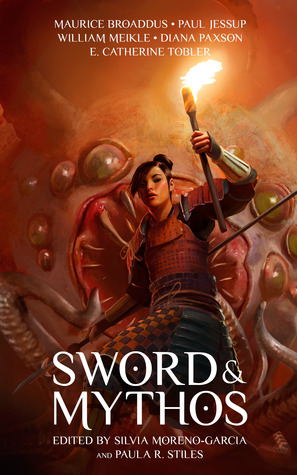
—Grey Yuen, “The Sorrow of Qingfeng” in Swords & Mythos (2014) 256

Judge Di (or Dee) has become popular in the West through a series of historical crime novels by Robert van Gulik; but the character was based on a real person, Di Renjie, a magistrate during the late Tang dynasty and the early Zhou dynasty under the empress Wu Zetian (“Her Majesty of Ten Thousand Years”), and it is in this period (694 CE) that the story is set. This is not a detective story; though it shares some elements with that genre. “The Sorrow of Qingfeng” is something rarer and weirder: a Mythos Wuxia story.

Wuxia is a genre of Chinese (and more broadly Southeast Asian) fiction dealing with the adventures of martial artists; a form of fantasy which has enthralled millions across the globe, especially in the form of Japanese manga and anime like Dragonball and Fist of the North Star, and Chinese martial arts films like The 36th Chamber of Shaolin (1978) and Crouching Tiger, Hidden Dragon (2000). The influence of wuxia can still be clearly seen in Dungeons & Dragons and many other roleplaying games, action film around the world, and English-language fantasy fiction.

Mythos fiction, not so much.

Action & adventure is nothing new to the Mythos. The original draft of the first story of Conan the Cimmerian, “The Phoenix on the Sword” (Weird Tales Dec 1932) mentions Yog-Sothoth and the Old Ones, and that was neither the first or last time Robert E. Howard’s sword & sorcery heroes touched base with the Mythos; “The Vale of Lost Women” being a notable instance of swords being taken up against a Lovecraftian horror. Howard was not entirely ignorant of Asian martial arts; there were exhibitions and matches even in Texas in the 1920s, and even wrote “Hard-Fisted Sentiment,” a mixed-martial arts story where an American boxer goes up against masters in French savate, jujitsu, and British boxing in turn.

It has been relatively rare to see a Mythos story where wuxia-style fantasy martial arts feature prominently. Steve Perry’s “The Case of the Wavy Black Dagger” in Shadows over Baker Street (2003) comes pretty close, but for the most part the two modes of fiction simply don’t cross over very often. Cthulhu may be punched, but said punches usually have little to do with specific schools or techniques, swords of nigh-magical sharpness, or the cultivation of internal force. These are the tropes that Grey Yuen specifically invokes in “The Sorrow of Qingfeng.”

Grey Yuen’s style in the story is reminiscent of “Quest of the Nameless City” (2007) by Tachihara Tōya (立原透耶); the effort is made to set the story not in some nameless quasi-medieval Asian setting, but in a specific era of Chinese history and with a style of narration that borrows at least a little from the Romance of the Three Kingdoms (which period, the Tang dynasty, immediately preceded the Zhou dynasty). Like Tachihara Tōya, Yuen makes an effort to combine Western-style Lovecraftian imagery with a very different cultural context, with fairly solid results:

It stared back at me. He stared back me. He was…black—not dark-skinned, not in his skin tone. He was black like the night. At first, I thought he was from the lands far to the west, where the sun scorches and the sands run yellow, where an ancient city waits to be discovered again. But then I realised he was from much farther aay, waiting to give away secrets that would doom us all.
—Grey Yuen, “The Sorrow of Qingfeng” in Swords & Mythos (2014) 267-268

The question of the racial characterization of Nyarlathotep rears its head, as it did in “Collector the Third: Charles Wilson Hodap (1842-1944)” (1995) by Kenneth W. Faig, Jr., but in a slightly different syntax. Yuen is smart to keep explicit details to a minimum, this is a story where a wuxia character encounters the Mythos, and suggestion works better than detailed explanation. Likewise, the spectacle of Master Yue’s Taishan Wulei Palm is all the more effective for seeing the results than the execution.

“The Sorrow of Qingfeng” is definitely an odd duck of a story, and it is hard to see where it might have been published except in an anthology like Sword & Mythos (2014), edited by Silvia Moreno-Garcia & Paula R. Stiles—yet it is an effective story, one that marries disparate modes of fiction and cultural contexts into a very competent whole. It has not yet been reprinted.


Bobby Derie is the author of Weird Talers: Essays on Robert E. Howard & Others (2019) and Sex and the Cthulhu Mythos (2014).