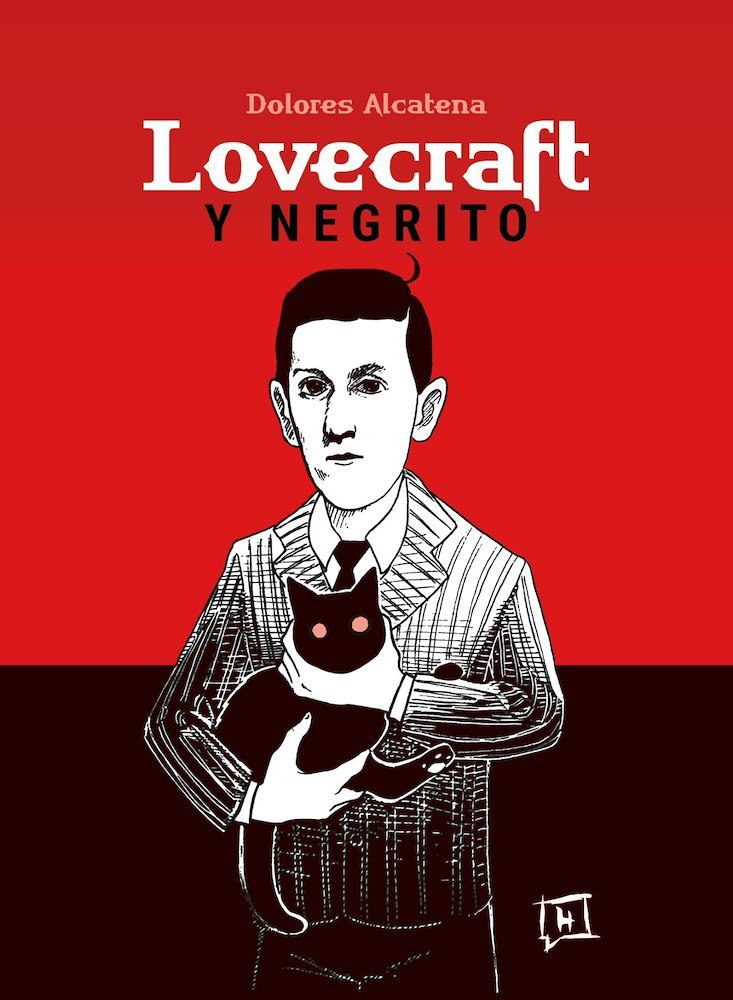
Lovecraft y Negrito (2023) by Dolores Alcatena

Racist Language
This review concerns H. P. Lovecraft’s cat, whose name was a racial slur against Black people.
As part of this review, the cat’s name and variations are included. Reader discretion advised.


The first known reference to H. P. Lovecraft’s cat was in a letter from his grandfather when Lovecraft was only 5 years old:

You and Dumplin Mama must keep the Barn shut every night and take care of Nig.
—Whipple Van Buren Phillips to H. P. Lovecraft, 17 Oct 1895, Letters to Family & Family Friends 2.1046

“Nig” was short for “Niggerman.” It was a black cat, at a time when the N-word was relatively common for pets with black coats. Whether it was Lovecraft who named the kitten, or a family member or friend, is not recorded in any of Lovecraft’s letters. It was his childhood pet—and, as it happened, the only pet he could afford during his life, although he retained a great fondness for cats throughout his life, often petting or playing with strays. In 1904, Whipple Van Buren Phillips died. Lovecraft’s family home was sold, he and his mother moved away from his childhood home, and the cat disappeared during the tumult, never seen again.

Lovecraft remembered his feline companion in later years, and based two cats in his stories on his lost pet: Niggerman in “The Rats in the Walls,” and Nig in The Case of Charles Dexter Ward. Neither appearance caused any particular outcry at the time of publication; Weird Tales was no stranger to the N-word and other terms, and it was not until “The Rats in the Walls” (1956) that any serious effort was made to censor or bowdlerize the cat’s name. Works in translation and adaptation were more likely to change the name; different languages, with different histories regarding race relations and Black slavery, have their own nuances of language to give shades of meaning or seek to avoid giving offense.

In 2023, Argentinian illustrator and writer Dolores’ Alcatena published Lovecraft y Negrito, a short graphic novel about Lovecraft’s friendship with his beloved pet. As she puts it in the opening:

Como amante de los gatos, Howard Philips Lovecraft frecuentemente incluía en sus relatos a estos elegantes y misteriosos animalitos. En su estilo deliberadamente desamorado y serio, los describía como símbolos de perfección, estética, libertad e independencia. Pero entre las cartas del escritor aparece Niggerman, un gatito negro que acompañaba a Lovecraft en su niñez. Al hablar de Niggerman (rebautizado ‘Negrito” para esta obra) las palabras del autor asumían un tono cálido, recordando con ternura cómo jugaban juntos en el jardín. Al hablar del gatito, el escritor no pudo, o no quiso, esconder sus sentimientos. El cariño que Lovecraft mantuvo a lo largo de su vida por Niggerman inspiró esta historia, permitiéndonos acceder a un costado más humano del gran autor del horror.As a cat lover, Howard Philips Lovecraft often included these elegant and mysterious animals in his stories. In his deliberately dispassionate and serious style, he described them as symbols of perfection, aesthetics, freedom, and independence. But among the writer’s letters appears Niggerman, a black kitten who accompanied Lovecraft in his boyhood. When talking about Niggerman (renamed “Negrito” for this work), the author’s words took on a warm tone, fondly recalling how they played together in the garden. When talking about the kitten, the writer could not, or did not want to, hide his feelings. Lovecraft’s lifelong affection for Niggerman inspired this story, allowing us to glimpse a more human side of the great horror author.
Dolores Alcatena, Lovecraft y Negrito (2023)English translation

“Negro” in Spanish is the color black, “-ito” is a diminutive suffix; context is important because in some usages “negrito” can mean bold type, or it can be a reference to certain Southeast Asian peoples, or a not-necessarily-kind reference to small Black children. In the context of this story, it might be best to think of it as a term of affection, like naming a black kitten “Blackie.”
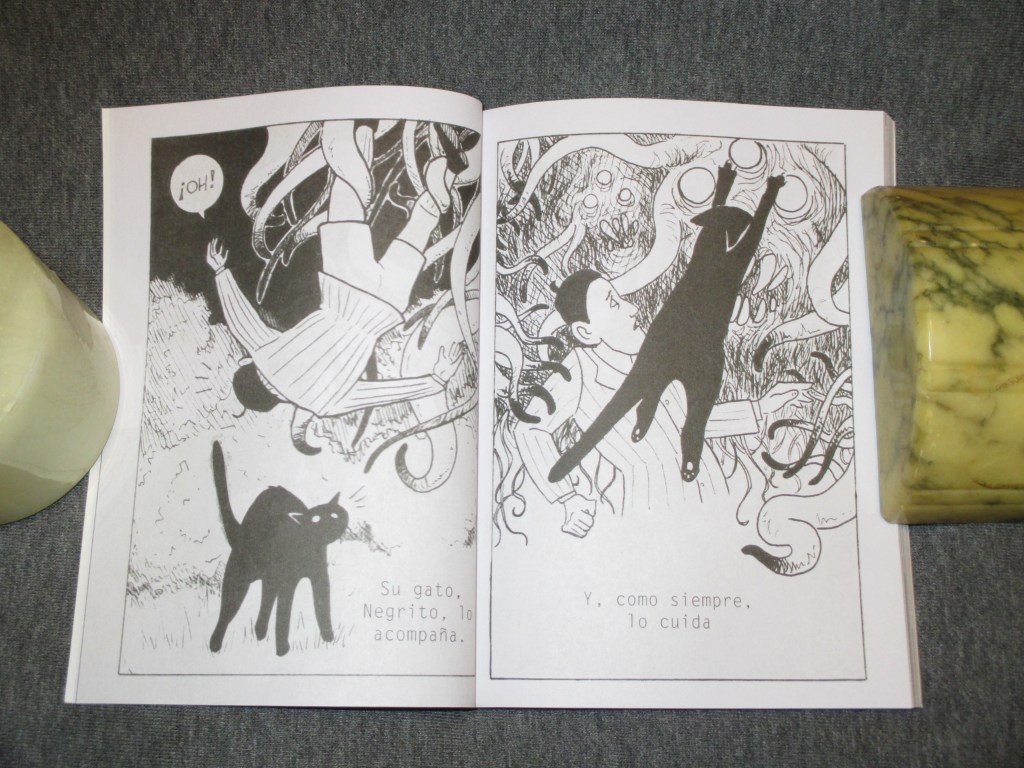
Su gato, Negrito, lo acompaña.

Y, como siempre, lo cuida.
His cat, Negrito, accompanies him.

And, as always, takes care of him.
Dolores Alcatena, Lovecraft y Negrito (2023)English translation

The story is told in black and white, mostly from Negrito’s perspective. The cat aids and protects Howard through his journeys, including the events that would inspire “The Cats of Ulthar” and “The Shadow over Innsmouth.” From a cat’s perspective, the cat-killing couple in Ulthar are particularly horrific.
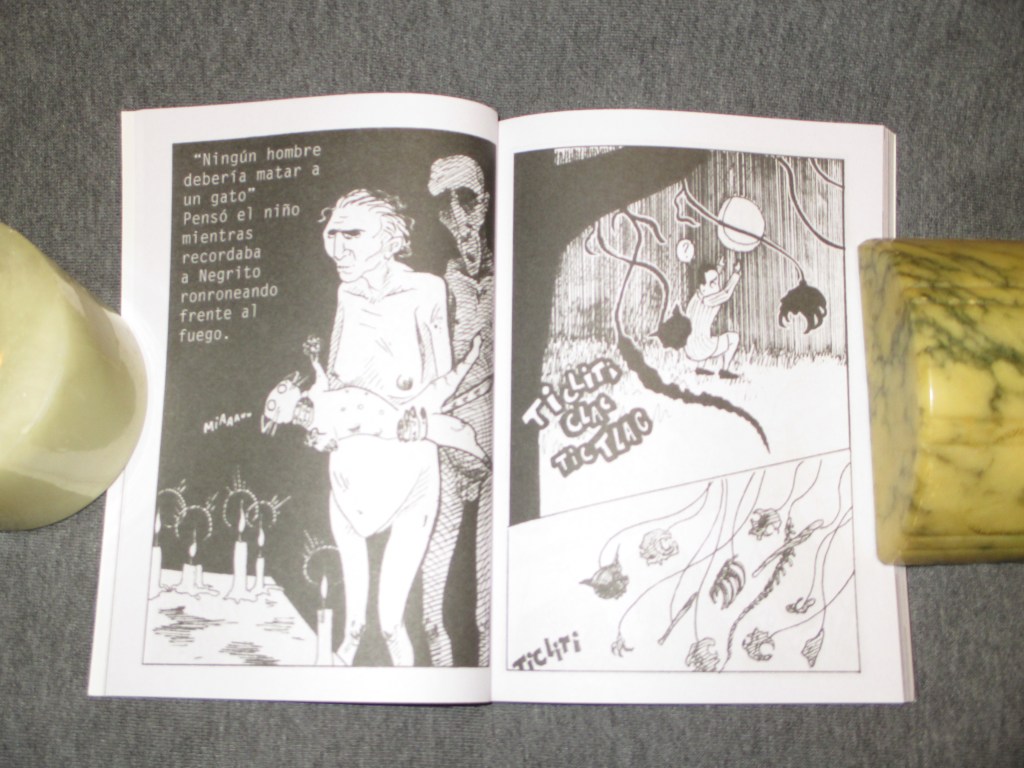
“Ningún hombre debería matar a un gato”
Pensó el niño mientras recordaba a Negrito ronroneando frente al fuego.
“No man should kill a cat,” the boy thought as he remembered Negrito purring in front of the fire.
Dolores Alcatena, Lovecraft y Negrito (2023)English translation

There is a somewhat fairy-tale quality to the retelling, the traipse through Lovecraft’s fiction. Most of Howard’s waking life we don’t see…but then his cat was not there to see that.
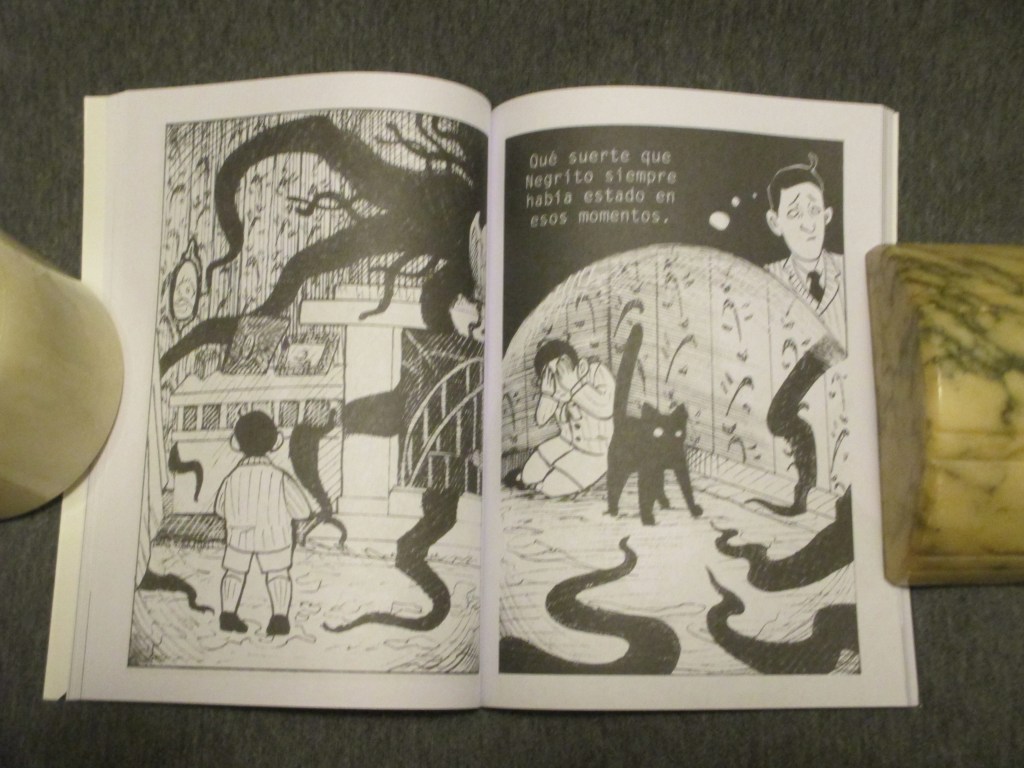
Qué suerte que Negrito siempre había estado en esos momentos.How lucky that Negrito had always been there in those moments.
Dolores Alcatena, Lovecraft y Negrito (2023)English translation

The Lovecraft of these stories is a scared, almost a traumatized kid, with Negrito as his only friend; parental figures are absent. It is a very sympathetic view of Howard as a child, but in comparison to El Joven Lovecraft by José Oliver & Bartolo Torres it does not show Lovecraft’s occasional joyfully morbid side. Readers are meant to empathize with a young Lovecraft.
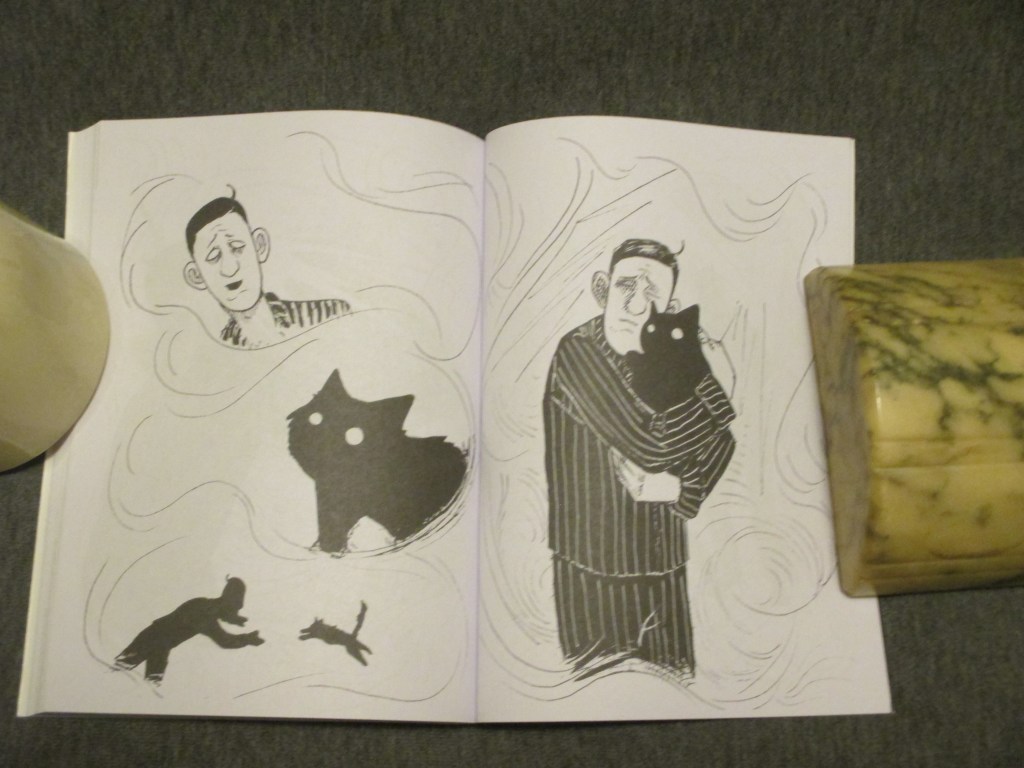
The ending, a wordless reunion between the dead Lovecraft and his lost cat, is the kind of afterlife that every cat-lover might wish to experience themselves someday.
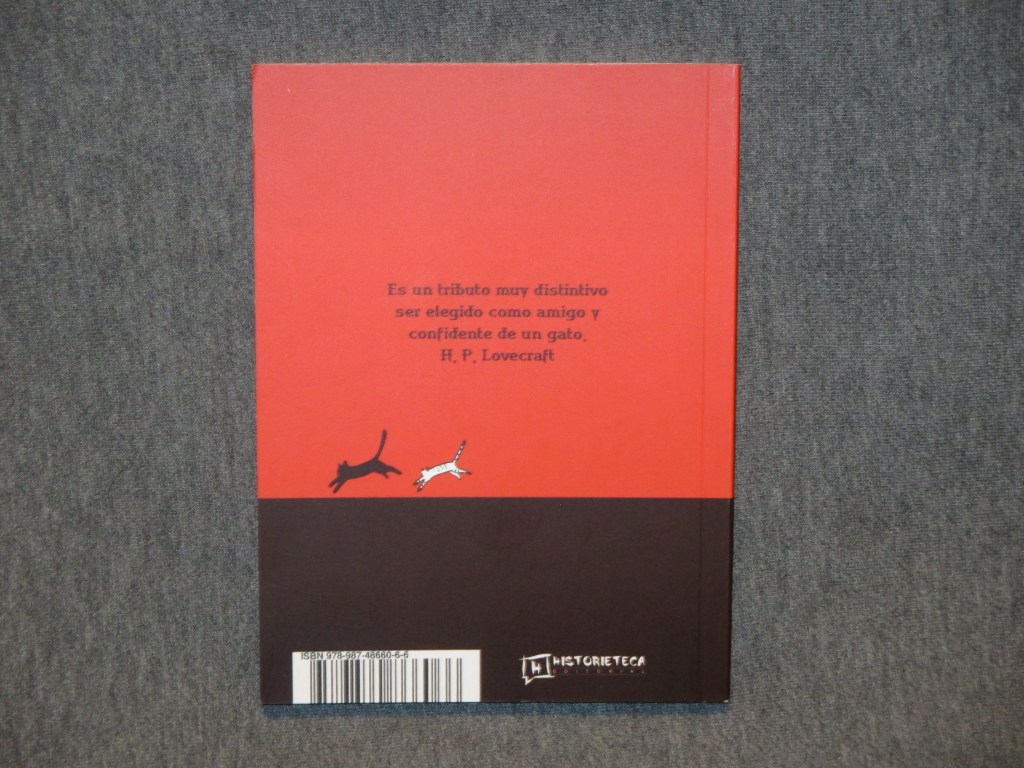
Es un tributo muy distintivo ser elegido como amigo y confidente de un gato.
H. P. Lovecraft.
It is a very distinctive tribute to be chosen as a friend and confidant of a cat.
H. P. Lovecraft.
 It is no compliment to be the stupidly idolised master of a dog whose instinct it is to idolise, but it is a very distinct tribute to be chosen as the friend and confidant of a philosophic cat who is wholly his own master and could easily choose another companion if he found such an one more agreeable and interesting.
Dolores Alcatena, Lovecraft y Negrito (2023)English translationH. P. Lovecraft, “Cats and Dogs”

Lovecraft y Negrito is a story about a boy and his cat. It is not a historical work that delves into the nuances of the cultural forces that went into such names, or how naming cats did or did not reflect Lovecraft’s racial prejudices in later life. If readers want a scholarly exploration of what we do and don’t know about the real animal, check out Ken Faig’s essay “Lovecraft’s Boyhood Cat” in Lovecraft Annual #19 (2025). If you want a heartwarming fantasy about Lovecraft and his beloved pet, which has gained a kind of literary immortality, then read Lovecraft y Negrito.


Bobby Derie is the author of Weird Talers: Essays on Robert E. Howard and Others and Sex and the Cthulhu Mythos.

Deep Cuts in a Lovecraftian Vein uses Amazon Associate links. As an Amazon Associate I earn from qualifying purchases.
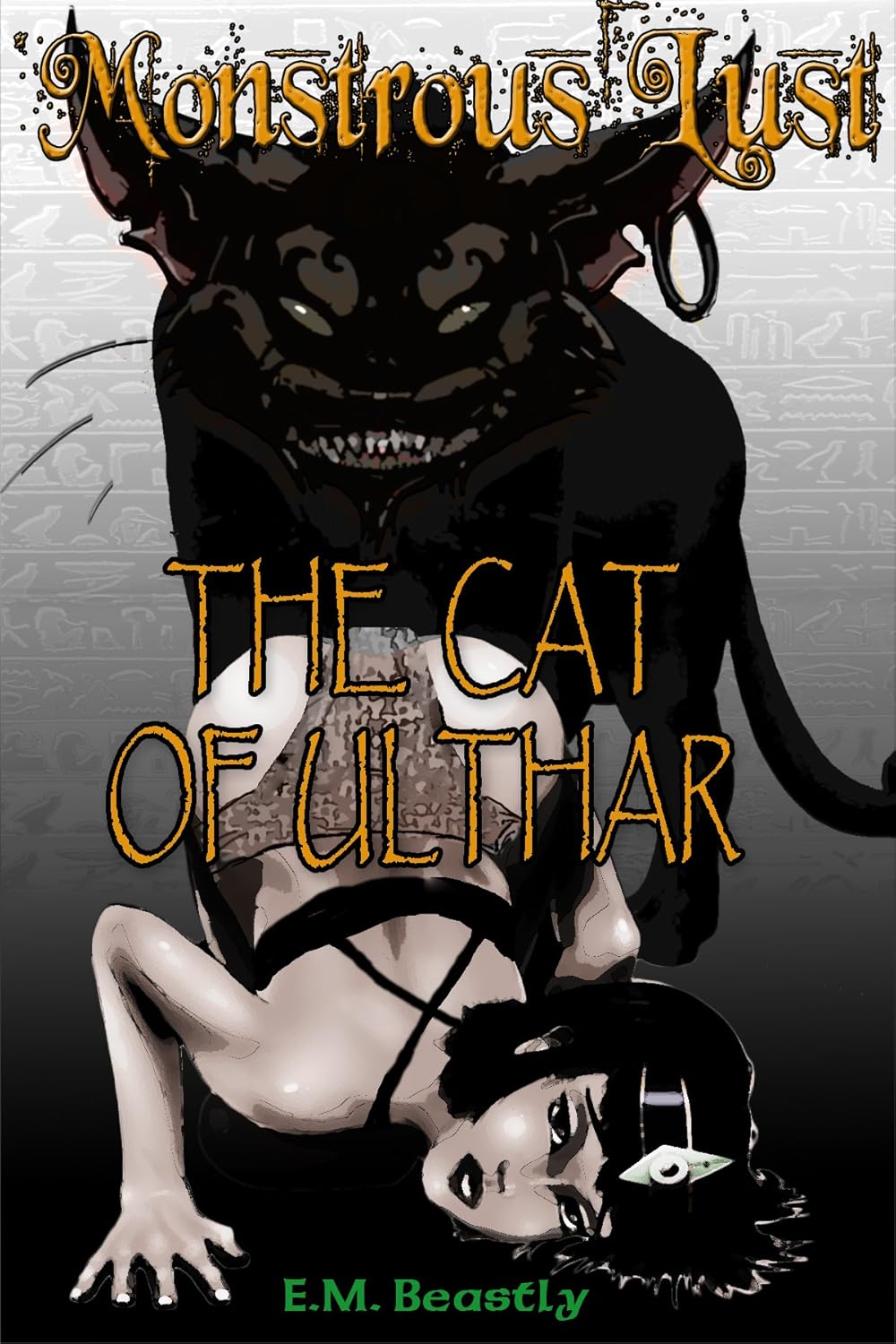
Monstrous Lust: The Cat of Ulthar (2017) by E. M. Beastly

Eldritch Fappenings
This review concerns a work of explicit adult literature. Reader discretion is advised.


There is an old legen in Ulthar, which lies beyond the river Skai, that no person can kill a cat. The legend speaks of a caravan full of strange wanderers. Some say they brought with them a blessing, others say a curse. From that day when a little boy lost his previous black kitten to an old cotter and his wife, the people of Ulthar did not dare kill a cat.

In Ulthar the cat became revered, cherished and praised. His the kind of the jungle’s lords, and heri to the secrets of hoary and sinister Africa. The Sphinx is his cousin, and he speaks her language; but is more ancient than the Sphinx, and remembers that which she hath forgotten.

As time went by, visitors to Ulthar said the cat became a powerful symbol.
—E. M. Beastly, Monstrous Lust: The Cat of Ulthar (2017)

According to Rule 34 of the Internet, there is porn of it. No exceptions. Strictly speaking, this is not true. It would be more accurate to say that the potential for erotic art and literature exists for every human conception. Diligent researchers would struggle to find, for example, a more explicit re-telling of H. P. Lovecraft’s “Sweet Ermengarde,” or lovingly rendered erotic fan-art of “Winged Death” (1934) by Hazel Heald & H. P. Lovecraft. There’s no reason for those adult works to not exist, but searchers after erotic horror will find vastly greater numbers of images dedicated to Cthulhu, Deep Ones, and shoggoths, shoggoths, shoggoths.

If porn of everything exists, it isn’t very evenly distributed. Some works and ideas attract more erotic attention and creativity than others.

Erotic works derived from Lovecraft’s “The Cats of Ulthar” exist in a relative minority compared to the erotic library spawned by “The Shadow over Innsmouth.” Lovecraft’s Dunsany-esque fantasy, part of the Dreamlands cycle, has no named characters, and as the name implies is primarily concerned with an episode involving domestic felines, told with the distinct style of a fable or just-so story. The erotic potential isn’t absent, but how to best adapt the themes and characters of the story to adult entertainment.

Well, there are the cats…

Erotic fanworks involving animal characters (expressive, talking animals, or fully anthropomorphic) have been around since at least the 1930s/1940s, when Tijuana bibles depicted erotic episodes of popular comic strip (e.g. Napoleon) and cartoon characters (e.g. Donald Duck). The emergence of an organized furry fandom from science fiction and comic book fandom would come in the 1970s and 80s, as a result of a convergence of factors, including the increased prevalence of fur-clad aliens in science fiction, the increase in shapechangers in fantasy, the success and sophistication of anthropomorphic characters in comics, cartoons, and animated films especially Disney’s Robin Hood (1973), and the late 60s/early 70s underground comic movement which included strong currents of parody, satire, and explicit sexuality that gave birth to characters like Fritz the Cat.

Technically speaking, Lovecraft got into the talking animals game in the 1920s when he wrote “The Dream-Quest of Unknown Kadath,” where the cats of the Dreamlands are not just intelligent but conversant with Randolph Carter. While Lovecraft isn’t usually seen as a precursor to contemporary furry fandom, it is clear that he was drawing from the idea of talking animals stories from stock collections of fairie tales and fables, and that he conceived the cats of Ulthar as capable of being characters in their own right. So when E. M. Beastly decided to riff off of Lovecraft for another entry in their Monstrous Lust series, the step from talking animal to anthropomorphic animal was less of a stretch than it might seem at first glance.

“Monstrous Lust: The Cat of Ulthar” is at once a sequel to and continuation of Lovecraft’s “The Cats of Ulthar,” and an erotic novella that takes the basic premise of the story in unexpected directions. While Lovecraft’s tale is horrible in the sense of Poe or Dunsany, Beastly takes things in a direction that seems to owe more to “The Shadow over Innsmouth,” where the cat-friendly law of Ulthar leads to more profound cultural changes, the rise of a dark cult, and finally physical expression in the bodies of the people of Ulthar. Until at last they disappear entirely, leaving behind a monstrous creature…the Cat of Ulthar.

While the concept is interesting, the execution is the real key. Here, the actual plot and writing of the story may disappoint readers. While the set-up of an Ulthar haunted by a sexy creature caught between human and cat with aspects of both has promise, in personality the eponymous Cat has a personality not unlike a sexually promiscuous version of the Cheshire Cat, and the two human characters who go to confront the creature are seduced and corrupted with a bare minimum of conflict. The stakes are low-to-nonexistent, the characters barely sketches, and the premise a bit weak. If you’re interested in passages discussing furry breasts and sexually explicit encounters between humans and a mystical cat-human hybrid, the story checks those boxes—but it doesn’t go far beyond that.

It is important to emphasize that there’s nothing inherently more taboo, weird, or perverted about anthropomorphic literature than any other kind. Nearly everyone has seen or read talking animal stories in some format, from Bambi to Br’er Rabbit, and anthropomorphism can apply to inanimate objects as easily as animals, as shown by the Transformers and Cars (2006). The same standards and good storytelling principles which apply to other literature also apply to anthropomorphic lit. As one reviewer put it:

On the surface, Bambi’s story is just what the subtitle says: A Life in the Woods. Yet one can find so much more in the story. The entire novel can be read as an existentaist parable, suggesting how one might make meaning in one’s own life. The novel is often seen as a disatribe against hunting, or more generally, a warning of the danger human beings pose to the natural world. The story can be read as castigating any system where the powerful exploit the weak, whether aristocracy or capitalism.

Yet Bambi is not a sermon. Salten’s beliefs and values are suggested on every page, but he doesn’t beat the reader over the head with them. He’s created characters that we as readers care about. Seeing them go through their struggles better enables us to contemplate our own lives. It is a story about its characters, not about issues; the issues become important to us because of the characters.
—Donald Jacob Uitvlugt, “Re-Reading a Classic: Bambi for the Furry Writer” in
A Glimpse of Anthropomorphic Literature (2016), 85-96

This is where “Monstrous Lust: The Cat of Ulthar” tends to fall flat; the characters fail to engage emotionally, and the story scenario doesn’t make sufficient use of the Lovecraftian setting and premise—which is, in Lovecraftian lit., a character in its own right. There’s humping and pumping, but without characters we care about. The setting is nominally Ulthar, but an Ulthar twisted into a Lovecraftian pastiche of itself, warped, twisted, depopulated, and barely present during the sexytimes. It is a fantasy sexual encounter that might easily be moved into any generical medieval setting with minimal effort.

Which is not to say that E. M. Beastly’s story is a failure, if that is exactly what the reader wants.


Bobby Derie is the author of Weird Talers: Essays on Robert E. Howard and Others and Sex and the Cthulhu Mythos.

Deep Cuts in a Lovecraftian Vein uses Amazon Associate links. As an Amazon Associate I earn from qualifying purchases.

An Asian Writer Looks At Lovecraft

An Asian Writer Looks Into Lovecraft
by Nicole Ortega

To me, “The Cats of Ulthar” is a wish-fulfillment story.

The story reads like a white community desperately wanting to get rid of poor immigrants in their neighborhoods. These neighbors kill cats and even dispatch their beloved pets. In real life, the local police would probably come and take away these cat killers; white people are known to love animals, especially their pets. There were no police and mobs but this town just sat in their fear of the cotter and his wife. I find it curious and baffling that they did nothing when the couple was isolated from the rest of the town and its people. I think of Lovecraft and his famous loathing for immigrants coming to his beloved town and contaminating the culture of white Protestantism that he wholeheartedly loves and seeing it from that viewpoint on the decision to do away with the repulsive cat-killing couple in Uther by another outsider; Menes from a traveling caravan.

The townspeople and the narrator feel helpless and unable to do anything about these notorious neighbors. Lovecraft renders his protagonists unable to confront the dangers of forces alien to them: 

In truth, much as the owners of cats hated these odd folk, they feared them more; and instead of berating them as brutal assassins, merely took care that no cherished pet or mouser should stray toward the remote hovel under the dark trees.

H. P. Lovecraft, “The Cats of Ulthar”

Lovecraft’s stories including “The Street,” “The Terrible Old Man,” “The Horror at Red Hook,” and “The Dreams in the Witch House” feature immigrants and place them as a central focus in the stories. Lovecraft clearly imbued his dual fear and disgust over immigrants in these stories. His fear of an outside force infecting and changing a wholesome white community is apparent in his letters and works of fiction.

Is this how Lovecraft felt in his personal life when people who do not belong to his accepted racial and cultural identity moved into his hometown of Providence? The cotter and his wife are symbols of Lovecraft and the white fear of the immigrant. In the story, when the cotter and his wife were suspected and witnessed by the town of catching and butchering cats, I feel that this was a reference to the racist stereotypes of foreigners; a marker of “othering” that is specifically designed to target Asians.

In the United States of America, there have been negative stereotypes of Asians as unhygienic and unsanitary.  Asian cuisine, notably Chinese cuisine, was derided as dirty and the meat was rumored to be made of dogs and cats. This was tied to when Chinese immigrants set up restaurants and food stalls and were popular in the U.S. and so racist propaganda against them was made up to sabotage their businesses.

There was no mention whether the couple ate the cats or just killed them but I believe that the mention of cats and their status in the community has made me see them as a placeholder for Asian immigrants to a white community. In the story, the couple lived in a hovel near dark wood. As an Asian and family who are immigrants, I believe that the hovel was in a rough part of town where immigrants who were mostly workers, lower class or living underneath the poverty line come from. Lovecraft mentioned these communities in his letters and looked down on them:

We walked—at my suggestion—in the middle of the street, for contact with the heterogenous sidewalk denizens, spilled out of their bulging brick kennels as if by a spawning beyond the capacity of the places, was not by any means to be sought. At times, though we struck peculiarly deserted areas—these swine have instinctive swarming movements, no doubt, which no ordinary biologist can fathom. Gawd knows what they are—Jew, Italian, separate or mixed, with possible touches of residual Irish and exotic hints of the Far East—a bastard mess of stewing mongrel flesh without intellect, repellent to eye, nose, and imagination—would to heaven a kindly gust of cyanogen could asphyxiate the whole gigantic abortion, end the misery, and clean out the place.

H. P. Lovecraft to Maurice W. Moe, May 1922, Letters to Maurice W. Moe 97

To the white gaze; there have been much discrimination and prejudice regarding Asians and the Oriental thinking of white people surrounding food and hygiene.

Racists in the beginning of the pandemic sadly stoked the fires of anti-Asian prejudice. Hate crimes have been rising ever since; the Trump campaign and administration have made white rage and racism their base and it was proven to be sadly so effective that even today the consequences of such rhetoric have manifested into the undue attacks on minorities especially Asians because of the connections racists like Trump has made to them with the pandemic. 

Donald Trump constantly referred to COVID-19 as the “Chinese Virus” even though experts said that this contributes significantly to anti-Asian sentiment. Racists connecting minority groups and diseases create pogroms. The elderly and/or women are the primary targets of anti-Asian sentiment. Attacks on Asians in public places and outright murder in chilling instances like the 2021 Atlanta Spa Shootings show how violence follows prejudice. Hate crimes against Asians have skyrocketed in the U.S. in the past year.

I am from one of those countries in Asia that rely on people going abroad where they are vulnerable to abuse and discrimination. There are many horror stories from migrant workers here about cruel employers and some even get trafficked as slaves. There is little to no protection offered by embassies or consulates because of the lack of resources and power of a government that is mostly apathetic. When Trump was elected, I feared for what would happen to Asians and other minorities and what happened was even worse than I could have imagined. Millions of people voted for this kind of administration and the support of white supremacist groups and ideology is ramping up even more.

It was fully a week before the villagers noticed that no lights were appearing at dusk in the windows of the cottage under the trees. Then the lean Nith remarked that no one had seen the old man or his wife since the night the cats were away. […] And when they had broken down the frail door they found only this: two cleanly picked human skeletons on the earthen floor, and a number of singular beetles crawling in the shadowy corners.

H. P. Lovecraft, “The Cats of Ulthar”

It is a very powerful and potent fear in the minds of white people to be displaced, subsumed —devoured by a strange and foreign culture. The feelings of intense revulsion and disgust the narrator and the townspeople of Ulthar can be likened to the white neighbour who complains too much about the immigrant neighbours. The town retains its innocence and the cotter and his wife are destroyed not by the town but another outsider. Revenge and murder are actions taken by both outsiders and not the white townspeople. Conflict is between different outside forces and not the good people of Ulthar. All is well in the end with the couple dead and Menes and the travelling caravan gone. A good ending is where no outsider lives among a white community. It is clear that the interaction of different groups of people brings discord, chaos and violence.

East versus West—they can talk for aeons without others knowing what the other really means. On our side there is a shuddering physical repugnance to most Semitic types, & when we try to be tolerant we are merely blind or hypocritical. Two elements so discordant can never build up one society—no feeling of real linkage can exist where so vast a disparity of ancestral memories is concerned—so that wherever the Wandering Jew wanders, he will have to content himself with his own society till he disappears or is killed off in some sudden outburst of mad physical loathing on our own part.

H. P. Lovecraft to Lillian D. Clark, 11 Jan 1926, Letters to Family and Family Friends 2.535

The townspeople didn’t try to reach out to the cotter and his wife and understand where they are coming from. Of course, they are butchering cats and all of them deem them really unpleasant but with the entirety of the town at odds with them, it is curious to see nothing to be done.  It feels like the town of Uthar has made them into something inhuman, something that cannot be reasoned with or something they themselves cannot stop.

In the story, Ulthar was rid of the cat-killing poor and unpleasant couple without having to do anything by themselves.  In the end, the orphan whose beloved pet was killed and who successfully did away with the perpetrator, did not come to live in Ulthar. Lovecraft believed that cultures in contact with one another have an inevitable way to be in conflict with one another and one dominant culture will surface with the other culture diminished or faded.  This is one of Lovecraft’s fears:

Racial admixture—all apart from the question of superiority, equality, or inferiority—is indubitably an influence adverse to cultural & environmental continuity. It weakens everything we really live for, & diminishes all the landmarks of familiarity—moods, accents, thoughts, customs, memories, folklore, perspectives, physiognomical types, &c.—which prevent us from going mad with homesickness, loneliness, & ancestral estrangement. Thus it is the duty of every self-respecting citizen to take a stand against large-scale racial amalgamation—whether with newly invading groups, or with differentiated groups anciently seated amongst us. Of course, I realise that “duty” in the sense of cosmic mandate is a myth—but what I mean is, that this is the course which will be followed by every normal American who wishes to avoid spiritual exile & agony for himself & his descendants, & whose eyes are not blinded by the abstract ethical sentimentalities surviving from a naiver period of our intellectual evolution. My own motto is, ‘life in a pure English nation or death’.

H. P. Lovecraft to James F. Morton, 29 Dec 1930, Letters to James F. Morton 260-261

The revenge of the foreign orphan and the cat-killing couple to me is one such clash. The Clash of Civilizations by Samuel P. Huntington posits a theory that civilizations or cultures are bound to clash with one another. The fear of the foreigner being a threat to white western culture is not new. Lovecraft was not unique in sharing this opinion. Look what Lovecraft talked about in his letters, he wanted cultures to be pure and find mixing of cultures to be a shame and a sort of destruction. The clash of cultures already exists at the beginning of “The Cats of Ulthar,” and at the end the town is “saved” from the presence of what I see as ethnic immigrants in a white town like Providence in which H.P. Lovecraft lived.

It is not explicitly stated anywhere that the cotter and his wife were Asians, but to me the descriptions and stereotype of killing cats and poor living conditions like hovels as described by letters of the author in which Asians are living in, I believe there is a hint of Asian identity to the characterization or the very least Lovecraft wanted to label them as “other.” Through the narrative and the character of the orphan, he got rid of the “other” by another outsider and thus bringing peace and stability to the community and in which the narrator and the townspeople need not have dirtied their hands or do any proactive role in trying to drive out the offending entities.

I believe this is Lovecraft wanting to maintain white innocence and zero culpability. We see this happening in real life: there is no reckoning on how white supremacy is coming back in full force because white feelings need to be coddled even at the expense of lives of minorities.

Even now, I am not comfortable traveling to the U.S. and other countries because of the reports of hate crimes and I have even asked my friend if I look “Asian.”  I wonder if I could “pass” as white and blend in to avoid getting targeted. These are the things I have to deal with because this is what the feelings of white people like Lovecraft have; they want their communities to be pure and untouched by people like me. I remembered feeling numb and shocked when Trump was elected. To think, millions of people voted for him, saw what he was saying about immigrants and foreigners, and supported him. It was eye-opening to see the reach and breadth of that kind of hateful rhetoric today. By giving white supremacists a major platform in society increases violence against minority groups and allows the state to harm them through its institutions and policies.

In Ulthar, there are no people who harm cats anymore. There are no strange people who catch cats and kill them. There are no outsiders who call on magic to exact revenge. There are just the townspeople and the narrator who live happily. I am not advocating for the killing of cats but the town of Uther seems to be intolerant and unwelcoming to foreigners. They did not thank Menes at all or even welcome him and the caravan after the whole fiasco. I believe if Menes and his caravan had not left, they too would be looked upon with fear and revulsion by the people of Uthar.


N.C. Ortega is a writer and artist from Cebu, Philippines. They love horror, sff and romance. Bouncing from one interest to another, they hope to maybe create games, comics, and stories in various mediums and formats in the future.

Twitter: @granadamoon

Copyright 2022 N.C. Ortega