And then the girl behind the counter
She asks me how I feel today
I feel like Lovecraft in Brooklyn
—final chorus
“Lovecraft in Brooklyn” is the eighth track on Heretic Pride (2008, 4AD) the eleventh studio album by The Mountain Goats, an indie/folk-rock project by singer/songwriter John Darnielle and his collaborators. The song was written and performed by Darnielle, and produced by Scott Solter and John Vanderslice. The tense 3:49 recording is narrated by an individual in a city, expressing muted frustration and horrific fantasies. References to Lovecraft and his work are few and vague, beginning with the second chorus:
Rhode Island drops into the ocean
No place to call home anymore
Lovecraft in Brooklyn
And ending with a reference to what might be the Fungi from Yuggoth:
Someday something’s coming
From way out beyond the stars
To kill us while we stand here
It’ll store our brains in Mason jars
…or perhaps just a paranoid ramble from an undiagnosed schizophrenic. While nothing happens in the narrative of the song, there is the implicit promise of violence about to occur, and “Lovecraft in Brooklyn” is the narrator’s common reference point for how they feel, a reference that they expect others to understand.
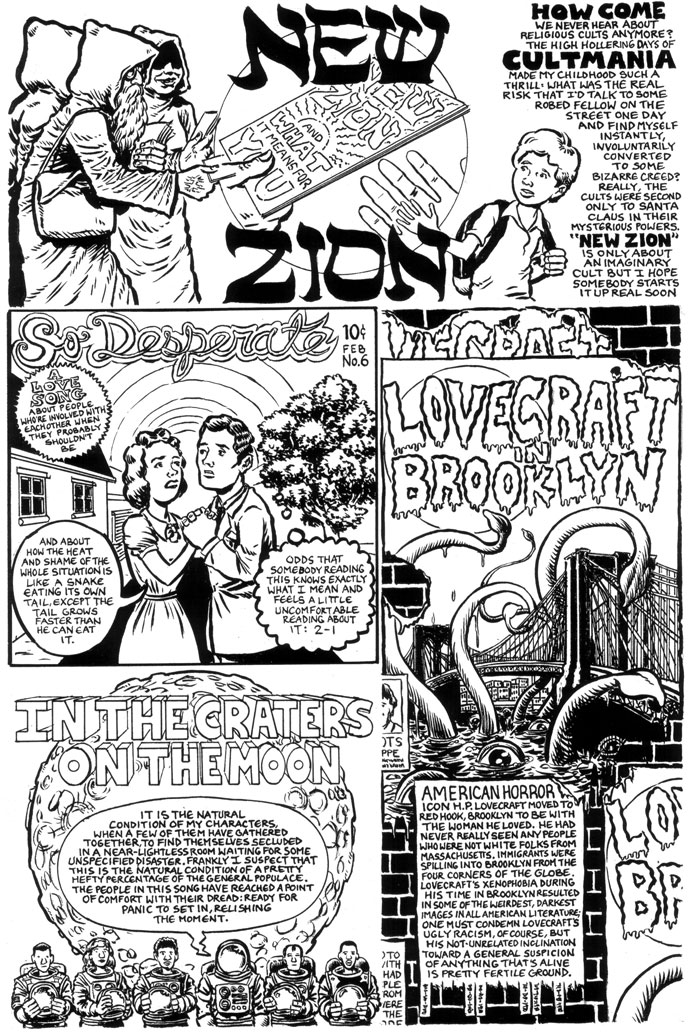
As part of the promotion of the album, comic book artist Jeffrey Lewis produced a three-page comic illustrating Darnielle’s notes about the songs.
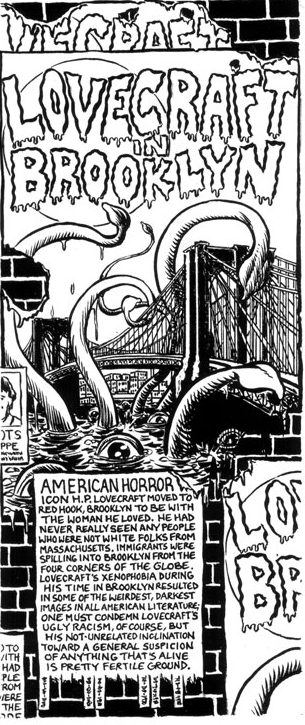
American horror icon H. P. Lovecraft moved to Red Hook, Brooklyn to be with the woman he loved. He had never really seen any people who were not white folks from Massachusetts. Immigrants were spilling into Brooklyn from the four corners of the globe. Lovecraft’s xenophobia during his time in Brooklyn resulted in some of the weirdest, darkest images in all American literature; one must condemn Lovecraft’s ugly racism, of course, but his not-unrelated inclination toward a general suspicion of anything that’s alive is pretty fertile ground.
In a 2008 interview about the science fiction influence on his work, Darnielle was asked specifically about the song:
[Charlie Jane Anders]: Your new album includes a song about H.P. Lovecraft, “Lovecraft In Brooklyn.” Why should we identify with H.P. Lovecraft’s feelings of alienation and xenophobia during his exile in Red Hook? What about that image appeals to you? In Lovecraft’s case, that alienation leads to all his best speculative horror… do you think xenophobia creates better speculative fiction than xenophilia?
[John Darnielle]: Well the song is not really about Lovecraft — it’s sung by a guy who’s identifying with Lovecraft at his most xenophobic and terrified. Why does that appeal? I think I’m just attracted to hermits in general — to people who don’t feel like they’re part of the world, who have a hard time feeling like they’re really present in the same space as everybody else.
—Charlie Jane Anders, “The Mountain Goats Explain Why Ozzy Osbourne Is A Scifi Visionary” (Gizmodo, 27 Mar 2008)
An apocryphal account of the 22 March 2008 live session The Mountain Goats played at the Black Cat club in Washington, D.C. captures an opener John Darnielle gave before playing this song:
Once again, to express my affection for you, I’d like to play this song about a fellow who is really so filled with anger and rage that the mere sight of other human beings makes him feel even more angry. He’s angry already when he wakes up, before he remembers that there’s other people on the planet. But once he thinks of those other people, then he starts to really get going. And heaven help you if he should have to go and get some kleenex or whatever from the corner store, then he will really be filled with a special kind of contempt. Why? Because you have bodies and they make him sick. That’s what this song is about. I know everyone can relate to the tender feelings expressed in it.
John Darnielle is not a Lovecraft scholar; his understanding of Lovecraft as represented in the promotional materials, lyrics, and intra-show commentary reflects a popular depiction of Lovecraft as an angry xenophobe trapped in a place surrounded by people who weren’t like him, and it made him go crazy. “Lovecraft in Brooklyn” reflects the legend of Lovecraft’s 1924-1926 sojourn to New York, much like Victor LaValle’s “The Ballad of Black Tom” (2016) represents an interpretation of “The Horror at Red Hook,” one of the stories Lovecraft wrote during that period, with an emphasis on Lovecraft’s racism.
The reality was more complicated. 1924 wasn’t the first time Lovecraft had been to New York; it wasn’t the first time Lovecraft had been out of state, or seen people of color or different ethnicities. Lovecraft had experiences leading up to his 1924 elopement with Sonia H. Greene, who gave her version of their married life in The Private Life of H. P. Lovecraft (1985), which he thought prepared him for life in New York.
As it happened, Lovecraft was wrong. He failed to find employment; soon after marriage, his wife fell ill and required hospitalization and then rest. Without either of them working, money swiftly became an issue. Sonia eventually found a job out in the Midwest, but Lovecraft would not follow her there, so he was left alone, in the poor Red Hook neighborhood of Brooklyn. Largely alone, unable to make his own way, dependent on a wife he didn’t see for weeks and distant aunts, Lovecraft tried to make the best of it with his local friends.
Then thieves broke into his apartment.
Letters from Lovecraft to his aunts Lillian D. Clark and Annie Gamwell show how unhappy he was. While he never blamed the immigrants or people of color for his own failures, his letters to them during this period show how much Lovecraft’s prejudices were exacerbated during this final, stressful period in New York…until, at last, his aunts and wife prevailed upon him to return to Providence, Rhode Island, where he could be happier.
So he did.
Most of Lovecraft’s New York experiences did not make it into his fiction; not even the fiction he wrote while living in and set in the city. “The Horror at Red Hook” is unusual because through Lovecraft’s letters and various anecdotes in memoirs we can trace it back to a specific incident—overhearing some hardboiled toughs talking a little too loudly about criminal goings-on at a local cafeteria—from which Lovecraft spun out his fantasy of an immigrant gang-cum-cult involved in human trafficking, murder, and more esoteric activities.
“The Horror at Red Hook” reads pretty baldly racist; the equivalent today might be a story of an MS-13-type group that was also a survival of ancient Aztec religion that still practiced human sacrifice. That was very explicitly fiction, though—a play on contemporary prejudices, not Lovecraft just putting his own prejudices onto the paper. A fine distinction for a lot of readers who don’t always like to distinguish between what Lovecraft thought and how he portrayed things in the pages of Weird Tales.
New York-based rapper and producer Aesop Rock (Ian Matthias) did a remix of “Lovecraft in Brooklyn,” which at 3:31 retains all of Darnielle’s lyrics but quickens the beat and reworks the soundscape with added effects to add to the tension and air of alienation of the song, and providing a densely-packed fourth verse of his own. The added lyrics are grounded much more firmly in Brooklyn itself, and suggest a deeper understanding of Lovecraft’s time in New York (“Summer lovin’ snuck him toward the tarnished arms of liberty”), and perhaps reflect W. Paul Cook’s assessment that Lovecraft’s time in New York was pivotal toward his development as a writer (“Little Howie’s parachute has flowered down the rabbit hole”).
“Lovecraft in Brooklyn” is an expression of the pop cultural phenomenon that is Lovecraft; his legend used to evoke certain ideas, attitudes, and aesthetics completely rather than any attempt to relate a distinct biographical episode from his life. It showcases how Lovecraft’s reputation as a bigot and xenophobe has become so rampant; of course, the fact that he was racist (if not always to the degree or in the way folks like Darnielle portray) cannot be ignored and shouldn’t be downplayed.
While Darnielle’s particular impression of Lovecraft may be factually incorrect, Darnielle was right in that Lovecraft’s legacy continues to be fertile ground for artists to fuel their own imaginations.
“Lovecraft in Brooklyn” – The Mountain Goats (Youtube link)
“Lovecraft in Brooklyn” (remix) – The Mountain Goats / Aesop Rock (Youtube link)
Bobby Derie is the author of Weird Talers: Essays on Robert E. Howard and Others and Sex and the Cthulhu Mythos .
Deep Cuts in a Lovecraftian Vein uses Amazon Associate links. As an Amazon Associate I earn from qualifying purchases.
 Deep Cuts in a Lovecraftian Vein