I have given the whole of a cloudy Sabbath to finish my dismembered corpse story—“The Return of Helman Carnby”. I shall enclose the carbon with this; and I hope you will like it. The thing became a sizable yarn, with all the details that I worked out . . . It goes to “Ghost Stories”, then to W. T.,—both of which will doubtless reject it. But I think myself that the tale is a pretty fair literary beginning for the New Year. I like to picture it in the sunny and lightsome pages of the “Ladies’ Home Journal.”
—Clark Ashton Smith to H. P. Lovecraft, c. early Jan 1931, Dawnward Spire, Lonely Hill 290Needless to say, I perused the monstrous narrative of Helman Carnby with the most acute & shuddering admiration; &, having made the verbal changes indicated in your supplementary note, have forwarded to Derleth with instructions for return to you through Wandrei. It is certainly a great piece of work, & I am extremely flattered by the prominent part played therein by the Necronomicon. But God! If there is still a copy of the original Arabic version in existence, what safety can we guarantee for this unhappy planet? Is it not true that no copy was found when the police entered the seemingly deserted mansion of Carnby & observed those hideous & inexplicable conditions which the newspapers were not allowed to print? What of that utterly unthinkable foot-mark which seemed to be burned into the floor? But one must not think of such things! Anyway, it’s a great yarn, & the cumulative suspense & malign suggestiveness of the earlier parts are enough to set any outfit of teeth—even false ones on a dentist’s cupboard shelf—chattering! It looks to me quite all right as it is—if there were any way of piling on another shudder, I’d say it would be by veiling the final horror a little more obscurely from actual sight, & trying to hint or imply the blasphemous abnormality which sent the secretary fleeing from that accursed habitation. I certainly hope that the tale will find a typographical haven.
—H. P. Lovecraft to Clark Ashton Smith, c. 18 Jan 1931, Dawnward Spire, Lonely Hill 293
Ghost Stories did not take “The Return of Helman Carnby,” not even after Smith re-wrote the ending and sent it back for another look; nor was it published by Weird Tales. The story was published in Strange Tales of Mystery and Terror (Sep 1931), under the title “The Return of the Sorcerer.” This is arguably Smith’s most distinctly “Lovecraftian” story, being an explicit extension of Lovecraft’s Mythos rather than involving any of Smith’s own fabulous settings and entities, and one of the first uses of the Necronomicon outside of Lovecraft’s own works (compare “The Were-Snake” (1925) by Frank Belknap Long, Jr. and “The Picture” (1939) by Robert D. Harris).
“The Return of the Sorcerer” was reprinted in Smith’s first Arkham House collection Out of Space and Time (1942), and anthologist August Derleth selected it for inclusion in Sleep No More (1944), which meant it was included in the Armed Services Edition of that book issued to soldiers during World War II. One can just about imagine a marine en route across the Pacific Ocean idling away a sweltering hour reading of the dismembered corpse crawling from the grave. By the 1950s, however, “The Return of the Sorcerer” had been out of print for years—though not forgotten.
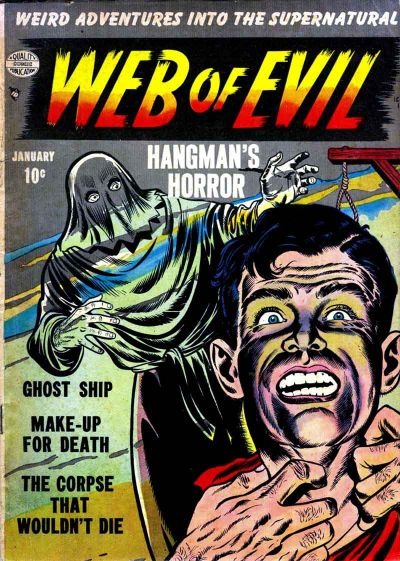
Web of Evil was a horror comic published by Quality in the years immediately before the formation of the Comics Code Authority, and which ran 21 issues. The product was typical of the era: often shoddy artwork and simple, quick stories that emphasized grue and taboo, shock and suspense. The stories were often unsigned and the creators weren’t above lifting a plot from an old pulp magazine from time to time.
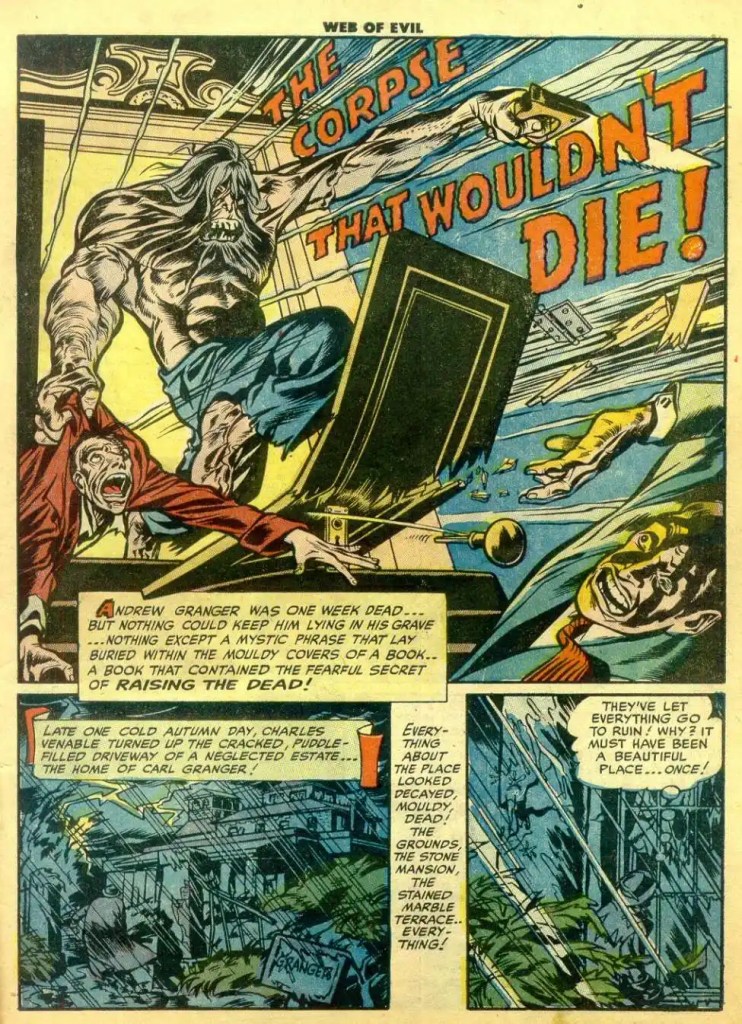
“The Corpse That Wouldn’t Die!” in Web of Evil #2 (Jan 1953) by artist Jack Cole is very clearly based on “The Return of the Sorcerer.” The names were changed to hide the plagiarism, and the unnamed Necronomicon is in Sanskrit rather than Arabic, but the essentials of the story are clearly recognizable. It may no longer be a Mythos story, but for all that it has a distinct charm for those that recognize that Cole is, at least, lifting from the best.
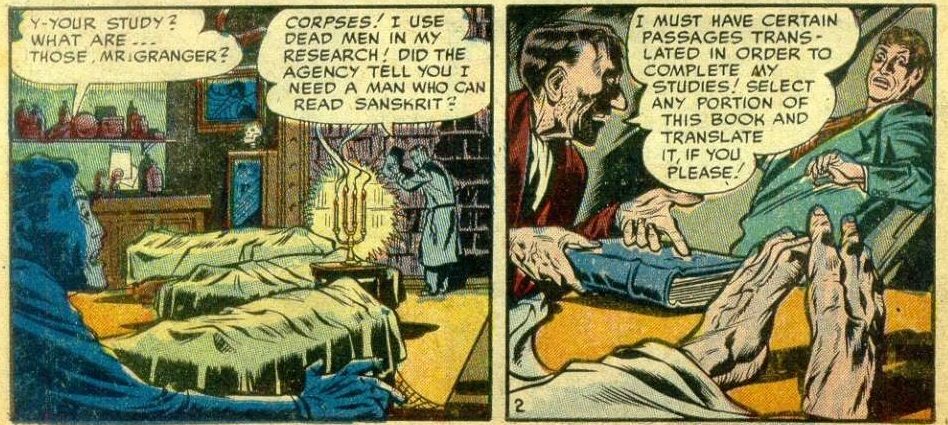
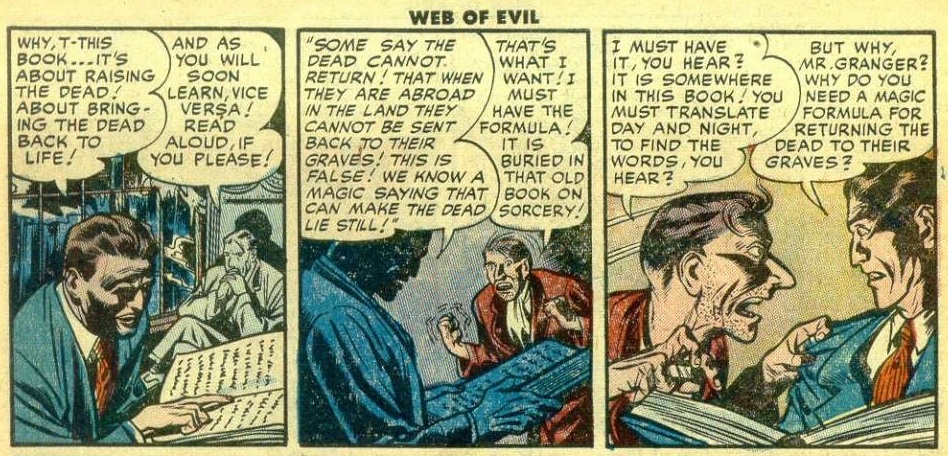
At six pages, the action moves fast—and in almost every panel, Cole tries to add some dramatic element of lighting or motion to capture the eye or set the tone, which often leads to near-comical exaggeration. Though there is not so much grue as there might have been: after all the corpse of the deceased sorcerer is still intact when it returns from the grave.
Lifting stories from pulp writers was not unusual in the 50s, and “The Corpse That Wouldn’t Die!” sits neatly among the Pre-Code Lovecraftian Horror Comics. The tale has been reprinted a number of times, including a version in Tales of Voodoo vol. 5, no. 2 (Mar 1972), where the art was reworked by Oscar Fraga and the result retitled “The Deadly Corpse” (sample pages below). Fraga’s rework updates the art to match the sensibilities of Eerie Publications in the 70s, but doesn’t add anything new to the story itself.
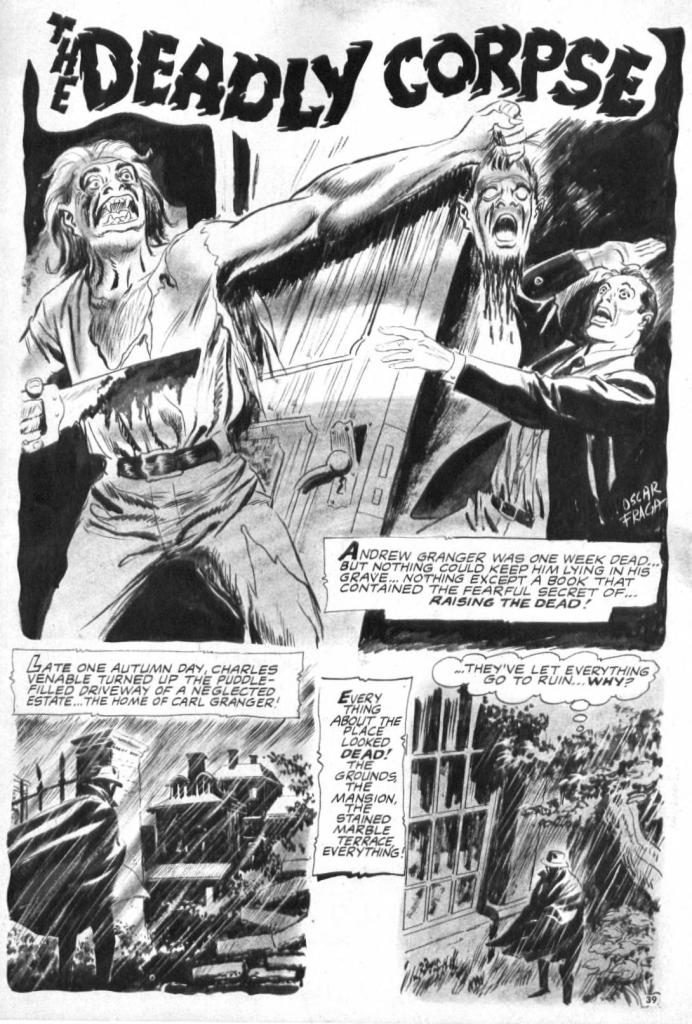
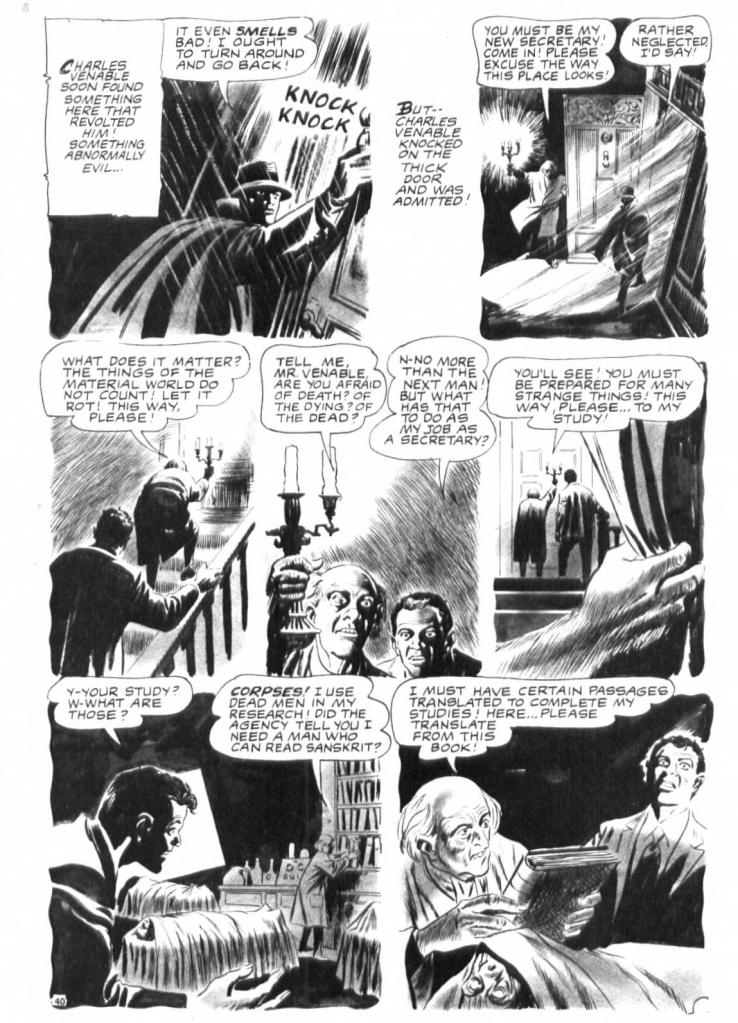
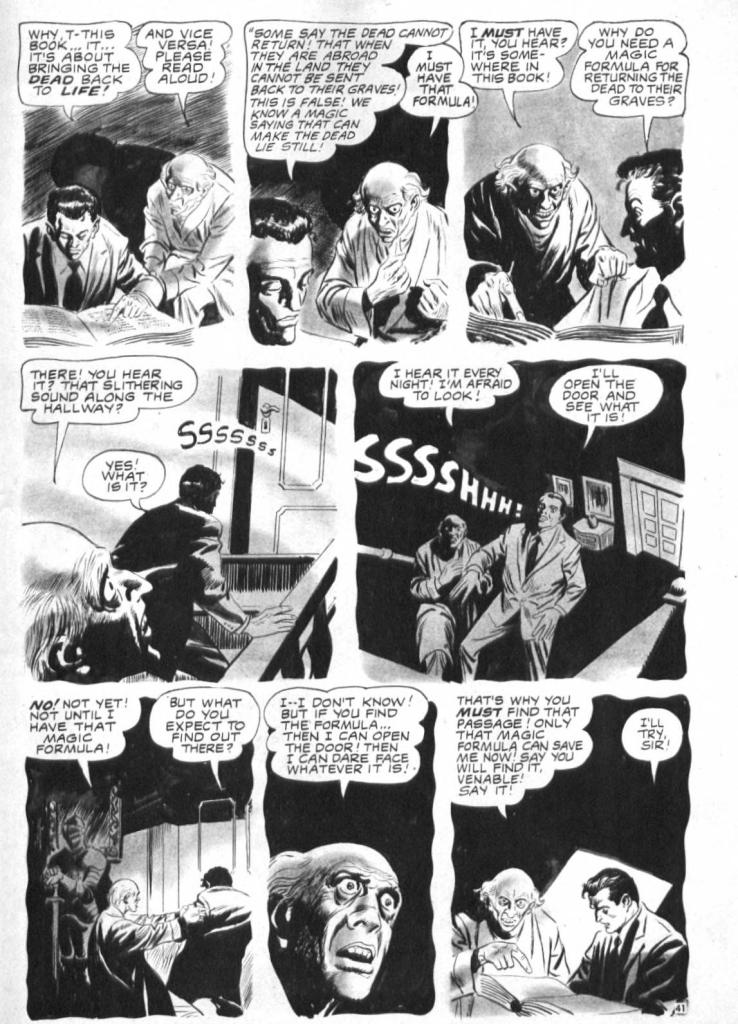
The original Web of Evil version can be read for free at Comic Book Plus.
Bobby Derie is the author of Weird Talers: Essays on Robert E. Howard and Others and Sex and the Cthulhu Mythos.
Deep Cuts in a Lovecraftian Vein uses Amazon Associate links. As an Amazon Associate I earn from qualifying purchases.
 Deep Cuts in a Lovecraftian Vein