I repeat to you, gentlemen, that your inquisition is fruitless. Detain me here forever if you will; confine or execute me if you must have a victim to propitiate the illusion you call justice; but I can say no more than I have said already. Everything that I can remember, I have told with perfect candour. Nothing has been distorted or concealed, and if anything remains vague, it is only because of the dark cloud which has come over my mind—that cloud and the nebulous nature of the horrors which brought it upon me.
—H. P. Lovecraft, “The Statement of Randolph Carter” (1920)
The Lovecraft Mythos was written in a particular cultural syntax. H. P. Lovecraft never tells the reader, for example, that the characters in “The Statement of Randolph Carter” are white. Caucasian heterosexual male was the default state for pulp fiction, and for much of the popular fiction of the 20th century. Once a writer or artist realizes that this is the framework in which the Mythos was set during the time of Lovecraft and his contemporaries, it is easier to imagine how those same stories might look differently within a different context. So it is that adaptation can often remain relatively faithful to the original story in term of plot, characters, narrative, and dialogue, and yet add to the story by providing a different context which changes how the story is read and understood.
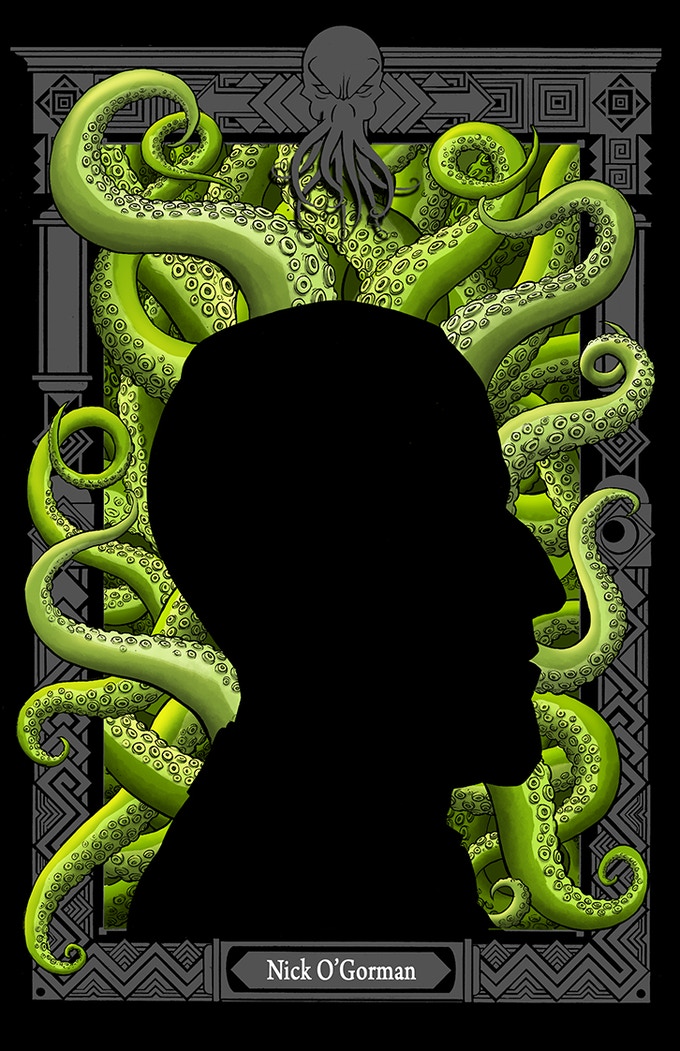
In comic books, two examples of this kind of adaptation are Nick O’Gorman’s HPL 1920 (2020) and Tales of the Cthulhuverse #1-3 (2020, Mythx Media). Both are indie horror comics that adapt three stories from H. P. Lovecraft—O’Gorman was specifically adapting stories from 1920, to be published on their centenary, while Tales of the Cthulhuverse aimed for more of an update on the classic Lovecraft tales by setting them in the 21st century. In both cases, the authors remained very faithful overall to the original story—but in both cases simple, subtle changes to presentation can drastically affect how the story is read and understood.
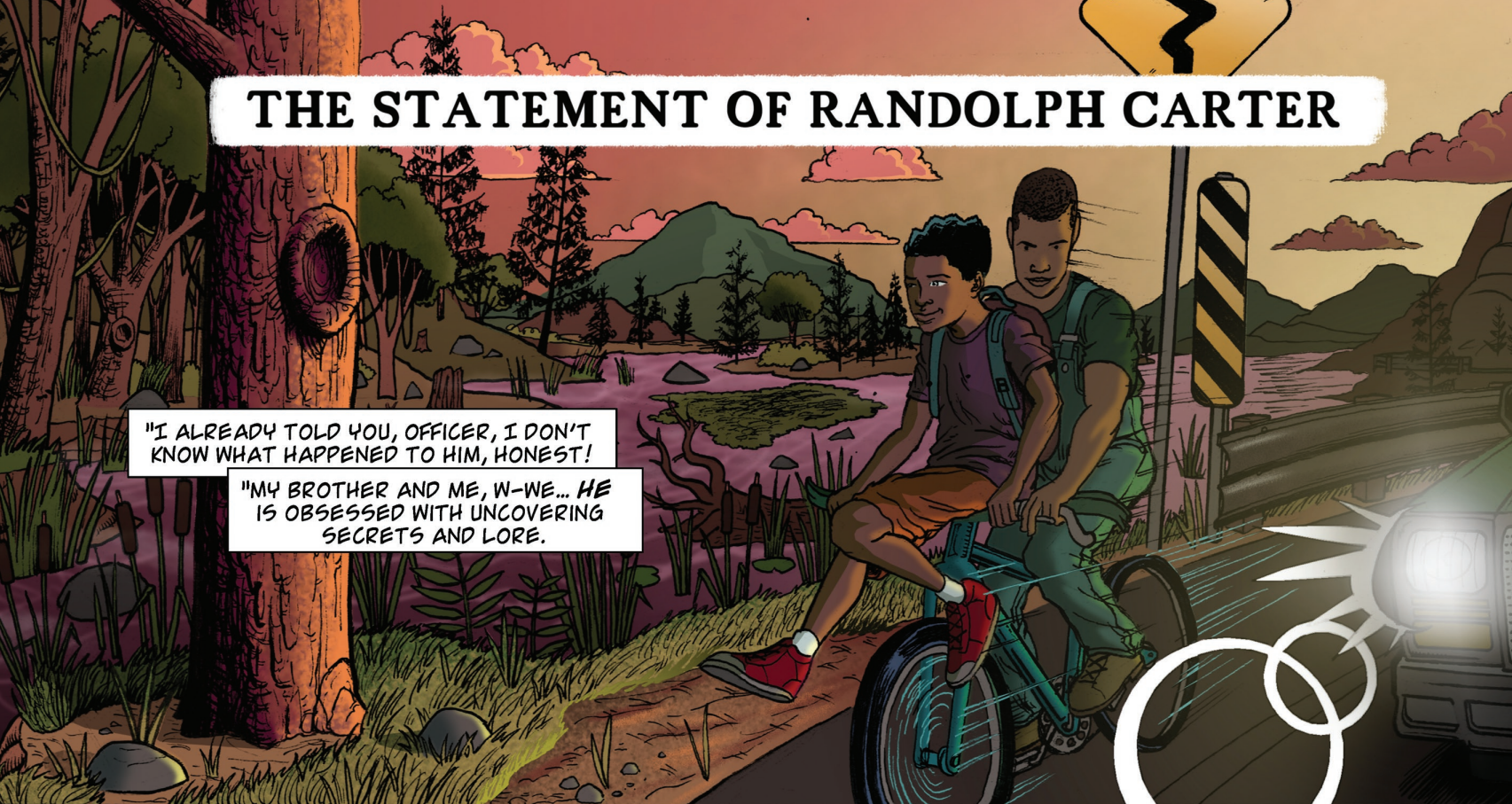
HPL 1920 adapts “The Statement of Randolph Carter”—except now Randolph Carter isn’t an older white male, he’s an African-American teenager. This puts an entirely different perspective on talking with the police in any contemporary American context, and yet it doesn’t require any substantial change to how the story works—two people, searchers after horror, go into a graveyard and one descends while the other waits behind. The basic idea of “The Statement of Randolph Carter” is not particular to any particular race or culture; curiosity and breaking taboos are universal human traits. What changes the story is how we receive it when the person relating it is someone other than “the default”—African-American teenagers are subject to systemic bias by the justice system in the United States, which adds a layer of tension to the story…and O’Gorman plays with that, at least a little bit:
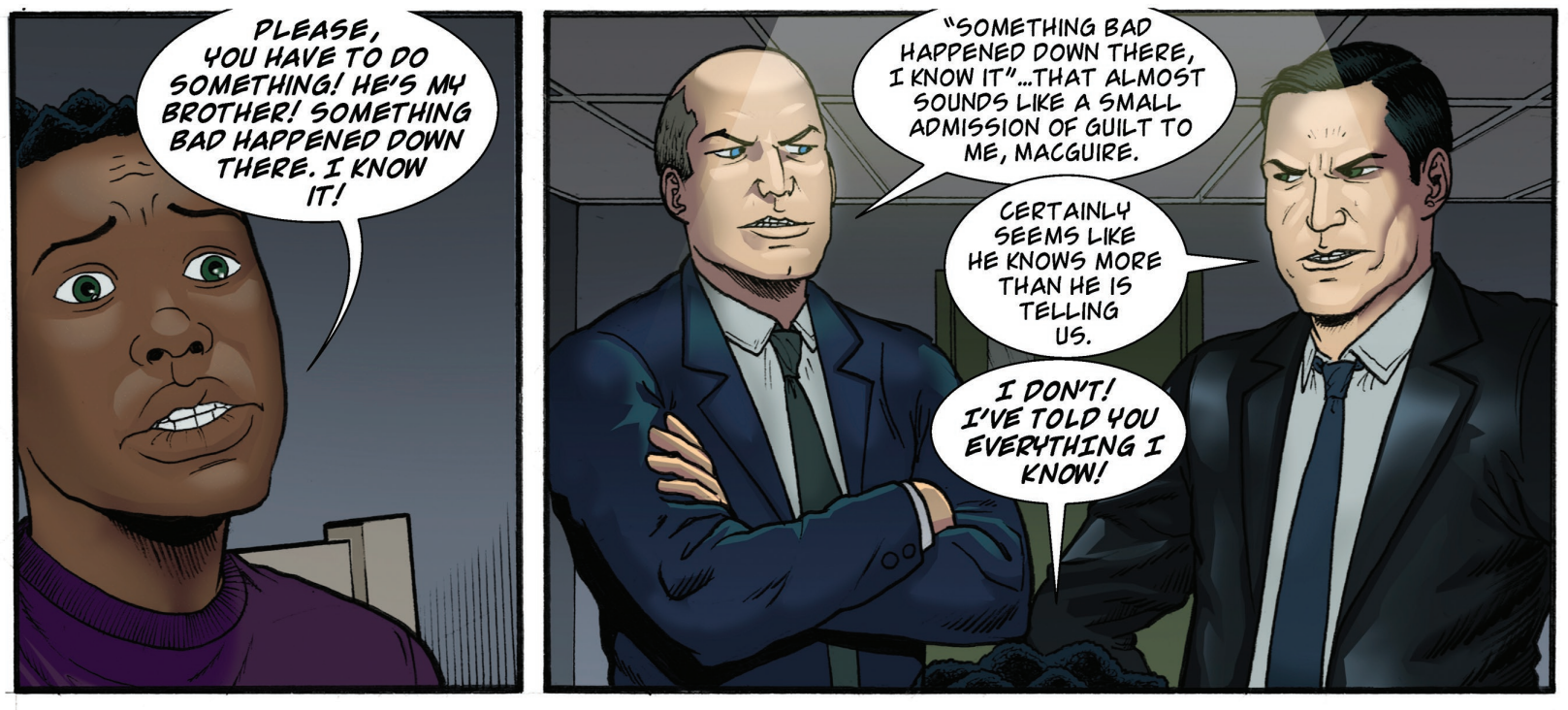
Does a white male Randolph Carter in this exact same situation affect the reader in the same way—or is there a part of the story unspoken here, just in these two panels, because people of today can fill in the unwritten details? How would this scene have played out differently if it wasn’t two white cops? We can ask these questions because we’ve stepped outside of the cultural syntax which Lovecraft was writing in…and there are more possibilities to explore the Lovecraft Mythos than just changing up race.
It is true that I have sent six bullets through the head of my best friend, and yet I hope to shew by this statement that I am not his murderer. At first I shall be called a madman—madder than the man I shot in his cell at the Arkham Sanitarium.
—H. P. Lovecraft, “The Thing on the Doorstep”

Where HPL 1920 changes the race of the principal characters, Tales of the Cthulhuverse #1 changes the gender. Daniel Upton becomes Danielle, Edward Derby becomes Eve, Asenath Waite becomes Asa—there are a few other changes, since the setting is now contemporary Massachusetts (2020s) and the Danielle & Eve are college roommates of a similar age and unmarried; the plot is condensed down considerably—but the main change is simply a what if scenario:
How would “The Thing on the Doorstep” have changed if the genders had been reversed?
As with “The Statement of Randolph Carter” and HPL 1920, the initial response would be: not by much. Lovecraft’s original story already involves gender change due to body-swapping; in a literary shell game, it is largely irrelevant what the writer uses for shells, as long as the same relationships are in place. So it is in Tales of the Cthulhuverse #1, where much the same events as Lovecraft’s story play out despite changing the genders of the main characters. If that was all there was too it, the adaptation would be boring.

Lovecraft’s frame for “The Thing on the Doorstep” is minimal: it’s a statement, but unlike “The Statement of Randolph Carter” it’s not to any particular party. Daniel Upton isn’t explicitly talking to the police; Danielle Upton in Tales of the Cthulhuverse #1 is. So like HPL 1920, there’s a specific dynamic of interaction being invoked—the police procedural dynamic, only this time a little more sympathetic. After all, Danielle Upton is a white woman…and so was Eve Derby.
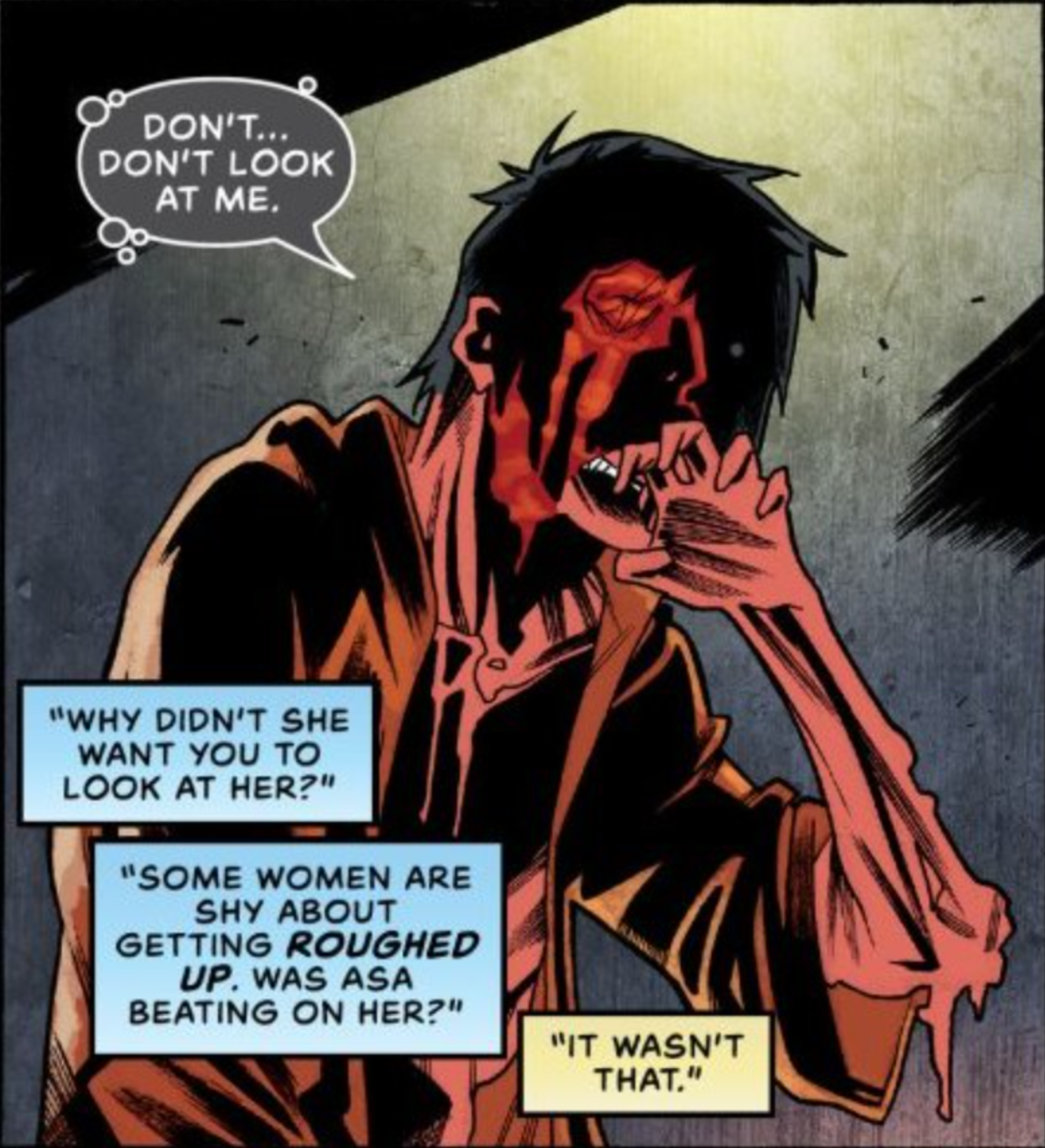
Domestic violence is not usually the first thing that springs to mind when reading Lovecraft’s “The Thing on the Doorstep”—not because men aren’t subject to domestic violence and abuse, but because the audience is generally not used to thinking about his marriage in that context. Because Daniel Upton wasn’t talking to the police, they weren’t trying to fit two dead bodies and a bad romantic relationship into a context they understood in Lovecraft’s narrative. Change the genders, though, and suddenly this becomes a much more logical leap for the cops to make…and maybe another one.
Daniel Upton has a weird angle in Lovecraft’s “The Thing on the Doorstep.” He is Edward Derby’s closest male friend, and Derby then marries Asenath, so Derby is caught between Daniel and Asenath. It isn’t explicitly a lover’s triangle because there are no indications that Daniel is homosexual (and if he is, being married and with a son indicates he’s at least in the closet), but the close relationships between men in some of Lovecraft’s stories have inspired homosexual interpretations of those stories (as explored in depth in Sex and the Cthulhu Mythos).
The exact same dynamic still applies in the Tales of the Cthulhuverse adaptation, and Zee Romero plays it as straight as can be (no pun intended)—there’s no explicit idea given that Danielle Upton is a lesbian or in love with Eve Derby in any kind of romantic sense. The story can be read as a perfectly platonic tale of shooting the bastard that stole the body of your best friend. That said, there’s also definitely enough subtext here to read it as a genuine lover’s triangle too—unlike Lovecraft, who gave Daniel a wife and baby to at least imply a heterosexual relationship, Romero doesn’t give Danielle any romantic interests at all. It is definitely an interesting way to re-imagine Lovecraft’s story…and that’s before the final revelations come out.
Ultimately, HPL 1920 and Tales of the Cthulhuverse are two parallel approaches with the same aim: contemporary writers and artists seeking to remain faithful to the core of Lovecraft’s narratives while also finding new things to say about those narratives in the way they present them. By and large they both succeed. If there’s a flaw in these comics, it’s not the approach, but sometimes the execution. Indie comics can’t always afford the most polished art, and it shows—the production values aren’t bad on either of these, but for Tales of the Cthulhuverse in particular the lack of detail in the gore and nudity feels like a misstep, or at least a missed opportunity. O’Gorman and Cicognola definitely know their material, because there are little allusions to the Gate sigil from the Simon Necronomicon and August Derleth’s version of the Elder Sign as popularized by the Call of Cthulhu Roleplaying Game, but a lot more could have been done with these same scripts if Jacen Burrows, Kelly Jones, or Laci had been handling the material.
HPL 1920 was written, drawn, and colored by Nick O’Gorman, and funded through Kickstarter. Copies of the comic are available through his Etsy shop.
Tales of the Cthulhuverse #1 was written by Zee Romero, pencils and inks by Luca Cicognola, colored by Sean Burres, with a cover by Jeff Chapman, and published by Mythx Media. They are currently available for purchase on Comixology.
Bobby Derie is the author of Weird Talers: Essays on Robert E. Howard & Others (2019) and Sex and the Cthulhu Mythos (2014).
 Deep Cuts in a Lovecraftian Vein