This is Cthulhu Mythos fiction unlike any you have read before.
—Darrel Schweitzer, introduction to
The Queen of K’n-Yan xiii
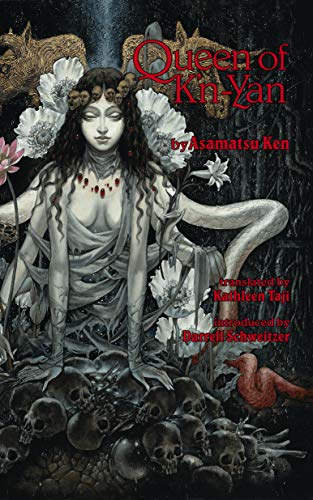
The Queen of K’n-yan (2008,
Kurodahan Press) by Asamatsu Ken (朝松健) is the English-language translation of his 1993 novel 崑央の女王 (K’n-Yan no Joō); the translator was Kathleen Taji.
There is a world of Mythos fiction beyond the English language, and it depends on translation. The original works of Lovecraft and his contemporaries, their ideas, concepts, and language, have to be translated from their original English into the new language. This process is not automatic or uniform, not every word that Lovecraft & co. wrote has been translated or published; many of the letters especially have not yet made the jump into other languages, and may never. Imagine what it takes to read Lovecraft, filtered through someone else trying to capture his style and language, to twist the language to translate not just the literal words but the ideas and weird names which might not transliterate easily or cleanly.
Then imagine translating an original Mythos novel back into English. How much survives? How much is recognizable? What new cultural syntax is picked up?
It is more of an issue than you might think, because there is a cultural syntax to the Cthulhu Mythos already; the stories, and the secondary literature of pastiches, sequels, prequels, etc. are highly intertextual, sometimes metatextual—and not everything that is written in English gets translated. The result is that some ideas which are largely outmoded in current English-language Mythos fiction may be retained longer in non-English-language Mythos fiction; and of course some new bits are often added which English language Mythos fans have never seen before.
Kathleen Taji’s translation of The Queen of K’n-Yan is a good example. As a novel, Asamatsu Ken’s work is definitely atypical for Mythos fare: the setting is a contemporary Japan and WW2-era China, the massive, secured corporate arcology and overall plot are something out of a cyberpunk novel, echoes of The Thing (1982), Aliens (1986), and Gunhead (1989). Archaeological mystery and psychic flashbacks to a Japanese war camp conducting medical experiments on Chinese civilians give way to a survival horror/body horror aesthetic somewhat foreshadowing works like Parasite Eve (1995) and Resident Evil (1996).
It isn’t too much of a spoiler to let you know that Asamatsu Ken’s
The Queen of K’n-yan involves the discovery of a mummy from that same underground realm, but excavated in China […]
—Darrel Schweitzer, introduction to
The Queen of K’n-Yan ix
Asamatsu Ken takes the idea of the people of K’n-Yan and expands them to a global scale, parts of their underground realm running throughout Asia, and ties them into existing history and mythology:
Before the advent of humanity, the world was divided and ruled by several races of intelligent beings. That’s to say, the dragon race, the denizens of Zhùróng – the fire deity – the earth wolf tribes, the wind bull people, and the star-spawn – as can be deduced, they symbolize the five elements of water, fire, earth, wood, and metal. The human descendants of the dragon race are the Han, the human descendants of the earth wolf are the Manchu, and the human descendants of the wind bull people are the Tibetans […] The denizens of Zhùróng, the symbol of fire, rose in revolt against the Yellow Emperor and were sealed underground in retribution. The underground cavern where they were imprisoned is called K’n-Yan. And the star-spawn were banished to the distant heavens.
—Asamatsu Ken, trans. Kathleen Taji, The Queen of K’n-Yan 85
For English-language Mythos fans, this might be sounding suspiciously like the early “elemental” theory of the Cthulhu Mythos first postulated by August Derleth in “The Return of Hastur” (1939). Derleth designated various entities according to the four elements of the Western tradition of Hermetic occultism (Cthulhu, water; Tsathoggua, earth; Hastur, air; and creating Cthugha as the missing “fire elemental”). Asamatsu Ken is certainly paying homage to this idea, even if he is taking it in a different direction:
What appeared were strange sentences containing a mix of Chinese characters, cursive Japanese hiragana, and roman letters. They read –
“Beseech the god of the western seas, THCLH, with sacred reverence.
Beseech the forefather of heat and flame, THGHC, with sacred reverence.
Beseech anon our birth lord, ZTHRNG, with sacred reverence.
The infant princess, through the black disease
When reborn as Queen
Even death will not die…”
—Asamatsu Ken, trans. Kathleen Taji, The Queen of K’n-Yan 112
Zhùróng is a complicated personage, but often considered a god of fire; THGHC is a reference to Derleth’s Cthugha, THCLH to Cthulhu. The complexities of Japanese, Chinese, and Japanese languages coming into play here were probably difficult to translate, but readers can recall how in “The Mound” Cthulhu was represented as “Tulu” and get the vague idea of how Japanese readers might have been piecing together clues.
As an aside, applying the five-element approach to the Mythos is not unique to Asamatsu Ken’s work either. Shirow Masamune in his manga
Orion (仙術超攻殻オリオン) has a Cthulhu-esque entity arise from an occult effort involving an unbalanced water-element.
The discussion of “races” in the context of Mythos fiction is more complicated, and
not unique to this work. Perhaps for the best, Asamatsu Ken doesn’t delve too deep into the geopolitics or genetics of it all. The main characters are left piecing together bits of history so old that they’ve faded into myth, trying to sort out bits of truth from the old legends.
As the story enters its penultimate phase, the survival horror aspect comes to the fore. A weird game of cat-and-mouse occurs between Morishita Anri (the novel’s protagonist, Japanese), Dr. Li (the novel’s secondary antagonist, Chinese), and the Queen of K’n-Yan, who a la The Thing has taken on the form of a human woman—hinted to possibly be either Morishita or Li. Reanimated body parts are combined together in was reminiscent of Bride of Re-animator (1990):
An ankle with eyes. A left hand with three lips. Orifices with fangs. A large intestine with wings on its back. Thirty upper arms congealed together, spherical in shape. A thigh with a face, knees with thin hands, and ankles growing out of shins. Eyeballs with tentacles, and most horrendous of all, hordes of internal organs, squirming and groping.
—Asamatsu Ken, trans. Kathleen Taji, The Queen of K’n-Yan 175
Strange as it may be with all these diverse elements, the novel does actually come together at the end, in a fairly satisfying way. Not every mystery is explained, nor do they need to be; background noise about large sinkholes in China where the Princess of K’n-Yan was discovered, outbreaks of disease, and rising heat suggest what is about to come, but that is a horror for the future beyond the last page in the novel.
For all that works, at least within the internal rationale of the novel, there are a few things that don’t translate well. There are elements of style and plot which simply don’t come across to English-language readers as nicely as they could, and it is difficult (not having read, or able to read, the original) to tell whether this is a quirk of the translation being too literal or simply a faithful reproduction of Asamatsu’s style which doesn’t quite click.
Stylistically, the chunks of raw exposition embedded in the narrative stand out as exactly that; the Mythos references when they come aren’t exactly subtle. From the standpoint of characters, most are fairly weakly developed except for the protagonist Morishita Anri and the mysterious Dr. Li…and even then, there is a relatively late development in the novel which comes almost out of nowhere:
Something was trying to take shape. Akiyama Haruka’s face appeared in midair – three times larger than the actual face. This was followed by the appearance of a neck, shoulders, lithe arms, and lastly, shapely breasts. Akiyama winked at Anri, and her pupils sent an insinuating and lascivious look her way.
“Hold me, please…pretty please.”
On hearing her words, Andri felt like retching.
The queen knows?! Somehow she’s found out that I’m gay.
—Asamatsu Ken, trans. Kathleen Taji, The Queen of K’n-Yan 199
The issue of Mosihita Anri’s homosexuality, for about the first hundred and ninety-eight pages up until this point, is so low-key as to be completely absent. Going back to re-read the novel, there are only extremely vague hints which maybe point to that if the reader already knows she’s a lesbian; this feels like a character development which was either not communicated well in the original or which was so subtle that the translation didn’t quite convey it. Which is not in any way a dig at Kathleen Taji, only an exemplar of how difficult the job of translation is. How do you communicate someone’s sexuality in Japanese culture when they do not have any immediate love interest? Were there cues that would have made sense to a Japanese audience that an English reader would miss?
These are the kind of questions that consume the reader in The Queen of K’n-Yan. It is an effective Mythos novel; Asamatsu Ken knows what he is doing. Yet it is undoubtedly a very different Mythos novel from August Derleth’s The Lurker at the Threshold (1945) or Robert Bloch’s Strange Eons (1978). The setting and the syntax are in line with Japanese horror of the late 1980s and early 1990s, the Mythos translated, adapted, and integrated into a post-WW2 world with computers, genetic engineering, wuxing, and the People’s Liberation Army.
Perhaps most importantly, The Queen of K’n-Yan is an example of what translation offers to the English-speaking audience: something different, a new way to think about the old Mythos. For those of us who cannot read Japanese, it is only through translation that we can approach these works—even if, like Wilbur Whateley in “The Dunwich Horror,” thumbing through the English translation of the Necronomicon, we know that there is something missing from the original.
 (2014)
 Deep Cuts in a Lovecraftian Vein