
The writing life of Catherine Lucille Moore (24 Jan 1911 – 4 Apr 1987) can be roughly divided into five periods, dominated by major life events:
- C. L. Moore Before The Pulps (1911-1930): Her juvenilia and early amateur work that ran from her childhood through her second year at Indiana University, when she had to withdraw and begin working to support her family.
- Early Career (1933-1940): C. L. Moore’s first professional publication, from her first appearance in Weird Tales through her marriage with Henry Kuttner in 1940.
- Professional Writer (1940-1958): C. L. Moore and Kuttner as a prolific writing team, for pulps, novels, fanzines, and television, all through World War II and afterward into Kuttner’s teaching career, only ending with his death in 1958.
- Late Career (1958-1963): C. L. Moore’s late career was dominated by scriptwriting for television. It ended with her marriage to Thomas Reggie in 1963.
- Twilight years (1963-1987): With C. L. Moore’s second marriage and her early onset of Alzheimer’s disease, output practically ceased. The period saw the consolidation and republication of her work, as well as interviews and biographical materials. It ended with her death.
Of all the periods of Moore’s work, her early career gets the most attention. It is dominated by her output at Weird Tales, and to a lesser extent at Astounding, and follows her transition from weird fiction to the characteristic fantasy and science fiction that marked Unknown in the 1940s. This retrospective takes a look at what C. L. Moore was writing and publishing, and why and how the events of that period shaped the writer she was—and would become.
1933
[…] it was a rainy afternoon in the middle of the Depression, I had nothing to do—but I really should’ve looked busy because jobs were hard to get! I didn’t want to appear that I wasn’t earning my daily keep! To take up time, I was practicing things on the typewriter to improve my speed—things like ‘the quick brown fox jumped over the lazy dog.” That got boring, so I began to write bits of poetry I remembered from my college courses…in particular, I was quoting a poem called “The Haystack in the Flood.” […] The poem was about a woman in 13th century France who is being pursued by enemies of some kind…she was running across a field and these men were after her. I had misquoted a line in my mind, as well as on the typewriter, and referred to a “Red, running figure.” […] At the time I thought, “Ha! A red, running figure! Why is she running? Who is she running from and where is she running to? What’s going to happen to her? Strangely enough, I just swung from that line of poetry into the opening of “Shambleau.”
—“Interview: C. L. Moore Talks To Chacal” in Chacal #1 (1976), 26
The Great Depression had ended C. L. Moore’s attempt at college, and with it her opportunities to publish her stories. She worked as a secretary at the Fletcher Trust Company in Indianapolis, where her fiancé also worked as a teller. Her spare dimes and quarters went to issues of Amazing Stories, Wonder Stories, Astounding, and Weird Tales, and at last she mustered up the courage to submit a story unlike anything else on the stands. The effect on the fans was electric, the effect of the check for the story no less so on C. L. Moore—it was her first professional sale and publication. By the time “Shambleau” hit stands, there are indications she was already writing sequels:
I trust your revisions may make Mrs. Moore’s second story as striking and interesting as this one.
—H. P. Lovecraft to Farnsworth Wright, 21 Nov 1933, Letters to Woodburn Harris 86
Moore would, from her reading, be aware of the possibilities of a series character like Northwest Smith. Farnsworth Wright, editor of Weird Tales, was willing to work with new writers. So it is not surprising that following stories followed Smith’s adventures, with little continuity but often featuring the same vivid imagery and ideas that marked “Shambleau.”
- “Shambleau” (Weird Tales Nov 1933) by C. L. Moore
1934
I hope you will not be too much disappointed in the stories that follow. Perhaps, when you have read those appearing in the April and May issues, you will write again to tell me what you thought of them.
—C. L. Moore to R. H. Barlow, 8 Mar 1934, MSS. Brown Digital Repository
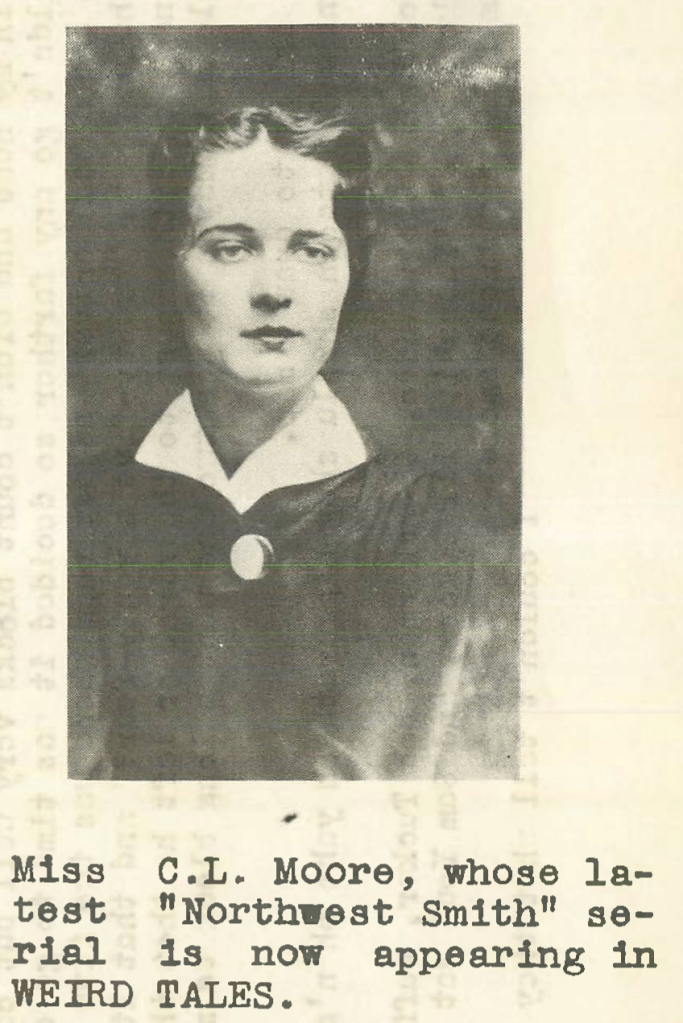
Both Farnsworth Wright and the fans of Weird Tales were pleased with Moore’s work, and 1934 became a busy year, with three further adventures of Northwest Smith appearing in quick succession ( “Black Thirst,” “Scarlet Dream,” and “Dust of the Gods”). Through Weird Tales, Moore also came in touch with pulp fans like R. H. Barlow and Forrest J. Ackerman. Her “secret” identity was swiftly revealed in the May 1934 issue of The Fantasy Fan, though many pulp readers would not learn this for years.
Yes, I do much more revising that I care about. Have to, tho it simply sickens me, and I hate everybody in sight while laboring away at the disgusting job. A story of mine which I’ve just sold to ASTOUNDING and which will appear in Oct. is really a third of one original N.W.Smith tale. I had that almost finished when I saw that it was two stories, and split it apart. Then the half I got to work on began to show amoeba-like tendencies toward division, and the third attempt resulted in THE BRIGHT ILLUSION, which I’ve sold, to Astounding. The other two nuclei are still simmering gently in the back of my mind, and may emerge some day.
—C. L. Moore to R. H. Barlow, 5 Jul 1934, MSS Brown Digital Repository
While it may have looked like Moore was selling everything she could write to Weird Tales, the truth was more complicated. Some stories didn’t work out, and Farnsworth Wright apparently rejected some stories and sent others back for revision. This was the unglamorous work of pulp writing, and Moore was learning the ropes of the trade, including rewriting stories to send to other magazines, which is how she splashed Astounding.
Near the end of the year, feeling that the Northwest Smith stories were growing stale, Moore tried another character on Farnsworth Wright: Jirel of Joiry. The character arose from some of Moore’s pre-pulp world-building, given a new life in Weird Tales:
Long, long ago I had thoughts of a belligerent dame who must have been her progenitor, and went so far as to begin a story which went something like this: “The noise of battle beating up around the walls of Arazon castle rang sweetly in the ears of Arazon’s warrior lady.” And I think it went no farther. So far as I know she stands ther eyet listening to the tumult of an eternal battle. Back to her Jirel of Joiry no doubt traces her ancestry.
—C. L. Moore, “An Autobiographical Sketch of C. L. Moore,” Echoes of Valor 2, 37-38
As with Northwest Smith, the fan response was extremely positive. More swiftly followed up “Black God’s Kiss” with a direct sequel, “Black God’s Shadow,” that was published before the end of the year.
- “Black Thirst” (Weird Tales Apr 1934) by C. L. Moore
- “Scarlet Dream” (Weird Tales May 1934) by C. L. Moore
- “Dust of the Gods” (Weird Tales Aug 1934) by C. L. Moore
- “Black God’s Kiss” (Weird Tales Oct 1934) by C. L. Moore
- “The Bright Illusion” (Astounding Oct 1934) by C. L. Moore
- “Black God’s Shadow” (Weird Tales Dec 1934) by C. L. Moore
1935
Now a fairly well-established author at Weird Tales, Moore began correspondence with other authors, including E. Hoffmann Price, Robert E. Howard, and H. P. Lovecraft. From the surviving correspondence, we can see that all of these individuals had their influence on Moore’s writing practice: Lovecraft’s considered criticism, Price’s practical pulp-writing advice, and Howard’s encouragement and sharing of his own swordswoman stories all entered into consideration.
From a publication viewpoint, 1935 was probably a letdown, Moore only sold and saw published four professional tales: two Northwest Smith yarns (“Julhi,” “The Cold Gray God”), including one with an illustration by Moore, and a Jirel story (“Jirel Meets Magic”) to Weird Tales, and another “thought-variant” story for Astounding (“Greater Glories”). Reading between the lines, the implication is that Wright was getting more selective about what he bought from Moore. For her own part, Moore’s interest in fandom and the pulp community was increasing, as marked by a collaboration with arch-fan Forrest J Ackerman (“Nymph of Darkness”) and taking part in a round-robin tale with A. Merritt, H. P. Lovecraft, Robert E. Howard, and Frank Belknap Long (“The Challenge from Beyond”) for Fantasy Magazine.
These were Moore’s first collaborations with other writers since childhood, and were, perhaps, important lessons in what worked and what didn’t. In “The Challenge from Beyond,” it was clear how each writer was working the parts on their own, often with drastic shifts in style and tone, not making a cohesive whole. With “Nymph of Darkness,” Moore was working from Ackerman’s ideas—but even if they shared the brainstorming, she was clearly doing all the actual work of writing.
- “Julhi” (Weird Tales Mar 1935) by C. L. Moore
- “Nymph of Darkness” (Fantasy Magazine Apr 1935) by C. L. Moore & Forrest J Ackerman
- “Jirel Meets Magic” (Weird Tales Jul 1935) by C. L. Moore
- “The Challenge from Beyond” (Fantasy Magazine Sep 1935) by C. L. Moore
- “Greater Glories” (Astounding Sep 1935) by C. L. Moore
- “The Cold Gray God” (Weird Tales Oct 1935) by C. L. Moore
1936
Glad you liked “The Dark Land”. I made the drawing a long time ago, and wrote the story so I could bring it in, with the addition of a cadaverous head and a swirl of vagueness.
—C. L. Moore to H. P. Lovecraft, 30 Jan 1936, Letters to C. L. Moore 108
The year started out well—the new issue of Weird Tales was on the stands with a Jirel story (“The Dark Land”), with a drawing by C. L. Moore to boot. The next month would see another Ackerman collaboration on a Northwest Smith tale (“Yvala”), and two more would be published by the end of the year (“Lost Paradise”, “Tree of Life”). Tragedy, however, would quickly mar the year.
On 13 February 1936, Moore’s fiancé (Herbert) Ernest Lewis died from a self-inflicted gunshot wound to the head; the newspapers presented it as an accident while cleaning his rifle, which was stored in the bank vault, Lewis being part of a shooting club that used a nearby range. Moore was desolate and took some weeks off work to mourn, traveling by bus with her mother to Florida. Lovecraft kept up a steady stream of letters to keep her mind occupied during the period of mourning. Only a few months later, on 11 June 1936, her friend Robert E. Howard took his own life with a self-inflicted gunshot wound to the head. Moore spread the news to Lovecraft, who spread it to others.
At this time, Moore was in contact with the literary agent Otis Adelbert Kline (former agent for Howard and Price), and was trying to expand her writing markets, but neither was quite to her tastes and apparently came to nothing.
My recent writings seem to have bogged down completely. In the last five months I have produced one trashy horror which Kline ages ago asked me to rewrite, thinking he could sell it in a revised form and which I haven’t touched since, and a drippy love-story which languished away and ceased half-finished some six weeks ago. The weather is partly responsible, but I must admit a sort of mental vacuum which shows no promise of change. I devote seven and a half hours daily to my secretarial duties and spend the rest of the time sewing desultorily, knitting a very handsome afg[h]an, attending about three movies weekly, induling in endless gossip with friends. How long this cloistered and nun-like seclusion will continue I wish I knew. I suspect that if my brain were functioning I would find myself bored to a horrible death, and rather dread the awakening. A few non-commercial attempts which I mentioned I should be very happy to have you read if I could ever get them finished to my satisfaction. I am writing and rewriting them over and over, in moments of comparative consciousness, and am far from satisfied even yet. However, to quote Mr. Penner once again, There’ll come a day.
—C. L. Moore to H. P. Lovecraft, 24 Jun 1936, Letters to C. L. Moore 143
She did manage a sale to Astounding (“Tryst in Time”), which may have begun as a rejected Northwest Smith yarn, Wright apparently still being more critical about which stories he would accept.
- “The Dark Land” (Weird Tales Jan 1936) by C. L. Moore
- “Yvala” (Weird Tales Feb 1936) by C. L. Moore & Forrest J Ackerman
- “Lost Paradise” (Weird Tales Jul 1936) by C. L. Moore
- “Tree of Life” (Weird Tales Oct 1936) by C. L. Moore
- “Tryst in Time” (Astounding Dec 1936) by C. L. Moore
1937
Glad to hear that you & C L M are collaborating on a dual masterpiece. The result certainly ought to be powerful enough! Staging a meeting betwixt the mediaeval Jirel & the future Northwest Smith will call for some of your most adroit time-juggling—but with two keen imaginations at work no obstacle is likely to be unsurmountable. Good luck to both of you aesthetically & financially!
—H. P. Lovecraft to Henry Kuttner, 8 Feb 1937, Letters to C. L. Moore 262
In May 1936, Lovecraft had introduced Moore and Kuttner through mail. Their correspondence developed, and eventually led to collaboration. At this point, one of our best sources on C. L. Moore (her letters with Lovecraft) dries up, due to Lovecraft’s death on 15 March 1937. So too, Moore’s publications in the pulps dry up. She was, very probably, busy with work, caring for her family, and managing a burgeoning romance with Kuttner.
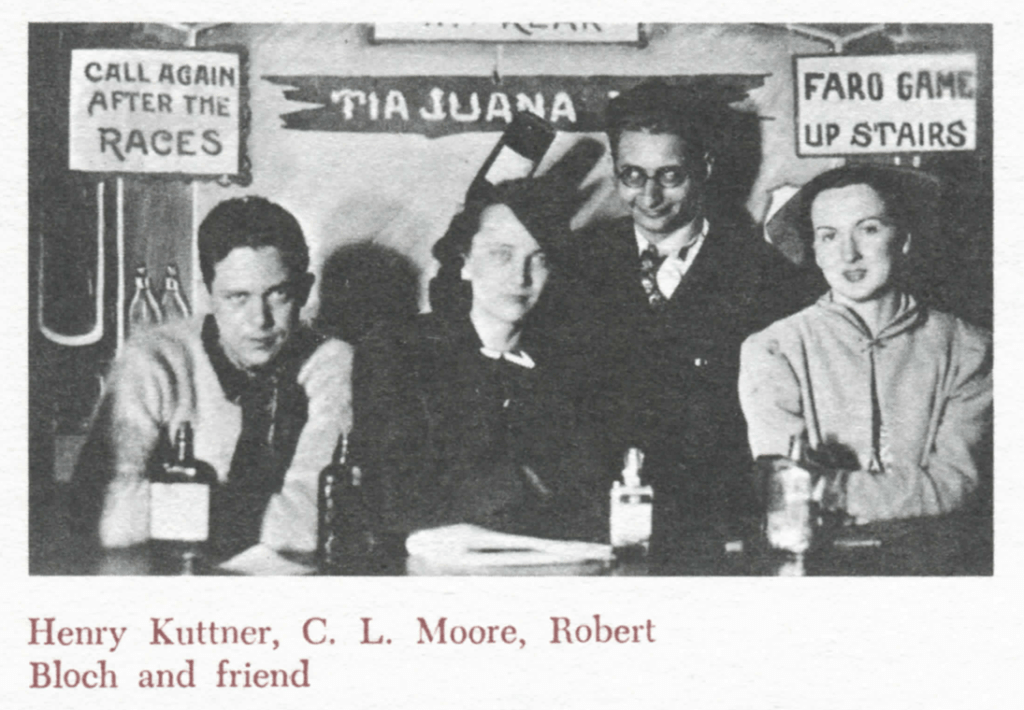
It was in 1937 that Moore made her first trip to Los Angeles, California, where she and a friend met Kuttner in person—and another Kuttner collaborator, Robert Bloch (Fanscient #8).
CA: You met Mr. Kuttner, then, through your writing?
MOORE: Yes. We corresponded for a while, and then I came out with a friend for my first visit to California and we met. He moved to New York shortly after that. Then He made several trips to Indianapolis, where I was living, and eventually he persuaded me that it would be a good idea to get married. He was perfectly right. We had a fine marriage.
—Interview with C. L. Moore in Contemporary Authors vol. 104, 326
- “Quest of the Starstone” (Weird Tales Nov 1937) by C. L. Moore & Henry Kuttner
1938
No, I haven’t yet beaten my typewriter into knitting needles—I have beaten it much more lucratively in the process of hammering out a tale for Astounding in my usual vein, to be known as GREATER THAN GODS and to be published—sometime. They just accepted it the other day. And a new story about a maiden—well, a female—named Jirel of Joiry has just gone off to Wright in the hope that he realizes as well as I do how badly he needs it.
[…] I look forward to LEAVES, not for Werewoman’s sake but for the pleasure I expect to derive from reading it.
—C. L. Moore to R. H. Barlow, 13 Jul 1938
Moore appears to have done little writing in 1938; or at least, nothing that was published. “Werewoman” was an early, rejected Northwest Smith story. It was published, finally, in her friend R. H. Barlow’s amateur journal Leaves. E. Hoffmann Price’s memoir Book of the Dead also recalls Moore traveled to California in 1938 (262).
We can presume that she hadn’t given up writing, but was probably still busy with her job, Henry Kuttner, and possibly her mother’s growing illness.
- “Werewoman” (Leaves 1938) by C. L. Moore
1939
Farnsworth Wright was not yet out as editor at Weird Tales, but the magazine had been sold and relocated to New York. Moore’s last contributions to the Unique Magazine appeared in 1939: her final Jirel of Joiry tale (“Hellsgarde”), and an expurgated version of a Northwest Smith tale previously published in a fanzine (“Nymph of Darkness”).
If Moore’s relationship with Weird Tales was coming to an end, however, she was pursuing new opportunities with other magazines (“Miracle in Three Dimensions,” “Greater Than Gods”). These stories mark a definite shift in style, possibly due to unspoken collaboration with Henry Kuttner—or at least, from his influence. She was moving into the lighter style of science fiction that would become a hallmark of their work in the 1940s.
Maude Moore, mother of Catherine, died of colon cancer on 8 Oct 1939.
- “Hellsgarde” (Weird Tales Apr 1939) by C. L. Moore
- “Miracle in Three Dimensions” (Strange Stories Apr 1939) by C. L. Moore
- “Greater Than Gods” (Astounding Jul 1939) by C. L. Moore
- “Nymph of Darkness” [expurgated] (Weird Tales Dec 1939) by C. L. Moore & Forrest J Ackerman
1940
Moore’s job at the Fletcher Trust Company was implicitly dependent on her remaining single; in the sexist environment at the time, married women were expected to be supported by their husbands. In 1940, Moore took a tremendous plunge—she left her job, left Indianapolis, and moved to New York City, where on 7 June 1940 she married Henry Kuttner. It was the start of a new chapter in her life and her professional career, one where the “C. L. Moore” byline largely disappeared, as she and her husband wrote almost everything together, but published largely under his name or shared pseudonyms.
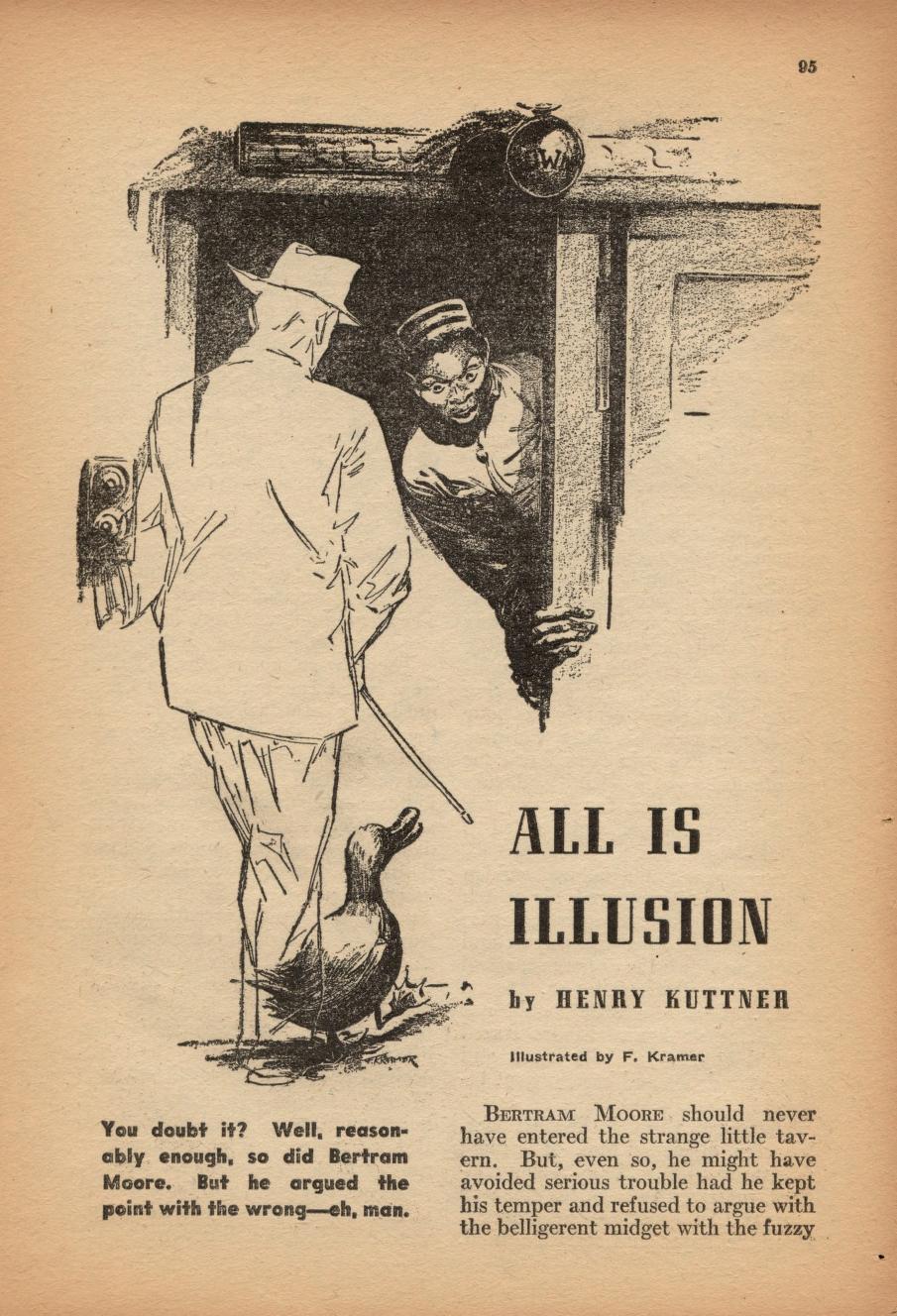
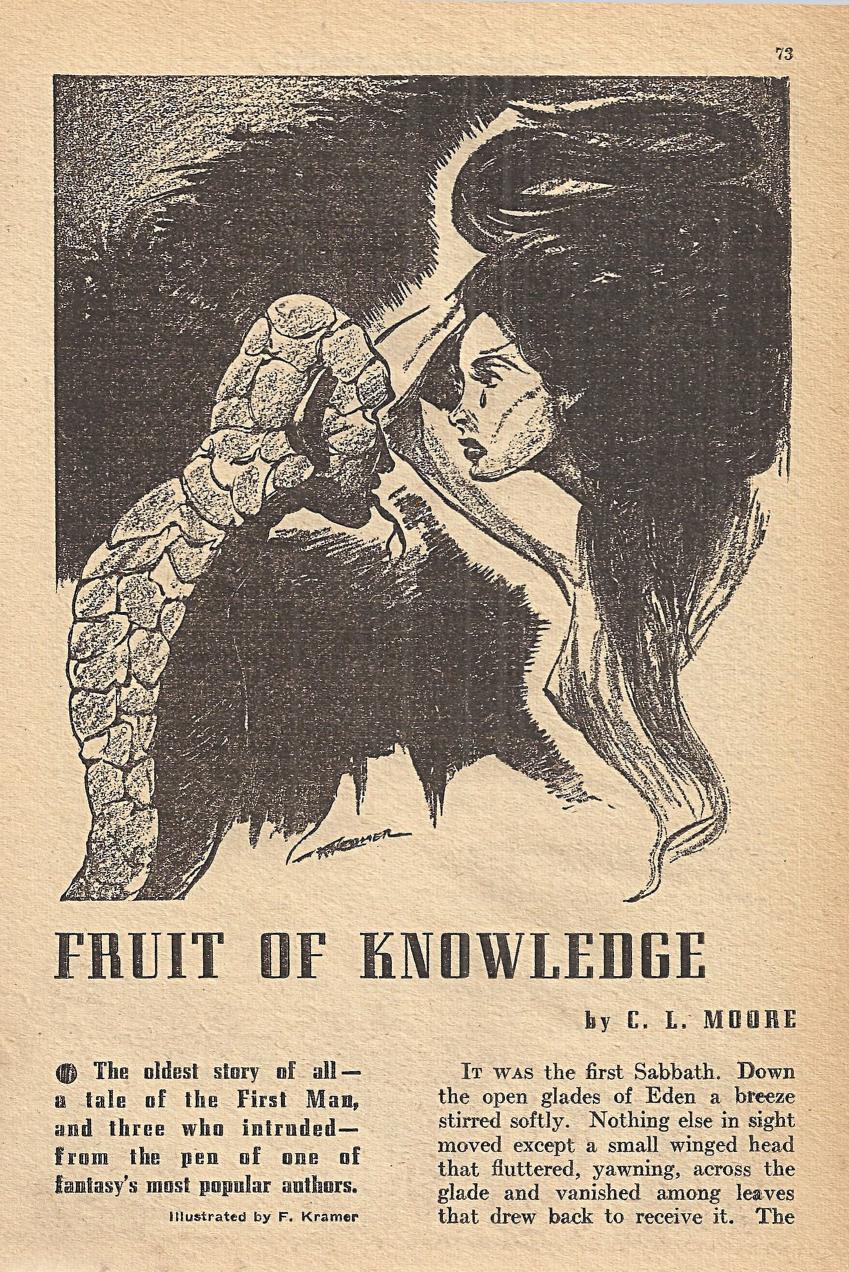
The final Northwest Smith tale (“Song in a Minor Key”) appeared in the fanzines Scienti-Snaps; Farnsworth Wright was no longer editor of Weird Tales, and would soon be dead, and the new editor Dorothy McIlwraith had no relationship with Moore and was moving the magazine in a different direction from interplanetary stories or sword & sorcery. Instead, Moore and Kuttner turned their attention to a new fantasy magazine, Unknown, which pointed the way to the future (“All Is Illusion,” “Fruit of Knowledge”).
- “Song in a Minor Key” (Scienti-Snaps Feb 1940) by C. L. Moore
- “All Is Illusion” (Unknown Apr 1940) by C. L. Moore & Henry Kuttner
- “Fruit of Knowledge” (Unknown Oct 1940) by C. L. Moore
The hallmarks of Moore’s early career were stories that straddled genres. Northwest Smith’s tales have an interplanetary setting, but he often faces alien gods, sorcerers, and psychic vampires of various stripes. The Jirel of Joiry stories are nominally sword & sorcery, but there is little swordplay and many of the strange worlds she encounters are better seen as other dimensions. Her early protagonists regularly face experiences that pass beyond the normal sensory experience, dealing with beings and sensations that strain their minds and senses to their hilt—yet the characters themselves have an almost hardboiled aspect to them, adventurers and outlaws.
Over the course of those seven years, Moore received feedback from editors, agents, fans, and fellow writers. Some of them, like Lovecraft and Barlow, encouraged Moore’s artistic creativity; others like E. Hoffmann Price emphasized the practical necessities of pulp fiction. Moore absorbed all of this influence, and when the initial spate of her stories falters in 1936 after the tragedies of her fiancé and Robert E. Howard’s death, one gets the sense that Moore had realized her own limitations. Even her non-series stories in Astounding were, ultimately, developed from initial ideas intended for Northwest Smith.
The lack of published work in 1937 and 1938 should not be taken as evidence that Moore wasn’t writing. More likely, she had ceased selling. When she does emerge back into professional publication in 1939 and 1940, her work shows a definite maturity in plotting and characterization—her last tales of Jirel of Joiry and Northwest Smith are some of her best of the series.
The end of Moore’s early career dovetails into her next period. The collaboration with Kuttner that began with “Quest of the Starstone” did not lead immediately to a slew of new stories, but Kuttner’s influence on her style and thinking are obvious in the 1940 stories, and while not often quite as recognized, some of Moore’s style is evident in a few of Kuttner’s stories from the same period. Their marriage may have formalized their writing partnership, but it seems clear that Moore and Kuttner were working together, unofficially at least, during 1937-1940—and perhaps some of the stories normally attributed to Kuttner alone are possibly collaborations as well.
The seven years of Moore’s early career mark her journeyman period. She had emerged from writing just for herself and stepped into the professional arena, where she learned both discipline and disappointment; she had to suffer rejection and revision; made friends and lost them; worried over her creativity and received tremendous encouragement from people she admired and respected. Hard financial necessities and the social mores that bound single women in society shaped some of her decisions, but the voice she found was her own—even if, as desires and circumstances dictated, her own byline was largely lost as she focused on collaboration with Kuttner.
C. L. Moore was not just another pulpsmith, churning out endless variations on the same story—though she definitely ran her own themes through several variations as she learned the business of pulp fiction writing. Her early attempts at series characters, Northwest Smith and Jirel of Joiry, were incredibly well received by fans, but the series were not really written as a series of connected episodes, and that may be why Moore ultimately abandoned her early creations to focus on new characters and different stories. Others might have given up; Moore embraced the changes she needed to make. First, for the sake of her family and financial well-being, and then for love and the chance at a new life.
It was Moore’s early career that laid the groundwork for acclaimed stories like “The Twonky” (1942), “Mimsy Were the Borogroves” (1943), “No Woman Born” (1944), “Vintage Season” (1946), “Daemon” (1946), “Two-Handed Engine” (1955), and novels like Judgment Night (1952).
Bobby Derie is the author of Weird Talers: Essays on Robert E. Howard and Others and Sex and the Cthulhu Mythos.
Deep Cuts in a Lovecraftian Vein uses Amazon Associate links. As an Amazon Associate I earn from qualifying purchases.
 Deep Cuts in a Lovecraftian Vein