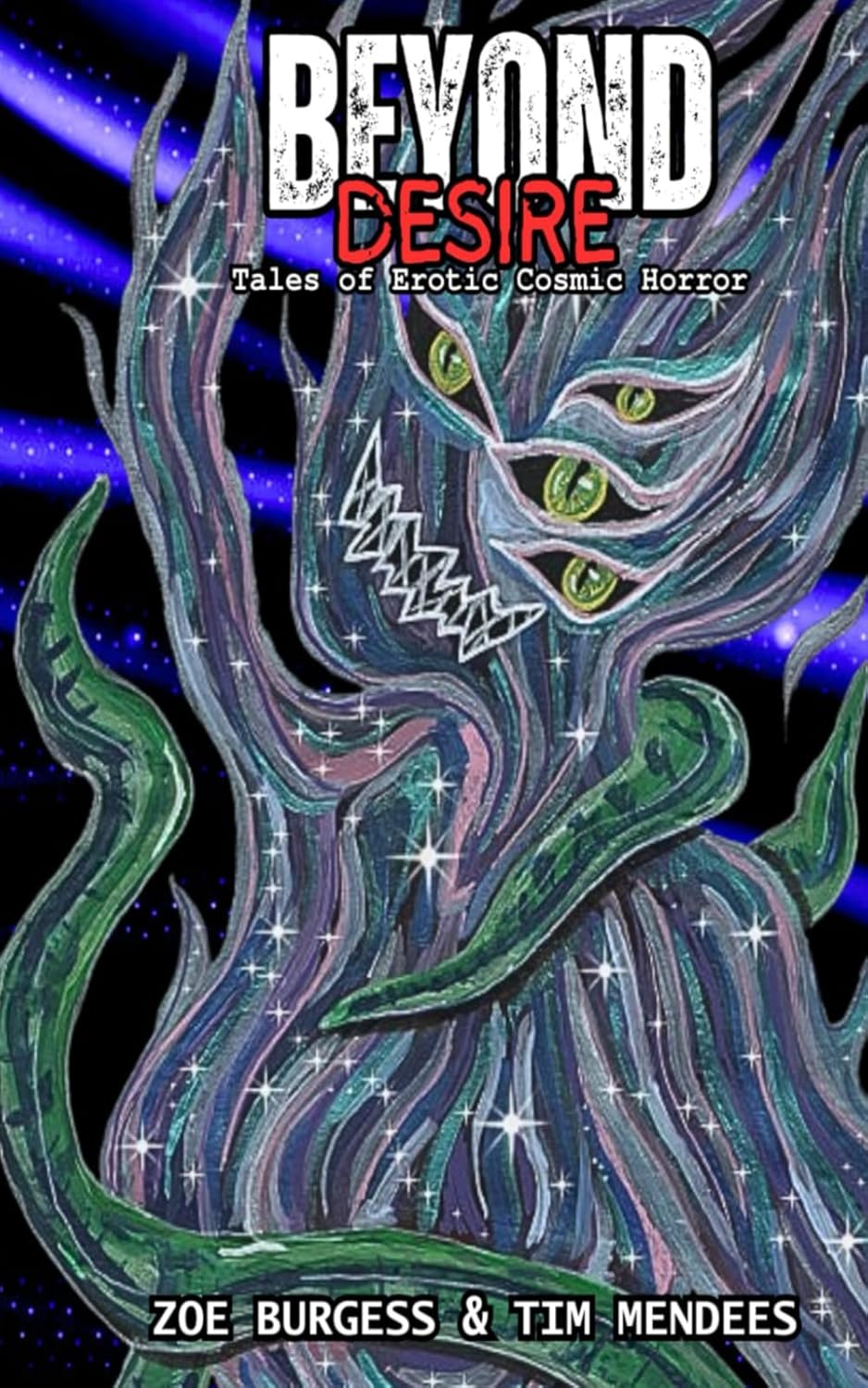
“The Tunnel” (2025) by Zoe Burgess

Ever since Helen Vaughan saw ‘the face of The Great God Pan’ and Lavinia Whately gave birth to the spawn of Yog-Sothoth, a sexual undercurrent has existed in cosmic horror. Rarely seen but its effects often felt, eroticism helps to shape tales of the uncanny and unfathomable.
—Back cover copy of Beyond Desire (2025)

Lovecraftian erotica is not the same as erotic horror. However horrific some elements of Lovecraftian erotica may be, it is a rare story that manages to mingle terror and titillation, rather than just use the tropes of the Mythos in another erotic fantasy with eldritch entities. “Cthulhu for Christmas” (2023) by Meghan Maslow or Tentacles and Wedding Bells (2022) by Margaret L. Carter owe more to cozy romances than horror for their structure, just as Booty Call of Cthulhu (2012) by Dalia Daudelin is more of a straight sex tale, and “The Vulviflora of Vuutsavek” (2008) by Charlotte Alchemilla Smythe is an exercise in pastiche. It is a relatively rare story that tries to find the balance between fear and lust, that plays the two forms of excitement against each other on a knife’s edge, that is unsettling in its sensuality.

This is a difficult balance, yet it seems to be what Zoe Burgess aims for in “The Tunnel.” The beginning of this story was featured in the Flash Horror 250 Contest in 2024, and if that visceral opening whets a reader’s whistle, Burgess goes much deeper—and gets more explicit—as the story is developed in her joint collection with Tim Mendees: Beyond Desire: Tales of Erotic Cosmic Horror (2025); the volume also contains “Writhing Mind” (2022) by Zoe Burgess.

Like in that story, “The Tunnel” is a tale of obsession, of an almost fetishistic desire for knowledge and sensation. There’s a quality reminiscent of Clive Barker’s “The Hellbound Heart,” the familiar outlines of which have been seen in many weird and erotic stories over the decades. Shades of Dr. Raymond’s search in Mary’s brain for the Great God Pan, or of William’s desire to uncover real magic through the artifact in The Invitation (2017) by InCase The language of the story is deliberately decadent, emphasizing the physical, the intimate, and hinting at something more than merely carnal.

This was what awoke Izzy’s companions, and they were greeted by faces of fear and adjective horror as the iron shell melted away to reveal the throbbing flesh-like pages of the manuscript inside.
—Zoe Burgess, “The Tunnel” in Beyond Desire (2025) 166

There is a literalness to the descriptions that is reminiscent of “Night Voices, Night Journeys” (2005) by Inoue Masahiko (井上雅彦), but it is probably more accurate to say that Burgess knows the tropes of the genre and plays to them. Familiar images remixed, recombined, carefully arranged. The tunnel of the title is both physical distance for the protagonist Izzy to transverse and the metaphysical vagina to be reborn from. The reader is just along for the ride, the voyeur of a journey of discovery and self-discovery:

Izzy held onto tarlike hips and almost felt like they were pushing deeper into the unknown, as that hot cavern pulsated and caressed as well.
—Zoe Burgess, “The Tunnel” in Beyond Desire (2025) 175

Metaphor and description break down on such an ecstatic psychosexual journey. Burgess strives to capture both novel sensations and something beyond that, some spiritual contagion that warps and fills and makes the sex act something profoundly more than just sticking tab A into slot B, repeat as desired. The story is essentially a spiritual descendant of the climax of Ramsey Campbell’s “The Moon Lens,” a story of initiation and transformation; while the cosmic horror is not called Shub-Niggurath, Burgess’ Void Walker has some of the same attributes.

More than anything else, “The Tunnel” by Zoe Burgess is an effort to tell an erotic horror story in the Lovecraftian mode. Not by invoking Cthulhu and the Necronomicon, but by trying to invoke familiar images and aspects as she tells a raw, uncensored story of transgression, transfiguration, and finally a kind of transcendence. When Izzy goes back out into the world, born from the tunnel, they are a carrier of a strange and terrible disease of knowledge, one which they desire to spread—and isn’t that so very familiar, readers of the Mythos?


Bobby Derie is the author of Weird Talers: Essays on Robert E. Howard and Others and Sex and the Cthulhu Mythos.

Deep Cuts in a Lovecraftian Vein uses Amazon Associate links. As an Amazon Associate I earn from qualifying purchases.
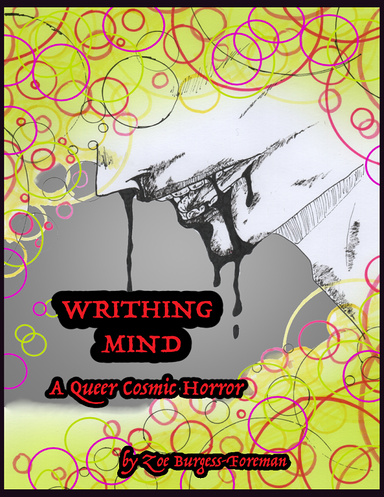
“Writhing Mind” (2022) by Zoe Burgess-Foreman

What he truly wanted to do was to find a way to express the feelings and images that had begun to creep into his head when he dreamt – a vast cosmos, something swirling and dancing in the void beyond, a body dancing to a distant beat and tendrils reaching out to take his hand.

Zoe Burgess-Foreman, “Writhing MInd” (2022)

Madness is a key theme of cosmic horror, an aspect of both attraction and repulsion. Weird fiction rarely accurately depicts mental health issues, but it has often sought to capture something of the mystique of the distorted sensorium, the disordered mind, the transition from “normal” and prosaic consciousness to one that has moved beyond rationality and into an increasingly different world view and mode of thinking. In traditional horror fiction, that state of altered consciousness is unreal—in weird fiction, that state is the true reality, a glimpse behind the veil, a realization of previously hidden truths.

Artists are a common lightning rod for such eldritch revelations, as exemplified by Lovecraft’s horror in clay:

Wilcox was a precocious youth of known genius but great eccentricity, and had from childhood excited attention through the strange stories and odd dreams he was in the habit of relating. He called himself “psychically hypersensitive”, but the staid folk of the ancient commercial city dismissed him as merely “queer”. Never mingling much with his kind, he had dropped gradually from social visibility, and was now known only to a small group of aesthetes from other towns. Even the Providence Art Club, anxious to preserve its conservatism, had found him quite hopeless.

H. P. Lovecraft, “The Call of Cthulhu”

Other writers picked up on the idea; “Something in Wood” (1948), “The Tulu Jar” (2000) by Ann K. Schwader, “The Summoned” (2015) by Clint Collins, a macabre gallery could be filled with Mythos-inflected objets d’art. Yet few stories focus on the headspace of the artist, the experience of creation, the relationship or insight or period of possession which shapes ordinary materials into an effort to capture in some form the extraordinary.

Which is ultimately what Zoe Burgess-Forman’s “Writhing Mind” is. As a story, it is almost a snapshot; there is little build-up and the denouement is cursory. These are the boring parts of the story anyway, the background and exposition. By the time the story starts, the events have already begun; the reader is only carried along for the ride, like a voyeur, watching the artist struggle to create, their descent and transcendence. The bloody climax rolls out like the first few minutes of a horror film, normal people too stuck in rational thinking to recognize the signs or heed the warnings, leaving behind only blood, bodies, and a particularly tenacious and circular idea.

They had slightly moist quality to them, not unpleasant but just enough to make them glide over his skn and make his body tingle with anticipation. They reminded him, now he collected his thoughts, of the tentacles of an octopus as rounded mouths sucked on his flesh like hungry kisses.

Zoe Burgess-Foreman, “Writhing MInd” (2022)

“Writhing Mind” is described as “a queer cosmic horror,” and that’s worth a moment of consideration. Lovecraftian fiction, as much as it deals with cosmic horrors from beyond human experience, is almost always heteronormative by default. Works like “(UN)Bury Your Gays: A Queering of Herbert West – Reanimator by H.P. Lovecraft” by Clinton W. Waters are the exception, not the rule. Queer Lovecraftian works like Le Pornomicon (2005) by Logan Kowalsky, Dagger of Blood (1997) by John Blackburn, and Strange Bedfellows (2023) by Caroline Manley (Raph) are comparatively rare compared to works like Booty Call of Cthulhu (2012) by Dalia Daudelin. By comparison, the sensuality and sexuality in Zoe Brugess-Foreman’s story is explicit, but not overly concerned with labels. The artist is cisgender male and a self-described himbo; but their sexual preference, if any, is oblique. Ultimately, it doesn’t matter.

The artist is queer for tentacled things from beyond. This is entirely appropriate: the same open mind that fuels their eldritch artwork goes pseudopod-in-hand with their sexuality. In the context of the story, there is no introspection that goes into this. The artist is already too far along in the process to question their sexual shift, or to comment on it rationally. No passing reference to Hokusai’s erotic print Tako no Ama, no anatomical studies of octopus or squid, or anything that could serve as a foreshadowing of a growing paraphilia that comes to consume them.

In hindsight, that feels like a mistake, because the artist is the only queer character in the story. Their queerness becomes inextricable from their madness, and lacking the boring build-up of a background, a deeper understanding of the character’s mindset and sexuality, the combination of sensuality, violence, and mental illness can be mistaken as causal rather than correlation. It feels like the story would have benefited from giving the artist a queer friend, someone that understood them and could relate to them but was unaffected. This was a device that Lovecraft used in stories like “The Thing on the Doorstep,” where a more straitlaced friend tells the story of a weirder associate.

Ultimately, “Writhing Mind” feels like a literary exercise with many familiar building blocks. It is not explicitly a part of the Cthulhu Mythos, there are no references to the Necronomicon, and the eldritch entity that fills the artist’s dreams and body is called by no familiar barbarous name. Yet it is clearly working in the same mode as works like Prnomicon and Strange Bedfellows, even if it mixes the ingredients a little differently…and not without a degree of skill.

“Writhing Mind” (2022) by Zoe Burgess-Foreman is available on Lulu as an ebook.


Bobby Derie is the author of Weird Talers: Essays on Robert E. Howard & Others (2019) and Sex and the Cthulhu Mythos (2014).

Deep Cuts in a Lovecraftian Vein uses Amazon Associate links. As an Amazon Associate I earn from qualifying purchases.