Antisemitism
The following article deals explicitly with antisemitism in a historical context. Frank discussion of these matters requires the reproduction of at least some samples of antisemitic speech from historical sources (e.g. Lovecraft’s letters). As such, please be advised before reading further.
H. P. Lovecraft was an antisemite. To go into exact detail about the nature of his antisemitic biases and views, the influences from the books he read and people he met, and how those encounters changed the shape and expression of his prejudices over the course of his life, is beyond the scope of this article. It is sufficient to say that from an early age and extending throughout his life Lovecraft held to common stereotypes regarding Jews as an ethnicity and Judaism as a religion, both of which he was largely ignorant about, and largely considered them a people racially and culturally apart from Anglo-Americans like himself. This general antipathy did not extend to friends and loved ones such as Samuel Loveman or his wife Sonia H. Greene, and was rarely made public, but is well-documented in his private letters and influenced views of his peers such as Hugo Gernsback. Lovecraft was not unique in these beliefs, but has left a deep record of personal correspondence which allows more insight into his thoughts on such topics than most of his contemporaries.
We despise people—like the Jews—who purchase life at the price of a resigned heritage, and consent to live in a world which has stamped out their culture as a geographic reality.
H. P. Lovecraft to Woodburn Harris, 9 Nov 1929, Letters to Woodburn Harris 200
For the first 30 years of H. P. Lovecraft’s life, the territory of Palestine was a part of the Ottoman Empire, which supported a primarily Arabic population of Muslims, Jews, and Christians. During the 19th century private efforts to encourage Jewish immigration to the Biblical lands had gained some headway, a movement referred to as “Zionism” (Zion being a Hebrew word for the historical Jerusalem and territory of the Israelites). During World War I, the Ottoman Empire’s alliance with Germany and Austria against France, Britain, and Russia led the British in 1917 to issue the Balfour Declaration, voicing support for the “establishment in Palestine of a national home for the Jewish people.” The United States echoed this support with the Lodge-Fish Resolution in 1922.
Following the defeat of the Ottomans in World War I, the British-administered Mandate of Palestine was established in 1920, and Jewish immigration to the region increased—as did opposition from autochthonous Arabic Muslims, Jews, Christians, and other peoples of varied religion and ethnicity who were already living in the region. Immigration and conflict in the region would continue until long after Lovecraft was dead, and eventually lead to the creation of the contemporary state of Israel, but during his life it was an ongoing international issue that cropped up occasionally in his letters. Lovecraft earliest views on the subject are from April 1918, before the end of WWI:
I hope, as you do, that the Jews can be rehabilitated as a nation in Palestine. I doubt their capacity for full self-government, for their physical courage & national (as distinct from religio-cultural) sense has been broken by long dispersal & Aryan contempt; but I fancy they will do very well under British protectorate.
H. P. Lovecraft to James Larkin Pearson, 6 Apr 1918, Letters to Rheinhart Kleiner & Others 315
Lovecraft’s normal approach to colonialism was conservative. He acknowledged the fundamental unfairness of the forceful takeover of a territory from the indigenous inhabitants with a general might-makes-right narrative, as when he discussed the European invasion and colonization of North and South America:
It is true that our ancestors ruthlessly pushed the redskin aside—but after all, this is no more than one tribe had always been doing to another. If the English brutally displaced the Iroquois in New York State, so must the Iroquois themselves have displaced the earlier Algonquin tribes when they occupied the region. And so on . . . and so on . . . . Of course, the greater strength and superior weapons of the white man made his case a good deal different—but the general idea is not to be forgotten.
H. P. Lovecraft to Robert E. Howard, 11 Jul 1936, A Means to Freedom 2.856
Perhaps unsurprisingly, Lovecraft was also critical of reparations of territory to dispossessed peoples or of allowing colonies self-governance:
To try to go back and theoretically right all the wrongs of history is simply fantastic. On that basis the Aryan race has no business in Europe at all, since it probably took it by force from Neanderthalers and Mongoloids. When a region is inhabited by its own race and unwillingly held in subjection, there is legitimate ground for revolt; but the idea of dispossessing long-adjusted present populations in favour of remote historical claims—however just in theory—is chimerical to the point of downright criminality.
H. P. Lovecraft to Robert E. Howard, 21 Jan 1933, A Means to Freedom 2.531
In effect, Lovecraft might not have encouraged wars of conquest, but once a region had been conquered he was unwilling to change the status quo. With regard to Palestine, this leads to a bit of a philosophical conundrum: one of Lovecraft’s criticisms and stereotypes of Jews was as a people dispossessed of a homeland (e.g. Letters to J. Vernon Shea 94) which Lovecraft attributed essentially to cowardice, a stereotype fundamental to his distinction between Jews and “Aryans” like himself:
What we can’t forgive in the Jew is not the tone of his prayers or the size of his nose, but the fact that he is willing to survive under the conditions he accepts. Being weak may not have been his fault—but it is his fault that he is alive & not free & dominant. If we were as weak as he, & could not fight our way to self-respect, we would perish utterly—taunting our foes, virile & unbroken, as the last man fell. That unbrokenness is all that matters to us.
H. P. Lovecraft to James F. Morton, 12 Jun 1933, Letters to James F. Morton 325
One would think that Lovecraft might then admire any effort by the Jews to re-establish themselves in Palestine, but after the establishment of the Mandate of Palestine, he instead described Jewish revaunchism as a “sentimental claim of the Zionist Jews to essentially Arab-Moslem Palestine” (Lovecraft to Robert E. Howard, 10 Nov 1932, A Means to Freedom 1.484). This is the only direct reference to Zionism in Lovecraft’s letters, although he alludes to it elsewhere as “Palestine” or “the Palestine question.”
Lovecraft favoring Arabic Muslim Palestinians in this matter is not surprising; it was a combination of his long-held antisemitic beliefs coupled with his previously stated anti-revanchist stance—and perhaps a touch of pro-Arabic/Muslim sentiment, as Lovecraft once wrote:
It’s because the Jews have allowed themselves to fill a football’s role that we instinctively hate them. Note how much greater is our respect for their fellow-Semites, the Arabs, who have the high heart—shewn in courage and a laughing sense of beauty—which we emotionally understand and approve.
H. P. Lovecraft to Frank Belknap Long, Jr., 21 Aug 1926, Selected Letters 2.66
This led Lovecraft to some odd territory in actually disagreeing with the British government, a very rare thing for the anglophile Lovecraft:
Only by reading the outside press & the national magazines can New Yorkers get any idea of how Americans feel regarding such things as Nazism, the Palestine question (in which, by every decent standard, the Arabs are dead right & both England & the Jews intolerably wrong), the American immigration policy, & so on. […]
H. P. Lovecraft to J. Vernon Shea, 8 Nov 1933, Letters to J. Vernon Shea 170, 172
[172]I think the (probably) 100,000 Yankees in Providence ought to be able to say what they choose about Italy without making apologies to Federal Hill (our local Nuova Napoli), & that the (perhaps) 1,000,000 Americans in New York ought to be able to discuss Hitler & Palestine & pork chops without glancing fearfully over their shoulders at a horde of fortune-seeking Yiddish newcomers.
It is notable that this issue of Palestine comes up in Lovecraft’s letters c.1933, which is when Hitler and the Nazis also come to the fore. The rise of the Nazis largely coincides with when Lovecraft begins emphasizing a conspiracy theory of Jewish control of newspapers in New York; this comes up as Lovecraft addresses the point of anti-Nazi articles published in New York papers, which he attributes to Jewish influence in opposition to the rabidly antisemitic Nazis. So this reference to Jewish media influence in his letters, and Lovecraft’s stance on it, is not something he’s volunteering as a general antisemeitc rant, but in answer to a specific point to Shea, who was anti-Nazi. The reference to Palestine is Lovecraft identifying a subject he associates with a pro-Jewish bias.
The British support for Zionism was partially supported by the idea of British Israelism, a belief that the peoples of the British Isles were biologically and/or culturally descended from the Jewish people. The claims gained currency in the 19th century through works like Our Israelitish Origin (1840) and Lost Israel Found in the Anglo-Saxon Race (1886). Lovecraft was aware of the idea, and once joked “[David Van Bush] fondly believes our Saxon stock to be descended from the twelve [sic] lost tribes of Israel!” (Letters to James F. Morton 179), but his antisemitism did not permit him to share this belief:
Your theory that Anglo-Saxons are lost Israelites can be punctured in an instant by the facts of ethnology. Semitic races like the Jews & their kindreds have distinctive ethnic traits, none of which appear in the Englishman. The English, on the other hand, are most obviously and positively related to the Aryan Teutonic races of Northern Europe. The anthropological gulf between Jew & Saxon is so great as to be utterly impassable. No common ancestry this side of the Quaternary age is conceivable. They are as different as two white races can possibly be.
H. P. Lovecraft to James Larkin Pearson, 3 Aug 1919, Letters to Rheinhart Kleiner & Others 318
Ironically, Lovecraft’s prejudice in this matter and his general atheism led him away from 1930s white supremacist organizations like the Anglo-Saxon Federation of America. While some of Lovecraft’s antisemitic and white supremacist prejudices parallel that of the Christian Identity movement of the time, Lovecraft never attempted to provide a theological rationale for his antisemitism, white supremacist beliefs, or Zionism.
The question may be asked how Zionism impacted Lovecraft’s relations with his wife Sonia, who was herself a Jewish immigrant to the United States. The short answer is, we don’t know; their letters do not survive, and Sonia’s memoir of the marriage does not mention it. Perhaps it never came up or played little role in their relationship. However, we know Sonia was at least nominally in favor of Zionism, because of a letter to the editor that was published:
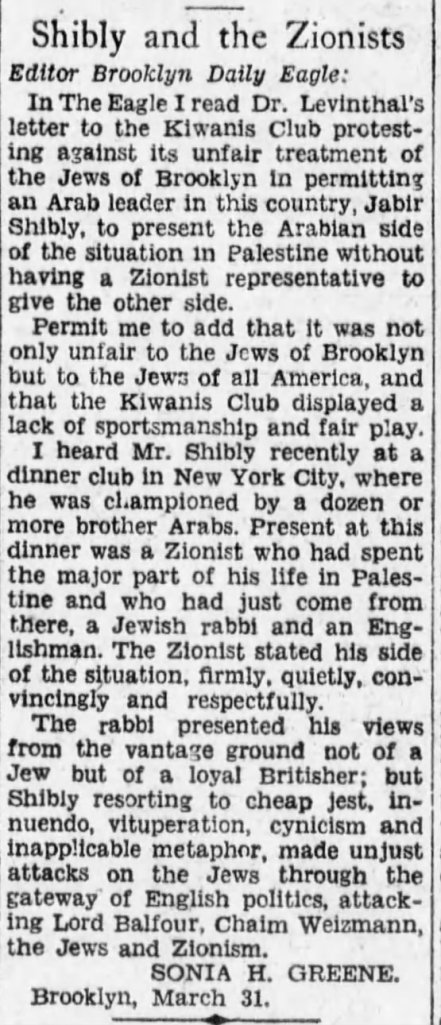
By 1930, Sonia and Howard were long separated, but it gives an indication that Lovecraft was at least intimately acquainted with someone who held opposite views on the subject than himself.
Jewish immigration to the Mandate of Palestine is an exceedingly minor topic in Lovecraft’s vast corpus of letters, which reflects his general lack of knowledge or interest in the subject. His few thoughts in his letters do not express any particularly unusual argument or exceptional insight. Nor did it find any expression in his fiction. Lovecraft did not live to see the horrors of the Holocaust, the formation of the state of Israel, the struggle for Palestinian statehood, or the immediate beginnings of hostilities currently ongoing in the region.
For readers today, the relevance of Lovecraft’s comments on the subject is as a representative slice of history—like a tree ring from a fossilized stump that shows the effects of a distant volcanic eruption. How these events, long ago and far away for so many, still touch the lives of so many, and continue to be leave scars that can be seen and felt down into the present day. So while many readers might be interested in Lovecraft’s specific thoughts, it may help to think of this as an expression of how an average person of Lovecraft’s day thought and expressed themselves on this topic. Lovecraft not as an important historic personage, but only as a core sample into a historic period.
If you wish to support the victims of this conflict, please consider a donation to a charitable organization such as Médecins Sans Frontières (Doctors Without Borders).
Bobby Derie is the author of Weird Talers: Essays on Robert E. Howard and Others and Sex and the Cthulhu Mythos.
Deep Cuts in a Lovecraftian Vein uses Amazon Associate links. As an Amazon Associate I earn from qualifying purchases.


Wow, this post packed a punch! Well done. You did an excellent job handling this heavy topic, which did well in revealing HPL’s overall ignorance. Your post reminded me of a book that Sonia had recommended, which was written by a Jewish journalist exactly at the time when Jews were encouraged to immigrate to Palestine. It’s called Spring Up, Oh Well by Dorothy Ruth Kahn. I haven’t yet read it, but seems promising.
LikeLiked by 1 person
I know you expressed some reservations about treating this subject just now, but one the who
LikeLike